
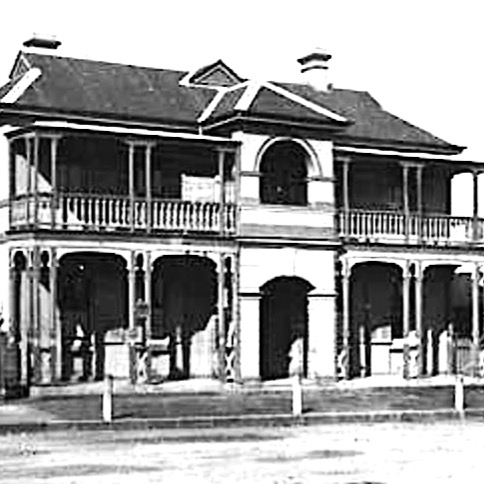
Introduction
Raymond Terrace’s first Post Office opened on 1 August 1834.
At least nine postmasters served during its first century, although details of the earliest holders of the position are unknown.
The earliest known postmaster was Thomas Gilbert, who held the position in the early 1840s, after arriving in New South Wales from England in 1840.
Early postmasters were required to provide their own premises. Thomas Gilbert worked as a watchmaker and postmaster in “Noah’s Ark” in his building in Burke Street, Raymond Terrace. It was on the site of the former Rowing Club’s boatshed. Its nickname reflected its vulnerability to flooding.
On 1 June 1860, W. E. Shaw became postmaster, operating from his premises in King Street, Raymond Terrace, overlooking the Hunter River. He was described as “Tanner, Postmaster and Coroner”.
The Post Office later moved to a government-built riverside building adjoining Major Windeyer’s residence, with Shaw as postmaster and Miss Marion Shaw as telegraphist.
In the late 1870s, the Rev. George Carter of Adelaide, South Australia, gave the first telephone demonstration at a New South Wales Post Office, from these premises in Raymond Terrace.
A new Post and Telegraph Office opened in Port Stephens Street, Raymond Terrace, in 1880.
The Dungog Chronicle of 7 February 1941, page 4, provided the following history of the early mail routes that served the early Raymond Terrace Post Offices, as delivered in an address given by Mr. W. Brown, in 1941:
‘The transit of mails in the early days of Raymond Terrace was an important business, as all the mail, as far north as Port Macquarie, once came from Sydney to Raymond Terrace [for sorting] per steamer, and from Raymond Terrace was carried on first by horse and packhorse, and later about 1865 by coach. The early coaches drawn by four horses were also the means used for the conveyance of much luggage and passengers, and those who essayed the ride from Raymond Terrace and later Hexham, from where the coaches started after the railway opened up from Sydney by the northern line had a trying experience, for the journey was long and most inconvenient and particularly so when the coach was crowded.
The journey was done in stages and relays of horses, and the first stage was from Hexham to Limeburner’s Creek, but the headquarters of the coaches were at Raymond Terrace and all business in connection with the conveyance of mails and passengers was done at Raymond Terrace. From Limeburner’s Creek the next stop for a change of horses was Stroud; then on to Ward’s River; then Gloucester; and from Gloucester by 15 and 20 mile stages to Taree and Port Macquarie.
Travelling per coach in the wintertime was a numbing experience and the friendly fire of Witt’s hotel at Limeburner’s, known as the Halfway House, was a most welcome respite to the stiff and chilled passenger. The ‘Cottage of Content’ at Stroud, too, was always welcome, as the early dawn was first announcing itself as the coaches rolled in and breakfast was an enjoyable and heartily approached interlude to the first 36 miles of the long journey.
Among the earliest coach proprietors was the firm of C. Mclntyre & Co. and they were in the service for many years, but their run was from Hexham to Gloucester, and another firm went from there on. They were in the business about 1880. Other later proprietors were Tuck and Co., H. J. McCullough and August Reichert. The latter finished the coach service in 1912, as the North Coast railway opened and carried the mails on for Stroud and northwards.
Among the early drivers were Jos. Kay, Jack Shanagan, Dick Oldfleld, James Welsh, Fred Waldron, now of Nabiac Hotel, Jack Mitchell, and Herb and Chas. McCullough. All were artists in handling the ‘ribbons,’ and this is verified by the fact that few accidents occurred during, the many years they were on the road in the coaching days. The art of driving a four or six-horse team has gone with the advent of the motors, but the drivers’ names will go down among the pioneers who served a useful period in the development of the State.’
The early history of the Raymond Terrace Post and Telegraph Office and the telephone service is set out in this paper.
The services provided by the Post Office included mail sorting and delivery; telegraph despatch and receipt; and telephone services. All of these were critical to the communication and commercial needs of the local inhabitants. Community action would result when complaints arose.
Public action in support of the Raymond Terrace Postmaster – 1863
The Maitland Mercury and Hunter River General Advertiser of 9 July 1863, page 2, reported on a meeting convened to support the Postmaster, Mr, Shaw, against a petition then in circulation calling for his removal by the Postmaster General:
‘A public meeting was held at the Courthouse, Raymond Terrace, on the evening of 4th July, convened by advertisement, in reference to a petition privately being taken about for signature for the dismissal of the Raymond Terrace Postmaster. The Courthouse was crowded to excess, and the interest evinced was great.
Mr. John Barry was voted into the chair, and after a few introductory remarks, was followed by the various movers, seconders, and supporters of the resolutions submitted, which were all passed with all but entire unanimity. ….
The resolutions adopted are as follows (the letter referred to in the last being numerously signed at the close of the meeting, and now in course of signature): —
1st. That this meeting has heard, with astonishment and regret, that a petition—a copy of which it has heard read—has been taken about for signature, for the removal of Mr. W. E. Shaw as Postmaster at Raymond Terrace, and expresses its disapproval of the petition, it not having been submitted to and adopted by a public meeting, or got up in a candid and legitimate way; and as containing no specific charges or complaints, but indefinite statements impossible to be properly met, and, therefore, calculated to place the Postmaster in a very unfair position.
2nd. That admitting the possibility of occasional errors, incidental to the fulfilment of the duties of any difficult and onerous office, as those attached to any rural post-office, yet that the Raymond Terrace Postmaster has the approval of this meeting for performing his duties in a thoroughly business-like and satisfactory manner.
3rd. That to counteract the injury, both to the Postmaster and the district, which is calculated to arise from the petition referred to, the following letter be sent to Mr. Shaw, to enable him to furnish a suitable answer should he be called upon by the authorities for one; the letter to be accompanied by a copy of the resolutions passed at this meeting.’
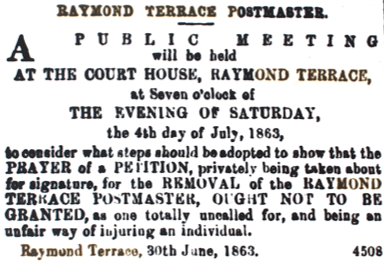
Advertisement for the public meeting to support Mr. Shaw, the Postmaster [The Maitland Mercury and Hunter river General Advertiser, 2 July 1863]
Post Office flooded on multiple occasions – 1864 to 1870
The Maitland Mercury and Hunter River General Advertiser of 14 June 1864, page 2, reported:
‘We have this last week suffered from the most severe flood experienced since August 1857, in suddenness and height. Wednesday 1st instant was a fine hot day; but on Thursday, 2nd, a storm of wind and rain came on, which few remember seeing equalled. On Friday morning the [Hunter] river was almost bank high, and continued rising all day, until at dark it was over the wharves and in some of the houses, and during Saturday and Sunday boats were pulled through the streets loading from the Old and New Companies wharves, round the mill and Black’s store. To give you an idea of the height of the water, it was two foot in the post office.’
The Maitland Mercury and Hunter River General Advertiser of 29 June 1867, page 4, reported:
‘The valley of the Lower Hunter has again been submerged in water to an alarming extent. On Monday the water had risen eight inches above the great flood of 1857. On Thursday last the river commenced to rise, and on Friday it was over the land on Roslyn estate; throughout Saturday and Sunday the water was continually rising. The whole of the houses on the riverbank were on Saturday evening flooded. The Steamship Hotel and Post Office had about eight feet of water in them, and from this you may judge what a fearful state other parts of the town were in.’
The Maitland Mercury and Hunter River General Advertiser of 20 February 1868, page 3, reported:
‘The Post office, Mr. Ewan’s Steam Ship Hotel, and Mr. Black’s stores have several feet of water in them, the proprietors and families having to leave the lower part of their premises.’
The Maitland Mercury and Hunter River General Advertiser of 24 March 1870, page 3, finally reported:
‘The telegraph and post offices have been removed to the courthouse, owing to the flood since Friday.’
Meeting convened to consider alteration to existing mail arrangements – 1873
The Maitland Mercury and Hunter River General Advertiser of 19 August 1873, page 2, reported:
‘On Saturday afternoon a public meeting convened by the Police Magistrate on requisition, was held in the Courthouse, Raymond Terrace, to take into consideration the propriety of petitioning Government for the alteration of existing mail arrangements. There were about twenty-five persons present, Mr H. J. Bolding, P. M., was voted into the chair.
The Chairman read the advertisement convening the meeting and explained that his duty was simply to preside; he expressed no opinion either in one way or the other as to the question they had met to discuss.
Mr. Cyrus Doyle said that for five months he had been a resident of Raymond Terrace and had noticed that the mails were delivered very irregularly. He had also seen that the inhabitants of the postal town of Stroud had received their mails which started from Raymond Terrace very irregularly. He would presently read them a letter from a principal resident in Stroud, promising them support in every step they might take to have the public mails delivered more promptly.
For the past two months the people of Raymond Terrace had been very badly served in respect to the mails; he had seen the steamer pass the town with the mails, take them on to Sydney, and bring them back on the return trip. The Rev. Mr. Simm had shown him a letter written by the Bishop of Newcastle, in Morpeth, on a Thursday, which did not arrive in Raymond Terrace till eight o’clock on the following Tuesday night. He thought therefore it would be well to have a mail service from Hexham railway station to Raymond Terrace, by which means they could get their letters by nine o’clock every morning.
The Stroud mail leaves at a quarter past nine, but time could be given to the postmaster to make up the mails, and still there would be ample time to let the Stroud people get their letters reasonably early —there is thirty-two miles between Raymond Terrace and Stroud, — while the arrangement would facilitate postal communication between Stroud and the Manning and those districts. He happened to know the distance between Dungog and Stroud, and between Clarence Town and Morpeth, and would undertake to say that the Clarence Town people receive their mails with greater regularity than the Raymond Terrace people. He begged to propose the adoption of the following petition, for the reasons he had stated:
“To the Honorable Henry Parkes, Acting-Postmaster General of New South Wales. The petition of the undersigned residents of Raymond Terrace, Miller’s Forest, Nelson’s Plains, Limeburners Creek, Stroud, and the surrounding districts initiated at public meeting holden at Raymond Terrace, on 16th August, 1873, respectfully sheweth—
“That your petitioners are much inconvenienced by the delay in the delivery of the mails from Sydney and Newcastle, caused by the detention at Newcastle of the steamers carrying the said mails, and also by the irregular manner in which the mails are received during times of flood, as during the last two months, on different occasions when the steamers did not come further than Newcastle, we have been for several days without any mails at all, during all of which time residents of other towns enjoyed the advantages of an uninterrupted mail communication.
And your petitioners would respectfully wish to point out that while contributing in common with the rest of the inhabitants of the colony our quota to the general revenue, we derive, compared with more favoured localities, a very small return in the way of public expenditure, and this circumstance, added to the inconvenience already alluded to, emboldens your petitioners to ask that the mails for the localities mentioned above, from Sydney, &c, should be landed at Newcastle, and forwarded by the first G. N. Railway train to Hexham, from which point we desire that a mail may be dispatched for Raymond Terrace, enabling the mails to be received at the latter town by nine a.m., and then sent on to Stroud, Port Macquarie, the Manning, and other Northern districts. These arrangements, your petitioners contend, would be a boon to those localities ensuring, as it would, the early and punctual dispatch of their mails. And your petitioners, &c.”
He was of opinion that Mr. Portus had told him that he had received a letter written from Morpeth four days after it was written. He would ask Mr.Portus if that was so?
Mr Portus: Certainly that was the case.
Mr Doyle: He did not think he need say anything more. The method proposed in the petition was the best that could be adopted, and if they did not succeed in getting what they wanted now, they should renew their application and keep on asking.
Mr. H. D. Portus would second the motion, as there could be no doubt whatever that the statements made in the petition were correct. They had suffered inconvenience from the non-delivery of the mails, and if they could get the Government to do what they asked, by having the mail forwarded to Hexham by the first train, it would be granting a boon not only to Raymond Terrace, but to all other districts to which mails were despatched via Raymond Terrace. There was a contingent benefit which the petition did not mention or the mover refer to.
The proposed route to Hexham was one of the outlets of the town, and if it became of importance as a mail route it might be classed higher and thus be the means of giving the place a fillip ahead. It would open the main road to Newcastle to some extent, and it would benefit the Government by inducing a greater use of the railway. Something was said in the petition about the small Government expenditure in Raymond Terrace and its neighbourhood, and they certainly did get a very small return for their contribution to the general revenue Other places were beautified at their expense; railway extension went on, and they had to pay for it, and he did not see why they should not have some pickings out of the general revenue.
Mr. Doyle asked a Stroud resident present what time the mail now reached Stroud.
Mr. Wenham: About six o’clock in the afternoon. Mr. Doyle: And sometimes not at all in the day? Mr. Wenham: And sometimes not at all.
At the instance of Mr. Doyle, the following letter was read:—
“Stroud, 14th August 1873. C. E. Doyle, Esq.
“Dear Sir,—In reply to your note of the 11th instant, relative to the delivery of the mails at Raymond Terrace via Hexham, instead of by steamers as at present, I beg to say that all the residents of Stroud, as well as the people of the district in general, will only be too happy to assist the people at Raymond Terrace in carrying out the object proposed. I am, dear sir, yours faithfully, “Thomas Nicholls.”
The resolution was then put and carried unanimously, and the proceedings closed with a vote of thanks to Mr. Bolding. A number of persons present signed the petition.’
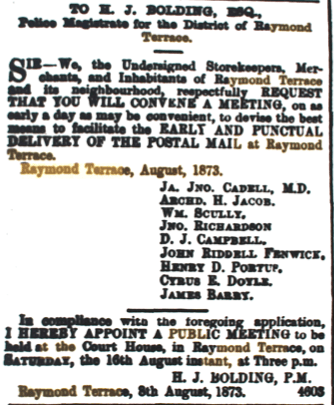
Advertisement for the Public Meeting [The Maitland Mercury and Hunter River General Advertiser, 12 August 1873]
Tenders called for construction of the new Post Office – 1879
The Newcastle Morning Herald and Miners’ Advocate of 4 July 1879, page 2, reported:
‘On Tuesday night Sir Henry Parkes said, in answer to Mr. Jacob, that tenders for the erection of the post and telegraph offices, Raymond Terrace, had been invited in Tuesday’s Gazette.’
Demonstration of the telephone service at Raymond Terrace – 1879
Rev. W. T. Carter was a nineteenth-century Wesleyan Methodist clergyman from South Australia known for hosting public demonstrations of the telephone in 1879 and 1880.
The Newcastle Morning Herald and Miners’ Advocate of 3 November 1879, page 3, reported:
‘The Rev. W. T. Carter, who I notice has been lecturing upon the telephone, phonograph &c., in Newcastle and the surrounding townships, tried an experiment with the former instrument [telephone], between here [Raymond Terrace] and Morpeth on Saturday evening, and was very successful considering that there was a stiff breeze blowing at the time. Various questions were asked and replied to from both ends and the song, “Home Sweet Home,” was sung at Morpeth and was heard very distinctly here.’
The existing telegraph lines that connected to the Post and Telegraph Office would have been used to demonstrate the telephone.
Construction of the new Post and Telegraph Office begins – 1879
The Newcastle Morning Herald and Miners’ Advocate of 14 November 1879, page 2, reported:
‘Today, I believe, the first stone of the base course of our new post and telegraph office is to be laid, apparently without any ceremony to commemorate the event, although it is a looked-for—if not usual—thing that when the foundation stone of any public building is laid, some member of the government is present to perform that ceremony, or in their absence the honour is entrusted to some private citizen, and I certainly think that something should have been done in this case; but it is nothing strange for Raymond Terrace, as it is only upholding the designation which it long ago received of “Sleepy Hollow.”
The building, when finished, will be a handsome and commodious edifice, judging from the plans which were shown me today by the foreman of works, Thomas Rowland, Esq. It is to be a brick building on stone foundation 50ft. 6in. in length by 46ft, wide, containing seven rooms, including the residence of the post and telegraph master.
The room intended for the combined offices is 20ft, x 15ft., lobby 6ft. x 15ft., 3 bedrooms 9ft. 3in. x 15ft., 10ft. x 15ft., and 14ft. x 12ft. respectively, private entrance 6ft. x 14ft.; servant’s room 14ft. x 8ft.; kitchen 14ft. x 12ft.; a verandah runs the full length of the building in front, to be enclosed by pilasters of a very neat design, and the verandah at the rear of the building is to be 17ft in length by 6ft. wide.
The building is in a very central position, being situated in Port Stephens street, nearly opposite the present post office, and on the main road from Stroud, and also from Hexham. The plans are from the office of the Colonial Architect (Mr. James Barnett). Mr. Lewis is inspector of the work, and the contractor is V. H. Galbraith, Esq., of Newcastle [as verified by the Newcastle Morning Herald and Miners’ Advocate of 18 November 1879, page 2], who has ten men employed at the building at present. ….
The telegraph wire which is suspended across the river here was blown from the top of the mast at the Miller’s Forest side, on Saturday night last, during the heavy thunderstorm which broke over here, and had to be cut. Communication is at present stopped.’
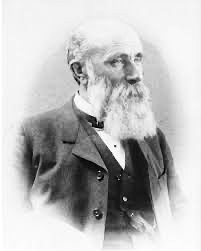
James Barnett – Colonial Architect of NSW
New Post and Telegraph Office almost complete – 1880
The Maitland Mercury and Hunter River General Advertiser of 15 June 1880, page 7, reported:
‘Our new post office is nearly completed and will be open in a few days for business. It is situated in Port Stephens street, the main or principal street in the township. Mr. Master has just completed a neat new building near the post office, now let to Mr. Mayo, who is about erecting a handsome place of business on the opposite side of the street, which, when completed, will be a great ornament to the town.’
Problems in the new Post and Telegraph Office – 1880
The Newcastle Morning Herald and Miners’ Advocate of 18 September 1880, page 5, reported:
‘Another instance of bungling and carelessness on the part of some of the officials of the Post and Telegraph Department came under notice yesterday; having some business to transact at the post and telegraph office here, my attention was drawn by the post-master to the condition of the roof of the building, which, so far as keeping rain out is concerned, is little better than a sieve. The rain which fell yesterday poured in in a perfect steam, flooding the floor of the telegraph office, and it was with difficulty that the machine could be kept dry for the transaction of business.
The new office has been completed some time now, but, like most other Government affairs, another spell must ensue before the necessary furniture and fittings are forwarded, to prepare for business. Surely, we have had to be contented long enough with the miserable pigeon box at present in use; now that the new building is ready, why, in the name of common sense, is it not made available for use?’
The Maitland Mercury and Hunter River General Advertiser of 30 October 1880, page 2, published the following letter to the editor providing further information on the above matter:
‘Sirs, Please let me inform all those interested in the above that I have ascertained the cause of delay in furnishing the office has arisen from want of funds in the particular department to which the building appertains, but a grant has been obtained from the Treasurer’s Advance Vote and no unnecessary delay, I am told, will take place in providing all that is necessary. Obediently yours, Archd. H. Jacob, Ashfield, 27th October 1886.’
Changes to postal closing times criticised – 1889
The Newcastle Morning Herald and Miners’ Advocate of 5 July 1889, page 4, reported:
‘For a very long-time past letters addressed to Raymond Terrace could be posted in the Newcastle post-office until 6 o’clock a.m., and within two or three hours would be delivered at their destination. This arrangement suited our business folk admirably and worked well in every way. Now, however, some Tite Barnacle of the Postal Department has again demonstrated his fitness for a berth in a lunatic asylum by ordering that the mail for Raymond Terrace will close at Newcastle at 9.30 p.m. Thus, if a businessman is unfortunate enough to post his letter at (say) 9.31 p.m. it will remain in the local office 24 hours before being despatched on its journey.
That the new rule is inconvenient and irritating is amply evidenced by the strong complaints which have been addressed to us by correspondents who have already suffered through the stupidity of some blunderer “in the head office.” We are certain that no local official would advocate the change which has been made; and if the convenience of the inhabitants of Newcastle and Raymond Terrace (and intermediate townships) is worth the consideration of the nameless perpetrator of this latest postal farce, then let the old practice be reverted to without a moment’s loss of time.
There is a chance for the Postmaster-General to prove himself master of his office and his officials. It is too bad that at this hour of the day any progress in postal matters should be backward instead of forward.’
Public meeting to express support for Mr Wakely, Post and Telegraph Master – 1891
The Sydney Morning Herald of 12 September 1891, page 10, reported on a public meeting conducted to support the postmaster who had been accused of ‘wrongdoing’ about missing letters:
‘A public meeting was held here last night, convened by the Mayor, in response to a requisition in reference to the local postal service. The following resolutions were earned unanimously: –Moved by Mr. J. Richardson and seconded by Mr M. Carmody, ” That in the opinion of this meeting the conduct of Mr Wakely, the master in charge of the local post office, during his residence amongst us, both in his official and private capacity, has been of such a character as to have secured our highest confidence and esteem and being aware that irregularities occurring in connection with the transit of certain letters on the North Coast mail route causing Mr. Wakely much mental anxiety and personal annoyance, this meeting hereby tenders to Mr. Wakely that sympathy and support to which we deem him justly entitled; and we trust that should his removal take place at any time in the interest of the service, that such removal will be marked by promotion worthy of his zeal and conduct here.”
Moved by Mr. W. Bowden, seconded by Mr. J Kearney–”That copies of the foregoing resolution, signed by the Mayor as chairman of this meeting, be forwarded to the Hon. the Postmaster-General and to Mr Wakely, and, in like manner, a copy be forwarded to the hon. member for Gloucester with the request that he will use his influence and support in favour of the resolutions.”
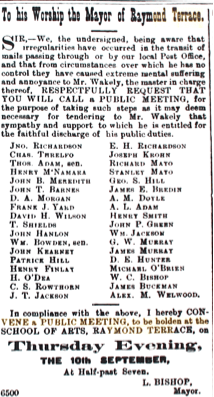
Advertisement for the public meeting to support the Postmaster [The Maitland Mercury and Hunter River General Advertiser, 10 September 1891]
A promotion for Mr. Wakely – 1892
The Australian Star of 18 May 1892, page 3, reported:
‘In the official list of promotions issued by the postal department this month is the name of Mr. J. B. Wakely, post and telegraph master at Raymond Terrace, who receives an increase of salary dating from January 1. The responsible mail work of the Raymond Terrace office is equal to that of any office outside the metropolis. Anyone travelling through to the Manning district cannot help seeing the vast number of mails pouring into that office, to be sorted and checked for all offices along the extensive mail route; and this work is performed at midnight. Hence the department has sought to recognise the importance of the work and the manner in which it was carried out by the promotion of Mr. Wakely.’
Announcement of nominations received for the electorate of Gloucester – 1894
The Maitland Daily Mercury of 10 July 1894, page 5, reported:
‘Punctually at noon today, Mr. John Richardson, the Returning Officer, announced from the local post office the various nominations received for the respected candidates nominated for the Gloucester electorate.’
Telephone communication to be established between Raymond Terrace and Newcastle – 1905
The Maitland Daily Mercury of 18 March 1905, page 6, reported:
‘Dr Liddell. M. P. has received the following official letter: — “Commonwealth of Australia, “Postmaster General’s Department. “Melbourne, March 14, 1905. Sir,— With reference to the letter forwarded by you on January 24 last, from Mr. J. T. Martin, secretary to the Lower Hunter Progress Association, Raymond Terrace, New South Wales respecting the desired establishment of telephone communication between Newcastle and Raymond Terrace, I have the honour by direction, to inform you inquiry has been made, and the Postmaster-General has approved of a recommendation submitted by the Deputy Postmaster-Geneeral, Sydney, that the desired communication be provided on the condenser system, via Stockton, and instructions are being issued accordingly.
The fees will be 6d for the first three minutes, or portion thereof, and 4d for each additional three minutes, or portion thereof. I am to add that before an exchange could be opened at Raymond Terrace, it would be necessary for at least 15 subscribers to agree to rent these at that place for a day service; 25 subscribers would be required for an exchange with a day and night service. I have, etc. Robt. T. Scott, Secretary.’
An early condenser telephone system carried voice calls over existing single wire Morse telegraph lines. Inductors blocked the higher-frequency voice signals, while condensers passed them and blocked the lower-frequency Morse signals. By separating the signals at the terminal equipment, the system avoided the need to rebuild or restring long overhead telegraph lines.
Post and Telegraphic Office damaged in a storm – 1905
The Maitland Daily Mercury of 18 November 1905, page 5, reported:
‘Raymond Terrace was the scene of the heaviest windstorm ever reported there. …. Slates were blown off the post-office, and other damages was done.’
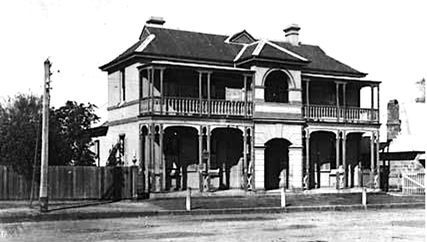
Raymond Terrace Post and Telegraph Office – 1907. The telegraph pole is located near the building [National Archives of Australia]
Additional staff for the Raymond Terrace Post and Telegraph Office – 1908
The Maitland Daily Mercury of 10 April 1908, page 4, reported:
‘With reference to the representations made by the member for the Hunter to the Postmaster-General on his visit to the Maitland district, that a case of sweating existed at the Raymond Terrace Post Office, where an officer has to work from 7.30 a.m. until he retires at 1.30 a.m., and also to attend for 2½ hours on Sunday.
Dr. Liddell has received word from the Postmaster-General that arrangements have been made for the appointment of an additional assistant at Raymond Terrace, and that the matter will receive attention on the passing of the additional estimates.’
New Postmaster for Raymond Terrace – 1908
The Molong Express and Western District Advertiser of 6 June 1908, page 10, reported:
‘Under the reclassification scheme of the post offices in the Commonwealth, Mr. E. A. Guillier, postmaster at Molong, has been transferred to Raymond Terrace on an increase in salary of £25, making his yearly allowance £235.’
Possible improvement to telephone services from Raymond Terrace – 1908
The Maitland Daily Mercury of 22 September 1908, page 2, reported:
‘In reply to a letter of the 12th May last asking inter alia that direct telephonic communication be established between Raymond Terrace and Newcastle, and between Raymond Terrace and West Maitland, N.S.W., Dr. Liddell has received word from the Department that inquiry has been made and the following extract from a report in regard to the matter submitted by the Deputy Postmaster-General, Sydney, has been supplied to him “Existing arrangements permit of Raymond Terrace obtaining reasonably prompt circuit with Newcastle by condenser service via Stockton, and, as this arrangement is apparently sufficient for present requirements, there appears to be no necessity for a special trunk line between these places.
The means of communication between Raymond Terrace and West Maitland, are not, however, so satisfactory, the route being through Newcastle and over the busy trunk telephone line between the latter place and West Maitland. The electrical engineer reports that if the proposed trunk telephone line from West Maitland to Morpeth (for which an estimate has been furnished) were erected, it could be extended on the existing poles of the Department to Raymond Terrace.
Before the new wires could be erected it would be necessary to replace about 106 poles. If the extension were carried out it would give Raymond Terrace, East Maitland, Morpeth, Hinton, Largs, Miller’s Forest, Dock Yard, and Woodville direct communication with West Maitland and district. It would also afford an alternative service with Newcastle, and being a metallic circuit throughout, would further give a better service over the long-distance trunk line to Sydney.
The erection of the line appears to be justified, but in view of the reductions in the draft estimates submitted, and, the large amount of important work in sight, for the current financial year, the construction of the line even if approved would have to be deferred unless other works already approved and of greater urgency were put on one side. The Postmaster-General has approved of the work of extending the proposed West Maitland-Morpeth trunk telephone line to Raymond Terrace being carried out as early as circumstances will permit.’
Need For the Raymond Terrace Police Station to be provided with a telephone service – 1918
The Northern Times of 16 January 1918, page 5, reported:
‘The fact of the police station at Raymond Terrace not being connected with the local telephone exchange is something the residents should not countenance, neither should the public generally.
Yesterday our Maitland representative endeavoured to get in touch with the police at that centre and was surprised to find the position as stated. Apart from this, there is every reason why every police station should be connected where a telephone exchange is installed, and it is hard to understand why such an undesirable state of affairs has been allowed to exist in an important centre such as ‘The Terrace’.
Valedictory at Raymond Terrace for departing Post Office staff member – 1920
The Maitland Daily Mercury of 15 July 1920, page 4, reported:
‘A very pleasant evening was spent on Tuesday night at the residence of Mr. Blunt, postmaster, where the members of the post office staff entertained and presented Mr. T. C. Jones with a silver shaving outfit and silver-mounted umbrella prior to his departure for Branxton, where he has been transferred.
Mr. Blunt spoke in praiseworthy terms of the departing officer and regretted that through circumstances bringing about a reduction in the staff it was necessary for Mr. Jones to leave them. He said that after 30 years experience as a postmaster he had never worked with a more conscientious and efficient assistant. Mr. Wood (late postmaster) and Mr. Dwyer also echoed the remarks of Mr. Blunt and regretted the departure of their guest, which ended some very happy associations.
Mr. Jones thanked the officers for their kind words and generous gifts, and remarked that during the time, he had been at Raymond Terrace he had always tried to work in harmony and do his best for his fellow officers. The spirit of good fellowship which always existed was a notable feature of his associations in the office. Several musical items and recitations tended to make the evening more enjoyable.’
Request For a continuous telephone service for Raymond Terace – 1920
The Newcastle Morning Herald and Miners’ Advocate of 31 August 1920, page 3, reported:
‘Efforts are being made to have a continuous telephone service established at Raymond Terrace. The matter was considered at a meeting of the citizens, at which a letter was read from the Postmaster General’s Department, dealing with the guarantee required before the all-night service could be instituted in conjunction with that already existing. The amount required is £250, and the revenue now is within £56 of that amount.
A scheme was approved by which the required guarantee will be reached, and when this has been subscribed the Postmaster General will be invited to instal the service.’
The Newcastle Morning Herald and Miners’ Advocate of 24 November 1921, page 3, further reported:
‘Mr. A. L. Adam, town clerk, has received from the Postmaster General the following communication with reference to the proposed continuous telephone service: — “I have to inform you that the actual revenue received from the Raymond Terrace telephone exchange for the year ended October 31, 1921, amounted to £213 14s 6d. this being £6 5s 6d short of the amount of £250, the actual revenue required under the regulations to secure continuous service without guarantee. The deficiency of £6 5s 6d has been deducted from the deposit of £56 3s 9d. leaving a balance of £49 18s 3d to be held to meet the deficiency, if any, of the ensuing year.”
Protest against Port Office Public Holiday – 1921
The Raymond Terrace Examiner and Lower Hunter and Port Stephens Advertiser of 30 December 1921, page 3, reported:
‘Alderman Krohn moved “that a letter be written to the P.M.G., through Mr. M. Charlton protesting against the Post Office being closed on Wednesday last. The Council should take the matter up. He did not think the public should be put to so much inconvenience as they were. He did not know the reason why the office was closed, but it was a great inconvenience to business people.
The Mayor said they could not alter it now. Alderman Krohn said if they made no protest these holidays would be getting too frequent. Alderman Hanlon seconded the motion and remarked that he thought there was no necessity for the holiday seeing that all other business places were open, and the public so much inconvenienced. The motion was carried.’
Financial guarantee for the telephone services at Raymond Terrace no longer required – 1923
The Maitland Daily Mercury of 2 January 1923, page 4, reported:
‘A letter received by the town clerk at Raymond Terrace, from the Postmaster General, states that the revenue from the local telephone service last year was £341/14/1. As this was considerably beyond the amount for which the guarantee had been asked, the bond would be withdrawn, and not again enforced, so long as the annual amounts did not fall below £250. The refund of the amount under the guarantee was being made.’
The financial revenue guarantee had been required in order for the Postmaster Generals Department to provide a condenser telephone service to Raymond Terrace.
Fire reported by the Postmaster – 1923
The Raymond Terrace Examiner and Lower Hunter and Port Stephens Advertiser of 1 June 1923, page 3, reported:
‘The long immunity from fires in Raymond Terrace was broken on Friday night when at about 9.45 a fire was noticed in the premises occupied by Mrs. G. and Mr. R. Morris. The alarm was first given by Mr. Blunt, at the post office, which is opposite, by ringing up Mr. E. Windeyer, close by. The alarm was soon around, and a crowd quickly gathered. Mr. Windeyer reached the scene to find that even the household of 7 persons were quite oblivious of the fact that their house was on fire. He aroused them, and quickly they made what effort they could to save clothing and such readily removable goods as could be shifted.’
Need for a telephone connection with Hexham Railway Station – 1925
The Newcastle Morning Herald and Miners’ Advocate of 28 July 1925, page 5, reported:
‘A deal of local inconvenience is experienced by business people and others through there being no telephone connection with Hexham railway station, with which it is often necessary to communicate regarding goods to arrive, or the running of trains. An effort is to be made to establish the connection.’
Honour Roll for the Red Cross unveiled at the Post and Telegraph Office – 1925
The Newcastle Sun of 16 November 1925, page 6, reported:
‘The unveiling ceremony of the Raymond Terrace soldiers’ memorial took place on Saturday afternoon in the presence of a large crowd. The monument, which is erected at the entrance of the park, is a beautiful design, and cost about £400. Mrs. Burton performed the unveiling of the monument, and Mrs. G. H. Pepper the fence. General Paton, in a very appropriate address, dedicated the memorial.
General Paton unveiled and dedicated an honour roll to the memory of the Red Cross [for their service during World War One]. The roll, which is erected in the post office, is a very neat design, and bears the names of all the members of that society through the period of the war. The committee is still in existence.’
The Newcastle Morning Herald and Miners’ Advocate of 16 November 1925, page 7, also reported:
‘The citizens then assembled at the post office, where General Paton unveiled an honour roll, containing the names of all the soldiers who went from the district, as well as those of members of the Red Coss Society. The original idea was that of Mrs. Garbett, then president of the Red Cross, a great worker for all war efforts. It was at first intended to make a banner and dispose of it for Red Cross purposes.
When the war ceased, the banner was not nearly completed and was not finished for a considerable time afterwards. Then the members of the Red Cross decided to make it into an honour roll and retain it in a public building in the town. It was worked for the Red Cross by Miss Macpherson and several other members, being finally mounted by Mrs. Garbett, and made ready for framing. Both ceremonies were attended by numbers of returned men from all parts of the Lower Hunter, including Dr. J. B. Meredith, Major Windeyer, and Colonel Richardson. The Boy Scouts and the children from the public school took part.’
Long term staff member moved – 1928
The Newcastle Morning Herald and Miners’ Advocate of 9 May 1928, page 9, reported:
‘Mr. J. C. Dwyer, who, for sixteen years has been on the local post office staff, has been appointed to Newcastle.’
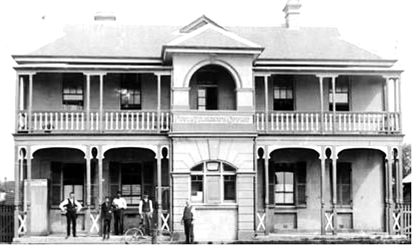
Raymond Terrace Post and Telegraph Office – circa 1930 [National Archives of Australia]
Farewell valedictory given to two staff members – 1931
The Maitland Daily Mercury of 10 December 1931, page 4, reported:
‘Misses Monica Erickson and Gwen Cardow, lately on the staff of the Raymond Terrace post office, who have received notice oi their transfer to Sydney, were tendered. a complimentary social in the Oddfellows’ Hall, Raymond Terrace. There was a good attendance of their friends and townspeople. The evening was filled in until about 11 p.m. with dances.’
Retirement Mr James Blunt, Raymond Terrace Postmaster – 1932
The Newcastle Morning Herald and Miners’ Advocate of 26 August 1932, page 6, reported:
‘Mr. James E. Blunt, Postmaster at Raymond Terrace, will retire tomorrow from the service of the Postal Department, with which he has been connected for 47 years.
Mr. Blunt was born at Lucknow 61 years ago and is the youngest son of the late Mr. Charles Blunt, sen., who for 27 years was licensee of the Commercial Hotel in that town, situated on the Main Western Road, near Orange. In those days Cobb and Co.’s coaches conveyed mails and passengers from Sydney to western towns. At the age of 14, Mr. Blunt joined the staff of the Orange Post office as messenger. Six months’ probation was necessary, a condition being that if everything were satisfactory with regard to character and ability, he would be engaged.
A neighbour of the Blunt family was Mr. H. W. Newman, well known as the undefeated Nationalist member for Orange, who died suddenly in the midst of an election campaign, gave the future postmaster a reference, with an understanding that if the boy failed to realise all that was stated he would forfeit a sum to the District Hospital at Orange. That was unnecessary. Everything was as Mr. Newman predicted, and the boy was permanently appointed.
From Orange Mr. Blunt was sent to Strathfield, then to Tamworth, and after a term there he was transferred again to Sydney. With three other officers he opened the mail branch at the old Redfern station, where there are now 40 men engaged. After some years in the Newtown office, Mr. Blunt returned as Postmaster to his native town. There he remained until after the big Lucknow strike, when the mining town went down.
His next shift was to Mulwala, a border town near Yarrawonga (Victoria), on the Murray River. After three years he was transferred to the relieving staff, in which branch of the service he continued for eight years.
Mr. Blunt recalls some stirring times during the days when he was on the relief staff, and he was obliged to go from Head Office, Sydney, to wherever he was needed. Mr. Blunt has had under his official control many juniors, who today are holding leading positions. One who was under his charge is now Assistant Superintendent of Telegraphs in Sydney.
On being transferred from the relief staff, Mr. Blunt took up duties as Postmaster at Paterson. There he remained for three years, until his appointment to Raymond Terrace, with which town he has been associated for 13 years. ….
Mr. Blunt was married in 1898 at Lucknow, to a daughter of Captain Strathen, the first manager of the Burraga copper mines, and later of Sunny Corner and Grafton districts. Mrs. Blunt died 17 years ago. A daughter (Mrs. W. J. Coupland) is a resident of Manilla. Cr. Charles Blunt. who for some years was President of the Orange Shire Council, and also President of the Orange Agricultural Society, is a brother. Next Wednesday Mr. Blunt will be the guest of the citizens at a farewell social, to be held in the Oddfellows’ Hall at Raymond Terrace.’
Telephone charges for Raymond Terrace residents remain unchanged – 1933
The Newcastle Morning Herald and Miners’ Advocate of 6 September 1933, page 6, reported:
‘At a conference of the Primary Producers’ Union, held at Raymond Terrace in August, the question of charges for the telephone service between Newcastle and that town came up for consideration, and it was decided to make representations to have the charges for calls reduced.
The local branch of the union has now been advised by the head office that the request was submitted to the Postmaster General’s Department, which has now replied that Raymond Terrace is radially distant from Newcastle 11 miles 25 chains; and that trunk line charges, which are among the lowest in the world, are computed on this radial or airline distance, instead of on the basis of the actual mileage of trunk lines used. Heavy annual losses are sustained on the operation of trunk lines throughout the Commonwealth. In view of this, and also the extreme liberality of the existing rates, any reduction at the present time could not be justified and would be out of the question, the department affirms.’
Centenary of the establishment of first Post and Telegraph Office at Raymond Terrace celebrated – 1934
The Maitland Daily Mercury of 1 August 1934, page 4, reported:
‘Raymond Terrace, of which the golden jubilee of the municipality will be celebrated next month, also attains this year its centenary as a township, and it is 100 years today, August 1, since the first post office there was opened. The celebration of this event will take place with the jubilee week next month. The first postmaster there, as far back as can be traced, was John Gilbert, who officiated in that capacity during the ‘forties. He was succeeded in 1860 by the late Mr. W. E. Shaw.’
Reduced telephone charges sought – 1938
The Sydney Morning Herald of 4 May 1938, page 11, reported:
‘The Chamber of Commerce at a meeting last night decided to urge the Government to reduce telephone rents, call charges, and parcel postage generally, in view of the surplus in postal revenue of £2,500,000. The extension of the telephone service in count ry districts will also be sought.’
Request for improved meteorological facilities at the the Post and Telegraph Office – 1939
The Raymond Terrace Examiner and Lower Hunter and Port Stephens Advertiser of 16 February 1939, page 2, reported:
‘Mr. Fairweather referred to the small amount of information given by the Weather Bureau and thought some reference could be made to it. More instruments were required at the Post Office in order to take registrations of various weather phases. They gave the altitude of cloud formation, etc, now and other useful observations could be made if the office was equipped with the instruments. Now there was a possibility of the aerodrome coming near it may be worthwhile. The President said the information would be very useful. It was agreed to call for the instruments.’
The Maitland Daily Mercury of 18 February 1939, page 2, further reported:
‘Several matters were mentioned by representatives of the Port Stephens Shire Council, the Raymond Terrace Chamber of Commerce and the Raymond Terrace branch of the Primary Producers’ Union to the Federal Minister for Commerce (Sir Earle Page), and the Assistant Minister (Mr. V. C. Thompson), when they visited Raymond Terrace yesterday. ….
The president of the Chamber of Commerce (Mr. A. M. Cunningham) asked for improved meteorological facilities at the Raymond Terrace Post Office, including a barometer and thermometer.’
Postmaster farewelled at Raymond Terrace – 1941
The Maitland Mercury of 19 September 1941, page 7, reported:
‘The staff of the Raymond Terrace Post Office farewelled Mr. Fairweather, Postmaster, prior to his departure to Gilgandra. Mr. Channon, Assistant P.M., on behalf of the staff, wished Mr. Fairweather and family the best of luck in the new sphere into which they would soon move. It was with great pleasure he made the presentation of a travelling bag. Mr. Jolly said that he also wished his chief the best of good fortune. He had found Mr. Fairweather a man who would do all in his power for his staff and they had always got on extremely well together. He hoped he would do as well at Gilgandra as he had done at the ‘Terrace.’
Miss Joan Peterson, on behalf of the telephone staff, said that Mr. and Mrs. Fairweather would carry away with them the good wishes of the telephonists. Mr. Fairweather had seen each one start duty there and had taken an interest in their work, Miss Quigley and Miss Forman, telephonists, also spoke. Mr. Fairweather thanked the staff for their kind expressions of good will and for the gift, which he would long treasure. His term of office here had been a most enjoyable one, and he had always had the loyal cooperation of the entire staff. He would always remember his association with them.’
The Maitland Mercury of 20 September 1941, page 3, reported:
‘In the Cosmopolitan Hotel, Raymond Terrace, a large number gathered to say farewell to Mr. McAlpine, of the Commercial Bank, who has been transferred to Rockhampton district, and Mr. Fairweather, the postmaster, who goes to Gilgandra. Mrs. Thomson placed the rooms of the hotel at the disposal of the company, which was presided over by Mr. O. R. Hopkins, who thanked Mrs. Thomson for their courtesy.
Mr. A. M. Cunningham, who made the presentations, said that the departure of Messrs. Fairweather and McAlpine would be much regretted in the town as they had been popular while they were there. They had been excellent officers in their respective spheres and good townsmen. He wished both of them all the good luck that the future could bring. Other speakers were Messrs. W. Brown, L. F. Monkley, Sgt. H. Collins. E. C. Armstrong, A. Griffiths, J. Farlow, C. Nurse and Mrs. Thomson.
Messrs. Fairweather and McAlpine replied, thanking the company for their remarks and presentations. The health of the guests was then drunk and supper enjoyed. The health of the hostess, Mrs. Thompson, was also honoured. This was acknowledged by Mrs. Thomson.
On Wednesday night at the Junction Hotel, Mr. and Mrs. Colin Morris entertained a few friends, who had assembled at their imitation to honour Mr. Fairweather prior to his departure. The presentation of a silver cigarette case and propelling pencil was made. There were also speeches eulogising Mr. Fairweather. The company was afterwards entertained to dinner by Mr. and Mrs. Morris.’
Telephone delays at Raymond Terrace – 1942
The Maitland Mercury of 11 July 1942, page 3, reported:
‘The frequency of telephonic delays at the Raymond Terrace Post Office, was referred to by Mr. Morgan at a meeting of the Chamber of Commerce. The matter, he said, was beyond the control of the staff, who did their best to meet the convenience of the public. There was only one girl on from 7 to 10.30 p.m., and she could not handle the traffic. He had often to wait for three hours for calls. It another girl were employed, he thought the delays would not occur.
Mr. Herrett said that the roster should be rearranged to allow of another girl being on at that time of night. There were seven girls at the office, and he thought that it would be a simple matter for the roster to be arranged so that there would be another girl on from 7 to 10:30 p.m. Mr. H. J. Smith said that the fault was not so much at Raymond Terrace as at Newcastle. Mr. Herrett said the fault was accentuated by the fact that there was only one line to Maitland. It was decided to write to the postal inspector, and ask that the roster be rearranged, so that there would be two girls on at the time mentioned.’
New Post Office requested by Chamber of Commerce – 1944
The Maitland Mercury of 8 January 1944, page 2, reported:
‘Raymond Terrace Chamber of Commerce decided at its monthly meeting to ask the Postmaster-General’s Department to erect a new post office at Raymond Terrace. It was stated that the present office was inadequate. The president, Mr. H. W. Morgan, said he understood that a new building would be erected after the war. It was also decided to make representations for the installation of a machine for the issuing of stamps at the post office.’
The Raymond Terrace Examiner and Lower Hunter and Port Stephens Advertiser of 10 February 1944, page 2, further reported:
‘The P.M.G. said the local post office is under consideration for repairs when the war is over.’
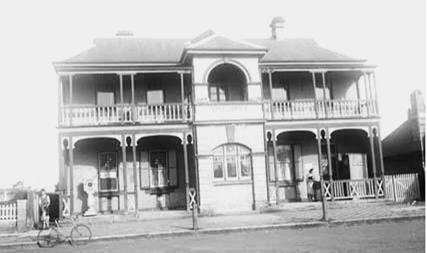
Raymond Terrace Post and Telegraph Office – 1944. A personal coin operated weighing machine is located on the front verandah [National Archives of Australia]
New Postmaster for Raymond Terrace – 1945
The Barrier Daily Truth of 17 November 1945, page 2, reported:
‘To replace Mr. P. McMillan as Postmaster at South Post Office [Broken Hill], owing to his transfer to Raymond Terrace, Mr. G. W. Keppie, of Central Post Office, has been appointed to the position.’
Delays with mail delivery to the Millers Forest area – 1946
The Raymond Terrace Examiner and Lower Hunter and Port Stephens Advertiser of 4 July 1946, page 2, reported:
‘The Postal Department refused to send a mail bag from Raymond Terrace to Dockyard [opposite side of Hunter River] and Millers’ Forest as they stated the mails now arrive the following day at 9 a.m. after they are posted at Raymond Terrace. This was stated to be incorrect by several members, as the mails are often days behind. Papers posted at Raymond Terrace sometimes arrived there on Monday or Tuesday. Mr. Hutchinson said that the Department was not, in some cases, giving the best service. He moved that the instances where a remedy could be affected should be brought before the Inspector. Mr. W. Priddle seconded, and it was carried.’
Need for a telephone service between Raymond Terrace, Stroud, Dungog and other towns – 1948
The Newcastle Morning Herald and Miners’ Advocate of 10 June 1948, page 3, reported:
‘Raymond Terrace Chamber of Commerce decided to seek direct telephone lines to Stroud and Dungog. Mr. A. Cunningham complained of delays in getting a call through to both towns. Mr. Hutchinson said there should be a direct line through Seaham and Clarencetown to Dungog. He felt that time lost must be caused by the line being overloaded.’
Raymond Terrace Post Office downgraded – 1949
The Raymond Terrace Examiner and Lower Hunter and Port Stephens Advertiser of 7 July 1949, page 3, reported:
‘It was mentioned at the meeting [of the Raymond Terrace Chamber of Commerce] that the post office had been reduced in grade and the newly appointed postmaster, Mr. Prindable had been notified that he would be transferred to another office in his grade. Mr. Cunningham said they should enquire as to the reasons for the reduction in the grade. He did not see any occasion for it, as the business was much the same as usual for the past several months.
Mr. Robinson said it was reduced in grade several years ago when they introduced road mails. It must have been reduced, when they appointed the present postmaster and it was difficult to understand why they were now going to transfer him. Further enquiries will be made.
Mr. Cunningham referred to the service to Millers’ Forest having to go to Newcastle and Maitland to Millers’ Forest, when he thought it would be much more convenient for the people of the mails went direct from Raymond Terrace to the Forest and Duckenfield. He moved that enquiries be made from the Inspector if it were not possible to have the mails sent direct to Millers’ Forest. Mr. Hunter seconded. He said years ago there was a delivery to Martins Wharf and Dockyard and was more convenient than present arrangements regarding the route of the mails. It now takes more time to get a reply. Mr. W. R. Scott supported the motion.’
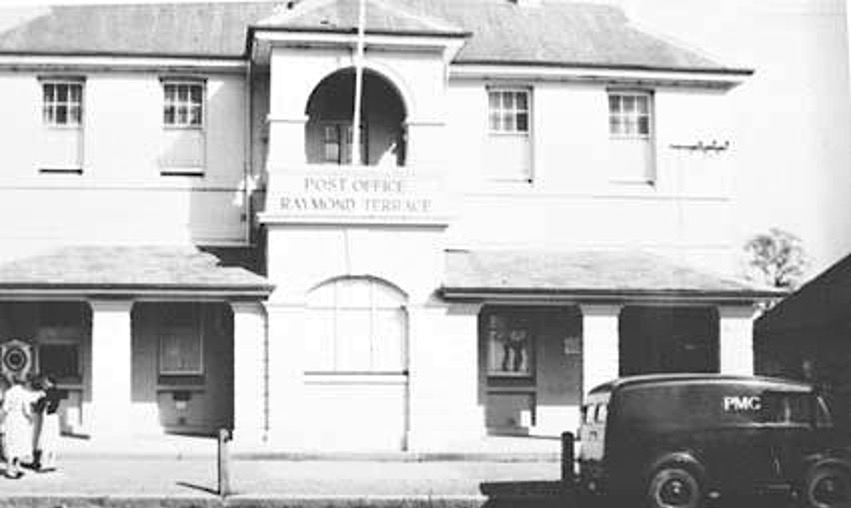
Raymond Terrace Post Office – 1950 [National Archives of Australia]
Presentation made to Raymond Terrace letter carrier – 1950
The Maitland Mercury of 7 January 1950, page 2, reported:
‘The staff of the Raymond Terrace Post Office made a presentation to Mr. J. Wattus, who for the past few years has been, letter carrier. Mr. Wattus has resigned from the department. Mr. A. Lilly made the presentation and referred to the satisfactory way in which Mr. Wattus had carried out his duties. He presented him with a wallet. Messrs. D. R. Prindable, C. Johnson and other members of the staff also spoke. Mr. Wattus thanked the staff for the presentation.’
Concluding Comments
After serving the Raymond Terrace community for more than a century, the Post Office at 61 Port Stephens Street closed around 1985.
Australia Post later sold the building to Fry Bros. Funeral Directors, who renovated it and operate their business from the premises.
Around 1985, Australia Post built a smaller Post Office and mail-handling facility at 35 Sturgeon Street, Raymond Terrace, to replace the former postal premises in Port Stephens Street.
It closed just ten years later, when postal operations moved to a Post Shop at 22/34 Sturgeon Street, in the Raymond Terrace Central shopping centre.
Australia Post subsequently sold the postal building at 35 Sturgeon Street, which is now used as office premises.
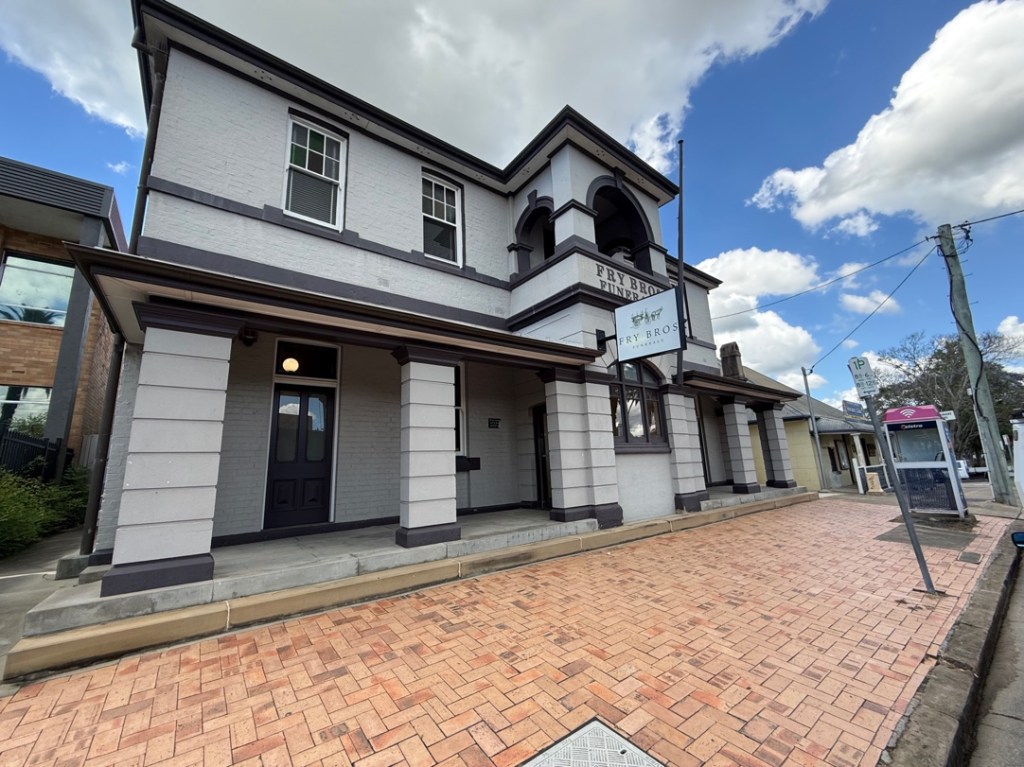
A street view of the former Raymond Terrace Post Office [Author photo – November 2026]
The histories of other Post Offices in the Port Stephens region are published on this website at the following links:
Early History of the Nelson Bay Post and Telegraph Office and Telephone Service
Early History of Pindimar Post Office Port Stephens
Further papers on the history of Raymond Terrace district are also published on this website at the following links:
Early History of St. Brigid’s Catholic Church – The First 100 Years
War Loan Tank Drive Visits Raymond Terrace, Port Stephens – 1918
A Tour of Millers Forest and Raymond Terrace, Port Stephens – 1918
Raymond Terrace Municipal Council Jubilee Celebrations – 1934
Journey to the Vineyards of the Lower Hunter and Port Stephens Districts – 1865
Millet Growing and Broom Manufacture in the Raymond Terrace District – Port Stephens
A Story of the Raymond Terrace District of Port Stephens in 1893
Researched and compiled by Kevin McGuinness


