
Introduction
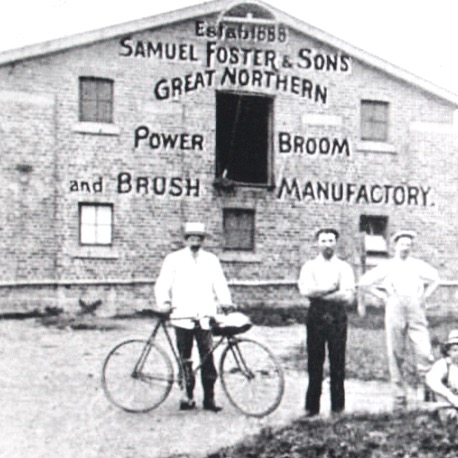
This paper examines the story of Samuel Foster and his Great Northern Power Broom and Brush Manufactory which he established at Bowthorne in 1888.
It also examines Samuel Foster’s role in encouraging farmers in the Raymond Terrace district to grow an improved type of broom millet as a profitable cash crop.
The broom factory provided an important local market for farmers who grew broom millet. After first operating from an 1888 building, Foster moved his business to a larger brick factory in 1897.
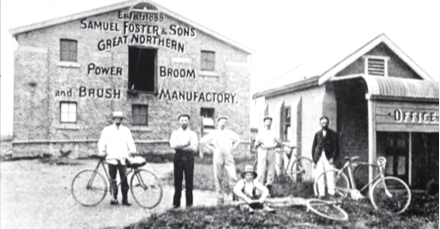
Samuel Foster and Sons Great Northern Power Broom and Brush Manufactory (established in 1888) showing the 1897 brick building [Ancestry]
He later altered his business structure to include his sons and operated as Samuel Foster and Sons Great Northern Power Broom and Brush Manufactory.
The factory appears to have ceased operating by the mid-1950s. This paper also explores the growing of broom millet in the areas surrounding the factory while it was in operation.
Samuel Foster’s Challenge to Glover Brothers – 1891
Samuel Foster was a passionate broom maker who took great pride in his manufactured product.
With this passion in mind, he issued a public challenge to a competitor, Glover Brothers, a millet broom manufacturer of Wickham, a suburb of Newcastle. This company had beaten Foster at the Maitland Show in 1890, having obtained first and second prizes for their millet booms:
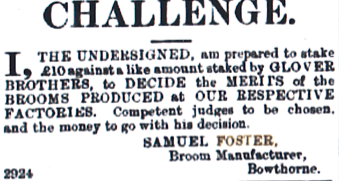
Samuel Foster’s challenge [Maitland Mercury and Hunter River General Advertiser – 25 April 1891]
The Maitland Mercury and Hunter River General Advertiser of 2 May 1891, page 2, published the following letter to the editor that was a response by Glover Brothers of Wickham, to the above challenge:
‘Sir,—Kindly allow us a small space in your valuable columns to reply to a challenge which we noticed in your issue of Saturday last, 25th April, from Samuel Foster to us to decide the merits of the brooms produced at our respective factories for the sum of £10, competent judges to be chosen.
It is still fresh in the minds of the public that we competed for first and second prizes at the Maitland Show in 1890, when Mr Foster also competed, on which occasion he suffered an ignominious defeat. We competed again at the late Show, when Mr Foster was again defeated by us. At this Show Mr. Foster offered a special prize of 10s for the best six Shaker Brooms, he entering two exhibits to our one, his attempt to win being a miserable failure, as we carried off all honours.
No doubt Mr. Foster feels his defeat very keenly, which brings all the more honour to us, and also to the Hunter River district, as the material used by us was the product of that district. Mr Foster objects to the judges’ decision for this reason that they were men not competent to judge millet brooms. We are surprised to hear that this man, possessing so much knowledge as to be able to criticise the decision of three men appointed by the members of the Hunter River Agricultural Association, has not been appointed judge also. No doubt these judges would be thankful to him were he to call on them and instruct them in this matter, viz, judging millet brooms, which we fail to see he can do, as he himself is only a novice at the trade, and received instructions from judges that judged this exhibit at the Show in 1890.
Our advice to Mr. Foster is never to count his chickens before they are hatched, or lay wagers before he knows he can win; but enter his brooms in a show where no one else competes, and he is sure to win This is the best way out of the trouble he is in, as we never take notice of any man that is dissatisfied with judges’ decisions after being fairly beaten. When we are defeated, we will, like sensible men ought to do, acknowledge that defeat, and rest contented knowing that the best exhibit won.’
Tour of the Great Northern Broom Factory at Bowthorne – 1893
The Maitland Mercury and Hunter River General Advertiser of 21 September 1893, page 3, published a description of Foster’s Millet Broom Factory at Bowthorne, Hinton:
‘On Tuesday last we had an opportunity of looking through the Great Northern Broom Factory, conducted by Mr. Samuel Foster at Bowthorne, Hinton [15 kilometres from Raymond Terrace]. As it is not only of importance as a local industry, but also from the fact of providing a good market for one product of the farm, we purpose describing it.
The industry is purely a local one, established by a local man. Mr. Foster was born and reared on a farm at Woodville and is therefore well aware of the advantages such an industry is to the farming community. Broom-making has been and is yet to a certain extent carried on by farmers themselves, but of course not as well as can be done in a properly equipped factory. The Great Northern factory is situated at Bowthorne, Hinton, almost opposite the butter factory of Mr. Lavis, on property belonging to Mr. James Stuart, Hinton, who also takes a lively interest in the success of the industry.
The factory was started by Mr. Foster, in a small way, in 1888, when be only employed one man. But he increased gradually his machinery and staff of workmen, and has had eleven men constantly employed, though at the time of our visit the number was only five; the decrease being, he informed us, owing to the lack of raw material rather than the demand for the manufactured article.
When he began work there was a very limited demand for broom millet, which was disposed of at from £12 to £16 per ton for the millet cleaned of seed. The second year of his factory working the price jumped up to £25 per ton, and that has been the value of millet ever since, and we understand there is an extensive demand at that price. All the work of manufacture is carried out at the factory except the making of the handles, which has not yet been attempted, and they have to be imported, a drawback which will no doubt be remedied as the industry expands and becomes more established.
A great many operations are involved in the production of even such a common and useful article as a broom. The handles are simply turned pieces of wood, with a gentle taper from end to end. They have to receive some embellishment. The cheaper kinds are simply ringed with different colonred paint, which is not done by a brush, but by laying it on a series of rollers with different sized projections upon them which run through receptacles containing the colours to be placed upon the handle; and, the rollers revolving, the article is quickly encircled with rings of various colours. Others are varnished as well, and this is also placed upon them without the aid of a brush, the handle being simply dipped into a long tin tube filled with the varnish.
It is now when dry, ready for the broom maker, who places it in a tube in the machine, and with quick turns of the machine with his foot, by means of a drum with bars on it, places the millet upon it tightly bound by wire, the heads of the stalks being trimmed off and forming the foundation for the necessary shape, and different layers being laid on, the outer one in the best qualities being the long filaments of the bead without the centre stalk, which the wire is bound round and fastened off.
The broom is then handed over to another man, who places it in a couple of iron jaws, and sews it, the rows of hitching being three or four according to the quality. Some eight or nine different grades are made, the best being with longer and heavier heads, and with more work in the making, being more wired and sewn, and some having a couple of rows of velvet put on with the outside wires. The few seeds which the farmer may have left on the millet are then removed, the head of the broom being laid on an iron drum furnished with long spikes or teeth, which is quickly revolved. Another machine cuts off the heads square, the brooms are then tied in bundles of a dozen, the factory label is put on, and they are then ready for market.
The latest improved American machinery is used. In addition to those named, Mr. Foster has one for corrugating or crimping thin strips of tin, two or three of which are placed on the outer row of millet on the handle, and the wire falls into the grooves of the tin, making it much firmer. In addition to the ordinary length handles, he also makes cobweb brooms on handles 10 feet long, which are said to be much superior to the Turk’s Head [round head] in cleaning down the nests of spiders, which stick to the millet better than to soft hair, and are much cheaper.
Now some hints to farmers. Mr. Foster tells us he is able to take up at present about 52 tons of millet a year, that is about one ton a week. Not only is the supply insufficient here, but the quality is far from what it ought to be, the seed having run out through the same kind of seed being continually sown, and the plant has not power to properly develop through being sown too thickly. The consequence is that the heads are short in length and miserably small in size.
Mr. Foster has to pay away a good sum annually for Italian millet, which should certainly not be the case in a country like this so favourably circumstanced for the production of a good article. Off some of the imported article he got some of the seed which is left on, and his father sowed it at Woodville last year. It succeeded very well. Last year he obtained enough seed to sow five acres, and next year there will be sufficient to sow all that is required in the district. We were shown some of this locally grown millet from the Italian seed and the vast improvement on the local article cannot fail to be at once apparent. The heads are quite as long as those from which the seed were taken, though the colonial article is much coarser and stronger than the imported, a defect which will improve as it becomes more acclimatised and properly cultivated.
Farmers should take the hint and procure some of the proper kind of seed and take a little more trouble in the planting of it. The plant stools to such an extent that the seed should be planted almost separately giving space for it to grow and come to perfection. The trouble would be well repaid, as instead of harvesting from 6 to 8 cwt. per acre they would be rewarded with a return of from 10 to 12 cwt.
Other advantages to the farmer we were told were that millet would grow well on soil not of the richest, he can obtain ready money on its sale and though discoloured by the inundation of flood waters Mr. Foster has shown that it can be cleaned and dyed, making it workable, a condition of things not the case with most of the farmers’ productions. In case the grower may consider that there would be over-production, and consequently a fall in price, Mr. Foster is prepared to guarantee £20 per ton for any grown. Such a chance should not be thrown away by our farmers, who have an opportunity not only of improving their own prospects, but of assisting a good local industry.’
Growing of Millet and Broom Manufacture – 1902
The Sydney Mail and New South Wales Advertiser of 5 July 1902, page 35, reported:
‘Although a broom is one of the most generally used and most indispensable articles in domestic operations, very little is known by the public of the growth of the raw material and manufacture of the fibre from which it is made. The crop is sown in the spring in drills or rows similar to maize and matures towards the end of the summer months. It matures best when fine, dry weather prevails, a good light green colour being promoted by such weather, while that toughness which is essential to a good wearing broom is retained. The crop averages from 15cwt. to 18cwt. per acre on the river flats around the Raymond Terrace district, and during the last three years has proved a very lucrative article, many farmers obtaining cheques of from £50 to £350 for their crops.
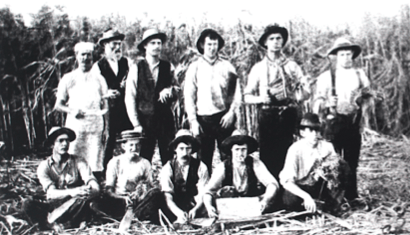
Group of broom millet cutters [Sydney Mail and New South Wales advertiser – 5 July 1902]
At the period of cutting, which is done when the grain has gained its fulness and before it is hard, a good many of the unemployed find employment. One of my pictures depicts millet standing 8ft. high and the outer rows broken down about 3ft. from the top to enable the cutters to reach the head of the fibre. The heads when cut are laid with the stems all one way and as even as possible at the bottom of the stacks, and are all left sufficient time for the sap of the fibre to evaporate. It is then gathered in heaps and carted to the shed.
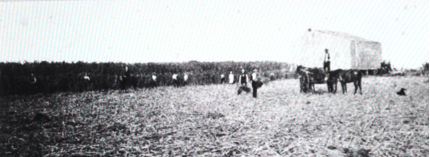
Broom Millet 8 ft. high – the outer rims broken down 3ft. to enable cutters to reach the head of the fibre [Sydney Mail and New South Wales advertiser – 5 July 1902]
Another picture shows a second stage in the early manufacture of the broom, which is known as ‘hackling,’ by which the seeds are stripped from the fibre. The operation is simple but requires an ordinary machine with three or four hands according to the size of the machine used. The operators are shown in the picture ready to assort the millet, long and short. They then pass it along to the machine, heads one way, as evenly as possible.
The heads are taken, a handful at a time, and held over a revolving cylinder with spikes about 4 or 5 inches long. After the seed is stripped from the fibre it is tied in convenient sized bundles and stored ready for consignment in bales similar to those shown in the background of the photograph. This is as far as the farmers generally go in the making of the domestic broom.
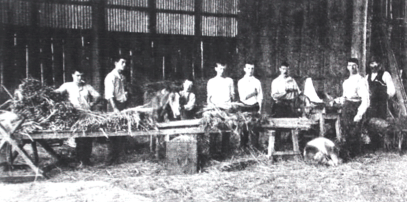
‘Hackling’ the millet [Sydney Mail and New South Wales advertiser – 5 July 1902]
Some small finishing establishments are in the district, but the bulk of the millet finds its way to the Sydney market, as the subsequent completion of the broom requires skilled labour under a process too lengthy for description here.’
How to grow Broom Millet – 1902
The Australian Town and Country Journal of 16 August 1902, page 27, reported:
‘To plant broom millet, observe the following directions: Prepare your land as if for maize, and sow the mlllet at the season for maize. Make the rows about 3ft apart, and drill in about l in. deep and about 1ft apart. It will take about 2¼lb of seed per acre. In a few days harrow to kill weeds. There should be about six stalks to each hill. Keep it, well cultivated and clear of weeds. It should be cut when the earliest stalks begin to turn red at the top, but it should not be cut too soon, and if it gets too ripe, it will get very red at the top and will not sell well. Therefore, caution is necessary in harvesting it.’
History of the Great Northern Power Broom and Brush Factory at Bowthorne- 1906
The Maitland Weekly Mercury of 20 October 1906, page 12, reported:
‘Though it occupies but a comparatively insignificant place geographically, still the pretty little village of Bowthorne, situated on the left bank of the Paterson River, and in the midst of wonderfully rich and fertile agricultural country, is of far greater importance in the industrial world than its size or position indicates. Besides an up-to-date butter factory, it boasts of a flourishing and well-equipped broom factory, controlled by Messrs. Samuel Foster and Sons, and known as the Great Northern Power Broom and Brush Factory.
Through the courtesy of Mr. Samuel Foster, the head of the firm, a representative of this journal was enabled during the week to make an inspection of the factory when he was shown the great progress made in a few years by the application of industry and perseverance, coupled with sound business methods. From a small beginning, Mr. Foster has succeeded in building up a lucrative business, which is gradually forging itself ahead, notwithstanding keen competition, and which holds a leading place among the broom manufactories of the State, by reason of the excellence of the article placed on the market.
But Mr Foster’s keenness and business activity will not allow him to remain at a standstill, despite the success already attained, for besides a recent valuable addition to his already extensive plant, he intends to make further additions in the near future, to enable him to materially increase his present output, and thus cope with the growing demand for the article he manufactures.
During a chat with Mr. Foster, it was learned that he began the business in 1888, and that he has since gradually improved and added to the plant, until the factory has reached its present extensive dimensions. When he first started there was no demand for millet, consequently little was grown, and what few tons he then purchased had been stored away by the growers for 10 and 11 years in many instances. The farmers only grew sufficient for their own requirements, while the balance remaining was stored away from year to year.
The first year Mr. Foster went round, the district in order to purchase millet, he offered the farmers encouragement to go in for its production by giving a guarantee of £20 per ton for millet, delivered at the factory. The second year after he started, he brought the Sydney Broom Manufactory, into the local market, and since then millet has been cultivated in increased quantities each year, until now it has come to be regarded as one of the leading crops in the Hunter Valley. Consequently Mr. Foster naturally claims, and not without some reason and pardonable pride, that he is the pioneer of the millet industry in the district.
Although millet is now extensively cultivated in the Hunter River district, particularly in the localities surrounding Bowthorne, a ready demand is experienced for hurl [millet with husk removed] of good quality, and remunerative figures are obtainable, the present value ranging from £20 to £22 10s per ton. Throughout the millet season, Mr. Foster makes extensive purchases and stores the product in a spacious galvanised iron shed, capable of holding upwards of 100 tons of pressed millet.
At the present time, his supply, of course, is very much reduced, still he has sufficient on hand to keep him going till this season’s crop is harvested. After directing attention to the bulk store, he entered into a lucid explanation of the manner in which the millet is treated in order to prepare it for making the brooms, and animadverted upon the various processes subsequently adopted in turning out the finished article, all of which proved highly interesting.
First of all, he pointed out that the millet required for boom-making was brought down from the bulk store the day previous to its being manufactured and put through a special damping and partially drying process for the purpose of toughening the hurl, thus rendering it less liable to break when being handled in the factory, a spacious two-storey brick building. When being subjected to the toughening process the millet is placed in a specially constructed small brick room.
Then it is removed into the factory adjoining, and spread out on a bench, where it undergoes a process of sorting. The various lengths used for making different grades of brooms, are carefully sorted out, and care taken to see that all unfit for use is discarded.
Next the millet is put through a machine, which cuts the hurl and sorts it, separating the outer and inner parts, the stouter and stiffer fibre being used in the outer portion of the broom, and the finer and weaker fibre in the centre. The hurl is then ready for the broom-maker. Mr. Foster has three broom-making machines installed, but it is his intention if trade continues to increase— and there is every prospect that it will— to shortly add to the number.
After passing through the hands of the broom-maker, during which process the hurl is securely and neatly fastened to the handle, the partially made brooms are put through the hackler, a machine in which are embodied some of Mr. Foster’s own ideas. It is run at the rate of 800 revolutions per minute, and the effect is twofold. In addition to combing the broom out, thus straightening the fibre, the hackler also has the effect of removing all seeds and seed-shells, and leaves the broom thoroughly clean. Then it is ready for sewing.
Formerly, the sewing was done by hand, but Mr. Foster, enterprising and desirous of moving with the times, recently had installed a Lipe-Walrath Broom Sewing Machines, one of the latest improved American inventions. The machine is a beautiful piece of mechanism, and we were informed is the only one of its kind in the State. It is of one-half horsepower, with a capacity of 40 dozen brooms per day, and is driven by a tension pulley, and can be started and stopped, as required.
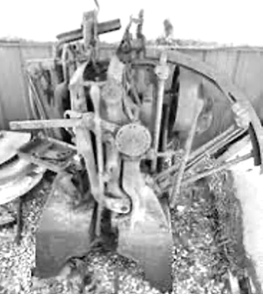
Lipe-Walrath Broom Sewing Machine [Smokstack – Antique Engine Community]
In its work the machine is perfect, and capable engineers who have seen it describe it as “a box of tricks,” so compact are the workings. First of all, the broom is placed in the machine and pressed into shape; then the operator places the thread round the broom, leaving a long end, and arms on either side force the needles through the broom, the sewing being performed with remarkable neatness. No threading of needles is required; they thread themselves.
Compared with hand-sewing, the machine work is much superior, and Mr. Foster is now able to turn out a stronger and much better broom than formerly. In fact, the difference in the workmanship is so apparent that he has begun to re-sew a large number of hand-sewn brooms that he has in stock. In pointing out the great advantages consequent on the introduction of the new machine, Mr. Foster dwelt on the fact that he was now able to put a 50 per cent. better broom on the market without charging any move for it.
Another advantage was that the machine ensured uniformity in workmanship; that is, it sewed the cheaper grade of broom just as well as the dearer classes. Then it performed the work much quicker than it could be accomplished by hand; in support of which Mr. Foster explained that compared with the capacity of the machine to turn out 40 dozen brooms per day, only from 12 to 14 dozen could be done by hand, to sew them properly. The new machine sews 5/8 of an inch stitch, and as many as seven lines if desired.
After being sewn, the brooms are subjected to treatment in the cutter, when the ends are neatly trimmed, and they are then consigned through a hatchway to the upstairs portion of the factory, where they are stacked to dry. In addition to the machines already mentioned, and which are driven by a four-horse power Hercules oil engine, Mr. Foster has had installed a large revolving drum for the purpose of dressing the handles.
Many of the handles, in fact the bulk of them, when received from the handle manufacturer, are very rough, and in order to render them smooth and a comfort to use, they are placed in the drum, which is set revolving at a certain speed, and all the roughness is thereby completely removed. About 400 handles are treated at the one time. Afterwards they are hand-painted, and a specially designed machine performs the ringing process.
About 3000 handles a day can be treated with the aid of this machine, which performs its work to perfection Mr. Foster mixes his paint with the ordinary paint-oil, so that it will not come off on the hands of whoever might use his brooms. Then, again, he has a small machine for corrugating the strips of tin used in connection with the braiding of the brooms.
Mr. Foster uses a considerable quantity of millet in a year, as will be gleaned from the fact that for the past few years the average number of brooms manufactured has been about 2500 dozen. He employs two hands besides himself and three sons, and turns out 16 different classes of brooms, together with four classes of brushes, besides a cob-web broom with a 10ft. handle.
Mr Foster manufactures an excellent class of article and at the Maitland Jubilee Exhibition in 1894 was awarded first and second prizes. The following year he was again successful, but he did not show from that date until last year, when he, again carried off first honours a fact which speaks for itself regarding the make and quality of his brooms. It is Mr. Foster’s intention to secure two extra broom-making machines according as trade increases, and he also contemplates lighting the factory with electricity. Mr Foster is to be congratulated on his enterprise, and the success which he has attained through his energy and perseverance.’
‘Closer to the town [Maitland], and along the banks of the Patterson River, a different industry [to maize growing]—that of millet growing—is in existence. Here, the land is so valuable that no room is allowed, even for dividing fences. The homes of the settlers are situated on the bank of the river, and steamers regularly call at the back door to take the produce to market. Only a few hundred feet separate the different homes, and looking down upon them, covered in vines and foliage of various kinds, with a plentiful sprinkling of fruit trees suitable to the district, one gets an idea of the true advantages of closer settlement.
As a result of the absence of fences, the domestic cow has to be kept tethered close to the homes, and as the farms are of very small acreage, no space on the expensive flats can be spared for grazing. In fact, the crops of millet run right up to the doors of the homes. The different farms are separated by a headland—only known to the different owners—as crops interlock each other, and it would be impossible for a stranger to find any line of demarcation between the different holdings.
On all these low-lying flats the millet is grown very extensively, and in its present state of growth, makes a remarkable picture. The whole acreage, as far as the eye can see, is covered with millet, lucerne, and maize, the latter, towering up to a height of from 12 to 14 feet in the middle of the green carpet of lucerne.
The millet cutting season is now in full swing, and in this district, as in the South Coast dairying districts, the scarcity of the labourer is troubling the grower. It seems a most peculiar thing that not many miles from here, one hears of men idling their time away in Newcastle, through scarcity of work, while on these flats many of them could secure profitable employment.
The pioneering work in connection with the millet industry of this district is due to Mr. Samuel Foster. Some 21 years ago, Mr. Foster opened a broom factory, and to encourage the growth and assure himself of sufficient millet to keep his factory employed, he guaranteed the growers that, he would take from them their crops at a price of £20 per ton delivered at the factory. Mr. Foster has built up quite a large business, and today looks with pride on the fact that through his efforts in steadily forging ahead and creating a healthy, competition in the market, that millet is the principal industry, and most profitable crop in his district.’
The accompanying picture [see below] shows the factory which Mr. Foster has erected. No expense has been spared in fitting up the building with the latest machinery and the motive power is a 13-h.p. suction gas engine. To give an idea of the completeness of the factory, one might mention the fact that the building is lighted with electricity. The broom factory is always kept working at full pressure, and as a result over 30,000 brooms are turned out and sent on to the market each year. The value of an industry of this sort will readily be seen when it is mentioned that millet growing, which at one time barely paid, has now been turned into a highly profitable industry.’
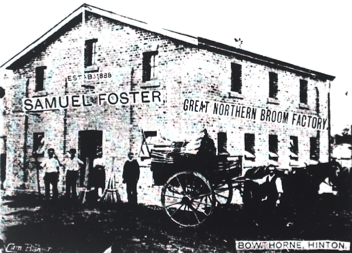
Great Northern Broom Factory, at Bowthorne, near Hinton. Note: the wording was not attached to the building, having only been placed on the photo [The Land, 24 March 1911]
The following advertisement is for the auction of the Hickey Family Estate, Cheverley, between East Maitland and Raymond Terrace. It illustrates the value of the rich alluvial arable lands of the area for the growing of broom millet and other crops:
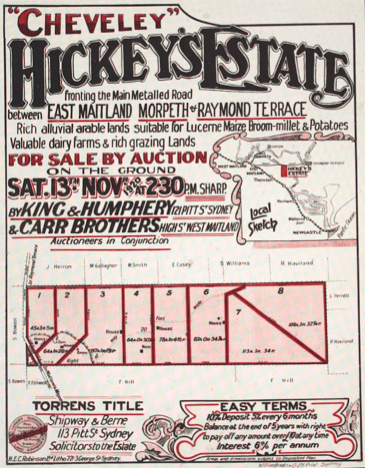
Advertisement for auction on 13 November 1920, of ‘Cheveley’, Hickey’s Estate, near Raymond Terace, suitable for the growing of broom millet, lucerne and potatoes, [National Library of Australia]
Samuel Foster presents Millet Brooms to Prince of Wales – 1920
The Newcastle Sun of 7 September 1920, page 1, reported:
‘When Messrs. Samuel Foster and Sons, who control the Great Northern Power Broom and Brush Factory at Bowthorne, on the banks of the Hunter, commenced business in 1888, the price of millet was £8 a ton. Today, this factory is the largest in Australia and the price of millet is £70 a ton. It thus provides a benefit for the farmers as well as work far a large number of employees. …..
On the occasion of the Prince’s visit to the Newcastle district the firm forwarded a pair of millet brushes to his Royal Highness and have now received the following acknowledgment: —
“H.M.S. Renown, August 20. — The private secretary is desired by the Prince of Wales to thank Messrs. S. Foster and Sons for the two brushes which arrived on board H.M.S. Renown and which he has been pleased to accept.”
Millet farmers seek tariff relief on imports of millet – 1921
The Raymond Terrace Examiner and Lower Hunter and Port Stephens Advertiser of 17 June 1921, page 4, reported:
‘When the Tariff debate was going on in the Federal House, Mr. Charlton, M.P. [member for federal seat of Hunter] said: — I want to bring under the notice of the Minister for Trade and Customs (Mr. Massy Greene) the position of farmers who are growing millet. Quite a number of men on the land in New South Wales and Queensland are growing millet, but they find it difficult to carry on because of the competition of the inferior Italian production. Millet is grown on the Lower Hunter, the Manning, and Richmond Rivers, as well as at Yanco and Tamworth. A good deal is grown in my own electorate.
The duty is only 4s. per cental [hundredweight]. That protection is insufficient, and growers have written to me stating that with such a duty it is impossible to profitably carry on. The Japanese are sending in, for broom making purposes, an inferior millet which is being largely used.
I have two letters, which I shall read to the committee, in order to show that our farmers are dissatisfied with the present duty. Here is one written by Mr. Cunningham on behalf of the farmers of Nelson’s Plains [adjacent to Raymond Terrace] shortly after the Tariff schedule was laid on the table — Dear Mr. Charlton, — I am directed by the Nelson’s Plains Progress Association to ask you to urge upon the Minister for Customs the necessity of raising the Tariff on imported broom millet in order to save an Australian industry from extinction.
We understand that the Tariff will be dealt with immediately Parliament reassembles and would respectfully urge that you use your best endeavours to have the Tariff raised at least four fold. As you are not perhaps familiar with the subject, I will try briefly to make the matter plain to you.
The areas in which broom millet is grown in New South Wales are the Lower Hunter, and Manning and Richmond River, on the coast, and smaller quantities at Yanco and the Tamworth districts. The amount grown in these districts is quite sufficient to supply Australian and New Zealand in any season, and consequently there is no need to import any from outside.
At the present time millet is quoted at £50 per ton of 2,000 lbs. in Sydney, but very little is being sold for that, the average price being from £30 to £40, which is altogether too low a price to pay farmers at the present high cost of living. The low range of prices has been brought about by the action of the manufacturers and speculators forming a ring and importing, to date, 120 tons from Italy, although there are ample stocks of Australian millet awaiting sale in all the millet growing districts.
Last year they succeeded in inducing the Federal Government to place an embargo on the exportation of millet to New Zealand, although then as now there were ample stocks to supply both countries and this action was taken, without consulting the growers, who were certainly entitled to have a say in the matter. To show you how the manufacturers score at the expense of the growers — The price of millet is no better, or hardly as good as before the war, when you could buy a broom — retail — in any shop in the State for 1s 6d., whereas at the present time brooms range from 3/6 to 4/-, and the cost of production to the grower has gone up 200 per cent. Trusting you will do your best in the matter. Yours respectfully, M. Cunningham. …..
Most honourable members are familiar with this district where a great deal of millet is grown. I have also a letter from a resident of Miller’s Forest, where probably more millet is grown than in any other part of New South Wales- — Dear Mr. Charlton. — On behalf of the farmers of the Hunter Valley I wish to draw your attention with a view of having it placed before the Federal authorities of the treatment meted out to the millet growers of this locality, as to importations of millet from other countries.
Owing to the cost of labour, the price paid for the cultivation, raising, and cutting of this crop was nearly 100 per cent. more this season than in past years, and when the first millet was harvested, as early as December last, the price offered for this millet was £80 per ton at the shed. This is just a payable price, and nothing more. A few weeks later what do we find? The “profiteers” have got their heads together, and today. we are very lucky if we get £40 a ton for it at shed. Do you not consider this an injustice, and on top of this the Federal Government is allowing foreign countries to simply flood the country with so called Italian millet. Is this a fair go?
The past seasons may have been good to some farmers, but others have simply to depend upon this crop to meet their rents, etc., and what is to become of the poor struggling farmer when, on the 1st of July of this year, he has to sacrifice his crop for the paltry sum of £40 per ton when it cost him nearly £30 per ton to raise same? We consider it a grave injustice, and I think you would earn the esteem and appreciation of all the millet growers in New South Wales if you would ventilate this matter on the floor of the House. What we want is to get the Tariff increased, and an inquiry made into the matter. Hoping to hear from you in the course of a few weeks. — A. J. O’Brien, Secretary.
I ask the Minister to increase the duty on this item. It is far too small at present. Mr. Jackson. — What do you suggest should be the amount? Mr. Charlton . — It should be sufficient to prevent effective competition by the inferior stuff from overseas, which threatens to kill the millet growing industry in Australia. Manufacturers get hold of it, use it for the trade, and then they charge the very highest prices for the product as if it were Australian millet. Mr. Fleming. — The Japanese product is killing the local industry. Mr. Charlton. — The honourable member for East Sydney (Mr. West) has just told me that the manufacturers mix this inferior stuff at the factories, but the fact remains that our farmers are growing enough millet for the whole of the Australian and New Zealand requirements’
Formation of a Broom Millet Growers Association at Millers Forest – 1925
The Maitland Weekly Mercury of 21 November 1925, page 9, reported:
‘A very largely attended meeting of millet growers of Miller’s Forest [adjacent to Raymond Terrace] assembled for the purpose of forming a Broom Millet Growers’ Association. Some time ago the Miller’s Forest Progress Association called a meeting of the growers with the object of starting a Co-operative broom and brush factory under the Rural Credit and Community Settlement Act, and at this meeting also, Mr. P. Burton Bradley, secretary of the Victorian Broom Growers’ Association was present.
Mr. Bradley stressed upon the growers the necessity of being organised. At this meeting it was unanimously decided to form a branch of the Broom Growers’ Association, and with this object in view the farmers gathered together last Thursday night. Mr. T. E. Osborne presided and outlined the business of the evening. A. J. O’Brien (secretary pro tem), also read communications from Mr. Bradley, and also from Mr. S. Foster, Hinton. Messrs. Priddle and Monkley submitted a report of their canvass, as also did Messrs. Broderiek and Leaver. Two other important centres in Miller’s Forest had not been canvassed.
Canvassers report excellent results, and the matter was taken up enthusiastically. Messrs. Markham, Priddle, Cunningham, Hughes, O’Brien, McDonald, and Osborne promised to canvass the Plains, Swan Reach, Wallaby, Phoenix Park and Woodville. The business was discussed and great promise was in evidence as regards the formation of a successful association.
The following officers were elected: President, Mr. T. E. Osborne; vice-president, Mr. F. McDonnell; treasurer, Mr. L. F. Monkley; secretary, A. J. O’Brien. It was decided to fix the fee at £1 per annum, and the financial year be from July to June. A full committee will meet next week with the object of drawing up the laws and by-laws of the association, and later on a grand conference will be called of all branches of the Manning, Tumut, and Tamworth districts.’
Tarro millet growers object to importation of Italian Millet Brooms – 1929
The Newcastle Morning Herald and Miners’ Advocate of 12 February 1929, page 6, reported:
‘Mr. R. James, M.H.R., has received the following letter from the Federal Department of Health—”With reference to your letter of January 11, 1929, on the question of the importation of millet brooms, said to be Italian manufactured, and the request submitted from the honorary secretary of the Tarro Progress Association, for a similar prohibition, and for legislative protection in the broom manufacturing industry.
I desire to inform you that the matter has been carefully reviewed in all its aspects, especially the information known on the life history of the European corn borer (Pyrausta nubilalis), the records of its distribution, and the effects of the treatment to which millet is subjected during the processes of manufacture into brooms, and in view of the fact that all millet brooms on arrival are subject to examination by quarantine officers, and can be more effectively treated than baled millet, if found necessary, it has been decided that it is not necessary, from the standpoint of danger of introducing the European corn borer, to prohibit the importation of millet brooms manufactured abroad.
The question of the competition of cheap imported brooms with the manufacture of brooms in Australia is an economic one, referable to the Tariff Board (Trade and Customs Department), whereas the prohibitions under the Quarantine Act are proclaimed with a view to preventing the introduction of pests and diseases, without reference to the value of the goods or the trade therein. Mr. Jams proposes to go further into the matter when the tariff is under discussion in Parliament.’
Broom Millet grown at Bobs Farm – 1937
The Maitland Daily Mercury of 6 March 1937, page 2, reported:
‘At Bob’s Farm, Raymond Terrace, Mr. H. Upton has harvested a crop of broom millet of fine quality. Mr. Upton’s success demonstrates the suitability of the district for millet culture.’
Problems with Raymond Terrace Millet Crop – 1938
The Newcastle Morning Herald and Miners’ Advocate of 1 November 1938, page 3, reported:
‘Early showings of millet have been destroyed by caterpillars and cutworms on many farms at Miller’s Forest and the adjoining district. These will require replanting. The President of the Lower Hunter branch of the Primary Producers Union (Mr. R. L. Fitzgerald) and the general Secretary (Mr. J. L. Shute) conferred with the growers at Mt. Kanwary on several aspects of the Millet-growing industry. Matters relating to the Marketing of Primary Products Act were discussed, and the following resolution was adopted “This meeting of Millett growers of the Hunter River district is of the opinion that the time is opportune for the taking of another poll to declare broom millet a product under the Marketing Act.” A copy of the resolution will be forwarded to the Director of Marketing.’
A possible new market for Raymond Terrace District Broom Millet – 1940
The Maitland Mercury of 2 March 1940, page 6, reported:
‘During the week T. S. Elkin and Co., of Raymond Terrace, sold millet for Mr. W. Carmody, of the Devil’s Elbow, Miller’s Forest. The millet was of good quality considering the very dry weather. The field was about 16 cwt to the acre. The millet went to West Australia.
What may possibly become a new market for millet was brought under the notice of Messrs. Elkin and Co. during the week, when an inquiry was received from Canada, which previously imported its requirements from Italy, but now, owing to the high shipping charges, due to war, of cargoes from Europe, attention has now been drawn to Australia as a possible source of supply. The price mentioned was £85 per ton f.o.b., but this perhaps would be regarded as too low by most farmers. It is doubtful, however, whether there would be any available for export, as most of the surplus millet in Australia goes to New Zealand. However, if the demand warranted it, increased acreage could be planted.’
Local Millet Growers reject proposed fixing of broom millet prices – 1943
During the Second World War, the Raymond Terrace Examiner and Lower Hunter and Port Stephens Advertiser of 25 February 1943, page 2, reported:”
The P. P. U. [Primary Producers Union] District Council meeting discussed the proposed fixing of the price of broom millet at £55 per ton. Mr A. J. O’Brien in moving a motion to send a wire to Prof. Copland asking him to refrain from fixing a price till a conference had been held with the millet growers on the Hunter, said it was the most drastic knock the millet growers had ever got.
Millet supplies were short on account of the drought last year, and the manpower conditions, and the only hope the millet growers had of getting something over the cost of production was by an increased price, which was operating at the present time, as millet was now on account of the small amount sown this year in strong demand up to £80 per ton.
The threatened fixed price was at the request of the combine [millet buyers], the producer was not to be allowed to get a payable return for his labour, and at £55 a ton the millet did not pay with the increased price of everything. The amount of millet available usually ran about 300 tons on the Hunter in a season. This year the estimate is about 60 tons. This was a chance for those who have a bit of millet to get a payable price for it.
The combine had bought up all the millet at Tumut, and had openly boasted, he was informed, that they would have a price fixed. He therefore moved that a wire be sent to Professor Copland, asking him to hold fixing a price, and an injunction be sought, to prevent any price being fixed till a conference had been held with the millet growers and the price fixing Commission. Mr. J. Saunders seconded the motion. He said he had heard about a month ago that the combine was going to have a price fixed.
The price fixing authorities should come and see for themselves what the conditions were. It was ridiculous to fix a price — the law of supply and demand was the only way the price could be regulated. Very few people were growing millet this year. Those who had were forced to work early and late and even employ womenfolk to assist in getting it in. The price was high because there was a scarcity. Mr. T. Lantry supported the motion. The people who had millet were quite entitled to the higher price. He had seen girls cutting millet at daylight and on to dark.
The combine were just a handful of people who were out to save their own profits but denied it to the growers. If matters were not more favourable to men on the land in the future there would be many more forced off the land. He can show them now, some of the most fertile land out of use because of price fixing and control of crops, and such like, and now they are adding millet to the list. He did not know what was going to become of the farms in the future. Mr. Armstrong suggested they should add fruit and vegetables to the motion as well as millet. The motion was carried.’
War Time Effects on Broom Millet Growers – 1943
The Raymond Terrace Examiner and Lower Hunter and Port Stephens Advertiser of 23 September 1943, page 3, reported:
‘Mr. Pitt, Senior Agricultural Inspector, Taree, says; The advice that there will be no change in the ceiling price (£75) for broom millet for the coming season should be of much interest to local broom millet growers. The price is not excessive by any means when one considers that most skilled men have gone and the farmer has to pay the fixed wage for unskilled labour, as well as higher costs for other things connected with the industry.
There is a very strong demand for broom millet, not only because of the low production, (there are no reserves) but because of the demand by the services, factories, hospitals, factories etc. Practically no brooms have been released for civilian requirements during the past six months in the metropolitan area. In many instances, factories have been using extensively fibre substitutes, which is bad for the millet producer and unsatisfactory for the user.
Every effort should be made by farmers on the coast to increase the areas. Approximately 1000 tons have been suggested for the season’s target — an enormous quantity compared with past years — and it will require from 2500 to 3000 acres to produce this quantity. Broom millet requires a fair amount of labour, including some skilled. Providing that the grower can supply the latter there should not be much difficulty in obtaining help to do the routine work. It is suggested that growers organise their own neighbourhood and harvest on community lines.’
Post Second World War Years
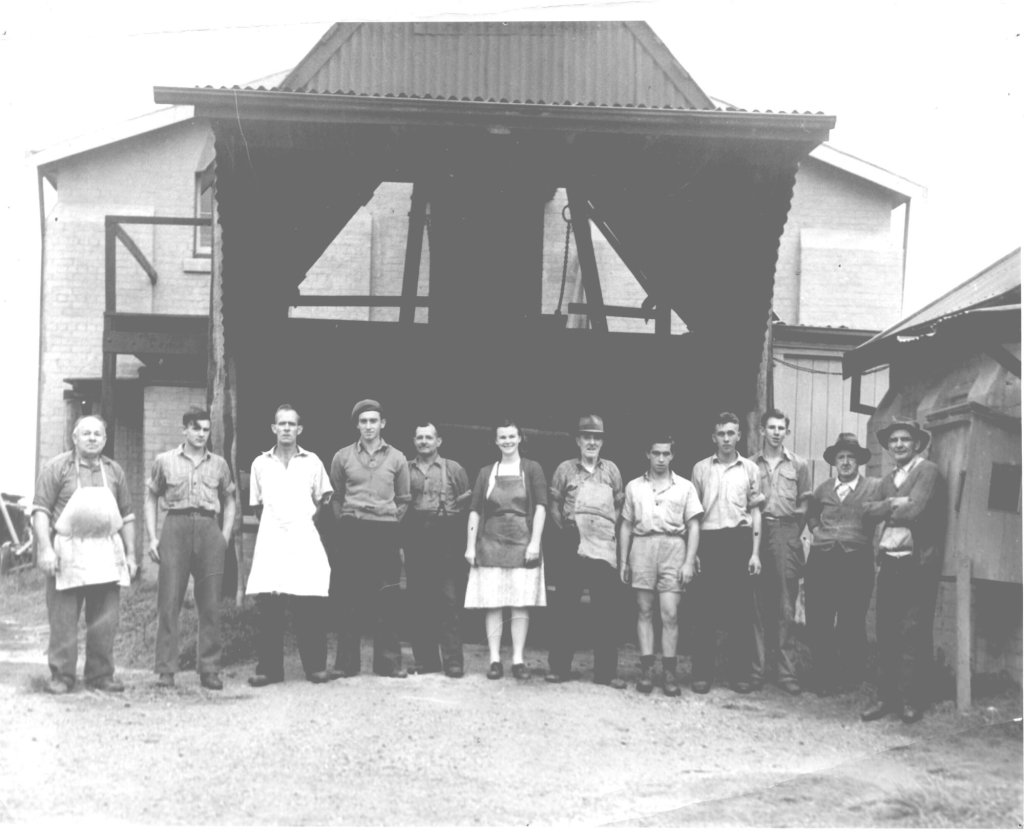
Photo of employees of the Great Northern Power Broom and Brush Manufactory at McClymonts Swamp Rd, Wallalong near Hinton (Bowthorne), NSW c 1945. [University of Newcastle Library Living Histories Collection}
Death of Samuel Foster and Obituary
Samuel Foster, pioneer millet broom manufacturer died in July 1946. The following obituary for him appeared in the Maitland Mercury of 27 July 1946, page 3:
‘With the recent passing of the late Samuel Thomas Randall Foster, of Bowthorne, the district lost one of its oldest and most respected residents. Born at Woodville 87 years ago the late Mr. Foster spent his early days farming but later became a commercial traveller.
In 1888 he started a broom manufacturing business at Bowthorne, which he carried on practically till his death. At first millet growing was not considered a very lucrative business, but Mr. Foster was instrumental in inducing farmers to pay more attention to the crop, and finally imported millet seed from Italy. It soon became acclimatised and justified his confidence.
The late Mr. Foster was a staunch member of the Methodist Church, and for many years was church steward and trustee. He married a Miss Cummings, who also came from a pioneering family. Mrs. Foster predeceased her husband by eight years. A family of five sons survives— Roy and Sid (Bowthorne), Bruce (Sydney), and Cecil and Eric (E. Maitland), also numerous grand and great grandchildren.’
1950’s
Following Samuel’s death, the company continued under the family management.
The following newspaper photos and articles were published on company activities of this time.
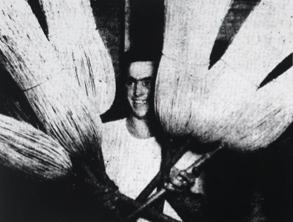
Keith Single with new broom at the Great Northern Broom Factory [Newcastle Morning Herald and Miners’ Advocate, 30 March 1950]
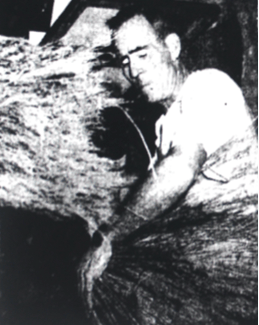
Mr. W. Crehan gathers millet heads to make a broom at the Great Northern Broom Factory [Newcastle Morning Herald and Miners’ Advocate, 30 March 1950]
Prospect for the local millet crop – 1952
The Maitland Mercury of 29 January 1952, page 2, reported:
‘Prospects for this season broom millet harvest in the Hunter Valley were favourable, despite early setbacks, because of the prolonged dry weather. More millet was sown this season than last, but the lack of rain early in the season caused some crops to fail.
Mr. C. B. Nurse, of T. S. Elkin and Company, of Raymond Terrace, said this morning that had there been a normal season there would have been a big output of broom millet in the Hunter Valley. The millet being harvested at present was a good line, with good texture and colour, and the output was better than expected, said Mr. Nurse. There were prospects of the price being very favourable. Last year the millet price was £150 a. ton.
The harvest is expected to continue until March, and the late crop should have a fair yield. This season, broom millet has been grown at Phoenix Park, Morpeth, Swan Reach, Hinton, Raymond Terrace, and Beresfield, with small crops at Miller’s Forest, Nelson’s Plains, and Louth Park.
Phoenix Park grower, Mr. J. E. McFadyan did not paint as rosy a picture as Mr. Nurse. Mr. McFadyan said: “Prospects are not so bright, and a lot of the area under millet is patchy.” He said this morning that, in a trip through the millet growing areas, he saw some good stands, but there were other patches which were not very good. “Had there been a couple of inches of rain two months ago, the prospects would have been better,” he added. The yield per acre would be much lighter than in previous years, and the acreage was not as great. He said the heartiest acreages were in the Phoenix Park area. The Miller’s Forest acreage was very low this season. Referring to a price for the crop, Mr. McFadyen said Sydney buyers who were in the district last week would not commit themselves on a price. He said that many growers were disappointed at the apparent poor yields this year, and the size of next season’s crop would depend on how they got on this year.’
Great Northern Broom Factory at Bowthorne ready for more production – 1953
The Newcastle Morning Herald and Miners’ Advocate of 10 January 1953, page 5, reported:
‘The millet is ripening out past Raymond Terrace in the Miller’s Forest and Phoenix Park area, ripening into a new set of brooms for the housewives of Australia.
The son of the founder of the broom industry in those parts, Mr. Roy Foster, is getting his factory at Bowthorne ready for the first harvest of millet towards the end of the month. The factory makes about 130 dozen brooms a week throughout the year, an output which adds up to quite a lot of sweeping. The first to make sweeping changes in the area was Mr. Samuel Foster, who started the factory in 1888. This happened in a curious fashion and is related by Mr Roy Foster. Mr. Samuel Foster was a travelling salesman in 1888, operating in country towns with jewellery, watches and the like. While selling his wares at Minmi, he heard that a certain John Brown, who was making a name in the coal business, wanted a watch. He sought him out, the upshot of this business being that he received a contract to supply John Brown with a large quantity of corn.
Mr. Samuel Foster went to Hinton seeking corn. He found there was plenty of corn to buy — but only if he also bought millet (an early example of the “conditional sale” in Australia). He bought his corn, and the millet, and very soon had enough millet to make brooms for six years. Mr. Samuel Foster had no book-learning but, with the aid of two school-teachers, he worked out that he would have to do something with the millet if he was ever going to make a profit on the corn.
He bought a broom-making machine and this began the broom making industry of the Lower Hunter. The quality of the millet was not good, so Mr. Foster introduced Italian millet into the Hunter. The old gentleman died at nearly 90 and his sons carry on the business. Mr. Roy Foster says that the season was a poor one for germination, because of the floods and, when the crops did start to grow, a plague of caterpillars ate out a good portion of the crop. Farmers had to sow their millet a third time. Those caterpillars, incidentally, had a somewhat expensive meal because the best district millet may fetch £200 a ton.
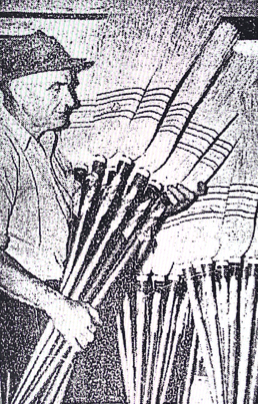
Roy Foster with some of his brooms [Newcastle Morning Herald and Miners’ Advocate, 10 January 1953]
In a week or two when the crop is ready, the farmers will cut their millet, seed it and either press the millet into bales or cart in bundles to Mr. Foster’s factory. This is a chancy time, for rain at this period can mar the millet. “Of course that’s the luck of farming,” philosophised one farmer. “Take that millet. It could be worth £200 a ton —or it could be worth what the buyer will give you for it. If it gets too wet when it’s being harvested, it’s not worth very much. So a lot of money depends on a little bit of rain. “It isn’t only millet,” he added mournfully. “You even need luck with pumpkins.”
Last year, the area provided about 300 tons of millet which amounts to about 700 acres growing brooms. While the Hunter was the founder of broom production in the State, Tumut is now the largest producer.
When the millet is brought to the factory, it is soaked with water, drained and dried, this process making it pliable. The millet is bundled by expert hands into the shape of a broom, pressed by machinery, stitched and, with its pine or hardwood handle which has also been specially treated, sent into the world as a broom.
The key point about millet, says Mr. Foster, is the length of the “hurl,” that is the stalk which carries the seeds. A long hurl makes a long, wide, good quality broom. Mr. Foster has 10 employees in his factory, most being skilled workers because, even with modern machinery, it is not easy to make a good broom.
In Raymond Terrace I met a veteran millet grower of the district, Mr. W. Carmody, who retired from farming a year or so ago and had been growing millet for 40 years. When he started, millet was as low as £25 a ton.
Mr. Foster remembers times like that, too, but brooms are in demand now. But he regrets that some of the niceties have gone out of broom making. Once, every broom coming from the factory had red and green velvet bands around the broom end of the handle. But that is only possible for special brooms today. On the other hand, the area’s broom industry had progressed far from the old original machine which Mr. Samuel Foster bought to start the work and which Mr. Roy Foster still has.
Through the working year Mr. Foster travels to Melbourne by road on broom business, following the growing areas and talking brooms all the time. Or he makes trips to the north to buy seed or millet and thus keep pace with the housewife’s unending sweeping. But brooms aren’t all of Mr. Foster’s life. His private passion is growing prize gladioli. Mr. Roy Foster with some of his brooms. His factory will start new season’s production shortly when the new millet in the area is harvested.’
No Broom Millet crop in the Lower Hunter area – 1955
The Raymond Terrace Examiner and Lower Hunter and Port Stephens Advertiser of 21 April 1955, page 3, reported:
‘Broom millet growers in the Tumut district are reaping an excellent harvest. This district, says Mr. L. Kaanagh, Special Agronomist of the Division of Plant Industry, New South Wales Department of Agriculture. Recent weather has been almost perfect for harvesting and drying.
It is likely that 90 per cent of the N. S. W. output this year will come from the Tumut area, and prices being received range from £180 to £200 per ton. There will be no millet from the Hunter area this year. There would have been very little new millet even had there been no flood. It was considered that millet as crop was not payable. Most farmers have a carry-over of millet from the previous season. This has now gone in the flood.’
Concluding Comments
The last recorded operation of the Bowthorne broom factory was in 1953. William John Roy Foster who had managed the broom factory in 1953 died on 10 June 1958 at Bowthorne.
The buildings that comprised the broom factory still exist at Wallalong.
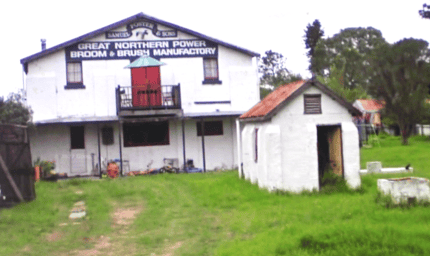
Former factory of the Great Northern Power Broom and Brush Manufactory at 44 McClymonts Swamp Road, Bowthorne, now utilised as a residence. The premises were sold to its current owner in 1995 and are listed under NSW Heritage Legislation.
Broom millet is still grown in the Lower Hunter Region but to a much lesser extent than in the pre -1955 years.
Researched and compiled by Kevin McGuinness
September 2026

 Port Stephens - a history exploration