
How the Giant Forest Trees were moved to Market
The Sydney Mail published an article on 17 April 1912, page 19, entitled ‘Forest Giants: How They Are Slain’.
The article is reproduced below and offers a realistic account of the timber-getting industry that once formed a significant part of the Port Stephens region’s economic life.
‘The deep silence of the forest is shocked by the loud shouting of the drivers, who, dexterously wielding their long whips in the small, cleared space, make the bush echo and re-echo with the tumult of shouts and cracking thongs. “Wo-back! Come here!” A second time the order is roared, followed by another volley from the whips, and the bullocks, thus admonished, follow the leaders and turn, walking slowly back towards the drivers.
The task before the bullocks and men is no ordinary one, or rather it would not be to the general run of drivers. To haul an 80-foot turpentine log from the spot where it was felled through a perfect maze of big forest trees and dense undergrowth on to a bush track is work which can only be accomplished by men and bullocks trained to the work.
The training process is a gradual one; a new beast being yoked up with a team to get into the run of the work. To train a leader the bullock chosen is yoked with the other leader, and he soon learns. If he doesn’t, he gets hurt. A good pair of leaders make a big difference to a team, and so do good “tailers.”
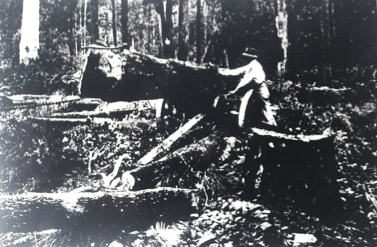
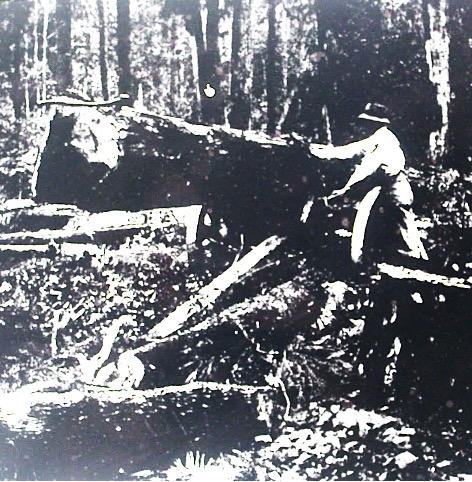
Hauling a Blue Gum from the forest near Myall Lakes. The tree measured 22ft [7 metres] in girth, and would be cut into about 10,000ft of timber [Sydney Mail, 17 April 1912]
Many difficulties confront bullock-drivers and their teams in the big timber country north of the Myall Lakes, within 200 miles of Sydney, where some of the best turpentine forests of Australia are located. There is an extensive trade in these logs or piles for wharf-building in Sydney and Melbourne, the Harbour Trusts in each State specifying turpentine timber for its durability in the water, due to its power to resist the cobra. Big shipments of these piles have also been made to Canada.
To indicate how extensive these forests are, it may be explained that for nearly half a century axemen have been cutting big trees — turpentine, black-butt, tallowwood, ironbark, and blue gum — on the mainland side of the Upper Myall Lakes, and yet there is still timber in sight, or growing to maturity, sufficient for another thirty years [until 1942], if cutting proceeds at the same rate.
The vehicle for the conveyance of the logs, called a truck, is composed of two distinct sets of wheels, built either of solid wood bound with an iron rim or with spokes. In the front of the forward wheels is a thick pole, on each side of which stand the “tailers.” The indispensable axe and a mattock are placed on the truck, while spare chain or two is also in evidence. This is not a “shire” road that is followed, but merely a bush track, cut out of the dense timber by the teamsters who have been on the trail for logs.
The wheels, laden with their heavy freight, have ploughed deep ruts, and when they get so deep as to be absolutely impassable a detour is made in the bush, and a new road is made. At the bottom of a deep gully the teams come to a halt, where a little mountain stream runs quietly through the underbrush. Here the long teams are unhitched from the trucks.
The business of the day starts in earnest now, for the logs have to be hauled down to the bush track. Even a timber truck cannot travel to the spot where the giant of the forest has been slain, and the bullocks must be taken alone. Each team hauls out a log and so different paths are taken. After bullocks and men struggle for some time through the scrub a halt is cried, and one of the axemen who has already been at work comes forward. These tree-slayers have just been sitting and smoking their pipes on the great tree which yesterday held its head in the open sunlight above the forest, and which now awaits its removal to the lakeside.
The bullock-driver exchanges a word or two with the axemen, and the plan of work is ready to be carried out. The tree has been shorn of all its limbs and is to all intents and purposes a pile ready for use. In its position the bullocks cannot get a straight pull, but a chain is passed round its base, and a block and tackle affixed to a tree 30ft in front. The team is hitched up to the tackle after a lot of manoeuvres to ensure a straight pull. The driver then roars his orders, calling many of the animals by name, and letting the whip fall from time to time. His shouts are unintelligible, except to the bullocks, and as the log trembles to the terrible strain his mates cry out in encouragement: “She moves, Billy! She’s going! Keep ’em up to it.”
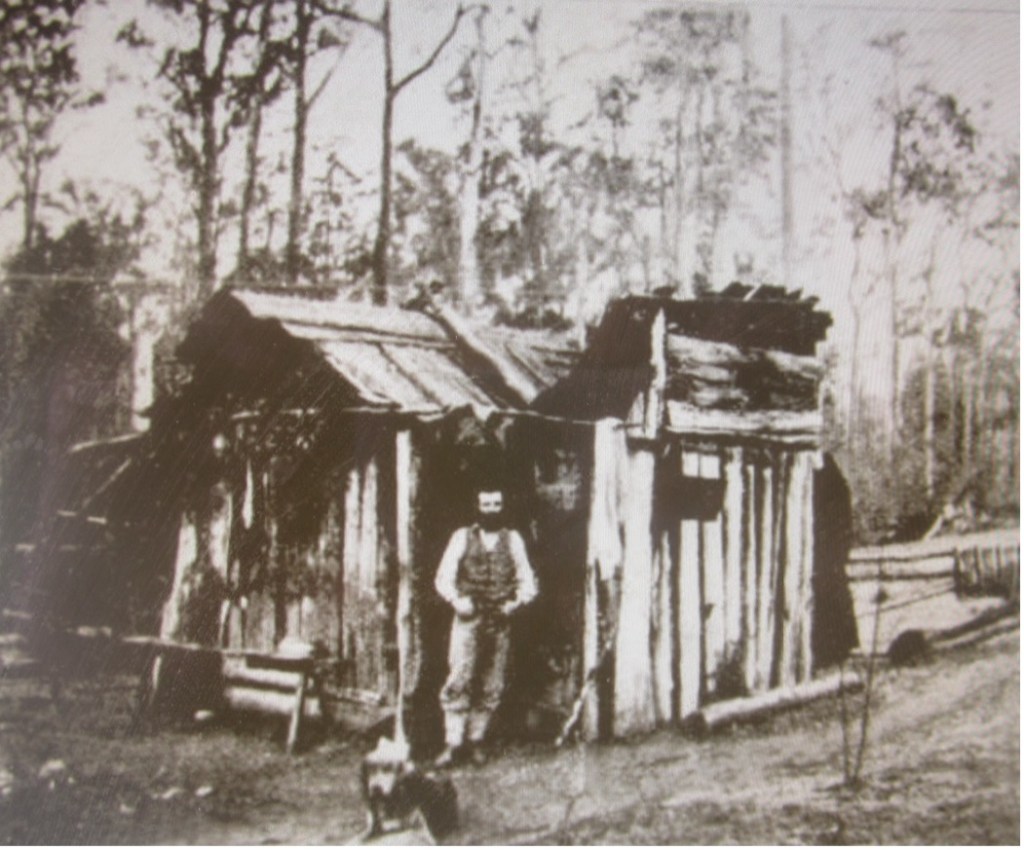
A timber-cutters hut, typical of those found around the Myall River [Sydney Mail and New South Wales Advertiser, 28 July 1900]
So encouraged, the driver executes a fearsome dance, cracking and whirling his whip, and shouting the names of his bullocks. It is quite true the log is slowly moving, but it meets another fallen tree, and the team is called to a stand. The axes are got to work, and the impeding tree is cut through. The same scene is enacted, and the log moves along again, until it comes up to the block. The block is then fixed to a tree in a different direction, and after another pull the block and tackle are dispensed with. Then, amidst the noise of cracking whips and shouted orders, the team slowly draws the huge log through the forest, tearing down small trees and bushes as it passes along.
In the maze of turnings, the bullocks often get into what appear to be hopeless tangles, but the team rights itself in a wonderful way with a little manipulation on the driver’s part.
Once the main bush track is regained the trucks are brought into requisition to carry the log to the waterside. The log is first drawn over one truck by means of a skid-log placed against the wheels, and a side pull by the bullocks draws the pile over the wheel on to the truck. The other end of the pile rests on the forward truck, and as soon as it is securely chained to the trucks a start is made. The roads on the outward journey are bad enough, but on the return with an 80-foot pile trailing behind the team, the bad road becomes positively dangerous.
Quite frequently one of the trucks, lurches or skids into a deep rut, and the whole outfit turns over. There are windings so sharp that even the expert judgment and driving on the men’s part cannot avert an accident at times. Sometimes they are “up against” a tree, and either that has to be chopped down or the team placed on to the other end of the pile to draw it back, so that a detour can be made.
When the piles are cut they are hauled to various depots round the Myall Lakes, Wallingat River [mid north coast region], Bulahdelah, Coolongolook, Forster, and the Karuah River. There are big sawmills on the waterfront at Bungwahl, Nabiac, Coolongolook, and Forster, and, in addition, many depots for the loading and despatch of piles. One of the most important of these is at Rock View, on the Wallingat River, where there are often 2000 piles awaiting shipment. Here they are measured, and payments are made monthly.
Prices for logs range from 3s to 7s per 100 super feet, according to class of timber. Piles are measured by the running foot and realise about 1s or 1s 3d a foot. The royalty [fee payable to NSW Government] on turpentine piles is threepence, and ironbark fourpence per foot.
The piles are loaded on to droghers, and from the Upper Myall Lakes they have a lake journey of about 60 miles to Port Stephens, where the deep-sea vessels load them for the various States or for overseas.
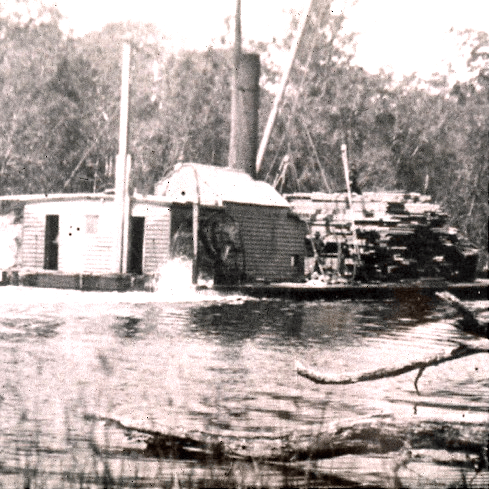
Timber drogher on the Myall River
About five miles from Bungwahl on the Upper Myall Lake, there are two depots, which form the termini for tramway lines from the mountains above. The logs are hauled from the forest to the tramlines and are brought down by horse teams. At this depot the writer saw one turpentine pile measuring 98ft, but these big lengths are not often met with nowadays. This important industry employs a large number of men — axemen, drivers, labourers, drogher hands, and mill employees, and every phase of the work, more especially that in the heart of the bush, is alive with interest to the visitor.’
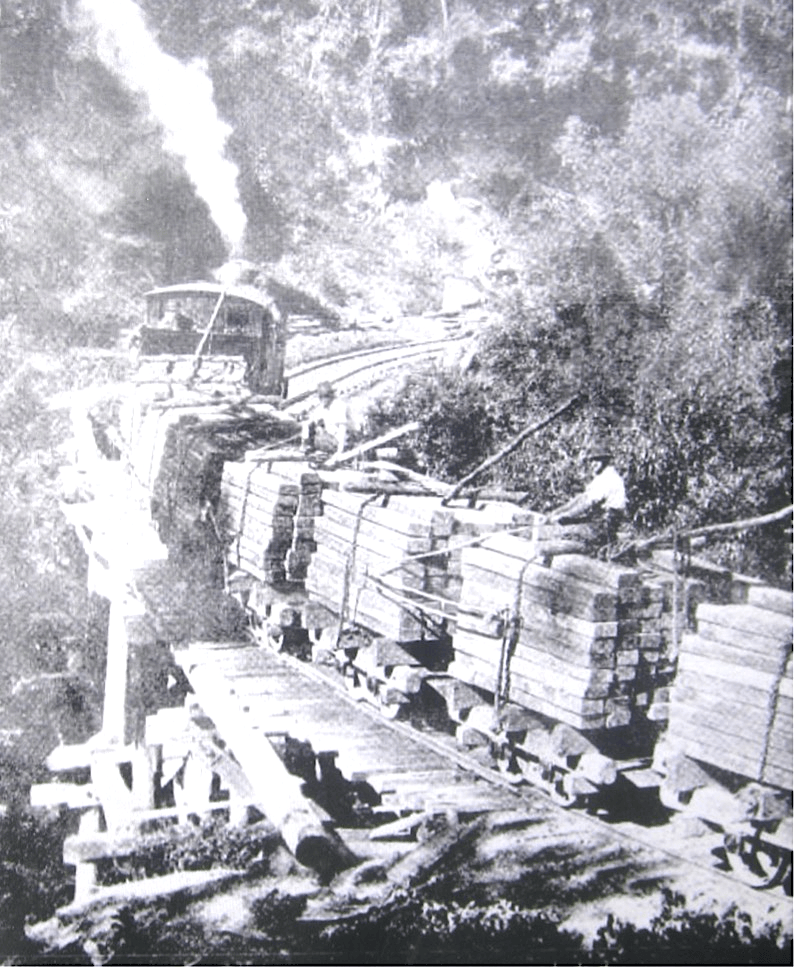
Railway sleepers being transported on a timber tramline in the Myall district [Sydney Mail, 13 October 1920]
Concluding Comments.
By the early 1950’s, the halcyon period of timber getting and milling in the Port Stephens region was over. The Myall Lakes area, once frequented by timber workers, entered a quieter period and was discovered by tourists.
Other papers dealing with the Port Stephens timber industry are published on this website and can be viewed at the following links:
Early History of the Timber Industry in the Myall and Port Stephens Areas
History of the Birdwood Timber Mill at Winda Woppa – Port Stephens
A Journal of the Port Stephens Waterside Workers Federation – 1924
Activities of the Waterside Workers Federation at Port Stephens
Researched and compiled by Kevin McGuinness
September 2026


