
Introduction
The Newcastle Morning Herald and Miners’ Advocate of 8 August 1893, page 7, published an article written by an unnamed special reporter who covered the history and current issues of the Raymond Terrace district at that time.
The article gives an insight into the period of the economic depression of 1890’s in the Australian states. The year 1893, when the article was published, marked the nadir of the financial depression and the banking crisis that froze over half of bank deposits.
The banking crisis had severe consequences for the farmers of the Raymond Terrace district who were trying to recover after the devastating flood of February 1893 that had destroyed their farms and livelihood.
The article is set out in full as below:
Raymond Terrace – 1893
‘One of the most prosperous and important towns on the Hunter [River] is Raymond Terrace, which occupies a beautiful situation on the east bank of the river, 18 miles by water from this city [Newcastle]. A representative of this journal visited the place on Thursday, and owing to the kindness of a number of inhabitants, he was enabled to see all that there was to be seen in the town and its immediate district.
There are two ways of reaching Raymond Terrace from this city, the most frequented route being, by water. Every morning the Newcastle and Hunter River Steamship Company runs one of its boats to Morpeth, and three times a week the little steamer Favourite runs to the town and the Williams River. The alternative route is taking the train to Hexham, and then proceeding by the northern coach, which passes through Raymond Terrace.
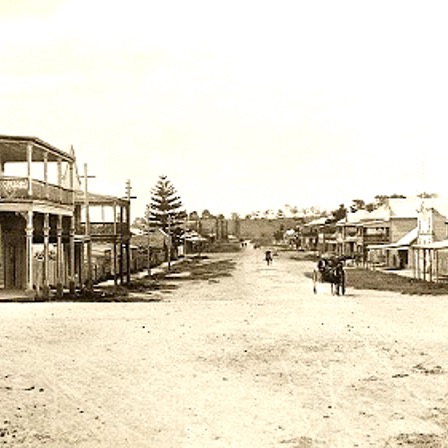
Built on a gentle slope from the water, the town is pleasantly situated, just between the junction of the Hunter and Williams Rivers and overlooking the beautiful valley which stretches westward as far as Maitland. Only the lower portion of the town is liable to floods, and in the unprecedented deluge in February last hundreds of flooded-out settlers sought refuge in the public buildings and houses of Raymond Terrace. Although the town itself suffered little damage, the low-lying, country along the west bank of the river was flooded to a height of, in some places, 15ft, and great havoc was wrought. From the effects of this flood the farmers have not yet recovered, and the continual rains which have fallen since have almost distracted the poor settlers, many of whom pay enormous rents for their holdings.
Raymond Terrace has the distinction of being amongst the first three places surveyed for a town in New South Wales. It was a smiling village before Newcastle was named and is even older than Morpeth or Singleton. Being the centre of what is termed the Lower Hunter district one of the most fertile along the matchless valley of the river—Raymond Terrace in former times ran a neck and neck race with Morpeth for supremacy. The construction of the Great Northern Railway [completed in 1889], however, settled the question, and both places have been excelled by the two Maitlands [East and West], Singleton, and Muswellbrook.
It would seem that Raymond Terrace was named after a gentleman [James Raymond] who occupied the position of Postmaster General long before the days of responsible government in New South Wales.
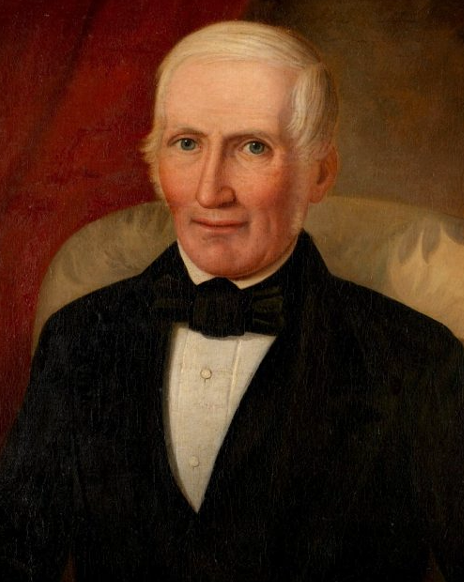
James Raymond (1786-1851) – first Postmaster-General in New South Wales [National Portrait Gallery]
From the Government records it is found that the first town lots were sold in the year 1840, and in 1884. Raymond Terrace was formed into a municipality. Alderman Henry Courtney is the present Mayor, and to that gentleman our representative is indebted for much of the information contained in this article.
The present population of the town is 960 souls, while in the immediate district, which embraces Miller’s Forest, Nelson Plains, and the land to the east and south of the town as far as Williamtown and Tomago, it is over 3000. Raymond Terrace is the principal settlement in the Gloucester electorate, which is bounded on the west by the Hunter and Williams rivers, on the south by Northumberland, on the east by the ocean, and extending north to Bulahdelah and Stroud. It is a very large constituency and considerable speculation exists as to how the boundaries will be altered under the new Act.
Many of the people, and probably the majority, are in favour of extending the eastern boundary so that Miller’s Forest and Nelson Plains can be included and the northerly confines shifted as far south as to give the requisite number of electors under the Act. They all agree that Williamtown must be retained, but opinion is divided as to whether Stockton should or should not, be tacked on to the seat. With the exception of this question matters political are very quiet at Raymond Terrace, but a movement is on foot to urge the Railways Commissioners to authorise the stoppage of the mail trains at Hexham.
It appears that the Post-Office in the town, which is under the charge of Mr. J. B. Wakely, is the receiving station for the whole of the mails from as far north as Kempsey, Port Macquarie, and the Myall River. The average number of mail bags received daily is 52, and last year they totalled 96,649 letters. At the present time these mails are taken to Hexham by coach and sent to Newcastle by the 5.26 p.m. suburban train. They remain in this city until 7.40 p.m., when they are taken on to Sydney by the northern express. Mails from Sydney are delayed in Newcastle from the arrival, of the night express at 9.35 until the last suburban train at 10.45 p.m., and frequently this latter train is delayed for the convenience of country visitors to places of amusement until 11 p.m.
By stopping the mail trains at Hexham hours would be saved in the delivery of mails; but the most important argument in favour of the change is the inconvenience caused to passengers travelling to Gloucester or the Manning district, as they too are delayed just in the same way as the mails by having to tranship at Newcastle. A monster petition, signed by some 300 people, will be presented to the Commissioners shortly, and it is the intention of the movers to prevail upon Sir William Windeyer, Mr. John Eales, M.L.C., and Mr. J. S. Hart, the member for the district, to undertake the duty.
The town of Raymond Terrace is splendidly laid out, the streets being nearly all over a chain in width. On an eminence overlooking the whole country is the reserve [now names Boomerang Park], which has an area of 97 acres, and from a rotunda constructed there a magnificent view— alone sufficient to compensate the tourist for his trouble—is obtained. The hill in this city [Newcastle] can be seen plainly, for it is within 11 miles as the crow flies.
At the present time the rates from the property in the municipality amount to about £300 per annum, and, in common with the rest of the towns in New South Wales, the council are often at their wits’ end to find funds to meet the expenditure. The town boasts a very good School of Arts, containing 800 volumes; a courthouse, a police station, and a post and telegraph office. In connection with this last building a grievance exists, because the Government, after drawing up plans and actually calling for tenders to add a second story to the structure [Sydney Morning Herald of 29 December 1892 reported that 10 tenders were received and Southam Brothers had tendered the lowest price of £717], suddenly quashed the whole thing, and found out that the building was good enough for all present requirements.
The public school, which is in charge of Mr. J. P. Green, is attended daily by some 108 pupils, and the people are justly proud of the high standard attained by them at the last annual examinations. Among the religious bodies the Roman Catholics head the list, followed by the Church of England, the Presbyterians, and the Wesleyans. One of the most striking landmarks of the place are a number of magnificent trees which stand in the parsonage grounds of the Church of England. Three of the trees are Norfolk Island pines, and although not so large in diameter as the three magnificent specimens in the Sydney Botanical Gardens, they are much higher and more symmetrical. The Rev. Canon Simm states that they were planted in the year 1850, and are undoubtedly the finest specimens in the colony, the deep sandy loam being the soil in which such trees might be expected to attain their greatest perfection.
Surrounding Raymond Terrace are some magnificent estates, many of the landowners being extremely wealthy. On the town side of the river, and running south, is Kinross, the property of the late Mr. John Windeyer, whose vineyards are justly famed all over the colony.
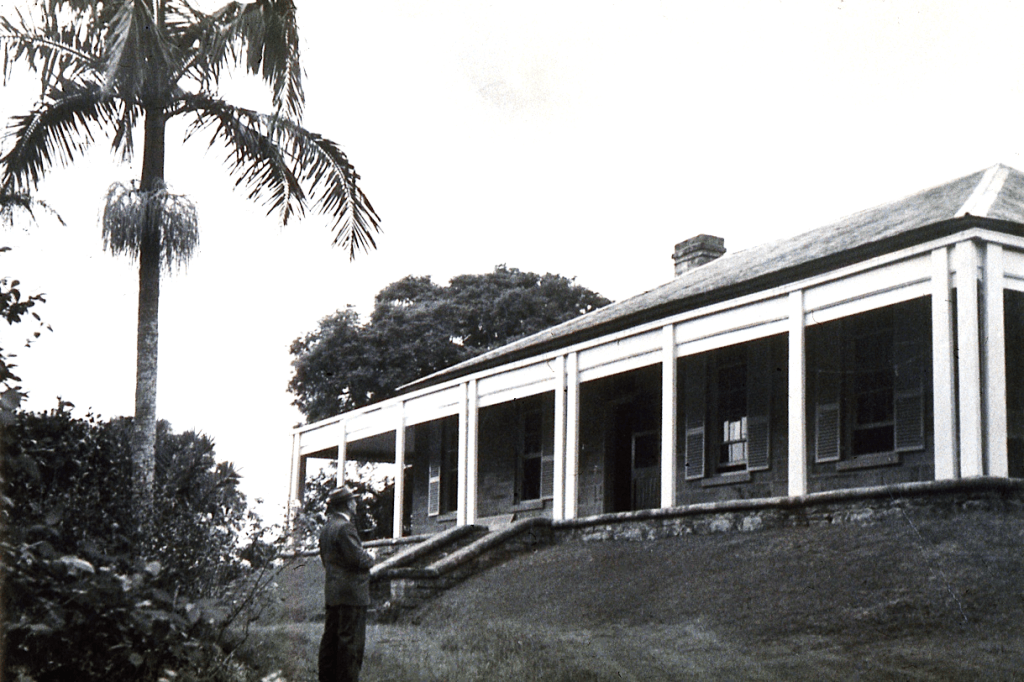
Kinross House – home of the Windeyers of Raymond Terrace – 1974 [University of Newcastle Library Living Histories Collection]
Motto Farm, the property of Mr. G. H. Pepper, skirts the river on the southern boundary of Kinross, and on this estate, the people of Raymond Terrace have laid out what is one of the finest country racecourses in the colony.
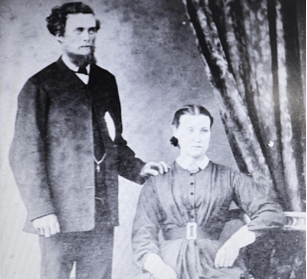
George Henry Pepper and Mary Ann Pepper ( nee Moxey)
Mr. Brett’s ‘Hollow Tree’ estate extends from Motto Farm nearly to Hexham, the land to the eastward being of a swampy nature or covered with bush. Here and there are fertile spots, but, except for mining purposes, the land between Raymond Terrace and Port Stephens is sterile, and unfit for cultivation. The North Stockton Coal and Land Company of Victoria own some 11,000 acres of this country, and they have proved the existence of payable coal seams in several spots by the diamond drill.
Across the river from Raymond Terrace is a magnificent area of alluvial land known as Miller’s Forest. It embraces an area of fully five thousand acres, and on this is settled a farming population of about 100 families. The majority of this land is freehold, and when any is to be leased a rent of, in some cases, £2 10s per acre per annum has been obtained. Although the whole valley of the Hunter suffered terribly from the great flood of February, it would seem that Miller’s Forrest came in for even more than a fair share of the devastation which was caused. The whole of the farmers were compelled to fly from their homes ……
The farmers at the present hour are in a most unenviable condition, for scores of them lost nearly all their stock by the floods, while hundreds of acres of crops were destroyed. Unfortunately, the ground has remained in a sodden state ever since, and the young crops now appear unhealthy, and in some places extremely backward. Many farmers, owing to the suspension of the banks, and the depressed state of the money market generally, have been unable to purchase stock to take the place of those lost, while others are unable to keep more cows owing to the scarcity of feed. As one farmer said to our representative, it would seem that all three of the most dreaded afflictions struck the valley at one time, namely, the greatest flood on record, followed by the most terrible financial crisis ever experienced, and, to cap all, a decline in prices for all marketable produce. It would be impossible to calculate the amount of destruction, accomplished on Miller’s Forest alone by the flood, as fully 60 per cent. of the dairy cattle on the farms were swept away.
A great deal of relief was afforded to the sufferers by the local committee, who received various handsome donations from the Newcastle fund, and the farmers generally state that they will never forget the kindness of the Newcastle people in so promptly coming to their assistance in the hour of need. Of course, instances are on record where seed was given to men who should not have received a grain, while others have been unfairly treated, but such cases are happily few and far between, and, on the whole, the fund seems to have been most creditably distributed. This is certainly the opinion of the majority of the settlers, and it reflects the greatest credit on all concerned.
In common with the farmers of Ash Island, the Miller’s Forest settlers, who lease their lands, are by no means pleased with some of their landlords. Some have foregone twelve months’ rent, others six, while a few insist on their “pound of flesh.”
Since the firm of J. Ireland, in this city [Newcastle], established their butter factory, creameries have been started all along the valley of the Hunter. In the Raymond Terrace district, there are three creameries situated at Miller’s Forest, Osterley, and Eagleton on the Williams River. Before the flood the industry was thriving to a remarkable extent, but the daily production of milk has dwindled since the flood by certainly 50 per cent., some of the people placing the estimate at as high as 60 per cent.
A great deal of butter is made in the district, while the export of lucerne hay is a large one, and forms no small part of the wealth of the district. Cereal crops are almost neglected …… Mr. John Eales, M.L.C., is the largest landowner in the district, his estates being Duckenfield and Booroona, the former property, however, being more correctly speaking in the Morpeth district. This gentleman also owns a considerable number of farms at Miller’s’ Forest and Nelson’s Plains, which are on the north side of the Hunter, and west of the Williams River.
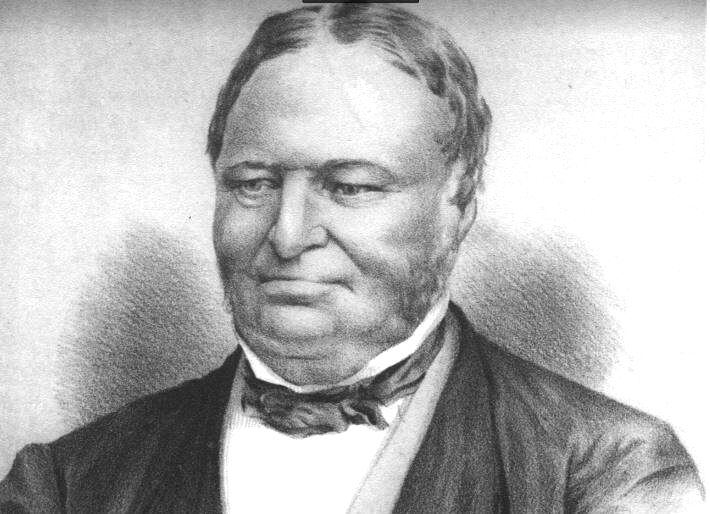
John Eales – one of the wealthiest men in New South Wales
It appears that Mr. Eales, in consequence of the floods, has agreed to forego six month’s rent on all his farms, and by those who were in arrears the following letter has been received from Mr. H. E. Smith, the agent:—”I have been instructed by the Hon. John Eales to inform you that all his tenants holding farms take notice, that those who have paid their rents to 31st December, 1892, or who immediately pay the amount then due, shall be allowed one ‘half-year’s rent to 30th June, 1893. Those tenants in arrears at 31st December, 1892, will have to give their promissory notes at 12 months, with interest at 8 per cent. added, dated lst June next, and made payable at a bank in Maitland or Morpeth. When this is complied with, one half-year’s rent to 30th June, 1893, shall be allowed them.” Thanks to the kindness of Mr. Monteagresti, manager of the A.J.S. [Australian Joint Stock] Bank at Raymond Terrace, our representative was driven round the district and was thus enabled to inquire into the condition of the farmers.
Although they are in a sad plight, and ruin stares many of them in the face, they do not sit down and cry over their losses but are working hard to redeem their position. If they are assisted by their landlords, or their banks, as the case may be, the chances are that with a good season, they will restore their farms to their former state, because the flood had its bright side, for the land has been covered with a deposit of rich alluvium, which cannot fail to fertilise the ground, and produce more than ordinary crops.
Concluding Comments
Other papers dealing with the early history and reminiscences of Raymond Terrace and district are published on this website and can be viewed at the following links:
Reminiscences of Raymond Terrace, Millers Forest and Nelsons Plains – Port Stephens
Life and Times of George Henry Pepper and Mary Ann Pepper – Pioneers of the Port Stephens Region
Journey to the Vineyards of the Lower Hunter and Port Stephens Districts – 1865
A Tour of Millers Forest and Raymond Terrace Port Stephens – 1918
Early Reminiscences of Raymond Terrace – Port Stephens
Researched and compiled by Kevin McGuinness
October 2026


