
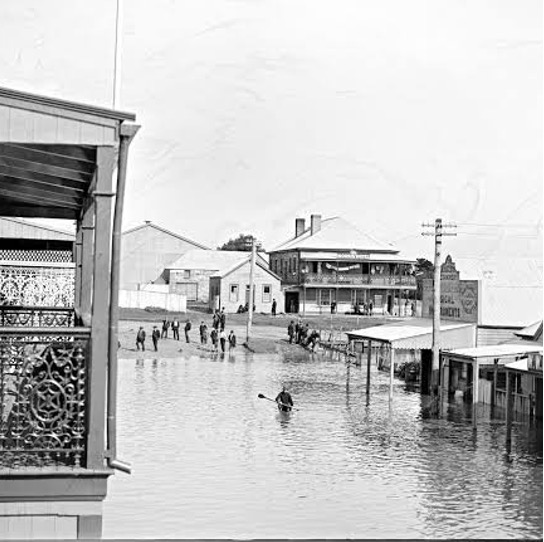
Introduction
Floods have long affected the Raymond Terrace district when the waters of the Williams, Paterson and Hunter Rivers rise.
Before early settlers introduced farming and the clearing of trees and vegetation from the river catchments, floods caused little damage while Aboriginal people were the land’s sole occupants. The vegetation slowed floodwaters, limiting riverbank erosion and damage to the surrounding land.
A report in the Daily Telegraph of 18 July 1931, page 7, described flooding in the Raymond Terrace district from 1840 onward:
‘Writing in 1891, journalist John Richard Houlding—known as “Old Boomerang” in the 1860s—recalled that when he arrived in Raymond Terrace in 1841, “There were no damaging floods in the good old days of yore.” The old flour mill supports this account: although built in 1840 on one of the town’s most flood-prone sites, it operated continuously until wheat rust forced it to close in 1867.
There appear to have been no significant floods between 1840 and 1854, with serious flooding emerging only in the late 1860s. Houlding attributed the heavier floods to extensive timber clearing. He argued that bush and scrub may have influenced rainfall and slowed runoff, and that disastrous floods became evident only after much of the country had been cleared.
The claim that comprehensive flood mitigation would be prohibitively expensive should be weighed against the cost of repeated flooding. In the 23 years from 1908 to 1931, the State experienced 17 devastating floods and countless smaller “freshes,” causing incalculable production losses. From a national perspective, even a costly mitigation scheme would be more economical than allowing continual flooding to constrain production in such a fertile valley.
Another concern was the apparent increase in the volume of Lower Hunter floods. The nine floods between 1908 and May 1921 averaged 4 ft 4.8 in., compared with 6 ft 1.6 in. for the eight floods from then to 1931. The report suggested that reduced river shipping and the resulting decline in dredging might explain the rise. Whatever the cause, it argued that without measures to limit these inundations, the State would not realise the full benefit of this highly productive region.’
Flooding in Raymond Terrace has generally coincided with flooding in the Maitland district as both are parts of the Hunter, William and Paterson River systems .
The Evening News of 26 August 1899, page 6, reviewed Maitland’s major flood years, which would also have affected Raymond Terrace:
‘The earliest recorded flood occurred in 1826, when the river rose 29 ft above summer level. Maitland later recorded the following heights: 1840, 29 ft; 1851, 23 ft; 1857, 26 ft; July 1857, 30 ft; 1861, 24 ft; 1864, 29 ft; 1866, 28 ft; 1867, 31 ft; 1868, 30 ft; 11 March 1870, 29 ft; 19 March 1870, 30 ft; April 1870, 34 ft; 1875, 33 ft; 1889, 33 ft; February 1890, 31 ft; March 1890, 36 ft; and 1893, 36 ft 3 in. The 1893 flood was the highest on record, and some claimed that the river rose even higher than these figures indicate.’
This paper examines the major floods that affected the Raymond Terrace district in the following 7 years: 1857, 1867, 1875, 1893, 1899, 1913 and 1955, focusing on their devastating effects on local household residents and farmers.
1. GREAT FLOOD OF AUGUST 1857
Inundation of the Raymond Terrace District
The Empire of 28 August 1857, page 4, reported:
‘…. At Raymond Terrace the inhabitants were unprepared for the flood, so sudden was the rise of the river there. The water reached a level of about five feet above that of the last flood. It was reported that several persons were drowned up the Williams River, and that the current was running with such force as to prevent those unfortunate persons from retaining their hold of ropes thrown to them. Whether this report referred to the family named Boss, and the two Germans at Holmes’ Flat, elsewhere spoken of, we could not ascertain.
Mr. J. O. Portus, of Raymond Terrace, and others, were out in boats rescuing their neighbours from danger. Several persons were taken from the very ridge of the roof of Mr. W. Woods’s, at Cockadingy, behind Mr. Eales’s. A boat was pulled in front of Berry Park House, to the great surprise of Mr. Eales. One sheet of water extended from the Duckholes to the Williams River. ….’
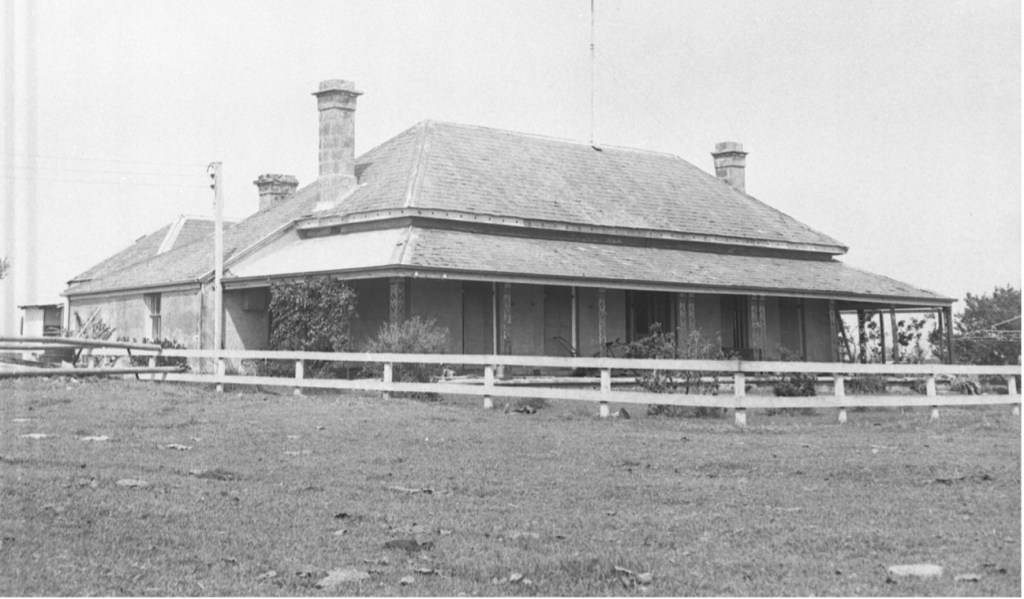
Berry Pary House (John Eales’’ House ) – 1974 [University of Newcastle Library, Living Histories collection]
Extent of Flooding
The Empire of 1 September 1857, page 3, reported:
‘Like Job’s messengers of adversity following each other in quick succession has flood followed flood, each more destructive than the last.
On Wednesday evening [26 August 1857] the storm cloud arose in the north accompanied by heavy rain and thunder. The rain continued Thursday, the wind veering round to the eastward, blowing a gale; and the watery element pouring down a perfect deluge. Friday the weather still continued much the same. The Hunter now poured over its banks and inundated the whole low country, while the Williams and the Paterson contributed their currents to increase the waters to a perfect sea.
Active measures were now taken to rescue property and life. The population of Nelson’s Plains, on the Williams, took alarm, and seizing what boats they could, descended to Raymond Terrace; while the chief constable, Mr. Buckly, the constabulary, the fishermen, Mr. Jacobs, and other volunteers crossed the river to the rescue of numbers of the residents of Miller’s Forest, who had by firing guns, &c, given intimation of their danger. Several were taken off the tie-beams of their houses and thus saved a watery grave. The boats were literally laden with human beings to the very gunwale’s edge, so pressing the necessity.
The flood still rising on Saturday and Sunday, although the rain had ceased about noon, Sunday, the townspeople were obliged to desert their habitations in the lower part of the town. Some were taken from the upper story by boats, the flood having risen some six or seven feet within their stores and dwellings, destroying a considerable amount of property which it was utterly impossible to rescue.
Near 400 persons, driven from their homes, had on Friday assembled at Raymond Terrace. The inns were filled, the church, the police office, &c., were thrown open, and private dwellings made sanctuaries for the fugitives. The inhabitants took up their carpets and gave them for coverings, while Mr. Windeyer issued instructions to the bakers and butchers to supply food.
The lower floor of Mr. Portus’s mill was several feet high in water. The Steam Companies’ stores were in like manner deluged and several of the stores of the town had the water over their counters. Such a flood had not been on record for upwards of 30 years—possibly the flood of 1820, which rose so high at Maitland. Thanks to the activity of the police and volunteers no lives have been lost although the amount of property destroyed must be very great. Wheat, flour, cattle, poultry, soft goods, &c., will furnish a distressing account of ruined property as soon as the waters subside.
Monday, noon. — The river still flows on, and the water is still rising although the rain has abated. Hay-stacks, cradles, dead animals, casks, &c, all mingled together float down the current on a voyage to the sea, and the whole country on the Miller’s Forest side and the Nelson Plains is one inland waste of waters, with here and there the gable-end of a house just appearing above the water, serving as flood marks for future record.
As yet we have heard nothing from Maitland, but as this flood is certainly some 8 or 10 feet above the July flood, the disasters there must be fearful. We only hope that no life has been lost, and wait impatiently for intelligence.
Many families must be ruined; the hopes of years of industry destroyed, and the energy of too many paralysed, for they can see in this no security for the future on the low and fertile banks of these rivers. The critical season for corn and potatoes, &c., is now immediate, but the state of the ground after this flood, the destruction of fences, the loss of working bullocks and horses, farming implements, &. cannot fail but to throw back all agricultural operations to a late period.
The Government, we trust, will in some way look to this, and set on foot at once an inquiry as to the ability of the district to resume agricultural operations, &c. A circular to the benches of magistrates, uniting with them some of the more intelligent residents, may in a week or so put the Ministry in possession of various facts and suggestions to guide them in their relief proceedings.
Monday night. — The moon now shines brightly, casting her silvery beams across the desolation, and the stars stand out clearly as if giving the forlorn and houseless a hope of the speedy subsidence of the waters. But what a cheerless prospect. Yet there is no use in despair; but those people want the countenance not only of the public generally but of the Government, of the people’s representatives in the Legislative Assembly, to assure them that their individual exertions will meet with sympathy and support from the Ministry and the Parliament. It is not to be behaved as an ordinary calamity, but one affecting all our interests; in fact, affecting the fixity of population in our richest and most productive localities.
Friday. — Waters began to subside, so that parties were enabled to return to their farms on Wednesday and Thursday. I find that there were near 1000 persons collected here. What will become of many of them it is hard to say. The town presents a melancholy appearance; wheat drying here, calicoes there, haberdashery spread abroad in all directions; houses filled with mire, streets impassable, and desponding faces at every corner. We hear that a family of seven persons have perished at Dungog, and two children near Clarence Town.’
Public Meeting at Raymond Terrace
The Empire of 11 September 1857, page 6, reported:
‘According to notice, a meeting of the inhabitants of Raymond Terrace and its neighbourhood, took place at the Courthouse, on Friday last, for the purpose of expressing their approbation of the meritorious conduct of parties in rescuing life and property in the late disastrous flood. The chair was occupied by A. [Archibald] Windeyer, Esq., J.P.
Mr. Windeyer observed that the conduct of the inhabitants was above all praise in the late fearful emergency—that their activity in saving life, and their indifference to their own wants, in many instances, was calculated to make one proud of such a population. The manner in which the inhabitants took in their suffering fellowbeings was deserving of thanks.
Lieutenant R. Sadleir, R.N., moved the first resolution. He regretted that from his position he could not reach the scene of action, being surrounded himself by water but he was happy to learn, that through the exertions of his brother magistrate, now in the chair, the orderly conduct of the people, the activity of Mr. Buckley the chief constable and the ordinary constables, together with the praise-worthy zeal of the inhabitants, his services were not required. The visitation had been too general over the colony for the Government to give general relief, but there were cases of utter ruin in which something, he thought, ought to be done. [Many voices called out, “We don’t want charity, but a loan to start us again, paying interest.”]
Mr. Sadleir said that was his own idea, giving loans to those who are real sufferers. He also said that some forty years back three successive floods took place at the Hawkesbury, and we must expect repetitions of like calamities, though it is to be hoped, far between. A question therefore for consideration was whether any suggestion could be made to lessen the fearful consequences of such calamities. Now he thought, as at Richmond a large common on high land had been reserved as a refuge for the people and their cattle, similar reserves ought to be made along the various rivers of the colony for like purpose.
The population also on the banks of these rivers ought to form boat clubs, which, in times of flood, would serve a similar purpose as fire brigades, to rescue life and property, and not as had lately been the case in Maitland, to send to Newcastle for boats, manned by New Zealanders, and thus to trust to casualties of that description in such fearful emergencies. He could not forbear to mention the wide hospitality of the inhabitants in throwing open their houses to the destitute, and thus proving their benevolence and sympathy with suffering; nor could he help remarking on the activity of their chairman, who though far advanced in life, nevertheless exhibited the energy of younger days, and also took upon himself the responsibility of issuing clothing and food to upwards of four hundred destitute beings who had been driven from their homes by this sudden visitation.
He was happy to hear the grateful acknowledgment of the meeting as to the services rendered them by Mr. Buckley, the police, the Messrs. Jacob, the Phelps’ fishermen, Davis, and others. [Several voices at this time called out, “Yes, our lives were saved by these parties.”]
He now moved the resolution:—”That this meeting records with heartfelt admiration its sense of the services rendered by various volunteers, who by their alacrity and untiring exertions in the boats were the means of rescuing many of their fellow-beings in the late disastrous flood in this district from imminent peril and death.” Mr. Manary seconded the resolution, which was carried unanimously.
At this stage of the proceedings, some mention having been made that the newspapers had taken no notice of Raymond Terrace, a paragraph was read from the Empire, showing that that paper had not overlooked the neighbourhood, but given insertion to a minute article describing the calamity, and suggesting that the Government should set on foot an enquiry into the extent of the calamity.
Mr. John Baerry moved the second resolution. He observed that he had himself witnessed the activity and exertions of not only Mr. Buckley, but the Messrs. Jacobs, to whom the population were greatly indebted for the preservation of life and property. Unfortunately he was himself obliged to look to his own family, to rescue them from danger, and therefore could not render any essential service. He therefore moved the resolution with these few remarks—”That this meeting only abstains from particularizing the names of those whose conduct merits the highest praise and publicity, from a feeling of difficulty in discriminating amongst the many who in that emergency, indifferent to fatigue and to personal loss, devoted themselves to this work of humanity.” Mr. Donoghue seconded the resolution, which was carried unanimously.
The third resolution was proposed by A. Jacons, Esq., who said, the calamity had been so general, scarce any one escaping some degree of loss, that he did not see how the Government could relieve all; but he had received a letter from Mr. Barker, who had sent down a ton of flour to be distributed, and stated that he had formed one of a deputation to the Government to bring the urgency of the case under notice—”proposing that the Government should render assistance in proportion to funds raised by the population, and that the deputation had hopes of their application being successful.”
This proposition had no doubt been made previous to the last flood, as such aid now would not at all be adequate to what was required. The Government would have to grant some thousands, and then there would not be relief sufficient. There were a great many sufferers who, no doubt, would prefer loans to having the money given to them, and of course such a step would be the preferable one where it could be carried out. [Several voices here remarked that they would prefer loans to gifts to enable them to start afresh.]
He had much pleasure in moving the resolution:— “That this meeting, deploring the serious losses which many of the residents of the town and neighbourhood have suffered on that occasion, takes this opportunity of expressing their deep sympathy in a disaster so very general as to leave scarce any individual resident free from some visitation, but which to many has been little short of ruin, whom they would recommend to the consideration of the Government.” The resolution was seconded by Mr. Makin, and carried unanimously.
Mr. Robert Jacobs, in moving the fourth resolution, observed, what they wanted was a better police boat, the present one was neither safe nor suitable; there ought to be a light whale-boat for two men, as at Newcastle or Sydney; the lives of the police were endangered by the present boat. The repairs of the boat cost more than a new one. He would most willingly unite in a boat club and look after the boats. With these observations be moved—”That to mark their respect for conduct so eminently successful in rescuing life and property, these resolutions be forwarded to the press for insertion.” The resolution having been seconded by Mr. Buckley, was carried unanimously.
A vote of thanks, with three cheers for the Chairman, closed the proceedings of the meeting, at which there were some 50 persons present, several of whom stated their lives had been rescued from a watery grave by the exertions of their neighbours.’
Millers Forest Flood Experience
The Maitland Mercury and Hunter River General Advertiser of 12 September 1857, page 2, reported:
‘Although at no great distance from Maitland, I presume from the impassable state of the roads, we seem to be a “terra incognita ” to the Maitlanders, as in reading the various accounts of the floods. I see no allusion made to the destruction caused by the last and greatest of them in this vicinity.
As none of the previous floods had reached our houses, and had injured nothing except the growing crops, we were lulled into a false feeling of security, which was rudely broken in upon on the morning of the 22nd, by the “sound of many waters” just before daylight, when from the river overflowing its banks about Berry Park [near Millers Forest], and almost simultaneously at the elbow a little below Osterley, and low lying lands between Duckenfield and Raymond Terrace, comprising the whole of Millers Forest, filled up with fearful rapidly, as all those parts are much lower than the Banks of the river.
The Scotch Creek had been watched the previous night, and found to have a hardly perceptible rise, and most person in the district retired to rest with perfect confidence but were aroused by the firing of guns and cries of distress, and upon getting out of bed found themselves in many instances up to their knees in water. The water rose with most alarming rapidity; near where I reside it rose five feet in perpendicular height in about an hour and a half. My house, being rather higher than any of my neighbours’, was soon filled with women and children, for whom I made a platform of forms on the floor, but before they were taken off it was over their shoes, even upon this.
Some persons who resided near high ground escaped by wading with hardly an article of clothing on them. As the young men of Maitland have been deservedly chronicled for their exertions on behalf of their suffering fellow creatures allow me to mention the names of some in this vicinity who “did likewise.” Where all exerted themselves, it would he invidious to particularise but the first boat that arrived to our rescue was that of Mr. Adam McDonaugh an old and worthy resident and this after rescuing a man and his wife who had spent the night upon a platform on the tie beams of their house, the wife being in a delicate state of health after her confinement.
Mr. Taylor, another settler, followed very soon after, in a very small boat, not much larger than a dingy, and pulled about by himself against the fearful current with much unceasing activity, rendering assistance wherever he could be useful. The boats of Messrs. Hickey, Martin, and Miner rendered the most valuable assistance, and rescued numbers of people from their perilous position. And by the evening of Saturday, nearly every person was conveyed to a place of safety.
There were many “moving accidents by flood,” and several persons nearly lost their lives by falling into drains while making to higher ground through the water; one man carried his wife nearly a mile upon his back, and for a considerable distance the water was up to his breast. A number of the people flooded out were located in Mr Eales’s new house, which was kindly thrown open to their use. The conduct of this gentleman is above all praise, as he did not only this but ordered rations to be served out to all those who chose to go for them, after inviting them to do so; he also had bullocks killed at the Duck Holes and served out to those who were in want.
Mr. Humphries at Berry Park, also invited those who had families to go there, who were supplied with everything required during their stay. The conduct of these gentlemen is more deserving of credit, as the persons relieved were not tenants of their own. Mrs Parnell, at Osterley, also opened her house, and most kindly received all who went to her. But the conduct of a humble individual, a “brother Scot,” named John McPherson, a farmer at Duckenfield, deserves more particularly to be recorded. The sloping land at the front of his house being the most convenient place for the boats to land their living freight, and he making every one welcome as they landed, the great majority remained there – as from thence they could have an opportunity of seeing how their cattle, which, were in many instances in the stockyards, or on the high banks of the creek, stood it out – so that at last there could not have been less than 100 people there. The whole house was thrown open to them.
To my knowledge Mr. McPherson walked his own verandah for three successive nights, his own bed room being taken up by the women, as some of these persons were not very refined, and the company not select – many of them (especially the children) making themselves quite at home, and taking things quite as a matter of course I take it this instance of christian spirit is worthy of special remark, as during the whole time his constant study was to see that no person was overlooked at meal times; his family were nearly worked to death cooking; night and day for so many.” The Lord reward them according to their works,”
For my own part I “roughed it” the whole time in a barn upon some lucerne hay – verily floods, as well as poverty,” as Shakespeare has it, “make us acquainted with strange bedfellows,”
But the most distressing part is the fearful destruction of property in this neighbourhood, nearly every settler having the whole of his corn crop on the straddle, or stored in the house, and a great number their wheat crop also, which as the previous floods did not reach them they presumed to be quite safe; in fact, it has been almost impossible for several months past to get drays to any town, from the bridges over the creeks being broken down, and the impassable state of the roads, and as the former floods had carried away the settlers’ wharves on the river bank, there was no way of getting the grain to market.
I counted about 10,000 bushels of grain entirely lost between about 20 settlers within a circuit of a mile or so from the Duck Holes. I know three parties who had lost 1000 bushels each between wheat and maize. Of course, all the pigs, and a great deal of the poultry have been swept away. Nearly all the cattle from the Scotch Creek were saved at the time of the flood, as not being very far from high ground they managed to swim to it, but many of them are dying now from scarcity of feed. But I understand that nearly all were lost in the lower part of the [Millers] Forest near Raymond Terrace, as those which were loose endeavoured to make for the opposite bank of the river, and were swept down by the current.
The loss of clothing, flour, &c., is very considerable, many persons, myself among the number, placed their boxes of clothing and most valuable articles on their tables, supposing that when the water spread on the flat lands it could not rise very high; but they were grievously mistaken, for the tables floated and were overturned by the current running through the houses. I know men with families who hardly know where to procure a meal’s victuals; and some small farmers have been obliged to go to hired service from the sudden and unexpected nature of the calamity. Every person has lost more or less, and many are entirely ruined.
In many places the smell of rotten and fermenting grain is most offensive, as it was impossible to return to the homes in time to save the grain, and every place being covered with mud there was nowhere to spread it out to dry, even had the weather been favourable; it is consequently all lost.
In conclusion, had the gentleman (Mr. Wright I think) who spoke at the Flood Meeting a few days since, seen our locality on Sunday, 23rd August, one complete sea, with the top of a house to be seen here and there, he would not have said, as he is reported to have done, that ” the rise of the river below Morpeth was so small us scarcely to be worth mentioning.” It is unnecessary to say that all the growing crops are destroyed, and most of the settlers have sown wheat three times this season.
2. GREAT FLOOD OF JUNE 1867
First report of the devastating flood to the Government
The Sydney Morning Herald of 27 June 1867, page 2, published the following letter written on June 25 from Raymond Terrace authorities to the NSW Government:
‘It is my painful duty to record a flood of a most disastrous character, in consequence of the late heavy rains – a flood greater than any we have had within the memory of the oldest inhabitant – a flood that has ruined our district, and has reduced to the extremist poverty the well to-do farmers, who now are solely dependent on the charity of those whose good fortune was to be out of the flood.
It would be impossible to give the faintest idea of the risk and narrow escapes of the gallant crews who went to the rescue of the sufferers, during the whole of Friday, Saturday and Sunday nights. The flood had reached its highest on Monday, 24th, when it was about from nine inches to a foot higher than the Great Flood of 1857.
Nearly the whole of Miller’s Forest, Nelson’s Plains, and the Williams is under water, horses, cattle, and pigs destroyed; haystacks, sheds, and barns filled with produce swallowed up by the angry water. The river for miles was covered with bales of hay, cobs of corn, and pumpkins. The whole of the lower streets of Raymond Terrace are inundated, and the inhabitants compelled to flee for their lives. The destruction of property is comparatively as great at the Terrace as other parts of the district. The debris washing against doors and windows of the houses destroyed them. The property of the poor people floating out was irrecoverably lost.
Our townspeople have vied with each other in rendering assistance to the unfortunates. Every house was thrown open, and every handheld out to assist those in distress. The Junction Inn sheltered and fed some 100 people, The Racehorse, forty; Mr E Doherty, sixty, Mr. Russell, thirty, the Catholic schoolhouse, the Court house also had its numbers, in fact, nearly every house (out of the water) sheltered more or less.
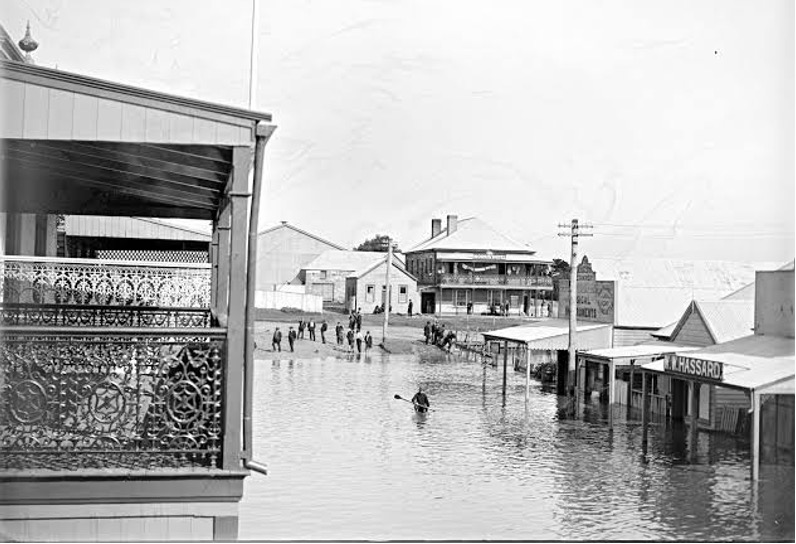
Junction Inn (two storey building at top of the hill) Raymond Terrace, which housed distressed persons during the 1867 flood, also remained above the water during a later flood
Among the numbers who exerted themselves to assist there are some that require special notice. Dr. Hector was most conspicuous in administering to the wants of those in distress, his house was thrown open for the reception of all, and by his example, day and night, stimulating others to exert themselves. H. J. Bolding, our P.M., procuring provisions – flour, tea, sugar, and meat, and clothing, and caused them to be served out to those in need.
But our volunteer boat crews exceeded all, the boat manned by Messrs T. Lenney, J. Barry, W. Chapman, E. de Ridder, and D. O’Sullivan succeeded alone in bringing off 153 souls, another crew of three Thomas Doherty, Edward Rennix, and Hugh McPherson also brought off a great number. There were other boats out, who all did good service, but the above-named crews worked one day and two nights without ceasing in the drenching rain and cutting wind, while these boats were engaged in so laudable a purpose, another crew, headed by Mr. T. Waugh, were going from place to place with provisions, and how welcome must this gentleman have been to the half-famished people.
While all these boats and men were engaged in rendering assistance to fellow creatures in distress, and while guns of distress boomed from all quarters of the forest and plains, some of the best boats were engaged bringing pigs from a house on the Terrace to dry land, and another loading his boat with pumpkins that were floating down the river, while their owners, perhaps, were perishing on the top of a house.
All postal communications are cut off; we are completely isolated. The flood is receding rapidly. The City of Newcastle, steamer, brought our papers to-day, the first news we have had since last Wednesday.
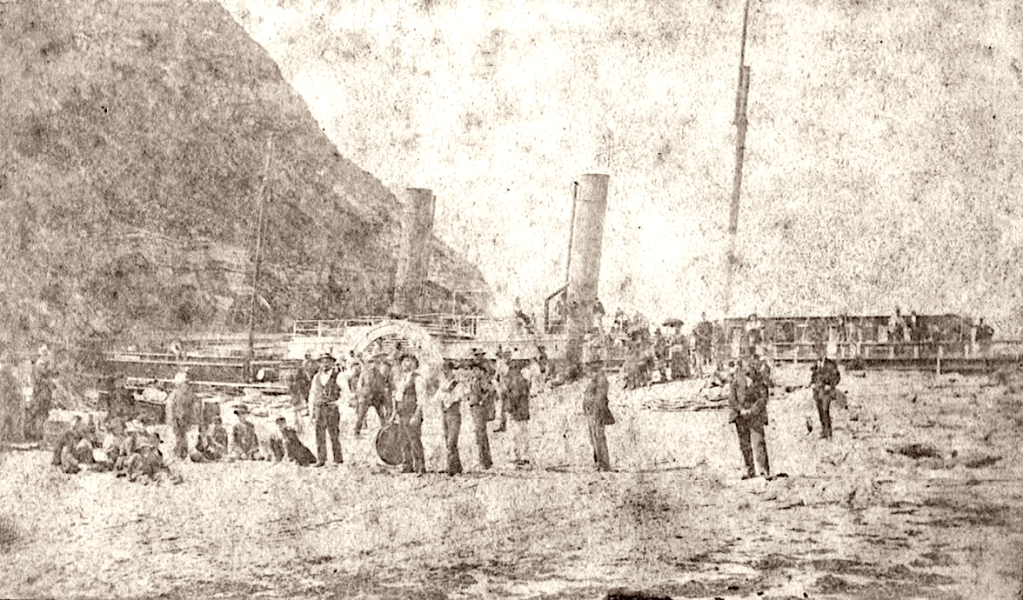
SS Paddle Steamer ‘City of Newcastle’
Additional Report of the Flood Devastation
The Maitland Mercury and Hunter River General Advertiser of 29 June 1867, page 4, reported:
‘The valley of the Lower Hunter has again been submerged in water to an alarming extent. On Monday the water had risen eight inches above the great flood of 1857. On Thursday last the river commenced to rise, and on Friday it was over the land on Roslyn estate; throughout Saturday and Sunday the water was continually rising. The whole of the houses on the riverbank were on Saturday evening flooded.
The Steamship Hotel and Post Office had about eight feet of water in them, and from this you may judge what a fearful state other parts of the town were in. Miller’s Forest and Nelson’s Plains were one sheet of water. I believe there was only one or two dry spots in these large flats of cultivation. It is as yet impossible to form any idea of the immense loss and damage done by this fearful body of water.
John Delaney, of Miller’s Forest, has lost 700 bushels of corn, besides a large stack of hay. A barn containing 150 bales of hay, besides farming implements, were swept away. Several other places are spoken of as being totally or partly gone, but as yet no reliable information can be obtained as to the losses sustained. A quantity of pumpkins, hay, corn, &c., was visible floating down the strong current on Saturday and Sunday last.
On Monday morning the water began to recede. A strong westerly wind was blowing during the day, which caused an immense quantity of articles to be blown ashore; the place was strewed with pumpkins, driftwood, &c., and people could be seen in all directions gathering the same. A great number of dead fowls and ducks drifted ashore, the stench arising from the same in many places is abominable.
I am sorry to add to this melancholy record the loss of one life — that of a young lad named Mcadyen. It seems from what I can learn that the boy lost his life in endeavouring to seek higher shelter. The body as yet has not been recovered. — It is also reported that a man was drowned near Hexham; also a young woman on Nelson’s Plains; those reports I believe to be unfounded. …..
News has just arrived that two vessels have been wrecked off Port Stephens heads [viz: Concord and Cyclone].
On Saturday last the courthouse was opened for those in distress. Provisions have also been supplied to those who are left destitute by this sad calamity. I cannot as yet forward you any further reliable information of losses by this fearful visitation. Some assistance must be rendered, or many will never be able to keep that giant (hunger) from the door. The water is now receding, and the principal parts of the roads are becoming again passable.’
Extent of the Damage
The Maitland Mercury and Hunter River General Advertiser of 6 July 1867, page 4, reported:
‘The water has again subsided, and the people are nearly all returned to their houses, to find them in a most wretched state—some of the dwellings partly gone, from others the furniture swept away. Accounts of the losses are daily received. It is but very few who have been able to save any maize or hay; some 90 bales of hay were destroyed in Portus’ mill during the flood, McDonald, Allen, Gilbert, Keating, Cameron, Melgate, and Donaghue are suffers—in fact it would occupy too much space to name all who have lost their maize, hay, lucerne seed, pigs, calves, &c.’
Raymond Terrace Flood Relief Fund
The Maitland Mercury and Hunter River General Advertiser of 11 July 1867, page 4, reported:
‘The account which your usual correspondent has supplied you of the public meeting, which was called by the Police Magistrate, H. J. Bolding, Esq., to organise means to relieve the sufferers by the late disastrous flood, gives the public such a meagre idea of the real and heartfelt sympathy which were manifested on the occasion, that our district is in danger of being overlooked by those who are able and willing to assist the unfortunate people for whose sake the meeting was called.
There was but one feeling in the meeting—that a great calamity had befallen the district; the flood had swept over Miller’s Forest and Nelson’s Plains, driving all before it; the poor people from their homes, the produce from the barns —laying waste the whole neighbourhood. During the rising and subsidence of the flood, the houses in the Terrace were thrown open by the kind-hearted occupants to receive the destitute sufferers; some of them were crowded.
The Police Magistrate was indefatigable in affording relief to the sufferers, who were being landed hourly from boats, which were manned by volunteers of the Terrace, who vied with one another in rescuing the wretched sufferers from all parts of the Forest and the Plains. At the public meeting the Police Magistrate paid a grateful tribute of respect to the volunteers who had done so much in rescuing the people.
The speakers who followed spoke in earnest terms on the importance of unanimity of action; and Mr. Archibald Jacob, in moving a vote of thanks to the chairman, H. J. Bolding, Esq., for his conduct in the chair, also greatly eulogised that gentleman for the prompt measures he had taken on his own responsibility, in giving relief to those in distress, and for calling the meeting.
Since the public meeting, the Police Magistrate has sat daily, receiving applications—which he relieves as he deems most suitable after a careful investigation.
The committee of the Relief Fund meet on Monday and Wednesday, for the transaction of business and the relief of applicants. On Wednesday last the committee received 35 applications for help. To meet the above over whelming disaster we have received, besides the Government aid, which has been the more valuable because promptly supplied, about £50 in money, some bread and biscuit, and from the Sydney Central Committee 2 tons flour, ½ ton sugar, 1 chest of tea, 50 blankets, and some general clothing.
Assistance is urgently required, for distress meets the eye at every turn, and applicants are hourly appearing. Clothes, blankets, and seed of all kinds will be thankfully received by the secretaries— the Rev. S. Simm, at the Parsonage, Raymond Terrace, and the Rev. P. J. O’Quinlivan.’
The Maitland Mercury and Hunter River General Advertiser of 17 August 1867, page 4, further reported:
‘This committee [Flood Relief Committee] has been diligently engaged endeavouring to supply, with the very limited means at their disposal, the pressing necessities of the applicants who are weekly calling for supplies. The Central Committee of Sydney deserve the best thanks of the colony for the manner in which they have attended to the claims of the various districts which have suffered by the late disastrous flood. Had it not been for that organisation, numbers of persons must have been starved; as it is there is great privation among the women and children, and if we may judge from the appearance of many of the ruined settlers, they have been living on short supplies.
The whole amount raised by local efforts amounts to about £100. The following applications for the one article, lucerne seed, will enable you to form some idea of the immense damage done in this district: — Applicants 88; number of acres for which seed is required, 312—requiring about 6840 lbs. of seed, to meet which the committee have only about 2000 lbs. What will be the result unless the Government or Central Committee considerably increase our supplies, it is not hard to say —increased starvation and misery.’
Focus on Millers Forest
The Maitland Mercury and Hunter River General Advertiser of 18 July 1867, page 3, reported the following comments by a Millers Forest correspondent:
‘It was a grand but awful sight to see an area of about twenty-five square miles [Millers Forest area] under water, with nothing to be seen to indicate its whereabouts save the tops of dead trees, the roofs of houses and sheds, with an occasional haystack; though I suppose Miller’s Forest, comparatively speaking, has after all escaped better than many localities on the Lower Hunter.
There has been a good deal of hay in stack saved and I would imagine that one half of the lucerne root is still alive, and that a few weeks of mild weather would resuscitate much of what is at present supposed to be lost; no doubt, near all the maize, potatoes, and onions are lost. It would be vain for me to attempt to particularise individual losses; suffice it to say, that all have lost more or less, and some poor families have lost their all by the unexpected height this flood attained.
At your humble servant’s residence, it was only some few inches higher than the flood of ’57. On the Scotch Creek, they tell me it was one foot higher. It is surprising how people living in these low and back places cling tenaciously to their houses in the face of such heavy rain and an overflowing river, without boats; though I hear a gentleman in the neighbourhood has generously provided some of them with a boat.
In the next great flood, they may be as independent as the clan of McLean’s, who are said to have an “ark” of their own in the year 2352, so that the self-praise of some, and the eulogies heralded about the faithfulness and gallantness of others, will go for ever unpublished. I am sorry to think that men would ever desire praise and commendation for doing their duty, and the less deserving in many cases will have more praise than those who, under a sense of duty, true feelings of benevolence and humanity, spontaneously, and without ostentation, do all they can to help their fellowmen; as in the case of Mr. Pritchard and Mr. Lowther, and other gentlemen, who (though in another sense to what I speak of) immediately sent relief to the several districts suffering.
For your information I may state that Mr. Lowther sent one ton of potatoes to this place. In the next place I would suggest to the inhabitants of the Raymond Terrace district, the importance of having a flag staff erected at the residence of J. Eales, Esq., and another on the eastern slope of the ridge Morpeth is built on, and by distinguishing flags we could be made aware of the state of the river and weather up the country in flood times, the expense would be trifling.
Is there no preventing these inundations? Yes, by cutting a canal from above Maitland to Lake Macquarie, and the work to be performed by the hundreds of scoundrels in the gaols, living like aldermen at an expense of tens of thousands to the public purse. If I remember well, Mr Fenwick, of Raymond Terrace, suggested this plan some years ago, I only hope a more able pen will take this matter up, and hurl the refined notions and sympathy for criminals of the present day to the dust.’
3. GREAT FLOOD OF MARCH 1875
Flood in the Hunter and Raymond Terrace District
The Newcastle Chronicle of 4 March 1875, page 3, reported:
‘On Tuesday morning, in answer to numerous and repeated requests, a number of boats were despatched to Morpeth and Raymond Terrace to render assistance. The Ajax Government steam-tug left early in the morning, with two boats for Raymond Terrace, and rendered also valuable assistance herself to many who were flooded out. The boats were kept going incessantly saving life and property and succeeded in rescuing a good number of persons who were in almost immediate peril. …..
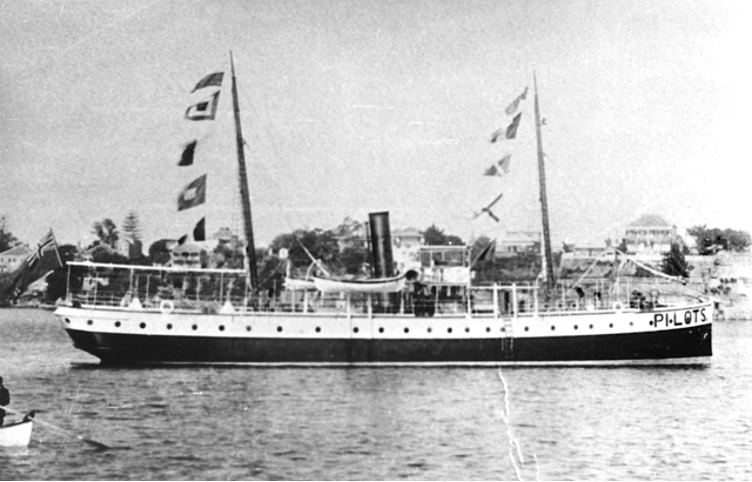
Pilot steamboat – ‘Ajax’ [Australian War Memorial – 300113]
From Raymond Terrace comes the same tale. The whole of the township, as far up as Hart’s Hotel, is completely submerged. At Morpeth and in the vicinity around, the same dreary spectacle presents itself, and opposite the town for miles and miles, as far as the eye can span, there is nothing but a rushing roaring torrent, carrying in its tumultuous course colonial produce and livestock, and in one case a large stack of hay. Boats are busy rendering all possible assistance to the flooded, and as many as eighty-seven families have, by the timely aid from the boats and their gallant crews, been saved from their housetops when the water had almost reached them. ….
Yesterday morning, a party of gentlemen chartered the steamer Perseverance to proceed to Morpeth and obtain a view of the flood at its height. The steamer left the wharf at 11 o’clock and made good headway against the strong fresh which was at that time running. Passing the islands, the effects of the deluge were noticeable, and nearly every house was flooded. Some were filled with water up to the windowsills, and on Ash Island others were covered up as high as the eaves. Numbers of horses and cattle were to be observed on the higher portions of the islands, and on the tops of the houses, pigs, goats, and poultry were to be seen, whilst on top of one of the dwellings a large cat yelled in defiance or fear at the water surrounding her “tight little island.”
As the steamer neared Raymond Terrace, the scene became more desolate, and the damage done appeared to be more considerable. Near Raymond Terrace, and on the same side of the river, were some splendid orchards, and also some very handsome houses, all of which are submerged by the water, and which, doubtless, will be much injured thereby. The beautiful orchards and gardens are almost ruined, but if the water falls fast the trees may be saved from being killed by the submersion.
From this spot about two miles to the Newcastle side of Raymond Terrace, the Hexham railway station could be plainly seen, and the water extended like a broad sea as far as the eye could discern towards the east, and as far as the Minmi shoots. Numbers of cattle and other livestock were congregated on the Hexham shoots, and some farmers and their wives might have been seen waiting in a half-dressed state for flood to subside, until they should procure some clothing.
Reaching the Terrace, again the effects of the floods were discernible, and the township was flooded, the streets instead of being plied upon by carts and horses were rowed over by boats. The Perseverance made fast alongside the schooner Kate Moynahan, which was lying off Campbell’s wharf. The water was right over the wharf and extended a considerable way up the bank towards Mr. Hart’s public-house. Numbers of boats then came up for information and news, and if possible, to procure a few loaves of bread, which substance was so scarce that hardly a loaf could be procured in the whole of the town.
The water extended almost up to Hart’s Hotel, and in Richardson and Sculley’s draper store the water was about halfway up the side of the building. Ewen’s house was filled, and on the opposite side of the road the water rolled along for a width of several miles. Whilst at the Terrace several refugees from the flood were, taken on board the vessel, and in one case there were three young women in the loft of a house, and in rescuing them the rescuers had to break through the roof of the house in which the unfortunate, females were stationed.
At Miller’s Forest there were several children in a hayloft, but who refused to leave it, whilst a woman was observed to be wading about up to her waist in the water, endeavouring to save some property. The worst part of the flood was from the Terrace to Duckenfield, the residence of John Eales, Esq., and fields of corn, and gardens for miles around were covered with water. From Duckenfield to Morpeth the scene was one of most pitiable and heartrending desolation, and the water, which was everywhere, studded with colonial produce, and an unlimited number of snakes and other reptiles.
The river had fallen a foot at Raymond Terrace, and at Morpeth the fall has been about eighteen inches. Two sons of the late Speaker, W. J. Arnold, Esq., went as far as Morpeth in the Perseverance, and from thence they were rowed in the Custom House boat, accompanied by Captain Dye, of the A. S. N. Company, as far as the Paterson. Much sympathy is felt for the family of the deceased, and the flags were lowered to half-mast, as a token of respect to his memory. The Perseverance remained at Morpeth an hour and returned to Newcastle in the short space of time of two hours and a half, and had it not been for the melancholy surroundings and the pitiful sights, the trip would have been one of a most enjoyable character.’
Flood prevents publication of Newspaper at Maitland
The Maitland Mercury and Hunter River General Advertiser of 4 March 1875, page 1, reported:
‘Once more we have to set before our readers a mere Flood Extra, instead of our usual broadsheet. We have all of us very great occasion to be thankful that our share of the frightful storm that has been blowing and of the extraordinary rains that have been falling, have only given us a flood about equal to that of January 1874—the highest indeed ever known at the eastern end of West Maitland but nearly one foot less at the western end than the great flood of 1870.
Most persons in Maitland heard with awful dread the pouring and continuous rain of Sunday night, and the very heavy showers of Monday night, for, following as they did on an already very high fresh from the first part of the gale, it was certain that if the same tremendous rains were falling throughout the Hunter Valley, we should be visited with a flood of unprecedented height and violence.
Very happily for us all, the upper part of the Hunter valley had much lighter rains. But on the other hand, the Paterson river has been flooded several feet higher than has occurred for more than thirty years at least; and the Williams has also been in high flood. So that although less flood water has reached Maitland from the upper part of the Hunter valley than we all dreaded, — excessive floods in the Paterson and Williams, entering the Hunter just below Morpeth, and just above Raymond Terrace not only flooded those two towns higher than usual, but kept back the Hunter waters from escaping down to the sea as fast as they otherwise would.
Amid all the numberless escapes and flood disasters that have occurred, but of which we have yet no sufficient records, universal grief will be felt at the drowning of Mr. W. M. Arnold, the Speaker of the Legislative Assembly, in the Paterson, near his own residence, Stradbroke. This is a heavy loss, not only to his family and friends, but to the whole colony.
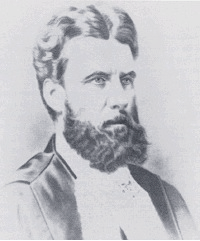
William Munnings Arnold (1819 – 1875)
And now for a much smaller matter—our own omissions. On Monday afternoon we commenced at three o’clock to print off our usual impression for Tuesday morning, instead of waiting as usual till after ten at night. We knew that at a certain height of the river (about 32ft 3in., Belmore Bridge mark) the flood waters entered our printing-machine rooms through the floors, and we feared to wait till night so as to give our usual paper, lest the water should enter them, and stop the machines. But we had not allowed for the effects of the Paterson waters backing up the Hunter, or some other cause, which has made the water at the western end more than a foot higher than that at the eastern end of West Maitland, as measured by all the floods before January 1874.
The flood waters entered our machine rooms before we had been an hour printing off, and by half past four the machine was beginning to slide to and fro on its bed with each revolution. Propping it steady by blocks of wood between it and the wall, we worked on, till we found the wall itself was beginning to be affected, and the machine to rock again. We were compelled therefore to stop printing, having worked off only about one third of the requisite number. Thus, we could only supply our town subscribers and a small portion of the other subscribers still reachable by some conveyance.
And we now reprint a portion of Tuesday’s news, to prevent disappointment as much as we can. We must mention that some of our town subscribers were missed, some unavoidably, from dangerous flood currents, or high flood waters—and some from those accidental omissions that invariably occur in a time of such peril and such upsetting of all usual arrangements.
The machines and our printing press are still standing in water. And we are indebted to the kind permission of Mr Tipper, of west Maitland, for permission to work off this page at his printing press —a Flood Extra instead of Thursday’s full Mercury.
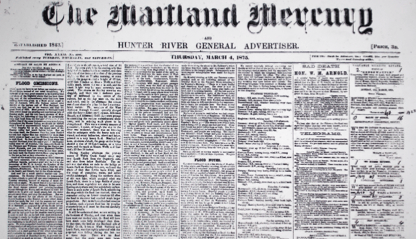
Section of the front page of the special edition of The ‘Maitland Mercury and Hunter River General Advertiser’ – published under flood conditions, 4 March 1875
Raymond Terrace Flood waters recede
The Evening News of 5 March 1875, page 2, reported:
‘The water has fallen about 1 foot 6 inches and is higher than any previous flood. Had not the Government steamer Ajax been sent up from Newcastle, the sufferings of the people would have been great; and the farmers feel very grateful for the mindfulness of the Government under the circumstances. Captain Sadleir is acting for the Police Magistrate, Mr. Bolding, is giving general satisfaction in his kind efforts to help those in want of assistance.’
Address to Government Boat Crews
The Newcastle Chronicle of 11 March 1875, page 3, reported:
‘At the request of Captain Sadlier, R.N., Acting P.M., Raymond Terrace, we publish the following letter of thanks presented to, and verbally acknowledged by, the relief party sent up the river by the Government in the Ajax, to render assistance (by saving lives and otherwise) to the sufferers in the Lower Hunter districts by the late disastrous flood: — Raymond Terrace, 6th March, 1875. Gentlemen — By the express wish of several of the inhabitants of this district, I beg to convey to you their appreciation of your services in rendering assistance to the numerous sufferers by flood in this locality.
To the captain and boats crews of the Ajax and dredge Hunter, much praise is especially due for their unceasing exertions in conveying supplies of food and rendering assistance to some hundreds of persons cut off from communication and left in a very perilous and destitute condition. I gladly add my own appreciation of these services carried out under my observation, and subscribe myself yours very sincerely, Richard Sadlier, J.P.’
4. GREAT FLOOD OF FEBRUARY 1893
Early reports of the Great Flood
The great 1893 flood at Raymond Terrace, the highest ever experienced up to that time, led to local inhabitants’ starvation, enormous loss of property and one death.
The deadly flood warning for Raymond Terrace was first reported in the Sydney Morning Herald of 14 February 1893, page 5:
‘Five inches of rain have fallen here since Saturday night, and the river has risen 25ft, and is still rising quickly. Much of the low land is under water, and a flood is expected. The weather is overcast, and there is no appearance of its taking up. A flood at the present time would do immense damage to the farming industry.’
An official report published in the Evening News of 11 March 1893, page 4, painted a picture of the developing crisis at Raymond Terrace:
‘The Postmaster-General last night received the following reports: Raymond Terrace, 1.15 p.m. — Great flood here considerably higher than the 1857 flood, and water still rising very fast. Enormous loss throughout the district. All available places in town are being occupied by distressed families. Two steamers, together with boats, engaged since yesterday rescuing families. Mail communication is blocked.’
Flood reaches a record level and Raymond Terrace is inundated
The Newcastle Morning Herald and Miners’ Advocate of 11 March 1893, page 5, reported:
‘Although direct telegraphic communication between this city [Newcastle] and Raymond Terrace was suspended on Thursday by the cable across the river at Hexham parting, some news was received by way of Stockton yesterday. The police during the morning received an urgent message from the Terrace, stating that the waters had covered the farms at Miller’s Forest, and the lives of hundreds of people were in danger.
Inspector Brennan at once dispatched a boat and a crew of the water police in one of the Government tugs, placed at his disposal by the Harbours and Rivers Department, and they reached their destination in time to do good service. There were 10 of the water police with two boats at Raymond Terrace, but from the harrowing accounts received it would seem that although scores of boats and a steamer were employed in the rescue operations all the people were only just being taken from their partly submerged homes in the nick of time.
Just before 6 o’clock last night the river steamer Planet arrived from Raymond Terrace, and among her passengers was Mr. A. L. Adams, secretary of the Lower Hunter Steamship Company, and a resident of the little town. He gives a most graphic description of the flood, and after he had transacted the urgent business for which he had visited this city, our representative had an interview with him.
Mr. Adams’ first step on arrival was to purchase food for the inhabitants of Raymond Terrace, who for the most part are on the verge of starvation. He then called on the inspector of police and asked that food might be sent up by the steamer Planet at daylight this morning.
He then gave an account of the flood and stated that since Wednesday night the weather had been terrible, and never within the recollection of the oldest inhabitant of Raymond Terrace had so much rain fallen in so short a time. For the 36 hours ending yesterday morning no less than 18 inches of rain fell, but the weather cleared early and no rain had fallen since 8 a.m.
On Wednesday night the river commenced to rise, and as the inhabitants had heard that the Williams River was running a banker at Clarencetown, and the Hunter and Paterson were also rising, they were prepared for a flood, but certainly not for the inundation that did come upon them. The river rose steadily every hour on Thursday, and at 10 p.m. on that day the flood reached the highest mark of the great deluge of 1875, which until now has been the worst yet known.
In March 1890, when the great Maitland flood occurred, Raymond Terrace was not seriously interfered with, as the Williams River, which joins the Hunter close to the town, was not swollen, and it requires all three streams, including the Paterson, to flood the lower districts.
“When the flood reached the 1875 mark,” said Mr. Adams, “the people imagined that the worst was over, but the water gradually rose at the rate of 3 inches per hour until daylight. It was soon found that the large number of settlers who live at Miller’s Forest—that fine tract of rich land over the river—were in danger of their lives, as their houses were submerged, and in many instances the families had taken refuge in the roofs.”
At 6 o’clock yesterday morning the water was 20 in higher than the record, and still rising. Every available boat was obtained, and rescue parties were formed. Mr. Adams went with others in the steamer Planet, and this little craft alone rescued some 200 people. In many cases the roofs of houses had to be chopped through with an axe before the people could be rescued. They had as usual stuck to their houses; past experience leading them to believe that this mark or that one would never be reached by water. When their floors were covered, they got on the tables if in a one-storey house, and when the water followed, they took to the top storey or the rafters as the case might be.
It is almost miraculous that all were saved, for it must be remembered that fully 300 men, women, and children were rescued almost at the last moment. The rowing boats did good service, and some 150 were saved in this way during the two days. Right from the Terrace to Morpeth was one vast sea of water, the whole of Miller’s Forest and Nelson’s Plains being inundated. All the people were taken to Raymond Terrace, where they were placed in the School of Arts, the Britannia Hall, Mayo’s shed, the Public School, or some other building on the hill, out of the reach of the water.
The town of Raymond Terrace suffered extensively, the water being three feet deep in the office of the Gloucester Gazette in King-street. Messrs. Richardson and Scully’s large stores near the wharf are entirely submerged, the damage to the stock being estimated at nearly £1000. Mr. Richardson also lost 31 horses, and Alderman Threlfo has only rescued 11 head out of 80 cattle and horses which were on his land. The loss of stock Mr. Adams states must be enormous; while all the crops are, of course, ruined.
As all the stores in the place are submerged, the supply of food almost ran out yesterday. No bread was obtainable for love or money, and even on Thursday morning the bakers were forced to work up to their waists in water. Since then, the bakeries have been submerged, and at the lower end of King-street the houses and shops are all under water. Mr. Adams left Raymond Terrace at half-past 2 o’clock yesterday afternoon, and at that hour the water was steadily rising. It was then 3ft above the level of the 1875 flood, but fortunately high hills exist at the rear of the town, and as all the inhabitants have been brought in from the surrounding district no further damage to life can occur.
It was reported that Mr. Louis Kuhn, the late proprietor of the Royal Hotel, had been drowned on Thursday, but he fortunately escaped. He went away early on Thursday to look for his stock, and when the flood submerged the country, he took refuge in a tree in the Hollow Tree Estate. A boat from Kinross rescued him yesterday, after he had spent many cheerless hours watching the water surging around the tree, and threatening every moment to engulf him.
A report reached the Terrace yesterday that a settler near Pipeclay Creek had been drowned, and the news has since been confirmed. The name of the unfortunate farmer was James Blanch, a married man with a family. On the way down yesterday, the Planet passed some hundreds of cattle, many of which only had their heads out of the water. As the flood was rising on all sides it is more than probable that the greater number of them will be drowned.
Mr. Adams reports that all the country from Raymond Terrace to Mosquito Island is under water and owing to the swift current and the large quantity of timber floating about, navigation is most dangerous. The steamer will return this morning with a cargo of provisions for the hundreds of homeless people who are now sheltered in the halls and public buildings of Raymond Terrace.
Last week Alderman Moore, the Mayor of this city [Newcastle], received a wire from Alderman Courtney, the Mayor of Raymond Terrace, stating that the town was thronged with destitute settlers, and the people required food and blankets. The wire also stated that no meat could be obtained, and the carcases of two bullocks would be acceptable. Steps were at once taken, and Inspector Brennan, who had also received a similar wire from Senior-constable Steel was consulted. Having received orders from the Government to do anything within reason for the sufferers from the floods he took steps to obtain a supply of provisions. Two carcases of beef, 400 loaves and 86 blankets were obtained, and the goods will be sent up by the steamer Planet this morning.’
A report published in the Daily Telegraph of 11 March 1893, page 5, provided additional early information on the developing flood crisis at Raymond Terrace:
‘Raymond Terrace, Friday, 7.35 p.m. — The flood in 4ft. higher than was ever known before. Every farmer for miles around is flooded out, and all the business places in town are flooded. The water is 6ft. deep in the office of the Gloucester Gazette [in King Street].
The Government steamer Orestes came up from Newcastle and proceeded up the river at daylight this morning in charge of the Mayor. She returned at 4 o’clock this evening, bringing 300 people. The town is crowded with people, and all the public buildings are occupied, but there are no provisions to feed so many. Nearly every farmer in the district will lose all his livestock. The devastation is universal and unprecedented. The river is still rising, but the weather has cleared. Up to the present no loss of life has occurred, but some timely rescues have been made, and in many cases at immense risk.
Newcastle, Friday, 8.45 p.m. — This morning Superintendent Brennan received a telegram from Thornton, asking for boats to rescue the inhabitants of Miller’s Forest, on the other side of the Hunter River, opposite to Raymond Terrace. The message stated that the water was up to the eaves of a majority of the houses in the vicinity, and that people were clinging to the roofs. Negotiations were at once entered into with the Harbors and Rivers Department, and the steamer Ceres was dispatched from here with two boats and two constables, in charge of Sergeant McVane.
Newcastle, Friday, 9.20 p.m. — Mr. C. D. Charles, of the Harbors and Rivers Department, who left in the steamer Ceres for Miller’s Forest with relief boats, has just returned to Newcastle. He states that Miller’s Forest, which is close to the junction of the mouths of the Hunter and Williams Rivers, is one sheet of water. This peculiarity in the position of Miller’s Forest renders it more liable to floods than any of the islets on the Hunter. The inhabitants are principally farmers, whose holdings are greatly scattered, thereby making assistance from each other in times of flood almost impossible. It is expected that the relief party will be kept busily employed throughout the night in rendering assistance to the distressed residents. When the steamer Ceres left Raymond Terrace on her return to Newcastle the floodwaters were slowly rising.’
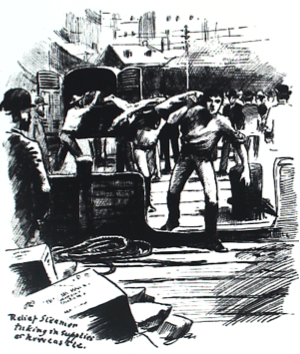
Relief steamer taking on supplies at Newcastle [The Sydney Mail and New South Wales Advertiser – 18 March 1893]
Disastrous Flood becomes widespread
The Newcastle Morning Herald and Miners’ Advocate of 11 March 1893, page 4, reported:
‘Although the weather yesterday was fair, the condition of the Hunter River plainly told something regarding the extent of the calamity caused by the terrible storm of Wednesday and the smaller rainfall of Thursday. A reddish coloured sheet of water flowed out to sea, on which were borne numbers of dead trees and the debris usually to be found on such occasions. The difficulty experienced by steamers and sailing vessels in entering the port [of Newcastle] told significantly regarding the strength of the river current, and in one case a steamer, with full steam ahead and assisted by sail, unsuccessfully attempted to make headway after crossing the bar, and had to be assisted in by two tugs.
The extent and force of the flood had destroyed all telegraphic communication with the Maitlands, and later in the day telephonic communication from station to station on the railway was stopped. With Singleton there has been no telegraphic communication for some days, and up to the time of our writing it is practically as far out of touch with the outside world as Tim-buctoo.
With regard to the condition of West Maitland after 12.30 yesterday, absolutely nothing was known, but the intelligence received before that time showed that the town was suffering from the effects of a flood more disastrous than any yet experienced in the history of the place. The messages received told the sad tale of water being many feet deep in homes founded on sites which were reasonably believed to be above flood level, of water being up to the eaves of St. Paul’s Church, and of people being forced to leave the places of shelter to which they had in the first instance fled in order to find what appeared to be safer quarters. …..
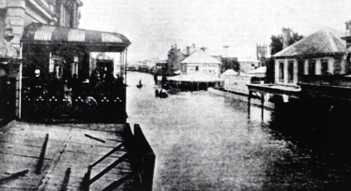
Flood scene in High Street – West Maitland [Australian Town and Country Journal, 25 March 1893]
But the terrible experiences of the residents of Raymond Terrace and Miller’s Forest lead us to fear that when the full tale of this catastrophe is told it will be found to be a very sorrowful and disastrous one. When families are forced to betake themselves to trees, and the rescuers have to remove the roofs of houses in order to carry the almost perishing women and children to places of comparative safety, it is easy to fill in the rest of the black picture. The dwellers in these townships appear to have been satisfied to escape with their lives, and the loss of horses, stock, and farm produce must be enormous.
It was even found necessary to have provisions sent up from Newcastle, for the waste of turbid waters had destroyed, carried away, or covered up the food on the spot. It is to be feared that many poor people in isolated positions have found graves in the water which came upon them like a thief in the night. The loss of human life up to the present, so far as is known, appears to consist of six persons, some of whom perished in the glorious attempt to save others who were being over-whelmed in the depths.
The sufferings of our neighbours further, up plead for sympathy, and that of a very practical kind. The Government will, probably, see to it that the immediate necessities of the flooded-out people will be provided for, but a call for assistance has been directed to Newcastle. Times have been and are bad, but the residents have not been swept out of house and home, nor have they seen their household gods borne away before their eyes to the sea. When the proper time arrives the people of Newcastle, who responded to the call from Brisbane and the northern rivers, will, without doubt, further perform their duty to the sufferers from the inundation so close to their own doors.’
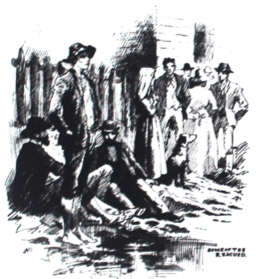
As water recedes terrible sufferings become evident at Raymond Terrace
The Sydney Morning Herald of 13 March 1893, page 8, reported:
‘The flood is the highest yet known here [at Raymond Terrace] by 5ft. Several hundreds of people are in town, who have been rescued by the local boats and those sent up from Newcastle. The Government steamer Orestes, under command of Captain Burnett, rendered great service.
Mr. [John Shadrach] Hart, M.L.A., came from Sydney yesterday, and actively interested himself on behalf of the people. The flood rose with immense velocity and had it at been for prompt assistance, many lives must have been lost. As it is, there are many hairbreadth escapes while families were being rescued from their housetops. The water has commenced to recede slowly, and there is hope of its going down, as the weather has taken up. The loss to the district cannot, of course, be accurately estimated, but farmers have lost, in nearly every instance, all they were possessed of, and the business people have suffered just as severely.
Messrs. Richardson and Scully are the heaviest losers. Nearly all of their general stock of goods, to the value of £3000, has been destroyed. There is no issue of the Gloucester Gazette today, and the proprietor Mr Courtney, will be one of the greatest losers. We have had no mail from Stroud since Tuesday, and only one Sydney mail since Wednesday, and telegraphic communication with Sydney, Newcastle, and Maitland only for the last three days.
The flood waters began falling at 6 o’clock yesterday evening and went down slowly during the night. Since 6 o’clock this morning the flood has gone down nearly 5ft. No single instance of loss of life or accident of any kind is reported in this district [Raymond Terrace]. Up to the present the timely and decisive action of the Mayor, Mr Courtney, in obtaining assistance and food supplies from Newcastle, has been the means of saving many lives, as well as averted much suffering and want.
The town was full of rescued people, and the food supplies soon gave out. The Mayor communicated with the Mayor of Newcastle, who quickly responded and had whatever supplies were wanted at hand at Newcastle at once. The steamer Planet brought up 400 loaves and some beef yesterday afternoon, and the Major took down the Government steamer early this morning and returned with a further supply of 10000 loaves of bread. The Mayor speaks highly of the service rendered by the steamer Orestes under Captain Burnett, and relates some heroic displays made by the crew in rescuing the sufferers.
The water police and Sergeants McKellar and McVane, from Newcastle, were are also indefatigable in their efforts, and never hesitated at any risk on behalf of the flooded-out people.’
Raymond Terrace residents return to flooded and damaged properties
The Daily Telegraph of 14 March 1893, page 6, reported:
‘Farmers are being taken back to their houses by the police boats, though the water has not fallen 8ft. yet. Besides the total destruction of crops and the loss of livestock, many houses have been demolished at Miller’s Forest, and Nelson plains, and several are much damaged. The townspeople who have been flooded out have had all their furniture damaged or destroyed, and the businesspeople, all of whom have been flooded, are very heavy losers.
The flood water is running off well, and nearly all the farmers have returned to their places. The water police— Senior-constable Harrison, Constable Hayes, Sergeant McVane, and Constable McKellar — returned to Newcastle this evening. They were publicly thanked by the Mayor for the assistance which they had given and were accorded hearty cheers as they moved off. Several of the local people worked most strenuously on behalf of the flooded-out people and did not shrink from risking their lives. Amongst them Dr. Meredith particularly distinguished himself.’
The Sydney Morning Herald of 15 March 1893, page 8, also reported:
‘Now that the flood has gone out of the business places in the town [Raymond Terrace] the total wreck which has been caused can be seen. The loss and destruction are simply unparalleled, and it is questionable if many of our businessmen will be able to get upon their feet again.
The farmers, most of them are reduced to absolute poverty, and cannot look to obtain credit, and what most of them will do is a problem. The people look to the Government to came to their aid immediately and effectively, otherwise the consequences to the district must be misery beyond calculation.
A sum of money was collected and placed in the hands of the Mayor, but it is totally insufficient to meet the main causes or immediate and pressing distress. All of what has been subscribed was rapidly absorbed in the purchase of clothing for the people who have lost all they had. The Mayor received today by wire a donation of £20 from the Stockton Flood Relief Fund.’
Public Meeting held at Raymond Terrace
The Sydney Morning Herald of 17 March 1893, page 5, reported:
‘A public meeting, presided over by the Mayor, was held in the School of Arts last night. The following resolution were passed: —
1. “That the warmest thanks be accorded to our local member, and the Mayor, Mr. Courtney, for their prompt and devoted efforts in procuring and organising successfully the means of rescuing the people in peril during the late flood and obtaining supplies of provisions and the meeting further requests the Mayor to offer the best thanks of the people of the district to the brave men who came from Newcastle to rescue so many people, and to place on record a minute of the liberality of those who in a few hours contributed a £100 to relieve the immediate necessity of those who lost everything”
2. “While thanking the Government for ready aid in relieving extreme necessity, it further respectfully calls upon the Government to liberally assist the district in its present deplorable and paralysed condition.”
3. “The meeting desires to offer its hearty thanks to the ladies and gentlemen of Newcastle, Sydney, and Stockton, who generously undertook to promote the object of the Raymond Terrace Flood Relief Fund.”
The following gentleman were appointed a relief committee to receive all contributions on behalf of the fund and to dispose of the same on their judgment: — The Mayor, Rev. T. A. Newton, Dr. Meredith, Messrs Monteagresti, Bishop, Richardson, Wakely, Green, Doyle, Markham, Upfold, and Gibbins.
The committee met this afternoon and urged the Mayor to proceed to Sydney tonight for the purpose of placing the actual position before the authorities, and to urge that further assistance be extended. It was decided that the relief funds received be applied to the police district of Raymond Terrace, embracing Millers Forest and Nelson’s Plains. A considerable quantity of clothing was applied for by farmers today, and the applications were dealt with.’
Aid arrives at Raymond Terrace
The Australian Star of 18 March 1893, page 6, reported:
‘The Mayor of Raymond Terrace has requested the Mayor and police of this city [Newcastle] to cease forwarding supplies of bread for the flood refugees in that place, as it is intended to procure the food from local bakers.
The fund initiated on Tuesday evening for the relief of the sufferers by the floods is growing apace, and will, it is anticipated, soon reach £1000. Large quantities of clothing are also being collected for the ruined people, and the ladies of the district are busily engaged in making and repairing articles of clothing for them.’
The Maitland Mercury and Hunter River General Advertiser of 23 March 1893, page 5, also reported:
‘The local [Raymond Terrace] Flood Relief Committee have met every day up to date entertaining and relieving distressed cases. Over 200 cases were dealt with in the last few days. Through exertions of the Mayor a sum of £200 has been granted by Government for further relief.
Numbers of cases continue daily to come in, and the strain upon the funds is heavy. Further assistance from Newcastle has been promised and anxiously waited for. Farmers and others of Miller’s Forest, Nelson’s Plains, etc., are being put to much inconvenience for want of drinking water; nearly in every instance their tanks were carried away, and wells covered with flood water. It is necessary to come several miles daily to Raymond Terrace for a water supply.
A generous act has been done by Mr. W. Fisher, of Brandon, Seaham. He has granted each of his farm tenants a year’s free rental. This will amount to several thousand pounds. It is hoped other landlords, who are in still better positions, will grant a similar concession.
Since the water has gone off the farms considerable sickness is prevalent. Direct telegraph communication with Sydney, which has been cut off for the past fortnight, was restored yesterday.’
A perspective of the flood help given to Raymond Terrace
The Newcastle Morning Herald and Miners’ Advocate of 23 March 1893, page 5, published the following letter to the editor from Rev. Samuel Simm, Church of England Minister at Raymond Terrace:
‘Sir,—On reading the resolutions which appeared in your issue of Friday last, and which I had the honour of moving, in the public meeting held in Raymond Terrace on Wednesday, 15th instant [also published in the Sydney Morning Herald of 17 March 1893], to consider what could be done to mitigate the mischief and misery caused by the late overwhelming disaster, I was struck with the feebleness and inadequacy of the best intended resolutions to convey anything like the warmth of thanks and gratitude which a meeting really feels and which it desired to convey.
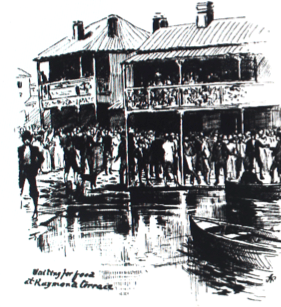
Waiting for food at Raymond Terrace [The Sydney Mail and New South Wales Advertiser, 18 March 1893]
With your kind permission, I will briefly endeavour to supply what appears to me now the want of especially the first resolution, and which could not appear from the brevity required by such a medium of communication—the scene in which those to whom thanks were conveyed by the first resolution actually took part.
On Tuesday, the 7th instant, Miller’s Forest and a portion of Nelson’s Plains were covered with growing crops. The splendid milking cows of the farmers could be seen in every direction enjoying themselves on an abundant pasturage. The horses, generally of a valuable character, were also to be seen grazing in peace, the pride of their respective owners. The homes of our stalwart farmers and their industrious wives were in a state of perfect neatness and cleanliness, with their homely gardens adding to the order and comfort of their daily life. On this Tuesday night the ensuing devastation appeared to begin with a storm.
On Wednesday the storm had advanced to an unprecedented downpour, which was like the fall of waterspouts, such as can be seen only in tropical regions. Already the Hunter is rising, and already farmers are moving in all directions; anxiety is becoming general. Storekeepers are moving their goods as they vainly think out of the reach of the flood, and some of the more wide-awake farmers have commenced to remove their cattle.
Wednesday night is a terrible night. The water has risen to the height of past floods and is still rising. Guns are heard in all directions; lights are being flashed in all directions. Men have been endeavouring to place all the belongings of the disordered homes out of flood reach-all in vain!
The dawn of Thursday morning comes; boats have arrived from Newcastle, but danger and death would have been met in attempts to rescue sooner than with the dawn; but now the work really begins. The waters have risen and are still rising to heights unknown in the history of anyone in this district. Men, women, and children have been forced to run to haystacks, on the roofs of houses, into lofts, anywhere, everywhere. The water is over the crops. The horses and cattle are trembling for their very lives. Already they are seen taking refuge on the highest spots, from which the water will presently drive them.
Now the peaceful homes and pretty gardens are submerged. Now all that the busy housewife looked upon with pleasure is being steeped in mud. Now the whole district is submerged. The water is up to the eaves of the houses; fences are covered; the one sight for miles is the devastating water. The one consideration now is the saving of life. It is at this time that the member for the electorate, Mr. J. S. Hart, took up his position both as our member and as a citizen, as he had done in the latter capacity in a dozen floods before this, and displayed an energy, coolness, and intrepidity which had long ago raised him to a high place in the hearts of the people and caused them to elect him as their member of Parliament.
Doubtless, the manner in which he has acted on the present occasion will eventuate not only in this expression of our gratitude, but in a resolve that when an opportunity occurs those who have the power will confirm their gratitude, which we can only now feebly express in words, by their votes. Night and day he has worked in doing all he could. His house has been filled in every corner with refugees, and still the helpless find shelter under his roof.
In the same manner the Mayor, Mr. H. Courtney, has performed the duties of his office, and is deserving of the warmest thanks of the whole community. These gentlemen not only set the band of rescuers who came from Newcastle to their dangerous and arduous work, but they accompanied them wherever there were helpless men, women, and children to be rescued.
The sight all day on Thursday and Friday at the landing place at Raymond Terrace was pitiable indeed, as boatload after boatload of precious human life was landed. Women who having had to run for their lives were but thinly clad, and most of them with infants in their arms, presented a sight which will never be forgotten by many of us. The praise of these noble fellows, as well as the work done by the captains and crews of the Government steamers, were in the hearts and mouths of our people in all directions.
No expression of a resolution can convey the real warmth and heartfelt thanks which we in public meeting felt. One thing further which redounds to the honour of these brave fellows is this. When they were about to leave Raymond Terrace on Saturday, in conversation with them, several of them spoke in high terms of the service which had been rendered by two of our young men, Messrs. William Hart and Haddock, in the work of rescuing. No doubt others right manfully did their duty in this work; indeed, the generosity and readiness to help have been a credit to the town. But as these two young men were named by the brave fellows from Newcastle in such a kind and manly way, I feel it my duty to record the simple fact that at some future time some small public recognition may be taken of the service so gallantly rendered. In any case, we are proud to have such young men amongst us, and at present we can only thank them for the services they nobly rendered to their flooded-out neighbours.
It was with such feelings as these that I moved the resolution of thanks to all who had stood by us in our dangers and trials, as also to those ladies and gentlemen in Sydney, Newcastle, and Stockton who have so practically shown their sympathy with us at this season of bitter trouble. It has been my lot to see floods of all kinds since the year 1857; but never have I seen such a flood as this, either for height or destruction.’
Flood mitigation canal suggested for the Raymond Terrace area
The Newcastle Morning Herald and Miners’ Advocate of 28 March 1893, page 4, reported on several flood mitigation possibilities for Raymond Terrace, Maitland and areas that experienced the great flood:
‘In the present state of political affairs in New South Wales there is a danger that the lessons, taught by the late disastrous flood in the Hunter River district will be quickly forgotten by those who had no experience of its ravages. In such obliviousness, however, the residents of this part of the country will not be sharers, and it is not desirable that such a calamity should occur without the people of the colony being aroused to action for the purpose of taking such steps as are open to them for the prevention for the future of effects similar to those which have, unfortunately, been experienced in one of the most fruitful belts of country in Australia.
Other people may take the places of the many persons who have been utterly ruined and impoverished by the raging waters; and matters may be prosperous with them for a time. But, abnormal though the flood, was, what has already happened may again happen; and it is not to the credit of the State that one set of flooded-out people should be frightened out of dangerous locations by stern experience only to make room for fresh victims. ……
With a river passing our doors which under ordinary conditions is a placid stream, but in stormy and rainy weather a raging torrent, it becomes the Government once again to direct its attention to providing for a liability which may at any moment be forced upon it. After the ravages of the recent flood had disclosed themselves, the liability of the State to provide food and shelter for the ruined people would have been much greater than it was if it were not for the noble response made by the people of Newcastle and elsewhere to the cry for aid which proceeded from the ruined people up the river.
But the homes and industries of the farming population cannot long be maintained by charity; and it is high time that some steps were taken for the purpose of arriving at some permanent measure of relief for the population endeavouring to make a livelihood amid the natural advantages and accompanying disadvantages presented in the valley of the Hunter to persons accustomed to agricultural pursuits.
Full information, worthy of being depended on, is required in the first instance. Fortunately, many data regarding floods of the olden time are on record, and accurate figures relative to rainfall and heights of water during recent floods are available. The effects of dredging the harbour at Newcastle, and of the construction of the wharves and breakwaters thereat, are also factors in the case to be considered. The effects of the construction of embankments at West Maitland, and of the new railway embankment from East Maitland are, to say the least, quite as important as any alterations of former conditions which have taken place near Newcastle.
As any permanent cure for inundations must be an expensive one, it will be necessary to obtain information regarding the loss sustained by the people in the flood of 1893. No one has yet attempted the difficult task of framing an estimate regarding the extent of the damage done to individuals in this latest storm, but such information is absolutely necessary to forming a just idea as to whether the interest on the sum necessary for prevention will or will not be a comparatively small amount as insurance against the effects of like visitations in the future.
In conducting such inquiries, the damage sustained by individuals alone will not represent the full tale of the loss; for the destruction of Government property—railways, roads, bridges, and buildings—has amounted to a considerable sum. Indeed, in considering the advisableness of providing a remedy for the evil, it must be remembered that the Government is quite as much interested in the result as any individual concerned. ……
Another scheme [for flood mitigation] is the formation of a canal from Raymond Terrace to Port Stephens, via Tillegerry Creek, a distance of 9 miles, as against the distance of 21 miles the water has now to run to Newcastle. No natural difficulties on a large scale would be met with on the route of this canal, which could be conducted between Muree and the Quarry Hill.
While it would be necessary to have a cutting 30ft deep at Raymond Terrace, the average of cuttings necessary would be about 8ft, as the route would be through a low, flat country, occupied by very few people. This canal would tap the Hunter at a point where it frequently in flood times banks up freshes in the Williams and Paterson Rivers. The estimate made some years ago as to the cost of this work was a very high one, but matters have changed greatly since then, and it is possible that this canal could now be finished for a sum which would justify the Government initiating the work.’
Excursion to view flood devastation at Raymond Terrace
The Newcastle Morning Herald and Miners’ Advocate of 4 April 1893, page 5, reported on a pleasure excursion to view the flood devastation:
‘The Young Men’s Christian Association [Y.M.C.A] chartered the commodious steamer Namoi for an excursion to Raymond Terrace, and the vessel left the company’s wharf shortly after 10 o’clock with a full complement of passengers. The Fourth Regiment Band was in attendance, and as the craft steamed up the river the musical strains attracted general attention. The passengers were afforded an opportunity of witnessing the ravages of the recent floods and the condition of the unfortunate residents of the Hunter Valley. An excellent luncheon, with cordials and refreshments, was supplied on board, and the pleasure seekers enjoyed the outing immensely.’
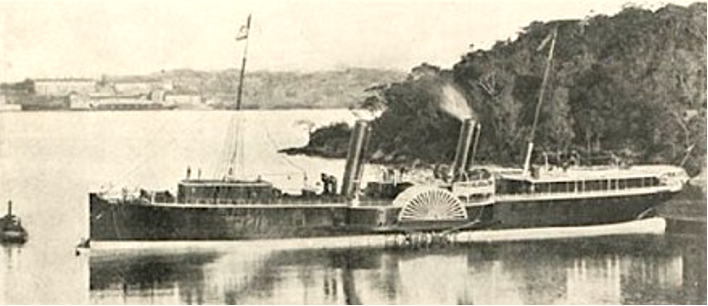
‘SS Namoi’ owned by the Newcastle and Hunter Steam Ship Company, Limited
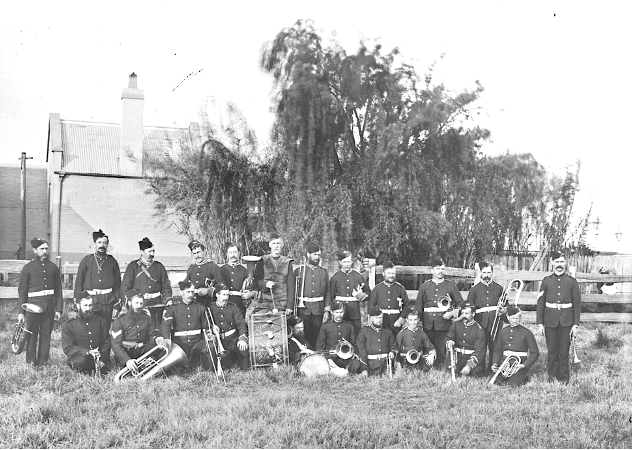
Fourth Regiment Band – date unknown [Newcastle Library Photobank]
Letter of Thanks received by the Captain of the Steamer ‘Orestes’
The Newcastle Morning Herald and Miners’ Advocate of 6 April 1893, page 5, published the following letter of thanks:
‘Captain Burnett, of the steamer Orestes, has received the following letter of thanks from Mr. Henry Courtney, the Mayor of Raymond Terrace: —”Dear Sir, I have not had time ere this to render you an acknowledgment, on behalf of the people of this community, of the very great service rendered by the steamer under your command on the occasion of the recent flood. Had it not been for the aid given by the Orestes, and the unflinching bravery of the men who composed her crew, we most certainly would not be in a position to relate the very consoling fact that amidst all our misfortunes not a single life was lost nor the slightest mishap occasioned.
I wish I knew the names of the noble fellows who belonged to the crew of the Orestes, so that I could give their names to the world as men of true grit; but I trust that you will convey to them my assurance that their unselfish and dauntless behaviour in rescuing people under the most dangerous circumstances, has the full recognition and appreciation of the people of this community.” [We are informed that the crew of the Oreates on the occasion referred to consisted of Messrs. W. Richardson, S. Gibson, O. Valentine, and W. Avery.’
Dispute regarding a funding misunderstanding at Raymond Terrace
The Newcastle Morning Herald and Miners’ Advocate of 11 April 1893, page 5, reported:
‘An unfortunate misunderstanding has occurred at Raymond Terrace with regard to the sum of money recently granted by the Government for the relief of the sufferers by the floods. It appears that when the Flood Relief Committee was appointed at Raymond Terrace the first step taken was to pass a resolution requesting Alderman Courtenay (the Mayor) to proceed to Sydney, and endeavour to obtain, a sum of money from the Government for the express purpose of relieving the distress caused by the floods.
The expenses incurred by the Mayor were defrayed from the funds in the hands of the committee, and the result of the interview with Sir George Dibbs was that the Government granted £200. The money was placed to the credit of the Mayor in one of the banks, and the committee passed a special vote of thanks to Alderman Courtenay for his successful visit to the metropolis.
On Thursday evening a meeting of the relief committee was held, and, to the surprise of the majority, the Mayor stated that the money was lying to his credit, and he intended to expend it as he pleased, and in the shape of repairing roads and making good the damage done in the municipality by the floods. A strong protest was made by the majority of the committee, who argued that the money was for the relief of the sufferers, and should be at once expended in that way.
After a stormy meeting the Mayor declined to recognise the committee in the matter, and he further refused to write to the Premier for the purpose of asking the wishes of the Government as to how the money was to be distributed. The matter has caused considerable excitement at Raymond Terrace, the majority of the residents holding that the committee should secure, the money, especially as a special Government grant of £100 had been received by the council for repairing the streets and roads.’
The Newcastle Morning Herald and Miners’ Advocate of 15 April 1893, page 4, also reported:
‘It is understood that several members of the Flood Relief Committee at Raymond Terrace intend to place before the Premier the action of the municipal authorities of that town with regard to the vote of £200 by the Government on behalf of the sufferers by the flood in the district of the Terrace. The point they wish to ascertain is if the amount was given for expenditure on municipal works in that locality, or for distribution in the district to those who lost severely by the recent inundation.
They maintain that any expenditure on corporation works is a violation of the conditions of the grant authorised by the Colonial Secretary. Considering that material assistance has been given by the people of the Newcastle district to the distressed at Raymond Terrace, it is a matter of interest to the former to know how the vote for the Terrace has been locally spent. Expenditure in direct relief to people who have been swept out of house and home is one thing; expenditure on municipal improvements, although it may be argued that they are relief works, is another.
The matter is one regarding which a question in the Assembly might elicit some definite information or expression of opinion from Sir George Dibbs. Certainly, the assistance of the people of Newcastle might not have been so prompt or on so large a scale if they had known that money directly voted by the Government for relief to the distressed generally at Raymond Terrace would be expended on works which would in the first instance relieve only the men employed on them, and in the long run the municipality in which they reside.’
A tale from the Raymond Terrace Flood
The Newcastle Morning Herald and Miners’ Advocate of 11 May 1893, page 8, reported on the following tale:
‘During the great flood in the Hunter in March last a farmer at Miller’s Forest, Mr. A. H. Brown, was compelled to seek refuge on the roof of his house. While in that position he placed a piece of paper in a bottle, and having corked it up committed it to the rushing tide. The paper bore the following inscription: — “I am on the roof of my house at Miller’s Forest, near Raymond Terrace. The water is within 2ft of us and rising. If I escape death, I will pay the finder of this paper any expenses occurred in sending it to me.”
Three weeks ago, Mr. F. Smedmore, the well-known sportsman, was cruising some four miles south of Botany Bay Heads in his yacht and seeing a bottle dancing about in the waves he secured it. Having read the enclosed paper, he determined to communicate with the person who signed it, but not returning to Sydney until yesterday nothing has yet been done. If there is a person at Miller’s Forest of the name already mentioned, it would be most interesting to know that he had received his letter back again after two months.’
Picnic at Raymond Terrace held for Newcastle Flood Relief Committee members
The Newcastle Morning Herald and Miners’ Advocate of 27 September 1893, page 5, reported:
‘The late Flood Relief Committee intend giving the hon. secretaries a picnic to Raymond Terrace tomorrow. The party will leave Newcastle by steamer at 9 a.m., and during the day will play a cricket match against the Raymond Terrace Flood Relief Committee. During luncheon Mr. H. H. Lang will be presented by the Newcastle district committee with a beautifully wrought silver model of a lifeboat, and Mr. L. Grant and Capt. Williams will also be presented with handsome gold medals as tokens of appreciation of their generous services during the distribution of flood relief. The outing promises to be a very enjoyable one, as the residents of the river township are doing everything possible to fittingly entertain the visitors.’
The Newcastle Morning Herald and Miners’ Advocate of 29 September 1893, page 8, further reported:
‘A fitting termination of the labours of the Newcastle Central Flood Relief Committee took place yesterday in the shape of a picnic given by the committee to the honorary secretaries, Messrs. Lang and Grant, and Capt. D. Williams, as an acknowledgment of their arduous duties during that period of distress. Capt. D. Williams, with his accustomed liberality, placed his steamer Berlinda at the disposal of the committee, and a start was made from the wharf at 9.55, with the following gentlemen on board: – Messrs. C. Upfold, H. H. Lang, D. McMichaeh, C. Robbins, W. P. Lance, D. J. McLean, W. B. Sharp, I. Winn. Capt. D. Williams, J. O’ Mara, A. Brayley, W. J. Ellis, J. Burke, L. Grant, and T. Raysmith, and as the morning was beautifully fine a most enjoyable trip resulted.
On arriving at the Terrace they were met by the local relief committee, headed by Messrs. Montigreasti, Wakely, Richardson, and Gibbons, and escorted to the Cosmopolitan Hotel, where a sumptuous dinner had been provided. It was not long before ample justice was done to the viands, and at the conclusion Mr. D. J. McLean rose to make the presentations on behalf of the central committee. He first read apologies from the Mayor of Newcastle, who was unavoidably absent at the municipal conference in Sydney, Messrs. F. Earp, J. H. Hall, B. A. Wallace, and others whose duties necessitated their absence, but who expressed the greatest regret at their inability to be present.
Mr. McLean said it was with feelings of the sincerest pleasure that the duty had been accorded him of making these presentations. The active part he had taken as one of the joint treasurers placed him in a position to speak with authority of the untiring efforts of the two honorary secretaries, and he knew for a positive fact that at the inception of the fund these gentlemen were for some weeks compelled to stay until 1 and 2 o’clock in the morning to get through the mass of correspondence and other duties incident to the positions they occupied.
He eulogised the way the central committee had worked. and the noble manner in which the public of Newcastle had responded. He concluded by wishing each of the recipients a long and prosperous career, and a hope that their services might never again be called into requisition for such a sad cause as that which had called forth the deepest sympathy of the whole of the colony.
Mr. H. H. Lang, who was loudly cheered on rising, said that he did not think an auctioneer ought to be embarrassed, but he certainly did feel deeply the position in which he was placed on this occasion. He had taken up the duties of honorary secretary simply with a desire to help the cause of distress and never imagined that those pleasurable duties would be rewarded by so flattering an acknowledgment as that of which he was at the present time a recipient.
He also referred at length to the enthusiastic way in which the movement had been responded to by the citizens. He said that his great aim had been, when ministering to the relief of the people, to make them feel that they sustained no loss of dignity by applying for relief on such an occasion. It was from a visitation of the Almighty, and none could resist His decree.
With regard to the souvenir, he should value it above anything he possessed of this world’s goods, and the sight of it would bring back many pleasurable recollections of those who had assisted to make his efforts successful. He thanked one and all for the kind manner in which they had spoken of him, and also for the beautiful gift.
Mr. L. Grant, who was also loudly cheered on rising, said the present day would be a red-letter one in the calendar of his life. Like his colleague, Mr. H. H. Lang, he had worked with a desire to do his utmost in that season of dire distress. He thought the noblest duty of any man’s life was to try and assist his fellows, and that no purer pleasure could be experienced than the knowledge that his efforts had been successful. He spoke in his highest terms of Mr., Lang, whom he the work, and of his generous bearing and unassuming demeanour through the whole. He should hand down this medal to his children as one of his most valued possessions and should look upon it during his life with pride and pleasure. He referred to the magnificent workmanship and design of the medal.
Captain D. Williams, whose rising was a signal for renewed cheering, thanked one and all for the present they had given him, and the very kindly way in which his efforts to alleviate the great distress had been recognised. Should such a cause again exist, which he sincerely trusted never would, he would gladly place every steamer in his fleet at the disposal of a duly constituted committee and do his utmost to help those who under such circumstances were unable to help themselves.
The chairman then called on Alderman Sharp to propose “The Raymond Terrace Flood Relief Committee.” Mr. Sharp, in a felicitous speech, spoke of the yeomen service rendered by that body, and also how inadequately the work of relief would have been carried out by the central committee had it not been for their invaluable aid. Mr. C. Upfold responded, in a humorous speech, on behalf of that body, and spoke at considerable length of the distress of which he had been an eyewitness.
Mr. C. Wakely also spoke, and the company then adjourned to play a friendly cricket match. Great credit is due to Mr. T. H. Raysmith, jeweller, for the beauty of the various presentations. That of Mr. H. H. Lang consisted of a massive silver inkstand, with a lifeboat suspended so as to form a penholder and ink well, with a suitable inscription; and the medals, which are of solid gold, were very tastefully designed, the inscription being on one side and a drawing of a lifeboat surmounted by oars on the other.
The greatest possible courtesy and kindness was experienced by all at the hands of their Raymond Terrace friends, and the visit will long be most pleasantly. remembered by all who took part in it.’
5. GREAT FLOOD OF AUGUST 1899
First report of the Great Flood
The Sydney Morning Herald of 25 August 1899, page 7, reported:
‘The police authorities received a telegram from Raymond Terrace at midnight, making an urgent appeal for assistance by the immediate despatch of boats. Sub-inspector Hinds and Senior-sergeant McVane have completed arrangements for two of the police boats to be sent to the scene of distress, and a start will be made before daylight.
It rained heavily during the afternoon. The river continues to rise. All the storekeepers are packing up. All King-street will be flooded before morning. No Sydney mails arrived today, the road being impassable through the flood. Postal communication is also cut off from other towns. There is an indication of a very disastrous flood.
‘The river here [at Raymond Terrace] is in flood. All the lowlands about Miller’s Forest, Nelson’s Plains, Eskdale, Alnwick, and Osterley are submerged. The farmers are shifting their stock to higher ground. The townspeople in the lower parts are also packing up, as the river is still rising, and reports from the stations all-round the watershed of the Paterson, the Hunter, and the Williams show a further rise, with rain still falling.
All the ferries and roads are submerged in most places. The wharfs here are not yet submerged, but two expected to be so by night. The heavy gale of last night has abated, but rain is still falling.’
Considerable damage to the Raymond Terrace district
The Daily Telegraph of 26 August 1899, page 10, reported:
‘Flood waters have been rising all day. Nelson’s Plains is submerged several feet, and hundreds of acres at Miller’s Forest are also under water. The water is 3ft. deep in King-street [Raymond Terrace], and stores and hotels are flooded. Rescue work was carried on today by the water police from Newcastle, who arrived by the Government launch this morning. The local police also assisted in the work. A number of families from both the Hunter and Williams Rivers were brought to town tonight. No loss of life has been reported, and the losses of stock have been small. Farmers took precautions to remove them early. The mails arrived today from Sydney, a day late. They were brought from Newcastle by steamer. The weather is now fine.’
Flooding was widespread
The Clarence and Richmond Examiner of 26 August 1899, page 5, reported:
‘The weather is calm and fine. The river at Belmore Bridge is 30 feet over the level, and rising slowly. The embankments around West Maitland are holding well and will stand a further rise of 8 feet.
The Dunmore embankment gave way yesterday, and the river flowed in torrents over the farms and grazing land.
At Phoenix Park, Dunmore, Wallalong, Woodville, and Goulburn Grove, the water was over 9 feet deep. Many of the residences were half submerged, while the flood was pouring through the majority of the houses a foot deep. Mr. Graham, President of the Largs Progress Association, estimates the damage done to crops and farmhouses are equal to that in the 1893 flood.
The river is now flowing 8 feet over the wharves at Morpeth, and has broken over into Brisbanefield, Berry Park, and part of Duckenfield Park. Although the river is rising slowly, it is considered the greater part of the town will escape. …
The storm last night developed into a cyclone, at times the rate the wind reached was 51 miles an hour, accompanied by blinding sheets of rain up till a late hour. All the rivers are flooded, and boats have been sent to Raymond Terrace. There is a great flood at Singleton, Muswellbrook, Greta, and other places. A boy was drowned at Singleton. There are terrific seas along the coast, and all shipping is paralysed. Fears are entertained of the safety of several vessels. There is great damage to crops in low-lying suburbs. The weather now shows signs of clearing.’
The Maitland Weekly Mercury of 26 August 1899, page 5, also reported:
‘Nine inches of rain fell in Maitland during the past fortnight, while at Raymond Terrace there were fourteen inches, and at Gresford on Wednesday night over six inches were recorded for the one night.’
Floods subside
The Daily Telegraph of 29 August 1899, page 5, reported:
‘The flood waters have receded from the farms with the exception of very low-lying ones. Farmers are afraid that the whole of the lucerne plants will be destroyed. Along the banks of the Hunter River a very heavy deposit of silt has been left, entirely covering the grass, in some places. The dairymen will feel the shortage in the grass, as the fodder crops have been destroyed. It will be a fortnight before the land can he cultivated again. Twenty-one inches seven points of rain have fallen this month.’
The Newcastle Morning Herald and Miners’ Advocate of 29 August 1899, page 4, also reported:
‘Senior-sergeant McVane, with Constables Revatto, Kemp, and Roberts, who proceeded to Raymond Terrace in the steamer Dawn on Friday morning last, returned yesterday. The senior-sergeant states that the flood was nothing compared with that of 1893. On Friday his party patrolled up the river in the steamer Planet, and saw that everything was safe. On the banks of the Williams, they met several families who needed assistance, who were at once removed to the Terrace, although loth to leave their homes.
Benefiting by their experience in 1893 several of the farmers raised their houses, so that in most cases the water failed to reach them. The crops, however, did not escape. Most of those were completely ruined, but the loss of stock was a more trifle, all the horses and cattle having been driven on to the high land. In 1893 the farmers did not have an opportunity of doing this, owing to the flood coming upon them suddenly, but this year they had ample warning, and they heeded it.
The police had one sensational experience. A man lodged a report on Saturday night at the Terrace to the effect that his son was missing, having left his home early in the morning in a light skiff. The police boat was at once manned and armed with a lantern Senior-sergeant McVane had a close search of the flooded country made. Trees and fences were encountered in all directions, and altogether the occupants of the boat had a particularly rough time, being in dread of a capsize at any moment. They subsequently ascertained, after scouring the country for three miles that the boy had reached his home in safety, having abandoned his skiff and walked through the flooded fields.
The water reached some of the houses in the main street, particularly those on the river side, but at no time was any serious danger apprehended. The farmers around Miller’s Forest, and those on the banks of the Williams were the worst sufferers, but the police only found it necessary to distribute bread to a few families who were surrounded by water. On Sunday afternoon the river commenced to fall rapidly, and yesterday it was down several feet.’
6. GREAT FLOOD OF MAY 1913
First report of the Great Flood
The Evening News of 15 May 1913, page 7, provided the first comprehensive report on the 1913 flood affecting Raymond Terrace and surrounding districts:
‘The Williams River, which joins the Hunter at Raymond Terrace, ran over its banks early on Tuesday night, and since that time more heavy rain has fallen along both rivers. This morning the Hunter was almost blotted out as a river, the water swelling from hill to hill. The ferries were laid up yesterday, and traffic places over the rivers has been cut off. Bakers, butchers. and grocers are supplying their goods by boat, while tanners have removed their stock to higher and drier grounds.
The water is still on the rise, and all the low-lying places of the town are inundated. Several families had to be removed from their homes by boat. Between Maitland, Seaham, and Raymond Terrace there is one wide stretch of water, and considerable damage has been done to the lucerne farms. The cream boats of the Raymond Terrace and Bowthorne Butter Factory have been laid off, and the dairy farmers will suffer considerably by either losing their cream altogether or having to keep it until the boats are able to ply again, in which case it will deteriorate in quality.
It is still raining, and the river is sure to rise further. One fatality has occurred, a young man, named Joseph Egan, being drowned this morning while on his way to Morpeth with another person to procure provisions.’
Floods return after a long reprieve
The Raymond Terrace Examiner and Lower Hunter and Port Stephens Advertiser of 16 May 1913, page 2, reported:
‘After a long and welcome spell, the immunity which the Lower Hunter has enjoyed from floods broke up this week, and the break is a bad one. After about a month of broken weather, during which rain had fallen in lesser or larger quantities, the wind got to the east on Tuesday night, and by 9 a.m. next morning close on three inches were registered at most places up the river.
Jerry’s Plains, up the Hunter watershed, had 390 points; this was the heaviest on Tuesday night. The Williams ran a flood early on Tuesday night, due to the 440 points at Dungog and five inches at Clarence Town. They were about the heaviest falls on Tuesday night, but the trouble did not cease there; rain continued and is still continuing to fall up to the present. Most of the falls up the river have been considerably augmented, and yesterday morning the Hunter was almost blotted out as a river — the water swelled from hill to hill.
On Wednesday afternoon the ferries went off, and traffic by road was at an end. On Wednesday, too, the farmers were busy removing stock to higher grounds, and along the roads over Nelson’s Plains way groups of horses and cattle could be seen at intervals “splogging” their way through the water in search of dry camping and feeding grounds.
The river broke over in the low places on Wednesday about midday and continued from that time onward to spread over the land. The wharves at midnight at the Terrace were only about a foot out of water, and taking every precaution, people who had goods lying there at once hurried and bustled the carters to remove the stuff to safer levels. It is surprising the quantity of material that lies stored about the sheds, and when a rush occurs such as this a week’s work of ordinary removal has to be crowded into about six hours or so. However, all the sheds were cleared by Thursday morning, and little damage can be done now unless the water rises to a 1893 level, which is not very likely.
The water about Maitland has risen to a fairly high level, 32 feet on Thursday morning, and still rising, so that it could be expected that a serious flood has occurred there. From Maitland downward the water has a large spread, and Phoenix Park, Narrowgut, Brisbanefield, Boorara, Nelson’s Plains, and Alnwick are mostly covered. There is in each of these localities high land not yet covered, nor are householders compelled to remove from their homes, but it will probably happen that those in the lower sites will have to pack up and seek dryer abodes for the time being.
The rainfall registered here was close upon six inches up to 9 a.m. on Thursday morning, and there is still heavy south wind and a bad weather appearance about the coast. The outflow of the river, too, is seriously, impeded by the high sea running, which had been brought by the easterly gale of yesterday and the previous night. But the shift in the wind did not do much towards reducing the sea, as the force at times was that of a gale.
The damage along the river will be large enough, as many hundreds of acres of lucerne will be covered, the plant partly killed, and young lucerne, of which there is a good deal in this year, will have to be resowed later on in the spring, so that time and labour will be required over many months to replace the damage done in a few days.
It is upwards of 14 years [circa 1899] since a flood of any consequence took place, and whether we are to have a return to wet seasons or not is a question often uppermost in the minds of those who are chiefly concerned. The cream boats collecting along the river are tied up, and not only do the lucerne farmers suffer loss, but the dairy man will have to hold his cream to a depreciation point before communication will be restored and he is able to reach the factory. There will be a fall in quality, and hence a fall in value, and it will be some time before the grass is of sufficient quality to build up the cream supply.
The quantity of water that came down the Williams is greater than in many floods of the past, and the result is a wide spread of water right, from Seaham to Raymond Terrace. Bakers’ and butchers are plying trade per boat on their usual runs, and are doing their best, with a maximum of inconvenience, to keep their customers supplied regularly. The people appreciate their efforts, no doubt, or they ought to at all events. The rainfall this year registered at Raymond Terrace for the four months, and a half is 28 inches 10 points.’
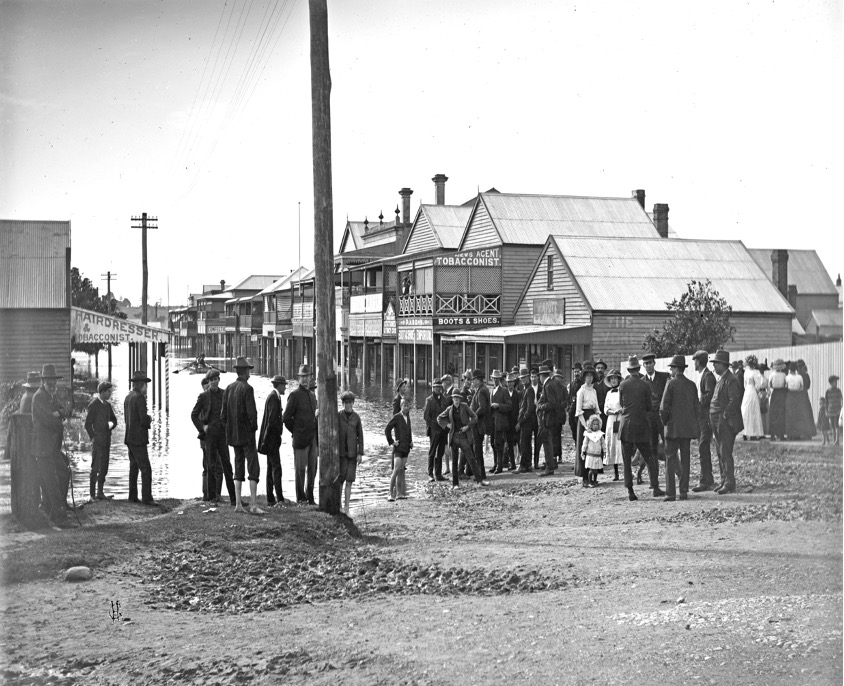
Raymond Terrace Flood – 1913 [University of Newcastle Library, Living Histories Collection]
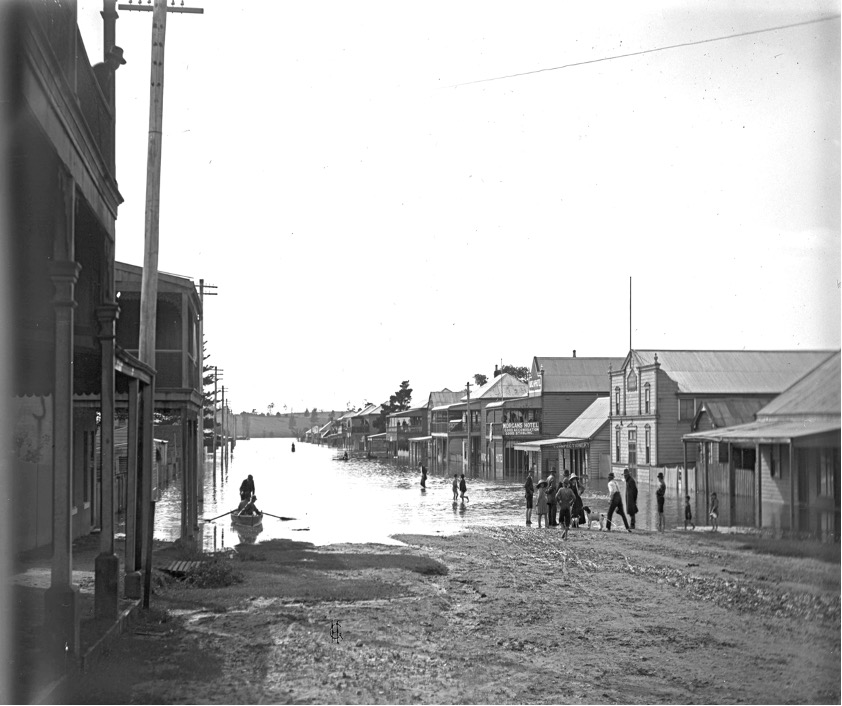
Raymond Terrace Flood – 1913 [University of Newcastle Library, Living Histories Collection]
Help sought from Newcastle
The Newcastle Morning Herald and Miners’ Advocate of 17 May 1913, page 5, reported:
‘Yesterday morning the Newcastle police received two telegrams from the police at Raymond Terrace, asking that boats be sent up as soon as possible, to rescue the occupants of houses in the flooded area to safety. Sub-inspector McHardy [at Newcastle] got into communication with the Navigation Department, and with the Public Works Department.
Mr. Bloomfield, the district engineer, placed the tug Galatea at the disposal of the police, and Captain Cumming, deputy-superintendent of navigation provided three boats which, with two others supplied by the police, were taken in tow by the Galatea to Raymond Terrace. Six of the water police were also despatched by the Galatea to man the boats at Raymond Terrace.
At 8 o’clock last night, our Raymond Terrace correspondent telephoned that the river had been rising all day and had attained the level of the flood of 1875. It was, however, five feet below the level of the flood of 1893. The police and the boats arrived early in the afternoon, and the work of rescuing the flooded settlers was at once commenced. Some of the people preferred to remain on their houses or haystacks.
Last evening the police boats landed at Raymond Terrace the members of the Daly, Tiernan, and McNamara families. The water had invaded all the business premises, and the only hotel which was not flooded was the Junction.’
Massive losses to farmers
The Dungog Chronicle of 20 May 1913, page 2, reported:
‘Reports from Raymond Terrace that the flood is one of the worst that has ever been experienced in that part of the country. For miles the farmlands have been inundated to a depth of twelve or fifteen feet, and many of the residents were living on the roofs of their barns and houses. Word was despatched to the police at Newcastle to lend assistance in the shape of boats to rescue the marooned people and three lifeboats were sent up manned by the water police. These did good work and rescued many people.
The town itself was partly submerged, and the local paper was issued by the stafi working up to their knees in water. The flood entered most of the houses and business places in most of the streets along the river side and drove the inhabitants to the top stories or to the roofs. Here they were out of reach of the water, but the tide caused a rise on Saturday night and rendered their refuge most precarious.
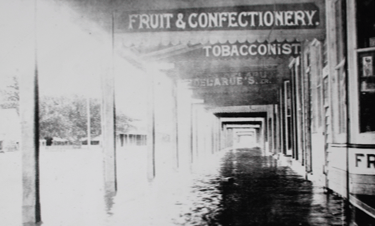
Flooded shops in King Street at Raymond Terrace [Australian Town and Country Journal, 21 May 1913]
The losses to the farmers cannot be estimated at present, but all the maize and millet crops have been totally ruined, while the loss of cattle, pigs, and poultry is terrific. It will take many years before the farmers recover from the blow.’
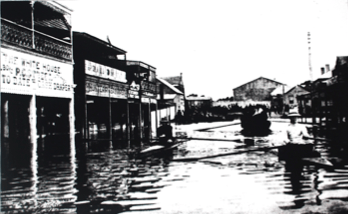
A skiff race in King Street at Raymond Terrace during the 1913 flood [Australian Town and Country Journal, 21 May 1913]
The Gloucester Advocate of 21 May 1913, page 5, also reported:
‘Most of the inhabitants of Miller’s Forest, Nelson’s Plains, and the lower parts of Raymond Terrace were safe and in some cases, families were rescued with difficulty and in others taken of their roofs. The water entered all the business places of the town, and great damage was done in consequence, although much was saved by willing helpers who worked all night.
It was only with great difficulty and inconvenience that the “Examiner” was published on Friday morning. The staff had to work knee deep in water. The water was three feet deep in some of the streets of the town, and at sharp intersections the currents were very strong. Several people were carried from their homes and lost practically everything in the yards; while furniture was seriously damaged.

Front page of the May 16, 1913 edition of the ‘Raymond Terrace Examiner’ produced under flooded conditions
Business was entirely suspended for a couple of days. Accommodation was provided for the unfortunate sufferers by hotelkeepers while many brought provisions and camped in public buildings. Scores of houses were flooded.’
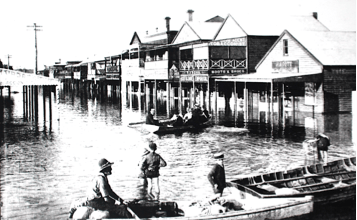
Flood in King Street at Raymond Terrace. The mails are being carried in one of the boats in the photo [Australian Town and Country Journal, 21 May 1913]
Military Sports Cancelled
The Dungog Chronicle of 23 May 1913, page 2, reported:
‘Owing to the fact that most of the intending competitors at the military sports to have been held [Dungog] here on June 3rd will be unable to leave Maitland and Raymond Terrace owing to the floods it has been decided to postpone them till a later date, notice of which will be duly given in our columns.’
Appreciation of the service provided by steamboats during flood
The Sydney Morning Herald 27 May 1913, page 7, published the following letter to the editor written by a prominent Raymond Terrace resident:
Sir, —In your issue of the 20th, I notice “Traveller” says “that far better boats might have been put on to convoy passengers from Morpeth to Newcastle during the flood time.” which, to local residents, is highly amusing.
No other boats, “excepting Government steamers,” are available, and it is apparent the Government steamers were not, as the steamer Irrawang, of the Lower Hunter Company, was chartered to carry mails to and from Morpeth and Newcastle. These little boats are specially built for the river trade and is one amongst the many hundreds of others held up by flood waters. I was only too glad to avail myself of the convenience of being able to get home from Newcastle against the surging flood waters.
I cannot speak too highly of the splendid work done by this company as we came along, seeing provisions put off into rowing boats where settlers were hemmed in by water, and relief and assistance given wherever it was possible. At such times one has to make the best of things, and no company could have done more to relieve the discomforts than did the Lower Hunter Company, and, be it said to their credit they never asked a penny extra over ordinary fares or rates for the convenience made of them. Local residents appreciate the company’s efforts, even if “traveller” did not approve of their boats. I am, etc, Arch. Windeyer, Kinross, Raymond Terrace.’
Letter of appreciation sent to Newcastle Water Police
The Raymond Terrace Examiner and Lower Hunter and Port Stephens Advertiser of 6 June 1913, page 3, reported:
‘Mr. W. Brown, M.L.A. has forwarded us the following official correspondence for publication: — Inspector’s Office, Newcastle, 30th May, 1913. Sir, — I beg to acknowledge the receipt of your letter of the 21st instant expressing on behalf of the residents of Raymond Terrace and district appreciation of the services rendered by the Newcastle Water Police on the occasion of the recent severe flood in the Hunter River, and in reply have to inform you that your letter has been read to the members of police concerned.
I might add that it gives me very great pleasure to receive from yourself and residents of Raymod Terrace this very high commendation of the services rendered by the police. — I have, etc., R. Day, Inspector of Police.’
7. GREAT FLOOD OF FEBRUARY 1955
Great 1955 ‘Maitland Flood’
In February 2025, newspaper articles marked the 70th anniversary of the devastating ‘Maitland Flood’ of 1955 which caused major flooding in the Hunter and Lower Hunter regions.
This paper tells of the effects on the residents, farmers and business owners during and after that major flooding event in the Raymond Terrace district. Although no lives were lost there, fatalities had occurred elsewhere.
The threat of flooding at Raymond Terrace became apparent on 17 February 1955 after heavy rains fell across the Hunter region. This weather event continued, and torrential falls on 24 February created the conditions that led to the great ‘Maitland Flood.’
The disaster drew extensive newspaper and newsreel coverage at the time.

Screen title of Movitone News on the February 1955 Maitland Flood that was screened widely in picture theatres.
Shortly before the Maitland Flood, Raymond Terrace residents had raised concerns about the need for a better flood-warning system. However, the rapidly unfolding weather overtook further community discussion and proposed action.
The Raymond Terrace Examiner and Lower Hunter and Port Stephens Advertiser of 10 February 1955, page 2, ominously reported:
‘A letter was received [by the Raymond Terrace Chamber of Commerce] from Mr. Enticknap, Minister for Conservation concerning the provision of flood warning information for the residents of the Raymond Terrace district. The Minister stated that the question of improved flood warning service for the Lower Hunter generally had been raised by the Port Stephens Shire Council who had been informed that the matter had been looked into by the State.
The [Flood Warning] Committee had reported that there was no objection to the expansion of the flood warning system but having regard to the facilities, available for the recording of flood heights on the Paterson and Williams River it was not clear just how it was suggested that the scheme should be further expanded.
Mr. Enticknap said that the Maitland Flood Warning Committee had advised that it was quite ready to cooperate by broadcasting information relating to river heights for the benefit of residents of the Lower Hunter but there must be some source of local information on which the Maitland organisation could draw. The Minister suggested that the Shire Council itself might undertake the organisation of a committee in its own area which could arrange to obtain all necessary local information and pass it on to the Maitland Committee for broadcasting.
He said that his information was that the Water Conservation and Irrigation Commission had established gauges along both the Paterson and Williams Rivers and had appointed gauge readers who would keep any local committee informed regarding flood heights at required intervals during flood periods. The Minister suggested that the Chamber might confer with the Shire Council on any further developments of the existing organisation and he would be happy to arrange for representatives of the State Flood Warning Committee to visit Raymond Terrace for the purpose of discussing the matter with representatives of the Council and Chamber.
Mr. Rodgers moved that a letter be sent to the Council embodying the contents of the Minister’s letter and asking that at an early date the President convene a meeting of interested bodies.’
The rapid onset of the great flood did not provide time for action on this matter as then proposed.
Indications of a damaging flood likely at Raymond Terrace
The Maitland Mercury of 17 February 1955, page 1, reported on an improving flood outlook for Maitland, while the potential flood situation at Raymond Terrace was looking more ominous:
‘Maitland relaxed this afternoon after its second lightning flood disaster threat in exactly 12 months. However, district farmers in many areas continued to stand by as water crept slowly over hundreds of acres of valuable crops. Thousands of pounds worth of crops in South Maitland, Phoenix Park, Swan Reach, Dungog, Paterson, Halton, and Raymond Terrace areas have been damaged, either by flooding or the strong winds and lashing rains last night.
The flood scare rose last night as the Hunter Valley was drenched by torrential rain and lashed by gale force winds. The rain had caused lightning rises in the Hunter, Williams and Paterson rivers by first light this morning.
The rivers continued to rise until mid-morning and then began either to fall or remain stationary. However, Raymond Terrace farmers said at midday that a flood was almost certain in their area. The river had less than a foot to break over on to farmlands and this rise was expected from backed up water. Mr L. F. Monkley said that if the water went over it would be the sixth flood since 1949. He said the water from the Williams River still had to reach the area.
Raymond Terrace had heavy rain at the height of last night’s storm, which flattened hundreds of acres of saccaline [sorghum] and lucerne crops. The recently formed Hunter Valley radio flood-warning system was brought into operation at 6.30 this morning and has been operating full time since. Maitland City Council officials have been receiving an hourly warning over the system from all main danger points. …..
The Mayor early this morning called on all residents of low-lying areas from Maitland to Raymond Terrace to take all precautions.’
New Flood warning system fails for Raymond Terrace
The Maitland Mercury of 18 February 1955, page 1, reported:
‘The town clerk (of Maitland Council, Mr. S. J. Dunkley) today denied a claim that the central organisation had been responsible for the partial failure of the Hunter Valley flood warning system yesterday.
The system yesterday failed to give Raymond Terrace, farmers information on local river heights. In a leading article yesterday, the editor of a Hunter Valley newspaper claimed the lack of information could be directly attributed to the central organisation in Maitland. Mr. Dunkley is a member of the committee, which controls the warning system throughout the Hunter Valley from Maitland.
The editor who made the criticism, claimed today that the type of information given by the system through newspapers and over radio stations was inadequate. Mr. Dunkley said that the system in the Raymond Terrace area had broken down because of the failure of the Port Stephens Shire Council to supply information.
“The arrangement made by my council and the Lower Hunter Shire and Port Stephens Shires was, in the absence of radio reporting stations, to collect information of the Paterson and Williams Rivers, and telephone it to Maitland,” said the town clerk. It would then be issued to radio stations and the press. “I contacted Lower Hunter Shire Council at 7 p.m. Port Stephens Council at 8 a.m. I was informed regarding the ferries, but received no further information on the Williams River, which apparently, according to reports, was available at the shire office.
“The flood reporting system is built on cooperation, and if Raymond Terrace cannot or will not cooperate, the central administration in Maitland cannot be blamed for lack of information.
Mr. Dunkley said adequate information had been given in a bulletin issued at 11 a.m. yesterday as far as the Hunter and Paterson Rivers were concerned. The writer of the article criticising the central organisation said that when he had contacted the central organisation in Maitland to get information for farmers, he had been told only that the river at Maitland was 26 feet. Mr. Dunkley was not available and an officer who answered the phone was not able to give river heights or rainfall conditions in other areas, the article claimed.
“Farmers in this area were anxious during the day following the rapid overnight rise,” said the writer. “They wanted river heights from Muswellbrook, Singleton, Jerry’s Plains and Wollombi, to gauge the added amount of water they could expect. “They also needed information on the upper Williams River. However, it appears that this was not given over the air, nor was it available from the central office in Maitland.”
He said he had later received the information on the Williams River from the Port Stephens Shire Office. Many farmers, without, telephones could not get information on the position as it affected them. “They had no idea how much more water could be expected and were anxious when the river rose two feet in a very short time,” he added.’
The Maitland Mercury of 21 February 1955, page 1, also reported that the flood warning system had been a failure for the Lower Hunter area:
‘A Lower Hunter dairy farmer said in Maitland this morning he considered the “so called flood warning system” in the Hunter Valley was a complete failure as far the lower river was concerned.
The farmer is Mr. C. L. Adam, of Raymond Terrace. Mr. Adam was commenting on the partial failure of the system last Thursday. On that day it failed to give Raymond Terrace farmers information on local river heights. The Maitland town clerk (Mr. S. J. Dunkley) told the “Mercury” on Friday that the system in the Raymond Terrace area had broken down because of the failure of the Port Stephens Shire Council to supply information. Mr. Dunkley is a member of the committee which controls the flood warning system. Mr. Adam said this morning: “We should have information on rainfalls prior to flood.
“We don’t want to be told there is a flood on when our farms are already under which happened in a great number of cases on Thursday. “Admittedly, it was a quick rise last week. “However, consideration should have been given by the committee in a conference on the rainfall, when the rain became heavy, in order to gauge the prospects.”
Mr. Adam said that on Friday afternoon he sat by the wireless from 1.30 to 3.30 waiting for the latest news on the fall in the river at Maitland, but no news was given over the air in that time. “We want to know the position of the river at Maitland because it is when it is falling at the Belmore that we suffer with the water coming down,” he said. “After all, the flood warning system is supposed to benefit the whole of the Hunter Valley that is endangered by floods, not merely, one particular centre. “If there is an arrangement between the various shires to do certain work on the system then, if the facts are as stated by Mr. Dunkley, Port Stephens Shire Council is just as much to blame as the committee.
“Perhaps there is some misunderstanding somewhere. It would seem that the councils, must get together and have some definite workable policy if the system is to be of any use to the Lower Hunter.” Mr. Adam said he wondered if the officials concerned were going far enough afield.’
The Maitland Mercury of 22 February 1955, page 1, finally reported:
‘The Hunter Valley Conservation Trust is expected to discuss claims that the Hunter flood warning system failed to give adequate warning to Raymond Terrace farmers.
The claims were made by the editor of a Hunter Valley newspaper and a Raymond Terrace farmer, Mr. C. Adam, who is a member of the trust. The secretary of the trust (Mr. W. C. Hawke) has prepared a statement on the claims for submission to members.
The second trust meeting for 1955 will be held in Maitland on Tuesday. Mr. Hawke today replied to a criticism of the trust contained in the Hunter Valley paper. The article claimed that the Hunter flood warning system had failed on its first practical application.
It said the system had been opened with “much back-slapping” by ministers of the Crown and members of the Hunter Valley Conservation Trust. Mr. Hawke said the Raymond Terrace Chamber of Commerce had told the trust in 1954 that it was not possible to obtain accurate information on Raymond Terrace river heights. “The trust, on advice from the Department of Conservation, told the chamber that flood warnings from the Paterson and Williams Rivers could he settled if the matter were taken up with the Maitland City Council,” he said. “The trust was also represented at the opening of the flood warning system in August 1954. “At this opening, the deputy chairman (Mr. H. T. Skilton) said the Lower Hunter area deserved more security.
The president of the Port Stephens Shire Council at the time, Cr. L. J. Shearman, at the ceremony urged the Minister to consider the establishment of radio stations on the Paterson and Williams Rivers. “A recent proposal that the trust share in the financial responsibility for the maintenance of the warning system was rejected by councils concerned, including Port Stephens. He said the Hunter Valley Conservation Trust was concerned with floods but not connected with the Hunter Valley flood warning system.
“The attack on the Hunter Valley Trust is, therefore, not warranted,” he said. The Maitland town clerk (Mr. S. J. Dunkley) today would not comment on a statement made by Mr. Adam. Mr. Adam said yesterday that the warning system had proved a complete failure. He said the system had failed to give Raymond Terrace farmers adequate warning on river rises and information of further water expected. Mr. Hawke has forwarded a copy of the article criticising the system to all Trust members.’
Raymond Terrace Show affected by the Flood
The Maitland Mercury of 18 February 1955, page 3, reported:
‘President of Raymond Terrace Show Society (Mr. C. F. Brown) said today that he expected this week’s flooding would have an adverse effect on show exhibits. Although entries in many classes exceeded those of former years, the rain would prevent many farmers bringing their exhibits. Many entries in the cattle section had been cancelled, and he expected others would be unable to bring their stock to the ground.
In the junior farmer section, the inter-district exhibit from Eagleton had been cancelled when rain destroyed much of the produce. Mr. Brown said that on some farms there was five to six feet of water. The show began in warm weather today and the ring showed little effect of yesterday’s rain. Officials were surprised at the condition of the ground. It should be firm for tomorrow’s ring events, although small pools of water are still on the ground and around the pavilion. There was water over foot deep in a street less than 100 yards from the ground.
Mr. Brown said he expected the attendance would be seriously affected by the rain as many farmers would have to detour through Maitland to reach Raymond Terrace.’
Great Maitland Flood and the impact on Raymond Terrace
The Raymond Terrace Examiner and Lower Hunter and Port Stephens Advertiser of 3 March 1955, page 1, published the following extensive report on the great Maitland Flood, which was the greatest ever, where at Raymond Terrace the height reached higher that the great 1893 flood, and covered much of the central business district:
‘Water reached such a level in William Street, Raymond Terrace that launches were able to travel between King and William Street, and pulling boats were moored under the awning on the Bank of N.S.W. (late Foley’s) corner. The water entered the Clare Castle Hotel to a depth of 18 inches and at one stage on Sunday night for a short time flowed across William Street along the gutter in Port Stephens street and linked up with the water coming from Glenelg Street end.
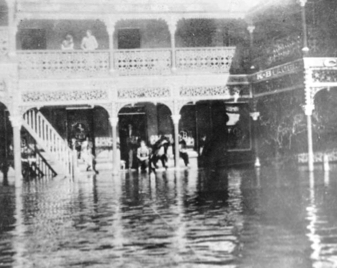
Flooded ‘Clare Castle Hotel’ in King Street at Raymond Terrace [Newcastle Library, Hunter Photobank]
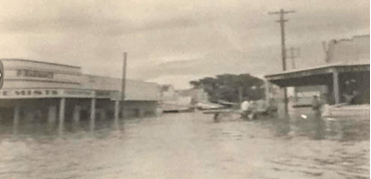
King Street at Raymond Terrace in flood – 1955 [Facebook]
This was the most disastrous flood on record as far as the Lower River was concerned for not only did it rise to record height, but it rose with such rapidity that it caught all unprepared. All residents of Miller’s Forest, Nelson’s Plains and Raymond Terrace (the lower part) who were forced to leave their home did so in such extreme urgency that they left behind them all their possessions and escaped only in the clothes they stood up in.
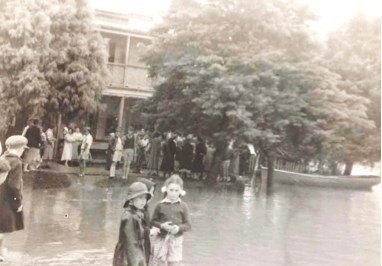
Raymond Terrrace in flood – 1955. Residents were assembled outside the Junction Hotel [Facebook]
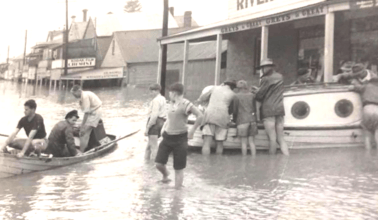
King Street at Raymond Terrrace in flood – 1955 [Facebook]
Furniture, which had been packed to a safe height, and a little more, as it was thought when compared with other floods, was submerged and ruined in this flood which reach ed heights well above the windows in houses never before entered by a flood. Storekeepers in the King Street, Port Stephens Street, area, who packed their stock up to ceiling level, allowing what they thought was a safe margin in what they knew was going to be a big flood, were dismayed to find that the water rose almost to ceiling level, and in the case of the Cosmopolitan Hotel lapped the floorboards of the top storey, and were heavy losers of stock.
The rapidity of the rise was factor that caught all unawares. The river which had been rising steadily at the rate 3 inches per hour from midday on Friday, at about 11 p.m. commenced to rise at the alarming rate of over a foot an hour and in two hours at one stage had risen almost three feet, this inrush of water made it imperative for people to get out and get out quick, with little chance of moving anything out.
Furniture and goods were stacked up to heights that had been safe in all previous floods and were raised still higher as the water came in but it was of no avail and when the water reached up to armpits most people had to abandon the struggle and take to the roof or the haystack. Practically all persons on the [Millers] Forest and Nelson’s Plains area had to be rescued from roof tops or haystacks.
Typical of many was the story told by Mr. Jack Cunningham of Miller’s Forest. He says that he worked rapidly, taking his furniture upstairs, but as he carried each piece up the water rose almost a stair at a time. He was forced at last to abandon the struggle when water reached his armpits and he had to take to the upstairs and leave the furniture to take its chances. He was distressed to see a beautiful herd of cows belonging to a neighbour, (Mr. Jim Hin) tumbling over and over in the water as they were being washed away and drowned. When he left his home by boat at 2 p.m. on Saturday the water was then 1ft. over a mark in the old barn which denoted the height of the 1893 flood.
A graphic story of how a tragedy was narrowly averted is told by Mr. Jim Boag, of Seaham. When the river rose in the afternoon, he went down to see if Mr. John Considine, a little lower down the Williams wanted help. He was informed that the family intended to stay there until forced out. He went to bed that night and when he awoke in the morning was amazed at the depth of water. He at once thought of Mr. Considine and set out to get a neighbour’s boat (Mr. Wilson’s) to go to his aid. However, Mr. Wilson was busily engaged with the boat himself. He then borrowed the punt boat and with Mr. Newson rowed down to the Considine home. Arriving there they found that Mr. Considine, who is elderly was being held up in water up to his armpits by his son. It appeared that he had been sitting on a chair on a table, and as the water rose, it tipped the table and chair up and deposited the old man in the water. “Had I been an hour or so later,” Mr. Boag said, “they would have drowned.
Another dramatic story is told by Mr. Athol Tomkins, who was a member of a boat crew from Raymond Terrace who went over to the [Millers] Forest on a rescue mission, Mr. Tomkins says. “Bill Humble Ivor Evans, Neville Poole and myself had a launch and a pulling boat and observed the helicopter trying to rescue a couple with a baby who were marooned on a haystack in a shed. The helicopter tried three times to rescue them, but the wind kept blowing the rope across the power lines and finally the pilot had to give up the attempt. Then we tried with the pulling boat with Ivor Evans and myself at the oars, but the current was too strong. It was impossible to come down-stream owing to the lay-out of other buildings. The river at this particular place was boiling with waves about 2ft. high and we were not good enough and had to give up.
So, then Bill Humble and Ivor Evans tried with the launch, but also had to give up. We then came back down the river till we met Jim Humbles’ big launch and sent them to the rescue. Jim tried for 30 minutes to get to the hayshed but also had to give it away. We then sent the Stockton surfboat to try, and they succeeded in picking up the man, his wife and baby, but on their way out got caught in the telephone lines which capsized the surf boat. We raced to their rescue but were beaten to the job by a green pulling boat, who picked up the man, his wife and four months’ old baby. We picked up the surf crew and took their boat in tow and proceeded to another house not far away where the crew were able to empty their boat out carry on with the good job which they were doing. (The party rescued were Mr. and Mrs. Kevin Whatman, who now occupy the farm known as Billy Carmody’s).
In response to calls, boats and crews came to Raymond Terrace by lorry from Stockton, Lake Macquarie, South Newcastle, and Karuah. They along with local crews in local boats did valuable work, But in some cases coordination on the part of those responsible for controlling the boats was bad and crews were given unnecessary tasks and much effort was in wasted, however on the whole they did a grand job and the spirit in which they came to render assistance was much appreciated.
Mr. Jim Cromarty, of Nelson’s Plains, carried out a one-man effort in rescuing all his neighbours and transporting firstly to Walker’s home and later when the water was getting deeper and the house beginning to quiver, he brought them on to Raymond Terrace. To make it a full day he then gathered up a three head of stock and towed them up to the high ground at the top of the Plains. A Navy helicopter based on Williamtown did valuable work in rescuing people in our area and in Maitland.
On Saturday afternoon three tugs were sent up the river from Newcastle but arrived when really the job was over. Had the authorities controlling the tugs had them on their way early on Saturday they would have been able to do some good. Seeing that there was nothing left for them to do they departed back to Newcastle.
All day long the drone of bombers based on Williamtown was heard as they moved overhead in what virtually amounted to a steady procession as they carried food, medical supplies etc. from Williamtown to the flooded areas of the Hunter. It was one of the biggest Air Force operations of peacetime.
With the water above the bridge rails on the new Windeyer’s Creek bridge this road was out early in the flood, the only way out was then via Boomerang Park across the high ground to the Highway and via Ringwood. However, on Sunday, seven feet of water covered the Stockton road near the Mental Hospital and this road was out. Early on Saturday morning the water covered the road from Motto to Williamtown and on Sunday residents of the area along the Cabbage Tree road and up to the store at Williamtown was covered. Residents in this area had to pack up. The water eventually found its way up past Salt Ash and flowed into Telligherry Creek and then into Port Stephens. On Tuesday the water had abated on the Stockton road sufficiently for heavy lorries to get through and on Wednesday most other roads were down sufficiently for traffic to be resumed.
Water covered the Hexham area to a depth of 12 feet in places and the Hunter Valley Dairy Co.’s factory at Hexham was flooded and put out of commission. It will be a few days before the factory is able to resume. Cream from the lower end is being carted to Gloucester factory, where it will be churned and the morning’s milk is going direct to the Dairy Farmers Co. in Newcastle.
Stock losses throughout the whole valley have been heavy. In the Miller’s Forest area one herd of 27 cows and two horses belonging to Mr. Jim King were drowned, Mr. L. Reed lost 21 cows and Mr. B. Farley 11. These are only some of the losses that information has been received on, more will come in as the full story is told.
Seldom has the farming land looked better, bright verdant crops of lucerne, etc. clothed the land last week, today there is a foot to two and even three feet of sticky mud covering all crops. Lucerne will have to be replanted. A grower Mr. L. F. Monkley estimates that it will cost him £1000 to replant his 70 acres of lucerne, by the time he buys seeds, etc. and allows for wages.
Mr. Greg O’Brien, typical of many, lost bags of lucerne seed valued at about £400. This is the first time, for 40 years, that my father before me, and I have not had our own seed. “I will have to buy some.”— and so the story goes on. Where farmers still have their stock, they will be faced with loss of production and the problem of finding fodder to tide them over. Fodder is scarce and dear, and with floods at main lucerne producing centres, such as Mudgee and Tamworth the position is aggravated.
With the going down of the waters on Tuesday and Wednesday came the heartbreaking task of going back to the homes and removing the mud and debris. Some returned to find dead cows and other rubbish strewn on the verandas. Doors burst open with a dead animal in the doorway and inside overturned and ruined furniture, over which was spread a coating of thick, slimy mud. This was to be got rid of and was a most depressing task. As one victim put it, it was “indescribable.” In almost all cases too, cars had to be left behind and in one shed, always a safe point, until this flood; there are five cars and two tractors, which were covered to a depth of five feet.
Clothes and other articles left behind in the flight are stained and covered with mud, treasured possessions of the children are gone and over all the appalling stench of a putrid pigsty arises from the mud arid rotting vegetation. But still they are going back and we have not as yet seen one dismal face, even though it may hide many a heavy heart and with an optimism, best expressed by a remark heard in the street — “We have lost all, but we have our lives and can start again.”
A pleasing feature was the readiness of the hospitality extended to the refugees, not only by their friends but by the English section of our community, who were only too anxious and ready to billet a family or two. The ladies of St. John’s Women’s Guild in association with the Fellowship provided food both for the billeted people and also for the boat crews from outside who came to help, and this was much appreciated by those who availed.
Tales of animal survival
The Raymond Terrace Examiner and Lower Hunter and Port Stephens Advertiser, of 3 March 1955, page 6, reported:
‘A story is told of how a dog belonging to Mr. J. Considine saved himself during the flood. Mr. Considine before leaving his dwelling on Miller’s Forest put his dog on the roof of the house. The family came to Raymond Terrace to stay with friends. Sometime during the afternoon Mrs. Considine opened the back door of the house, and there was the dog. The dog swam about two miles through the flood from Miller’s Forest.
Mr. Considine’s pony also swam to safety across the river to Raymond Terrace and for a few days was quite happy regaling himself on the long kikuyu grass at the rear of our office.
Mr. Ralph Campbell’s (Nelsons Plains) horse also turned up on dry land in Raymond Terrace. This pony swam about three miles to Raymond Terrace. Two or three cows were pulled ashore by Hollowtree people but they died the next day. ….
A cow also is reported to have been rescued at Broughton Island off Port Stephens. The cow was floating on some rubbish.’
The story of the cow that landed on Broughton Island was recorded in the book ‘Broughton Islanders’ that was published by John Clarke in 2009. The cow was named ‘Clarabell’ by the islanders and was eventually returned to the mainland.
‘Clarabell’ after being returned from Broughton Island to the mainland (page 91), ‘Broughton Islanders’, by John Clarke 2009]
Proposal to move sections of Raymond Terrace to higher ground
The Maitland Mercury of 9 March 1955, page 2, reported:
‘Port Stephens Shire Council yesterday asked the engineer (Mr. L Greer) to investigate the possibility of moving homes from low-lying parts of Raymond Terrace to higher ground.
A proposal to move the homes will be considered at the next council meeting. The flood had entered a number of business premises and an estimated 70 homes in the town. Cr. Rodgers said that hardship could be alleviated in, Raymond Terrace by moving houses from flood areas. He considered a section of Boomerang Park, near Elizabeth-street, would allow the building of about 50 homes. The park was far bigger than Raymond Terrace needed, he said.
His estimate of the cost of the proposed move was that it would not exceed £5000. The only cost householders should have to meet would be that of connecting water and electricity at the new sites. “I see no reason why we should not get a Government grant for the cost of the move,” he said. The shire president (Cr. Scott) considered that about 80 per cent of the homes that flooded could be moved.’
The Raymond Terrace Examiner and Lower Hunter and Port Stephens Advertiser of 17 March 1955, page 2, also reported:
‘A proposal to shift flood low-lying parts of the town was initiated by Cr. Rodgers at the meeting of the Port Stephens shire Council meeting on Tuesday. Cr. Rodgers said he had heard Maitland was considering shifting the whole city above flood level.
Hardship could be alleviated in Raymond Terrace by moving homes from flooded areas. Boomerang Park was far bigger than Raymond Terrace needed. A section of the park near Elizabeth Street would provide about 50 suitable blocks of land to which flooded houses could be removed. Cr. Rodgers said land from which houses were shifted could be used for parkland or farming. ‘I estimated that it would cost no more than £5000 to shift these homes, and I see no reason why we should not get a government grant for it. He thought the only cost the householders should have to meet would be that of connecting water and electricity to the new sites.
Supporting the suggestion the Shire President (Cr. Scott) said he thought that about 50 per cent could be shifted. Cr. Bettles said, that in addition to considering shifting houses the council should consider asking for a re-zoning of higher land near the Pacific Highway so that shops could also be built away from the flood level.
The Clerk, (Mr. Monkley) said that about 70 homes as well as business premises in Raymond Terrace were affected. The Council instructed the Engineer, (Mr. L. Geer), to investigate the possibility of moving the homes and report to the next meeting. Cr. Rodgers said most of these houses were upon sticks and could easily be shifted. The Council could put a gang on.’
The Raymond Terrace Examiner and Lower Hunter and Port Stephens Advertiser of 14 April 1955, page 1, finally reported:
‘The Council’s proposal, to endeavour to make available land in Boomerang Park, Raymond Terrace, fronting Elizabeth Avenue, and a proposed new road in the present area of the park has been examined, reported the Shire Clerk (Mr. Monkley) to the last meeting of the Council.
In the first place, the report proceeded, it is pointed out that the Council is merely Trustee of the Park for use for the purpose for which it was dedicated, viz: public recreation. The ownership of the land remains with the Crown and any proposals in regard to the disposal of any part of the park must receive the approval of that Department in the first instance.
Usually that Department requires full value for any lands disposed of in the manner suggested. As the lots in the Park would be worth at least £400 each and would be given in exchange for lots of an average value of £100, this would have to be resolved. Most of the flooded section of the town is zoned for light industrial purposes, and it would appear that some re-zoning of that section is required by the Northumberland County Council.
Should the Council desire to proceed with the disposal it is recommended: That the Lands Department be approached seeking its approval to the revocation of that part of Boomerang Park, proposed to be given in exchange for lots in the flood area and approval to the exchange without additional cost of land to the new owners. The report was adopted.
A letter from the people in the lower portion of the town approving of the move was presented to the Council. On the motion of Crs. Randall and Rodgers it was agreed to approach the Minister for Lands regarding the area. The Shire Engineer, (Mr. Geer) was instructed to report on the probable cost of either buying or hiring plant to shift the homes to the proposed area in Boomerang Park.’
No further newspaper reports were published on this issue.
Reduction in farm production farm production introduced for an extended period in the Lower Hunter Area
The Maitland Mercury of 9 March 1955, page 1, reported:
‘Vast damage to land, plant and equipment is expected to bring dairying and vegetable production in the Hunter Valley almost to a standstill for three to six months. The general president of the Milk Zone Dairymen’s Council (Mr. L. Shearman) said yesterday it was possible that some of the farms would never recover. He said at this stage it would be impossible to gauge the magnitude of the loss.
The damage on some areas will not be known until water falls and breaks the isolation of many rich and highly productive areas. Mr. Shearman and the general secretary of the organisation (Mr. F. Turton) inspected the Lower Hunter area this week. Mr Shearman said he estimated that at least 400 farms in the Lower Hunter area had been under water during the flood. Raymond Terrace area would be a “write off” as far as production was concerned for at least nine months.’
Effect of the Flood on bowling greens in Raymond Terrace
The Maitland Mercury of 16 March 1955, page 3, reported:
‘Bowls have been out for members of Raymond Terrace for the past three weeks, owing to the effect of the flood on the greens and also because many members have been assisting in the cleaning-up operations in the town and district. In addition to this, some members lost all their bowls gear in the flood.
At the time that the Pepper Shield was to be presented on Saturday, February 26, both greens were eighteen inches under water and at the peak of the flood it was three inches deep in the club house. “The worst that happened to the greens was a thorough soaking and a thin layer of top dressing which, however, will no doubt be full of weeds.’
Relief Applications
The Maitland Mercury of 17 March 1955, page 1, reported:
‘The Port Stephens Shire Flood Relief Committee has received 161 applications from persons within the Shire for relief. An initial payment has been made to each applicant and after further investigations have been made, it is possible an additional amount will be allocated to each applicant. It is expected that the committee will receive approximately 400 applications.’
The Raymond Terrace Examiner and Lower Hunter and Port Stephens Advertiser of 24 March 1955, page 4, also reported on Children’s flood relief that was also made available:
‘Melbourne High School has offered to assist children in Raymond Terrace and district (including Miller’s Forest, Nelsons Plains and Tomago), who suffered losses because of the recent flood. This assistance includes children of pre-school age as well as those attending school. Forms are obtainable at the Raymond Terrace Central School and St. Brigid’s Convent School, Raymond Terrace.’
Flood Food Relief Depot at Raymond Terrace
The Raymond Terrace Examiner and Lower Hunter and Port Stephens Advertiser of 31 March 1955, page 4, reported on the large community voluntary effort to support the local Flood Food Depot:
‘The following roster has been prepared for the staffing of the Flood Food depot, at the Church of England Hall, Raymond Terrace:
Thursday, March 31, 1.30 to 3.30: Mesdames Hanington, Lloyd, Rogers, Mrs. J. Windeyer, Buxton, Nixon, Miss Finlay. Clothing: Mesdames Everingham and Slade.
Monday, April 4, 9.30 to 12.30: Mesdames R. Richardson, Bennett, O’Brien, Knowles, Metcalf, Lloyd, Palmer, Payten. 1.30 to 4.30: Mesdames Hanington, Holdom, Collins, Judd, Hearn. Clothing: Miss Tranter, Mrs. Mrs. Slade.
Thursday, April 7, 9.30 to 12.30: Mesdames L. Richardson, O’Brien, Payten, Buxton (Mrs. Scott, Mrs. Griffith, if available). 1.30 to 4.30: Mesdames Hartington, Knowles, Metcalf, Mrs. Finlay. Clothing: Mrs. Everingham.
Thursday, April 14, 9.30: Mesdames Richardson, Rae Mexon, O’Brien, J. Windeyer, Collins, Holdom. 1.30 to 4.30: Mesdames Morgan, Donaldson, (if available), Griffiths, Rodgers, E. Windeyer, Misa McPherson, (if available). Clothing: Miss Tranter.
If food is still available after the dates set out above, it will be issued as usual, but not on Easter Monday. The next issue during the Easter period will therefore be on April 14, (Thursday).’
Flood Disposal Sales
As part of the post flood restoration measures were implemented, various local merchants advertised flood disposal sales and other offers to consumers and several of the associated advertisements are shown below:
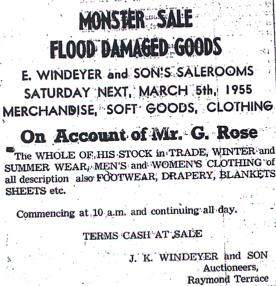
Advertisement for sale of flood damaged goods at Raymond Terrace [Raymond Terrace Examiner and Lower Hunter and Port Stephens Advertiser, 3 March 1955]
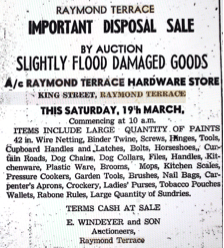
Disposal sale advertisement [Raymond Terrace Examiner and Lower Hunter and Port Stephens Advertiser, 17 March 1955]
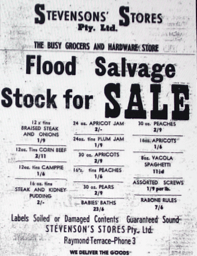
Flood salvage sale advertisement [Raymond Terrace Examiner and Lower Hunter and Port Stephens Advertiser, 24 March 1955]

Disposal discount advertisement [Raymond Terrace Examiner and Lower Hunter and Port Stephens Advertiser, 24 March 1955]

Flood photos advertisement [Raymond Terrace Examiner and Lower Hunter and Port Stephens Advertiser, 31 March 1955]
Concluding Comments
Raymond Terrace remains vulnerable to flooding, although no flood since 1955 has been as devastating.
Some businesses continue to operate in King Street, one of the first areas to be inundated in when flooding occurs. Most commercial activity have shifted to nearby William Street as a result of the devastation caused by the 1955 flood.
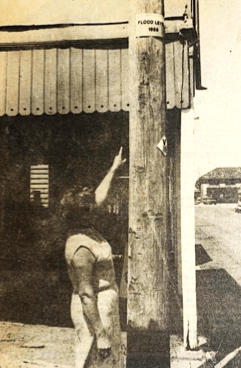
Photo caption: ‘A marker in King Street, Raymond Terrace, one of the worst affected areas in 1955. The Department of Public Works has given Raymond Terrace power poles a new look – markers are being erected showing the level of the 1955 flood. A spokesman for the department said the signs were erected to let people know how high flood waters could go in the town. Levy banks on the Williams River were completed in 1868-9 but they would not save Raymond Terrace from another flood of the 1955 magnitude. “The amount of water would be so great the banks would make no appreciable difference,” said the spokesman. The markers will give police and State Emergency Services personnel a quick gauge of how bad the situation could get. The department has also put markers up at Maitland. The pole and marker no in place.’
Other papers on the history of Raymond Terrace area are published on this website and can be viewed at the following links:
Early History of St. Brigid’s Catholic Church – The First 100 Years
War Loan Tank Drive Visits Raymond Terrace, Port Stephens – 1918
A Tour of Millers Forest and Raymond Terrace, Port Stephens – 1918
Raymond Terrace Municipal Council Jubilee Celebrations – 1934
Journey to the Vineyards of the Lower Hunter and Port Stephens Districts – 1865
Millet Growing and Broom Manufacture in the Raymond Terrace District – Port Stephens
A Story of the Raymond Terrace District of Port Stephens in 1893
Researched and compiled by Kevin McGuinness
October 2026


