
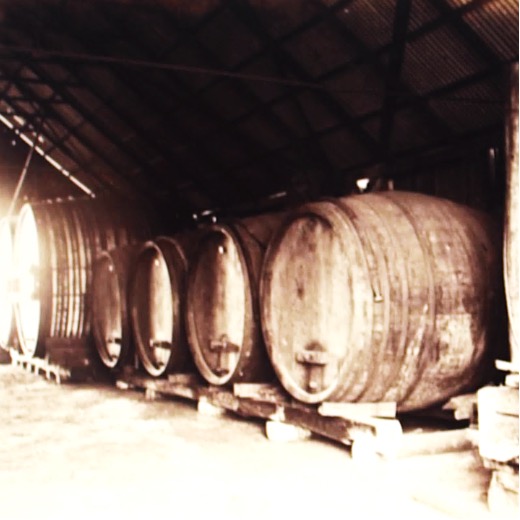
Introduction
In 1865, an unnamed reporter for the Maitland Mercury and Hunter River General Advertiser travelled through the Lower Hunter and Port Stephens districts during a favourable season, visiting thirteen established vineyards and their wineries:
Kaloudah Eelah Windermere Irrawang
Kinross Eden Vale Dalwood Orindinna
Lewinsbrook Camyrallyn Clevedon Porphyry
Berry Lea Kirkton
The articles trace the history of these properties back to the 1830s and provide detailed accounts of homesteads, farm layouts, crops, winemaking methods, cellars and equipment. They also describe the hardships faced by winemakers, including damage caused by hailstorms and floods.
The articles were published in the following editions of the Maitland Mercury and Hunter River General Advertiser:
16 November 1865 page 2; 18 November 1865 page 4; 23 November 1865 pg 2;
7 December 1865 page 2; 12 December 1865 page 2; 16 December 1865, page 2;
26 December 1865 page 2; 30 December 1865 page 4; 6 January 1866 page 5;
11 January 1866 page 2; and 3 February 1866 page 2.
Each article is prefaced by an introduction.
1. Kaloudah Vineyard
Kaludah (historically Kaloudah) is one of Australia’s oldest colonial vineyards, originally established in the 1820s. Located in Lochinvar in the Lower Hunter Valley.
‘Kaloudah vineyards are situated in a place of almost romantic beauty, about a mile from Lochinvar township, and eight miles from Maitland. The Lake or Loch after which the township was named, reposes at the base of the hill on which Kaloudah homestead is erected. At a short distance from it the pretty little village of Oswald lies nestling at the base of some lofty hills. Harper’s Hill, Windermere, and Winder’s Folly are clear to the view from the homestead, whilst in the distance the lofty peak of Tarrengower may be seen, and at the foot of the intervening hills the river Hunter pursues its winding course down to the valley in which Kaloudah is situated, the rich soil on either side being covered with fields of golden grain, or verdant crops. In no season more favourable than the present could it be seen.
Looking from one of the adjacent elevations, in almost every direction, well-cultivated farms with their comfortable homesteads were present to the view of the spectator, delighting the heart with indications of long-needed prosperity. On many farms the wheat was gathered, and the sheaves, ranged in little stacks on the fields where they were out, dotted the glistening stubble. On other farms the harvest was being reaped, the settlers and their helps working with a good will, for the harvest has been a good one, and has brightened the prospects of the settlers; and, as a consequence, imparted a cheerful feeling amongst-them.
Then again in other fields the ripe grain was waving, and shedding, and the straw was bending beneath the weight of the golden ears, inviting the reaper to come and gather. Some of the samples of wheat shown to us were said to be equal to any ever produced in the district. One field of about fourteen acres had a very abundant crop of the variety known as the golden drop (introduced by Mr. J. F. Doyle, many years ago, from Victoria). Again, the dark hue of the Californian wheat gave some fields the appearance of being affected by rust, and in a few plots this destroying pest prevailed to a serious extent, and, alas, affected the prosperity of those depending on it.
A field of oats on the Kaloudah Estate, adjoining the lake, promised an abundant crop, and varied the scene. Maize and other crops were cultivated with apparent success, the growth of the maize being in some places luxuriant in the extreme. The lake on the southern border of this part of the valley added beauty to the view. We will now proceed to describe the vineyards and the wine-making establishment.
There are now two vineyards on the estate, or, properly speaking, there are three, as the oldest was divided into two by one of the heavy floods in 1857. The old vineyard was formed in the year 1846, and at that time its extent was thirty-three acres; in 1843 the first wine was made from the grapes it produced, and, after passing through the hands of Mr. Duguid, the original proprietor, it became the property of the Aberdeen Company. For some years it was rented from this company by Mr. J. E. Blake, and through some cause or other but very inferior wine was produced after the first few years of the vineyard’s existence.
In 1855 the services of a thoroughly competent vine grower and wine maker (Mr. Philbert Terrier) were obtained, and he came from France to manage the Kaloudah vineyard for Mr. Blake. When he entered upon his task he found the cellars stocked with 12,000 gallons of what might be called indifferent vinegar. The sale of Kaloudah wine in that year did not exceed 500 gallons; three years afterwards it had so far regained its repute that 3,000 gallons were sold one season; and when Mr. Terrier left in 1861, 10,000 gallons were not sufficient to meet the demand. In that year he went to Victoria to plant the Tabilk vineyard, a notice of which appeared in this journal a few months ago. In six weeks, he had 250 acres of land cleared and planted with vines, and with such success that not more than five per cent. of them missed or failed to take root.
From there he went again to France and had an opportunity of examining the improvements introduced by vine-growers during the past decade. On his return to Australia, he resumed the management of Koloudah, which, at the time of Mr. Blake’s cessation of occupancy, had been purchased from the Aberdeen Company by the present energetic and spirited proprietor and occupant, Mr. John F. Doyle.
By the flood of August 1857, a large part of the old vineyard was destroyed, about eight acres of the vines being swept out by the roots by a vast stream which passed over them. The vines on this part of the estate have never been replaced, and the eight-acre strip which was left bare by the flood divides the old vineyard into two. This vineyard is about half-a-mile away, in a north-westerly direction, from the homestead; it extends almost to the river bank on one side, and down to the lake on the other; the soil is a rich alluvial loam, the surface of it is partly mixed with sand left by floods since the vineyard’s formation.
As a protection against further or future inundations, Mr. Doyle, after the floods of 1864, built an embankment on that part of the estate which, forming part of the riverbank, was low enough to admit the stream to overflow. the embankment is about 40 rods in length, and for two-thirds of that length it is fourteen feet high and now forms an effectual barrier against floods.
The second vineyard has been planted by Mr. Doyle. It comprises about 19 acres, 11 acres of which were planted in 1863 (and from which one cask of wine was made this year), and the remainder in 1864. This vineyard is also situated about half-a-mile from the homestead, and has been named St. John’s. It is on a hill rising from the lake, in the direction of the main road, and far beyond the reach of the highest floods.
One of the most noticeable features of this vineyard is the great regularity with which the vines are planted; they are divided into four beds, and though put in at different seasons, from whichever point they are viewed straight lines of vines present themselves to the vision of the spectator. The aspect is western, and the soil is a rich friable loam, with a substratum of rock, at a depth of about three feet. The advantages of such a substratum are the retention of moisture about the roots of the vines, and an improvement in the flavour of the grape and quality of the wine.
A great many varieties of the grape are planted in both vineyards, but lambruscat and burgundy for red wines are the principal varieties, and pineau, madeira, and muscatel for white. The vintage this year will rank as one of the best the colony has had, as regards the quality of the wine produced. The vintage at Kaloudah usually commences about the last week in February or first in March, according to the season.
Twelve or thirteen girls are generally employed to gather the grapes and place them in baskets, which are carried by men to a cart and taken up to the wine-house. The vintage lasts about nine or ten days, and in that time all the grapes must be gathered. The wine-house is situated at the rear of the homestead, and contiguous to the cellars; it is a building about forty-five feet in length, and about fifteen feet wide. At one end of it, and near the entrance, the wine-press is erected; it is a machine of great power, one man with a windlass being capable of putting on a pressure of fifty tons; the pressure usually necessary does not exceed thirty tons.
The grapes as they are brought to the wine-house are placed in what is termed a cylandre, or crushing machine. It is a cradle-shaped box with two wooden fluted rollers, in the bottom which revolve by the turning of a handle and crush the grapes. This is placed over a tub, and when the crushed grapes have passed through, the tub is emptied into another termed an égrappoir, which is perforated with a number of holes. By hand pressure in the égrappoir, the hulls or skins and liquid are forced through the perforated holes, and the stalks are thus separated from the grapes, and cast out. If white wine is to be made, the grapes, after being thus separated from the stalks, are placed in the doinaïde or case of the press, and, the lever being worked, the juice of the grape is forced through holes perforated at equal distances all-round the doinaïde into a larger receptacle, and through a pipe in the latter it flows into buckets, and is then carried to the casks.
To make red wine, the hulls and juice, after passing through the égrappoir, are placed in the fermenting casks, and allowed to remain for twenty-four hours fermenting. At the end of that time the lees will have risen to the top, and they are pressed between the hands of three or four men and sunk again in the wine. As it is from the hulls that colour is given to the wine, this process is repeated three or four times; the more frequently it is done the richer the colour given to the liquid.
The next thing done is to let the wine settle in the fermenting casks, and it is then drawn off to other casks; the lees are taken out and crushed in the press to extract the remaining wine, and this remainder is divided into equal portions and run into the casks of wine from the same fermenting. In each pressing from 1000 lbs. to 1200 lbs, of grapes are placed in the doinaïde, and they yield from 250 gallons to 300 gallons of juice.
There are many minor details not here referred to. The next important process is racking the wine—removing it from one cask to another—to get rid of all sediment. This is done chiefly by decanting syphons. When the syphon has brought the wine to an equal level in both casks, taps and tubes are affixed, and, by the use of an appliance called the odium bellows, the remainder is forced from one cask to the other without disturbing the sediment in the first, the tube of the bellows fits tightly into the bung of the cask, and the air forced into it having no escape, forces the wine through the taps and tubing into the other cask. The wine is racked or decanted from cask to cask several times until it is thoroughly clarified.
The fermenting casks are in the form of what on shipboard are called harness casks; they are each capable of containing five hundred gallons; they are made of French oak, and were brought by Mr. Terrier from Dijon, a celebrated wine-making province in a distant part of France, and near the coast.
Amongst the minor appliances shown to us in the wine-house were some baskets similar to those used in France for gathering the grapes in; these baskets when made cost a guinea a dozen, here they could not be made at less than four times that sum. A rasp-augur, for boring bungholes of any size and smoothing the sides of the hole at the same time, and a simple lever contrivance for drawing bungs without injuring the cask (as is usual by the use of the hammer and chisel) are much approved of by wine makers, and are used at this vineyard.
The cellars at Kaloudah are capable of holding 20,000 gallons, and the dimensions are about the same as those of the wine house. The wine is conveyed to the casks in them through piping which can be passed through windows or port holes near the floor of the wine house and the top of the cellar. The wine casks of every size, from the 2-gallon keg up to the 500-gallon cask, are ranged on either side of the cellar. At one end of it there are four 500-gallon casks, which were brought out by Mr. Ferrier from Dijon. They are very strong, the heads and staves being made of 2-inch oak. The heads are made concave so as to give much additional strength to the cask, and avoid the possibility of bulging out, and the necessity of placing unsightly staying bands on the heads.
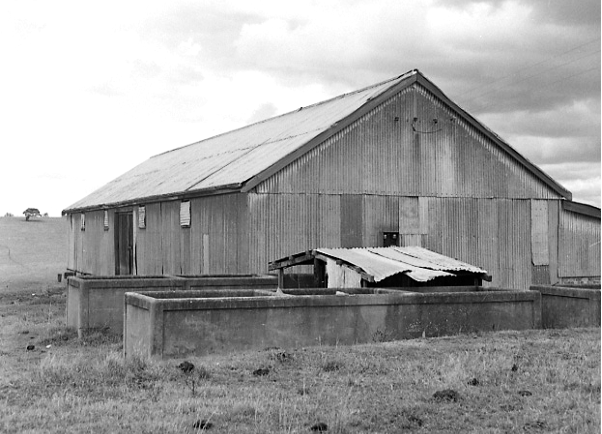
Building at the Kaludah winery [University of Newcastle Library Living Histories Collection]
In the outside head of each of these casks there is a porte, or manhole as it is sometimes called, through which a small man may get into the cask and clean it. The porte is closed by a tight-fitting door, affixed by a strong screw, and in it the tap is placed. Mr. Doyle gave an order to Mr. John Williams, of Sydney, to make a cask like these, and a few months ago it was received at Kalondah. The person who took the measurement of the cask must have failed to see the concave form of the heads of the French casks, and the only fault in that from Mr. Williams’s cooperage is the level instead of concave form of the heads. Its cost was about £20. The imported casks coat £8 each at Dijon, but having to be conveyed 550 miles to Boulogne, and thence to London for shipment to this colony, the freight and other expenses on them before delivery at Kaloudah averaged £10 each. The freight from London to Sydney was less than from Sydney to Kaloudah.
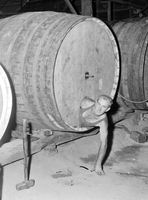
Porte, or manhole at the head of a cack [Hunter Photo Bank, Newcastle Library]
The wines in the cellars on the occasion of our visit had a delicious coolness, and a flavour that would recommend them to the taste of the fastidious. Mr. Doyle has a good demand for all that he can produce, and the Kaloudah vineyard is fast regaining its repute for excellent wine. All the land on the estate is well adapted for the vine; the great expense of planting and staking, and the long period before there is any appreciable return for the outlay necessary, at present deters the proprietor from extending his vineyard. The vines are all trained on stakes, which is preferred to the espalier system [practice of training trees or shrubs to grow flat against a two-dimensional surface, such as a wall, fence, or wire trellis] only from the fact of the ground being more easily cleaned; the plough and scuffler can be worked in any direction in this vineyard, and from its appearance when we visited it those implements had evidently been freely used, for hardly a weed or a blade of grass could be seen. The vines looked in splendid order, and the crop at present promises to be abundant and good.’
2. Eelah Vineyard
The Eelah estate dates back to the 1820s. By the 1860s, it operated as a highly regarded vineyard under its owners like John Nowlan and winemakers like Anton Bambach.
At its peak in the late 19th and early 20th centuries, it operated the “Eelah Wine Vaults” and “Eelah Wine Depot,” famously supplying celebrated table and altar wines to the Bishop of Maitland.
‘At a distance of little more than three miles from Maitland the Eelah estate and vineyard are situated, on the slopes of the Durham side of the Hunter River. The locality, like many other places on this river, possesses much scenic beauty to recommend it. Hills of irregular size encompass and shelter it on the western and northern aspects, and in some measure also on the eastern. The wild bush on the Maitland side of the river, which extends to within a short distance of the water, breaks the force of the southern gales—the estate being thus sheltered on all sides.
The vineyard is about half a mile from the homestead, and though comparatively small in extent, a considerable quantity of wine has been produced from it. It was established about five years ago, six acres of a rich friable loam and alluvial intermixed with sand being planted with several varieties of the grape. The principal varieties grown here are the black hermitage, ocreau, shepherd’s riesling, and lambruscat. The vines since planted have thriven luxuriantly, and yielded good crops, from which three excellent vintages have been obtained.
The vineyard is now under the management of Antone Bamback, a vigneron of considerable experience, to whom it has been leased by the proprietor, Mr. J. H. Nowlan. With a view to enlarging the area under the vine, eight acres of land adjacent to it were fenced in, but for the present the intention of setting vines therein has been abandoned.
The present manager has his wine-house and cellar near the vineyard; they are but rude contrivances yet serve well the purposes for which they were intended. The wine or press house is a closed-in shed adjoining the cellar. For a wine press a length of an ironbark tree has been hollowed out like a trough, into this a strong lid has been fitted, and the pressure necessary to extract the liquid from the grapes is obtained by a long lever of the same material as the trough, which is easily worked by a second and smaller lever. As the grapes are pressed the liquid exudes through holes perforated near the bottom of the trough, and it is then treated as necessary with such simple appliances as Mr. Bamback has at command.
The cellar is a slab building, with a double roof of bark. Inside the slabs, and about five or six inches from them, there is a tier of boarding all-round the cellar, and the space between the boarding and slabs is filled with earth, and thus the temperature of the cellar is kept cool in the summer weather. Wine casks are ranged on either side of it, and many of them contain wine of excellent quality; the wines of this year’s vintage here promise to deserve a good character. The cellar is capable of holding about 6000 or 7000 gallons.
Mr. Bamback expresses great confidence in the Eelah vineyard. The grapes are trained on the espalier system—that is, on wire extending throughout the rows of stakes. The wire used is No. 14, for a supply of which Mr. Nowlan had to send to England. The espalier system is here preferred for many reasons; the yield of the grape is very considerably increased, the bunches ripen more evenly, and, as a consequence, the flavour of the wine is improved. It is only recently that the wire has been used at Kelah, but its introduction there has given every satisfaction. The vineyard was in capital order when we visited it—cleanliness, the characteristic of so many of the vineyards of this district, marking it particularly. The grapes are rapidly forming, and show an abundant crop, yet a single hailstorm would, as has happened before, reduce its yield to the minimum quantity.
There are a number of other vineyards in the neighbourhood of Eelah, in which the grape is extensively cultivated. Adjoining Eelah vineyard, a German tenant of Mr. Hetherington’s, named Mr. Hatcher, has planted six acres of vines, the greater portion of them in August last. At Melville, which is also in the same neighbourhood, Mr. Kline has a good vineyard, in which he makes a large quantity of wine. Some of the settlers in the same locality have planted small plots of land with the same luscious fruit, and, in every instance, the vines have thriven admirably.’
3. Windermere Vineyard
Windermere is a historic locality in the Hunter Valley region known for its deep roots in early Australian winemaking. While the historic Windermere Estate cellars date back to the 19th century, the immediate area serves as a gateway to the broader, world-class Hunter Valley wine area.
‘Pursuing my travels from Kaloudah to Windermere, the residence of Mr. P. Green, J.P., the ride thither is one of the prettiest, and the view there to be obtained from the surrounding hills (Harper’s, Hungerford’s, Knockfin, &c.) is one of the most magnificent to be found in the Hunter River district.
The Windermere estate commences near Lochinvar, and the homestead is about one and a half miles distant from that improving little township, at right angles from the main road. There is a large extent of land cleared in the neighbourhood; the greater portion of it has been in cultivation, though at present not so much of it is now under crop. The soil appears to be well adapted for wheat and other cereals, and some fields of oats and wheat looked most luxuriant at the time of our visit.
The situation of Windermere is one of quiet beauty, and a ramble about it forms a most pleasant and agree able change from the busy and noisy scenes of town and commerce. The grandeur of the landscape may be seen to the best advantage upon reaching the highest point of ascent in its neighbourhood—Winder’s Folly. From there the view is beautiful in the extreme. On a clear day the town of Maitland, the Sugarloaf mountain, Brokenback, Nobby’s at Newcastle, and the railroad, in its course to city and country, may be distinctly seen, and will well compensate the tourist for his ride. Then, again, the rich alluvial flats, studded with cultivations and settlers’ homesteads, surrounded with hope-inspiring crops, cover the valley, and add their beauty to the scene.
In the westward the river Hunter quietly winds its tortuous course, dividing for miles the estates of Windermere and Luskintyre, on the banks of which several small lakes and lagoons display their silvery sheen, and afford sustenance to, and resorts for wild duck and other game. There are then again, the homesteads of the two estates, amongst the first formed in this rich valley, striking features, with the vineyards, orangery, mill, and other objects of interest, which attract attention, afford pleasurable reflection, and throw the greatest credit upon the indomitable perseverance and enterprise of their worthy and spirited proprietor, Mr. Green.
In years gone by these properties, with others, were held by William Charles Wentworth, and he must have expended some thousands of pounds in improvements of various kinds upon them. The homesteads, as now held, are computed at over two thousand acres, and a considerable amount of business, irrespective of ordinary agricultural operations, has for years been conducted at the boiling down establishment, the bone-dust factory, and flour mills, under Mr. John Nott, who is now energetically occupied in converting the better portions of the meat at the boiling down to profitable account—a process to which we will with pleasure, at some future time, direct attention.
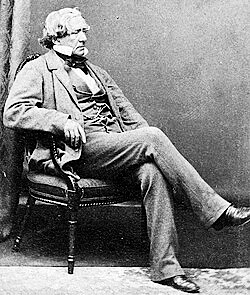
William Charles Wentworth circa 1860 [Dalton’s Royal Photographic Gallery]
The object to which at the present time we desire to give especial prominence is Mr. Green’s extensive vineyards upon Windemere and Luskintyre. They are five in number and collectively of considerable extent, upon various soils and aspects, three being on the first-named estate, and the other two on the latter. Before visiting the vineyards, we had an opportunity of seeing the orangery, which has been planted between Windermere House and the river.
It is twelve and-a-half acres in extent, and is planted throughout with orange trees, of fourteen of the choicest varieties; the planting of these extended over three successive seasons, the last few acres having been set last season. Their present appearance indicates that all possible care and attention have been bestowed upon them, and no expense spared. Some of those first planted are now covered with young fruit and look very healthy. The soil is a sandy and alluvial de-posit in the part nearest the river, and the remainder is of a red clayey and alluvial nature. It has had the advantage of plenty of manure from the boiling-down.
The orangery and vineyards together comprise a gross area of fifty acres. The vines are all in their second and third year of growth. The first vineyard is established on Windermere, and is thirteen acres in extent, on rich alluvial soil of considerable depth, and with an easterly aspect. The vines are set 5 ft x 5 ft. apart and are trained on stakes. The second is two acres, on alluvial soil of ten or twelve inches in depth, and a clay subsoil The third covers eight acres, on the site of the old and famed vineyard planted by Mr. Wentworth twenty-two years ago.
For a long time, wine was made here by Mr. Wentworth’s manager, and subsequently by Mr Nott. There was not at the time a remunerative demand for the Australian production, and about eight years ago Mr Nott had fourteen thousand gallons of it on hand. This and other causes led him to plough up the vineyard. The surface soil in this one is also alluvial to a depth of four or five feet, and with a stiff clay beneath. The fourth vineyard is on the Luskintyre estate is fourteen acres in extent, and about two and a half miles from the first; it is divided from Kaloudah by the river and is on a rich alluvial soil of great depth, intermixed with sand.
The fifth is also on the Luskintyre side of the river, but nearly a mile from it, upon a hill side of some elevation; its extent is twelve acres, and the soil is a red loam intermixed with small ironstone, resting at a depth of two or three feet in many places upon a decomposed rock, and in other places upon a stiff clay. The vines in this plot are set 5½ ft x 5½ ft apart, and, as is all the other vineyards, have been trained on stakes. Numbers two and five have been twice ploughed with plough and subsoiler (drawn by twelve or fourteen bullocks)—the ground being thus prepared as if trenched. All the vineyards are kept scrupulously clean and are looking most beautiful and promising. Upon some of the vines a considerable quantity of fine fruit is maturing.
We had the pleasure of tasting some of Mr Green’s first vintage (this year’s) which was a good strong-bodied wine, and very promising. A considerable yield is anticipated at the next vintage, and in order to carry out the operation of wine making the necessary steps have been taken. Two cellars (about 1½ miles apart) are in course of erection at Luskintyre. The dimensions of each will be about 50 feet by 26 feet. Mr Green is obtaining from France all the necessary internal apparatus for the successful conduct of his enterprise.
His wine operations are conducted under the supervision of Mons. Terrier, the manager at Kaloudah, who in this colony has gained for himself an enviable reputation, in having carried off, in 1856, the first prize a gold medal, for the manufacture of champagne, and also much commendation in successive years from our Hunter River Vineyard Association for wine matured under his superintendence at Kaloudah. Mr Green may be congratulated upon having secured a portion of the services of a vigneron so well qualified to do justice to his interests, and one to whom many winegrowers are indebted for the instruction and information which he at all times has been most willing to impart.
Mr Green has selected various sites and elevations for his vineyards with the object of ascertaining the best suited for the purpose. He has also most carefully selected fourteen of the best and choicest wine grapes to be had in the colony, with a view to ascertaining those best adapted to the various soils at his command, hereafter intending to reduce the numbers by grafting, so soon as the same shall by experience be proved desirable. He expresses a debt of gratitude due by all wine growers to our early pioneers —Messrs Busby and Macarthur, and also for the kind assistance afforded by the Messrs. Wyndham, of Dalwood.
The following are the varieties grown on Windermere and Luskintyre:—Gouais (or le folle) aucarot, yerdeilho, madeira, marsane and rousane, white scyras, shepherd’s reisling, German reisling, tokay, pineau blanc, black and white hermitage, grenache, mataro (or espaunoir), muscatel, and Pedro Ximines.
It is Mr. Green’s fixed intention to give all these varieties a fair chance before reducing their numbers, and he also expresses his determination to leave no stone un-turned and to spare no expense, to produce a superior article in such abundance as to place it at a price within the reach of all.’
4. Irrawang Vineyard
Irrawang is a an historic vineyard established in 1832 by Scottish merchant James King in the lower Hunter Region of NSW. James King settled on the property (located just north of Raymond Terrace) around 1835 and planted European vines sourced from Spain, France, and Portugal.
Though no longer producing, Irrawang helped pioneer the Australian wine industry, winning international acclaim.
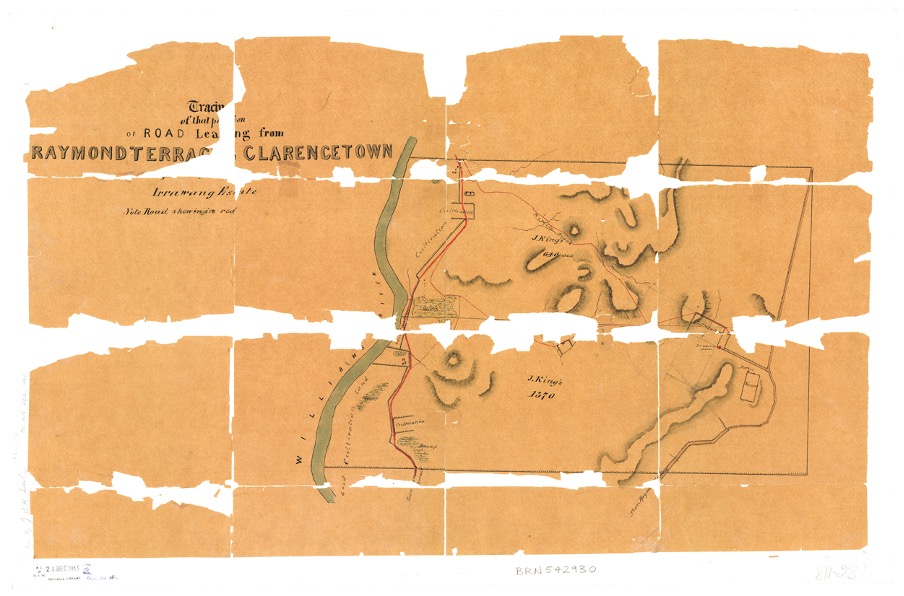
Irrawang’ the estate of James King, on the Williams River, near Raymond Terrace [State Library NSW, FL8784986]
‘A more dreary and monotonous ride than one along the road from Maitland to Raymond Terrace could not easily be found in the district. After passing over about six miles of hilly bush land the tourist enters upon a partially cleared alluvial flat commencing at Lidney; and on either side of the next two miles of road the prospect is anything but inviting. The land has been poorly cultivated, the trees which formerly covered the ground have been hewn down, but their unsightly stumps still occupy their native place and of course render much of the land useless. Beyond the Scotch Creek, which is a mile and a quarter from the Raymond Terrace ferry, the land is nearly all properly cleared and cultivated, some of the farms and homesteads especially those nearest to the riverbank, being models of cleanliness and apparently homes of comfort.
On arriving at Raymond Terrace, we bent our course in the direction of Irrawang, so famed for the production of its vineyards. It is accessible either by boat up the Williams River or by land along the Stroud and Gloucester road. Choosing the latter route, a pleasant ride of four miles brought us to the avenue leading up from the road to the Irrawing house, the residence of Mrs King. It was established by the late Mr. [James] King about thirty-five years ago. The estate is now in a somewhat neglected state; as recent as eight years ago hundreds of acres in one part of the property were covered with wheat, but now hardly an acre of that cereal is to be found upon it.

James King
An extensive pottery had been established in the vicinity of the homestead, and large quantities of potter’s ware were made there. The clay in the immediate neighbourhood was not well adapted for the purposes of this manufacture, and much expense was entailed in bringing suitable clays from a place near Stroud and also from Maitland, and ultimately the pottery works were discontinued.
Amongst the vineyards of the colony Irrawang had gained a celebrity years ago for the excellence of its vintage, it is one of the oldest vineyards of the colony—a portion of it having been planted as far back as thirty-three years ago. The chief ground of the at one time unrivalled excellence of the Irrawang wine, the red wine more particularly, was beyond doubt the skill and devoted attention paid to wine making by the late Mr. James King. He made it his principal pursuit, and entered largely into the more purely chemical questions connected with the fermentation of wine keeping up a correspondence with Baron Liebig, the first chemist of the day, on it, and communicating freely to his brother wine-makers and the public, at the Vineyard Association meetings, the valuable information he thus acquired.
There are two plots of vines now on the estate, the first covers an area of five acres, and is situated on a gentle slope, with a north-easterly aspect, between the Stroud road and Irrawang House, the distance from either being about two hundred yards. This is the oldest vineyard, and formerly it was larger in extent and production: a part of it having been set in low or marshy ground the wet drowned the vines and rendered them useless. The soil is sandy to a considerable depth; before being prepared for the reception of its present covering, it was covered with ferns and scrub.
The second vineyard is nearly three miles from the other, and quite close to the Williams River, extending almost to its bank; the ground from the bank declines inwards, and about four acres have here been planted, eighteen years ago. The soil is black alluvial to an untried depth. From the old vineyard the product has been gradually decreasing for the last ten years, and the vines there are rapidly giving out. The younger one still yields a large crop, but the quality is not equal to that of the old.
The present lessee of the vineyards, Mr Christopher Linz, has been fifteen years managing Irrawang, and during the past six or seven years has been lessee of it. He informed us that when he first entered on the management the produce of wine averaged 2000 gallons each vintage and that subsequently he brought it up to 2600 one year. It now does not exceed 800 or 900 gallons. There was an intention on the part of the proprietor to extend the acreage under vines, but it has not been carried into effect. The soil and elevation are well adapted for the purpose, and the demand for Irrawang wine far exceeds the supply.
Mr Linz has taken a prize for it at the Paris Exhibition and received high commendation for his wine at the Vineyard Association’s gatherings, and at the H.R.A. and H. Shows This year’s vintage has been unusually good and of a class that will do much towards making Australian wine the principal beverage in this colony. The wretched trash, and bad vinegar, much of which until lately has been sold in the metropolis as Australian wine has had a most perceptible effect in preventing the good article from coming into general demand.
The wine-house at Irrawang is close to Mrs. King’s residence; it is fitted with a press, fermenting tubs, and other necessary appliances, sufficient for the requirements of the establishment. The cellars are beneath a stone building contiguous to the wine house. Their temperature is very low in all weathers. The vaults are rather gloomy, and ventilation is obtained by small lights near the surface of the ground on the outside. About five thousand gallons can be stored in them, though at pre-sent they contain but a small quantity. The smaller vault is fitted with racks for bottled wine, choice samples of which were preserved there for years. Mr. Linz gets 5s. a gallon for all he can produce, and this yields a satisfactory return for the labour he expends on the vineyard. The vines are trained on stakes; the principal varieties of grape here grown are Shepherd’s riesling and black and white hermitage. The vines this season were much injured by a hailstorm as the fruit was blossoming.
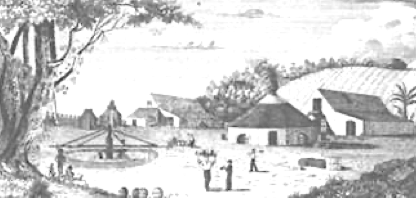
Irrawang vineyard and pottery
There are a number of other vineyards, between Raymond Terrace and Irrawang, the largest of them being one belonging to Mr. Flood, and situated on the road known as that leading to the Parading Ground [Williamtown], and about a mile and a half from the Stroud road; its extent is fifteen acres, and, like nearly all the vineyards in this locality, it has a sandy soil. On the same road, but nearer to the Terrace, Mr. Patrick Moy has eight acres under the vine, nearly all Shepherd’s riesling; his vineyard has been eight years planted, and he has made about four hundred gallons each vintage during the past four years. His appliances are very simple, but he manages to make a good bodied wine of fruity flavour. Mr. Marlin has also a plot of vines (about ten acres) near Raymond Terrace, and opposite Roslyn Hall. Mr. Millgate has two acres on the Stroud road, but he produces the grape only for table use.’
5. Kinross Vineyard
‘Kinross’ in the Hunter Valley was one of the region’s earliest pioneer estates. It was established near Raymond Terrace in the 1830’s by the early free settler, Archibald Windeyer.
‘Resuming our tour through the vineyards situate on the Hunter River and its tributaries, we next visited that of Mr. A. Windeyer, of Kinross. The Kinross estate is beautifully situated on the Lower Hunter, about one mile below Raymond Terrace. For upwards of twenty-five years it has been in the possession of Mr. Windeyer, its present occupant, and during that period very extensive improvements have been effected on it Kinross House is erected on one of the most elevated points overlooking the river and the islands in one direction, and Raymond Terrace and the Williams River, at its confluence with the Hunter, in another, whilst the course of the latter, as it flows between Miller’s Forest and Nelson’s Plains, past Duckinfield and Osterley, is plainly visible. The prospect in front is indeed charming.
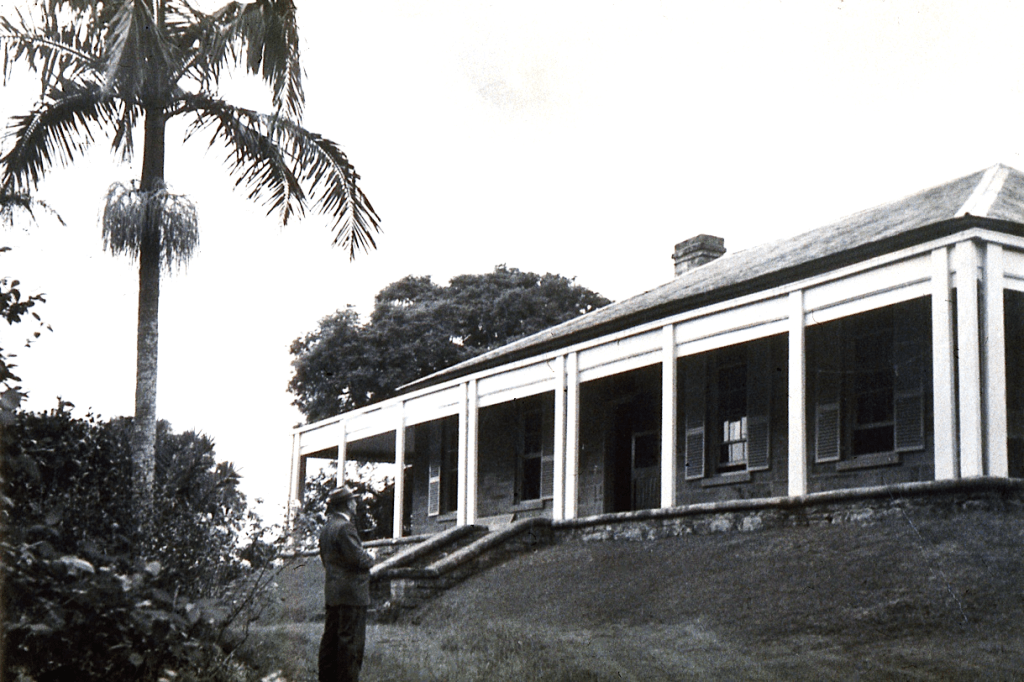
Kinross House, home of the Windeyers, Raymond Terrace, 1974 [University of Newcastle Library Living Histories Collection]
At Kinross the vine of late years has been cultivated on an extensive scale, and with a very considerable degree of success, especially as regards the quality of its produce. Prior to the year 1840, Mr. Henderson (now of Sydney) planted a couple of acres of vines, as an experiment, on the property ; the result was not so encouraging as to induce further planting at that time, and this was attributable to the unsuitability of the varieties of grape, then to be had, to the soil and climate. The black cluster was the principal kind, and that proved there a very bad and irregular bearer.
In 1843 a small quantity of wine was made here, and in the fallowing year twenty-seven gallons were made by Mr. Windeyer. He then planted a few acres, and in the year 1845 he had five acres under the vine; this acreage he added to occasionally until 1855, when he had ten acres in cultivation. The quantity of wine produced increased in nearly the same proportion; in 1845 the product was 587 gallons-an increase of 560 on the preceding year; in 1850, 1107 gallons; and in 1855, 1459 gallons. In the first instance the vine culture was entered on here chiefly to induce the tenantry to cultivate some vines for their own use (of the advantages of which more anon), but it had not that desirable effect. The tenantry took little or no interest in the matter, and up to the present day but few of them possess a single vine.
As vine growing and wine making pursuits possess strong attractions to all entering upon them, so what the proprietor of Kinross commenced as an example to others he, like other wine growers, became attached to, and, as that feeling grew, more care was bestowed upon the vineyard. In the ten acres we have mentioned there were twelve varieties of the grape, and to ascertain which varieties were best adapted to the soil and elevation of Kinross required time to allow the vines planted to develop themselves and prove their suitability or the reverse.
Within the last three years an additional area has been added to the vineyard, and it now altogether comprises 32 acres. In the new part only five varieties have been planted-the white soyras (sometimes called small sherry), hermitage, rose of burgundy, lambrusoit, and medec. Experience has proved these to be best suited to the soil and circumstances of this vineyard. The soil is a sort of silicious sand, the depth of which has not been ascertained.
When Mr. Windeyer settled at Kinross the property in most places was heavily timbered; huge trees of great diameter grew close to each other, and he justly calculated that notwithstanding the poor appearance of the surface of the soil, if it was capable of sustaining vitality in the heavy timber around it would afford sufficient nutriment to the vine, and the result in this respect has so far proved satisfactory. Yet here we learn that the old vines are giving out-that they do not yield so abundantly as they yielded a few years ago. This we understand is attributable to two causes — the German system of pruning adopted, and the want of manuring. It is supposed that the decayed leaves, bark, and ferns with which the surface was always strewn when the land was in a state of nature furnished manure for the soil, but a vineyard, having necessarily to be kept very clean, of itself does not supply any nourishment of this kind ; and as here there are so many particles of glass in the silicious sand, it is thought that manure would be comparatively useless owing to its non-absorbent nature.
The alleged fault of the pruning system alluded to is that the strong shoots of the vine are cut down during the pruning to within the third or fourth joint, the same as the weak laterals; and experience has lately shown, in the estimation of many, that it is best to encourage the vine where nature has shown an inclination to strong growth, and lop off altogether the weak laterals. This opinion is firmly maintained by Mr. William Keene (President of the Hunter River Vineyard Association), whose experience in the wine-growing districts of France and Spain gives weight to his opinion.
The vineyard of Kinross is well laid out, and it is kept clean and in good order; the vines look very healthy and promise a good average crop next vintage. The land is nearly all of the same elevation, and a road leading to Tomago divides the old and new plantations. The vines are trained to stakes throughout and are planted at a distance of 6 ft. by 7 ft. in one part, and 6 ft. by 6 ft. in another. That now most widely planted was originally 6 ft. by 3 ft. 6 in, but every alternate row of vines were subsequently removed.
The vineyard commences about two hundred yards from the house and extends in a north-easterly direction. The bright green clustering foliage of the vines, at the present season, forms a most pleasing contrast to the sandy scrub and forest on three sides surrounding them.
The cellarage at Kinross is the most perfect of any that we have yet visited. The cellars are all underground and cover a large space; they are divided into vaults in which the wines of the different vintages may be kept separate. About twenty-five thousand gallons can be stowed in them, and then there would remain sufficient room for carrying out all the operations comprised under the head of cellar management. There were about 10,000 gallons in wood on the occasion when we visited them; and a considerable quantity in bottle. In one of the vaults of the smallest cellar there are racks fitted to hold about 800 or 900 dozen bottles; as the wine is bottled off, the bottles are placed in these racks, and the interstices between them filled with sawdust, and so they lay until required.
The increase in the production of Kinross since 1855 has more than doubled. In that year 1459 gallons were obtained; in 1861, 3525 gallons; 1862, 2280; 1863, 2238; 1864, 2652; and in 1865, 3270 gallons. Next vintage a much larger quantity is anticipated. Mr. Windeyer at one time, by the use of Kauri pine casks, lost nearly 3700 gallons of wine; the wood impregnated the liquor with a highly resinous favour, and so destroyed it, affecting not only the wine with which it was blended in its early stage of management, but also the other casks to which that wine was transferred.
The quality of the Kinross wine stands high in comparison with any produced in the colonies. No effort has been made to force it on the market, or even to bring it into general local consumption, but it is quietly working its way into favour, and by those who have used it, it is held in high estimation. Mr. Windeyer is confident of its ultimate success, and as it is an article which improves with age, he is sanguine that as the taste for the Australian wines is fostered and grows among the people, the demand will equal the supply, with results beneficial alike to the wine grower and the wine drinker.
The arrangements for pressing, fermenting, and testing the wine after fermentation are very perfect here. The operations are carried out principally under the supervision of Mr. John Windeyer, assisted by a cellarer. The gathering of the vintage here also gives employment to a number of hands, and many children, when the time comes round.
Adjacent to the vineyard there is a large extent of land of a similar character to that under the vine, and which would be similarly cultivated if the demand for its produce were greater. It is situated about nine miles, in a direct line, from the sea coast; the intervening space is covered with large timber and brushwood, which shelters the vineyards from the southerly gales.’
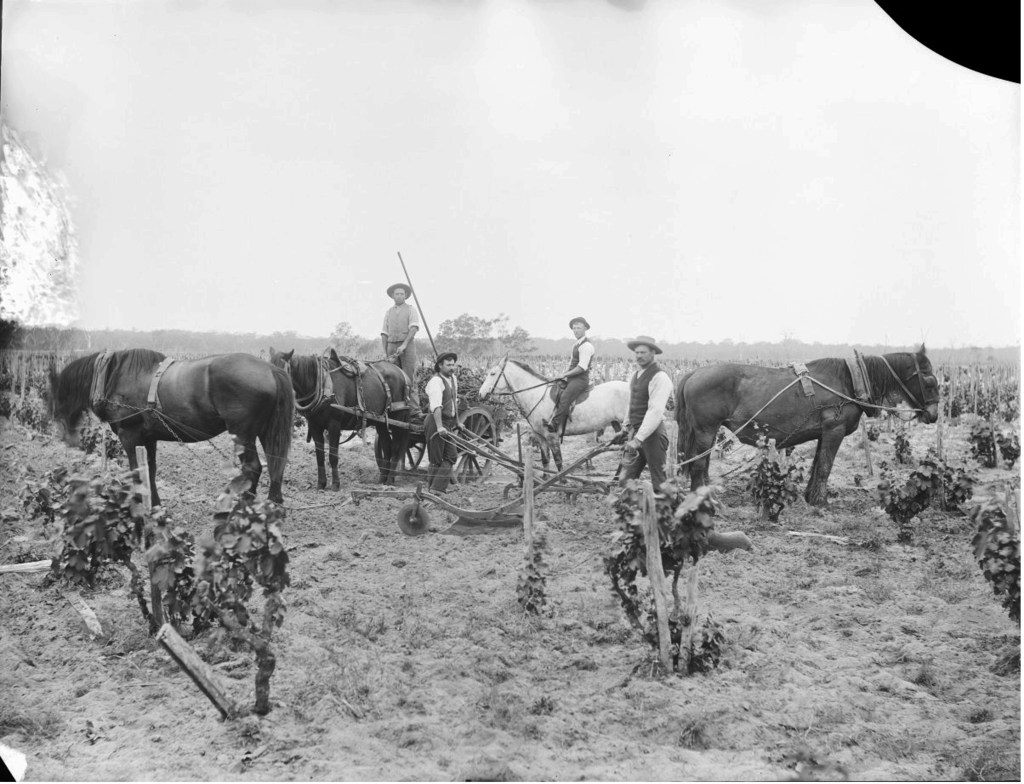
Ploughing of grape vines at Kinross vineyard [Newcastle Library, Hunter Photobook]
6. Eden Vale Vineyard
Eden Vale is not an active commercial vineyard today but is an important piece of Raymond Terrace’s pioneering agricultural history. It was established in the 1860s by Edward Doherty, who planted roughly 16 acres of grape varieties, including white scyras (syrah/shiraz) and hermitage, about a mile northeast of the town.
‘During the past four years Mr. Edward Doherty, of Raymond Terrace, has entered largely upon the cultivation of the vine for wine-making purposes. His vineyard is named Eden Vale, and is situated less than a mile in a north-easterly direction from the Terrace. In the oldest part of the vineyard about ten acres of vines were planted, and these have, with the exception of an acre, thriven well. In the place excepted the vines did not strike well, and had to be replanted in successive seasons. Mr. Doherty attributes this fact to the circumstance that originally the cuttings here were set too perpendicularly in the earth, instead of with a horizontal slope. This error was avoided in subsequent plantings. The vineyard is now in the fifth year of its existence and third of bearing.
In 1863 it was extended by the addition of four acres, and last winter it was further added to by two acres. The two-year-old vines are mostly white scyras, and though the cuttings were small, they have this season thrown strong, promising vines, six and seven feet long. The hermitage, lambruscat, and Shepherd’s are also grown here with varying success.
The wine made at Eden Vale is of a palatable and good-bodied character, and its producer has a demand for all that he can supply; the quan-ity as yet produced is small in comparison with the acreage, but many of the grapes are sent to the Sydney market for table use, the contiguity of the vineyard to a place of shipment affording advantages for this purpose. The quantity of wine that will be made here in the coming vintage will probably amount to 1000 gallons. The price obtained for the wine is 5s. par gallon. Satisfied with the results of his enterprise, and confident of greater success by an extended culture of the vine,
Mr. Doherty is having a few acres more land prepared to receive cuttings next winter; the labour attendant on this work is very great—much timber having to be cut down and removed, and the land to be trenched a depth of two feet.
The soil at Eden Vale is a silicious sand like that of Kinross, but being of a much lower level there is at a depth varying from two to four feet a kind of volcanic black soil. The aspect on the older part of the vineyard is south-eastern, and the remainder is situate on a level flat, the whole being surrounded by forest trees and scrub.
The vines are here trained on stakes and are laid at six feet by five in a portion of the ground, and much closer in the remainder. The vineyard is rented by Mr. Hoffer, an intelligent German; his wine press and cellar are of a primitive character but answer well all the purposes of wine making.’
7. Dalwood Vineyard
The Dalwood Estateis an historic winery located in the Hunter Valley. Established in 1828 along the Hunter River, it is officially recognized as the longest running commercial vineyard in Australia and the ultimate birthplace of Hunter Valley wine.
‘Continuing our tour through the vineyards of this district, we had the opportunity of visiting the famed Dalwood, the property of Messrs. Wyndham. From the Branxton railway station a pleasant drive through open forest land or sheltered coppice, and over a good road, for a distance of three miles and a half, brought us to the crown of a ridge of hills, at the base of which the rich pasture lands of the Dalwood estate commence, and from whence they extend in undulating meadows to the river Hunter, which waters a frontage of five miles of the estate.
From the ridge referred to a fine prospect presents itself to the tourist’s vision; the valley intervening between it and the opposite range of hills, and through which the river slowly ripples, is nearly all cleared of its ancient forest, and, on the Dalwood (Northumberland) side of the stream, shows traces of former cultivation; whilst the land on the valley and on the slopes of the opposite side, at the time of our visit, bore on its rich red soil most excellent crops of wheat and other grain, or afforded rich pasture to the stock of the settlers.
In former days we learn that wheat was most extensively grown on the Dalwood estate, hundreds of acres having borne that crop; but the frequent failures, consequent upon bad seasons and other causes, induced the proprietor to cease its cultivation, and turn the fields into pasture land for stock; and grazing has proved more remunerative than the purposes to which it was formerly applied.
On a part of the Dalwood estate the vine is now grown to a considerable extent; and although it is only within the past few years that the luscious products of the Dalwood vineyards have been placed before the public, yet in that time they have obtained a preeminent celebrity, which it has been, the care and determination of the Messrs. Wyndham to sustain and improve. Wines of the highest order are here produced, and in very considerable quantities, when we consider the comparatively recent period when its production was entered upon as a commercial enterprise.
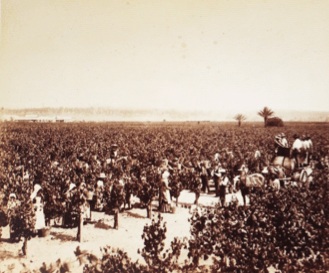
Harvest time at Dalwood vineyard, with female pickers,1886 [State Library of New South Wales]
The vine was planted here by Mr George Wyndham, sen., as far back as the years 1831-32, when he cultivated five acres of it for his own use. The site of the old vineyard was an alluvial flat, near the river, and subject to inundation. The cuttings for this plot were obtained from all parts of the country, and comprised, of course, a great many varieties, the selection of choice kinds at that time not being large in the colony. Even then most excellent wines were produced, which in the judgment of many were equal to some of the most prized burgundies.
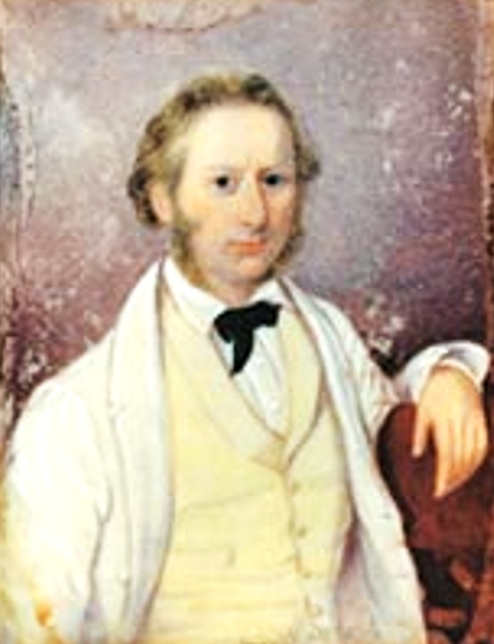
George Wyndham
Some of them were kept in cask, with the best of care, for fourteen or fifteen years, others were bottled off after standing twelve years in the cellars, and went overland to the Richmond Heads, thence to the Solitary Islands, and elsewhere, occupying a period of three years in travel. Some of these again returned to the cellars, and after remaining there a year or more were tested by the late Mr. [Alexander] Macleay, of Elizabeth Bay, and other competent judges, and by them pronounced equal to the best Burgundies. This we mention to show how a pure unadulterated wine will travel without injury. The small vineyard was rented to a German who by neglect allowed it to be overrun with couch grass, which could never be properly eradicated after once getting the upper hand, and ultimately the vineyard was totally destroyed by it, and the vines had to be ploughed up.
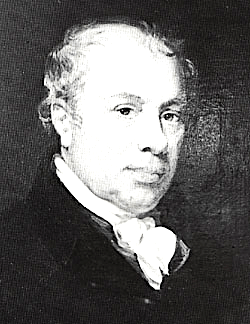
Alexander McLeay
In 1854, a commencement was made with a fresh vineyard on a new site. An elevated plateau, on the southern end of which Dalwood House is erected, was chosen for the purpose. In that year between three and four acres were planted. Satisfied with the result of this Messrs. Wyndham extended their vineyards in 1856 by enclosing and planting eight acres more; and it was about that time that the production of wine here, as a remunerating enterprise, was determined upon, and with this object in view a further area of twenty-one acres was planted in the years 1858-9. In July 1864, two acres more of choice Chiraz grape were added to the vineyard.
The thirty-five acres which these various plots together comprise form one vineyard within the same enclosure, and when viewed either from any elevated point around it or from the gazebos, or towers built within it, the large expanse of verdant and clustering foliage is a most refreshing sight; even in the warmest days the fresh and vigorous leaves show no indication of drooping, but rather spread themselves out as it were to court the sun’s rays. The vineyard is intersected at regular distances with broad paths, through which the drays in vintage time may be driven, to gather the baskets of grapes and convey them to the wine house. These broad paths run between every fifty vines; and smaller paths, through which three persons may pass abreast, are made at every twenty-five rows of vines. The narrow paths are used as shooting alleys and are made to facilitate grape gathering and the destruction of birds, which are troublesome to the wine grower and injurious to the grape crop when the fruit is ripening.
As the magpie, goburra, and a few other birds of less epicurean tastes than the smaller feathered tribes, confine their appetites to indulgence in insects only, they are protected from the operation of the general order for slaughter, and any of the workmen who fire at these exempted varieties is subject to fine. Two of the shooting alleys are covered with vines trained on arched trellises, after the style known as the “Hautain;” the agreeable shade they give, combined with the handsome appearance they present, with thick clustering bunches of the luscious fruit hanging pendant beneath the framework, yields a sensation of delight to anyone passing through them.
The Dalwood vineyards show to advantage the benefits accruing from high cultivation and careful training. The espalier system has been adopted throughout, though it was not without much persuasion that Messrs. Wyndham induced the Germans who work in the vineyard to believe it a better system of training than clustering the vines around the stakes, and tying them up like gooseberry bushes. When the Messrs. Wyndham determined to adopt the espalier method, they allowed the Germans to cultivate two acres in one plot in the old style to which they were so wedded, directing them to give this plot as much care as they pleased; the result was that with equal care bestowed on both styles, though the espalier requires rather more labour than the other, the two acres left to the Germans yielded 400 gallons to the acre, whilst the remainder in the same plot, trained on rails and wires, returned 800 gallons to the acre, in the first year after that system was adopted. That happened to be a good vintage, and in the following season the returns were not so large from either, but the disparity in the yield was greater-the old style giving only 800 gallons to the acre, and the other 600 gallons per acre.
Throughout the vineyard paragrailles, resembling telegraph posts, are erected, to serve as lightning conductors, and a kind of guard against hail.
The vines, on the occasion of our visit, were in beautiful order. They are mostly trained on wire (No 14), which is carried from stake to stake; but in some place’s rails are used instead of wire. Instead of being topped to such an extent as was necessary in stake training, the tops are bent down and tied to the top wire, and thus the fruit is in a great measure sheltered from the hailstorms, and at the same time the free passage of air is not in any way interrupted. The freedom with which every bunch seemed to hang was evidence of careful pruning and promise of simultaneous ripening. The yield of the crop now growing does not promise to be unusually abundant.
The gathering of the vintage gives employment at vintage time to between sixty and seventy persons – the settlers, and families of settlers residing in the neighbourhood. The vineyard is kept clean throughout the year; the task of keeping it in order, and doing all the work necessary, such as weeding, pruning, tying down, and topping the vines, is performed by contract, a party of Germans being the contracting parties; by this plan the work is well done, at about half the former cost, with satisfaction to the proprietor and to the employed,
Nothing could exceed the great regularity with which the vines are planted, and the almost religious strictness with which the different varieties of grape are kept. One of the great difficulties the wine grower has within this colony is ascertaining the varieties, the soil and climate. At Dalwood the choices closely adapted, have been selected; and in eight acres of pineau blanc, hermitage, and varieties, were grafted to replace a quantity of German reisling, and other sorts which do not seem suited to Dalwood, as they ripened so unevenly, the berries on them at vintage time being in every stage of maturity from the preliminary to the mouldy and decayed.
The varieties most recently planted are chiraz and pedro ximines. The chiraz makes an effervescing wine like champagne, if properly treated, and generally resembles still champagne. In 1860 some of it was pitted against champagne direct from the vineyards of the grower’s brother in France and placed before well qualified judges when the preference was given to the product of Dalwood chiraz. There are here about 13,000 vines of it, including the 3000 planted in July, 1864. The other choice vines of which this vineyard possesses almost a monopoly in this colony are the malbec, carminet, and verdôt. The hermitage is from cuttings only once removed from the famous Hill of Hermitage from which the variety takes its name; that is, the vines from which the cuttings were obtained (Mr. Kelman’s vineyard at Kirkton) were direct from the Hill of Hermitage; and the pineau noir is only once removed from that of the famed closvoujou vineyard. Pineau blanc and pineau noir, shepherd’s reisling, and lambruscat, also occupy some portions of the vineyard; the Isabella grape, so remarkable for its similarity in flavour and odour to the hautboy strawberry, is also grown here, and a further area of it will probably be soon planted.
At Fern Hill, on another part of the Dalwood estate, and about two miles from the main vineyard, Mr. George Wyndham jun., has twelve acres of vines, four acres of which were planted in 1858, and the remainder in July, 1864. The scenery in the neighbourhood of Fern Hill, and that in the distance as viewed from it, is of a most charming character; lofty ranges of hills rise before it on the farther side of the Hunter; the opening of Lamb’s Valley may be seen on the right, whilst in different directions Knockfin, Tangorin, Hudson’s Peak, Bald Hills, and other well-known properties are visible, and give a quiet grandeur to the surrounding locality.
The produce of Fern Hill is conveyed to the Dalwood wine-house as gathered, and there converted into wine. The soil at Dalwood is a dark sandy loam, varying from eighteen inches to ten feet in depth, and beneath it there is a stratum of ironstone gravel, and substratum of strong yellow clay. The vines are planted six feet by six feet, and six feet by five feet, on the Dalwood vineyard. At Fern Hill, where the soil is a rich black sand to an untried depth, the vines are chiefly planted at a distance of eight feet by six feet.
The wine-house, presses, and cellars are built within a short distance of the homestead. The wine-house is a large wooden building, within which the processes of expressing the juice, fermenting, and racking are conducted. There are two wine presses, each capable of crushing about fifteen cwt. of grapes at a time. The crushing power is obtained by a most simple and effective plan; two ironbark beams, thirty-six feet long, and tapering from eighteen inches to a foot in diameter are attached to each press, and with double reeving-blocks and tackle two men can with a capstan get a pressure of forty tons, quite sufficient for all purposes. There are here, of course, all the necessary appliances for removing the liquid as it flows from the presses to the fermenting casks, and for its subsequent treatment. The pressing is the most simple process of all, and the presses are of such simple construction that any accident that might happen them can be readily remedied.
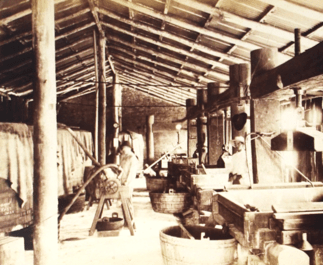
Equipment used for wine processing, Dalwood vineyard, 1886 [State Library of New South Wales]
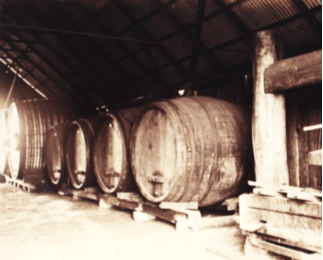
Large wine barrels at Dalwood vineyard 1886 [State Library of New South Wales]
At Dalwood the wine is made after the most approved plans; the utmost care and cleanliness is observed during vintage (and this has been the case more particularly during the last two vintages-wines that have not yet come before the public). Every mouldy and damaged berry is most carefully picked out and cast away. Dr. Kelly, in a recently published work on “The Vine in Australia,” contends that a low temperature is the best for fermenting; experience at Dalwood has not fully borne out this view of the doctor. In fermentation, and all the subsequent processes of the liquid, most rigid care is observed, the production of wine of the best quality rather than abundance of an inferior stamp, being the aim of the proprietors of Dalwood. All the arrangements of the vine house and cellars are most complete and perfect.
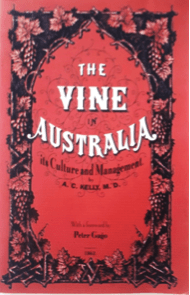
‘The Vine in Australia’ by A. C. Kelly 1862
The Dalwood cellars are very extensive buildings and are all above ground. The principal one is a two-storied stone building and attached to it is a wooden and zinc roofed shed, which is used for the same purpose; there is also a great deal of storeroom in the wine-house. The upper floor of the stone building is used for bottling, labelling, and packing. The cellars are capable of holding about 60,000 gallons in wood.
Messrs. Wyndham personally superintend the winemaking, and have a regular cellar staff, who are constantly at work racking and fining. The head cooper or cellar man, Frederick Müller – who has two assistants – is a thoroughly experienced hand. When Mr. Blake had Irrawang, Muller came from Germany to manage for him and afterwards attached himself to Dalwood. He is efficient in his profession, having been sixteen years in the cellars of Prince Metternich, at Nassau, and in one of the chief Johanisberg cellars for twelve years more.
On bottling days extra hands are called in, and a 300-gallon cask of wine is quickly run off into bottles, then sealed, labelled, and packed away in cases by professional hands, right and tight, ready for market. The labelling is done by the daughters of the tenants, to whom winemaking thus affords occasional employment. The bottles all undergo a thorough cleansing in four waters before being used. In the first wash a solution of soda is used; in the next they are rinsed with ant-hill gravel; and then they pass into the hands of a third man, who gives them a rinsing in the other two waters, and places them in a rack to dry. This work is carried out in a shed attached to the cellars. Equally good arrangements are made for cleansing the casks.
Dalwood vineyard produces chiefly wines that are sold when 2.5 or 3 years old, at from 7s to 8s. per gallon in wood, or 21s. to 24s. per dozen in bottle. There is besides the ” first growths” that sell readily at from 32s. to 42s per dozen, and even as much as 60s. per dozen has been obtained for some of the fine old wines that have been kept back, of the growths of 1861-3 vintages. Besides these Messrs. Wyndham have large quantities of wines that are not counted worthy of bottling, some of which have been purchased during the last three years by them, from neighbouring vineyards, and after mixing or blending with low-classed wines of their own vine-yards – the result of bad or rainy seasons – are carefully racked and fined the requisite number of times, and then sold by them, in wood, as “Pale Australian,” or “Light-red Australian,” at from 4s. to 5s. per gallon. They are kept for two years before being sold, and we are assured that a less price would not pay for this class of wine.
We tasted a few samples of it in the cellar, and they were of nice, light, palatable, and clean-flavoured quality. For these wines there is in fact an everyday increasing demand. Here, indeed, are to be found wines suited to the tastes and purses of all comers, from the fine, rich, generous “Bukkullas,” and full-flavoured, fragrant, and high-priced Dalwood, down almost to the everyday Vin Ordinaire of France.
The stocks on hand at the time of our visit, notwithstanding the brisk sales of the present year, equalled 30,000 gallons. From the Dalwood cellars the quantity of wine actually sold will average 1300 gallons per month for the year 1865, provided the December sales equal those of the preceding month (1700 gallons), and from the demand in the early part of the month there is every probability of that estimate being realised. Messrs. Wyndham informed us that the ordinary 21s. and 24s. wines preparing for next summer’s campaign will far surpass any they have hitherto had in the market at that figure, and they confidently hope and expect a further improvement as they gain knowledge and experience.
The wines that sell at from 21s. to 24s per dozen are from two years to three years old, and they will be found to improve considerably with age. A large quantity, about 3000 gallons, of wines of 1861 (a very bad season) were put away as unsaleable, but nevertheless they received regular attention, with all the necessary racking, firing, etc, and this spring, when 5.5 years old, they have been found to have improved so much as to have become invaluable for blending with young growths, and exceedingly valuable by themselves.
Messrs. Wyndham at first were strong advocates of selling wine young, but experience has induced them to change this preference, and they now seem to regret having parted with many wines which would have been much improved by age.
It is only within the last few years that the vine has been cultivated to a very large extent in this district, and the fresh life and vigour shown in this industry is a hopeful indication of a prosperous future for it. The Dalwood wines did not come fairly into market until November 1862, and they were then submitted to the public in such good order that they at once obtained a high position, which they have every year since improved. The chief trade in them lies inland north from Maitland, and in the neighbouring colonies. We are informed by travellers that hardly a roadside inn is to be found northward within 400 miles of Maitland at which Dalwood red and white is not to be had. And Messrs, Wyndham assure us that of the many hundred casks they have sent out rarely has one of them spoiled.
They have been taken as far away as Winton, out on the Narren, and to Fort Bourke, in casks, and overland to Rockhampton and Brisbane. Many are the tales of weary and thirsty travellers who have expressed their delight and satisfaction on dropping, at some far inland public, on a bottle of good Australian wine from the Dalwood vineyards. The travellers all bear testimony to the refreshing and invigorating effects – so refreshing and healthful in a hot country – effects that are only known to those who are accustomed to drink the pure juice of the grape, such as the product of Dalwood, Bukkulla, Cawarra, Kinross, Lewinsbrook, Orindinna, Kirkton, Porphyry, and Irrawang, and which many other vineyards in this district are so well fitted to produce. This is most acceptable to those who prefer the wholesome and invigorating effects of pure wine, rather than the intoxicating and stupefying effects of imported deleterious compounds.
A great difficulty, and indeed one of the chief difficulties, experienced by winegrowers in bringing their wine into sale and general consumption, is the want of knowledge regarding the treatment of pure wines, which many publicans and others manifest. They keep it in kegs left on the tap-room shelf, in a temperature of 85 or 90 degrees, and lay it lukewarm before their customers, in which state it is as insipid and disagreeable as lukewarm water, instead of bottling it off and keeping it in a place of low temperature. This remark does not, of course, apply to all publicans; a few understand the treatment the wine requires, and give it that treatment with profit to themselves and satisfaction to their customers.
Before the present prohibitive duty was passed a fine business was beginning with New Zealand. Messrs. Wyndham inform us that (thanks to Messrs. Ferguson and Son) their Dalwood wines are now to be found in Bombay and other places in India, where a few casks of them have been introduced by merchants and friends. They have also been introduced on a small scale into London, Liverpool, and other places in England in bottle and wood. To England about three dozen quarter casks have been sent to order, and they always travelled well. The wines sent home were from fifteen months to two years old, and placed at 8s., 12s. and 15s. per gallon. That sent in wood on arrival in England was bottled off according to instructions sent with it. The wines thus exported always received the highest compliments for their quality and flavour; one firm stating that they were “altogether taken by surprise by the good quality of the Australian growths.”
Small quantities are sent in casks every year. Some cases were even sent to Bordeaux, a celebrated wine making and exporting province of France. Here also they received the highest commendations, and from England they received what was more satisfactory than commendations, or rather as high commendation as could be desired orders for a further supply.
Since wine-growing on the Hunter and its tributaries secured the attention of capitalists, and became an extensive occupation, as it did about the year 1860, we have had nothing but a succession of bad seasons; and, not-withstanding this discouragement, the wine-growers have persevered with a determination to overcome all difficulties, and the remit of their efforts indicate the gradual accomplishment of their desire, and some of them think (Messrs. Wyndham amongst others) that the Hunter, in the course of eight or ten years, will be proclaimed the Douro of the antipodes.
The Dalwood red is made chiefly from the Hermitage, Black Verdôt, Malbec, and Pineau Noir; the white from Pineau Blanc, Chiraz, and Madeira or Verdeilho. We had the opportunity of tasting several samples, and certainly they deserved the high character which the winning of about a dozen silver prize cups at the agricultural exhibitions have stamped them with. The yield anticipated at Dalwood in the coming vintage is 17,000 gallons.’
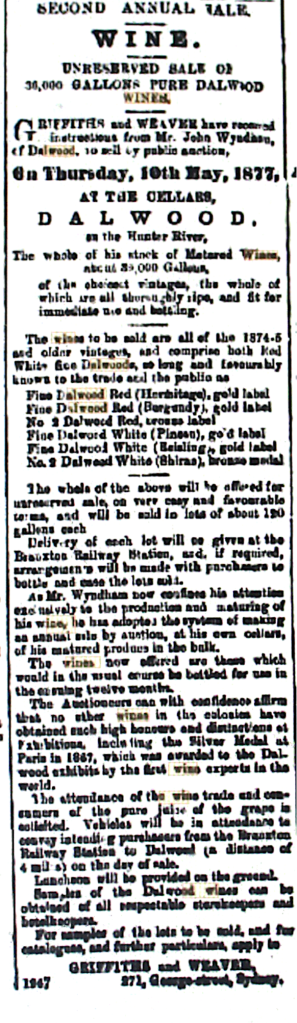
Auction sale of the whole stock of Dalwood Vineyard brought about by a new system of offering all wine holdings at an annual auction [Newcastle Morning Herald and Miners’ Advocate, 5 May 1877]
8. Orindinna Vineyard
Orindinna is a historic property and a pioneering, 19th-century vineyard located near Gresford in the Paterson River Valley of New South Wales. Originally established and operated by the Glennie family, the Orindinna vineyard was highly celebrated in the region for producing award-winning red and white clarets during the 1850s and 1860s.
‘The cultivation of the vine and production of wine in this district is not restricted to the Hunter alone; the Paterson, the Allyn, and its tributary Lewinsbrook, possess soil and situations admirably adapted for the growth of the vine, and the advantages of those two important features have been somewhat extensively availed of by a few of the enterprising gentlemen who own estates in that beautiful district. Winemaking has there been conducted with a degree of success that is highly encouraging. Many of the vineyards of those localities have attained a reputation, for the excellence of their wines, extending beyond the colonies: — such are the Cawarra and Lewinsbrook; whilst others—the Orindinna, Caergwrile, Camyrallyn, Brinkburne, Glenthorne, Colstoun, and Dunheved—have an enviable local celebrity for their produce. Many young vineyards have also recently been planted in this part of the district, and in a year or two will be coming into bearing—the largest of these is Clevedon.
The first vineyard we visited on the Upper Paterson was that of Mr. John Glennie, at Orindinna. It is situated in a partially sheltered valley, on the north bank of the Paterson River, near to Gresford, and about sixteen miles from the Paterson township, or twenty-eight miles from Maitland. The first vines were planted here by Captain Patch, twenty years ago, on an area of three acres; and a few years thereafter he enlarged his vineyard by fifteen acres more. Any vines that have since then been put out were merely to replace varieties that were not adapted to the soil of the locality.
Owing to the unsuitability of many of the sorts with which the vineyard was originally planted, but little wine was made from it during its early years. Experience proved the varieties of grape that would answer for wine making purposes on this ground, and by degrees they replaced or were grafted on to the old sorts. It is somewhat remarkable that many kinds of grape which flourish and produce good wine on the Hunter are comparatively valueless on the Upper Paterson and Upper Allyn.
At Orindinna the two kinds of which the vineyard now chiefly consists are the madeira (or verdeilbo), nine acres, for white, and black hermitage, seven acres, for red wine. There are small plots of shepherd’s riesling, shiraz, and lambruscat also. The madeira is not an abundant bearer here, but it produces the most excellent wine. The hermitage on the Paterson, in addition to a prolific yield, possesses all the qualities of a good wine-making grape. The lambruscat gives only a middling crop.
Orindinna was purchased by Mr. Glennie, its present proprietor and occupant, about seven years ago; and when he came into possession of it, a five years’ lease, held by a previous occupier, had just terminated. During the period (and in the latter part of it especially) that the vineyard was under lease, the vines and ground had been much neglected and were in very indifferent order. To restore it to a state of comparatively good order was a work of no small difficulty, but it has nevertheless been accomplished.
The soil is extremely rich black alluvial, and great trouble is experienced, and labour expended in keeping down the grass and weeds, which, if left unmolested for a short time, spring up and grow in rank luxuriance. The most troublesome of them is a bulbous grass generally known here as Townshend grass – having been introduced to that part of the district by Mr. Townshend, senior, of Trevallyn, several years ago; this grass has found its way to this and other vineyards in the neighbourhood, and wherever it has grown, it is next to impossible to eradicate it. Every portion of the vineyard last year was dug with the spade; this season it has been twice ploughed and harrowed, and throughout the year the grubbing and chipping hoes are kept at work on it, yet the weeds and grasses cannot be kept thoroughly under.
The vineyard is planted in a southerly direction from Mr. Glennie’s residence, commencing about fifty yards from it, and extending along the river’s bank for a considerable distance, no portion of it being much more than one hundred yards from the bank of the river. A blind creek divides the ground; on one side of it there are fifteen acres of vines, and five on the other. The planting is pretty close, five feet by four and a half feet being the distance between the rows and vines. The espalier system of training is here approved of and carried in a temporary manner on the greater portion of the land. Instead of battens or wire, bamboos are secured to the stakes, with short pieces of fine wire; the bamboos require to be replaced every alternate year; they grow in abundance on a small plot allotted to them in a corner of the vineyard.
The trouble attendant upon renewing the espalier is not so great as might be imagined, but the wire espalier (which Mr. Glennie intends to use in the course of time) is immensely superior, and renders unnecessary much labour which the bamboo trellis requires. The cost of wire for the espalier system is about £6 per acre, and it would ultimately, prove the cheapest plan of espaliering. For tying the vines around the stakes where there is no espalier a quantity of ordinary ship rope was separated into strands and combines strength with economy. At vintage time eighteen or twenty women and girls are employed gathering the grapes, and extra men are also engaged in the cellar and wine-house during the vintage.
The vineyards of the Paterson and its tributaries have during the past few years suffered very severely, and somewhat frequently, by those disastrous visitations -hailstorms. On the 15th of November 1861, Orindinna was completely wrecked by one of them, just as the fruit was forming. It took almost every leaf from the vines and damaged the wood to a great extant. The cicatrised marks of the hailstones are yet plainly visible on the vines. The loss by that storm was very heavy; instead of making 5000 gallons of wine, as was anticipated by the early promise of the crop, only 200 gallons were obtained from it. This was the second severe hailstorm which has visited Orindinna during the seven years of Mr. Glennies occupancy; the other one also wrecked the vineyard, and the loss sustained by them both was equal to 8000 gallons, worth about £1200. With such discouraging events, perseverance in the pursuit is commendable. The vines are now recovering, and their vigorous growth after the wrecking they received is a strong indication of the richness of the soil.
This season only about fifteen acres are being worked for wine making, the high price of labour causing the remainder to be abandoned for the present. Notwithstanding the heavy losses sustained by the hailstorms, the average product of Orindinna for the last seven years has been 4000 gallons per annum. In 1864, nearly 6000 gallons were made. In the coming vintage, if not affected by storms before the gathering takes place, probably 3000 gallons will be made.
The wine house, in which the pressing and fermenting operations are conducted, is attached to the homestead, and about one hundred yards from the nearest part of the vineyard. The winepress is worked with a screw, turned with an iron capstan-bar; its capacity is such that from 280 to 300 gallons can be run off at one pressing. Adjacent to the press are four 200-gallon fermenting vats; from the wine house the liquid is conducted to the casks in the cellar along an open wooden tube, which can be extended or shortened to any required length; it is let in to the cellar through a porthole in the wine house.
The cellar is fifty feet in the clear by twenty-five feet in breadth and is capable of holding 14,000 gallons in wood. Originally it was a shallow well made by Captain Patch, beneath one end of the house; Mr. Glennie increased its dimension to its present size, by excavation. It has a low temperature and can always be kept ten degrees below that shown by a thermometer in veranda shade. It generally stands between 63 and 65, never ranging five degrees above that.
The wines in stock at Orindinna now amount to 4000 gallons of claret and hock, by which names the red and white wines here are respectively designated. They are generally all sold when about fifteen months old, to the settlers in the neighbourhood, or to the proprietors of larger vineyards who have an extensive trade with Sydney. They, however, do not come to perfection until they are three or four years old. Some of them sent to the last meeting of the Hunter River Vineyard Association, we remember, realised high commendations, especially the white wines; the white wine of the past vintage has only the fault of being small in quantity; in flavour, aroma, and body it excels that which was so well commended. The claret (red) wines also possess superior qualities and are preferable to many imported clarets of high price.
Upon the removal of the liquid from the fermenting vats, at the proper time, much of the success of wine making depends. The time, of course, is dependent upon the period occupied in fermentation, and this is further governed by the temperature. At Orindinna it is carefully observed, and to this fact, as much as to cellar management, is the excellence of the wine attributed.’
9. Lewinsbrook Vineyard
Lewinsbrook has deep historical roots as one of the oldest pioneering vineyards in the Hunter Valley. The original Lewinsbrook estate was established in 1826 and planted with grapevines in the early 1830s by Scottish settler Alexander Park.
‘Another vineyard which has attained a wide-spread celebrity for its production is Lewinsbrook, which is situated upon the banks of a rivulet of that name, a tributary to the Allyn River It was planted by Mr Alexander Park upwards of twenty years ago, and is the second largest vineyard in the Northern District, covering as it does an area of thirty acres, the vines in which were planted in one season.
In March 1844, the ground now bearing this rich product was covered with timber and underwood. Before the following September it had been cleared, stumped, and otherwise prepared for receiving the vine cuttings intended for it, and before the end of the month 50,000 cuttings had replaced the forest. This fact indicates the great energy and enterprising spirit with which Mr. Park commenced the undertaking, and one which at that period of the colony’s existence was considered a work of considerable magnitude.
Great care was bestowed on the vineyard in its infancy, it was dug throughout with the spade every year, and hoes were kept constantly at work in it, the vines were planted too close together to allow of the plough being used. The result of the care bestowed upon it, and the high cultivation it received, was that in the fourth year of its existence 10,000 gallons of wine and 200 gallons of brandy were obtained from it at one vintage. Here, as at other places, several varieties of the grape were originally planted, but by degrees many of them were found to be unsuited to the soil or situation, and they have been replaced by other kinds or by grafting’s from the vines that were most approved of in the vineyard. Where the old vines have been altogether removed the cuttings which replaced them have been planted wider apart-four or five feet between the vines, and seven feet between the rows, being the distances generally observed.
The vines thrive remarkably well, and the enterprise was very successful for several years after its commencement, but since the era of the gold discovery in 1851, Mr Park assures us that the seasons have frequently been very disastrous-some years destroying the crop to such an extent that only 300 or 400 gallons would be obtained from the whole vineyard. The damage was chiefly done by hailstorms, but, notwithstanding the frequency of these unwelcome visitants, and the discouragement their effects must have caused, the production of wine has been persevered in with much energy.
We regret to state that it was only in the end of November last that a violent hailstorm, with the usual disastrous results, visited Lewinsbrook, and cut up the vineyard in a most disheartening manner, completely destroying two-thirds of a very promising crop which the vines were bearing, and injuring the vines to such an extent as to affect their bearing next year, the storm was of brief duration, and the hail about the size of marbles. Wet seasons when the grapes are just about fit to gather, also prove very destructive, affecting not only the quantity of wine by rotting many of the berries but also the quality. The vineyard, however, will stand any quantity of rain or degree of heat up to the time of ripening, and not suffer in any way from it.
A large extent of the Lewinsbrook vineyard was originally planted with burgundy, which, though making a most delicious and delicate wine, was a shy bearer, and so susceptible of injury from rain when ripening that a crop could never be relied upon. It is therefore being gradually replaced with black hermitage Shepherd’s reisling (or seedling as it is sometimes designated) and the verdelho occupy a large share of the vineyard, they being considered here the best for white wine, and the black hermitage for red. Indeed, throughout the Paterson district those are the three varieties which are in every vineyard approved, and recommended to intending wine-growers There yet remain at Lewinsbrook several other sorts which give fair crops, that yield a wine which blends well with that of the choicer kinds.
Stake training, and not espalier, is the system adopted throughout. The situation of the vineyard is almost perfectly flat; the land has a slight dip inward from the brook to the hills forming the valley’s side. The aspect is favourable to the complete maturation of the crop, and the soil is especially well suited for vine culture; it is an alluvial loam, of a calcareous character, being strongly impregnated with limestone from the adjacent hills. The ranges hemming in the valley abound in limestone and the decomposition of these hills, washed down with the rains, have made the land most valuable, by imparting lo it its calcareous character. In the possession of a soil of this kind Mr Park is very fortunate, as it has generally been deemed the best possible for the growth of good wine-making grape-most of the celebrated vine yards of Europe having soils of the same character.
At vintage time the greatest possible care is taken to make good wine-good quality and not large quantity being Mr Park’s object. Every bad or mouldy berry is picked out by the grape gatherers, as the bunches are plucked, and each basket is emptied on to boards, and again examined by Mr Park, to see that all bad berries had been discarded before the grapes are put into the crushing machine. About three years ago a great loss was sustained at Lewinsbrook by the cellars being burnt down, and some 13,000 gallons of wine were destroyed by this occurrence, besides everything else the cellar contained.
The cellar is built close to Lewinsbrook House, which stands on an eminence that commands a fine view of the valley and the surrounding scenery. It is distant about a quarter of a mile from the nearest part of the vineyard, and about three quarters of a mile from the furthest part.
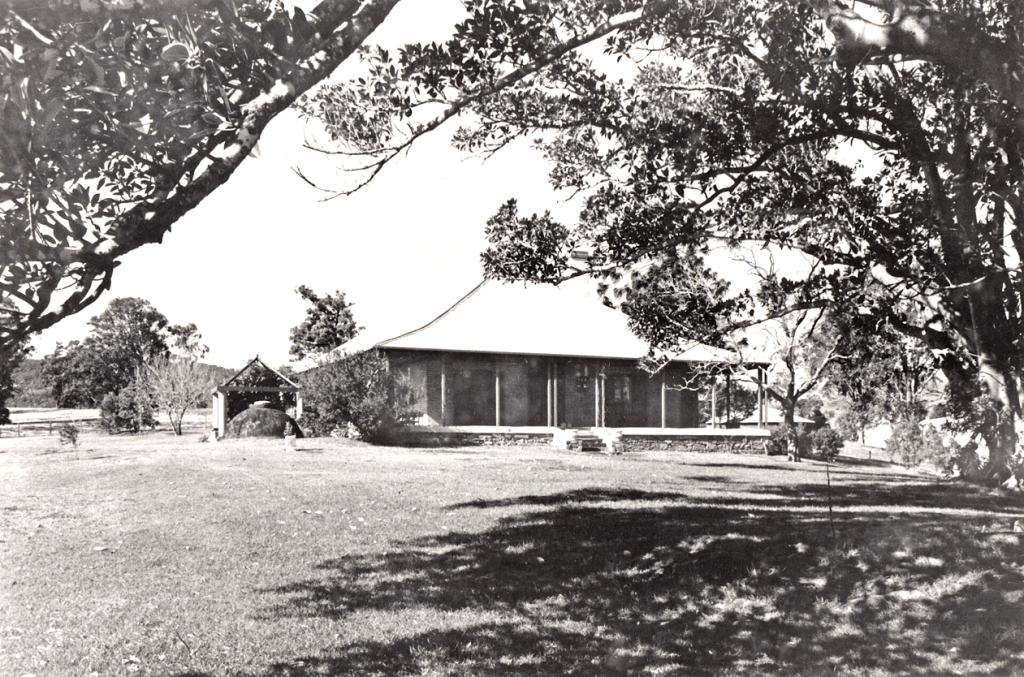
Lewinsbrook homestead [Paterson Historical Society]
The cellar was erected of stone, and soon after its destruction it was rebuilt, and again fitted with every necessary appliance for wine making. The walls when rebuilt were raised higher than they originally stood, and the upper part of the building was then made useful as a granary. The cellar measures eighty feet on the clear by forty feet in width, and, leaving room for the wine presses and other necessary apparatus for wine making, it is capable of containing about 40,000 gallons in wood.
One of the most noticeable features in the Lewinsbrook cellar is the enormous sized casks that are used. There are two capable of containing each from 1250 to 1300 gallons. These were imported from France at very considerable cost, the freight forming a very large item in that cost. On the model of these Mr. Park is having a sufficient number of casks of the same size built on his premises, to range on each side of the cellar. He has five of them already completed, and two set up and in use. They are made of cedar two and a half inches thick, which is treated in the following manner. After being sawn it is placed in the brook, and allowed to remain there three months, it is then removed and allowed to dry for three or four months, after which it is worked up, and then again taken to the brook, filled with water, and kept full for ten days; after that the cask is emptied, taken to the cellar, and after three days’ drying it is ready for use.
Some fears were expressed by winegrowers and others that the cedar would impart to the wine a disagreeable woody taste, but the treatment it underwent at Lewinsbrook before being used has made those fears groundless, the wine in the casks which have been filled having sustained no damage whatever from the wood. The casks are made to stand upright, and when so fixed they are about 7 feet 6 inches in diameter at the base, and 6 feet 6 inches at the top. As the evaporation from so large a surface would be very great if the casks were allowed to stand perfectly level, Mr. Park bas avoided this loss by fixing them at an angle of about 90 degrees, and thus but a small portion of the surface is liable to evaporation – indeed so little that an ordinary 250 – gallon cask loses as much by evaporation as any one of these giants loses.
In making these casks great care has been observed to give the smoothest possible surface to the woodside, the advantage of which is that when a cask is being cleaned no sediment can remain in any little roughness, as has been known to be the case with many other casks, to the injury of the wine subsequently placed in them. For hooping, plate iron about four inches broad and nearly a quarter of an inch thick is used; there are six bands of this to each cask. There are a number of other casks of goodly dimensions in the cellar, and amongst them are three of 600 gallons each, and seven of 496 gallons each.
The cellar contains at present a large stock of wine, the vintages since the fire having accumulated, and until lately being too young for the market. Mr. Park sells only in very large quantities; and the care bestowed on the Lewinsbrook wines has obtained for them, a good name, which in return has obtained a very fair demand.
We tasted some of the shepherd’s riesling of ’64, the madeira or verdellho of ’65, and the hermitage of ’65. The riesling was a beautiful light wine, clear and brilliant to the eye, and very pleasing to the palate. The madeira was a wine of very high quality, possessing a rich generous flavour, combined with strength and a delightful aroma, beside which high-priced hock and sauterne would not bear comparison. A bottle of burgundy, about seven years old, from one of a few cases saved from the fire, was a splendid sample of wine; its rich and potent dryness proved how greatly the wines of this colony improve with age. The Lewinsbrook wines promise to rank higher than they have hitherto done.
On the estate, and on the opposite bank of the brook, there is a fine orangery of several acres, which for years past has yielded large and never-failing crops of that delicious fruit.’
10. Camyrallyn (Camyr Allyn) and Clevedon Vineyards
The viticultural history of Camyrallyn dates back to 1833. Welsh settler Charles Boydell planted some of the earliest vines in the Allyn River Valley. Nearby Clevedon was established as an early boutique winery.
‘There are a number of smaller vineyards on the upper Paterson, and Upper Allyn, a few only of which we had the opportunity of visiting; amongst them is Camyrallyn, the property of Mr. Charles Boydell. It comprises 15 acres, from which wine of excellent quality has been made for several years past. Mrs. Brown, of Coulstoun, has three acres; Mr. Steers, of Dunheved, has three acres; and Captain Champain, of Glenthorne (the Rev. A. Glennie’s property), has four acres.
From all these vineyards considerable quantities of wine have been made. Mr. McCormick, of Clevedon, on the Allyn, has eight acres, planted entirely with madeira, and two acres more are to be planted with hermitage next season. The cuttings in Clevedon vineyard were set only two years ago and unfortunately in the first year of their growth a hail-storm destroyed more than half of them, just after the shoots had attained a length of six inches. They had to be replaced the following year with fresh cuttings, and this has caused the vineyard to look at present somewhat uneven. All the vines are now flourishing, and at the time of our visit the ground was in beautiful order; a weed or blade of grass could hardly be found in it, and the ground was worked to an admirable fineness. The vines have been laid out with much regularity, and are properly intersected with the necessary roadways for the carts at vintage time. A few of the vines are already in bearing.’
11. Porphyry Vineyard
The Porphyry vineyard wasestablished in 1839 by Reverend Henry Carmichael in Seaham, near Raymond Terrace. Carmichael hired European vinedressers to craft high-quality wines.
By the mid-19th century, his “Porphyry Sauternes” gained international acclaim and won medals at European wine shows.
‘Porphyry Vineyard is situated on the right bank of the Williams River, adjacent to the young township of Seaham, and about twelve miles from the river’s confluence with the Hunter, above Raymond Terrace. The Williams is a fine broad stream, with gentle windings, its banks for some miles are like the banks of a canal, so regular are they in their formation, to a considerable distance beyond Porphyry Point. The land on both sides is cultivated to within a few yards of the water’s edge, and the crops of maize and lucerne (after the few refreshing showers which visited that part of the district on Tuesday and the two succeeding days) looked healthy and promising.
A trip up the Williams River is a decidedly pleasant and agreeable means of enjoyment, and there is much in the prospect to repay the pleasure-seeker for the time it occupies.
On landing at Porphry we visited the vineyard of Messrs. Carmichael, which lines the right bank of the river for a considerable distance. The vineyard is now twelve acres in extent, eight acres of which are in full bearing, and the remainder in their first year of bearing. The first cuttings of this vineyard were planted by the late Dr. Carmichael in 1838 twenty-seven years ago; and a few of every variety that could then be obtained were planted together without distinction of sorts – Dr. Carmichael’s idea being that each separate locality throughout the colony would likely prove favourable to some peculiar variety or varieties more than to others; and that the most ready way of forming the best vineyard would be – after the experience of two or three years – to select for further cultivation any such sorts as should thus be found best suited to the soil and situation. Accordingly, the shepherd’s riesling being found to be an excellent wine grape and combining with that the qualities of being a good bearer and very hardy, it was selected and used chiefly in all subsequent extensions of the vineyard.
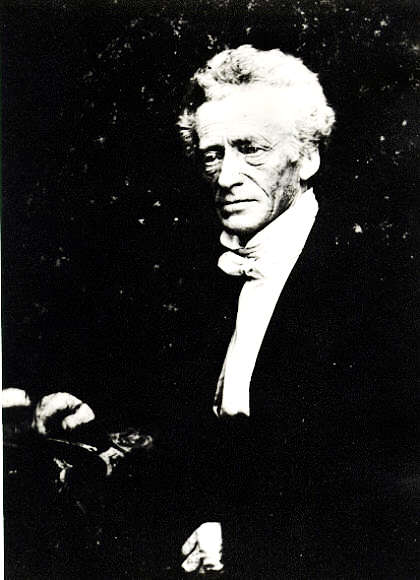
Rev. Henry Carmichael – viticulture pioneer
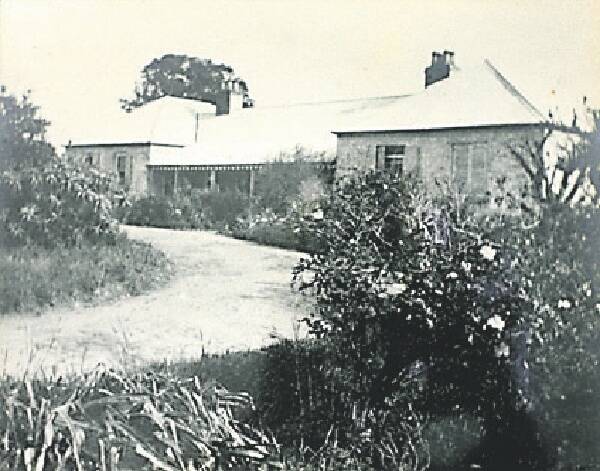
The former Porphry homestead at Seaham [Newcastle Herald, 1 November 2012]
The only other white grape here cultivated is the madeira or verdeilhe, a small quantity of the produce of which, blended with that of the riesling, makes a very superior wine. For red wine the pineau noir (or black cluster), and the red hermitage are found to answer best, and a small plot of these sorts has been added to the vineyard. The pineau noir is one of the earliest grapes, and it is now rapidly maturing.
The soil at Porphyry vineyard is partly alluvial, with a clay subsoil, and partly results from the debris of porphyry rock. The alluvium does not extend to a depth of more than two feet, and in many parts of the ground it is much less. When being originally prepared for vine culture a portion of it was trenched and prepared in an expensive manner. The untrenched part is on the alluvial bank of the river.
The process of preparation for the introduction of cuttings is thus described: The land was thoroughly stumped, so that all roots should be eradicated beneath the reach of the deepest ordinary ploughing. It was then ploughed and harrowed— all weeds and rubbish being collected and burned on the ground. A dressing of stable, stockyard, and sheepyard manure was mixed together, and spread over the land, which afterwards was cross ploughed and harrowed again. The ground was then laid off in rows, which were furrowed at every tenth link of Gunter’s chain.
Stakes were driven throughout these furrows in quineunx order, at every fifth link. The cuttings were then planted, thus making the distance between each 6 ft 6 in. by 3 ft. 3 in. The mode of planting adopted, and which was found to succeed admirably, was to dig parallelopiped boles with a spade, two feet long, one foot broad, and about eighteen or twenty-four inches deep. The cuttings were from twenty to thirty inches in length, and were laid along the bottom of the hole, with a bend upwards towards the stake; an attendant then filled in with the top earth, finely pulverised and mixed with a compost incorporating a small quantity of lime, the cuttings being meanwhile so managed as to emerge from the ground about an inch from the stake, and to have the topmost bud level with the general surface.
The soil round the cutting was carefully pressed down with the foot. In one part of the vineyard, instead of furrows opened by the plough, trenches were dug with the spade a foot broad and three spadesful deep throughout the whole extent of the row, the cuttings were set, and the top earth filled over them, the lower earth of the trench being used on top. The ordinary mode of trenching was first adopted, but afterwards another system was tried. The trench being opened to a depth of at least thirty inches, a layer of stones from the adjacent ridge of Porphyry rok was placed in the bottom, and covered with earth from the top of the next trench.
Over this in the trench trunks of trees, that had been lying about the ground for years, were placed in couplets or triplets, at a distance of from two to three rods apart. They were set fire to, and when sufficiently kindled to maintain ignition the undersoil of the newly opened trench was heaped over them, and they were allowed to smoulder while the trench work was going on. When the trenching was finished, and the smouldering had ran its course, the half-burned stuff was dug up and scattered throughout the ground.
Although this mode of trenching was expensive, Dr. Carmichael considered its advantages such as to advise its adoption. The stones in the bottom of the trenches, besides serving the purposes of drainage to the ground, become a lasting source of manure to the vines, the roots of which will in time be found to permeate the whole substratum. The clay of the subsoil, by being raised to a high temperature, is rendered capable of uniting with the alkaline ingredients of the ground, whilst the more excessively heated portions, in being spread throughout the soil, keep it open to the vivifying influences of the atmosphere.
The ground is now worked with a small horse-plough between the rows and is chipped with hoes around and between the stocks. It is ploughed and chipped in this manner three or four times during the season. The mode of pruning adopted is the short or German system, and each vine is tied up to a single stake. The proprietors — Messrs. G. T. and J. B. Carmichael — are testing the espalier system of training this season, with a view to its adoption throughout the vineyard, if the experiment they are making produces results to their satisfaction. They have used small stringy-bark saplings, about an inch in diameter, for the small plot of espaliers, and the vines trained on them already show a largely in-creased bearing power, and the only doubt remaining to be settled is the quality of the wine they will produce.
At the time of wine-making the grapes are cut by women and children into buckets, and tumbled into a cask, which is placed on a slide and drawn up the rows by a horse. Each cask, when full, is taken up to the wine house, and there emptied into the crusher. It is a semi-circular swivel machine, made of wood, with a beater which is worked backwards and forwards by two men, the semi-circular motion crushing and separating the berries from the stalks, and allowing the juice, pulp, and skins to pass through wooden bars at the bottom of the machine into a receiving tub underneath, the stalks remaining in the body of the machine. When the receiving tub is full its contents are transferred to the fermenting vats, and the stalks and hulls are pressed in a large screw press standing in the wine-house.
The expressed juice from these is fermented separately. There are several fermenting vats, the largest of which will hold 600 gallons, and the next in size 500 gallons; the others about 200 gallons each. All stand in one of the wine-houses.
The wine houses, of which there are two, are slab buildings, 50 feet long and 18 feet wide, and capable of holding 4500 gallons each. They are used for storing wine, there not being sufficient cellarage yet on the place. Besides these buildings there is a cellar under-ground, which holds about 3000 gallons. This is beneath Porphyry house. It has been found that wooden buildings are not suitable for keeping wine in during the summer months, the temperature being too high; and Messrs. Carmichael have now in course of erection, close to the cellars, a large stone building 50 feet long by 30 feet wide, the cellar of which is excavated from rock and gravel, and which will hold about 12,000 gallons in bulk. The storeroom above it is intended to be used for labelling, packing, and storing wine in case. There is a distillery apparatus on the establishment, with a 35-gallon boiler; it is used for making brandy from the refuse.
The production of wine at Porphyry having been for so many years the chief pursuit of the late Dr. Henry Carmiohael and the present proprietors, their experience gained in that time as winegrowers has enabled them to produce a high classed article. Hitherto the Porphyry wines have almost entirely been disposed of in bulk when young, but the proprietors are now making arrangements to bottle and case all their own wines, and with this object in view they are storing them with great care and attention until they are thoroughly matured—it being their intention not to offer for sale any wines under two and a half years old. As these arrangements have only recently been initiated, they are as yet incomplete but are progressing rapidly.
Next season there will be ready for bottling the whole of the 1864 vintage, which took the prize at the last agricultural show in Maitland. The quantity made last season was 2700 gallons, and the preceding season eight acres yielded 4500 gallons. This season there will be four acres additional in partial bearing; but being the first crop, it is necessarily small. The whole crop this year is apparently below average in quantity, and probably altogether will not much exceed that of last year.
The vineyard is situated on a bend of the river; the vines being planted from the bank about 150 or 200 yards inwards. From the edge of the bank the land takes a downward slope of about one in ten on an average. On all the young part of the vineyard shepherd’s riesling is the only variety that has been planted. Messrs. Carmichael purpose extending their vineyard every year, round the bend of the river, and adhering to the same variety of grape; next season a few acres will be planted.
The proprietors seem determined to enter largely on the production of wine, being satisfied with it as a remunerating enterprise. The growing demand for the Australian product will make it even more so. They have lately been at a large outlay in putting the vineyard in thoroughly good order and extending their arrangements for wine making and storing. From a calculation made the cost of planting proves to be somewhat above £20 per acre, but that is not taking into consideration the use of many things which served also for other purposes, nor the outlay of the second and third year. A large item in the original outlay was the cost of stakes: their price was about £7 per thousand, and to each acre nearly 2000 were driven.
From Messrs Carmichael’s residence, which is situated on an elevated part of the estate, and about a furlong from the nearest part of the vineyard, a full view of its whole extent can be had at a glance. The view also embraces a nice prospect on the opposite bank of the river; up-stream slowly gliding past, and upwards some lofty hills rise from its margin, enhancing the beauty of the scene. The aspect of the vineyards is north and north-eastern, and when we visited it the ground was in clean order, the vines topped and in healthy condition.
The wines in stock now amount to about 7000 gallons. Mr. G. T. Carmichael superintends the cellar management, and of course it receives his best attention The stock is chiefly white wine. The wines of 1862 and 1865 are of excellent quality—the latter especially promise surpassing excellence when they have attained a few years’ age.
The white of 1864 is the best white wine of that year’s vintage, which we tested. It gained a silver cup prize at the Agricultural and Horticultural Society’s Show last year. The Porphyry red wine (must) of 1865 took the prize in its class at the same exhibition. In 1850 some samples of Porphyry wine, originally intended to be sent to the first Great Exhibition in London, were forwarded as a present to his Royal Highness, the late Prince Albert, and at the palace it was considered excellent. The Master of the Queen’s Household stated that it was tried at several parties at the palace, and deemed excellent at all of them, being allowed to take its chance at the table, and being left to the opinion of the guests.
For the exhibition of 1862 some samples were forwarded home; previous to their transmission they were exhibited at the exhibition in Sydney, and received the silver medal of the Sydney Commissioners, These, then, were high commendations, and sufficiently indicate the character of the wines from Porphyry. By the even greater care that is now being bestowed upon them higher and better results will probably be attained. The prices obtained for the Porphyry wine range from 5s. to to 7s. per gallon in wood by the hogshead; and from 17s. 6d. to 21s. per dozen in bottle. At these rates Messrs. Carmichael have good demand for their produce.’
12. Berry Lea Vineyard
The property was established by John Melbourne Ireland, a pioneer of the early Australian colonial wine and cotton industries. It is plocated on the banks of the Williams River near Seaham.
Between 1861 and 1862, colonial wines and cotton produced at Berry Lea won bronze medals at the London and Paris Exhibitions.
‘From Porphyry we proceeded up the Williams River to Mr. John M. Ireland’s vineyard, Berry Lea, which is situated on the opposite bank, and about three miles by the river above Porphyry. The land forming the vineyard is part of the Church and School estates, which on this river embraces a very large area of the most valuable, but at the same time comparatively unproductive, soil. The vineyard now comprises twelve acres, the greater portion of which was planted only four years ago.
The vines originally planted covered an area of five acres, and were set fifteen, fourteen, and thirteen years back. This piece of vineyard yielded good and regular crops, averaging 500 gallons per acre. The variety of grape planted is chiefly the shepherd’s riesling, which is here marked by the same qualities as at Porphyry— being an abundant bearer, and a good wine maker. A small plot of madeira is also grown, to mix with the other variety. Very little red wine is made here, the grapes for it—pineau noir, and hermitage—generally finding their way to the fruit market.
In the new portion of the vineyard, shepherd’s riesling is the only kind that is grown; last year (the first of its bearing) the seven acres of new vines yielded six hundred gallons, but the crops on them this year promise to return about an equal quantity to the five acres of old vines. They are all, with the exception of a few of the most exposed vines on the edge of the vineyard, in a healthy and thriving condition—indeed as good as any vines of their age could be expected to be.
The soil is alluvial throughout the greater part of the vineyard, with a subsoil of marley clay; in other parts deep and fine black sand covers the subsoil of clay, but in the sandy places the vines do not thrive so well as in the alluvium. The ground is all above flood level, but a small basin of it retains the surface water of the vineyard for a few days after heavy rain. The land is somewhat irregular in its formation, having a general incline inward from the riverbank, which the vines border. The general aspect of it is south-western.
The wine-house and cellar are built close to Mr. Ireland’s residence and to the vineyard. The wine-house is a slab building, erected above an excavation in the sloping bank of the river. The excavation ii slabbed all round and serves the purposes of a cellar; it is capable of holding 3000 gallons in wood, and the casks are ranged on either side of it. Above the cellar there is a cooperage, where casks and kegs are made sufficient for the requirements of Mr. Ireland’s trade. Adjoining the cooperage is a wine house, in which the fermenting vats, wine press, and other appliances are kept a quantity of wine is also stored here, in consequence of the cellar being insufficient to hold all the produce of Berry Lea.
As the land is only held under a lease, and from a lessor with whom arrangements cannot be easily made, Mr. Ireland does not consider himself justified in making a large expenditure for further cellar accommodation, and consequently he has to sell his wine when very young—the only wines he has now on hand in any quantity being a portion of the vintage of 1864 and the vintage of 1865. The ready sale they meet is a pretty fair indication of their merit. The Berry Lea wines are stronger and more spirituous than many other wines produced in this district.
At the Maitland Exhibition held at the School of Arts, in 1861, Mr. Ireland’s wine was awarded a certificate of merit; and at the Great Exhibition of 1662 in London, under class XVIII., his wines received a bronze medal for their excellence. At the Hunter River Agricultural Society’s exhibition, last year, he received the prize for the best red wine (must) of 1865. Thus it will be seen that he has been tolerably successful in his competition, and the repute his wines have gained at these exhibitions doubtless improved the demand for them.
The wine of 1865, for which (when must) be received the prize, we tasted beside other wines of good quality, and up to the present time it has lost none of those qualities which gained for it the preference of the wine judges. It promises to rank amongst wines of a very high class when it shall have attained a few years’ age.
Most of the wines from Berry Lea are sold in cask, and the remainder is bottled and cased in the cellar. As a proof of the extent to which the taste for Australian wine is growing, we were informed that at Clarence Town a case of it would have been sufficient to supply a public-house for twelve months some three or four years ago, and that now the same house sometimes sells as much as a quarter-cask per week. Should the demand in other places increase in an equal ratio, our winegrowers will have a difficulty in meeting it.
The vineyard, when we visited it, was in very fair order; on a few patches the couch grass had certainly taken hold, but as the season has been so dry the grass had not spread to a large extent. Some parts of the soil is very rich, and it is on those parts much trouble is experienced in keeping down and eradicating the grass and weeds. The vines are trained to stakes, and planted at a distance of 6 feet between the rows and 3 ft. 6 in. between the vines. The ground was well prepared before the vines were planted and is now worked every season with a horse plough. …..
The Berry Lea wines sell at 4s. per gallon in bulk, and 15s per dozen in bottle. Within the last two months the sales have exceeded 800 gallons.
There are a few other vineyards of small dimensions on the Williams River. The first of these is Mr. Warren’s, at Brandon; the proprietor, however, makes wine for his own use only, and his wine has the repute of being equal to any produced in the colony. The vineyard is only about one acre in extent— Mr. C. F. Holmes, of Oakendale, has between three and four acres of vines, from which he occasionally makes wine. Last year his vineyard yielded about 1000 gallons.
Mr. Mac-kay, of Melbee, Dungog, has also entered upon the cultivation of the vine; and Mr John Hook, of Dingaree, Dungog, planted a few acres three or four years ago, and these are now coming into bearing.’
13. Kirkton Vineyard
Originally located on the banks of the Hunter River near Lower Belford and Branxton, the Kirkton Vineyard is widely considered the birthplace of the Australian wine industry.
Established in 1824 by John Busby, the estate was named after his Scottish birthplace. John’s son, James Busby, planted 365 different varieties of European vine cuttings on the property. This monumental project fundamentally shaped the viticultural history of Australia. The property was managed by James’s brother-in-law, William Kelman.
John Busby bequeathed Kirkton to the Kelmans. After their parents died, James and Catherine Jessie Kelman inherited the estate, including its vineyards and cellars. In 1914, Lindeman Ltd acquired Kirkton; C. F. Lindeman was James Kelman’s brother-in-law, having married James’s sister. Ten years later, the original Busby vines were still producing a small crop, and the last wine from them was made in 1924. Messrs Lindeman claimed that many of the vines planted in South Australia’s early viticultural years came from Kirkton.
‘About six miles from the Branxton railway station, and nine from Singleton, Kirkton vineyard is situated. The Kirkton estate adjoins the Belford estate, and extends to the river Hunter, embracing a considerable extent of valuable land. The homestead is erected on a gentle eminence overlooking the river and commanding a pleasing prospect. From the homestead to the river’s bank a grass meadow, with an orange grove in its centre, presents itself to the eye, and on the opposite bank of the river the land rises abruptly, and in close proximity a high range of hills fills up the background.
Kirkton is one of the oldest settled estates in this part of the district, and the vineyard claims the same distinction as regards age, a portion of it having been formed and planted upwards of thirty years ago, by the late Mr. W. D. [William] Kelman, an enthusiastic cultivator of the vine. He, with Captains Ogilvie and Pike, and other gentlemen, soon after their settlement upon the Upper Hunter, in 1829, at the instance of the Messrs. Macarthur, of Camden, directed much of their attention to vine culture, and with varying success.
Mr. Kelman originally prepared ten acres of ground, on an elevated site at the rear of Kirkton House. A portion of this only was planted, it being then impossible to get sufficient vine cuttings to plant on a more extensive scale. As time advanced this difficulty was surmounted, and before 1837 there were nearly twenty acres under the vine, and at the present time the Kirkton vineyards embrace thirty-two acres. Twelve acres of this were planted two years and a half ago and will yield their first crop in 1867. Five acres of old vines were taken out about eighteen months ago and replaced with young cuttings of the madeira variety. These are thriving well.
The Kirkton vineyards are three in number (two of ten acres each, and one of twelve acres), separated only by roadways. Each vineyard is laid out in four equal divisions, and the vines are planted in quincunx form, giving to the rows a very regular and pleasing appearance. The soil is a deep sand, of light brown colour, and, judging by the healthy state of the vines, and the good crops they have yielded, it is admirably adapted for vine culture.
The older part of the vineyard is sheltered all round by a high hedge of Cape mulberry and prickly pear. The latter hedging is not recommended, it being too liable to spread. The mulberry hedge has been a great protection to the vineyard, serving, as it did, to break the force of the hot winds, which in bye-gone years were so prevalent, and so destructive to all cultivation. The hedge is now from fifteen to twenty feet high, and as luxuriant as ever.
At Kirkton, as in many other vineyards, much difficulty was originally experienced in obtaining cuttings to commence with, and, consequently, a great many varieties were planted in the first instance. One division in the old vineyard, even now, contains upward of 300 varieties of the grape; at one time it contained 360 varieties, and as it may be a matter of interest to many to know how so many kinds were to be had in Australia thirty years ago, and also to know a little of the difficulty the vine-grower at that time experienced in getting cuttings, we may here mention how these varieties were introduced and distributed.
In 1832, James Busby, Esq. (Mrs. Kelman’s brother), during a tour through Europe, especially the vine-growing countries of that continent, selected a large number of cuttings, and brought them with him to this colony; they comprised nearly five hundred varieties, and he generously presented them to the Government, which at that time regarded the culture of the vine with considerable interest, and encouraged its extension. The cuttings were planted in the Sydney Botanical Gardens. Every gentleman who required cuttings from these each year sent in an application for them, and they were proportionately allotted to the applicants.
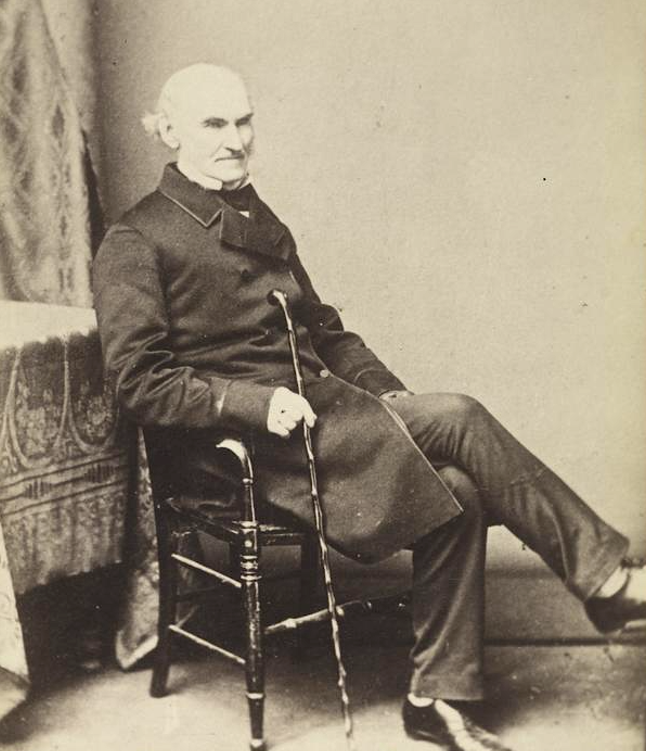
James Busby, regarded by many as the father of the Australian wine industry [Hocken Digital Collections]
Some of the gentlemen, however, applied only for cuttings of certain varieties, and sometimes one or two cuttings each was all that could be given to vine growers, and the acquirement of any particular variety was a labour of years. Thus, it was that the Kirkton vineyard came to possess such an extensive variety of the grape. By degrees Mr. Kelman was enabled to extend his vineyard by cuttings from his own vines. Each vine that he received was nursed with the most tender care, and every year from the second after their planting (1835) Mr. Kelman made copious notes, and kept a record of the state and yield of each vine; noting the form, colour, and flavour of the grapes; the suitability of each sort for wine making, and the character of the wine made from them.
By comparison of these notes, he was enabled to form a correct judgment of the varieties best adapted for his vineyard, and in all subsequent extensions of it this knowledge was brought into use in selecting cuttings. The 12-acre vineyard is planted solely with red hermitage.
When we state that there are upwards of 1300 vines to the acre, some idea may be formed of the great pains bestowed by Mr. Kelman upon his vineyard in recording so fully and with so much care as he did the state of each vine. There are few vineyards in the district which are not indebted to Kirkton for cuttings, the famed Dalwood among others. As the fruit of many of the varieties originally planted at Kirton was fit only for table use, the vineyard for a considerable period after its establishment supplied the Sydney market with grapes about a ton being forwarded every week whilst the season lasted.
Wine of excellent quality was made here by Mr. Kelman, and he took great interest in its management, The vineyard was kept in scrupulously clean order until the gold-fields were discovered, when, owing to the scarcity and high price of labour, the ground did not receive that care which had previously been bestowed upon it, and as a consequence couch grass got a firm hold of a portion of it, to such an extent that since it has never been thoroughly eradicated. The greater part of the vineyard, when we visited it, was remarkably clean, and we were assured that the few acres now covered with weeds were, six weeks ago, as clean as any part ‘of the ground.
One division in the old vineyard has this year suffered very much from the ravages of a small kind of grasshopper, which has eaten away the leaves, and in some instances the fruit, in an astonishing manner.
The cellar and wine house are built between the vineyard and the homestead, almost adjoining the latter. The cellar is excavated and bricked around: above it is the wine house, where the crushing and fermenting is conducted. The grapes are crushed by two semicircular swivel machines, with wooden beaters inside. By these machines two men can express about two hundred and fifty gallons a day. These machines are placed over fermenting vats, so that the juice, pulp, and hulls at once fall into them. When white wine is being made, the hulls are separated from the juice and pulp by a false screen bottom in the receiving tubs.
From the wine house to the casks in the cellar the liquid is conducted by a hose passing through the floor, and which may be made any required length. There is an iron screw press fitted up in the cooper’s shed, and this is used to extract the juice from the hulls and uncrushed pulp. The cellar is capable of holding about 8000 gallons, and as the Kirkton wine is all sold when a year old, the cellar is sufficient for present purposes. The old slab building formerly used as a cellar is decaying and has not latterly been used; but as the young vines come into bearing, the cellar accommodation will require to be extended.
About one-third of the produce of Kirkton vineyard is usually sold to the Messrs. Wyndham, of Dalwood; and a large portion is annually sent to Bathurst, where there is a good demand for it. The whole vintage is usually sold out every year before the succeeding vintage is ready for the cellar. The reason for this is that the late Mr. Kelman for some time suffered from failing health and was unable to give that attention to cellar management which was necessary to maintain the character of the Kirkton wines; and therefore, the system of disposing of the wine when a year old was adopted. It is all sold in bulk.
A very choice sample of madeira, about four years old, and which had been two years and a half in bottle, was submitted to us, and it certainly was the best Australian madeira we have tasted. The white hermitage here produced is a very fine wine but requires five or six years to mature and fully develop its high qualities. The red hermitage is also a superior wine-rich and potent, with good flavour and aroma.
The annual yield of the Kirkton vineyard does not exceed 300 gallons per acre; and that is considered a very good crop. This vintage there are about fifteen acres in full bearing. The white hermitage shows an abundant yield, and the red promises a good average return. The mixed divisions also bear good crops. The late rains did much good to the vines; the bunches were filled out by it in a most gratifying degree.
The great age of the vines has given a corresponding strength to their produce, and rain, which in a younger vineyard would have a tendency, at the present period of the season, to deteriorate the quality of the grapes, is here beneficial. The age of the vines does not seem to have lessened their yield, as we observed was the case in some of the vineyards on the lower part of the Hunter. The vintage throughout this district is unusually early this season, owing to the long prevalence of dry weather that preceded the late rains. The vintage gathering will be commenced early next week at Kirkton, and probably at many other vineyards in the district.’
Concluding Comments
The legacy of the pioneer winemakers remains strong in the Hunter Valley, and to a certain extent in the Port Stephens district.
While winemaking methods have become more sophisticated and automated, the basic principles remain largely unchanged.
Wine is still produced on some of the vineyard estates discussed in this paper, while other properties have been converted to different agricultural uses or residential development.
Researched and compiled by Kevin McGuinness
June 2026

 Port Stephens - a history exploration