
Introduction
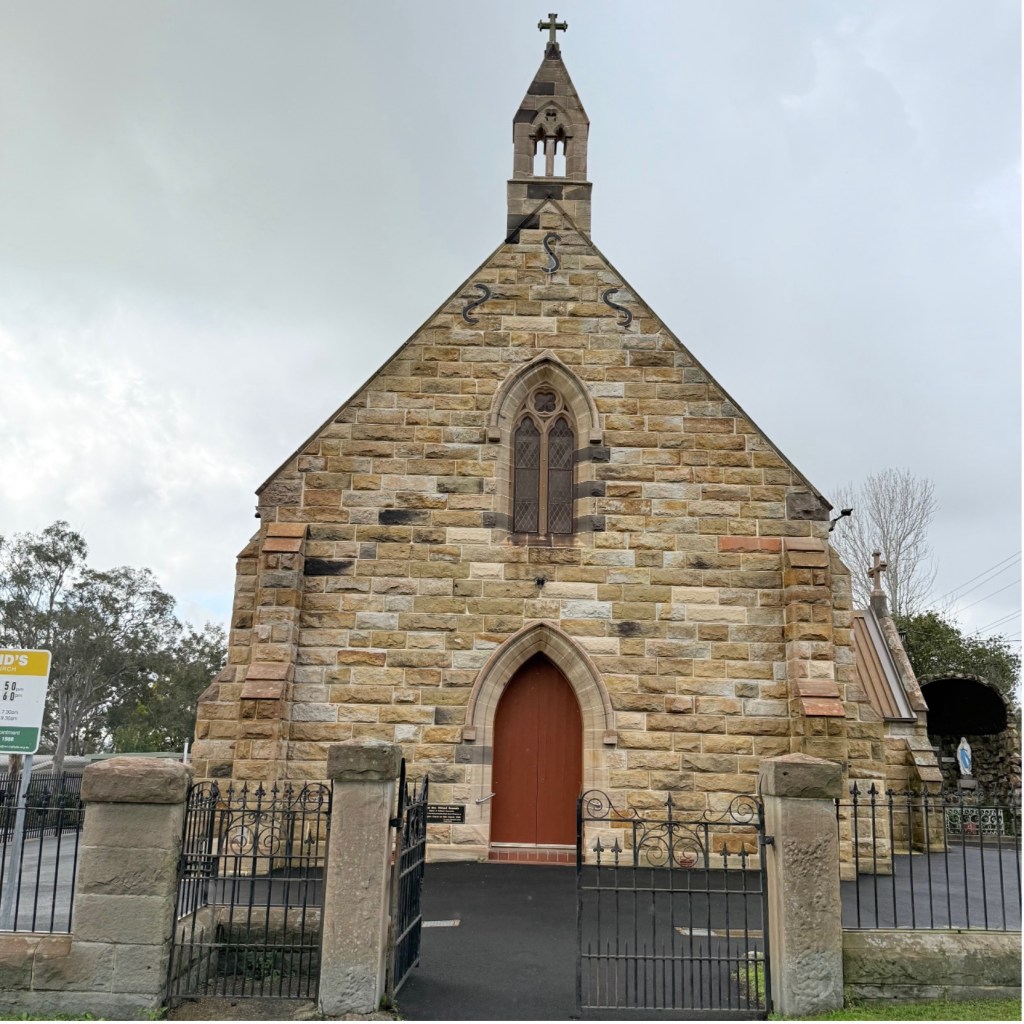
The Catholic Parish Church of St Brigid’s at Raymond Terrace stands today in William Street, adjacent to Boomerang Park in Raymond Terrace, dating from its opening in 1862.
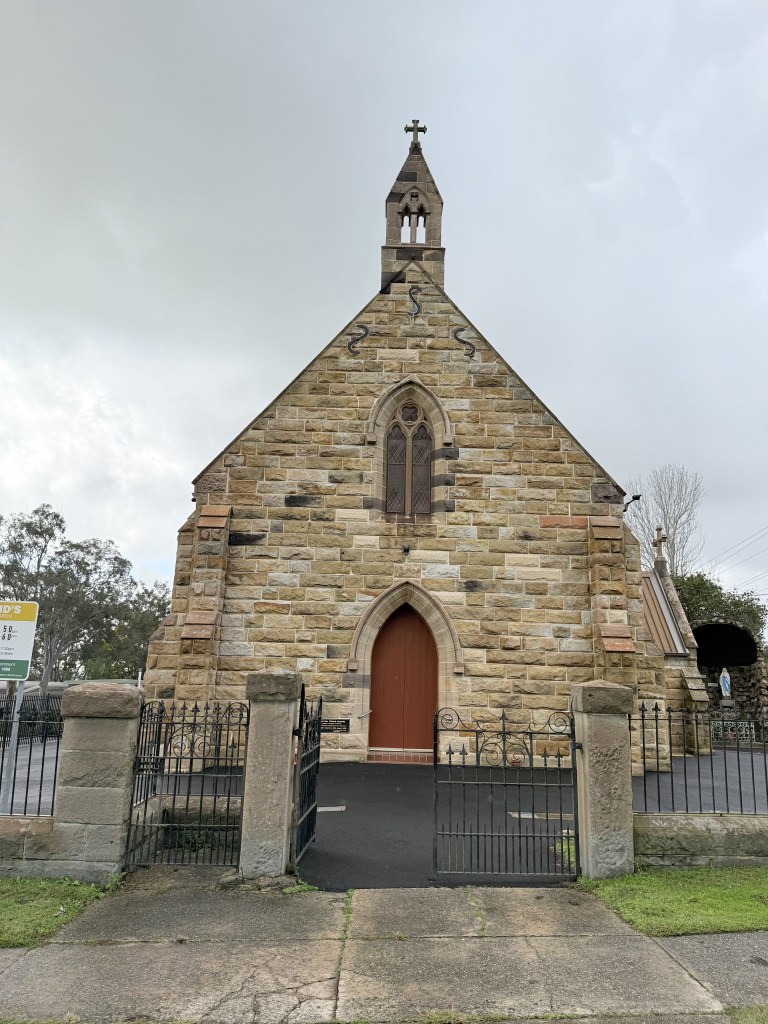
St Brigid’s Catholic Church at Raymond Terrace [Author Photo -June 2026]
Catholic worship in the Raymond Terrace district of Port Stephens, began around 1852 with the appointment of Charles Quinn, an Irishman, as the area’s first Catholic priest.
For many years, most Catholics in Raymond Terrace, along with their parish priests, were of Irish descent and retained strong ties to their ancestral homeland.
In the early 1850s, religious services were held in the Raymond Terrace Court House. Over time, the Catholic community strongly supported their priests’ efforts to establish a church, presbytery and school.
This paper traces the early history of St. Brigid’s Parish and community in it’s first one hundred years.
It tells the story of how the parish was established and how the community worshipped and came together in the years before the Second Vatican Council (1962 – 1965). Particular attention is given to the sodalities and guilds that enriched Catholic worship and devotion.
The events and activities described give a broad appreciation of the worship, enthusiasm and dedication of the parish community.
Early Reminiscences of the Raymond Terrace Catholic Church
Early Reminiscences of the Raymond Terrace Catholic Church by a local resident, Mr. Doherty, were published in the Raymond Terrace Examiner and Lower Hunter and Port Stephens Advertiser of 23 October 1941, page 4, and provide a starting point for the history set out in this paper:
‘Up to about 1860 the Court House [built in 1841] was used on Sunday mornings and sometimes week holidays by R. Cs. before dinner time and the C. of. E. in the afternoons. as each agreed. Then there was a rough building erected, where I went to school for some years. I remember having just recovered from the diphtheria my mother taking me to the yard to see the builders slating the roof of the Catholic Church. I also saw them shingling the Church of England. I saw Archbishop Polding several times when the church was opened. I also remember Bishop Tyrrell, C. of E. …..
Then Father Quinlivan lived at the Terrace for several years and then moved to Port Macquarie. A visiting priest went with him along the shore. Fr. Quinlivan went in for a swim while his friend walked along reading, for some distance. When he returned, he found Fr. Quinlivan’s clothes on the beach, but no trace of Fr Quinlivan was ever found. Then came Fr. Lonergan who lived at the Terrace 7 on 8 years. He built a brick residence at the back of the Church but is now the Convent.
After he had left Father Nealon took charge and was P. P. for the record time of any resident priest. I believe he baptized and married several who were born during this time. He caused a lot of improvements to the Church premises but as I removed to Newcastle in his time there are many others who could give more particulars than I can. My earliest recollections of Raymond Terrace date back ‘to 1863 in my 8th year when Archbishop Polding gave confirmation in the new church of St. Brigid’s I happened to be the youngest boy to be confirmed. There were several of the old priests with the Archbishop but are dead many years. Archdeacon McEncroe, Fathers Dunn, Quinlivan, Deans, O’Connel, Sheridan, Rigney, and others I cannot call to mind.
Before the church was built mass used to be celebrated in the Court House. The Catholics used it before noon and the Church of England in the afternoon. I was baptized there. Father Quinn was there when my parents arrived in 1855. Then Father Luckie. I do not know if any of them resided at the Terrace, but I remember Father J. T. Dunne [Dunn] lived nearly opposite the Court House for some years until the Maitland Diocese was formed and Dr. Murray took charge. As there was a scarcity of priests, we only had mass once a fortnight. ‘
Parish Priests for the First 100 Years
The parish priests of St. Brigid’s Catholic Church at Raymond Terrace for the first 100 years were:
Charles B. Quinn: 1852 – 1856
Eugene J. Luckie: 1856 – 1863
J. T. Dunne: 1863 – 1865
Patrick J. O’Quinlivan: 1866 – 1868
No priest appointed 1869 – 1870
Thomas A. Lonergan: 1871 – 1874
Thomas Aloysius Nealon: 1874 – 1913
John O’Flynn: 1914 – 1939
Joseph O’Donohue: 1939 – 1945
B. H. Watson: 1945 – 1947
Patrick Gerald Grace: 1947 – 1953
John Morrissey: 1953 –
Assistant priests are not recorded above.
Catholic School at Raymond Terrace – 1850
The Catholic citizens of Raymond Terrace were also willing to voice their concerns publicly, as shown in the following letter to the editor of the Freeman’s Journal, published on 22 August 1850, page 4, about the need for improved government funding of Catholic schools:
‘We have received a letter signed by eighteen Catholics, heads of families at this place [Raymond Terrace], stating that forty-five children are attending the Catholic School there, and some eight or ten going to schools where they cannot receive any instruction in the tenets of the Catholic Church — and complaining of the injustice they suffer in not getting any public aid towards the support of their school, and also insinuating that it is owing to the neglect of the Catholic Clergy that they do not receive Government aid as well as others for education.
We heartily sympathise with those good people for being unjustly deprived of any portion of the sum voted for public education. But we must correct a serious error under which these individuals labour in complaining that their clergy are the cause of not removing the grievance under which they suffer. It is quite the reverse.
The clergy have by “petitions and entreaties” endeavoured to procure from the Legislative Council a just sum, in proportion to the number of Roman Catholics in the colony, towards the support of Catholic Schools, but in vain! [The NSW Legislative was not established until 1856]. And during the last week, a Member of Council brought in a Bill for the purpose, amongst other things, if carried, of getting one of the Catholic Clergy punished by fine and imprisonment for daring to charge the honourable member with being instrumental in procuring a casting vote against an additional sum of £800 which the Government placed on the estimates for Catholic Schools for 1851.
No, the fault of the Catholics not getting their fair share of the Education Fund does not rest on the shoulders of the Clergy, but on some of those members whom the Catholics helped to place in the Legislative Council, and if the Catholics of the colony wish to bring up their children in the faith of their Irish and English forefathers, who suffered the loss of everything dear in this world, but preserved the “Faith”, let them take care to vote for no candidate at the next election who will not pledge himself to see justice done to them, in this regard. We want no favours, we seek for justice, and we shall not rest satisfied until full justice, be done to us and to our children.’
First action to erect a permanent Catholic Church – 1851
The Maitland Mercury and Hunter River General Advertiser of 29 March 1851, page 2, reported:
‘A meeting at Raymond Terrace of the Roman Catholics was held on Tuesday; one of the objects, to propose the erection of a chapel there. It is singular that so numerous a body as they are in that quarter have not done so before.’
At this time, the catholic community would have been served by visiting priests from the Maitland area.
Appointment of Father Charles Quinn as the first resident priest at Raymond -1852
Rev. Charles B. Quinn was appointed as the first resident catholic priest at Raymond Terrace in 1852. When he took up his ministry a church had not been constructed. In 1854 he established a subscription scheme to raise funds for the construction of a temporary chapel.
In the Freeman’s Journal of 9 September 1854, Father Quinn had published a large advertisement, that acknowledged the many donations made by interested persons towards the cost of construction the temporary church at Raymond Terrace. The 8 segments of t he large advertisement as set out in the Appendix.
Rev. Quinn remained at Raymond Terrace until May 1865, when it was advertised in the Maitland Mercury and Hunter River General Advertiser of 13 May 1856, page 3, that his furniture was to be auctioned at his residence.
Appointment of Father Eugene Luckie as the next parish priest – 1856.
Confirmation held in the temporary church and appeals for the funding of a permanent church commenced – 1859
The Freeman’s Journal of 22 June 1859, page 2, reported:
‘On Friday, the 10th instant, his Grace the Archbishop of Sydney (John Bede Polding) administered the Sacrament of Confirmation to 230 postulants in the temporary church of this township, in presence of an immense congregation of the faithful of this and the surrounding districts. His Grace, who was accompanied by the Rev. Father Sheehy, of St. Mary’s, Sydney, arrived by the Collaroy steamer from Sydney on the Sunday previous, the 5th instant, just at the time Mass was being celebrated by the Rev. Father [Eugene J.] Luckie, the respected pastor of the district.
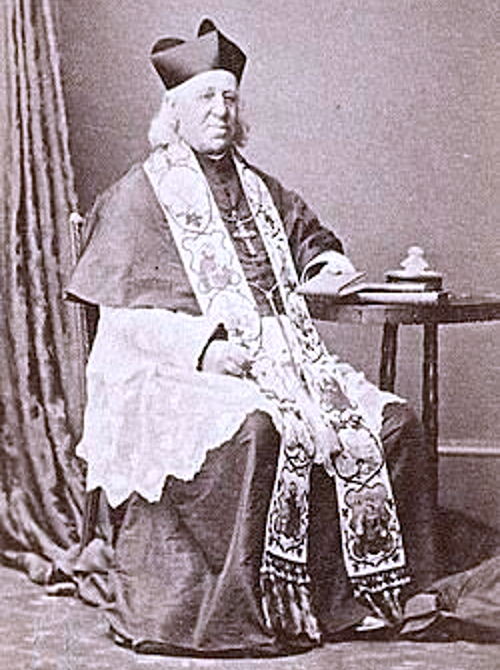
John Bede Polding – first Catholic Archbishop of Sydney
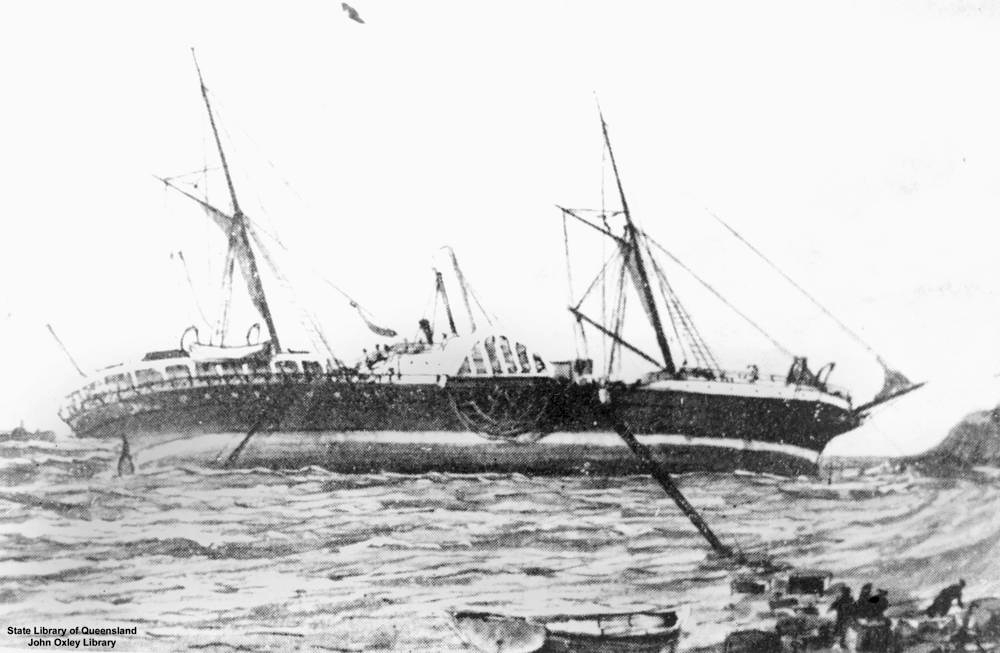
Paddle steamer ‘Collaroy’ stranded near Pittwater, Sydney in 1881. The Sydney suburb of Collaroy now bears its name [State Library of Queensland]
The Rev. Father Luckie having announced that his Grace would celebrate Mass there, all the people waited. His Grace, after having celebrated the holy sacrifice of the Mass, preached a very impressive sermon, during which he expressed himself gratified with seeing the church so well attended on that day, notwithstanding the unfavourable state of the weather, for it had rained heavily throughout the forenoon of the day.
His Grace preached in the evening again to a large congregation; and having announced that he should administer Confirmation on the following Friday at eleven o’clock, he was engaged in the confessional, together with the Rev. Fathers Luckie and Sheehy, till a late hour at night. On the following morning, after Mass and instructions given by his Grace, he departed for Maitland, to pursue his visitation of that part of the Hunter River district.
Punctual to the time appointed, his Grace returned on the Thursday afternoon following, and immediately on his arrival commenced the examination of those who had been till then preparing themselves, by acquiring a competent knowledge of the Christian Doctrine, for the Holy Sacrament. His Grace the Archbishop expressed himself sincerely gratified with the correct knowledge the candidates in general displayed, by their intelligent answering, of their advanced proficiency in the Christian doctrine; and I understand that his Grace highly complimented their esteemed pastor, Father Luckie, on the care and pains he had evidently taken with their preparation for the Sacrament of Confirmation.
On the next day, at an early hour, crowds of the faithful began to wend their way towards the church, and his Grace expressed himself surprised at the large number of Catholics he found here now, where some years ago he found only a scattered few. After administering the Sacrament of Confirmation, his Grace preached a most beautiful and impressive sermon, which was listened to through, out with the profoundest attention by the immense congregation; amongst which could be noticed several Protestant families of Raymond Terrace, and who paid marked attention to his Grace’s eloquent language.
A beautiful incident occurred at the termination of the ceremonies of the day. His Grace called upon all the young people who wished to take the total abstinence pledge to come forward. There was a general rush to the sanctuary rails, and a very large number of young people of both sexes having promised total abstinence from intoxicating drinks, his Grace distributed a large number of medals and Agni Dei amongst them, which were joyfully received, and shall be treasured as souvenirs of his Grace’s visit to Raymond Terrace.
The children then (beautifully attired, as they always are on such occasions) formed a procession, which was joined by the rest of the congregation, and accompanied the archbishop to the residence of the Rev. Father Luckie. They afterwards accompanied his Grace to the Ferry, where they received his Grace’s farewell blessing on bended knees, after which the vast multitude gave three cheers for his Grace, that echoed and re-echoed amongst the hills for miles around, thus in their simplicity and kindly nature testifying aloud their attachment and reverence for their chief pastor.
On Monday, the 13th, his Grace, accompanied by the Rev. Father Luckie, made his visitation of the church and school at Newcastle, and in the afternoon took his departure for Sydney. Immediately after his Grace’s departure — a movement had been set on foot at Raymond Terrace towards the erection of the permanent church there — a subscription was opened; and I understand that a large sum has been already promised, which, when paid, together with the amount already on hands, will bring up the church funds to nearly £1,000. Newcastle, June 18th, 1859.’
Tenders Called for Construction of the New Church – 1860
The following advertisement invited tenders for the construction of the new Catholic Church at Raymond Terrace:
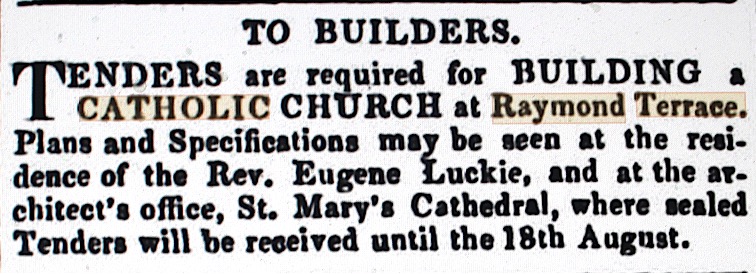
Tender advertisement [Freemans Journal, 8 August 1860]
Construction of New Church Under Way – 1861
The Maitland Mercury and Hunter River General Advertiser of 5 January 1861, page 2, reported:
‘The operations in connection with the Catholic church lately commenced to be erected at Raymond Terrace continue to progress satisfactorily. The contractors for the building are Messrs. Hugh Mair, John McLeod, and Thomas McKenzie, well-established Sydney builders, and whose favourable reputation is a guarantee that this magnificent structure will be erected, and all its details carried out according to the beautiful plan and specification.
The stonework is to be axe and draft, and in that style known as “rockwork,” the first of the kind, we believe, that has been yet attempted in the colony in church building. The stone in Raymond Terrace quarry turns out remarkably well, notwithstanding the fears that were at first felt that it would be found unequal for the elaborate, neat masonry of the building.’
The former Raymond Terrace stone quarry was located across the road from the church, in the area currently known as Boomerang Park.
Foundation Stone of New Church Laid – 1861
The Freeman’s Journal of 6 March 1861, page 5, reported:
‘The above-named event [laying the foundation stone], so long looked for by the Catholics of the District, took place on yesterday, the 28th ult., as previously advertised in the local papers, to the great gratification of those immediately interested, and to the edification of the numerous body of our separated brethren, who felt interested in witnessing the expressive and imposing ceremony prescribed by the Pontifical for the occasion.’
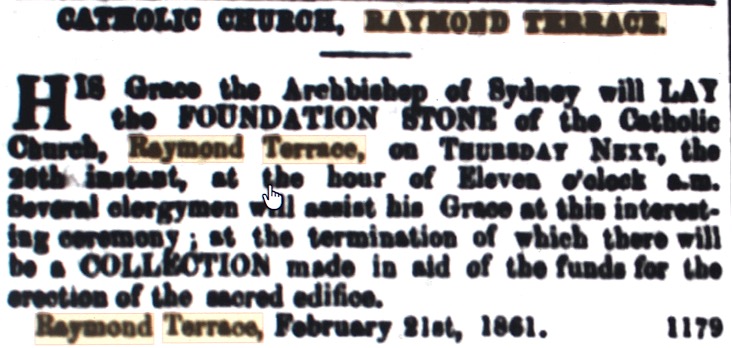
Advertisement for the foundation stone ceremony [The Maitland Mercury and Hunter River General Advertiser, 23 February 18
His Grace arrived [John Bede Polding] on the Wednesday before by the steamer Illalong; and, after a short rest, proceeded to inspect the preparations made by the workmen preliminary to the ceremony on the day following. During the day, his Grace occasionally superintended these arrangements.
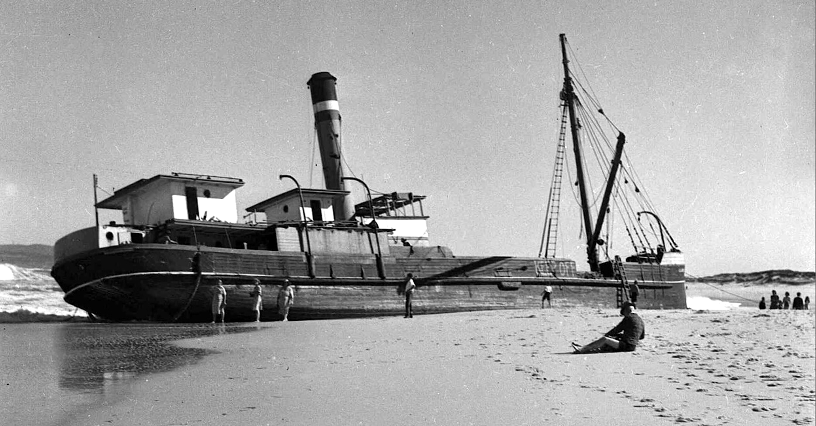
Final resting place of the ‘Illalong’ on Nine Mile Beach, near Newcastle, 1948 [H. G. Slilton collection]
On the following day, his Grace celebrated Mass in the temporary chapel, at eight o’clock in the morning. At eleven o’clock, the hour announced for the ceremonies of the day to commence, a procession was formed in the temporary chapel and proceeded in good order to the spot where the foundation-stone was to be laid. His Grace here, in full pontificals, and wearing mitre and crosier, addressed the large assemblage in that beautiful strain of Christian eloquence peculiar to his Grace — an eloquence at once enlightening the reason and purifying the heart; and in other respects so ornate and chaste as to win the admiration of a Quintilian.
After his Grace had given a lucid exposition of the nature of the sacred rite he was about to perform, he proceeded, assisted by the Very Rev. S. A. Sheehy (Vicar-General), the Very Rev. Dean O’Connell, and the Rev. Father Luckie (Pastor of the District), with the ceremony, which was performed with the utmost accuracy, and in the solemn and affective manner suited to the occasion.
The Litany was admirably executed by the four voices: we have seldom heard it more beautifully chanted than on this occasion. This magnificent structure, the first of its kind, as to details of style, in this colony, and which now begins to exhibit its large and massive proportions, for already parts of the walls are up a few feet in height, is dedicated to Almighty God under the invocation of St. Brigid, the glorious patroness of Erin [Ireland].
This dedication must be gratifying not only to the numerous Catholics of the District, the great majority of whom hail from the “Island of Saints,” and who naturally have a predilection for their illustrious national patroness, but also to their esteemed Pastor, who, we are informed, was born near Fochart, in Ireland, where we are told by those celebrated biographers, the Bolandists, that the great St. Brigid was born. But the illustrious servant of God belongs to the whole “Household of the Faith.” The English, the Scotch, the French, the Spanish, the German, and the Italians, as well as natives of other countries, have vied with the Irish in honouring St. Bridget; for in each of the above-named countries, Churches have continued to be dedicated to her for the last 1400 years. Numberless books have been written recording the transcendent virtues of the great Irish Abbess.
Even the prejudiced Usher has testified to the stupendous miracles wrought through her instrumentality, which he alleges are too numerous to particularise. Her remains rested in Downpatrick, with those of St. Patrick and St. Columbkille, till the reign of Henry VIII., when the inhuman monster, it is said, directed they should be cast to the winds of heaven, and the monument enclosing them destroyed.
St. Brigid’s is built in the Gothic style of architecture of the medieval period, and will consist of nave, chancel, vestry, porch, and tower. When completed, it will measure upwards of 100 feet over all; 33 feet in width; height of side walls, 21 feet. It is proposed to erect only the nave, porch, and tower at present. This will cost nearly £2000. The architect is Mr. W. Munro, of Sydney.
The following inscription [written in Latin], neatly written on strong, durable paper, and placed in a bottle, with some ancient and modem coins, was deposited in a cavity of the foundation-stone prepared for the purpose: —
Ad majorem Dei gloriam — Amen. Primarium Lapidem hujus ecclesice adificandœ in honorem Dei, sub invocatione Sanctœ Bridgitat Irlandœ patronœ benedixit et posuit Reverendissimus et Illustrissimus Joannes Beda Archiepiscopus Sydneiensis resto Sancti Oswaldi Anno Domini 1861. Reverendo admodum Sumuele Augustine Sheehy, Vioario Generali, Reve-rendo admodum Daniele Mauro O’Cornell, Derano et Eugenio Joanne Luckie, missionario Districtus assistentibus presbyteris, stante magno corono fidelium qui munera sua volenti animo et magnocorde largiter obiulerunt. Pio Nono Christi vices patienta sed fortiter gerente in terris — Victoria Brittanniarium Regina feliciter regnante. Quos Deus diu conservet.
English translation: —
To the greater glory of God— Amen. The foundation-stone of this Church to be erected in honour of Almighty God under the invocation of St. Brigid, Patroness of Ireland, was blessed and laid by the Most Reverend and the Most Illustrious John Bede, Archbishop of Sydney, on the Feast of St. Oswald, in the year of Our Lord 1861. Assisted by the Very Reverend Samuel Augustine Sheehy, Vicar-General, the Very Reverend Daniel Maurus O’Connell, Dean, and the Reverend Eugene John Luckie, missionary of the district, in presence of a large concourse of the faithful, who with a willing mind and truly Christian liberality contributed large offerings. In the Pontificate of the suffering but courageous Pius the Ninth, and in the prosperous reign of Victoria, Queen of Great Britain and Ireland and dependencies. All whom may God long preserve.
On the afternoon of Thursday, his Grace left Raymond Terrace for East Maitland; and as the steamer moved slowly from the wharf three deafening cheers, which his Grace politely acknowledged, testified to that warmth of affection which the Catholics of Raymond Terrace entertain for their subordinate and chief pastor. The respectable sum of £80 was collected at the laying of the foundation-stone.’
Construction of new Church reaches an advanced stage – 1861
The Maitland Mercury and Hunter River General Advertiser of 27 August 1861, page 2, reported:
‘This noble-looking church, built in the Gothic style of architecture, is now advanced towards completion so far as to be ready to receive the roof, for which tenders are to be very soon invited. Great credit is due to the contractors—Messrs. Mair, McLeod, and McKenzie—for the energy with which they have carried on this building since its commencement, about the 1st of January last, for they have had to contend with many unforeseen difficulties.
The quarry at Raymond Terrace, from which they obtained most of the stone for the church, was found very difficult to work, and was often during the past season so filled with water as to cause frequent pumping necessary to render it workable. But notwithstanding these drawbacks, and the generally wet state of the season, and also that all the stone required for the ornamental work had to be brought from Sydney at much inconvenience and expense, yet they have now completed the stonework of this large church in a little over seven months.
That this is a church of no ordinary size, the following dimensions will satisfy you: —it is 74 feet in length over all, with a width of some 36½; the height of side walls 18½ above the base-course, whereas the top of the cross on the bell tower measures some 63 feet from the ground
This building, which commends a delightful view of the town and surrounding country, is erected of freestone. In that style of workmanship technically known as “axe and draft,” with the exception that the central portion or body of each stone is left in its natural state, undressed, as it came from the quarry; but around each stone there is a margin draft, which is enlarged at angles and buttresses.
This style of work, as may be expected, has a very fine effect, which is heightened in appearance by the sixteen massive buttresses which support the walls. The base-course, all the jambs of doors, windows, and chancel arch, as also all water tables, string course, and copings, are clean chiselled work. A moulded stringcourse, at about the height of six feet above the base-course, runs the whole length of the building. An ornate moulding surmounts chancel arch, western and porch doors, and has a very pleasing effect, especially the elaborate label moulding of the chancel arch, the top of which stands some 28 feet from the floor and is built of the blue stone found in the Raymond Terrace quarry.
I should notice here a peculiarity in this building. It appears that the stone in this quarry is of two colours—brown and blue; the brown-coloured stone has been very judiciously put in the outer facing of the wall, while the blue has been placed inside.
Notwithstanding the height and massive strength of the chancel arch, it looks light and graceful, exhibiting at once the taste of the plan and the skill of the workmen. The windows lighting the building—thirteen in all—are surmounted with similar highly-wrought label moulding and are designed to receive iron casements.
The porch is lighted up with two beautiful, graceful lancet windows. There is some ornamental and elegant tracery in the western window, which will be of stained glass. The belfry, which is fitted for the reception of two bells, is in perfect keeping with the rest of the building, and is adorned with finials, and an elaborately sculptured cross on the top. The chancel and porch gables are also adorned with beautifully wrought crosses.
The roof of this church, which is to be slated, will be constructed of open timber, resting upon four principals, supported by springers morticed into eight corbels on both sides.
For bold and graceful outline, combining elegance with massive strength, this church will be inferior to no other in the colony, and will stand a monument of the zeal and energy of the Catholics of Raymond Terrace, and their excellent pastor, Rev. Father Luckie.’
The Maitland Mercury and Hunter River General Advertiser of 26 December 1861, page 2, further reported:
‘The new church in this town, the stonework of which has been complete for some time past, is now about receiving the roof, the contract for which has been entered into with Mr. Henry Bing, of this place. According to the terms of the contract, the whole of the roofing, flooring, doors, and glazing is to be completed in the space of six months. It will be a great advantage to the congregation, who find the present temporary church quite too small to accommodate all, to have the new church completed before the severity of the next winter sets in.’
New Church nearing completion – 1862
The Freeman’s Journal of 21 May 1862, page 9, reported:
‘This beautiful Church is fast approaching completion. The slating of it is finished; and there remains only the glazing— the windows for which are ready— and the placing of the floor to be done now. It is expected to be opened with due solemnity at an early date. The roof is constructed in that style known as “open timber work.” Four principals of great strength support the roof. These principals are again supported by springers resting on stone corbels, and are well braced together by collar ties, lower and upper circular braces, tenanted and joggled into king posts—the whole doubly secured by best crown iron bolts one inch in diameter, of which there are about 80 in all.
All timbers are dressed with a neat moulding or chamfered. The rafters rest on pinlins, and are sheathed throughout with cedar boards, whose rich polish and beautiful colour contrast magnificently with the other deeply stained timbers in the roof. This cedar covering has taken the enormous quantity of five thousand feet, it is said; nor is this to be wondered at when we take into account the great height of the roof, which measures 30 feet from the wall-plate. The effect produced by this richly-polished cedar in the roof far surpasses, any other description of ceiling we have seen similarly used in churches.
The ridge-board is surmounted with a capping of galvanized iron, elevated about one inch on supports, but firmly secured thereto by iron bands screwed down. This is a provision made for ventilating purposes, which is very desirable in all public buildings in our latitudes, but too often neglected; for, it appears, the majority of our colonists who hail from cold latitudes are content to have their erections constructed upon hyperborean principles.
The windows are made of lead-lights in iron casements, to be secured in the stone jambs with mastic cement. The large western window is ornamented with mullions and an elaborate tracery admirably adapted for stained glass which it is eventually to receive. We had almost forgotten to mention that all the timber used in the building has been brought from Port Stephens and is characterized by all those excellent qualities for which the timber of that locality is justly celebrated— the hardwood as well as the cedar being of the very best description.
The contractor of the roof is Mr. Henry Binge, of Raymond Terrace; and the manner in which he has executed his contract reflects the highest credit upon his professional ability. His work, for unity of design, combining strength with gracefulness, and a complete finish of minor details, could not be well sur-passed. Mr. Binge, we understand, is a native of Nassau, in Germany, and has, we are told, executed very important contracts in his native land— his last engagement there, before he took his departure for this land of his adoption, was assisting in the restoration of the magnificent Palace of the Prince Von Metternich, which was burned down in the troublous times of 1848.
We close this short notice of this noble Gothic Church with congratulations to the zealous and untiring Pastor, Rev. Father Luckie, and his faithful people upon this consummation of their indefatigable labours in the holy cause of Religion.
St Brigid’s Church was blessed an opened in 1862.

Plaque commemorating the laying of the Foundation Stone on 27 February 1861; Blessing and opening in 1862; and Dedication on 23 December 1981 [Author photo – June 2026]
Fund raising Tea Party and Musical Soiree for Church – 1862
The following advertisement for a tea party and musical soiree evening to raise funds to pay off the church debt to be held in November 1862.
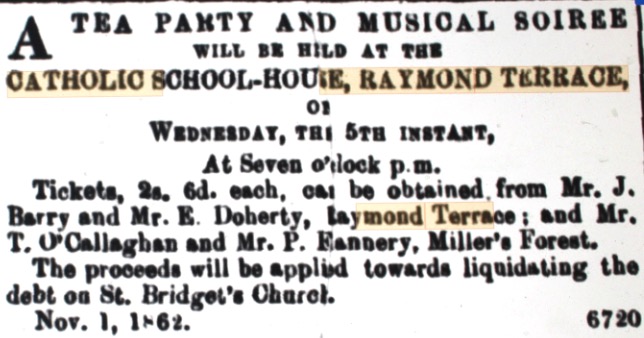
Tea Party and Musical Soiree advertisement [The Maitland Mercury and Hunter River General Advertiser – 1 November 1862]
Testimonial to Father Luckie prior to his departure from Raymond Terrace – 1863
The Maitland Mercury and Hunter River General Advertiser of 23 May 1863, pages 1 and 2, reported:
‘Last evening a meeting was held at Mr. Barry’s Hotel, Raymond Terrace for the purpose of presenting the Rev Father Luckie with an address and testimonial previous to his departure from this place for another district to which he had been appointed by his Grace the Archbishop.
Upon the motion of Mr G. F. Ewen, seconded by Mr. P. Donohoe, senr., Archibald H. Jacob, Esq., was moved to the chair, and unanimously requested to make the presentation alluded to, to Mr Luckie.
In doing so Mr. Jacob returned thanks for the honour done him by his Roman Catholic friends in electing him to such an office and expressed his willingness. to accede to such request though emanating from a religious section of the community differing from his own. During the course of his observations Mr. Jacob alluded to the Rev. Father Luckie’s career here in the most complimentary terms after which he read the address to which Rev Father Luckie made an appropriate reply.
The business of the evening was concluded by Mr T. O’Callaghan according to a vote of thanks to Mr Jacob upon the motion of Mr. Ewen seconded by Mr. H. McNamara which unanimously expressed the meetings grateful thanks to Mr. Jacob lor his kindness in presiding on the occasion.
The two speeches delivered were:
“We cannot permit you to depart from amongst us—where you have resided for the last six years, and where your unassuming manners and kind deposition, as well as your great zeal and efficiency as a Priest, have won for you not only the unbounded love and confidence of the Catholic community, but the respect and esteem of persons of every class and denomination here—without marking our appreciation of your labours by a small substantial token of the same.
We regret exceedingly that the attempt lately made here, when a petition bearing nine hundred signatures was presented to his Grace the Archbishop of Sydney, to induce him, if possible, to retain your valuable services amongst us, was unsuccessful.
But since his Grace, however, has thought fit to remove you to another and a distant portion of the Archdiocese, it is not for us to question the justice of his act; perhaps his Grace has seen that the zeal and ability that have accomplished so much good here, may be more required elsewhere; and therefore it is that in the midst of our bereavement, we experience some slight consolation from the reflection that our loss will confer much gain upon another portion of the Lord’s Vineyard in this land.
That we do not speak the language of flattery or exaggeration, a brief review of plain facts will testify. On your arrival here, six years ago, we had neither churches nor schoolhouses that deserved the appellation: now we possess both churches and schools. The beautiful stone Church of St. Brigid, Raymond Terrace, the neat brick Church of St. Malachy, Port Stephen’s, and the large, commodious, new school-house at Miller’s Forest, attest more truthfully than language can portray, your successful and well directed efforts in promoting the sacred causes of religion and education amongst; us: though such efforts had been frequently (to our knowledge) attended with difficulties, privations, and discomforts, as witnessed in your labours collecting funds and superintending the erection of the buildings alluded to.
But it is in the improved spiritual condition of the people that your ministrations have been blessed with the greatest measure of success. This is evidenced in the frequentation of the Sacraments—the progress made by the youth of both sexes in the knowledge of the Christian doctrine—and in the order, sobriety, and general tranquillity that now happily characteries our Catholic population.
Filled, therefore, with sentiments of the liveliest gratitude towards you for the kind and vigilant attention you have always bestowed upon our religions and educational requirements, and for the palpable improvement in our spiritual condition which you have been the means, under Divine Providence, of effecting here, w beg you will be pleased to accept the accompanying Purse of 120 Sovereigns as a slight recognition of what we believe due to you from your affectionate and faithful friends and admirers.
In wishing you adieu, we humbly ask your blessing for ourselves and families, and we pray that God, in his in-finite mercy, may grant you success and every choice blessing in your new sphere of labour”.
We remain, Rev. Dear Sir, Your Affectionate Late Parishioners.
Reply by Rev. Luckie:
“My dear Friends—There are occasions, and the present is one of them, when language is found inadequate to give expression to the sentiments the heart would dictate. Wonder not, therefore, that I find the feeble forms of speech insufficient at the present moment, to convey to you from an overflowing heart my most grateful acknowledgments and sincerest thanks, for the very flattering address and handsome purse that you have presented to me to-day. I need not tell you that I shall cherish the recollection of this crowning act of your kindness, which so nobly illustrates your high esteem and warm personal affection for me; and be assured the innumerable testimonies you have given me for the last six years, that I have resided amongst you, of your constant attachment and confidence, and of your earnest desire to heartily co-operate with me in every good and useful work that I have undertaken here, I shall treasure up in a grateful memory as long as I live.
You are pleased to allude to an effort which you made to retain my humble services amongst you. This clear proof of your estimate of my ministry overwhelms me with gratitude, and must render my separation from you the more painful; but though I grieve no less than yourselves at this separation,—a separation, as I have inti-mated, rendered more poignant by the knowledge of your great anxiety that I should still be allowed to re-main with you,—I was, nevertheless, exceedingly gratified to learn that no one did hear the voice of my superior ordering otherwise than in a spirit of obedience, and with true Christian instinct you submitted at once to the Archbishop’s arrangements. This unhesitating devotion to legitimate authority is alike creditable to your intelligent and generous disposition.
You have been pleased to refer, also, to the humble efforts I have made to establish churches and schools in this mission, and you touchingly allude to the difficulties and discomforts I have had to encounter, whilst labouring to complete these erections. Your partiality, however, towards me, has concealed from your view, or you delicately suppress all mention of the important part you yourselves did bear in those undertakings. True, I have had some slight difficulties and discomforts to endure; but your cheerful co-operation, on which I have always had reason to calculate, sustained me, lightened my labours, and made success certain. It was this union of heart and mind and purpose, that has given us now good reason for mutual congratulations; for we must, indeed, feel gratified at the completion, or approaching completion, of the fond object of our heartfelt solicitude, namely, the complete organisation of this mission, with the essential appliances of permanent churches and schools.
If you behold any improvement in the religious and social condition of the people, let us give thanks to our good and merciful God, and attribute all the success to Him who has been pleased to bless the exercise of an humbly ministry. I am gratified beyond measure to observe objectionable habits replaced by good order, sobriety, and general decorum.
In accepting this purse, let me not be understood as, believing that any labours of mine have merited such a recognition. I have only simply done my duty; perhaps less; but certainly, much less than I could have desired to accomplish. Whilst again sincerely thanking you, and bidding you farewell, let me assure you, wherever I go, I shall not fail to reciprocate your prayerful wishes, and at the same time I earnestly desire a remembrance in your prayers. With the kindest regards for the spiritual and temporal welfare of yourselves and families,
I remain, my Dear Friends, Your faithful and affectionate servant in Jesus Christ, Eug. J. Luckie”.
Departure of Rev. Father Luckie from Raymond Terrace – 1863
The Freeman’s Journal of 6 June 1863, page 4, reported:
‘One of those affecting scenes that must live long in the memory of the spectator took place here to-day, and one that eloquently bespoke the people’s love and the ‘Soggarth Aroon’s’ worth. As it was generally known that the Rev. Father Luckie was to take his departure by the afternoon steamer, about one o’clock p.m. his late parishioners and others, willing—nay, eager— to give one more parting token of their heartfelt affection and esteem for him, began to assemble in large numbers.
At 2 o’clock the church bell tolled for the parting Service. The Service was conducted in a very impressive manner by the Rev. Father Dunne, who succeeds Father Luckie in the Raymond Terrace Mission. At its conclusion, Father Luckie ascended the steps of the altar and addressed the crowded congregation a few, but impressive, words of exhortation, that could not fail to move the least susceptible heart; indeed, the moving language of the speaker, who was deeply impressed himself, and who struggled to restrain the tears that rushed for egress, and the responsive sobs of the vast congregation assembled, testified to the timely nature of the parting advice, and that its excellent effect will likely be permanent. He implored the people to listen to their pastor’s admonitions— to discharge punctually their religious duties— to refrain from intoxicating drinks.
A procession was then formed, the school children, numbering about 150, leading, and the adults following after. When the assemblage reached the wharf, there could not be less than 700 persons present, amongst whom we noticed the leading gentlemen of the district, who came to testify specially their esteem and veneration for Father Luckie at his departure from amongst them. But bow came the most affecting incident of all —the good priest bidding adieu to the little school children, who were ranged in lines opposite the landing stage. No eye could behold that sight unmoved, as the broken-hearted sobs of the little ones replied to the gentle admonition— “My little children, be good; and God bless you.”
In a few moments the steamer moved off; and amidst the waving of hats and handkerchiefs, which was politely acknowledged, Father Luckie left, bearing with him to his future sphere of labour the good will of all classes and denominations of people in this district, but the more, especially unbounded love and esteem of the Catholic community.’
Appointment of Father J. T. Dunne as Parish Priest 1863 – 1865
Fund raising Tea Party and Musical Soiree for Church – 1864
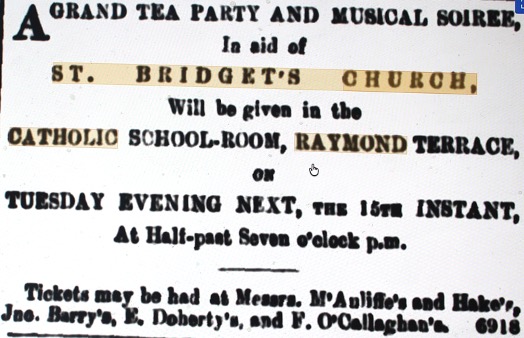
Tea Party and Musical Soiree advertisement [The Maitland Mercury and Hunter River General Advertiser – 12 November 1864]
Parish fund raising for the rebuilding of the of the first St. Marys Cathedral in Sydney – 1865
The first St Mary’s Cathedral in Sydney was destroyed by a devastating fire on the night of 29 June 1865. In response, many local community centres established fund raising campaigns.
The Freeman’s Journal of 29 July 1865, page 466, reported on the fund-raising activities commenced at Raymond Terrace:
‘A meeting was held at the Raymond Terrace Court House, on Friday evening 21, for the purpose of raising funds for the re-erection of the above Cathedral [St. Marys]. Owing to the unfavourable state of the weather, the attendance was small, there not being over sixty persons in the room. On the motion of Mr.Barry, junr., seconded by Mr. Donohue, the Rev. Father Dunn was voted to the chair. ……
Mr. G. F. Ewen, in a few appropriate remarks, proposed the following resolution:— ‘That this meeting sympathised with the community, for the loss sustained by the burning of St. Mary’s Cathedral, and pledges itself to do all in its power for its re-erection.” Mr. H. D. Portus, seconded the resolution. The calamity that has fallen upon the Roman Catholic body by the destruction of their fine Cathedral, is too recent to need any remarks in support of a motion expressive of the sympathy of this meeting. Let ours be the task of joining in carrying out the latter part of the resolution, by giving our active assistance in order to alleviate the loss that has been sustained; and in doing so, those of us who may be of a different creed, should remember the proverbial warm-hearted liberality of the sons of Erin, when any movement occurs requiring their sympathy and support. No observations of mine are necessary to the members of that body who worshipped in the Cathedral, and to those, their friends and eco-religionists in the country, it will be alike their aim and melancholy pleasure, to endeavour to re-erect that building which to them “though lost to sight, still to memory dear.” We are told that afflictions like these are sent for our good, and so it is in the present instance, as we find the burning of St. Mary’s has been the means of calling forth an outburst of sympathy in all directions and bringing about a union of all parties and creeds.
Mr. Robert Jacob, moved the second resolution—”That subscription lists be at once opened for the rebuilding of St. Mary’s Cathedral.” Had it not been for the Roman Catholics in this neighbourhood, the church in which he worshipped would not have been built, and they had also greatly assisted in procuring funds for the burial ground. They were always generous when called upon, and now therefore was the time for not only him, but everybody, to assist them, and give all that they could afford; and when called upon would, no doubt, respond to the call. Mr. E. Doherty, senr., had much pleasure in seconding the motion.
Mr. John Barry, senr., moved the third resolution “which was the appointment of a local committee, with, power to add to their number.” It gave him much pain to be present on such an occasion. He regretted exceedingly that such a fine edifice as St. Mary’s, the pride of Sydney, should have been burnt. He never expected that such a calamity would have occurred, and he hoped that all sects would come forward and assist in providing funds and do unto others as they would be done by. Mr. H. McNamara had great pleasure in seconding the resolution.
Mr. B Lunny proposed, Mr. R. Jacob seconded—”That the Rev. Father Dunn be appointed Treasurer, and Mr. John Barry, junr., Secretary.”— The foregoing resolutions were carried unanimously. The Rev. Chairman then read a list of subscriptions made in the room, which amounted to £124 8s. A vote of thanks to the Rev. Chairman was carried by acclamation.’
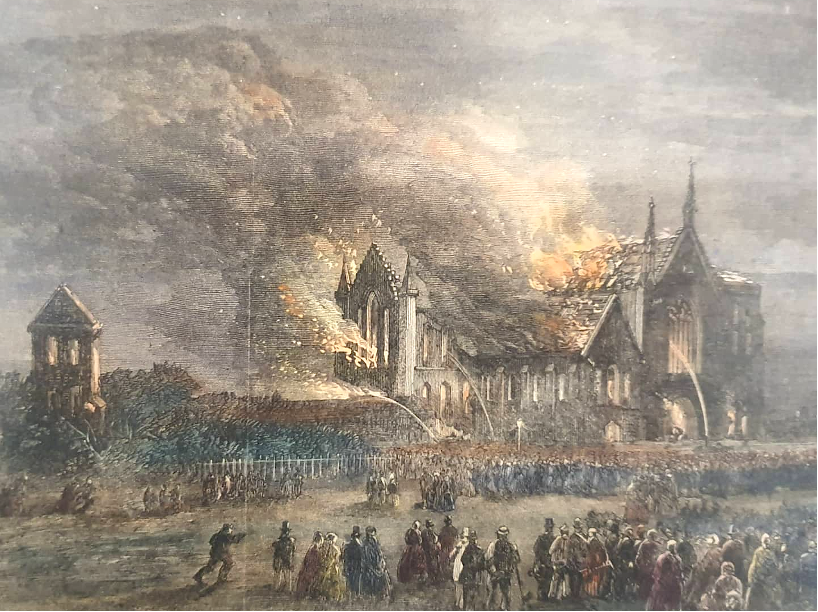
Image of the destruction of St. Mary’s Cathedral in Sydney – 29 June 1865
Father Dunne leaves Raymond Terrace with neighbouring clergy to attend to the Parish – 1865
The Freeman’s Journal of 12 August 1865, page 503, reported:
‘The Rev. J. T. Dunne who has lately been stationed at Raymond Terrace, has been appointed to the district of Penrith, which for some time past has been without a resident clergyman. Until further arrangements Raymond Terrace will be attended by the neighbouring clergy.’
Appointment of Father Patrick O’Quinlivan as Parish Priest – 1866 to 1868
The Freeman’s Journal of 3 February 1866, page 73, reported:
‘The following changes amongst the clergy have recently taken place: — The Rev. Dr. Keating of Bathurst has been appointed to St. Mary’s Cathedral, and his place will be filled by the Rev. Father Quinn [former Parish Priest of Raymond Terrace], lately returned, from Europe where he had gone on a sick leave. The Rev. P. J. O’Quinlivan has left Brisbane Water for Raymond Terrace, where he is succeeded by the Rev. Dr. O’Reilly.
First resident Catholic Bishop of Maitland visits Raymond Terrace – 1866
The Freeman’s Journal of 8 December 1866, page 778, reported:
‘On Sunday morning last our township was honoured by the presence of the Right Rev. the Catholic Bishop of Maitland [James Murray, appointed in 1865 as the first resident Bishop of Maitland], who paid his first visit to this part of his Episcopate. His Lordship was, I believe, escorted on his journey from Maitland, some distance down the Miller’s Forest Road, to the punt and across the Hunter, thence to St. Bridget’s Church, at the door of which he was met by the Rev. P. J. O’Quinlivan who said 11 o’clock Mass, at which Dr. Murray preached, taking his text from the Gospel of the Day the first Sunday of Advent.
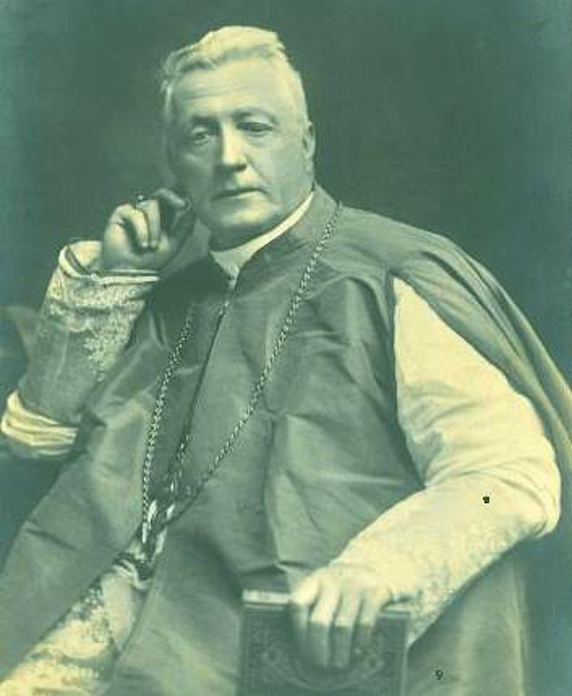
Bishop James Murray
The sermon, an eloquent and instructive one, was most attentively listened to by a numerous congregation of the Catholics of the district. After the conclusion of the Holy Sacrifice of the Mass, the Rev. gentleman having retired to the residence of the Catholic Pastor of the district, the parishioners met in the schoolhouse in connection with St. Bridget’s (and which I may remark was thronged with people in every part, and tastefully decorated,) preparatory to presenting an address of Congratulation to his Lordship on the occasion of His first visit, and which it was understood he would be pleased to receive.
About two o’clock p.m., his Lordship accompanied by Father Quinlivan entered the schoolhouse. Shortly after Father Quinlivan introduced a deputation of some of the principal Catholics to the Right Rev. Bishop, when the following address was read by Mr. Ashton on behalf of the deputation:—
To the Right Reverend Lord Bishop of Maitland. May it please your Lordship, — The Catholics of the Parish of Raymond Terrace beg most respectfully to approach your Lordship, animated with feelings of joy and gratitude to that good God who has been mercifully pleased to spare and bring you safe to the shores of Australia, to congratulate you on your arrival amongst us, and bid you a heartfelt welcome.
Since first the happy news of your Lordship’s appointment to the Diocese of Maitland reached us, we have long looked for this joyful meeting. Joyful it is indeed to us, because the instinct of our Catholic teaching makes us receive with jubilee and thankfulness the pastor who recently from our Holy Father Pius the Ninth, brings benedictions and blessings on this portion of God’s Holy Church.
Your presence also is an additional source of gratification to us, as it will relieve our dear and much-loved Venerable Archbishop in his declining years of the cares of no inconsiderable portion of his late diocese, and who for more than thirty years, has borne the heat and burden of the day — zealously labouring, sowing the seed of Catholicity in every portion of this vast region of our birth, or adoption.
Your Lordship’s name is not unknown to us, coming from the land of our fathers in which Catholicity has made such great and wonderful progress. We shall have every confidence in your Lordship’s administration in this part of our Lord’s vineyard, and we promise you every assistance and support as dutiful children of the Holy Catholic and Apostolic Church.
Therefore for many reasons, whether for our present needs and wants, for the love of that dear old land from which you came, for the love of the Church by which you are sent amongst us, for the love of this fair Australian land in which our lot is cast, for the love of our Lord Himself the Head of the Church, or for the love of His Blessed Mother, we give you a deep an affectionate welcome to our land and to our hearts.
In our names, in those of our families and in the names of our absent parishioners we offer you welcome, obedience, veneration and love. May your Lordship’s life be prolonged very many years may you gather rich and abundant fruits of the holy labours for which our Lord has sent you amongst us as His chosen minister for our highest good.
Again, we reiterate welcome affectionate welcome.
In reply his lordship regretted not having sufficient time to prepare a written reply to what he was pleased to term the beautiful address just read to him. He however, alluded most feelingly to every part of it. First, he thanked them for the kind and courteous reception he met with from the parishioners of Raymond Terrace, then alluding to his connection with Rome, informed the assemblage that he had been educated there, having spent many years of his life in the Holy City, that he was a child of the Pope and that he would not be an Irishman were he not so.
He very graphically described the present position of the Holy Father, hoping that when he called upon his people to assist the Pope, the parishioners of Raymond Terrace would cheerfully respond to the call. He said it gave more than ordinary pleasures to find that in the charge of Pastors, they had not for gotten the Venerable Archbishop who, he truly said, may be styled the Patriarch of Australia coming hither when it was not fashionable to do so, and when obstacles and difficulties of every kind had to be encountered and overcome, bearing the heat and burden of the day, sowing the good seed of Catholicity far and wide in this remote Australian land.
His Lordship as stated previously replied at great lengths to the other parts of the address at the conclusion of which he again returned them his ardent and sincere thanks for the generous reception accorded to him often ‘you say,’ said his Lordship (in peroration) in your beautiful address that I bring “blessings and benedictions for our Holy Father, and as it was not given in the morning, kneel down now and receive that blessing which spring from the vicar of Christ for you all.” The entire body of the people assembled in the school room then reverently knelt down and received from the Bishop the Pope’s blessing. After which the meeting terminated. In the course of the evening his Lordship returned to Maitland.’
Message sent to H.R.H. Prince Alfred Duke of Edinburgh – 1868
It came as a shock to Australian citizens that an assassination attempt was made in Sydney during an Australian tour, on the life of Prince Alfred, the fourth child of Queen Victoria.
The Maitland Mercury and Hunter River General Advertiser of 26 March 1868, page 2, reported:
‘On Tuesday evening, the gentlemen of the committee appointed to draw up an address to His Royal Highness the Duke of Edinburgh, met at the [Raymond Terrace] School of Arts.
The following address was sent: –
To H. R. H. Prince Alfred, Duke of Edinburgh, K.G., &c., &c. May it please your Royal Highness – The Inhabitants of this town and district of Raymond Terrace, in a public meeting assembled, deeply lamenting the recent and very unexpected attack upon your Royal Highness, hasten to offer to you their earnest and most affectionate sympathy, acknowledging the good providence of Almighty God in preserving the life of your Royal Highness. They pray that you may be speedily restored to health and strength.
They desire also to declare their unswerving loyalty and devotion to her majesty the Queen, and their firm determination to support the authority of his Excellency the Governor-in Chief of this colony – a land in which, by God’s help, traitors and assassins shall never prosper. On behalf of and authority of the meeting.
The following address, signed by 150 of the Catholic residents of the district, was forwarded to his Royal Highness by the Rev. Father O’Quinlivan:
To H. R. H. Prince Alfred, Duke of Edinburgh, &c., &c. May it please your Royal Highness –
We, the undersigned Roman Catholic inhabitants of Raymond Terrace, Miller’s Forest, and the surrounding district, respectfully beg leave to address you, and express our horror and indignation at the diabolical attempt which has been recently made on your Royal Highness’s life, and to assure you of the feelings oi profound grief and sympathy which pervade our whole community.
We also beg to assure you of our devoted and unalterable attachment to our Most Gracious Queen, and to all the Royal Family, and we humbly but earnestly pray to that good God whom we all serve, to protect and guard your Royal Highness from every danger, and that He in his infinite goodness will be graciously pleased to restore you speedily to perfect health. Dated: Raymond Terrace, March 17, 1868.
The following answer was received by the Rev. Father O’Quinlivan from Earl Belmore [Governor of NSW] on 19th instant: Government House, Sydney, l5th March 1868.
Rev. Sir, – I am directed by the Earl of Belmore to acknowledge the receipt of your letter of the 17th instant, forwarding a communication from the Roman Catholic inhabitants of Raymond Terrace, Miller’s Forest, and the surrounding district, expressing their horror and indignation at the late attempted assassination of the Duke of Edinburgh, and to inform you that his Excellency has caused the same to be presented to his Royal Highness. – I have the honour to be, rev. sir, your most obedient servant. [Signed] Fred. B. Toulmin.’
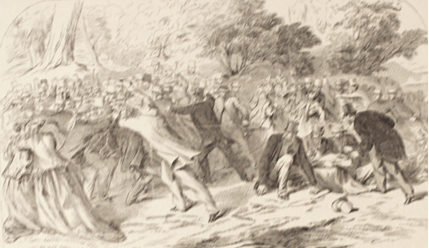
Artist impression of the attempted assassination of the Duke of Edinburgh in Sydney [Australian Illustrated News – 30 March 1868]
Spiritual Retreat held at St. Brigid’s Church – 1868
The Freeman’s Journal of 27 June 1868, page 2, reported:
‘It may not be uninteresting to your Catholic readers to know, that Father Mounier [Monnier] of the Marist Fathers opened a Spiritual Retreat in this parish on Thursday, 28th May, which finally closed on Sunday evening, 14th June.
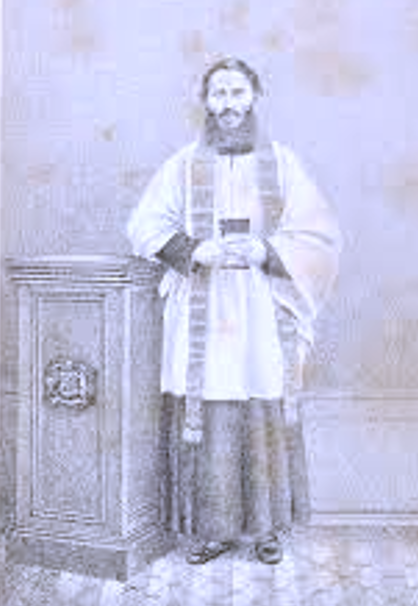
Rev. J. Monnier, Marist Father attached to St. Patricks Catholic Church, Sydney
One of the objects of his visit was to assist the pastor of the district, Father O’Quinlivan, in instructing those who were preparing to receive the Sacrament of Confirmation. It may be consoling to the worthy Marist Father, to be informed, that the good seed which he has sown broadcast amongst us, has not fallen on arid and barren soil, and it is reasonably to be expected that it will, in due time, germinate and yield rich and abundant fruits, worthy of the intentions for which it was planted. He will be long remembered in this parish, for his deep and fervent piety, for his zealous endeavours to win souls to God from the power of the evil one and for his constant attendance on the Confessional during the Retreat—from early dawn often to a late hour in the night.
To use the expressive language of the poet “He wept and felt and prayed for all.” During the Retreat the Holy Sacrifice was offered up every morning at 9 o’clock, Rosary at half-past 3 in the evening, with Sermon and instruction at 5 o’clock. On Sundays we had two Masses at 9 and 11 o’clock. There were very few indeed in this parish who did not profit by the spiritual blessings of the Retreat, in making their peace with God. Some hundreds must have had the happiness to approach the Holy Communion.
On Sunday, 14th June, his Lordship the Bishop of Maitland arrived at the Terrace, somewhere about 11 o’clock. The persons who had been preparing for Confirmation were awaiting him at the schoolhouse, and on his arrival they walked in procession to meet his Lordship to the residence of Father O’Quinlivan; thence the procession proceeded to St. Bridget’s Church, the children as they walked sang some of those beautiful hymns of the Church.
His Lordship with Father Mounier, and Dr. O’Quinlivan, walked at the end till it entered the church. Father Mounier then said Mass. After Mass Dr. Murray ascended the altar and delivered a beautiful address to those who were about to be Confirmed, reminding them of the sacred duties and obligations, contracted in the Holy Sacrament they were about to receive. At the termination of his address his Lordship examined the children in their knowledge of our Holy religion and of its imperative obligations. All of them we understand gave satisfactory answers.
The Holy Sacrament of Confirmation was then administered by the Bishop, assisted by Father Mounier to eighty-six persons—forty-five male and forty-one female. His Lordship after Confirmation, gave another powerful discourse to the numerous congregation present, specially alluding to the duties of parents to their children and of the urgent necessity of a good sound Catholic education for the rising generation, in this fair land of Australia; his Lordship’s words have not fallen on inattentive ears, and they seemed to make a deep impression on those for whom they were intended.
I may mention there were many persons present, not in our Holy Faith, who paid marked attention, and were deeply interested in witnessing those beautiful ceremonies of the Church. At the conclusion the persons who had been Confirmed walked back to the residence of our worthy pastor, in the same order they entered the church, the children again singing on their return in procession, his Lordship with Fathers Mounier and O’Quinlivan, joining as before.
We understand that Dr. Murray was quite pleased and gratified at the manner in which everything was conducted during his short stay amongst us. He left that evening for East Maitland, about 4 o’clock. Father Mounier left us on Monday morning for Maitland followed by the regrets and prayers of all our people. He enrolled numbers during his stay with us under the order of the Scapular—a large army indeed under the protection of the mother of God, to give battle to Satan.’
Church damaged during hailstorm – 1868
The Newcastle Chronicle of 27 October 1868, page 2, reported:
‘The damage done by the hailstorm on Tuesday last is not as destructive in the vineyards and fruit gardens as was expected. Some of the vineyards escaped; the principal damage is the breaking of glass in the English, Roman Catholic, and Presbyterian churches, as well as in several dwelling-houses.’
Following Father O’Quinliven’s departure from Raymond Terrace in late 1868, no official parish priest was appointed to Raymond Terrace.
Former Parish Priest of Raymond Terrace drowns at Port Macquarie – 1869
The Sydney Morning Herald of 29 January 1869, page 8, reported:
‘A great many of our readers in the neighbourhood of Raymond Terrace, and other parts of this district, will see with painful interest the brief notice in our telegram, that the Rev. Father O’Quinlivan has been drowned at Port Macquarie, while bathing. If we are correct in believing this to be the same Catholic clergyman who was so long stationed at Raymond Terrace, and who left there for Port Macquarie quite recently, we shall no doubt receive a fitting tribute to his virtues from some of our correspondents who knew him well. The leading characteristic we have ourselves heard in connection with Mr. O’Quinlivan’s life and habits was, that he was truly a “Catholic” minister, in the sense of being the warm friend of every good man, of every religious denomination. He was, if we have been rightly informed, a man who, had he lived to be old, would have acquired in some wider sphere a character for universal benevolence and charity united with learning, similar to that borne by the late Venerable Archdeacon McEncroe—who was mourned by all.’
Tea Meeting and Soiree to raise funds for the School building – 1869
The Newcastle Chronicle of 16 March 1869, page 3, reported:
‘A public tea meeting and soiree [elegant social gathering] will be given in the Roman Catholic Schoolroom, Raymond Terrace, on Easter Monday, 29th March, for the purpose of raising funds to put the school building in a fit state of repair. No doubt the meeting will be a large one, as the proceeds are to be devoted to so good a purpose.
Denominational School buildings must be kept in a suitable condition by local contributions, or some other means, by those interested, as the Council of Education has decided to give no assistance to furnish or repair such buildings. We wish the promoters every success, now that a teacher has lately been appointed to this school who is well known and strongly recommended.’
Appointment Father Thomas. A. Lonergan as Parish Priest – 1871
Funds sought for new Presbytery – 1871
The Freeman’s Journal of 16 December 1871, page 7, reported:
‘It may be interesting to some of your readers to learn that, amongst other arrangements made by his Lordship the Bishop of Maitland previous to his departure for Europe, was the appointment of the Rev. Father [T. A.] Lonergan to this large and important district. Hitherto the reverend gentleman used to visit us only once a month, but from this forth he will be stationed in our midst — thanks to the paternal solicitude of our beloved Bishop, who did not forget to provide for the spiritual wants of the Catholics here.
The other outlying places which are to be under the charge of Father Lonergan are Stroud, Dungog, Brookfield, Clarence Town, Hexham, Wallsend, and Lambton.
On Sunday last these regulations were fully explained to the congregation by our good pastor; and after Mass he presided over a meeting, held in the church, at which resolutions affirming the necessity of at once taking steps to erect a clergyman’s residence, were carried unanimously. A strong committee was appointed to canvass the district for subscriptions. A list was then opened, and the handsome sum of £85 was contributed towards the good work, Father Lonergan, with his usual liberality, heading the list, with ten pounds. 11th December 1871.’
Foundation stone laid for new Presbytery – 1872
The Freeman’s Journal of 12 October 1872, page 9, reported:
‘There took place here on Thursday a very impressive ceremony, in which the Catholics of the Terrace and the surrounding district, took a deep interest, as evidenced by the large numbers in which they assembled to witness it, and the liberal manner in which they showed their sympathy with the work which was that day begun, and which they themselves originated to give practical proof of their appreciation of the services of their beloved pastor, the Rev. J. A. Lonergan.
Some time ago they resolved to erect a Presbytery, as the most substantial testimony they could offer Father Lonergan, and as they knew it would confer a permanent benefit on religion here, they rightly supposed that, it would be more in consonance with Father Lonergan’s wishes, than ought else they could do.
The visit of the Right Rev. Dr. Quinn, Bishop of Bathurst, to Maitland, was availed of, to ask him to lay the foundation stone, and accordingly on Thursday last, his Lordship arrived at the Terrace. In the morning a heavy storm of thunder and hail occurred, but the weather afterwards assumed a more promising aspect, and the afternoon fortunately turned out fine. The Rev. Dr. Woods, of Adelaide, has for some days past been conducting a retreat for the people here, nearly all of whom approached Holy Communion in the morning.
On the arrival of Dr. Quinn, he was met by Father Lonergan, and a procession formed to the Church, where after the recital of appropriate prayers, the procession walked to the site of the proposed Presbytery, and his Lordship laid the foundation stone with the usual ceremonials.
Dr. Woods preached an excellent sermon. A collection was next made, and the sum of £90 was deposited on the stone, this, with the amount already subscribed, brings the cash in hand up to £300. The estimated cost of the building is £600 — the deficiency, it is expected, will be raised by a grand bazaar which will shortly take place. The generosity of gentlemen of other denominations deserves special mention, and particularly that of Mr. John Windeyer, of Kinross, who sent on this occasion a second donation of £5.’
Preparations underway for bazaar to raise funds for new Presbytery – 1872
A large bazaar in Raymond Terrace organised by the Parish Priest, Father Lonergan, to raise funds for the erection of the new Presbytery, was planned to commence on 17 March 1873. Prior to the Bazaar, numerous advertisements were placed in the local newspaper, such as that illustrated below, that requested donations of goods.
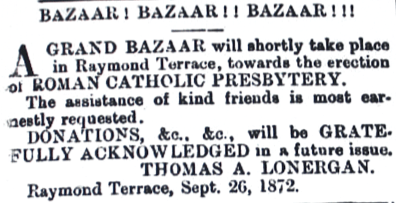
One of several advertisements for the bazaar [Freeman’s Journal, 26 October 1872]
List of donations to the Bazaar – 1872
The Freeman’s Journal of 21 December 1872, page 1, published the following advertisement placed by Father Lonergan that listed all donations to the fund-raising bazaar. Father Lonergan donated the 8th prize, which was a double-barrelled gun, with powder-horn, shot belt, etc., valued at £8:
‘The Rev. Father Lonergan begs to acknowledge, with many thanks, the following donations towards his bazaar, in Raymond Terrace, on the 17th of March next, and succeeding days.
The donations are listed in the order of the prizes to be awarded:
1st–
A carriage, in perfect order, with hood and pole, which may be used
by one or two horses; originally the property of Alex. Dodd, Esq.
Mayor of East Maitland. Presented by Mr. Peter Kegan, East
Maitland
2nd-
A First-class Quiet Horse, suitable for carriage or saddle, of Gleen Quinn’s run
3rd–
A Plough, valued at £10, presented by Alderman McLoughlin East Maitland
4th–
A Double Harrow, presented by Mr. Cridland, Miller’s Forest, or £6 (if preferred)
5th –
£5, Presented by Mrs. P. O’Donough, Raymond Terrace
6th –
A First-class Suit of Clothes, presented by Mr. Arren, of West Maitland
7th –
A Good Milch Cow, presented by Mrs. McAuliffe, Nelson’s Plains
8th–
A Double-barrelled Gun, with Powder-horn, Shot belt, etc., valued at £8 self
9th–
£5, presented by Mr. Pat. O’Brien, Brookfield
10th–
A valuable Pony, presented by Miss Connolly, Clarence Town
11th-
A Horse, by Mr. Hough, near Stroud
12th–
A good Horse, by Mr. Pat. Bourke, East Maitland
13th–
A Saddle and Bridle, by Mr. Quirk, East Maitland
14th–
A good Clock, by W. H. Smith, Esq., West Maitland
15th–
An excellent Chest of Drawers, by Mr. Hyndes, West Maitland
16th–
A good Suit of Clothes, to order of the winner, by Mr. Tierney, of
West Maitland
17th–
A Half-dozen Whips and 2 Bridles, by Mr. John Rigney, West Maitland
18th–
A nice Saddle Mare, broken in by Mr. Rugg,, of Oakhampton Road, West Maitland
19th–
Three beautiful Pictures, by Mr. J. G. O’Connor, Sydney
20th–
A valuable Picture of ‘The Madonna,’ and magnificently framed, by Mr. B. Lynch, Raymond Terrace
21st–
A white-hided Bridle, plaited, and most valuable for bush-work, valued at £4, presented by a friend in Raymond Terrace
22nd –
A Pair of Turkeys, or £1 in Cash, by Mrs. Feeney, Raymond Terrace
23rd –
A valuable Pony, by Mr. Alex. Reid, of Raymond Terrace
24th –
The Maitland Mercury, for 6 months, by Mrs. Falls, of West Maitland
25th–
The Newcastle Pilot, for 12 months, by the Proprietors, Messrs. Maxted, Newcastle
26th–
The Freeman’s Journal, for 12 months, by the Proprietors, Messrs. Butler and Rubie, Sydney.
27th–
A Patent Churn, by Mrs. Frize, of Raymond Terrace
28th–
A Case of Hennessy’s Pale Brandy, by Mr. P. O’Donough, Raymond Terrace
29th-–
An Iron-grey Horse, by Mr. Keegan, of Raymond Terrace
30th–
A good Milch Cow, or £3, by Mr. John Moy, Raymond Terrace
31st–
Mr Connolly, Clarence Town, presented a two-year-old Steer.
32nd–
A Case of Wine, by Mr. Carmichael, of Seahan
33rd–
A Prize of £2 2s., by Mr. Patrick Ward, of West Maitland
34th-
A Saddle by Mr. James O’Brien, of Brookfield
35th–
A Horse, valued at £10, by Mr. Carlton, of Brookfield
36th
A Case of Wine (4 dozen best of Dingadee), by Mr. Pat. Nihill, Dungog
37th–
A Heifer in Calf, or £5, by Mr. John Meekell, Williams River, Terrace
38th–
A Truss of Hay, by Mr. John Pearman, of Miller’s Forest
39th–
A Yearling Steer, or £3, by Mr. Lenihan, Hexham
40th–
A Bullock, or £3, by Mr. Considine, of Williams River, Terrace
41st–
A Beautiful Gold Watch and Guard, by E. T. Hollingdale, Esq., Sydney, valued at £15 15s
42nd–
A Valuable Cabbage-tree Hat, valued at £2 10s., presented by T. Hart, Esq., West Maitland
43rd–
A Valuable Pair of Gold Ear Rings, by Mr. W. T. Moore, West Maitland
44th–
A Case of best Brandy, by Mr. J. S. Hart, Raymond Terrace
45th–
A Pair of Turkeys, or £1 in cash, by Mrs. Crowe, of Raymond Terrace
46th–
A Ton of Hay, by Mr. Matt. Martin, Miller’s Forest
47th–
A 3 year old Milch Cow, by Mr. P. Considine, Williams River
48th–
A Lady’s Chain, by Mrs. John Moy, Raymond Terrace
49th–
A One Pound Note, by Miss Sarah Moy, West Maitland
50th–
A Box of Staunton’s Chess Men, by Mr. Stokes, of R. C. School, Newcastle
51st–
A Grey Mare and Foal, by Mr. Michael Keegan, Williams River
52nd-
A Pair of Turkeys, and
53rd–
A pair of Geese, a pair of Fowls and pair of Ducks, by Mrs. Mich. Keegan, Williams River
54th–
Valuable Books, by Mr. Caraher, Sydney
55th–
A good present of Books, by Mr. J. J. Moore, George-street, Sydney.
Note. — Any further donations will be gratefully acknowledged in a future issue; and all the 100 Prizes in connection with this Bazaar, will be obtainable either in Raymond Terrace, or West Maitland, or forwarded to the winners, according to request, as far as possibly convenient. One of the Best Brass Bands in the Colony has been secured for the occasion.’
New vestments purchased and Presbytery fund raising continues – 1872
The Freeman’s Journal of 14 December 1872, page 9, reported:
‘During the past week events have occurred in this district, which deserve notice in your journal. On Sunday evening last, the Feast of the Immaculate Conception, Benediction of the Most Holy Sacrament was given by Rev. T. A. Lonergan, the respected pastor of this mission.
Benediction had on a few occasions previous, been given at the Terrace, but on all these occasions, the vestments and outer articles required in the ceremony had to be procured from either Newcastle or Morpeth. The necessity to borrow no longer exists. During a recent visit to Sydney the Rev. Father Lonergan ordered the vestments at the Good Shepherd and the remonstrance and other articles at McLean and Sons, York-street. In each case the order has been executed in a manner reflecting the highest credit on all concerned.
The cope and veil are of yellow silk, with purple velvet border, richly worked. The remonstrance, pair of branch candlesticks, thurible and boat are electro-plated, manufactured by McLean and Sons, and are very neat and chaste in design.
A few days after these last-named articles were received from Mr. McLean, by Father Lonergan, the cost of purchase, £14, was in a spirit that does her infinite credit, generously defrayed by Mrs. P. O’Douoghoe of the Terrace.
The vestments, &c were all blessed on Tuesday, and in the evening, benediction was given. The school children under the conductorship of Mrs. Lynch, who presided at the harmonium, were an excellent choir, and sang with great sweetness and power, several hymns, the ‘Litany of the Blessed Virgin,’ the ‘O Salutaris’ and ‘ Tantum Ergo.’ After the
Rosary had been recited, a most eloquent and impressive sermon on the Immaculate Conception was preached by the Rev. Father Lonergan. The litany followed the benediction. The church was crowded, many present being of other denominations. It should be added that the altar had been neatly decorated with a profusion of flowers, tapers, &c.
The erection of the new presbytery is being proceeded with. The foundation and stonework generally are completed, and this week the bricklayers are at work. In six weeks’, time it will be, I believe, completed.
The tickets for the grand drawing of prizes, the proceeds of which are for the presbytery fund, are now being distributed. They have been sent to the more remote places first. Their sale is exceeding anticipations. Last week, in a small village, one young lady alone disposed of £10 (ten pounds) worth. No doubt wherever Father Lonergan is known or heard of for energetic and indefatigable zeal in the advancement of Catholicity, or the promotion of the spiritual interests of the people of his mission, these tickets will be readily taken up.
Of the prizes and the bazaar generally, the following extract from a late issue of the Maitland Mercury is important testimony: — ‘ Raymond Terrace Bazaar and Drawing for Prizes. — Our readers will doubtless be aware that a grand fancy bazaar and drawing for prizes has been for some time in contemplation with a view to the reduction of the debt upon the new Roman Catholic Presbytery at Raymond Terrace. We would now direct their attention to an advertisement elsewhere, which fixes the date of the bazaar for the 17th, 18th, and 19th March next. A large number of valuable prizes have already been received and will be found enumerated in the advertisement referred to. Many of these have come to hand since the tickets were printed, and therefore could not be mentioned on those documents; several others equally valuable, have been promised, and will be advertised as they arrive.
A glance at the list will show not only the great variety of prizes, offered (including vehicles, horses, cattle, money prizes, ploughs, and other agricultural implements, clothing, clocks, pictures, literature, saddles, harness, jewellery, &c), but also that a gratifying spirit of harmony pervades this district, ignoring mere sectarian distinctions, since donations have been made by large-hearted persons of almost every denomination — a fact that must be very pleasing to the kind, courteous, and energetic clergyman, the Rev. T. A. Lonergan, in the erection of whose residence the bazaar is intended to assist.
Father Lonergan informs us that in order to obviate a matter of dissatisfaction that has presented itself on other occasions he had made arrangements to have every one of the prizes on the ground at the time of the bazaar, so that the fortunate winners can take the gift that Fortune sends, away with them at once if they desire it; or he will deliver the prizes at West Maitland if required, or forward them to the winners at their request, so far as can possibly be done.
The attractions of music will not be wanting at the bazaar, for a splendid brass band has been engaged; and in short nothing will be neglected to make the occasion a perfect success. Books of tickets have been left for sale at all the principal stores in town, and at this office, so that those who may feel disposed to assist in a good work, with the chance of getting a handsome prize into the bargain, need have no difficulty in finding the means of doing so.’
Preparations for Presbytery fund raising Bazaar continue – 1873
The Freeman’s Journal of 15 February 1873, page 10, reported:
‘We publish today an additional list of prizes for the above bazaar. Our readers will see that the zealous and energetic pastor of Raymond Terrace, Father Lonergan, has now succeeded in getting together such a collection of articles as is bound to ensure the success of his bazaar and lottery, soon to be held in aid of the presbytery building fund. We have seldom seen such a list of valuable prizes. It is not long since we published the first, and now there are added nearly a dozen more horses, a number of cattle, money prizes, silver cups, jewellery and a large number of other things of consider able value. We have no doubt that Father Lonergan will realize a handsome amount from the bazaar. He appears to be well supported in his efforts by his flock as the singulary valuable prizes attest, as he deserves to be.’
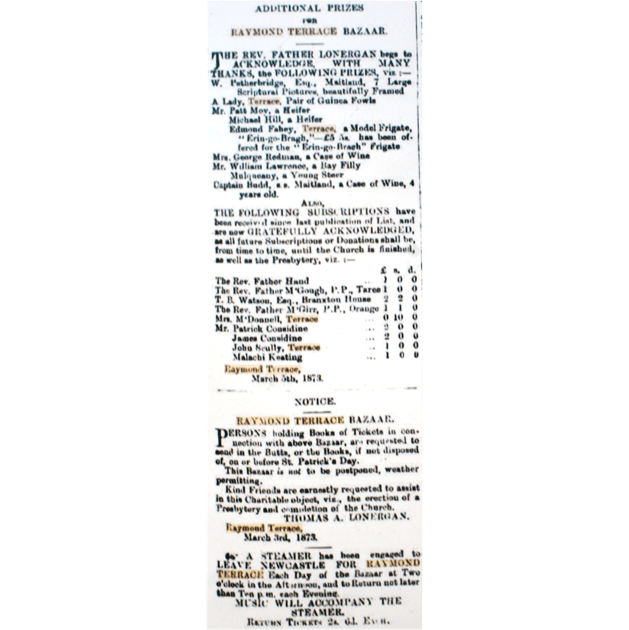
One of twelve advertisements published by Father Lonergan promoting the fund raising Bazaar [Freemans Journal -15 March 1873]
Fund Raising Bazaar Successful – 1873
The Sydney Mail and New South Wales Advertiser of 22 March 1873, page 370, reported:
‘The bazaar at Raymond Terrace for the erection of a Catholic presbytery has been a great success.’
Father Lonergan to organise a Easter Monday Picnic – 1873
The Maitland Mercury and Hunter River General Advertiser of 12 April 1873, page 3, reported:
‘We are happy to learn that several of your Maitland people were fortunate m obtaining valuable prizes at the late Raymond Terrace Bazaar, amongst whom are-Mr. McHugh, a £5 note, Mrs David Brown, a cow or £3, Mr Pickering, letter carrier, £1, Miss May Lee, three valuable books, Mrs. Curtain, a suit of clothes; Miss Healy, a chest of drawers, &c.
We are also delighted to hear that a picnic is to be given on Easter Monday, by Father Lonergan free of all cost, to all the children in and around Raymond Terrace, and a dance is likewise to be given in the evening, free of cost too, as a token of gratitude for the assistance which Father Lonergan obtained from all classes, all creeds.’
Bishop of Maitland visits Raymond Terrace – Description of new Presbytery – 1873
The Freeman’s Journal of 26 July 1873, page 10, reported:
‘His Lordship the Right Rev. Dr. Murray visited the Terrace on Sunday, the 13th instant and gave the Apostolic Benediction. After Mass there was a collection for his Holiness the Pope, and one also to clear off the debt still due in connection with the presbytery.
In the evening a magnificent sermon was preached by the Ven. Archdeacon Russell, and Benediction, of the Most Holy Sacrament was given by Lordship. Dr. Murray was delighted and surprised at the great change effected by the Rev Father Lonergan at the Terrace during his absence [overseas]. When, immediately previous to his Lordship’s departure for Europe, he appointed Father Lonergan to the charge of this mission it was thought that if the amount sufficient for his support were collected every year the Terrace would be immortalized. The result has been that this and a great deal more has been accomplished.
A new presbytery has been erected at a cost of £932 5s. 8d. and is entirely free of debt. The church and presbytery grounds have been enlarged by the purchase off several additional allotments and planted with a number of magnificent orange and other trees; the various diocesan collections have been liberally responded to, and throughout the whole district a generous spirit of emulation to assist in some way or other these great aids to religion prevails. We have had added, too, during the past, year, the vestments, &c, necessary for Benediction service.
The presbytery is a grand building. It occupies the most elevated position in the Terrace, within a few yards of the church. It fronts the reserve, and as the only allotments near it that were private property have been purchased by Father Lonergan, it can never be hemmed in by other erections. It contains four large spacious rooms and has a large veranda running all round the building. The roof is slated. To the rear of the building are the kitchen and servants’ rooms. It certainly is one of the very few presbyteries that may be called by the name in the colony.
The debt that has still to be cleared off is due for the purchase of some land, for the purchase of furniture, &c. The amount, considered in relation to the cost of the whole building, is not much; and it can hardly be supposed that the Catholics of the Terrace will leave it very long to remain as an incubus on further progress.
Father Lonergan’s next work is the completion of the church. This is one of the erections — a strong, stable one— of the olden time. A considerable sum was spent on it during the past year in repairs and decorations, which have much, improved it. It is without a sanctuary; and as this is absolutely necessary, to provide increased accommodation, the erection of one must be very shortly commenced. This, then, is a short summary of what we have been doing in the Terrace during the past year. The same happy results have been obtained in other portions of the mission. We have surprised Dr. Murray; we have surprised ourselves; we have gone beyond our expectations — and could not have done so were it not for the continued zeal, energy and perseverance of our pastor, the Rev. T. A. Lonergan.’
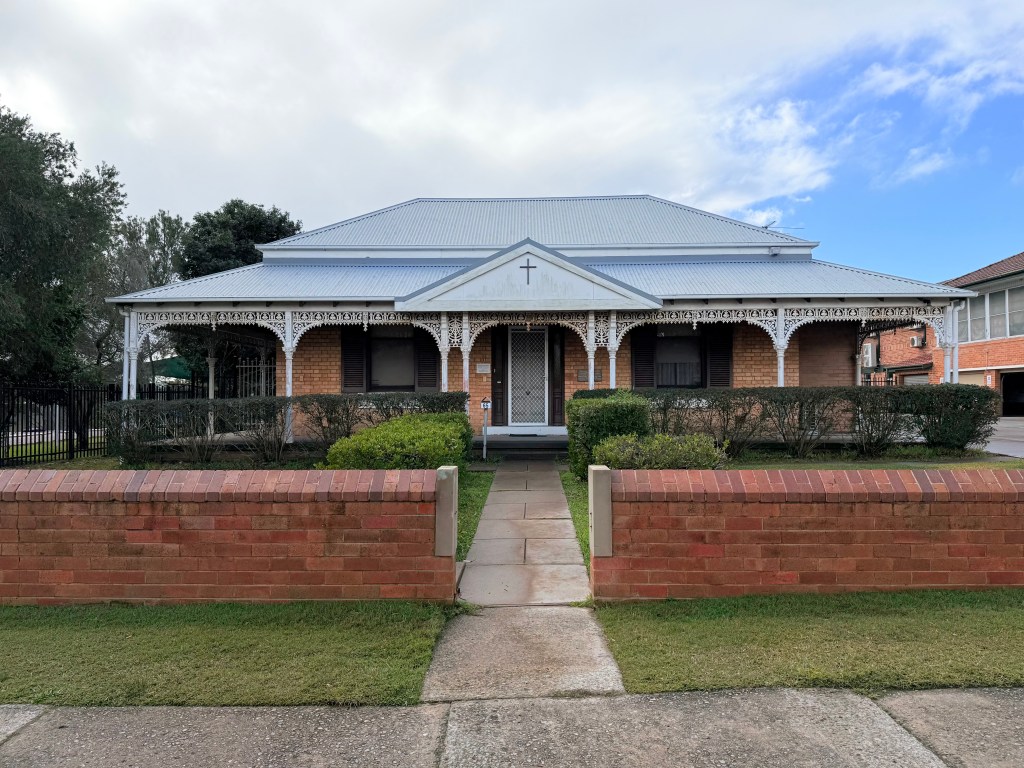
Raymond Terrace Catholic Presbytery – constructed in 1872. The original verandah roof was replaced in 1901 and restoration and extensions were made in 1971. [Author Photo – July 2026]
Father Lonergan commences raising funds for construction of a Catholic Church at Brookfield – 1873
The Maitland Mercury and Hunter River General Advertiser of 25 September 1873, page 3, reported:
‘Scarcely has Father Lonergan got the presbytery at Raymond Terrace completed, after indefatigable labour, than he set to work to collect subscriptions for a new Catholic Church at Brookfield, a settlement between Clarence Town and Dungog, He wants £700, and in the subscription list which has been shown us, we see that £145 of the money has been already subscribed, £50 of the sum being promised by the Bishop of Maitland. The matter being in the hands of Father Lonergan, it will of course succeed, for he knows no such word as “fail”.
Father Lonergan recovers from illness – 1873
The Freeman’s Journal of 15 November 1873, page 10, reported:
‘The friends of the esteemed pastor of Raymond Terrace [Rev. T. A Lonergan] will be glad to learn that he is fast recovering from his late serious indisposition. He has been staying in Maitland for some time! He hopes, we understand, to be quite convalescent in a week or two, when he will return to his parish.’
Appointment of Father Thomas Aloysius Nealon as Parish Priest – 1873
Father Thomas Nealon was appointed the new Parish Priest of St Brigid’at Raymond Terrace in !873. His ministry there was to last some forty.
Bushfire threatens Church Property – 1876
The Newcastle Chronicle of 13 January 1876, page 3, reported:
‘On Saturday our phlegmatic little township was most unceremoniously aroused from its apathy by a bush fire making its appearance in the rear of the town, on the quarry hill, about noon. The Catholic bell and also the Town fire bell gave notice of danger, which might have escaped general notice, in consequence of the heavy smoke that had been hanging about for several days past from large bush fires near the town.
Assistance was promptly rendered, and the insidious enemy kept from doing much harm, within the town, —although it required every exertion to prevent it from injuring the Roman Catholic Presbytery fencing, and also the pound. The Catholic and Wesleyan burial ground fences were destroyed, likewise some of Mr. Windeyer’s.’
Father Nealon associated With Indian Famine Relief Fund – 1877
The year 1880 marked the culmination of the devastating Great Indian Famine of 1876–1878 and the establishment of the Indian Famine Codes in 1880. The crisis caused an estimated 5.6 to 9.6 million deaths across southern and central India due to severe drought compounded by colonial grain export and free-market policies.
The Maitland Mercury and Hunter River General Advertiser of 27 October 1877, page 3, reported:
‘A public meeting was held in the courthouse, Raymond Terrace, at four p.m. on Tuesday, the 23rd inst., with reference to the Indian famine. C. R. Middleton, Esq., P.M., in the chair.
The Chairman opened the meeting in a forcible manner, vividly portraying the sufferings of those in whose aid the meeting was convened; and he called upon the Rev. Mr. Simm to move the first resolution, which was placed before the meeting in a concise, earnest, and energetic address: “That this meeting having heard of the great distress existing among vast numbers of our fellow subjects in India, by famine, and disease resulting therefrom, desires to express its deep sympathy with the sufferers.”
The above resolution having been seconded by W. B. Shaw, Esq, was carried unanimously Mr. Shaw, in seconding, exemplified the sufferings during a famine by a case which fell under his own observation.
The second resolution was moved by the Rev. Mr. Nealon “That a fund for the relief of the sufferers be now formed, to be called the Indian Famine Relief Fund.” The rev. gentleman said he would not trespass upon the time of the hearers. The resolution be had to move being a natural sequence of the previous one, he followed the previous speakers in his sentiments, fully endorsing all that had fallen from them. Mr. J. Richardson seconded the resolution, which was also put to the meeting and carried. …..
Two collectors were then appointed to canvass each of the surrounding, districts, viz. -Messrs. Middleton and Adam, for Raymond Terrace; Messrs. Kilgour and Macnamara, for Miller’s Forest; Messrs. Campbell and Boyle, for The Parading Ground [Williamtown] and Cabbage Tree; and Messrs, A. Sparke and J. Roberts, for Hexham. All collecting lists to be handed in if possible, to C. R. Middleton, Esq,, at the Court House, Raymond Terrace, on Monday, the 29th, inst., at 4 p.m., to which time and place the meeting was then adjourned.’
The committee, which included Father Nealon, brought their work to an end later that year, which resulted in over £94 being collected.
Father Nealon associated with Irish Relief Fund – 1880
The 1880’s was an era of profound social, economic, and political upheaval in Ireland, categorised by two struggles: land reform and political self-determination. The threat of another food famine was also present.
The Maitland Mercury and Hunter River General Advertiser of 28 February 1880, page 6, reported:
‘At a meeting of the committee of the Irish Relief Fund, held at the Courthouse, Raymond Terrace on Monday, the 16th February 1880, the Police Magistrate, the Rev. Mr. Nealon, Mr. John Richardson, and Messrs. Andrew Adam, H. McNamara, and Elkin being present. Messrs. McNamara and Elkin handed in £18 Us; Mr. John Richardson paid in some mousy. It was found that up to that time £105 1s 10d had been received by the treasurer. Other amounts have been received, and the treasurer now reports having forwarded to Sydney to the Central Committee a total of £108 6s 4d, viz. on the 19th February I860, £106 12a 10d; on the 26th February, £1 13s 6d.
The collectors’ lists have been sent to the honorary secretary in Sydney, so that subscribers will be able to see that their names are properly given, and the amounts they subscribed are accounted for. This closes the account, which may be considered very satisfactory as regards Raymond Terrace.’
Sisters of Mercy branch to be formed at Raymond Terrace – 1880
The Freeman’s Journal of 9 October 1880 reported:
‘We are informed that a branch of the Sisters of Mercy will be established at Raymond Terrace” next month. Rev. Father T. Nealon, with characteristic generosity, has given up his presbytery for the use of the nuns, who will come from the parent house at Singleton.’
The Raymond Terrace convent was opened in May 1881.
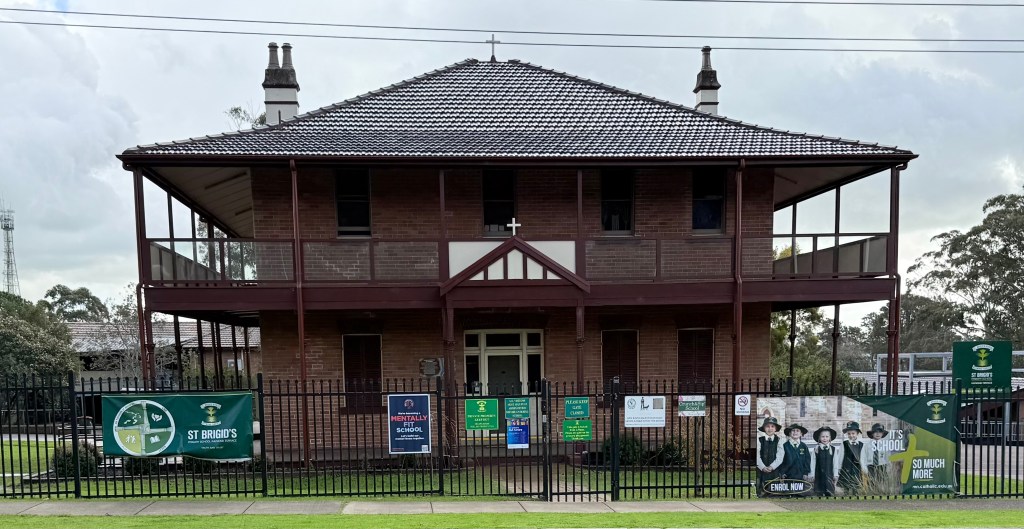
Former Sisters of Mercy Convent in Adelaide Street – Raymond Terrace. Currently the Administration Block of St Brigid’s Primary School [Author photo -July 2026]
Father Nealon finds boarding placements for boys – 1884
The Evening News of 10 July 1884, page 3, reported on a monthly meeting of the State Children’s Relief Board. At the meeting:
‘Attention was drawn to the fact that the Rev. Mr. Nealon, Roman Catholic clergyman, of Raymond Terrace, was rendering valuable help in connection with the boarding-out system at Raymond Terrace and had there secured a number of good Catholic homes for boys.’
Testimonial organised for Father Nealon’s trip to Ireland – 1886
The Freeman’s Journal of 29 May 1886, page 14, reported:
‘A meeting of the Catholics of this parish was held a few evenings since, at Mr. Hanlon’s Hotel, the object being to organize a testimonial to the Rev. Father Nealon, who is about to leave the parish to proceed on a visit to Ireland. The chair was occupied by Mr. H. Montigreash, J.P., Manager of the A. J. S. Bank, and the meeting was very enthusiastic.
A committee was formed to carry out the object, and forty guineas was subscribed in the room. The Rev. Father Nealon has been in charge of this parish during the last thirteen years, during which, time he has endeared himself to every member of the Catholic community, while he is held in the highest respect by non-Catholics, and he will leave the parish on his well-earned holiday with the kindest wishes of all who know him.’
Quadrille Party in aid of the Presbytery Fund – 1886
The Maitland Mercury and Hunter River General Advertiser of 13 November 1886, page 11, reported:
‘A quadrille party [ballroom dance for four couples arranged in a square formation], in aid of the Catholic presbytery fund, was held on the evening of Tuesday, the 9th November, in the School of Arts, Raymond Terrace, and was undoubtedly a great success. It by far eclipsed anything of the kind ever held in this district, there being fully one hundred and forty couples present.
Shortly after eight clock dancing commenced to the sweet strains of music so ably rendered by Messrs. Torpy, Reynolds, and Waterman, who played piano, violin, and cornet respectively, and were kept busily going till eleven o’clock, when a young brother and sister, named Mooney, who, I believe, hail from Branxton, gave the weary musicians time to have a rest by playing for several dances. The audience was delighted, with the music supplied by the young lady, and the manner in which she handled her violin.
Towards midnight the Rev. Father Foran, stepped upon the stage and thanked his friends from Newcastle, Maitland, and Morpeth, for the kindness they had shown him by attending that night in such large numbers. He also thanked those genuine ladies who so kindly assisted in preparing the tea. He then announced that tea was on the tables in the Temperance Hall and for the gentlemen to conduct their partners over and for them not to be disappointed as there was no banquet prepared only light tea.
We then wended our way over to the Temperance Hall, only a very short distance from the School of Arts, where we found those who preceded us busily engaged and apparently well satisfied with the good things before them. The ladies who waited on the tables had a busy time of it, and I must say a great deal of patience, for from the time you went in you could hear nothing scarcely but “Tea here, coffee there, one tea, two coffees,” which were dealt out with admirable quickness and civility.
Tea at last being over they all returned to the hall, and dancing was resumed as merry as ever, and was kept up till the sun was not far off putting in an appearance. The ladies were mostly all very nicely attired, and I am not going to attempt to describe any of their wearing apparel, suffice to say they were all most attractive and hard to distinguish which was entitled to the premier position. Mr. J. Moy performed the duties of M.C., and under his watchful eye everything passed off quiet and respectable.’

Holy water font inside St. Brigid’s Church, dedicated to the memory of John Moy, the master of ceremonies at the Quadrille Party [Author photo -June 2026]
Catholic School opened at nearby Miller’s Forest – 1887
The Sydney Mail and New South Wales Advertiser of 9 April 1887, page 772, reported:
‘Dr. Murray, Bishop of Maitland, opened and blessed a new Romas Catholic school at Miller’s Forest on Sunday afternoon, in the presence of about 400 persons. The building is of wood, and is one of the largest schools in the district. The cost of erection is about £700, the balance of which was realised by a collection at the opening, amounting to £90.
The Bishop delivered a short address. He said that were it not for the vigorous action taken by the Catholics here in establishing schools of their own, the same state of things would have been brought about in this colony by the Public school system as in the United States, where, owing to the system of State education, seven millions of Irish Catholics were lost to the Church.’
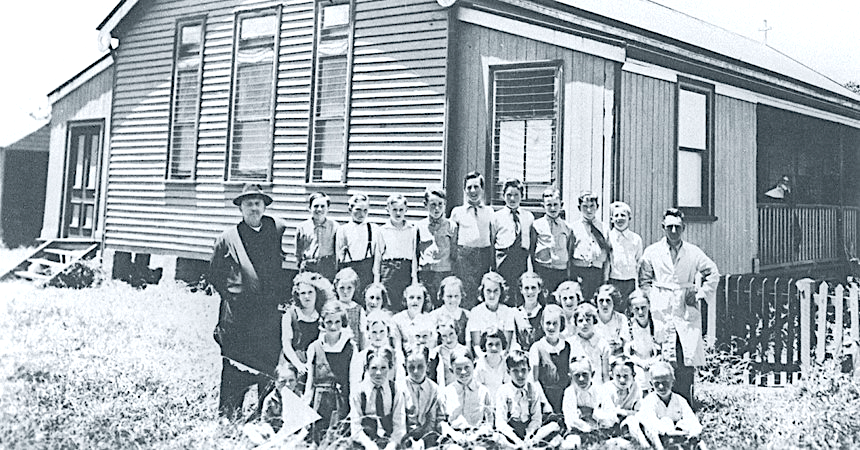
Millers Forest Catholic School several years after the official opening. The Raymond Terrace priest and a Mercy nun are in the picture [mnnews.today]
Former Millers Forest Catholic School, 49 Monkleys Road. The site is now privately owned.
Return of Father Nealon to Raymond Terrace – 1887
The Maitland Mercury and Hunter River General Advertiser of 2 July 1887, page 11, reported:
‘The many friends of the Rev. Father Nealon will be glad to learn that he is returning to this parish after a twelve months’ trip to Ireland. He is expected to arrive on next Tuesday, and the parishioners have engaged the s.s. Planet to convey him from Newcastle to Raymond Terrace, where on his arrival he will be presented with an address of welcome. The address, which is in picture form, was illuminated by Mr. Sands, of Sydney, and it goes without saying reflects the highest credit upon him.’
The Maitland Mercury and Hunter River General Advertiser of 9 July 1887, page 14, further reported:
‘It will be remembered that some 12 months ago Father Nealon decided upon taking a trip to Ireland, to see some of his friends & relations. Prior to his departure his many friends presented him with an address & purse of sovereigns, to mark their appreciation for him. This severance from his parishioners, after 13 years’ labour amongst them, had a melancholy & touching tenderness.
It became known 3 weeks ago that the above gentleman was on his way to Australia by the R.M.S. ‘Chiraborazo’. Those joyful tidings were received with much warmth by his many admirers & a Committee of gentlemen met & decided upon giving a fitting reception. Mr. Carmody, J.P., was appointed Treasurer; and in a few days donations began to roll in from every quarter of the Parish. Meetings were held every few days; an Address was prepared & forwarded to Mr Sands, of Sydney, execute.
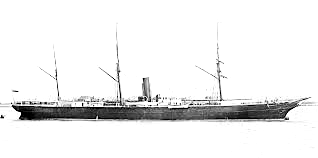
RMS Chimborazo
The ss ‘Planet’ was engaged to convey the Reverend Gentleman from Newcastle and on Tuesday morning about 50 persons assembled on the boat to accompany the Rev. Gentleman on the return journey. 1st Class provision was made in the way of refreshments on board the steamer and under the inspiration of the cheery voice of Dr. R. J. Allan, the time passed away merrily.
On arriving at the Great Northern Hotel, where Father Nealon was met after a severe shaking of hands, which must have been trying to the Rev. Father. Mr. Monteagresti (Manager of the AJS Bank, Raymond Terrace) rose and said – ‘Gentlemen, I have been asked to propose the only toast that is to be proposed here today and that is the Health of Father Nealon, has been absent from us for a period of over 12 months and after seeing his native country and all the principal cities of the Continent and America, has now returned to us and happy to say, looking well & healthy.
The presence of so many of his friends here to do him honour must no doubt show to him, how well beloved he is by his spiritual children. I am not going to give you a long speech and tell you of his many sterling qualities and virtues, as he is too well known amongst you, that it would be superfluous for me to do so. All I can say is that I am glad to him once again amongst us and also to welcome him back on behalf of his parishioners and friends. I therefore Gentleman, beg to propose the health of Father Nealon, which was received with great cheers. Taking into consideration that the host of the hotel, Mr. Alex Watt, was taken quite unawares by this assemblage himself and his able staff of waitresses attended to the wants of all in a short space of time.
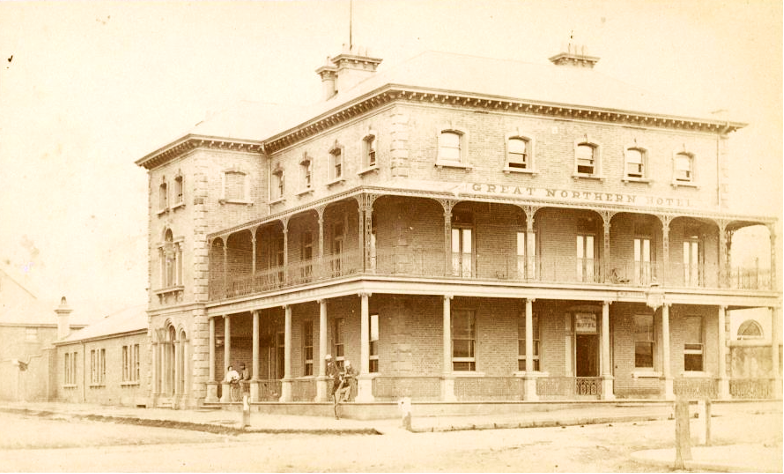
Great Northern Hotel, Newcastle, circa 1870’s [Hunter Living Histories, University of Newcastle]
Well, leaving Newcastle and arriving at Raymond Terrace, on the wharf fully 400 persons had assembled. Dr. Allan kindly placed his carriage at the disposal of the Committee, in which Father Nealon was seated; the ribbons being handled by the genial Dr. in true artistic style.
A vast concourse of people proceeded in front of Father Nealon to the schoolroom. On arriving there, the procession was formed in two lines and three cheers given for the Rev. Father right heartily as he marched into the schoolroom, a smile lighting up his countenance. When every available space in the schoolroom had been filled, Mr. Delaney proposed that Mr. Carmody should read the Address to Father Nealon.
Mr Carmody stepped forward and gave a neat little speech and read the following Address of Welcome: –
Reverend and Dear Sir, – We, your parishioners & friends, beg most respectively to tender you our sincere and heartfelt welcome on your return to the Pastorate of Raymond Terrace and to congratulate you on your safe arrival after your long absence from amongst us. We hope, dear Father, your visit to your Native Land has proved a source of pleasure to you and that you have gained renewed vigour to resume the duties of your sacred office, which you have ever performed with so much zeal & devotion & earnestly pray that Divine Providence may spare you long to watch over the spiritual welfare of your devoted children.
Signed on behalf of the Parishioners:-
R. H. D.. White, JP., Martin Hill, M. Carmody, J.P., D. J. Carmody, M. S. Monteagesti, J.P., Michael Reid, John Delaney, Ald., M. J. Martin, Patrick Moy, John O’Brien, Michael Cunningham, J. Grady, John Corbett and John Hanlon.
Father Nealon in responding said the words sufficient to express the delight he felt at seeing so many of his old friends around him & receiving such an unexpected and unusual Address of Welcome was beyond his power to express. It is a usual thing when a person is leaving a district to make some little fuss and present them with a thing of this sort. Though quite adverse to demonstrations of this kind he could not but feel pleased. When far away in other lands from the Mass he said in Honolulu on the one side, to Rome on the other he included his people in his Prayers. Three cheers for Father Nealon, three for Dr. Allan and three for Mr. Monteagesti, brought the proceedings to a close.
The Address, which is in picture form, is beautifully illuminated and does credit to the donors as well as the recipient.’
Presentation to Father Nealon by the Children of Mary Sodality – 1887
The Maitland Mercury and Hunter River General Advertiser of 16 July 1887, page 12, reported:
‘On Sunday last the Rev. T. A. Nealon was “made the recipient of a very handsome silver tea service of a beautiful design, and an address by the children of Mary. The address which is in picture form is beautifully illuminated and reads thus :
The gloom bas disappeared at last
And many lonely hours hare passed,
The violets bloomed, the rose tell dead
While bitter silent tears were shed
For oft we missed a well known guide.
Between us dashed deep oceans wide;
Se to a distant land had gone,
And days and weeks and months rolled on.
But now the sun shines bright again,
And birds sing in joyous strain
To welcome back our pastor friend,
The child of Mary’s voice must blend
And mingle in the joyous throng
To echo back in welcome song
Our guide in youth, our friend sincere,
No more we’ll shed the silent tear.
Then welcome back from Erin’s shore
And never, never leave us more. ‘
Fund raising Tea Party in aid of the Church- 1888
The Maitland Mercury and Hunter River General of 25 August 1888, page 8, reported:
‘The tea party in aid of the Roman Catholic Church, which for weeks had been looked forward too with pleasurable anticipations, is over, but will for ever be embalmed amongst our most delightful recollections. This enjoyable festival came off in the School of Arts on the 15th inst., and fully 250 persons were present, many of whom came from Newcastle, Maitland, Morpeth, and intermediate places.
Precisely at the appointed time the local brass band, under the leadership of the genial T. Adam, sent forth majestic strains, and it is needless to say put the lovers of the light fantastic on the move, which was kept up until 12 o’clock, when an adjournment was made to the Temperance Hall to refresh the inner man, whose appetite was considerably sharpened by the exhilarating exercise of the dance. The ladies who attended at the tables, also Mr. T. Wood, were very obliging, and the success of the entertainment, from a social point of view, was in a great measure due to their exertions. Mr. J. J. Moy acquitted himself as M.C. in a creditable manner.
The majority of the ladies wore evening dress, and it would indeed be a difficult task to name the belle; but, going to the extreme, and standing a show of being woolled by some disconsolate lover, I think a young lady from Miller’s Forest walked away with the palm. The thanks of the committee are due to the members of the band for playing gratis; likewise, to Messrs. J. Hill and Phelps, for playing piano and violin at intervals during the evening and thus depriving themselves of many an enjoyable dance.
Evening Fund Raising Tea Party Held – 1888
The Maitland Mercury and Hunter River General Advertiser of 25 August 1888, page 8, reported:
‘The tea party in aid of the Roman Catholic Church, which for weeks had been looked forward too with pleasurable anticipations, is over, but will for ever be embalmed amongst our most delightful recollections. This enjoyable festival came off in the School of Arts on the 15th inst., and fully 250 persons were present, many of whom came from Newcastle, Maitland, Morpeth, and intermediate places.
Precisely at the appointed time the local brass band, under the leadership of the genial T. Adam, sent forth majestic strains, and it is need-less to say put the lovers of the light fantastic on the move, which was kept up until 12 o’clock, when an adjournment was made to the Temperance Hall to refresh the inner man, whose appetite was considerably sharpened by the exhilarating exercise of the dance. The ladies who attended at the tables, also Mr. T. Wood, were very obliging, and the success of the entertainment, from a social point of view, was in a great measure due to their exertions. Mr. J. J. Moy acquitted himself as M.C. in a creditable manner.
The majority of the ladies wore evening dress, and it would indeed be a difficult task to name the belle; but, going to the extreme, and standing a show of being woolled by some disconsolate lover, I think a young lady from Miller’s Forest walked away with the palm. The thanks of the committee are due to the members of the band for playing gratis; likewise, to Messrs. J. Hill and Phelps, for playing piano and violin at intervals during the evening and thus depriving themselves of many an enjoyable dance.’
Presentation to Father John Carroll, Assistant Priest at St. Brigid’s – 1894
The Maitland Daily Mercury of 19 January 1894, page 2, reported:
‘The Rev. John Carrol, who has been assistant priest to the Rev. Father Nealon for the past twelve months, has been appointed [since March 1893] to the parish of Dungog as curate to Rev. Father Flynn. Father Carrol was a very popular priest here, and very much beloved amongst his co-religionists. He gave a valedictory sermon on Sunday last, the congregation, I am told, being unusually large. The people were greatly moved during his discourse, and there was hardly a dry eye amongst those present. The rev. gentleman was always to be seen moving about amongst his people in the district and was an able coadjutor to the esteemed senior clergyman, the Rev. T. A. Nealon.’
The Maitland Daily Mercury of 26 January 1894, page 4, further reported:
‘A gathering of the members of St. Brigid’s congregation assembled in the schoolroom here on Sunday afternoon last for the purpose of presenting the Rev. Father Carroll with an address expressing their appreciation of his services during the twelve months that he has been in Raymond Terrace. The meeting was presided over by Alderman HanIon. The address read to Father Carroll was as follows : —
Rev. and Dear Father, — We, the Catholics of St. Brigid’s parish, Raymond Terrace, on the eve or your departure from amongst us to take up the duties of your sacred calling in another parish, desire to convey to you an expression of the feelings of sincere regard and high esteem and respect which we entertain towards you, and the regret which we feel at losing you from our midst.
During the period of your comparatively short stay in the parish, we have, all of us, experienced the warmth and genuineness of your kindly, sympathetic disposition, and have been benefitted, we hope, by the practical interest which you have so constantly and so earnestly manifested in our spiritual welfare. Deep down in the heart of every true member of the church there always exists a proper reverence and veneration for God’s anointed, but the union that binds the Irish priest to his people is pre-eminently one of affection, and the ‘soggarth aroon’ is ever loved as well as revered.
Coming so recently as you have to this new land of Australia direct from the Island of Saints, we would feign hope that your experience amongst us has proved to you that we have endeavoured to keep burning brightly the lamp of faith that shines so resplendently in the land of our forefathers; and we trust that, on leaving Raymond Terrace, the impression you will take away regarding us shall not be an unfavourable one.
Before saying farewell, we would, dear Father Carroll, make a special request of you to remember in your prayers the people of the first parish in this country to which you were appointed for the exercise of the divine functions of your exalted office, and we, on our part, promise to not forget in our humble petitions to the Almighty the kind and gentle priest, whose unselfish devotion to our religious wants and anxious solicitude concerning our eternal well-being while labouring amongst us we can never adequately repay. Signed on behalf of the parishioners. (Here follow the signatures.)
The Chairman explained that owing to the shortness of the notice of Father Carroll’s removal that there had not been sufficient time to get the address properly illuminated and framed, but that this would be done, and it would be duly sent on to the rev. gentleman to Dungog.
Father Carroll made a lengthened reply, and manifestation of feeling on the part of the people whom he was leaving. He said that he would never forget the kindness that he had received from the people that he had laboured amongst during the past twelve months. Although he came as a stranger to them, and to the country, he soon found that he was at home and with kind and generous people. The kind sentiments which they had expressed towards him he fully reciprocated, and the district of Raymond Terrace and its warm-hearted people would ever hold a place in his affections second only to the laud of his birth.
Mr. H. O’Dea spoke in high terms of commendation of Father Carroll and what he had done for the people. He was a most sincere and zealous clergyman, and the district would feel very much his loss.
Mr. J. J. Moy also spoke, and said that the fact of Father Carroll’s departure being so much and so sincerely regretted as it was, gave ample testimony to the goodness of his character, and he considered that the Dungog people were fortunate in having him appointed to their district. He only trusted that Father Carroll would meet there friends as firm, as sincere, and as staunch as he has made during bis stay in Raymond Terrace. Father Carroll departed on Tuesday for his new sphere of duty at Dungog. A number of his friends assembled on the wharf to bid him farewell.’
Rev. John O’Flynn Appointed as an Assistant Priest at Raymond Terrace – 1896
The Freeman’s Journal of 28 November 1896, page 16, reported:
‘The Rev. J. O’Flynn has been appointed assistant to the Very Rev. T. A. Nealon, in the Raymond Terrace parish. Father O’Flynn takes his departure from Maitland on Wednesday.’
Father John O’Flynn remained at Raymond Terrace for two years and was later returned after he was appointed as the Parish Priest in 1914.
Commentary on the Raymond Terrace Catholic Community – 1896
The Catholic Press of 28 November 1896, page 18, published the following commentary written by one of its correspondents on the Raymond Terrace Catholic community:
‘This town is situated on the left bank of the Hunter, just where that river is joined by the Williams, an important tributary, whose source, like that of the Nile, remains one of Nature’s secrets. Though the centre of a great agricultural district, yet it has not a very thriving or imposing appearance.
Even the borrowing Governments of the past seem to have been sparing in their grants to this district, and all the public buildings, not excluding the public school, give evidence that they were constructed with a view to the most rigid economy.
The Hon. Mr. Jacob, M.L.C., was for many years the representative of this place, and it is evident that he was far too honourable and had too high a sense of public duty to join in the incessant raids that his brother members were accustomed to make on the Treasury for the benefit of their respective districts. He was particularly revered by the Catholics of Raymond Terrace for his sternly refusing to join with Sir Henry Parkes in his assault on denominational schools.
On the memorable division that prostrates the colony beneath the heel of secularism he led a forlorn hope on behalf of justice to Catholics. They have not forgotten his courageous and honourable conduct on that trying occasion, and they feel for him a far higher respect than if he had adorned the town with large municipal halls, an imposing school of arts, a mechanics’ institute, and with beautiful public gardens rich in fountains, lakes, and flowers.
The present member is Mr. B. A. Price, and he, too, seems, like the Hon. Mr. Jacob, to think that he is in Parliament to promote the general interests of the colony, and not to ornament the towns in his constituency. He is, of course, a Protectionist, as the electors belong to the farming classes, and can naturally see no wisdom or patriotism in that policy that compels them to sell their lucerne almost for nothing. They raise large quantities of this crop, but, after paying the shipping companies for carrying it to the markets, and the commission agents for disposing of it, they have but little left to meet their rents and their legitimate wants. ……..
There are few more picturesque spots on the Hunter than this town. From a fine eminence above the Catholic church, that has been fenced in and planted with trees as a public reserve, there is a magnificent view, in which everything that from time immemorial was considered essential to charming scenery comes into prominence. Valleys and hills, waving crops of richest profusion, and the simple beauties of undisturbed nature, the homes of happy peasantry, and numbers of cattle, whose glossy skin tells of the richness of their pasture; the slowly winding river now flashing back the bright sunlight, and again disappearing seemingly for over amidst the fields of hay or corn — these and numberless other things, equally as admired by poets and people of a romantic, novel-reading disposition, spread themselves out in the fairest arrray and in limitless variety before the gaze of any one who stands on the summit of this eminence of which I speak.
The Catholics of Raymond Terrace have reason to be proud of their church, schools, and presbytery. The church is a very solid building of hammered stone and is sufficiently commodious to afford for many years yet ample accommodation to the members of the congregation. The Sisters of Mercy have charge of the schools, and they have also another important and well-attended school, the other side of the river, at Miller’s Forest. How well they are discharging their duties as teachers may be gathered from the fact that the Diocesan Inspector has awarded their pupils the highest percentage of marks. They have a very pretty convent, with beautiful grounds attached, in the best site in the district, so that, in the matter of religion and Catholic education, few parishes in the colony can claim to be more fully equipped than Raymond Terrace.
The parish priest is the Very Rev. T. Naylon, who has had charge of the parish since he came to the colony — 23 years ago [1873]. He is one of those on whom years and work tell but lightly, and he is now as strong and as earnest in the discharge of his missionary duties as he was in the first three years of his ministry. His Lordship Dr. Murray has appointed the Rev. Father O’Flynn, who recently arrived from Ireland, to assist him in carrying on the work of the parish.
Father Bunbury preached here on last Sunday at the two Masses, and appealed to the people to support The Catholic Press. Very Rev. Father Naylon, in introducing him, also exhorted the people to generously lend their support to the movement that was now happily commenced to give the Catholics of the colony a cheap paper. Father Bunbury, in his remarks, emphasised the glaring fact that the large body of the Catholics of the colony do not read a Catholic paper. Everyone, not blinded by ignorance, indifference, or conceit, admitted that this was a deplorable evil. As it might be generally conceded that the Press of today was anti-Catholic — in this that it was either secular, hostile, or indifferent all religious — after the sacraments the salvation of the world, in the designs of Providence, depended on the almost indefinite multiplication of able Catholic newspapers. …… A Catholic paper would prove of inestimable advantage to the people by bringing home to them the best efforts of the greatest men in the Church in Australia.
Father Bunbury returns to Sydney at the end of the week, the time allowed him for preaching in the country districts (on behalf of the Press) having expired.’
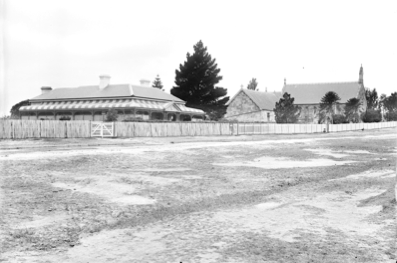
Raymond Terrace Catholic precinct showing (left to right) Presbytery, school, and St. Brigid’s Church, 1896 [Newcastle Library]
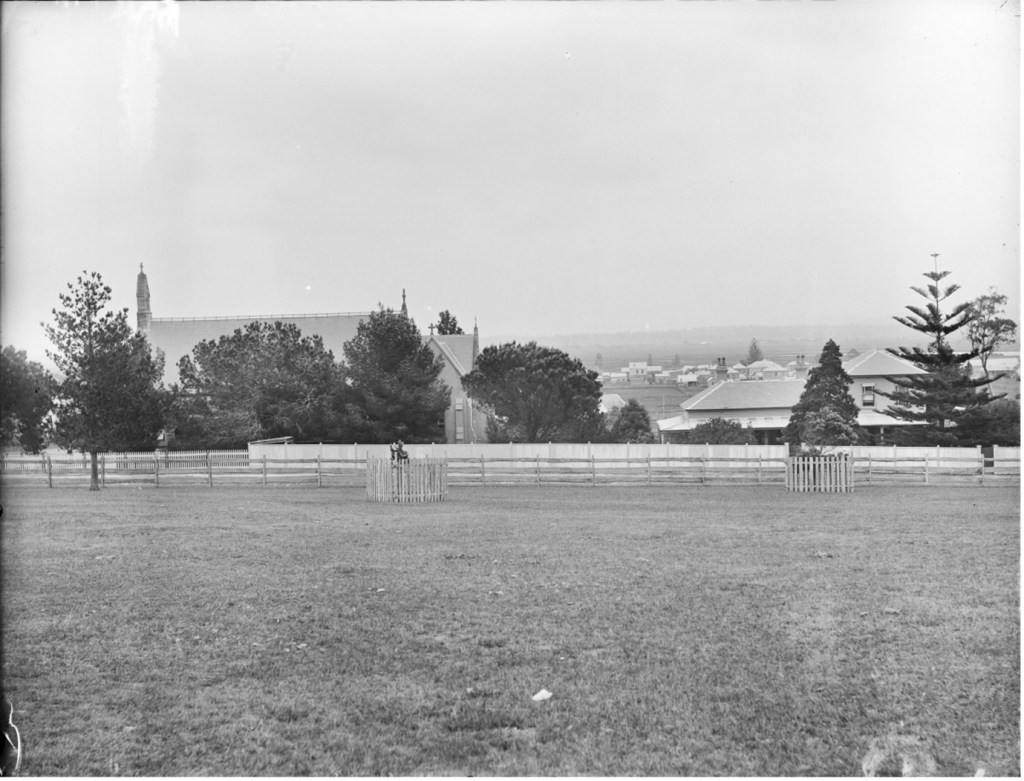
View of the precinct looking west from Boomerang Park with Church centre left, 1896 [Newcastle Library]
Hibernian Australasian Catholic Benefit Society branch formed in Raymond Terrace – 1897
A branch of the Hibernian Australasian Catholic Benefit Society (H.A.C.B.) was formed in Raymond Terrace on 19 September 1897, by Mr. J. J. Edstein. Founded in 1868, it is an historical Catholic fraternal benefit organization in Australia that provided friendly society benefits like medical care, insurance, and funeral assistance to Irish-Catholic immigrants and local parishioners.
Fund Raising Bazaar – 1898
The Maitland Daily Mercury of 31 August 1898, page 5, reported:
‘A grand bazaar and art union in aid of St. Brigid’s Church Fund, was opened in the Britannia Hall, here on Saturday evening last. The opening ceremony being performed by his Worship the Major (Alderman Elkin) in the presence of a large attendance of the public. An apology was tendered by the Rev. T. A. Nealon for the absence through indisposition of his Lordship Bishop Murray.
The mayor, in declaring the bazaar open, congratulated the ladies who had been working so assiduously for months past at the very excellent display upon the stalls and he was certain that they would find their labours amply rewarded by the success financially, and otherwise that the results would show at the close of the bazaar. The bazaar will continue during the present week, and on the closing day the drawing for the art union prizes will take place. Prizes are offered of good value, sewing machine, two first-class sulkies, and a trophy valued at £10 are amongst the items that will be offered.
During each evening musical programmes, vocal items, clog dancing, maypole dances, etc., will be conducted, and in other ways attraction will be offered in order to entertain the public, who may be expected to attend liberally.’
Thoughts of an 8-year-old pupil from Raymond Terrace Catholic Primary School – 1901
The Catholic Press of 3 August 1901, page 29, published the following letter from Polly Lunny, aged 8 years, who was a pupil at the Raymond Terrace Catholic primary school:
‘First, I might tell you that Raymond Terrace, the town where I reside, is a very pretty little place, built on the bank of the Hunter River, just below the junction of the Williams River. It is a great farming centre. On the opposite side of the river is Miller’s Forest, and a little further north Nelson’s Plains.
We have a very nice church, presbytery and convent. Very Rev. Fr. Nealon is parish priest. The convent school, of which I am a pupil, is in charge of the Sisters of Mercy. We have Mass here twice every Sunday and once every weekday. In conclusion I wish the Catholic Press every success.
Father Nealon supports Irish Home Rule Movement – 1902
In 1902, the Irish Home Rule movement was formed n a period of political regrouping following the failed 1886 and 1892 Bills. The movement campaigned for an Irish parliament to manage domestic affairs while remaining under the British Crown. The movement received support from around the world.
The Catholic Press of 13 September 1902, page 22, reported:
‘The Home Rule movement which the Catholic Press started some few months ago, and fanned into life, has spread throughout Australia. Every big city has had its meeting, and the country districts are following their example. …….
The following additional subscriptions have been received in Sydney:— The priests and people of Raymond Terrace (per Rev. Father T. A. Nealon), £25 3s.’
Church damaged by hailstorm – 1902
The Newcastle Morning Herald and Miners’ Advocate of 5 December 1902, page 5, reported:
‘A very heavy storm, one of the most severe experienced locally for many years, passed over the town this afternoon. …. A large number of buildings suffered. All the windows on the western side of the Church of England, and the R.C. Church, were broken, while the windows of many dwelling houses were similarly treated.’
Father Nealon helps raise funds for the Waratah Deaf and Dumb Institution – 1909
The Freeman’s Journal of 19 August 1909, page 16, reported:
‘During the afternoon of the same day [10 August 1909] most of the lady members of the committee of the late Raymond Terrace ball, in aid of the deaf and dumb, came to Waratah to hand over to the Sisters the proceeds of their united efforts in the good cause, which amounted to the splendid sum of £70 net. Such a pronounced success deserves the warmest thanks of the Sisters in charge of the institution, as well as of the afflicted children, and they unite in offering their acknowledgments and appreciation of such genuine charity.
They wish also to tender sincere thanks to the Very Rev. Father Nealon, who so generously helped them and abetted their cause, for without his hearty cooperation such results would neither have been expected nor achieved.’
Australian Holy Catholic Guild Ceremony – 1911
The Australian Holy Catholic Guild (A.H.C. Guild) was a Catholic fraternal benefit society established in 1845 by Sydney Archbishop John Bede Polding. It operated primarily as a friendly society, providing working-class Catholics with sick pay, medical and pharmaceutical benefits, and funeral assistance.
The Maitland Weekly Mercury of 2 September 1911, page 14, reported:
‘The solemn investiture and installation ceremony of St. Brigid’s Branch, No. 64, Raymond Terrace of the A.H.C. Guilds, took place on Sunday morning, August 20, immediately after first Mass, the Rev. Father Nealon, chaplain to the society, performing the sacred ceremony.
A procession of the members, headed by the cross-bearer, marched from the Guild Hall to St. Brigid’s Church, where the Rev. Chaplain blessed the regalia’s, which were laid on a table in front of the high altar. After the solemn blessing each member, carrying his regalia, knelt down, and after the chaplain had read the “Investiture Prayer,” devoutly invested the members with the regalia of the society. The enrolled members then recited aloud their ”solemn admission.”
A very impressive sermon was then delivered by the Rev. Father Nealon who spoke highly of the guild and urged the members of the society to pay great attention to their spiritua1 obligations as well as the necessity of leading the life of good Christian men. The following are the names of the officers installed: — Bro. F. McDonnel, W,; Bro. J. Saunders, D.W.; Bro. J. Krohn, B.B.; Bro. A. J. O’Brien, B.S.; Bro. J. Dwyer, trustee; Bro. T. O’Hearn, trustee; Bro. P. Keegan, trustee; Bro. W. Corbett, councillor; Bro. W. McDarmett, councillor; Bro. D. Butler, councillor.
During first Mass on Sunday the members wore their mourning regalia out of respect to the memory of their dearly beloved patron, His Eminence Cardinal Moran. [Cardinal Partrick Moran, the third Archbishop of Sydney, died on 17 August 1911]. A motion of sympathy, to be placed on record was carried at the meeting, the members standing while same was being carried.’
Death of Parish Priest Father Thomas Aloysius Nealon – 1913
The Maitland Daily Mercury of 29 December 1913, page 4, reported:
‘The death occurred in Lewisham Hospital, Sydney, yesterday morning of the Very Rev. Thomas Aloysius Nealon, parish priest of Raymond Terrace, who had been ill for some time, and who underwent a serious operation a few days before his demise.
Father Nealon had been stationed at Raymond Terrace for 40 years and was held in the highest respect by his parishioners and friends of all denominations. He was one of the diocesan consultors and a member of the diocesan council of vigilance. He was noted for his great zeal in the interests of religion and education, and for his charitable deposition. A devoted pastor, who was held in the highest esteem by his bishop and fellow priests, his death will be very much regretted, more especially by his parishioners, with whom he was very popular.
His remains will be brought to Raymond Terrace for interment, when a solemn requiem mass and office for the dead will be celebrated.’
Funeral of Father Thomas Aloysius Nealon – 1914
The Catholic Press of 5 February 1914, page 28, reported:
‘The funeral for the late Very Rev. Father T. A. Nealon, P.P. of Raymond Terrace, who died in Lewisham Hospital on December 28, took place in St. Brigid’s Church, Raymond Terrace, on Wednesday week. Large congregations were present at the two early Masses, when almost every person in the church, adults and children, received Communion, and offered it for the repose of the soul of their late pastor. At 10.30 the Solemn Office was chanted, and the Requiem High Mass celebrated.
The edifice was packed to the doors The Right Rev. Dr. Dwyer, Bishop of Maitland, pre-sided, and pronounced the Last Absolutions at the conclusion of the ceremonies. His Lordship, with a procession of priests, marched from the presbytery to the church, the members of the A.H.C. Guild forming a guard of honour. The catafalque was placed in front of the High Altar, and the interior of the church was draped in mourning by the Sisters of Mercy. The chanters of the dirge were the Very Rev. Father F. O ‘Gorman, P.P. and J. Coady (both of East Maitland). The Rev. Father J. Roche (Muswellbrook) was celebrant of the Mass, the Rev. Father P. McCormack (Lochinvar) being deacon, and the Rev. Father P. Brady (Muswellbrook), sub-deacon. Rev. Father M. F. McAuliffe (Adm., Newcastle), was master of ceremonies.
The ecclesiastical choir comprised Very Rev. Fathers J. O’Donohoe (Adm., Hamilton), W. E. O’Reilly (Merriwa), and T. Harrington (Quirindi), Rev.
Fathers P. Cogan (Murrurundi), J. Costello (Burwood), M. Forde and H. Ward (West Maitland), P. P. Murray, C.SS.R. (Waratah). B. McKiernan (Newcastle), C. O’Regan (Singleton), and John M. Flynn (formerly of Muswellbrook), who succeeds the late Father Nealon as P.P. of Raymond Terrace.
The panegyric was preached by the Very Rev. Father O’Donohoe, who dwelt on the 40 years ministry of the late Father Nealon, and his fatherly love and solicitude for the spiritual and temporal well-being of his flock. He dealt in detail with what a priest should be — model, pious, and charitable; his love for his flock entrusted to his charge; his example shown them, counsel given, and his every solicitude, for their spiritual welfare, all of which took him along the many paths, tracks, and roads to all parts of his parish at all hours by night or day, in all weathers, with consolation and com-fort to the sick and dying. He also dealt at length with the union which a priest sought to create between himself and his people, and likewise with Almighty God, all of which was faithfully carried out by Father Nealon for over 40 years. All those qualities and desires were lavishly found in their late pastor. They should thank God for having had such a pastor as Father Nealon, also for having appointed, through the mouth of their Bishop, one so competent to succeed him as the Rev. Father John M. O ‘Flynn.
With all of them time worked its changes, so it was for Father Nealon’s time to come when, having completed over 40 years’ office of sacred ministry among them, he had to depart and place himself in the care of angels at Lewisham (for he could call them by no other name), to tend him and prepare him for his last long journey. They it was who held those hands and members which had anointed so many, and which were now physically disabled, to be anointed and close his eyes to the world. He exhorted the parishioners to pray for Father Nealon, to offer their Holy Communion and Rosary, and to repeat a short prayer by his silent grave, which is placed within the shadow of the wall of the church in which he laboured so many years; also, to remind their children of whose grave it is.
Bishop Dwyer endorsed what had been said by the preacher, and reminded the people how much they owed to their late pastor for his spiritual solicitations to the throne of God on their behalf during his long term amongst them, and said he hoped that not one member of the parish would pass his grave without offering up a prayer for the eternal repose of the soul of one who be sought for them spiritual and temporal happiness in this life and in eternity.
The Bishop also said that as they were blessed in their late priest, they were singularly blessed in having as his successor Father O ‘Flynn, whom he commended to their prayers. The Bishop then installed Father John M. O ‘Flynn as parish priest of Raymond Terrace.’
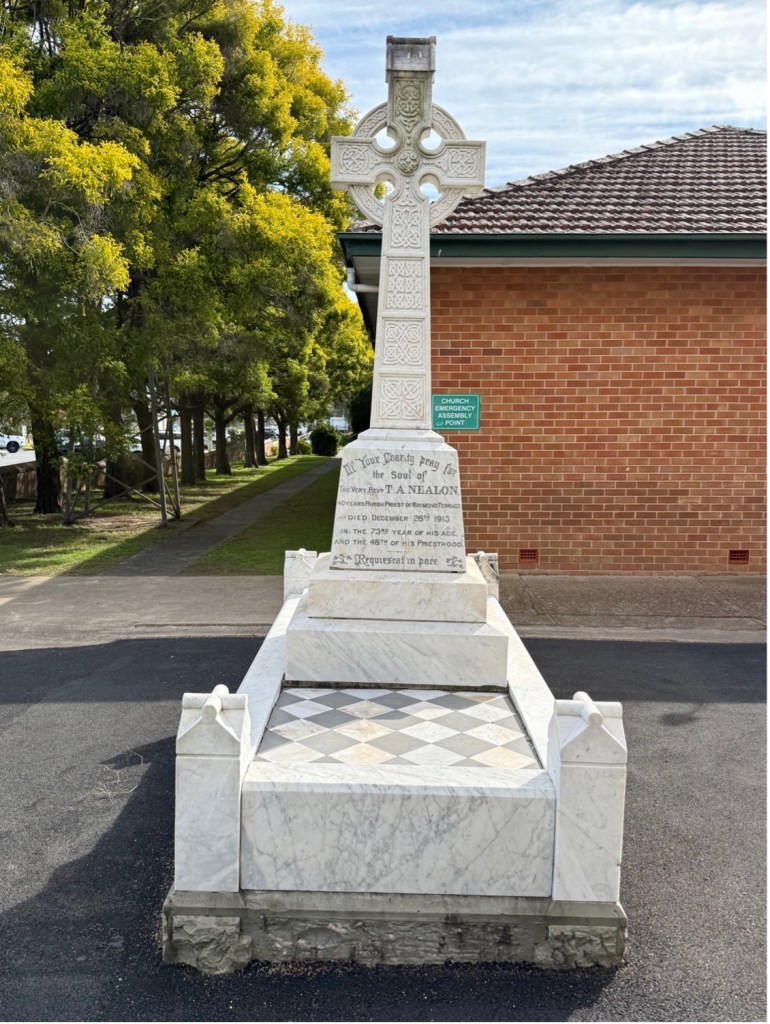
Grave of Rev. Father T. A. Nealon, parish priest, within the grounds of St. Brigid’s Church, Raymond Terrace [Author photo – June 2026]
Appointment of Father John O’Flynn as new Parish Priest – January 1914
The Maitland Daily Mercury of 15 January 1914, page 4, reported:
‘The Rev. John O’Flynn, of Muswellbrook, was today appointed by the Right Rev. Dr. Dwyer to the important parish of Raymond Terrace, rendered vacant, by the recent death of the late Father Nealon. Father O’Flynn was ordained priest at All Hallows’ College, Dublin, in the year 1896, and arrived in the Maitland diocese at the end of that year. His first appointment was to Raymond Terrace, where he spent two years, after which he went to Newcastle as assistant, and afterwards as Administrator.
His health failing, he was forced to take a short rest, and on his return he was sent successively to Branxton and Muswellbrook. The Rev. Father has spent six years at the last-named place, during which time he has done very excellent and arduous work. The news of Father O’Flynn’s promotion will, we are sure, be most gratifying not only to his fellow priests, but among his large circle of friends of the laity, whoso congratulations and best wishes will go out to him.’
Rev. J. O’Flynn was previously an Assistant Priest at Raymond Terrace during 1896 and 1897.
Father J. O’Flynn given a Farewell Presentation at Muswellbrook – 1914
The W.A. Record (Perth) of 4 April 1914, page 7, reported:
‘The Rev Father J. M. O’Flynn, who was recently appointed to the charge of Raymond Terrace, after seven years as assistant priest to very Rev. Father P. J. Roche, Muswellbrook, was presented recently with an illuminated address, and a substantial cheque as a token of the esteem in which he was held by Muswellbrook Catholics and others.
The gathering was a large one, and took place in the primary school hall, representatives from all parts of the district being present. Father Roche presided and paid a graceful tribute to the energy zeal and priestly character of Father O’Flynn. The Rev. Father is succeeded at Muswellbrook by Father Brady.’
Annual Communion Breakfast of A.H.C. Guild held at Raymond Terrace – 1915
The Maitland Daily Mercury of 3 May 1915, page 6, reported:
‘The annual Communion breakfast, in connection with the Central Northern District of the A.H.C. Guild was held this year at St. Brigid’s parish, Raymond Terrace, on Sunday last. The event was one of the greatest held in the Raymond Terrace Catholic Church and for a great Catholic demonstration it could not be eclipsed. All the branches in the Hunter district were represented, the greatest representation being from West Maitland, East Maitland, Largs and Morpeth.
Visitors were conveyed from Morpeth and Largs and Hoban’s Wharf by the s.s. Irrawang, which was chartered for the occasion, and which all met on the arrival of the train at Morpeth. Included in the guests on board were Bros. E. W. O’Sullivan (Warden General), T. J. McCabe (Past Warden General) and Mr. P. H. Louis, M.A., Catholic Federation. After a delightful trip down the Hunter, which looks at the present time a glorious sight, Raymond Terrace was reached at 9.45 a.m. Here the visitors were met by the members of St. Brigid’s branch, No. 64 and Bro. J. J. Moy, on behalf of the officers and members extended the Warden General and the visitors a hearty welcome.
An adjournment was then made to St. Brigid’s School, where the chaplain (Rev. Father O’Flynn) welcomed the various delegates. The procession was then formed and the members of the society, numbering over 110 marched to the church, where Mass was celebrated by the chaplain. The procession was headed by the cross bearer, then came the members of the ladies’ branches in pale blue collars. The members of the men’s branches (green sashes), trustees (blue), bursars (yellow), deputy wardens (purple sashes), and wardens (purple collars), and the representatives of the executive council, St. John’s Boys’ choir (West Maitland), under the direction of Bro. Aloysius sang the Mass, and it was greatly appreciated as it was the first occasion that such a privilege was bestowed upon the society. Apologies were received for the absence of Bro. Keating, executive councillor, Newcastle.
After Mass an adjournment was made to the Oddfellows’ Hall where a sumptuous breakfast was in readiness. The Rev. Father O’Flynn presided. After justice had been done to the good things provided the chairman, in a speech, appropriate to the occasion, proposed the toast of “The Pope and King.” The choir boys then sang “God Bless our Pope,” ”The National Anthem,” “The Marsellaise,” and the “Belgian Anthem.” The A.H.C. Guild, was next proposed by Father O’Flynn, who paid a glowing tribute to the society on its progress, its financial position, and its stand in the State as a Catholic society. He complimented the various branches present, on the magnificent display of Catholic faith, and the great honour conferred on the parish by their visit.
Bro. O’Sullivan (Warden General) responded and also complimented the branches. It was the greatest country function of Guilds he was ever present at. He complimented the Central Northern District on their organisation and the progress made. He pointed out the superior benefits paid by the Guild to any other Catholic society, and he quoted the complimentary remarks of the registrar of friendly societies on the present financial position of the society, and the great interest it was earning in connection with the loaning of its funds.
Bro. T. J. McCabe, who is an eloquent and fluent speaker, proposed the toast of “The Central Northern District Branches.” He spoke at length on the war and the great shadow cast on this beautiful continent at the present time. He spoke of the advancement of the Irish race and the prominent position they were holding in the present crisis. He offered his heartiest congratulations to all branches in the north and concluded by stating that the event of the day was an eye-opener for all members of the executive council and other societies.
Bros. J. J. Moy, R. D. Dilley, and P. McDonnell, all responded on behalf of their respective branches. “The Visitors” were proposed by Bro. P. McDonnell, and responded to by Bro. O’Grady (Hibernian Society) and Bro. A. J. O’Brien on behalf of the Children of Mary. Mr. Louis, M.A., in responding on behalf of the Catholic Federation, in a very forcible speech put forward the aims and objects of the federation, and exhorted all members of the parish to join it. He spoke at some length of the disabilities under which the Catholic population of New South Wales laboured. “The Chairman” was proposed by the Warden General.
The visitors were then treated to an excursion up the Williams River in the afternoon and returned about 4 p.m. to catch the 5 p.m. train from Morpeth. The various branches represented were St. Joseph, Weston; St. John’s, West Maitland; St. Joseph’s, East Maitland; Holy Family, Largs; St. Bede’s, Morpeth; Bros. O’Grady and O’Brien, H.A.C.B.S., Raymond Terrace; Bro. J. Dorney, H.A.C.B.S., Seaham; Bros. H. Bull and Sharkey, A.H.C. Guild, Newcastle; and Miss Moy, president, and Miss Markham, Children of Mary. The carrying out of the arrangements were in charge of Bro. T. Maguire, West Maitland, and a committee of the delegates from the various branches.’
Catholic Federation Branch Formed at Raymond Terrace – 1915
The Maitland Daily Mercury of 30 October 1915, page 3, reported:
‘On Sunday last Mr. P. S. Cleary, president of the Catholic Federation, paid an official visit to the parish with the object of opening a branch of the Catholic Federation. Mr. Cleary arrived by late train from Sydney at Hexham on Saturday evening, and was met by motor car, after which he was conveyed to Raymond Terrace, and there was the guest of the Rev. Father O’Flynn at the presbytery.
On Sunday morning, the officers of the A.H.C. Guild, of which society Mr. Cleary is past warden-general, treated him to a motor trip through the rich fertile lands of Miller’s Forest, Duckenfield, Morpeth, East and West Maitland, Lorn, Bolwarra, Largs, Phoenix Park, Hinton, and Nelson’s Plains. Mr. Cleary was delighted at what he saw and spoke in loud praises of the richness and fertility of the lands of the Hunter Valley. Those comprising the party were Bros. F. McDonnell, W. McDermott, W. Dwyer, J. S. Krohn, and A. J. O’Brien.
On Sunday afternoon in St. Patrick’s School, Miller’s Forest, to a very large audience. Mr. Cleary explained the aims and objects of the Federation. Father O’Flynn presided. Over 130 members were enrolled including about 10 life members. At the conclusion of the meeting the speaker and chairman were accorded the customary votes of thanks.’
St. Brigid’s A.H.C. Branch Meeting – 1916
The Freeman’s Journal of 27 January 1916, page 20, reported:
‘The half-yearly branch of St. Brigid’s’ branch A.H.C. Guild was held on Monday night, January l0th, the attendance being very large. The chaplain, Rev. Father O’Flynn, presided. The secretary read the annual report, which was a very, lengthy, and included all the excellent work carried on by the Society during the past year. The balance-sheet of the Sick, Funeral, and Management Funds was also read, and all were in a nourishing condition. The Rev. Father O’Flynn, in moving the adoption of the report, spoke of the progress of the Society and the excellent manner in which they carried out their duties, particularly relating to the quarterly Communion. He spoke of the very many functions held during the year, and the increase in. membership. He desired to see the branch still further advancing and thanked the members for the assistance they at all times gave to church festivities.
Bro. J. J. Moy (Warden), seconded the motion, and briefly explained all matters in detail. He would like to see all young men join the Guild, they were the premier Catholic Society in New South Wales. The Warden presented the chaplain with a honorarium, and at the same time thanked Father O’Flynn for the great interest he had taken in the Society. Father O’Flynn suitably responded and stated that he would remember the Society always in the many Masses that he would offer during the year.
The chaplain then, assisted by Bro. J. J. Moy, performed the installation. Warden, Bro. W. McDermott; Deputy-Warden, Bro. W. Dwyer; Bursar, Bro. J. S. Krohn; Secretary, Bro. A. J. O’Brien; Trustees, Bros. Copper, Carmody, Dwyer; Councillors, Bros. O’Hearne, McDonnell, Doherty, G. Cunningham; Sick Visitors, Bros. Campbell and Gallagher; Auditors, Bros. J. O’Hearne and T. McDonnell; Delegate Annual Conference, Bro. A. J. O’Brien; Cross-bearer, Bro. J. Koen; Guardian, Bro. W. Downes.’
Meeting of the Catholic Federation at Raymond Terrace – 1916
Between 1913 and 1924 the Catholic Federation of New South Wales articulated and advocated the political interests of the Catholic Church in the state.
The Freeman’s Journal of 14 December 1916, page 40, reported:
‘In Federation matters this is a remarkable little branch. The following, recently received from the local correspondent, Mr. A. J. O’Brien, is interesting and encouraging: The total membership of the Raymond Terrace branch for 19l6 consisted of 265 members, including 21 Life, members. Already, without any canvassing, over 20 new members have handed in their contributions for 1917.
At the meeting held on Sunday, afternoon, December 3rd, the secretary reported that the annual meeting would be held early in January 1917, when it is considered that over double the number for 1916 will be enrolled. It is pleasing to note that, after working so assiduously for the past four months, the bazaar in aid of the church debt and the new school organised by the ladies and gentlemen of the Catholic Federation, with the Rev. Father O’Flynn as president, came off last month and proved a record for the parish. The total receipts were £764 17s 3d, and the expenditure only £11 10s, leaving a credit balance of £753 7s 3d. Needless to say, everyone is delighted, and the result testifies eloquently to the good work done by the Federation for the first year.
The next work which is occupying the attention of the branch is the cleaning and putting in order of the Catholic cemetery at Raymond Terrace. At first a bee meeting was considered, but at the present time the farmers are too busy, and the branch has arranged for a collection to be made on Sunday, December 10th and 17th.’
Annual Meetings of the A.H.C. Guild and Catholic Federation – 1917
The Maitland Daily Mercury of 1 February 1917, page 7, reported:
‘The annual meeting and installation ceremony of officers of the St. Brigid’s branch A.H.C. Guild was held in the Convent School, Raymond Terrace, on Monday night, 22nd January. The rev. chaplain (Father O’Flynn, P.P.) presided. The Bro. Warden, W. Dwyer, extended a hearty welcome to the chaplain. The report, which was a very lengthy one, was read by the bro. secretary, and stated that the society had given four of its members to fight for King and country. One brother, Corporal Vincent Campbell, was killed in battle in July last. The report showed that the present membership of the society was 43 financial members. The balance sheet showed everything to be in creditable state, especially the management fund.’
Raymond Terrace War Memorial on which the name of V. Campbell is inscribed [Author photo – July 2026]
‘The rev. chaplain congratulated the society on its splendid progress and the very healthy state of the funds. He expressed pleasure at knowing that the society had retained all its past members and made a handsome gain during the year. He had much pleasure in moving the adoption of the report and balance-sheet. The warden seconded the resolution. The chaplain was presented with an honorarium for his services to the society for the year.
the adoption of the report and balance-sheet. The warden seconded the resolution. The chaplain was presented with an honorarium for his services to the society for the year.
The following brothers were installed in their respective offices for 1917 by the rev. chaplain, assisted by Bro. J. J. Moy, P.B.W.: — B. W. Bro. W. Dwyer; D. B. W. Bro. G. Cunningham; B. B. Bro. J. T. Krohn; B. S. Bro. A. J. O’Brien; B. T. Bros. A. J. Cooper, J. J. Dwyer, and R. J. Carmody; guardian; Bro. W. P. Campbell; councillors, Bros. J. P. O’Hearn, F. McDonnell, V. Doherty and H. McDermott; cross-bearer, Bro. Louis Campbell; delegate to annual conference, Bro. A. J. O’Brien.
The annual meeting of St. Brigid’s branch of the Catholic Federation of New South Wales was held in the Convent Schoolroom, Raymond Terrace, on Sunday evening, Jan. 21. There was a very large attendance of members, and the rev. president, Father O’Flynn, presided.
The secretary read the annual report, which showed that a membership of 257 had been attained during the year. This branch possesses the largest life membership in the State, consisting of 16 members. During the year the branch was very active in assisting in church matters. The chaplains tent collection at Rutherford was carried out by the federation, and also a most successful bazaar was held last November to liquidate the church debt. This bazaar realised £704, which was considered splendid. The balance-sheet showed a credit balance of £4/1/10. The adoption of the report and balance-sheet was moved by the Rev. Father O’Flynn, seconded by Mr. M. Cunningham.
The election of officers for 1917 then took place in the following order: — President, Rev. Father O’Flynn, P.P.; vice-presidents, Messrs. J. J. Moy and J. M. Feeney; treasurer, Mr. J. Lunny; secretary, Mr. A. J. O’Brien; A.H.C. Guild representatives Messrs. J. Dwyer, sen., and I. McDonnell;
The election of officers for 1917 then took place in the following or-der: — President, Rev. Father O’Flynn, P.P.; vice-presidents, Messrs. J. J. Moy and J. M. Feeney; treasurer, Mr. J. Lunny; secretary, Mr. A. J. O’Brien; A.H.C. Guild representatives Messrs. J. Dwyer, sen., and I. McDonnell; H.A.C.B.S. representatives, Messrs J. Kelly and J. Feeney; parish committee, Messrs. E. Keogh, W. Dwyer, J. O’Grady, J. Saunders, M, Cunningham, and J. Hanlon; Children of Mary, Misses Foley and O’Brien; Sacred Heart, Misses Moy and Markham.
No further reports on the activities of the Raymond Terrace A.H.C. Guild and Catholic Federation are set out in this paper.
St. Johns College Fundraising Appeal – 1917
The 1917 St. John’s College fundraising appeal was a major financial and community campaign led by the Rector of St. John’s College at the University of Sydney, Rev. Father Michael J. O’Reilly, to support Catholic higher education and clear college debts. Father M.J. O’Reilly led the appeal, travelling to Sydney parishes and regional centres to raise funds and promote Catholic youth education. Fundraising from 1915 to 1917 aimed to strengthen the residential college’s finances, uphold Catholic faith and morals in university life, and fund building improvements.
St. John’s College at the University of Sydney
On 29 April 1917, Father Michael J. O’Reilly visited St. Brigid’s Church at Raymond Terrace to raise funds for the St. John’s College appeal. The Freeman’s Journal of 3 May 1917, page 23, published the following letter to the editor in which Father O’Reilly acknowledged the various donations he received from the St. Brigid’s parishioners:
‘Sir,— On Sunday last I was given an opportunity of resuming my parochial appeals after the Easter recess, by the kind invitation of the Rev. J. M. O’Flynn, P.P., of Raymond Terrace. The total received, to which Father O’Flynn notably contributed by his own earnestness in the cause of the collection, was £87 4s 6d. Taking into account the size of the parish, there have been few results more creditable than this.
My thanks to all concerned – £5 5s: Rev. J. O’Flynn, P.P.; £3: Mr. J. J. O’Brien; £2 2s: Mr. J. J. Moy; £3 each: Messrs. J. O’Hearn, John Saunders, Michael Markham, Andrew Markham; £1 1s each: Misses B. Hill, S. Hill, M. Hill, Messrs. M. Hill (junr.), Thos. Meere; £1 each: Mesdames Mary Hill, D. J. Morgan, Maguire, M. Cunningham, Messrs. W. Dwyer, J. Dwyer; Matthew Smith junr., M. Hill, senr., M. Cunningham, J. McMahon, W. Corbett, W. Hill, James Saunders, M. Considine, T. McDermott, M. Bowen, J. Considine, Leo Campbell, M. Considine (New Line), James Campbell, F. Markham, W. McMahon, Thomas O’Brien, Thomas Gallagher, J. P. Hill, P. Moy, Thos. Considinie, J. J. Edstein; 10s each: Mesdames P. Corbett, M. McDermott, Foley, Kennedy, Reid, E. Casey, G. White, C. Bowen, Wynn, Gallagher (senr.), Misses Saunders, B. Daly, Haverty, Messrs. Mat. Smith (senr.), John Smith, J. J. Dwyer, P. Moy, Hugh Corbett, Thomas Cunningham, James Dwyer, T. Lynch, Jos. O’Brien, J. Moy, Edmund Keogh, Dan O’Brien, Denis O’Brien, M. O’Brien, P. Feeney, John Feeney, P. McDonnell, F. Barry, F. Edstein, J. F. O’Brien, Joseph, O’Grady, Thomas Davoren, J. P. Hughes, J. O’Brien, F. Kiem, J. J. Kearney, M. Donohue, W. O’Donnell, T. Feeney, J. O’Brien, J. Reid, P. Considine, J. E. Considine, Mat McDermott, J. Lunny, M. O’Grady.’
Picnic Day for Raymond Terrace and Millers Forest Convent Schools – 1917
The Maitland Weekly Mercury of 8 December 1917, page 6, reported:
‘Wednesday, 21st November, was a gala day for the children attending the Convent Schools of Raymond Terrace and Miller’s Forest when they were treated to a monster picnic held on the Boomerang Park, Raymond Terrace. The local branch of the Catholic Federation, which is now in existence two years, considered that the time was now opportune in which something should be done for the children, considering it was nearly 13 years since they were treated to a picnic, and they enthusiastically took the matter up and formed two strong committees, consisting of the ladies and gentlemen of the branch.
The day in the early part looked as if rain was about to set in, but later on it broke fine and a most beautiful day was enjoyed by old and young who took part in the picnic. They assembled in the school ground at 9.30 a.m. after which they were marshalled and marched to St. Brigid’s Church, whore prayers were offered and hymns sung. A procession was then formed every child carrying a flag of the Allies, headed by the Union Jack, Australian flag, and the Irish flag, and marched to the park under the direction of Rev. Father O’Flynn, and members of the committee.
Three cheers were given on the arrival at the park for the Rev. Father O’Flynn and the Sisters of Mercy. The ladies then treated them to light refreshments, after which the day’s fun commenced, and was kept going until about 12.30 p.m., when dinner was served by the ladies. Visitors were present from various parts of the district, and included his Lordship Dr. Dwyer, Revs. Fathers O’Donohue (Hamilton), O’Gorman (East Maitland), Kelly and McKiernan (Newcastle), Mulachay and McGurk (West Maitland), O’Regan (Singleton), Alderman James Hanlon (Mayor), and Mr. A. L. Adam, (town clerk).
The ladies of the committee arranged a very sumptuous dinner for the clergy, which took place in the pavilion. During the afternoon the Raymond Terrace Band. played selections and made things very enjoyable. The distribution of prizes took place at 2.30 p.m. Each child attending school received a very neat and valuable prize as a memento of the picnic. During the afternoon races for the children took place. …..
Tea was served at 6 o’clock, after which the children were all marshalled, and sang to the strains of the band the National Anthem, after which they were escorted into town headed by the band, thus concluding one of the most enjoyable and successful panics held in Raymond Terrace for years.’
Euche Party organised by the Children of Mary Sodality- 1919
The Children of Mary is a Sodality for young people between the ages of 7 and 18 who wish to consecrate themselves in a special way to Our Blessed Mother.
The Maitland Daily Mercury of 1 November 1919, page 10, reported:
‘The euchre party and social organised by the local branch of the Children of Mary took place in the Oddfellows’ Hall on the 21st instant. The hall was packed over 100 couples being present. Visitors were in attendance from Morpeth, East Maitland, Largs, Clarence Town, and Newcastle. The weather was favourable, the hall in good order, and the music by Beirn’s orchestra kept matters’ very lively, and was very pleasing to listen to. Messrs. V. Doherty and F. Davoren proved very capable M.C.’s, whilst the duties of conducting the euchre tournament, which consisted of 22 tables, fell to Messrs. A. J. O’Brien and P. Montgomery.
The men’s prize— a gold-mounted pipe— was presented by Messrs. Francis McDonnell and Michael Gallagher (A.H.C. Guild officers), and Mrs. Cunningham, “Kilnnhall,” Millers Forest, donated the lady’s prize, a beautiful silver jewel case. The ladies’ prize was won by Miss E. Gallagher, “Fairview,” Miller’s Forest; whilst Mr. C. Cavavagh won the men’s prize, Mrs. M. Hill, “Hillholme,” Alnwick, kindly donated a beautiful set of afternoon tea spoons as a consolation prize, these wore won by Mr. J. O’Grady, who redonated to the Sisters of Mercy at the Terrace.
The ladles supplied a most delicious supper at 11 p.m. The well-laden tables were beautifully decorated. After supper Mr. A. J. O’Brien announced the winners of the various prizes, and Mr. J. M. Feenby returned thanks for the very large patronage and wished the winners further success. Music and dancing was again indulged in, and kept going until 2 a.m. A very enjoyable night terminated to strains of the National Anthem.
A few nights ago the balance sheet was submitted by the secretary (Miss Clara O’Brien). The total receipts were £60/ 8/10, and the expenditure £1/10/10, leaving a credit balance of £58/29/, which will go towards the repairing of the Sisters’ Home and obtaining new trees and plants for the grounds. The rent of the hall was donated by the members of the A.H.C. Guild, and the music by the Hibernian Society. Mr. A. J. O’Brien, on behalf of the ladies returned thanks to all who gave donations, and to the gentlemen of the committee for the manner in which they conducted the social.’
Construction of Catholic School Commenced – 1920
The Maitland Daily Mercury of 30 January 1920, page 6, reported:
‘The work of the erection of the new Catholic School at Raymond Terrace has been commenced by the contractors, Compton and sons, Maitland, and already the weather shed is partly built. The new school will cost £2286, and all the money is in hand, and the school will be opened free of debt’.
New Catholic Primary School opened – 1920
The Catholic Press of 5 August 1920, page 31, reported on the opening of the new Catholic Primary School at Raymond Terrace, as set out below.
Another Catholic schoolroom at Raymond Terrace had already been in operation for many years.
The address by the Bishop of Maitland exemplifies the tensions that existed at the time between the Catholic communities, which were largely made up of people with strong Irish connections and many others in the community, who had an English background.
‘On Sunday last the magnificent new school recently erected at Raymond Terrace was blessed and opened by the Right Rev. Dr. Dwyer, Bishop of Maitland, in the presence of a large and enthusiastic gathering of the parishioners. The local Hibernians and Guilds formed the bodyguard for the Bishop. The Rev. Father V. Peters attended his Lordship during the ceremony
The clergy present were: Very Rev. Father T. G. Brown, C.SS.R., Rev. Fathers M. F. McAuliffe (Newcastle), J. J. Costelloe (Merewether), J. O’Flynn (Raymond Terrace), V. F. Peters (West Maitland), B. McKiernan (Stockton) and M. Forde (Raymond Terrace).
At the conclusion of the ceremony, the Rev. Father O’Flynn said the Catholics of Raymond Terrace had every reason to rejoice on the accomplishment of the work commenced only five or six months ago. The building was not erected to be an ornament to the town, but they had to admit that it was such.
Two or three years ago the Catholics of the district decided that the school had done much yeoman service in the past, and today they had put the coping stone on that decision. The speaker paid tribute to the work of the architects (especially the late Robert Wilkins), and to the builders. But even with the best of architects and the most conscientious of builders, you cannot erect a school without money, and who was he to appeal to for this but to his own Catholic people? They were true Sinn Feiners in his parish [an Irish republican and democratic socialist political party active in Ireland]; they had relied on themselves alone up to this, with the exception of the few outsiders who could not be kept out. They provided the means so far, and he knew that he would not appeal to them in vain.
The Mayor of Raymond Terrace (Alderman James Hanlon) officially welcomed the Bishop to the town, on behalf of the citizens. He said they all knew the great works the Bishop had carried out during the 11 years he had directed the affairs of the diocese, but there was none greater than his Lordship’s work in the matter of Catholic education, and he was gratified to see the Bishop there, on that occasion to give a further proof of his solicitude for the small ones of his flock — the future men and women of the district. He complimented Father O’Flynn on the great work he had accomplished.
The Bishop thanked the Mayor, and he congratulated Father O’Flynn and the people of Raymond Terrace, the architects, and the builders on the completion of a good work that would speak for itself. The new school was well worthy of the group of Catholic buildings at that end of the town. It would stand for many years as something of great advantage, spiritual and temporal, to the people and their children. In the diocese at present there are 50 or 60 schools, and between 5000 and 6000 children in them, with some 300 religious teachers to take care of their education. Catholic education is a living thing, with no signs of decay.
We sometimes hear that Australians do not take kindly to religion; that they do not go to church. And, it would appear from the constant reiterating of these views, that there must be some truth for the statement. But these people cannot be speaking of Catholics. It cannot be said that Catholic churches are empty on Sundays, that its men do not take an interest in religion, that its practice is relegated to the women and children. Our Church lives and thrives energetically, producing the fruit of a real living faith of the Catholics, whose work it is. There is no vain showing off. It is the work of real, earnest religion. It has prospered during the last 40 years without any help from the public authorities. We have to work on our own; we have been made Sin Feiners — made to depend on ourselves — and depending on ourselves we have not failed.
We are in earnest about education. They sometimes tell us we are not loyal. It is great impudence to call us disloyal, an insult founded on falsehood, and if our people had any public spirit, they would resent it. He would feel it as the greatest insult that could be offered to him if these bigots were to style him a “loyalist,” in their sense of the term. Who gave these people the right to confer decrees in loyalty, anyway? It was a downright impertinence. They need not fear that when a Catholic school was erected it was going to teach disloyalty. We do not parade our loyalty; we do not talk about it; but these creatures consider that the first thing is to talk. Perhaps they have some need to proclaim their standing in this matter. Not so very long ago a certain clique, now preaching loyalty from the house tops, were prepared and ready to start the fires of rebellion against a law of the land. We have our ideals, too; not the very low ones of those outside.
Two names come before us these days with very different ideals — two Olivers— one of these names came to us recently from Rome, where he was placed on the altars of the Church; his name was Plunket. He was the Primate of Ireland. He was hanged, drawn and quartered in London. The other Oliver, whose name was Cromwell, was not put on the altars of the Church. He did his very best during his worthless life to destroy the Catholic Church. This Oliver is now the hero of the public school. Oliver Plunket was as unknown as the most secluded person in the Chinese Empire.
You will remember, a short time ago, the laughable display of ignorance and stupidity on the part of our daily press when they solemnly announced that the Pope had canonised Oliver Plunket and explained that the new saint was a gentleman at present living in Dublin. Oliver, the great hero of the public schools, took off the head of a king, and this is the person the public-school children were taught to look on as something to venerate and emulate. A splendid type of loyalty, and yet these were the people who talked as if they alone possessed the true brand of adherence to the throne.
A subscription list was opened, on the motion of Mr. M. Cunningham, seconded by Mr. A. O’Brien. The amount subscribed, including that handed in at the laying of the foundation stone, was between £2000 and £3000, leaving the building free from debt.
The new building is constructed of red-faced bricks, on a reinforced concrete foundation. The building is so planned that two class-rooms are provided, each measuring 25ft. x 21ft. 6in., divided by sliding doors, receding into cavity walls. The main front is relieved by a bold porch, with double entrance doors, and the eastern main wall is carried up in gable and finished at top with stone Celtic cross. On the northeastern side of the school a veranda 10ft. wide extends the full length of same, with two hat-rooms, measuring 10ft. by 9ft., erected on each end. Each room is fitted with lunch compartments, seats, and hat pegs. A side porch has also been designed to the veranda. The interior of the school is finished with plastered buff dados, and the plastered walls are finished in white. Special attention has been given to the ventilation of classrooms. Seating accommodation has been provided for 100 pupils, and the school fittings are of the dual desk and seat type. A shelter shed has been erected in the school yard.’
Catholic school officially opened in August 1920 – opposite the Church [Author photo – July 2026
The Newcastle Morning Herald and Miners’ Advocate of 17 August 1920, page 3, also reported:
‘The new Roman Catholic School, opened by Dr. Dwyer Bishop of Maitland, is one of the outstanding buildings of Raymond Terrace, and is already free of debt. lt is one of the finest primary schools in the district and harmonises with the other ecclesiastical building on the slopes facing Boomerang Park.
The new school, which is constructed of red-faced brick on a foundation of reinforced concrete is so planned that two classrooms are provided each measuring 25 feet x 21 feet 6 inches, and divided by sliding doors receding into cavity walls. There are double entrance doors, and the eastern main wall is carried up in gable, finished at the top with a Celtic cross of stone; On the north-eastern side of the school is a veranda 10 feet wide extending the full length of the building. The interior of ‘the school is finished with plaster, in white and the effect is most artistic. Special attention has been given to the ventilation of the classrooms which are well equipped and there is seating accommodation for one hundred pupils. The appointments are modern, and the school is a credit to the builders.’
Raymond Terrace Hibernians celebrate Silver Jubilee – 1922
The Catholic Press of 19 October 1922, page 37, reported:
‘St. Brigid’s branch, No. 291, of the Hibernian A.C.B. Society [Hibernian Australasian Benefit Society, is a prominent church-based support network and friendly society], Raymond Terrace, celebrated its 25th anniversary recently in the form of a general Communion and breakfast. The branch was established on September 19, 1897, with 16 members, four of whom were present, namely, Bros. J. J. Edstein, P. O’Brien, J. Broderick and P. J. Moy.
Mass was celebrated by the Rev. Father O’Flynn, P.P., chaplain, at 8 o’clock, in St. Brigid’s Church. The members of the society occupied the centre seats and were marshalled by Bro. J. J. Edstein. About 88 members attended Holy Communion. During the Mass the choir sang St. Cecilia’s Mass.
After Mass, the procession moved to St. Brigid’s Hall, for the breakfast. The hall and tables were gaily decorated by the ladies. The viands [items of food] were generously donated by the ladies. Bro. P. Montgomery presided, and amongst those present were Rev. Father O’Flynn, Bros. M. J. Clara, D.V.P., P. O’Loughlin, D.S. (Hibernian A.C.B. Society), J. J. Dwyer, D.W., and A. J. O’Brien, B.S. (representing the H.C. Guild, Raymond. Terrace), J. Doran (Carrington), H. Bowe (Hamilton), J. L. McDonnell (Newcastle), T. A Dolahenty (West Maitland), J. Dorney (Seaham), R. C Mackenzie (Branxton), and Councillor M. R. Markham. An apology was received from the Right Rev. Dr. Dwyer, Bishop of Maitland.
The toast of ‘H.A.C.B. Society’ was proposed by Bro. R. C. Mackenzie, who conveyed greetings from the Branxton branch. He pointed out the qualifications of a Hibernian and stressed the necessity of all members paying particular attention to their religious obligations. In conclusion, he complimented the District Board on their excellent management and spoke of the great advancement made by the present officers. Bro. M. J. Clara, D.V.P., in responding on behalf of the district officers, complimented the Raymond Terrace branch on their great demonstration. He spoke of the many benefits obtained by joining the society. He also touched upon the spiritual duties of the members.
Bro. J. J. Edstein then submitted the toast, ‘Our Clergy,’ and in doing so eulogised the work of Rev. Father O’Flynn for the advancement of the society. Rev. Father O’Flynn expressed regret that their Bishop was unable to be present to see the excellent gathering of Hibernians that morning and praised the manner in which the silver jubilee was being celebrated. He referred to the Hibernians as the right hand of the parish. He had also a good word for the Guilds and said that these two banded together made an excellent and helpful combination in the Catholic Federation. In matters appertaining to the spiritual welfare, he was always ready and willing to do his utmost for the members.
Bro. P. O’Loughlin, D.S., proposed the toast of ‘Kindred Societies,’ and in the beginning spoke of the strength of the H.A.C.B. Society. He referred to the excellent feeling between the Guilds and Hibernians in the city and hoped that the same spirit prevailed in Raymond Terrace. Bro. A. J. O’Brien responded on behalf of the Guilds and stated that the position of the Hibernians at Raymond Terrace could be attributed to the establishment of the Guilds in the parish, without which they would not be able to boast of over 200 members in the various branches today in Raymond Terrace. He offered his congratulations to the Hibernians.
Other toasts honoured were: ‘The Visitors,’ by Bro. J. F. O’Brien, and responded to by Bros. Bowe, McDonnell and Councillor Markham; ‘The Ladies,’ by Bro. J. A. Hill, and responded to by Bro. J. O’Grady; ‘St. Brigid’s Branch, No. 291,’ by Bro. T. A. Dolahenty, and responded to by Bro. J. M. Feeney, who stated that today funds of the local branch amounted to £465, and the membership 99, and membership of ladies’ branch, 45. ‘The Chairman,’ by Bro. P. O’Loughlin, D.S., and responded to by Bro. P. Montgomery. During the breakfast, songs were rendered by Mrs. M. O’Grady, and other lady members, whilst the accompaniments were played by Bro. A. J. O’Brien. The ladies’ committee, consisting of Mrs. J. M. Feeney, and Mrs. M. O’Grady, together with their assistants, deserve every praise for the manner in which they provided the breakfast, and attended to the wants of all present.’
Fund Raising Euchre Parties and Socials – 1923
The Maitland Daily Mercury of 15 August 1923, page 3, reported on the August fund raiser:
‘A very successful euchre party and social, in aid of the Raymond Terrace Catholic Church Building Fund, was held in the Oddfellows’ Hall, Raymond Terrace. The night was an ideal one for dancing, and visitors were present from Maitland, Seaham, and Hinton. Messrs. O’Donohue’s Orchestra supplied excellent music; the duties of M.C. were ably conducted by Mr. Frank Davoren.
The euchre tournament was conducted by Mr. A J. O’Brien, the prizes, a box of handkerchiefs, were won by Miss Daphne Erickson; a box of cigars, Mr. William Corbett. During the evening extras were played by Miss Josie O’Brien, and Mr. A. J. O’Brien. The ladies’ committee provided a sumptuous supper about eleven o’clock. Mr. A. J. O’Brien presented the prizes, and on behalf of Misses Markham and Moy and committee conveyed their grateful appreciation of the success of the entertainment. The event terminated at 1 a.m., to the strains of the National Anthem.‘
The Maitland Daily Mercury of 3 October1923, page 2, reported on the October fund raiser:
‘The euchre party and social promoted by Misses Moy and Markham in aid of the Catholic Church building fund took place in the Oddfellows’ Hall, Raymond Terrace on last, Wednesday night. The night was all that could be desired and number very fair was present. A most enjoyable time was spent. Misses O’Donohue supplied excellent music, whilst the duties of M.C. were carried out by Mr. Leo. O’Brien. The euchre tournament was conducted by Mr. A. J. O’Brien. A box of scent was won by Miss May (McDermott, and a razor strop by Mr. Greg O’Brien).
During the evening extras were played by Misses Flynn, O’Brien and A. J. O’Brien. The chocolate waltz was won by Master Joseph Hanlon, whilst Mr. Frank Edstein won the pair of ducks. A dainty supper was served at 11 p.m. Mr. A. J. O’Brien presented the prizes and conveyed the thanks on behalf of the committee. A most enjoyable night closed at 1 a.m. to the strains of the National Anthem.’
Church Altar Consecrated – 1930
Extensions were made to the back of the Church including the current sanctuary, circa 1929, and the altar was consecrated in November 1930.
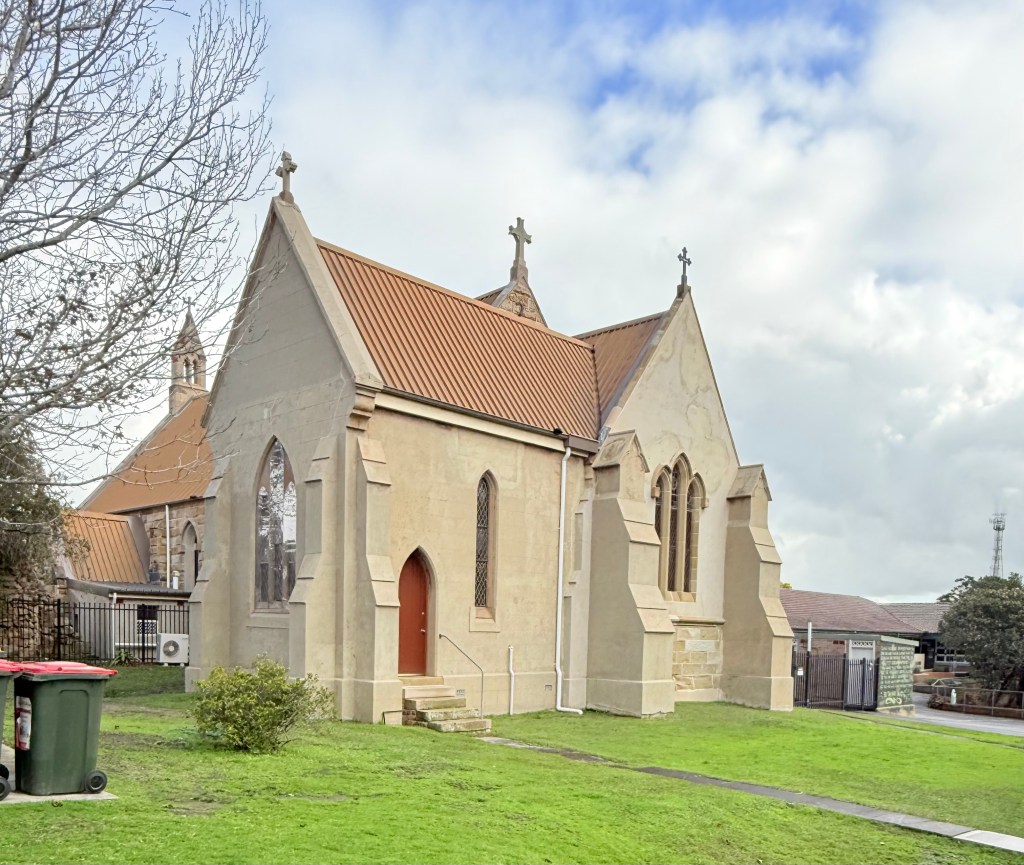
Photo showing the extensions at the back of the original St Brigid’s Church [Author photo -July 2026]
The Newcastle Morning Herald and Miners’ Advocate of 2 December 1930, page 6, reported:
‘The ceremony of the consecration of the altar of St. Brigid’s Church, Raymond Terrace, was carried out on Wednesday by the Coadjutor Bishop of Maitland (the Right Rev. E. Gleeson), assisted by the Very Rev. J. O’Flynn, P.P., Revs J. J. Coady, Adm., and M. J. Fitzgerald (West Maitland), Rev. M. Forde (Murrurundi), Revs. E. V. Tweedy and B. Watson. The ceremony occupied several hours, and included the placing of relics of the martyrs, Sts. Clement and Boniface, in the sepulchre in the altar stone.
On the following morning mass was celebrated by the Bishop assisted by the Rev. J. O’Flynn. Raymond Terrace has had a resident priest since 1852, when the Rev. C. B. Quinn was in charge of the parish, which was a very extensive one. One of his successors, the Rev. T. A. Nealon, was parish priest for 40 years. The foundation stone of the old church was laid in March 1861, by Archbishop Polding. It was opened in the following year.’
35th Anniversary of the Raymond Terrace Hibernians – 1932
The Catholic Press of 29 September 1932, page 28, reported:
‘On Sunday, the 18th inst., St. Brigid’s [Hibernian] branch, No. 291, Raymond Terrace, celebrated the 35th anniversary of its establishment by a ‘Communion and breakfast’. The committee of management set out to make this function an outstanding one as far as Hibernianism in this town was concerned, and so successful were their efforts that the function exceeded all expectations generally, taking into account the strenuous times [great depression] through which we are passing. The breakfast arrangements and decorations in St. Brigid’s Hall were attended to by lady members of the branch, and the wives and sisters of members, who were highly complimented on their successful attainments.
The 8 o’clock Mass was celebrated by his Lordship Dr. E. Gleeson, C.SS.R. (Bishop of Maitland), who delivered a very eloquent and instructive address on Hibernian matters. About 80 members, consisting of District officers, Bro. J. P. Byrne (P.D.P.), Bro. J. T. Lyons (District Treasurer), Bro. T. P. O’Connor (P.D.P.) and District Trustee), Bro. Geo. Nott (C.D.V.P., Maitland diocese), and representatives of the A.H.C. Guild, also Hibernian representatives from Seaham, Tighe’s Hill, Cessnock, Mayfield, Lambton, Branxton, Hamilton, Adamstown, Merewether and Newcastle, all wearing regalia, received Holy Communion in a body, and the sight was a most inspiring one. The centre row of seats in the church were kindly given up for the use of the visitors and members, and this action was much appreciated by the committee.
After Mass the president of the local branch, Bro. J. J. O’Grady, with the district officers, conducted the Bishop from the church through a guard of honour formed by the members present to St. Brigid’s Hall, where the breakfast was partaken of. …… The proceedings terminated by all singing ‘Faith of Our Fathers.’ Songs wore rendered during the morning by Sister K. O’Brien, Bro. J. R. O’Grady and Bro. W. V. Feeney, and Bro. W. Bowe gave some favourite recitations.’
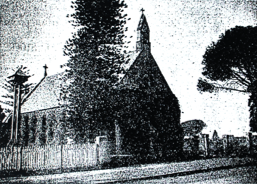
St. Brigid’s Roman Catholic Church, at Raymond Terrace [Newcastle Morning Herald and Miners’ Advocate, 19 May 1934]. A bell is situated beside the Church.
Mercy Sister dies at the Raymond Terrace Convent – 1937
The Singleton Argus of 12 March 1937, page 6, reported:
‘Sister Mary Columba O’Farrell, aged 69 years, died suddenly from a heart attack in the Raymond Terrace Convent of Mercy on Monday morning. The deceased nun was a native of Hokitiko, South Island of New Zealand, and entered the Order of Mercy at Singleton 53 years ago. She taught in various schools of the diocese of Maitland, and before going to Raymond Terrace was in charge of the orphanage at Campbell’s Hill, West Maitland. The remains were brought to Singleton by road on Monday afternoon, and the cortege included many residents of Raymond Terrace.
As the cortege passed through Campbell’s Hill the orphans formed a guard of honour. Many residents of Raymond Terrace came back to Singleton for the Requiem High Mass and interment on Tuesday. The Mass was celebrated in the Sisters of Mercy chapel. His Lordship the Bishop of Maitland (Dr. K. Gleeson) presided, and the celebrant of the Mass was Father Morrissoy, with Father Hanrahan as deacon and Father Quinn as subdeacon. Rev. Father M. Carlton was master of ceremonies, and there was a large attendance of the diocesan clergy. The remains were interred in the Sisters’ cemetery [at Singleton].’
A.H.C. Guild Reunion at Raymond Terrace – 1939
The Catholic Freeman’s Journal of 9 March 1939, page 31, reported:
‘The Newcastle District Council and the Central Northern Council of the A.H.C. Guild held their first reunion on Sunday last by a Guild Day at Raymond Terrace. Much organising work had taken place, and the society anticipated a record day. The rain, which started at the weekend, it was thought, would cause a postponement of the function, but it did not dampen the enthusiasm of the committee, and, in spite of the weather, nearly 600 from Newcastle, Maitland and coalfields branches attended.
The hall at the Terrace was secured and an enjoyable day was spent. The children, who were present, cheered the free helping of ginger-beer, etc., and every child received a free toy. The sports arranged, however, could not be carried out, so other games were provided under cover. The long line of ‘buses at the sports ground, together with the bigger vehicles that remained at the Miller’s Forest side of the river, caused a deal of interest to the residents of Raymond Terrace.
During the afternoon, Very Rev. Father J. O’Donohue, L.C., Rev. Father Bernasconi, and Rev, Father Quinn, paid a visit, and were heartily welcomed. The organisation was most complete, the ‘buses from the Newcastle, Maitland and coalfields districts arriving just on the scheduled time, and the departure in the afternoon was in accordance with the arrangements made. The Warden-General, Bro. W. F. O’Hearn, expressed, on behalf of the society, sincere thanks to the Councils on the great effort which, he said, laid the foundations for an annual ‘Guild Day.’
Bro. A. J. O’Brien, who has been secretary of St. Brigid’s Branch, Raymond Terrace, for 28 years, welcomed the visitors. He said that with some improvements the grounds at Raymond Terrace could not be bettered for such a function, and he believed that many similar days would be witnessed there. Visiting officials included Warden General Bro. W. F. O’Hearn; Past Warden-Generals, Bros. J. Jordan and W. Ferrer; Executive Councillors, Bros. R. Barrett (East Maitland), and T. Reilly (Wallsend); Past Executive Councillors, Bros. W. Murphy (Cessnock), T. Peters (Newcastle), and B. O’Donnell (Newcastle); Bros. P. Lantry, Cross Bearer (Morpeth Branch); L. Gilwiller (secretary Newcastle District Council); Bros. A. Passfield, L. Dixon (Cessnock), J. Lorraine, G. Lethbridge (West Maitland), J. Hartcher (East Maitland), G. Brigdale (president Friendly Societies Association, Newcastle), V. Bernasconi (Hamilton). The Marist Brothers from Maitland also attended.
The proceeds are to be devoted to the Guild Bursary Fund. So pleased were the visitors that the hope was expressed that Raymond Terrace would be chosen for the next annual function.’
Death and Funeral of Rev. John O’Flynn – 1939
The Catholic Freeman’s Journal of 16 March 1939, page 34, reported:
‘The death of the Very Rev. John O’Flynn, who had been parish priest of Raymond Terrace since 1914, took place at the Mater Misericordiae Hospital, Waratah, after a long illness, early last week. The late Father O’Flynn was born in County Cork, Ireland, on May 3, 1870, and completed his training at St. Finbarr’s Seminary, Cork, and later at All Hallows’ College, Dublin. He was ordained as a priest at the latter college on June 24, 1896. The deceased arrived in the Maitland Diocese on October 21, 1896, and spent some time at Raymond Terrace as assistant and later at Newcastle as assistant of that parish in 1904. He was assistant priest at Branxton in 1907, and the following seven years were spent as assistant at Muswellbrook.
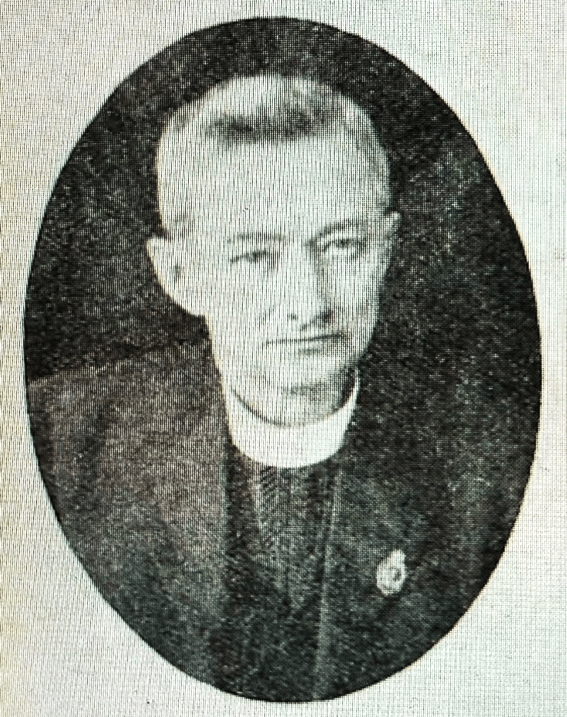
Rev John O’Flynn
In 1914 he was made parish priest at Raymond Terrace. He was made a Diocesan Consultor in 1924. The late Father O’Flynn was renowned for his piety and devotion to duty. He was esteemed by all, and his death will be mourned by Bishop, priests and people alike. He did wonderful work in the various parishes, and especially in Raymond Terrace his memory will live, and the fruits of his labour will be long remembered. For the last twelve months the deceased had been slowly declining in health, and the four months prior to his death were spent in hospital.
The funeral took place on Wednesday week after a Solemn Requiem Mass in St. Brigid’s Church. This was celebrated by his Lordship the Bishop of Maitland (Most Rev. E. Gleeson, C.SS.R), assisted by Very Rev. Father H. Ward (Lochinvar), Rev. Father D. Forde (Waratah), and Rev. Father J. Walsh (Cessnock), as assistant deacons. Rev. Father J. P. Bernasconi (West Maitland), deacon, and Rev. Father T. M. Purcell (West Maitland), sub-deacon. Very Rev. Father E. V. Tweedy (Administrator, West Maitland) was master of ceremonies, and Rev. Father J. E. Quinn (Raymond Terrace), assistant; and Rev. Fathers E. Jordan (Merewether) and N. Withnell (West Maitland) were chanters.
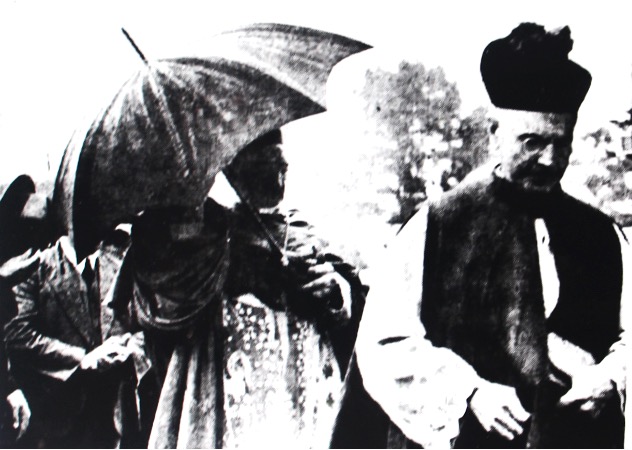
Bishop Gleeson, with umbrella, and Monsignor Peters arriving at St. Brigid’s Church, for the Solemn Requiem Mass and funeral for Very Rev. J. O’Flynn [Newcastle Morning Herald and Miners’ Advocate, 9 March 1939]
His Lordship Dr. Gleeson, C.SS.R., Bishop of Maitland, preached the panegyric. He took for his text: “Diligam Te, Domine, fortitudo mea, Deus meus adjutor meus, et sperabo in Eum” — “I will love Thee, O Lord, my strength. My God is my helper, and in Him will I put my trust.” — Ps. 17 read, in the Second Nocturn of the Matins of Monday.
He said; ‘It is not very long since we gathered around the remains of one of our senior priests to pay our affectionate tribute of respect. A similar ditty has brought us here today. The remains of Very Rev. John O’Flynn lie before us. He was a priest of great personal sanctity and of unbounded zeal. The diocese owes him much. He lived solely for God and the salvation of souls. It is then a most pleasing duty on our part to pray for the repose of his soul, to say in his behalf what he has said for others many a time in this church; “Eternal rest give to him, O Lord, and let perpetual light shine upon him.” These’ words are, I am sure, on the lips of priests, religious and people for him today, and you are elevating and strengthening the appeal by means of the Sacrifice of the Mass.
All the other lessons he gave you as your parish priest on devotion for the faithful departed you will now put in practice for his own departed self. And not for this day only; you will keep praying for him. Being always a humble man, he would I believe wish me to speak to you only from that point of view on this sad and solemn occasion; but feeling that his soul’s interests are safe in your hands.
I will rather dwell upon the text. “Diligam Te, Domine for titudo mea. Deus meus adjutor meus, et sperabo in Eum.” His Favorite Prayer. It was his favourite prayer. He would love God with his whole heart; he would give Him the highest service; he would light against every evil propensity within himself as well as outside of him in the world. But to do so he believed he needed God, and he needed God all the more because of his own physical weakness. “Diligam Te, Domine” — “I will love Thee, O Lord.” These words therefore were constantly in his mind and on his lips. He uttered them during his student days when he realised that the call to the priesthood was among God’s most splendid gifts to him. He uttered them on the days when he took the first step to the altar. But he uttered them with more deliberation and strength of purpose on his ordination day. And he has been uttering them ever since. These words created, that intimacy with Jesus Christ in the tabernacle of which you, brethren of Raymond Terrace and the Sisters of the Convent here, have been witnesses for more than twenty-five years.
There is a great modern movement which has been prompted by the Vicar of Christ and which gives Eucharistic devotion a wonderful prominence for clergy, religious and laity. But, before ever the Pope launched this movement, Father John O’Flynn had its spirit, and, under my own eyes, as one of my assistant priests close on forty years ago, he put it into practice in St. Mary’s, Newcastle. How we, his fellow priests, should rejoice today at the recounting of this sweet memory of him, and how it should urge us to remember him in a very practical way in all our own Eucharistic devotions. But he did not stop at the words, “Diligam Te, Domine” — “I will love Thee, O Lord.” He added, “I will love Thee, O Lord, my strength. My God is my helper, and in Him I will put my trust.” For he well understood the warning of Jesus Christ, “Without Me you can do nothing,” and the words of St. Paul, “Our sufficiency is from God.” And so he cast all his care upon God; his spiritual needs, his work, his projects, his trials and crosses; he protested that God’s help, God’s light, God’s guidance was needed for them all.
He was a man of poor health for over forty years. He spent different periods in hospital. From 1904 to 1907 he travelled through Australia seeking health. Still, he was a man of work; his life was full of work. As Administrator of St. Mary’s, Newcastle, for a short time, as Assistant priest at Branxton and Muswellbrook, and as parish priest of Raymond Terrace he was an indefatigable worker. Church and school and the homes of the sick saw him at his post with almost inimitable punctuality. For some years he had to do the work of his parish single-handed. But the dread of the night sick-call even when he was showing a temperature, or of the Sunday’s two Masses, or of the full day’s work before him, did not cause him dismay. With what confidence did he not say in such circumstances, “Diligam Te, Domine, fortitudo mea” — “I will love Thee, O Lord, my strength. My God is my helper, and in Him will I put my trust.” How he must have repeated the words at dead of night when sleeplessness afflicted him, or at other times when he contended with utter weakness even in the short journey from his presbytery to the church?
He was a man of work I say, indeed when he had done his work in church and school or in other priestly offices out of doors, he did not think his work was over. A priest he believed should love books and keep himself well acquainted with ecclesiastical literature and with the questions of the day. Hence in his quiet moments in his presbytery, one found him in the midst of books and magazines triumphing over weariness and weakness and finding interest in reading and study.
His devoted medical adviser, Dr. Meredith, one to whom I owe a special tribute of gratitude on this day for untiring attention and fatherly regard towards the deceased, had to warn and urge him many a time to spare himself. I remember receiving a letter from Dr. Meredith a few years ago begging me to order Father O’Flynn to take a holiday else, wrote the doctor, he will not be able to go through the winter. Thus, the Years Went By. But his love of work for souls and his trust in God’s help were so great that it was only with difficulty one could re-strain him. And thus the years of his career went by, abounding in labour for his own sanctification, abounding in sacrifice, abounding in merit, abounding in good for the souls committed to his care.
What a beautiful account the recording Angel can give of the work of this zealous pastor for each one of you: his incessant labour to ground you deeply in the Catholic Faith, his counsel so solid and wise, his encouragement so constant and persevering, his correction so fatherly and sympathetic. Good spiritual children of his you surely must be, begotten by him through the abundance of grace his zeal for your interests made him the means of communicating to you. Be faithful to his teaching; forget not his splendid example of piety; make your Catholic life an act of gratitude for his loving care of you. We priests can learn from him the lesson of love of God in all the circumstances of our life; the lesson of trust in God in all our difficulties; the lesson of devotedness to work. Let the words of the Psalm in Monday’s Matins, be on our lips, too, binding us to God, protesting to Him our dependence on Him, and making us sure of His help and blessing: “Diligam Te, Domine, fortitudo mea. Deus meus adjutor meus, et sperabo in Eum.”
Finally, as we accompany the mortal remains of this revered brother and pastor and friend to their last resting place on earth, let us pray that his immortal soul, if not already in Heaven, may be there soon, to say for ever “Diligam Te.” He will no longer add the other words, for then needing nothing else he will be in possession of the, all-good, the all-satisfying, the all-happy-making “things God hath prepared for them that love Him.”
Other members of the clergy at the obobsequies were Right Rev. Monsignor V. F. Peters (Hamilton), Very Rev. Father C. S. Regan (East Maitland), Very Rev. Father J. O’Donohoe (West Maitland), Very Rev. Father J. J. Coady (Merewether), Very Rev. Father W. L. Byrne, C.SS.R. (Mayfield), Rev. Fathers J. Marshall (Lambton), G. P. Youll (Stockton), T. Mulcahy (Taree), T. Quigley (Krambach), M. Bourke (Dungog), P. Duggan (Denman), M. Moylan (Mayfield), M. O’Connor (Wallsend), J. T. Walsh, p.p. (Morpeth), P. G. Grace (Tighe’s Hill), B. Watson (Coalcliff), W. Hourigan (Murrurundi), M. J. Fitzgerald (Muswellbrook), J. J. Morrissey (Singleton), J. F. Kelly (Branxton), J. P. Kelly (Bulahdelah), R. O’Moore (Adamstown), P. Carey (Campbell’s Hill), P. Ryan and V. E. Casey (Newcastle), P. D. Cotter (Waratah), J. V. Curran (East Maitland), F. R. Ryan (Lambton), T. Cronin, J. F. Lavery (Hamilton), J. P. Burke , (Cessnock), J. Walsh (Cessnock), T. Gloster and W. T. Morrissey (Kurri Kurri), M. J. Brennan (Singleton), R. F. Smyth (Scone), J. Jensen, M. O’Dwyer (Mayfield), J. Cantwell (Tighe’s Hill) and J. V. Curran (East Maitland).
The interment was made in the Raymond Terrace cemetery, in the presence of a large gathering. The chief mourners were the Misses Rowan and Corrie (Randwick). The pallbearers were Bros. J. W. Hughes, J. Broderick (H.A.C.B. Society), F. W. Edstein, E. Jensen (St. Vincent de Paul Society), P. Kennedy, and J. Saunders (A.H.C. Guild). The Hibernian Society was represented by Bros. J. Hughes (President), J. M. Feeney (Secretary) and members; the A.H.C. Guild by Bros. P. Kennedy (Warden), A. J. O’Brien (Secretary), and members; the Port Stephens Shire Council by the President (Dr. J. B. Meredith), the Deputy President (Cr. G. J. Russell), Cr. R. A. Elkin, arid the Shire Clerk (Cr. C. L. Monkley).
Others who attended included the branch manager of the Commercial Banking Co. of Sydney (Mr. W. J. McAlpine), Messrs. J. Dwyer (Mayfield), J. Findlay, P. J. O’Brien (Morpeth), J. Edstein (Taree), S. Clark (Miller’s Forest), J. Smith, A. M. Cunningham, W. Brown, ex-M.L.A., the Mayor of Dungog (Ald. R. L. Fitzgerald), Messrs. J. P. O’Grady (Miller’s Forest), J. P. Burgess, A. C. Boots, J. Dorney (Seaham), Joseph Ferney, M. Lynch, and W. P. Corbett.’
Appointment and welcome to Father Joseph O’Donohue as the New Parish Priest – 1939
The Maitland Daily Mercury of 5 April 1939, page 3, reported:
‘In. St. Brigid’s Parish Hall, Raymond Terrace, a large and representative gathering welcomed the Rev. Father O’Donohue, who has been appointed parish priest in succession to the late Rev. Father O’Flynn, who died about a month ago.
Mr. J. J. Edestein, speaking on behalf of the general body of parishioners, stated that the appointment of the Rev. Father O’Donohue as their pastor met with the approval of everybody. It was a most appropriate appointment in succession to the revered pastor who had loyally served the parish for nearly 25 years. He assured Father O’Donohue that he would find the people of Raymond Terrace and district an excellent class of men and women, and he felt certain, knowing Father O’Donohue as he did, all classes and creeds would respect him. He wished him every blessing in his new home.
Bro. J. M. Feeney, speaking of the Hibernian Society, assured Father O’Donohue of their help and conveyed the congratulations of the members. Bro. A. J. O’Brien spoke on behalf of the A.H.C. Guild, and assured Father O’Donohue of the loyalty and assistance necessary from the society. Mr. Frank Edestem (St. Vincent de Paul Society) also offered his sincere congratulations.
Rev. Father O’Donoghue stated that he appreciated very sincerely the hearty welcome tendered by all. He felt that he had undertaken a great task in endeavouring to follow in the footsteps of their late lamented pastor and friend, the Rev. Father John O’Flynn. He paid a wonderful tribute to the work of Father O’Flynn and spoke of the love and obedience the people of Raymond Terrace had for him. He felt confident that the good people of Raymond Terrace would continue to work harmoniously with him (Father O’Donoghue) as they had done for their departed friend.
Prior to going to Ireland about 30 years ago, he had charge of one of the most flourishing parishes in the diocese of Maitland and during his long period in the priesthood he was always treated with the greatest respect and all his parishioners worked very happily with him. He expected, and he felt assured, that the people of Raymond Terrace would he no exception.
In perpetuation of the memory of the late Rev. Father John O’Flynn, it was decided by the parishioners of Raymond Terrace to erect a tombstone over his grave in the Raymond Terrace Catholic cemetery, and to erect a set of stations of the Cross in St. Brigid’s Church, Raymond Terrace. The Rev. Father O’Donoghue, in speaking of this subject, stated that he felt sure the people of Raymond Terrace would honour the memory of their late pastor. Before the close of the meeting five gifts of one station each were made. Each gift is to be inscribed on a brass tablet.’
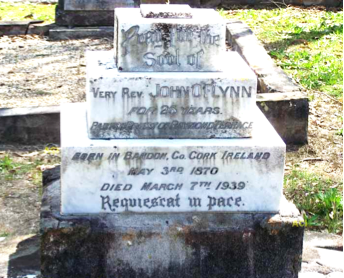
Gravestone of Rev. John O’Flynn at Pioneer Hill Cemetery, Raymond Terrace. The top section of the memorial funded by the Raymond Terrace parishioners, is missing.
Gift of the Stations of the Cross by Parishioners – 1939
The Catholic Freeman’s Journal of 11 May 1939, page 34, reported:
‘The blessing and consecration of the beautiful set of Stations of the Cross presented by fourteen of his parishioners of St. Brigid’s Church, Raymond Terrace, to the memory of the late Rev. Father John O’Flynn, who was for 25 years parish priest of that centre, took place in the presence of a large congregation.
The priests present in the Sanctuary were the very Rev. Father O’Donohue, P.P., Fathers Quinn, Hayes (Kendall) and Hanrahan (Taree). The Rev. Father O’Donohue spoke on the prayer of “The Way of the Cross.” Next to the Sanctuary came the Stations of the Cross. It was the prayer and the route walked by the Lord on His way to Calvary.
Before the blessing and consecration, Father O’Donohue stated that the erection of the Stations was a wonderful tribute of love and affection to the memory of their departed pastor. He could safely say that the memorials were the most elaborate in the diocese of Maitland. They were made by one of the greatest workers of art in Rome, and, apart from their beauty, it was a wonderful testimony of love when it was known that every Station was freely given and erected free of debt.
After the blessing, the priests sang the hymn, “Come, Holy Spirit,” and the consecrating of the Stations took place. As each Station was erected in its position, the “Way of the Cross” was made by the parishioners, and the choir sang at each alternate Station the “Stabat Mater.”
The contractors for the Stations were J. J. Edstein and Sons, of Raymond Terrace. Mr. Frank Edstein had charge of placing the Station in position at the service. The music was played by Miss Mary Hughes, organist of St. Brigid’s Church. The Solemn Benediction of the Blessed Sacrament was given by the Rev. Father Hanrahan.’
Mission held at Raymond Terrace – 1939
The Maitland Daily Mercury of 24 June 1939, page 6, reported:
‘A mission is being conducted at St. Brigid’s Roman Catholic Church, Raymond Terrace. Large congregations have attended each service, particularly at night. The mission will continue for seven days.’
Debutantes presented at Catholic Ball – 1939
The Newcastle Morning Herald and Miners’ Advocate of 31 August 1939, page 2, reported:
‘The third annual ball of the Raymond Terrace Catholic Church, held last night, attracted about 500 dancers from all parts of the district. The Deputy Mayor and Mayoress of West Maitland (Ald. and Mrs. Joe Kennedy) received 14 debutantes.
The ball was held at the Raymond Terrace Oddfellows’ Hall, which was gaily decorated with festoons in gold and orange toning’s. Hanging baskets filled with greenery and flowers of the same shades added to the colourful scene. The supper tables also repeated these colours. A two-tiered debutantes’ cake decorated with miniature dolls was featured. It was an exciting night for Miss Maureen Hughes, who, as well as making her debut, was chosen as belle of the ball.
The Mayoress of Greater Newcastle (Mrs. Jenner), Mrs, Walter Enright, of Maitland, and Mrs. L. Callinan of Morpeth, were judges. They were presented with bouquets.
The debutantes wore a spray of white stock in their hair and carried bouquets of pink stock and sweet pea. Miss Maureen Hughes chose a bouffant gown of white moiré taffeta with bands of ruching trimming the wide neckline; Miss Joan Petersen’s white lace gown was designed on Princess lines and smartly trimmed with taffeta bows; Miss Margaret Edstein was charmingly frocked in white organza featuring an all-over design of rucked ribbon; Miss Fanny Green had rows of taffeta ruching on the wide skirt of a dainty white lace gown; Miss Mary Clark’s graceful gown of appliqued not was shirred at the waist line; Miss Mary Gallacher’s white sheer frock was finely shirred at the shoulders; Miss Ida Godfrey’s white crepe façonné frock was cut on moulded lines and finished at the waistline with a crystal buckle; Miss Marie O’Brien’s dainty white crinkly sheer gown was shirred at the corsage and at the waist.
Miss Eileen O’Brien wore a lovely crinoline gown of white chantilly lace, accented with tiny pink baby roses; Miss Mona Hughes wore a becoming old world gown of white sheer with a softly draped skirt; Miss Joan Hughes added a matching bolero to a pretty white silk marquisette gown, which was smartly shirred at the waist; Miss Ella Hughes wore a crisp lace bolero with her shir-red gown of white sheer; Miss Patricia Cox featured silver bands at the waist-line of a smart gown of white figured taffeta; Miss Mary O’Brien had tiny pink baby roses at the shoulders of a pretty white lace gown.
The debutantes were preceded by two Page Boys, Masters Desmond O’Hearn and Edward Foley, who wore magnolia satin suits trimmed with lace, and eight flower girls, Misses Carmel Cunningham, Margaret Feeney, Margaret Dwyer, Yvonne Edstein, Pauline O’Brien, Maureen Edwards, Dorothy Cunningham, and Maureen O’Donohue. They wore dainty period frocks of rose pink and blue net and carried posies of pink sweet peas. Their haloes were of blue forget-me-nots and pink roses. They formed a guard of honour on the steps of the stage, on which the official party was seated.
The matron of honour was Mrs. Feeney. Following their presentation the girls and their partners danced a destiny waltz, for which they were trained by Mrs. P. Edstein, assisted by Mrs. A. M. Cunningham. Their bouquets were made and presented by Misses Hill, of the Dockyard. The official party included the President of the Port Stephens Shire (Dr. J. B. Meredith), the Mayor and Mayoress of Greater Newcastle (Ald. and Mrs. G. W. Jenner), the Deputy Mayor and Mayoress of West Maitland (Ald. and Mrs. Joe Kennedy), Mrs. J. H. Feeney (President of the Ladies’ Committee), Mr. F. Edstein, Sister Clery (Vice-presidents), Rev. Fathers J. Quinn (President and Treasurer), J. O’Donohoe (Parish Priest), P. Ryan (Newcastle), J. Welsh (Morpeth), Mr. J. M. Feeney, Miss Muriel O’Brien (Joint Secretaries), Mr. J. Hughes was M.C.’
Anniversary of Very Rev. John O’Flynn’s Death – 1940
The Raymond Terrace Examiner and Lower Hunter and Port Stephens Advertiser of 21 March 1940, page 4, reported:
‘Father O’Flynn’s anniversary was celebrated with due solemnity in the Catholic Church, Raymond Terrace, on Thursday the 7th March last. The Very Rev. John J. Coady, was celebrant, Rev. Bert Watson, Deacon, and Rev. Daniel Forde, Sub-Deacon, Very Rev. H. Ward, Master of Ceremonies assisted by Rev. J. E. Quin. Very Rev. J. O’Donohue supervised the arrangements of the function. His Lordship, Most Rev. Dr. Gleeson presided, and at the conclusion of the ceremonies pronounced the final Absolution.
The following priests of the Diocese were present. Apologies were received from some who were not able to attend. Very Rev. J. O’Donohue, Raymond Terrace; Very Rev. W. Byrne, C.SS.R, Mayfield; Very Rev. J. J. Coady, Merewether; Very Rev. H. Ward, Lochinvar; Very Rev. E. B. Keegan, E. Maitland; Very Rev. C. McCormack, Singleton; Rev. J. Marshall, Lambton; Rev. P. Ryan, Newcastle; Rev. J. F. Kelly, Branxton; Rev. W. Hourigan, Murrurundi; Rev. P. Grace, Tighes Hill; Rev. D. P. Linehan, Branxton; Rev. E. Jordan, Stockton; Rev. M. Bourke, Dungog; Rev. B. Watson, Cardiff; Rev. J. Brennan, Singleton; Rev. J. Morrissey, Singleton; Rev. J. Lavery, Hamilton; Rev. L. Cronin, Hamilton; Rev. J. E. Quinn, Raymond Terrace; Rev. A. Forde, Waratah; Rev. P. Cotter, Waratah; Rev. J. P. Kelly, Bulahdelah; Rev. R Smythe, Scone; Rev. M. Dwyer, Mayfield; Rev. J. Jensen, Mayfield.
The priests were entertained to lunch by the Sisters of Mercy, assisted by the ladies of the Parish. Over forty priests were in attendance. His Lordship acknowledged the hospitality extended to the visitors and thanked the Sisters for the splendid repast provided by them and the assisting good ladies.’
Mission held at Raymond Terrace – 1940
The Maitland Mercury of 3 May 1940, page 6, reported:
‘A mission is being held in St. Brigid’s Catholic Church, Raymond Terrace. The Rev. Fr. Gilmartin, C.SS.R., of the Redemptorist Fathers’ Monastery, at Mayfield, is the missioner. There have been good congregations’ night and morning for the special Masses and sermons. The Forty Hours devotions will commence on Sunday, when Solemn Mass will be sung by the Rt. Rev. Monsignor Peters. The Bishop of Maitland, Most Rev. Dr. Gleeson, C.SS.R., will preside.’
School of Music and Elocution at the Sisters of Mercy Convent, Raymond Terrace – 1940
Since 1912 the Sisters of Mercy at their Convent at Raymond Terrace conducted music and elocution lessons and the associated examinations were conducted there.
The following report published in the Raymond Terrace Examiner and Lower Hunter and Port Stephens Advertiser of 23 May 1940, page 3, provides an overview of the musical activities:
‘On the 1st of May, the distinguished representative of the Sydney Conservatorium of Music, Mr. Pennicuisk, held the above examination at the Convent of Mercy, Raymond Terrace. Four promising candidates were presented. Yvonne Edstein, Margaret Feeney, Aileen Krohn and Maureen Edwards. The examiner was very pleased with the work of all the students.
In the official report the following laudatory remarks occur. ‘Very musical performance, everything correct’. ‘Everything well and carefully done’ and again ‘everything correct and playing showing musical ideas’. Margaret Feeney and Yvonne Edstein gained the highest mark, 91 out of a possible 100. They thus won the silver cup donated by Messrs. Paling and Co. Eillen Krohn got 90 and Maureen Edwards 88. But here came a difficulty— there was one course open to cut for the silver cup. But then there would be a wee little heart a-breaking. So Father O’Donohue approached Mr. Wilson, (Paling’s representative) and the result of the conference was that two silver cups of equal value were donated and then ”all was pleasant along the Potomac’.
The occasion was made notable, when the cups were presented at a gathering of parents and children. It was a glorious frolic, the Catholic Hall was crowded the tables were loaded with all the good things that the ladies of the parish provided. Father O’Donohue in a few well-chosen remarks, congratulated the successful candidates, their parents and their teachers. Amidst laughter he jokingly said that ‘the children had the good looks of their mothers, and their father’s sweet tempers’.
Father O’Donohue entertained the Examiner at afternoon tea. ‘In the course of conversation Mr. Pennicuisk deplored the spread of jazz music, if music it could be called. He also said that the wireless has made inroads into instrumental and musical culture. One prefers a piece from some celebrated musician played even by a child on piano or violin to all the ‘wireless’ of a nighttime.
The Examiner as a parting goodbye asked Fr. O’Donoghue to congratulate the music teachers and say that he deemed them highly talented and thoroughly qualified for teaching ‘highest grade’. There are some vacancies in the Convent School of Music and Elocution for more students, and it is to be hoped that full advantage will be taken of the opportunity afforded. Application can be made to the local Superior, Convent of Mercy, Raymond Terrace.’
Farewell to Assistant Priest, Father Quinn – 1941
The Raymond Terrace Examiner and Lower Hunter and Port Stephens Advertiser of 27 March 1941, page 3, reported:
‘There was an overflow meeting at the Catholic Hall, Raymond Terrace, on Monday night last when the parishioners of St. Brigid’s assembled to say farewell to Father Quinn, who is leaving for Muswellbrook. The chair was occupied by the Very Rev. J. O’Donohoe, in charge of the Parish and apologies were tendered for the family of the late Mr. D. O’Brien, and from Mr. and Mrs. W. E. Goodman. General Meredith and Father Marker from Maitland were among the assembly.
Very Rev. Father O’Donohoe said the object of this meeting is, as you know, to give Fr. Quinn a farewell, on his promotion to the important parish of Muswellbrook, as assistant. The policy of His Lordship is to remove assistants every four years or so to give them a wider experience of men and manners. This the Lordship does every three or four years. It is good for the assistants and good for the people. There is always a sadness in saying farewell. Fr. Quinn has given him great help since he came here and it was with much regret that he said good-bye and wished him God-speed in his new sphere of labour. ….
Fr. Quinn came here with the highest references inasmuch that he has a good father and an excellent mother and that he belongs to a respectable and decent family. (Hear, hear). Father O’Donohoe said that he was delighted to see such a large and representative gathering there that night. It showed the esteem in which Fr. Quinn was held and the respect and confidence the Catholic people have for their priests. Dr. Meredith said he was sorry they were going to lose Fr. Quinn as he was one with whom he was very friendly and he had always found him a gentleman. The more he saw of Fr. Quinn the better he liked him. He hoped when he went to Muswellbrook the people there would appreciate him as much as they did here. He had found Fr. Quinn’s assistance at times very valuable, and he thanked him for it. He wished him every success in the future.
Mr. J. A. Hill said it was not a pleasure to lose Fr. Quinn, as he was loved throughout the Parish by everyone, and he regarded him as one of the best priests they ever had here. He became very popular with the people and it was with much regret they heard that he was departing. But it is a rule in the Church to transfer the priests to other parishes after a few years’ service in each. He wished Father Quinn long life and the very best in the future.
Mr. A. J. O’Brien said he was thankful to Father Quinn for the many kind actions he had done him, and he had found him pleasant, kindly and a perfect gentleman. He had carried out his duties in a most satisfactory manner and was esteemed throughout the parish. He felt certain that wherever he went he would be a big success. On behalf of the various Friendly Societies he thanked Fr. Quinn and assured him they were sorry to lose him. He wished him every success in the future.
Mr. Jas. Saunders said he was sorry they had to say farewell to Father Quinn for he was liked very much by everyone. He spoke on behalf of the Nelsons Plains people, who like all others in the Parish were sorry to lose Father Quinn. He took a keen interest in the welfare of the young as well as the general interests of the parish. In teaching the young people growing up to take up their duties later in life was a good thing for the community. He was also active in all social events and gave much assistance to the church in that way. He could assure Father Quinn that the people of Nelsons Plains were sorry when they heard he was going away, and they would watch his future with interest, and trusted wherever he went he would gain the same confidence that he held here. He again wished him success.
Sergeant Collins said he endorsed all that had been said by previous speakers. He regretted his leaving, as he had known Father Quinn from his boyhood and he was always well behaved. He had never, heard or knew of him being guilty of misbehaviour nor having his pockets full of stones and a shanghai. He commended the way he had carried out his duties in the Parish, and he had the good wishes of all the people in the district. He wished him, for many years to come, good health and prosperity, and was sure he would remember the people of Raymond Terrace.
Mr. B. Fairweather too felt regret at Father Quinn’s departure. He had always found him most courteous and had a large share of good fellowship and was most unassuming in his actions. He was very well liked by all classes in the community here, and he was sure he would make many friends in Muswellbrook as he had done here. He wished him a happy time in the future.
Father Marker said he was not at all surprised at the large gathering that had assembled to say farewell to Father Quinn for he was one of the most popular priests in the diocese of Maitland. He was an excellent priest and a gentleman, and he knew he had been a good help to father O’Donohoe. He was pleased to be present and to be associated with the gathering.
Mr. W. Brown also eulogised the residence of Father Quinn in Raymond Terrace, as he not only carried out his duties in the Parish well, but he was also a good citizen in his willingness to help any movement for good. He had always found him courteous, gentlemanly and obliging, and all denominations spoke well of him. He regretted he was leaving but wished him a full measure of success in the future and thought he would go far in the Church.
Father Quinn replying, was warmly applauded. He said he thanked the Very Rev. Father O’Donohoe for the kind and dignified words he had expressed towards him. his associations with him and the Parish had been of a pleasant nature. When he came here, he had taken part in the social life of the Parish and was pleased if he had rendered, any service thereby and to know that his services had been appreciated. He gave a few reminiscences of his association with Father O’Donohoe at college, and his experience with umbrellas, and Father O’Donohoe’s remarks.
It had been a pleasure and a privilege he said to work with the people of the parish, and he had made some happy associations as there were many good families here. And the advice he got from his old pastor was very helpful indeed. He expressed his thanks also for many kindnesses and advice he had received from the late Father O’Flynn. He also thanked Dr. Meredith for he had always found him a good friend and helped him much in his work.
He had found all the people very sociable, and he related on one occasion while walking along the Forest road, three young fellows passed him in a sulky, and asked him if he would ride. As he was out for a walk, he did not accept the invitation. After they had gone some distance, they came back and said if he was going on a visit to the sick, they would drive him there. He thought that was very kind and thoughtful and especially as they were non-Catholics. He thanked the people for their compliment to him that night and said he would always cherish their kindness and good wishes to him whilst in the Parish, and he would be pleased to see any of them, at any time. He thanked them again.
Very Rey. Father O’Donohoe thanked the ladies who had attended and provided such a dainty supper and also other who had assisted at the function. He also thanked Mrs. Moody for her kindness in coming to play the piano for their enjoyable dance. During the evening Miss M. Broderick on behalf of the Children of Mary thanked Father Quinn for his close interest in the Children of Mary and assured him of their kindest wishes for his future welfare. Father Quinn thanked them for their kindness. The social evening was continued till midnight, which terminated a very successful and flattering farewell ceremony.’
Anzac Day celebrated at St. Brigid’s Church – 1941
The Raymond Terrace Examiner and Lower Hunter and Port Stephens Advertiser of 1 May 1941, page 3, reported:
‘Anzac Day was celebrated with great solemnity at the Catholic Church, Raymond Terrace. The church was quite filled at the 7 o’clock Mass which Father O’Donohoe celebrated for the repose of those who fell in that memorable battle. Anzac was the initial letters of the Australian, New Zealand Army Corps. A word that now has world-wide fame.
Some of the men who fought were present, ‘men of the old brigade’. Their sons are at present upholding the honour of their fathers and the glory of their country on the shores of Greece. We are now waging a terrific battle against the fury of the Huns, when that war will end no man knows. The motto of St. Augustine: ‘Work and pray’ must be ours. The whole congregation sang with deep emotion ‘Faith of our Fathers’, and a final prayer that the Lord may have mercy on the souls of our departed heroes and that their souls and all the souls of the faithful departed may rest in peace.’
Lourdes’ Grotto erected in Grounds of St. Brigid’s Church – 1941
The Catholic Press of 24 July 1941, page 25, reported:
‘A Lourdes’ Grotto has been erected in the grounds of St. Brigid’s Church, Raymond Terrace.
It was recently blessed by the Bishop, who spoke of his own visit to Lourdes with Irish children. The grotto is the gift of Mrs. Armstrong, of Raymond Terrace, and was designed by Messrs. Edstein Brothers.’
Lourdes Grotto in grounds of St. Brigid’s Church [Author photo – June 2026]
Mission held at Raymond Terrace Church – 1942
The Maitland Mercury of 2 May 1942, page 4, reported:
‘The Rev. Fr. Forgan is conducting a mission in St. Brigid’s Church, Raymond Terrace. There have been a large attendances night and morning. The missioner is an eloquent preacher.’
Convent Fete at Raymond Terrace – 1943
The Maitland Mercury of 17 December 1943, page 3, reported:
‘A fete in aid of the Sisters of Mercy was held in the Catholic Hall, Raymond Terrace. It was the grand finale in a series of functions held by the various stalls over a period of two months. In spite of difficult circumstances, the response from all sections of the community was splendid, and every stall gave in a sum of money which exceeded the expectations of even the most optimistic. All the articles were disposed of and although some were of the coverted prizes went far afield, the Terrace retained a fair share of them. Every stall was tastefully decorated, well furnished, and splendidly patronised.’
Farewell to Assistant Priest, Father Florence O’Donohue – 1943
The Maitland Mercury of 24 December 1943, page 3, reported:
‘The parishioners of St. Brigid’s Roman Catholic Church Raymond Terrace presented Fr. Florence O’Donohue with a wallet of notes as a token of their regard. Fr. O’Donohue is leaving the parish, having been appointed to Lambton. There was a large attendance at the Catholic Hall, and the proceedings were enthusiastic. Fr. O’Donohue, responding, said he had had a happy time amongst them, and he hoped they would continue to work as amiably with his successor, as they had with him. He wished success to the parish and hoped that they and Fr. Watson would have a happy time together.’
Death and Funeral of Father Joseph O’Donohue – 1945
The Newcastle Morning Herald and Miners’ Advocate of 16 January 1945, page 2, reported:
‘Solemn Pontifical Requiem Mass was celebrated in the parish church of Raymond Terrace yesterday for the repose of the soul of Very Rev. Joseph O’Donohue. The celebrant was the Bishop of Maitland (Most Rev. Dr. Gleeson, C.SS.R.), and the assisting ministers were Deacon and Sub-deacon, Rev. P. Ryan (Adm., Newcastle) and Rev. N. A. Withnell (Adm., West Maitland), assistant priest, Very Rev. Henry Ward (Lochinvar), Masters of Ceremonies, Rev. B. H. Watson (Adm., Raymond Terrace), and Rev. P. Carey (Campbell’s Hill).
Prior to the Mass, the Office of the Dead was chanted, the cantors being Rev. Fathers G. P. Flatley (West Maitland) and F. W Coffey (Hamilton). Taking for his text, “Let us praise the Lord with joy; let us joyfully sing to God our Saviour,” Bishop Gleeson, in his panegyric, said the words of the Psalmist might well be chosen as expressive of the motto Father O’Donohue had adopted for his life and closely followed till his death. Joy, he felt, became the hard things of life as well as those that were pleasant. In the sickroom he was scarcely less joyful than in the banquet hall. The smile was on his face in the darkest hour, and the pleasant word was on his lips. In his sermons and instructions, in his exhortations and counsels, even in his admonitions and corrections, there was always a joyful touch; bitterness was unknown to him.
He therefore went through life making many friends, and without making a single enemy. He made many friends for God too, and converted many a sinner. His jovial disposition served him well. In 1894 he became pastor of the Sacred Heart parish of Hamilton. That position, said Bishop Gleesen, gave ample opportunities to his talents, zeal, and personality. He organised his parish well, gave the people a strong love of the Faith, and prepared them to do the great things for which the parish was remarkable in Greater Newcastle.
In 1920, his health broke down and he returned to Ireland,” said the Bishop. “In 1931, I welcomed him back restored to fairly good health, and I appointed him editor of the “Catholic Sentinel.” “Raymond Terrace has had the privilege of this great and amiable priest in the eventide of his life. Infirmities lessened his activities but in every work for your spiritual interests he was the same Father Joseph O’Donohue of earlier years— sincere, kind, sympathetic, with the constant theme on the love and mercy of God sweetening his ministry, making it attractive and giving him a lasting peace in the hearts of his people.”
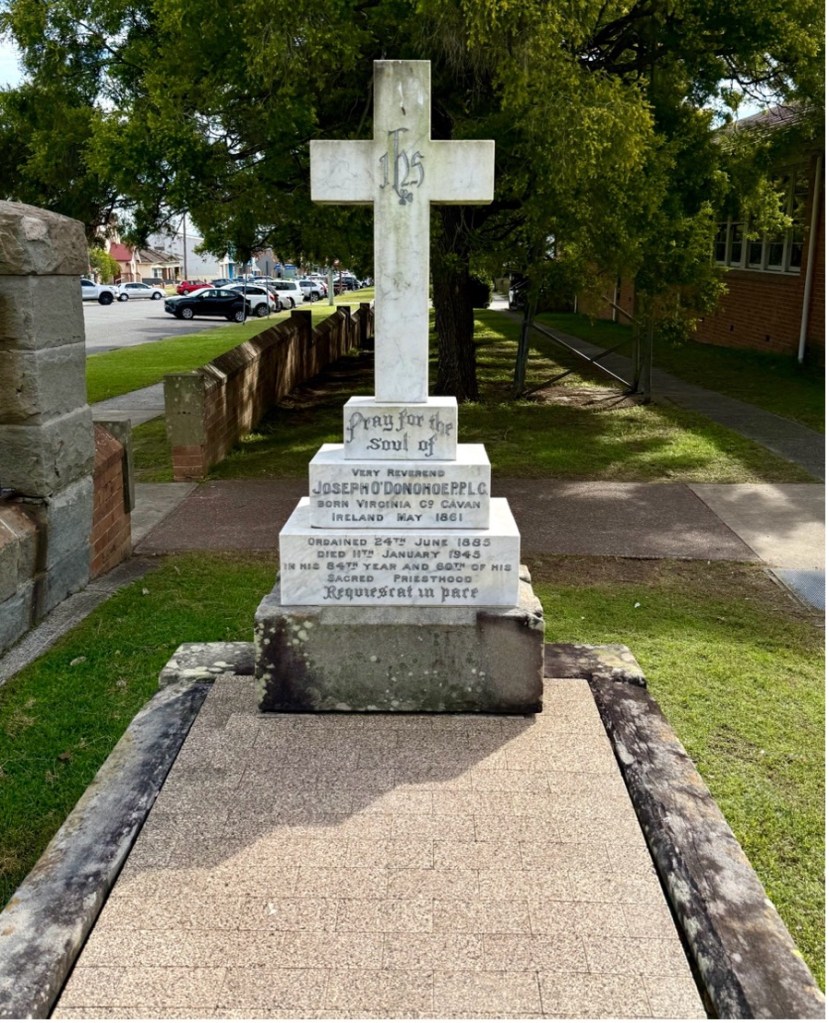
Grave of Rev. Joseph O’Donohue, Parish Priest, in the grounds of St. Brigid’s Catholic Church [Author photo – June 2026]
Appointment of Father B.H. Watson as Parish Priest – 1945 to 1947
Appointment of Father Partick Grace as Parish Priest – 1947
The Manning River Times and Advocate for the Northern Coast Districts of New South Wales of 8 November 1947, page 8, reported:
‘A number of alterations have been made by the [Catholic] Bishop of Maitland in connection with the Maitland Diocese. These have been necessary owing to the death recently of Rev. Fr. Watson, of Raymond Terrace. …. Rev. Fr. Grace, from Tighes’ Hill to Raymond Terrace.’
The Catholic Weekly of 13 November 1947, page 20, also reported:
‘The Rev. Father P. Grace has been appointed parish priest of Raymond Terrace, in succession to the late Father B. H. Watson. Father Grace was at one time attached to the parish of St. Mary’s, Newcastle, as assistant to the late Father M. F. McAuliffe. In 1925 Adamstown was made a parish — the last to be created by the late Bishop Dwyer — and Father Grace was appointed its first rector. After only a few years there, Father Grace was instrumental in having a presbytery and a model convent school erected. Incidentally, the school was built to his own design. From Adamstown Father Grace was transferred to Tighe’s Hill, where he continued his work as a notable organiser. Rosedale Hall was secured and proved a great asset to the parish. Father Grace has gained wide popularity in the parishes of Newcastle.’
Farewell to Both Assistant Priests Father Cichalini and and Father O’Donovan – 1948
The Newcastle Morning Herald and Miners’ Advocate of 10 April 1948, page 4, reported:
‘Parishioners of. St. Brigid’s Church, Raymond Terrace, farewelled Father Cichalini in the church hall. Mr. J. M. Feeney presided. Father Cichalini was presented with a wallet of notes by the parishioners. Presentations were also made by the Younger Set and the Tennis Club. Mr. P. D. Hughes spoke on behalf of the H.A.C.B.S., Mr. J. Saunders, for the A.H.C. Guild, Mr. F. Edstein for St. Vincent de Paul Society, Miss R. Hughes for the Children of Mary and Mrs. G. Cunningham for the Legion of Catholic Women. Father Cichalini thanked the gathering for the compliments paid him and for the presentations. Visiting clergy were present from Dungog, Kurri Kurri and East Maitland. Father M. O’Donovan [Assistant Priest], successor to Father Cichalini, was welcome’
Summer School held at Raymond Terrace for Country Children – 1949
The Catholic Weekly of 3 March 1949, page 6, reported:
‘During the school vacation a Summer School, arranged and organised by the Rev. Father P. G. Grace, P.P., for children of the outlying districts of the parish, was held at Raymond Terrace, and was an outstanding success in every way.
Boys and girls from seven to 14 years of age attended from Tea Gardens, Karuah, Medowie, Kooindah, Tomago and Mt. Kenway. The Rev. T. Williams and the Rev. B. O’Hearn (recently ordained deacons), assisted Fathers Grace and Donovan with the instructions. The programme included daily Mass, which was explained, step by step, religious instruction given in class groups in the morning; sport, game and recreation in the afternoon and lantern slides and explanations in the evening.
he Legion of Catholic Women assisted Father Grace in securing accommodation for the children with families in the parish. Their Lordships Bishop Gleeson, C.SS.R., and Bishop Toohey visited the school. On the last Sunday there was a general Holy Communion of the children. A number made their First Holy Communion. This was followed by breakfast arranged by the Legion of Catholic Women.’
Raymond Terrace educated Sister of Mercy dies at Grafton – 1950
The Catholic Weekly of 11 May 1950, page 6, reported:
‘Sister M. Joseph McAuliffe, who died at the Convent of Mercy, Grafton, on April 27, was the first child to receive Holy Communion and to be confirmed at the then newly-built church at Raymond Terrace. Born at Wallsend, on April 5, 1869, Sister Joseph …… received her early education from the Sisters of Mercy, Raymond Terrace. In 1892 the McAuliffe family came to the Richmond River district, and in 1898 she entered the novitiate of the Sisters of Mercy, Grafton, and was professed in 1901. Sister Joseph was in the first contingent of Sisters of Mercy sent to staff the convent school at Kempsey, and later was stationed at Cowper, Tatham, Maclean and Grafton.’
Parish Priest, Father P. G. Grace, recovering from illness – 1951
The Catholic Weekly of 8 March 1951, page 6, reported:
‘The Rev. Father P. G. Grace, parish priest of Raymond Terrace, and previously attached for long periods to Tighe’s Hill and Newcastle, is making satisfactory progress in St. Vincent’s Hospital, Sydney, from his long and severe illness.’
Catholic Centenary Ball – 1952
The Maitland Mercury of 16 June 1952, page 6, reported on the Parish Centenary Ball:
‘The Bishop Coadjutor of Maitland (Dr. Toohey) received the seven debutantes at the Roman Catholic ball held in the pavilion at Raymond Terrace on Friday night. Dr. Toohey, accompanied by Father Grace, led the official party into the hall for the presentation. They were accompanied by Mr. Pat Hughes, president of the ball committee, and Miss Aileen Hughes in aqua-marine faille; the president of Port Stephens Shire (Cr. S. Rodgers) and Mrs. Rodgers in old gold embossed velvet made with a panniered skirt; the Mayor of Maitland (Ald. J. Harvey) and Mrs. Harvey in dusty pink crepe; and Fathers O’Donovan and O’Hearne.
The debutantes proceeded down the hall through a large shamrock, and were preceded by Mrs. Colin Morris, the matron of honour, gowned in a frock of platinum blue slipper satin, embossed in sliver thread, rhinestones and seed pearls, and carrying cyclamen cattleya orchids tied with blue nylon streamers.
The debutantes and their partners were Anne Edstein (Paul Cunningham), in satin striped crepe plassy; Dorothy Considine (Ken Smith) in silk lace over taffeta, full gathered skirt; Kathleen Considine (Ron Considine), white nylon over taffeta, lace yoke; Patricia Keegan (Kevin Keegan), figured organdie over taffeta made with scalloped neck and waistline; Rita Moy (Thomas Hughes), white taffeta with satin ribbon trimming; Judith McDonald (Ray O’Donoghue), chenille figured organza over taffeta, portrait neckline; Marlene Feenev (Gerald Hughes), broderie anglaise nylon yoke, trail of hand-made flowers on skirt.
Flower girls were Denise and Bernice McDonnell, twin daughters of Mr. and Mrs. J. McDonnell, who wore mauve organdie with skirts caught up with flowers, and trails of flowers in their hair. The pages, in white satin suits, were Douglas Hickling and John O’Brien. The presentation finished with the debutantes dancing The Valeta. The debutante’s carried bouquets of pink camellias, carnations and white hyacinths, surrounded by pink tulle, and wore similar sprays in their hair.’
Boxing Night to aid Church Funds – 1953
The Raymond Terrace Examiner and Lower Hunter and Port Stephens Advertiser of 29 January 1953, page 1, reported:
‘The Boxing Night held in aid of the Catholic Church Parochial Funds on Friday night turned in some first-class entertainment but was very poorly attended. The newly-renovated R.S.L. Hall was used for the first time and the promoters of the function wish to take this opportunity of cordially thanking the R.S.L. Committee for use of the hall. They wish to express appreciation for the ready help and spirit of cooperation displayed by the President and Secretary and to congratulate the League on the really first-class appearance and fittings of the building.
Mr. Jack O’Connor brought five of his best boys from Karuah gratis while Mr. Tom Maguire and a troupe of four boys came from Newcastle. Mr. Ted O’Connor also from Maitland, gave transport to three lads from Maitland. With Mr. Ken Hickling announcing and refereeing the bouts the night opened with the much-awaited return match between Mickey Foley of the Terrace and Barry O’Connor of Maitland. ……
Father O’Hearn [not attached to the Raymond Terrace parish] then thanked all the competitors, Mr. Ernie Moylan, for his work on the door, Mr. Ed. Feeney and Mr. Les Banton for their assistance and finally Mr. Ken Hickling for conducting the show.’
Death and Funeral of Parish Priest, Father Patrick Gerald Grace – 1953
The Dungog Chronicle of 28 March 1953, page 4, reported:
‘Reverend Father Grace died at Raymond Terrace on Wednesday. He was aged 73. He had served as parish priest at Raymond Terrace for. the past, six years. In the early years of his service he was stationed at the Newcastle Presbyteries of St. Mary’s, Tighe’s Hill and Adamstown. At Maitland some years ago he was a Catholic examiner. Solemn Requiem Mass preceded the funeral on Thursday morning.’
The Catholic Weekly of 9 April 1953, page 2, reported:
‘The Rev. Father Patrick Gerald Grace, parish priest of Raymond Terrace, who died recently at Mater Misericordiae Hospital, Waratah, was a former Inspector of Schools in the Maitland Diocese. Father Grace had been ailing for some time and his death was not unexpected. Conscious right to the end, he devoutly received all the Last Sacraments, and his last words were a request that those at his bedside should recite the Rosary. While it was being recited Father Grace died peacefully.
At Raymond Terrace parish church 66 diocesan priests were joined by Redemptorist Fathers, De La Salle Brothers, Daughters of Charity, Sisters of Mercy, and a large congregation of parishioners in celebrating the Solemn Office and Requiem. His Lordship Bishop Gleeson presided and also in the sanctuary was His Lordship the Coadjutor Bishop, the Most Rev. J. Toohey, D.D.
Senior curate of the parish (the Rev. Father B. O’Hearn) was celebrant of the Mass, with the Rev. Fathers D. McAlinden and J. P. Burke deacon and subdeacon. The Rev. Father J. J. O’Dwyer was master of ceremonies. Chanters of the Priests Choir were the Rev. Fathers J. Lavery, G. Flatley, D. Heffernan, and D. Gooud.
Before the final Absolution Bishop Gleeson paid a very high tribute to the excellence of the departed parish priest. The remains were laid to rest in the parish cemetery beside the graves of two former parish priests. Father Grace was born at Dunmanway, County Cork, Ireland, on April 28, 1880. He completed his studies at St. Patrick’s College, Thurles, and was ordained in Thurles Cathedral by Archbishop Harty on June 15, 1917.
Since his arrival in the diocese of Maitland, he had been assistant at Newcastle (1928-1925), first rector of Adamstown (1925-1932), rector of Tighe’s Hill (1932-1947) and parish priest of Raymond Terrace (1947 until his death). Father Grace was also the author of a very popular series of articles on the Mass in the Catholic Sentinel.’
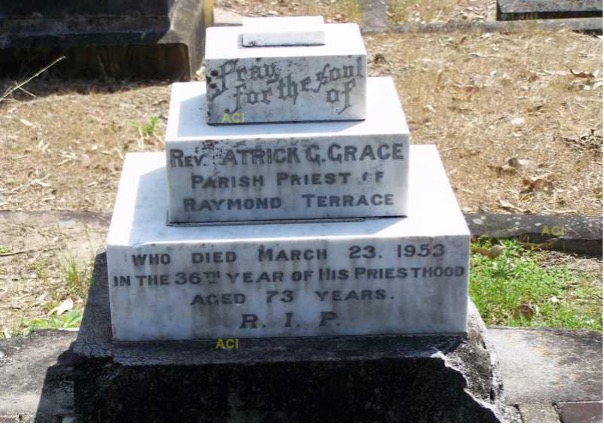
Grave of Rev. Patrick Grace at Pioneer Hill Cemetery, Raymond Terrace [Australian Cemeteries Index]
Welcome to New Parish Pries, Father John Morrissey – 1953
In April 1953, the Bishop of Maitland, Rev. Dr. Gleeson announced the transfer of Rev J. Morrissey, the former parish priest of Kendal parish, to the Raymond Terrace parish.
The Maitland Mercury of 21 May 1953, page 4, reported:
‘About 150 parishioners of St. Brigid’s Church, Raymond Terrace, welcomed their newly appointed parish priest, Father Morrissey, in C.U.S.A. Hall on Sunday evening after devotions. Father Quinn, who journeyed from Bulahdelah, spoke of his long association and friendship with Father Morrissey. Mr. F. W. Edstein welcomed Father Morrissey on behalf of the parishioners and reminded all present that St. Brigid’s would celebrate its centenary this year.
The assistant priests, Father O’Hearn and Father Macalinden, also extended a welcome. A representative from the various societies and church organisations also spoke. Musical items were provided by Mrs. O’Brien, Mrs. B. Smith, Miss Y. Edstein, Mr. Frank and Jack Thomas, of Newcastle.
Father Morrissey, returning thanks for their welcome, assured them that he was happy to be appointed to Raymond Terrace.’
Induction Ceremony for Father Morrissey – 1953
The Catholic Weekly of 20 August 1953, page 11, reported:
‘His Lordship conducted the solemn induction ceremony of the new parish priest of St. Brigid’s parish, Raymond Terrace, the Rev. Father James Morrissey. His Lordship was met by a guard of honour as he arrived at the parish church for the 9.30 a.m. Mass. Father Morrissey was celebrant of the Mass, during which His Lordship preached.’
St. Brigid’s Younger Set Ball – 1953
The Newcastle Sun of 7 October 1953, page 12, reported:
‘Miss Teresa O’Brien was announced winner of the popular girl competition held by St. Brigid’s Church, Raymond Terrace, at the annual ball of St. Brigid’s Younger Set. She was crowned by the Bishop of Maitland (Most Rev. E. Gleeson, C.SS.R.), who attended the ball. The competition raised £1216 for church funds. Other candidates were Misses Patricia’ Keegan, Maureen Hofman and Jill Burke. Each girl received a gift from Rev. J. Morrissey. P.P. Later the official party and mothers of the candidates were entertained at supper, arranged by a committee headed by Mrs. J. M. Feeney.’
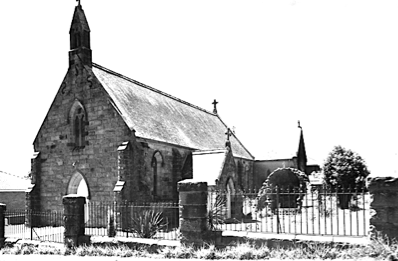
St. Brigid’s Church, 1974 [Newcastle Library]
Concluding Comments
St Brigid’s Catholic Church and Parish at Raymond Terrace has a vibrant history testament to the strong faith of its parish community.
In 2024, the 163-year-old St. Brigid’s Church was temporarily closed for repairs and renovations.
It reopened for services on Sunday, 10 August 2025.
The most notable refurishment during the closure was the installation of seven new glass windows.
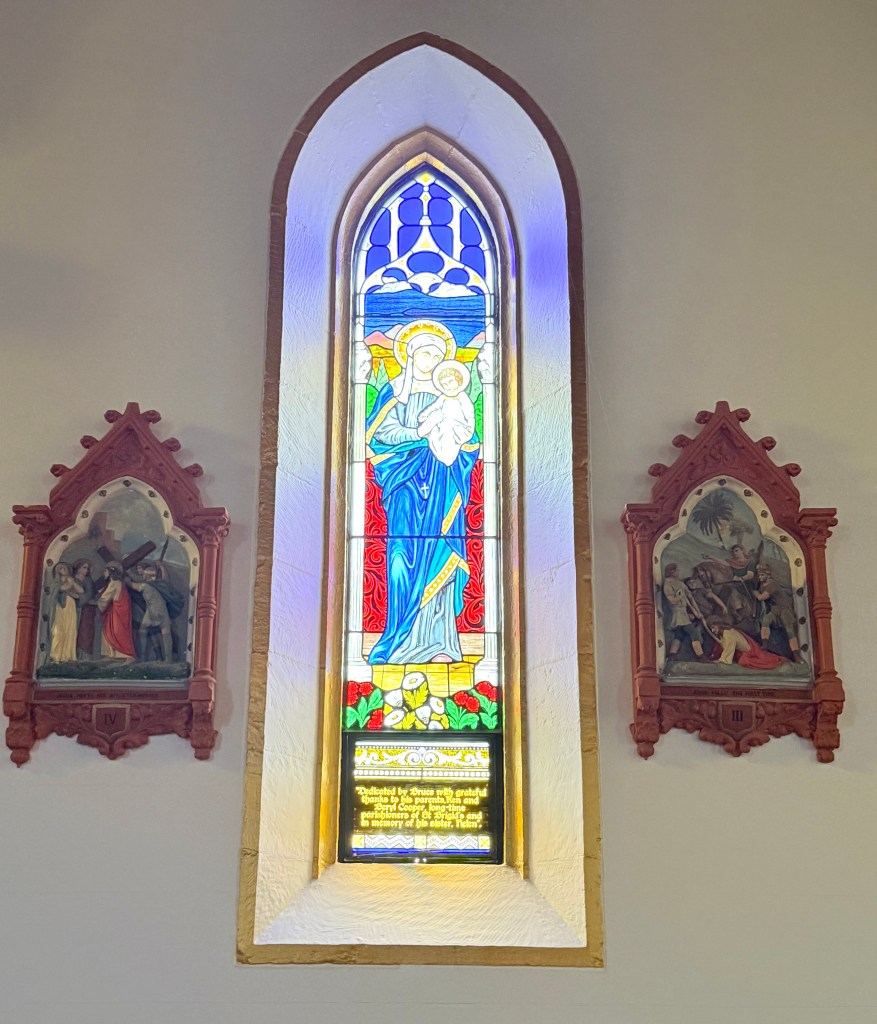
One of the seven new installed stained-glass windows [Author photo – June 2026]

Interior of St Brigid’s showing the Sanctuary and the original chancery arch [Author Photo -July 2026]
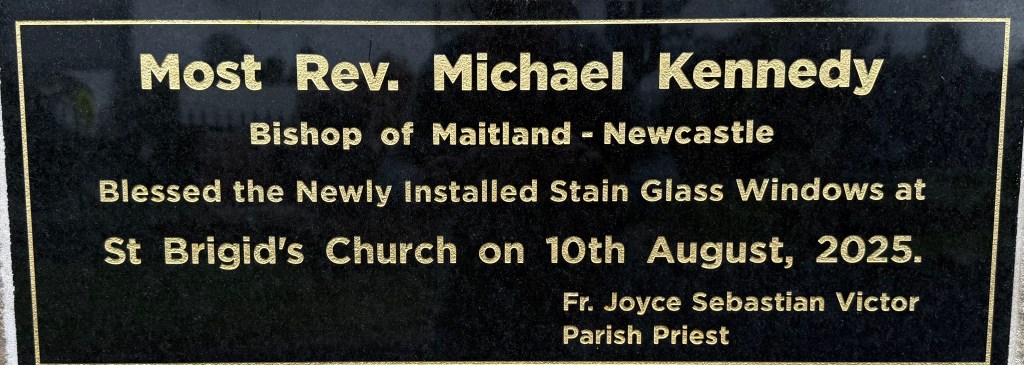
Plaque commemorating the Blessing of the newly installed glass windows by Bishop Michael Kennedy [Author photo – June 2026]
Two bells were never installed at St. Brigid’s, although space for them had been originally provided for at the top of the front wall.
As a footnote to the story, Father Eugene J. Luckie, who planned and oversaw the construction of St. Brigid’s Church, was transferred from Raymond Terrace to the Pyrmont Parish in Sydney in 1863, where he became the first priest in charge.
Drawing on his church-building experience at Raymond Terrace, he began construction of St. Bede’s Church at Pyrmont, a stone building completed in 1867.
The two churches share similar features both in the exterior stonework and the interior chancel arch.
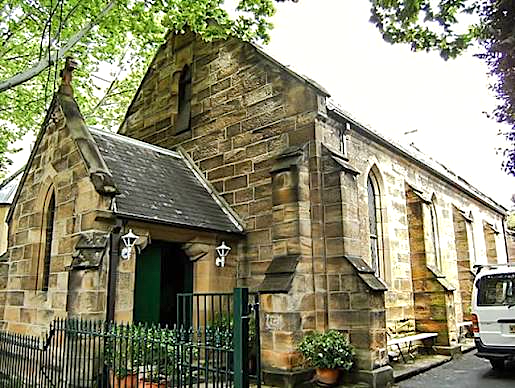
St. Bede’s Catholic Church, Pyrmont, constructed in 1867 while Rev. Eugene J. Luckie was parish priest [Pyrmont History Group]
The histories of several churches in the Port Stephens region are published on this website and can be viewed at the following links:
Early History of All Saints Anglican Church at Nelson Bay – Port Stephens
The Carrington Church at Port Stephens
St. Andrews Anglican Church at Tea Gardens – Port Stephens
St. Saviours Anglican Church at Williamtown – Port Stephens
St. Michaels Catholic Church at Nelson Bay – Port Stephens
History of the Methodist Church at Nelson Bay – Port Stephens
Former Uniting Church at Williamtown – Port Stephens
Researched and compiled by Kevin McGuinness
June 2026


