
Introduction
Two steam-powered vessels named after England’s sailor king, William the Fourth, were integral to the early New South Wales steam boat fleet. Both were owned by the Sydney merchant and shipowner Joseph Hickey Grose.
One was the William the Fourth (known locally as the ‘Billy’) being the first coastal steamer to be constructed in New South Wales and launched in 1831.
The other was the steamer, King William the Fourth, built at Rotherhithe U.K. in 1830 and imported to New South Wales by Joseph Grose in 1838.
King William the Fourth departed from London under Captain Stamp on September 22, 1837, arriving in Sydney on January 20, 1838. Its engines, produced by Boulton and Watt of Birmingham, delivered 35 horsepower each.
The vessel measured 140 feet in length and 18 feet in width, featuring a narrow design suited for river navigation. Lloyd’s [Insurance] committee declined to grant her classification as a sea-going vessel due to her five-foot draught. Her maximum speed approached eight knots.
Her tenure along the New South Wales coast was brief, spanning the period from January 1838 to July 1839. During her short maritime life in the Colony, the steam boat made several trips to Port Stephens.
The story of the King William the Fourth and its connections to Port Stephens is told in this paper. Many of the references cited simply refer to the steam boat as the King William.
Joseph Hickey Grose – Steamship Owner
Joseph Hickey Grose was a Sydney merchant and steamship owner.
In 1830, Enthused by reports of the successes of steam-powered vessels in England, Joseph Grose commissioned Scottish shipwrights William Lowe and Marshall to construct a paddle-steamer for the Sydney to Hunter River trade.
The ship, William the Fourth, was launched from the Deptford yards, at Clarence Town on the Williams River, on 22 October 1831. It was the first coastal steamer constructed in New South Wales.
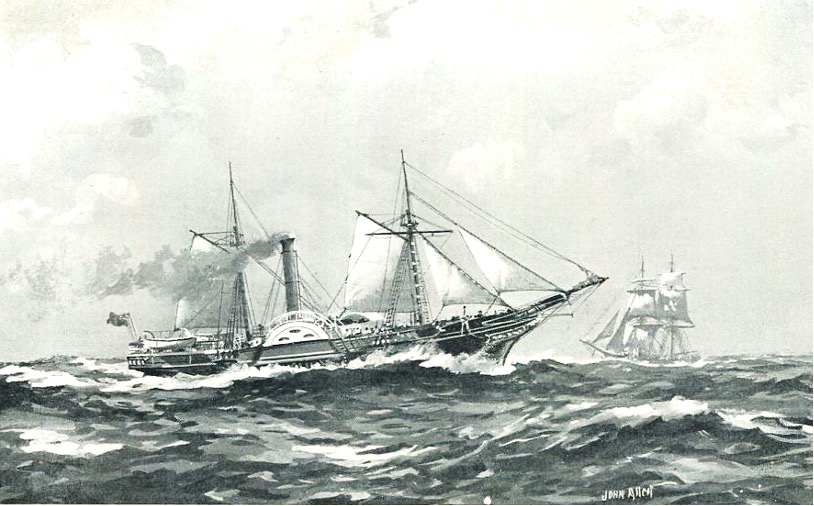
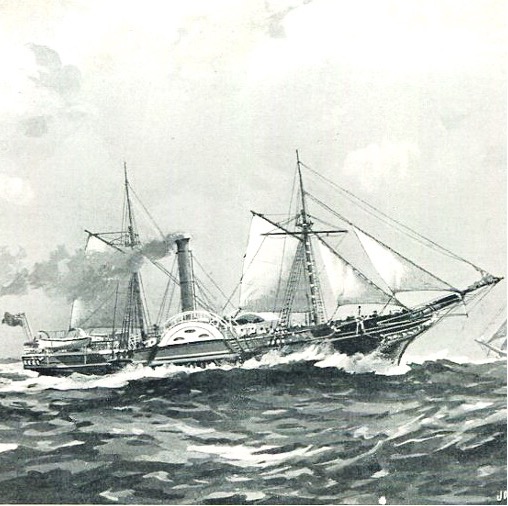
Artistic impression of the Paddle Steamer ‘William the Fourth’. The ‘King William the Fourth’ would likely have had a similar design
In 1832, Grose purchased the 153-ton paddle steamer Sophia Jane, which had arrived in Sydney from England in May 1831. This resulted in him gaining a dominant share of the Hunter River steamer trade for many years, connecting his Morpeth wharf and store with Sydney.
He expanded his fleet by importing the 141-ton James Watt in 1837 and the swift King William the Fourth in 1838.
Facing drought and competition from the Hunter River Steam Navigation Co. in the late 1830s, Grose turned his attention to developing the Clarence River Valley, dispatching 8000 sheep there in 1839.
Grose offered the King William the Fourth for a pastoral survey the area to be led by Deputy Surveyor General, Samuel Perry, in May of that year. This was a significant historical event as the vessel became the first steamship to enter the Clarence River.
The King William the Fourth was wrecked on the Newcastle oyster-bank under Captain Prescot in July 1839.
In 1849, Mr. Grose commissioned Mr. Chowne of Pyrmont to construct the 119-ton steamer ‘Sovereign‘ utilizing the salvaged engines from King William the Fourth.
The New Steam Boat, King William the Fourth – 1838
The Commercial Journal and Advertiser of 31 January 1838, page 2, reported:
‘Mr. Grose’s new steam boat, the King William IV., starts for the Green Hills [Morpeth] next week’.
The Sydney Herald of 5 February 1838, page 2, also reported:
‘Two additional steam boats will be laid on the Hunter’s River trade during the present month. Mr. Grose’s steam-boat King William appears to be a splendid vessel. She is only 81 tons steam measurement and has two engines of thirty-five horsepower each; her draught of water, it is expected, will not exceed five feet. It is intended she shall make the passage by daylight, leaving Sydney every Wednesday and Saturday morning, and the Green Hills [Morpeth] every Monday and Thursday morning at seven o’clock.’
The Sydney Gazette and New South Wales Advertiser of 13 February 1838, page 2, further reported:
‘The King William the Fourth, steam boat, will be in readiness, it is confidently expected, to commence running to Hunter’s River the latter end of this week. The cause of her detention at present, is in consequence of some trifling work to be done on board which could not be executed last week in consequence of the unfavourable state of the weather.’
King William the Fourth Travels to Port Stephens – 1838
The Commercial Journal and Advertiser of 10 March 1838, page 3, reported:
‘On Thursday [8th instant] the King William the Fourth, Steam Boat, was specially despatched to Port Stephen’s to bring up the body of Colonel [Henry] Dumaresq, Commissioner of the Australian Agricultural Company who died at Tahlee, Port Stephens on 5 March 1838, for interment, and may be hourly expected.’
Quick Trip to Morpeth – 1838
The Sydney Gazette and New South Wales Advertiser of 17 March 1838, page 2, reported:
‘The King William the 4th, steamer, made an expeditious trip from the Green Hills [Morpeth] last Monday, having sailed at seven o’clock, a.m., and arrived at her owner’s wharf at seven o’clock, p.m.’
King William the Fourth takes refuge in Port Stephens after a near sinking – 1838
The Colonist of 29 August 1838, page 2, reported:
‘The King William Steam-boat left the Green Hills [Morpeth] for Sydney, on the morning of Monday the 20th instant. On leaving Newcastle the wind was northwest and continued so for an hour or two. Afterwards, however; it veered round gradually to the southwest and freshened up into a smart gale towards the evening. The vessel was then pretty well up with Broken Bay, but was evidently drifting to seaward, and making little or no headway; her engines being much too weak to contend with the head wind and the rising sea.
About eleven o’clock, she had got within six or eight miles of the Heads [Sydney], (the South-head Light being clearly visible from her deck), when vainly contending with the wind and waves she was struck by a sea which laid her upon her beam-ends and carried away her stern-boat, the only one attached to the vessel. It was some time before she righted, and the short period of suspense was really alarming; but the paddle-box on the starboard side providently brought her up, and the captain was consequently, enabled to bring her round before the wind, and stand to the northward, it being impossible to reach either Port Jackson or Broken Bay.
The situation of the vessel during the night was sufficiently perilous; for, although the gale was by no means such as would have been considered serious in a tight sailing vessel, the chances were all against such a vessel as the King William, in such a gale on such a coast as this.
It was one o’clock on Tuesday the 21st, when the King William reached the entrance of the harbour of Newcastle. The wind was then blowing quite a gale from the southwest—of course right down the channel—and a heavy sea was running off Nobby’s; but as all her steam was up, and as she seemed to advance tolerably well for a few paces, every person on board was congratulating himself on the prospect of landing at Newcastle and getting a comfortable breakfast, (for nobody had thought of breakfast on board), in a quarter-of an hour or so, when suddenly—like a heifer that has been driven up with much ado to the door of a slaughter-house, and that suddenly wheels round and eludes the whole fraternity of butchers-she turned her broadside deliberately to the wind, steam and all, and the honest captain, wishing apparently to make the best of his bad bargain, hoisted the jib or foretop-mast staysail, (the one or other of these sails having been blown to pieces during the night), to enable her to make her conge [rejection] with a good grace.
In such circumstances there was no other resource but to run for Port Stephens, and providential it was, indeed, for the King William, and all on board her, that there was such a port to run for; for if there had not, or if, she had missed it—a very probable event in such hazy squally weather—there would most assuredly have been an end of the vessel and all her company, as she certainly could not have rode out another night at sea in such weather. As it was, with a strong gale and a heavy sea, a weak unmanageable vessel and a lee-shore, the probabilities were by no means in her favour. Through the good providence of God, however, she reached the noble inlet of Port Stephens at dusk on Tuesday evening.
The Tigress, whaler, being at anchor in that harbour at the time, the cabin passengers, five in number, obtained one of that vessel’s whale-boats with her crew next day to row them fifteen miles up the inlet to the Agricultural Company’s crossing place near Carrington, and after walking other [remaining] fifteen miles they reached the hospitable mansions of Irrawang and Roslin Castle [both near Raymond Terrace], near the confluence of the William and Hunter [rivers], in the evening of Wednesday.
It was Thursday evening before the party, some on foot and some on horseback, reached Maitland, where one of them, Charles Blaxland, Esq., heartily tired of seafaring, bought a horse, and rode overland to Sydney. The rest came up on Saturday by the Sophia Jane.
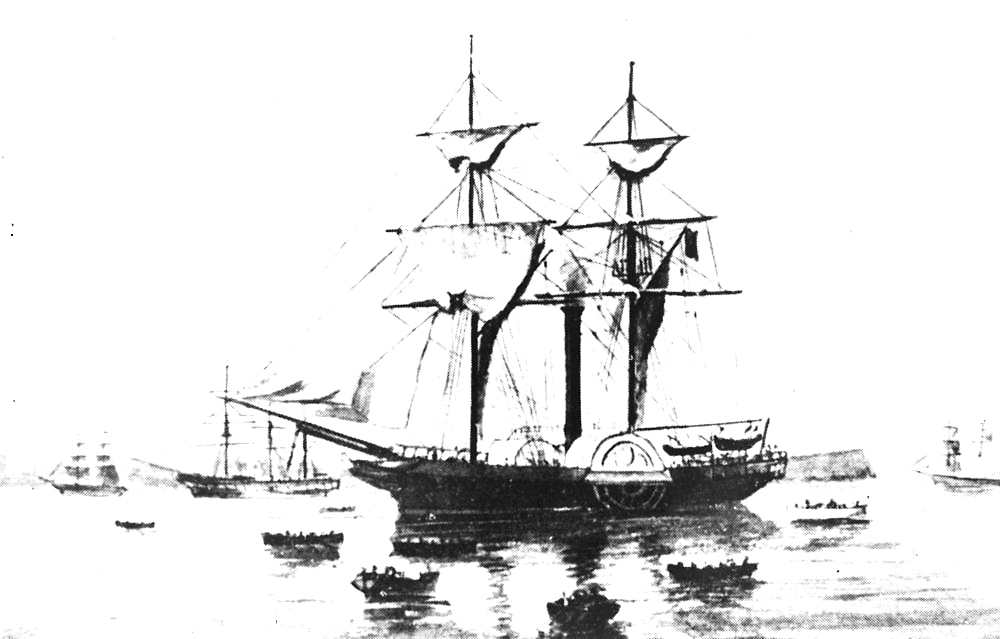
Paddle Streamer – ‘Sophia Jane’
Everything that could have been done in such circumstances was done by the Captain of the King William; to whom, for his zealous and unremitting efforts on the occasion, the highest praise is due. The following testimonial to that effect, to which we are most happy to give insertion, was placed in his hands [of Captain Charles Payne] by the cabin passengers on their leaving the vessel.’
The letter: ‘On board the King William, Port Stephens, August 22, 1838. Dear Sir,- We, the undersigned (cabin passengers per the King William, bound from Morpeth to Sydney, beg to express to you our sincere and very thankful thanks for your zealous and indefatigable exertions since the commencement of our singularly perilous and unfortunate voyage; to which, under the good providence of Almighty God, we consider ourselves indebted for the preservation of our lives; as also for the safety of the vessel, with that of all the persons and property on board.
Wishing you, all success in your future life, we are, Dear Sir, Your much obliged and very grateful servants, John Dunmore Lang, James Kenworthy, Patrick Walsh Mallon, Surgeon, Charles Blaxland. William Sparke.
But we have a word or two to say, in the hearing of our friends the public, to the owners of the King William, Messrs. Grose and Co, who, if the vessel had gone down and all on board perished – an event by no means improbable for some time – would have been accountable at a higher tribunal than man’s for their loss.
The King William was originally a London river boat, evidently intended for smooth water sailing, and never meant for so stormy a navigation as must be reckoned on in the wide Pacific between Port Jackson and Hunter’s River. Her draught of water is so small as to leave the rudder no command over her in a heavy sea, so that she becomes quite unmanageable in a gale. Her machinery also is much too weak for the work she must often have to do off this coast, and it is consequently not merely a Grose imposition, it is absolutely nothing less than sheer trifling with the lives of Her Majesty’s subjects, to place such a vessel on such a course, especially in the present advanced, state of the colony and of steam navigation.
At the same time if Her Majesty’s subjects suffer their lives to be trifled with in this manner, by interested parties like Messrs. Grose and Co. any longer, by patronising the King William as a Hunter’s River trader after this warning, when there are better boats on the course, they will have themselves and themselves only to blame. But unfit as the King William must have been for the ocean part of the Hunter’s River voyage in her best estate, she was in the worst possible condition for encountering a storm at sea on her recent voyage from Maitland. Her engines were in the worst possible order. The boiler and the decks both leaked and the pumps were choked; and during the greater part or the voyage the cabin, which seemed, like the door of an Irish cabin on shore, to be the natural outlet for both smoke and steam, was insupportably hot and suffocating.
In a word, she was altogether unfit for such a voyage. We should be sorry to cast such reflections as these gratuitously on Messrs. Grose and Co., to whom the colony is much indebted for their enterprising spirit in the matter of steam navigation; for although it was not Mr. Grose who set the first steamboat to work in this colony, he was certainly the first person in the colony that thought seriously on the subject; for his little William the Fourth, which now plies between Sydney and Port Macquarie, had been some time on the stocks, when Captain Biddulph and the Sophia Jane unexpectedly arrived from England.
But the interest of the public generally imperatively requires of us, as their virtual trustees, to insist upon the removal of the King William from the Hunter’s River course forthwith. Indeed, as she will eventually, and at no distant period too, be driven off that course by better vessels, we would recommend to Messrs. Grose and Co., to anticipate such a result by removing her at once, and of their own accord.’
Connection with Captain Willian Cromarty’s Death – 1838
Captain William Cromarty arrived in NSW with his wife in 1824 and was a prominent pioneer in the Port Stephens area. Due to his services at Port Stephens to the Australian Agricultural Company, he received a land grant near Booral but didn’t settle there. In 1833, he became Newcastle’s pilot, and later resigned after an injury.
William Cromarty moved to Soldiers Point, Port Stephens, working cargo with his ship ‘Fame‘. He and his son died in 1838 while salvaging a whale boat [that had been swept from the deck of the King William the Fourth] from One Mile Beach, near Anna Bay.
The Sydney Herald of 19 September 1838, page 2, reported:
‘We alluded in a late number, to the melancholy death of Mr. Cromarty well known to the old hands, in this Colony as captain of the old brig Fame; which now lies sunk at the head of Sydney Cove, and lately a settler on the south shore of Port Stephens, and for a short period pilot at Newcastle. We have been favoured with the sight of a letter containing a detail of the circumstances attending poor Cromarty’s death, from which we make the following extract: –
“You have doubtless heard of the steamer King William losing her boat in a gale of wind; Mr. Scott and Major Crummer of Newcastle wrote to Cromarty to endeavour to find her, and, if possible, get her into Nelson Bay; the man who was sent with this letter was lost for three days in the bush, and at last made the Tigress whaler, lying in Nelson’s Bay, the men belonging to which vessel conveyed him in a boat to Cromarty’s place, at Soldier’s Point; he told Mr. Cromarty he had seen the boat, and Cromarty returned with him for the purpose of putting the man safe on the Newcastle Beach, and examining the boat, which was lying on the One Mile Beach, just within Point Stephens; he returned home, and on Saturday, the 1st instant, started early in the morning with his son William, an assigned servant, and a native black, each taking an oar, and walking to the place where the boat was lying, intending to bring her into the harbour; he would not take any provisions with him, as he said he would be on board the Tigress in three or four hours.
This was the last that was seen of poor Cromarty; towards evening, his wife was anxiously expecting him, and when night came without his arrival, was in a dreadful state of suspense. The following morning a ship was seen coming in, and it was supposed that he had gone on board of her; but on the Monday, when the ship was at anchor, and the Captain of the Lady Blackwood, which was the name of the vessel, said he had seen nothing of them, the dreadful truth was suspected.
A native black named Bill Wicki was sent in search, and he returned in a few hours with Cromarty’s boots, William’s shoes, and the servant’s hat, and described the boat as being bottom upwards, with three oars lying a short distance off. The poor old gentleman’s snuffbox has since been found, but no traces of the bodies have been discovered.”
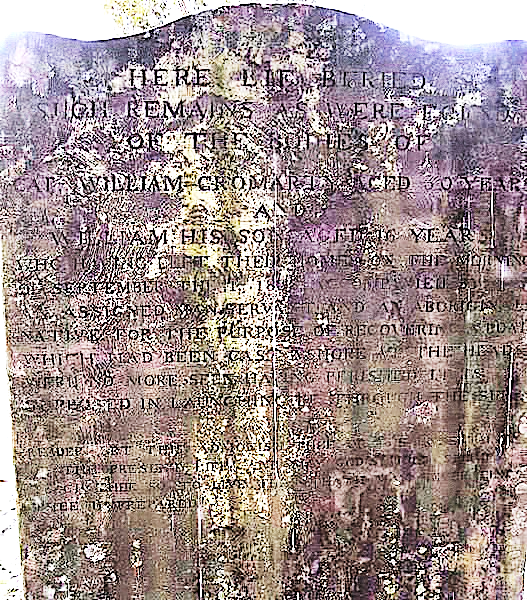
Gravestone of William Cromarty at Carrington Cemetery – Port Stephens
Of course, the exact method in which these unfortunate people came to their death is not known, but it is presumed that they launched the boat off the beach, but that before they could get her clear of the surf, which beats in very heavily, she was turned over by the rotters and went on shore again but that the bodies were caught by the drawback and taken so far out that the return of the surf did not bring them on shore. Mr Cromarty was a very worthy man and was very much respected.’
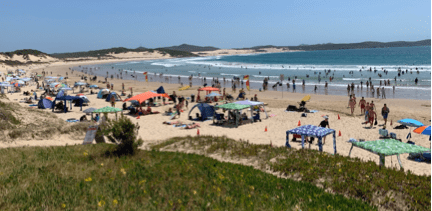
One Mile Beach, near Anna Bay, Port Stephens [Author photo]
Planned expedition to the Clarence River – 1839
The Colonist of 27 April 1839, page 3, reported:
‘We understand that the government have taken an interest in the projected expedition of the King William (steamer) to the Big River [Clarence River]; and that Captain Perry, the deputy Surveyor-General, will proceed on the trip to bring an official report. More applications have been made for passages than there are accommodations, and some difficulty will be felt in securing berths. The steamer, it is expected, will set out on her voyage about the middle of May.’
King William the Fourth sails back to Port Stephens with passengers – 1839
The Colonist of 18 May 1839, page 2, reported:
‘The King William steamer sailed for Port Stephens yesterday evening, with Captain King and family on board, who will now take up his residence on the Australian Agricultural Company’s Establishment [at Tahlee, near Carrington, Port Stephens], to the management of whose affairs Captain King has lately been appointed.’
Clarence River Expedition commences from Sydney with convicts onboard – 1839
The Sydney Gazette and New South Wales Advertiser of 21 May 1839, page 2, reported:
‘The King William steamer took her departure [from Sydney] for the Big River [Clarence River], calling at Port Macquarie, yesterday evening at six p.m. Her passengers were the Deputy Surveyor General, Captain Perry, and Messrs. G. Bowman, W. Bowman, – Milson, – Foss, W. Briggs, – Williams, and J. Turner. For Port Macquarie, Mr. Montefiore, Mrs. Oakes, Mrs. Watt, eight steerage passengers, and forty prisoners of the crown.’
King William the Fourth runs aground at Newcastle on route to Port Macquarie – 1839
The Sydney Gazette and New South Wales Advertiser of 23 May 1839, page 2, reported:
‘The King William, which left this port [Sydney] for the Big River via Newcastle and Port Macquarie, was ashore on the bank inside Nobby’s, but was expected to get off about an hour after the departure of the Sophia Jane from Newcastle. Capt. Griffin of the Sophia Jane joined the King William and would proceed in her to the Big River.’
King William the Fourth Arrives in Sydney after Expedition – 1839
The Sydney Monitor and Commercial Advertiser of 19 June 1839, page 3, reported:
‘The King William Steamer arrived yesterday from her exploring voyage up the Big River. She proceeded about 75 miles up the River, as far as the first falls. She grounded for a short time but was got off. Two men were lost in the bush for a day but were well treated by the blacks. On coming down the King William was visited by about twenty; they we’re very peaceably inclined but did not understand any English.
The country generally was very fine, and in some parts very luxuriant. Kangaroos and birds were in abundance. The following gentlemen have returned by the King William: – Captain Perry, Messrs Bowman, Mr Melsom, Mr Foss, Mr Williams, Mr Bigg, and Mr Turner.’
Wreck of the King William the Fourth – 1839
The Sydney Monitor and Commercial Advertiser of 5 July 1839, page 3, reported:
‘The King William was on her way to Sydney on Monday night, and during a strong gale from the southward, her funnel went overboard, so that they could make no further use of the steam. She endeavoured to put back to Newcastle but could not. She then anchored over a rocky bottom opposite “Redhead,” but the wind increasing, she dragged her anchors and went on shore on the sandy beach. The passengers about twenty-five in number, and the crew got on shore in safety. She soon went to pieces, and when the Tamar passed the spot on Tuesday, the only part of the wreck which could be perceived, was the ends of the boilers above water, and some portion of her cargo, which had washed up on the beach. The colonial or public loss of a steam boat at the present time, is peculiarly great.’
The Colonist of 6 July 1839, page 2, also reported:
‘This fine vessel was totally wrecked at Newcastle, on Tuesday morning. The formal particulars are given in the Captain’s letter to Mr. Grose, a copy of which we here give—
The letter: ‘To J. H. Grose, Esq. Newcastle, July 3, 1839. Sir,—With sorrow and regret I have to inform you of the wreck of the King William at Newcastle, on Monday, at half-past three p.m. at. I left Newcastle, wind southerly; at half-past five, there arose a perfect gale from the S.S.E. with heavy rain, got her head to wind and stood out to sea till about seven, when a link of the funnel shroud broke; the vessel pitching very much, before we could get it secured it came down and fell on the deck—put the fires out—got canvas on her—unconnected the engines—stood away to the north east—midnight wore ship head up S.S.E.; but the swell setting in so strong from the S. E. we could not clear the shore; ran into Newcastle about three o’clock on Tuesday morning, let go both anchors under Nobby’s, but they would not hold; we drifted until a quarter before six, when we struck, but we were so close to the shore that all the passengers and crew were saved.
I saved all the different articles I could, but it is not much at present; the vessel is all to pieces; the boilers went out on the off side; we will not be able to get them today, there is too much surf on; when the weather comes fine with some tackles and more help, we may save some of the wreck. I remain, Sir, Your obedient servant, Henry Prescott’.
There was a very strong fresh in the river which we understand caused the steamer to drift. Mr. Jackson, the pilot, had crossed over from Newcastle in the lifeboat, and was on the beach when the vessel struck. A rope was then passed from the vessel to the shore, by means of which the whole of the passengers escaped. Lieutenant Biddulph, R.N., was on board, and the other passengers speak in the highest manner of his exertions. Two infants that were on board, were tied up in blankets and thrown into the sea and were picked up by the pilot’s crew.
The opinion which the passengers entertain of Mr. Jackson’s exertions, is sufficiently explained by the following letter, and inscription – on a piece of plate which they intend presenting to him:
The letter: ‘To George William Jackson, Esq., Harbour Master, Newcastle, July 2, 1839. Sir,—We, the cabin passengers per King Wiliam the Fourth, this morning wrecked at Newcastle, beg leave to proffer you our most grateful thanks for the prompt assistance you rendered us, and the judicious management you displayed in rescuing us and our fellow passengers from our perilous situation, and we request your acceptance of a trifling memento of the high estimation in which we hold you, bearing the annexed inscription. We are, Sir, Yours most faithfully, John Hector, P. Adams, H. J. Pilcher, E. Biddulph, James Phillips, D. Thompson, George Lord, H. Hill
Inscription: Presented by the cabin passengers per King William, steamer, to George W. Jackson, Esq., Harbour Master at Newcastle, as a mark of their gratitude for the prompt and efficient assistance rendered them during the wreck of that vessel, on the morning of the 2nd of July 1839.’
More Steam Boats required after the loss of the King William the Fourth – 1839
The Sydney Gazette and New South Wales Advertiser of 9 July 1839, page 2, reported:
‘Public attention has been forcibly aroused by the loss of the King William the Fourth, steamer, to the utter inadequacy of the present supply of steam navigation to meet the wants of the Colony. In no respect New South Wales so far behind the mother-country as in the deficiency of steam communication both by land and water. In the course of a very few years, should railway travelling progress as it has done during the last ten years, and as it seems likely to continue to do for many years to come, the whole extent of Great Britain may be traversed, in its length and in its breadth, at the rate of from twenty to thirty miles an hour. The rivers and coasts of Britain are studded with steamers. Thick as the leaves in Vallambrosa’s shade.
The case is very different here; the number of steamers is not only wholly inadequate to meet the wants of the Colony, but such as we have are comparatively useless, most of them having, before making their debut in this port undergone a pretty decent period of servitude in the mother-country.
The first steamer that ever ploughed the waters of Port Jackson, the little Surprise, made its appearance in 1831. Since that period our colonial steam marine has been augmented by the successive arrivals from Britain of the Sophia Jane, the Tamar, the James Watt, the King William the Fourth, and the iron steamer Rapid. There have also been built in the Colony at various periods the William the Fourth, the Ceres, the Experiment, the Australia and the Maitland, forming in all eleven steamers which, at one time or another, have sailed to and from the port of Sydney. ….
Of these , the Ceres and the King William the Fourth are no more, the former having been dashed to pieces, in calm weather, on a rock off Reid’s Mistake [Swansea], on her way from the Hunter to Sydney, and the latter having been wrecked during the gale on Monday week, at the entrance to Newcastle harbour. The Surprise is also out of the Sydney trade, being now, we believe, employed on the Derwent at Hobart Town. Three steamers trade regularly to Hunter’s River, one to Port Macquarie, three to Parramatta, and one alternately to Hunter’s River and Illawarra.
Several of the vessels just enumerated are neither very useful nor very ornamental consequently, they could ill afford to come into competition with vessels of more modern build. Supposing them, however, all successfully employed on one or other of the various stations on which steam vessels are required, we still want, at the most moderate calculation, from fifteen to eighteen additional steamers, for which constant and profitable employment would be obtained.’
Engines salvaged – 1839
The Colonist of 17 July 1839, page 2, reported:
‘We are glad to learn that the engines of the unfortunate King William are completely saved. The steamer William the Fourth arrived here from Newcastle on Saturday, with part of the machinery, and proceeded on Monday night for the remainder, whence it is expected she will return about the latter end of the week, and that she will resume her trips to Port Macquarie on Monday next.’
Concluding Comments
The back story of the vessel King William the Fourth is a testament to the development of the Hunter River steam trade in the early days of the Colony.
When the King William the Fourth visited Port Stephens, the NSW colony was only 50 years old. Most of the area was still in its natural state with its only settlers being the original inhabitants, the Worimi Aboriginal people, and those associated with the Australian Agricultural Company at Carrington.
Few boats entered the Port, mostly seeking refuge only.
Researched and compiled by Kevin McGuinness
July 2026


