
Introduction
Friday 30 July 1915 was officially designated ‘Australia Day’ by the New South Wales government.
The initiative of Manly (NSW) resident, Ellen Wharton-Kirke, it was a patriotic fundraiser for the Australian Red Cross, to support the care of sick, wounded, and dying soldiers returning from the Gallipoli campaign of First World War.
Mrs Warton-Kirke proposed the ‘Australia Day’ initiative to the then Premier of New South Wales, William Holman, to support troops overseas and meet the overwhelming medical needs of First World War casualties.
The idea was accepted and the fund raising date was set for 30 July 1915.
The day was subsequently commemorated in the following wartime years of 1916, 1917 and 1918. Communities across Australia would hold street stalls, pageants, fairs, and concerts, selling badges and ribbons to raise hundreds of thousands of pounds for the war effort.
It is noted that the day is distinct from the current ‘Australia Day’ festivities held each year on 26 January, which was only adopted by all by State governments as a national holiday in 1946. In prior years, individual states held various commemorative days of their foundings. In New South Wales, 26 January was historically celebrated as Foundation Day/Anniversary Day.
Ellen Wharton-Kirke MBE
Ellen Wharton-Kirke, M.B.E., was a Sydney mother of five who raised more than £1,000,000 for wounded First World War soldiers, through the fund-raising campaign events that she inspired. Her four sons served in the First World War.
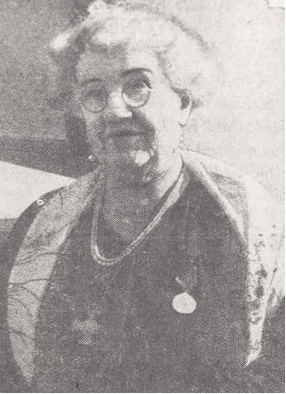
Ellen Wharton-Kirke
A plaque to the memory of Ellen Wharton-Kirke was erected in Gilbert Park, Manly, NSW, in 2023, which reads:
‘Manly`s Ellen Wharton-Kirke was an amazing woman … a hero of World War 1 without firing a shot. In the early 1900s, this part of Manly…the Corso…was home to Ellen; it’s where she shopped for her large family, where she yarned with her friends, where she was at peace with the world.
That changed with the start of the Great War, as she watched four sons, three brothers and a son-in-law head off to battle. When son Basil returned home among hundreds of wounded from Gallipoli, Ellen was appalled and immediately began a campaign to raise money for their care.
So, here in Manly, and around Australia like-minded women began selling ribbons, badges, matchboxes, buttons, handkerchiefs … and even a stud merino ram. On one day only, July 30th 1915, ironically called Australia Day they raised an astonishing 250 thousand pounds, today’s equivalent of $3.0 million.
While the fundraising continued, Ellen also fought against the odds for the introduction of conscription. She wrote:” my first-born son Erroll gave his life during a charge at Pozieres after two solid years without rest. Why? Because there was nobody to replace him.”
During the war the citizens of Sydney awarded Ellen a Gallipoli Gold Medalette; King George V, the Prince of Wales and King Albert of Belgium were the only others to receive it. Later she was awarded a King`s Jubilee Medal and an MBE.’
This paper sets out the various fund-raising events held in the Raymond Terrace district to raise funds for the 1915 ‘Australia Day’ campaign.
The major event was held on Saturday, 31 July 1915, when a large parade proceeded through the streets of Raymond Terrace, with festivities and sporting events continuing on the hill overlooking the town (present day Boomerang Park).
‘Australia Day’ events held at Raymond Terrace – July 1915
The Raymond Terrace Examiner and Lower Hunter and Port Stephens Advertiser of 23 July 1915, page 2, reported:
‘Next Friday, July 30, being Australia Day, a continental will be held in the Oddfellows’ Hall at 8 o’clock. Throughout the State the National Anthem is to be sung at that hour, followed by an address. This order of proceeding will be followed locally, and there will be various items, patriotic songs, recitations, dances, and a varied programme, sales, etc. The small charge of sixpence (6d) is being made for entrance, and the committee look for as generous support on that evening as on the Saturday, as the cause is one and the same — “Our wounded soldiers.”
The Raymond Terrace Examiner and Lower Hunter and Port Stephens Advertiser of 23 July 1915, page 2, also reported on a local Patriotic Concert to raise funds for ‘Australia Day’ held on Monday 19 July :
‘The concert and drama promoted by Mr P. A. Mayo, of Newcastle, in aid of the local fund to assist the Australian wounded, attracted a very large and enthusiastic audience on Monday night; this notwithstanding that the weather during the day and evening was anything but favourable, which prevented a goodly number of [Millers] Forest people from being present.
The concert portion of the programme was gone through first, and each performer, all of whom were from Newcastle, had to respond to an encore. The drama was a one act piece, entitled “In the Eyes of the world,” the leading roles being taken by Mr. Mayo as Dick Carlton and Miss Berta Bridekirk as Lady Mabel Wendover. The audience all through showed keen interest in the piece, and the rounds of applause must have gladdened the heart of each artist. ….. As a result of the entertainment, the Australia Day fund will benefit to the extent of about £16 odd.’
Raymond Terrace ‘Australia Day’ Parade and Sports Day – 31 July 1915
The Raymond Terrace Examiner and Lower Hunter and Port Stephens Advertiser of 6 August 1915, page 2, reported on the spectacular Australia Day procession held through the streets of Raymond Terrace held on Saturday 31 July 1935:
‘The local Australia Day committee have every reason to be pleased with the result of their efforts in connection with the celebrations held on Saturday last . Never before in the history of the town has such a splendid, brilliant, and lengthy procession paraded through the streets, nor has the old town ever been so gaily decorated with all manner of bunting, flags, wattle, etc. The whole display was one, as far as the procession was concerned, that would have done credit to a town much more densely populated than ours.
The people seemed to be imbued with the spirit of genuine enthusiasm in the cause and did their best to make the occasion one long to be remembered in the district, and for this the committee are under a debt of gratitude to them.
At 9 o’clock people began to vend their way to the marshalling ground, and by 10 a very large body had assembled. So well had everything been arranged that within five minutes of the official time of starting, 10.30, the procession was on its way, having the mounted police as its escort. It travelled along the route mapped out, and the different sections as they passed the people received well merited applause. Immediately following the police came the Band, after which were the Mayor (Alderman Markey) and the Secretary of the Patriotic Committee, Mr. Bridekirk, in front of an Australian emblem arranged by the Mayoress.
The tableaux [staged scenes] were a special feature of the procession and must have entailed a considerable amount of time and patience to bring them to what they were. Those displayed by the Convent school children were indeed a credit to them, one representing a boat crew landing at Gaba Tepe being arranged by the Sisters of Mercy, and the other by the Misses Hill, of Dockyard, and represented Australia’s duty to the Empire. The former was admittedly the best arranged tableau of the procession. The public-school children were to be seen in large numbers, amongst whom were a squad of girls in white, with blue sashes and red caps, and a squad of boys in the same colours; they were specially chosen by the teachers for flag and physical displays on the sports ground, and their respective items, particularly the girls, were one of the principal features of the sports.
The cadets were in full numbers under Lieut. Neil McDonald. Next came the pick of the 14th infantry with fixed bayonets, whose marching and bearing was a feature of the procession, and demonstrates what compulsory training can affect. A grand roll up of the Rifle Club members, under Capt. L. Richardson, carrying rifles, marched at the slope.
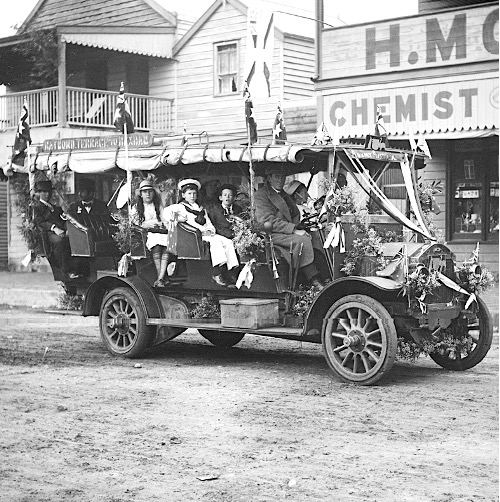
The Red Cross Society was represented by two large field ambulances filled with wounded soldiers and nurses attending them. Mr. Luke Lawrence, an old veteran who saw service in the Indian mutiny, was there, having a special place allotted to him by the committee.
Several motor cars took part, all being more or less decorated, and the two belonging to Mr. J. J. Edstein were exceptionally fine displays. Mr. H. Sutton had a model dairy in course of erection, and Mr. D. Hawkins had a fine collection of farmers’ produce, both representing farmers’ displays. Only three tradesmen’s displays were represented, Maker and Co. with a butcher’s cart, and Messrs. Smith and Feeney with a sulky each. A large number of the Friendly Societies of the district — Oddfellows, Hibernians, and Guilds — marched in regalia and added to the attractiveness of the procession.
The comical features were indeed good and were well thought out and arranged. The first was a wedding group from Way Back, comprising the clergyman (Jack Morris), bride (Geo. Smith), bridegroom (Arthur Krohn), father of bride (Frank Cross), best man (Ray. Hain), guests (Ernie Smith and Clyde Bishop). The second, which secured the prize for the worst turn-out, was a real break-up, in which were W. Greaves and Jack Brown, with a horse (or frame) in the shafts of a vehicle that one would not want to look at too hard for fear of its falling to pieces. The last was a representation of the Kaiser’s first impression of the Australian army, arranged by the footballers, consisting of five or six aboriginals on scare-crow horses decked out in bullock bells, boomerangs, spears, and other weapons.
Mr. King had his motor bike and sidecar very, nicely decorated, and Misses Dolly Palmer, Marjorie Street, and Olive Langley had decorated bicycles. The whole was whipped in by a full muster of Light Horse, thus forming a solid end to the possession, which had a good effect.
A biplane piloted by Mr. Neil McLellan created much interest, and was really very good, and many people went to the hill with the sole object of seeing it give an exhibition, but they were disappointed, as the machine was not built for flying purposes.
Prizes were awarded for various items i the procession, the judges declaring as follows: — Best decorated vehicle, Mrs. A. L. Adam; worst turnout, W. Greaves; best comic, “The Kaisers First Impression of the Australian Army,” Raymond Terrace Soccer Football Club; best farmer’s display, D. Hawkins; best decorated motor car, F. Edstein; best decorated motorcycle, Reg. King; best decorated bicycle, Miss Dolly Palmer; best trades display, Maker and Co. There were many other items that deserved prizes, such as the tableaux, but the committee did not deem it advisable to lessen the net proceeds by granting them, and those; that were given were only trifling, and very appropriate for the occasion, causing much merriment.
The sports were managed by a separate committee, comprising Messrs. R. Hill (secretary), J. M. Feeney, C. H. Boots, Sergt-Major Smith, and Sergt. Foot. The programme, which was a lengthy one, went off without a hitch, and everyone seemed to be well pleased with the day’s outing. A football match was played between the Raymond Terrace and Karuah soccer teams; the play was very even, the game resulting in each side scoring three goals each.
The following are the results of the sports: — Tent Pegging— Sergt-Major Smith; Best Boy Rider— Master Hain; Gent’s Hackney — A. Wattus’ Nigger ;Allcomers’ Trot—Rich’s Chester 1, Osborn’s Rob. Roy 2; Pony Race — McFadyen’s Play Girl 1, Passfield’s Miss Deemster 2; Tug-o’-War on horseback —Sergeant Foot’s team; Hack Race — J. Feeney ‘s Pebble 1, McFadyen’s Play Girl 2; Rescue Race — A. Irwin and W. Mc-Dermott; Hac Race — Feeney’ s Pebble 1, C. Priestley’s Nancy Lee 2; Stepping 100 yards— N. C. McLellan; Hippo Jumble Race — A. Smith; Beaten Stakes — Stan Fool’s Union Jack 1, Passfield’s Miss Deemster 2; Lemon Cutting — N. Cromarty; Corn Query — H. Markey.
At night a quadrille [ballroom dance] was held in the Oddfellows’ Hall, when the building was crowded. The whole day’s function was most successful, and the Australia Day Fund will benefit to the extent of something over £600 as a result of the committee’s efforts.’
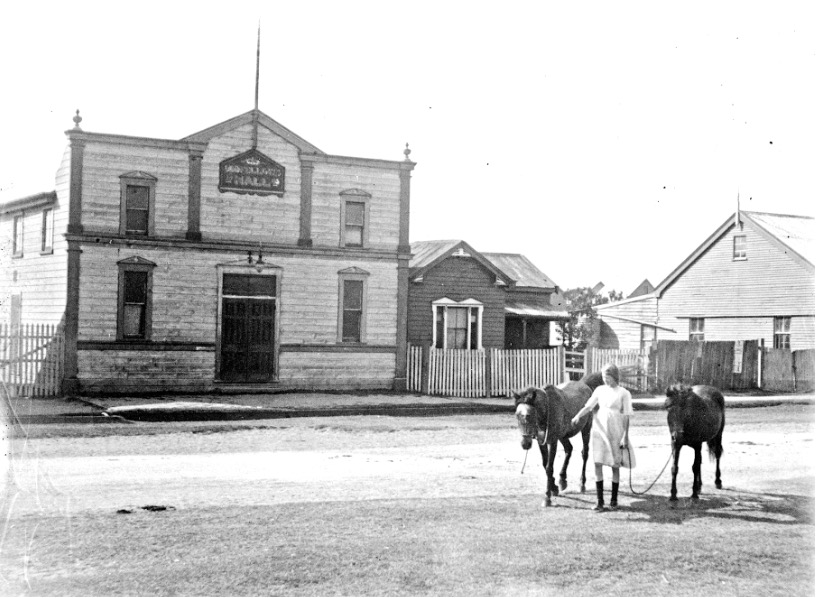
Oddfellows Hall – Raymond Terrace
Raymond Terrace ‘Australia Day’ Parade in Photos
The photographs of the Raymond Terrace Australia Day Parade, as shown below, are held in the University of Newcastle Library’s Living Histories Collection. The newspaper article above describes many of the scenes shown in the photos.
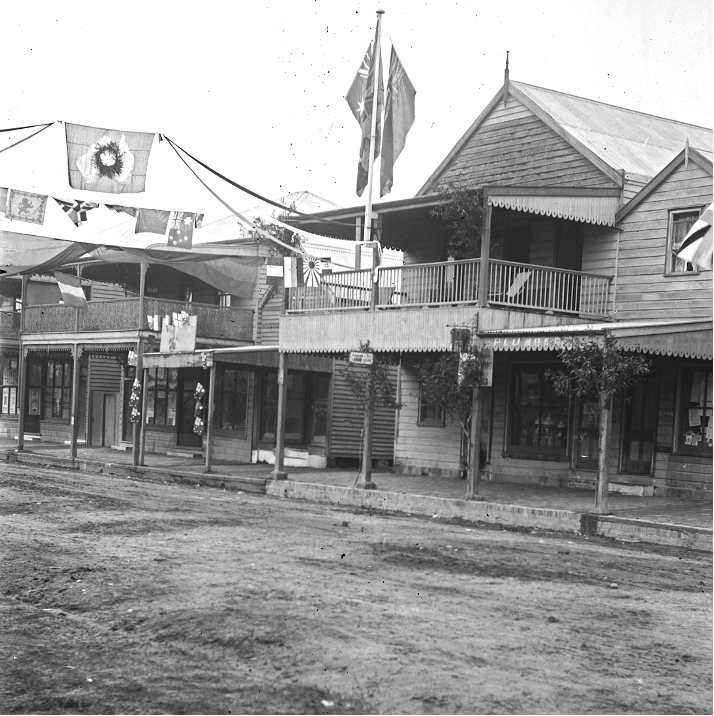
King Street decorated with banners prior to the parade
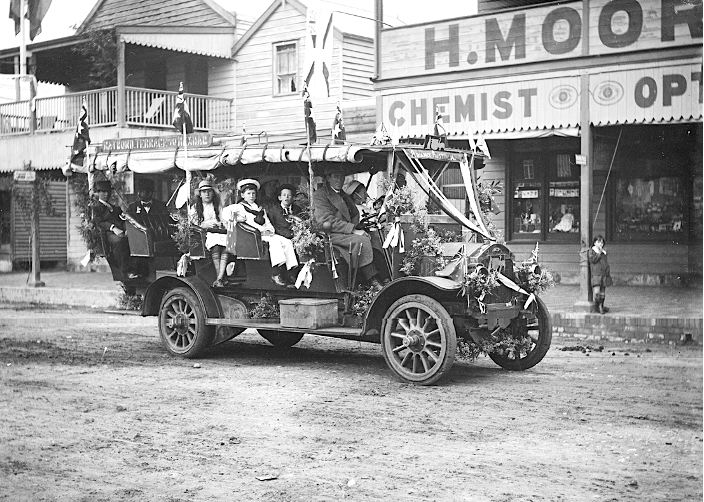
Decorated charabanc in King Street
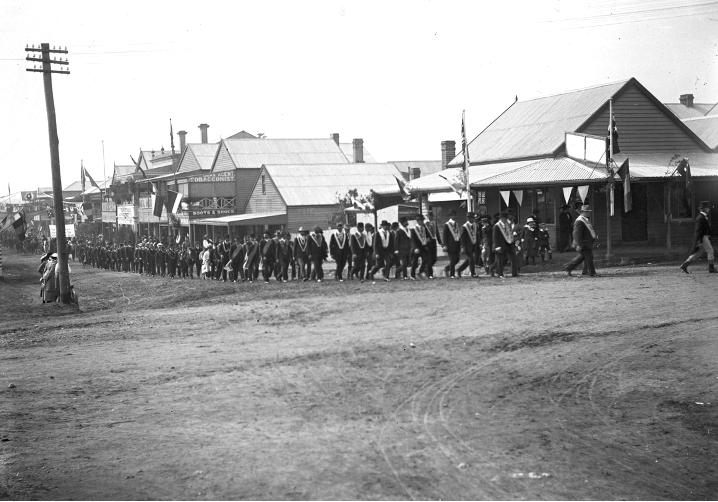
Freemasons march from King Street in the parade
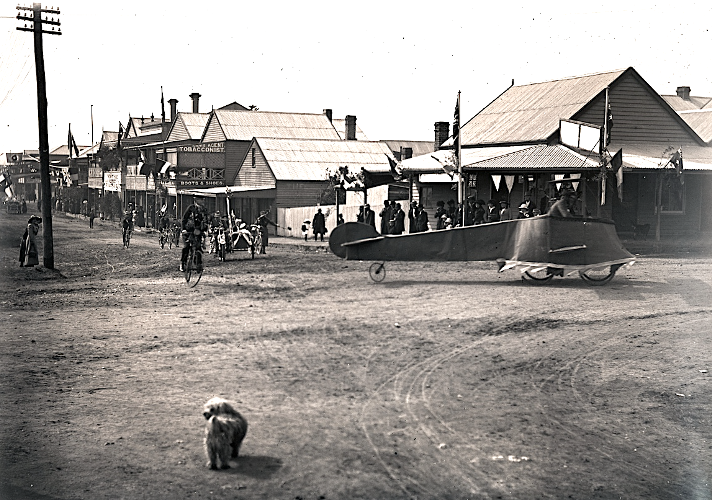
Mock-up bi-plane and motorcycle with sidecar exiting King Street in the parade
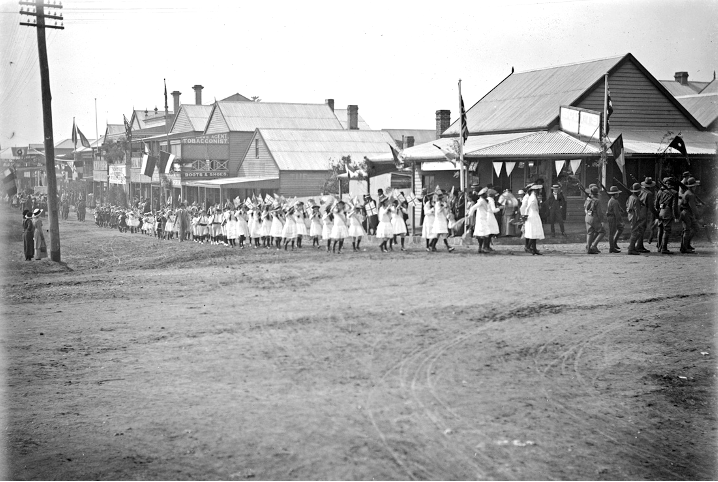
School children march from King Street
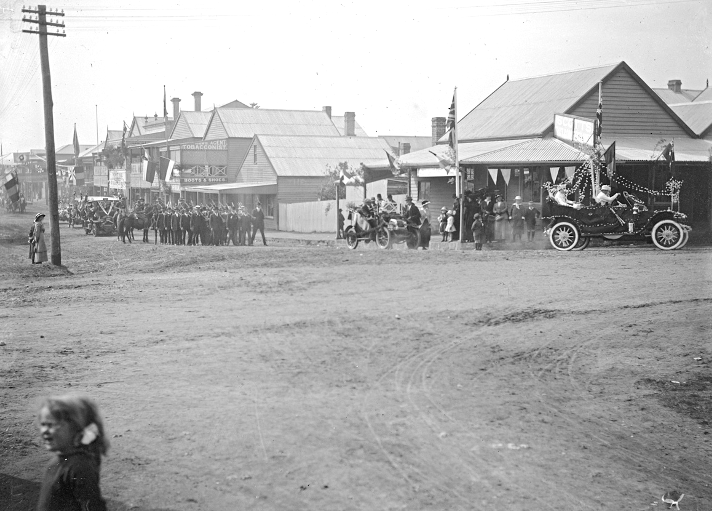
Parade marches from King Street
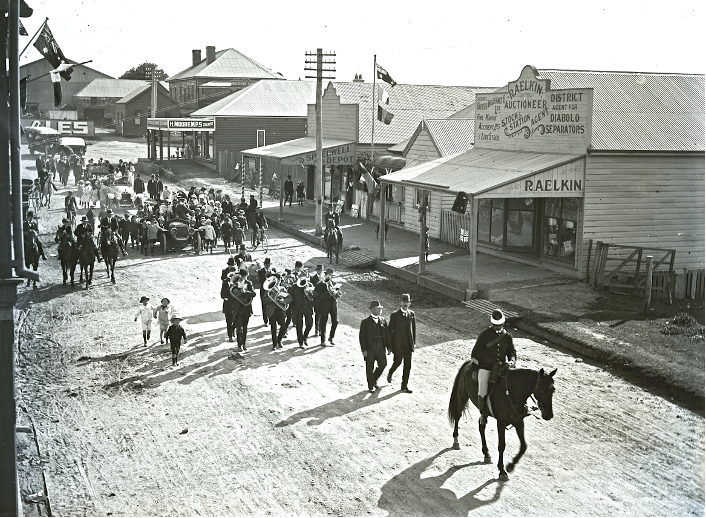
Front of the parade, passing the premises of R. A. Elkin, Auctioneer, William Street, Raymond Terrace, on the way to the park at the top of the town [now Boomerang Park]
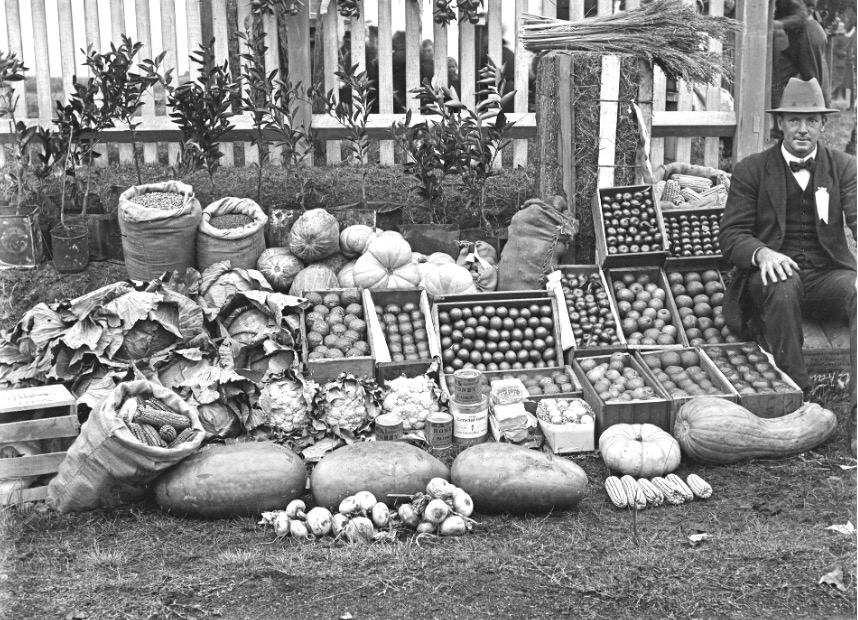
Farmers produce display presented as part of the parade
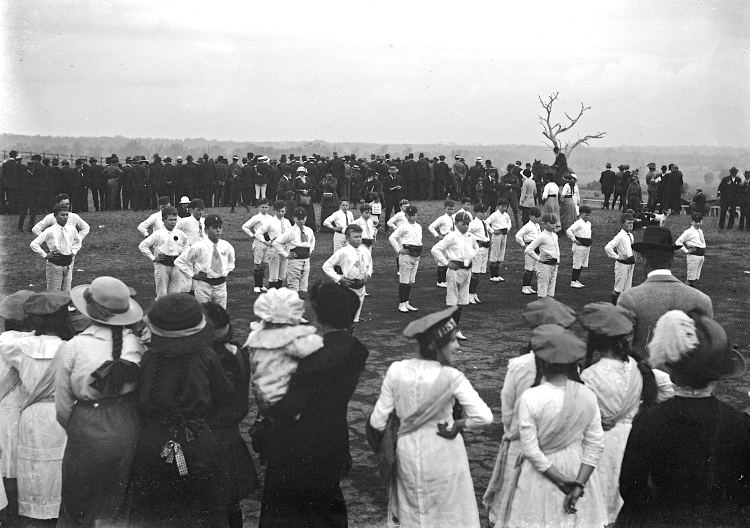
School boys provide a display in a field above the township [now Boomerang Park]
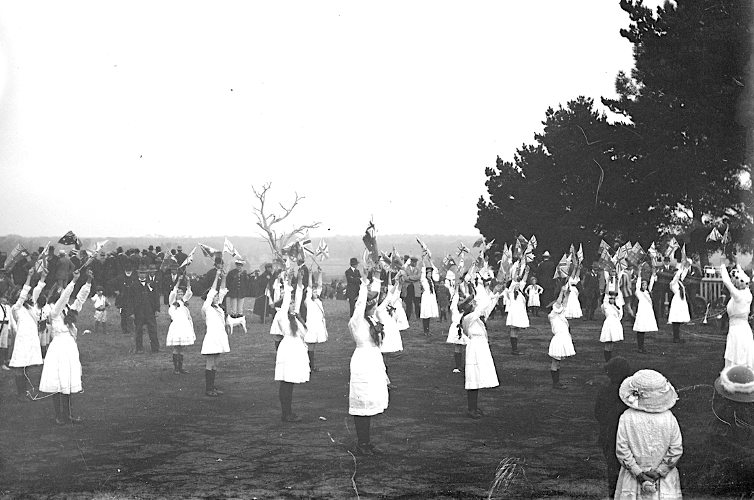
School girls provide a dance display with flags in field above the township [now Boomerang Park]
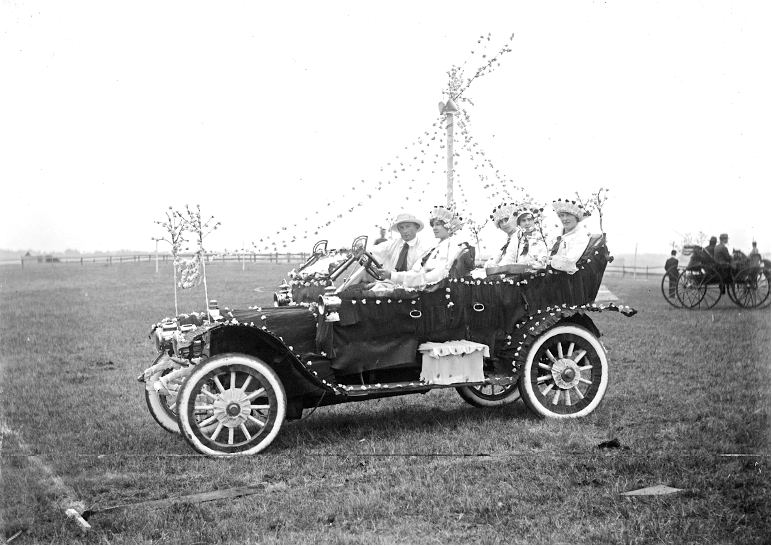
Decorated car in a field above the township [now Boomerang Park]
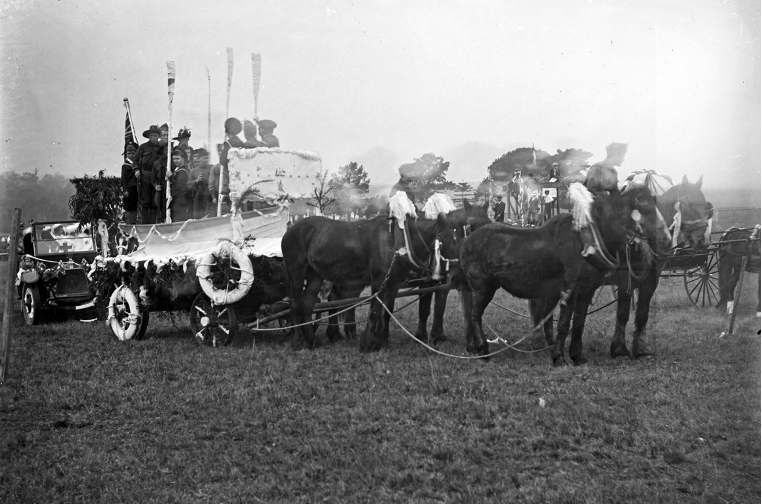
Children dressed as a boat crew and a field ambulance at the rear in a field above the township [now Boomerang Park]
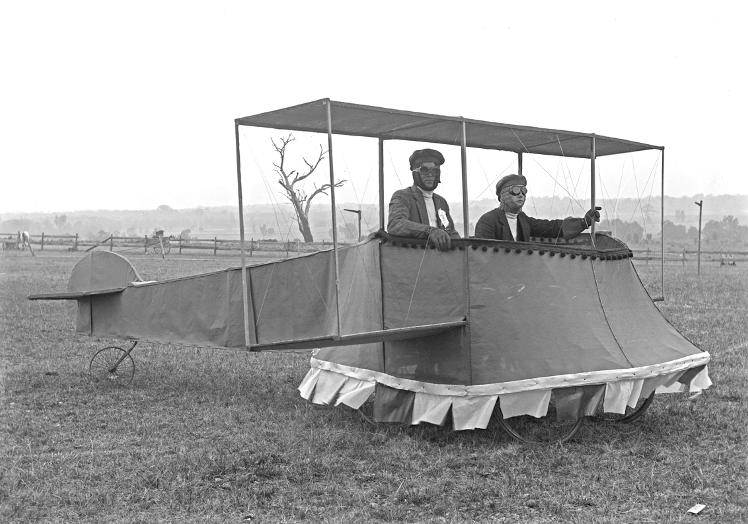
Mock-up of bi-plane in field above the township [now Boomerang Park]
Millers Forest Convent School Fair
The Maitland Daily Mercury of 13 August 1915, page 8, reported:
‘With the object of providing a donation towards the Raymond Terrace Australia Day Fund, the children attending the [Catholic] Convent Schools at Raymond Terrace and Miller’s Forest held two very successful fairs on Wednesday and Thursday evenings, July 28 and 29, in aid of the wounded Australians. Considering the many appeals made on behalf of this fund, the children worked energetically and were able to hand to the committee the handome sum of £210, which constitutes a record for miles around this district.
The fair at Miller’s Forest, was opened on Thursday afternoon, and just about the time of opening rain set in and interfered with the attendance greatly. The Rev. Father O’Flynn presided. The children sang “Australia,” and marked time with the waving of four Australian banners, after which a nice patriotic address was delivered by Kathleen O’Brien, Ita O’Hearn, Rene Mears, and Mary O’Brien, the children being loudly applauded. The singing of “God Save the King” concluded the opening for the children.
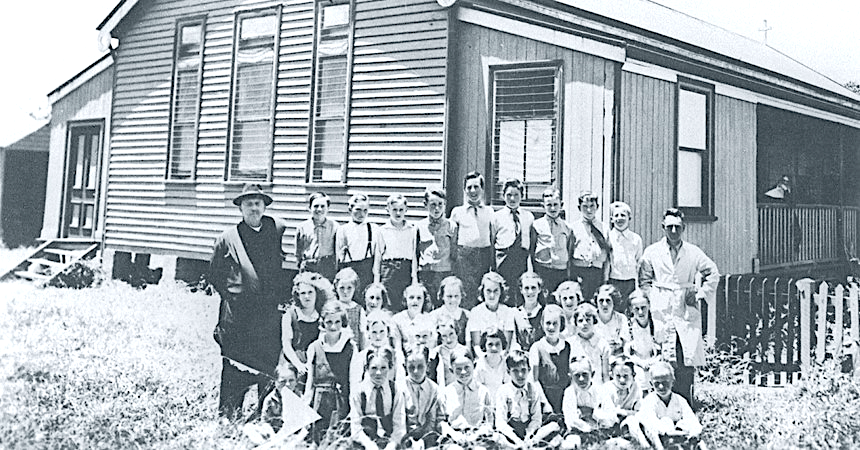
Millers Forest Catholic School. The Raymond Terrace priest and a Mercy nun are in the picture [mnnews.today]
Three nicely arranged stalls comprised the fair, consisting of “Australia” (fancy stall), “Gallipoli” (fancy stall), and “Dardanelles” (refreshments). The presidents of the “Australia” stalls were Misses Moy and Hill, assisted by Misses O’Brien (Dockyard), Hill (2), (Dockyard), Hill (Alnwick), Corbett and Moy; president of “Gallipoli” stall, Mrs. John O’Hearn, assisted by Misses O’Brien (2) (Edithville), O’Brien (Dockyard), Mrs. Carmody; and the presidents of the refreshment stall were Mesdames O’Brien and Keogh, assisted by Misses Corbett, O’Brien, Doherty, Sivyer, Cunningham, and Manarey.
The official opening of the fair took place at 7 p.m. by the Rev Father O’Flynn, who extended a hearty welcome. He asked all to remember the soldiers who were fighting for them in the Dardanelles, and to do their share for the wounded, and provide silver bullets.
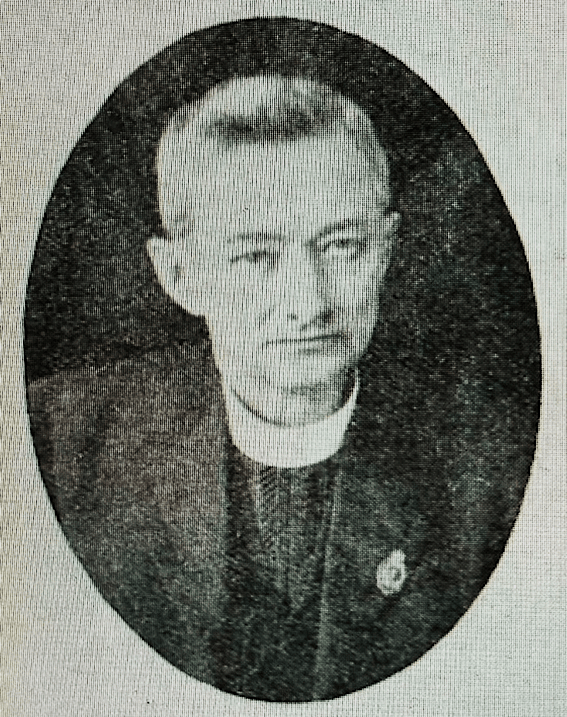
Rev. John O’Flynn
Master M. Cunningham then read the following excellently worded address:
— “Rev. Dear Father, Parents, and Friends, — We, the children of St. Patrick’s School, are much rejoiced to have the pleasure of tendering you all a most hearty welcome to our bazaar room tonight. We fully understand the object of your coming here, and we most gratefully appreciate your efforts to aid in our training in good citizenship. In spirit we followed our Australian boys across the perilous Indian Ocean, and we saw them broiled or months on the burning sands of Cairo, under the scorching rays of an Egyptian sun.
When we heard they had sailed for the Dardanelles, our hearts beat high with expectant hope that our boys would be true to the traditions of our forefathers. We watched them scale the precipitous cliffs of Gallipoli under a deadly Turkish fire. The gory plains strewn with the pride of our land told us, alas, too well, that Australia’s name in history had been won with the life’s blood of many a loving mother’s cherished son.
The survivors of that battle are coming back now to our Australian shores,’ coming back to a land of peace and plenty, coming home to us, for whom they have suffered and bled. It is true we cannot shell the enemy to avenge the cruel deeds of war, but we have here tonight a Gallipoli, a Dardanelles, and our own Australia, and we can shell out our gold and silver on our battlefields at home in aid of our brave heroes, who are coming back to us. ‘We are proud of them, proud of the glory they have won for Australia, and proud, also, that it is our privilege to help the men who have risked life and limb for our sakes.”
The fair having then been declared open, the stall-holders set to work in right good style. During the evening Mr. R. A. Elkin, auctioneer, of Raymond Terrace, gave his services free, and auctioned several articles, including a large Australian flag, which realised £9/10/. The fair concluded at 12 p.m.
The following are the results of each stall: — Australia Stall, £66; Gallipoli Stall, £34/8/7; Dardanelles Stall, £14/6/; donations to general fund, £4/10/3; door receipts, £3/5/, Grand total, £122/9/10. The final meeting in connection with the Australia Day Fund was held in the Convent School, Miller’s Forest, on Friday night, Aug. 7th, when votes of thanks were accorded the stallholders and their assistants, the Rev. Father O’Flynn, and the secretary and treasurer (Messrs. A. J. O’Brien and Mr. Hill).’
Australia Day Art Union
The Raymond Terrace Examiner and Lower Hunter and Port Stephens Advertiser of 10 September 1915, page 2, reported:
‘The drawing of the Raymond Terrace Art Union will take place in the Oddfellows’ Hall on Tuesday night next, 14th inst. A small charge of 1s for front seats and 6d for back seats is being made to defray the expenses of the hall, etc., and the drawing will be preceded by a programme of vocal and instrumental items. The committee would like to see a full audience, present. The drawing for the tank donated by Hunter and Sons will also take place on the same evening.’
The Raymond Terrace Examiner and Lower Hunter and Port Stephens Advertiser of 17 September 1915, page 3, further reported:
‘The drawing of prizes in connection with the Australia Day Art Union took place in the Oddfellows Hall on Tuesday night last under the supervision of a committee of gentlemen appointed for the purpose. Before the drawing took place a pro-gramme of songs, recitations, and instrumental items was gone through, the following ladies and gentlemen taking part: — Mr. J. Saunders, 2 songs; Mr. Mayo, recitation; Miss Yard, 2 songs; Mr. Moore, song; Messrs. Tweedie and Bishop, duet; Miss Pearl Finlay, song; Mr. W. Gilbert, recitation; Miss Marjorie Smith, song; Mr. C. Adam, cornet solo. Miss Molly Beirne and Mrs. H. J. Smith played the accompaniments.
The following is the result of the drawing: First prize, Chas. Smith, Hinton; Second prize, Masters E. and M. Toohey; Third prize, Miss E. Swebeck; Fourth prize, M. Lynch, Miller’s Forest; Fifth prize, Joe Robinson, Anna Bay; Sixth prize, W. G. Rae, Anna Bay’ Seventh prize, Chris Scala; Eighth prize, Miss EIsie McPherson; Ninth prize, Miss Pearl Pepper; Tenth prize, Miss Freda Pepper; Eleventh prize, P. Feeney; Twelfth prize, Master Wal. Cross; Thirteenth prize, G. A. Tranter; Fourteenth prize, Mrs. Bloomfield; Fifteenth prize, Miss Mary Keene; Sixteenth prize, Miss Hoffman. The tank offered by Mr. Hunter was also drawn for, the winner being Mrs. Clague.’
Concluding Comments
The ‘Australia Day’ campaign of July 1915 was one of many First World War patriotic fund-raising efforts supported by the community of the Raymond Terrace district.
The Raymond Terrace Examiner and Lower Hunter and Port Stephens Advertiser of 12 November 1915, page 3, published financial statements of the various patriotic funds that were generously supported by residents of the Raymond Terrace district during 1914 and 1915
[Note: the expenditures represent amounts paid from the local funds to the Head Office of the various bodies]:
‘The Treasurer of the local Patriotic Committee forwards us [the newspaper] the following statement in connection with the various Patriotic funds from August 14, 1914, to the end of September last: — Chamber of Commerce War Food Fund: Receipts £259 6s 8d, expenditure 259 10s, debit balance 3s 4d. Belgian Day Fund: Receipts £104 4s 9d, expenditure £100, credit £4 4s 9d. National Belgian Relief Fund: £178 7s 2d, expenditure £157 1s 11d, credit £21 5s 3d. General Fund: Receipts £11 0s 11d, expenditure £10 14s 8d. credit 6s 3d. Australia Day Fund: Receipts £716 8s 9d, expenditure £719 18s 9d, debit £3 10s. Lord Mayor’s Patriotic Fund: Receipts £14 14s 9d, expenditure £14 14s 9d. Red Cross Fund: Receipts £47 7s 3d, expenditure £41 13s 7d, credit £5 13s 8d. Belgian Relief Fund: Receipts £54 13s, expenditure £46 7s 6d, credit £8 5s 6d. Total from all sources: Receipts £1,386 3s 3d, expenditure £1350 1s 2d, balance at Bank £38 2s 1d.’
Information on the history of the First World War in the Raymond Terrace and other districts of the Port Stephens region are published on this website and can be viewed at the following links:
First World War Memorial at Raymond Terrace – Port Stephens
First World War Memorials at Nelson Bay – Port Stephens
First World War Memorial at Karuah – Port Stephens
War Loan Tank Drive Visits Raymond Terrace, Port Stephens – 1918
Letters from the Front sent by a First World War Soldier of Port Stephens – 1915
Further papers on the history of Raymond Terrace district are also published on this website and can be viewed at the following links:
Early History of St. Brigid’s Catholic Church – The First 100 Years
War Loan Tank Drive Visits Raymond Terrace, Port Stephens – 1918
A Tour of Millers Forest and Raymond Terrace, Port Stephens – 1918
Raymond Terrace Municipal Council Jubilee Celebrations – 1934
Journey to the Vineyards of the Lower Hunter and Port Stephens Districts – 1865
Millet Growing and Broom Manufacture in the Raymond Terrace District – Port Stephens
A Story of the Raymond Terrace District of Port Stephens in 1893
Researched and compiled by Kevin McGuinness
October 2026


