
Introduction
Raymond Terrace and the surrounding areas rose to the challenges of the First World War and supported their residents who volunteered to fight in Europe for ‘God and the Empire’. The period of the War lasted from 28 July 1914 to 11 November 1918.
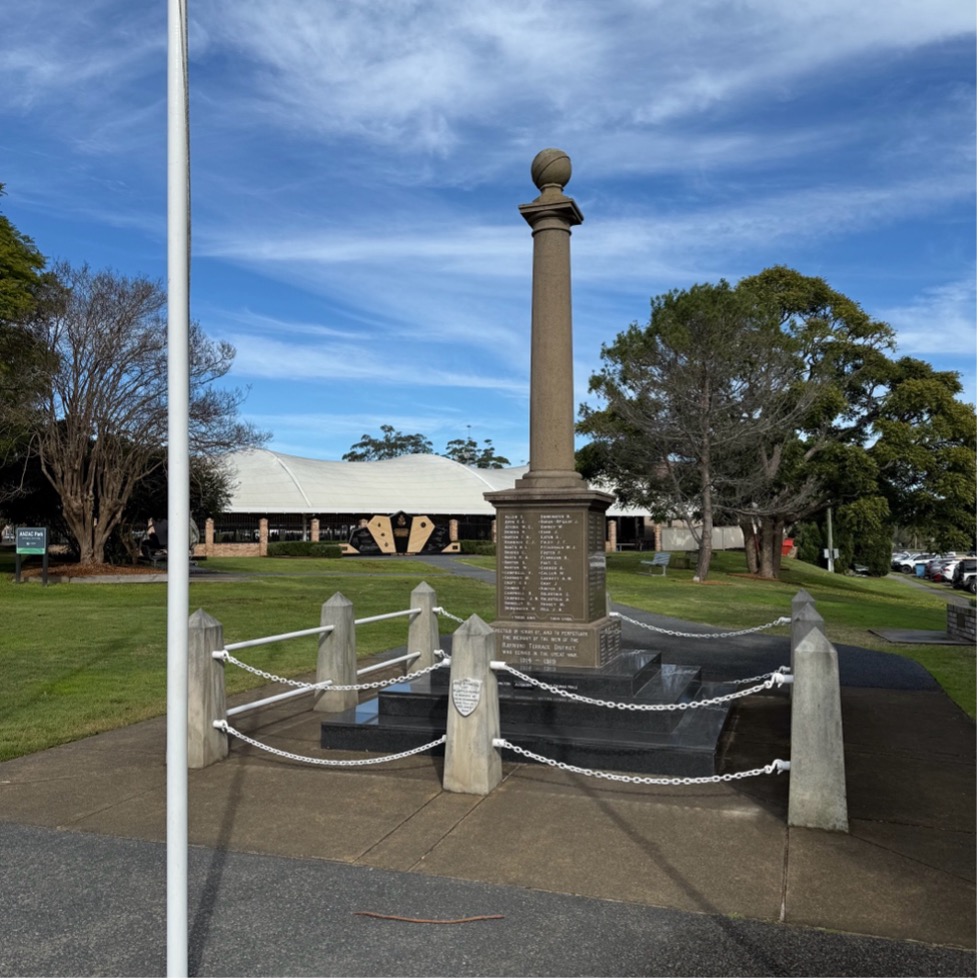
A War Memorial, or the Soldiers’ Monument as it was often called, was erected in Anzac Park (previously known as Market Reserve) at Raymond Terrace,.
When the Memorial was unveiled in November 1925, it bore the names of local residents who had volunteered for service during the First World War. It later encompassed other theatres of war including the the Boer War, Second World War and subsequent conflicts, inscribing the names of those who had served from the local area.
On Remembrance Day, 11 November 2025, a special ceremony was held at Raymond Terrace to commemorate the Centenary of the War Memorial.
This paper tells of the history of the construction of the Soldiers’ Memorial. It also tells of the stories of some of the First World War soldiers whose names are inscribed thereon, obtained from various sources including newspaper reports.
These stories give an insight into the respect and support that Raymond Terrace and Millers Forest townspeople gave their soldiers and of the hardship suffered by them while at the front line in Europe. The soldiers who returned home to Raymond Terrace after service, were widely welcomed. The Memorial contains the names of 116 soldiers and also identifies those who gave their lives during battle. Many of the soldiers who did return had suffered wounds, and many examples of a lucky escape were evident.
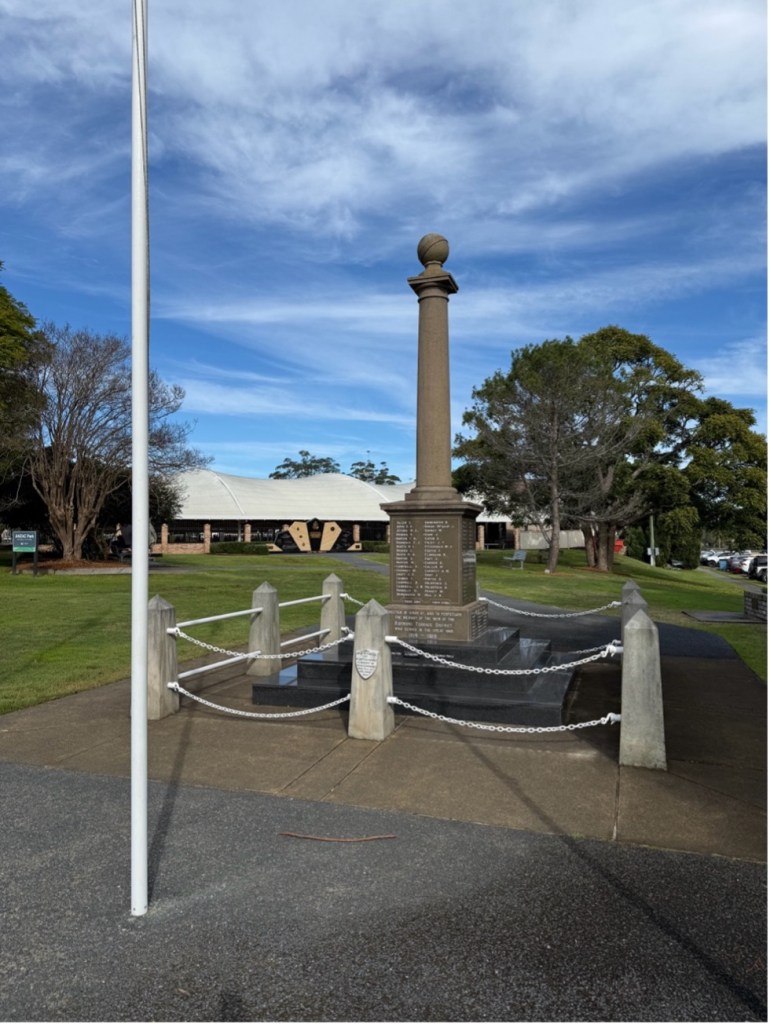
Raymond Terrace War Memorial at Anzac Park, formerly known as Market Reserve. The Armed Forces Commemorative Wall dedicated by the Raymond Terrace RSL Sub-branch on 25 April 2023 is in the background [Author photo]
This paper consists of three parts:
Part One: Erection of the Soldiers’ Memorial;
Part Two: Listing of soldiers on the Memorial who served in the First World War;
Part Three: Stories of some of the these soldiers as listed .
Three Appendices are included at the end of this paper.
Appendix One: Recruiting Column March to Raymond Terrace in 1918;
Appendix Two: Unveiling Ceremony of the Millers Forest Roll of Honour in 1918;
Appendix Three: Unveiling Ceremony of the Raymond Terrace Public School Roll of Honour in 1918.
PART ONE: Erection of the Soldiers’ Memorial
Soldiers’ Memorial Committee applies for a War Trophy – 1921
The Newcastle Morning Herald and Miners’ Advocate of 8 March 1921, page 7, reported:
‘The Soldiers’ Memorial Committee has given further consideration to the designs submitted. Objection having been raised to a figure memorial, it has been decided to communicate with the secretary to the War Museum, in Melbourne, to ascertain if it is possible to obtain a war trophy to place on the memorial.
An effort is to be made to have allotted the mountain-gun captured at Amman, in Eastern Palestine, in the 1918 fighting. The capture was made by the Seventh Light Horse, attached to which were a number of Lower Hunter soldiers, led by Colonel Richardson, of Raymond Terrace, who was in attendance at the meeting. The selection of the design for the memorial has therefore been deterred pending a reply from the authorities in Melbourne.’
The Newcastle Morning Herald and Miners’ Advocate of 31 March 1921, page 3, also reported:
‘Efforts were recently made by the Soldiers’ Memorial Committee to secure from the authorities a gun that was captured in Mesopotamia by Australian soldiers, many of whom had enlisted from the lower Hunter River district. A communication has now been received from the War Trophies Committee, stating that the gun inquired about was not obtainable, and that the trophies were allotted according to population.
Colonel Richardson, who had charge of the men at the time the gun was captured, stated at the meeting that the information he had received from the committee was to the effect that if the number and the calibre of the gun were given an effort would be made to allot it as desired to Raymond Terrace, provided that it had not previously been given to another town.’
The Newcastle Morning Herald and Miners’ Advocate of 30 June 1921, page 3 further reported:
‘Some time ago the Raymond Terrace Memorial Committee communicated with the War Trophies’ Museum with the view to obtaining the allotment of the mountain gun captured by the 7th Light Horse at Annam. A reply has been received by the committee to the effect that two guns had already been supplied to Raymond Terrace, and another could not be recommended. It was pointed out at the meeting of the committee that the museum authorities evidently missed the point as to why this particular gun was required by Raymond Terrace, which was that the gun was captured by the regiment in which were a large number of district soldiers, and at whose head was Colonel Richardson, of Raymond Terrace. A sketch of a pedestal suitable for a gun carriage was shown by a Newcastle firm of monmental masons, and this, with another, will be submitted for decision to the subscribing member.’
Advice received about Memorial Design and Location – 1922
The Newcastle Morning Herald and Miners’ Advocate of 13 May 1922, page 7, reported:
‘Designs for a soldiers’ memorial for Raymond Terrace were prepared some months ago, but the project has not gone much further than that. The amount in hand is £250, and it is probable an effort will be made to raise a larger sum. Five alternative sites have been suggested upon which the memorial shall be erected.
The committee has received from Mr. J. Garlick, Under-Secretary, Department of Local Government, the following letter on the matter: “Your council is correct in holding the view that even though the local memorial committee might submit a design of memorial and its proposed site, and obtain the Minister’s approval thereto, if the site proposed were in a public road or public reserve, under the control of the council, it would still be necessary for the memorial committee to obtain the council’s permission to erect the memorial upon that site.
If a monument were erected in a public road by permission of the council, and if any accident occurred directly traceable to the fact that the site of the monument was not adequately lit up, it is highly probable that upon action being taken by a person who suffered injury in such accident, the council would be involved in damages. If, therefore, the monument is to be placed in a public road, it would be advisable that it be properly lighted. ….. It was decided to investigate the cost, and to select the design and site at a future meeting.’
Market Reserve Memorial Site approved – 1922
The Raymond Terrace Examiner and Lower Hunter and Port Stephens Advertiser of 9 June 1922, page 2, reported:
‘Those appointed as a deputation from the Soldier’s Memorial meeting to interview the [Raymond Terrace Municipal] Council regarding the Memorial site, met the Council, and placed the request to the meeting for agreement by the Council to the site on the Market Reserve, before the Council. The actual site of the memorial, that is to say, which end of the reserve, had not been decided, but it is thought that the meeting meant the end near Sturgeon street.
The Council agreed to the site on the reserve, and the Mayor though it could be made ornamental by a few flower plots. Alderman Krohn said he favoured the Market Reserve from the first, as the best site, and therefore he had no objections. Alderman Hanlon said he had no objection, though he favoured the site at the top of William-street. Alderman Curtis said he thought the location on the Market Reserve should be the end near Glenelg-street. He had no objection to the site.’
The Newcastle Morning Herald and Miners’ Advocate of 14 November 1922, page 7, further reported:
‘At the last meeting of the Soldiers’ Memorial Committee, a suggestion was made for the acquiring of a block of land and its dedication as a memorial park, to be laid out in blocks for each family in the district who had lost a member at the war. Action was deferred pending an interview with the Memorial Advisory Board.’
Design rejected by Memorial Board – 1922
The Newcastle Morning Herald and Miners’ Advocate of 21 November 1922, page 7, reported:
‘Mr. R. A. Mackenzie has received a communication from Mr. T. H. Hill, stating that the latter had seen the Memorial Board regarding the design selected by the subscribers to the Raymond Terrace soldiers’ memorial. The board disapproved the design.
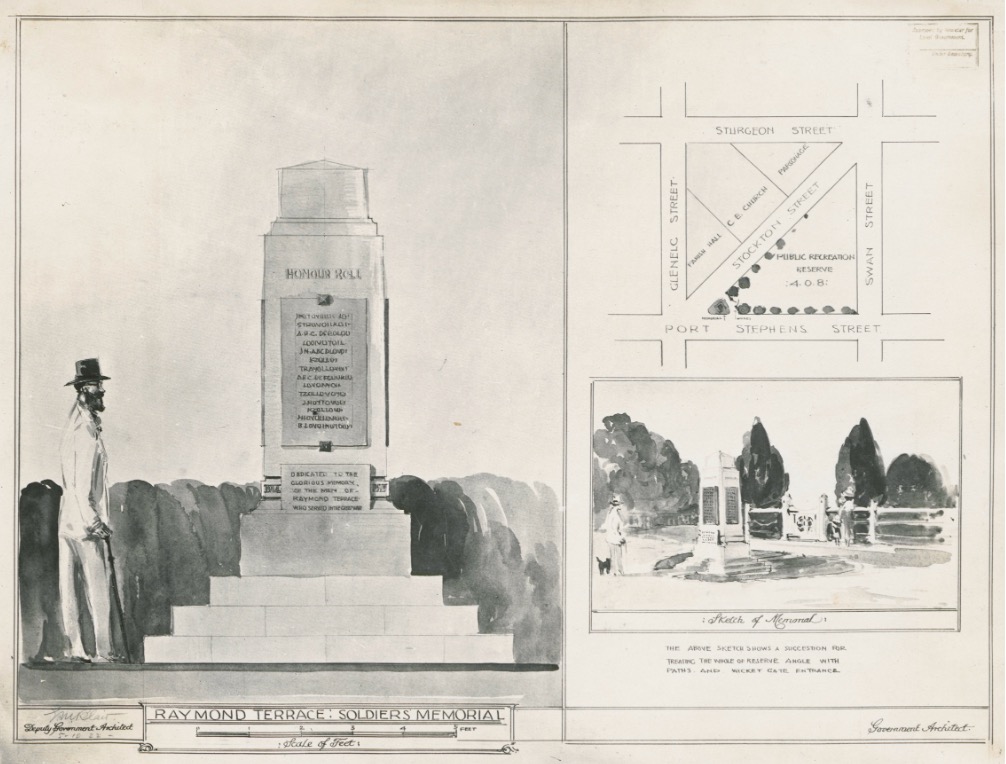
Raymond Terrace Soldiers Memorial plan, as prepared by the NSW Government Architect, dated 5 October 1922, rejected by the Memorial Board [NSW Department of Public Works, NSW State Archives]
The Newcastle Morning Herald and Miners’ Advocate of 30 January 1923, page 6, further reported:
‘At a meeting of the Soldiers’ Memorial Committee, a copy of the amended Local Government Act was received from Mr. T. H. Hill, M.P., and reference was made to the clause dealing with monuments. This provided that where a contract for the erection of a monument had been entered into after January 1, 1923, the person who was in charge was under a penalty if he proceeded with a work not sanctioned by the Minister. It was decided to write the Under-Secretary for Local Government, asking that the Minister reconsider his decision disapproving of the design submitted, which, it was stated, had been approved unanimously by the subscribers.’
Request for a new Memorial Design – 1923
The Newcastle Morning Herald and Miners’ Advocate of 14 March 1923, page 10, reported:
‘The memorial committee has decided to ask the Local Government Department for another design for the proposed soldiers’ memorial. There has existed a difference between the department and the subscribers as to the designs already submitted.’
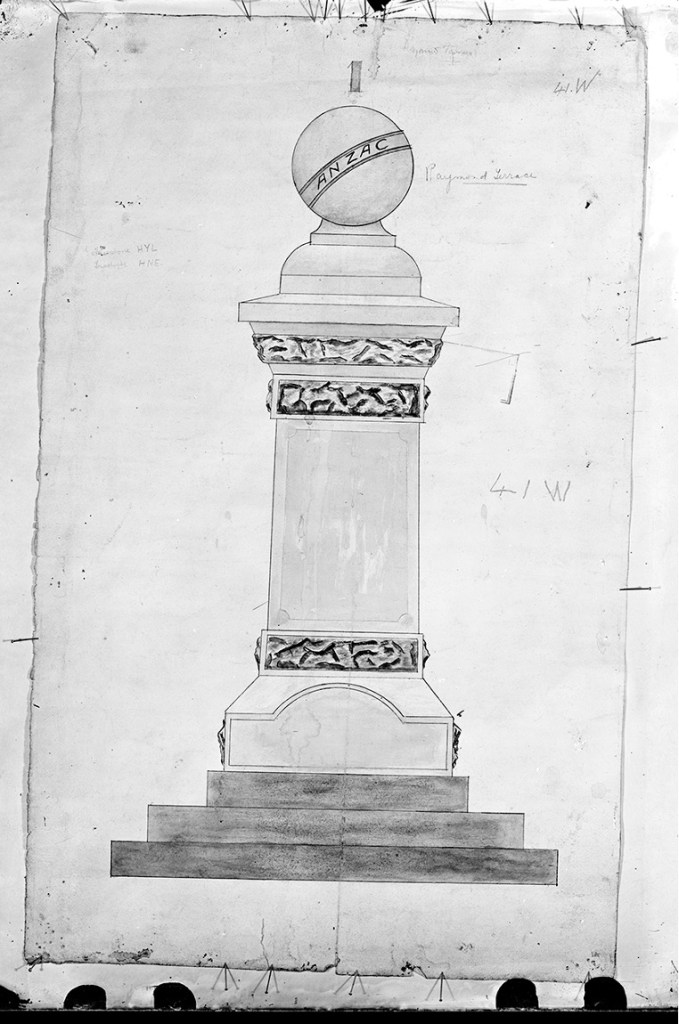
Undated concept diagram for the Raymond Terrace Soldiers Memorial, similar in many aspects to the final approved design [NSW Department of Public Works, NSW State Archives]
Design of Soldiers’ Memorial approved – 1923
The Newcastle Morning Herald and Miners’ Advocate of 5 September 1923, page 2, reported:
‘The Local Government Department Board, to whom the selection of the soldiers’ memorial plans have to be submitted for approval, has forwarded to Mr. R. A. Mackenzie, the secretary of the Raymond Terrace committee, its approval of the design, and has furnished the plans and specifications. After these have been considered by the committee, the work will then be gone on with.’
Planning of construction underway – 1923
The Newcastle Morning Herald and Miners’ Advocate of 12 September 1923, page 3, reported:
‘Mr. J. P. Hanlon presided at a meeting of the soldiers’ memorial committee, at which correspondence was read from the Minister, approving the design of the proposed monument. The plan was adopted with some details agreed upon. It was resolved that the inscription at the base should read: “Erected in honour of, and to perpetuate the memory of the men of the Raymond Terrace district who served In the great war, 1914-1919” There are up wards of 100 names to be written on the monument, the cost of which will be £350. The authority to sign the contract under the amended specification was agreed to by the meeting, and as soon as the municipal council approves the design, the work will be proceeded with by Messrs. Edstein and Sons.’
The Raymond Terrace Municipal Council subsequently approved the monument design. Messrs J. J. Edstein and Son of Raymond Terrace had previously been granted the contract to construct the Morpeth War Memorial during June 1921, for a cost of 235 pounds.
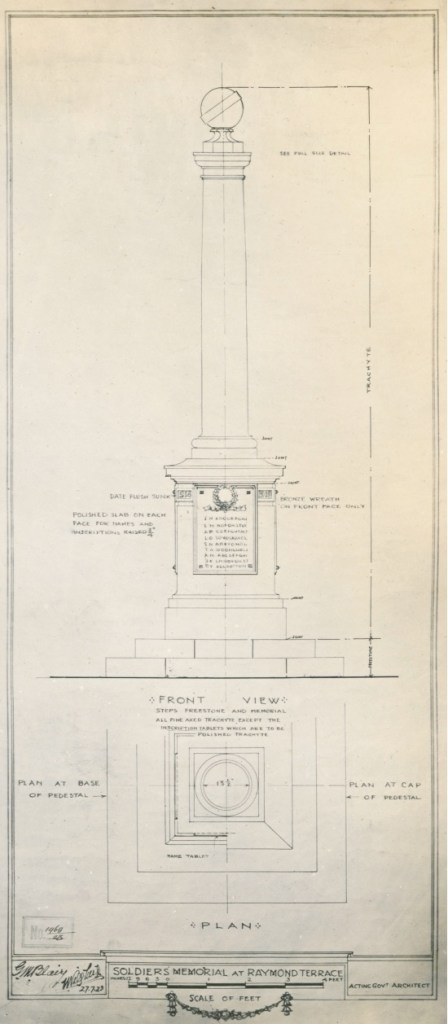
Approved concept plan, as prepared by the NSW Government Architect, dated 27 July 1923, for Raymond Terrace Soldiers Memorial [NSW Department of Public Works, NSW State Archives]
Names approved for inclusion on the Soldiers’ Memorial – 1924
The Newcastle Morning Herald and Miners’ Advocate of 29 February 1924, page 7, reported:
‘A list of the names to be placed on the soldiers’ memorial has been prepared by Mr. R. A. Mackenzie, the secretary to the committee, and includes those who enlisted from Raymond Terrace, Tomago, Hollow Tree, Engleton, Miller’s Forest, and Nelson’s Plains. The list includes the names of one hundred local soldiers, and the committee expect the number will be added to.’
The Newcastle Morning Herald and Miners’ Advocate of 24 October 1924, page 8, further reported:
‘The list of names to be placed on the soldiers’ memorial has been completed. and is available for inspection at the office of Mr. R. A. Mackenzie.’
Unveiling Ceremony planned for Armistice Day – 1925
The Newcastle Morning Herald and Miners’ Advocate of 29 August 1925, page 7, reported:
‘It has been decided that the unveiling ceremony in connection with the soldiers’ memorial will take place on Armistice Day. The cost of the memorial will be about £350, upwards of £300 having already been raised.’
Cost of surrounding fence donated – 1925
The Newcastle Sun of 23 October 1925, page 6, reported:
‘Mr. and Mrs. G. H. Pepper, of Nelson’s Bay, have donated the material for a fence around the Soldiers’ Memorial at Raymond Terrace. At a meeting of the memorial committee on Monday night a letter was forwarded to Mr. and Mrs. Pepper, thanking them for the gift.’
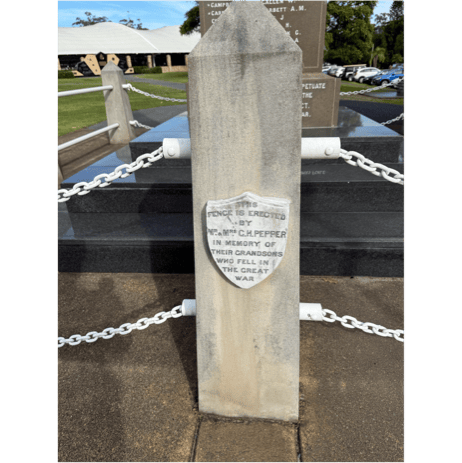
Plaque at the Soldiers Memorial commemorating donation of fence by Mr. and Mrs. G. H. Pepper [Author photo]
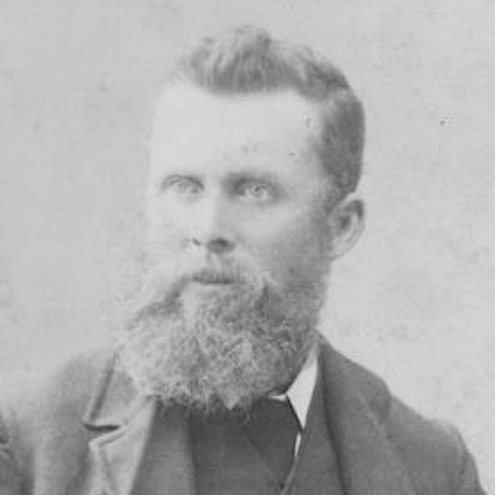
George Henry Pepper [Ancestry]
Date of Unveiling Ceremony altered to 14 November 1925
The Newcastle Morning Herald and Miners’ Advocate of 3 November 1925, page 6, reported:
‘The date of the unveiling of the district soldiers’ memorial has been altered from November 11 to November 14. The secretary to the committee was informed that General Paton, of Newcastle, could not accept the invitation to unveil the memorial on the date originally decided upon, and the alteration was accordingly agreed to. The function will take place at three o’clock in the afternoon. The duty of dedicating the memorial fence will be entrusted to a member of Mrs. G. H. pepper’s family.’
Soldiers’ Memorial Unveiled – 1925
The Newcastle Morning Herald and Miners’ Advocate of 16 November 1925, page 7, reported:
‘The Raymond Terrace and district soldiers’ memorial was unveiled and dedicated in the presence of a large gathering on Saturday. Alderman J. M. Feeney, the Mayor of Raymond Terrace, in the course of his introductory remarks, explained the circumstances under which the memorial had been erected. He then called upon Councillor T. H. Pearse, president of the Port Stephens Shire, who gave an address, eulogising the Australian soldiers, and referring to the wonderful name they had made for the country in the great war. The memorial was unveiled by Mrs. Burton, and the fence surrounding it by Mrs. G. H. Pepper.
The dedication ceremony was performed by General J. Paton, C.B., of Newcastle. In an address, he said he was grateful for the opportunity of being present at such an important and interesting ceremony, which, he felt sure, would in the years to come be regarded as one of the most important in the history of the Raymond Terrace district. He complimented the residents on the fine spirit they had displayed in erecting the memorial as a tribute to the men who went from there to fight for their King and country. It was fitting that each locality should have its own memorial, which would be a perpetual reminder to the men who passed to and fro, and the children who played around the monument, and to future generations, that once utter catastrophe threatened to sweep away their heritage, and that it was saved to them by the courage, self-sacrifice and patriotism of their forebears.
On the roll he noticed the names of a number of men whom he knew, in person, and his thoughts were taken to an incident in Gallipoli, when, just before the evacuation, he went down to see the graves of some very old friends of his who had been laid there, and the only man, out of all the thousands, besides himself, in the graveyard was, strangely enough, a resident of Raymond Terrace (Major Windeyer).
After making reference to the gallantry of the soldiers, he went on to speak of their imitative, resourcefulness, pluck and cheerfulness under adverse conditions. These ceremonies brought back recollections to those relatives who had lost their loved ones during the war, and the sympathy of all went out to them in the great loss they had sustained. But they had the satisfaction of knowing that their men folk did not die in vain. Probably there was no more glorious way of going out than fighting for one’s King and country, and right and justice. Let it he hoped that they had not died in vain, and that through their sacrifice and the efforts they had made Australia would be allowed to work out its own destiny without interference from any outside foe.
At the request of the committee, he dedicated the memorial “to those brave fellows who went away from this district and made the supreme sacrifice. Let us hope that the memorial erected here by the citizens of this town will serve for all time to remind future generations of the noble efforts and sacrifices made in the cause of right and justice.” It was a memorial of the past and an inspiration for the future.
The memorial fence was also dedicated. The citizens then assembled at the post office, where General Paton unveiled an honour roll, containing the names of all the soldiers who went from the district, as well as those of members of the Red Cross Society. The original idea was that of Mrs. Garbett, then president of the Red Cross, a great worker for all war efforts. It was at first intended to make a banner and dispose of it for Red Cross purposes. When the war ceased, the banner was not nearly completed and was not finished for a considerable time afterwards. Then the members of the Red Cross decided to make it into an honour roll, and retain it in a public building in the town. It was worked for the Red Cross by Miss Macpherson and several other members, being finally mounted by Mrs. Garbett, and made ready for framing.
Both ceremonies were attended by numbers of returned men from all parts of the Lower Hunter, including Dr. J. B. Meredith, Major Windeyer, and Colonel Richardson. The Boy Scouts and the children from the public school took part.
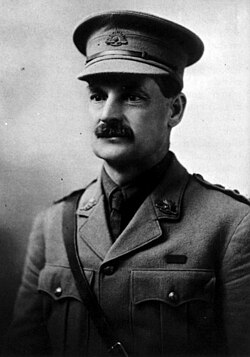
Major General John Paton delivered the dedication speech
Proposal to place two machine guns near Soldiers’ Memorial – 1926
The Raymond Terrace Examiner and Lower Hunter and Port Stephens Advertiser of 19 February 1926, page 3, reported:
‘The meeting of the Council was held on Monday week last in the Council Chambers, when Aldermen Krohn, (Mayor) Feeney, Curtis, Boots, Windeyer and Hain were present. The trustees for the War trophies asked that some proper location should be selected for the placing of the trophies (2 machine guns,) now lying in the Council Chambers and suggested that the same may be erected alongside the Soldier’s Memorial. The trustees were Messrs Windeyer, J. Hanlon and A. L. Adam.
Council agreed that something should be done, and a letter was authorised to be written to the Soldier’s Memorial Committee asking if they had any objection to the war trophies being placed alongside the memorial.’
The Raymond Terrace Examiner and Lower Hunter and Port Stephens Advertiser of 12 March 1926, page 2, further reported:
‘The committee of the Soldiers Memorial wrote [to the Council] saying that they thought there was insufficient space in the Memorial enclosure to put the machine gun trophies and suggested that the position just at the rear of the Memorial, between the Memorial and the fence might be considered as a suitable place. The Mayor explained the position. The matter was left over.’
Action to place the machine guns near the Soldier’s Memorial was never undertaken.
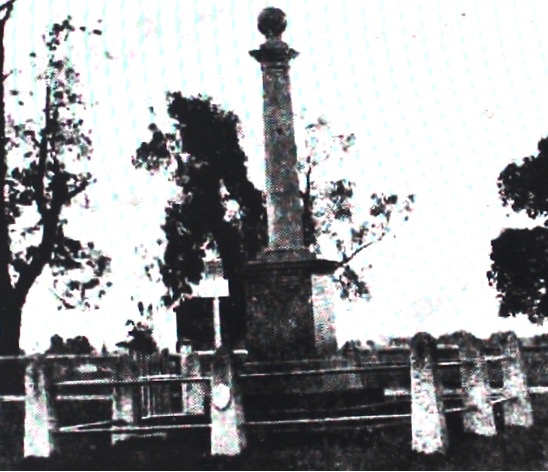
Raymond Terrace War Memorial [Newcastle Morning Herald and Miner’s Advocate, 8 September 1934]
New location for Soldiers’ Memorial proposed – 1936
The Maitland Daily Mercury of 24 October 1936, page 11, reported:
‘The Returned Soldiers’ League is not in favour of the site of the soldiers’ memorial at Raymond Terrace, and the Mayor, at the request of the league, called a public meeting to consider the question of shifting it.
The memorial at present is in Port Stephens and Glenelg streets, and the League considers that this spot is not public enough for the memorial to get the recognition that it merits. The traffic does not go this way normally, but only traffic to the reserves on the riverbank and when games are played on the Market reserve at the side of which is the memorial. There was a good attendance at the meeting, including soldiers as well as interested citizens and subscribers.
The Mayor (Ald. E. L. Markey) said he had been asked to call the meeting by the returned soldiers. The memorial was a fine tribute to the returned men and to those who had fallen. It had been built by subscription from the public, and a special meeting decided to put the memorial where it now was. Mrs. G. W. Pepper, who was not able to attend, had asked him to mention that the fence around the memorial had been erected by her late husband, and he had expressed a wish that he did not want it shifted.
If the memorial were shifted, he did not think the Municipal Council would contribute towards the shifting. The expense would have to be found somewhere else. Mr. G. Pepper asked if they could get an idea from the returned soldiers as to why they wanted the memorial shifted. Brigadier Richardson said he was appointed to represent the returned soldiers at the meeting. He had come rather to hear other people’s views on the matter, as there was a number of townspeople who were interested in the matter. He could not then say how he felt on the matter.
Mr. J. Palmer, president of the sub-branch, said they were asked why the soldiers wanted it shifted. The reason was that they did not think it was in a public enough position. Numbers of the public who come to Raymond Terrace never saw the memorial at all, as it was out of the track of traffic.
Mr. R. J. Pepper produced a list of subscribers of 1921, showing the names of many of those who had subscribed and mentioned all the sites advocated at the time, the present one being chosen. He thought the matter should be decided on a vote of the subscribers and not that of the general public. If this meeting had been called to make a garden at the memorial, he would be with it. The present site he thought a good one. There was plenty of room there for children and others to gather on Anzac Day, and the place was always clean.
Mr. Chapman said he spoke, not as an alderman, nor as a returned soldier, but as one of the public, and he thought the memorial was in the wrong place. It was erected to the memory of the men who had served at the front and who had fallen, and if it could not be seen by many it was not much of a memorial. He thought that if the returned soldiers wanted the memorial shifted, the public should not oppose them, as he thought they had the best right on the matter.
Brigadier Richardson said he agreed a good deal with Mr. Pepper regarding the spot as being ideal for the carrying out of services and it was also very suitable for garden purposes, if someone would only take the trouble to make one. He had noticed that no one seemed to take much trouble to attend to it, and it was left to the returned soldiers to draw attention to it. The idea of the subscribers was that the place was the best site at the time, but they may not think so now, or in 60 years’ time. The memorial should be in a position that would put it even before the public. In its present position very few people saw the memorial. If it could be placed in some other position where it would not interfere with the traffic it would serve its purpose better. If it were going to offend the sentiments of some people, he would not have anything to do with it, as he did not want, and he was sure the returned soldiers did not want, any quarrelling over a memorial to their fallen comrades.
Mr. Hain thought the memorial should be put where it could be seen. He thought Adam Place would be a much more suitable site. Before very long the park where the memorial was, may cease to be a public resort, as games would be shifted elsewhere. Mr. J. O’Flaherty said the present site was too obscure, and only residents of Raymond Terrace knew where it was. He favoured a more public site, in William-street, at Foley’s Corner, or in a place where the traffic was greater. He thought it would be shifted, and he moved “That the memorial be shifted to another site.” Mr. J. A. Palmer seconded.
Dr. Meredith said the public subscribed for the memorial, and they decided to put it where it was. He thought before that meeting did anything, the subscribers should be consulted, and they should vote as to whether it was to be shifted or not. Had the returned soldiers a right or not to move the monument when they were not asked to vote on it at first?
The money that had been spent on it could have been spent to much more advantage to returned soldiers. The site suggested in William-street was on a main road, and the Main Roads Board would not allow it to go there. The present site was on the way of children going to school, and they passed it daily, and that might be better than having it where the traffic was heavier.
Mr. George Pepper thought that the subscribers should have the say in shifting it or not. If a vote were taken that night, it would be mostly returned soldiers who would vote, and they were in the majority. He thought the present site ideal. If the park could be improved a little more, it would be a nice situation. If a garden were made, it would be all right. Mr. Chapman: Who is going to pay for looking after a garden?
Mr. Windeyer said the meeting was a public one, and the public could have attended. Brigadier Richardson said the notice was a public one, and the returned soldiers came along, as they did not forget their comrades. The right of the returned soldiers to take part had been questioned, and he would ask Mr. Flaherty to withdraw the motion, and the returned soldiers would withdraw into the background. They wanted no petty arguments over the matter and would leave it where it was. Mr. Flaherty and the seconder agreed to withdraw the motion. Mr. G. Hodges then moved: “That the memorial be shifted to a more suitable site.” Mr. Chapman seconded. On being put none of the returned soldiers voted, and the motion was carried.’
The Soldiers’ Memorial was never moved.
PART TWO: Names of Soldiers on the Memorial who served in the First World War
The following 116 names are today inscribed on the Soldiers’ Memorial with those that gave their lives being marked with an asterisk:
Allen E
Apps E. E.
Atkins W. C.
Bambach C. J.
Boots H. L.
Boots R. A.
Brooks G.
Brooks H.
Burton S.*
Burton T. B*
Burton W.
Campbell H.
Campbell J. N.
Campbell V.*
Carmody M*
Croft C. S.
Coombs C.
Donnelly H.
Doran-McLeay J.*
Dorney W.
Drinkwater B.
Drinkwater W.
Eaton A.
Egan J.*
Fitzgerald M. J.
Foley J. F.
Foster F.
Flanagan R.
Foot G.
Gallen W.*
Garbett A. M.
Garred A.*
Gray J.
Hamilton H*
Healey A.
Healey C.
Hill J. A.
Hogan J.
Holbert J
Holdstock A.
Holdstock G.
Hunter H.*
Hussey M.
Jackson J. R.*
Jackson W. V.*
James D.
James H.
James R.
Jones A.
Johnson A.
Keegan W.
Kennedy A..
Kevin J. F.
Kevin R. G
King B. l.
King E. G.
Linton C.
Linton W.
Markey R. G.
McBride J.
McBride P.
McDermott W.
McIntosh N.
McNiven A.
Meredith J. B.
Meredith J. B. W.
Monkley L. E.
Morris H. R.
Nissen M.
Northstead S.
O’Brien T.*
O’Donnell G.
O’Grady F.*
O’Mara F.
Osborn A.
Osborn J.
Osborn S.
Osborne H.
Osborne H. L.
Page G.
Page J. D.
Palmer J.
Pepper F.
Perrett J.
Pogonoski K. T.
Poile W.
Poile W. T.
Poole A.*
Pywell R. L.
Richardson J. D.
Richardson R. J. D.
Roberts H.
Roberts R.
Robinson S.*
Rose H.
Russell H*
Searl S.
Searl W.
Smith C.
Smith E.
Smith G.
Spruce R.
Warren E. R. L.
Wattus C.*
Wattus W.
Windeyer C. R.*
Windeyer E.
Windeyer G. S.
Windeyer H. C.
Windeyer R. M.
Wood R. E.
Woodward J.
Zeisser P.*
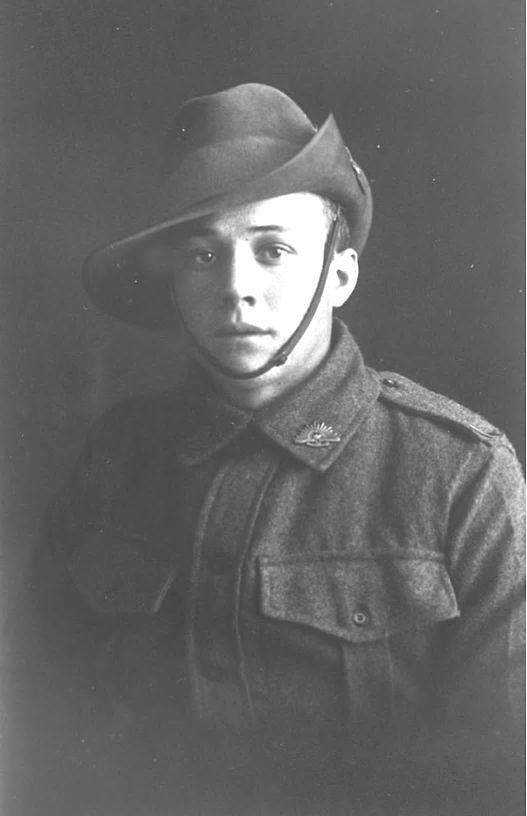
Jack Doran – listed on the Raymond Terrace Soldiers Memorial [State Library NSW]
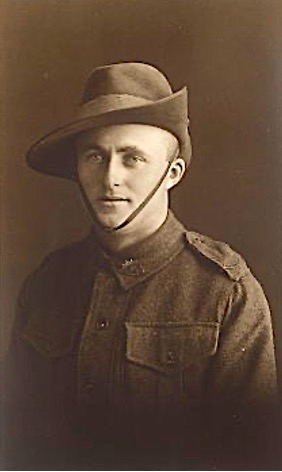
Frank Pepper – listed on the Raymond Terrace Soldiers Memorial [State Library NSW]
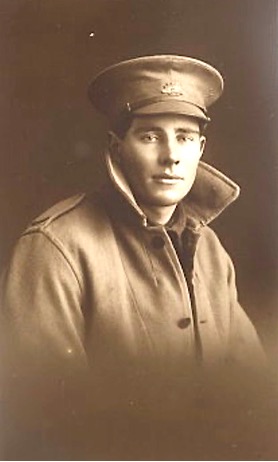
Fred Foster – listed on the Raymond Terrace Soldiers Memorial [State Library NSW]
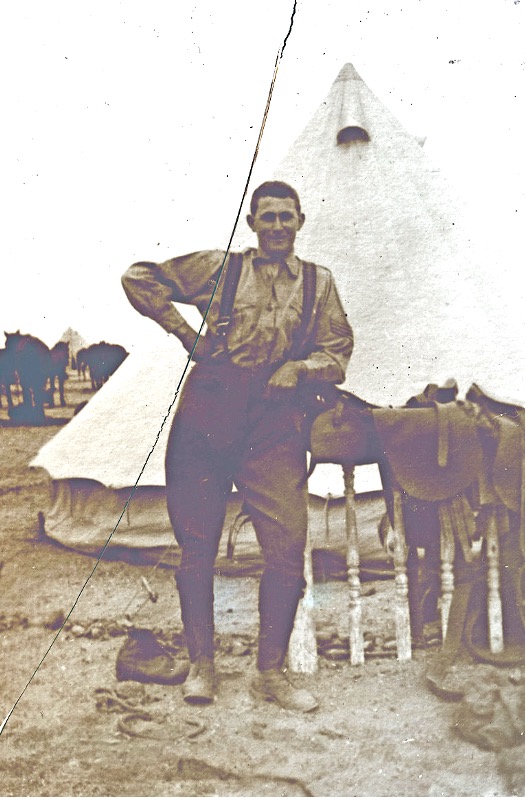
Alfred Thomas Poole, Headquarters of 1st Light Horse, Aerodrome Camp, Heliopolis, Egypt, 27 March 1915 [University of Newcastle Library, Living Histories Collection]
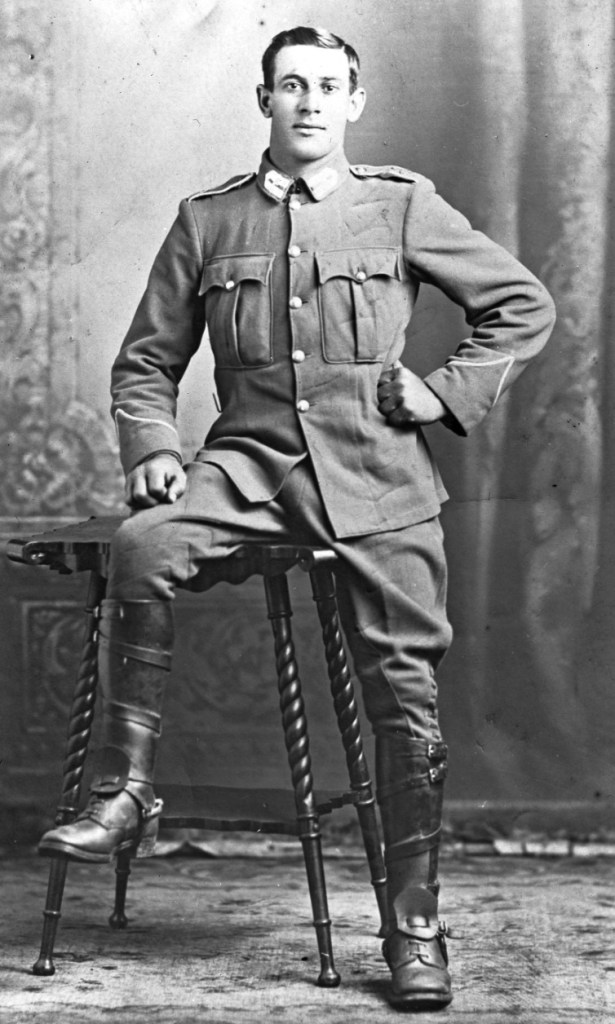
Peter Zeisser – A Squadron, 1st Light Horse [University of Newcastle Library Living Collection Histories]
Roll of Honour
The Raymond Terrace Examiner and Lower Hunter and Port Stephens Advertiserpublished a weekly listing of a “Roll of Honour” of those who had enlisted in the military from the various districts surrounding Raymond Terrace, from 2 March 1917 to 11 July 1919.
The weekly lists of the serving and enlisted soldiers included the noting of those who had died in action, as well as those who had been returned to Australia with wounds or illness.
The weekly “Roll of Honour” published in the newspaper is cited to prepare the following list of soldiers who enlisted in the military forces from the districts of Millers Forest, Nelsons Plains, Raymond Terrace and Tomago, for the First World War. Twenty-one of the soldiers listed died while on service overseas.
The newspaper reports relied on contributions from readers to advise of omissions or errors. There are 94 soldiers listed, and just over 50% were noted as either: killed, wounded, missing or prisoner of war.
There is a high correlation of the names set out in the newspaper Roll of Honour and those inscribed on the Raymond Terrace Soldiers’ Memorial.
Edward Allen, wounded
Eric Edmund Apps, returned wounded
W. C. Atkins
Clarence John Bambach, killed
Herbert Boots, returned wounded
Ralph Boots
William Boots
George Brooks, wounded
Harold Brooks, killed
Samuel Burton
Thomas Bradbury Burton, killed
William Burton
Henry Campbell
Vincent Campbell, killed
M. Carmody, killed
Clarrie Coombs, wounded
Cyril Croft, invalided home
Henry Donnelly
William Drinkwater
Albert Eaton
Jack Egan, killed
M. J. Fitzgerald
Robert Flanagan
Jack Foley, twice wounded
Gerald Foot, Portree, returned wounded
Fred Foster
William Gallen, killed
Alan M. Garbett
Archie Garred, killed
John Gray, returned wounded
Herbert Hamilton, killed
Arthur Healey, wounded
Charles Healey, wounded
Jack Hill, invalided home
John Hogan
Adrian Holdstock, invalided home
George Holdstock, prisoner
Horace Hunter, missing
Martin Hussey, returned wounded
Jack Jackson, killed
Andrew Johnson, invalided home
Arthur Jones, returned wounded
William Keegan
Andrew Kennedy, returned wounded
John F. Kevin
Reginald G. Kevin
Bert King
Ernest George King, returned wounded
Charles Linton, wounded
William Linton, returned wounded
Ray Markey
John McBride
Patrick McBride, returned wounded
William McDermott, wounded
Norman McIntosh
Allan McNiven
John Baldwin Meredith, returned invalided and discharged
J. B. W. Meredith
E. Monkley
Harold R. Morris, wounded
Martin Nissen
S. Northstead
George O’Donnell
Frank O’Grady, killed
Frank O’Meara
Alfred Osborn, returned wounded
Harry Osborn
John Osborn, killed
Stanley Osborn
Hamilton Leslie Osborne, wounded
James David Page
George Page
Joseph Palmer, twice wounded and gassed
Frank Pepper
James Perrett
Kasmer Thomas Pogonoski, invalided home
William Poile
Alfred Poole, died of wounds
John D. Richardson, twice wounded
Ross D. Richardson
Herbert Roberts
Richard Roberts
Samuel Robinson, killed
Herbert Rose, returned wounded
Herbert Russell, killed
Stanley Searl, returned wounded
Walter Searl, wounded
Cleve Smith
Ernest Smith, returned wounded
George Smith, wounded
Raymond Spruce
Richard Warren
William Wattus
C. R. Windeyer, killed
Edward Windeyer, returned wounded
G. S. Windeyer
R. M. Windeyer
Ronald Wood
Jack Woodward
Peter Zeisser, killed
PART THREE: Stories of some of the Soldiers listed on the Memorial
Many of the soldiers listed on the Raymond Terrace Soldiers’ Memorial were mentioned in newspaper reports of the time.
A selection of the newspaper reports, as below, covers farewell and welcome celebrations, experience of soldiers overseas and local community support.
Farewell to Constable Martin Hussey – 1914
The Raymond Terrace Examiner and Lower Hunter and Port Stephens Advertiser of 28 August 1914, page 2, reported:
‘Constable Hussey, who has joined the Expeditionary Force to be sent to the front, was farewelled by a large number of citizens at Morris’ Junction Inn last week and presented with a sum of money to mark the appreciation of gallantry in making sacrifices to take up arms for his country in the present upheaval in Europe. He, with the other members that are going to the front, Troopers W. Poile and A. Poole, Sergeant James, Trumpeter Boots, and Trooper Zeisser — left for Sydney on Saturday morning last, and a regular procession of the Light Horse and others escorted them to Hexham.’
Captain Windeyer Promoted – 1915
The Maitland Daily Mercury of 1 January 1915, page 5, reported:
‘Captain E. Windeyer, of Raymond Terrace, who has just been promoted to the position of Major in the Australian Imperial Force, served as a trooper in the New South Wales Mounted Rifles, under De Lisle, throughout the South African War. He is the youngest son of the late Sir William Charles Windeyer, who was instrumental in the successful inauguration of the volunteer movement in New South Wales in 1861, and who called the public meeting at which it was resolved to form the volunteer forces, which continued successfully until the establishment of the Commonwealth forces.
Sir William was himself for many years a captain in the 2nd Regiment, and became one of the best rifle shots in the colony. In addition to this son, four grandchildren of the late Judge, have now volunteered for the front, namely Major A. W. Ralston, who is serving with the forces in New Guinea; Trooper James Traill, who is a signalman in the 1st Regiment, A. L. H., now in Egypt; Lance-Corporal Charles Windeyer, the oldest son of Mr. R. Windeyer, who is serving under Colonel Cox in the 6th A.L.H.; and Sergeant-Major E. Ralston, who leaves with the next contingent of Light Horse.’
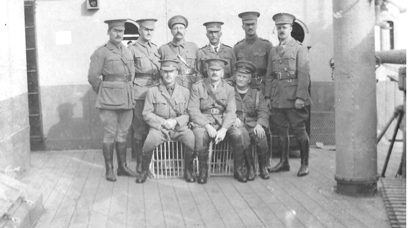
Colonel Edward Windeyer (at back third from left) [Australian War Museum]
Three letters written by Constable Martin Hussey from Egypt and the Western Front – 1915
The Maitland Weekly Mercury of 27 February 1915, page 5, reported the first letter:
‘Constable Hussey, who was stationed at Raymond Terrace, but who joined the Light Horse Division of the Australian Expeditionary Force now in Egypt, writing from the Light Horse Camp at Maadi to Mrs. Bennett of Telaralh says: —
‘We got a surprise when, we were told to come here. I thought it hard luck. I believed we should have gone to England before going to France, but Egypt is a great place for our training. The climate and everything is very suitable for us. I see by the papers that the Canadians are finding the winter severe in England, and it is difficult for them to do any training. We thought we were landing here to fight the Turks, but there is nothing doing whatever, and no sign of a fight as yet. Still, for fear of a surprise one Light Horse Regiment each day in turns carry rifles wherever they go — and sleep fully dressed with rifles by their side at night.
On Boxing Day half our men were on leave, and visited Cairo, and on Christmas Day the greater part of the regiment had the day off. I got away at night, and had dinner in Cairo, with some comrades, our Lieutenant standing the cost. We sat down at 7 o’clock and rose at 10. All the waiting is done by men. They move very slowly, smiling all the time, and can never be made to understand that anyone could be in a hurry. We had fish, a little roast beef, poultry, pudding, fruits. One of our boys as a little waiter walked slowly past put out his arm, pulled the waiter to him, and leaned on his shoulder. The waiter stood patiently as a leaning post and would not stir until his services were dispensed with.
The first night we arrived in camp we were so tired that we laid on the sandy desert and went to sleep. Our tents were not ready, but we have them now. We had rain the first day we were here, but none since. It scarcely ever rains here. The nights were fairly cold, like those at Raymond Terrace in the winter, with very heavy dews. Anyone sleeping out at nights finds his blankets wet in the morning. The days are comfortably warm, with an occasional foggy morning.
Our camp at the village of Maadi is very prettily situated. Wealthy tourists,— English and French — come here in the winter to escape the severe cold at home. This place is very hot in summer, especially the months of June and July. Our food supply was rough for a few days but is better now. We get fried meat for breakfast; meat, potatoes, and cabbage for dinner; and either tinned fish, tinned sausages or cheese. with plenty of tea and bread for our evening meal.
We expect to get into good fighting trim here and go straight to France in March. We have 150,000 troops here in all, including the New Zealanders, the Indians, and the English Tommies. I met some English and French women here whose husbands were either killed or wounded in the war. When a man realises the great issue of this war and sees the anxiety of English and French people here, it makes him glad that he has come to do his little bit, and I hope to get a chance soon to empty a few cartridges to help old England in her difficulty. …..
All the Raymond Terrace boys are particularly well. We are all separated now. Though still in the one regiment, we are on different jobs, and in different tents. Herb. Boots is a good hoy, and a hearty soldier. I often have a long talk with him. Billy Poole is the happy boy of the regiment. Peter Zeisser has grown a lot and got very strong. He never passes without trying to upset me, telling me I’m not a John now, and he wants satisfaction. He is a great bit of fighting material. Poole has done well. He’s the Sergeant’s cook at 12/ a day. Things are much better here than I expected. Our trip over was a great holiday.’
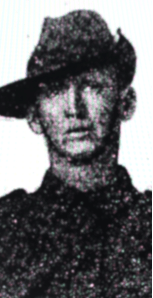
Corporal M. P. Hussey of Raymond Terrace [Sydney Mail, 22 September 1915]
The Raymond Terrace Examiner and Lower Hunter and Port Stephens Advertiser of 30 April 1915, page 3, reported the second letter:
‘The Hon. Secretary of the Red Cross Society, Raymond Terrace, has received the following letter of thanks: — “Cairo, Egypt, ‘”19th March, 1915. My Dear Miss Bishop, —We have received the parcels you so kindly sent to us, and on behalf of the Raymond Terrace Boys I thank you and all members of your society for your kindness and generosity. We appreciate your thoughtfulness. Every article is useful, and the Germans will be a busy crowd trying to knock us out of our sheepskin coats.
Each parcel was in good order and complete when received. The chocolates were a treat, and we had a comfortable smoke. You are all very kind, and from our first joining the Expeditionary Force the Raymond Terrace people have treated us splendidly, and a man can do his little might for the great cause with pride when you people at home are working so hard in carrying on such good work.
All the boys of Raymond Terrace are doing well, and I am sure everything in connection with our regiment is a success. We have spent a really good time since coming to Egypt. This, during winter months, is an ideal place for training. We have worked hard, and I am sure our regiment is quite up-to-date now.
Our Colonel, of course, has been a busy man all this time. He is looking well, and we are all anxiously waiting for word to be up and away. We expect word to move any day now. Although, Miss Bishop, we worked hard at our training, there were times when we had our day off duty, and we have spent some good times roaming round the ancient places that are to be found in and around Cairo. Many are really wonderful. “We found this a great change on our arrival here. All nationalities are gathered here, and the ways and ideas of life is, in many ways, altogether different to our own.
Cairo is a gay city. I can recommend Egypt for a holiday resort, but I would not leave good Australia to live here. Natives are always at our heels trying to sell something, and as sure as a soldier sits down to a meal in Cairo, an Arab or some dusky-looking coon will grab his leg and start cleaning his boots. You have to let him go right on or get busy on him with the free boot; but often another boy has that one.
The change of life — always some-thing fresh to be seen on board — has kept us fresh and fit for work. No one is complaining, and our stay in Egypt has been interesting, and, I think, our training successful. “It would interest our farming friends over the river were they to have a look through the farms along the river Nile. We have been through some splendid farms here. They are much like the Forest, only all cultivation land here is irrigated. The irrigation scheme is well arranged, but it runs into a lot of labour that our farmers are saved by their good rainfall.
We had a few points of rain the night we landed here, and a shower last week. Our only rain here (2½ in.), I am told, is the annual rainfall here. Altogether, Miss Bishop, we have been very comfortable here — well clothed and have always had good meals. Wonderful how well everything in connection with the army is arranged, and how smoothly everything is working. We have never had cause to complain, and I have not heard a Raymond Terrace soldier express regret for coming away. Of course, we realise that there is a strenuous time ahead, but we are well and fit, and, I hope, equal to the occasion. We will find out.
“Again, Miss Bishop, on behalf of the Raymond Terrace boys, I thank you and all members of your society for your thoughtful gifts, which we all appreciate. We are also grateful to our many friends of Raymond Terrace for their many kindnesses. “On behalf of the Raymond Terrace boys, I am “Yours, ever grateful, “Mart. Hussey.”
The Raymond Terrace Examiner and Lower Hunter and Port Stephens Advertiser of 13 August 1915, page 2, reported the third letter:
‘The following has been received by Mr. A. L. Adam from Corporal Martin Hussey, who is in the firing line at the Dardanelles: — 13th June. Dear Mr. Adam, — Thanks for writing. I was greatly surprised when I opened your letter to learn my good old Sergeant had passed away. He was a great man to live with; I will never forget him, nor regret the 2 years I spent with him. His ideas of life and living are really beautiful, and I regret that he has passed away. I must write to Mrs. Grimshaw or the girls, if possible, soon.
No doubt Herb. Boots has written home since being wounded. He is a lucky boy, for he was fired at twice from no great distance; the second bullet went through his arm and across the right buttock. He was side on to a sniper. I saw the wound dressed and am sure that once healed he will not suffer ill effects. I miss Herb now.
We take our turn in the trenches, and it is not half so rough as one would expect. We are settled to the game now, and almost comfortable; good food and well looked after. Sergeant Poole is here and is well. The Colonel, Poire, and Peter Zeisser are in Egypt. I would sooner be here. It is a grand climate, and everything is going along well for us.
I would have written to Mr. Boots when Herb was wounded but did not have an envelope at the time. Our old address in Egypt will find us any time. Our infantry did wonderfully good work here before we landed. They are marvels. Kind regards and every good wishes to self and family, and to all old friends at Raymond Terrace. Met Mr. Richardson the other day. He is A.1.’
Soldiers from Raymond Terrace Wounded in Action – 1915
The Raymond Terrace Examiner and Lower Hunter and Port Stephens Advertiser of 10 September 1915, page 3, reported:
‘The cables announce the following names of those of our district who have been wounded: — Corporal Hussey, First Light Horse. Gunner Jas. Dalton, of Salt Ash. Private Geo. Priestley, son of Mr. Geo. Priestley, of Gostwyck, Paterson. Private Ham. Osborne, son of Mr. Samuel Osborne, of Raymond Terrace. Corporal Allen Garbett, son of the Rev. M. Garbett, of Raymond Terrace. Private Alf. Osborn, son of Mr. W. Osborn, of Raymond Terrace.’
Farewell to Henry Campbell and Jack Foley – 1915
The Raymond Terrace Examiner and Lower Hunter and Port Stephens Advertiser of 10 September 1915, reported:
‘On Wednesday night last a large number of members of the Raymond Terrace Rifle Club and others assembled at Morgan’s Hotel to bid farewell to Trooper Henry Campbell, son of Mr. Jas. Campbell, of Nelson’s Plains, and Private Jack Foley, of Raymond Terrace. Captain L. Richardson presided, and after the Royal toast had been honoured, eulogised the patriotic action of the men they had assembled to do honour to in answering the call of the authorities for new recruits.
The toast of the departing guests was proposed by Mr. J. Dwyer, and supported by Messrs. H. Hodges, P. G. Street, W. Scott, Neil McDonald, W. L. Priddle, Jas. Bishop, W. Tooze, and E. Foot. Captain Richardson then handed to each of the recruits most suitable souvenirs as mementos from their comrades of the Rifle Club. Both the recipients briefly responded and said they were only doing their duty towards their King and country and hoped someday to come back amongst them. During the evening songs were rendered by Messrs. J. Saunders, N. and A. McDonald, A. Milton (Newcastle), and P. Montgomery.’
Memorial Service for Troopers Alf Poole and Peter Zeisser – 1915
The Raymond Terrace Examiner and Lower Hunter and Port Stephens Advertiser of 10 September 1915, reported:
‘The memorial service announced to be held in St John’s Church next Sunday will not be held but a united memorial service for Troopers Peter Zeisser and Alf Poole will be held in the Oddfellows’ Hall on Sunday afternoon, September 26th, at 3 p.m. A collection will be devoted to the Wounded Soldiers Fund or some such fund to be announced later. The Military and Rifle Club headed by the Town Band will march to the hall and take part in the service.’
Presentation to Private John Foley – 1915
The Maitland Weekly Mercury of 13 November 1915, page 10, reported:
‘The euchre party and social prompted by the local patriotic committee to provide funds for the sewing guild was held in the Oddfellows’ Hall, Miller’s Forest, on Thursday, 4th inst. …….
Mr. O’Meara, the secretary to the function, then presented Private John Foley, Raymond Terrace, with a. beautiful fountainpen on behalf of the patriotic committee. He eulogised Mr. Foley for his patriotic sentiments, and wished him success at the front, and concluded by stating that the pen would be very serviceable, particularly when he would be notifying his many friends at Miller’s Forest that he was coming home. Mr. Foley thanked the patriotic committee ‘ for its handsome present and assured it that he would at all times endeavour to do his best while serving for the Empire.’
Letter of Private J. R. Jackson from Egypt – 1915
The Raymond Terrace Examiner and Lower Hunter and Port Stephens Advertiser of 19 November 1915, page 3, reported:
‘Private J. R. Jackson, son of the late Mr. J. T. Jackson, of Raymond Terrace, and grandson of Mr. G. H. Pepper, writes from Zetoune Camp, Base Depot, Egypt, under date 30th Sept., to his sister as follows: —
You will see by the address that I have landed in Egypt. We arrived at Port Tewfik, at the entrance to Suez Canal, on the 9th inst., after a weary trip of 31 days. The run across the Bight was pretty rough; I was sick for a couple of days, but after that we had good weather right across the Indian Ocean. We sighted several large whales and were in sight of land nearly all the way down the Red Sea. It was terrible hot, and we nearly got baked.
Port Said is a great place for niggers and sharks— they are there in thousands. The town itself is a dirty, dreary place, and the natives still worse. They are very dirty, and dress in any old rags — men and women alike. We disembarked from the Runic, White Star liner, on the 15th, and then did eight hours in the train; half the journey was through the delta of the hill where the big irrigation system is, which covers 200 square miles, and all over this area it is covered with vegetation of the very best, just like one large Chinaman’s garden. The growth is marvellous.
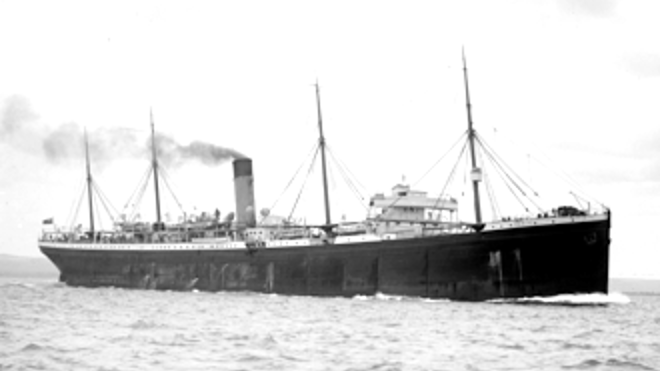
s.s. Runic
The water comes from the hill, as it never rains here. There are no fences, none to be seen anywhere. The native women work in the fields with the men. The ploughs used are old-fashioned wooden ones, drawn by either a camel and donkey or a buffalo cow. We detrained at a place called Helmiere, about six miles from Cairo, and about a mile from camp. The camp is in desert sand, and very heavy to march in. I have been in Cairo on every chance I got it is a great city, containing very ancient buildings. I have visited the Pyramids, it is a ten mile trip, and only costs one piastre. The Pyramids and Sphinx is as you see them in the photo. Some of the old Egyptian graves are 200 feet deep.
We went also to the Zoo, where there are hundreds of kinds of animals. Heliopolis is the garden suburb of Cairo, about two miles from camp, and connected with Cairo by electric cars, which is a good service and regular. Heliopolis has a few hundred houses, or rather mansions and palaces. There are magnificent restaurants, mostly in the open, with picture shows to watch while eating your meals. We are enjoying ourselves here for the short while be-ore going to the trenches.
Money is counted here in piastres (2½d); it took getting used to, and the language puzzles one. People from every nation seem to be here trying to earn a living, and it is a mix up when they are all together, each speaking his own language. The Mena camp is broken up now. There are a terrible lot of wounded soldiers at Heliopolis. There are some spanking horses here, nearly all grey Arabs — fine animals and hardy, too. We use all goats’ milk, and its not too bad; of course, we don’t get it in camp, only in town. Remember me to all my friends. Jack.’
Second-Lieutenant Garbett on last barge to leave Gallipoli – 1916
The Maitland Daily Mercury of 10 April 1916, page 4, reported:
‘Second-Lieutenant A. M. Garbett is the only son of the rector of Raymond Terrace, and was educated at the Church of England Grammar School, North Sydney, under Mr. Hodges. During the football season he represented his school in the first fifteen, and won recognition as a player. Alter completing his course at the Church of England Grammar School he entered the Hawkesbury Agricultural College and took his diploma in 1913.
At the outbreak of the war he was working for Dr. R. Davies on his farm near Scone, and from there enlisted as a private in the 1st Light horse, and proceeded with the regiment to Egypt and Gallipoli, where he won his stripes. He was invalided immediately after Lonesome Pine, and on recovery returned to the peninsula, and was among the last barge load to leave on the occasion of the historic withdrawal.’
Presentation to Lance-Corporal Stan Searle – 1916
The Raymond Terrace Examiner and Lower Hunter and Port Stephens Advertiser of 26 May 1916, page 2, reported:
‘On Saturday night last a large number of representative towns people assembled at the council chambers to bid farewell to Lance Corporal Stanley Searl, youngest son of Mr. and Mrs. John Searl of Raymond Terrace, who was in town on final leave prior to his departure for active service with the Australian Imperial Forces.
Mr. A L. Adam occupied the chair, and apologised for the absence of the Mayor and Mr. W. Brown, M. L. A. The chairman, in presenting Corporal Searl with a prismatic compass, commended the young man’s action in offering his services in defence of the Empire, and trusted that he would have a successful campaign, and a safe return to the fair land of Australia.
Messrs. R. A. Mackenzie, A. S. Bridekirk, C. H. Boots, N. C. McLellan, J. M. Feeney, and Sergeant Stein supplemented the remarks of Mr. Adam. Corporal Searl suitably responded, and thanked the people for their very valuable gift, which, he assured them, would be of great value to him in his work, and if he had the good fortune to come back safe he would always treasure it. Mr. Geo. Searl, of Dungog, brother of Stan, thanked those present for the gift on behalf of his parents.’
Welcome Planned for Returned Soldiers – 1916
The Raymond Terrace Examiner and Lower Hunter and Port Stephens Advertiser of 22 September 1916, page 3, reported:
‘A special meeting of the local Patriotic Committee will be held in the council chambers on Monday night next for the purpose of making arrangements for the reception of Lieut-Colonel Meredith, Major Windeyer, Corporal Hussey, and Private Croft, the three latter being wounded, and the former on three months’ furlough. A full attendance of the committee is requested to be present.’
Corporal Vincent Campbell Killed in Action – 1916
The Maitland Daily Mercury of 29 September 1916, page 3, reported:
‘On Friday, September 15, word came from the Defence Department, Melbourne, that Corporal Vincent Campbell, fourth son of Mr. and Mrs. James Campbell, had fallen bravely for his King and country while fighting in France on or about July 29. When the sad news came to hand the town and district was thrown in a state of mourning, and all the flags were flying half mast, because our young hero was so well known and so highly respected and esteemed that the public in general desired to show, their last respect to one of Australia’s noble sons.
Corporal Campbell in April 1915, entered Holsworthy camp, Sydney, and joined the A.M. Corps and sailed for Egypt in July. He saw action in the Gallipoli campaign, and on his return to Egypt he joined another branch of artillery and was later sent to France, and there whilst engaged in a severe battle he fell as a hero.
Deceased, who was the fourth son of Mr. and Mrs. James Campbell, of Nelson’s Plains, was a most popular young man, and everyone held him in very high esteem, both for his manly disposition and his great kindness in hours of need. He was born at Williamtown, and was 25 years of age, and took a prominent part in all the sporting bodies in our district. Those positions he forfeited when the call came to do honour to his country. He was a very active member of the A.H.C. Guild and hold office at the time of his enlistment. We extend to his parents, brothers and sisters our deepest and sincerest sympathy.’
Private John Raymond Jackson Killed in Action – 1916
The Raymond Terrace Examiner and Lower Hunter and Port Stephens Advertiser of 29 September 1916, page 2, reported:
Mr. G. H. Pepper has received word that his grandson, Private John Raymond Jackson, has been killed in action in France on 13th August. Private Jackson was the eldest son of the late Mr. and Mrs. Jackson, of Raymond Terrace, and at the time of enlisting was holding a good position in the Public Service.’
Major E. Windeyer returns home after being wounded – 1916
The Maitland Daily Mercury of 2 October 1916, page 4, reported:
‘Amongst the troops who returned to Sydney yesterday was Major E. Windeyer of Raymond Terrace, of the Light Horse. It was his bad luck to be struck by a machine gun bullet, and subsequently to get another three bullet wounds. As the Major told his tale leaning over the rail he hardly looked as if only a few months ago he had literally been dragged out of the jaws of death.
This was the case, however. “I owe my life to Lieut. Ryan, of the Light Horse,” he said, “for within half an hour of going into action at Romani a machine-gun bullet got me in the head, and I was bowled over. Lieut. Ryan came to my assistance, and, raising me, gripped me round the thigh to help me along. We had not gone far when a bullet smashed right through his hand and into my thigh. Lieut. Ryan, in spite of his injury, continued to help me, but on the way to safety shrapnel bullets got me in the shoulder and chest. It was a close call, but I’m feeling pretty well all right now.”
Thomas Bradbury Burton Killed in Action – 1916
The Raymond Terrace Examiner and Lower Hunter and Port Stephens Advertiser of 6 October 1916, page 3, reported:
‘Mr. S. E. Burton, of Tomago, has received word that his son, Thomas Bradbury Burton, was killed in France on the 26th of July last. Mr. Burton has two more sons at present fighting in France.’
Soldiers welcomed home to Raymond Terrace – 1916
The Maitland Daily Mercury of 14 October 1916, page 7, reported:
‘The welcome home on Saturday last tendered to Colonel Meredith, Captain Windeyer, and Corporal Hussey and Croft was a great event, and compared favourably with the great event of Australia Day last year. Every home in the town and the surrounding districts was well represented.
The four heroes were met at the town boundary by the Mayor and Mayoress (Alderman and Mrs. Hanlon), and representatives from the patriotic committee and other citizens, and headed by the town band a large procession wended its way to the Oddfellows Hall, where the guests of the day were tendered a civic reception. Colonel Meredith is home on furlough, while the three latter officers are home for good. On the whole the officers look well, but all show want of a complete rest.’
Farewell Presentation to Private William McDermott – 1916
The Maitland Daily Mercury of 1 November 1916, page 7, reported:
‘The call to arms of our brave soldier boys has not fallen on deaf ears in the members of the A.H.C. [Australian Holy Catholic] Guild, Raymond Terrace, as already four have volunteered for active service, the latest being Private Bro. William McDermott.
On Saturday evening in St. Brigid’s school room, Raymond Terrace, the officers and members of the branch tendered Private McDermott a smoke concert and presentation. The Bro. Warden, W. Dwyer, presided. There was also present the Rev. Chaplain to the branch, Father O’Flynn, P. P., J. J. Moy, P. B. W., G. Cunningham, D. W. and A. J. O’Brien, secretary, together with the remaining officers and members of the branch.
Bro. Warden, welcomed the company, and proposed the toast of “The Pope” and “King.” The toast of “Our Guest: was next submitted by the Bro. Chairman. He stated that Bro. McDermott was one of the best members of the branch, and by his energy and interest in the society had worked himself from the bottom of the ladder to the top. He first joined the society, when the branch was opened in 1902, as an ordinary member and since then he had passed through all the offices of the society up to that of Warden. He enjoyed the confidence of all the members of the branch, especially the young members. His patriotic efforts were highly appreciated by all, and he felt sure that a more upright and braver soldier never donned the King’s uniform.
The toast was supported by Bros. J. J. Moy, A. J. O’Brien, G. Cunningham, A. J. Cooper, J. J. Dwyce, J. T. O’Brien, and J. P. O’Hearn. The rev. chaplain then presented Bro. McDermott with a beautifully engraved solid gold cross representing the emblem of the society, with the coat of arms set in the cross, surrounded with a wreath of waratahs and wattle leaves representing the Australian flower. The four points of the cross had affixed in raised gold, the letters A.H.C.G.
The chaplain in making the presentation, eulogised the good Bro McDermott had done in the Church and society, and said he sincerely regretted his departure. He was an exemplary creditable young man and one that was held in the highest respect in the parish. He spoke of his heroism and his sacrifice in leaving such fond parents and happiness of home. He assured all present that wherever Brother McDermott went he would always uphold his good name and never discredit it. He wished Brother McDermott God’s blessing wherever he went and hoped that all would be present to welcome him home again in a very short time.
Bro. McDermott who was greeted by the singing ”For He’s a jolly’ good Fellow,” stated’ that he considered that he was not deserving of the many things spoken of him, because what he had done for the society he was obliged by his conscience to’ do. He regretted severing his office with the branch and he was proud of it, and of its members. While holding office he had done to the best of his ability. He had joined the colours simply because he considered it his duty conscientiously to do so. He could be spared, and he thought it was up to him to lend a hand. He asked the members always to remember him in their prayers, and he hoped to be with them some day. He sincerely thanked them for their very beautiful present.’
Report on Local Military Officers – 1916
The Maitland Daily Mercury of 9 November 1916, page 7, reported:
‘Major J. D. Richardson is now acting lieutenant-colonel commanding the 7th Light Horse in Egypt. This officer, who has been wounded three times, volunteered as soon as war broke out, and has been on active service nearly the whole time of its duration. He is a member of a well-known and respected Raymond Terrace family and held rank as a lieutenant when he enlisted from here.
Major E. Windeyer, who was recently invalided from Egypt, will not be returning to the front. This officer was in temporary command of his regiment at Gallipoli, and was four times wounded.
Second-lieutenant A. M. Garbett, son of the Rev. M. G. H. Garbett, rector of the Church of England, has received promotion. The young officer is at present in the Light Horse in Egypt.
Sergeant H. James has received his commission as lieutenant in the First Light Horse. He was among the earliest to enlist and is now in Egypt with the forces. November 8.
Privates J. and W. V. Jackson Killed in Action – 1916
The Newcastle Morning Herald and Miners’ Advocate of 13 November 1916, page 5, reported:
‘Mrs. W. C. Daniels, of Maitland-road, Tighe’s Hill, has received word that her nephew, Private W. V. (Bill) Jackson was killed in France on October 16th. He was 19 years last July and was the second son of the late Mr. and Mrs. J. T. Jackson, of Raymond Terrace. His brother Jack was killed on August 11th in France.
Letter of Trooper W. Spruce from the Front – 1916
The Raymond Terrace Examiner and Lower Hunter and Port Stephens Advertiser of 17 November 1916, page 3, reported:
‘Trooper W. Spruce, writing to his father under date of 26th September, says:— I am well at present. You will be glad to see the old Doctor and Major Windeyer back at Raymond Terrace again. I would very much liked to have seen him before he left, poor old chap, as I had only met him once for a few hours. We have had another fly at the Turks since the big battle and came out of it lucky this time. The Turks cannot face the cold steel like we Australians. I suppose you have seen the full account of it in the papers before this.
I was unlucky enough to get a slight wound at the battle of Romani, but nothing serious, being wounded the same day as Major Windeyer, which put me in the hospital for a month’s holiday, but I am alright again now and back with my regiment.
Davie James is over here again as our sergeant, a jolly fine fellow he is. Major Richardson is keeping well and looks splendid. It is a fine sight at present to see the date crop, and we nearly live on them. I hope that this great and cruel war will soon come to an end, but I don’t think it can last much longer. Remember me to all at the Terrace.’
Report on Local Soldiers – 1916
The Newcastle Morning Herald and Miners’ Advocate of 27 January 1917, page 2, reported:
‘Constable M. Hussey, of the local police force, has been transferred to Sydney. He recently returned to this district after an absence in Gallipoli, where he was twice wounded.
Major E. Windeyer has been discharged from military duty and will resume business with his firm at Raymond Terrace. The Major was seriously disabled in Egypt, and has been convalescing on the South Coast, having been appointed to a position at Kiama some months ago.
Private W. Keegan has returned to Raymond Terrace on furlough, after fourteen months’ service in Rabaul.
Colonel J. B. Meredith, D.S.O. has again arrived in Egypt, and will resume his military duties.
The fifteenth member of the Raymond Terrace Rifle Club has just enlisted. This is Private Allen McNiven, who was presented with marks of esteem by the various patriotic organisations in the town, the rifle club, and by private well-wishers, on the eve of leaving for the front.’
Private Walter Searl wounded in France – 1917
The Raymond Terrace Examiner and Lower Hunter and Port Stephens Advertiser of 1 June 1917, page 2, reported:
‘Mr. John Searl, of the Terrace, has received a cable stating that his son, Private Walter Searl, has been wounded, and is now in hospital in France doing very well.’
Local soldiers help raise ‘War Chest’ Funds – 1917
The Dungog Chronicle of 2 October 1917, page 2, reported:
‘This riverside town [Raymond Terrace] was ‘en fete’ on Saturday last, when an effort was made by the ladies to raise funds for the War Chest. The centre of attraction was a procession of contestants for the Queen of the Day competition. There were seven young ladies in the running, and each in tableaux represented some distinctive subject, such as “The Allies,” “War Chest,” “Red Cross,” “Ireland,” “Cream Industry,” etc. …..
The Mayor, Mr Hanlon, afterwards welcomed home Privates Grey (Girvan), and Pogonoski (Raymond Terrace), and the gathering was addressed by Hon. Walter Bennett, who handed the Queen a cheque for £10 towards the War Chest fund from Mr R. Elkin, the well-known auctioneer.’
Four Soldiers welcomed home – 1917
The Raymond Terrace Examiner and Lower Hunter and Port Stephens Advertiser of 5 October 1917, page 3, reported:
‘During the interval at the coronation ceremony on Wednesday night, occasion was taken to accord a public welcome home to Lance-Corporal A. Holdstock, Private Gray, Corporal Pogonoski, and Private Stewart, who had returned from the front.
The Mayor occupied the chair and referred to the fact that the soldiers there had just returned, and had done their duty at the front. They appreciated their noble action in offering their services, and still more the services they had rendered. He hoped they would soon be fully restored to health and strength again.
Mr. A. L. Adam said he was pleased to have the honour of being present to welcome home Lance Corporal Holdstock, Pte Pogonoski, Private Gray and Private Stewart. They represented that night the Australian forces who had done so much to make the name of Australia honoured in the Empire, men who had fought for those things they all prized most, their liberties and their privileges. He quoted Burns’ as applicable to the circumstances of the honour, that should be paid to such men as these, for the services they had rendered their native land. He hoped under the generous conditions. of climate, in Australia, they would be restored to their usual health and strength. He cordially welcomed them home, and fully appreciated the value of the heroism they had shown.
Lance-corporal Holdstock in thanking them for their welcome, said he asked them, to remember the men in the trenches; they wanted papers and letters, as they went a long way towards cheering them up. They could think of them in this way. He thanked them for the honour they had done him in the welcome they had given him. Corporal Pogonoski also tendered the public his thanks for the welcome home they had given him. Private Gray and Stewart thanked them through the Mayor. They could fight better than they could talk. Cheers for the returned men and the men at the front were given, and the four soldiers gave three cheers for their reception.’
Raymond Terrace Sock Fund – 1918
The Raymond Terrace Examiner and Lower Hunter and Port Stephens Advertiser of 4 January 1918, page 3, reported:
‘This little fund keeps quietly on its way with a pair of socks each month to our local boys at the front, and letters of thanks to the workers and supporters have been received from Major J. D. Richardson, Lieut. James, George Holdstock, J. Campbell, G. Carmody, M. Fitzgerald, Charles and Arthur Healey, John McBride, Archie Garred, Hamilton Osborne, H. Roberts, Sam and Will Burton, Joe Palmer, and the late Charles Wattus.
The letters may all be seen at Mr. A. L. Adam’s office by those interested. The secretary: Mrs. A. J. Windeyer, will gratefully receive donation of tobacco or cigarettes, (in tins if possible) to enclose in the parcels each month from those men and lads, who can’t assist the fund in any other way. It means something from their own district, and the boys do appreciate a smoke from home. Don’t forget what they are doing for you.’
Private E. Smith returns after being wounded – 1918
The Newcastle Morning Herald and Miners’ Advocate of 7 January 1918, page 6, reported:
‘Private E. Smith, of Raymond Terrace, has returned from France, where he has been for the past fifteen months on active service. He was severely wounded in the right foot, at the battle of Messines, and the amputation of three toes was found necessary.’
Missing Raymond Terrace Youth, Ronald Wood, joins the Military – 1918
The Daily Observer of 14 January 1918, page 2, reported:
‘The police have ascertained that a lad named Ronald Wood, 17½ years of age, who was missing from Raymond Terrace, arrived at Brisbane recently. He asked a civilian to direct him to the A.I.F. camp, where it is assumed, he now is.’
Private William Osborn Killed in Action – 1918
The Maitland Weekly Mercury of 16 February 1918, page 12, reported:
‘Word was received last week by Mr. William Osborn, sen., of Raymond Terrace, to the effect that his son, Private John Osborne, was killed in battle lately. He was not officially informed, but it is considered to be too true, as the informant is most reliable, and Mr. Osborn has not received a letter from his son for some time back.
Private Osborn joined the colours in the early stages of the war and was in constant communication with his parents up till a few weeks ago. The sympathy of the district goes to Mr. and Mrs. Osborn in their sad loss, but like the brave hearted parents of old they have the consolation of knowing that their soldier-son fell as a hero in the noble light of liberty and righteousness.’
Private Eric Apps returns home after being wounded – 1918
The Maitland Weekly Mercury of 6 April 1918, page 1, reported:
‘Private Eric Apps, eldest son of Mr. Richard Apps, of Miller’s Forest, arrived home from the front a few days ago severely wounded in the legs. Private Apps was absent for over two years on active service, and about six months ago he was in a hospital in England. After improving somewhat, he was sent home. He was to be accorded a public ‘welcome home’ on last Monday night, but his feet again caused him great trouble, and consequently he was compelled to return to a military hospital in Sydney. He played a hero’s part, and we sympathise with him in his affliction.’
Sergeant C. Coombs wounded and Private A Poole Killed in Action – 1918
The Newcastle Morning Herald and Miners’ Advocate of 30 April 1918, page 4, reported:
Mrs. C. Coombs, of Raymond Torrace has been informed that her husband, Sergeant Coombs has been wounded during the recent severe fighting on the western front.
Private A. Poole, a native of Raymond Terrace, has been killed in action.’
Private W. L. (Red Wing) Gallen Killed in Action – 1918
The Maitland Daily Mercury of 4 May 1918, page 20, reported:
‘Much gloom was cast over the district and Raymond Terrace when the sad intelligence came to hand stating that “Red Wing” (Private W. L. Gallen) was killed in battle on April 10….
Private Gallen, whose interesting letters often appeared in the ”Mercury” was the only son of Mr. and Mrs. Patrick Gallen, of Eagleton, and practically lived all his life in Miller’s Forest. He was a great favourite and took a very deep interest in the Miller’s Forest Cricket Club, which body at his departure for the front, gave him a great send-off and a handsome presentation. He was a born soldier, and it would be a difficult task to find one more enthusiastic.
Deceased, who was aged 25 years, enlisted nearly three years ago, and with the exception of six months’ furlough in Scotland spent most of that time fighting. In his many letters home, he frequently mentioned his homecoming, but alas, “Man proposes, but God disposes.” The sad news was received by the Rev. Father O’Flynn, P.P., Raymond Terrace, who conveyed it to his parents. A Mass and prayers for his soul were recited by the Rev. Father O’Flynn at a service in St. Brigid’s Church, Raymond Terraae, on Monday morning, which was largely attended.’
Sergeant A. D. Garred Killed in Action – 1918
The Newcastle Morning Herald and Miners’ Advocate of 17 May 1918, page 6, reported:
‘Following the announcement that Sergeant A. D. Garred was reported missing on 5th April 1918, Mrs. D. J. Garred, of Raymond Terrace, has now been officially informed that her son was killed in action on that date. Sergeant Garred enlisted as a private in September 1914, leaving Melbourne on December 22nd of the same year. He participated in the landing on the Gallipoli Peninsula, being a member of Colonel Burnage’s Battalion. After being on the peninsula about a fortnight, he was wounded during an attack on “Pope’s Hill,” having the lower part of his ear blown off. He jocularly remarked that he was “well-ear-marked”
After a short absence in hospital in Egypt, he returned to the Peninsula and was taken ill, and landed at Malta for hospital treatment, necessitating an absence of about four weeks. He again returned to the peninsula and participated in the various battles. After the evacuation he was promoted corporal, and transferred to the 45th Battalion, being among those sent to France. He participated in various actions in France until August 1916, when he was wounded in the left hand and foot by shrapnel.
After an absence of about ten weeks in England, he returned to France, but during the winter of 1916-17 he contracted trench feet, and was again sent to England for treatment, where he remained about six months. Returning to France he was promoted sergeant and participated in the advance of the Allies during the summer of 1917. In his letters received prior to the announcement by telegram of his death, he stated that he expected to be able to come home on six months’ furlough, but the advance of the Germans evidently stopped all leave and resulted in his death. Sergeant Garred would have attained his 28th birthday next July and was the only remaining single son of Mrs. M. Garred and the late D. J. Garred.’
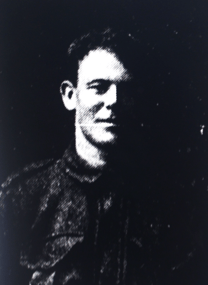
Archie D. Garred of Raymond Terrace killed in action [Daily Observer – 18 May 1918]
Private P. McBride Returned Wounded – 1918
The Newcastle Morning Herald and Miners’ Advocate of 18 June 1918, page 7, reported:
‘Private P. McBride, who has been absent on active service for the past two years, during which time he was severely wounded in the hand, has returned to Raymond Terrace. He travelled home in the same vessel in which he left Australia tw and a half years ago.’
Welcome Home to Corporal Henry P. Campbell and Private William J. McDermott – 1919
The Maitland Daily Mercury of 8 February 1919, page 2, reported:
‘The Oddfellows Hall, Raymond Terrace, presented a very gay appearance on Monday night last, when the members of the local branch of the A.H.C. Guild tendered a hearty welcome home to two of their brothers who have been on active service, in the persons of Bro. (corporal) Henry P. Campbell, and Bro. (private) William J. McDermott.
Corporal Campbell enlisted nearly two and a half years ago, and witnesses the scenes of many battles in Egypt, whilst Private McDermott, who enlisted about two years ago, spent most of his time in France, and was in the thick of the fighting. He took part in the battles of the Somme, Bullecourt and Amiens, and was twice wounded. Private Campbell served in the A.L.H. in Egypt, and in the early stages of the war took part in the principal battles fought there, but latterly he was compelled to go into the hospital as he suffered greatly from sickness, which was very prevalent in those parts. Both soldiers look the pink of condition and are loud in their rejoicing at being home once more.
The welcome took the form of a conversazione [social gathering], which was well attended. Over 125, consisting principally of the members of the society and their families, and a few very intimate friends of the returned boys, sat down to the banquet. The tables and walls of the hall had been very prettily decorated by the ladies. The returned heroes were met at the door by the Warden (Bro. W. Dwyer), and the Past-warden (Bro. J. J. Moy), whilst cheers were called and heartily given. Headed by two little girls, Misses Molly Saunders and Ita O’Hearn, bearing the Union Jack and the Australian flag, the guests of the evening passed through a guard of honour formed by the brethren of the society, to the stage. The ladies in the meantime singing “Home, Sweet Home.”
After the singing of the National Anthem, Bro. W. Dwyer, on behalf of the guilds of Raymond Terrace, extended a hearty welcome to the returned men. All present then sat down to table, the Rev. Father O’Flynn presiding. Seated on each side of him were the guests of the evening, their parents, and sisters, and the representatives of the Hibernian Society, Messrs. J. O’Grady and J. M. Feeney. Apologies were received from Mr. and Mrs. J. Campbell (parents), who, owing to the death of a grandchild that day, were unable to be present, and from others.
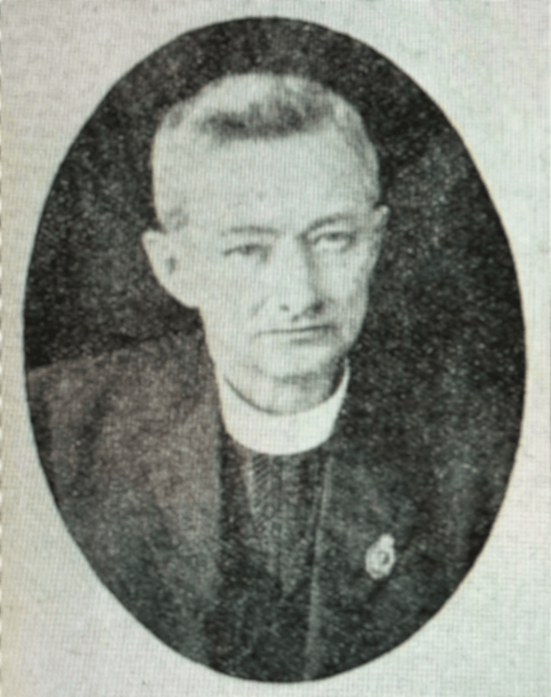
Father O’Flynn – Chairman of the Welcome Home celebration
After the loyal toasts had been honoured, the rev. chairman proposed the toast of “Our Returned Brothers.” He congratulated 1Bros. Campbell and McDermott on their return and wished them many years of happiness. He paid a glowing tribute to all the soldiers who enlisted from the district and sympathised with the relatives of the be-loved ones lost in the fray. Other speakers who offered their hearty congratulations at the return of the soldiers were Bros. W. Dwyer, J. Saunders, J. M. Feeney, and Messrs. J. Quilkey and M. R. Markham.
“For They are Jolly Good Fellows’ was then sung after which the Rev. Chairman called upon Bro. Moy to make the presentation. Bro. Moy stated that he felt highly honoured to make the presentations to such worthy members. He had much pleasure in presenting on behalf of the Guild’s a beautiful cross, suitably inscribed to Bro. Campbell, and set of sold sleeve links, initialled, to Bro. McDermott, and he hoped that these mementoes would always remind them of their homecoming.
Bro. H. Campbell, who, on rising to respond was greeted with great applause, said that he was very thankful to the Guilds and the many friends who had gathered there to pay him and Bro. McDermott a tribute of respect, and Bro W. McDermott, who also met with a most hearty reception, expressed his thanks to the society and to all who had honoured him. He spoke briefly of his time abroad, but said after all he had travelled and witnessed, no place was like home. He thanked the Guilds for their handsome gift, which he would always cherish.
Other toasts honoured were “The Parents,” by Bro. W. Dwyer, and responded to by Mr. M. McDermott and Bro. H. Campbell, who apologised for his parents’ absence. “The Ladies,” by Bro. A. J. O’Brien, and acknowledged by Mr. M. R. Markham, and “The Rev. Chairman,” by Bro. J. J. Moy. During the evening songs were rendered by Miss Eileen Quilkey, and Bro. J. J. Dwyer, whilst Miss Ita O’Hearn recited amidst much applause. Miss Beirne’s orchestra, consisting of violin and piano, played selections during the banquet, and also for the social, which followed. Bro. V. Doherty acted as M.C. A memorable night closed about 1 a.m. to the strains of the National Anthem.’
G.U.O.O.F. Roll of Honour Unveiled – 1919
The Newcastle Morning Herald and Miners’ Advocate of 14 April 1919, page 3, reported:
‘The unveiling of the roll of honour of the G.U.O, O.F. [Grand United Order of Oddfellows], in the Oddfellows’ Hall, was performed by Bro. Sneesby, of Newcastle, in the presence of a number of those interested in friendly society work.
The roll contains the following names: H. Boots, R. Boots, W. Boots, W. Wattus., H. Sandeman, A. Smith, J. Palmer, R. J. Pywell, F. Pepper, G. and G. H. Smith. The names of C. Adam, G. Greaves, and G. Sutton, who volunteered but were not eligible, were also placed on the board.’
Raymond Terrace Returned Sailors and Soldiers’ Imperial Service League Sub-branch Formed – 1919
The Australian Town and Country Journal of 11 June 1919, page 14, reported:
‘A sub-branch of the Returned Sailors and Soldiers’ Imperial Service League has been formed by the returned men of Raymond Terrace and district. Brigadier-General Meredith, D.s.O, was appointed patron, Major Windeyer president, Messrs. Keegan and James vice-presidents, and Warrant Officer Osborne secretary. A committee representative of the district was elected.’
Parents of Private H. Russell receive Commemorative Medal – 1919
The Newcastle Morning Herald and Miners’ Advocate of 29 July 1919, page 3, reported:
‘Mrs. G. Russell, of Raymond Terrace, has received from the Defence Department a commemorative medal in respect to her son, Private H. Russell, who was killed in France two years ago. The medal has at the top a bar of white metal, and from this is suspended a strip of black ribbon, on which is worked in golden thread a representation of the rising sun and the words, “For Australia,” with sprigs of wattle in either corner. At the bottom there is another band of medal bearing a star.’
Lieutenant-Colonel J. D. Richardson returns to Raymond Terrace from England – 1919
The Raymond Terrace Examiner and Lower Hunter and Port Stephens Advertiser of 15 August 1919, page 3, reported:
‘Colonel J. D. Richardson returned home to Raymond Terrace on Saturday last, after an absence of close on five years on active service. He was met at, and brought from Hexham by Major Windeyer, and on arrival at Raymond Terrace the Colonel was met by the Mayor and townspeople and given a formal welcome home.
The Mayor (Alderman Tooze) extended a hearty welcome to the Colonel, after putting up a record of those who have returned of being the longest on active service, nearly five years, and he was pleased to compliment him on his record over there, and the promotions and reputation he had gained. His career in the Light Horse before he went demonstrated that if he got the chance, he was able to make use of it. He thanked him for the services he had rendered in helping to defeat the Germans and assure that in the future liberty and fair play would be enjoyed by the Empire as a result of his and others great service in the cause.
This was merely a formal welcome, and later on they would take the opportunity of presenting him and others lately returned with a civilian’s welcome and a medal. The Rev. M. G. H. Garbett, on behalf of the Patriotic Committee, the Red Cross and War Chest, extended a hearty welcome to the Colonel on his achievements and his safe return. As a welcome on a larger scale would be taking place later, he would say no more.
Brigadier-General Meredith also welcomed the Colonel as one of his old comrades, who he was glad to welcome back, and to congratulate him upon his brilliant services.
Colonel Richardson said he thanked them for their kindness which had prompted them to meet and welcome him back. He had wished to get back sooner, and join his family and friends, but it could not be done. The town of Raymond Terrace was to him more than any in the world, there was no place like it. When he entered Sydney Harbor, though he had travelled a good deal, and seen many fine places, he thought it the most beautiful sight he had ever seen and was only rivalled by one other view, and that was looking from his home, on the top of Roslyn, down over the Hunter River and farms below. He was glad to go, and glad to stay there while anything could be done. He thanked them for their kind welcome. Three cheers were given for the Colonel and his family, who were then driven to their home.
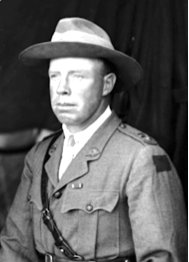
Lieutenant-Colonel John Dalyell Richardson of Raymond Terrace [Australian War Memorial]
Hibernians welcome Sergeant J. F. Foley and Private J. P. Hogan – 1919
The Freeman’s Journal of 18 September 1919, page 30, reported:
‘On Thursday night, August 28, the Oddfellow’s Hall, Raymond Terrace, was the scene of a gay and enthusiastic gathering, the occasion being a welcome home and social evening tendered by the members of the local Hibernian Society (men’s and women’s branches) to two of their brethren who have just returned from the war— Bros Sergeant J. F. Foley and Private J. P. Hogan.
The hall was decorated and enlivened by flags and the colours of their regiments. The returned members were met by the president, Bro. F. Davoren, and the vice-president, Bro. T. Corbett. A guard of honour was formed by the members. The president (Bro. Davoren) tendered cheering and hearty words of welcome, and during the repast the toast of “Our Returned Brothers” was given by Bro. J. F. O’Brien and supported by the vice-president (Bro. T. Corbett) and Bro. C. P. O’Brien.
Presentations of gold emblems of the society, suitably inscribed, were made to each of the returned members by Bro. J. M. Feeney, who referred to the services rendered by the returned members; and the presentations were the medium by which the branch expressed in a small way its appreciation of the services they had both rendered.
Bros. Foley and Hogan both expressed their gratitude for the honour tendered them, for the hearty welcome and presentations. The toast of “The Visitors” was given by Bro. J. P. Montgomery and acknowledged by Bros. W. J. McDermott and P. Kennedy, members of the local A.H.C. Guild. Apologies were received from the Rev. Father O’Flynn, the warden and secretary of the A.H.C. Guild (Bros. W. Dwyer and A. J. O’Brien), also from Bros. M. J. and J. O’Grady.
Refreshments were provided by the ladies and music hy Miss Bierne’s Orchestra. During the evening songs were rendered by Sisters D. Edstein M. Feeney and Bro. V. J. Edstein, and recitations by Miss C. Cunningham. The attendance was about 150, who after the welcome and presentation ceremony had terminated, enjoyed dancing till 1 a.m.’
Roll of Honour Notice for Clarence John Bambach Killed in Action – 1919
For many years following the end of the First World War hostilities, the relatives of fallen soldiers often remembered and celebrated their service through the placement of notices in the ‘Roll of Honour’ section of newspapers. The notice below for the Raymond Terrace soldier, Private Clarence John Bambach, serves as an example of the loss suffered by those left behind.
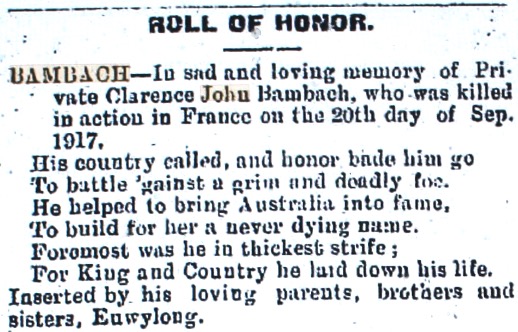
Roll of Honour Notice for Private Clarence John Banbach [Raymond Terrace Examiner and Lower Hunter and Port Stephens Advertiser – 19 September 1919]
Continental Fete held for residents who had assisted in the War Effort – 1920
The Raymond Terrace Examiner and Lower Hunter and Port Stephens Advertiser of 12 March 1920, page 3, reported:
‘Between 500 and 600 people assembled in the Public-School Grounds, Raymond Terrace, on Monday night, the occasion being a Continental Fete given by the Returned Soldiers of the town and district, to the Red Cross Workers, War Chest Comforts’ Fund, Knitting Circles, and all others who had assisted in promoting the wellbeing of the boys at the front.
The Raymond Terrace branch of the Returned S. and S. I. L. organised the Fete as evidence of the regard and gratitude they feel, and desired to express, to those who had done such noble service during the war in the heaps of goods they had sent to our soldiers overseas. It was a pleasant recognition of those services, and the war workers appreciated the compliment as it fully conveyed the fact that their services had been so valuable to the men. The attendance included visitors from all the districts around, motor cars conveying the Eagleton, Seaham, Williamtown and other visitors to the scene about eight p.m.
The grounds were adequately lighted with airgas, acetylene, and Chinese lanters, the latter showing up against the tree foliage in a graceful effect. The Union Jack at the gate was a triumphant verification of the valour of its sons, else some other flag might have been there. There was a good rally of soldiers and included in the gathering were Brigadier General Meredith, Colonel J. D. Richardson, Major E. Windeyer, Caplain-Chaplnin MacAulay, Capt. H. H. Smith, Lieut. Hop. James, and the ubiquitous Sec., Sgr-Mjr. A. Osborn.
There are few of the smaller communities like ours that can boast of the same strength. The Officers and men were most anxious to secure the most enjoyable time for their patrons, and those who did not get a full measure of enjoyment, could at-tach no blame to their hosts. During the evening, Major Windeyer, Colonel Richardson, and Capt. Chaplain MacAulay publicly expressed their thanks to all those who had worked during the war to keep up the supply of goods, which had cheered so many of their hearts, and told them they were not forgotten by their own folk. In the dressing stations and in the hospitals too, the goods were invaluable, and helped hundreds of men to convalescence and comfort; and only the soldiers knew, far beyond the conception of those who made or contributed towards the goods, the deep feeling of gratitude that possessed the men.
There was no country that sent so much goods and gifts to their soldiers, according to the population, as the Australians, and Chaplain MacAulay related an incident of an enquiring Tommy, who was given a small parcel, and being told they were free gifts from Australia, extended his eyes and exclaimed “My God, I’m going there when the war’s over.”
Mrs Garbett, as President of the Red Cross and War Chest thanked the soldiers for the compliment paid the war workers and said they were delighted to know their efforts were so much appreciated. Why should they not work when the soldiers were fighting to save their homes and country. Their efforts were small in comparison to the services given by the men, but they appreciated very much the fete tendered them. In memory of fallen comrades, the audience stood with uncovered and bowed heads, while the “Last Post” was sounded by Trooper Ralph Boots.
During the evening refreshments were handed round on a liberal scale by the returned soldiers, and the youngsters were lavishly supplied with sweets. They had a great time. Concert items were given by Mr. J. Morris, and Miss Cunningham, the latter reciting “Mother of Men.” The Raymond Terrace Band rendered an appreciative programme, under the baton of Mr. T. Adam.
An item which contributed to the amusement of the assemblage was O’Grady’s drill. The word of command is given, but unless it includes the word O’Grady it has to be ignored. Men accustomed to the word of command promptly obey it and are passed out of the ranks. There were about 30 in the drill, and the drill sergeant was Major Windeyer, and his first command was “O’Grady says quick march.” The men marched. The command “halt” was then given, and about 5 of the men halted, and were passed out. They should have waited for “O’Grady says halt.” The drill continued until one, Private Charlie Healey was left in, and he secured a prize. The people dispersed about 11 p.m. and terminated a very successful evening.’
Welcome Home Celebration and Medal Presentation for Soldiers – 1920
The Raymond Terrace Examiner and Lower Hunter and Port Stephens Advertiser of 4 June 1920, page 3, reported:
‘There was a very creditable attendance at the welcome home to returned soldiers in the Oddfellows’ Hall, on Monday night, and the function passed off pleasantly and successfully. There was also a good rally of returned men, generally. The ladies of the Red Cross had the hall decorated in an attractive way, and the stage arranged in effective method for the occasion.
The boys who were the principal guests of Monday night were: Privates A. W. Healey, A. Gilbert, F. Pepper, and J. McBride. There were however, only two of them able to be present— Privates Healey and McBride being absent. Apologies were tendered. Mr. W. G. Tooze president of the Patriotic Association, occupied the chair, and in opening invited those soldiers who had not yet received their medals, but were ready at former welcomes for them, to come on to the stage.
The opening of the ceremony began by the Band, under the leadership of Mr. T. Adam, playing “Home Sweet Home” and “Home Again to Dear Old Aussie.” Mr. Tooze, then extended a public welcome to the returned men, and referred to the gratitude which they all felt for the service they had rendered to the Empire, the Commonwealth and their own, town. They had gone away determined to do their duty, and this they had done thoroughly. That night marked the winding up ceremony, and he referred to the fact that some would not return, having given their lives in the cause, and in such cases the full sympathy of the people went to the parents and friends of the fallen.
He extended a hearty welcome again to those who had returned and felt that no words could express in full the thanks of the community for their services in upholding the flag and the Empire. He read apologies from Mr. Jas. Hanlon, Mayor, and from Sergent Foley, Mr. Davies, (Public School,) Privates Wood and C. and A. Healey. He then invited Mr. Charlton M. P. to ask the Rev. MacAulay to accept memorial medals for the next of kin, who were not present at the function. The medals are to commemorate Gunner Stuart, Privates Bambach, M. Carmody, Trooper V. Campbell, the Band playing “Nearer My God to Thee.” The medals will be handed over by Captain-Chaplain MacAulay.
Mr. Charlton then addressed the gathering, extending a hearty welcome to the men who had returned, and expressed his sympathy to the friends of those who had made the supreme sacrifice. He said that no one could but say when they looked back to 1914, that England had done the right thing in entering the war. He paid a tribute to the wonderful work of Australia in the number of men who had gone to the war, and the glorious achievements of the men, which had rendered Australia more service than 1000 Government agencies could have done. He characterised the Australian soldier as good as any that ever fought, with Napoleon.
He also paid a highly complementary reference to the good work done by the mothers and sisters of Australians in their war work. They too had helped to keep the flag flying. He hoped he returned men would be blessed with good health and prosperity in the land they had fought to protect.
He presented medals to Lieut-Colonel Richardson, who was invested by Mrs. Richardson; Mrs. Garbett on behalf of Captain Garbett; Pte. W. Keegan, H. L. Osborn, (by Mrs. Osborne, mother), Pte. O. Carmody, Pte. C. Healey, (Miss Healey, neice), Pte. H. P. Campbell, Pte. A. Bond, Pte. A. Allen, Pte. G. O’Donnell, Pte. A. W. Healey (Miss Healey, neice), Pte. Frank Pepper (Miss jackson,) Pte. H. R. Morris, Pte. W. Wattus, (Mrs. Pywell, sister), Pte. C. Coombs, Pte. A. Gilbert, Trooper McBride (Miss McBride, sister), Pte. G. Wilson, (sister).
The Rev. MacAulay, on behalf of those for whom he had received memorial medals, thanked the committee for the mark of honour conferred. Col. Richardson, in replying, said he thanked them for the welcome back, and for the token of appreciation. He need not tell them how glad he was to get back to the Terrace, for which place no one had a greater appreciation than he had. He thanked the Red Cross, War Chest, and Sock Fund for the gifts they had sent, and he could not tell them how they were appreciated, it made them think however that they were remembered.
Raymond Terrace was ever in his thoughts during the time he was away. He said that while returned soldiers may expect a reasonable amount of preference, they did not want spoon feeding, and did not look for it, and he hoped they would all prove better citizens by reason of the experience which they had gained having broadened their outlook. A man’s first duty was to his country. He thanked the patriotic committee, and the public for their kindness, while he was away and also since his return.
Pte. O. Carmody, replied on behalf of his mother for the memorial medal for his late brother Michael, and for the medal he received that night. Thanks, were also offered by Pte. Frank Pepper, W. Wattus, and A. Gilbert, and also by the Rev. Garbett, on behalf of himself and Mrs. Garbett, for Captain A. Garbett. Thanks were extended to Mr. Charlton for his attendance.
During the evening Mrs. H. J. Smith and Miss Beirne acted as accompanists; and songs were given by Misses P. Finlay, MacPherson, D. Edstein, Mr. C. Adam, Mr. J. Edstein, recitation by Miss V. Morris, and several selections by the Band. Major Windeyer asked the returned soldiers to make a point of joining the R.S. and S. League locally or elsewhere, and thus maintain their interest, as well as those elsewhere in the country. At the close of the welcome all rereturned soldiers present were entertained at light refreshments, for which General Meredith expressed his thanks on their behalf, and at the same time counselled them to keep together by joining the League, and so to watch their own interests, and maintain the general good of the Empire they had fought for.
Mrs. Garbett accepted the thanks on behalf of the Red Cross and expressed the pleasure it was to the Red Cross to have worked and done what they had. She also asked the Red Cross workers to keep the society going, to tend and care for the sick and wounded from time to time.’
Concluding Comments
As servicemen from the Port Stephens region went to Europe to fight for ‘King and Empire’ it is fitting that the various towns from where they came, be commemorated on the Australian War Memorial in London which was unveiled in Hyde Park Corner on 11 November 2003.
The Memorial commemorates the service men and women who served in the First World War and Second World War by listing the names of the towns in which they were born. The name Raymond Terrace is inscribed on the London memorial.
Raymond Terraceas displayed on the Australian War Memorial in London. Other centres in the Port Stephens district including Nelson Bay, Anna Bay and Salt Ash are also commemorated.
Information on the following First World War subjects are published on this website and can be viewed at the following links:
First World War Memorials at Nelson Bay – Port Stephens
First World War Memorial at Karuah – Port Stephens
War Loan Tank Drive Visits Raymond Terrace, Port Stephens – 1918
Letters from the Front sent by a First World War Soldier of Port Stephens – 1915
APPENDIX 1: Recruiting Column March to Raymond Terrace – 1918
The Raymond Terrace Examiner and Lower Hunter and Port Stephens Advertiser of 21 June 1918, page 3, reported:
‘A recruiting column, comprising about 120 officers and men, in charge of Major Stark, from the Newcastle camp, marched to Raymond Terrace on Wednesday from Hexham, to where they railed from Newcastle. The column was accompanied by their transport wagon and a gun and crew. The mission was to search for recruits.
The column arrived at Hexham at about 9am., and on arrival in the Port Stephens Shire was met by President Graham and the councillors of the shire, and a welcome tendered them. At Motto they were regaled on oranges from Mr. Dick Pepper’s. They marched to Kinross, where they arrived about 1 p.m., and were entertained at luncheon provided by the committee, the grounds being kindly lent by Mr. A. J. Windeyer. Here, after the tramp of five miles, they appreciated the refreshments and were loud in applauding the excellence of the food supplied them.
They departed from Kinross about 2.30 and marched to the town boundary. Here a big crowd of citizens had assembled to meet and welcome their arrival and included in the gathering were the ladies of the Red Cross in uniform and lined up also were the school children from Raymond Terrace and Miller’s Forest, who distributed cigarettes to the troops. The Mayor and aldermen, representing the town, met Major Stark, and the Mayor in a few words extended a cordial welcome to the column, hoping that they would take away almost as many more as they came with. It was a pleasure to receive them, as Raymond Terrace had not previously had such a visit.
Major Stark briefly thanked the Mayor and citizens. Cheers were given for the King and Empire, and the procession formed up, headed by Teddy Hubert (the Australian), the police, the Town Band, the schoolchildren, the Red Cross, the Hamilton and Cook’s Hill school bands, which accompanied the column, and then the column itself. The Oddfellows’ Hall was the point of destination, and on reaching there a halt was made, and from the footpath, opposite the hall, on an improvised platform, the Mayor again gave a welcoming word or two and stated the object of the column visiting Raymond Terrace was to secure recruits and announced that recruiting speeches would be made. He then handed the function over to Sergt-Major Desmond, recruiting officer.
Major Desmond introduced Private Jackson, V.C., D.S.O., Private Jack Taylor (“Battling Taylor, the Irish Kid” as he is known in the boxing arena), Private Jimmy Clabby and Private Tommy Uren (both of the ring), Lieut. Mason, Lieut. McKenzie, and Private W. Miller. Rousing cheers greeted Private Jackson, the V.C. hero, and liberal cheers greeted the others.
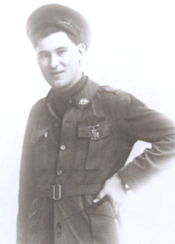
William Jackson awarded the Victoria Cross in 1916
Speeches, wherein strong appeals were made for recruits, were delivered by Private Taylor, Lieut. McKenzie, and Private W. Miller, the latter describing some of the heart-rending scenes he had witnessed, caused by the brutality of the Prussian “dogs,” as he referred to them. …..
The meeting then adjourned till 7 p.m. At 5 o’clock the tables were laid in the Oddfellows Hall, and a repast provided for the column, at which the Mayor; and citizens, Brigadier-General Meredith, Major Windeyer, Warrant-officer Osborn and a number of returned men sat down. The provisions were supplied by the people of the district, and loyally, and royally they responded, There were but few refusals, and the supply was ample and of a quality that seldom covers the tables at such functions. The menu comprised poultry, meats of all kinds, puddings and confections of all kinds, vegetables in season, fruit, light drinks, tea and coffee.
The ladies of the Red Cross excelled all previous efforts. The provisions were beautifully cooked, carved, and laid before the pleasantly surprised men of the column. They had not expected such a banquet, and those who were members of the ‘March to Freedom’ column say emphatically that Raymond Terrace outdid all others, good though they were in their royal reception and the treatment accorded. And no praise be too highly or flatteringly expressed for the practical services of the ladies. The men of the column voiced it and so did everyone else who shared in the reception.
Toasts of “The King”, “The Recruiting Column,” by Mr Charlton, and replied to by Major Stark, who thanked them for their magnificent welcome; it was indeed the best they had received yet, and he complimented ladies who were assisting in doing their share for Empire and King. The boys of the column, at his call, gave three cheers for the ladies. “The Boys at the Front” was proposed by Brigadier-General Meredith who, as an old veteran, gave sound advice to the boys, and to let their conduct be such that it would not disgrace the cloth they wore or the good name won for Australia, and there were few armies with so little crime.
Lieut. McKenzie replied, and among other things mentioned a circumstance which displayed the faith of the French in the Australian. At one little French town, the boys going into the front line used to buy cigarettes from an old French lady who kept a shop. He one day said to her on seeing her hand out tobacco without being paid for it, “Are you not afraid to trust these men”? She replied, “Trust the Australians! The Australians always pay.” She only lost six francs, and that, he thought, was due to the debtor going into action through wounds. The men in the trenches had turned down conscription because they said if the others are not game to come, we won’t force them.’
God Save the King terminated the dinner. At 7 o’clock, the hall (enlivened by gay decorations of flags and greenery), having been cleared in the meanwhile, the war pictures were screened. At their conclusion the Mayor announced to a densely packed audience that the presentation of medals would be made. The returned men, headed by the Red Cross Ladies, entered the hall to cheers.
Those present were Brigadier General Meredith. Major Windeyer, Warrant Officer A. Osborn, Lance-Corporal Holdstock, Privates. H. Rose, E. Smith, Pat. McBride, K. Pogonoski, G. Foot, and Trooper J. A. Hill. The Mayor stated that it was the intention of the Patriotic Committee to present a medal to each returned soldier, and to the parents or nearest relative of those who had fallen. The latter, however, would be deferred till a later date, as all particular had not been obtained in time.
He cordially welcomed Privates Smith Rose and McBride on their return and was glad to see their safe return. The others had been formally welcomed previously. They appreciated the good work they had all done the at front, having braved its perils, and never shirked their duty. He then called on Mr. M. Charlton to address the audience, and hand out the presentations.
Mr. Charlton congratulated the large gathering for its spontaneous and hearty appreciation of the men who had returned and had played their part in the greatest war history had ever recorded and had worthily represented the people of Australia. They could always be depended upon; and had never flinched. They had been engaged in many theatres of the war and had given a good account of themselves. He regretted that some had, returned incapacitated by the loss of limbs, and he hoped the day would never come when Australia would be unmindful of the services they had rendered. He was opposed to war, but in this they had no option, but had to continue till Germany saw she had no hope to conquer.
When the war was over the flag of Britain would still float at the mast head the symbol of justice and liberty, and the custodian, of civilization. He paid a high compliment to the ladies for the work they had done that day and also for the completeness of the arrangements, and he complimented the residents of the town for their hearty appreciation and action in the function. He also congratulated Raymond Terrace in having produced officers, and men who had performed important services in the war.
He then first called on Brigadier-General Meredith to receive the first medal in order of rank. The medals were handed to a Red Cross lady to be pinned on the breast of each recipient. Mrs. Garbett, as president decorated the Brigadier-General; Mrs. Priddle, Major Windeyer. Warrant-officer Osborn, Mrs. F. Newman; Lance Corporal Holdstock, Mrs. Holdstock (his mother); Private H. Rose, Mrs. W. Markey; Trooper J. A. Hill, Miss Edstein; Private Pat. McBride, Mrs. S. Osborn; Sergt. Stan. Searl (absent on duty,) medal received by Miss Searl; Private Gerald Foot, Mrs. Garbett. Private Pogonoski was absent and he and others, along with the relatives of fallen soldiers, will be presented at a later date. Cheers greeted each presentation.
Brigadier-General Meredith replied on behalf of the recipients and himself. The reception showed that the people had appreciated their efforts of service, and hoped all, would return and receive the same welcome home. Private’ Pat. McBride said he thanked them. He related some of his experiences in different parts of France, about half a dozen battles, and someone had the cheek to ask him if he had ever been in France. He had been up to his neck in it. He was glad he had gone, if they wanted him again, he was ready to go. He got wounded about five miles behind the line with a German shell, which took of his right thumb. He said, “All right Fritz, you are welcome to that much but you’ll get no more of Pat. McBride.” He referred to some of his mates and their mishaps and thanked them sincerely for their presentation and welcome to him.
Gunner Jack Meredith was given a presentation of a safety razor and flogger by the Committee through Mr. Charlton as a token of appreciation of his action in enlisting. He replied thanking them for their gifts, and he would try to do his duty. Thanks were given the Mayor for presiding, the Ladies and Mr. Ambler for the hall, and cheers for the King and the Boys ended the proceeding.
Recruiting speeches were made by Private Jackson V.C., Serg-Major. Taylor Lieut. McKenzie, M.C., Private Miller, Lieut. Mason, Gen. Meredith, and Major Windeyer.
Fifteen recruits volunteered— Arthur Edmonds, Raymond Terrace; Albert Wootton, Miller’s Forest; G. T. Relf, Raymond Terrace; W. Melmeth, Limeburners Creek; Frank Pepper, Hollow Tree; J. McClay, Raymond Terrace; L. Shearman, Williamtown; H. Millard, Williamtown; F. Boyce, Williamtown; L. E. Monkley, Miller’s Forest, W. A. Adams, Tomago; G. Sutton, Raymond Terrace; A. Murrell, Tomago; C. Adam, Raymond Terrace. The lads were clapped as they came on to the stage, and their names enrolled.
During the evening boxing bouts were given by Tommy Uren and Harry Smith “the local lad,” and Jimmy, Clabby and Murrell another “local lad “. The column consisted of about 120, and out of that number it was announced that only seven were over 18 ½ years. Breakfast was served to the boys on Thursday morning and about 9.30 they marched round the town, first giving cheers for the Red Cross Ladies and their welcome generally, and then struck out for Hexham. The demonstration all through was the most successful held in the Terrace, and the crowd the largest.’
APPENDIX 2: Unveiling Ceremony of the Millers Forest Roll of Honour – 1918
The Maitland Daily Mercury of 1 June 1918, page 7, reported:
‘The great event, which has been eagerly looked for by young and old in Miller’s Forest [near Raymond Terrace] took place in the Oddfellows’ Hall, Miller’s Forest, on Wednesday night, May 22, when the greatest crowd ever witnessed at any public gathering was present to witness the unveiling of a public roll of honour, erected by the residents in memory of the brave boys who have gone to fight for King and Empire.
The memorial, which takes the form of a marble tablet, was executed by Mr. J. J. Edstein and Sons, Raymond Terrace, and reflects the greatest credit on this firm for the artistic manner in which it is arranged and the excellent workmanship shown therein. The principal slab is of white marble, about 3ft, by 4ft., and this is set on a black marble background about 3½ft. by 4½ft., and both are surrounded by a beautiful cedar moulding of a rich design.
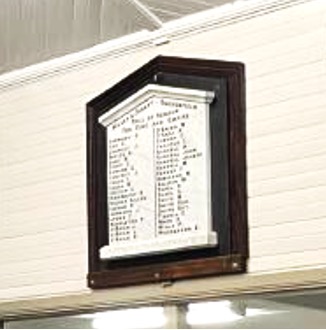
Millers Forest Roll of Honour in the present ‘Popular Hall’
The honour roll is surmounted by the crossed swords and cap in a space of sparrow-picked marble and is headed by the following: — ‘Miller’s Forest Public Roll of Honour. For King and Empire.’ The roll contains the names of soldier boys enlisted, including seven who have paid the supreme sacrifice.
The lettering is in gold, and the following are the names — E. E. Apps, T, O’Meara, C. Linton, J. Hogan, W. L. Gallen (killed), W. Linton, A. Kennedy, A. Johnson, A. Jones, L. J. Perrett, H. Donnelly, W. Drinkwater, J. Egan (killed), J. Tobin (killed), J. Osborne (killed), S. Osborne, A. Osborne, F. O’Grady (killed), T. P. O’Brien, J. A. Hill, C. King (killed). R. King. J. King, J. Keys, S. Robinson (killed), R. Flanagan, E. G. King, D. J. Casey, M. Nissen.
The unveiling took the form of a high-class two-part concert, followed by a social. The stage and hall were gaily decorated with flags (lent through Lieut-Colonel Nicholson, M.L.A., from the Public Works Department), palms, evergreens, and flowers. The ladies and gentlemen of the committee, who went to a great deal of trouble, were complimented on the manner in which they had the decorations arranged by the visitors who were present.
Surmounting the roll of honour was a bountiful wreath of white cactus dahlias and maiden hair ferns, arranged in a circle and trimmed with purple and black ribbons. This was the gift of Mrs. W. H. King in memory of the fallen heroes.
Amongst those who were present were Mr. J. J. Kearney, vice-president of the Miller Forest Progress Association, who also presided, Lieut.-Colonel Nicholson and Mrs. Nicholson, Rev. M. G. Garbett and Mrs. Garbett (Raymond Terrace), Alderman W. Tooze and Mrs. Tooze (Mayor and Mayoress of Raymond Terrace), Councillor Markham representing the Tarro Shiro Council), and Mr. Thomas (president, of the Millers Forest Patriotic Association).
The concert opened by an overture by the orchestra, consisting of Miss M. Beirne (piano) and A. O’Donohue (violinist); song, ‘My Ain Folk,’ Miss Delia McPherson ……….. The second part of the concert consisted of an overture by the orchestra, and Miss Delia McPherson sang ‘I don’t seem to want you when you’re with me.’ Each of the singers during the second part of the concert obliged the audience with a song. The concert concluded about 10 p.m. by the singing of the National Anthem.
During the interval the unveiling ceremony was performed by the member for the district, Lieut.-Colonel Nicholson, M.L.A. Apologies were read from Mr. and Mrs. M. Charlton, M. H. R., Rev. and Mrs. Stuart-Wright, Brigadier-General and Mrs. Meredith, Major E. and Mrs. Windeyer, Mr. A. L. Adam, and Mrs. Adams (Town Clerk, Raymond Terrace), and Mr. and Mrs. James Priddle (president of the Miller’s Forest Progress Association), Mrs. Priddle being too ill to attend.
Mr. Kearney, in opening the proceedings, spoke of the splendid gathering present, all eager to show their respect and admiration to the boys who had gone forth to tight for King and Empire. It was a memorable night which would for years to come be borne in mind by all present. He paid a great tribute to the boys who had enlisted. He sympathised with the parents and friends of those who had fallen, and he hoped to see before long all the boys return. He then called upon Colonel Nicholson to unveil the honour roll.
Lieut.-Colonel Nicholson gave an address, in which he declared that he solemnly dedicated the tablet to the memory of those whose names were inscribed upon it, for their brave and conspicuous gallantry in the time of dire peril to the British nation, and for the valuable and never-to-be-forgotten services rendered by them to their King and country. He stated that by their patriotism, heroism, and unflinching courage and devotion they had nobly upheld the best traditions of their forefathers and the honour of their country. To those who had made the great sacrifice and fallen in the struggle may God grant eternal peace, and, to those who still heroically defend and fight in the fight for freedom and honour, may He in His intimate goodness grant a safe and speedy return.
The roll of honour was covered with two immense Union Jacks, set on a frame and worked by pulleys, and as the Colonel gently lowered the frame Bugler Boots announced the fact by giving the call. Mr. O’Brien, at Colonel Nicholson’s request, read the formal dedication. The audience then sang the National Anthem, and the names of those inscribed on the roll were read aloud. Colonel Nicholson congratulated the people on erecting such a magnificent memorial and complimented the contractor on his workmanship and skill.
The Rev. M. Garbett thanked the committee for the honour of being asked to speak at such an important function. He congratulated the district on the number of boys enlisted and spoke of many lessons to be learned spiritually from the war. He spoke of the ugliness of war, and all matters which seek to destroy mankind and put nation against nation.
Alderman Tooze thanked the people of Miller’s Forest for the kind invitation to be present and congratulated them for the splendid memorial erected. The “Last Call” was then sounded the audience standing meanwhile, after which all sang “Nearer My God to Thee” in memory of the fallen heroes.
The concert was again resumed at the conclusion of which the hall was cleared, and the social took place. The committee entertained the performers and the invited guests in the supper room, and the general public was provided with supper about 11 p.m. At 1.30 a.m. a memorable night closed with the National Anthem. This night will be long remembered in our district, and will be similar, it is to be hoped, “when the boys come home again.”
APPENDIX 3: Unveiling Ceremony of the Raymond Terrace Public School Roll of Honour – 1918
The Raymond Terrace Examiner and Lower Hunter and Port Stephens Advertiser of 7 June 1918, page 3, reported:
‘On Monday afternoon the unveiling ceremony of the Public School Roll of Honour was carried out. There was a very large attendance of the public, the space provided at the school being unable to seat the attendance, and many, ladies included, had to stand outside, or leave, The chair was occupied by the President of the Parents’ and Citizens’ Association, and he extended a cordial welcome to Mr. and Mrs. Bridekirk, the former having come from Sydney, at the Associations invitation to unveil the roll.
The proceedings were opened by a patriotic song from the school children, who were under the baton of the Mayor — Mr. W. Tooze. The president said, after a few words of welcome to Mr. Bridekirk, that they were proud to join in such a ceremony. The roll they were going to unveil was a gift of the Parents’ and Citizens of Raymond Terrace, to mark their appreciation of, and perpetuate the memory of the boys who had offered their services, and who had been pupils of the school.
Their hearts were full of gratitude for what they had done. The King’s message to his people was that they were hard pressed, and so all should give help, if not in the firing line then whatever way they could and so make the country more worthy of the great name the boys had won for it. They should ever remember the lads who had laid down their lives for their country. The children sang “Rule Britannia,” when the president asked Mr Bridekirk to unveil the roll.
Mr Bridekirk, who received a rousing welcome, with three cheers, said he was pleased to be with them, and thanked them for the great honour they had conferred on him, and also for their welcome to Mrs Bridekirk and himself. They all were or should be endeavouring to defeat the military sway of the Hun, and the names of those inscribed on the roll would be honoured for their great services, and the patriotic path they had followed. There were 59 names on the roll, and he thought that would compare favourably with schools of similar size in the State. Some had left wife, mother, sister, and friends, and suffered untold hardships in the country’s defence. Some would not return, but it was a consolation to their relatives to know that their lives were lost in defence of their King, home and country.
For how can man die better than by facing fearful odds, For the ashes of his fathers, And the temple of his gods. He could not relate all their good deeds but believed all had done their best. He had met one of his old pupils at Randwick Hospital, and he was pleased to hear him speak highly of his officers, General Meredith, Major Windeyer, and Major J. Richardson. People were often heard saying they were tired of the war, but they should recollect the continued duty the men were sticking to in the trenches, they were no doubt tired too, but they were still fighting, and only those there knew what they had to endure. All the discomforts of the people paled into insignificance before the work these men had to do. The Union Jack covering the roll was their symbol of truth, liberty and freedom, and they should revere it.
He trusted God would spare those who had not fallen and bring them safe home again. These names would be kept for ever green in our memories, and to posterity. They would leave their footprints on the sand of time. He then drew aside the flags covering the Roll. Brigadier General Meredith, at, the call of the President, said he was proud to be present at such a ceremony, to honour those who had done their duty by going to the front.
He counselled the women folk not to do anything to prevent the men from going, if they desired to, for they were all so urgently required at the present and in the future. He asked the children to be loyal and to follow in the footsteps of the boys whose names were before them on the roll. If a man or woman were not loyal, they were not much good to the country. It was a shocking thing that so many were shirking their duty. The Government should do something to overcome it. They were proud of those whose names were on the roll, and he trusted they who had not fallen would return safely.
Major Windeyer said he felt it a great honour to be asked to speak on an occasion of that kind. The roll served as a witness for all times of what these men had done for liberty and justice. He thought the people did not realise the threatening position the Empire was in. When he returned, he saw the hotels full, and the races and pleasure resorts patronised the same as ever. It struck him as being a reflection on the people, that they did not seriously think of their position. He counselled the children to worthily emulate the boys on the roll, and to remember for all their lives, the duty they had done.
Rev. Stuart-Wright referred to the inscription in Westminster Abbey, “If you seek a monument look around,” as an illustration of the merit of the great architect who had designed the structure, and so here the children would see the monument on the walls, and think every time they read the names of the boys who had left home, and friends to fight for country, when they could have stayed at home had they chosen. But they had responded to the call, and had given their all, in some cases. In years to come the wood may decay, but the names on the roll would never decay in the memory of those who would never forget the service they had given.
The hymn “Nearer My God to Thee,” and the song “They Lie Sleeping in Gallipoli” from the children, and God Save the King, concluded the ceremony. The children were given sweets and fruit afterwards. The ceremony was successfully conducted, and the large attendance marked the great interest taken in the function.
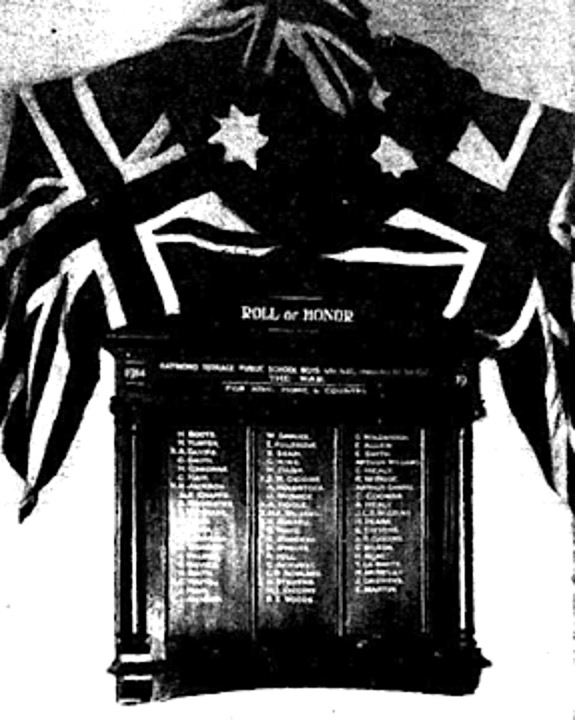
Raymond Terrace Public School Roll of Honour – unveiled on 3 June 1918 [Virtual War Memorial Australia]
The names of those on the roll are as follows. The cross denotes those who have fallen for their country: — H. Boots, H. Hunter, x A. Davies, G. Smith, H. Osborne, G. Hain, Alf Chaafe, B. Rochester, A. Cochrane, R. King, x J. Dark, T. C. Giggins, x A. Garred, Joe Palmer, S. Davies, W. Smith, x C. Wattus, J. Hain, J Jackson, W. Spruce, F. Fullerlove, S. Searl, C. King, H. Dark, S. W. Giggins, A. Holdstock, J. McBride, x A. Poole, Alf Williams, x H. Russell, S. Mayo, G. Burgess, R. Spruce, R. Hill, C. Akhurst, L. P. Nowland, A. Stevens, H. L. Giggins, R. S. Wood, G. Holdstock, E. Allen, E. Smith, Art Williams, C. Healey, R .McBride, Arthur Chaffe, C. Coombs, A. Healey, J. C. R. McCourt, H. Pearn, S. Stevens, A. R. Giggins, G. Wilson, H. Rose, T. La Barte, H. McNeilley, J. Griffith, E. Martin.’
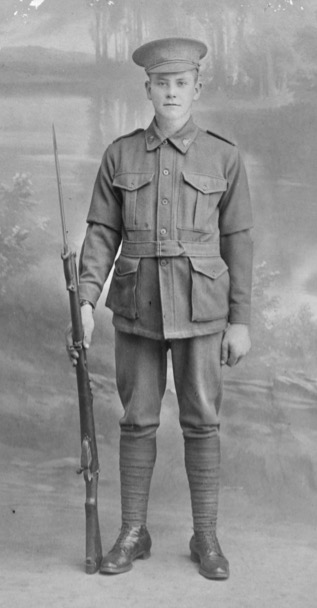
Horace David Hunter listed on the Raymond Terrace Public School Roll of Honour [Australian War Memorial]
Researched and compiled by Kevin McGuinness
July 2026


