
Introduction
In January 1918, the Newcastle Morning Herald and Miners’ Advocate published two articles in the editions of 12th and 14th of the month which reported on the economic activities of Millers Forest and Raymond Terrace districts. Both of areas were within a thirty-two kilometre radius of the Newcastle headquarters of the newspaper.
Together, the articles offer a useful snapshot of farming activity in the two rural districts in 1918, along with reflections on their earlier history.
The two newspaper articles are reproduced below.
Millers Forest Area
Newcastle’s needs are many and varied. With the popular mind concentrated on the rapid expansion of mineral wealth, the concurrent development in other directions is to a large extent lost sight of; but that this has been phenomenal, especially in respect to dairying; a tour of the Lower Hunter, commencing at Miller’s Forest and journeying through to North Stockton, affords very convincing proof.
Within the area radiating eighteen or twenty miles from this office, everything the large population needs is produced and procurable. It is self-contained in a real sense, and as, perhaps, no other city of its size and importance could with truth be said to be. Butter, cheese, milk, bacon, eggs, beef, poultry, fruit and vegetables are produced in profusion; and in the earlier days, locally grown wheat was converted into flour in the mills operated on the river. The advent of rust in 1857 put an end to this industry; and the great flour mills conducted by the Piortus family have disappeared without leaving behind them a solitary trace of where they once so thrivingly stood. The largest of these was located on a site held by Mr. A. L. Adam, in central Raymond Terrace.
One moves through the cultivations with scarcely a sight of an ear of wheat. Development, however, continued in other industries, some idea of which will be given in this and succeeding articles. Seventy years ago, Miller’s Forest was a veritable bush, with trees enough on it to build a city. Nelson’s Plains, adjoining, was almost as thickly timbered. This is how it appeared to Mr. J. R. Houlding, probably the senior surviving pioneer of the Lower Hunter.
It is a much-altered forest one sees today with its great lucerne areas, millet fields, attractive and prosperous homesteads, and all the other adjuncts of a well contented community. The grazing paddocks, mantled in green, are just at present at their best, couch grass, clover, and prairie being exceedingly well adapted to the soil. The herds, as the fat stock salesman phrases it, are everywhere in the pink of condition.
Although the rainfall is good—averaging between 40 and 50 inches annually—the water question has always been given a lot of consideration by the dairy farmers. The river is, more often than not, either brackish or salty, and resort has been had to wells and dams. An agitation has been going on for some years to secure a supply of main water from Buttai [in the Hunter Valley]. Negotiations were entered into between the Water Board and the progress association. With the scheme now being carried out by the board, it is possible that in the near future an ample supply for domestic use and livestock will be made available for Miller’s Forest.
The soil is alluvial, and the farms range in size from ten to sixty acres. The value of the land is from £3 to £50 an acre; enhanced values have been received, in some instances approaching the £100 limit.
Floods in years gone by wrought havoc with the crops and stock. It is related that for weeks after that of 1893, the carcases of valuable animals were being ether burned or buried on Stockton Beach. Nothing like that flood has been since seen on the river. The farmer, however, taught by bitter experience, looks warily ahead. To secure his possessions, he has for a long-time discussed schemes for the damming back of flood waters. The Government had a survey made about twelve months ago, preparatory to the construction of an embankment, but there is a good deal of diversified opinion on this matter. Floods, it is contended by some, are a natural heritage, and give the land its high value.
A survey has also been made for a line of railway to connect Morpeth and Hex-ham, and incidentally signally convenience Miller’s Forest. It is unlikely that these proposals will be started before the war stops; they then should be. Both are required. Dredging operations are to be proceeded with as soon as a dredge is available.
An enormous quantity of hay is despatched to the city markets from here every year. The excessive wet has, however, limited this considerably. The millet crop, too, has been more or less spoiled through the same cause. Dairying and agriculture are carried on largely on the Duckenfield Estate, situated on the outskirts of Miller’s Forest, and consisting of valuable flats. There is also the hilly back country that serves a useful purpose as a “drying ground” for stock in time of flood.
This is one of the finest millet-growing centres in the State. For years the manufacture of brooms was extensively carried on, both in the Forest and across the river at the Terrace. The millet is still grown, but the broom factories were closed down during the last fifteen or twenty years. The cutting of the millet crop is a long and disagreeable process; each head being cut singly. It is bundled and tied, and in due course “hackled,” pressed, then despatched to market in Newcastle, Sydney and Melbourne, realising £30 to £40 a ton, and has gone as high as £50. There is a likelihood of a broom factory being again started in the vicinity of where the millet is grown, the suggestion being that the co-operative principle, so successful in other industries in the district, be adopted in this connection also.
Cooperation among the Lower Hunter farmers has accomplished so much that many of those who grow millet are convinced that broom-making can be made to pay handsomely here. The work is simple; the material right at hand.
There is a wide-awake progress association that looks to the welfare of the Forest. Mr. J. Priddle is the president, and Mr. A. J. O’Brien the secretary. The populatlon numbers between five and six hundred. The Perretts, Markhams, Hills, Cootes, Cunninghams, Corbetts, Carpenters, Monkleys and Priddles are amongst the best-known families. There are churches of several denominations, and educatoonal facilities are provided be the Department of Public Instruction and the Sisters of Mercy.’
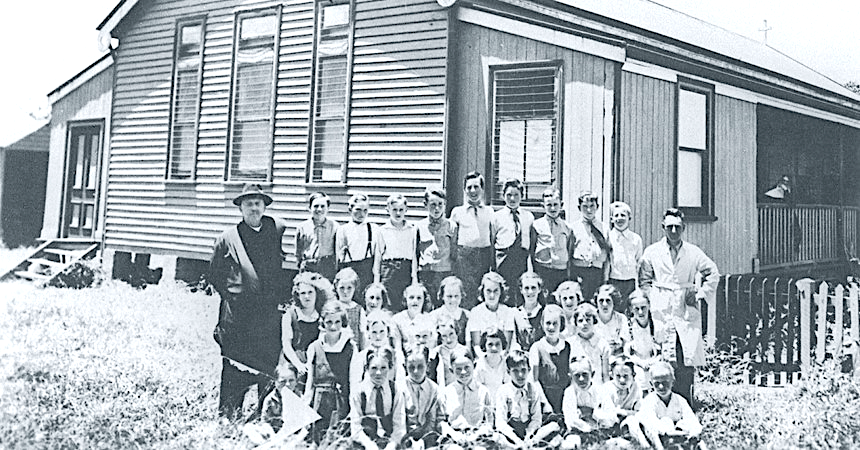
Millers Forest Catholic School conducted by the Sisters of Mercy
Raymond Terrace Area
‘Raymond Terrace, on the opposite bank of the Hunter River, is one of the oldest towns in New South Wales. It is more than one hundred years since the first white settlers ventured along from the Botany Bay and Port Jackson settlements. The fame of the place soon spread, and the few pioneers who are left refer disappointingly to the non-fulfilment of the district’s early promise.
Until 1890 this was the terminal point of the north. The traffic was heavy. Here was the outlet to the developable area beyond, and the settlers, even on the alert for fresh fields, moved onward and outward from year to year. The best land could be got for a pepper-corn rental; many of the finest agricultural areas were given to the original occupants for a song. They put it to good use.
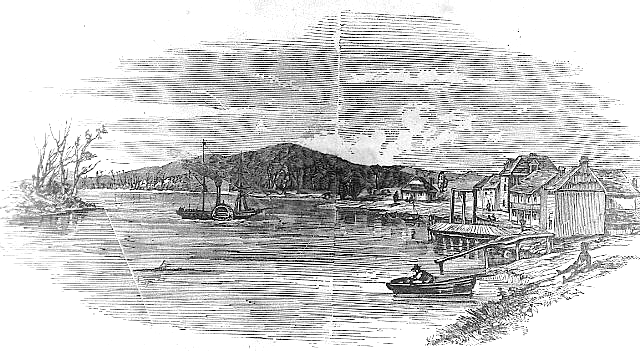
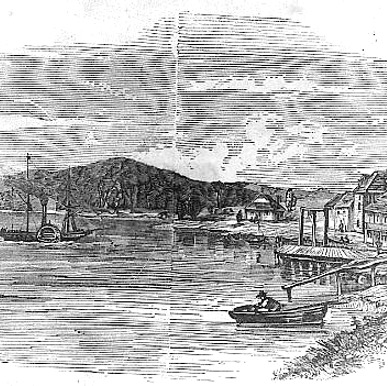
View of Raymond Terrace with a paddle steamer on the Hunter River – 1857 [Newcastle Library]
To the credit of the pioneers that much must be said. For some years wheat was grown extensively. Later, the mind of the community turned to other industries in consequence of the wheat failure through “rust.” During the last quarter of a century the advancement in dairying has been phenomenal, and it is easily first in order of importance at the present time.
The firm of Ireland’s, in Newcastle, assisted largely in this direction at the commencement, and the cream was forwarded to that firm in considerable quantities. The first factory was started at Duckenfield. The industry soon became general. It was recognised that there was money in it. The Raymond Terrace Dairy Company’s factory was opened in 1903 and is now one of the outstanding features of the district. A description of these works will be given in a later article, showing the success that attends well-directed co-operative effort.
The town is low-lying, and subject to inundation. In the big flood twenty-four years ago, the residents were for some time cut off from communication with the outside district. Even the balconies in King-street—the principal thoroughfare, were under water, which surged past like a torrent, carrying thousands of pounds’ worth of farm produce and stock to destruction. From floods of this magnitude there has since been fortunate freedom.
There were only a few dairies on the margin of the swamp lands, some of which have been drained advantageously, and are today fine grazing plots. There were then a number of extensive vineyards and orangeries; and further back were other vineyards, the wines from which were highly esteemed by connoisseurs.
Away to the south-west, in the direction of Stockton, there are rich arable lands, occupied by a well-to-do class of proprietors and tenants. The town, apart from its claims to business, is becoming increasingly popular for residential purposes. Within the past two years a number of houses, with considerable pretensions to style, have been erected on the hillside near Boomerang Park, in the centre of the Terrace. It is from this park that a panoramic view of this wonderful district is best obtained. The green fields and pastures, stretching away for miles, like a magnified bowling green, are divided by the Hunter and the Williams rivers. Neither is very wide or deep, but the steamer Namoi (1400 tons) and other ocean-going vessels pass beyond the town.
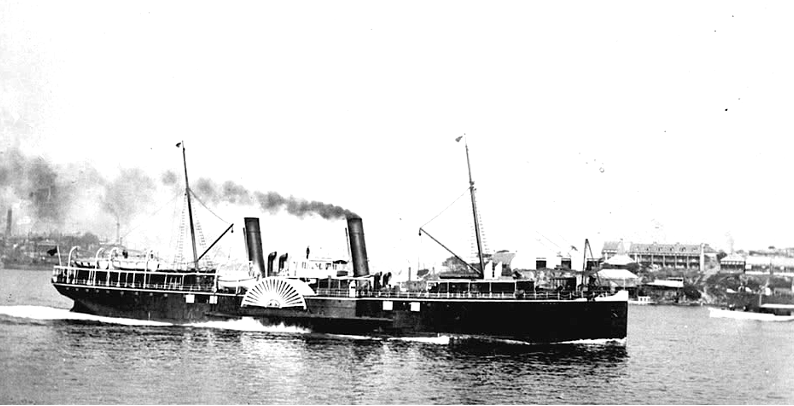
ss Namoi
This steamboat traffic of sixty or seventy years has gradually widened the river— a questionable service—and kept the mud in a constant stir or ferment. The Lower Hunter is nowadays about the colour and consistency of the Thames at London Bridge, though it may smell a trifle sweeter. Fifty years ago, it is to have been as pellucid as a summer brook, and the fish therein had their natural flavour. All that is altered.
In the process of years hundreds of acres of rich alluvial soil have been scoured out to sea. “I have many times set to ruminate under the shade of a native apple tree, which grows fifty feet or more outward from the present margin of the stream,” says on old and respected citizen. “Some of the atoms of soil which nourished my favourite tree are now perhaps deposited on the ocean bed half-way to New Caledonia; and the tree itself, root and branch, has long since been eaten up by cobra. This remark suggests the protection of the inland waterways from the inroads of erosion; it is probably too big a question to expect to get attention in these days.
There has been advancement, nevertheless. No visitor to this part of the district can stand in the Upper Reserve [present day Boomerang park] without expressing astonishment at the evidence of this progress as he for the first time sees it. Beholding the expanse of arable land in the high state of cultivation stretching westward almost to the foot of the distant mountain ranges, the broad grassed streets, the stylish homesteads, substantial churches, and wealth and beauty everywhere abounding, this surely appears charm enough for the most fastidious.
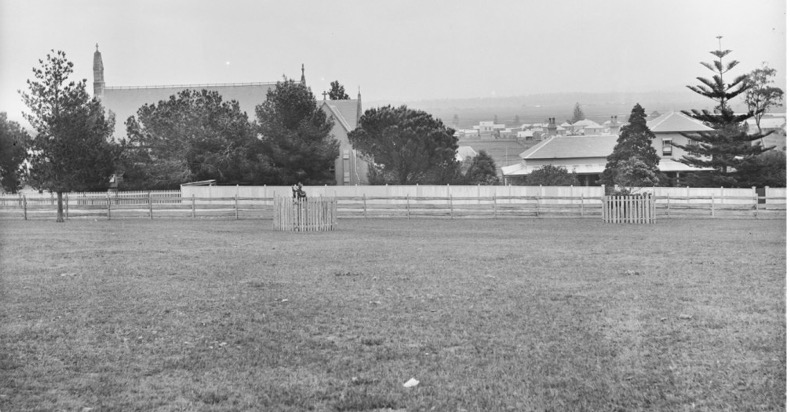
View of Raymond Terrace from Boomerang Park with St. Brigid’s Catholic Church at left – 1896 [Newcastle Library]
Land values “slumped” twenty years ago, when it became evident that Raymond Terrace had for a time at least lost its place “in the sun.” A piece of land with a frontage to the main street [then King Street] and to the river exchanged hands recently for £500. The original owner was given £4500 for it. And was paid in sovereigns! Regular weekly produce sales have been conducted on this spot for more than thirty years. They were started by Mr. G. S, Hill. Dealers attend from most of the mining townships and Newcastle. The cattle sales have also been a feature of Terrace activities for about the same period. The turnover in those two lines of commerce is £50,000 annually.
The development that has taken place during recent years has all been from within the immediate district; and although there been no progress in the generally accepted sense, the town is itself as prosperous as ever it has been. The timber industry is of substantial proportions. Mr Cross has proved the fruit-producing value of the land, which years ago grew a particularly fine variety of orange and lemon. Citrus culture has not had much attention for a long time. The only recent attempt on anything like a large scale has been that of Mr. John Richardson, who has placed ten acres of his land on the boundary of the town under citrus trees. The orchard looks well, and the enterprise of Mr. Richardson will no doubt he well repaid. His name has been associated with the place for a lifetime.
Other familiar Raymond Terrace families are the Lunneys, Scullys, Bishops, Whites, Merediths, Russells, Adams, Holdstocks, Boots, and the Kinross Windeyers. The municipal council and the Port Stephens Shire have their headquarters in the town. The district has enjoyed a succession of good seasons; the present being described as the best for forty years by a pioneer who has been nearly double that time emersed in farming pursuits on the Lower Hunter.
Concluding Comments
Other papers on the history of Raymond Terrace area are published on this website and can be viewed at the following links:
Early History of St. Brigid’s Catholic Church – The First 100 Years
War Loan Tank Drive Visits Raymond Terrace, Port Stephens – 1918
Raymond Terrace Municipal Council Jubilee Celebrations – 1934
Journey to the Vineyards of the Lower Hunter and Port Stephens Districts – 1865
Researched and compiled by Kevin McGuinness
July 2026


