
Introduction
In 1913, the State Children’s Relief Department established the Raymond Terrace Boys Home on the site of the former Viticulture Nursery, to accommodate boys considered unsuitable for placement with other children
It replaced the Private Probationary Home at Dora Creek, near Lake Macquarie, and the boys from that institution were transferred to Raymond Terrace.
The following report published in the Newcastle Morning Herald and Miners’ Advocate of 23 October 1908, page 7, provides an example of entertainment that was provided to the boys at the Dora Creek Boys Home:
‘The male members of the Guthrie concert company journeyed from Newcastle on Saturday evening and gave an entertainment to the State boys at the probationary home, Dora Creek, where they are located under the supervision of Mr. W. Delacheur [Walter Louis Delacheur], the superintendent.
A lengthy programme was gone through, a portion of which were solos on the Apollo piano player and a duet by Messrs. D. Smith and J. Wiggins with Apollo accompaniment, which was rendered capitally. Mr. A. Stone sang “No Tongue Can Tell,” and as an encore “Larboard Watch.” Mr. J. Fitzpatrick “Asleep in the Deep,” and for an extra “Davy Jones’ Locker,” whilst humorous items were rendered by Messrs. T. Guthrie, E. Ash, R. Reeves, and A. Wiggins, and greatly enjoyed.
Not the least entertaining item on the programme was the magic and sleight of hand tricks performed by Mr. D. Murray, most of which created laughter and amazement. Mr. A. G. Roberts officiated at the piano. At the conclusion supper was partaken of at the invitation of the superintendent, during which he thanked the contributing artists for their services. The function was, owing to the hospitality of Mr. and Mrs. Delacheur, enjoyed by all. The company returned to Newcastle next day.’
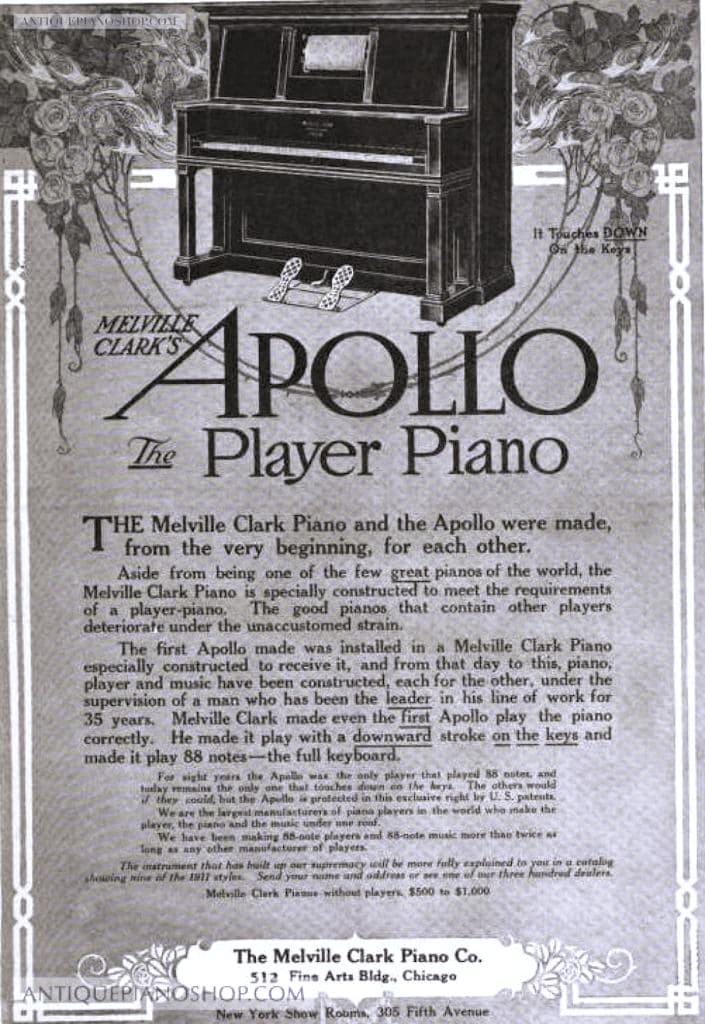
Advertisement for an Apollo piano [pianola] player
This paper tells the story of activities at the Raymond Terrace Boys Home from various newspaper sources, before its closure in 1926.
Readers may find some of expressions referring to the boys, as described in the following newspaper reports, as offensive. The articles are published here in full without any form of moderation or exclusion. To alter that material would be akin to altering history.
Description of the Raymond Terrace Boys Home – 1916
The State Children’s Relief Board’s Annual Report for 1916 described how Raymond Terrace operated and what happened to boys after they left:
‘Opened in October 1913 under the direct supervision of a married couple, the home replaced the Private Probationary Home at Dora Creek, with the boys from that institution transferred to Raymond Terrace. On 5 April 1916, 29 boys were living there. During the year, 31 were admitted and 28 discharged, leaving 32 at year’s end.
The report described the boys as generally “mentally weak”, with some said to be “of very feeble intellect”. It listed 6 truants or habitual wanderers, 1 Aboriginal boy, 2 boys described as cripples and 10 labelled as moral degenerates. It noted that their general health and conduct were good. Ten boys attended school full time, while 6 older boys who were considered behind but willing to learn attended half time.
Boys discharged into local employment were visited four times during the year. Others were discharged over age and placed in work, boarded out, returned to relatives, sent to sea, transferred to Rookwood Asylum or the Boys’ Shelter in Sydney, found coal-mine work, placed locally, or sent to Gosford Farm Home after absconding.
Of the boys now at work, 8 are in tailor’s shop, 8 are engaged in bootmaking, 2 at carpentering, 4 at toy-making, 2 at gardening, 2 at woodchopping, and 4 at indoor work.’
Toy Making at the Raymond Terrace Boys Home – 1917
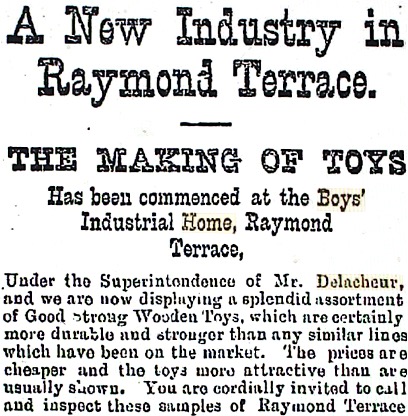
The Raymond Terrace Examiner and Lower Hunter and Port Stephens Advertiser of 7 September 1917, page 2, reported:
‘A new industry has developed in the Raymond Terrace district, during the past few weeks. Mr. Delacheur who is in charge of the State Boy’s Home, near Tomago, is utilising the labour of the boys, and turning it to profitable account, in the construction of all kinds of toys. We have seen a sample of the articles at Mr. Harry Moore’s and by comparison with imported toys, they are a superior article.
The construction is solid, and the articles will stand more harsh treatment at the youngsters’ hands than toys supplied elsewhere. The articles consist of toy waggons, wheel barrows, scooters, rocking horses, motor cars, clowns of ingenious balance and progress, horses, elephant carts, and so on. The manager of the Home deserves commendation for the usefulness he is making of the boys, as well as giving them an occupation that will go a good way towards their own maintenance, and at the same time offering an opportunity to the boys to acquire a useful trade.
The articles, too, are well finished, and are in every way equal in this regard to toys made elsewhere. The boys can be complimented on their work, and no doubt in a few months will have acquired such proficiency that toys of mechanical description will be worked up. It is a splendid move on the part of Mr. Delacheur, and we hope the local people when selecting their toys for Christmas will ask to be shown and buy the Raymond Terrace made article. The toys can be seen in Mr. Moore’s windows.’
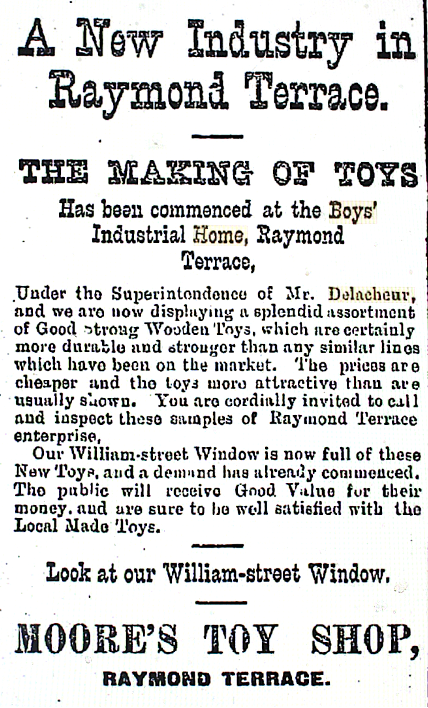
Advertisement for a new toy industry in Raymond Terrace [Raymond Terrace Examiner and Lower Hunter and Port Stephens Advertise – 7 September 1917]
Boys Home on the site of the former Raymond Terrace Viticulture Farm – 1917
The Maitland Weekly Mercury of 20 October 1917, page 3, reported:
‘Hidden among the sandhills in the triangle formed by the Hexham-Raymond Terrace, the Hexham-Williamtown, and Raymond Terrace-Williamtown roads, but nearer to Tomago than to the Terrace, is a considerable expenditure of public money in the ill-starred enterprise that was called the Raymond Terrace Viticultural Farm.
When the purpose was abandoned [in 1913] of using the place for vine cultivation and the production of phylloxera-resistant strains, the property was secured by the State Children’s Relief Board for use as a State Boys’ Home for boys who through mental or other defects could not be placed in private homes, at any rate without passing through a period of special training and probation.
For some years Mr. W. L. Delacheur had taken in boys of this class on his farm at Dora Creek, and had been so successful in dealing with them, fitting them to go out into the world and battle for themselves., that he was placed in charge of the new facility near Tomago, and here during the past four years he has made good in the extended work. He and his family deserve every encouragement, and more than they get in their isolated position, so largely cut off from any society, except that of the boys under their charge.
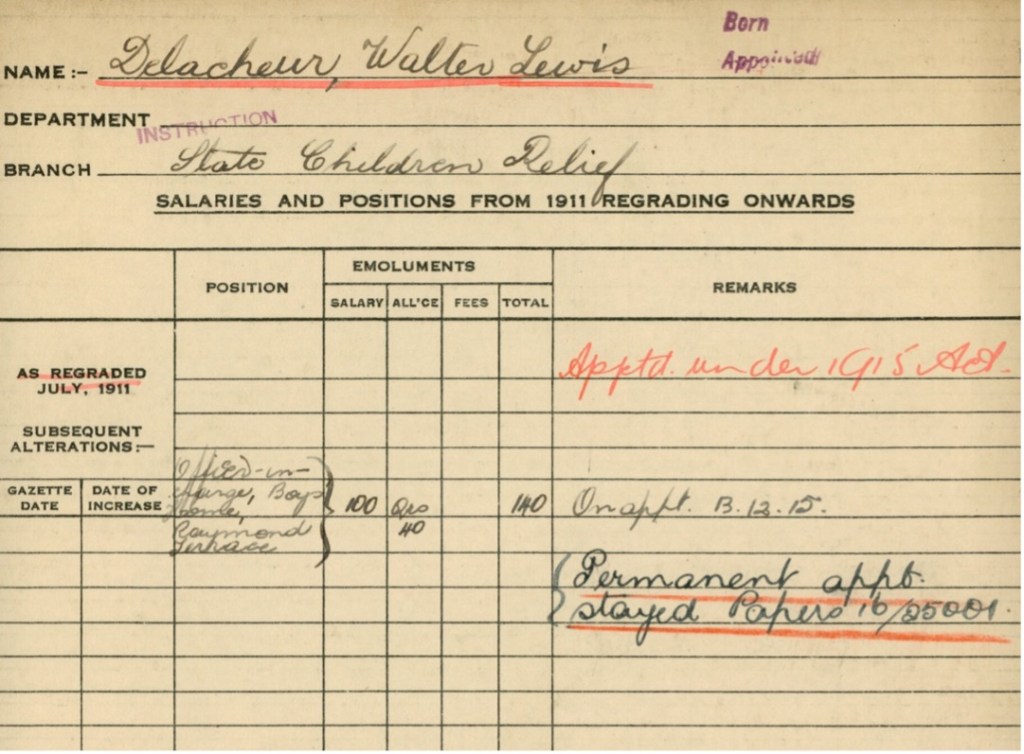
Employment Record Card for Walter Lewis Delacheur during his time at the Raymond Terrace Boys Home [NSW State Archives]
In the workshops not only are useful articles being made, which enable the home to go a good way towards self-support, but the waste human material of city streets is being turned into a useful type of citizen. There are about thirty boys in the home, some of them needing much more personal attention than the limited stuff can supply. Tailoring and boot-making are carried on very successfully, and there is no evidence of “go-slow” tactics in the boys’ work.
For some time, the boot uppers were obtained from another Government department, but now they are made on the premises, and the boy who machines the uppers is one of the most profitable workers in the establishment. Latterly toys have been added to the products of the workshops, and fine substantial articles they are, well worthy of being substituted for the “Made in Germany” article.
Mr. Delacheur wants customers for the varied and excellent toys that his boys are turning out, and he ought to have no difficulty in getting them. Mr. Delacheur also looks after the interests of State boys who have been placed out within a certain area of the farm. He is proud of the considerable number of his “old boys” who are serving in the A.I.F.
Mr. Peirce recently visited the home with his son Frank and gave the boys a treat with an exhibition of moving pictures. A cinema would be a welcome addition to the home, as the boys, who work so wall in the workshops, deserve some such pleasure as this, and the films used were instructive as well as interesting and amusing. The boys gave hearty cheers for Mr. Peirce and his son Frank, who operated the cinema, for the treat afforded them.’
Purchase Order placed for toys – 1917
The Maitland Daily Mercury of 29 October 1917, page 8, reported:
‘Many readers were interested in reading of the good work being done by Mr. W. L. Delacheur and family at the State Boys’ Home at Raymond Terrace. Arrangements were being made for some of the toys made in the workshops there by the boys to be on view and sale at the fetes at Lorn and East Maitland on Saturday, but a few days ago Mr. Delacheur received a pleasant but somewhat embarrassing surprise in the form of orders from two firms for about £60 worth of toys.
The boys are only beginners at the industry, and their tools are somewhat primitive, so that efforts have to be concentrated at present on the fulfilment of these orders. Mr. Delacheur, however, sent up for each of the fetes a fine large bundle of flannel flowers which grow in great profusion in the vicinity of the home. In adaption Mr. Delacheur and family sent a contribution of 18/ for the Battleplane Fund for which Saturday’s garden fete was held.’
Boys Home supports Red Cross Day – 1918
The Raymond Terrace Examiner and Lower Hunter and Port Stephens Advertiser of 31 May 1918, page 3, reported:
‘The people of Raymond Terrace and district made their effort on Saturday, and attained a very creditable result. The attendance was fairly good in the daytime, and very good at night. ….
The State Boy’s Industrial Home, at Tomago sent along a splendid parcel, through the Manager, Mr. Delacheur, of toys, boots, suits of clothes, caps, and groceries — the latter his and Mrs. Delacheur’s contribution. Two pairs of boots were worthy of note, as they were neat well shaped arid sewn, the work of Walter Byres, and Lawrence Burns [Byrnes], aged 14, who should be credited with aptness at the trade after only 8 months training. The parcel demonstrated the value of the institution, and the good work done in training the boys.’
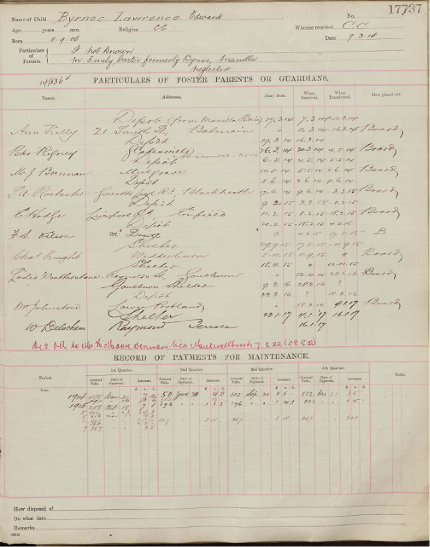
The many foster placements of Lawrence Edward Byrnes (referred to in the above newspaper article], prior to his placement with Mr. Delacheur on 16 January 1917 at the Raymond Terrace Boys Home [NSW State Archives]
Description of the Raymond Terrace Boys Home – 1918
The Maitland Weekly Mercury of 9 November 1918, page 7, reported:
‘Hidden away among the sandhills in the triangle formed by the Raymond Terrace – Williamtown, Raymond Terrace – Hexham, and Hexham – Williamtown roads, is a block of buildings erected at a cost of some thousands of pounds by the State Government for a viticultural farm for the culture of phyloxera resistant stock. When this ill-advised experiment was abandoned, the soil being poor and the place unsuited for anything for the Agricultural Department, it was taken over by the State Children’s Department and used as a boys’ reformatory.
The buildings are out of sight in the scrub from the roads mentioned above, and few even of those who continually pass nearby know of the good work that is being done there by Mr. Delacheur and his family. Before being placed over this establishment, Mr. Delacheur had made good in dealing with a class of boys who could not be placed out in ordinary farm homes, at any rate without some special discipline and training, and probation, on his farm holding on Dora Creek.
Instead of ten or a dozen, Mr. Delacheur has here upwards of 30 boys. He speaks with pardonable pride of 69 of his “old boys,” in whom he continues to take a kindly interest who have enlisted [with the A.I.F]. The boys have their Workshops in which they are kept busy at tailoring, boatmaking and toymaking. It is interesting to learn how those various industries were started, and what fine results Mr. Delacheur has secured out of most unpromising material.
If we commend, as we rightly do, those who find a use for seemingly waste inert matter, we should have much greater admiration, for those who make useful citizens out of seemingly waste human material. Mr. Delacheur does not pretend to be an expert tradesman, but he has shown a patience and a versatility that have enabled him to overcome many difficulties. He has pulled suits and boots to pieces, and made his own patterns, and taught successive groups of boys to make suits of clothes and boots from start to finish, supplying the needs of his own and other homes of the department.
When the war broke out and German toys became unprocurable, Mr. Delacheur turned his attention to the making of toys, and the variety and excellence of the toys that are now being turned out, with the difficulties that have required to be overcome, speak well for the diligent and painstaking manager and superintendent. The weekly output from such a body of youthful workers is quite a surprise to the few who find their way to this securely hidden place among the sand hills near Tomago.
Last Sunday Rev. T. E. Peirce visited the home in company with Mr. David Ley, and received the usual warm welcome from the boys and those who are spending their lives in their interests. A supply of khaki New Testaments and illustrated magazines was supplied from the W.M. Auxiliary of the British and Foreign Bible Society, and an address given to the boys on the need for and difficulty of saying the little word “No” when occasion requires. Those who are doing this good work in this curiously isolated place so near, to close settlement, deserve much more encouragement than they receive.’
Description of a Visit to the Raymond Terrace Boys Home – 1919
The Newcastle Sun of 29 August 1919, page 4, reported:
‘Last week the Raymond Terrace Boys’ Home was visited. It is one of the Institutions of the State Children’s Relief Department, situated some miles from Raymond Terrace in sandy grounds that have the extensive area of 800 acres, administered from Sydney, locally superintended by Mr. Delacheur, having accommodation for 36 boys and at present housing 34.
How far the State is conscientiously doing its duly at Raymond Terrace no man paying a flying visit of two hours’ duration should presume to say; he should first go there and live among the boys for a month. The first impression is of an atmosphere of stolidness. It should be observed that the majority of these boys have passed through the Children’s Court, and many of them are of sub-normal intellect. As against this, they are housed in great stone premises that savour more of the barracks than of the home (previously used by the State Viticultural Farm) and that at about 6.30 p.m. the little boys were getting into bed in one of the two dormitories as though by habit, when they should have been making for some room containing a big fire, and with opportunity for a romp.
The superintendent and his good wife, the matron, happened to be away when the writer visited Raymond Terrace. The assistant, Mr. R. Winn, who is the superintendent’s son-in-law, was in charge; and so far from discouraging investigation— the natural impulse of the average official, — he showed the enthusiasm of a man whose work is his hobby.
The boys’ interest is aroused in congenial occupations like wood-turning, jig-sawing, cutting, nailing and sewing. The turning and sawing are turned to practical account in the manufacture of toys such as wooden horses, engines, motor cars, swings, and more useful articles like washboards, doughboards and rollers, and barrows; the cutting and nailing, in the making of boys’ boots; and the sewing, also the cutting here again, in the making of suits, caps, pyjamas, shirts, and working trousers. These are turned out in admirable commercial condition.
Messrs. Johnson and Company (Newcastle), Poulton (Maitland), and Moore (Raymond Terrace) find a ready market for all the output of toys, paying as high as 12s 6d for one type or double-horse-and-waggon turnout. The boots and clothes all go to Ormond House, Paddington, the depot where State children are fitted out.
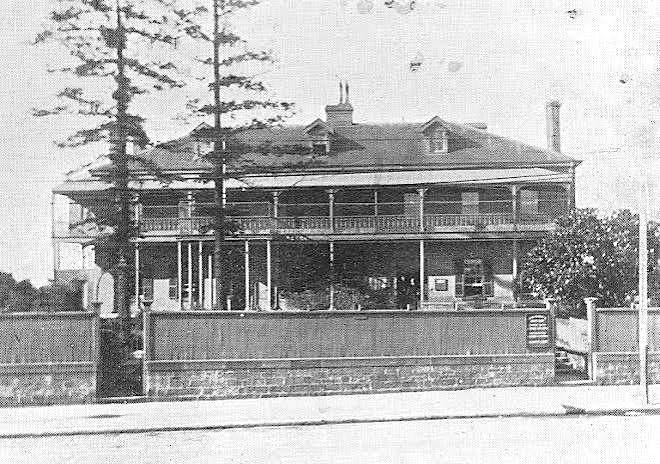
Osmond House – Paddington, Sydney
The workshop is attractively fitted with little lathes, jigsaws and other tools. Mr. Delacheur at one time was a public-school inspector, has been connected with the Stale Children’s Relief Department for 27 years, and is a practical tailor. He personally leads seven boys in the tailoring section. One of these, an aborigine aged 14, does the buttonholes; another aborigine, 17, the pressing; and of the other four, white boys of nine years to about 15, two are machinists, one is becoming a cutter, and two are learning to be coat hands. The last named couple, aged nine and 13, work only in the morning, and spend the afternoon at school.
The boot and toy work rooms are led by Mr. Wynn, who, of course. does all the heavier work, such as the cutting of the soles and the boards. One lad cuts the uppers, another machines them and five do the lasting up and finishing. The toy room is operated similarly.
There is no speeding-up. The idea is to keep the boys interested and to train them to be industrious. A new-comer is quietly allowed to wander about the workrooms at will for his first week, and in whatever he manifests a special interest he is then allowed to take a regular part. If he changes his mind from, say, turning to sawing, or tailoring to boot making, he is at liberty to carry on in the department of his new preference, subject to a gentle process of education to discipline.
The methods are most humane, and the response of the boys is gratifying. It will be seen that the term “workshop” as applied to this establishment is rather a misnomer. At the same time, the seven boot making boys, aided by Mr. Wynn, average 33 pairs of light boots a week. Two of the elder boys prefer vegetable gardening and save the place £50 a year by producing many of its vegetables. Such progress have one or two lads of 16 to 19 years made at one time and another that the department has given effect to the superintendent’s recommendation that they be paid 5s a week. This had been banked for them, and at times they have been allowed to go to town, and even to Newcastle and spend some of their earnings. On such occasions they have evinced particular pride in proving themselves absolutely trustworthy.
All the other lads over 14 years receive from 1s 6d to 4s a week, according to capacity. The boys who have left schoolwork five and a half hours dally, from 8.30 a.m. to 4 p.m., with dinner for half-an-hour and field games, such as cricket and football for an hour and a half (12 to 2). The visitor gathered the impression that a kindly citizen owning a couple of up-to-date cricket sets, footballs and tennis balls would find these received with joy.
Up to the age of 11, other things being equal, all the boys are schooled each afternoon (save Friday, Saturday and Sunday). The school is conducted on public school lines by two of the superintendent’s daughters — Misses Rene (a certified teacher) and Roma Delacheur. Great patience is necessary in the case of the slow-witted pupils. Mr. Wynn was at pains to impress the visitor with the fact that some of the children, both in the school and in the workshop are, however, anything; but slow.
The youngest schoolboy there just now is aged 10. Some of the boys have parents, and occasionally a boy is taken back home by his father and mother. The majority are indentured to trades such as those they have been learning. Some are boarded out. None under the age of 14 is indentured. Boarding-out occurs at any age. All these matters are subject to approval which is not given till a clergyman in each instance, and of the religious denomination of the individual boy, has favourably reported on the case.
Better provision for Christmas and birthday gifts seems to be called for. The place is watered from a well supply pumped by oil engine. Most of the boys think they are on an island. The home was started in 1913. No fewer than 79 young men formerly trained in the home fought in the war. One of these as a boy, before passing into Mr. Delacheur’s hands, was so incorrigible as to have been in 13 homes in three years.’
Reference to Raymond Terrace Boys Home in the Royal Commission Report – 1920
The Daily Examiner of 5 August 1920, page 5, reported:
‘The report of the Royal Commissioner, Mr. Mason Allard, upon the State Children’s Relief Department states:……
Severe criticisms of the distribution of relief are also given. Mr. Allard urges that provision should be made for the mental examination of all persons charged with criminal offences. He particularly noted a recent case at the Raymond Terrace home which had been used especially for boys of low and vicious moral tendencies. An extremely perverted lad was recommended as a member of the crew of a foreign-going vessel, and so was released on the community — one who could not fail to be a shocking danger to his fellows.
He recommends, among other things, that State wards, against whom no offence is alleged, should not be put into the industrial school section; that inmates of the industrial school section should be immediately re-classified and grouped; only boys committed from the courts and after proper medical examination should be sent to Raymond Terrace.’
Reference to Raymond Terrace Boys Home in a Labor Committee’s Report – 1920
The Evening News of 13 October 1920, page 6, reported:
“We condemn the extraordinary view of the department that good children should be mixed with bad to make the latter better.”— A.L.P. committee.
The committee appointed by the A.L.P. to investigate the State Children’s Relief Department has made a report to Mr. Mutch, Minister for Education, recommending drastic changes. The commutes discovered “depraving conditions,” and Mr. Mutch has promised to carry out many of the recommendations made.
The committee, which consisted of Mr. Mitchell, secretary Hospital and Asylum Employees’ Union, Mrs. Kate Dwyer, Mrs. Benson, R. W. Martin, and Mr. Finucane, waited on Mr. Mutch at Parliament House last night. Referring to certain parts of the report, Mr. Mitchell said:— “The department have expressed the opinion that there is nothing wrong with some of the classifications we quote, because they hold the view that by mixing bad girls (or boys) with good girls (or boys) that the good ones will make the bad ones better. The A.L.P. committee condemned this view, as they feel the opposite result would accrue.
The report quotes the following specific cases in this connection: — “The classification of children showed great inefficiency and want of segregation. The slip-shod methods adopted by the president and boarding-out officer, such as the grouping of boys and girls of normal mentality with inmates showing mental deficiency, some of whom were even on the vicious side, are examples. (Parramatta and Raymond Terrace institutions are mentioned.) …..
The classification at Raymond Terrace was considered shocking. The following classes were grouped together: Sexual, mental, cripples, epileptica, half-castes, aborigines, and poor little truants. There were no records kept at Raymond Terrace to show the authority for sending the boys there, and no medical examination to show the mental deficients.’
Walter Delachuer leaves Raymond Terrace following the Temporary Closure of the Raymond Terrace Boys Home – 1923
Following the temporary closure of the Boys Home, Mr. Delacheur placed the following advertisement in the Raymond Terrace Examiner and Lower Hunter and Port Stephens Advertiser of 23 March 1923, page 3, as he was leaving the district:
‘For Sale. Overland Touring Car,18 h.p., Hood Side Curtains, Glass Wind Screen, Electric Horn, Head Lights, Tail Lamp, Starting Outfit, With Magneto Ignition quite separate. Tyre Pump on engine. Built 1917. Had very little use. Guarantee same as new car. Must sell. Leaving the district. Offers wanted. W. Delacheur, Boys’ Home, Raymond Terrace.’
Proposal to open the Home again for Older Boys and to operate as a part of the Gosford Training School – 1924
The Raymond Terrace Examiner and Lower Hunter and Port Stephens Advertiser of 8 August 1924, page 3, reported:
‘In all probability in a week or two, the premises known as the Boys’ Home, on the Williamtown Road, will be brought into commission again. Previously they were occupied by boys who needed supervision on account of weaker mental faculties, but more congenial surroundings down the coast were found for these boys, and they were sent there. The idea now is to utilise the Boys’ Home near the Terrace for older boys, who have been on several farms, but on account of their needing more restraint than others a special home must be provided for them.
Their influence among the younger and better conducted boys was not considered beneficial, and the tendency to scoff at discipline had a bad impression on those who were disposed to be amenable to training. Hence the idea of isolating the boys of certain temperaments will be tried as an experiment. The boys will have to work, and be kept at work, in order to train them for some use in the community.
Various occupations will be found for them at the home. Mr. Bruntnell, Minister for Education, accompanied by Mr. Bethel, of the State Children’s Department, and Mr. J. L. Feegan, were in Raymond Terrace on Monday, and inspected the site. While the Minister admits that the surroundings are not too congenial for well disposed boys, he thinks the type of boy that will be housed at the Home, will be more impressed by the conditions he finds at the Raymond Terrace Home than at any other the State possesses. However it is more than likely the trial will be made.’
The Gosford Times and Wyong District Advocate of 18 September 1924, page 19, further reported:
‘Speaking to our representative, Mr. Bethel indicated the forward move now being accomplished in respect to the welfare of the boys for which this School [Gosford Training School] catered — a movement which had for weary years been hindered by the opposition of those who could or would not see that progress in this vital matter was of paramount importance to the State. Now, however, there were brighter days ahead for lads who for any reason had not the careful control of parents.
The system had been changed, and the benefits of the new regime were well illustrated by the happy results following on Major Parsonage’s control of the Gosford School. This Home was being extended, and there was also being established an overflow Home at Raymond Terrace. Also, the age at which his Department took charge of lads was being raised from sixteen to eighteen — so now there was no need for any boy who for whatever reason had got into wrong paths, to be dealt with in the old harsh manner.’
New Officer In Charge appointed at the Raymond Terrace Boys Home – 1924/1925
The Sydney Morning Herald of 10 December 1924, page 14, reported:
‘The appointment of Mr. E. Dermody as officer in charge of the Boys’ Home at Raymond Terrace was approved yesterday by the Executive Council.’
The Gosford Times and Wyong District Advocate of 12 February 1925, page 6, also reported:
‘Mr. and Mrs. Edward Dermody, so long associated with the Training School at Gosford, are at present enjoying a holiday — the first they have had for two years. Mr. Dermody was recently appointed Superintendent of the newly established Training School at Raymond Terrace, and Mrs. Dermody has been appointed Matron.
We have already congratulated Mr. Dermody upon the official recognition and promotion that have justly come his way, and in Mrs. Dermody’s departure the town and district will lose one of its best workers for public and charitable causes. We join with Gosford people in wishing Mr. and Mrs. Dermody happiness and success in their new sphere of labour.’
The Raymond Terrace Examiner and Lower Hunter and Port Stephens Advertiser of 5 June 1925, page 2, further reported:
‘A valedictory social was tendered to Mr and Mrs. E. Dermody at the Gosford Training School on Friday evening last. A very representative gathering of the district assembled to bid farewell and congratulate them on their promotion as Superintendent and Matron of the Boys’ Home, at Raymond Terrace. The social gathering took the form of a dance.
The Superintendent, Major A. W. Parsonage, welcomed all present, and, before calling on Mr. O’Hearn, M. L. A. for Maitland District, to make the presentation to Mr. and Mrs. Dermody, he eulogised the good work done at the Training School by Mr. Dermody, and spoke very highly of Mr. Dermody’s services at Raymond Terrace.
The system as in force there is carried along on the same lines as at Gosford, the scheme having already extended that far. Mr. W. F. O’Hearn, M.L.A. then made the presentation of a beautiful silver oak tray with silver rails, which was suitably inscribed as a presentation from the staff, who held them in high esteem, and a handsome silver epergne from the boys. He welcome Mr. and Mrs. Dermody into his district of Maitland.
He remarked also on the great change that had come over the training school under the new regime and felt quite satisfied that the institution was making rapid progress in its up-to-date methods. On behalf of the Returned Soldiers’ and Sailors’ League, Mr. R. E. Weeks presented Mrs. Dermody with three valuable solid silver vases suitably inscribed as a token of their appreciation of her energetic and untiring services during the Great War as vice-president of the local branch of the Red Cross Society.
In responding, on behalf of his good wife and himself, Mr. E. Dermody thanked his fellow officers, friends, and boys, and all present, and for the very handsome gifts received. Mr. Dermody went on to say that he had been in the service for 34 years, first being stationed on the Nautical School Ship, “Vernon,” then located at the mouth of the Parramatta River. The boys were then transferred from this old ship on the 11th June 1892, to the “Sobraon,” which was purchased during Sir Henry Parke’s term of office. Mr. Dermody was stationed on the “Sobraon” until the vessel was handed over to the Federal Government, in 1911. He was then transferred to Brush Farm, Eastwood, and entered on duties at Gosford at the opening of the Farm Home, in 1912.
During his 34 year’s service he saw many systems tried and emphatically denied that any of them compared with the system now in vogue at the Training School, and at Raymond Terrace, at the present time. Mr. Dermody was pleased to stress that with the old system went the harsh method of chastisement. The hall was tastefully decorated, under the guidance of Matron A. W. Parsonage.’
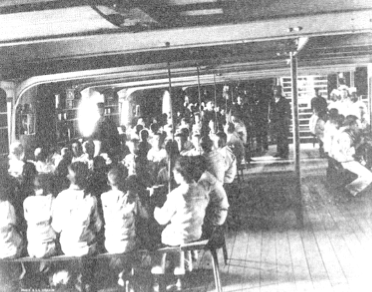
Sobraon training ship for boys – 1890’s [State Archives of NSW]
Raymond Terrace Boys Home receives favourable report – 1926
The Gosford Times and Wyong District Advocate of 19 August 1926, page 7, reported:
‘On Monday, August 9th, Major A. W. Parsonage, in his dual official capacity as Superintendent of the Training. School and Inspector of Institutions, journeyed to Raymond Terrace and Inspected the Boys’ Home (Mr. E. Dermody, Superintendent) there, which is part and parcel of the Gosford Training School. A very favourable report was furnished.’
Staffing at the Raymond Terrace Boys Home criticised following its closure – 1927
The Raymond Terrace Boys Home permanently closed in 1926 and the officer-in-charge, Mr. Dermody was transferred to a similar position at the Narara establishment.
Following the closure of the Raymond Terrace Boys Home, the Maitland Weekly Mercury of 22 January 1927, page 11, reported:
‘The Public Service Board inquired into the allegations of Mr. Moore, ‘on information called for by the Premier,’ that expenditure for salaries, wages, provisions, etc., could be incurred for the upkeep of a home at Raymond Terrace, at which no boys were housed for a period of six months, is a serious reflection upon the administration of the Child Welfare Department.’ ‘This statement is not justified by the facts,’ says the Public Service Board.
The only member of the staff at the home at the time referred to was the cook, who acted as caretaker. The home could not have been left without a caretaker.’
Transfer of ownership of land of the Raymond Terrace Boys Home – 1927
The Newcastle Sun of 29 December 1927, page 4, reported:
‘The Boys’ Home, an estate between Raymond Torrace and Williamtown, which has been under control of the Agriculture Department for a number of years, has gone over to the Lands Department. It will probably be sold.’
Concluding Comments
The story of the Raymond Terrace Boys Home in the early years of the twentieth century is one of such welfare institutions at that time. It tells of the difficulties faced but also of some positive outcomes for the boys who lived there.
The story of the site former Raymond Terrace Viticulture Nursery, on which the Boys Home was located is also published on this website and can be found at this link.
Other papers on the early history of Raymond Terrace are published on this website and can be found at the following links:
Early History of St. Brigid’s Catholic Church – The First 100 Years
War Loan Tank Drive Visits Raymond Terrace, Port Stephens – 1918
Raymond Terrace Municipal Council Jubilee Celebrations – 1934
Journey to the Vineyards of the Lower Hunter and Port Stephens Districts – 1865
Researched and compiled by Kevin McGuinness
July 2026


