
Introduction
In 1908, the New South Wales Department of Agriculture established a Viticulture Nursery at Raymond Terrace to grow phylloxera free grape vines.
Viticulture refers to the agricultural science and practice of cultivating and harvesting grapevines, primarily for winemaking.
Phylloxera is an aphid-like insect that destroys grapevines by eating the roots and infestations are easily spread.
In the early 20th century, phylloxera infected vineyards were widespread throughout New South Wales and Victoria.
In New South Wales, the Department of Agriculture established several Viticulture Nurseries to grow phylloxera free grape vines to distribute to wine growers sothat they could replace diseased vines with the pest free varieties.
Raymond Terrace was chosen as the site for a Viticulture Nursery as the soil in the area was of a sandy nature, which retarded the survival of phylloxera. The Raymond Terrace Nursery was also used to train young farm apprentices.
The viticulture venture at Raymond Terrace was a failure and was wound up in 1913. Its operations were then transferred to the Gosford Nursery at Narara.
The site remained unused for a short time until the State Children’s Relief Department established the Raymond Terrace Boys Home later in 1913.
Raymond Terrace Viticulture Nursery replaces Belmont Nursery – 1908
The Daily Telegraph of 1 September 1908, page 5, reported:
‘The Department of Agriculture is getting underway at Raymond Terrace what will ultimately develop into a second viticultural station. An area of 200 acres of very suitable undulating Crown land is here available, a small portion of which is being cleared as a beginning, and it is the intention, to put in some good resistant stocks forthwith. This new undertaking will supersede the nursery established last year at Belmont, which is being abandoned. Belmont [Lake Macquarie] was selected as a site for a nursery under the old regime of the department, chiefly as a matter of financial expediency.
The necessity for a nursery other than that at Howlong and quite clear of phylloxera infected areas, so that clean [grape growing] districts could be supplied with stocks without risk, had long been recognised. For this purpose, a sandy soil was needed for the reason that stocks strike much better in sand, and also that the grape enjoys immunity from phylloxera in fine sandy soil. The Belmont site in a measure answered the requirements, but it would never have been suitable for anything else than a nursery. A small patch was cleared and a number of stocks planted.
Owing, however, to the delays by the contractors in clearing and preparing the land, it was not until December that planting was started, and January 3 saw the finish. Six weeks followed without rain. Then 17 inches, fell, and the land was flooded. Under all these adverse conditions it is not to be wondered at that a large proportion of the stocks failed. However, about 15,000 struck. At present the ground is said to be so waterlogged as to be useless for the purpose intended. It was recognised all along that the Belmont site would have to be drained.
When the new Department of Agriculture was created, the conclusion was arrived at that the nursery should be in a district such as the Hunter River, where its presence would be an object lesson, and on an area of suitable land to permit of its usefulness being eventually expanded into a station for all classes of viticultural work. At Belmont some £700 had been expended, and the determination was wisely arrived at to make the first loss the only one, and not to waste more money on an inadequate site that was not in other respects entirely suitable tor nursery work even. However, there has already been three applications for the land for market-gardening, so that the expenditure incurred to date by the Government will not have been all thrown away.’
European Grape Varieties imported for Raymond Terrace Viticultural Nursery – 1909
The Farmer and Settler of 11 June 1909, page 9, reported:
‘The viticultural department has imported 37,001 cuttings of European varieties of table grapes which are being planted at the new viticultural station at Raymond Terrace. With a view of assisting the vignerons to reconstruct on phylloxera-resistant stock, the department of agriculture has introduced from Europe four experts in bench grafting.’
Hunter River Winegrowers protest against Raymond Terrace Viticulture Nursery – 1909
The Sydney Morning Herald of 21 July 1909, page 6, reported:
‘With reference to the protest which appeared in the press on 6th instant from the Hunter River Winegrowers’ Association against the establishment of a viticultural nursery at Raymond Terrace, the Minister of Agriculture desires to point out that there is no danger whatever of phylloxera being spread by the agency of this nursery. On the contrary, the very reason why Raymond Terrace was chosen was that the sandy soil there would make it impossible for the nursery ever to become infected with phylloxera. Even if stocks badly infected were planted, the pest would die after a few days in the sandy soil.
In regard to the request of the association that no vines from the nursery be distributed in the Hunter River district, the Minister desires to say that stocks will not be forced on anybody, but those who apply for them will get them.
In this connection it may be pointed out that another reason for establishing the nursery at Raymond Terrace was that the Minister decided that no stocks should be sent from Howlong to a clean district, and it was therefore, thought advisable to establish another nursery in a district hitherto not attacked by the pest, from which resistant stocks could be supplied to vine-growers in clean districts.
It may also be pointed out that the department is so anxious to prevent phylloxera from attacking the vineyards in the Hunter River Valley that it has recently issued a proclamation absolutely prohibiting the sending into that district of any vines or part thereof from the counties of Camden and Cumberland.’
Tender for installation of a Water Pump accepted – 1909
The Maitland Daily Mercury of 28 December 1909, page 5, reported:
‘Hayes and Ferry’s tender has been accepted for construction of a pump, well, etc., for Raymond Terrace Viticultural Station Water Supply.’
Overseer appointed to Raymond Terrace Viticulture Nursery – 1910
The National Advocate of 24 January 1910, page 3, reported:
‘Mr. L. J. Kehoe assistant orchardist at the Bathurst Experimental Farm for the past three years, has been promoted to the position of overseer at the Raymond Terrace Viticultural Station. During his residence in Bathurst, Mr. Kehoe has made many friends all of whom, while learning with regret of his departure, will be pleased to learn that it carries with it promotion. He will be especially missed in cricket circles as not only a good all-round player but rendered service to the game as honorary secretary of the Bathurst District Cricket Association.’
Youths from the Dreadnought Scheme to be trained at Raymond Terrace – 1910
The Dreadnought Scheme was an early twentieth-century farm apprenticeship program that brought British teenagers to Australia to work as rural labourers. Named after a proposed battleship, it operated from 1911 to 1939.
The Australian Town and Country Journal of 10 August 1910, page 9, reported:
‘A report received from the Department of Agriculture states: — A letter from Dr. Arthur, M.L.A., recently appeared in the Press regarding the education of city lads for a country life, and also the training of the British lads to be brought to the State under the “Dreadnought Farms” scheme. There appears to have been some misapprehension in this matter, as the Department of Agriculture is making provision for the class of lads referred to. Dr. Arthur appears to be under the impression— to use his own words— that “the Dreadnought scheme at present, seems to be hanging fire in some extraordinary manner;” but the Department points out that the Government has already accepted proposals of the Lord Mayor in this matter, and is preparing to receive from Great Britain about 100 lads each year, who wish to get practical experience in Australian agriculture.
These lads will be trained for a complete year at one of the farms under the department’s control. In addition, to the existing schools, which can take 310 students, accommodation is being provided for 20 lads at Cowra, Grafton, Glen Innes, and Yanco experiment Farms, Howlong Viticultural Station, and the Hunter Valley Viticultural Nursery, Raymond Terrace; also for a few at the Dural Demonstration Orchard.
As soon as the demands warrant it, provision is to be made for doubling the number to be taken. Furthermore, city lads or others from any part of the State will be accepted and trained at any of these institutions on the same terms as the British boys, whose fees are to be paid from the Dreadnought fund. These new schools are to be known as Farm Apprentice Schools, and the fee will be made to suit the class of lads for whom this scheme has been planned. The intention of this scheme is to give every lad accepted a practical training for a year, which will fit him to be a useful assistant on any mixed farm, and enable him satisfactorily to carry out any of the ordinary operations that a young agricultural labourer would be expected to undertake.’
Growing of grafted grape vines progressing at Raymond Terrace- 1911
The Daily Telegraph of 4 January 1911, page 7, reported:
‘At the Raymond Terrace station, where there is about nine acres under vines, there is already a large number of table and vine grapes on resistant stocks, including a numerous selection of new varieties imported from France, Italy, Spain, Portugal, Greece, and Turkey. These will be available for distribution in due course. There are also something like 110,000 ordinary rooted cuttings in the nursery for next season’s planting.’
Farm Apprentice School operational at Raymond Terrace – 1911
The Sydney Mail and New South Wales Advertiser of 18 January 1911, page 12, reported:
‘The Agricultural Department some time ago started a new class of school called farm apprentice schools. They were opened at Yanco, Cowra, Grafton, Glen Innes, Raymond Terrace, and Dural. At the first of these a number of lads ranging from 16 to 20 years of age will receive practical instruction in irrigation, more especially with regard to the grading and preparation of land for water, and in the “duty” of water on different classes of fruit trees, grape vines, lucerne, and other fodder crops which may be deemed valuable enough for this intensive cultivation.
At Cowra the lads will get a thoroughly practical training for one year in wheat growing and sheep-breeding. At Grafton mixed farming suitable to a sub-tropical district will be taught, and at Glen Innes mixed farming of the class usually pursued in Great Britain. At the Hunter River viticultural station, near Raymond Terrace, lads will be trained in all the details of nursery work, with special reference to grafting vines on phylloxera-resistant stocks. At Dural a small number of lads has already been taken for practical instruction in fruit growing, and they are taught every operation connected with the making and renewing of a citrus orchard.
This class of training school has been instituted to fill a gap which has been long felt, the object being to train lads as farm labourers. Practical instruction only will be given, a fee of only £5 being charged for a year’s instruction, as it is recognised that the right class of lads, who alone will be taken at these schools, will be able to earn their board and lodging after the first six months’ apprenticeship and unprofitable work.’
Accommodation Building under construction at Raymond Terrace – 1911
The Australian Town and Country Journal of 17 May 1911, page 6, reported:
‘In pursuance of the policy of the N.S.W. Department of Agriculture to afford proper training for youths intending to make their living from the land, buildings are now in course of erection at the Hunter Valley Viticultural Station, Raymond Terrace, to accommodate up to 10 lads, who wish to learn as much as possible on the subject of viticulture.
At this station the department raises annually a very large number of grape vines grafted on to stocks which are resistant to that dread disease— phylloxera. These are then distributed to various applicants throughout the State. It is expected that the buildings will be ready for the “apprentices” about the middle of July, and intending applicants are advised to send in their applications for admission at an early date. Copies of the regulations on the matter and of the form of application may be obtained from the Under-Secretary, Department of Agriculture. The apprentices will be given a year’s practical training for the small sum of £5 for the first six months, the second six being free if the apprentice proves satisfactory.’
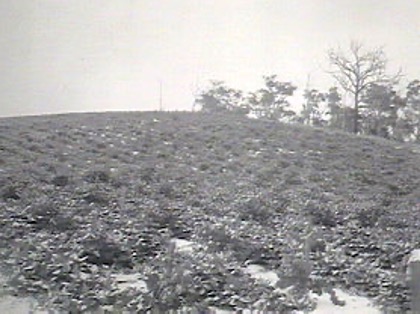
Phylloxera free vines at the Raymond Terrace Viticulture Farm [State Library NSW]
Phylloxera resistant vine stock ready for distribution – 1911
The Sydney Stock and Station Journal of 26 May 1911, page 15, reported:
‘In pursuance of its usual policy, the Department of Agriculture will, during the coming winter, distribute amongst vignerons large numbers of phylloxera resistant vine stocks from the Howlong Agricultural Station and the Hunter Valley Viticultural Station at Raymond’ Terrace.
These stocks do not bear grapes, but are planted in the usual way, and in the spring of the following year have the ordinary grape bearing varieties grafted on to them. The latter then become phylloxera resistant. There will also be available a limited number of ready-grafted rooting’s of wine and table grapes, also a fairly large number of rooting’s of table, raisin, and wine grapes not grafted.’
Status of Raymond Terrace College Buildings clarified – 1911
The Newcastle Morning Herald and Miners’ Advocate of 16 June 1911, page 5, reported:
‘Mr. Trefle, the Assistant Minister for Agriculture, answering Mr. Brown [Member of Parliament], stated that it was not proposed to utilise the college buildings, erected at the Viticulture Farm, Raymond Terrace, solely for boy immigrants. The status of the place would be an apprentice school for labourers, not a college. Local boys would be given practical instruction in viticulture, for which a fee of £5 for six months would be charged, and under certain conditions, a further six months’ training would be given free of charge.’
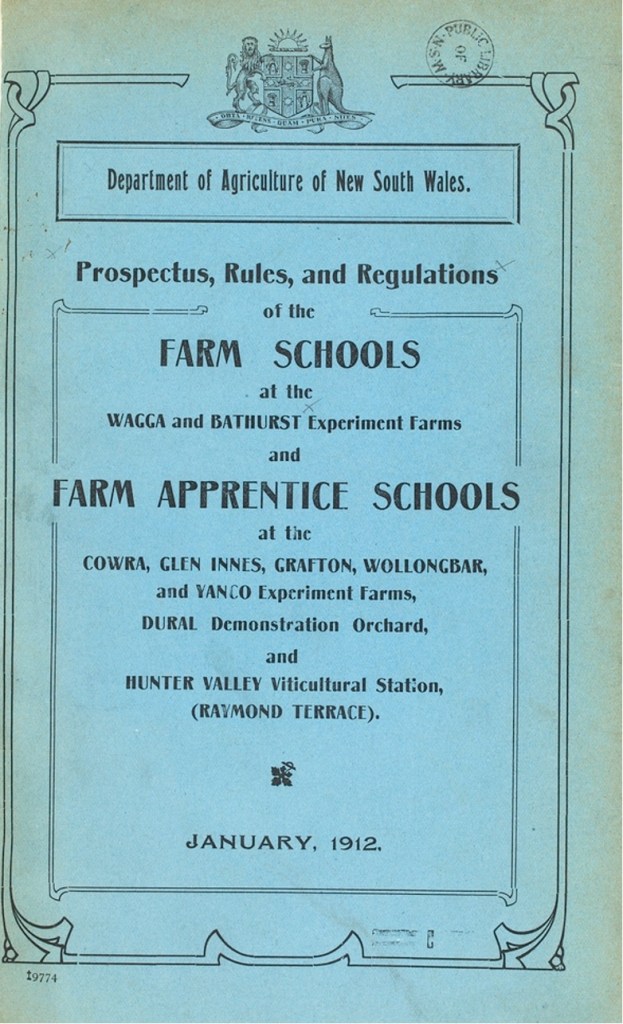
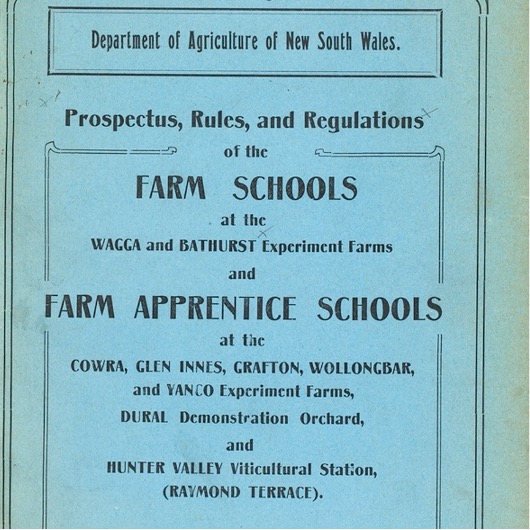
Cover page of the Prospectus, Rules and Regulations of the various Farm Schools, including the Raymond Terrace Viticultural Station, 1912 [State Library NSW]
Summary of Raymond Terrace Viticulture Station Operations – 1911
The Land of 27 October 1911, page 2, reported:
‘Aware of the immunity from phylloxera of vines grown in sandy soil, a new viticultural station was started at Raymond Terrace, in the Hunter Valley where the soil was sandy, in 1908. Clearing off the heavy timber took some time, but as soon as a sufficient area was cleared, it was planted with table grapes of the best varieties, imported from all parts of Europe. A large number of rootlings have been raised, and sold to small landholders, so that they could enjoy the luxury of fine-quality grapes at a nominal cost. No instance of phylloxera having attacked the vines has as yet been reported.
The reason why sandy soils are immune is that phylloxera cannot find its way to the roots, and therefore, perishes. Even infested vines planted in such sands, free themselves of the parasite within a month. Professor Manon, the late well-known European expert, was of opinion that sand acts as an insecticide.’
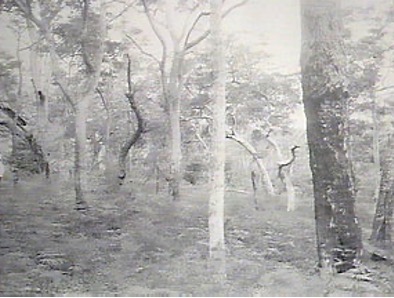
Timber on the Raymond Terrace farm site prior to clearing, 3 September 1908 [State Library NSW]
Criticism of Raymond Terrace and other Viticultural Farms – 1911
The Farmer and Settler of 5 December 1911, page 7, reported:
‘In the annual report of the N.S.W. Department of Agriculture, the Under-secretary makes mention in the following terms of the efforts made by the State to encourage viticulture: — A survey of the development of viticulture and winemaking in this State during the past twenty-one years gives little cause for congratulation. The area under vines now is 8321 acres, which is less by 120 acres than the area cultivated ten years ago, and only 8.4 per cent. more than that of 1890. If we take to ourselves any of the credit for the splendid expansion in wheat growing, dairying, and wool production, we must accept some of the discredit attached to such a condition of stagnation in viticulture.
A viticultural nursery was established at Howlong, on which no less than £14,793 has been spent, besides the value of the land, £1800. Another was started at Lake Macquarie, on which £1001 was entirely wasted, owing to lack of elementary knowledge of practical field requirements. Another nursery has now been started near Raymond Terrace, on which already £5576 has been spent, much of it unwisely and unnecessarily. The total cost of these operations has, therefore been £21,371, besides the salary and incidental expenses of the viticultural expert and an assistant, which have absorbed another £8200.
Steps have now been taken to reorganise completely this branch of our work, and to place the field of operations and nursery work under an efficient practical man, so that the expert will be left to concentrate his whole time on the work of teaching wine makers and supervising more effectively the cellar operations throughout the State. We may in this way be able to help the vine-growing industry to expand, as it should do, and to raise the production and reputation of our wines to that position among Australian States which our conditions of soil and climate warrant us to expect.’
Vignerons’ trip to the Raymond Terrace Viticultural Station – 1912
The Maitland Weekly Mercury of 18 May 1912, page 14, reported:
‘Last week Mr. E. P. Capper (who is a committee man of the Pokolbin and District Vine-growers’ Association) took several members of the association to Raymond Terrace in his motor car for the purpose of inspecting the viticultural station. On arrival, the visitors were agreeably surprised at the extent of the operations carried out by the Department of Viticulture.
The vineyard and nursery are situated on undulating ground of such a sandy nature, that it would be practically impossible for phylloxera to live in it. The fact that the surrounding country for some miles is of similar soil, is a great additional safeguard. The cleared area is about 20 acres, and of this about 15 acres are planted with vines. The main ridge faces west, and there are also slopes to the north, south, and east planted with vines. The eastern slope makes an ideal basin for a nursery, being sheltered from every point of the compass. The soil is, of course, poor, but is remarkably suitable for the propagation of phylloxera resistant vine stocks, and the lack of richness can easily be made up by fertilizers and green manures, such as cow peas, which grow luxuriantly when planted among the vines.
The station has only been in existence three years, so that there are not many grafted vines available yet for distribution to growers. The “mother” stocks and older vines planted two years ago are showing good growth and development, and a number of them are fit to trellis. There are a great number of varieties of both table and wine grapes, in addition to the phylloxera resistant vines.
There is a good well and pumping plant, and the well is capable of supplying 7000 gallons of water per day for irrigation purposes. Water pipes are laid through the nurseries, and irrigation is carried on from overhead sprinklers. Water is also laid on to all the buildings, including the stables. A large shed built into the side of a hill is used for callousing grafted vines. The soil is remarkably easy to work and requires practically nothing but a cultivator to keep it clean and loose.
Two cottages are built on the highest parts of the vineyard, and the trustees of the “Dreadnought” Fund have undertaken the erection of two fine buildings only recently completed at a cost of about £1800. These buildings are intended to be used by viticultural students and are most up-to-date and well-furnished throughout. They are built of hollow concrete bricks made on the place and are replete with every
convenience.
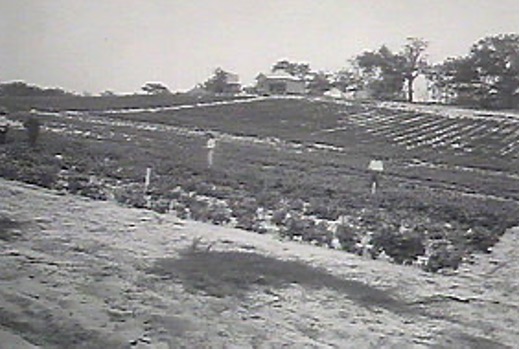
Area of the Raymond Terrace Viticulture Farm, showing two buildings on the hilltop [State Llibrary NSW]
A large dormitory has 10 beds and wardrobes for students, and there is a large workroom, besides kitchen, storerooms, and washhouse……. Lighting is carried out by means of a large acetylene plant. The station has over 600 acres of land which no doubt will be utilized as time goes on. The visitors were unanimous in their approval of the place and considered the Agricultural Department worthy of praise for amount of work they have accomplished. The trip was enjoyable, and distinctly educational and the visitors returned home with a lot of useful knowledge.’
Raymond Terrace Viticultural Station operations transferred to Gosford – 1913
The Dungog Chronicle of 23 May 1913, page 10, reported:
‘Mr Trefle has decided to close down the Raymond Terrace viticultural station and has made [other] arrangements for the growing of phylloxera resistant vines for vignerons.’
The Sydney Morning Herald of 20 August 1913, page 9, further reported:
‘Great dissatisfaction still prevails among vignerons in the Murray Valley, notwithstanding that the demand for phylloxera resistant vines was so strong as to impel the Minister for Agriculture, three months ago, to announce he had decided to remove the nursery at Raymond Terrace to an area near the State forest nursery at Gosford.
The present dissatisfaction has not in any degree emanated from Mr. Trefle’s announcement for the removal of the nursery to a more suitable site is recognised as being “better late than never,” but from belated departmental action, and neglected and inadequate provision for the supply of phylloxera resistant vines Especially for the latter reason is the Department of Agriculture criticised, and many vignerons have grown so tired of waiting for vines, that they are now turning their attention to obtaining their requirements, if possible, in another direction without further delay.
The inability of the Government to supply vines has not only given a great set-back to the wine industry, which it will take some years to recover; but in hopelessly failing to overcome the vicissitudes of a nursery after four years’ resultless work, the Department of Agriculture has courted “a viticultural stigma” on an otherwise policy of progression.
In announcing his decision to remove the nursery from Raymond Terrace to Gosford, because “it had proved most unsatisfactory,” the reasons given by the Minister for Agriculture in condemnation of the former site, make it appear strange that such conditions should have been permitted to continue so long without any departmental intervention. No less strange does it seem in the face of such drawbacks as “poor soil,” “too exposed situation,” and “hot westerly winds,” that such a site should have been recommended at all.
Certainly, vignerons have entered frequent and strong protests against Raymond Terrace Nursery, if for no other reason than it had absolutely failed to carry out its purpose; while the expense of the nursery, in proportion to the extremely limited output of vines, has several times been challenged by Riverina vignerons as unwarrantable and unjustifiable. It is claimed that such money could have been better expended in other directions, and the result would have been the assurance for orders for vines being fulfilled.’
Initial success of Gosford Nursery – 1914
The Border Morning Mail and Riverina Times of 12 February 1914, page 2, reported:
‘At the Gosford Nursery, or to be correct, at the Narara Viticultural Nursery, 100 acres have been set apart for viticultural purposes. The soil is very sandy, and the site has on three sides mountains, so that it is well protected from hot winds. The open side faces the east, and directly the rising sun shines on the nursery. The average rainfall averages about 40 inches.
In August last, when the site was taken over, the land had to be cleared of brush stumps, ploughed, and the subsoiled with a subsoiler. After this work had been completed, bench-grafting was proceeded with, the whip-tongue graft being employed. For conducting those operations there were not any elaborate and costly buildings like those at Raymond Terrace; everything was done in a crude manner at a minimum of expense. The work was carried out by seven men and five boys, under the supervision of Mr. Jenkins.
Considering that both men and boys were inexperienced at grafting, the men in a short time were able to graft 1000 cuttings, and the boys from 700 to 800 daily. The grafts were planted straightaway in the nursery as they were done. The period of planting extended from September up to the first week in November. …. It is expected that the department will be in the position to distribute for the approaching planting season approximately 35,000 phylloxera resistant grafted vines, and 1000,000 resistant rootlings.’
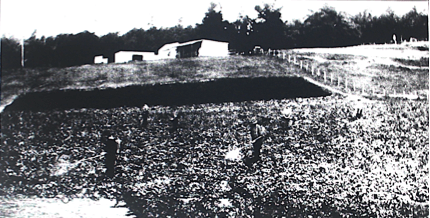
Government Viticultural Station at Narara, near Gosford [Sydney Mail, 5 August 1914]
Concluding Comments
Following the transfer of the viticulture operations from Raymond Terrrace, the site remained unused for a short time until the State Children’s Relief Department established the Raymond Terrace Boys Home in 1913.
The history of the Raymond Terrace Boys Home is published on this website and can be found as this link.
Other papers on the early history of Raymond Terrace are published on this website and can be viewed at the following links:
Early History of St. Brigid’s Catholic Church – The First 100 Years
War Loan Tank Drive Visits Raymond Terrace, Port Stephens – 1918
Raymond Terrace Municipal Council Jubilee Celebrations – 1934
Journey to the Vineyards of the Lower Hunter and Port Stephens Districts – 1865
Researched and compiled by Kevin McGuinness
July 2026


