
Introduction
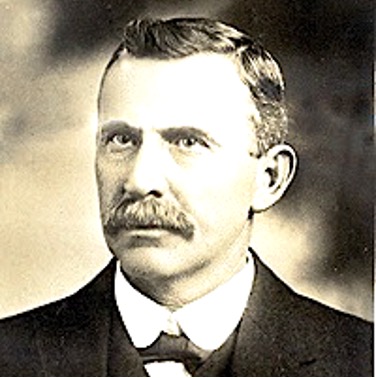
William Brown (1867-1954) was the owner and editor of the Raymond Terrace Examiner which he founded in 1893, holding the position until his death in 1954.
He was also a member of the NSW Legislative Assembly (as Member for Durham 1907-17) and was a longtime resident of the Raymond Terrace and Nelsons Plains at Port Stephens.
In 1941, he gave a talk at Raymond Terrace to local residents on his reminiscences of the area.
In 1943, William Brown was given a well-deserved community dinner to recognise and celebrate his various achievement in the local area. In his address at the dinner, he reflected on his early memories, such as how a stream originally went across King Street, Raymone Terrace, which was for many years the centre of the commercial district.
The above events were featured in the following newspaper articles. They provide a valuable history of Raymond Terrace, Millers Forest and Nelsons Plains.
Reminiscences of Early Raymond Terrace by William Brown – 1941
The Dungog Chronicle of 17 January 1941, page 4, reported:
‘At the Men’s Fellowing meeting held in the Parish Hall, Raymond Terrace, recently, Mr. W. [Bill] Brown gave a talk on early Raymond Terrace. Mr. Brown said it was always interesting to talk over old times and particularly so to those who were of contemporary age, as many things remembered by one may have been forgotten by the other.
He said the early records show that boats came up the river as early as June 27, 1801, for on that date Col. Paterson came from the coal river, as it was then called (Newcastle now), and proceeded up the Hunter and landed at the junction of the rivers.
In 1818 Governor Macquarie mentions going to Raymond’s Terrace with four boats and a company of about 50 persons and made what he called a brave showing. He passed Hexham, where there were myriads of waterfowl in the ti-tree marshes, and reached the mouth of the Williams on the 29th, for the party, he said, landed at the junction of the two rivers. This would no doubt be on what is now McDermott’s farm. That would he where the highest banks along the river existed in this locality, and the water would be deep right up to the bank. The banks would be farther out in the river then, as some erosion has taken place since that time.
In 1812 the locality most probably derived its name, for in that year an exploratory boat party was sent up the river, and it landed at the same spot as Col. Paterson. The officer in charge of the boat was Lieutenant Raymond, and the addition of the name Terrace originated from the contour of the hills viewed from the downriver approach to Raymond Terrace.
In those days the hills, densely covered with timber, ran in undulating outline one after the other, presenting the appearance of terraces, and it was referred to later as Raymond’s Terraces. The late Lady Windeyer (Major Windeyer’s mother) often said when residing at Tomago that Governor Shortland sent Lieut. Raymond up the river. She would now be over 100 years old if surviving. This would authenticate the fact of the name Raymond’s Terraces then coming into existence.
In 1818 the place was known as Raymond’s Terraces, and according to Mr. Ifould, one of our reputed historians, the place was known as Raymond’s Terraces before Governor Macquarie came up. The Governor states his party landed at the junction of two rivers, and he searched for a gum tree on which had been cut by his nephew, in 1812, his initials (Governor Macquarie and those of his nephew), a Lieut. McLain. He found the tree and described the initials cut thereon. Mr. Brown said it was rather a misfortune that the tree had not been preserved.
In trying to find out how the name Miller’s Forest originated, he said he had no doubt that the name Miller’s Forest had come through pit sawyers coming up the river from Newcastle cutting cedar, for it was plentiful along the alluvial flats of the river and was known as Newcastle cedar. The cedar was cut by what was then known as pit sawyers — a square hole would be cut in the ground and the log rolled across it. One man would get into the pit and the other would stand on the log on top and the saw pushed and pulled up and down. Much of the cedar used in the early homes was cut in this way.
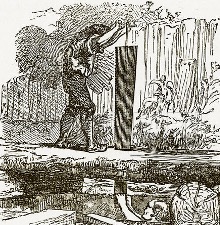
Image of a saw-pit
Through a good deal of timber being available all about the flats the place no doubt came to be known as Millers’ Forest. There is no other way that he knew of as to how the name could have originated, as there was no person of the name of Miller associated with the land grants or early purchases of land. The name Nelson’s Plains no doubt originated from Lord Nelson, the Trafalgar hero, for about that time or a few years before the area is referred to in our history, Lord Nelson was a popular and much revered hero. Here also there is no name “Nelson” associated with any of the landowners of the early years.
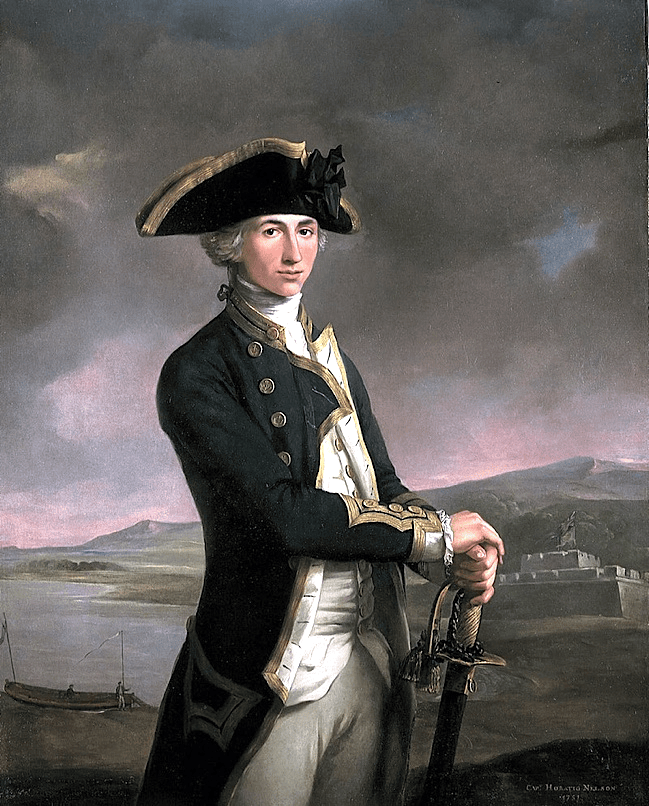
Captain Horatio Nelson – 1781 painting
The first mention of settlement on Nelson’s Plains was in 1829, for the land was then vested in the Church and School Lands Corporation, and the trustees in 1833 sold the Nelson’s Plains area to a John Weighton, 2562 acres, for the sum of £1281, or 10/ per acre. The land was advertised for, sale in the Government Gazette of November 22, 1832, by the Church and School Lands Corporation in three lots. Lot 1 of 820 acres was the lower part of Nelson’s Plains; lot 2 of 649 acres the central part; and lot 3 of 844 acres the upper portion. The upset price was fixed at 10/ per acre and apparently Weighton [Wighton] was the only applicant for purchase, for in February 1833, the land was transferred to him by J. P. Oldfield and others, viz., his wife, and Ingles and wife, of London, and Georgiana Wighton, of Glasgow, spinster, and K. Snodgrass, for Great Britain.
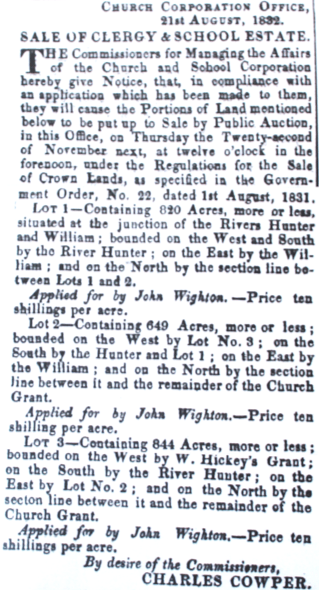
Sale of Clergy and School Estate at the junction of the Hunter and William Rivers [NSW Government Gazette – 21 November 1832]
In 1840 it was sold to John Eales by K. Snodgrass for £5092/12/. It was mortgaged by this owner in 1844 to Hastings Elwin. In 1847 it was vested in the Australian Trust Co., and in 1853 reconveyed to John Eales. In 1893 it was mortgaged by John Eales to the Scottish Widows’ Life Assurance, and in 1895 he passed away, leaving the estate to his sons. In 1904 the area was submitted to auction, and a number of the purchasers or their descendants are still on the properties.
In earlier years much of the land on Nelson’s Plains was undrained and considered too low. Some of the lower end along the Williams River was overgrown with reeds, and for a time was a sort of no-man’s land, where any cattle could stray. There was also a dense growth of ti-tree and oak in the swampy parts, but as time went on this gradually became less as the land was drained and disappeared altogether excepting in what was then known as the little swamp where today is standing a remnant of the former dense ti-tree scrub which covered the edges of all the swamp lands in earlier days.
Nelson’s Plains once boasted a public school with an enrolment of 72 pupils. The first school was a slab and shingle low long room, with wooden shutters for windows. As a boy going to school there, it was common to see the aboriginals of all ages passing along the road to camp on the uplands of Nelson’s Plains, and today there exists a waterhole there called Kitty’s waterhole, after a black gin of the name who died there.
In a few — very few — years they had all passed away — the piccaninnies and youths, as well as the elder aboriginals. The ravages of colds and pulmonary complaints accounted for almost all, as the wearing of clothes more than any other cause seemed fatal to them. Rum drinking is said to have caused a prolific number of deaths among the natives, but while that may have accelerated the death rate, principally the mortality was due to wearing clothes and falling easy victims to colds and the ailments which follow and other epidemics. There are a few of their descendants, but no full bloods in the mission area at Karuah.
The speaker also referred to the decline, in population on Nelson’s Plains, and he said there was no school there of any dimensions at all now. The early families were large, and he enumerated them and a number of children in each family, the smallest family being four children. It was a regrettable circumstance that the population has not been maintained. Mr. Brown also referred to the fauna that existed in the earlier years about the riverbanks and flats, and plentifully existing all over the forest lands were opossums, native bears, and the native cat, now extinct in this area, a most destructive little animal that frequently raided the fowl houses and chicken coops. The “boorabee,” as the aboriginals called it, or native bear, was a beautiful little animal and some fine specimens existed before settlement had brought the wanton and thoughtless hand of destruction among them.
They, too, are almost extinct in this area now, but their disappearance in later years was due a to disease which killed them off at an alarming rate. The opossum was almost extinct hereabouts, but since protection of it became general by close sea sons it is slowly building up in numbers again. The kangaroo and the wallaby are here still, but few in numbers compared to early years. But their decrease is due to the lands being opened up and their haunts no longer available to them unless in those localities that are too poor in soil qualities to be worth clearing.
All species of wild fowl, particularly ducks, were in thousands in the early days, and flocks of hundreds at a time were a daily occurrence. The swamp about Grahamstown, Campvale, Moffits, Eskdale, etc., abounded, in game, and bags of 50 pairs were a common occurrence. But they, too, have had to seek other fields for sustenance and security, as most of their haunts have been drained and few feeding grounds are now in existence. The protection of game will doubtless bring back in time greater numbers than at present exist, but never again can they ever become so numerous as in those days of less molestation and earlier settlement.
There, too, were extremely plentiful in the pioneer days all the snake varieties, and the black snake was often found invading the homes, and particularly so after floods. They are quite plentiful enough today, but they existed in the swamp areas in hundreds before the settled areas made constant war upon them and decimated their numbers. Their extinction has not yet been accomplished, but it is on its way.
Mr. Brown also referred to the improved homes of the people of today compared to when he was a boy. The usual abode then was often a bark covered hut or a house of two rooms with a skillion. The two rooms would be floored, but the floor of the skillion was of earth. The walls were slabs split and trimmed with the adze, and cracks were open through which one could see. Paper was sometimes pasted on the inside walls, and this kept the cracks sealed and prevented the keen winds of winter from whistling through. But he was pleased to say those homes have been supplanted with more modern dwellings, and a most notable change came about soon after the occupiers became the owners of their own farms. Before 1904 the farms on Nelson’s Plains were all under tenancy and improvements came slowly.
A ferry service, probably the first that operated at Nelson’s Plains, was a rowing boat service which connected the point at the junction of the Williams across to Raymond Terrace. When the roads were laid out in 1838 the ferry connected with the road, and the punt was worked by a rope. The passengers seized the rope at one end of the ferry and walked to the other and then returned to the other end to repeat the performance. This was the order of ferrying also at Raymond Terrace, where the late Mr John Hanlon was one of those who ‘kept’ the ferry.
The first ferryman, he thought, at Nelson’s Plains, was named McDougall, but on that point be was not sure. Among the early settlers on Nelson’s Plains were the families named Worboys, Baker, Allan, Foot, Perrett, Pearn, Warley, Goswell, Priddle, Holwell, Brown, Parsons, Carmody (two families), MacAuliffe, Pratt, Garnet, MacAlpine, Carroll, Clark. Some of their descendants are still in residence there.
It will perhaps be not generally known that sugar cane grew on the river, and a sugar cane mill was operated by a Mr. Fraser, who lived on Miller’s Forest and owned the property now owned by Messrs. Markham Bros., near Martin’s wharf. But as the country became opened up frosts attacked the cane, and about 1872 the mill was closed down and removed to the Clarence River. The last cane grown on the river was on the farm occupied now by Mr. Jas. Saunders, but at that time in the occupancy of the late Mr. Jos. Dennett, who later purchased the farm opposite Raymond Terrace.
There was a fire brigade in existence at Raymond Terrace in 1857, and the bell post was in the middle of Port Stephens-street, between the bank corner and the Shire Office. It frequently rang, not always when a fire occurred but when some miscreant youth or bibulous resident could imagine some fun would arise from the pulling of the bell rope.
On the same corner, too, it was in the early days convincing ground for the champion marble players. Men as well as boys were in the ‘big ring’ contests, and as many as thirty or forty residents, adults and youths, would be gathered around the ring.
The laying out of Raymond Terrace was approved by the Colonial Secretary in 1837. Prior to that Mr. T. Mitchell, Surveyor-General, instructed the Assistant Surveyor, Mr. G B. White, in the following terms: “His Excellency the Governor having been pleased to direct that a village is to be laid out at Raymond Terrace so that Mr. King, who wish es to establish an earthenware manufactory there may purchase some allotments, I have to request that all features of the land may be carefully surveyed and a plan thereof on the usual scale of 8 chains to 1in. transmitted to me together with your report as to the capabilities of the spot for a village — as regards fresh water, elevation, roads, etc., together with any suggestion you may have to offer on the subject.”
On November 27, 1837, the Col. Secretary wrote to the Surveyor General approving the site and placed a minimum price of £4 per acre on the land. The sale was advertised in the Government Gazette and took place at Market Building, George-street, Sydney, on August 9, 1838, upset price being £4 per acre. At a later sale on November 8, 1838, the corner block where the new hotel is being erected realised £8/13/4, and the corner block where the bank stands £4/13/3, both being purchased by Mr. G. H. Oliver. At this time King-street was not in existence. At this sale the land on the flat below the public school was purchased by T. Magner for £24 for two acres, this land evidently being regarded as of more value from an agricultural point of view.
Some of the early landowners were G. T. Graham, who was promised what is now known as “Kinross,” but then as “Wurraburrabeen” or “Wurrapurraben,” in 1828, and eventually granted to him on July 7, 1835, on conditions that he clean and cultivate 55 acres or expend £100 in improvements. This land was defined as commencing on the south-west corner of the Crown reserve known as Raymond Terrace. J. King acquired by grant 100 acres adjoining the town on January 1, 1830, it being land promised to Andrew Bennett on or before April 4, 1831, but at the request of Andrew Bennett was granted to J. King. Mr. King later acquired Irrawang.
K. Siddons was granted in January 1831, “Motto Farm,” area 600 acres, from the riverbank back on condition that he was to clean and cultivate 55 acres or expend in improvements £275. William Russell (Capt. Russell), of Orthes, was granted a lease of 680 acres and 1155 acres for ¼d for ever, if demanded. This was in the parish of Stockton. He was a retired field officer from His Majesty’s Army of upwards of 25 years’ service and was later permitted to purchase the respective areas for £170 and £280/15/.
Caut. Russell was the great grandfather of Messrs. G. R., Arthur, and William Russell, of Raymond Terrace. Other early names were those of Pennington, Thew, Snodgrass, Peppercorn, T. Brown, A. and R. Windeyer, and there are others farther away from Raymond Terrace. Mr. Henderson was promised Roslyn in 1831, and was granted the land in 1837.’
Community Dinner for William Brown – November 1943
The Newcastle Morning Herald and Miners’ Advocate of 24 November 1943, page 2, reported:
‘Mr. William Brown was the guest of more than 100 friends at dinner in the Masonic Hall, Raymond Terrace, last night. Just 50 years ago [in 1893] he established the first newspaper, “The Examiner,” in that town. The President of Port Stephens Shire (Cr. G. J. Russell) presided. He said the progress of the paper had never been interrupted. Mr. Brown had for part of the time served the people as a representative in the Legislative Assembly.
Many congratulations received by Mr. Brown included a cablegram from General Carpenter, of the Salvation Army, in London. General Carpenter served his apprenticeship as a compositor at Raymond Terrace under Mr. Brown. The Chief Librarian in Sydney (Mr. J. Metcalfe), and the President of Newcastle and Hunter District Historical Society (Mr. W. Goold) sent letters of congratulation and good wishes.
The toast to the guest was proposed by Mr. N. McLean. It was supported by Mr. L. B. Fisher, Chairman of Directors of the Raymond Terrace Cooperative Dairy Company, and other district representatives. An album incorporating an illuminated address was presented to Mr. Brown.
In his response Mr. Brown said he had spent his 70 years in the district. A toast to the Raymond Terrace district was proposed by Mr. W. Steinbeck, of Broadmeadow, and formerly of Raymond Terrace. Responses were given by Major-General J. D. Richardson and Mr. Cyril Adam.’
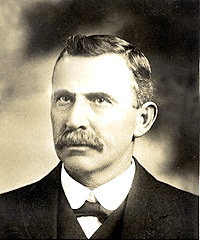
William Brown (1867 – 1954), former Member of the NSW Legislative Assembly [NSW Parliament]
Reminiscences of William Brown at the Community Dinner – November 1943
The Maitland Mercury of 26 November 1943, page 6, reported:
‘As briefly reported in our issue of Wednesday’s date, Mr. W. Brown, of “The Raymond Terrace Examiner,” who has completed 60 years as the editor and owner of that paper, was given a complimentary dinner by the residents of Raymond Terrace and old friends, in the Masonic Hall, Raymond Terrace, on Tuesday night last.
Cr. G. J. Russell, President of Port Stephen’s Shire Council, who presided, said the idea of the gathering originated with Mr. W. McDonald, who one day told him that he had sent a letter to General Carpenter, head of the Salvation Army, who had his time as a compositor under Mr. Brown, bringing under his notice the fact that they promised to celebrate the 50th year of the journal and also the editorship of Mr. Brown. They had had a very gratifying letter in reply from the General, which Mr. Russell read. He said that there were also numerous other complimentary letters.
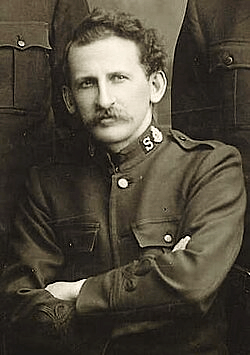
George Lyndon Carpenter in 1909 and General of the Salvation Army from 1939 to 1946. Was a carpenter who trained at Raymond Terrace [Wikipedia]
It was unique in the history of country journalism, he thought, that there should be such a continuity of ownership, and editorship. There were few papers that had had the one owner and the one editor over such a long period of years. They all wished Mr. Brown long life and happiness.
Mr. N. C. McLelland, proposing the toast of “Our Guest,” said that for 30 years he had awaited just such an opportunity to testify to the worth of his old friend, Bill Brown. There was not a movement that the town had inaugurated that Mr. Brown was not associated with. Perhaps the most outstanding work was the formation of the Raymond Terrace Dairy Co. This was a monument that would live for ever. He had been associated with Bill Brown in many matters and had found him to be one of nature’s gentlemen. He wished Mr. Brown long life and happiness.
Mr. L. B. Fisher, who supported the toast, said he was there in the capacity of deputy chairman of the “Maitland Mercury,” and also as chairman of directors of the Raymond Terrace Dairy Co. He read 3 messages of congratulation from the “Maitland Mercury” and the Raymond Terrace Dairy Co. Mr. Brown had rendered a great service to the district when he organised the Raymond Terrace Dairy Co. The first factory was opened in 1903. Mr. Brown was the acting secretary, and the factory was opened by Mrs. Brown. There were remarkable possibilities in the Lower Hunter for post-war development, and he hoped that Mr. Brown would be spared to see them. He wished Mr. Brown all the best of good wishes and hoped that he would have a long life.
The toast was also supported by Messrs. T. S. Elkin (Raymond Terrace). L. P. Monkley (Miller’s Forest), J. M. Feeney (Raymond Terrace), W. Priddle (Nelson’s Plains), T. Lantry (Swan Reach), Ray Hain (Raymond Terrace), G. J. Russell (Williamtown), A. M. Cunningham (Raymond Terrace), Eli Priddle (Ryde), Cecil Wall (Sydney), George King (Miller’s Forest), A. M. Davies (Mittagong), H. H. Smith (Denman), Cr. Abbott (Dungog), Len Johnson (Waverley). Mr. N. C. McLellan then presented to the guest a wallet and an autographed illuminated album.
Mr. Brown, replying, thanked all for the honour they had conferred on him. He was deeply appreciative of the fact that so many of his old friends had assembled to celebrate, the 50th year of the Raymond Terrace “Examiner” [commenced in 1893]. He thought he really should be honouring them for the courtesy and consideration that he had been shown over that period.
He reviewed the progress that had taken place in the 76 years since he was born [1867]. When he was a boy the slab cottage with the bark roof was the chief form of residence. He was pleased to see that there were now better conditions of living. He also referred to the advent of the mowing machine and the iron plough. The matter of roads, too, had improved.
But there was one thing where they had not improved, he said, and that was this: when he went to school there was a school of 76 pupils on Nelson’s Plains. Now there was not a school there. Unless they could build up the population of Australia, then Australia was doomed. He referred to early Raymond Terrace and said that one of the things that fascinated him as a small boy were the telegraph wires that were strung on high masts across the river near where Mr. Windeyer’s residence now is, and when a boat came up the river to see a sailor climb the mast and with a broom hoist the wires clear of the mast.
King-street then had a creek running across it, and there was plank and a few big stones for pedestrians to get over. Raymond Terrace in those days was a busy place, being the head of navigation for traffic for the Copeland [mining] diggings and all points north. This went out with the coming of the railway. Then came the butter factory, but this had shifted. Now they had the Masonite factory, and he thought the future of the district was assured.
He thanked them for the fine album. He would cherish it and hand it down to the family. Old schoolmates who were present were Messrs. Eli and A. E. Priddle and Jim Mclnerney. He was sorry that others in the district were not able to get there.
The toast of “Raymond Terrace and District” was given by Mr. W. Sternbeck, who said they had a great future before them. A town that had as its backing such rich agricultural land could not fail, for the man on the land was the backbone of the country.
General J. D. Richardson, replying, thought the district was on the eve of great things. They had the opportunity in the post-war period and this must not be lost. There was ample scope for irrigation and other schemes that would benefit the district. Speaking from the point of view of the man on the land, he said, the future of the district was unlimited. Cr. H. W. Morgan, also supporting the toast, said that the company he represented had spent £600,000 in the district and they were so satisfied with its future that they were prepared, when the post-war period came, to spend another £600,000. Though he was only a newcomer he was impressed by the district.
Mr. Frank Hogue also responded. “The Press” was given by Mr. Cyril Adam and acknowledged by Mr. C. E. Bennett, of the Dungog Chronicle.” Songs and musical items were rendered by Messrs. W. Smith, Lance Adams and Harry Brown.’
Concluding Comments
Other papers on the history of the Raymond Terrace area are published on this website and can be viewed at the following links:
Early History of St. Brigid’s Catholic Church – The First 100 Years
War Loan Tank Drive Visits Raymond Terrace, Port Stephens – 1918
Raymond Terrace Municipal Council Jubilee Celebrations – 1934
Journey to the Vineyards of the Lower Hunter and Port Stephens Districts – 1865
A Tour of Millers Forest and Raymond Terrace Port Stephens – 1918
Early Reminiscences of Raymond Terrace – Port Stephens
Researched and compiled by Kevin McGuinness
August 2026


