
Introduction
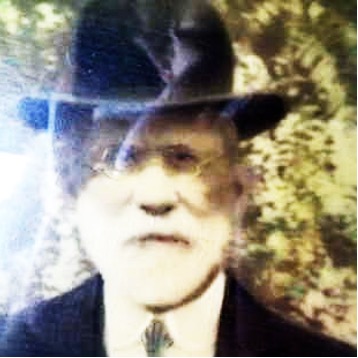
Mr. Philip Joseph Doherty (1854 -1929), a long-time resident of Raymond Terrace was asked by an old friend, Mr. A. J. O’Brien, to write some particulars of the town in its early days.
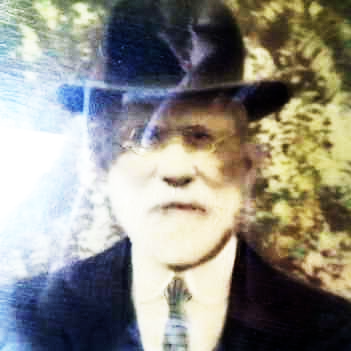
Philip Joseph Doherty (1854 – 1929) [Ancestry]
Philip Doherty’s reminiscences, as told to A.J. O’Brien, were not dated but were later published in the Raymond Terrace Examiner and Lower Hunter and Port Stephens Advertiser, editions of 16 October 1941, page 4, and 23 October 1941, page 4, and are cited below.
Early Reminiscences of Raymond Terrace as told by Mr. Philip Doherty
‘’My father immigrated here in the year 1853. His sister’s husband preceded him by 14 years, as he arrived at Raymond Terrace in 1839.
He found it a scattered village in a prosperous condition and was surprised to see it well laid out in squares. All the streets were parallel to each other, with roads in many directions, (to places) such as Port Stephens. Stroud, Dungog, Miller’s Forest, Hexham, Tomago Williamtown, and several others.
There were also a few large brick and stone houses. The Court House, a large hotel now known as Morris’ Hotel, Barry’s Racehorse Inn. Dr. Cadell’s residence, Rev. Mr. McCulloch’s and a large building which we were told, was intended for a Church of England College, although it was a private residence, occupied by Mrs. Dalzell and family. The parsonage was also a large cottage, with many fruit trees and some Norfolk Island pines which must be well over a century old.
Mr. A. H. Jacob had a nice cottage and orchard, with some choice fruits. Mr. Jacob was later M.L.A. for the lower Hunter for many years, and was after a time, chairman of Committees in the Legislative Council.
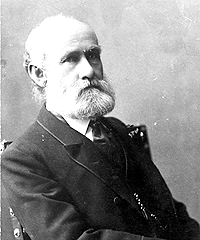
Archibald Hamilton Jacob (1829 – 1900) [NSW Parliament]
About a mile from the Terrace towards Hexham was a large estate with two vineyards, owned by Mr. A. Windeyer, who, with his son Mr. J. Windeyer manufactured many kinds of wine on a large scale. A lot of us boys and girls used to go grape cutting in the season.
There was also a flour mill, near the steamer’s wharf, owned by Mr. H. Portus, the manager of the Sydney steamer Co. I had as a lad, often watched the revolving mill stones, grinding flour, oat, and corn meal, bran and pollard, but the machinery was ruined by floods. It was afterwards used as a sawmill by Mr. Thos. Adam, Senr., whose son, Andrew. was Town Clerk for over 50 years.
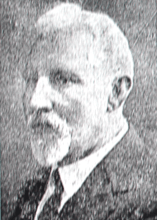
Andrew Adam, long serving Town Clerk of Raymond Terrace Municipal Council [Raymond Terrace Examiner and Lower Hunter and Port Stephens Advertiser – 27 September 1934]
The working and business people were kept busy by the farmers, who were mostly comfortable, but often suffered severe loss by great floods. In two floods you could only see the tops of houses between the Terrace and Morpeth.
My earliest recollections take me back Ito my third year when there was an election for a M. L. A. Mr. (afterwards Sir) Williiam Windeyer, of Tomago, who was afterwards a Judge of the Supreme Court, and a Mr. Sadler were the candidates. The Australian youths were called ‘Corn-Stalks’ and when Mr Windeyer was declared elected and as we lived opposite the Court House though I was only three years old, I remember, as yesterday, the cheering and waving of blue flags, on cornstalks.
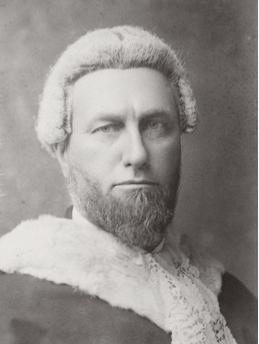
Judge William Charles Windeyer ‘Mitchell Library]
The ferry man to the [Millers] Forest was named Pat Hough, and after the poll there was some quarrelling on the punt, and Pat was knocked off and drowned. I do not know who succeeded him. but Mr. Murt. O’Sullivan who had been lockup keeper, ran the ferry after, assisted by his two older sons. One of whom was known as Jack Sullivan, the greatest practical joker of his time. He was a stevedore in Newcastle later on and as the harbour used to be full of ships he made a great deal of money obtaining crews for the skippers. [Finding the crew used to he called ‘shanghaiing’] and Jack had the name of being an expert at the game.
Although I know a good many of his jokes, I will relate one that caused a lot of amusement at the time. He invited five skippers to a day’s outing at Lake Macquarie. They went on horseback. I believe some of them had never been on a horse before. On coming back late in the evening Jack suddenly reined in his horse in Hunter Street West and in a great state told the Captains that the Newcastle Council had just passed a law preventing anyone from riding after sunset without a light. But he settled the matter by buying six candles and six bottles. After knocking the bottoms off the bottles, he fixed the candles and told them that they must ride in single file and hold up the lights in their right hand and so he led a torch light procession along Hunter Street, to the Great North ern Hotel. A good many Newcastle people remembered the joke which caused great fun at the time.
Another time the late Mr. Edmunds, the barrister, was staying at the Great Northern Hotel. The conversation came up about some of Sullivan’s jokes. Mr. Edmunds said that he did not think that Jack could play a joke on him. Word was immediately sent to Jack who came and asked to see Mr. Edmunds, who he heard was in the Hotel. Jack introduced himself as a squatter from up country, and being on the point of engaging in a large lawsuit running into thousands of pounds, he would like Mr. Edmunds to represent him on the case. After about half an hour’s chat they decided to meet again the next evening. When Sullivan had gone but a short distance, one of the guests asked Mr. Edmunds where he had met Jack Sullivan. Mr Edmunds replied: ‘Is that Jack Sullivan?’ Then called him back and shouted champagne for him. He took the joke in good part and acknowledged himself beaten. (
Mr. Doherty continued his reminiscences with another of the late Jack Sullivan’s jokes. He says; Another time when he — Jack Sullivan — was going to Randwick races, he arranged with a mate to send a wire to Sydney on the evening of the races. As I do not remember the name of the Sydney people I will call the husband Mr. B . After the races Jack and mate had tea at Mr. B’s. house. The wire came informing Mr. B. that Mrs. A. in Lambton had died. He then sent a wire to Mr. A. in Lambton that Mrs. B was dead. Mr. and Mrs. B. left Sydney by the 11 pm. steamer for Newcastle and by bus for Lambton. Mr. and Mrs. A. left Lambton by bus for Newcastle and then by the 11 pm. boat for Sydney. They passed each other on the way and arrived at each other’s houses to find that both parties had gone to each other’s wife’s funeral.
As I left the Terrace when I was 19 my friend knows as much as I from the time the Terrace was incorporated [as a municipality in 1843] to the present [1941]. Up to about 1860 the Court House was used on Sunday mornings and sometimes week holidays by Roman Catholics, before dinner time and the Church of England, in the afternoons. as each agreed.
Then there was a rough building erected, where I went to school for some years. I remember having just recovered from the diphtheria my mother taking me to the yard to see the builders slating the roof of the Catholic Church [circa 1861]. I also saw them shingling the Church of England. I saw Archbishop Polding several times when the church was opened. I also remember Bishop Tyrrell, Church of England.
My uncle opened a large general store opposite Mrs. Foley’s present shop and remained there until my father had built a stone building next to Morris present hotel and as he had to quarry the stone and burn shells for lime, it must have taken quite a long while. A few weeks ago, I sat in front of the old shop, now occupied by Mr. E Windeyer and about 50 feet from where I was born at the back of the shop.
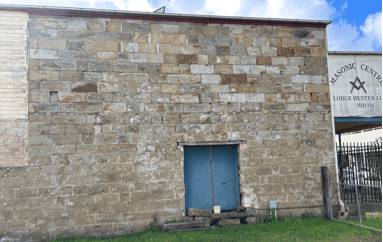
Side of the stone building in King Street, Raymond Terrace. A second story was later added. The stone wall of the original one floor building stopped three layers above the blue side door.
Then Father Quinlivan [Catholic Priest] lived at the Terrace for several years and then moved to Port Macquarie. A visiting priest went with him along the shore. Fr. Quinlivan went in for a swim while his friend walked along reading for some distance When he returned, he found Fr. Quinlivan’s clothes on the beach, but no trace of Fr Quinlivan was ever found. Then came Fr. Lonergan who lived at the Terrace 7 on 8 years. He built a brick residence at the back of the Church but is now the Convent. After he had left Father Nealon took charge and was Parish Priest for the record time of any resident priest. I believe he baptized and married several who were born during this time. He caused a lot of improvements to the Church premises but as I removed to Newcastle in his time there are many others who could give more particulars than I can.
My earliest recollections of Raymond Terrace date back to 1863 in my 8th year when Archbishop Polding gave confirmation in the new church of St. Brigids. I happened to be the youngest boy to be confirmed. There were sevral of the old priests with the Archbishop but are dead many years. Archdeacon Mc Encroe, Fathers Dunn, Quinlivan, Deans; O’Connel, Sheridan, Rigney and others I cannot call to mind.
Before the church was built mass used to be celebrated in the Court House. The Catholics used it before noon and the Church of England in the afternoon. I was baptised there. Father Quinn was there when my parents arrived in 1855. Then Father Luckie. I do not know if any of them resided at the Terrace, but I remember Father J T Dunne lived nearly opposite the Court House for some years until the Maitland Diocese was formed and Dr. Murray took charge. As there was a scarcity of priests, we only had mass once a fortnight: Father Cusse from Newcastle; Father Quinlevan from Port Macquarie; Father Byrne; afterwards Bishop of Bathurst and others from Maitland.”
Concluding Comments
Philip Joseph Doherty was born on 25 April 1854 at Millers Forest and died there on 15 February 1929 . He married Elizabeth Ann Nonan (1854 – 1929) on 10 June 1889 at Bulahdelah. Philip’s parents were Patrick Doherty (1819 – 1895) and Ann Nancy Gallen (1822 – 1890).
Other papers on the history of Raymond Terrace area are published on this website and can be viewed at the following links:
Early History of St. Brigid’s Catholic Church – The First 100 Years
War Loan Tank Drive Visits Raymond Terrace, Port Stephens – 1918
Raymond Terrace Municipal Council Jubilee Celebrations – 1934
Journey to the Vineyards of the Lower Hunter and Port Stephens Districts – 1865
A Tour of Millers Forest and Raymond Terrace Port Stephens – 1918
Reminiscences of Raymond Terrace, Millers Forest and Nelsons Plains – Port Stephens
Researched and compiled by Kevin McGuinness
August 2026


