
Introduction
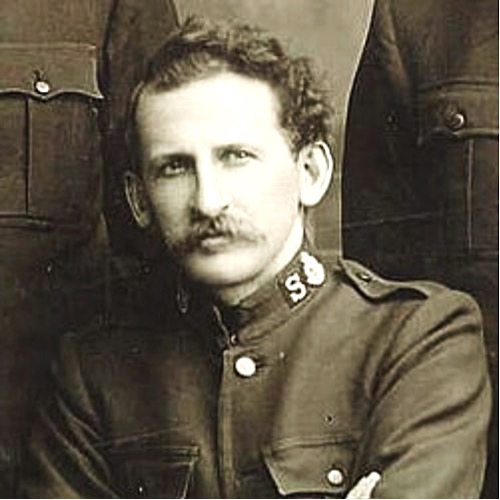
This paper tells the story of George Lyndon Carpenter who was born at Millers Forest in 1872, in the Raymond Terrace district.
He worked as a ‘printer’s devil’ (apprentice) at the local Raymond Terrace newspaper until he was aged 19 years. Around this time, while attending a service at the Raymond Terrace Methodist Church, he converted to the Salvation Army movement.
On 21 June 1899, George married a fellow Salvation Army officer, Minnie Lindsay Rowell, in Melbourne. They had three children between 1901 and 1908.
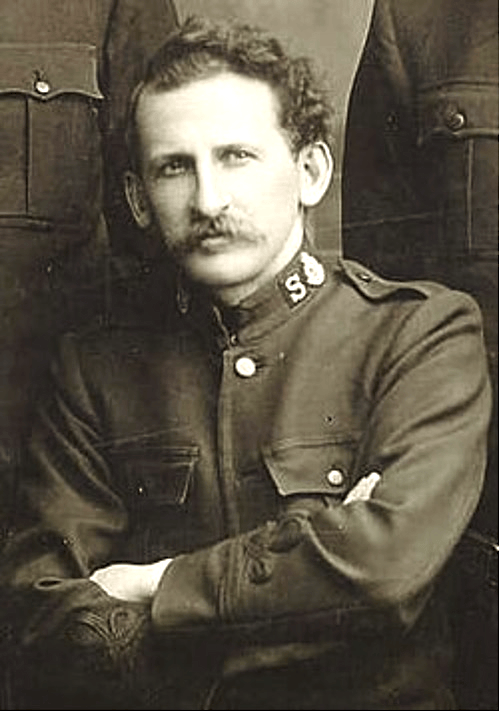
Salvation Army officer George Lyndon Carpenter – 1909
George Carpenter spent most of his early Salvation Army career editing and publishing journals in Melbourne. This editorial experience led to the Carpenters being transferred to the Salvation Army headquarters in London in 1911.
By 1914, George had been promoted to Salvation Army Colonel. In London he became literary secretary to General Bramwell Booth (the second Salvation Army General) and travelled widely with him to the countries where the Salvation Army worked.
By 1927, General Bramwell Booth, then ageing, was struggling to manage the organisation. George Carpenter’s attempts to help caused friction between them, and he was sent back to Australia as editor of the Sydney War Cry.
The reporting of George Carpenter’s career, as referenced belowcommences from this date.
When Edward Higgins became the Salvation Army’s third General in 1929, Carpenter was again given important leadership roles at the London headquarters.
From 1929, he held a succession of senior posts: chief secretary for New South Wales and Queensland (1929), territorial commander for South America East, based in Buenos Aires (1933), and territorial commander for Canada (1937).
On 24 August 1939, he was elected the Fifth General and international leader of the Salvation Army.
On 31 October, he took office as its Fifth General, succeeding Evangeline Booth who was the Fourth General and the first woman to hold the post.
Before retiring, General and Mrs Carpenter made a brief return visit to Australia. On 29 December 1945, they spent a day in Raymond Terrace, where residents officially welcomed them and George met some old friends.
Carpenter served as Salvation Army General until he retired in April 1946 and moved from London back to Sydney where he died on 9 April 1948. His wife Minnie died in Sydney on 25 November 1960. They were buried together at Rookwood Cemetery.
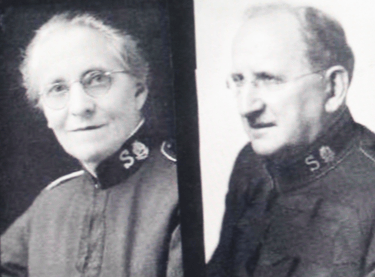
George and Minnie Carpenter
Colonel and Mrs Carpenter return to Australia from London – 1927
The Evening News of 5 February 1927, page 6, reported:
‘Colonel George Carpenter, of Raymond Terrace, who for some years, has been in charge of the Salvation Army literary department in London, is due to arrive at Sydney in April to take the position vacated by Lieut-Colonel Sandall as editor-in-chief in the Sydney editorial departments.
Colonel Carpenter’s wife is an able writer, and during their stay In London, issued five books on some notable personalities and early-day incidents of the Army. Her father and mother are well-known residents of Auburn. Mr. Rowell, her father, is more than 90 years of age.’
Colonel Carpenter appointed as Chief Secretary at the Sydney Headquarters – 1929
The Wingham Chronicle and Manning River Observer of 30 April 1929, page 1, reported:
‘Colonel Walter Suttor, chief secretary of the Salvation Army in the Eastern Territory of Australia, has received instructions to prepare for transfer to England, where he will take charge of the Army’s Land Colony in Essex. The colony is used partly as a training ground for migrant boys about to be transferred by the Army to overseas Dominions. Colonel and Mrs. Suttor will leave Sydney on April 30. and will join the R.M.S. Narkunda at Melbourne.
Colonel George Carpenter, who for two years has been chief editor of the Army’s publications in the Eastern Command in Australia, has been appointed to succeed Colonel Suttor as chief secretary at the Sydney headquarters. Colonel Carpenter, who began his experience with newspaper life at Raymond Terrace, was for 12 years associated with General Booth at the Army’s international headquarters in London.
Brigadier Webb, chief editor of the Army’s headquarters in Melbourne, has been appointed to a similar position at the Sydney headquarters in succession to Colonel Carpenter. He will take up his new duties on May 1.’
Colonel Carpenter’s father, ‘Tris’ Carpenter’ dies – 1931
The Raymond Terrace Examiner and Lower Hunter and Port Stephens Advertiser of 16 April 1931, page 3, reported:
‘The death occurred on Saturday morning last, at his home at Mayfield of Mr. Tristan d’Acunha Carpenter, at the age of 92 years. The deceased was a member of the well-known late Carpenter family of Millers Forest, and brother of Messrs. Harry, Abe, Edward and Thomas Carpenter nearly all of whom lived to enter the nineties.
Mr. ”Tris” Carpenter received his name from the island of Tristan D’Acunha, he having been born when the ship ‘Orestes’ bringing his parents to Australia in 1839 was passing that Island. For many years he lived in Raymond Terrace being part owner of a drogher on the river. Later he entered the dredge service at Newcastle and remained there till retiring age relieved him of duty.
He was highly esteemed for his urbanity his honesty of purpose and neighbourly disposition. The men of the Newcastle dredge service attended the funeral in large numbers. He was an enthusiastic Oddfellow and had been a member of that order for years. Most of his family, if not all, were born at Raymond Terrace, and Col. George Carpenter, one of the heads of the Salvation Army in Australia is his only son. Deceased was indeed a link with the past and as he carried his age with a vivid remembrance of early events on the Lower Hunter
He was an entertaining personality. He was residing at Merewether with his daughter Miss Sarah Carpenter. Mrs. Snow is another daughter, who survives him. The funeral at Sandgate on Sunday was attended by a large band of sympathetic friends. Many of them old neighbours from Raymond Terrace. His brothers who were all well known in the Lower Hunter predeceased him as follows: — Thomas in 1914, aged 88; Abe, 1920, aged 91; Harry 1919, aged 82; Edward, 1923 aged 85.’
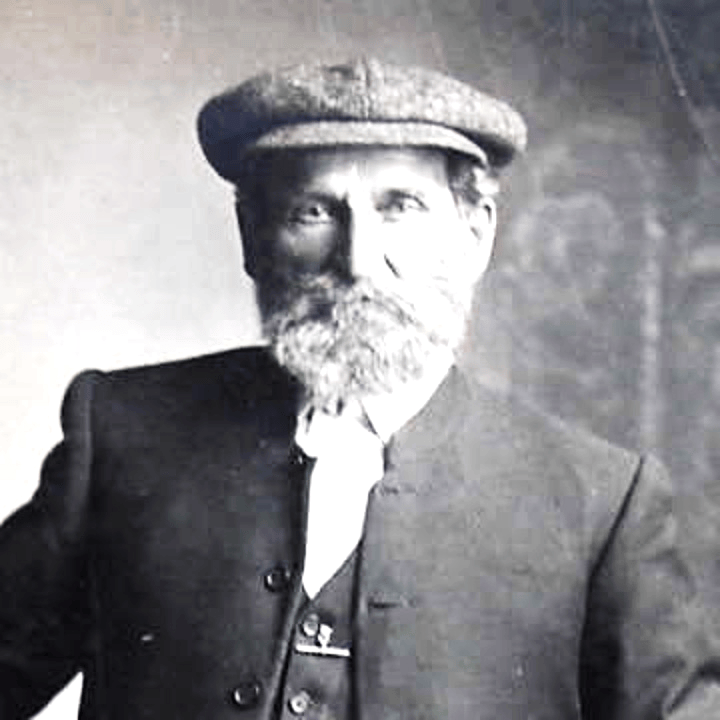
Tristan D’Acunha Carpenter
Lieutenant Commissioner and Mrs Carpenter transferred to South America – 1933
The Sydney Morning Herald of 25 May 1933, page 8, reported:
‘Colonel George L. Carpenter, chief secretary of the Salvation Army for the Eastern Territory of Australia, has been appointed by General Higgins to the command of the work in South America, with the increased rank of Lieutenant-Commissioner.
His field of responsibility will embrace the republics of the Argentine, Uruguay, and Paraguay, with headquarters in Buenos Aires. Commissioner Carpenter succeeds Commissioner Mrs. Booth-Hellberg, youngest daughter of General William Booth, founder of the Salvation Army, who retires under the age limit.’
The Sydney Morning Herald of 3 June 1933, page 7, further reported:
‘Colonel George Carpenter, of the Salvation Army, New South Wales, will leave Sydney next month for the Argentine.’
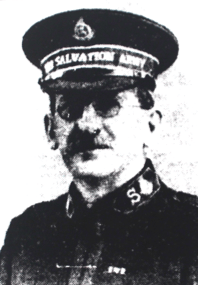
Lieutenant-Commissioner Carpenter [Sydney Morning Herald – 3 June 1933]
Newcastle farewell for Lieutenant-Commissioner and Mrs Carpenter – 1933
‘Commissioner and Mrs. Carpenter, of the Salvation Army, who have been appointed to command the Salvation Army In South America, will be farewelled at the Newcastle Citadel on Monday night. ….
Since he left Raymond Terrace 40 years ago, the Commissioner has travelled extensively, his last appointment being the Chief Secretaryship of the Salvation Army in Eastern Australia. He is still a worthy representative of the Newcastle district, and it is expected that there will be a large attendance at the farewell meeting.’
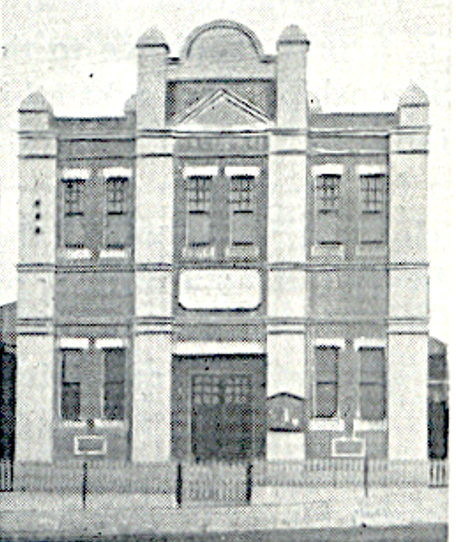
Newcastle Salvation Army Citadel [University of Newcastle Library – Living Histories Collection]
The Sydney Morning Herald of 4 July 1933, page 10, further reported:
‘The final public farewell to Lieut.-Commissioner George Carpenter and Mrs. Carpenter, of the Salvation Army, who have been promoted to the oversight of the Argentine, was attended by hundreds of members of the organisation in city and suburbs at the Congress Hall last night.
Addresses, the keynote of which was the esteem in which both officers were held in Australia, were delivered by Commissioner McKenzie, Adjutant McClure (Young Peoples’ secretary), Brigadier Scotney (Lieut.-Commissioner for Sydney Central), Brigadier Mary Bentley (Women’s Social Secretary), and Mrs. Commissioner McKenzie.
Reference was made to the conscientious and unselfish work of the departing officers, and particularly to the influence for good exercised by Mrs. Carpenter. Commissioner McKenzie told of the advancement of Lieut. Commissioner Carpenter from the time, when, as a youth from Raymond Terrace, he had entered the training home in Melbourne, until he had filled the most important positions the Army had to offer as he climbed the ladder, and finally found himself the honoured and trusted man he was today. “We are sorry to lose both of them,” he added, “but we send them as a gift to South America.”
The Lieut.-Commissioner and Mrs. Carpenter both spoke in acknowledgement.
A programme of vocal and instrumental music was performed by the Congress Band, the Lidcombe Songsters, and Bandsman Newby, who rendered a pleasing baritone solo.
Lieut.-Commissioner Carpenter, Mrs. Carpenter, and Miss Stella Carpenter will leave Sydney Central Station by the Limited express tomorrow evening, and will embark from Melbourne on the Jervis Bay for London, whence they proceed to South America.’
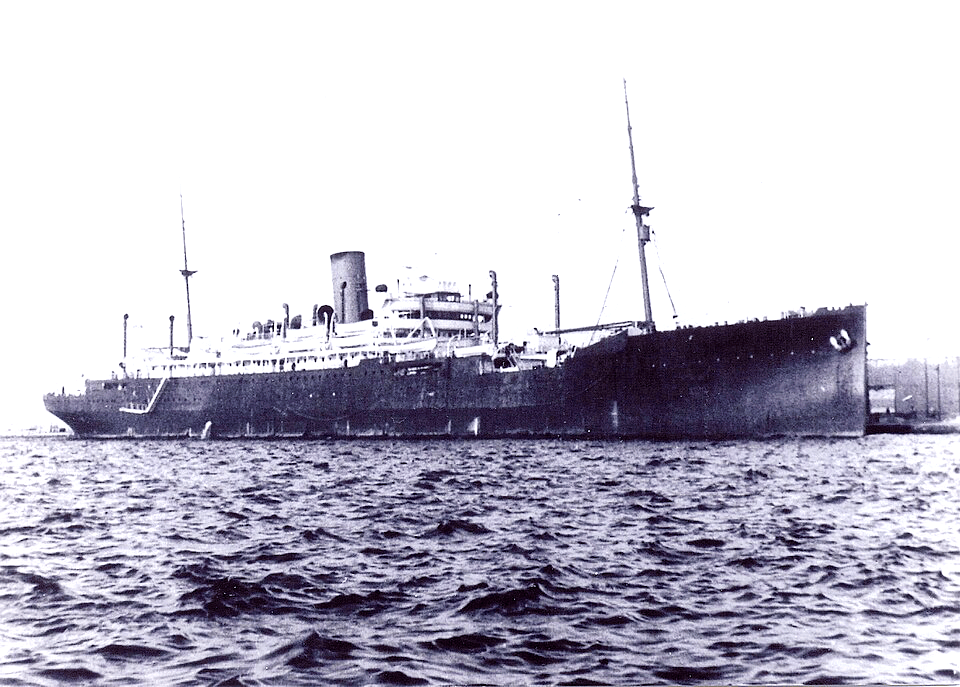
Australian steamer – ‘Jervis Bay’ [Wikipedia]
Five nominations accepted in London for Salvation Army Chief – 1939
The Maitland Daily Mercury of 24 August 1939, page 10, reported:
‘The High Council of the Salvation Army has accepted the following nominations for the generalship in succession to General Evangeline Booth. Lieutenant-Commissioner William Dalziel (Australia), Commissioners Catherine Bramwell Booth and George L. Carpenter (Canada), Benjamin Orames (United States), Lieutenant-Commissioner Albert Orsborn (Scotland and Ireland).
The council is drawing up a questionnaire for the candidates. Commissioner George Carpenter began his career in the Salvation Army at Raymond Terrace in 1892. He was later appointed Territorial Commander in South America, and today holds a similar position in Canada. He also served at International Headquarters in London and was chief secretary in Eastern Australia.
In 1899 he married Ensign Winnie Rowell, who is the author of ‘Miriam Booth,’ ‘The Angel Adjutant,’ ‘Three Great Hearts,’ ‘Commissioner Lawley,’ ‘Notable Officers of the Salvation Army,’ and ‘Commissioner Henry Howard.’ Commissioner Orames was also born in Australia.’
Headmaster of Raymond Terrace Public School receives letter from Lieut.-Commissioner Carpenter – 1937
The Raymond Terrace Examiner and Lower Hunter and Port Stephens Advertiser of 25 March 1937, page 1, reported:
‘Col. Geo. Carpenter, Salvation Army Commissioner for South America, writes Mr. Jefferys, B. A. headmaster of the Raymond Terrace Public School, from Buenos Aires, S. America, as follows: —
”Recently I have had the pleasure to read accounts of the opening of your new school premises at Raymond Terrace. The event awakened vivid memories of my boyhood in that delightful little town. As a scholar in 1883, I was present at the opening of the old building during Mr. Thistlewayte’ term as headmaster. (Incidentally I was amongst those who ‘raided’ the parsonage orchard, so interestingly described in the souvenir brochure of your celebrations.)
I recall happy school days at Raymond Terrace, under Mr. Kilgour, Mr. Thistlewayte’s term as headmaster. (Inspiring in me a keen growing love of knowledge. At 14 years of age I passed the pupil teacher’s examination, afterwards being offered a post in my own school, I preferred for some reason to be a printer and served my apprentice under Mr. William Brown of the Gloucester Examiner, on a weekly paper owned by the late Henry Courtney.
Following a notable spiritual experience at a revival service at the [Raymond Terrace] Methodist Church in 1891, I later threw in my lot with the Salvation Army and was trained in its ranks in Melbourne where for many years I served at the Head Quarters’ principally in journalistic work. During those years I travelled extensively in Australia and New Zealand.
Transferred in 1911, with my wife, also of New South Wales, to the Army’s headquarters in London, I was engaged for sixteen years in administrative and literary work in connection with which my duties took me to many parts of the Continent of Europe, also to all parts of Great Britain, and Ireland. They brought me into contact with many notable figures. It has been my privilege also to visit the Orient.
Returning to Australia in 1927 it was a great joy to me to visit my old school during a brief call at Raymond Terrace. Mr. Davies was the headmaster at that time. Nearly four years ago, I was appointed to the charge of the Salvation Army operations in the Republics of Argentina, Uruguay and Paraguay with headquarters at Buenos Aires. We have had a most happy and useful period of service amongst a delightfully interesting people. One could write volumes about the Latin Americans. South America, as you will know, is a land of enormous dimensions, with vast stretches of land of probably matchless fertility, and watered by enormous rivers. The River Plate at Buenos Aires, for example, is thirty miles across and that is 150 miles from the Atlantic Ocean.
At Ascuncion in Paraguay — 1,000 miles inland from Buenos Aires, I saw a vessel of a size capable of trading in the seven seas. Large vessels trade hundreds of miles further inland. Buenos Aires itself, is a remarkably progressive city of two and a quarter million, modern in the last degree. Although the city is as flat as a table — like most of Argentina, with consequently no natural advantages, it has been developed into one of the most beautiful cities I have seen anywhere in the world. Almost all its streets have avenues of shade trees which make for health and beauty and comfort. I have often wished more trees were planted in the streets of Australian towns and cities.
With apologies for intruding this upon you. I felt I should like to greet your scholars with the fervent hope that they might as I did in my teens, “seek first the Kingdom of God and his righteousness.” At the same time, I congratulate you upon your school and wish you good success in your almost matchless opportunity for influencing men and women of the coming days. May the rich blessing of God be with you. I am, Yours faithfully, Geo. L. Carpenter, Commissioner.
P. S. – As a boy, I lived in a little cottage on the corner of Kinross Estate, near the public school, and I planted the fig tree, which I believe still flourishes near the front of the house.’
Lieut.-Commissioner Carpenter appointed General of the Salvation Army – 1939
The appointment of Lieut.-Commissioner Carpenter as the new General of the Salvation Army received much international publicity. Two of the local newspaper reports concerning the appointment are set out below.
The Newcastle Sun of 25 August 1939, page 8, reported:
“I am very proud to be first Australian to attain this honour,” said Commissioner George L. Carpenter who, today was elected General of the Salvation Army in succession to General Evangeline Booth. He was born at Raymond Terrace 67 years ago.
There were five candidates for the office and on the final ballot the voting was:— Commissioner G. L. Carpenter (Canada) 35; Commissioner Catherine Bramwell Booth (daughter of General William Booth) 8; Lieut. Commissioners A. Orsborn (Scotland and Ireland) 6. There were two blanks. This will be the first time since the Army was established by William Booth that the supreme command has been held by anyone outside the Booth family.
“It is a great responsibility which I did not expect,” said Commissioner Carpenter. ‘I don’t even know who nominated me and I came to England completely unaware of my nomination. “I am assuming office on November 1, after which my whole purpose will be to intensify the Army’s evangelistic work and to increase its efficiency and its relief work among the poor. ‘I owe an immense debt to Australia where a stimulating life breeds aggressiveness of action which has helped me throughout my career. Please convey my greetings to Australia. It always is in my thoughts.
The General elect entered the Salvation Army in Sydney in 1892 and went to South America in 1929, where he was the Army leader. Later he was appointed to a similar post in Canada. Mrs. Carpenter was also born in Sydney and has published several books on religion. It is expected that Commissioner Carpenter will develop the Army along principally spiritual lines.
Referring to his career, Commissioner Carpenter said that his first wage at 16 was 5s a week. His boss frequently went horse-racing and for weeks on end left him in complete charge of the printing works at Raymond Terrace. Next, he worked on a newspaper at Katoomba and later entered the Melbourne Training College.
The most thrilling period of his career, he added, was his stay in South America, where he directed the Army’s activities in three Republics and survived two revolutions. Subsequently, during his Canadian service, he travelled 40,000 miles. His supervision included Bermuda, Alaska and Newfoundland.
Commissioner Carpenter told the News-Chronicle that, though the project of a Salvation Army cabinet was not accepted, he had undertaken to establish a council within the Army’s existing framework to advise him on various matters, mainly legislative. Other newspapers recall that Commissioner Carpenter formerly was General Bramwell Booth’s literary secretary, serving him devotedly, but that he frankly advised the General of matters agitating the Army in 1928 whereupon General Booth “exiled” him to Australia, reducing him to Editor-in-Chief, the post he occupied in 1908.
Commissioner Carpenter, announcing his future programme amid cries of “Hallelujah,” declared. “My first point will be religion, the second religion. and the third religion which, I hope, will be “hot,” as our founder used to say.”
‘While I do not know the new General very well personally.’ said the officer-in-charge of the Salvation Army in Newcastle (Colonel W. Cottrill) at the same time I might say that we regard this as an honour conferred upon us that an Australian raised officer should be selected as the principal of the Salvation Army “The new General bears an honoured name all over the world, and we have every confidence that he will carry out his high responsibilities with credit to himself and the Army.
General Carpenter’s wife is a gifted literary woman and has written quite a number of books, which have travelled far beyond Salvation Army circles. She also is an Australian and was known formerly as Ensign Minnie Rowell.”
Commissioner Carpenter is the son of the late Mr. and Mrs. Tristan da Cunha Carpenter, and was born at Miller’s Forest, near Raymond Terrace in 1872. His father, whose parents were natives of Bristol, was born on the high seas on the voyage out to Australia in 1839, and for many years was a farmer in the Raymond Terrace area. His mother was a native of Hertfordshire (England). The new Army leader received all his education at Raymond Terrace.
At the age of 16 he started work as a printer’s “devil” on the Gloucester Gazette, then printed at Raymond Terrace by Mr. Henry Courtney. He had been waiting for an appointment to a position as a school teacher. The appointment was offered to him some time after he began work on the Gloucester Gazette, but he preferred to keep on with the printing work. A few years later he went to Katoomba as a printer and it was while he was there that he made application for office in the Salvation Army.
In 1892, after going through the training school, he was appointed to head quarters as a social officer. He came from there with the rank of lieutenant and soon after was promoted to the position of captain. It is significant of his administrative and executive ability that Commissioner Carpenter never did any field work. He has always been attached to the headquarters staffs in the countries where he has served.
Following a period as Editor in Chief of the ‘War Cry’ in Melbourne, Commissioner Carpenter was transferred to England in 1911. He served at the International Headquarters in London for 16 years and then returned to Australia as editor of the ‘War Cry.’ After a short time he was appointed Chief Secretary of the Army in Eastern Australia. Six years ago, he went to South America as Territorial Commander. He has been in Canada for two years.
Commissioner Carpenter married an Australian girl, who herself has done fine work in the Army. Before her marriage she was Ensign Minnie Rowell. She was born at Mudgee, New South Wales. Mrs. Carpenter has had a number of books dealing with Army matters published. Among them are “Miriam Booth,” “The Angel Adjutant,” “Three Great Hearts,” “Commissioner Lawley” and “Commissioner Henry Howard.” Before her marriage also she was the editress of the “Young Soldier,” a Salvation Army publication for children, in Melbourne.
Two sisters of the Army leader are living in Newcastle. They are Mrs. W. Snow, of Kenrick Street, Merewether, and Miss Sarah Elizabeth Carpenter, of Bar Beach Avenue, Bar Beach. Mrs. Snow is younger than her brother, but Miss Carpenter is his senior by some years. Both were being freely congratulated today on their brothers appointment. Mrs. Snow said that she was very proud of her brother. Her only hope was that he would be able to fill the position as ably as the past leaders of the Army had done. “I know he is competent enough,” she said, “and when I saw the nominations I was sure that he would be elected. The position has such a tremendous responsibility with it, but I know that he will get every help from his wife, whose knowledge of the Army will make her on ideal assistant.”
Mrs. Snow said that her brother had travelled the world and when serving under General Bramwell Booth had accompanied him on practically all his travels. “There is no doubt that I am proud, but I am sorry, too,” said Miss Carpenter. “The responsibility which my brother will feel will be a big strain, especially with the world in the turmoil [prelude to the Second World War] it is going through at present. “However, I am confident that he will fill the position admirably and will carry out his work to the best of his ability.”
The Newcastle Morning Herald and Miners’ Advocate of 26 August 1939, page 14, also reported on Carpenter’s former life at Raymond Terrace:
“Hey, Mum, when I grow up I am going to be a jockey or a butcher’s boy.” Highly excited at the thought of such an exalted position in life, a young lad rushed into his mother’s kitchen at Miller’s Forest and made that announcement. The boy was George Lyndon Carpenter. More than 50 years have passed since that incident. On Thursday he was elected General of the Salvation Army, to succeed General Evangeline Booth.
He is now 67 years of age. Born at Miller’s Forest, George Lyndon Carpenter was educated at the Raymond Terrace Public School. Before he was 15 years of age, he passed examinations which entitled him to become a schoolteacher. There was no position vacant at the time, so the boy became apprenticed to the printing trade in the office of the ‘Gloucester Gazette,’ at Raymond Terrace. After having served some months at the trade he was notified that there was an opening for a teacher. He was invited to accept it but declined. He had acquired a love for printing and finished his training at that trade. A boy with him at the time was William Brown, who is now conducting the ‘Raymond Terrace Examiner.’
Always a studious boy, but fond of sport nevertheless, young Carpenter once attended a Methodist Mission at Raymond Terrace which was conducted by Rev. Walker. That night he was converted and started to look for higher things in life. Still attached to the printing business, he went to Katoomba for a time. While there the work of the Salvation Army appealed to him. He made application to take part in the activities and was immediately sent to the training college at Melbourne.
From the training college he went to headquarters in Victoria as a social work collector, with the rank of lieutenant. Sometime later he was promoted to be captain and eventually held every rank that the Army had to offer. He became editor of the Army publications in Australia; and in 1911 went to England and was associated with General Bramwell Booth for upwards of 10 years.
Back in Australia, he became Editor of the ‘War Cry’ in Eastern Australia; and later Chief Secretary of the Eastern Territory, covering New South Wales and Queensland. Six years ago, he was promoted to Lieutenant Commissioner and then to Territorial Commander for South America, with headquarters at Buenos Aires. Two years ago, he was appointed to a similar position in Canada. He will now occupy in London the highest position in the Salvation Army.
General Carpenter married Ensign Minnie L. Rowell, of Mudgee. There were three children – two girls and a boy. One of the girls died, the other is with the family in London, and the boy is captain of a Salvation Army Corps in England.
Two of General Carpenter’s sisters live in the Newcastle district. One is Miss Carpenter, of Bar Beach-avenue, the other Mrs. Snow, of Kenrick-street, Merewether. Both are naturally pleased, at their brother’s success. Many callers visited their homes yesterday to offer congratulations; while telegrams containing congratulatory messages have arrived from distant parts. “When I heard that he was likely to be nominated I wrote him, telling him that the honour would be great, but that the responsibility would be very heavy,” said Miss Carpenter yesterday. Earlier this week she received a reply to that letter. In it the General said: “I will tremble if I am elected.” Miss Carpenter told the story of her brother’s childish ambitions to become either a jockey or a butcher’s boy. He was fond of horses and loved a gun, she said. General Carpenter is the first Australian to become leader of the Salvation Army.
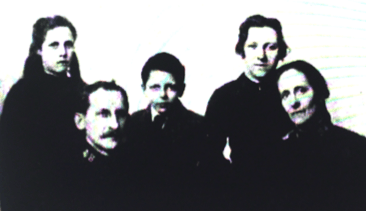
The Carpenter Family – circa 1930’s. [Newcastle Morning Herald and Miners’ Advocate, 26 August 1939]
Commissioner Carpenter writes from London to an old friend prior to his new appointment taking effect – 1939
The Wingham Chronicle and Manning River Observer of 1 September 1939, page 4, reported:
‘Commissioner George L. Carpenter, of Toronto, Canada, who has just been elected General of the Salvation Army in succession to General Evangeline Booth, is a native of Raymond Terrace. He was a friend of Mr. L. E. Street, of Gloucester, when the two were young men living at the Terrace.
In a letter to Mr. Street after the death of his son, Mr. Jack Street, at Cundletown, General Carpenter expressed his sympathy to Mr. Street and recalled the old times in Raymond Terrace [Jack Street drowned in the Manning River during February 1939]. Referring to the fact that he had noticed the death of Mr. Jack Street in the ‘Raymond Terrace Examiner,’ the General went on to say: —
“When I saw your name there came back many memories of the old days in Raymond Terrace, when you and your brother Phillip, and the bunch of fellows at the “Gazette” office had some intrigues of various kinds. Well, a lot has happened to the world since those days. And a let of the old hands have passed on. You and I, and a few others, are still in the land of the living.
“Since I left the Terrace in ’92 I have been privileged, in the service of the Army, to contact with people in many parts of the world. At the present time I have responsibility for Salvation Army work in the Dominion of Canada, also in Bermuda, Newfoundland and Alaska, so you can imagine I have a fairly big field to cover. “I have something like fourteen hundred officers under my direction, four hundred centres of work, and about sixty or seventy institutions of various kinds for the care of the poor and distressed, including about a dozen hospitals.”
First interview with the new Salvation Army Chief George Carpenter – 1939
The Smith’s Weekly of 9 September 1939, page 6, published details of the first of two interviews with the new Salvation Army Chief, George Carpenter. The first interview report was specially written for ‘Smith’s Weekly’ by Brigadier Stanley A. Harris, Editor of ‘The War Cry‘:
‘Fifth General of the Salvation Army, George Lyndon Carpenter, native of the small township of Raymond Terrace (New South Wales), has been royally and loyally accepted by Australian Salvationists. And this is not only because he is “one of their own.” They know that he measures up to the high stature required of an international leader of such a humanitarian organisation.
One of the foundation motives of Salvation Army service is love for the worst. The new General, when editor of ‘The War Cry’ in Melbourne, and later, as editor-in-chief and second-in-command of the Army in Sydney, was remarkable for seeking out the lowest and most degraded. His official duties did not demand it. His time was more than fully occupied in editing and writing for the Army journals and in complex administration work.
But he could not go through the streets without being touched by the sight of the drunkard. He would speak to them and find out if he could help them in any way. General Carpenter’s associates in Sydney will never forget “Dick,” a street musician who, when in drink, would stumble into the editorial office. We knew he had come to see his “best friend.” Carpenter would gently reprove him for again being drunk, and then they would kneel together and pray. Calm, and his penitent spirit satisfied, “Dick” would then kiss his friend on the cheek, ‘God bless you, Dick,” (The General would smilingly say, “try to keep straight” No wonder “Dick’ would speak of him as being “the greatest man in the world.
When in Melbourne the new General was sub-editor under Commissioner McKenzie. ‘Fighting Mac’ recalls that work was frequently interrupted by drunks, who knew that the Salvationist editors were interested in them. They would he treated to hot coffee, made in the office, and then prayed with. Some of them became converted; some of them would pray for themselves in their own way, one man, exclaiming: “O God, you know I am a damned drunkard, but for God’s sake cure me of this damn drink!” Expressive, but very sincere.
Near to the Sydney Army Headquarters is a Men’s Shelter, where the homeless and workless are cared for. Carpenter used often to visit the Home and talk to the men, and he frequently said he would be happy spending his life in caring for the material and spiritual needs of those men who were “down,” but “not out.”
The friendliest of men, Carpenter naturally seemed to give to his sympathy and interest the warmth of affection, and, although poor in this world’s goods, his hand was often in his pocket on behalf of the needy. He possesses a nimble brain and is quick to make the most of an occasion for profit. When travelling in a Sydney street car he was surveyed rather critically by a jovial, and slightly intoxicated artisan. “You must have a pretty good job to be able to afford a coat like that,” the man remarked. “Oh, yes. The Army treats me all right,” was the reply. After a pleasant exchange of conversation, Carpenter, then a colonel, asked the man how much he earned a week. He found that the jovial one had an advantage over his own remuneration of 14/- a week. Carpenter then asked how much the man spent on beer, and, when told, remarked: “That is £40 a year, and you’ve nothing for it. if you didn’t ‘booze,’ you could have an overcoat, and a better one than mine; you could take the wife and kiddies to the seaside for a holiday once a year and pay a good insurance premium into the bargain.” They parted the best of friends, and the man admitted: “There is something in what you say.”
As an Army Leader the new General already has had charge of two big continents, South America and Canada. In the former he directed the work in three Republics and narrowly escaped the whistling bullets and gun fire in two revolutions. His oversight of Canada involved travelling 40,000 miles, the area under his supervision also including Bermuda, Alaska (among the Red Indians) and Newfoundland.
I served under General Carpenter both in Sydney and London and regard him as one of the finest characters in the Army. When the Army Founder, William Booth, travelled the world, he used to take notice of outstanding officers and transfer them to international headquarters in London. Colonel and Mrs. Carpenter were among his selection. They were appointed to Great Britain, but for some reason the appointment fell through. In the meantime, the editor from South Africa (also an Australian-raised officer, and a personal friend of Colonel Carpenter) went to the vacant post.
When the Carpenters eventually found themselves in London there was no editorial vacancy and the editor-in-chief from Australia was given a junior clerical position, so much lower in status that his friends complained and he was advised to make a strong protest. So sure was Colonel Carpenter that his life was in the disposition of the will of God that he continued entering invoices in a book and making up his costs. His character and ability soon won him preference. He was made second in command, controlling three weekly and four monthly journals, and it was not long before General Bramwell Booth brought him on to his personal staff, as head of the Literary Department, with a regular output of books and periodicals.
He was also a counsellor to Bramwell Booth and had a position of influence in the administration of Army affairs. The Army’s foundation doctrinal teachings and principles are safe with the new General. When he was first transferred to London, one of the staff was experimenting with an Eastern philosophy far removed from the simple Bible truths which are the basis of Army doctrine. To the Carpenters this was a serious betrayal. They did not question the sincerity of the man’s inquiries into secret doctrine and esoteric religion, with its mahatmas.and astral planes, its etheric doubles and reincarnation. The point with them was that the man. having departed from the faith, should relinquish officership. It was loyalty to the Army doctrine and not uncharitableness that caused the Carpenters to bring about the resignation of this officer, who then was free to follow his own mental bent. He was last heard of at Adyar, pursuing his esoteric studies.
George carpenter was the only boy in a family of six. At fifteen he qualified as a schoolteacher, but, because there were no vacancies, he made his first acquaintance with printer’s ink in the office of the local newspaper. In those days he was an agnostic; in other words, because he could not understand God he would not believe in him. His wages were only 5/- a week, but he had a man’s responsibility. His “boss” would “follow the horses” for weeks on end leaving the young apprentice in complete charge of the printing works.
He was converted to Christianity through a Methodist mission at Raymond Terrace. As the remainder of his family were Salvationists it was quite natural for him to join the ranks. It was while employed at a printery in Katoomba, that he joined the Salvation Army in 1891. He entered the training college at Melbourne and graduated with the lowest rank in the Army— that of Lieutenant. Since then, his service has touched almost all phases of the Army’s operations.
In his early days, he was a social officer. Later, property affairs claimed his attention. Afterwards he spent a term in the highly specialised work of the training of officers. Many years were given to editorial and literary work in Australia and England. When, with Bramwell Booth, he was literary secretary and had much to do with the revising of the Army’s regulations (which govern every section of its work), he also had the oversight of the Army’s many periodicals and publications, quite a number of which were from the pen of Mrs. Carpenter (nee Minnie Rowell, of Mudgee, N.S.W.), who is a gifted authoress.
His confidential associations with Bramwell Booth brought him into the closest touch with the Army’s leaders from all parts of the world, and no man, save Bramwell Booth and the chief of the staff was more conversant with the international progress and development of the organisation. Those years will stand him in good stead, now that he himself is to be the General.
In an interview with the Press, after his election, General Carpenter said that his programme would be to intensify the evangelistic work and to increase the relief among the poor. This, of course, is the essential work of the Salvation Army, and, ever since having responsibility as an officer, General Carpenter has never deviated from the programme.
General Carpenter received a big majority at the High Council, 35 out of 51. Next highest secured only eight votes. Among the High Councillors were a number of Australians, Commissioners Benjamin Orames, Robert Henry, and Herbert Colledge. All these officers had grown up with him and knew he was the right man for these times, when are needed godliness, a zeal for world evangelism and a vision for advanced social reform, which would find practical expression in more complete measures for fulfilment. General Carpenter has an unusual flair for making individual contacts.
His strength is not so much oil the platform as in personal dealing. His face lights up with a spiritual fire and he easily wins the confidence of those he is counselling. He has extraordinary physical energy. I have known him to work 13 and 14 hours a day for weeks at a time and still remain cheery and alert. In all things he is under Divine control, and one of his most frequent axioms of advice to young people is: “Begin the Day with God.”
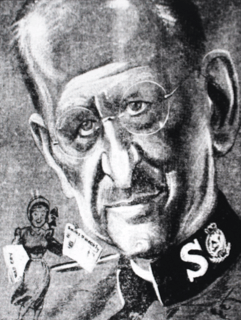
Caricature of General George Carpenter [Smith’s Weekley – 9 September 1939]
Second interview with the new Salvation Army Chief George Carpenter – 1939
The Smith’s Weekly of 11 November 1939, page 7, published details of the second of two interviews with the new Salvation Army Chief, George Carpenter. The second interview report was written for ‘Smith’s Weekly’ by Frank L. McIlraith, the papers London representative:
‘General George Carpenter, installed in London as Commander-in-Chief of the Salvation Army on November 1, did not always tread the straight and narrow path. But it was a long, long time ago. He admitted to me quite frankly, sitting in his big office in London headquarters, that he had once, in his early youth, tasted alcoholic liquor! But only once. That was when he was a printer’s apprentice at Raymond Terrace, his hometown, about twenty miles from Newcastle, N.S.W.
Young George Carpenter, who had passed brilliantly through a primary school, was offered a job as pupil-teacher, but he hankered after the local newspaper office. So his people decided to allow him to follow his inclinations.
Thus it was that he joined the composing staff of Raymond Terrace ‘Examiner’, formerly the ‘Gloucester Gazette.’ He has never regretted the experience he gained in the printing shop, and the knowledge of world affairs he learned from his association with printers. It stood him in good stead later in his Army life, as he has frequently been placed in charge of Army publications. “My mother,” he said, “was a Salvationist, but up to the age of nineteen I did not take any particular interest, either in the Army or in church activities. I was just a boy like the other boys. I worked alongside a big printer, who was frequently drunk, and who did his best to corrupt me with his shocking language.
“Then one Sunday evening I was out walking with another boy of my own age, when he suggested we should go to the local Methodist Chapel, where a revival was being held. I went in just to keep him company, and with no intention of taking part in the meeting. Then a remarkable thing happened. A spiritual change came over me, and I was converted. “My whole life was changed, and from that evening I decided to devote my life to spiritual matters.
I joined the local Salvation Army and immediately took an active part in its work. General Carpenter sat back in his chair and recalled those early days. He talked of his foreman at the printing works, Mr. Will Brown, who is now the proprietor of the Raymond Terrace ‘Examiner.’ “Do you ever hear from him?” I asked. “Not recently,” replied the General, “but while I was in Canada, South America, and in England for the first time, he always sent me copies of his paper. Though I have been away from Raymond Terrace for 45 years I still find interest in reading the local paper, and in following the activities of people I remember as a youth.”
“I am sure,” I replied, “that when Mr. Brown reads this article in ‘Smith’s Weekly’ he will continue to send you his paper.” “I hope he will,” said the General. “I got quite a kick out of reading the Raymond Terrace ‘Examiner’.” The General comes from long-lived stock on his father’s side. His father’s parents came to Australia seventy years ago, and his father was born as a ship lay off the island of Tristan da Cunha, and Tristan da Cunha became his father’s Christian name. Tristan da Cunha Carpenter sounded quite a mouthful. His father and four brothers held a reunion when Tristan da Cunha Carpenter celebrated his 70th birthday. The old man died at the age of 91½ years. The other brothers were aged 91, 89, 88, and 78, when they died. All lived in the Hunter River district.
After his conversion, young Carpenter left Raymond Terrace and went to Katoomba, where he worked on the ‘Blue Mountains Express.’ He became the friend of the editor, Mr. Robert MacMillan. He threw himself with enthusiasm into the work of the Salvation Army in Katoomba, much to the astonishment of his editor, who once remarked: “I’d give a thousand pounds to have your cheek to go out in the street and preach to people.”
It was in Katoomba that George Carpenter decided to give up his whole life to the Army. He was transferred to the Salvation Army training college in Melbourne, in 1892, and after passing his officer’s training course, was appointed editor of the Army papers. Always, interested in politics, he frequently went down to the Federal House to listen to the debates carried on by the giants of those days. He still thinks that the late Alfred Deakin was one of the finest orators he has ever heard. He also listened to Billy Hughes, and recalls an acid remark made by the little man in answer to a speech by Deakin. “I would prefer a scheme of redemption from the Bottomless Pit to labor legislation from the Member for Ballarat,” said Mr. Hughes. He also recalls a speech — a stone-walling speech — by a New South Wales Member, which lasted for ten hours and thirty-five minutes!
General Carpenter left Australia in 1911 to go to England, where he was appointed literary secretary to the late Bramwell Booth. In this work he was brought in close collaboration with the founder of the Army, General William Booth. He accompanied the General on many of his travels and was with him during his last tour of Australia and New Zealand. After spending sixteen years in England, General Carpenter was transferred to Sydney, where he remained until 1933 in charge of the New South Wales and Queensland districts. During this period, he travelled extensively over both States.
From Sydney, he was transferred to the Argentine, where his territory included also Paraguay and Uruguay. His four years there were strenuous. General Carpenter was next placed in charge of the Army’s affairs in Canada. Here his change also took in Alaska, Newfoundland, and the West Indies. In his two years in Canada, he spent 217 days in each year away from home.
When he returned to London to take part in the election of a new General he had no idea that he himself was in the running. It was only the night before nominations closed that he learned that his name had been put up. His election, therefore, was a complete surprise. His new job has, of course, altered many plans he had made, and war has further complicated his programme. He had intended, after his election, to re-visit Australia, but this plan has been dropped for the time being. Prospect of a world war has filled him with dismay. He cannot see any good coming out of a fratricidal struggle between nations.
He has travelled so much and mixed with so many nationalities of all creeds and colours that he has become an internationalist in the true sense. The strength of the Army, he told me, was its international outlook. As true Christians they abhorred war and the shedding of blood. The present threatened holocaust was almost too terrible to contemplate, but he still entertained the hope that the peoples of Europe would find some way out of the impasse which could only result in the slaughter of innocent people.’
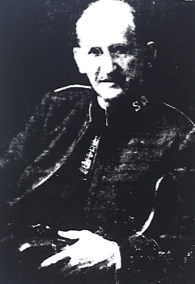
General Carpenter [Smith’s Weekly, 11 November 1939]
Radio Broadcast to the Empire – 1939
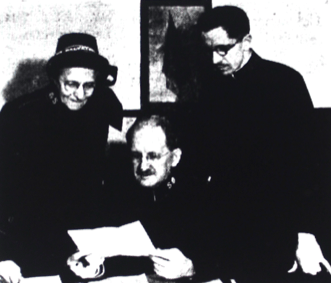
Salvation Army Chief, General George Carpenter, who will give an Empire broadcast at 1a.m. (Newcastle time), tomorrow, is shown with his wife and son [Newcastle Morning Herald and Miners’ Advocate – 17 November 1939]
Raymond Terrace resident receives a letter from General Carpenter – 1940
The Maitland Mercury of 29 June 1940, page 4, reported:
‘A resident of Raymond Terrace has received a letter from General G. L. Carpenter, head of the Salvation in London. He states that both he and Mrs. Carpenter are well although very busy. His son is now in the Salvation Army, having given up his position as master in an art school. General Carpenter mentions old friends in his letters and refers to a letter of congratulation received from Mr. H. King, of Miller’s Forest.’
Raymond Terrace resident receives a letter from General Carpenter – 1941
The Raymond Terrace Examiner and Lower Hunter and Port Stephens Advertiser of 3 July 1941, page 2, reported:
‘General G. L. Carpenter, writing from the International Headquarters of the Salvation Army to Mr. W. Brown, [editor] of Raymond Terrace, says: ‘I have been much interested in the sketches you have published of early day Raymond Terrace. Much of what you have given as to the founding of the old town was new to me, but I could take up the memories which you revived of life around sixty years ago [circa 1881]. It is most interesting to discern how much of charm there is in the common-place things of a little community such as the Terrace is.
I have often thought that some sketches that would have been worthy of the ablest pens might have been provided by certain types of the Terrace and surrounding district. However, I suppose that is too much to expect to be done, unless you turn your literary gifts in that direction. Thanks for the ‘Examiner’ which comes as regularly as the Nazi forces will permit. I do not think I have missed many copies since you have been good enough to place my name on your free list.
In recent issues I learn of the passing of such old identities as Walter Threlfo, Mrs. Feeney and Martin Devereux. Your obituary notices always have a kindly note and throw into relief the spirit and influence of these old residents which I am sure are appreciated by your readers, particularly the older folks of which I suppose I must consider myself. These are tremendous days and one wonders how long the dreadful struggle is likely to continue. For myself I cannot see an early cessation.
I had hoped to perceive a more widely developed seriousness in the outlook of many people for I am strongly of the view that only by the influences of vital religion in the life of the People of the Empire can we hope to find that better world which so many hearts are desiring.
Writing to our people in Victoria recently I remarked that I felt the neglect of God — which was so widespread in the world — was more to be feared than even the ravages of war. Whilst I would not suggest that a revival of religion would immediately bring about a victorious conclusion of the War, at the same time I feel that the nations are plunged in this dreadful strife because of the neglect of vital religion.
Here in the Old Country, whilst one does not know from hour to hour what may confront him, there is a tremendous zest imparted to life. Indeed, notwithstanding the dancers that are all about us, I would not wish to be anywhere but right here in the midst of all the uncertainties and the great needs amongst the people. I have visited practically all of the centres that have been severely raided and have not encountered one person who is in any way down in spirit or the subject of complaint. I have seen men well on in life who have had everything swept away in an hour or two, and yet they face the ordeal with a steadfastness and a courage that is simply amazing. I have seen poor men and women and others, who have been bombed again and again, taking up life without any bitterness but steadily looking to a righteous conclusion of that which is disturbing the peace of the world. The spirit of Britain is something that makes one feel a high sense of pride.’
General Carpenter’s busy life during the Second World War – 1941
The Newcastle Morning Herald and Miners’ Advocate of 1 February 1941, page 3, reported:
‘General Carpenter. head of the Salvation Army, has sent to a Raymond Terrace friend a copy of his review, covering the first year of his occupancy of the office. “Can, it be a year since we watched the outgoing transports packed with men. who waved cheerily to us as our vessel made for a British dock?” he asks, remarking that at the time he and others were returning from the Continent. “The months have been so crowded that they seem to have flown past; and so full of tasks that half a lifetime seems to stand between us and November 1939.
We hurried across France . . . but the tide of war swept on. So perplexing have been the months, and so swift the changes, I have not felt at liberty to leave the International Centre for the long journeys which sea travel now entails much as I would like to be able to go to bed, say, in Toronto, or Melbourne, to sleep without the wail of an alert, to set me wondering where in the darkness poor souls are suffering. But some recompense has come in the unending host of letters from every Army land.”
General Carpenter abandons a trip to Australia – 1943
The Newcastle Morning Herald and Miners’ Advocate of 6 November 1943, page 2, reported:
‘General G. Carpenter, head of the Salvation Army in London, has abandoned his trip to Australia for the present. This is due to travel difficulties, he states in a letter to Mr. J. P. Hanlon, of Hamilton, a former Mayor of Raymond Terrace, where the General’s boyhood was spent.
“How wonderful the Australians have been doing in this terrible world struggle,” he writes. “I meet them almost everywhere. A few days ago I was in the Isle of Man and met three—one from Brisbane, the others from Adelaide. “Last year Mrs. Carpenter and I visited North and South America, travelling across the ocean by air. We travelled 32,000 miles, 20,000 by air. It was a remarkable experience.
On the other side of the Atlantic we carried through a heavy programme and met something like 150,000 people. It was a pleasure to meet the President of the United States, and the official heads of Brazil and Argentina.” General Carpenter refers to early incidents in his life on the Hunter River, and adds: “How little I thought of the great opportunities that were opened out to me when I first set out, so many years ago, from Raymond Terrace—a town I am always pleased to remember—and welcome news of it and friends in Australia.”
General Carpenter to visit Raymond Terrace – 1945
The Maitland Mercury of 17 October 1945, page 4, reported:
‘Captain Luzon, of the East Maitland Salvation Army, wrote to Port Stephens Shire Council stating that General Carpenter, head of the Salvation Army, would be visiting Australia, and would be at Raymond Terrace on December 22. He would spend the day at Raymond Terrace and then go on to Newcastle. The Raymond Terrace Chamber of Commerce also wrote on the same matter, detailing what had been decided on as the form the welcome should take. They would assist the council in whatever way they could. Cr. Russell moved that a public meeting be held for the purpose of deciding on the form of welcome. Cr. Tranter seconded, and it was carried.’
General Carpenter leaves London for Australia – 1945
The Maitland Mercury of 30 October 1945, page 3, reported:
Accompanied by his wife, the Australian-born leader of the Salvation Army, General Carpenter, has left England for an extensive tour of Australia and New Zealand. They are flying most of the way to Australia, where they will visit all the principal cities and also Raymond Terrace, where the General was born.’
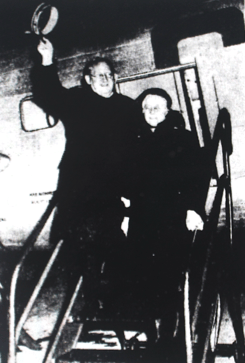
General George Carpenter with Mrs Carpenter, about board a plane for the trip from England to Australia [Newcastle Morning Herald and Miners’ Advocate – 9 November 1945]
General and Mrs Carpenter arrive in Sydney – 1945
The Newcastle Morning Herald and Miners’ Advocate of 5 December 1945, page 5, reported:
‘The Australian-born International leaders of the Salvation Army, General and Mrs. George L. Carpenter, arrived in Sydney yesterday by air from Melbourne. General Carpenter announced that he hoped to relinquish his command next June. He will continue with Salvation Army work but will take no part in its administration. “I hope I will make a good private,” he said.
On his retirement he hopes to return to Sydney. General Carpenter was born at Raymond Terrace 73 years ago. With Mrs. Carpenter he will visit his hometown and Newcastle on December 29 and 30. General Carpenter joined the Salvation Army as a convert in the early ’90’s at Raymond Terrace. He is the first International leader of the Army to be born outside of England. In 1927, when second-in-command of Queensland and N.S.W., he was appointed to the command of the Army Operations in South America.
He was appointed General by the High Council of the Salvation Army a month before war was declared. General and Mrs. Carpenter will conduct a campaign in Sydney from December 6 to December 12 and will then visit Queensland.’
Enthusiastic welcome at Raymond Terrace for General and Mrs Carpenter – 1945
The Raymond Terrace Examiner and Lower Hunter and Port Stephens Advertiser of 3 January 1946, page 3, reported:
‘On Saturday last, December 29th, General Geo. L. Carpenter and Mrs. Carpenter, International Leader and General of the Salvation Army, came back to his hometown and was given the keenest and heartiest welcome that has ever been given to a visitor to Raymond Terrace. He can hardly be classed as a visitor for he was born in the Raymond Terrace District, at Miller’s Forest, and had gone away over 50 years ago a young man full of vigour and capacity and returned after the period mentioned as one of the leading men of the world and it was a delight and joy unspeakable to welcome him home again.
His parents and the family resided in Raymond Terrace for many years near the public school on the town boundary, and here near his old home site the first welcome was given him and a large crowd was present, some from districts far away but who knew General Carpenter in his boyhood days in the Terrace and at school under the late Mr. F. K. Thistlethwaite and later under the late Mr. J. P. Green. The reunion of him and his old friends was of the heartiest character, but time was too short for him to meet all he desired to meet.
The General and Mrs. Carpenter, accompanied by Colonel and Mrs. Ebbs, Colonels Hawker and Cutler; Lieut-Col. Duncan, Brigadiers Satchell, and Rixon, Major Hutchinson, (Newcastle) and Capt. Lupton, (Maitland) arrived about noon having left Sydney at about 8 a.m. They reached the Masonite factory at about 12.15; where the manager had kindly consented to make available to them rooms for a wash and brush-up.
After leaving the factory they were met at the town boundary. Across the highway was suspended a banner bearing the words ‘We Welcome you, General and Mrs. Carpenter.’ The attendance was large and after a few minutes halt the party headed by the Salvation Army Band, under Bandmaster Woods, marched on towards the Sports Ground Pavilion, where a luncheon was prepared for about 50 guests, including the General’s party. Also among the number were Mrs Snow, and Miss S. Carpenter, Hon. J. P. Abbott. M.P., Mr. R. L. Fitzgerald, M.L.A., Mr. Arthur Howarth, M.L.A. for Maitland, Ald. Norris, (Mayor of Greater Newcastle), Revs. Linton and Roberts, Mrs. Linton and Mrs. Roberts, Mr. N. C McLellan, (Chamber of Commerce), Crs. Parish, Russell and Upton of the Port Stephens Shire, Cr. L. F. Monkley, of Lower Hunter Shire, General and Mrs. Richardson, Mr. W. Brown, Mr. O. R. Hopkins, Mr. Cyril Adam, Mr. Bowes Thistlethwaite and Mr. J. R. Alford and members of the Chamber of Commerce.
The luncheon was presided over by Cr. Parish, President of the Port Stephens Shire. Cr. Russell for Port Stephens Shire and Cr. Monkley, Past President of the Lower Hunter Shire, on behalf of their Shires, extended a most cordial welcome to General and Mrs. Carpenter. Cr. Russell said he was pleased, to meet General and Mrs. Carpenter at the Masonite factory that morning. They would try and make the welcome to him a hearty and enjoyable one and that his visit would be pleasant.
In General Carpenter’s day in the town they sometimes had a visit from Salvationists to Williamtown. Then it took about two or three hours to get to Williamtown from Raymond Terrace, now they did it in about a quarter of an hour. He would still meet many in Raymond Terrace who knew him years ago, and who were delighted to meet him again, and to honour him for the onerous and leading position he occupied in the world as head of the great organisation he belonged to. He dealt with the Army’s work in the world and hoped and trusted the General and Mrs. Carpenter would have a few happy hours in the town and would long be spared to carry on the good work they had made their life’s duty.
Cr. L. F. Monkley, on behalf of the Lower Hunter Shire, gave a welcome to General and Mrs. Carpenter and was happy to meet two of the most distinguished persons in the world. He was asked to take them to Miller’s Forest where he was proud to say General Carpenter was born, though some claimed he was born at Raymond Terrace. He claimed he was born at Miller’s Forest. Gen. Carpenter: That is right. Cr. Monkley: Well that settles the argument. As the representative of the Shire and a resident of the locality nearby where the General was born he would be able to show him his birthplace and places he knew in years gone by. He hoped General and Mrs. Carpenter would have a very happy time in Raymond Terrace.
General Carpenter thanked them for the very cordial way they had welcomed him to his old hometown, and he thanked them for Mrs. Carpenter also. His visit recalled memories of other days, and they appreciated to the full the way they had been received. He wished them all the blessings of God. They hoped to make the most of the few hours they would have among them, meeting old friends and seeing again the scenes of his boy-hood days.
After the luncheon about 2 p.m. the General and Mrs. Carpenter were taken across to Miller’s Forest, by Cr. L. F. Monkley, accompanied by the Mayor of Newcastle, (Ald. Norris), Mr. W. Brown, Hon. J. P. Abbott, Messrs. Howarth and Fitzgerald, Ms.L.A. for Maitland and Gloucester, Cr. Parish and a number of others. The General was taken to the farm where he was born, on the riverbank, above Martins Wharf, and occupied after the Carpenter family left it by Mr. T. McDermott, and is at present occupied by Mr. Keith Davis.
The General though only four years of age when he left Millers’ Forest to come to Raymond Terrace remembered the fig tree he played under as a boy, and the places across the river (Osterley). The fig tree is still a large one but has lost some of its former dimensions by gales and borers. Leaving the farm where he was born, the General was taken to where his uncle once lived, now where Mr. L. F. Monkley resides. The house occupied by his uncle has gone, but the General and Mrs. Carpenter recognised the old shed, and other situations.
He went onto the wharf and re-marked “This is where I learned to swim, and I used to catch prawns in the river here with a bag.” “Yes,” Mr. Brown said “it was a common way for us boys to get prawns in those early days. We used what we called a soogee bag, that the potatoes came in from Warnambool.” Mrs. Carpenter was keenly interested in the crops, and when seeing a millet crop asked, “is that sorghum.” She was told that it was broom millet, the crop that provides most of the domestic brooms. She carefully examined the millet head and the process of cutting and drying it for making brooms was explained by Cr. Monkley. Mr. Abbott was surprised to see the growth of lucerne, which in a few days, though dry, he was informed since it was cut, to several inches high. Mrs. Carpenter also enquired as to the number of times a year the lucerne could be cut. Mrs. Carpenter is a native of Mudgee and was interested in farming as she had seen farms in that district.
The party returned to Raymond Terrace, after the General and Mrs. Carpenter had been introduced to Mrs. Monkley and members of the family, including the grandson. Features of this portion of the General’s visit were filmed for newsreel purposes and will appear locally later on.
The public welcome was given the General and Mrs. Carpenter about 3.30 in the Sports Ground pavilion. There was a large gathering of all sections of the community. The chair was occupied by Cr. Parish, President of the Port Stephens Shire and those present included Ald. Norris. (Mayor of Greater Newcastle), Messrs. Fitzgerald and Howarth Ms. L.A., Hon. J. P. Abbott, M.H.R., Councillors of Lowler Hunter and Port Stephens Shire, Mr. Bowes Thistlethwaite of Gordon, an old friend of General Carpenter when boys together in Raymond Terrace; Mr. N. C. McLellan, (Chamber of Commerce), General and Mrs. Richardson, Revs. Linton and Roberts and many officers of the Salvation Army from Sydney, Newcastle, Maitland, etc.
Cr. Parish in voicing the welcome to General and Mrs. Carpenter, referred to the important work the Salvation Army had done and is doing, among the nations of the world and the great uplift to vast numbers throughout the world by having brought them from a life of hopelessness to one in which they became respected citizens, and so were carrying out the desire for which Christ had died. In that work the General and Mrs. Carpenter were spending their lives and would be their life’s work. It was a great honour to us for the General to visit them, and they appreciated his visit, and trusted that he and Mrs. Carpenter would enjoy the return to General Carpenter’s native town.
Hon. J. P. Abbott, M.P., for New England said he was pleased to be present to join in the welcome to the most illustrious personality in New England, and one of the world’s leading men. The Salvation Army first came to Australia in 1881, in Adelaide and in 1883, or 84 were practically marching triumphant throughout the land. He knew of the Amy’s work in the battle fields and the great work they had done. He remembered them in Gallipoli and their wonderful work in succouring and helping the wounded, as well as the help in supplying tea and refreshments. They were in the front line and carried out their work regardless of the risks they ran. He was glad to meet the head of such a valuable religious organisation, which was respected for its good work all over the world. He hoped that General and Mrs. Carpenter would long be spared to continue the work they had so successfully carried through the last trying six years of their office as leaders.
Mr. Fitzgerald said he regarded it as a very great honour to join in the welcome to General and Mrs. Carpenter. He was informed that the General was born at Raymond Terrace, but now he finds he a native of Miller’s Forest, a suburb of Raymond Terrace. He remembered the time when the Army first came to Dungog. They had done wonderful work, and it was pleasing to be able to give a welcome to the General. He trusted that General and Mrs. Carpenter would long be spared for many years to come. The General spent his younger years in Raymond Terrace, and he had risen from the ranks as a humble soldier of the Salvation Army to become its International leader and General. They applauded his useful services and he and Mrs. Carpenter fully deserved the welcome given them that day.
Mr. W. Brown said he regarded it as a great privilege, after about 53 years to be here to join in a welcome to his friend of early years and who, with himself, Charlie Dawson, Jack Corrigan and Harry Macourt had been employed in the ‘Gloucester Gazette’ office then ran by Mr Henry Courtney. The way the General had discharged his duties as the leader of the Salvation Army was not a surprise to him, as he knew he had the capacity to meet any onerous situation that would arise, and deal efficiently with it. He looked upon him as the most efficient and energetic leader the Salvation Army had.
When the question arose as to who would be the successor of General Booth, he said there is one man who, for the welfare of the great worldwide organisation the Army has now grown to, who would fill the office with honour and success, and that officer was George Carpenter. He was elected and during the strenuous seven years he had filled the position, he had travelled the snows of Alaska, the desert sands of Africa, the cold winds of North Canada, and if he had not crossed the Andes in South America, he had been there inspiring in all these territories, the Salvation Army followers. He paid a warm tribute also to Mrs. Carpenter, who he said had many inspiring articles in ‘All the World’ magazine, and who was a great help to her husband and much of his good work had been possible only by her great help to him. Mr. Brown also referred to early reminiscences of their boyhood days. He hoped when General and Mrs. Carpenter retired they would come back to Australia and back to reside in the General’s home town.
Mrs. Carpenter who was well applauded when she rose to return thanks said the day was a happy one for them, in the welcome they were giving them. She had heard so much about Raymond Terrace from her husband that she thought she knew as much about it as he did. It was about 46 years ago that they first commenced the warfare against evil. She referred to the conversion of her husband when a boy, in the little Methodist Chapel at Raymond Terrace, and she thanked God for the work they had been able to do in extending His kingdom. She thanked them all for the wonderful welcome they had given them, and hoped God’s blessing would be with them all and remain with them.
General Carpenter received a solid round of applause when he rose to augment the thanks given by Mrs. Carpenter for the great honour and compliment, they had paid them. He had welcomes in many lands but none like the welcome that day. He said he had met Raymond Terrace people all over Australia, old friends and one of them was Mr. Alf. Slade, who in their boyhood days had made him sick by giving him a chew of tobacco. He never chewed tobacco anymore. The General referred to his conversion in the little Methodist Church at Raymond Terrace in 1891, and it altered altogether his outlook on life. He saw the higher uses a man could make of his life, and instead of thinking only about what was good for him, to think more of what was good for other people and to bring them up to a sense of the spiritual in-stead of the material things.
Mrs. Carpenter and himself had seen life with its many conflicting features in various parts of the world. They had met the highest in the land and the lowest. Their work brought them in contact with Kings and Queens, Presidents of the various nations, learned men from the world’s great universities, the work of great artists in various places they had been in. All very interesting, but there always remained the duty of their lives of redeeming fallen humanity and placing them on a higher plane with hope in their life and happiness in the next. None of these things would have happened had it not been for the wonderful thing that occurred to him in the little chapel there (pointing to the Methodist Church School hall).
This welcome will be an inspiration and a memory to them as long as they lived and to their children after them. He thanked God for the great privilege had given him. In his work he had appealed to the young people particularly, to choose a way of life that would bring them happiness and satisfaction in doing what was right— to help each other and think less of their own selfishness. It was better for them and for everyone and what God had sent his son, Jesus Christ to teach.
At night at 7 p.m. a short religious service was held in the Methodist Sunday School Hall, where General Carpenter was converted; Hymns and prayer and short addresses by Rev. Roberts and Gen. Carpenter were given. Col. Ebbs, also took part. At 8 p.m. in the Sports Ground pavilion, a general service of appreciation was held. The service was religious in charactcr, Revs. E. A. Roberts and H. Linton extended a welcome to General and Mrs. Carpenter on behalf of the Christian churches in Raymond Terrace and Mr. N. McLellan, on behalf of the Chamber of Commerce. Mrs. Carpenter and the General gave pointed and interesting addresses, particularly to the young men and women to lead lives of general good to those around them, rather than live for them-selves alone. They find a greater happiness in life.
Mrs. Carpenter referred to the trying time London had during the bombing when she and her daughter slept on the kitchen floor, while her husband slept under the staircase. She was not afraid, she felt in her heart that God would protect them, and they feared not if death should come. They would get up in the morning, she said, and where there stood a street of comfortable homes, they had all or almost all been destroyed in a night. It was terrible to look at. But the spirit to conquer remained through it all. General Carpenter mentioned the humorous side of it. He said he saw one shop slightly damaged with the sign “Open as usual.” Later he saw a shop nearby that had been more heavily damaged, with the sign up — “More open than usual.” Sometimes the wail of the siren was heard all through the night, but the spirit of the people was unsubdued. They were of that British stock that we are.
He said it was important that young lives should be living the life that counted and that which made the most of those virtues that mattered. He referred to his own conversion as evidence of the good that arose from seeking the true way of life through Jesus Christ and only hoped that he had time to go round and tell the young people what it meant to them. He thanked the Revs. Roberts and Linton for their words of welcome and also Mr. McLellan of the Chamber of Commerce.
Letters were handed the General from Mr. James Hanlon, (who was unable to be present), welcoming him and wishing him and Mrs. Carpenter well. Also, from Mr. F. Edstein, President of the Chamber of Commerce apologising for his absence, and conveying a hearty welcome and good wishes for Mrs. Carpenter and the General in the coming and future years.
General and Mrs. Carpenter returned to Newcastle on Saturday night about 10 p.m accompanied by the S. A. Army officers and their wives. The General in parting regretted that he was unable to visit those people who were too unwell to come to the welcome but he trusted they would understand that on account of the limited time he had he could not arrange it.’
Photo of General Carpenter unveiled at Raymond Terrace – 1946
The Maitland Mercury of 15 November 1946, page 4, reported:
‘When General Carpenter of the Salvation Army was welcomed back to Raymond Terrace about twelve months ago he visited the Methodist Sunday School, at which, in his day, was the church. It was in this church that he was converted to his life Christian work. The Rev. Roberts, in charge of the local Methodist Circuit, remarked to the General that he thought it would be fitting if there was some memento to mark the event.
A few weeks ago, there arrived from England, from the General a very fine photo of himself. There was a fitting ceremony in the Sunday School when the photo was unveiled. In the course of his remarks the Rev. Roberts said he thought it was fitting there should be something to mark the fact that it was in this building the General had been converted to his life’s work for Christ. He had done much for the cause since then. He felt that it was an honour for them to have his photo on the wall of their building.’
Reminiscences of General Carpenter Regarding Raymond Terace – 1947
The Raymond Terrace Examiner and Lower Hunter and Port Stephens Advertiser of 23 January 1947, page 4, reported:
‘The following letter to the then Town Clerk, the late Mr. A. L. Adam, in connection with the 1934 Jubilee, of the old Municipal Council contains a lot of interesting references to (now) 60 years ago, from General G. L. Carpenter. For the benefit of the younger generation, and those older, we reproduce it:
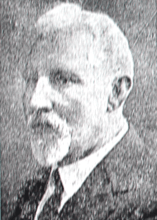
Mr A. L. Adam, in 1934, 50 years after first becoming the Town Clerk of Raymond Terrace Municipal Council [Raymond Terrace Examiner and Lower Hunter and Port Stephens Advertiser – 27 September 1934]
General Carpenter was then in charge of the Army work in Argentine, Paraguay and Uruguay. He says: ‘I could have visited the jubilee celebrations of ‘The Terrace’ had they fallen a year or so earlier, for in that case it would have been my happy privilege to share with you in the felicitations of the notable occasion. Clearly, I recall the assembly of the first Municipal Council with the late Mr. Hart, the first citizen and yourself as Town Clerk. I remember too, the political stirrings of those days, and what keen fighters some Terrace men were. The Hudson and White contests for Gloucester, and others are fresh in mind.
I recall the visit of the veteran Sir Henry Parkes, for the stone-laying of the School of Arts; and the characteristic ‘Bulletin’ cartoons by Phil May, depicting Sir Henry’s drive amongst the stumps and boulders of Quarry Hill. I am wondering if the visit of Mr B. S. B. Stevens is not the first visit of a Premier since the veteran Sir Henry honoured our charming little town with his presence.
Thinking of politicians I recall the visit of John (Jack) Haynes, M.L.A. some 50 years’ ago. He spoke in the Church of England School Hall on ‘Political Memories’. (Haynes was a pronounced Free Trader). Your old father with noble white head and beard was a picturesque figure on the front seat. What a keen Protectionist he was. Part time he had his eyes closed and appeared to be taking little critical interest. After Haynes had described dramatically some condition of backwardness in New South Wales, your father naively threw in (without opening his eyes), ‘And that is in a free-trade country!” For a moment Haynes was nonplussed, and then, as the laugh against him was subsiding, he replied, “Hello Rip Van Winkle, you have really waked up, have you?’
What floods of other memories come surging across the years! The establishment of the first newspaper, the ‘Gloucester Gazette’ where I served a not uneventful apprenticeship under my friend, Mr. W. Brown, the local Editor, who will be with you at the Jubilee. How little I dreamed, in the midst of boyish pranks (that made the streets surrounding the Gazette office rather hectic at times), that a Terrace printer’s boy should have been privileged with opportunities such as have come to me!
These are the result of a wonderful spiritual transformation in which took place well over 40 years ago in the little Methodist Church at the Terrace; and later devoting my life to the work of the Salvation Army, I recall the lines of mail coaches of Tuck and Co; also Charles McIntyre the droghers on the Hunter and Williams Robert (Bobby) Kilgour, William Osborn also Edward Foley’s ‘Contest’ and my father’s ‘Good Intent’. What days of delight I spent about the new company’s wharf when the river shipping was so active. I wanted to be a navigator and sail the wide seas!
As I write I can hear the familiar sound of the trucks running up the planks with the bales of hay on their way to the big shed near your office; also, your marvellous handling of the trucks. The sight of the old ‘Lubra’ (under Captain Manigal) with her bows running into the stones near the boat harbour, and swinging round in the tide alongside your wharf. Also, the old familiar stern-wheelers ‘Anna Maria’ and ‘Bolwarra’ recur to my mind. Then there was the ‘Coonanbarra’. What a Leviathan she seemed to our young minds, and the ‘City of Brisbane’ too. I recall the building of the powder magazine, ‘Sudan’, and her being launched (broadside), opposite McDermot’s Point; likewise the launching of the ‘Planet’, and the ‘Coreei’ and ‘Williams’.
Then there were the horse races on the Quarry Hill, and the energetic Secretary George Hill. There were the trotting contests from the ’16-mile’ along Stroud road. And the Saturday afternoon sensations they created in the quiet little township. The furious rowing contests on the Terrace ‘reach’. What a hero James Stanbury was to my boy-mind. I have walked miles to see him training on land or water. Notable personalities of the period recur to mind. Such worthies as the Rev. Samuel Simm, Charles R. Middleton, John Windeyer, John Richardson, William Scully, John Riddle Fenwick, John S. Hart, Richard Mayo, Lot Bishop, John Richard Houlding, Dr. Inglis, Dr. Ashley, Dr. Allen and ‘Old’ Mr., Shaw of the Post Office.
Also my old employer Henry Courtney. There were other types familiar in my boyhood: Stephen Adams, Johnny Palmer, and Charlie Boots ; then there were James Ebenezer, Haden Haddock, Scotchy Bain, and Ned Milgate (who claimed to have been one of Wellington’s bodyguard). Jimmie Holdstock — really one’s mind runs off at a tangent at the recalling of some of these names— ‘Lacky’ Keating, on the hill, James Cameron’s blacksmith’s shop and Harry and Jimmy Smith.
I recall the for matron of the Light Horse Brigade and the enthusiasm for it of one of the originals, John Macourt and Dr. J. B. Meredith, also his famous black colt Kildare. Then there was John Barry, of the Royal and his brother Richard; David Morgan and Mick Hanlon; George Priddle of the Junction. When I think of the five public-houses plying their trade in the Terrace, I imagine how powerful must have been the thirst of the residents in the surroundings.
There are photographed in my memory the great floods of 50 years ago. In one of these, I recall the ridgepole of a house on the way to Nelson’s Plains punt was all that could be seen. How delighted we youngsters were to go down to Richardson and Scully’s store to help packing things up out of flood reach. We could only see romance in a flood, not realising the devastation that followed. I remember too, the long letters ‘To the Editor’ that appeared in the ‘Gazette’ setting forth flood prevention schemes.’
Upon retirement General and Mrs Carpenter return to Australia – 1947
The Sydney Morning Herald of 2 June 1947, page 8, reported:
‘General G. L. Carpenter, former world leader of the Salvation Army, arrived today with his wife and daughter, on the liner Socotra. They intend to settle in Sydney where General Carpenter began his Salvation Army career in 1892.’
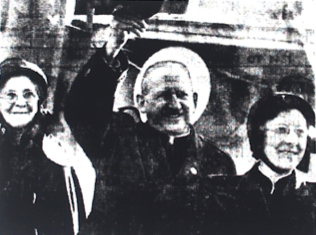
General George Carpenter, with his wife (left) and daughter, Miss Stella Carpenter (right) after arrival in Sydney on the steamer ‘Socotra’ from London [Daily Mirror, 9 June 1947]
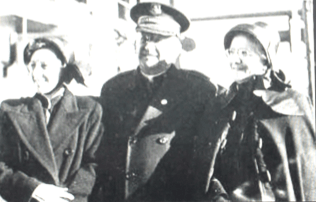
General George Carpenter, with his wife (right) and daughter, Miss Stella Carpenter (left) after arrival in Sydney on the steamer ‘Socotra’ from London
Death of General George Lyndon Carpenter – 1948
General George Carpenter died on 9 April 1948, aged 76 years. His death received much newspaper coverage. The Daily Mirror of 10 April 1948, page 2, reported:
‘General George L. Carpenter, who was head of the Salvation Army from 1939 to 1946, died at the Salvation Army Home, Stanmore, yesterday after a long illness. He was 77. He was born at Raymond Terrace, near Newcastle, and was employed in a printing establishment before being commissioned as an officer of the Salvation Army in 1892. General Carpenter served in the property, training, social and literary departments, and from 1911 to 1927 was literary secretary to General Bramwell Booth at International Headquarters, London.
In In 1927 he returned to Australia and held various executive positions, including Editor-in-Chief, Chief Secretary and Eastern Australia Territorial Commander. He distinguished himself by far-sighted leadership and contributed several books to the Salvation Army’s library. General Carpenter leaves a widow and two children, Adjutant Carpenter and Miss Stella Carpenter. The funeral will leave Congress Hall for Rookwood after a service at 1.15 p.m. on Monday.’
Funeral of General George Lyndon Carpenter – 1948
The Sydney Morning Herald of 13 April 1948, page 3, reported:
‘General George Lyndon Carpenter, a former head of the Salvation Army, was buried with full Salvation Army honours at Rookwood Cemetery yesterday.
Salvation Army officers from every State in the Commonwealth attended the funeral. The Rev. A. S. Eastman, chairman of the Council of Churches, the Rev. R. H. Durst, president of the Methodist Conference, and Sir Bertram Stevens, ex-Premier, were also present.
General Carpenter’s old comrades, with representatives of many walks of life, earlier filled the Salvation Army Congress Hall in Elizabeth Street to pay their last respects as his body lay in state. The service at the graveside was conducted by Commissioner James Hay.
General Carpenter, 77, an Australian, and one of the leading soldiers of the pioneer days of the Salvation Army, died on Friday. He had retired from active command of the Army a year before.’
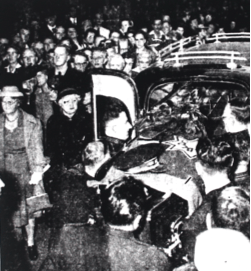
The funeral cortege for General George Lyndon Carpenter prepares to leave the Salvation Army Congress Hall [Daily Advertiser – 14 April 1948]
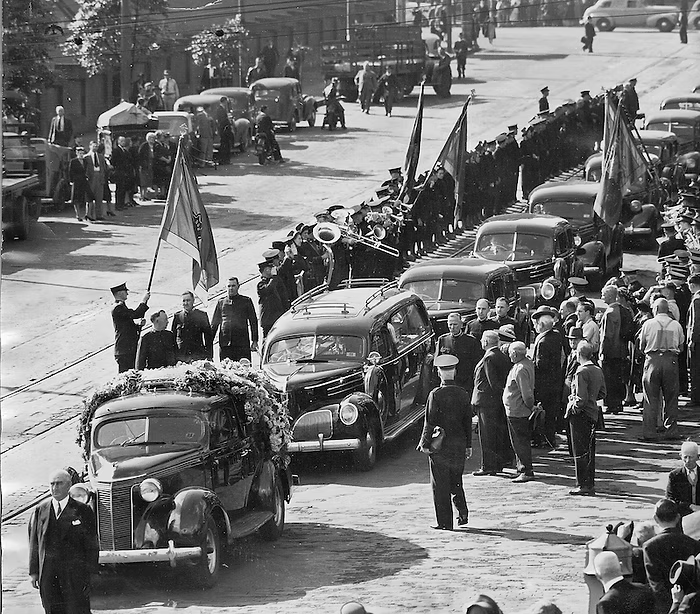
Funeral leaves Salvation Army Congress Hall
Concluding Comments
Following General Carpenter’s death, his widow, Minnie, continued active work on behalf of the Salvation Army. For instance, the Murrumbidgee Irrigator of 22 September 1950, page 4, reported:
‘The wife of a former General of the Salvation Army, General Carpenter, visited Leeton last Wednesday to speak at the Hostess Afternoon organised by Mrs. P. Bennett in aid of the work of the Missions conducted by the Salvation Army. Mrs. Carpenter was accompanied by Mrs. Senior Major Liddell who has visited Leeton on several occasions, and who gave a very interesting address on New Zealand at a previous afternoon.
The C.W.A. Club rooms were beautifully decorated with masses of spring blossoms and the hostess’s tables were very resplendent with silver, china and dainty linen and lace for the occasion. Mrs. O. J. Washington, wife of the Shire President welcomed Mrs. Carpenter and introduced her to the visitors numbering about sixty. Mrs. Washington, in welcoming Mrs. General Carpenter and Mrs. Senior Major Liddell said it was indeed a great pleasure to welcome one who had fulfilled the highest office in the Salvation Army with her husband, the late General G. Carpenter.
Mrs. Carpenter was an authoress of note in London, her latest book ‘The Land of His Love: Palestine’ having been recently published. Mrs. Carpenter was an Australian among Australians, having been born in Mudgee and had lived there previously to going to London. In addition to her high office of co-administrator with her late husband, General Carpenter, Mrs. Carpenter was head of the world organisation of the Women’s Home League of the Salvation Army, numbering 200,000 members.
Commanding Officers in Leeton, Captain and Mrs. D. E. Schoupp also spoke in welcome of Mrs. Carpenter, saying how much they appreciated her visiting Leeton to give them the benefit of her world-wide experience. ….’
Minnie Lindsay Carpenter [nee Rowell] died on 23 November 1960, aged 86 years, and was buried at Rookwood General Cemetery with her husband.
After the tenure of General Carpenter ended in 1946, 40 years was to elapse before a second Australian, Eva Burrows, was appointed as the Salvation Army’s thirteenth General. Eva Burrows, who was born in Newcastle, held the position from 1986 to 1993.
Other papers on the history of Raymond Terrace district are also published on this website and can be viewed at the following links:
Early History of St. Brigid’s Catholic Church – The First 100 Years
War Loan Tank Drive Visits Raymond Terrace, Port Stephens – 1918
A Tour of Millers Forest and Raymond Terrace, Port Stephens – 1918
Raymond Terrace Municipal Council Jubilee Celebrations – 1934
Journey to the Vineyards of the Lower Hunter and Port Stephens Districts – 1865
Millet Growing and Broom Manufacture in the Raymond Terrace District – Port Stephens
A Story of the Raymond Terrace District of Port Stephens in 1893
Early History of the Clare Castle Inn Hotel at Raymond Terrace – Port Stephens
Early History of the Junction Inn Hotel at Raymond Terrace – Port Stephens
Early History of the Cosmopolitan Hotel at Raymond Terrace – Port Stephens
Researched and compiled by Kevin McGuinness
November 2026


