
Introduction
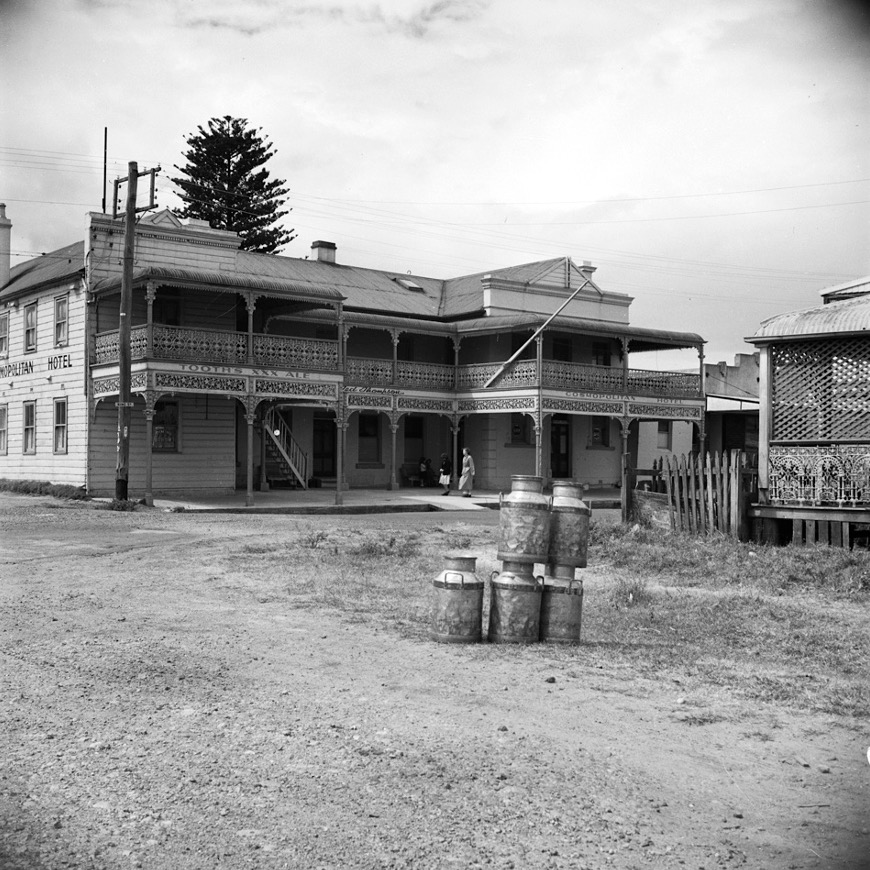
The Cosmopolitan Hotel, which stood at the corner of King and Bourke Streets, Raymond Terrace was built in the late 1870s.
It was an important gathering place for residents and visitors until its closure in the late 1950s.
In its early years, the hotel also hosted auctions, local coronial investigations and political meetings. Around twenty publicans held licenses over its lifetime, and Tooth and Company purchased the premises in 1921.
The hotel stood at the lowest point of King Street, then home to many businesses. This location was prone to frequent flooding. Heavy stock losses in the record-breaking 1955 flood probably was a factor that led to the hotel’s closure soon afterwards.
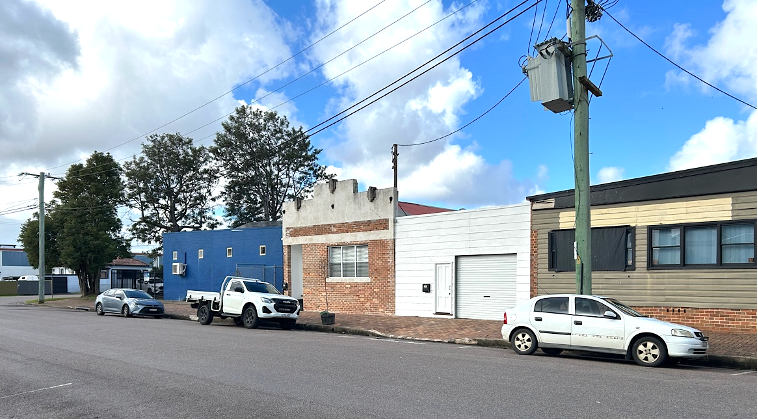
The blue building on the corner of King and Bourke streets, Raymond Terrace, now occupies the site of the former Cosmopolitan Hotel [Author photo]
This paper outlines the key events in the history of the Cosmopolitan Hotel at Raymond Terrace.
Publican charged with allowing gambling in the Cosmopolitan Hotel – 1879
The Maitland Mercury and Hunter River General Advertiser of 15 March 1879, page 6, reported:
‘Before Charles Middleton, Esq., P,M., and John Windeyer, Esq., A. H. Jacob, Esq., M. J. Parnell, Esq. A. D. Middleton, Esq., and J. K. Fenwick, Esq, J.P.’s, John McPherson, publican, of Raymond Terrace, appeared on summons and information, charged by senior-constable Finlay, for that he, John McPherson, did at Raymond Terrace, on the 3rd day of March, 1879, knowingly suffer unlawful gaming in his public house, called the “Cosmopolitan Hotel,” by permitting parsons to play for money in a hat at a game called “Tambaroora,” or shaking in the hat. [An early form of Two-Up]. Defendant pleaded not guilty.
After hearing the evidence of Senior-constable Finlay, Robert McKenzie, and Thomas Brennan, for the prosecution, and defendant not calling any evidence for the defence, the Bench (Mr. Fenwick dissenting) found defendant guilty, and fined him £3, 9s. 10d. costs, and 10s. witnesses’ expenses; levy and distress, in default 14 days’ imprisonment.’
‘Tambaroora” Case‘ – Publican and the Police in Dispute – 1879
The Newcastle Morning Herald and Miners’ Advocate of 30 May 1879, page 2, published the following views expressed by a correspondent:
‘In speaking of McPherson, I will use the plural, for it is the mother, son, and daughter that manage the business of what is known here as the Cosmopolitan Hotel, and from what I know of them, personally, their characters and that of the house is as respectable as any other like establishment in Raymond Terrace. During the few months they have been in business they have often been interfered with by the police; repeatedly been by them taken before the Bench of Magistrates, and sentenced to pay heavy penalties in proportion to the nature of offence—notably, what is known here as the “Tambaroora” case, which mulcted [punished] the Mac’s within a few pence of five pounds, besides loss of time to witnesses, &c., &c.; and which I have not yet found a resident here to stand up in defence —either of the constables or the Bench, who thus endorsed their action.
The position of the McPherson’s at last became such that if the constables and the Bench continued to act as they had done, they (the Mac’s) would have to give up business, and go elsewhere to strive for a living, smarting under what they conceived to be unfair play, on the part of both police and magistrates, and supported in that view of their case by that portion of their follow-townsmen who had the best means of forming a correct opinion thereon.
The Mac’s are advised; and, as a dernie ressort (last resort), made known their complaint to the Inspector of Police in Maitland. In this they exercised an undoubted right, a privilege which the law provides for them; and the result was, Sub-inspector Thorpe, of your city, came here, held a Court of investigation into the complaints referred to; and, I presume, discharged his duty faithfully, in view of the public interests in-volved, viz.:—
lst. Has the McPherson, in a business point of view, treated the constables with that courtesy and respect which is due to them, and whether or not there are extenuating circumstances on either side? His duty was not to consider punishment as the object, but rather to advise in what manner the public interests could be best served. I will illustrate that by supposing that it was deemed necessary to remove our P.M., and from the commission of the Peace other J.P.’s it should in no way be looked upon as a punishment, but as a sacrifice which they were called upon to make for the benefit of the public, and the duty of the public in such a case is to compensate them in a substantial manner for that sacrifice.
2nd. Have the constables exceeded their duty, or have they not, in the surveillance which they exercised over the McPhersons? Did they exercise the same zeal in the discharge of their duties towards the other three publicans in Raymond Terrace? Did they towards the McPhersons’ do their duty in a manner consistent with the dignity of the service to which they belong, and not in an offensive manner, as understood? These and other questions are the reasons why the public should encourage and stand by its proper constituted officers in the discharge of their duties as inspectors or subordinates, to determine the question as to who were guilty, or not guilty; and, it appears from what has transpired, that Sub-Inspector Thorpe found the police guilty, and in doing so, gave offence to them and the Bench, which had hitherto supported them.
Now the contention assumes a different phrase, the constables claim to have the charges investigated by the Bench of Magistrates, and it is granted; the case is entered upon, the McPherson’s have twenty witnesses in attendance; the son Robert, alone, is called upon—shortly after the Court is over, and the constables are said to have left it without a stain upon their character,—at the same time, it was well known that they were under orders to hold themselves in readiness for removal to some other district.
Then we have, what is called here, the indignation meeting, a report of which, is now before me. From it I learn, that one of our local J.P.’s, and brother of our P.M., was the convener and chairman. I never read speeches containing stronger arguments, or finer language, than is contained in this report, of what I consider to have been a most unfortunate display of sympathy for the persons intended to be benefited by it. “As a Lover of Truth and Fair Play,” and one that considers that every man’s character should be as free from calumny and misrepresentations as the laws can make it. I regret to find its total absence in the minds of the several speakers at that meeting, and when I call to mind that on the evening of that same day the effigies of a magistrate and a publican were burned in front of their homes by the larrikins of Raymond Terrace, who had been at the meeting, and were no doubt influenced by it.
I say that all things considered, the day’s proceedings was a gross violation of a public privilege, and an insult to every right-thinking man in the community. To prove this, just let us suppose that the Inspector-General were to comply with their wishes, and believe all that was said against his subordinates in the exercise of their important duties as inspectors and sub-inspectors, and, contrary to the decision previously given, retain the two constables here. I presume that all engaged in the administration of laws, whether as magistrates, Inspector-Generals, or police, should, like Cesar’s wife, be free from suspicion—equity and good conscience be their prevailing characteristics.
I ask in the name of common sense how could this be the case by such a concession, and say, as a “Lover of Truth and Fair Play,” that it would not only have been dangerous to those who brought it about, but it would have made the administration of justice here a farce and a blot on the character of those that are its guardians; and as for the McPhersons, their days would have been numbered and all others who dared to differ with those in authority here. My experience of such a state elsewhere, in days gone by, makes me say, “God forbid that ever they should exist here.”
It appears to me that the proper view for the community here to take of the Inspector-General’s conduct is, that he is not removing Senior constable Finlay as a punishment for offences against the police regulations, but rather in consideration of all the circumstances connected with the contention between himself and the McPhersons, the public interest will be best served by his removal. Constable Jones having resigned, no action is necessary in his case. I think, however, that both are deserving of our sympathy, and that Senior constable Finlay, on leaving here, not, it may be, because of wrong-doing, but for the good of those he leaves behind, should be made the recipient of a purse, containing sufficient to meet the expenses incurred in defending himself and the cost of removal to his now sphere of usefulness, in which, I hope, he may be more fortunate than in this.’
Application to transfer the Publican License fails – 1880
The Maitland Mercury and Hunter River General Advertiser of 14 February 1880, page 15, reported:
‘The bench, consisting of the Police Magistrate and Messrs. Shelley and J. R. Fenwick, Js.P., considered, on the 10th instant, the application of transfer of publican’s license for the Cosmopolitan Hotel from John McPherson to R. D. McPherson. An objection having been filed by senior-constable O’Sullivan, evidence was taken on oath as to the manner in which the house had been conducted while R. D. McPherson was acting as agent for his father. The Police Magistrate and Mr. Shelley gave their decision against granting, while Mr. Fenwick was in favour, asserting that as Mr. R. D. McPherson had been a good volunteer for some eight or nine years, he ought to get the license.’
Political meeting held at the Cosmopolitan Hotel – 1880
The Maitland Mercury and Hunter River General Advertiser 23 November 1880, page 1, reported on a political meeting held concerning the forthcoming general election:
‘Mr. Readett addressed the electors of Gloucester at McPherson’s Cosmopolitan Hotel, Raymond Terrace, on Monday night.
Mr. J. E. Fenwick was voted to the chair, and in a short and neat speech introduced Mr. Readett. He said he did it for three reasons – first, because Mr. Readett was a gentleman; secondly, he was a native, and thirdly, a member of the legal profession, which has given us such men as Butler, Wentworth, Windeyer, Wisdom, and other prominent members of legislative bodies; and concluded with asking for a fair and impartial hearing for Mr. Readett, whom he introduced.
Mr. Readett then stood up and was very well received by the large assemblage. He commenced by explaining the reason Mr. Simpson had withdrawn, and at the last moment he made his mind up to take his place, being so much encouraged by the warm reception he had met with at all the places he had been in within the electoral boundary lately.’
Auction of Hotel premises – 1881
The Maitland Mercury and Hunter River General of 2 April 1881, page 4, reported on the auction of the hotel premises and other sites at Raymond Terrace in the following abstract of sales by auction:
‘Mr. J. C. Bonarius, at the Borough Markets, Newcastle, at twelve, 12 large-sized building allotments at Raymond Terrace; the property adjoining the Raymond Terrace Saw Mills, with the improvements. — The premises known as the Cosmopolitan Hotel, Raymond Terrace, near the wharf.’
The Newcastle Morning Herald and Miners’ Advocate of 5 April 1881, page 2, further reported:
‘The Cosmopolitan Hotel at Raymond Terrace was next offered and bought in at £580. Six allotments of land at Raymond Terraoe, known as the Steam Sawmills, were quickly disposed of, and realised the sum of £465. A subdivision of twelve allotments at Raymond Terrace was next offered, and seven lots were disposed of for £158.’
New Licensee of the Cosmopolitan Hotel – 1887
The Newcastle Morning Herald and Miners’ Advocate of 17 January 1887, page 3, reported:
‘The proprietorship of the Cosmopolitan Hotel, Raymond Terrace, is about to change hands, Mr. Kay, of the Half-way House, being in negotiation with Mr. D. Morgan for the license and goodwill.’
Hon. Edmund Barton conducts meeting at the Cosmopolitan Hotel – 1890
The Newcastle Morning Herald and Miners’ Advocate of 15 February 1890, page 8, reported on a political meeting dealing with Protection and the Federation that was held at the hotel:
‘The Hon. Edmund Barton, M.L.C., and Mr. R. Atkinson Price, who arrived in Newcastle on Thursday evening en route for Raymond Terrace, where they were going for the purpose of speaking on Protection and Federation, left here by train at a quarter past 3 o’clock yesterday afternoon. Upon stepping out of the train at Hexham, …….. and were driven in buggies, direct to the Cosmopolitan Hotel, Raymond Terrace, where’ a number of other gentlemen were in waiting to receive them.
After an exchange of greeting had taken place, Mr. T. Adams, president of the local branch of the National Protection Association in a well chosen speech proposed the health of Mr. Barton, coupled with the name of Mr. R. Atkinson Price. Mr. Barton in replying said that he could not find language to thank them sufficiently for the kind terms in which Mr. Adams had proposed the toast. ….. It would be hard to imagine a more courteous or kindly reception than that Mr. Price and he had received. It was as homely and hearty as it was pleasant. He (the speaker) hoped that the night’s proceedings would be such as to reward them by enabling them to claim some converts to the cause of Protection.’
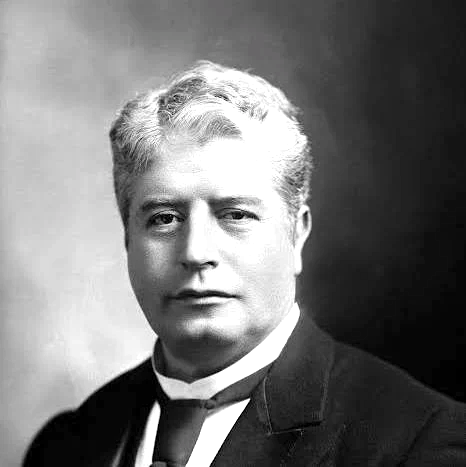
Edmund Barton (1849 – 1920) – first Prime Minister of Australia from 1901 to 1903
Presentation to Captain Gilmore at the Cosmopolitan Hotel – 1891
The Newcastle Morning Herald and Miners’ Advocate of 30 April 1891, page 5, reported:
‘On Thursday evening last, at the Cosmopolitan Hotel, Captain Gilmore, of the steamer Planet, which trades between Raymond Terrace and Newcastle daily, was presented with a handsome gold watch and chain. The presentation was made to Mr. Gilmore in recognition of the manner in which he has treated the travelling public, and those who have had occasion to do business with him in his capacity of captain of the little steamer. Mr. Monteagresti, who was voted to the chair, said he had very great pleasure in handing to Captain Gilmore the testimonial which had been subscribed for by a wide circle of people whose esteem and appreciation he had secured by the way in which he had discharged his duties as captain of the Planet.’
Local politician welcomed at the Cosmopolitan Hotel – 1891
The Maitland Mercury and Hunter River General Advertiser (of 2 July 1891, page 5, reported:
‘Mr. R. A. Price, the defeated candidate for Gloucester, was accorded a brilliant reception yesterday afternoon on his return from Stroud. A large cavalcade of buggies and horsemen, headed by the local Brass Band, met Mr. Price and escorted him to Shields’ Cosmopolitan Hotel, where his health was proposed by Mr. Thomas Adam, Mayor, and was drunk with great enthusiasm. Mr. Price, in reply to the toast, made a masterly speech, which deeply impressed all those who had the privilege of hearing it. Although defeated, he considered it his solemn duty to do all in his power to serve the interests of the 555 voters who supported him with what ability and influence he could command and promised if his health was spared to contest again and again the Gloucester electorate. At the close of his speech, he received a perfect ovation.’
Luncheon held at the Cosmopolitan Hotel following the opening of a new local bank branch – 1891
The Daily Telegraph of 3 August 1891, page 5, reported:’
‘A branch of the Northumbeland Banking Company was opened today at Raymond Terrace. A large party left West Maitland and drove to the terrace. A similar number left Newcastle, and after inspecting the bank premises, which are very commodious and central, adjourned for lunch to the Cosmopolitan Hotel, where a large party was assembled.’
Banquet held at the Cosmopolitan Hotel – 1892
The Maitland Mercury and Hunter River General Advertiser, 27 February 1892, reported:
‘The Aldermen of Stockton entertained their ex-mayor, Beveridge at a banquet here [Raymond Terrace] yesterday afternoon, a number of local residents were also invited. The proceedings passed off with great success, and mast have been very gratifying to those connected with the movement. The catering was ably carried out by host Shields of the Cosmopolitan Hotel.’
Advertisement for a visiting medical clairvoyant and herbalist at the Cosmopolitan Hotel – 1892
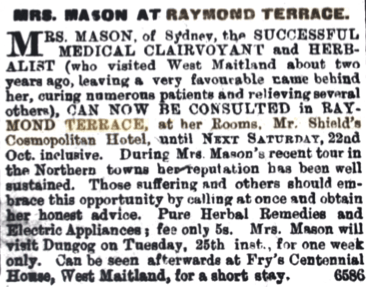
Advertisement for a visiting medical clairvoyant and herbalist available for consultation at the Cosmopolitan Hotel [Maitland Mercury and Hunter River General Advertiser, 18 October 1892]
G.U.O.O.F. Celebrates anniversary at the Cosmopolitan Hotel – 1893
The Maitland Mercury and Hunter River General Advertiser of 4 November 1893, page 7, reported:
‘The Council Masters’ Chapter, G.U.O.O.F. Miller’s Forest, celebrated their anniversary by a banquet and social evening at Bro. T. Shield’s Cosmopolitan Hotel, Raymond Terrace, on Thursday evening, October 26th. About thirty-one ladies and gentlemen were present. The tables were tastefully decorated with flowers and richly laden with the best of everything to tempt the appetite. The whole being a credit to our host and hostess.’
State Ministers entertained at the Cosmopolitan Hotel – 1896
The Maitland Weekly Mercury of 14 March 1896, page 5, reported:
‘The Minister of Works, the Hon. J. H. Young, and the Minister of Mines and Agriculture, the Hon. Sydney Smith, are now touring the Manning electorate. They are accompanied by Mr. Price, M.L.A., who is going to show the Ministers through his electorate — Gloucester. Mr. Young and Mr. Sydney Smith will be absent about ten days. The party was entertained at luncheon at the Cosmopolitan Hotel in Raymond Terrace, and at Stroud were given a banquet.’
Funeral leaves from the Cosmopolitan Hotel – 1896
The Australian Star of 27 June 1896, page 4, reported:
‘The funeral of the late Mr. Michaelangelo Stubb Monteagresti took place on Thursday afternoon and was the largest over seen here [Raymond Terrace]. Business was entirely suspended; shops were closed, and flags were hanging half-mast high. The funeral left the Cosmopolitan Hotel at 3 p.m., and moved towards the Catholic Church, where prayers were read by the Very Rev. T. A. Nealon. The procession, headed by a band playing the “Dead March,” proceeded to the Catholic cemetery.’
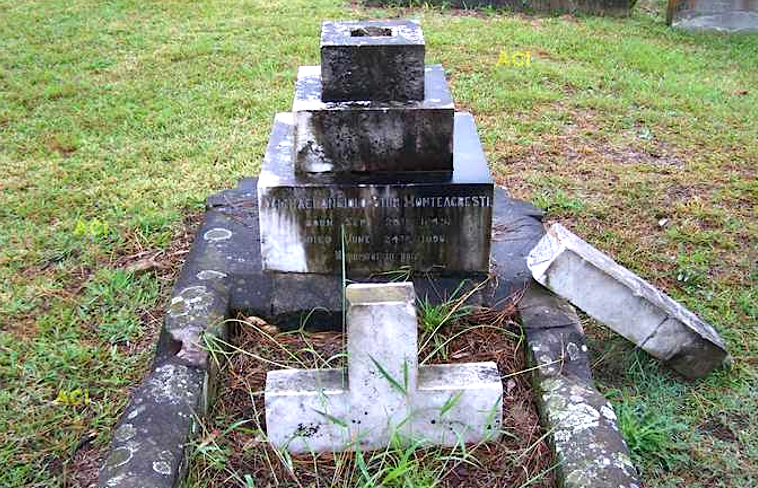
Grave of Michaelangelo Stubb Monteagresti at Raymond Terrace Cemetery [Australian Cemeteries Index]
Political address delivered from the balcony of the Cosmopolitan Hotel – 1903
The Maitland Daily Mercury of 7 December 1903, page 4, reported:
‘Mr. Arthur Rae, Labour candidate for the Hunter, addressed a large and sympathetic meeting at Raymond Terrace on Saturday evening from the balcony of the Cosmopolitan Hotel. Owing to the short notice the residents of Miller’s Forest and other local centres were prevented from attending, and a general desire was expressed lor another meeting before polling-day.’
Licensee of the Cosmopolitan Hospital injured in an accident – 1905
The Mudgee Guardian and North-Western Representative of 26 October 1905, page 7, reported:
‘The friends of Mr. J. S. Jenkins, formerly of the Gilgandra and Dubbo districts, and now keeping the Cosmopolitan Hotel at Raymond Terrace, will be pleased to hear that both he and Mrs. Jenkins are recovering from the painful accident which happened to them some weeks ago. Mr. Jenkins is doing a good business at Raymond Terrace.’
Picnic Luncheon held at the Cosmopolitan Hotel – 1906
The Newcastle Morning Herald and Miners’ Advocate of 12 March 1906, page 5, reported:
‘The twenty-third annual picnic of the Newcastle district employees of the Harbours and Rivers Department was held on Saturday at Raymond Terrace, the s.s. Namoi leaving the Market Wharf about 8.30 a.m. with a party which included some 600 adults…… The luncheon was served at the Cosmopolitan Hotel at one o’clock.’
Assault at the Cosmopolitan Hotel – 1906
The Newcastle Morning Herald and Miners’ Advocate of 24 May 1906, page 7, reported
‘Francis Lauret, 26, travelling musician, charged with having, at Raymond Terrace, on May 15th, 1906, maliciously wounded Joseph Hartley, pleaded not guilty, and was defended by Mr. W. Tighe, instructed by Mr. R. A. Mackenzie. To a second charge of assaulting Joseph Hartley, at the same place and date, the accused also pleaded not guilty. …
Joseph Hartley deposed that he was a groom at the Cosmopolitan Hotel, Raymond Terrace, and remembered the accused coming to the hotel on May 14th, with a wagonette and two horses. The horses were stabled, and on the next morning witness asked for 1s, [one shilling] which was due, before he would allow their removal. A fight resulted, the accused striking the first blow. Witness had hold of one of the horses and accused went to his waggonette and got a tomahawk, with which he struck witness on the head, cutting through his cap. Witness was stunned, and could not remember which part of the tomahawk was used. His head was cut open.
By Mr. Tighe: Accused has a short leg and wears an iron boot. George Pearce, labourer, deposed that on May 15th he was in the yard of the Cosmopolitan Hotel, when he saw the accused and Hartley scuffling near the fore part of the waggonette. The accused went and got a tomahawk and struck Hartley with the sharp edge. He tried to repeat the blow but was prevented. Witness was quite near when the blow was struck.
By Mr. Tighe: Hartley did not appear to be much excited. Thomas Henry McPherson, carpenter, deposed that he was in the yard and saw the scuffle. Witness prevented a second blow being struck. When witness took away the tomahawk the sharp edge was towards Hartley.
Police-sergeant Crawley deposed to having arrested the accused. who said that he had been hit severely by Hartley. He also said that he had used the back of the tomahawk. The accused’s face was reddened, but there were so marks upon it. The blood was running down Hartley’s face from a cut on the forehead. Witness took him to Dr. Meredith, who dressed the wound. Hartley had also some marks across his face like finger scratches. (The police court depositions of Dr. J. M. Meredith, wherein he stated his opinion that the blunt side of a tomahawk had been used, were here put in and read.) This was the case for the Crown.
For the defence, the accused, Francis Lauret, deposed that he was a travelling musician, and had arranged with the landlady of the hotel to put up for the night, he (the accused) finding his own horse feed. The demand for 1s was not a lawful one, and witness resisted it. Witness did not strike the first blow but was badly beaten in the fight that followed. Hartley was following him up to repeat the blows when witness took out the tomahawk and struck him with it, but not with the sharp part. Hartley was very excited. Witness, owing to a short leg, was not able to defend himself properly.
By Mr. Armstrong: “Witness did not strike Hartley first but shoved him away when he seized the reins. Mr. Tighe, in addressing the jury, submitted that the accused was, in the first place, only resisting an attempt to extort a tip, and that, considering his physical condition, it was improbable that he would have originated the quarrel. He had paid his bill honestly and had been frightened by Hartley into defending himself with the nearest weapon.
The jury, after three-quarters of an hour’s retirement, found a verdict do guilty upon the second count, that of wounding without intent. Evidence of good character having been tendered by Mr. Tighe, the accused was sentenced to six months’ imprisonment, with hard labour, the execution to be suspended on his entering into a recognisance of £20, with two sureties in £10 each, to be of good behaviour for twelve months.’
Reception for a champion sculler held at the Cosmopolitan Hotel – 1906
The Australian Star of 12 November 1906, page 6, reported:
‘After today’s sculling race Durnan landed at Raymond Terrace. A great crowd followed and assembled outside Jenkin’s Cosmopolitan Hotel. The crowd demanded to see Durnan, who at last appeared on the balcony and was loudly cheered. …. Some prominent Terrace people gave Durnan an enthusiastic reception at the Cosmopolitan Hotel this evening, when a big crowd again assembled.’
Advertisement for visiting optician at Cosmopolitan Hotel- 1907
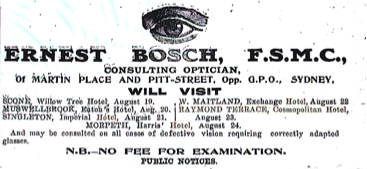
Advertisement for an optician available for consultation Cosmopolitan Hotel [The Catholic Press – 15 August 1907]
Banquet for a Parliamentarian held at the Cosmopolitan Hotel – 1907
The Newcastle Morning Herald and Miners’ Advocate of 25 November 1907, page 6, reported:
‘Some weeks ago, Mr. W. Bennett, late member for Durham, was entertained at Dungog by his supporters in that district, and was presented with a purse of sovereigns, in recognition of his services during his parliamentary career.
At Raymond Terrace on Friday evening, he was entertained by his supporters in the lower division of the electorate and was made the recipient of two purses of sovereigns. The entertainment took the form of a banquet, which was held in the Cosmopolitan Hotel, Raymond Terrace. Mr. A. L. Adam, council clerk, in the absence of the Mayor, Alderman Pepper, occupied the chair.
Advertisement for Cosmopolitan Hotel – 1910
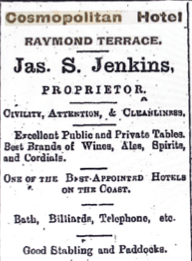
Advertisement placed by the licensee of the Cosmopolitan Hotel, James S. Jenkins [Dungog Chronicle, 13 July 1909]
Liquor Trades Defence Union holds meeting at the Cosmopolitan Hotel – 1910
The Dungog Chronicle of 9 August 1910, page 2, reported:
‘Mr E J. Murphy, organising secretary for the Liquor Trades Defence Union of New South Wales, is now in Dungog. Mr Murphy has held very successful meetings in all parts of the Durham electorate; on Monday, August 1st, at Jenkins’ Cosmopolitan Hotel, Raymond Terrace, a very successful meeting took place.
Mr Murphy addressed the audience and pointed out the basic deception practiced by the ‘no-license’ fanatics, and dwelt upon the way to vote— whether the existing licenses shall continue — whether existing number be reduced, or no licenses whatsoever, and to remember the abolition of the liquor trade really means the destruction of a revenue producing series of affiliated industries, which yield to the Treasury of this State millions sterling annually. Where is the deficit to come from to supply the gap, should ‘no license ‘ be carried?’
Licensee of the Cosmopolitan Hotel supports event in aid of Maitland Hospital – 1911
The Maitland Weekly Mercury of 29 April 1911, page 6, reported:
‘A grand dramatic entertainment in aid of the Maitland Hospital was held in the Oddfellows Hall, Raymond Terrace on Wednesday evening by the local Amateur Dramatic Society. The entertainment, (says a correspondent.) proved an immense success, the hall being crowded. The piece staged was “The Handsome Husband,” a one-act drama, which was beautifully staged, the furniture being kindly lent by Mr. J. S. Jenkins of the Cosmopolitan Hotel.’
Advertisement for Cosmopolitan Hotel – 1912
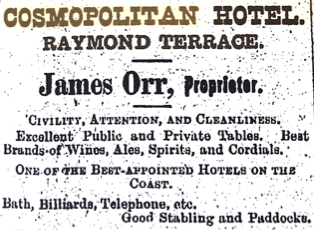
Advertisement placed by the licensee of the Cosmopolitan Hotel, James Orr [Raymond Terrace Examiner and Lower Hunter and Port Stephens Advertiser – 14 June 1912]
Cosmopolitan Hotel flooded – 1913
The Sunday Times of 18 May 1913, page 5, reported:
‘The [flood] water is over the bar in the Cosmopolitan Hotel at the Terrace.’
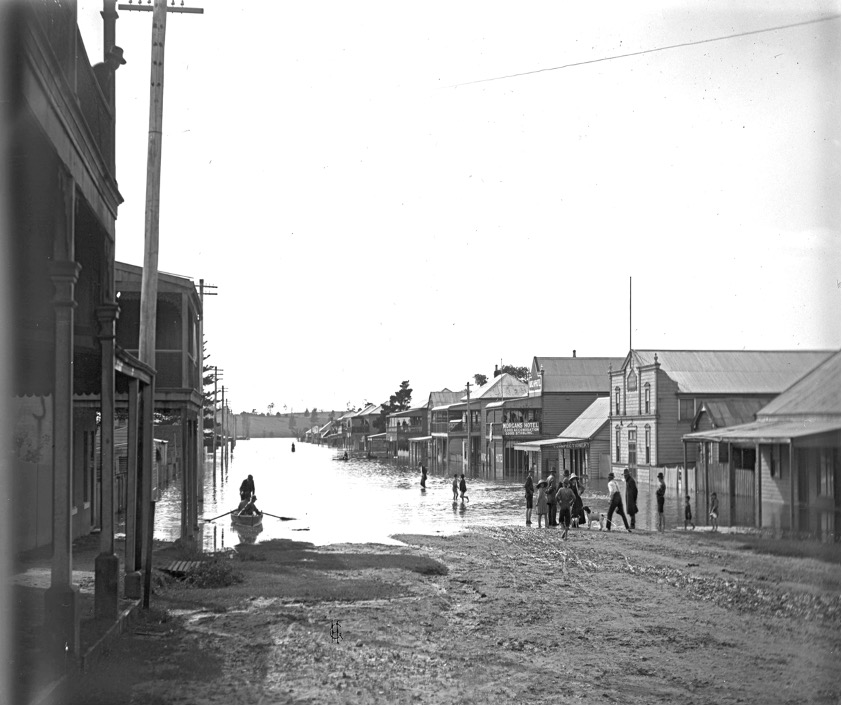
Flood water in King Street, at Raymond Terrace during the 1913 Great Flood. The flooded Cosmopolitan Hotel was located at the far end of the street on the right [University of Newcastle Library’s Living Histories Collection]
Raymond Terrace Football Club holds meeting in the Cosmopolitan Hotel – 1914
The Raymond Terrace Examiner and Lower Hunter and Port Stephens Advertiser of 24 April 1914, page 3, reported:
‘A meeting of members of the Raymond Terrace Football Club was held at the Cosmopolitan Hotel on Monday night last, when it was decided that the club take part in the Hunter districts competition, in the D grade if possible.‘
Advertisement for Cosmopolitan Hotel – 1916
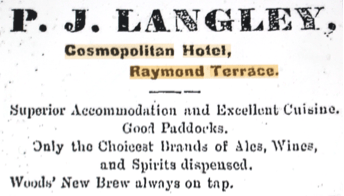
Advertisement placed by the licensee of the Cosmopolitan Hotel, P. J. Langley [Raymond Terrace Examiner and Lower Hunter and Port Stephens Advertiser – 28 April 1916]
Reduction in the License Fee for the Cosmopolitan Hotel – 1916
The Raymond Terrace Examiner and Lower Hunter and Port Stephens Advertiser of 30 June 1916, page 2, reported:
‘A reduction from £25 to £20 was made in the license fees of the Cosmopolitan and Junction Hotels [at Raymond Terrace].’
Tenders called for repairs and painting – March 1920
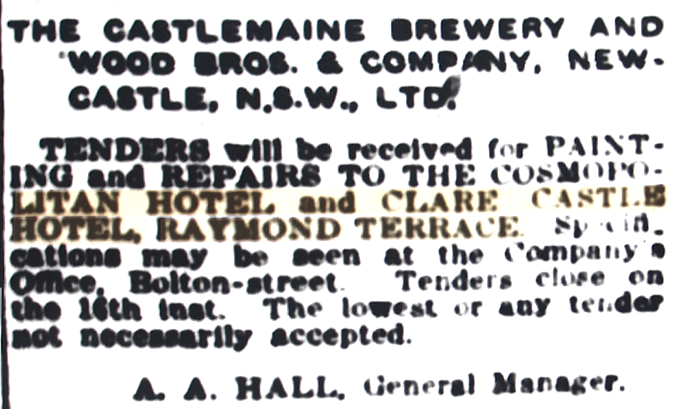
Advertisement for tenders for painting the Cosmopolitan Hotel and Clare Castle Hotels at Raymond Terrace [the Newcastle Sun – 13 March 1920]
Tooth and Company acquries the Cosmopolitan Hotel Premises – March 1921
In March 1921, Tooth and Company, a major brewer of beer in New South Wales, acquired the premises of the Cosmopolitan Hotel from the previous owner, Castlemaine Brewery and Wood Bros & Company of Newcastle.
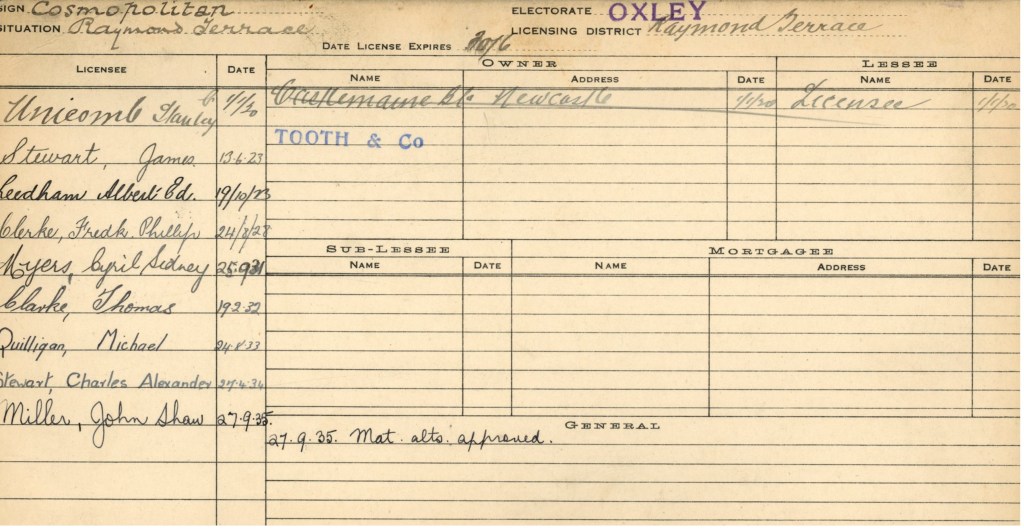
Raymond Terrace Cosmopolitan Hotel Licensee Card 1920 – 1935 [State Archives NSW]
Increase in license fee for the Cosmopolitan Hotel – 1921
The Newcastle Sun of 25 June 1921, page 5, reported:
‘The licence fee of practically every hotel in Maitland has been increased lately, and at Raymond Terrace yesterday the licence fee of the Junction Inn was increased from £20 to £30. The Cosmopolitan and Clare Castle hotels were raised from £20 to £25.’
Transfer of Cosmopolitan Hotel License – June 1923
The Raymond Terrace Examiner and Lower Hunter and Port Stephens Advertiser of 15 June 1923, page 3, reported:
‘The license of the Cosmopolitan Hotel was transferred on Wednesday from Mr. S. Unicomb to Mr. Stewart. There were no objections to the transfer, the requirements of the licensing inspector having been complied with.’
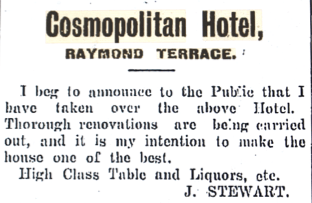
Advertisement placed by the new licensee of the Cosmopolitan Hotel, J. Stewart [Raymond Terrace Examiner and Lower Hunter and Port Stephens Advertiser – 29 June 1923]
Transfer of Cosmopolitan Hotel License – October 1923
The Dungog Chronicle of 23 October 1923, page 2, reported:
‘The licence of the Cosmopolitan Hotel, Raymond Terrace, has been transferred from Mr. James Stewart to Mr. Albert Edward Leedham. Albert was for a time host of the Court House Hotel, Dungog, and patrons can depend on first-class service and the best of liquors.’
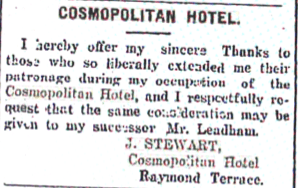
Advertisement placed by former licensee of the Cosmopolitan Hotel [Raymond Terrace Examiner and Lower Hunter and Port Stephens Advertiser – 19 October 1923]
Political meeting held at the Cosmopolitan Hotel – 1924
The Newcastle Sun of 22 July 1924, page 5, reported:
‘Mr. J. Fitzgerald. M.L.A., for Oxley, visited Raymond Terrace on Saturday, with Mr. W. O’Hearn, member for Maitland. They addressed a gathering of Labor supporters at the Cosmopolitan Hotel. They predict a big victory for Labor at the next elections, as people, they asserted, are awakening to the fact that it will be a universal policy. The actions of the present Government were condemned in connection with the immigration scheme and setting men on the land. The decentralisation scheme was dealt with by Mr. O’Hearn, who maintained that stagnation existed in every country town today.’
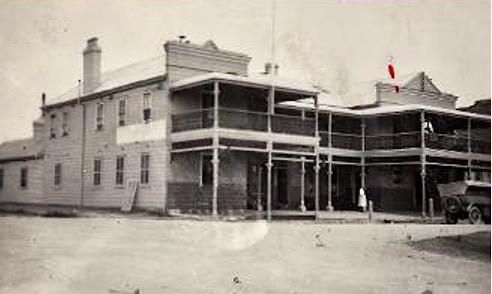
Cosmopolitan Hotel – 1924 [Australian National University – Open Research Repository]
Illegal drinkers fined – 1925
The Maitland Daily Mercury of 29 January 1925, page 4, reported:
‘Henry Spencer and Charles Dawson were each fined 10/ at the Raymond Terrace Police Court, for being drunk on the evening of January 26. For having falsely represented themselves as travellers at the Cosmopolitan Hotel, Raymond Terrace, they were each fined £5.’
Later that year, the Raymond Terrace Examiner and Lower Hunter and Port Stephens Advertiser of 2 October 1925, page 2, also reported:
‘Joseph Williams, Aubray Haslen, Alexander S. Duthrie, for falsely representing themselves to be travellers, and obtaining liquor at Cosmopolitan Hotel, Raymond Terrace, fined £5 each and 8/ costs.’
Customer jailed for refusing to pay accommodation and meal account – 1925
The Raymond Terrace Examiner and Lower Hunter and Port Stephens Advertiser of 5 June 1925, page 2, reported:
‘At the local police Court, on 29th May, before, Mr. R. A. Elkin, J. P., Walter Alfred Crockett, was charged, on warrant with refusing to pay £8/0/6 for meals, and accommodation supplied by A. E. Leedham, Cosmopolitan Hotel, at Raymond Terrace.
Defendant pleaded not guilty. After hearing statements from both sides, defendant was found guilty and sentenced to one-month hard labour in Maitland gaol. There was no option to the Bench, to inflict any other punishment, other than gaol, as the law only makes provision for that.’
Court action taken against patrons of the Cosmopolitan Hotel – 1926
The Raymond Terrace Examiner and Lower Hunter and Port Stephens Advertiser of 29 January 1926, page 3, reported:
‘T. McBride was charged [at the Raymond Terrace Police court] with carrying liquor from the Cosmopolitan Hotel, during prohibited hours, and supplying a per-son with same. Constable Priddis said he saw McBride come out of the Hotel and enter a shop in Port Stephens Street. Later he saw another person leaving the shop, and he intercepted him, and asked him where he got the whisky he carried. He said T. McBride gave it to him.
Evidence was given by E. McDonagh and F. Atkins, that they saw McBride in the shop on Sunday afternoon. Mr. Bray: who appeared for McBride said no offence had been disclosed as the evidence did not show where the liquor was purchased. McBride came from Newcastle that day and was a traveller. The P. M. thought the evidence not sufficient to convict on and dismissed the case.
A case arising out of the same circumstances was preferred against A. Leedham proprietor of the Cosmopolitan Hotel, but the P. M. held there was not enough evidence of sale to convict and dismissed the case. Mr. Bray and Mr. Mackenzie appeared for the defendant.
The police proceeded against B. Walmsley, J. Burt, E. Burt, and R. Martin for falsely representing themselves to be travellers for the purpose of obtaining liquor. J. Burt, E. Burt and R. Martin live at Martin’s Creek, and on the night in question left that place in a motor car. They heard there was a dance at the [Millers] Forest, and pulled up there, but did not go inside the hall. There they met B. Walmsley, and in the course of a conversation J. Burt said his ear was not going too well. Walmsley suggested a drive, as he might be able to locate the trouble. They all came to Raymond Terrace, and while there at 20 minutes past 11, went into the Cosmopolitan Hotel, and called for liquor. They informed the licensee that they were travellers and signed the book he kept for the purpose.
Constable Allard saw them go in, and said “have you come from the dance,” and they said ”yes.” He said “what are you doing in the hotel.” They replied, “getting a drink.” He said “I don’t think you are entitled to one, as you are not travellers, and if you have any I will make a case of it”. They had a drink and returned to the dance at the Forest but did not go inside. The three Martin’s Creek residents went on home, and left Walmsley, who had driven the orchestra from Maitland.
The prosecution held that as the defendants had stopped at the dance they had completed their journey and were not travellers when they reached the Terrace. Mr. Bray appeared for the defendants and quoted a number of cases bearing on the law as to when persons were held to be travellers and claimed that the defendants in this case were travellers, as they had not finished their journey, and would not cease to be travellers till they had reached home. The P.M. thought the stoppage at the dance did not end the journey and dismissed the information.’
Praise for the Cosmopolitan Hotel – 1926
The Dungog Chronicle of 16 February 1926, page 2, reported:
‘Mr. Albert Leedham, of the Cosmopolitan Hotel, Raymond Terrace, has a fine and up to date establishment. Albert can brighten the eyes of any weary traveller with a cool refreshing draught.‘
The Dungog Chronicle of 22 June 1926, page 2, further reported:
‘Mr. Albert Leedham; proprietor of the Cosmopolitan Hotel, Raymond Terrace, keeps one of the most up-to-date hotels along the Coast for towns of even greater size than the Terrace. The bar is a credit to the proprietor. The establishment is illuminated with electricity, a fine little [electric generating] plant being installed on the premises.’
Court action taken against a patron of the Cosmopolitan Hotel – 1926
The Raymond Terrace Examiner and Lower Hunter and Port Stephens Advertiser of 26 March 1926, page 3, reported:
‘John McCormick for carrying away liquor from the Cosmopolitan Hotel during prohibited hours, was fined £3 and 9/6 costs. Mr. Bray appeared for defendant, who pleaded not guilty, but on hearing Constable Allard’s evidence, he advised his client to plead guilty, which he did. For aiding and abetting in the carrying of the liquor, four young fellows were fined £3 and 8/ costs. They were seen by Constable Allard on the footpath, and to receive beer from McCormick.’
Licensee of the Cosmopolitan Hotel wins Popular Man Award – 1926
The Newcastle Sun of 8 October 1926, page 10, reported:
‘A popular man competition, organised by the Raymond Terrace Rowing Club, resulted in a win for Mr. Albert Leedham, of the Cosmopolitan Hotel, who secured 28,330 votes, which returned £118. The appeal realised £187 16s.’
Court action taken against a patron of the Cosmopolitan Hotel – 1927
The Raymond Terrace Examiner and Lower Hunter and Port Stephens Advertiser of 26 May 1927, page 3, reported:
‘Before Mr. Cleeve P.M. Friday, May 20th, 1927. A local resident falsely pretending that he was a traveller for the purpose of obtaining liquor was fined £5 and 9/6 costs. Defendant represented to Mrs. Leedham Cosmopolitan Hotel, that he came from Cessnock and. he was entitled to a drink. He signed the book and was given a drink.
Albert Edward Leedham, Cosmopolitan Hotel, was charged with permitting drunkenness on his premises. After hearing evidence by the police and Mr. Leedham the P. M. said he thought that there had been some effort made to prevent the parties from remaining on the premises, and he dismissed the information. Mr. Bray appeared for defendant. Two local drunks were fined one £1, and the other £2 with 8/- costs each.
Albert Edward Leedham, charged with serving a drunken person with liquor, pleaded not guilty, and was defended by Mr. Bray. This case was one in which a previous defendant was fined for representing himself as a traveller. The prosecutor stated that the person was drunk when he was served with liquor. Evidence given by Miss McDermott, who was server behind the bar, was that he did not appear drunk when he came to the slide door in the wall. He appeared to stand alright and did not act like a person drunk. The P. M. said he thought there was hardly enough in the case to justify him in convicting and he dismissed the case. Evidence was called by defendant from Mr. French who stays at the hotel when in Raymond Terrace, and he stated that the hotel was well conducted at those times when he visited it.’
Application to serve liquor with meals – 1927
The Raymond Terrace Examiner and Lower Hunter and Port Stephens Advertiser of 30 June 1927, page 3, reported:
‘An application was made by the licensee of the Cosmopolitan Hotel for a permit to serve liquor, with meals after 6 pm. …. Applicant said. he wanted the permit to enable dinners by the Football Club, Rowers Club, and other bodies to be held at the hotel, as they were now held.in various inconvenient places. A good deal of evidence was taken, but Mr. Enright, who appeared for applicant advised the withdrawal of the application, and this was done.’
Hotel changes hands – 1928
The Dungog Chronicle of 24 August 1928, page 2, reported:
‘Mr. Albert Leedham has disposed of the Cosmopolitan Hotel, Raymond Terrace, to Mr. Fred Clerke, once of the Bank Hotel, Dungog. Albert, also is well known to Dungog folk, being a son of Mrs Leedham of Brookfield. Motorists from this district will still be assured of a friendly smile and a drop of “good stuff” from one who is not unknown.’
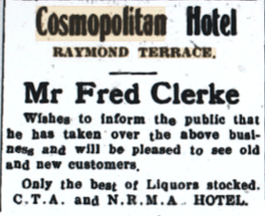
Advertisement placed by the new licensee of the Cosmopolitan Hotel, Fred Clerke [Dungog Chronicle – 16 May 1930]
A Fish Tale as told by the Licensee of the Cosmopolitan Hotel – 1931
The Southern Mail of 22 May 1931, page 3, reported:
‘Mr. Fred Clarke, of the Cosmopolitan Hotel, Raymond Terrace, housed twenty-seven refugees during the recent floods. He relates that the water spread all over the country thereabouts. In his meanderings he saw plenty of big fish, and, being an ardent angler, the sight delighted him. However, he became envious. He has caught monsters in his time, but the sight of these was too much for him. He saddled up his creamy pony and with a long lassoo rode out to the flooded flat where he spotted a huge flathead. By clever stock riding and skilful manoeuvring, he roped the fish and towed it back to the hotel yard. The water in the yard was several feet deep, so Fred tethered the flathead to the post of the clothesline. Fred stated the fish would tip the scales at about 27 lb. and invited any old Dungog friends to go down and view the fish, horse, lassoo, and himself.’
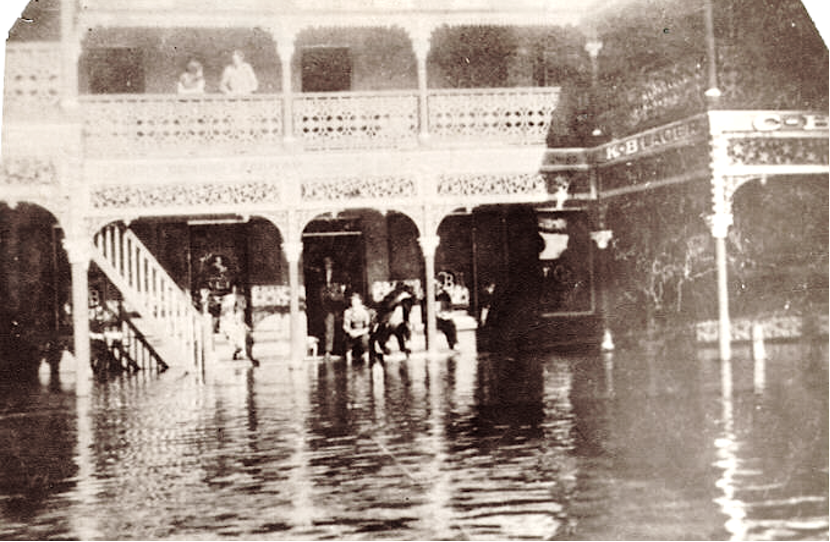
Flood waters outside the Cosmopolitan Hote at , Raymond Terrace – date unknown [Newcastle Library, Hunter Photobank]
Hotel changes hands again – 1931
The Raymond Terrace Examiner and Lower Hunter and Port Stephens Advertiser of 1 October 1931, page 3, reported:
‘The Cosmopolitan Hotel, Raymond Terrace, has changed hands, Mr. Meyers, a late hotel keeper in Newcastle having purchased from Mr. Clerke.’
Court action taken against the Hotel Licensee and two patrons – 1932
The Maitland Daily Mercury of 28 January 1932, page 2, reported:
‘Three persons were fined £2, with 8/ costs, for being on licensed promises at the Cosmopolitan Hotel after hours, and Cyril Sidney Myers [the new licensee] was fined £1 and 8/ costs for allowing them to be on his premises after hours.’
New Licensee fined for selling poor quality whisky – 1932
The Labor Daily of 16 February 1932, page 6, reported:
‘On a charge of having sold whisky not of the nature or quality demonstrated, Cyril Myres, licensee of the Cosmopolitan Hotel, Raymond Terrace, was fined £2, with £3/10/ costs, at Maitland Court to-day. On behalf of defendant, Mr. Enright stated that he had only just taken over the Hotel, and the stock was the same as when he entered. Since then, inspections had been made and everything was found in order. The defendant had been licensee of the Commercial Hotel, Newcastle, for eight years without complaint.’
Owner of the Cosmopolitan Hotel to Update Land Registration – 1932
The Raymond Terrace Examiner and Lower Hunter and Port Stephens Advertiser of 10 March 1932, page 3, reported:
‘The Registrar-General informed Council that Tooth and Co. was applying for a Real Property title for the Clare Castle and Cosmopolitan hotels and asked if there were any objections. Council did not object.’
New Licensees for the Cosmopolitan Hotel – 1932
The Raymond Terrace Examiner and Lower Hunter and Port Stephens Advertiser of 10 March 1932, page 3, reported:
‘The Cosmopolitan Hotel, Raymond Terrace is now under efficient management, it having been taken over by Mr. Tom Clark, who for the past 20 years has been associated with hotels in Newcastle, and for the last nine years, at the George Hotel. His years of experience enable him to give the very best service to the public and he devotes particular attention to the reliability of all brands of liquor he sells and assures the public of a good table at a moderate tariff.’
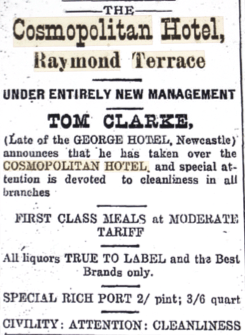
Advertisement placed by the new licensee of the Cosmopolitan Hotel, Tom Clarke [Raymond Terrace Examiner and Lower Hunter and Port Stephens Advertiser, 10 March 1932]
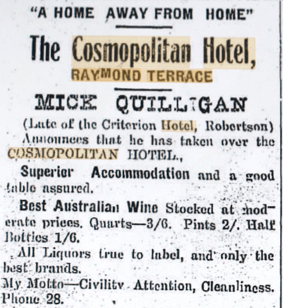
Advertisement placed by the new licensee of the Cosmopolitan Hotel, Mick Quilligan [Raymond Terrace Examiner and Lower Hunter and Port Stephens Advertiser – 16 November 1933]
Tenders called for painting of the Cosmopolitan Hotel – 1934
The Newcastle Morning Herald and Miners’ Advocate of 27 October 1934, page 14, reported:
‘Tenders will close with Tooth and Co. Ltd., Castlemaine Brewery, for exterior repairs and painting at the Clare Castle Hotel, Raymond Terrace, and the Cosmopolitan Hotel, Raymond Terrace. Specifications are on view at the offices of the company.’
Tenders called for Hotel alterations – 1935
The Newcastle Morning Herald and Miners’ Advocate of 28 September 1935, page 20, reported:
‘Tenders are invited for …… converting a bedroom into a bathroom and concreting footpath to lavatories at the Cosmopolitan Hotel, Raymond Terrace, for Messrs. Tooth and Co. Ltd. Plans and details may be obtained at the office of the Castlemaine Brewery, Hunter-street West.’
The Newcastle Morning Herald and Miners’ Advocate of 16 November 1935, page 22, further reported:
‘Extensive repairs are being carried out at the Cosmopolitan Hotel and the Clare Castle Hotel, Raymond Terrace, for Messrs. Tooth and Co. Ltd.’
New Licensee for the Cosmopolitan Hotel – 1935
The Newcastle Morning Herald and Miners’ Advocate of 5 October 1935, page 13, reported:
‘The licence of the Cosmopolitan Hotel, Raymond Terrace, has been transferred from Mr. C. A. Stewart to Mr. J. S. Miller, of Wallsend.’
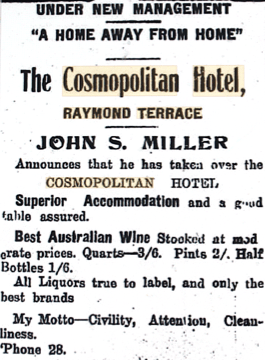
Advertisement placed by the new licensee of the Cosmopolitan Hotel, John S. Miller [Raymond Terrace Examiner and Lower Hunter and Port Stephens Advertiser – 31 October 1935]
Hotel Licensee wins Art Union Prize – 1937
The Raymond Terrace Examiner and Lower Hunter and Port Stephens Advertiser of 4 February 1937, page 3, reported:
‘Mr. J. Miller of the Cosmopolitan. Hotel wag the holder of the winning ticket in the Ambulance Arl Union. This entitles him to a refrigerator — a most serviceable article in hotel furnishings.’
New Licensee for the Cosmopolitan Hotel – 1939
The Maitland Daily Mercury of 1 December 1939, page 6, reported:
‘Mr. Jas. Miller has disposed of the licence gf of the Cosmopolitan Hotel at Raymond Terrace to Mr. Les Turnbull, late of the Great Northern Hotel, at Wallsend. Mr. Miller has gone to Wallsend, having purchased the licence of the Lemon Grove Hotel there.’
Alterations underway at the Cosmopolitan Hotel – 1940
The Newcastle Morning Herald and Miners’ Advocate of 18 May 1940, page 16, reported:
‘The tender, of Messrs. Murdoch and Turner, contractors, of Islington, for alterations to the Cosmopolitan Hotel, Raymond Terrace, has been accepted. Messrs. Pitt and Merewether, of Bolton-street [Newcastle] are the architects.’
New Licensee for the Cosmopolitan Hotel – May 1941
The Newcastle Morning Herald and Miners’ Advocate of 2 May 1941, page 13, reported:
‘The licence of the Cosmopolitan Hotel, Raymond Terrace, was transferred from Leslie Thomas Turnbull to Ernest William Herberts. Mr. A. M. Cunningham, on behalf of Messrs. Braye, Cragg and Cohen, appeared for the parties.’
Farewells held at the Cosmopolitan Hotel – 1941
The Maitland Mercury of 20 September 1941, page 3, reported:
‘In the Cosmopolitan Hotel, Raymond Terrace, a large number gathered to say farewell to Mr. McAlpine, of the Commercial Bank, who has been transferred to Rockhampton district, and Mr. Fairweather, the postmaster, who goes to Gilgandra. Mrs. Thomson placed the rooms of the hotel at the disposal of the company, which was presided over by Mr. O. R. Hopkins, who thanked Mrs. Thomson for their courtesy.’
New Licensee for the Cosmopolitan Hotel – November 1941
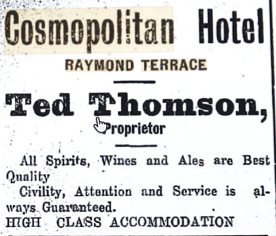
Advertisement placed by the new licensee of the Cosmopolitan Hotel, Ted Thomson [Raymond Terrace Examiner and Lower Hunter and Port Stephens Advertiser – 20 November 1941]
Licensee fined for selling adulterated rum – 1945
The Newcastle Sun of 11 December 1945, page 4, reported:
‘Spencer Moon, an inspector under the Pure Foods Act, purchased some rum from the Cosmopolitan Hotel, Raymond Terrace, conducted by Edward Thompson. On analysis it was found to contain the equal of 17 per cent. of added water, it was stated at Newcastle Police Court today. Mr. J. Braun (for Thompson) said that he had been in ill health, and his daughter had broken down the rum without his knowledge. Thompson was fined £5, with £6 11s 9d costs, or 24 days’ imprisonment.’
The Maitland Mercury of 7 February 1946, page 2, further reported:
‘Without proceeding to conviction Judge Nield. in the Quarter Sessions appeals discharged Edward Thomson, licensee of the Cosmopolitan Hotel, Raymond Terrace, and ordered him to enter into a bond to be of good behaviour for twelve months.
On December 11, Thomson was fined £5 by Mr. Carr-Boyd, SM. in the Newcastle Summons Court for selling adulterated rum. Mr. J. Braun, instructed by Messrs. Braye, Cragg and Cosaid that on the occasion of the offence appellant, who was a returned soldier, was ill and for some time had not taken an active part in the conduct of the Hotel. His wife was absent at the time and the daughter, who was in charge, had broken down the rum. Thomson had been in the hotel business for 23 years and had nothing against him.’
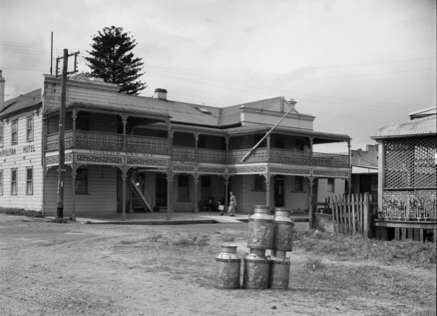
Cosmopolitan Hotel facing King Street, Raymond Terrace, with the name of the licensee ‘Ted Thompson’ painted on the front, circa 1945 [State Library NSW]
Till in the Hotel Bar Stolen – 1946
The Newcastle Morning Herald and Miners’ Advocate of 5 April 1946, page 2, reported:
‘Shortly after 11 p.m. on Wednesday two men were discovered carrying the till from the Cosmopolitan Hotel, Raymond Terrace. into the backyard. The men threw the till away and decamped. Investigation showed that entrance to the bar was gained by forcing a window and that two suit lengths and a quantity of tobacco were missing. Detective Sergeant D. G Sutherland and Detective Constable V. R. Woodward, of West Maitland, are investigating.’
The Maitland Mercury of 5 April 1946, page 5, also reported:
‘Two men who had broken into the cosmopolitan Hotel, Raymond Terrace, were escaping through the back yard when they were seen hy the licensee’s son, Mr. E. Thompson, who happened at that moment to be returning home. They immediately dropped the till and ran away. A small quantity of tobacco and cigarettes has been reported missing. Detective-Sergeant G. Sutherland and Detective-Constable V. E. Woodward, of West Maitland, are investigating.’
Dinner Party held for journalist William Brown at the Cosmopolitan Hotel – 1947
The Newcastle Sun of 8 October 1947, page 1, reported:
‘The Hunter District’s oldest journalist, Mr. William Brown, will be entertained at a dinner party on his 80th. birthday, tomorrow. On November 23, 1943, he was also entertained on the occasion of the golden Jubilee of the first issue of ‘The Examiner; Raymond Terrace, of which he was the founder. The souvenir programme mentioned that the new paper was fittingly christened at the Cosmopolitan Hotel and the proceedings were ‘a bit hilarious.’
Flood waters lap bar counters – 1949
The Daily Telegraph of 20 June 1949, page 5, reported:
‘At Raymond Terrace at midnight the river was stationary at a record level. Half the town is flooded and the whole area has been isolated since Saturday morning. Water is up to six feet deep in most of the shops and the main street. In the Cosmopolitan Hotel water is lapping over the bar counters.’
Flood waters cover the floor of the Cosmopolitan Hotel – 1950
The Newcastle Morning Herald and Miners’ Advocate of 24 June 1950, page 3, reported:
‘Flood water from the Hunter River is still in the main street of Raymond Terrace but has fallen to three feet. In the lower half of King Street, the main street, water covers the floor of the dining room of the Cosmopolitan Hotel.’
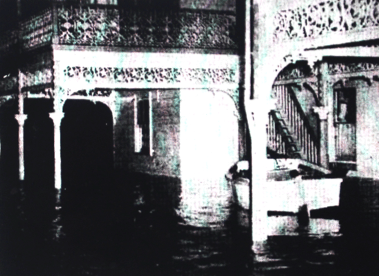
A boat moored to the door of the Cosmopolitan Hotel in the flood waters [Newcastle Morning Herald and Miners’ Advocate – 20 June 1950]
New Licensee for the Cosmopolitan Hotel – 1950
The Maitland Mercury of 17 November 1950, page 5, reported:
‘In the Licensing Court at Maitland this morning, Mr. F. Wood. S.M., granted the transfer of the licence of the Cosmopolitan Hotel, Raymond Terrace, from Edward Thompson to Anthony Joseph Coates, of Wychbury avenue, Croydon. Mr. Barnett appeared for both parties.’
The Newcastle Sun of 14 February 1951, page 1, further reported:
‘Licensee of the Cosmopolitan Hotel, Raymond Terrace, Mr. A. J. Coates, is a barrister, though a non-practising one at the moment. Atter the Licensing Court rose at Raymond Terrace yesterday, the chairman of the Bench (Mr. V. H. Wells, S.M.) asked Mr. Coates, “When are you returning to the other Bar?’ “When I make enough money from this one,” replied Mr. Coates.’
Cosmopolitan Hotel flooded again – 1952
The Sydney Morning Herald of 15 August 1952, page 3, reported:
‘At Raymond Terrace, 15 miles north of Newcastle, 15 families left their homes as the water rose through the lower end of the town. Water six inches deep in the main street (King street) was lapping shop doors and yesterday seeping through the front door of the Cosmopolitan Hotel, at the lower end of the town.’
Advertisement for the Cosmopolitan Hotel -1954
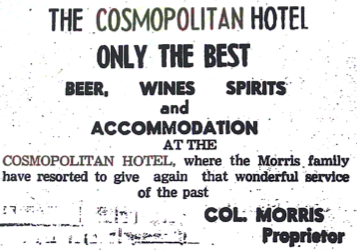
Advertisement placed by the licensee of the Cosmopolitan Hotel, Col. Morris [Raymond Terrace Examiner and Lower Hunter and Port Stephens Advertiser – 18 March 1954]
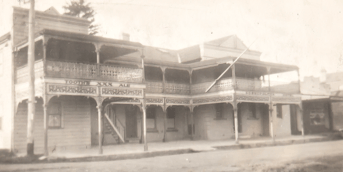
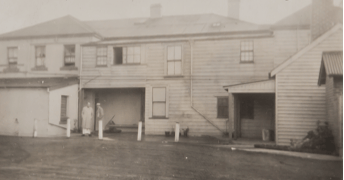
Front and rear views of the Cosmopolitan Hotel, July 1954 [Australian National University, Open Research Repository]
Flood waters reach top storey of the Cosmopolitan Hotel – 1955
The Raymond Terrace Examiner and Lower Hunter and Port Stephens Advertiser of 3 March 1955, page 1, reported on the highest flood to affect Raymond Terrace to date:
‘Storekeepers in the King Street, Port Stephens Street, area, who packed their stock up to ceiling level, allowing what they thought was a safe margin in what they knew was going to be a big flood, were dismayed to find that the water rose almost to ceiling level, and in the case of the Cosmopolitan Hotel lapped the floorboards of the top storey, and were heavy losers of stock.’
Concluding Comments
The record 1955 flood, following floods in 1949, 1950 and 1952, sealed the Cosmopolitan Hotel’s fate.
Tooth & Co, which purchased the hotel in 1921, built a replacement on nearby Port Stephens Street, Raymond Terrace, and closed the original hotel after transferral of its liquor licence to the new premises, named the Spinning Wheel Hotel which opened for trading in 1959. The former hotel was later utilised as an accommodation premises by a subsequent purchaser.
The Spinning Wheel Hotel continues to operate at 82 Port Stephens Street, Raymond Terrace. Designed by Newcastle architects Pitt and Pitt, the hotel cost approximately £78,000. At opening, it had eight guest rooms, a saloon and public bars, a lounge, a bottle shop and a beer garden.
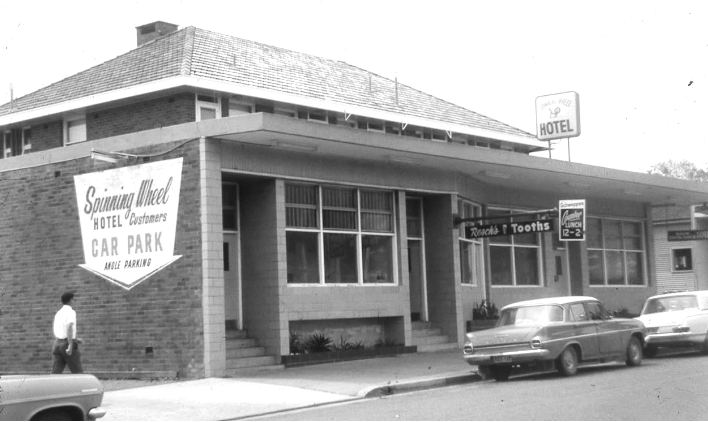
Spinning Wheel Hotel at Raymond Terrace, 1971 [University of Newcastle, Living Histories]
Information on the history of two other Raymond Terrace Hotels are also published on this website can be viewed at the following links:
Early History of the Junction Inn Hotel at Raymond Terrace – Port Stephens
Early History of the Clare Castle Inn Hotel at Raymond Terrace – Port Stephens
Further papers on the history of Raymond Terrace district are also published on this website and can be viewed at the following links:
Early History of St. Brigid’s Catholic Church – The First 100 Years
War Loan Tank Drive Visits Raymond Terrace, Port Stephens – 1918
A Tour of Millers Forest and Raymond Terrace, Port Stephens – 1918
Raymond Terrace Municipal Council Jubilee Celebrations – 1934
Journey to the Vineyards of the Lower Hunter and Port Stephens Districts – 1865
Millet Growing and Broom Manufacture in the Raymond Terrace District – Port Stephens
A Story of the Raymond Terrace District of Port Stephens in 1893
Researched and compiled by Kevin McGuinness
November 2026


