
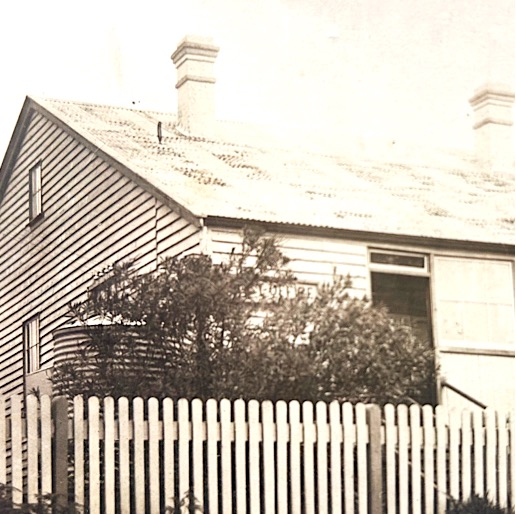
The future premises of the first Nelson Bay Post Office were built in 1880 as a weatherboard residential building for the manager of the NSW Fish Company which commenced operations down the hill on the foreshore at Nelson Bay in February 1880.
The company failed within two years, and the shareholders voted to wind-up it in October 1881. Nelson Bay benefited though, as the building remained for re-purposing.
The manager’s residence, in what is now Apex Park, was ideally located to house the new Nelson Bay Post and Telegraph Office, which opened on 1 September 1883. At that time the population of Nelson Bay was about 100 persons.
Emanuel Flew Dalgleish became the first Postmaster and Telegraph Operator at Nelson Bay in 1883. In June 1886, he was transferred to a fourth-class telegraph operator position in Head Office in Sydney.
In his place, William Jackson, a postal assistant and telegraph messenger at Taree, was appointed as a fourth-class post and telegraph station master at Nelson Bay.
In its early years as a Post Office, communication with other areas relied on Morse Code sent over a single wire strung through the bush from Nelson Bay to Raymond Terrace. Mail initially arrived at the Post Office by passenger ferry from Tea Gardens, stopping at other villages around Port Stephens before reaching Nelson Bay.
Home mail delivery did not begin until about 1949. With the construction of the current Post Office building at the corner of Magnus and Stockton Streets in 1960, the original building in Apex Park was retired from use. Prior to moving into its new building, the Nelson Bay Post Office operated from several premises in the Nelson Bay shopping area.
Response to a Petition for the establishment of Post Offices at Nelson Bay and Hawks Nest – 1874
The Maitland Mercury and Hunter River General Advertiser of 22 September 1874, page 2, published the following letter to the editor advising of the official response to earlier calls for the establishment of Port Offices at Nelson Bay and Hawks Nest:
‘General Post Office, Sydney, 16th September 1874.
Sir,—Adverting to my letters, dated the 1st and 17th June last, with respect to the proposed establishment of post-offices at Hawks Nest and Nelson’s Bay respectively, I am directed to inform you that a report has been received from the Postal Inspector, who has recently visited the district, and that considering the small population of the localities in question, and the limited correspondence received there, the Postmaster General does not feel warranted at present in establishing an office at either place,—I have the honour to be, Sir, your most obedient servant, (Signed) S. H. LAMBTON, Secretary. A. H. Jacob, Esq., M.P., Raymond Terrace.’
Opening of the Post Office at Nelson Bay delayed – 1881
The Sydney Mail and New South Wales Advertiser of 26 February 1881, page 342, reported:
‘There is very great dissatisfaction felt here at not having our post-office opened on the 15th, as gazetted. Much inconvenience is felt through the delay. We are likely to have a Public School granted shortly, which will be a great boon, there being no school nearer than Myall.’
Telegraph and Post Office reported as open – 1884
The first Nelson Bay Post Office opened in 1883 and served as a vital telegraph and mail link for the small fishing village. The Evening News of 6 October 1884, page 7, reported:
‘There is a telegraph and post-office at Nelson’s Bay, facilitating communication with Sydney.’
Post Office nearly destroyed by a bush fire – 1903
The Newcastle Morning Herald and Miners’ Advocate of 17 February 1903, page 5, reported:
‘Yesterday was a terrible day, the temperature registering 102 in the shade, in addition to which there was a strong north-westerly wind blowing, accompanied by clouds of dust and smoke from the bush fires. Early in the day the fire started on. Bagnall’s farm, about three miles from Nelson’s Bay, and completely destroyed all the crops and grass, a horse also being burnt. The damage is estimated at £500.
Later on the fire travelled towards the Bay, reaching within 200 yards of the Sea Breeze Hotel, the telegraph office, and other houses. Fortunately, it was stopped at that point by a strip of land which had been burnt off some time ago. Had that precaution not, been taken the whole of the buildings must have been destroyed, as the wind, which at the time had changed to the south, was blowing the flames towards them.’
Anna Bay and Nelson Bay Post Offices connected by telephone – 1905
The Newcastle Morning Herald and Miners’ Advocate of 17 August 1905, page 6, reported:
‘The post office at Anna Bay has been connected under the condenser system by telephone with Nelson’s Bay. This will be a great boon to residents of Anna Bay, who had previously to ride ten miles in event of wishing to despatch a telegram. In the event of wrecks occurring at Anna Bay the telephone will be a great convenience. When the steamer Fitzroy and the. barque Olmara were wrecked it was difficult to have telegrams despatched and delivered to shipwrecked passengers. It is also understood that Salt Ash post office will shortly be connected with Nelson’s Bay.’
Nelson Bay Post Office downgraded – 1906
In 1906, the Nelson Bay Post Office was downgraded due to falling revenue and the morse code equipment was disconnected. A later population increase would later restore full services in 1910.
The Newcastle Morning Herald and Miners’ Advocate of 12 July 1906, page 7, reported:
‘It is rumoured that Mr. W. J. Noble, postmaster at Nelson’s Bay, will shortly be removed to another station in consequence of the falling off of revenue at the local office, and it is surmised that the office will be converted into a telephone office. Mr. Noble will be greatly missed, for during his residence of nearly 15 years, he has always been a courteous and obliging officer.’
Farewell to Nelson Bay Postmaster William Noble – 1906
The Newcastle Morning Herald and Miners’ Advocate of 21 August 1906, page 6, reported:
‘On Friday night a large gathering assembled in Mr. Lund’s hall, the occasion being to present Mr. and Mrs. W. J. Noble, of the local post-office, with mementoes from the residents of Nelson’s and Anna Bay and surrounding districts.
On the arrival of Mr. and Mrs. W. J. Noble, Mrs. Mark Noble (mother), and Mrs. H. J. Noble (sister-in-law) they were met and welcomed by Miss Wright (secretary), Mrs. Thos. Laman, Mrs. C. H. Lund, and Mrs. A. Blanch, on behalf of the residents, Mrs. J. J. Luce playing the march of welcome. Mr. Jas. Dalton was voted to the chair and briefly explained that they had met to show respect to Mr. and Mrs. Noble, who were shortly to be removed to another position through the status of the local post-office being reduced.
Mr. Noble had been amongst them for 15 years and had always been obliging and courteous in his official duties, at the same time looking to the interest of his department. As a private individual, he had always shared the troubles of his fellows, and Mrs. Noble had done likewise.
He then read the following illuminated address, which was prepared by Miss Dimmock and Mr. W. H. Weiss, of Glendon Brook, Singleton:— “To Mr. and Mrs. Noble, Nelson’s Bay. Our Dear Friends, — We hear with regret of your approaching departure from our midst, and desire to assure you of our appreciation of your many acts of kindness whilst living amongst us. In your official capacity you have been faithful to your duty and courteous and obliging to all, while in your private capacity, during 15 years’ residence amongst us, we have learnt to know and esteem you as friends.
When trouble, sickness, or death came amongst us you shared our sorrows, and helped us by every means in your power, and your departure will be a sore grief to many homes. We pray that God’s blessings may go with you to your new location, and venture to hope that among the many new friends you may make your memories may sometimes wander back to your old friends here.” Mr. Noble was then presented with a gold watch and sovereign case, Mrs. Noble with silver flower and cake stand, and silver salts, all chastely inscribed.
Mr. Noble, in returning thanks, said in accepting the valuable presents, he could not find words to express his thanks for the kindness shown to Mrs. Noble and himself that night. He did not know of any deed they had done to warrant such kindness, and no matter what part of the State they were stationed in they would prize the gifts and would always think of their kind friends and acquaintances. and of the happy times spent in Nelson’s Bay. Mrs. Mark Noble, on behalf of the family, also thanked the residents for the kindness shown to her son, and his wife. It would be a lasting memory to her of the esteem in which they were held by the residents.
After a vote of thanks had been accorded to the ladies’ committee, and Mr. Dalton, the hall was cleared, and dancing commenced, the grand march being led by Mr. and Mrs. Noble. At midnight the company adjourned to Mr. Lund’s dining-room for supper. The room was decorated with ferns, flowers, etc., and the hall was similarly decked with flags. Facing the entrance was printed with large letters on a white background, the words, “A Hearty Welcome to Our Guests.” Dancing was kept up with vigour until 6 a.m., the music being supplied by Mr. R. Asquith, Mrs. Hough, Miss Wright, Mrs. Luce, and several others. The duties of M.C. were performed by Mr. W. J. Noble.’
Alterations to Nelson Bay Post Office premises – 1909
During February 1909 approval was given to carry out several alterations to the Nelson Bay Port Office. The alterations provided for an upgrade to the front office room; the provision of a second set of front stairs to serve the residential portion of the building; two new water tanks; and an additional new room.
The following diagrams were included in the construction tender documents held by the National Archives of Australia [SP155/1, NSW5863 PMG]:
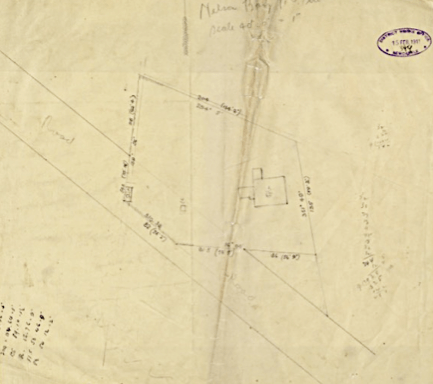
Location of the Post and Telegraph Office building within its parcel of land, that encroached on the present day Laman Street
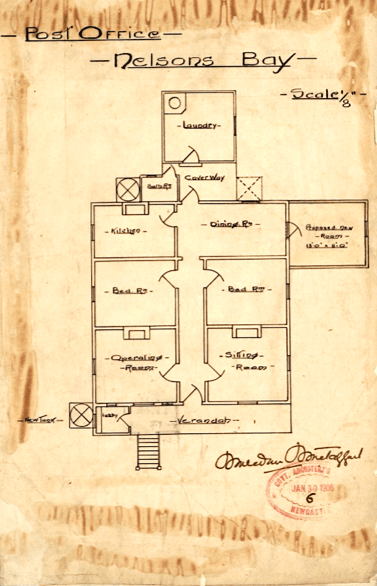
Plan of the Post and Telegraph Office building showing the alterations
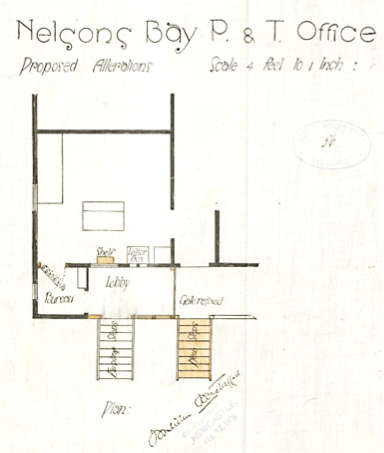
Detail of alterations for the office section of the building
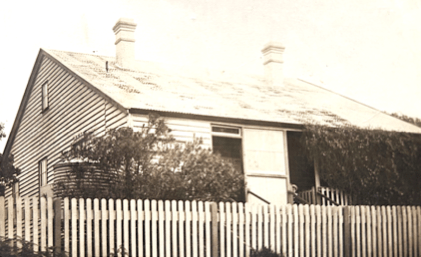
Nelson Bay Post and Telegraph Office, circa 1910, after the alterations approved in 1909 had been completed. The building faced the harbour. The Post Office was located in the front room, at the top of the stairs on the left side. The sign on the front of the building (partly obscured by a tree) states ‘Post Office’. The stairs on the right side led to the private postmaster’s residence.
Semi-official Post and Telegraph Office to be established at Nelson Bay – 1910.
The following notice was published in the Commonwealth of Australia Gazette of 16 July 1910 (No.46), page 1309, by the Postmaster-General’s Department:
‘Conduct of a Semi-official Post and Telephone Office at Nelson’s Bay. Offers will be received at the office of the Deputy Postmaster-General, Sydney, up to half-past Two p.m. on Wednesday, the 10th August, 1910, from persons willing to conduct a Semi-official Post and Telephone Office at Nelson’s Bay, for an allowance at the rate of £110 per annum, including quarters valued at £26 per annum, for a period of three years.
Detailed specifications may be seen, and application forms obtained, at the Post Offices, Nelson’s Bay, Raymond-terrace, Newcastle, Tea Gardens, and at the General Post Office, Sydney. Offers must be addressed to the Deputy Postmaster-General, Sydney, and indorsed “Offer for the conduct of a Semi-official Post and Telephone Office, Nelson’s Bay.” They may be deposited in the Tender-box at the General Post Office, Sydney; if sent by post they must be prepaid and registered.’
Telephone communication at Nelson Bay closed – 1917
The Raymond Terrace Examiner and Lower Hunter and Port Stephens Advertiser of 14 September 1917, page 3, reported:
‘The North Coast Steam Navigation Company brought under the notice of Newcastle Chamber of Commerce the fact that the telephone office at Port Stephens had been done away with from September 1, and that communication with the [outer] lighthouse there has now to be done by means of telegrams.
Members of the council pointed out that communication with the light house was not only a great convenience and assistance to shipping agents, but there was also the question of the sending of assistance to any vessel that might be in distress off that dangerous coast during a storm. The sending of messages by telegraph was not satisfactory, as there had been cases in which a boat coming down from Port Stephens had arrived ahead of a telegram. It was resolved to bring the matter under the notice of the Deputy-Postmaster-General, and to request that the telephone office be restored.’
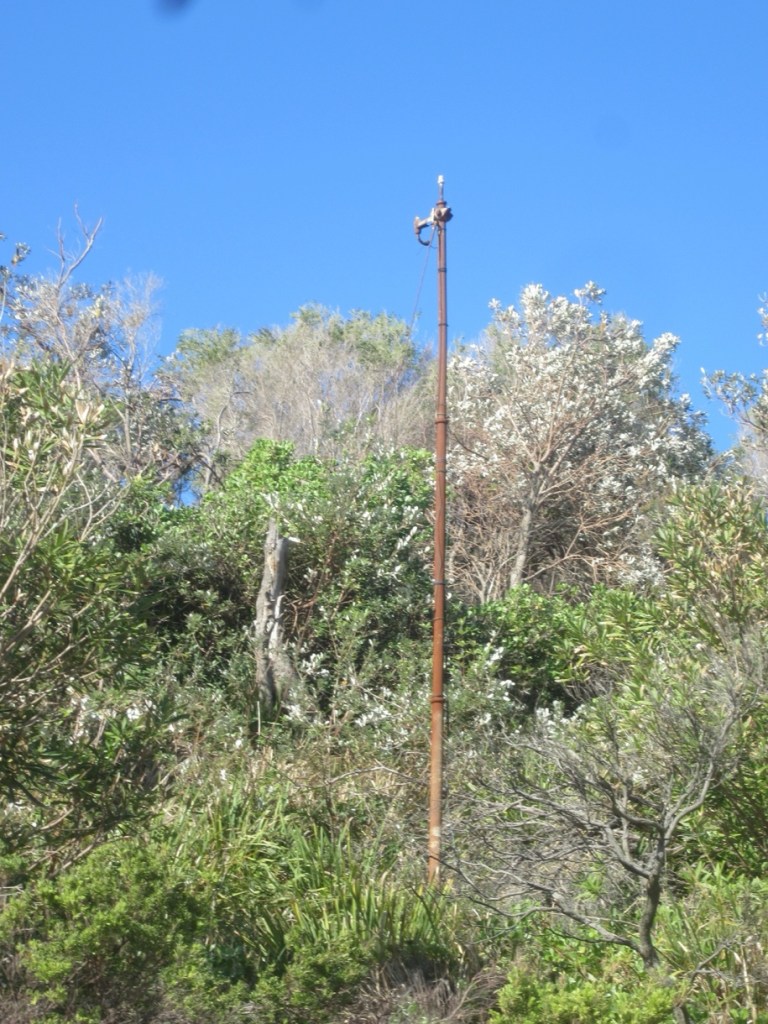
One of the remaining morse code telegraph poles that connected the Point Stephens Outer Lighthouse with the mainland [Author photo].
In response to the above representations a telephone exchange was opened at Nelson Bay on 23 October 1917, with two subscribers, viz: the Outer Lighthouse and Sea Breeze Hotel.
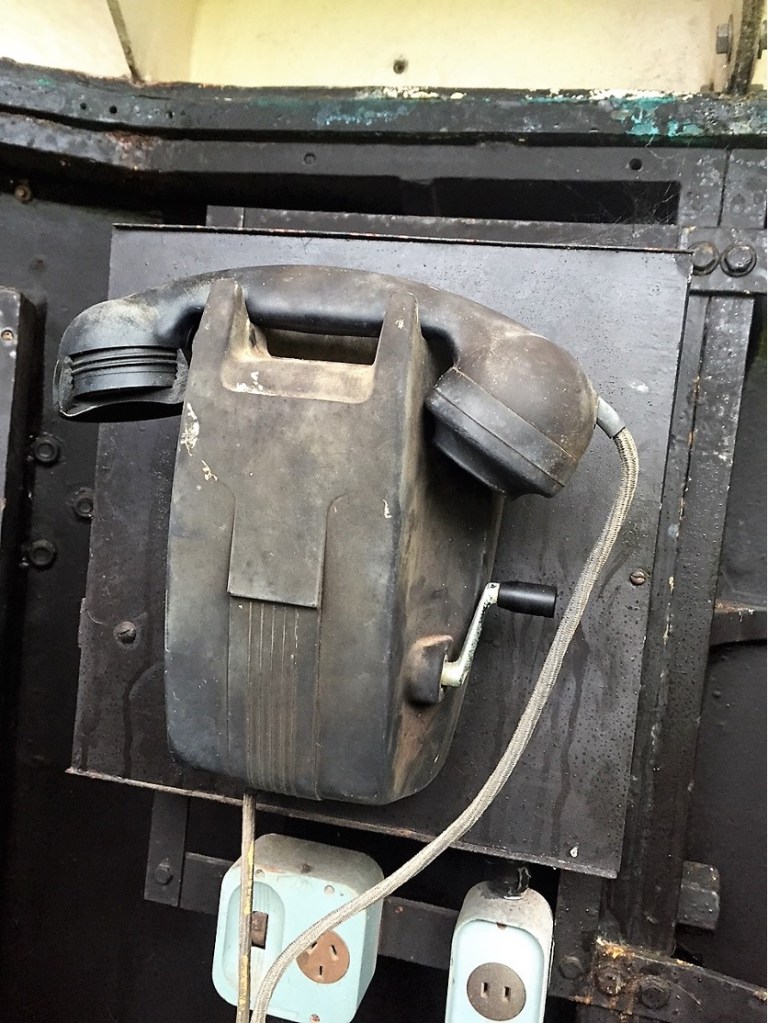
The Outer Lighthouse telephone which the lighthouse keeper would answer when ‘Nelson Bay 1’ was dialled.
Telegrams to be delivered at Nelson Bay – 1923
The Newcastle Morning Herald and Miners’ Advocate of 30 October 1923, page 5, reported:
‘Arrangements have been made by the Post and Telegraph Department for the delivery of telegrams within a radius not exceeding half-a-mile from the [Nelson Bay] post office.’
Improved telephone infrastructure for the Nelson Bay district – 1924/1925
The Raymond Terrace Examiner and Lower Hunter and Port Stephens Advertiser of 21 November 1924, page 3, reported:
‘At the monthly meeting of the Nelson’s Bay Progress Association the President Mr. W. Thompson, presided, and there was a good attendance of members pre-sent. …. Application is to be made to the Post Master-General for direct telephone communication with Newcastle through Salt Ash and Williamtown, instead of through Raymond Terrace as at present.’
The Raymond Terrace Examiner and Lower Hunter and Port Stephens Advertiser of 7 August 1925, page 2, reported:
‘A further effort will be made to induce the Postmaster General to complete the long promised telephonic connection between Salt Ash and Williamtown, to give direct communication to Newcastle.’
The Newcastle Morning Herald and Miners’ Advocate of 8 September 1925, page 5, finally reported:
‘The monthly meeting of the Nelson’s Bay Progress Association was held on Saturday evening. Mr. W. Thompson, president, presiding. Correspondence was received from the Deputy Postmaster General, stating that as a result of the association’s repeated application for a telephone line via Williamtown and Stockton, tenders were being called for the supply and delivery of poles to construct the line. It was expected that a commencement of the work would be made in a month’s or six weeks’ time.’
Improved telephone infrastructure extended to Williamtown – 1926
The Raymond Terrace Examiner and Lower Hunter and Port Stephens Advertiser of 10 September 1926, page 4, reported:
‘Mr. S. L. Gardner, M.P., has received the following communication from the Deputy Director of Posts and Telegraphs: Sir.—Referring to representations made by the Williamtown and district Progress Association (Mr. S. W. Smith Jnr.; Honorary Secretary,) in favour of the provision of a separate trunk line between Newcastle and Nelson’s Bay, I have to inform you that approval has been given for the erection of an additional trunk line from Newcastle to Williamtown to form portion of a direct circuit between Newcastle and stations in the Nelson’s Bay district, and the work will be undertaken at an early date.’
Vandals damage telephone lines in various districts including Nelson Bay – 1933
The Newcastle Morning Herald and Miners’ Advocate of 19 September 1933, page 6, reported:
‘The Telephone Department at Newcastle reports a recrudescence [reappearance] of the wanton smashing of telephone insulators that was common some months ago. Youths armed with catapults and pea rifles are blamed. The lines most seriously affected are those between Wallsend and West Wallsend, Abermain and Cessnock, and Nelson’s Bay and Williamstown. In addition to the damage to property, and the serious delay caused by interference, the cost of sending out men to make repairs and restore the services is substantial. The Telephone Department takes a serious view of these offences, and the aid of the police has been sought in detecting those responsible.’
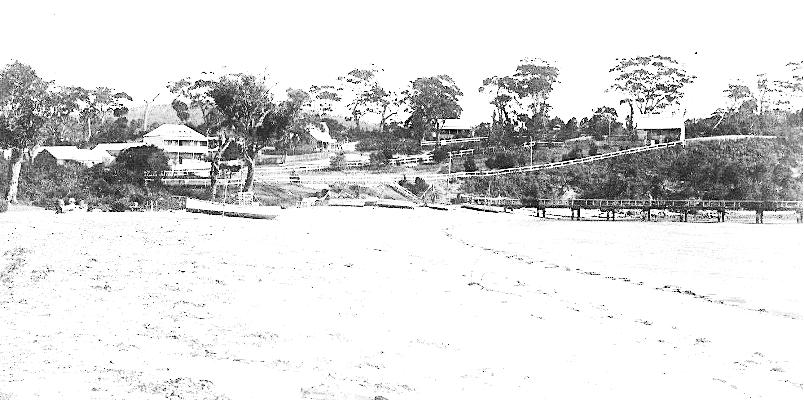
Former Nelson Bay Post Office at the top of the hill on the right, circa 1935, that now forms part of Apex Park.
Nelson Bay Postmaster assists Tea Gardens Police to send phone message – 1935
The Newcastle Morning Herald and Miners’ Advocate of 23 August 1935, page 11, reported:
‘Two young men, one from Tighe’s Hill and the other from Nelson’s Bay, are believed to have been drowned at Nelson’s Bay yesterday. The 15ft dinghy in which they had been fishing was found on the shore, slightly damaged and full of water. …..
News of the supposed tragedy did not reach Newcastle until last night. Constable Ovenstone, of Tea Gardens, which is inaccessible by telephone from Newcastle after dark, made arrangements with the postmaster at Nelson’s Bay to send a report to Newcastle police. It was received about 10 o’clock. The lighthouse-keepers at Point Stephens [outer lighthouse] and Nelson’s Bay [inner lighthouse] confirmed that the sea was calm. They said that they had not seen the dinghy at any time in the day.’
Extension of Hours for Nelson Bay Telephone Exchange – 1935
The Maitland Daily Mercury of 10 December 1935, page 7, reported:
‘Mr. V. C. Thompson, M.H.R., has been advised by the Postal Department that a review of the revenue derived from the Vacy and Nelson’s Bay Telephone Exchanges discloses that an extension of hours of attendance is justified, and approval has been given for the following hours of service to be observed:— 9 a.m. to 8 p.m., Monday to Friday; 9 a.m. to 1 p.m. Saturday.
The continuance of this arrangement will be subject to the pleasure of the present postmasters, or, in the event, of a change, to their successors agreeing to continue under the same terms. The increased hours of attendance will be introduced forthwith.’
Repair of damaged telephone wires serving Nelson Bay – 1936
The Newcastle Sun of 16 November 1936, page 6, reported:
‘A temporary ‘phone service was restored between Newcastle and Nelson’s Bay at midday by a gang of linesmen who started repairing broken lines early this morning. They found that fallen trees had broken the lines in a dozen places and in one area, between Bob’s Farm and the Lemon Tree Passage turn-off, the wire was down for nearly a quarter of a mile. It is expected that two- or three-days work will be necessary to repair the damage caused by the storm. Several poles were reported to be hanging over and will have to be straightened.’
Telephone service sought for Soldiers Point – 1938
The Dungog Chronicle of 12 August 1938, page 4, reported:
‘Representations were also made in regard to the hours of service at the telephone exchanges at Nelson’s Bay and Tea Gardens, and Mr. Thompson [Commonwealth Minister] is taking up the matter with the postal authorities in an endeavour to have a continuous service provided.
At the present time there is no telephone service to Soldiers Point. The Soldiers’ Point Progress Association has offered to make the road trafficable if the Postal Department will provide the material, which is estimated to cost about £3. At present about 50 settlers are located at Soldiers’ Point, and about 40 other blocks are being eagerly sought after.’
The Raymond Terrace Examiner and Lower Hunter and Port Stephens Advertiser of 18 August 1938, page 2, further reported:
‘The Hon. V. C. Thompson, M P., Asst. Treasurer and Asst. Minister for Repatriation, has received the following letter from the Deputy Director of Posts and Telegraphs:— Dear Sir: A letter has been received from Mr D. Bell, Hon. Sec., Nelsons Bay and surrounding districts progress Association, in which mention is made of frequent interruptions to service between Nelsons Bay and Newcastle and a direct [line] between those centres is requested.
Mr. Bell suggested that rusty iron wires might be responsible for the interruptions. Careful enquiries made into the working of the circuit in question disclose that the wires which are of hard drawn copper and in good condition, have been broken or fouled by foreign objects on four occasions during the past three months. This incidence of interruption is not regarded as excessive having regard to the season of the year and the fact that the line pushes through timbered and exposed country.
At the same time the inconvenience to callers, which, unfortunately is unavoidable in the circumstances is sincerely regretted. During the last summer season the influx of campers and visitors to the District severely taxed the capacity of existing telephones facilities to satisfactorily dispose of business and the Department is considering, therefore, the erection of an additional circuit between Newcastle and Salt Ash to relieve the existing channel of Salt Ash and Kooindah [Central Coast] traffic representing more than half of the line loading.
An excellent grade of service should then be available over the present circuit serving only Bobs Farm, Anna Bay and Nelsons Bay. Sometime must necessarily elapse before the relief facilities can be provided as the list of outstanding works is a lengthy one. Mr. Bell might please be assured, however, that the matter in which his Association is interested will be attended to in its order of urgency and with the least possible delay.’
Improvements planned for Nelson Bay Post Office – 1938
The Raymond Terrace Examiner and Lower Hunter and Port Stephens Advertiser of 25 August 1938, page 3, reported:
‘The Honourable V. C. Thompson, Assistant Minister for the Interior has been advised by the Postal Authorities that arrangements are being made to have the white ants eradicated from the Post Office buildings at Nelson’s Bay and to make good any damage they have caused. He has also been advised, in reply to representations made by him, that a survey of the postal and telephonic services at Nelson’s Bay, Tea Gardens and Soldiers Point, is being undertaken by the Postal Department, with a view to ascertaining whether improved facilities can be provided.’
War time access permits available at the Port Office – 1942
The Newcastle Sun of 16 December 1942, page 2, reported:
‘Persons applying for permits to enter the prohibited area at Nelson Bay must show or send identification cards and documents, such as deeds and rate notices, to military authorities to confirm ownership of property in the area. Those wishing to visit relatives in the area must indicate the relationship. Captain Norris will be at Nelson Bay Post Office again tomorrow to issue permits to residents.’
Post Office placed in danger by a bushfire – 1944
The Newcastle Morning Herald and Miners’ Advocate of 22 November 1944, page 2, reported:
‘Houses facing the beach at Nelson Bay were in danger from a bushfire which swept down the hill and threatened the township at midday yesterday. Several residents had prepared to go to other parts of the town. Towards nightfall the wind dropped. That enabled civilian and servicemen firefighters to keep the flames in check. A report from Nelson Bay at 10.30 p.m. indicated that the fire was burning in a gully at the southern end of the town. Danger had passed, but volunteers were standing by.
The fire started in the vicinity of False Bay on Monday night. Two sheds were burnt, and a poultry farm had a narrow escape. Fanned by a fierce southerly wind, the fire was driven rapidly towards the township. Myriads of sparks were blown over the roof of the post office, but dropped harmlessly in the bay be-yond. The town was in grave danger at one stage.’
Better phone service sought for Nelson Bay District – 1946
The Newcastle Sun of 27 May 1946, page 6, reported:
‘An improved telephone service for Nelson’s Bay is to be sought by the Soldiers Point Progress Association. At a meeting yesterday it was stated that the service through the present party line was poor. A sub-committee, comprising the president (Mr. E. P. Gilchrist), Messrs. F. W. Ball and J. Robb, was appointed to prepare a case to place before the P.M.G. Department.’
Nelson Bay Post Office trading hours extended – 1947
The Raymond Terrace Examiner and Lower Hunter and Port Stephens Advertiser of 3 July 1947, page 4, reported:
‘Mr. J. P Abbott, M. H. R. has been advised by the Postal Department that an extension of the hours of service at Nelson Bay Post Office is justified and approval has been given for the following hours to be observed: Monday to Friday 8-1 and 2-10 p.m. Saturday 8-1. Sunday, Christmas Day and Good Friday 9-10 a.m.’
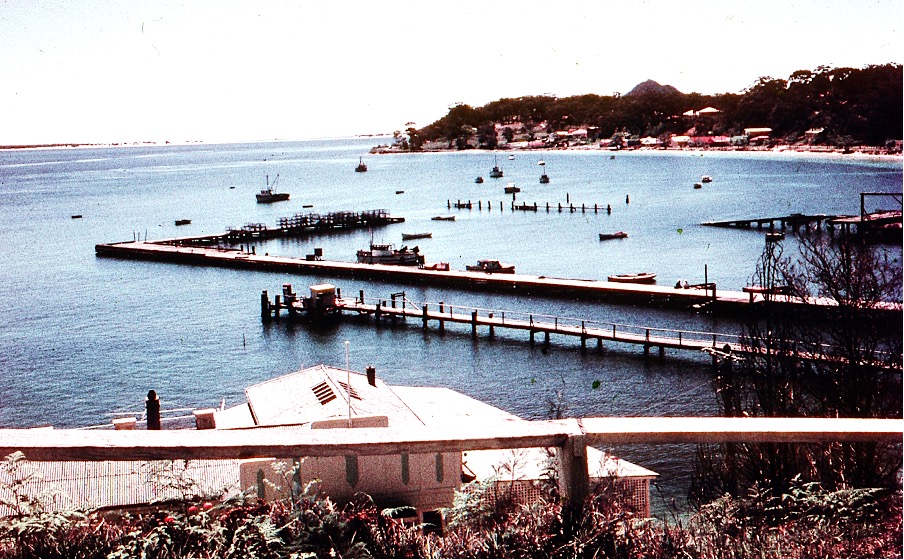
View of Nelson Bay from the location of the old Post Office in Apex Park, October 1950 [University of Newcastle, Living Histories Collection]
Concluding Comments
The current Post Office was erected on the corner of Magnus and Stockton Streets in 1960.
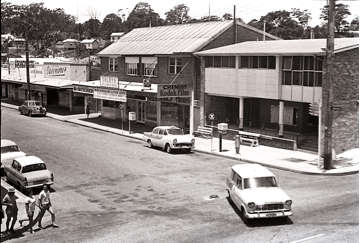
Current Post Office at Nelson Bay, on the corner of Magnus and Stockton Streets, circa 1965
An early history of the Pindimar Post Office can be found a this link on the website.
Researched and compiled by Kevin McGuinness
May 2026


