
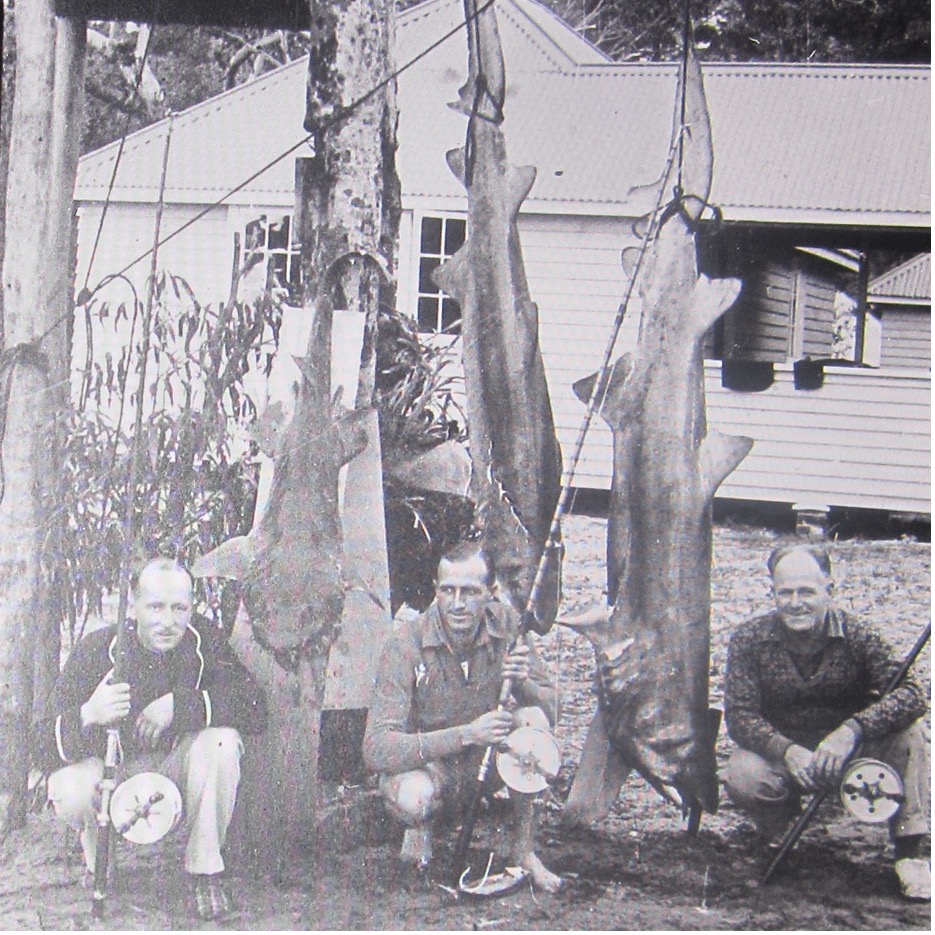
Introduction
Fishing has been an important activity at Port Stephens since the Woromi Aboriginal people relied on it for obtaining food.
After European settlement, both recreational and commercial fishing commenced. Oyster farming also became significant to the local economy. Before 1913, fishing was primarily undertaken in the port and rivers. Commercial fishing expanded into surrounding ocean waters after the Pindimar Fish Processing Factory was established in 1917.
In 1913, Dr. Mark Lidwill, a doctor from Sydney promoted the area’s potential for big game fishing. Before the sport was introduced in Australia, big game fishing was popular in America and often drew Australian competitors. It gained popularity in Sydney and the south coast of New South Wales before World War I, especially among medical professionals from Sydney.
A group of big game fishing enthusiasts from Sydney, Newcastle and Maitland formed the Pacific Big Game Fishing Club Limited in 1933 at Shoal Bay. By 1934, a camping ground had been established by the new club on crown land leased at Shoal Bay and a club house was constructed, opening in March 1935.
The formation of the fishing club popularised big game fishing to at Port Stephens and marked a major change in recreational and competition fishing in the region.
Big game fishing targets large sea fish such as kingfish, tunny, Spanish mackerel, and sharks. During competitions, members used regulation reels and lines with a specified maximum breaking strain, requiring skill to land large fish without breaking the line or rod.
In more recent times there has been a transition from capturing and weighing of game fish towards tag and release.
Over the years, numerous Australian and world record catches have been made in the waters off Port Stephens which is still regarded as one of the top areas for big game fishing in Australia.
Using the resourses of the National Library of Australia’s Trove newspaper collection, this reearch paper explores the early history of big game fishing at Port Stephens. It also looks at the beginnings of the Shoal Bay Country Club, as the premises of the fishing club became known.
Description by Dr. Mark Lidwill of Game Fishing at Port Stephens – 1913
The Sun of 11 May 1913, page 24, reported:
‘Dr. Mark Lidwill, of Strathfield, is a man who takes his holidays strenuously amongst the magnificent game fish of the world. He has found since his stay in New South Wales that in local waters the best representatives of the fighting fish are present in immense numbers, and that they give better sport to anglers than the tarpon, of Florida, or the leaping tuna, of Santa Catalina, off the Californian coast.
Speaking of his recent experiences in boats along the coast, Dr. Lidwill told members of the Rod Fishers’ Society the other night that the sport with the giant mackerels and kingfish here beggared description. “I went first to Tuncurry, where I heard there was big sea game,” said Dr. Lidwill, “but I couldn’t find them there”, and I hunted about the coast for a long time, till I found them. At Abraham’s Bosom, near Jervis Bay, I got my first local experience with something that took shifting. There I found thousands of huge Sharks. They were so thick that you could pick out the fish you wanted. They burst up my reels and tackle in no time, for the blue-pointer is a fighter of quality; and there is plenty of him.
Then I heard the tunny and big kingfish were off Port Stephens, so I went north and secured Dick Waterson and his boat, for the hunt. I purchased all the strongest spinners I could find; sent to England for the strongest made, and to America for the heaviest tarpon lures, and spun and spun for four weeks, with the result that my bag was a four-inch mackerel, caught in the eye. “I went again and tried round Broughton Island, and pretty soon all my spinners were proved to be useless. The big fish came on the job, and they smashed things to bits. The first day out I caught two kingfish, the biggest weighing 40lb., and a jewfish of 36lb., but they played the mischief with my reels and I found the thumb brake the biggest curse ever invented. I had to be content with what I had, though, until I could get better.
Then I got a Vom Hofe reel, and didn’t find it suitable, so I designed two or three kinds of reels, until at last I made one which gave all the brake-powers I wanted, and which ran freely when I wanted to reel in line. “Dick Waterson suggested that it might be advisable to try towing a garfish on lighter tackle and smaller flights of hooks behind the boat, so we went this season to Broughton Island again. We made our way into Esmeralda Cove, where there is a little boat haven, and in twenty minutes I lost twenty piano-wire traces and baits. The fish were there thick, and I learned something new every day. If the fish were hunting pilchards and gar at the top of the water there was no need to load the line with lead, but if, as often happened, they were down a few feet it was necessary to load the line with lead, each piece two feet away from the next, until as much as a pound was on, and then send the boat along at a good rate— six or seven knots. I used barrel loads, and I found short towing the best for kingfish. They are not nervous fish, and they come after a boat to see what is doing. ….
Dr. Lidwell did not try all the time close to the coast. He went 40 miles wide for the game fish, but did not get them so freely as close to the coast. He caught a young
diamond trevally that had evidently been carried hundreds of miles south from its accustomed waters in a fast south-setting current. It had curious dorsal extensions like the pennant fish. Then he came back, and got fast to a sword-fish— a rare catch— and to use his own words, it “came in like a mutton-bird.” It fairly stood on its tail in the water at times, shaking its head, and the party aboard expected the boat to be scuttled by its sword. Ultimately, however, it was beaten and gaffed, and subsequently figured in a photograph (see next section) as a remarkable catch, which it undoubtedly was. The fight with it lasted about 12 minutes, and the rod was a 14oz. one, which Dr. Lidwill considers will catch any fish in the sea.
Dr. Lidwill brought with him to the meeting three handsome specimens of the Spanish mackerel, kingfish, and tunny to show that his talk of the catches was not so much hot air. He had them cleaned and cold-stored, so that they kept splendidly. “One day off Broughton Island,” said the doctor, “I caught six Spanish mackerel, averaging about 65lb. I found them working in shoals, but directly two were caught the rest sheered off, and we had to hunt for them in another place. They differ from the kingies which will follow the boat for miles to see what has happened to those that have been caught. Coming back to Port Stephens one day we caught nine, and our average was nine for some days. …..
“The swordfish did not fight as well as a 15lb. schnapper, but the tunny is the king of them all. He fights till he dies, and I reckon it takes a minute per pound, of his weight to get him still enough alongside to gaff him. A kingflsh takes half the time, and a Spanish mackerel a quarter. A large schnapper comes next for lighting capacity; the 28-pounder was a great fighter. Next comes the blue-pointer, and then the hammer-head shark. A tailer 3ft. 6in. long also puts up a good fight. The speed of the tunny is about 60 or 70 miles an hour at first.”
Dr. Mark Lidwill and his Port Stephens Fish Specimen – 1913
In 1913, during one of his big game fishing excursions along the north coast of New South Wales, Dr. Mark Lidwell, caught a number of Spanish Mackeral, which he then thought were swordfish. Dr. Lidwell was a Sydney medical pioneer in anaesthesiology and cardiology. To identify their true species, he had one of the fish sent by the steamer ‘Karuah‘ to the Australian Museum in Sydney. The museum identified the specimen to be a Makaira Indica or Black Marlin and it became recognised that it was the first such fish in the world to have been caught on a rod and reel. The skeleton is still in the possession of the Australian Museum and was on exhibit there for many years.
In February 2003, the Newcastle and Port Stephens Game Fish Club named the weighing station at Nelson Bay in Dr Lidwell’s honour.
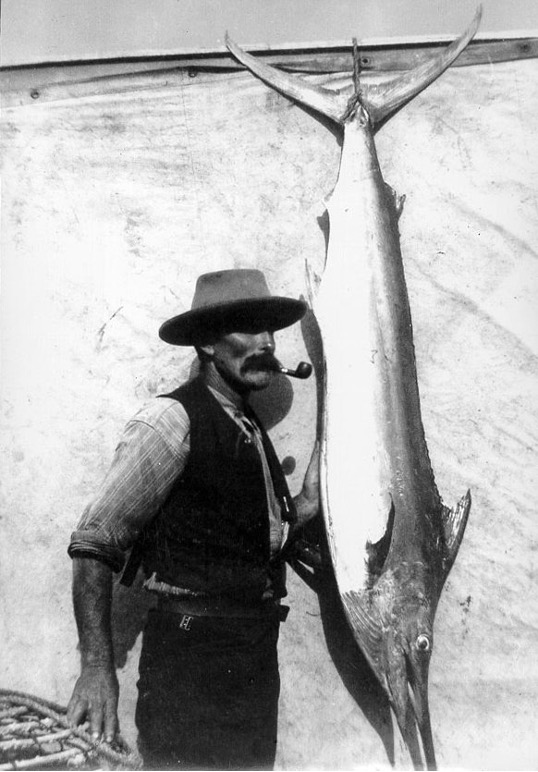
Dick Waterson, a Port Stephens boatman for Dr. Lidwell, with the Black Marlin caught at Port Stephens around 8 February 1913

Skeleton of Black Marlin caught by Doctor Mark Lidwill at Port Stephens, around 8 February 1913 – currently in the collection of the Australian Museum, Sydney [Australian Museum photo]
Early Plans for a Big Game Fishing Clubhouse at Port Stephens – 1913
The Sun of 7 December 1913, page 22, reported:
‘The big-game hunters who find their sport in the ocean off the New South Wales coast are not going to be content with the formation of a club affiliated with the Tuna Club of Santa Catalina Island, California. They are going to have their own clubhouse at a convenient centre for engaging in their exciting and dangerous sport. Dr. H. L. Maitland, president of the Anglers’ Casting Club and the local offshoot of the Tuna Club, is at the head of the movement, and his enthusiasm is shared by several medical men and others in professional and business circles in the State.
At present the club-house idea is in embryo, but it will not take long to make it an actuality, and once it is, its success is assured, for the waters of the Pacific are rich in fish of the game variety. Seen respecting the project Dr. Maitland said: “The club house is a necessary development of the magnificent ocean sport available here. Undoubtedly it will be at Port Stephens, which is convenient and safe. Broughton Island, near which the best fish are caught, is too far from the port, and too dangerous to approach in bad weather, but we can run to it in about an hour and a half from the port. In the bay near the entrance [Shoal Bay] to the port and not far from the lighthouse one can hardly throw a stone, during the Spanish mackerel season without hitting a fish. This great sport is bound to become very popular. The excitement of it has no rival, except in American waters, where varieties of game fish, such as the tuna, the giant yellowtail, the swordfish, the basses, and the albacore, are plentiful.
“The best way to establish a club will be on the company basis. There will be an outlay for the house and punt, and possibly a couple of launches, and in no time the club will pay its way, and the club “premises will increase in value automatically. Without undue optimism I can see a great future before the Port Stephens club house. Already we have a big membership, and there will be no difficulty about the financial side of the matter. It may take another year to get under way, but after that it will all be smooth sailing. I expect we will have members in all the States and New Zealand, and big-game fishers from other parts of the world will soon visit us when they see what New South Wales has to offer in the way of big fish.”
Alas, Dr. Maitland did not anticipate the First World War [1914 – 1918] which would delay the construction of the much-needed club house.

Dr. Herbert Maitland
Catch of a Rare Specimen – 1914
The Referee of 4 March 1914, page 10, reported:
‘Dr. H. L. Maitland [Herbert Lethington Maitland] and Messrs. C. H. Gorrick, Guy Belisario, and P. Hyland spent the weekend at Port Stephens, for the opening of the big sea game fishing season of the N.S.W. Anglers’ Casting Club. They had already sent up a launch from Sydney, and another was engaged at Port Stephens, the party splitting into two. Unfortunately, owing to rough weather, the launches could not get out further than the inner lighthouse, but by keeping close in shore, smoother water was found, and some large kingfish were struck. …….
A fish totally new to all anglers who have seen it was caught by Mr. Gorrick, and brought to Sydney to Mr. McCulloch, of the Australian Museum, who quickly identified it as an American black kingfish, and described it as the biggest specimen he had ever seen. This must not be confused with the local kingfish, with which it is not at all allied, being a distinct species, and more of the perch tribe. The fish, caught by Mr. Gorrick has a large, flat head, closely resembling that of a Murray cod. From the shoulders back to the tail the shape is very like the ordinary kingfish. It is dark brown in colour, with a silver stripe or band running from the gills to the tail along each side. It has a vivid orange belly. The Museum authorities intend setting up this fish, as it is the largest of its kind they have seen and consequently will form a valuable addition to their collection.’
Description of Game Fishing at Port Stephens – 1921
The Referee of 30 March 1921, page 14, reported:
‘Searchers for game fish are getting good fun with the tunny, Spanish mackerel and kingfish at Port Stephens. Shoals of garfish have attracted these sporting fish and those who enjoy the thrilling pastime are being kept fairly busy. The sport is somewhat exhausting, the strain involved in holding a big fighter for a long time being very severe on arms and wrists. Before this phase of angling became so popular Dr. Mark Lidwill, in an address to the Rod Fishers Society of N.S.W., said “The sport beggared description. At Broughton Island I lost twenty piano wire traces and hooks in as many minutes. If the fish were hunting gar and pilchards at the top of the water, there was no need to load the lines with lead, but if they were down a few feet it was necessary to put leads two feet apart until as much as a pound was on, then send the boat along at a good race — six or seven knots.
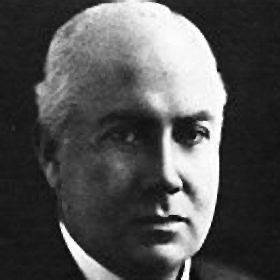
Dr. Mark Lidwill, of Sydney – a pioneer of game fishing at Port Stephens prior to his death in 1923
Kingfish are not nervous fish and will come after a boat to see what is doing, but they know every cavern in the deep, and if they can’t run ashore they dive and find a convenient rock to cut the trace below.” Regarding the fighting qualities of the fish, Dr. Lidwill said: “The swordfish did not fight as well as an 18lb snapper. The tunny is the king of them all. He fights till he dies and I reckon it takes a minute per lb of his weight to get him still enough to gaff him. A kingfish takes half the time. The speed of the tunny is almost 60 miles an hour at first.”
Some years ago, the Anglers Casting Club of N.S.W. drafted a code of rules, simple but comprehensive, to control competitions amongst its members. Anglers were compelled to bring fish to gaff unaided, and a broken rod, either before or after gaffing, constituted a disqualification. Buttons were awarded for different captures, and the sport was generally controlled on the lines adopted by the Santa Catalina organisation.
Whole garfish or pilchards make excellent bait. Garfish, which are proving the attraction for the game fish may be caught in quiet waters after being brought about by soaked bread berley well scattered.’
The weighing station on the public jetty at Nelson Bay was named in Dr Lidwill’s honour on 9 February 2003.
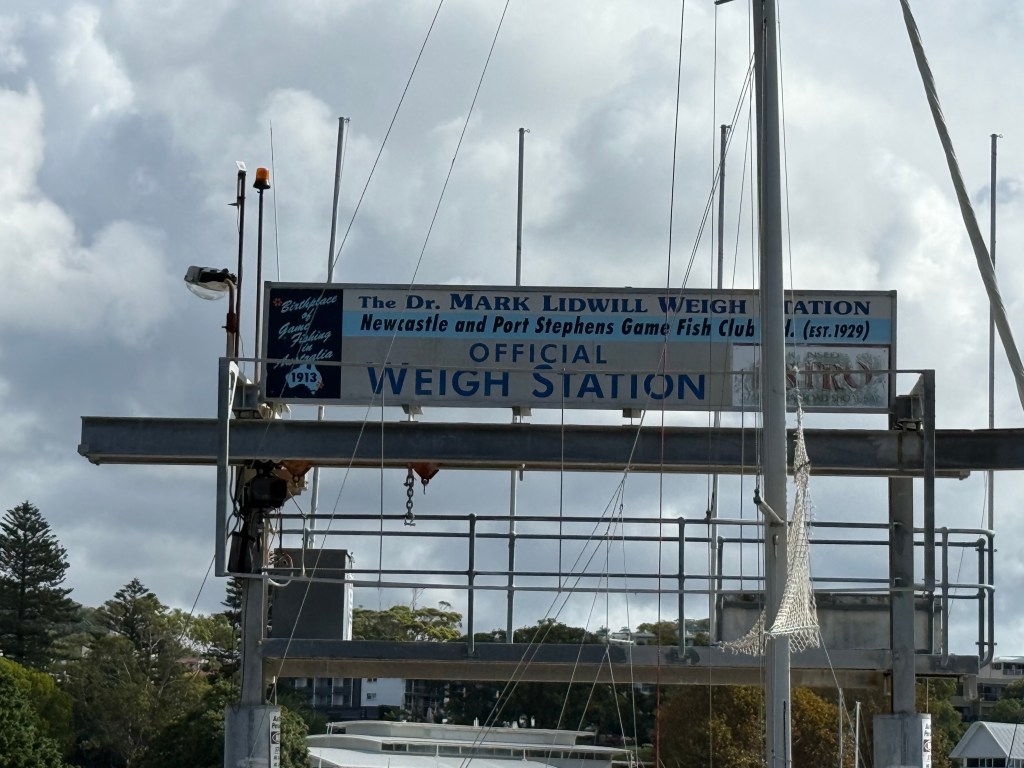
Official Weigh Station – Nelson Station [Author Photo]
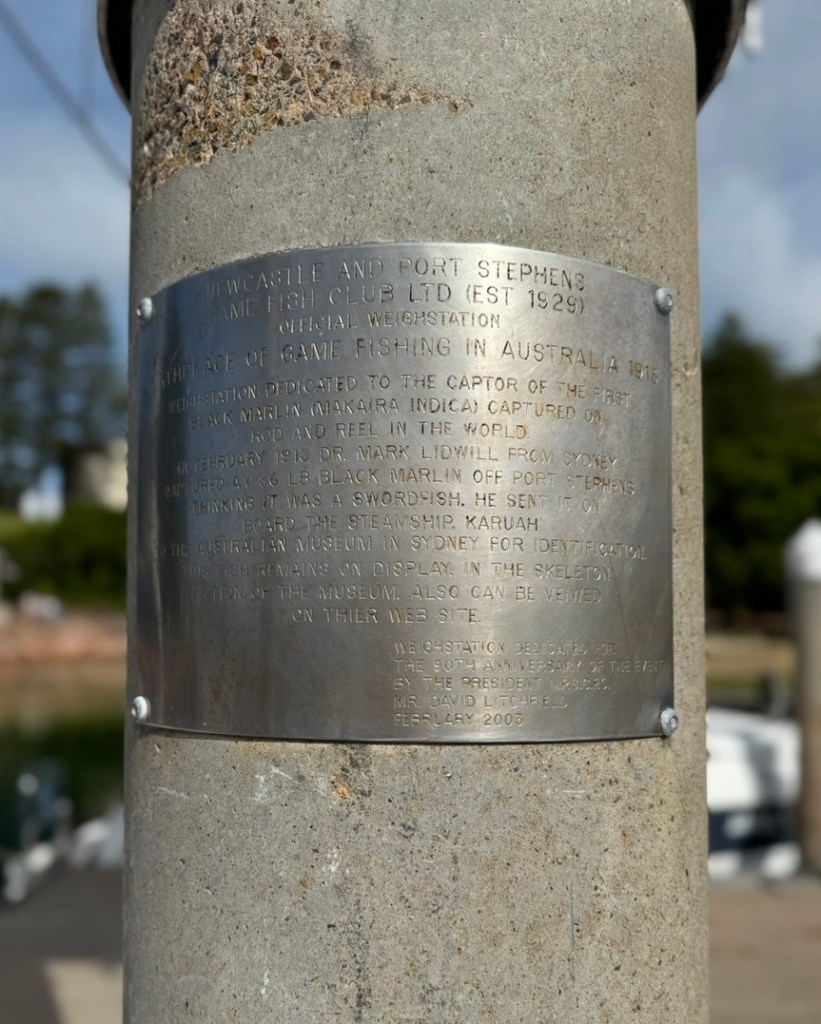
Commenorative plaque at Weigh Station [Author Photo]
The plaque reads:
Newcastle and Port Stephens Game Fish Club Ltd (established 1929) Official Weigh Station. Birthplace of Game Fishing in Australia 1913. Weigh Station dedicated to the captor of the first Black Marlin (Makaira Indica) captured on rod and reel in the world.
In February 1913 Dr. Mark Lidwell from Sydney captured an 86 lb. Black Marlin off Port Stephens thinking it was a Swordfish. He sent it on board the steamship, Karuah, to the Australian Museum in Sydney for identification. This fish remains on display, in the Skeleton Section of the Museum, also can be viewed on their Web Site.
Weigh Station dedicated for the 90th Anniversary of that event by the President, N. P. S. G. F. C., Mr. David Litchfield. February 2003.
Description of Big Game Fishing at Port Stephens – 1927
The Sydney Mail of 18 May 1927, page 10, reported:
‘One of the favourite haunts of the big-fishmen is Port Stephens, a beautiful harbour a few miles north of Newcastle, with good places of accommodation. “You leave Sydney as a rule early in the morning,” said Mr. Chidgey, in describing the sport, “and get to Port Stephens by train, car, and launch, arriving at the Port at about 6 o’clock. You can always get plenty of bait there. The fishing is done from the launch (shown in the two illustrations below).
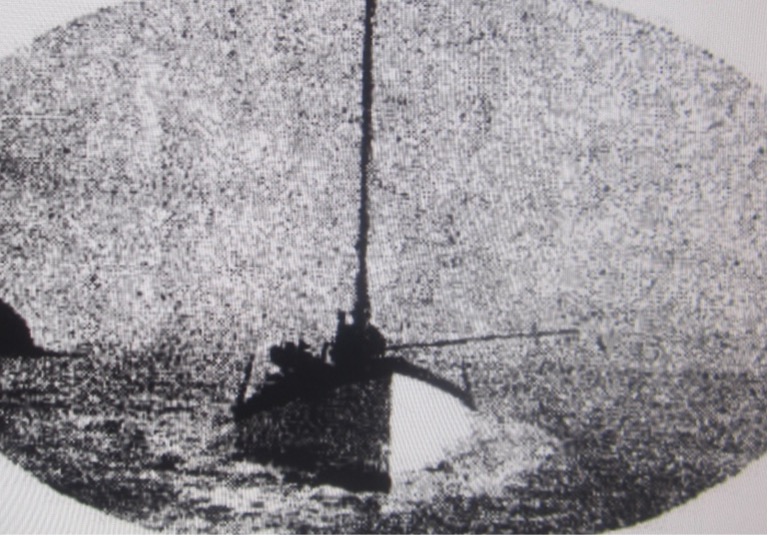
A boat used for big game fishing at Port Stephens [Sydney Mail, 18 May 1927]
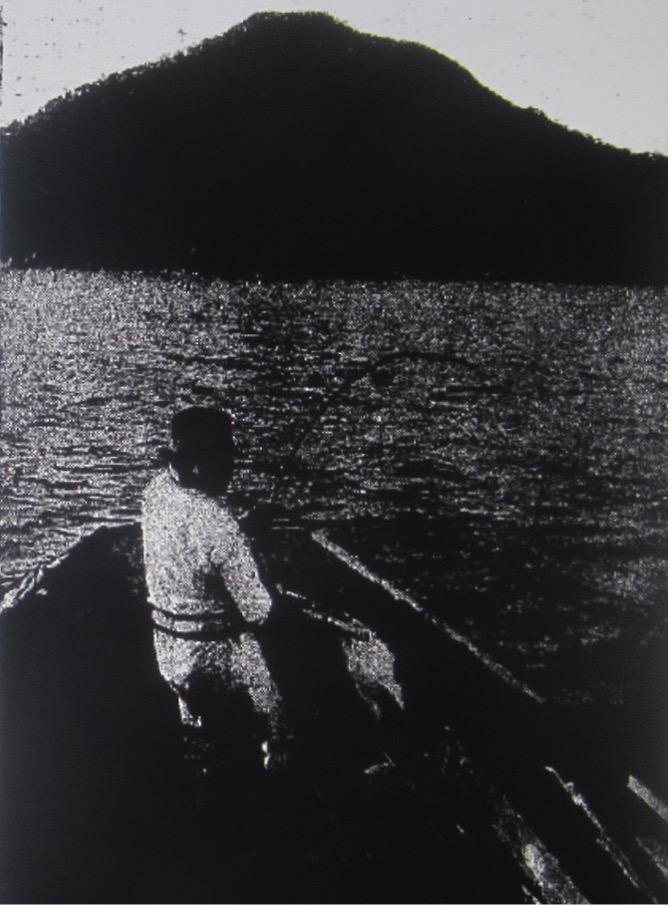
Mr. H. O. Chidgey playing a big fish at Port Stephens [Sydney Mail, 18 May 1927]
On the reel is a line of about 400 yards in length. Sometimes it is longer. In fishing, we have about 100 yards out behind the boat. We are after Spanish mackerel or tunny. When a big one bites it carries out in a rush for another 200 yards or so. That’s in the first rush. After that the fight begins. The fish makes more rushes. You get him closer and closer to the boat, and generally when you get him up close he starts off again. It is hard to get him in, and it can only be done by pumping. Sometimes the tussle will last half an hour; sometimes an hour and a half. You never know what you’re in for. If the tackle is light you have to let him go. Once you get him 15 or 20 feet from the boat it is difficult to shift him, because there is the danger of snapping the rod. You bring him a little closer, a little closer, every time he goes off — a little closer, until at last he is within striking distance with the gaff.
If he is smaller than you want you cut the wire with the pliers and let him go. Sometimes you will catch the same one a second time, which proves that fish haven’t got the feelings that we have. I’ve done that repeatedly. We are ‘game’ fishers. We don’t fish wantonly just for the mere killing. ‘Sometimes the catch will show tremendous power. In the rush they will pull you from one end of the boat to the other.
We can’t fish with toys in those circumstances. Inexperienced fishermen will break their rods easily. Sometimes an experienced man will do that when the fish will be brought underneath, and will make a rush straight down. That gives a pull on the rod in a way that makes it impossible for a break to be avoided. ‘The boat, when we are fishing, goes at about five or six miles an hour, with the line out and what is known as a teaser on it- — an imitation of a fish. They jump at the teaser.’
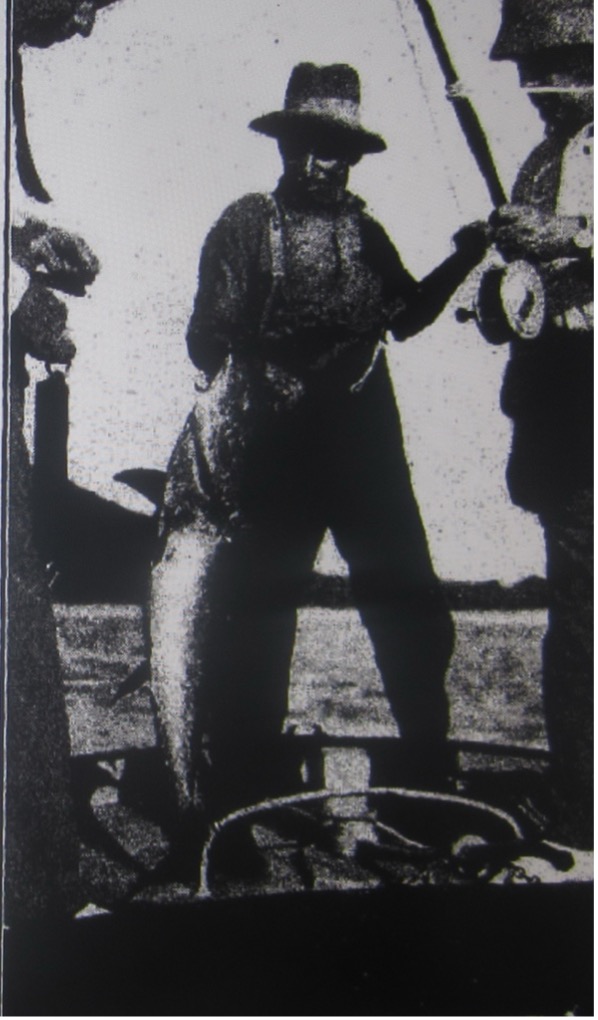
Weighing the catch at Port Stephens [Sydney Mail, 18 May 1927]
The Spanish mackerel run up to about 40 and 45 pounds in weight. It is known as a mackerel, but it belongs to the herring family. We catch them anywhere outside. They are a migratory fish, chasing the garfish, travelling up the coast all the time. We have never got them further south than Bateman’s Bay. They travel up north, and are gone by the end of May, after which we don’t see them again until about February. Sometimes those fish will jump 30 feet out of the water — a tremendous jump, but they are big powerful things, running to five and half feet in length. ….
The big game fish as we know them are the Spanish mackerel, the southern tuna, or tunny, the king fish, the tailer, and the sharks. Once we caught a swordfish as they do in New Zealand, but we haven’t discovered them properly yet. They have been seen off the coast by the fishermen in the last few years. The mako shark they catch in New Zealand is similar to the blue pointer, and we have millions of them here.
We have not long started this salt-water section of the society. The rodfishers, who are essentially trout fishers, decided to go in for it, and Mr. Pope, Mr. Andreas, and myself [Mr. Chidgey], joined the committee formed to popularise big game fishing in New South Wales. Mr. Andreas is a famous Australian fisherman. We are out for ‘game’ fish, and it is a sport that should be something more than the hobby of a society of a few members.
It should be a government work, popularising it as they do in New Zealand, where they make so much out of it. Look at the men who go from here to New Zealand after the big game fish. They go there because they don’t know we have big game here. As to shark fishing, is there anything so far as sharks are concerned in New Zealand to compare with what can be obtained here? Big fishing is not a matter of our own coast alone; you can go up to the Great Barrier Reef.”
Proposed formation of the Pacific Big Game Fishing Club – 1933
The Newcastle Morning Herald and Miners’ Advocate of 20 October 1933, page 10, reported:
‘Many times in fishing circles round Newcastle the possibilities of big game fishing have been discussed for Port Stephens waters, but up to the present nothing in the way of an organisation has been formed. It is claimed that Port Stephens compares favourably with the world’s famous game fishing resorts. A number of Newcastle leading anglers desire to form a big game club, and a meeting has been convened at the N.S.W. Sports Stores, 655 Hunter-street West, Newcastle, for 8.15 p.m. on Monday. Judging by the interest shown, it should be largely attended. Further particulars may be learned from Mr. Rex Asher. of the N.S.W. Sports Stores.’
The Newcastle Sun of 24 October 1933, page 8, also reported:
‘At a meeting of more than 50 fishing enthusiasts last night, it was decided to form an anglers’ club, to exploit the game fishing facilities of the Port Stephens and North Coast grounds.
The following officers were elected: President, Mr. R. A. Derkenne; vice-presidents, Messrs. B. M. Wainwright, W. R. Moore, P. Flohm, W. Thomas, and P. M. Gaussen; secretary, Mr. Rex Asher; assistant-secretary and treasurer, Mr. G. Grahame; auditors, Messrs. O. Banks and F. Armstrong; committee, Messrs. O. Banks, H. O. Hopkins, G. Stanley, F. Dickinson, N. V. Silverthorne, and Sutcliffe.’
Tourism Impact of the Big Game Fishing Camping Ground at Shoal Bay – 1934
By 1934 a camping ground had been established by the newly formed Pacific Big Game Fishing Club on crown land leased at Shoal Bay and a club house was planned for construction.
The Newcastle Sun of 13 August 1934, page 2, reported:
‘Regarded by the Newcastle Publicity Director, Mr. Cahill, as an important tourist project for the Newcastle and Northern district, a modern club house which will accommodate 80 or more guests is about to be built at Shoal Bay at the entrance to Port Stephens. The object is to popularise deep-sea fishing at Port Stephens and provide facilities for big-game fishermen whom it is hoped to attract, not only from all parts of Australia, but also from overseas.
The project is being undertaken by The Pacific Big Game Fishing Club, and work has already been commenced on the erection of 14 cottages (or “huts” as they are called) which are included in the scheme. An expenditure of between £2000 and £3000 will be involved in the complete project.
“Preference is to be given to club members who require accommodation,” the Newcastle Publicity Director (Mr. Cahill) said today, “but tourists will also be accommodated. The whole idea is to organise the tourist facilities there, and the scheme will bring Port Stephens into line with the leading fishing resorts of the world.” Mr. Cahill conferred with the organiser of the scheme (Mr. Raper), who is now in Newcastle, and who hopes that the project will appeal particularly to big-game fishermen in this area. “The facilities being provided,” Mr. Raper said, “are badly needed by big game fishermen who like fishing at Port Stephens”.
The club has about 40 acres of land there, and the main club house will include a dining-room for 140 people.” The situation is in picturesque scrub, the area being a declared sanctuary for native flora and fauna. The club house will be practically on an island at the entrance to Port Stephens and will be connected by a good track to the main road at Nelson’s Bay. There will be good surfing, swimming, and fishing on the ocean beaches at Zenith Beach, False Bay [Shoal Bay], and Fingal Cove, and the property will face Shoal Beach, which is a picturesque and safe anchorage.
We expect to commence constructing the club house within a fortnight, and that the whole job will be completed within two months.” The club house will be a two storey weatherboard building with a frontage of 138ft. Besides a dining room, which will also be used for dancing and will accommodate 140 people, it will contain vestibule, office, library, cloak room, buffet, two sun verandas, a billiard room, and two balconies overlooking the bay and the grounds. A view of the dance floor will also be available from the balconies, and a novel feature will be a balconette set in the centre of the chimney. The 14 huts, or cottages, six of which are now built, will be erected round the quadrangle.
Mr. Raper said that it was also intended to build a wharf, and that the scheme included the construction of a swimming baths. Both the wharf and the baths would be flood lit by electric light, and the Lands Department had now been asked for permission to proceed with this work. “If the fishermen are interested, tennis courts and a golf course will also be provided,” Mr. Raper said. “But this will depend on the desires of the fishermen who visit the place regularly.” Mr. Raper explained that the club was a proprietary company, which was about to be formed, and that membership would cost £10 for shares in the company. It was proposed to limit membership to 200, but accommodation would also be available for fishermen who were not members.’
The Newcastle Sun of 6 September 1934, page 18, also reported:
‘In these delightful surroundings the Newcastle and Northern District Big Game and Deep-Sea Fishing Club has its camping quarters in the Port Stephens district. The photograph [below] was taken by the Government official photographer, who has just completed a tour of the district in connection with the publicity drive launched by the Council Tourist Bureau.’

Shoal Bay Fishing Camp – situated on Crown land behind the present day Country Club and adjacent Ramada Resort [NSW State Archives]
The Newcastle Sun of 6 November 1934, page 10, also reported:
‘The Pacific Big Game Fishing Club, Ltd., which has been registered in New South Wales with nominal capital of £20.000, in shares of £1 each, has for its primary object the establishment of a Fishermen’s Club at Shoal Beach, Port Stephens. Shoal Beach is the old headquarters of the famous Tunny Fishing Club, in which the late Sir Herbert Maitland was prominent. The property acquired by the company is regarded as being ideally situated for a clubhouse.’
Preparations for the Opening of the Clubhouse at Shoal Bay – 1935
The Sydney Morning Herald of 19 February 1935, page 10, reported:
‘Provision for big game fishing as an organised sport in New South Wales coastal waters on a scale comparable with that developed in other countries is to be made available to sportsmen at Shell Beach [Shoal Bay], Port Stephens. The Pacific Big Game Fishing Club, Ltd., which has been registered with a nominal capital of £10,000, is about to take over a large and specially equipped clubhouse erected at Shell Beach by Dr. H. P. Elliot, of Tuncurry, and proposes to develop deep-sea big game, and other fishing in the waters of Port Stephens and the adjacent coasts.
It is proposed that membership of the club shall be limited to 300, all of whom will be subscribers. The clubhouse provides living accommodation for 64 members. In the grounds, which comprise more than 40 acres, there are also a number of comfortable cabins for the accommodation of parties. It is proposed, also, to lay out a golf course and tennis courts. A fleet of launches suitable for deep-sea work is to be provided for the use of members
The object is to attract oversea sportsmen to the coastal waters of New South Wales when the fishing grounds have been properly explored and proved. The new club is to be formally opened by the Chief Secretary (Mr. Chaffey) on March 2.’
The Newcastle Sun of 26 February 1935, page 4, also reported:
‘The Chief Secretary (Mr. Chaffey) will officially open the new club house and headquarters of the Pacific Big Game Fishing Club at Shoal Bay, Port Stephens, on Saturday, at 3 p.m. The Newcastle City Council will be represented at the function by the Mayor (Ald. Christie), the Town Clerk (Mr. Glassop), and the Publicity Director (Mr. Cahill), and many leading anglers from Sydney and Newcastle will be present, as well as the head of the Government Tourist Bureau (Mr. Lamble), of Sydney. Competitions for beach, estuary, and deep-sea fishing will be arranged.
Tunny fishing will be in full swing, and anglers are promised a good weekend. Mr. Cahill regards the establishment of these club headquarters as the first definite attempt to organise the fishing attractions of the area.’
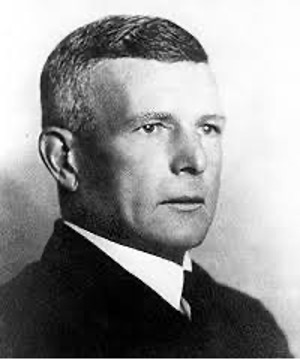
Frank Augustus Chaffey, Chief Secretary
The Newcastle Morning Herald and Miners’ Advocate of 27 February 1935, page 6, also reported:
‘The clubhouse and individual accommodation huts which have been erected at Shoal Bay, Port Stephens, for the establishment of what will be known as the Pacific Big Game Fishing Club will be officially opened by the Chief Secretary (Mr. F. A. Chaffey) in the presence of district and visiting local government authorities and the public on Saturday afternoon. Newcastle City Council will be represented by the Mayor (Ald. R. H. Christie), the Publicity Director (Mr. F. J. Cahill) and the Town Clerk (Mr. John Glassop).
Visitors from Sydney and Newcastle are expected. It was stated last night that those interested in the development of the club are keen to foster big game fishing. Beach and port fishing in the vicinity of the club quarters has been very successful, fish have even been caught by throwing a line from the clubhouse veranda, but little has been due in the direction of catching bigger fish. The clubhouse is a spacious building, erected on the water’s edge. Near it are a number of small huts, now leased to casual visitors, which will later be reserved for the use of members of the club.’
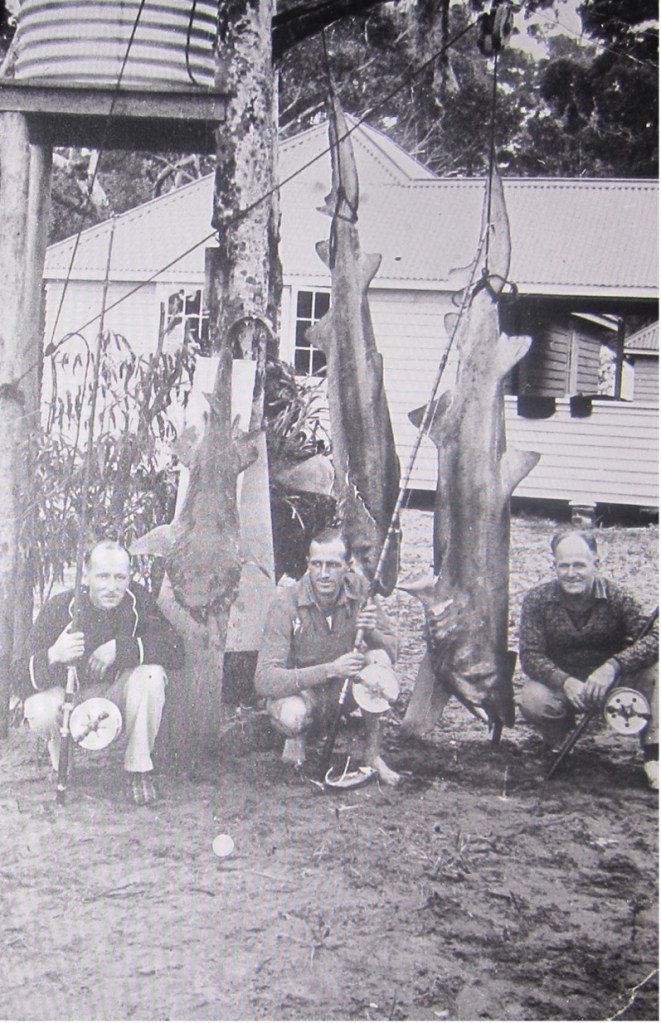
[Left to right] Athel D’Ombrain, Newman Silverthorne, Sil Rohu. The first big game catches of 1935 at Shoal Bay were two grey nurse sharks and a wobby-gong. The new clubhouse is in the background [Newcastle University Living Histories collection]
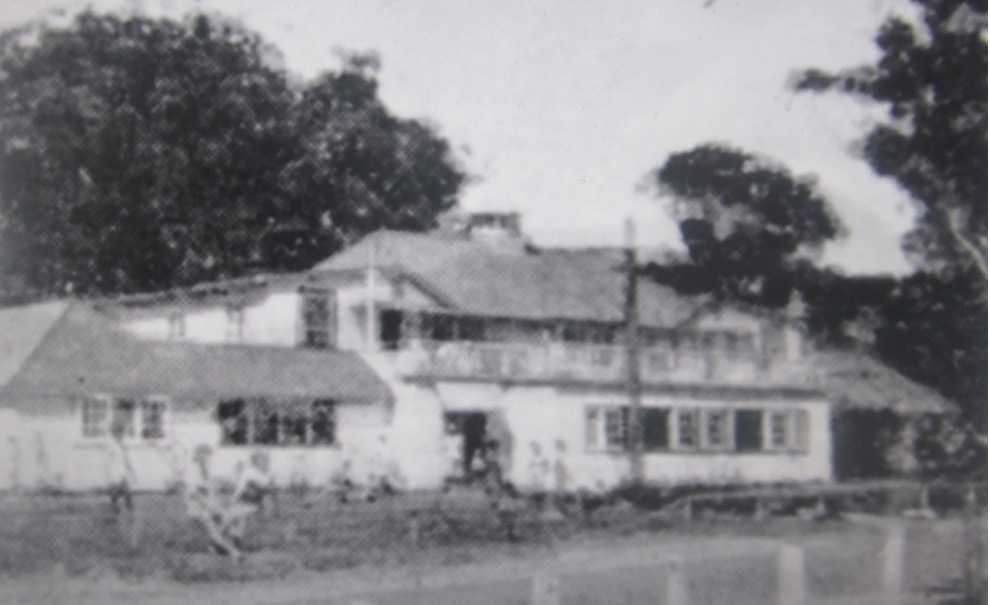
Former Big Game Fishing Club with its front veranda – the site and forerunner of the present day Shoal Bay Country Club
The Sun of 28 February 1935, page 2, also reported:
‘An elaborate fishing camp at Shoal Beach, just inside the heads of Port Stephens, will be opened by the Chief Secretary (Mr. Chaffey), for the Pacific Big Game Fishing Club, at 3 p.m. on Saturday. The clubhouse has been designed by Mr. R. J. Magoffin (who designed the new Mosman rowing shed). The big game fishing waters round Broughton Island and Seal Rocks are close at hand, while the port itself is a noted fishing ground.’
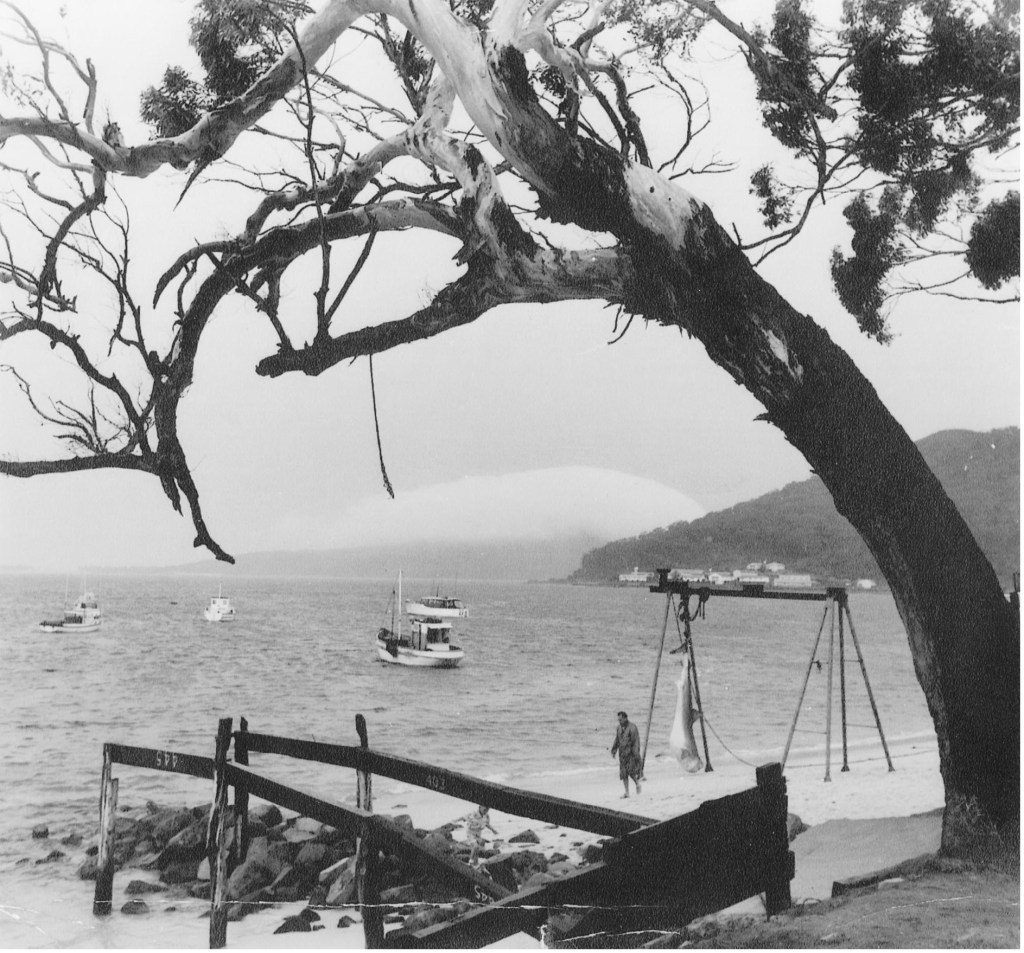
Weighing apparatus on the beach at Shoal Bay
Official Opening of Club House at Shoal Bay – 1935
The Sun of 3 March 1935, page 13, reported:
‘The Chief Secretary, Mr. Chaffey, opened the Pacific big game fishing clubhouse at Shoal Beach, Port Stephens, this afternoon, and spoke of the need for developing this important industry. He believed that the Amended Fisheries Bill now before the House would help to achieve this. Members of the club, including Mr. Chaffey, have been delighted with the catches since their arrival last night. Fishing competitions from the beach were held this afternoon, and tonight a large party will try its luck near the Heads. An all-day excursion will be made tomorrow.’
The Newcastle Sun of 4 March 1935, page 5, also reported:
‘Set in the picturesque surroundings of Shoal Beach, Port Stephens, with the mountains of Tomaree and Yacaaba in the background, the Pacific Big Game Fishing club-house was opened at the weekend by the Chief Secretary (Mr. Chaffey). The Mayor of Newcastle (Alderman Christie), the Town Clerk (Mr. Glossop), the Publicity Officer (Mr. Cahill) and the district representative of the N.R.M.A. (Mr. Rue) attended the happy function, which was held in front of the attractive new quarters of the club, situated on the edge of the beach. A humorous touch was supplied when one speaker referred to the new building as the “fishtory factory,” where, he said, many stories would no doubt be originated.
The enterprise and faith of the club builders in opening up one of the most beautiful tourist resorts of the North, with its waters teeming with fishing, was the subject of general comment. The Chief Secretary mentioned the amendments to the Fisheries Bill and the neglect to which the fishing industry had been subjected in the past. He had had the task imposed on him of studying the fishing laws and the inadequate provisions revealed the necessity for developing this important industry. He suggested the setting up of vigilance committees in the various districts to see that the industry was not abused.
“Port Stephens is a haven of peace,” said Mr. Chaffey “waiting in lonely majesty for the day when Australia will use its resources for trade and commerce. “It is unequalled for snapper fishing and for big game fish such as tunny and king fish as well as for the more common varieties not to mention jewfish. The fighting shark abounds, and very soon, I am convinced, these waters will be as popular as those of New Zealand.” Mr. Chaffey proved himself an able fisherman with Mr. F. Power (Bank of New South Wales), R. Whittaker (Jeweller) and Mr. A. Berrick (Bargain Arcades), of Newcastle, when he went deep fishing near Broughton Island.’
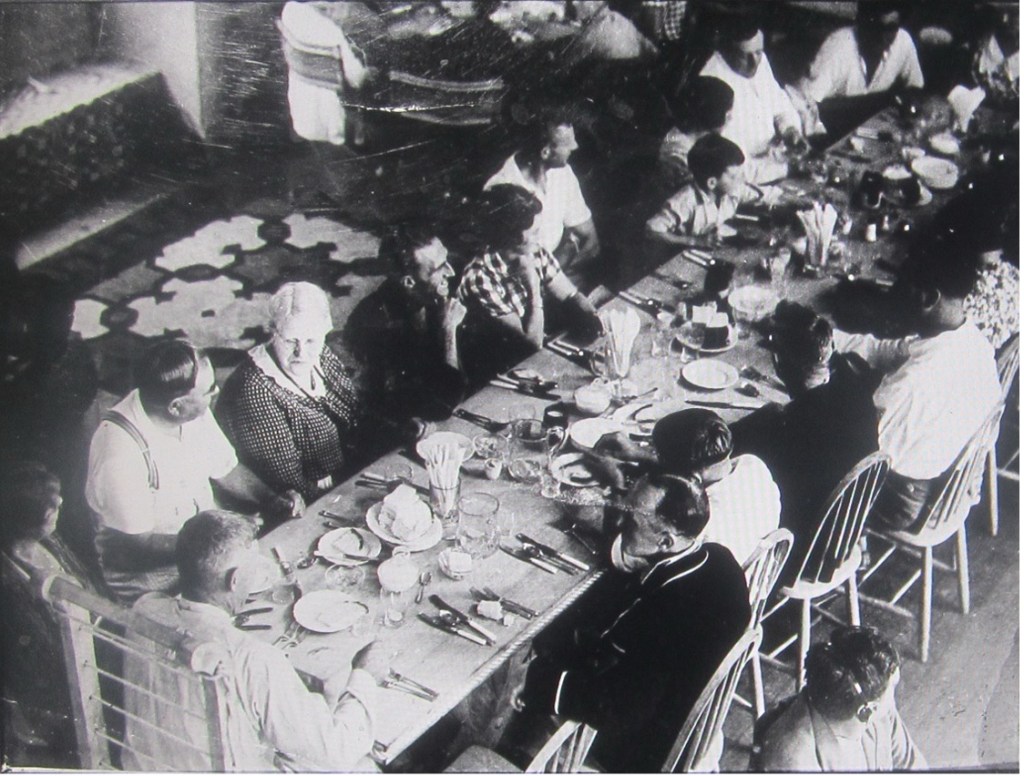
Official opening of the club house with Mr. Chaffey, Chief Secretary, in black coat at bottom of photo (Newcastle University, Living Histories collection)
Directions to the Club and Cabin Grounds – 1935
The Newcastle Sun of 5 March 1935, page 4, reported:
‘During the weekend some good catches of bream, schnapper and big game fish were noted in the bags of many visitors who spent the weekend at the official opening of the Pacific Big Game Fishing Club rooms at Shoal Bay.
The club house is in pretty bush, 2.3 miles from Nelson’s Bay township. It is reached by turning to the right at hotel [Sea Breeze Hotel at Nelson Bay], thereafter, following a road close to the water, beyond which a turn-off on the right hand side to False Bay [Fingal Bay] is noted and disregarded. Nearly half a mile further on a right-hand turn is taken. For the next mile to the club house the track is rather narrow and sandy and calls for careful driving. Considerable improvement to this track is promised in the near future. Adjoining the club house is a well timbered, sandy soil area suitable for camping. Water and conveniences are available, and a tennis court is being made. Motorists using the area have been promised the use of club rooms. A small fee is charged for camping. Motorists should communicate with the manager at Shoal Bay.’
An Unique Club on New South Wales Coast – 1935
The Newcastle Morning Herald and Miners’ Advocate of 29 March 1935, page 9, reported:
‘The Pacific Big Game Fishing Club, which began its activities this month at Shoal Bay, Port Stephens, is the only one of its kind on the coast of New South Wales. The object of the club is to provide facilities for fishermen, who find their sport in landing the big fish which inhabit the Pacific Ocean. Around Port Stephens, there are plenty of tunny, Spanish mackerel, kingfish, and sword fish, hammerhead and blue pointer sharks.
Of course, all these big fish could be landed with ease with heavy tackle, but the maximum of sport is obtained when they are caught on the regulation sporting tackle, which is so much lighter, and demands great skill in its manipulation in playing the fish. All these fish are caught on a trailing bait.
The club, in addition to housing its members comfortably, provides a number of motor boats. Although the club has been formed only a few weeks, there is already a good membership. The season for big game fish is now at its height, and at weekends, especially, there are large parties sharing in the sport. Sydney and Newcastle sportsmen are well represented at these gatherings. During this month, there have been some good catches of tunny and mackerel. Mr. T. Raper, of Sydney, is Manager of the club, which is aiming at a membership of 250.
Big Game Fishing filmed by Cinesound Films Limited – 1935
The Newcastle Morning Herald and Miners’ Advocate of 29 March 1935, page 10, also reported:
‘Cinesound Films Ltd., will send a cameraman with the Newcastle party which proposes to spend the weekend of April 13 and 14 big game fishing at Port Stephens. Pictures will be taken of exciting incidents, and of the scenery, and will be made into a gazette. It is hoped that the filming of Port Stephens will be a prelude to a gazette of Newcastle and its industries. The party, which has been arranged by the City Publicity Director (Mr. F. J. Cahill) will comprise amateur fishermen of Newcastle and Sydney, including many prominent businessmen of both cities. It is expected that about 100 will stay at the fishing camp [at Shoal Bay]. Amateur fishermen who desire to join the party should communicated with Mr. Cahill.’
“Fishing Guide to Newcastle and District” – published 1935
The Newcastle Morning Herald and Miners’ Advocate of 30 April 1935, page 6, reported:
‘The distribution by the Newcastle Tourist Bureau of the “Fishing Guide to Newcastle and District” has directed attention to the fishing attractions of the district. The bureau has received numerous requests for copies, not only from all parts of New South Wales, but from Queensland and Victoria. Mr. D. J. Pothecary, Editor of “The Fisherman,” published in Melbourne, and the only Australian fishing paper, said that he had visited the area at Port Stephens, and considered it a most suitable district, for the formation of big-game fishing club. He thought it was far superior to the present well-advertised district at Narooma. “The facilities for big game fishing are extraordinarily good at Port Stephens,” he said, “and particularly because there is no bar at the entrance, which is something which will eventually cause a falling off of the popularity at Narooma.” Mr. Pothceary said that the “Fishing Guide” was the most attractive booklet he had seen.’
Management of Club premises taken over by Pioneer Motor Tours – 1935
In 1935, the management of the Pacific Big Game Fishing Club’s premises were taken over by the travel organisation, Pioneer Motor Tours.
The game fishing club retained ownership of the club premises which became known as the Shoal Bay Country Club.
Promotion of fishing trips to Shoal Bay – 1935
The Newcastle Sun of 14 August 1935, page 9, reported:
‘The [Newcastle] City Council Tourist Bureau announced today that a fishing trip to Port Stephens had been arranged for the weekend. Saturday night will be spent at the Pacific Big Game Fishing Clubhouse and there will be fishing in the afternoon or evening. On Sunday there will be a picnic cruise by launch.’
The Newcastle Sun of 17 October 1935, page 12, reported:
‘Newcastle Tourist Bureau has been advised that the Pacific Big Game Fishing Club headquarters at Shoal Bay have been taken over by Pioneer Motor Tours, an interstate travel organisation. It is intended to develop the fishing camp as a holiday resort, and additional conveniences for holiday visitors are being provided. An office will be opened In Newcastle, and Mr. R. Burt has been appointed Newcastle manager.’
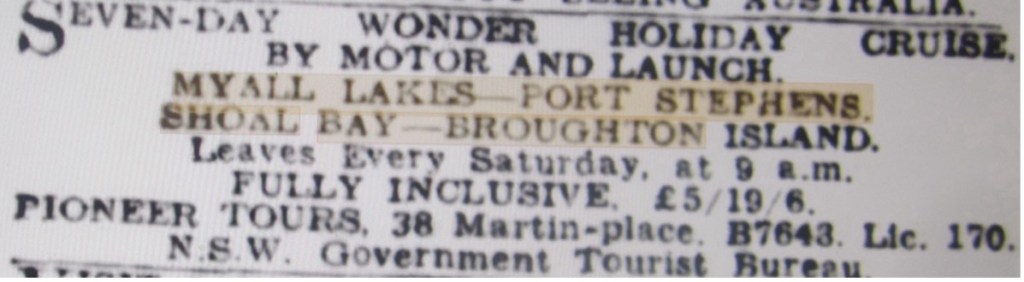
Advertisement in the Sydney Morning Herald of 2 November 1936, page 2, for a seven-day trip to the Port Stephens district with Pioneer Tours
Planned evaluation of Big Game Fishing tourism potential – 1936
The Dungog Chronicle of 21 January 1936, page 3, reported:
‘The possibilities of big game fishing off Port Stephens are to be investigated in the hope, of commercialising the sport. Mr. Zane Grey will be invited to fish at Port Stephens if an expedition, to visit that locality shortly, can prove that big fish are plentiful.
With a view to ascertaining if big game fishing at Port Stephens is sufficiently attractive to develop the sport as a commercial proposition, the Newcastle Publicity and Tourist Bureau, in conjunction with Pioneer Motor Tours, is making arrangements for a trial expedition at an early date. Should swordfish and other large fish be found in sufficient numbers, it is proposed to invite Mr. Zane Grey to spend some time fishing in the area before he leaves the Australian coast.
The possibilities of big game fishing off Port Stephens have been brought to the notice of Mr. Zane Grey, who has expressed a desire to obtain as much information as possible concerning the locality. A prominent big game fisherman, said recently that he had caught young swordfish off Broughton Island. The swordfish are migratory and arrive at New Zealand and the east coast of New South Wales about February. They start to leave about April and travel north as far as Japan. Because of the presence of young swordfish near Broughton Island, it is believed that their breeding places are in the northern waters of New South Wales.’
[Zane Gray was a world-famous author and keen big game fisherman. There is no record he visited Port Stephens to fish].
Reference to Shoal Bay Country Club – 1936
The Newcastle Sun of 8 June 1936, page 8, reported:
‘Port Stephens as a winter holiday resort is receiving a lot of attention from tourists according to the City Publicity Director (Mr. P. J. Cahill), who attended a ‘house-warming’ at the Country Club, Shoal Bay, on Saturday night.
The club has been taken over by a Sydney transport organisation which proposes to develop it, Mr. Cahill said today. If present plans are carried out, it should become one of the most popular tourist resorts in the State. The house-warming function was attended by tourists from Sydney, as well as visitors from Newcastle and Port Stephens. The President of Port Stephens Shire Council (Councillor Clode), the clerk (Mr. Monkley) and Mrs. Monkley were present.
The Shire President expressed the view that Port Stephens offered possibilities second to none along the coast as a holiday resort. He recognised, he said, that the road from Newcastle to Nelson’s Bay was a handicap, but the Shire Council proposed to tar surface another eight miles and put the balance in trafficable order before next tourist season. It had been impossible to get to Nelson’s Bay for years by road, but since the establishment of the Tourist Bureau by the [Newcastle] City Council there had been a tremendous increase in the number of holidaymakers and tourists generally.
Councillor Clode congratulated the Sydney organisation on its enterprise and assured both it, and the Newcastle Tourist Bureau of the Shire Council’s full cooperation in doing everything possible to make Nelson’s Bay more attractive. Mr. Cahill said today that next weekend a party of 40 or 50 Sydney people would visit Shoal Bay and it was his intention to cooperate in advancing the interests of Port Stephens and Newcastle as ideal winter sports.’
The Newcastle Sun of 7 December 1937, page 10, published the following tourism information on Shoal Bay:
‘Shoal Bay: Camping sites at Country Club’s Clubhouse. Turn right at Nelson’s Bay Hotel and follow beach road to sign ‘To Shoal Bay Clubhouse.’ Two miles to clubhouse. Camp sites for members, including water, fireplace, sanitation, tent poles. 2s 6d night, 5s week. Provisions, light refreshments from club. Handy to ocean beach and entrance to Port Stephens. Boats and launches. Fishing, swimming, boating, surfing, tennis, riding, huts available 10s week, controlled by Shoal Bay Country Club Ltd. Sydney office. 38 Martin-place. B7648.’
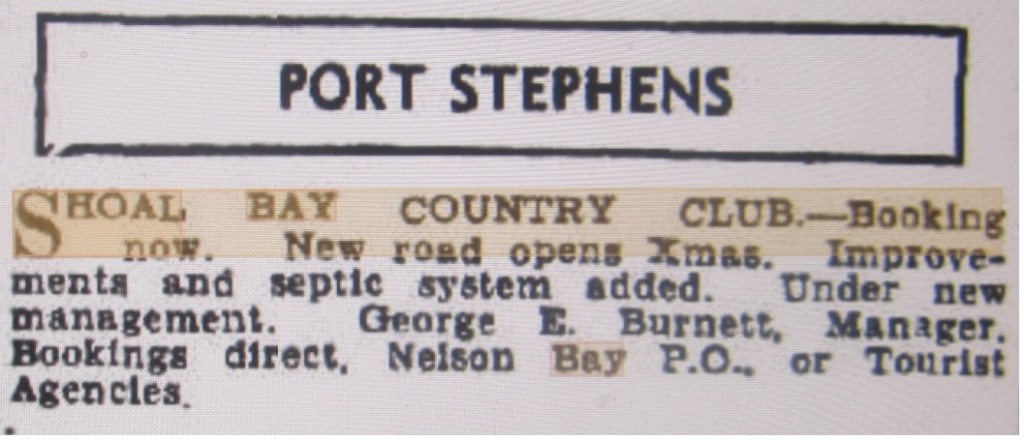
Advertisement for Shoal Bay Country Club advising that the country club was under new management and a new road was planned to open at Christmas [The Daily Telegraph, 7 December 1938, page 18]
The Maitland Daily Mercury of 16 September 1939, page 4, reported:
‘Shoal Bay Country Club, at Nelson’s Bay, asked the Council to improve the road to the property. The club was spending a good deal of money on improvements and asked that it receive some support in this way. The engineer was instructed to inspect the place.’
The Maitland Mercury of 30 December 1939, page 1, also reported:
‘Fishing from Mr. Jack Jensen’s boat a mile off Little Island this morning, Mr. Athol D’Ombrain, of Park-street, Lorn, hooked a 206lb black marlin. The fish’s first run took between 300 and 400 yards of line off the reel and after an exciting struggle of 45 minutes, it was eventually brought to gaff, and proudly taken to the Shoal Bay Country Club, where Mr. and Mrs. D’Ombrain are guests, to be weighed. This is the first marlin caught in the waters adjacent to Port Stephens this season, and there is sure to be a rush of big game fishermen to the vicinity.’

Athol D’Ombrain fighting a big fish
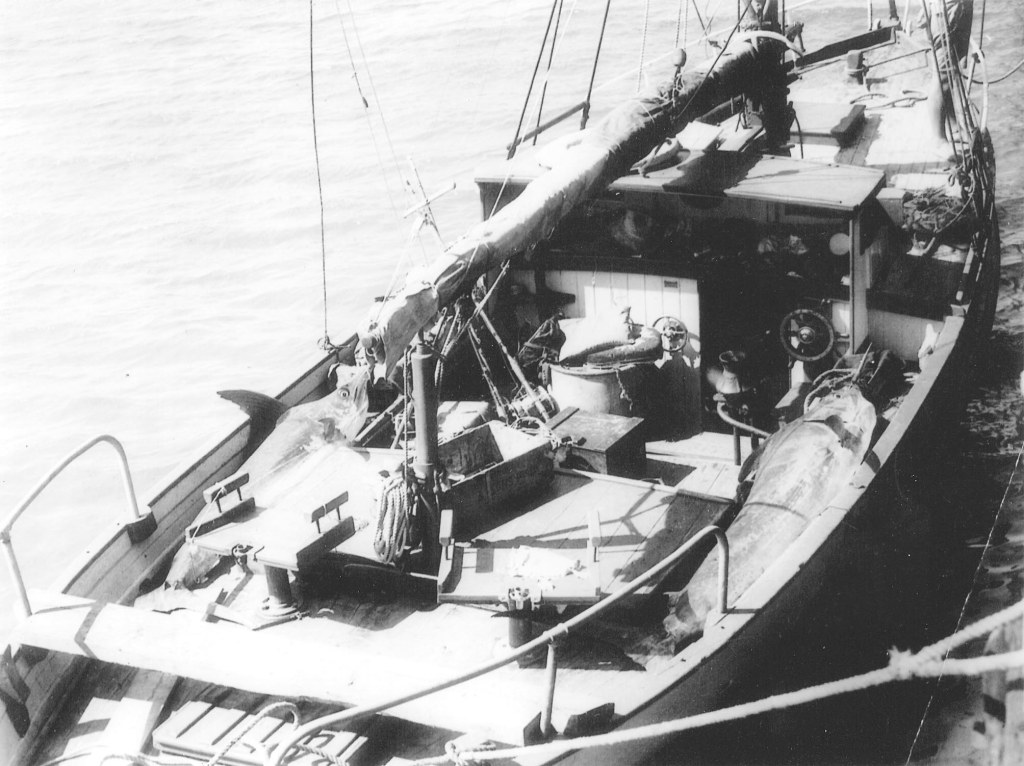
Two marlin and two fighting chairs on board the boat ‘Viking’ which was used for big game fishing.
New South Wales Game Fishing Association formed – 1938
The Referee of 7 July 1938, page 22, reported:
‘The New South Wales Game Fishing Association has been formed, and is made up of delegates from eighteen clubs alone the coast of the State, together with the N.S.W. and Barrier Reef Angling Club, consisting of 180 members with domicile in all States.
Officers were elected. — President: C. W. Firth; vice-president: T. G. A. Harle, A. L. Caseberg, G. G. Allard, L. H. Winkworth; committee: B. Hittman, D. S. Brookes, E. E. Bullen, F. J. Porter, D. G. Maitland, A. J. Clancy, Milton Kent, K. T. Wheeler; delegates to Federal Conference: C. W. Firth and and J. C. Folkard: technical adviser: T. C. Roughley; auditor: G. McL. Davis.’
The Pacific Big Game Fishing Club became affiliated with the New South Wales Game Fishing Association in 1939 and changed its name to Newcastle and Port Stephens Game Fish Club by which it is known today.
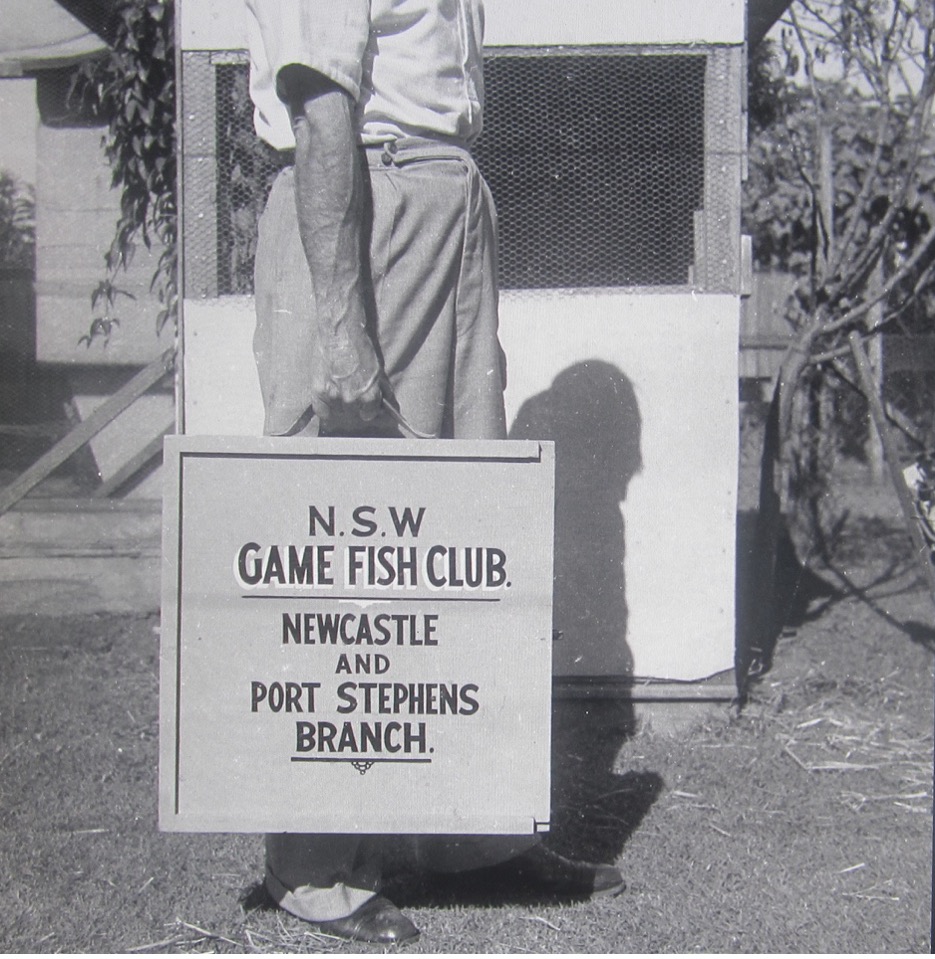
Portable scale box [Newcastle University Living Histories collection]
The Newcastle Sun of 3 November 1939, page 4, also reported:
‘The big game season will open officially for members of the Newcastle and Port Stephens Game Fishing Club next month. The first meeting of the 1939-40 season will be held on Monday night, with the Port Stephens Club, which had been allowed to lapse for more than a year, hence the adoption of the new title.
One of the matters to be discussed at the meeting will be the provision of weighing facilities for game fish at Nelson’s Bay. As the club’s season does not open officially until December, it is hoped that the gantry and weighing equipment will be installed by that time. The club has not lost sight of its representations for adequate mooring facilities in Newcastle Harbor, and latest advice is that the Port Advisory Committee has in hand the question of provision of moorings for small craft. Any scheme the committee adopts will include the club in its benefits. Prospects for the season are good, and several members are already preparing their boats to have them in readiness for the opening day’s fishing.’
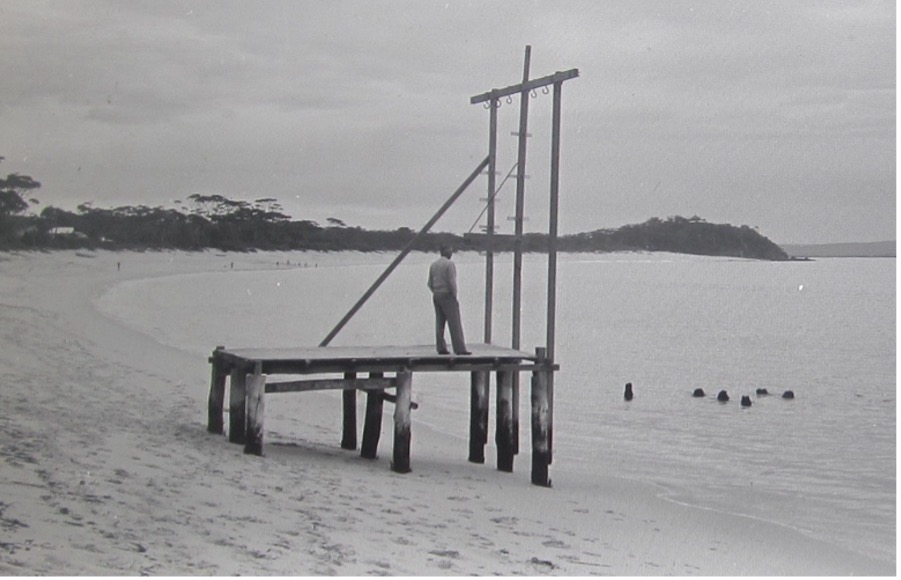
Weighing station at Shoal Bay adjacent to the remains of old weighing station [Newcastle University Living Histories collection]
Last Big Game Fishing season before the Second World War came to Port Stephens – 1940
The Newcastle Sun of 1 March 1940, page 2, reported:
‘It was reported at the annual meeting of the Newcastle and Port Stephens Game Fish Club last Monday night that this was the best season yet experienced. The “bag” to date totals 15 marlin and three sharks. The following office-bearers were elected at the meeting: Patrons. Drs. A. B. Watkins and S. Arnold; President, Mr. Fred. Toll; Vice-President, Mr. A. F. D’Ombrain; Secretary, Mr. Newman Silverthorne; Assistant Secretary, Mr. Horrie Hopkins; Treasurer, Mr. Bert Flohm; weighmasters, Messrs. J. Vaughan and Ray Moore (Newcastle), J. Brett (Toronto), Cartwright and A. Blanch (Port Stephens).
It was reported to the meeting that five trophies had been donated for competitions. Five marlin have been captured since last Friday. On Saturday, Dr. Watkins caught one weighing 263lb. and the following day Mr. Horrie Hopkins caught a striped marlin. Two were bagged on Monday by Messrs. Reg. Hayman (250lb.) and Bert Flohm (204lb.) and on Tuesday Mr. Hayman captured another, tipping the scales at 204lb.’

Last capture after War broke out – 500lb black whaler shark [University of Newcastle Living Histories Collection]
Shoal Bay Country Club appropriated by Australian War Cabinet – 1942
With the Second World War in progress the Canberra War Cabinet appropriated the Shoal Bay Country Club, that was still owned by the Newcastle and Port Stephens Big Game Fishing Club, for the use by American Army officers as their headquarters. American soldiers camped in the nearby bush areas.
After the end of the war, the club sold the clubhouse to Leonard Randall, who had been a Port Stephens Shire councillor. He later obtained a liquor licence and upgraded the premises.
New Premises for the Newcastle and Port Stephens Big Game Fishing Club
Following the sale of the Shoal Bay Country Club, the Newcastle and Port Stephens Big Game Fishing Club built new club premises further along Shoal Bay Road, from where they operated their club activities.
New club premises were opened on this site in 1984.
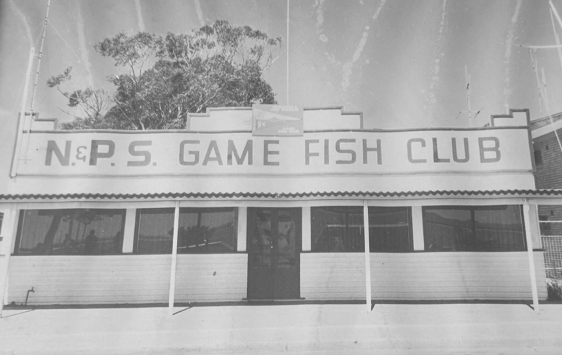
Former club premises at Shoal Bay [from photo displayed in foyer of current club]
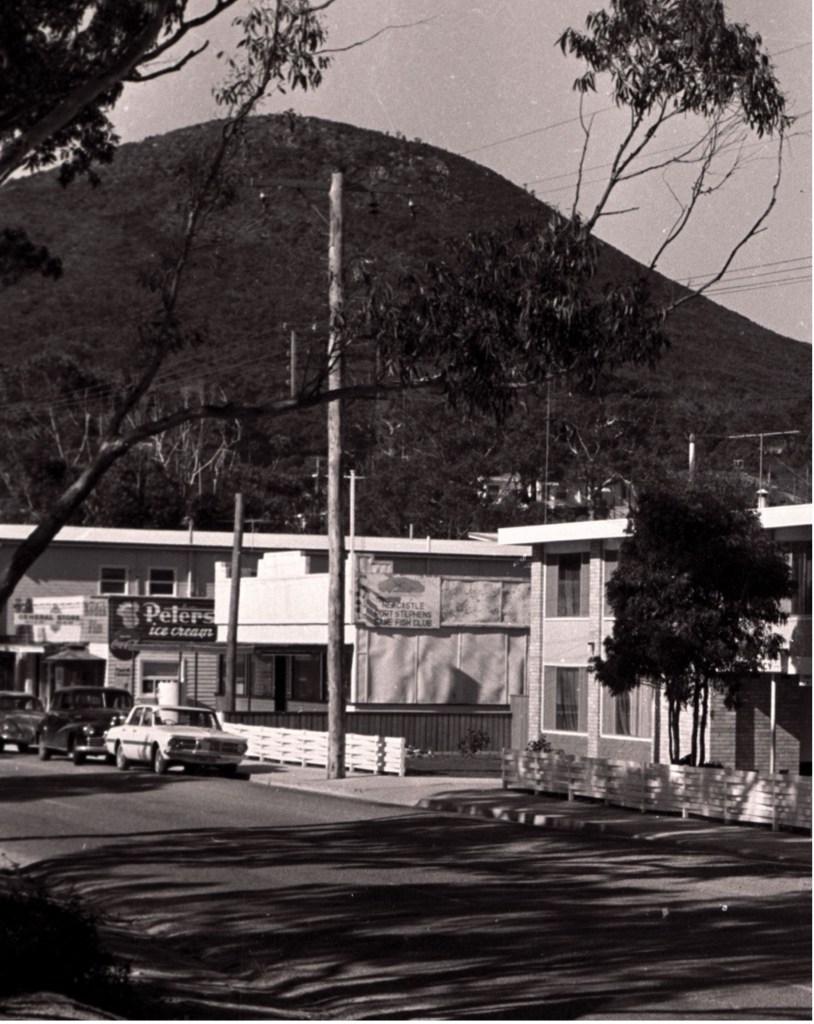
Another view of the first club premises.
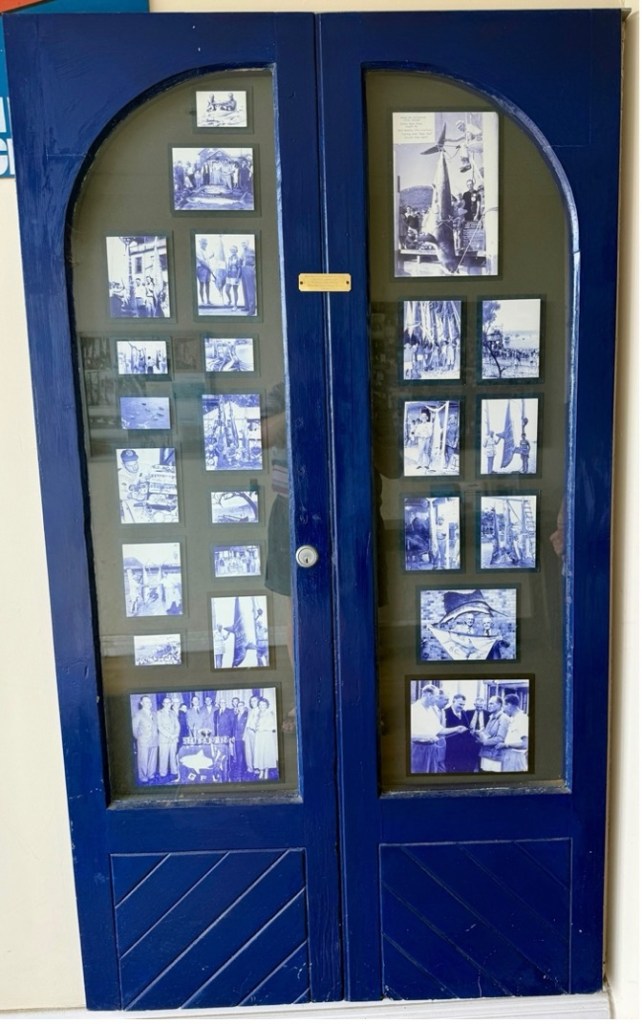
Front doors from the previous club premises as displayed in the foyer of the present day club house [Author photo]
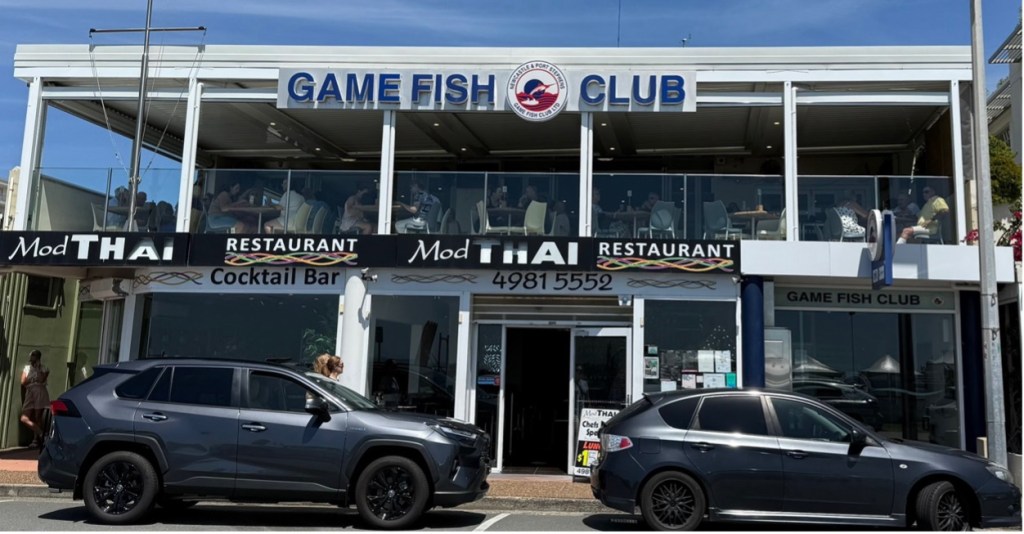
Present day Game Fish Club at Shoal Bay [Author photo – March 2025]

Plaque commemorating the opening of the present day club premises on 17 February 1984 by the NSW State Treasurer, Hon K. G. Booth, M.P.
Game Fishing revived after lapse of six years – 1946
The Newcastle Sun of 10 January 1946, page 16, reported:
‘The Newcastle and Port Stephens Big Game Fishing Club, which has been in recess during the war is to resume operations in the near future, and a meeting of members and others interested is to be held tonight. Particulars can be obtained from Mr. A. F. D’Ombrain at the office of Newcastle Optical Services, Bolton Street. It is proposed to establish another official weighing centre at Shoal Bay County Club, in addition to the head weighing centre in Newcastle.’
The Newcastle Morning Herald and Miners’ Advocate of 11 January 1946, page 10, also reported:
After a lapse of six years due to the war, the Newcastle and Port Stephens Game Fishing Club was reformed at a meeting in Newcastle last night. Because the first three months of the year are the most important in this form of sport, a programme of competitions and outings is being drawn up by the committee and will be ready for the next meeting on Thursday, January 24. Trophies are already in hand.
Intending members are asked to attend the next meeting in the Commercial Bank Chambers. The club has affiliated with the Game Fishing Association of Australia, the New South Wales Rod Fishers’ Society and the Newcastle Surf Fishing and Bait Casting Club. Officers elected – President, F. Toll; Vice-Presidents, Dr. A. B. K Watkins, J. Edwards; Secretary-Treasurer, A. F. d’Ombrain; Assistant Secretary, J. Wallace. Weight Masters, Shoal Bay: A. Cartwright, A. Kuffner, R. Browne, A Blanche, Newcastle: J Tait, with power to add. Toronto: J. Brett, J. L. Sims. Publicity Officer: H. Hopkins.’
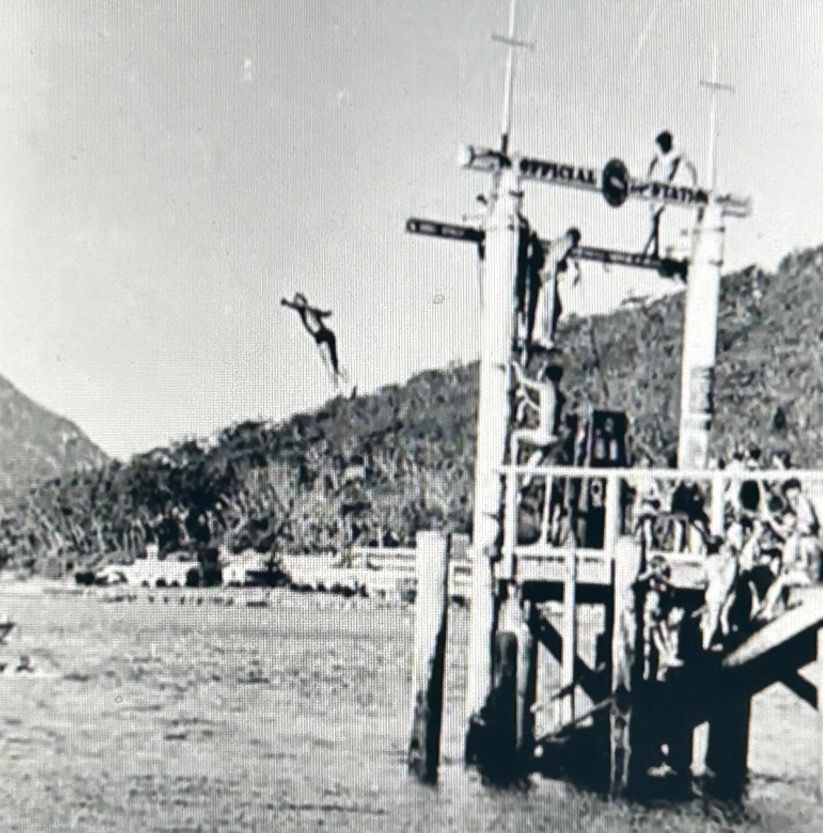
Former Big Game Fishing Weighing Station at Shoal Bay near the Clubhouse (circa 1950’s). Tomaree Lodge in the background
Meeting of New South Wales Game Fishing Association – 1946
The Newcastle Sun of 25 October 1946, page 18, reported:
‘Dr. Watkins (Vice-president) and Mr. Athol D’Ombrain (secretary) represented the Newcastle and Port Stephens Big Game Fishing Club at a representative meeting of all big game clubs along the N.S.W. coast in Sydney, and it was decided to embody all clubs under a new body to be known as the N.S.W. Game Fishing Association. However, each club will retain its own identity as branches of the parent body under its control and will conduct their own outings and competitions, but under the constitution and rules of the new association.
The president of the new association is Mr. J. A. C. Kelly, of Sydney, and Dr. Watkins and Mr. D’Ombrain are members of the committee. Mr. A. Williams is treasurer, but a secretary has yet to be appointed. Another meeting of the association will be held on Wednesday next and will be attended by Dr. Watkins and Mr. D’Ombrain.
It is the intention of the Newcastle and Port Stephens branch of the association to stage a big event in connection with Newcastle’s 150th anniversary celebrations next year.’
Biggest Big Game Fishing Contest proposed for Port Stephens – 1947
The Newcastle Morning Herald and Miners’ Advocate of 1 November 1947, page 4, reported:
‘In February, the New South Wales Game Fishing Association will conduct a five-day big game fishing contest between Sydney and Newcastle, off Port Stephens and Newcastle. Mr. Athol D’Ombrain, a committee member of the association, said yesterday that the contest would be the greatest fishing contest held in Australia. It was hoped that six boats on each side would take part in the contest, which would be filmed, he said. A naval patrol boat might take part. The headquarters of the contest would be made at Little Beach, near Nelson’s Bay, where the boats would moor each night. The official weighing station was there. The Chief Inspector of Fisheries (Mr. T. Roughley) would accompany the fishermen.’

Athol D’Ombrain who devised the tag and release system for big game fish in 1938
Big Game Fishing linked to Tourism Promotion – 1948
The Newcastle Morning Herald and Miners’ Advocate of 21 January 1948, page 3, reported:
‘The big game fishing contest at Port Stephens between February 17 and 20 might stimulate Australian and oversea interest in local fishing resources, a Vice-president of the Big Game Fishing Association of New South Wales (Dr. A. B. K.Watkins) said yesterday. Although the short period of fishing might prove disappointing, said Dr. Watkins, association members hoped to catch enough sharks and other game fish to demonstrate the local abundance.
The Minister for Tourist Activities (Mr. Finnan) had authorised two trophies from his department. Mr. Finnan had apologised for his inability to find a large “mother” ship, equipped with wireless, to safeguard those taking part in the competition. So that all anglers of the association could fish in the contest, the association committee had decided that two teams of boats, representing Sydney and Newcastle, should be arranged. Points would be averaged according to the number of craft on each side. Dr. Watkins said it had been decided to award one point for each pound of shark caught, and four points for each pound of marlin or other game fish.
Ten to 12 boats were expected to enter. To encourage competitors to catch large fish, no advantage would be allowed to those who angled with substandard strength lines. All fish would be weighed at the naval wharf near Halifax Park [Little Beach], Nelson’s Bay.

Weighing Station at Little Beach [Halifax Park], Nelson Bay, erected in 1947 – used before the construction of a weighing station at Shoal Bay
Prizes already allocated were a silver entree dish and a silver tray with glasses for the anglers taking the largest marlin, £25 for the angler who made the most meritorious performance, a medallion for mounting in the boat in which the highest point score was obtained, and a pennant for the club which secured the most points. Another prize would be selected for the angler with the highest individual point score. Sydney craft would leave Watson’s Bay on February 14, Dr Watkins added. The combined fleet would reach Nelson’s Bay on February 16. Realising that heavy weather or unfavourable winds would result in no fish being caught on the four competition days, some anglers were leaving earlier to fish outside the contest.’
Fishing contest hindered by Post Wartime fuel rationing – 1948
The Newcastle Morning Herald and Miners’ Advocate of 4 February 1948, page 2, reported:
The New South Wales Big Game Fishing Association’s contest off Newcastle and Port Stephens this month would take place, Mr. Athel D’Ombrain, Northern committeeman for the association, said yesterday. It would be on a restricted scale. It had been suggested that because of the difficulty of obtaining petrol for launches, the contest might be postponed, but a ration had been obtained. The fact that some of the boats taking part used diesel fuel would ease the situation, said Mr. D’Ombrain. The restricted petrol ration would mean that trolling for game fish would be curtailed, drifting being used as much as possible. Boats would also have to reduce their range and remain fairly close to shore. Arrangements would be made to get bait from local fishermen, saving petrol which would be used in trolling.’
Big Game Fishing Contest – 1948
The Newcastle Morning Herald and Miners’ Advocate of 17 February 1948, page 1, reported:
‘The first day of the New South Wales Amateur Big Game Fishing Association’s contest off Port Stephens and Newcastle ended yesterday with these two monsters hanging on the official weighing station at Halifax Park [Little Beach], Port Stephens [as shown below].
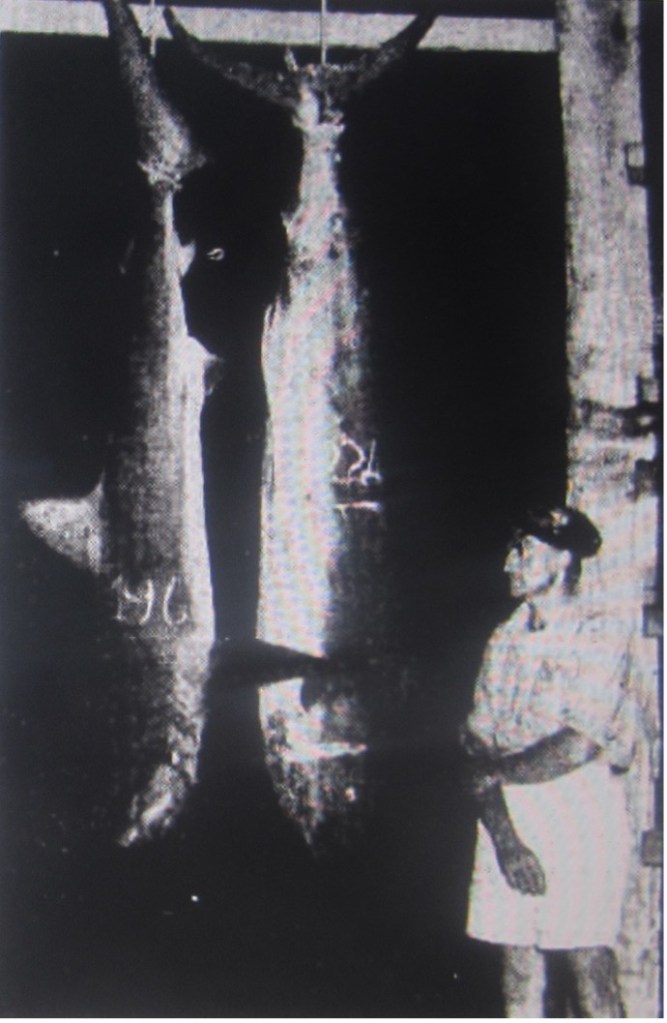
Mr. Athel D’Ombrain with his 224lb marlin, the only one caught. The whaler shark hanging beside it was caught by Max Lawson, of Sydney [Newcastle Morning Herald and Miners Advocate, 17 February 1948]
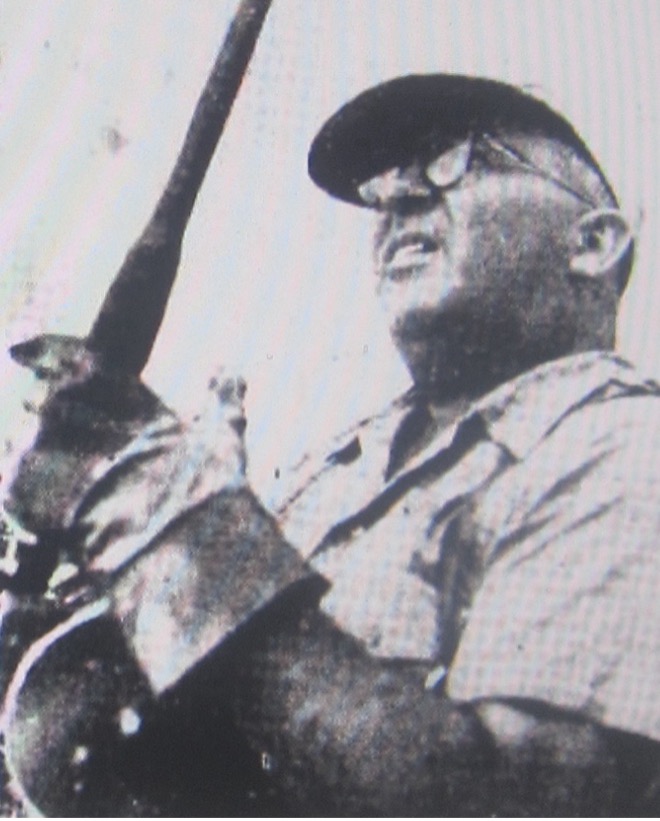
Mr. Lawson fighting the shark before it was landed [Newcastle Morning Herald and Miners Advocate, 17 February 1948]
The Maitland Mercury of 23 February 1948, page 2, reported on the final results of the big game fishing contest:
‘Four marlin were caught in the big game fishing contest off Port Stephens on Saturday, when the contest concluded. One was caught by Dr. Watkins (171lb.) and three by Mr. Max Lawson (100, 113 and 219lb.). On the previous night, Dr. Watkins caught a 386lb. shark—the largest taken in the contest. Sydney finished well ahead. Points were: Sydney 3944, Newcastle 2764. Mr. Max Laswon’s boat Murrawolga gained 3180 points—the highest number of points for an individual boat.’
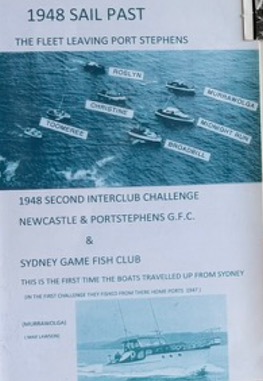
Publicity for the sail past of fishing vessels that participated in the 1948 second interclub challenge. Boats pictured are (left to right): Toomeree, Christine, Roslyn, Broadbill, Midnight Run, and Murrawolga [as displayed in the foyer of the Game Fish club, Shoal Bay]

Big game fishing launches at Little Beach [Halifax Park] weighting station. ‘Midnight Run’ is the large boat close to the wharf, circa 1948 [Newcastle University Living Histories collection]
Biggest Marlin caught off Port Stephens – 1949
The Newcastle Sun of 18 April 1949, page 4, reported:
‘Mr. J. R. Edwards, of the Newcastle and Port Stephens Game Fishing Club, fishing outside Port Stephens from Mr. Ted Moss’s launch yesterday, landed a 264 lb. striped marlin on 39 thread in 37 minutes. This is the biggest marlin of any species yet caught off Port Stephens. Another marlin, 208 lb., was caught by Mr. A. F. D’Ombrain, fishing from the same launch. It also was a striped marlin. This fish was caught on 15 thread and took 22 hours to land. The fish broke the rod when it dived to the bottom. This automatically disqualified the catch.’
Wreck of Shoal Bay Country Club’s Launch – 1950
The Newcastle Sun of 19 January 1950 reported that a 24 foot launch owned by the Shoal Bay Country Club and valued at 400 pounds, was wrecked at Shoal Bay, in a gale.
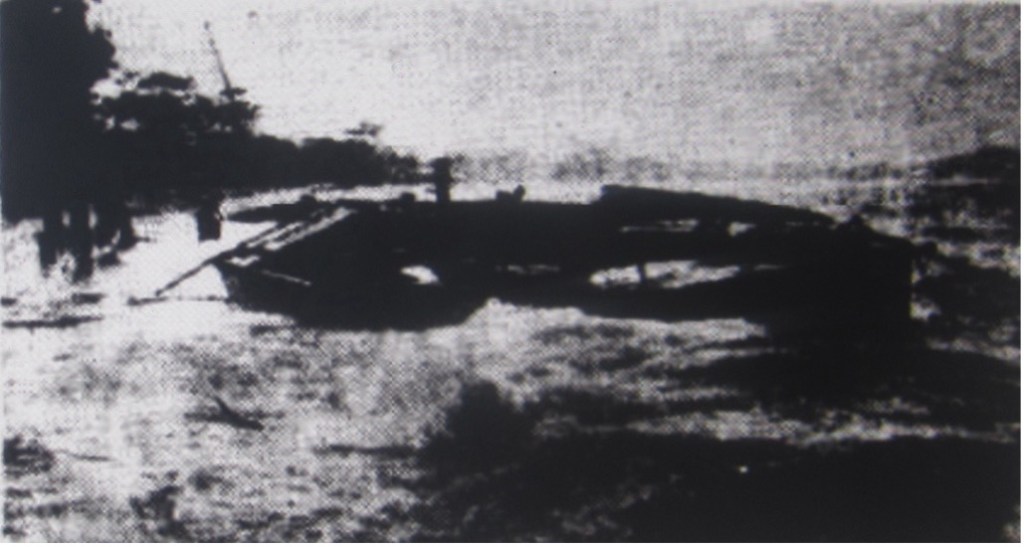
Launch owned by the Shoal Bay Country Club wrecked at Shoal Bay
Concluding Comments
During the 1950’s, the well-known radio and television personalities, Bob Dyer and Jack Davey, participated in big game fishing off Port Stephens and were featured in various newspaper reports.
The Sun of 9 January 1951, page 16, reported:
‘The rivalry between radio comedians (television was yet to commence in Australia) has now descended even to the depths of the Pacific. Last week, Bob Dyer went outside the Heads [of Sydney] and landed a 345lb bronze whaler shark. At the weekend, Jack Davey, not to be outdone, went north off Port Stephens and hauled in a 640lb tiger shark measuring, 12ft 6in. Over to you, Dyer.
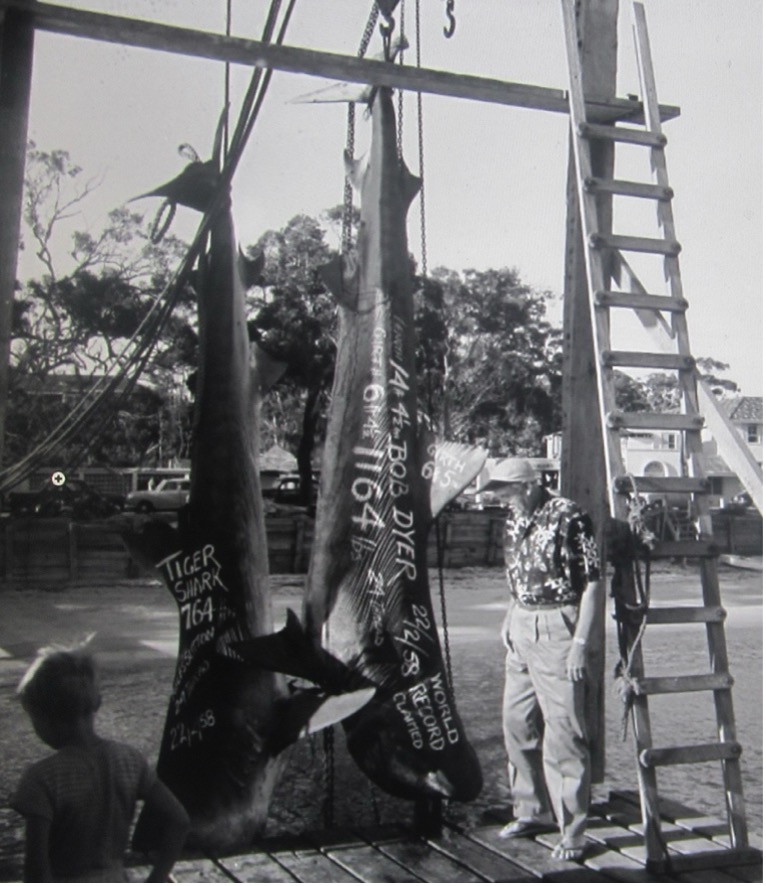
Bob Dyer with 1164lb world record tiger shark – 22 February 1958 with the rebuilt Shoal Bay Country Clubhouse in the background [Newcastle University Living Histories collection]
A visitor to Shoal Bay is soon made aware of the presence of big game fishing with the premises of the Newcastle and Port Stephens Big Game Fish Club on Shoal Bay Road in the centre of town.
Its members remain active participants in the sport off Port Stephens and elsewhere. The Club hosts annual fishing competitions.
The Club is a member of the New South Wales Game Fishing Association. Since 1962, the Association has conducted interclub State Championship Tournaments at Port Stephens, which attract competitors and boats from all over Australia.
Epilogue
The following papers concerning recreational and commercial fishing at the Port Stephens fishing industry are also published at the following links on this website:
Royal Commission on Fisheries – Evidence taken at Nelson Bay, 1895
New South Wales Fish Company First Fish Processing Facility at Nelson Bay
Chinese Fisherman at Port Stephens
Adventures of Spero Spathis – a Greek Fisherman at Port Stephens.
In September 1955, a fire broke out in the Shoal Bay Country Club and partly destroyed the building. In 1958 the premises reopened after being rebuilt. The Randall family sold the premised to new owners in 1987. In 1989 the Shoal Bay Property Corporation Pty. Ltd. purchased the premises and renovated the hotel and accommodation complex. The premises has been sold a number of times since.
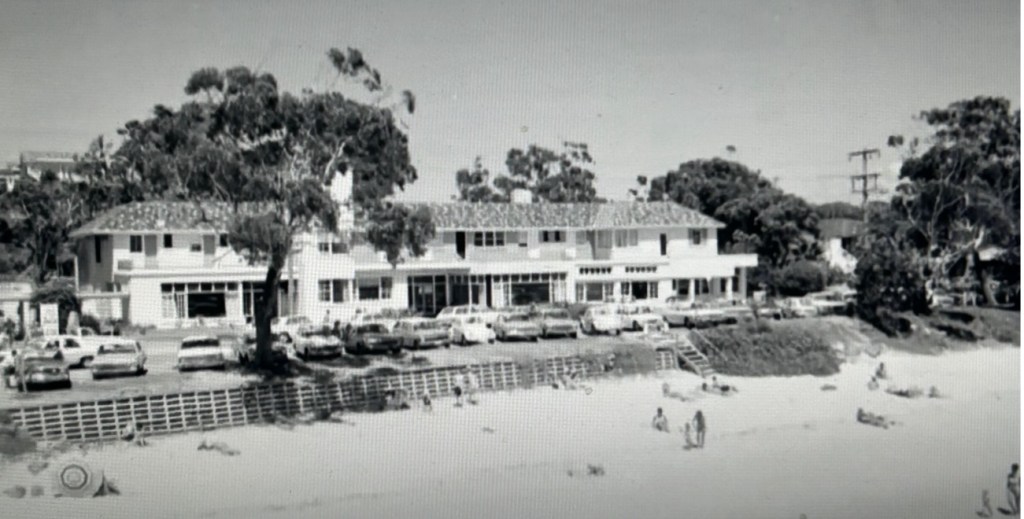
Shoal Bay Country Club, circa 1960, prior to later redevelopment.
Researched and compiled by Kevin McGuinness
March 2025


 Port Stephens - a history exploration