
Introduction
By the mid 1800’s, Chinese fishermen resided in the Port Stephens area and were actively engaged in fishing.
Their presence was very likely linked to the arrival of several thousand Chinese in New South Wales during the gold rush years of 1850’s and 1860’s.
The fishermen would salt and cure most of their catch and then send the fish to Chinese agents in Sydney, where some of it may have been shipped back home to China or sent to the Chinese still working on the goldfields. Evidence of some of their stone drying structures could still be seen around the foreshore near Fly Point, Nelson Bay, for many years.
The subject of Chinese immigration was discussed in the New South Wales Legislative Assembly on 20 September 1867, and the Sydney Morning Herald of 21 September 1867, page 3, reported on the following comments by Dr. Lang:
‘In 1861, when the last census was taken, the number of Chinamen in New South Wales was 12,998, but the decrease by departures over arrivals since that period had been not less than 1313, and the deaths 250, making the entire decrease 1593. Thus, the present estimated number of Chinese throughout the colony was 11,395, and this gave a proportion of only 2.66 per cent. of the whole population of this colony. ……
On the goldfields the Chinese generally employed themselves in working portions of stuff which the European miners threw away and made a living by their industry. They were also pretty extensively engaged in horticultural operations. They cultivate vegetables for the miners and travelled with them to the nearest diggings. Many were fishermen, as for instance at Lake Macquarie, where they had a considerable establishment. At Port Stephens they had another. They had others on the rivers and lakes of the interior, as for instance on the Edward River, near Deniliquin. They were all consumers of our produce, both domestic and foreign, and consequently contributed towards our colonial revenue. Few of them hired as servants either in the towns or in the country. They preferred for the most part to work for themselves, in a spirit of self-reliance and independence which he should be glad to see more frequently exemplified among our own people.’
The Chinese fishermen primarily worked in the Nelson Bay area and also caught crayfish at Broughton Island. They were viewed with much curiosity by the early visitors to the area. Some of the references to the Chinese are now viewed as derogative but have been retained in this paper for historical accuracy.
First reference to Chinese fishermen at Nelson Bay – 1861
The earliest reference to Chinese fishermen in Port Stephens was published in the Newcastle Chronicle and Hunter River District News of 16 March 1861, page 2:
‘Surveying its bold and rugged scenery, the visitors, on their arrival in Nelson Bay, were surprised to find a Chinese fishing and curing establishment, at which tons of fish are prepared for the market weekly.’
Chinese Fishermen near Port Stephens Lighthouse – 1862
A correspondent for the Empire of 26 March 1862, page 8, recorded aspects of his journey to Port Stephens with the lighthouse keepers who were to commence duty at the Point Stephens lighthouse:
‘I was quietly smoking my cigar in the Caledonia [Hotel] on Sunday morning, in that quietest of all cities, Newcastle, equally celebrated for its black diamonds and bad streets, wearily waiting for the next week to pass away, wondering what I should do with myself till then, when, in the other corner of the room I saw a group of travellers. I soon found out, by their conversation, that they were the lighthouse keepers and their friends proceeding to the new lighthouse erected at Port Stephen. Here is a chance for a change, thought I; and I soon found out, from my obliging host of the inn, that there was a party of officials going down in the steamer Doorabong the next day, to open the establishment and permanently settle the keepers in their department. So in the morning I packed my little black bag, took my stick, and went to the wharf. With my old luck, I soon found out I had an acquaitance in one of the officials, and on board I went for the trip. …….
In a small nook in Fly Roads [a safe anchorage cove adjacent to Point Stephens on which the Port Stephens lighthouse is located] there are a party of Chinese fishermen quietly engaged catching and curing fish for their brother Celestials on the diggings; and, judging by appearance, they make a good thing of it. Before landing this morning our prince of caterers, after making an inspection of the commissary department, found some of our stock of fowls were fast approaching that state the epicure relishes in game, so he packed up a basket and left it in the kitchen of John Chinaman’s house, who were all away fishing. On our return to the steamer we found John in ecstasies with his present; all talking at once, and the basket crammed with fresh fish, out of a splendid haul they had made, fully a ton weight of mullet. We were soon all on board, and at 7 p.m. arrived at the wharf, Newcastle.’
Quarrel between Chinese Fishermen at Nelson Bay – 1865
The Newcastle Chronicle and Hunter River District News of 8 February 1865, page 3, reported:
‘On Monday night last a quarrel arose between seven or eight Chinese fishermen who lived together at Nelson’s Bay, near Port Stephens Heads, during which one of them seized a knife and attacked another against whom his wrath was specially directed. He made a stab at him and inflicted a wound in a downward direction in the shoulder; the wound reached almost to the heart, and proved fatal, as the wounded man died within two hours after receiving it.
Another Chinaman attempted to take the knife from the murderer, and received two stabs in the thigh. The murderer was secured by the other men present and kept in custody by them whilst information was sent to Raymond Terrace, a distance of nearly forty miles. Sergeant Healy, accompanied by Dr. Wells, at once proceeded to Port Stephens lighthouse and arrested the murderer. The body was brought into Raymond Terrace, and an inquest was commenced there on Wednesday, and adjourned until yesterday (Friday). The body was buried on Thursday.
The following particulars were forwarded by our Raymond Terrace correspondent: —”Information was brought into town on Tuesday morning last, that two Chinese had been stabbed at a Chinese fishing establishment at Nelson’s Bay. Sergeant Healy and Dr. Wells immediately started and on their arrival at the scene of the outrage found one of the men dead, and the other lying in a precarious state, and unable, from the nature of his wounds, to be removed. The Chinaman that committed the deed was taken into custody and brought into town, as also the body of his victim. An inquest was initiated before Mr. Shaw, coroner, but stands adjourned until Friday next, to allow of an interpreter being procured, as most, if not all, the witnesses are Celestials.’
No report was published concerning the findings of the inquest or any further action taken.
Commentary on Chinese fishermen at Nelson Bay – 1867
The Sydney Morning Herald of 24 April 1867, page 2, reported on the following excursion to Port Stephens during the Easter holidays:
‘This long talked of event took place today, and notwithstanding the threatening appearance of the weather, and the rough look of the sea, a large number of excursionists ventured on the trip. The steamship City of Newcastle was the vessel engaged, ….
About 2 o’clock the anchor was let go in Nelson’s bay, close in shore, just opposite a very pretty little fishing village. The fishermen’s huts and gunyahs are built (somewhat scattered) at the foot of the hill which shelters them from the southerly winds. There are appliances erected for drying the fish; also huts or sheds for their protection from the weather. A number of white boats (mostly centreboard) lie quietly at anchor some little distance from the sandy shore, giving the scene, a romantic and pleasing effect.
There were a number of native blacks— women, and children, also Maories, Chinese and Europeans, all living together in a miniature settlement, apparently in comfort and happiness. The black picaninnies and the Chinese woman attracted great attention. The fishing establishment of the Chinamen also came in for special notice, and “John” did not lose the opportunity of disposing of a large quantity of fish, while at the same time another Chinaman made a large sale of tea done up in packets, and said to be of extraordinary quality, and for which he charged 1shilling. So great was the demand, that “John” was at last reluctantly compelled to declare there was no more.
At another Chinese hut some curious looking clocks were offered for sale, price 2 shillings; they were ingenious pieces of art, and would have found a ready sale had not the steamer’s bell given warning it was time to depart, which prevented many parties from walking so far.’
Chinese fishermen of continuing interest – 1871
The Newcastle Chronicle of 25 May 1871, page 2, reported on a tourist excursion to Port Stephens:
‘Dinner over, there arose a cry of “any body for the shore!” and shortly, three ships’ boats loads of excursionists were strolling on the sandy beach, or watching the Chinaman netting their nets, or pay their respects to the single, married Chinese lady resident at the fishing village.’
Commentary on Chinese fishermen at Port Stephens – 1874
The Illustrated Sydney News and New South Wales Agriculturalist and Grazier of 30 May 1874, page 6, reported:
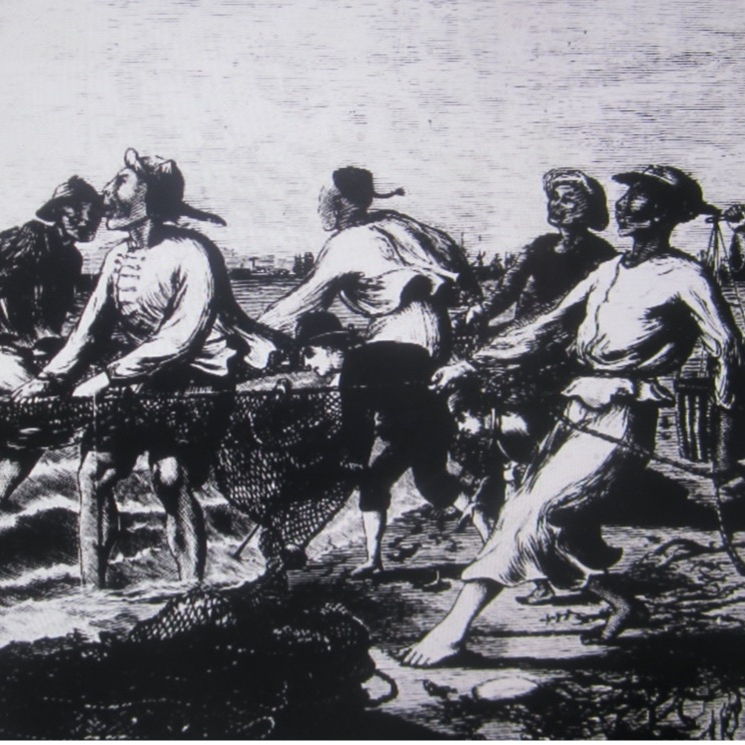
‘We have here endeavoured to portray a phase of industrial life at Port Stephens and other places in our colony. The engraving represents a party of Chinese fishermen pursuing their occupation on the beach.
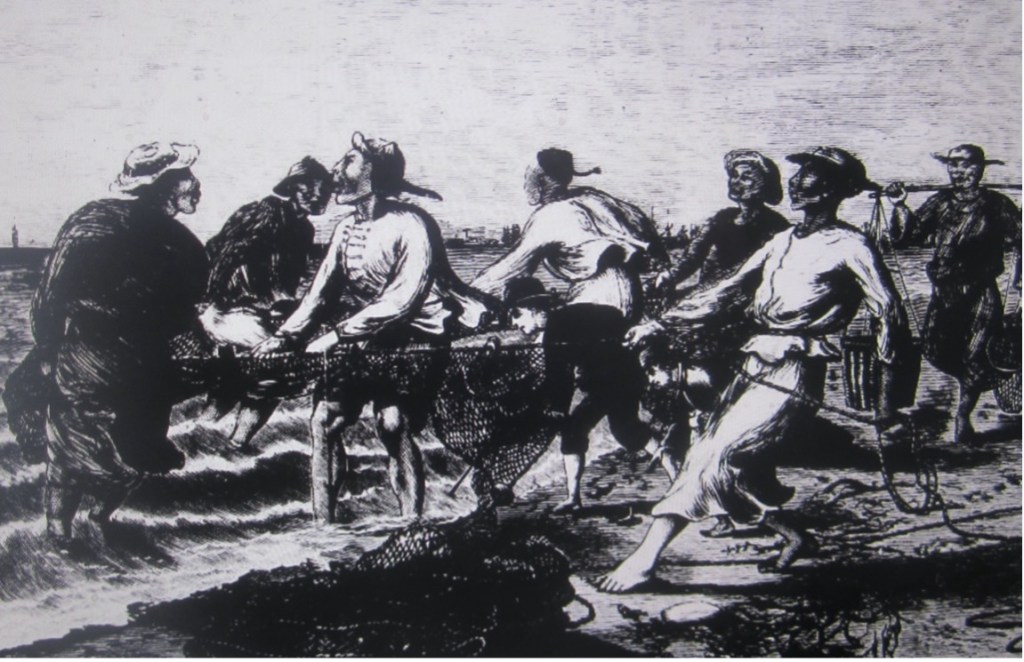
Chinese Fishermen at Port Stephens [Illustrated Sydney News, 30 May 1874]
Net fishing is what they are engaged in at the moment—a style of fishing in which our Mongolian immigrants appear to be most at home. The nets vary in length from forty to eighty fathoms, having inch meshes. The fish caught by them are mostly flounders, garfish, flatheads, salmon trout, silver fish, and mullet. Occasionally large numbers of stingarees, small sharks, squid, and devil fish are ensnared, and these not only do injury to the nets, but are useless except for bait.
The fishing is chiefly carried on at night, or early morning, when the sea is smooth, with a light wind blowing off the land. The yield varies; sometimes it is poor enough, and easily disposed of by Chinese hawkers in the city and suburbs; but when there is a glut, the fishermen send their fish themselves to market.
The fishermen live in huts of a wretched description close to the shore. To a stranger their circumstances appear unattractive, and as they are not very communicative, it is hard to say what their earnings are. The likelihood is, however, that they make what, with their standard of living, may be regarded by them as a competence. They live cheaply; carry on their fishing, as well as all their other industrial pursuits, in accordance with some principle of cooperation; and as they decline the services of agents or middlemen they are enabled to distance their European competitors. The Chinese are adepts at curing fish, and the smoked specimens forwarded to Sydney from Port Stephens and Newcastle are far superior to any imported.’
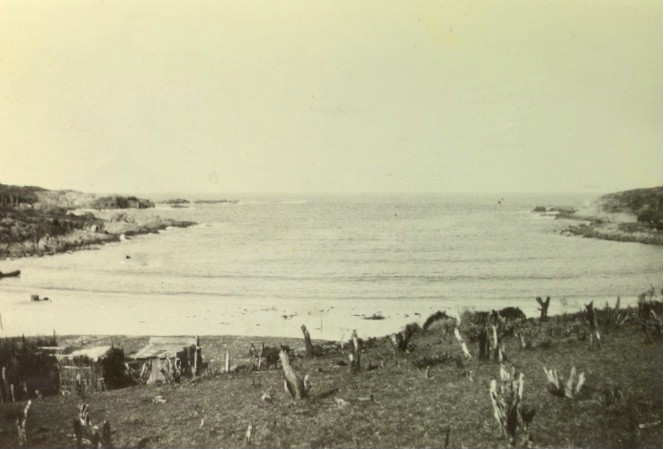
Boat Harbour, Port Stephens in 1927. Early settlement at Boat Harbour included Chinese fishermen who lived in tents on the beach.
Evidence of Chinese Fishermen at Port Stephens – 1880
A Royal Commission into the Fisheries of the Colony of NSW was appointed on 8 January 1880. In the Commission’s report the following information was provided about the Chinese fishermen at Port Stephens:
‘A considerable gang of Chinamen is always located at Nelson Bay, and as soon as one lot returns to its native country another takes its place. They catch their own fish here and preserve it after their own detestable fashion. At times Chinese fishermen go out seaward as far as Long Island, where they camp for several weeks at a time and catch vast quantities of fish, and might, if they chose, catch any quantity of crayfish (lobsters). All the Broughton Island group are singularly by their formation for these crustaceans, and the reefs and outlying rocks about Cabbage Tree and Boondelbah Islands, off the entrance to Port Stephens, and those which lie around Long Island, abound with this fish; but the distance, under the existing regime, is rather too remote from market to encourage the development of this fishery.’
The following two persons who provided evidence to the Commission specifically commented on the Chinese fishermen at Port Stephens in the following terms:
‘George Newton, fisherman stated: the Chinese at Port Stephens use the same method of dry curing fish as those at Sydney Harbour. They split the fish by cutting them down the back and salt them and shove them into a cask. They did not bone them. They have cured fish at Long Island.
James Priest, Lightkeeper, Port Stephens, stated: All the Chinese boats employed in fishing are located inside Port Stephens Heads. The number would be from six to eight, but they never send fresh fish to any market; all their take is salted down and sold usually to Chinese merchants in Sydney.’
Contempt expressed towards Chinese fishermen – 1884
By 1880, shades of a White Australia policy were emerging, and a large number of the Chinese in Australia were returning to their homeland.
A demeaning commentary on the Chinese fishermen who remained at Port Stephens was written by a travel correspondent who went on a cruise to the Myall Lakes.
It was published in the Sydney Mail and New South Wales Advertiser of 8 November 1884, page 953, with the correspondent blaming the Chinese fishermen for harming the lobster population on Broughton Island:
‘In former times the Port Stephens Chinamen used to resort regularly to Long Island [Broughton Island] to catch lobsters and other fish, but the Celestials are now represented by only three miserable derelicts, with a European woman who lives with them more or less in common, and the sooner they and all other Chinese fishermen on the coast clear out and take to market-gardening the better, for in this colony the Chinese fisherman is a miserable and pernicious fraud.’
A similar contempt towards Chinese fishermen was expressed by the same author featured above, in the Sydney Mail and New South Wales Advertiser of 15 November 1884, page 1006, in which he wrote about those fishermen settled at Lake Macquarie (about 35 nautical miles south of Port Stephens):
‘At the viaduct the river gets narrower, the channel lying close to the south bank until some three-quarters of a mile up you come to the inevitable Chinaman living in an atmosphere of fish offal and stinking mullet supposed to be cured. There are not many of them now, perhaps six. There were forty or sixty during the golden days of Ballarat, who made an excellent business by preparing schnappers, mullet, bream, garfish, and whiting for their countrymen on the goldfields. You smell the establishment from about a mile off. Hereafter, when there are no more fish to be caught in the lake or on the beaches outside, I suppose this intolerable nuisance will abate itself; but at present it flourishes, the abomination of putrefactions.’
Concluding Comments
The Chinese fishermen were only one group of the several nationalities that fished the waters around Port Stephens.
From all accounts, the Chinese fishermen were diligent workers but mostly kept company with their countrymen.
The only permanent reminder we have of the Chinese fishermen is the name of Ah Sing on a memorial stone at Fly Point. Ah Sing was thirty years of age when he accidently drowned at Nelson Bay in 1879 and was buried in the former Fly Point cemetery.
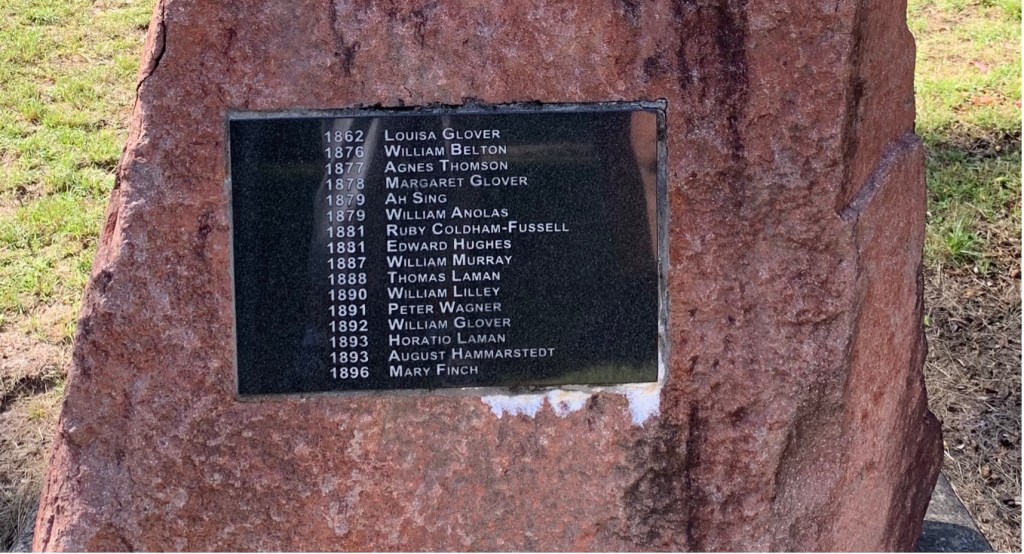
Memorial at former Fly Point cemetery at Nelson Bay, listing Ah Sing [Author photo]
Researched and compiled by Kevin McGuinness
April 2023


