

Introduction
Shoal Bay – “Where sunshine spends the winter”
Port Stephens Heads – “a tonic for the eyes”
So reported the The Newcastle Sun 24 December 1948, page 1, as it noted that ‘up at Port Stephens they are becoming scenic-slogan-conscious.’
Port Stephens is renowned for its beauty, its geography and its history.
Three reflections on the beauty of the natural environment of Port Stephens are featured below from various newspaper articles.
1) A Reflection on the Beauty of Port Stephens on a Moonlight Night – 1922
An article published in the Sydney Mail of 4 January 1922, page 9, from a correspondent, Ruby M. Doyle, who reflected on the beauty of Port Stephens on a moonlight night and its association with nature:
‘It falls across the bay in a broad sheet of light, a wide, gleaming path of silver stealing earthward from the moon. In marked contrast the headlands and salient points stand out bold and prominent, intensely black, like great bears crouched to spring. The beaches, strewn with seaweed and scattered shells, curve like glistening scimitars about the bay, and the waves, moon-tipped and wonderful, rush forward and recede like mischievous, teasing urchins.
How many centuries have they played in careless glee upon these shining sands? How often have they tossed the brown seaweed, catching it to them and flinging it back in wanton recklessness high upon the beaches? The laughter of their ceaseless ebb and flow changes to a whisper. They can tell stories of hidden treasures lying far out beyond the bay: of coral, pink and white; of marvellous jewels stored in iron-bound chests; of mermaids and strange sea folk; of great hulks lurking on the ocean bed, with bones bleached and white, and covered with a queer sea fungus.
The earth listens and is silent in sheer wonder and amazement at that which the little moon-tipped waves whisper so carelessly. So have they always held her attention, grim and deep, like that of an old, old woman who listens to the tales of the wild mad folk.
Sometimes the wind rushes from behind the hills and fans through the honeysuckle shrubs growing thick above the sand and seaweed. Perhaps it only laughs at the queer stories of the murmuring waves. Perchance it whispers others, weirder and more wonderful, to that ever listening ear of Mother Earth. It, too, can tell of caves, jewel-strewn, haunted with mystery and romance, can speak of strange houses afloat upon the ocean; whisper of lovers, dear and true; of brave men, stern and bold, who battle with forest, flood, and fire. The waves grow louder, more insistent. The wind laughs in a quiet undertone as it glides nonchalantly back to its lair behind the hills.
Stealing across the bay comes a little sailing vessel, sharply silhouetted against the light, her three sails outspread like the wings of a bird or like the full, stiff skirts of three quaint Dutch maidens. Silently it skims across the water and disappears into the heavy shadows of a sleep, high bank. Long black jetties fling themselves into the water, crawling out like centipedes, and from them fishing lines are thrown deep into dark mysterious places, which at times are lit up by the queer, fantastic fires of phosphorus, which leap across the moving water like tongues of flame, reappearing, disappearing, dancing a mad tarantella all their own; anon fading utterly away.
Old sailors sit here on the ledge and steps of the jetties, swapping yarns or staring in uninterrupted silence upon the dark face of the water lapping the immense wooden piles. Beyond the jetties a path climbs up the steep bank, on which stand tall straight trees, branching against the sky, shadowy, unreal; watching in endless patience the glory and wonder of the moonlight, starlight, and sunlight, as each in turn throws her magic mantle across the bay, transforming it into a witch spot, weird, glamorous, transcendently beautiful.’
2) Beauty of Port Stephens in Poetry – 1931
A local poet, Myrtle (Myth) De Guise Cutler was born in 1892 in Sydney and was the daughter of Sir Arthur Edward and Maud Cutler. She married Norman Clark and for much of her life resided on the shore at ‘Sunnyside’ of the Myall Lakes, between Tea Gardens and Bulahdelah. Myth died on 29 April 1968 at Bulahdelah.

‘Sunnyside’ on the foreshore of the Myall River – the residence of Myrtle’s parents which was the location that inspired many of her poems.
She was the author of poetic fairy tales which were inspired by the beauty of her local environment.
The Dungog Chronicle of 1 May 1931, page 4, reported:
‘Mr. W. F. Harris spent a day on the Lakes last week and, enjoyed a chat with Mr. and Mrs. Cutler. ….. Their home [Sunnyside] commands beautiful views of the lake from different angles — views that compel the soul of music to respond— it has done this for their cultured daughter Mrs. M. Clark of Sunnyside who resides nearby.
Those who remember 2 F.C. [radio station] and the “Children’s News” published by that Broadcasting Company will happily recall the beautiful Australian Fairy Tales so ably told in the music of verse, by their talented daughter. We shall publish, with Mrs. Clark’s permission a number of these poems that will be a delight, not only to children, but also to the grown-up children. ….
Mrs. Clark has certainly lavished praise upon the beauties of our lakes and bushland, and her fairy tales deserve to live on. They are Australian and were inspired by the vast and enduring beauty of our district.’
The poems of Myrtle (Myth) Clark (nee Cutler) as published in following editions of the Dungog Chronicle: viz, 1 May 1931; 8 May 1931; 15 May 1931; 29 May 1931; 5 June 1931; 12 June 1931; 19 June 1931; 26 June 1931; 29 June 1931; 10 July 1931, are as below:.
Moonshine
I love, on Summer evenings, when all the world is still,
To watch the laughing, yellow moon rise up behind our hill.
He quickly builds a shining bridge that spans across the lake.
And then the Bushland whispers and the little fairies wake.
They come singing from their houses, they come dancing down the ridge,
Thousands of merry fairy folk, to cross the old moon’s bridge.
I wish I was a fairy! I’d love to join the band
That comes across that golden bridge each night from Fairyland!
I love to lie and listen, when the wind sighs through the trees,
To all the fairy music that comes drifting down the breeze;
It mingles with the ripples of the softly singing lake —
The faintest, sweetest melodies, and I wish that I could take
A pair of fairy slippers, and go dancing down the hill
With all the little fairy folk, whose feet are never still.
I’d love to toe a fairy— and I’d dance the whole night long
To the music of the crickets — to the waters gentle song.
Autumn
The wind, it comes a-whispering, a whispering round the house,
It creeps in through the window like the quietest little Mouse,
It steals across my school-room and it whispers m my ear — ;
In its very gentlest whisper, so that mother may not hear —
‘Oh do leave those tiresome lessons, come outside and play with me,
For there’s sunshine in the orchard — there are apples on the tree.
The wind it comes a-howling, a-howling down the hill,
In a voice that’s very mournful — just like dingoes when they kill.
It taps against the windows, and it knocks at all the doors
Till it makes me think of goblins, and of dragons and their claws—
Then it calls to me so sadly as it journeys on its way —
Look, the big rain clouds are coming, so I cannot stop and play.
The Pixie Gown
In an old gum tree lived a pixie brown,
Who hadn’t a hat and who hadn’t a gown,
To wear when she went to Pixie Town.
She sighed “oh dear!” and “Oh dear!” sighed she,
In what a terrible fix I’ll be;
If somebody kind says “Come to Tea”
So she gathered the twinkle out of the dew,
A butterfly’s wing of the brightest blue,
A red gum leaf and a feather or two —
And she tacked and sewed in the old gum tree,
No pixie was ever more busy than she,
For the gown was finished by half past three.
And when next she went to Pixie town,
Her friends all cried, “What a beautiful gown!”
And praised and flattered that pixie brown.
The Runaway Star
A little star ran away one night,
From its kind old mother the Moon,
And creeping down to the earth it hid
In a silvery black lagoon.
And the waters sang a song to it,
Such a gentle lullaby,
That the little star fell fast asleep
And forgot the great big sky.
And all night long it slumbered there,
Rocked gently to and fro;
Till the first soft light of the morning
Fell on the earth below.
The sun woke up and stretched itself,
And made the shadows grow;
And the little star grew frightened
And knew not where to go.
In haste it climbed the big black hill,
It searched the sky in vain;
For no kind moon was waiting there,
To guide it home again.
I watched it from my window,
One lonely little star;
For it seemed to me so tiny
To have to travel far.
The sun came smiling from the East,
So warm and rosy-red;
It kissed the little frightened star
And took it home to bed.
When the Black Swans Show the Way
I wish that the fairies would give me
A wee fairy boat of my own
To sail on the lake in the summer —
Oh! I’d love to go sailing alone,
When the wind sets the white horses prancing
And they gallop out over the bay.
Then I’d sail to the furthermost island
And the black swans would show me the way.
When the stillness of twilight is falling
And the sun in the west’s sinking low;
Then, I’d drift down the creek with the current,
Past the banks where the bullrushes grow —
Where the trees that lean over the water,
Softly whisper and nod to and fro,
And I think they are seeking the treasure
That the little creek’s hidden below.
And then — when the night wind is singing
And the moon builds a wonderful track
That sparkles like gold on the water
While the shadows lie purple and black —
Then I’d sail to the land of the fairies
And I don’t think I’d ever come back.
Little Children of the Wind
When from the blue sky overhead the laughing sun looks down,
He sees a little winding track, all golden, green, and brown.
And, dancing down the old bush track, come, dimpled soft and fair,
The little children of the Wind, who love to linger there.
The fallen gum-leaves stir beneath their little dancing feet,
The tall trees nod their crimson heads, the air is warm and sweet.
And where the golden wattles dip their blooms in the creek,
The children leave the winding track, to play at hide and seek.
Or, by the little rock-rimmed pool, where sun and shadow play,
Where moss and lichen love to grow and trailing creepers sway.
They chase the golden butterflies, or, swinging in the trees,
They pluck the pale tecoma-bells and toss them to the breeze.
It’s evening when I cross the creek, all golden is the west;
The children hear their mother’s voice, that calls them home to rest.
They climb, with me the winding track, their whispers fill the air,
And I can feel their dimpled hands rest lightly on my hair.
A Lesson From Bushland
Sometimes my world goes very wrong and then I hate the Bushland’s song.
I hate the swallows flying free,
The scented bush — the blossomed tree!
Even the butterflies, it seems,
Have far more time than I for dreams.
Why have I got to work all day?
Then mother nature takes my hand
And softly says, “I understand”!
Come out into the world with me
And learn from blossom, bird and tree.
See there the swallow’s mud-made nest
Lined with feathers from her breast.
The fallen blossoms from the trees
Have given honey to the bees,
And now they ripen fruit or seed
To satisfy some other need.
The tiny worm, the little plant,
The great big tree, the crawling ant,
Each has a duty to fulfil,
And all obey the great God’s will.
Only to you He gave a mind,
The power to reason — and be kind,
So, surely you will try to do
The work that is assigned to you.
Can You Help Me?
I’ve been trying to find a fairy, and I’ve hunted everywhere,
I’ve looked in all the rose buds — but there wasn’t one in there,
I’ve shaken all the sunflowers that are growing near the wall,
‘Cause I thought if I shook hard enough I’d see a fairy fall.
And I’ve peeped in all the lilies — but I’ve only seen the bees
And some little yellow beetles— that were sheltering from the breeze.
My mother’s seen a fairy, and she says its eyes were blue —
It was dancing in our garden— and she heard it singing too.
She says its hair was golden, just like mine is in the sun—
Oh! I’d love to find a fairy — just a teeny-weeny one —
But I’ve looked all through the garden — I’ve been hunting all the day,
And I think that all the fairies must have quietly flown away.
A Stormy Night
The rain that fell the whole night had
An angry, sullen sound,
As if it sought in vain to wrest
Some secret from the ground.
I wonder if it sought to know
What makes the little seedlings grow.
The wind was sad, it seemed like some
Lost creature of the wild,
Who through the dark and stormy night
Went calling to its child.
I wonder if it sought in vain
The whispered music of the rain.
The trees all bent their wind-tossed heads,
And on my window pane
The May-bush beat imploring hands,
As if it sought to gain
A refuge from the stormy night —
A shelter from the rain.
I wonder if it thought my light
A little sun that shines by night.
The Beauty of the Lakes of Myall
The Dungog Chronicle of 4 December 1936, page 3, published the following article on the beauty of the Myall Lakes [Lakes of Myall], that featured a poem by Myrth Clark of ‘Sunnyside’ Myall Lakes.
‘The gateway to the famous Myall Lakes is Tea Gardens, and the broad expansive waters at different stages narrow into pleasing streams as the waters meander in their quietude along pleasant, twisting shores, where nature’s entrancing beauty is always within purview — while wild duck, blue cranes, black swans, and other birds peculiar to the coast, add colour to the heart of verdant nature.
The tourist making this trip will travel with the spirit of romance. Once in the lakes of Tamboi — the prawner’s paradise — the overseas travellers will find memories restored of their travels in Ireland and Scotland.

Beauty of the Myall Lakes (Lakes of Myall) [Author photo]
The consummate beauty of these lakes is an inspiration to the soul of song. This fact is impressed upon us by Mrs. Myrth Clark, “Sunnyside,” Myall Lakes, who has extolled this fairyland in the following stanzas of exquisite beauty: —
When the air is warm and fragrant
With the scent of blossom’d trees;
And the sleeping lake awakens
To the music of the breeze;
Then the water laughs in gladness
As it washes on the beach
By the nodding, whisp’ring tea-trees
That grow just beyond Its reach.
Then the water sprites come dancing
And the sunshine on their wings
Turns to gold the laughing water,
Ev’ry bird, full-hearted sings
And the echo of their singing
Softly drifts upon the breeze
And is mingled with the laughter —
With the whisp’ring of the trees.
When the sun, in silent splendour,
Has gone down behind the hill,
And the birds have ceased their singing,
Then, the lake grows dark and chill.
And the water sobs in sadness
As it washes on the beach
By the gnarl’d and twisted tea-trees
That it tries in vain to reach.
Then ghosts of all the goblins
Rise like mist from out the lake
And go creeping through the tea-trees
Then the night owls stir and wake,
And the air is full of whispers
As the frightened bush-folk fly;
While the black swans’ cry is echoed
As they sweep across the sky.
3) A Reflection on the Port Stephens Natural and Urban Environments – 1954
Another article was published by the Newcastle Morning Herald and Miners’ Advocate, 6 February 1954, reflecting on Port Stephens from the summit of Mount Tomaree.
The writer reflected on:
- how Aboriginal people may have viewed the landscape;
- natural features of the Port Stephens area including both the islands inside the Bay and those offshore; and
- history of the townships of Port Stephens, particularly the then most recent developments as the area was recovering post-World War Two.
The article is published in full as below:
‘Australia has retained hundreds of aboriginal names for towns and landmarks. Some are strange, many soft and euphonious, while they all have a meaning that invariably depicts some part of the district, or some outstanding tree, landmark or waterhole.
The two rugged and mighty peaks guarding the entrance to Port Stephens must surely have stirred the natives’ imagination when they gave North Head the odd-sounding name of Yacaaba, and its slightly lower but more prominent southern counterpart the soft, mysterious sounding Tomaree. To some it may seem a pity that no records remain to tell us the meaning of these strange words. To those of us who have climbed to Tomaree’s shrub-covered, wind-swept peak, there is little doubt that its meaning must surely be attributed to the beauty of the scene spread out below.
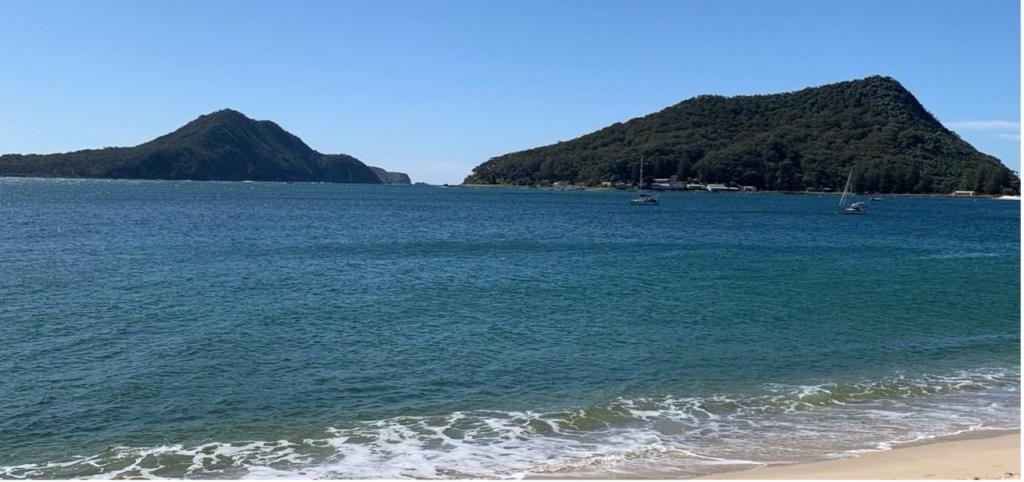
Port Stephens headlands – Yacabba (left) and Tomaree (right) [Author Photo]
The Australian aboriginal had a highly developed power of observation and a long memory for things he liked. Even if he did not appreciate beauty as we see it, the magnificence of what he saw from Tomaree’s peak no doubt so impressed him that this word could well have been his expression of satisfaction, his exclamation of delight: Too – meree! When he watched the summer sun rise golden from the horizon over the Pacific Ocean, he did not see as we can today, the faint outline of the mighty industrial city of Newcastle 25 miles to the south.
He would have seen Tomaree’s three neighbouring conical mountains forming a majestic backdrop to the curving sandy beaches, with frothing breakers rolling steadily in. Turning westward, the great sweep of the port cannot have changed much in general outline. Spreading over 25,000 acres, and extending 11 miles back, it is more than three miles across at the widest. Past deep channels, shallow sandbanks and countless beautiful tree-fringed bays, the waters of the port spread out like a great sheet of rippling silver in the evening sun.
To the north-west, as far as the eye can see, the Karuah River enters the inlet, and from this point start many large oyster leases extending for miles along the foreshores to Lemon Tree Passage, Tilligerry Creek, Swan Bay, and many other places. Port Stephens is famous for the excellence of its oysters and oyster farming forms one of the major industries.
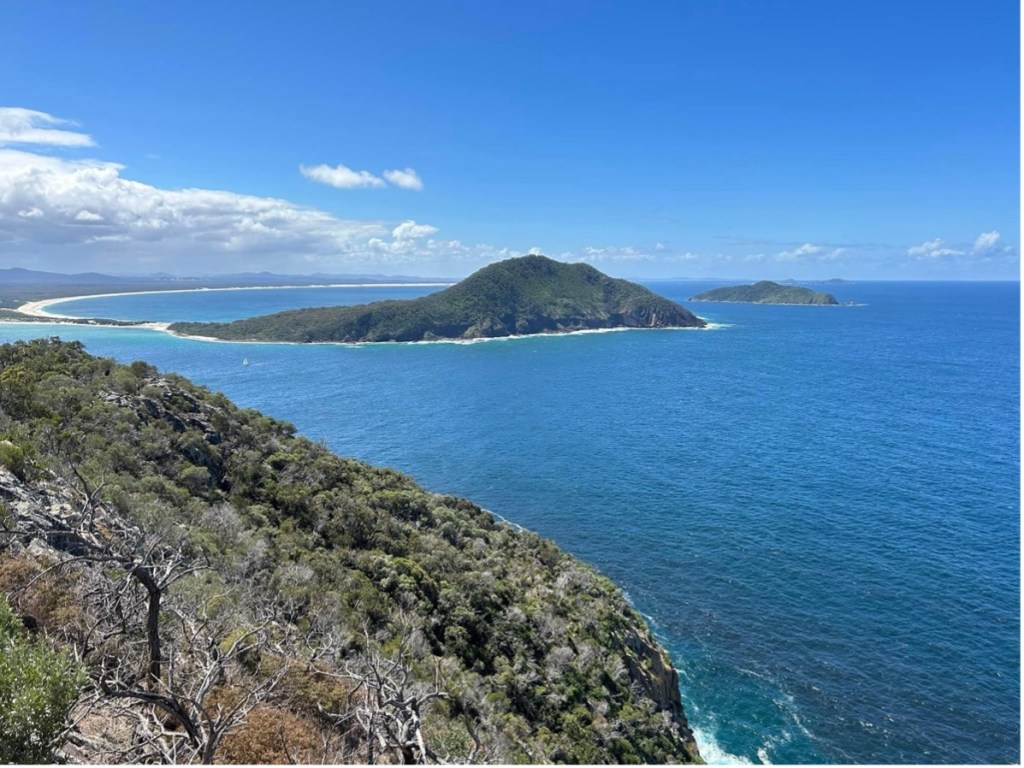
Yacabba as viewed from Tomaree, showing the harbour entrance, and looking north with Broughton Island in the far distance [Author Photo]
Still looking westward from Tomeree, the long, tree-covered expanse of Soldier’s Point extends from Salamander Bay, almost meeting the small island the aborigines knew as Boandabah. The tide races past either side of this island in very deep water, but near Soldiers’ Point it falls away to a shallow calm, the favoured spots of amateur fishermen. Once there was only a handful of huts. at this picturesque spot, but now many modern and comfortable bungalows and residences line the waterfront.
Within two miles of the heads on the southern shore, fronted by a sandy beach, is the main township, of Nelson’s Bay. For very many years Nelson’s Bay was sparsely settled and a very rough and stony track served for a road which joined the settlement with Newcastle at Stockton some 30 miles away. The residents were mostly hardy fishermen, who netted the beaches for the great schools of sea mullet, bream, blackfish and other pelagic fishes. A few went out in small craft to catch deep sea fish, snapper, morwong, flathead, and many other species of edible fish – working long hours in all kinds of weather, mostly making their catches by handlines. Lobster pots were made and set out in the deep water. This, together with seine trawling and trapping rough-skinned, sharp-toothed leatherjackets, gave the townsfolk their livelihood.
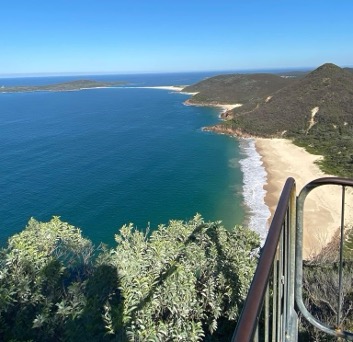
Looking south from Mount Tomaree [Author Photo]
The fame of the port and its adjacent waters soon spread. Amateur fishermen came from near and far to try the waters off Broughton Island, 10 miles northwards. Here they caught great quantities of snapper and many other deepwater fish. The sporting light-game fishermen soon found that here, too, were fighting fish such as tuna, mackerel and kingfish, worthy of their attention. The late Sir Herbert Maitland and his friend, Mr. E. P. Andreas, came regularly from Sydney to pit their skill against these fighting fish. A small band of enthusiasts from Newcastle and Maitland then discovered marlin at the doorstep of the port, and so came about the formation of the Newcastle and Port Stephens Game Fish Club. Many Australian and several world record catches have been made by its members, and the waters off Port Stephens are now considered amongst the best big game fishing areas off Australia.
Still the town of Nelson’s Bay remained unchanged till World War II brought troops by the thousand into the district. Soon bulldozers were pushing their way through the scrub and good roads appeared where earlier there had been only sandy bush tracks. After the war, fishing was taken up again, but by now boats and gear were vastly improved and things became more mechanised.
The town at last started to grow rapidly as people became aware of the good roads and attractions within comparatively easy distance of Newcastle and the Coalfields. Interest in amateur fishing was the main stimulus. Plain tent camping gear gave way to holiday homes, and caravans, guest houses and cabins developed and were soon booked out a year in advance. The beaches at Nelson’s Bay and Shoal Bay became favourites with the holiday crowds and, though lacking in surf, proved ideal for children to swim and frolic in the calm water, and sunbake on the clean white sand.
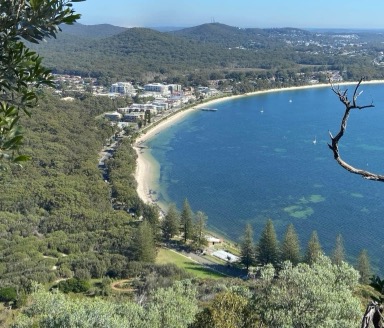
Shoal Bay as viewed from Mount Tomaree [Author Photo]
Looking down now from Tomaree, Shoal Bay curves away from the very foot of the mountain in a great, sandy tree-fringed arc, to the small lighthouse on Nelson Head. Once, only one lone launch rode at its solitary mooring out from the beach. Now more than a dozen up-to-date launches, all good seaworthy craft, cluster around the edge of the beach in front of Shoal Bay Country Club. Some are professional fishing boats, some game fishing launches, others pleasure launches, but all go out into the deep waters of the Pacific off Broughton Island in search of fish.
Far across the bay, to the north-west, the winding Myall River opens into Port Stephens at Corrie Island. For miles along these shallow shores, from Pindimar to Winda Woppa, to the township of Tea Gardens and beyond, thousands upon thousands of neatly stacked wooden stakes represent the district’s wealth in oyster culture. The Myall can be navigated up-stream by small boats, through a series of lakes, for 25 miles. Down from Bungwahl come the paddle-wheeled droghers carrying loads of hardwood and other timbers from the great, dense brushes and gullies to the mills at Winda Woppa, and for timber boats from Sydney.
Down from Tamboy come also the finest prawns in the State, to be rushed to the markets in Sydney and Melbourne. In the flat, scrub-covered bushland between the river and the sea, native flowers add their brilliance and perfume in the springtime, while many varieties of birds feed on the honey and insect life the plants attract. Creamy white flannel flowers like green-tipped stars spread in great patches over the whole bushland. Contrasting with these, pale pink eriostemon, crowea, and the darker and sweet-scented boronias make a blaze of glory everywhere. In the more swampy areas thousands of crimson bottle brushes bend their soft, hairlike blooms on slender stalks with green and silver leaves.
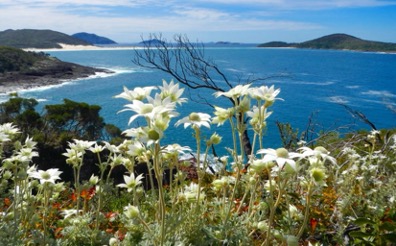
Native flannel flowers overlooking several islands that lie off Port Stephens [Author Photo]
A mile offshore from rugged Yacaaba, guarding the entrance to the port, lie two large islands and one small one. The aboriginal possibly never saw the heads from out at sea, for it is said he did not have the art of canoe making. So, there remains but one name for the centre island, which was called Boondelbah. The other two are known simply as Little Island, as a contrast to Boondelbah, or Big Island and Cabbage Tree Island. Cabbage Tree Island is covered in dense scrub, fig trees, and cabbage tree palms. Strangely the other two are bare of flora apart from course rushes and a few hardy low-growing shrubs.
Cabbage Tree Island is the only known nesting place in the world of a species of sea bird discovered more than 100 years ago by John Gould, the ornithologist. The species still occupy the island at certain times of the year. It bears the name Gould’s Petrel. The birds come in from miles to sea and make their landfall after dark, crashing through the thick canopy of palm leaves to alight with uncanny accuracy near the nesting sites they have chosen under the great boulders covering the steep hillside. Nemesis awaits the birds who come home before dark: the fierce peregrine falcon, credited with speed of more than 200 miles an hour, perches, ready to swoop on them.
And so back to the lookout on South Head, which has changed but little in thousands of years. The black north-easters that scream like Harpies through the heads in summer, the cold grey southerlies lashing the rocks with great crashing seas, rainstorms, fogs, westerlies, and bright sunny days, the aboriginal saw them all – and wondered at nature’s moods.’
Concluding Comments
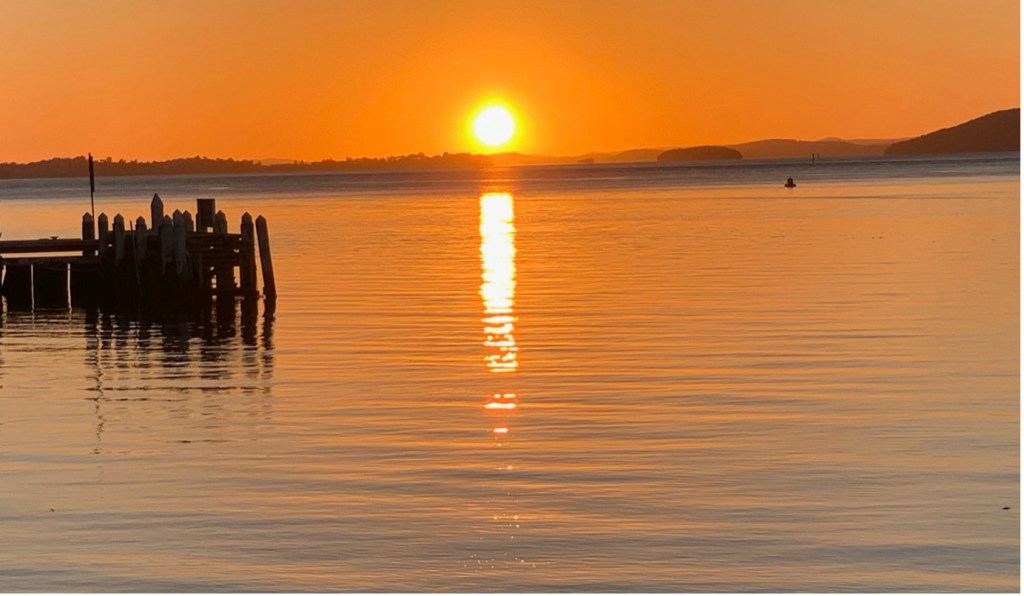
Sunset over the waters of Port Stephens – looking west from Little Beach [Author photo]
The following papers on early travel excursions in the Port Stephens region are published on the website and can be found at the following links:
History of Tourism Promotion at Port Stephens
The Lakes Travel Route to Mid-North Coast
A four-day excursion to Port Stephens – Christmas 1906
A personal tour of Port Stephens – 1914
Excursion from Newcastle to Port Stephens by sea
A journey from Port Stephens up the Myall River to Forster – 1908
Researched and compiled by Kevin McGuinness
March 2025


