
Introduction
The Volunteer Defence Corps (VDC) was an Australia-wide part-time volunteer military force that operated during the Second World War, based on the model of the British Home Guard.
Founded in July 1940 by the Returned and Services League of Australia (RSL), it initially comprised ex-servicemen from the First World War who were too old for active duty.
Initially, the government provided some weapons to the VDC but took full control and supplied standard uniforms from 1941 onwards.
Despite never being well equipped, the VDC numbered 44,000 when war with Japan began on 7 December 1941, with 5,000 members assigned to roles like coast watching and airfield defence.
After the war in Pacific broke out, the VDC was expanded in February 1942 to include men aged 18–60, reaching almost 100,000 members at its peak. The VDC focused on intelligence gathering, static home defence, protecting key sites, and preparing for possible guerrilla warfare.
VDC men wore green uniforms with Australian slouch hats and used .303 rifles or Vickers/Lewis machine guns. Other volunteers, initially facing equipment shortages, improvised their own weapons.
The Australian rifle clubs, organized under the National Rifle Association and connected to the Department of Defence, provided a foundation for the VDC as their members were experienced marksmen and familiar with firearms.
Members of the VDC were awarded the Australian Service Medal for three years part time service.
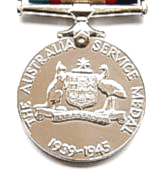
Australian Service Medal
From a selection of records from the Australian National Library ‘Trove’ collection, this paper sets out various aspects of the Volunteer Defence Corps operations before and after the Port Stephens Region became actively involved around March 1942.
Two Battalions of the VDC covered the Port Stephens Region, viz: 4th Battalion based at Taree which covered the region on the northern side of Port Stephens harbour, and the 5th Battalion, based at Newcastle, which covered the region on the southern side of the harbour.
From March 1942, local units were established in several towns throughout the Port Stephens region, where they trained locally and also took part in regional events, such as those at Bulahdelah and Dungog.
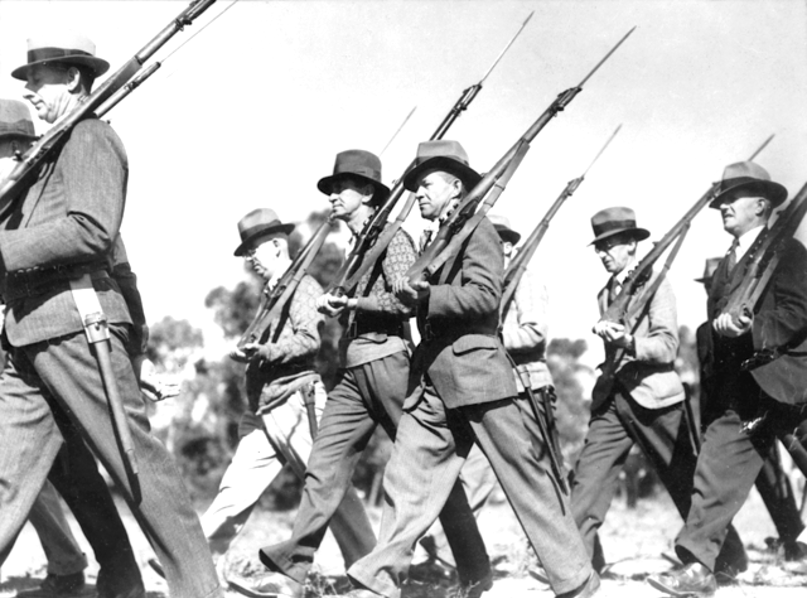
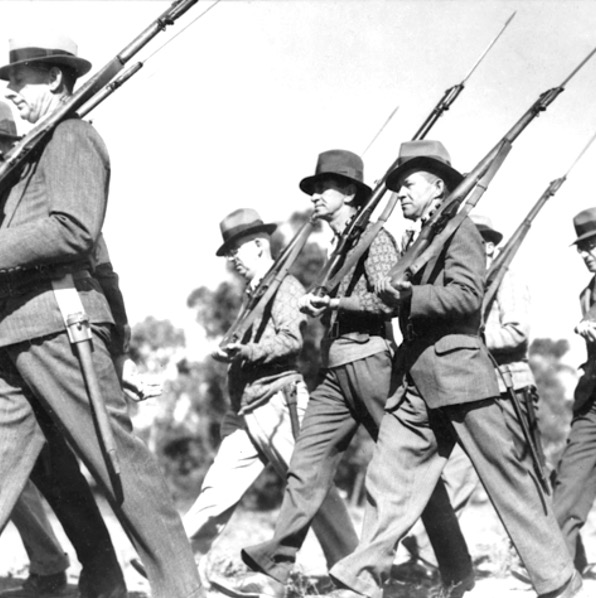
VDC members are shown marching before the issue of uniforms [Australian War Memorial]
The Volunteer Defence Corps in Australia began to wind down in 1945 with activities concluding around late November that year.
Early Days of the VDC in the Newcastle Region – 1941
The Newcastle Sun of 30 May 1941, page 4, reported:
‘Many Australians are more than willing to “go to it” if only they knew how to go about it. Thousands of the people cannot yet be absorbed into the industrial effort and are looking round to find a place in the war effort. There is now a big opportunity for service for many men prevented by various reasons from joining the A.I.F., the Air Force, the Navy or the Militia — the Volunteer Defence Corps.
Inevitably it will consist mainly of middle-aged men, particularly the returned soldiers, who will form its backbone, and those who are in the rather invidious position of having been too young to go to the last war, but who are at present regarded as too old for this one.
The first big rally of the corps will be held at the Newcastle Showground on Sunday morning. Red tape will not be a feature, and volunteers will be enrolled there and then and will go to the job at once. There may be a tendency to regard this, our second line of land defence, in a derisive light, but the war situation should preclude all considerations except that this force is being formed in deadly earnestness. We have no guarantee at all that this Continent won’t be invaded.’
The Newcastle Morning Herald and Miners’ Advocate of 31 May 1941, page 6, also reported:
‘There should be a ready response to the appeal for recruits for the Volunteer Defence Corps, and an opportunity for enrolment will be presented at the rally at the Showground tomorrow morning. The corps is the nearest Australian equivalent of the British Home Guard, which has proved of inestimable value in reinforcing the defences of the United Kingdom. Its strength must necessarily be based largely upon returned men and members of rifle clubs, but it is not restricted to them and will include men who are debarred from military service by age or some small invalidity.
Should raid or invasion unfortunately reach these shores it would be the instinct of every man in the community to pick up a gun. Unfortunately, he would be of no value whatever unless he had learned to use a rifle and mastered at least the elements of military routine. The Volunteer Defence Corps offers an opportunity to those who are unable to go on active service and are not being trained under the universal scheme to play their part In making Australia safe.’
Department of the Army takes over responsibility for the VDC – 1941
The Gloucester Advocate of 17 June 1941, page 2, reported:
‘The Volunteer Defence Corps has been taken over by the Department of the Army and the organisation is being placed on a regular military basis. All recruits will be required to pass a medical examination before acceptance and, when units are complete, members will be issued with uniforms and equipment. This area is to provide a Company, with headquarters at Gloucester and it will be necessary to enrol a substantial number of additional men.
An effort is being made to get in touch with all local men who might care to offer their services. Men who are interested are invited to attend the next parade of the local unit, to be held at Gloucester Park at 10.30 a.m. on Sunday 22nd June.’
Headquarters of the 5th Battalion of the VDC established at Hamilton – 1941
The Newcastle Morning Herald and Miners’ Advocate of 1 July 1941, page 4, reported:
‘Headquarters for the 5th Battalion Volunteer Defence Corps has been established at Hamilton Drill Hall. Major P. Charlton is the officer commanding. Tonight at Hamilton Drill Hall, Major Charlton has convened a meeting of commissioned officers and any members of the battalion in an equivalent position. On Wednesday night there will be a meeting of non-commissioned officers and those in equivalent positions attached to Headquarters Company.’
5th Battalion VDC held its first march from the Broadmeadow showground to Braye Park at Waratah and return. About 500 men participated [The Newcastle Sun, 28 July 1941]
VDC Parade at Newcastle – 1941
The Newcastle Morning Herald and Miners’ Advocate of 25 August 1941, page 5, reported:
‘The Volunteer Defence Corps paraded at the Showground yesterday morning. ln the afternoon there was a voluntary parade for the anti-tank and machine gun sections. About 600 men attended the general parade. Platoons were scattered over various parts of the ground; some even spread to District Park. Physical culture drill, marching, rifle exercises, and ordinary drill were undertaken. Officers are very pleased with the behaviour of the men.’
First Company VDC Parade near Stroud – 1941
The Gloucester Advocate of 26 September 1941, page 2, reported:
‘More than a hundred members of the Volunteer Defence Corps from Gloucester, Dungog and Stroud, are expected to meet at Weismantels next Sunday, 28th September, to take part in the first Company parade to be held in this area. A solid day’s activity is planned and the Battalion Commander, Captain M. V. Williams, will inspect the men at work during the day. Gloucester V.A.D. Detachment will also attend the parade and members look forward to some stretcher-drill and first-aid treatment of casualties.’
VDC Parade at Newcastle – 1941
The Newcastle Morning Herald and Miners’ Advocate of 6 October 1941, page 5, reported:
‘Newcastle Volunteer Defence Corps held a parade and exercise at Newcastle Showground yesterday. Rifle exercises, including drill aiming, bayonet drill, rifle leading, and trigger pressing, were carried out. Exercises with Vickers and Lewis guns were also carried out. The ambulance section and a trench mortar section trained. The parade was under the command of Major Charlton. Riflemen will visit a range shortly for firing practice.’
Machine Guns to be issued to the VDC – 1941
The Newcastle Sun of 4 December 1941, page 2, reported:
‘The Minister for the Army (Mr. Forde) has announced the issue of light-machine guns and sub-machine guns to the Volunteer Defence Corps. A full issue of mortars had been issued, he added. Rifles were being issued at the highest possible rate. In the near future all units would have uniforms, of which 11,000 had already been distributed.’
Port Stephens Region becomes involved in the VDC – 1942
The Raymond Terrace Examiner and Lower Hunter and Port Stephens Advertiser of 5 February 1942, page 4, reported:
‘A public meeting held by the residents of the above districts, to discuss the forming of a civilian volunteer unit, to undergo a course of military training was held in the Anna Bay Hall on Thursday, January 22nd. The meeting which was very capably presided over by Mr. H. Upton, was attended by Major Foster, Captain Cochrane and Lieut. Neilson of the military authorities and drew an excellent attendance.
In addressing the meeting, Major Foster was very impressive and interesting. He explained the valuable assistance a civilian force, if thoroughly trained could be in case of invasion, to the main fighting body and also pointed out that the war for Australia was not an individual person or person’s war, but seeing it is our country, every person has something very dear to protect.
At the conclusion of the Major’s address it was unanimously decided to immediately form a unit and in the vicinity of 60 volunteers registered. It was decided to undergo training, starting at 10 a.m. and training till 2 p.m. each Saturday commencing on Saturday last. Anna Bay Hall and grounds being selected as the training centre and Mr. Alf Blanch as commander of the Unit, assisted by Sectional Commanders in Mr. S. Thompson and Messrs. H. Upton, E. Bennett and C. Blanch. A. volte of thanks called for by the chairman to the Military officers for their attendance and very capable explanations on various matters was enthusiastically accorded with acclamation to which each of the officers responded with their sincere thanks for the good attendance and decision of the gathering in forming the unit.
As previously mentioned last Saturday commenced the training which was very interesting, reflected great credit to each of the instructors for the capable and thorough manner in which they performed their tasks.’
Formation of Mounted Units in country centres – 1942
The Raymond Terrace Examiner and Lower Hunter and Port Stephens Advertiser of 19 March 1942, page 4, reported:
‘Authority would be given for the formation of mounted units of the Volunteer Defence Corps in country centres, said the Corps Commander, (Major-General J. Richardson) ….. He expressed the hope that there would be a great expansion of the V.D.C. in the country as a result of the announcement……
Mounted units would have to be formed on the usual V.D.C. basis, Major General Richardson explained. Each recruit would have to provide his own horse and saddlery with feed for his mount on short parades or bivouacs. It was hoped to provide riding breeches leggings and other equipment for the mounted volunteers before long. Major General Richardson said it was desired to greatly increase the strength of the Corps.
Authority had been given to bring battalions to a greater strength than the establishment formerly set. The necessary organisation would he put in hand later. ‘It is hoped to get arms, equipment and uniforms issued in a much more satisfactory manner in the future,’ he said.’
VDC Unit to be set up in Raymond Terrace District – 1942
The Raymond Terrace Examiner and Lower Hunter and Port Stephens Advertiser of 19 March 1942, page 3, reported:
‘A meeting will be held in the Oddfellows’ Hall, Raymond Terrace, on Friday (tomorrow) night for the purpose of setting on foot a move to establish a V.D.C. in the Raymond Terrace districts. The meeting will be addressed by Major General J. D. Richardson, Cols. Rodd, Corlette and other staff officers.
For the past few weeks, a movement has been going as a ‘kind of civilian defence corps’ at which many have attended at the School of Arts to hear military instructions from non-com. officers on how to use the rifle, Bren gun, bayonet, the different kinds of grenades, and a lot of other useful information. This move came in on a request from the military authorities to Sergt. Collins, who arranged the meetings in Raymond Terrace and also for meetings in the districts which are under his Police surveillance.
The move to get the V. D. C. going is recognised as a very necessary one, as there are a good many who are able to serve in the defence of their own districts if required, who are in essential industries and who cannot leave home for any great period, but who could find time to get a bit of training or learn something at home. There are men also who have for age and other reasons failed to join up with the Militia or the A.I.F. who can join up in the V.D.C. and perhaps be able to render most useful service when called on and directed by the military.
The V.D.C will be able to get equipment such as rifles, and other material, and have a chance to defend their homes and families from the invading enemy. Only by numbers can he be stopped and everyone will count especially as he gets trained in the use of the rifle or bayonet, etc., and will know what to do if necessary.
Major-General Richardson is anxious to get a Light Horse mounted section in the V.D.C. as in bush country the mounted men can get where the mechanised troop cannot. Through the bush and across rough country anywhere the horse man can go, and as the Jap is not used to meeting horsemen he would be perplexed as to how he could stop them in the timbered country, and much fighting (if the enemy lands) will be along the coast in timbered country. Scarcity of horses may be a deterrent for a while, but horses will be dug up from somewhere.
Major-General Richardson is also considering the formation of bicycle troops. They are used by the Jap in infiltration methods, and as he has found them useful, they would also be useful here. They with the horsemen could round up and destroy any parachute troops or infiltration squads the enemy may use.
The men in adjoining districts are asked to come in to the meeting on Friday night. They will then get firsthand information of what each and all who can, are expected to do. Modifications in the rules of the V. D. C as first made, have been altered to enable men to join up for service in their own districts without having to go anywhere when called upon away from their own localities. They would be expected, to go anywhere in the districts around, but not too far away, unless the direst necessity arose.’
First VDC Drill at Raymond Terrace – 1942
The Raymond Terrace Examiner and Lower Hunter and Port Stephens Advertiser of 2 April 1942, page 3, reported:
‘There was a very good response to the first parade under the local V.D.C. on Saturday. The chairman of the Committee — Mr. Goodman — explained the objects that are aimed at attaining and said there was no time to be lost in becoming members and attaining efficiency. Mr. A. Osborn also addressed the recruits. Parades in future will be on Friday nights and Sunday mornings. When the mounted unit forms, they may, if they desire parade on Saturdays as they arrange.
All testation forms will be available this week and persons interested are asked to get them and fill them in so that the troop can be properly formed. It was also thought that perhaps it would be possible to have parades on Saturdays and Sundays to suit the convenience of those that find one day or the other the most convenient, no finality can be reached however on these matters until it is seen what instructors are available.’
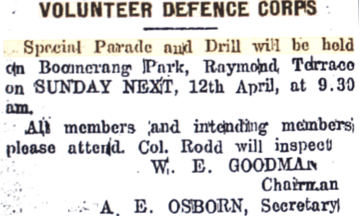
Advertisement for VDC Special Parade and Drill at Raymond Terrace [Raymond Terrace Examiner and Lower Hunter and Port Stephens Advertiser, 9 April 1942]
The Raymond Terrace Examiner and Lower Hunter and Port Stephens Advertiser of 16 April 1942, page 3, also reported on a follow-up parade:
‘There were about 60 on Boomerang Park on Sunday to learn the first phases of drill, gunnery, etc. The number will be augmented by others. It is important that all who are physically fit, not matter their age, should make themselves as efficient as possible, as the war has, from present indications a long way to go yet, and no one knows what role he may have to adopt. The effort to raise the light horse troop is going on and will take shape definitely as soon as horses are procured. A troop has been formed in Newcastle and Major-General Richardson is sanguine that he will get the number required to make a light-horse regiment.’
VDC activities at Dungog – 1942
The Dungog Chronicle of 27 March 1942, page 2, reported:
‘About 60 members of the Volunteer Defence Corps attended the parade on Wednesday evening at the Scout Hall [at Dungog]. Rifle drill, physical training and lectures were the order of the evening. New members continue to join up. There is room for many more. On Saturday afternoon there will be a route march and field operations. On Sunday morning, in deference to His Majesty’s call for a day of prayer, members of the V.D.C. will hold church parades at their respective churches. Messrs. Guy Waller and K A. Gam are going to Sydney for a five-day camp of instruction on guerilla tactics. On their return they will act as instructors to the members of the local V.D. Corps.
The Dungog Chronicle of 10 April 1942, page 3, also reported:
‘There was a very big attendance at the parade on Wednesday night. Another lot of rifles have arrived, and rifle drill was indulged in. Raw recruits were given special instruction. An appeal was made for men to enlist with the V.D.C. for permanent duty for the duration of the war. They will proceed to Taree in a few days. Mr N. H. J. Robson joined up as also did Messrs. Greg Smith, Bill Newton, George Lancaster, Jack Hodges and Norman Spencer. We understand that Mr. W. J. Ralph has also decided to join. Mr. Gus Hooke who went down to join the 8th Garrison, found that the lists had closed, so he had joined the permanent V.D.C. and leaves for Taree on Saturday’.
Mr. Alan Pearse, who has been instructed by General Richardson to, form up a troop of 25 mounted men, has met with much success. Already 23 have joined and of these 10 are new members and seven are from the already established V.D.C.
Messrs. Guy Waller and Bob Gam have returned from the Guerilla School in Sydney and report having had some strenuous trailing. Conditions were those of actual practice and there was no ‘playing about.’ At the appropriate time they will form a guerilla band in the V.D.C. and give them the benefit of their knowledge and training. Next Sunday the troops will carry provisions for a midday meal and march to a destination undisclosed.’
Port Stephens DVC member removed from dangerously ill list – 1942
The Daily Telegraph of 14 May 1942, page 3, reported that Pte. E. Holbert had been removed from a previously published list of a VDC member who had been placed on the NSW casualty list, and he was no longer dangerously ill.
Tomaree Headland Coastal Artillery Battery used for VDC Training
The War Diary of the Tomaree Headland Coastal Artillery Battery near Shoal Bay contains numerous entries concerning VDC training conducted at the facility.
The following excerpts from the Diary, which is held by the Australian War Memorial, and refer to VDC activities at the Tomaree Headland Battery are set out below:
19 August 1942 – V.D.C. personnel marched into Head Battery;
13 September 1942 – Visit from Senator Fell, V.D.C;
23 January 1943 – 160 V.D.C. personnel carried out weekend exercises at Tomaree;
28 August 1943 – One-inch Aiming practice carried out – 220 rounds fired by Battery and VDC personnel;
11 November 1943 – Breaches of security made by V.D.C. reported by Lt. Smith-Palmer;
29 November 1943 – Captain Fry to conference at Shepherds Hill regarding V.D.C training;
31 December 1943 – V.D.C. Training carried out vide Syllabus of training 8 series of one inch aiming rifle fired from Battery by V.D.C. personnel; During the afternoon all V.D.C. personnel marched out of Lower Camp;
2 January 1944 – 80 V.D.C. personnel marched into Lower Camp for weekend training;
13 January 1944 – V.D.C. Training carried out according to Syllabus;
6 February 1944 – V.D.C. on Battery for weekend camp;
19 February 1944 – V.D.C. in camp for training. With the exception of B.O.P. Lookout the manning of the Battery during darkness on 19 and 20th February was carried out by V.D.C. The job was carried out efficiently.
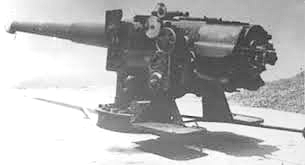
A 6-inch gun at the Tomaree Headland Coastal Artillery Battery, Port Stephens. The guns were nearly 8 metres long. The photo was taken before the installation of a shield designed to protect the gun crew.
Tea Gardens Member of the VDC appointed as a Lieutenant – 1942
The Wingham Chronicle and Manning River Observer of 11 September 1942, page 2, reported:
‘Major J. H. F. Lipscombe, commanding officer of the 4th VDC Battalion, has been advised of the following appointments to commissioned rank: Lieutenant – R. E. Webb (Tea Gardens)’
5th Battalion VDC Parade at Newcastle – 1942
The Newcastle Sun of 1 October 1942, page 5, reported:
‘From next Sunday all members of the 5th VDC Battalion will parade in summer dress. Parade arrangements for Sunday are: A Company will parade on Sunday at 9 a.m. at the Rifle Range for half-day parade. B Company will parade at the Showground at 9.30 for half-day parade. C Company will hold a half-day parade at Adamstown Rifle Range. The arrangements for E Company are: The 20th Platoon will parade at the Cathedral Hall at 8.30 a.m. The rest of the company will parade as usual at the aerodrome. On Monday, E Company will hold a parade at the Cathedral Hall at 7.30 p.m. The transport section of Headquarters Company will hold a special parade at the Cathedral Hall on Saturday at 3 p.m. All members of the section are expected to be present.’
VDC Activities in the Tea Gardens Area – 1943
The Dungog Chronicle of 8 January 1943, page 3, reported:
‘The V.D.C. is doing good work along the coast. An official inspection of the Providence Bay [Hawks Nest] detachment was made by Captain Webb, Commanding Officer, during the holidays. He has under his command the units at Bulahdelah, Wootton and Bungwahl. Capt. Webb saw service in the last war. He presides over the destinies of Tea Gardens Post Office. Puntman [of the Tea Gardens-Hawks Nest Ferry] Bill Cooper, who is a Signaller Corporal in the V.D.C., had a busy time during the holidays.’
Citizens urged to join the newly formed Raymond Terrace VDC – 1943
The Raymond Terrace Examiner and Lower Hunter and Port Stephens Advertiser of 18 March 1943, page 2, published the following emotive letter from a Raymond Terrace resident urging his fellow citizens to join the recently formed VDC Unit:
‘Sir. — In the opinion of those who are in a position to judge, enemy bombing raids are not only possible, but highly probable before the war is finished. There can be little doubt that these would be directed particularly against Sydney, Newcastle and Port Kembla, and so may come over our heads here in Raymond Terrace.
Thus, the ill-fated day may come when our own homes, wives, and children, become the target of enemy bombs. Till now, men, except Wardens could have done nothing but hide in a shelter, and shake their bare fists at the sky; but a means has now been placed before us whereby any man can train to actually man the guns and bring the raiders down from the skies.
What more could any red-blooded man wish than to be able to fight back — and fight back with all his might, if his own dear ones were being blasted from above? The cost of this opportunity is merely the foregoing of two hours leisure on Wednesday nights, and three hours on Sunday mornings training to man the heavy anti-aircraft guns nearby in the new unit of the Volunteer Defence Corps.
Not every man can go to the war — but it seems to me that the part-time training outlined above is just about as near as possible to real action that those who must stay at home can attain. The work is interesting, practical, and of value and all instruction is given by full-time A.LF. and A.M.F. personnel.
I appreciate the opportunity to appeal through your columns to the men of Raymond Terrace to join the new V.D.C. unit, the complement of which is still short. Now businessmen, tradesmen, and other residents, what about it?’
Sub-unit of 5th Battalion of VDC to be formed in the Anna Bay and Nelson Bay district – 1943
The Newcastle Sun of 1 April 1943, page 5, reported:
‘Arrangements are being made to form a sub-unit of the 5th Btn. VDC Artillery Company in the Anna Bay-Nelson’s Bay district. For some time, many men in this district have been anxious to play a part in the corps, but hitherto it had not been possible to arrange for their inclusion.
A scheme has now been worked out to enable these men to train in their own area and arrangements have been made to send an officer to the district next Monday, Tuesday and Wednesday. He will make contact with leading citizens and arrange meeting places where the plans will be explained and he will then proceed to enlist men.
Entrance to the 5th Btn. Artillery Company will be confined to men living on the southern shore of Port Stephens within easy reach of Anna Bay and Nelson’s Bay. The officer will leave Newcastle next Monday morning at 9 and will make calls along the route, leaving notice of where he can be contacted.’
The Newcastle Sun of 3 April 1943, page 3, also reported:
Lieutenant Salter of the 5th Battalion VDC, will be at Nelson’s Bay on Monday and Tuesday nights to interview recruits for coastal artillery and heavy anti-aircraft guns, and will also attend a meeting at the Anna Bay hall at 8 p.m. on Tuesday. In his absence, there will be a substitute at Nelson’s Bay.’
The Newcastle Morning Herald and Miners’ Advocate of 3 April 1943, page 2, further reported:
‘Lieutenant Salter, of the 5th Battalion, V.D.C., will visit Anna Bay and Nelson’s Bay on Monday and Tuesday of next week. He will be at the Sea Breeze Hotel, Nelson’s Bay, between 7 and 9 p.m. on those dates to interview recruits for coastal artillery and heavy anti-aircraft guns. Lieutenant Salter will also attend a meeting at the Anna Bay hall at 8 p.m. on Tuesday. A substitute will be in attendance at Nelson’s Bay in his absence.’
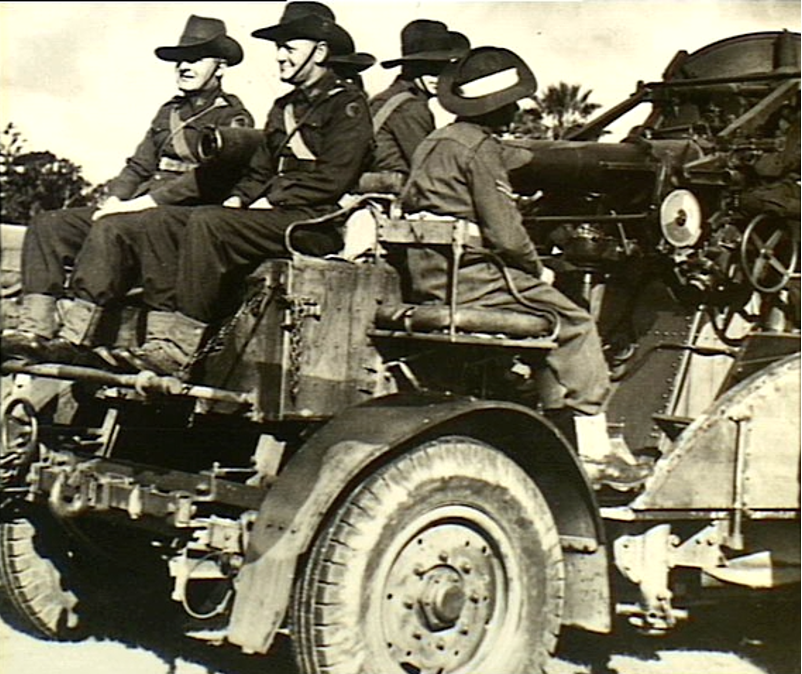
VDC members on an anti-aircraft unit on a training exercise, circa 1943 [Australian War Memorial]
VDC Bivouac at Hawks Nest – 1943
The Dungog Chronicle of 16 April 1943, page 4, reported that a letter had been sent to the Stroud Shire Council from the Officer in Charge, ‘F’ Company, 4th Battalion, V.D.C., expressing the thanks of the officers, N.C.O.’s and all ranks of the Company for the use of the Hawks Nest Pavilion during a recent weekend bivouac.
VDC Camp at Wingham includes representatives from Tea Gardens – 1943
The Dungog Chronicle of 30 April 1943, page 1, reported:
‘About sixty members of the Volunteer Defence Corps units from the area covered by the 4th Battalion were in camp over Easter at Wingham. Representatives from this district were Messrs. W. E. Wilson, L. Gatty, M. O’Regan, C. Foell, C. S. Cox (Dungog), A. Borham and J. Garner (Hilldale), C. Thomas, Milton Gorton, and V. Robards (Clarence Town). Mr. Wellard led a contingent from Stroud, while Bulahdelah district, Tea Gardens district, and Gloucester also had members present.
Major J. P. Lipscombe was in charge, and he delivered a series of lectures, while other battalion officers, as well as instructors supplied from other areas, assisted him. Col. Corlette, of Newcastle, Divisional C.O., was present for most of the period of the camp. In an address, he commented that the 4th Battalion had been the first to act on the suggestion of the authorities to provide such camps in order to increase efficiency of members, and that this camp was actually the first of its type to be held.
Those present were officers and senior N.C.O’s. and the syllabus had been designed to make the students better fitted and to enable them to act as instructors for their units when they returned to their units. It was a ‘closed’ camp and no one got leave. The troops were kept hard at work. There was not a spare moment.’
Bulahdelah Anzac Ceremony addressed by Tea Gardens VDC Officer – 1943
The Dungog Chronicle of 30 April 1943, page 3, reported:
‘The newly formed sub-branch of the Returned Soldiers’ League held its first procession and commemoration service on Sunday last, 25th April. …..
The main address was given by Capt. Webb, O.C. F Coy., V.D.C., of Tea Gardens. Capt. Webb, who is an Anzac, gave a most stirring address on the significance of Anzac Day, and this was very much appreciated by the large crowd.’
The Dungog Chronicle of 28 April 1944, page 3, reported that at the second Anzac Ceremony held at Bulahdelah, Capt. Webb, of Tea Gardens, delivered the Anzac Requiem.
Motivational Address to VDC Personnel – 1943
The Dungog Chronicle of 23 November 1943, page 2, reported:
‘The policy of the V.D.C. now is to make parades as attractive as possible with the employment of weapons to create an atmosphere as near to actual battle conditions as possible, and that this is greatly appreciated is indicated by improved attendances at parades.
Capt. Murdoch, of B Group Headquarters, in an address on Sunday morning at Taree to a number of the local Battalion personnel, spoke clearly and informatively on the future role of the V.D.C. He pointed out that as the Japs were pushed northward the area of static defence would increase. That area had to be defended and the V.D.C. was being called upon to do its share.
For several years the V.D.C. had been ignored and neglected. They had proclaimed themselves ready and able to do their share for the defence of Australia, and the authorities were calling their bluff. They were being supplied with ample equipment and facilities for training, and each battalion had been allotted its job. Despite statements that the danger to Australia was over, it was plain that such was not the case. One could quite easily visualise a quick land raid or a carrier-borne air raid with or without a land attack. The defence could be immobilised by a number of aircraft attacks on those points, while a land force could strike at key installations.
The speaker expressed concern at a falling-off in attendances at parades. There was a general feeling of complacency at the Pacific situation, but it was not justified by the facts, and he quoted various facts to prove his point. He urged that members of the V.D.C. keep up their training and see to it that those starting to ‘slip’ be fully acquainted of the position.’
VDC Christmas Camp at Tomaree Coastal Artillery Battery at Shoal Bay – 1943
The Cessnock Eagle and South Maitland Recorder of 17 December 1943, page 4, reported:
‘Camp for all ranks will be held at Nelson’s Bay from 26th December to 31st December. Training on search lights. Men may also attend for at least three days. Pay, allowances, and transport will be provided.’
VDC Easter Camp at Tomaree Coastal Artillery Battery at Shoal Bay – 1944
The Gloucester Advocate of 18 February 1944, page 4, reported:
‘The Easter Camp for 4 Battalion will be held at Tomaree, Port Stephens, from Thursday 6th April to Tuesday 11th April. All ranks are invited and personnel will be paid according to rank. Camp facilities at Tomaree include huts, electric light and showers. Surfing, and fishing are available. Motor transport will pick up members at central points. A most interesting course of training is being prepared, and it is hoped that all platoons will be well represented at the camp. Members who expect to be able to attend should advise Platoon commanders as soon as possible.’
The Muswellbrook Chronicle of 24 March 1944, page 1, also reported:
‘Over 20 members of the local unit will join the Easter camp for V.D.C. personnel to be held at Tomaree (Nelson ‘s Bay).’
VDC Reunion at Tea Gardens – 1944
The Dungog Chronicle of 3 March 1944, page 3, reported:
‘A re-union of members of the 18th Platoon at Australia Hall, Tea Gardens, took place on Friday, 18th ult., 25 members being present. Captain Webb, O.C., occupied the chair, and on rising to speak was applauded by the boys. He said it gave him much pleasure to be present at a function such as this, and it also brought back old and pleasant memories, and he hoped to be present at many more functions such as this one.
Amid cheers, the boys shouted, “Don’t worry, ‘Skipper,’ the ‘Cinderellas’ will never be wiped out.” During the evening songs were rendered by L/Cpl. Shultz, Pte. Tassill, and our old comedian, Pte. H. (‘Blue’) Asquith. A very enjoyable evening was spent.
On Sunday, 12th March, members of the 18th Platoon will proceed to Tamboi by Pte. Ringland’s launch, and there a day’s exercises will be carried out, returning to Tea Gardens the same day.’
Tea Gardens represented at VDC Camp at Wingham – 1944
The Dungog Chronicle of 14 April 1944, page 1, reported:
‘The second Easter camp of the 4th Battalion of the Volunteer Defence Corps took place at Wingham over the Easter holidays. Last year the camp was of four days’ duration, but this time it was extended to six days. The men went into camp on Thursday last and broke up on Tuesday, after spending the interim in an intensive training in as many phases of soldiering, as it was possible to crowd in. Their progress in the short period available was commented upon by visitors.
With last years’ experience to assist them, the staff had arrangements well in hand, and the students, thoroughly enjoyed their camp and left for home well pleased with it. Particularly was this so with the battle drill details. The men found that carrying out a mock battle was much more instructive and interesting than any lecture or theoretical problem. The equipment available also was of great help. An action carried out with Bren carrriers, mortars, machine-guns, Bren guns, Owen guns, smoke barrages, Verey lights, and live ammunition, while the men used rifles and blank cartridges, plus bayonet charges, was really worthwhile. …..
Instructors were provided from Group Headquarters. The attendance of students was not as good as was anticipated. Dungog was represented by Lieut. W. E. Wilson and Sgt. M. O’Regan, while Cpls. V. Robards and M. Gorton came from Clarence Town. Stroud, Tea Gardens, Bulahdelah and Gloucester Companies were also represented, the latter having a particularly good muster.’
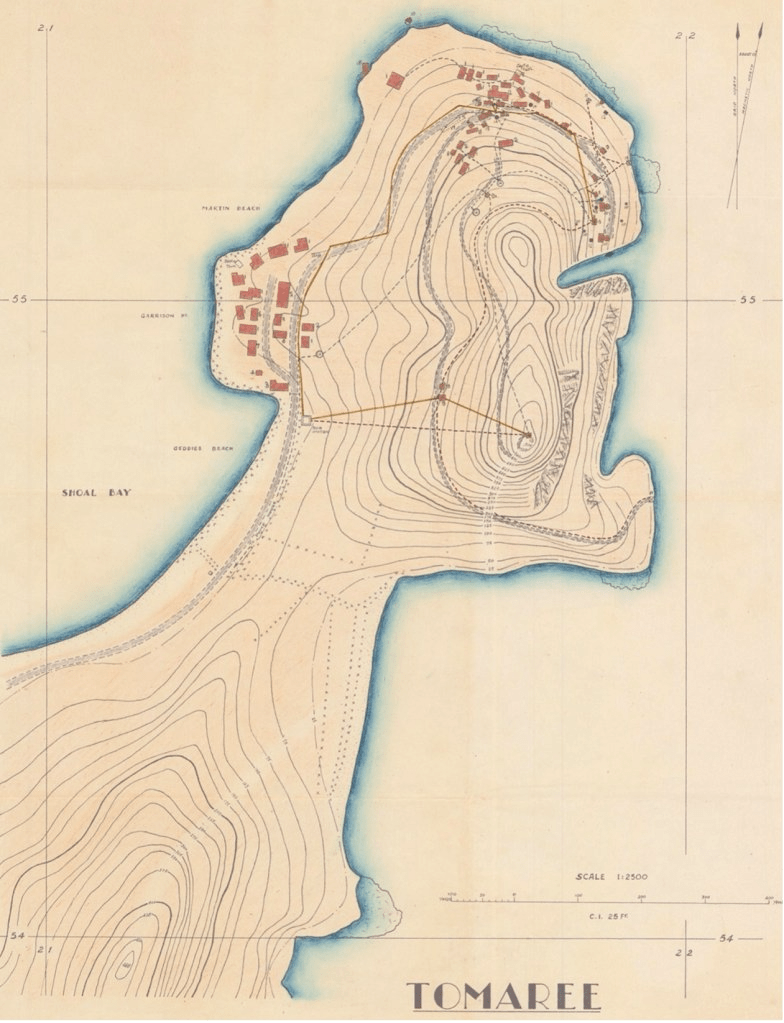
Map of the facilities at Tomaree Headland Coastal Artillery Battery at Port Stephens [National Archives of Australia]
VDC Parade to be held at Tea Gardens – 1944
The Dungog Chronicle of 25 August 1944, page 2, reported:
‘The local V.D.C. unit held a parade and shoot on Sunday last, when some good scores were recorded. Sgt. Keith Roberts was the winner and was in good form. Lieut. G. Bramble was in charge and advises that a company parade will be held on Sunday next at Tea Gardens and transport and rations will be provided. The local platoon are notified that they will be required to move off at 9 a.m. sharp and full dress is the order.’
VDC Picnic Trip to Tea Gardens and Hawks Nest – 1944
The Dungog Chronicle of 7 November 1944, page 1, reported:
‘On Sunday last a bus picnic was held at Hawks Nest and Tea Gardens by the local V.D.C. and a very good crowd attended. The day, which was not really the best owing to a cold wind blowing, was enjoyed by all and many took the opportunity of visiting friends and relations, whilst some of the boys tried their hands at fishing. Percy Griffis and “Spud” Murphy were most successful; after fishing all day their bag consisted of a good quantity of prawns (their bait), whilst Sergt. Keith Roberts caught a nice bag of oysters. They seem to think there are no fish there at all and are thinking of trying elsewhere next time. No swimming was indulged in and the return trip was made early after all had enjoyed themselves, with the mothers and children happy but tired.’
VDC Manoeuvre at Bulahdelah – 1944
The Dungog Chronicle of 17 November 1944, page 2, reported:
‘On Sunday last a detachment of two M.M.G. and crews travelled to Bulahdelah to take part in a company manoeuvre at that centre. …
Despite the terrific heat the troops went through a strenuous exercise, and. had no difficulty in carrying the assault on the ‘enemy’ post. It was the first time the mortars (from Taree) had taken part in any parades at the southern end of the battalion area, and their performance was watched with, keen interest.
The infantry platoon was drawn from the Bulahdelah and Tea Gardens areas, the latter under the leadership of Sgt. Bill Cooper. Unfortunately, the arrival of a boat [for loading by Waterside Workers] at Tea Gardens that morning kept many at work.’
Last VDC Bivouac at Hawks Nest – 1944
The Dungog Chronicle of 1 December 1944, page 3, published the following light-hearted report on the last bivouac held at Hawks Nest before the VDC organisation was wound-up:s
‘A week-end bivouac set down some time ago on the training syllabus of the local platoon of the V.D.C. was carried out on Hawk’s Nest Beach on Saturday and Sunday last. In view of the approaching suspension of the V.D.C. organisation, discipline was relaxed to a certain extent, and the programme became more of a picnic that would otherwise have been the case. The party comprised two officers and 19 O.R.’s, plus the Btn. Adjutant and Sgt.-Major instructor, from Taree.
Soon after lunch on Saturday the party got away from Dark’s Corner. The action of Mr. George Dark in emerging from his store with an armful of biscuit packets as a fillip to the rations was appreciated by the boys at the time, but more so before they got back. Contrary to usual procedure in troop advances, the staff car led the way, followed by the officers,’ and the truckload of troops brought up the rear. The boys realised why when they tried to get a drink en route. …..
The troops made a quick advance to Clarence Town. They left it just as quickly— a choice of lemonade or water doesn’t take much time to decide. But it was worse at Tea Gardens, where the truck arrived in time to see the last of the beer disappear down someone else’s throat. Back on the truck again and Bert blew them out as briskly as he blew them in, and in short order the rendezvous was reached, stores unloaded and bunks were rigged. It was noticeable that the two full-time soldiers got the best beds: experience and preparedness bring good rewards. For the rest, it was a case of “3 floorboards and blanket per man.”
The cook produced an excellent meal, and it got a warm welcome. The army biscuits lasted a long time, however, in more ways than one. Some of the boys went to get bait. There seemed to be something rum about the affair, but still they got the bait. Then some went to the pictures; others stayed behind and enjoyed the concert provided by Bert Gray (pipes and bones), Wally Wells (piano-accordeon and drums), Eric Nelson (cornet) and Theo Pascoe (drums and cornet).
Later on, a scout party went over to town to check up on the boys. They found some at the pictures and others where they expected to find them. They also discovered Harold. As all was serene, the scouts withdrew, but not before the Sar’-Major learnt some of the fine points of oyster raising from Harold. Meanwhile, the cook meditated on the breakfast menu, and was heard to declare, “I could give ’em eggs and rissoles, if I only had some eggs and something to make the rissoles!”
Midnight saw the fishing enthusiasts set out, but the wiser ones noted the whine of the sou’-easter and sought their beds. The fishermen soon followed suit. The 2 I/C broke his usual quietness and easily won the ensuing “broadcast.” “Sarge” was first up and the smoke screen he made when he lit the fire was better than any “Reveille.” Then he went off on a bit of a hike while morning tea and a surf filled in time for the rest till breakfast. The goulash and toast served up disappeared so swiftly that the hiker appeared just in time to rescue his share from those wanting a third issue.
The morning’s exercise consisted of a machine-gun shoot. ”Sarge’ had charge of the “O-Pip” and when he found the bullets churning up the sand a few feet away, lost no time in giving the correct range! Then the mortar crew had their turn, and gave the boys a thrill. They also gave the Sar’ Major a thrill when one bomb missed fire. A wild dash for bomb-fins as souvenirs was followed by a second dash home for lunch.
A final surf, then pack up and away for home. Before they left the cook thanked Captain Gatty on behalf of the party for his efforts in arranging the bivouac and urged that, even in private life, more be put on from time to time.
Capt. Gatty neatly countered by saying that the whole outing would have flopped without such a really good cook and he led the troops in giving three cheers for Les. At the last minute “Sarge” appeared with a parcel of fish which he distributed together with lively comments. The road home was shortened by a cheery concert and the most appropriate number was “Why Don’t We Do This More Often?”
VDC to participate in Raymond Terrace War Loan Rally – 1945
The Raymond Terrace Examiner and Lower Hunter and Port Stephens Advertiser of 12 April 1945, page 3, reported:
‘All members of the V.D. C. are asked to assemble at the Public School corner on Friday night, 13th inst. at 7 pm. in order to take port in War Loan Rally March which leaves School corner at 7.15 p.m. Military band will lead march. Rifles and side arms to be carried.’
Final Parade of 5th VDC Battalion held at Newcastle – 1945
The Newcastle Morning Herald and Miners’ Advocate of 23 August 1945, page 6, reported:
‘The final parade of the 5th Battalion, V.D.C., as a battalion will be held on Newcastle Showground at 9.30 a.m. on Sunday. Past and present members are asked to attend. The Commanding Officer (Lieut. Colonel Charlton) will address the troops.
On June 1, 1941, at the Showground, the battalion held its first parade as an organised V.D.C. unit. Few people realised then the role those citizen soldiers would play in the defence of Australia. From the 5th Battalion, which took in Maitland, Morpeth, Singleton, Cessnock, Kurri Kurri and other places [including portions of Port Stephens], grew one or two other battalions in the northern defence area.
So many people rushed to join the unit when the Japanese struck at Pearl Harbour that in 1942 the 31st V.D.C. Battalion, under Lieut.-Colonel Ruben, was formed to accommodate the overflow. Similarly, the 32nd Battalion composed of personnel from the heavy industries. came into being. This was commanded by Lieut.-Colonel McDougall in Maitland and Cessnock. The 20th Battalion was formed under Lieut. Colonel W. Murdoch. The four battalions operated as separate units under a group command from a central headquarters in Newcastle.
In1943 the 5th Battalion, formerly trained as an infantry unit, undertook the defence of Newcastle in the fortress area. The 10th Division, with headquarters at New Lambton, formerly had that task.
In January 1944, the activities of the 5th Battalion were extended to take over portion of the duties in coastal batteries at Newcastle and Port Stephens. Those duties were carried on until the end of last year, when the battalion was placed on the reserve.
The 5th Battalion, V.D.C., has been one of the most outstanding citizens’ units in the State. It was successful in all Army schools and had a rifle team which won the inter-coastal group rifle competition. The team has not been once defeated although it fired matches against teams from the Royal Marines and R.A.A F. At one stage more than 3000 men were attached to the V.D.C. in the north.
Troops attending the parade on Sunday are asked to be in winter dress and to take all arms and equipment, including oil and bottles, haversack, mess tin and water-proof capes. Transport will be provided for C Company, leaving Redhead and Swansea at 8.30 a.m.’
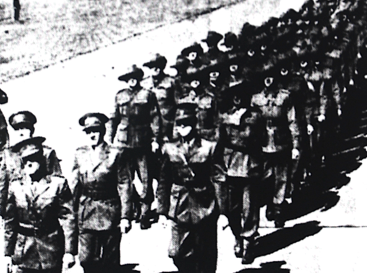
Final parade of the 5th Battalion VDC at Newcastle [The Newcastle Sun, 27 August 1945]
Letter of Thanks received by 4th Battalion VDC – 1945
The Dungog Chronicle of 23 November 1945, page 1, reported:
‘The 4 Battalion V.D.C. reports that copies of the C.I.C’s (General Sir Thomas Blarney) letter of thanks for the services rendered by the V.D.C. have been received. This Battalion received special mention in Corps Routine Orders for the excellent service rendered and the officers in charge of the Units on disbandment regret that large quantities of rifles, belts, and other equipment have still not been returned.
All equipment is a personal charge against the Commanding Officer and any member who has articles of equipment in his possession will assist in maintaining the good name of the Battalion by returning it direct or indirectly to Bn HQ, Albert Street, Taree, not later than 30th November 1945.’
Concluding Comments
The reports set out in this paper provide an overview of the VDC in general and particularly the role played by the Port Stephens region in the success of the organisation.
Despite the enthusiasm of the volunteer members, their involvement did involve hardship as they had to split their time between work, family and military responsibilities.
The following two newspaper excerpts provide an additional glimpse into the enthusiasm of Port Stephens VDC members:
The Newcastle Sun of 6 June 1946, page 1, reported:
‘Rees James, [was at Newcastle] down for the Synod, from Medowie [situated in Port Stephens]. During the war he joined the 5th, Bn. V.D.C. and rode the long trip on a cycle every Sunday morning and was never known to be late for parade.’
The Newcastle Sun of 16 October 1946, page 1, reported:
‘When Wal Jenkins, captain of the champion Fifth Battalion V.D.C. rifle team, went to Nelson’s Bay and issued a challenge to the [British] Royal Marines [who were in camp for one year at Nelson Bay] under service conditions, the Marines’ spokesman said, ‘How much start do you want? We’ll eat you.’ ‘We’ll be eaten from scratch then,’ said Jenkins. Several of the Marines gave masterly exhibitions, but the V.D.C. men won by a nice margin. Now the team, on a civilian basis, is looking for further ‘scalps.’
The history of the Volunteer Defence Corps in the Port Stephens region adds another story of the involvement of the local community in the years of the Second World War.
Further information on the Second World War years in the Port Stephens area are published on this website and can be found at the following links:
Wartime Restrictions in Port Stephens in the Second World War and its Aftermath
Port Stephens Residents Serving in the Australian Military Forces in the Second World War
Port Stephens Council During the Second World Wars
Post War History of the Gan Gan Military Camp at Port Stephens
War Diary of Tomaree Coastal Artillery Battery Port Stephens – 1942/1944
Westralia – A luxury Cruise Ship / Royal Australian Navy Warship
Manoora – A luxury Cruise Ship / Royal Australian Navy Warship
Kanimbla – A luxury Cruise Ship / Royal Australian Navy Warship
Several other papers dealing with the First World War in the Port Stephens region are published on this website and can be found at the following links:
Letters from the Front sent by a First World War Soldier of Port Stephens
First World War Trophies – Port Stephens
First World War Memorials at Nelson Bay – Port Stephens
First World War Memorial at Karuah – Port Stephens
When the First World War came to Anna Bay – Port Stephens
Researched and compiled by Kevin McGuinness
May 2026


