
Introduction
In the Gathang language of the Worimi people, ‘Gan Gan’ means ‘white breasted fish hawk’.
In 1942, the Gan Gan military camp was built as an amphibious training centre by the United States military at Port Stephens. It was situated in an area that today lies between Nelson Bay Road and Gan Gan Road about 4kms from Nelson Bay.
It was part of the Joint Overseas Operational Training School (JOOTS) facility in conjunction with HMAS Assault, to train both Australian and American troops in land/sea warfare.
Following the withdrawal of the United States military from the Port Stephens area after the end of the Second World War, the Gan Gan site was maintained by the Australian Army and used extensively in the post war period as a training facility.
Regular Army, National Service personnel and the Citizen Military Force (CMF) were among the groups that held training camps at the site. It was also available to other groups, such as school cadets and university students, for training exercises.
The post-war history post-war of the Gan Gan Military Camp is published in seven papers on this website.
This paper provides an overview of the Gan Gan Story. Links to the other six papers are found at the links at the end of this document.
The Gan Gan Story
The following article from the Newcastle Morning Herald and Miners’ Advocate of 18 July 1953, page 5, provides a good description of the original site:
‘Two miles on the city side of Nelson’s Bay and half hidden in bush is Gan Gan, the Army camp which many servicemen believe is the most attractive in Australia.
National Service lads, seeing it for the first time say, “Gee, Holdsworthy was never like this,” just as others who served before them said: “Easily seen it was built for the Yanks.” The camp was named for the woody hill behind it and trees are the essence of its charm. The bush sweeps through it. Gum trees and banksia grow around its huts. Ferns and wildflowers spring up beside its rockery walls and paths and at the proper time of the year the camp blushes with Christmas bush. When it was built, as many trees as possible were left standing. In some cases, the weatherboard and corrugated iron huts were literally built around trees, eaves being cut away, like awnings in Darlinghurst-road, to allow them to go soaring up over the roofs. The trees were left with the idea of providing natural camouflage, but today the Army has the value of pleasant surroundings in mind as well. So it has become “almost a crime sheet job” to destroy a Gan Gan sapling.
The result is that Gan Gan is cool and shady, a place of blacken and brown-green calm, totally unlike the big, barren, sunbaked camps that servicemen generally see. Its mood is more that of a holiday camp than anything else the Army has to offer. But there is more to Gan Gan than its natural beauty. It has some unusual features, not the least of which is the little-known grave “in the scrub across the road.” The grave dates back to the war years, when Gan Gan was new and occupied by American troops. A Negro G.I. was driving home to the camp in a jeep from Nelson’s Bay. Swerving to avoid a cow on the road his jeep overturned. The G.I. was killed. His mates buried him by the side of the road (the “old road” through Anna Bay), building a grave of stones which were gathered in the bush. According to Nelson’s Bay residents, the soldier’s name was Taylor. The plot where he was buried, although not much bigger than a normal grave, became known to them as Taylor Park.
A C.M.F. sergeant-major said that the other Negro G.I.’s at Gan Gan were so affected by what had happened that “they went berserk and shot all the stray cows and horses they could find.” Straying stock has long been a source of worry to units using Gan Gan. One lieutenant of 16 Company R.A.A.S.C. has had two accidents in two years trying to avoid, but hitting, a horse and a cow while driving along the road to camp at night. Taylor’s body was removed and returned to the United States two or three years ago, in accord with the American Army policy of taking home the bodies of all its men who died overseas, but the grave “in the scrub” remains.
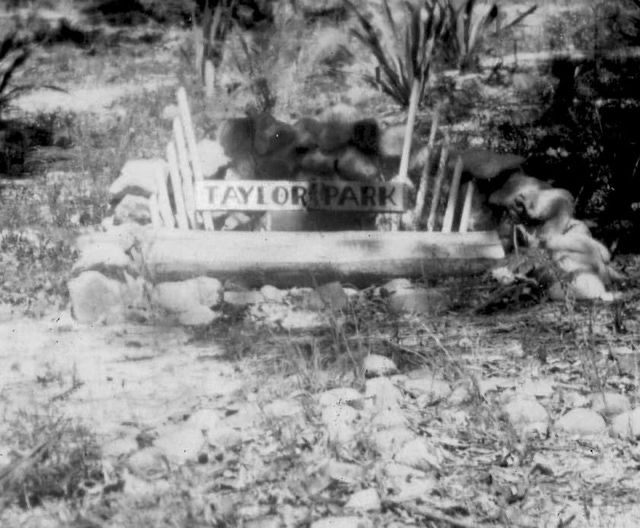
Photo of the Taylor Park grave as per Tomaree Museum Association Facebook page, 13 February 2021.
Gan Gan camp was built in 1942, when Nelson’s Bay and its precincts became a “hush-hush” training area for Australian and American troops. Units were camped all through the stretch from Anna Bay to Tomaree headland. There seemed to be Navy, Army and Air Force personnel everywhere. Gan Gan was “the nerve centre” for amphibious training that was carried out on Nelson’s and the other bays of Port Stephens. It was headquarters of an Austral-American outfit known as the Joint Overseas Operational Training School, from the initials of which was derived its nickname: “Joots”. Americans predominated at the school and it was doubtlessly because of the comforts they considered normal that Gan Gan’s huts (with their roofs painted green) had “mod. cons,” that were lacking in other camps. “Australian Army huts during the war were just four bare walls and a roof,” a C.M.F. officer said. “They were full of cracks and draughts. Gan Gan was better constructed. Most of its huts were divided into separate rooms for living quarters. The rooms were intended to accommodate two men and each has its separate entrance, some of them with steps and a landing like small private balcony at the door.
“The camp was provided with its own sewerage system and its own water supply, pumped from the underground swamps. Right from the start there were sinks in the toilet rooms, where in Australian Army ablution huts there were just tin troughs. You can easily see that when it was built Gan Gan was altogether too luxurious for an Australian camp.” In its “Joots” days, the camp, extended through the bush almost to the junction of the “old” and “new” roads into Nelson’s Bay, and also across the “old road.” In these areas, troops lived under canvas. Overgrown concrete slabs are all that exist to show where latrine and shower blocks stood in the tented sections and the camp, no longer sprawling, now confines itself to the comparatively small area that comprised the administrative and hospital block. The hospital hut now houses the guard room when units go to camp, the operating theatre becoming a Regimental Aid Post. The wartime school trained men for island landings and jungle warfare. Troops practised clambering up and down scrambling nets and rope-walked imaginary jungle streams in an old quarry in the bush. Some were required to run up and down Gan Gan hill as a pre-breakfast exercise.
Among units which underwent the training were the 18th Australian Battalion and those of the 32nd American Division. The division, after sending its brigades to the Gan Gan area for six weeks at a time, made Nelson’s Bay its hopping-off point for the islands. Towns-folk remember the Kanimbla, Manoora and Westralia among troopships that called at the port to carry the men away. The troops would be taken to the township early in the mornings and there, at the jetty of H.M.A.S. Assault, would embark in infantry landing craft, sail out to board troopships and spend the day going up and down scrambling nets, practising landings in the various bays. When the school closed and the Americans departed, Royal Marine engineers moved into Gan Gan. They were there about a year, during which the war ended. When they went home only a maintenance staff of Australian Army personnel was left at the camp. Although it took on a deserted look, it was kept in order and was ready for service again when the C.M.F. was reintroduced in 1948. Since then it has become the favourite camps of hundreds of militiamen from Newcastle and beyond. It is used by C.M.F. units for annual 14-day camps and periodical week-end bivouacs. From December to May, it has its busiest time. For the rest of the year, its small maintenance and security staff sees few callers. The camp’s smallness and setting seem to have the effect of making Army routine less irksome and this may be the reason why a 14 Infantry Brigade spokesman said: “Gan Gan is popular with the troops. it beats any other camp in Eastern Command.”
Its location is considered by American and Australian service chiefs to be unsurpassed for amphibious training. So Newcastle’s two amphibious C.M.F. units, 16 Company and 15 Northern Rivers Lancers always go there to camp. On more than one occasion, units have found their visits to Gan Gan coinciding with the arrival of Army and Navy Fairmiles [small launches] or corvettes at Nelsons Bay. At such times. they have cooperated in exercises, addling novelty to routine training, and more than one land-lubbing Army type has gone out on somewhat unofficial minesweeping exercises with the Navy. C.M.F. members who frequently go to Gan Gan are no longer surprised at its animal, bird and insect life.’
Gan Gan Military Burial Site
During the Second World War, several American soldiers stationed at the Gan Gan Military Camp lost their lives through misadventure. They were buried beside Gan Gan Road, opposite the military camp site. One of them was named Taylor, as mentioned above.
After the war, American authorities exhumed the remains and returned them to the USA. Six wooden crosses marked the former graves for several years.
In 1992, the Port Stephens Historical Society sought information from the American Office of War Graves about the soldiers buried at Gan Gan. Unfortunately, the American National Archives could not locate any details.
This lack of documentation concerning the death of Americans at Gan Gan many be due to a fire that occurred on 12 July 1973 in the National Personnel Records Centre at St Louis, Missouri. This fire destroyed up to 18 million official military personnel records of servicemen in 20th century.
Some remains of the burial site still exist beside Gan Gan Road, including scattered large grave rocks and Gymea Lillies planted around the perimeter.
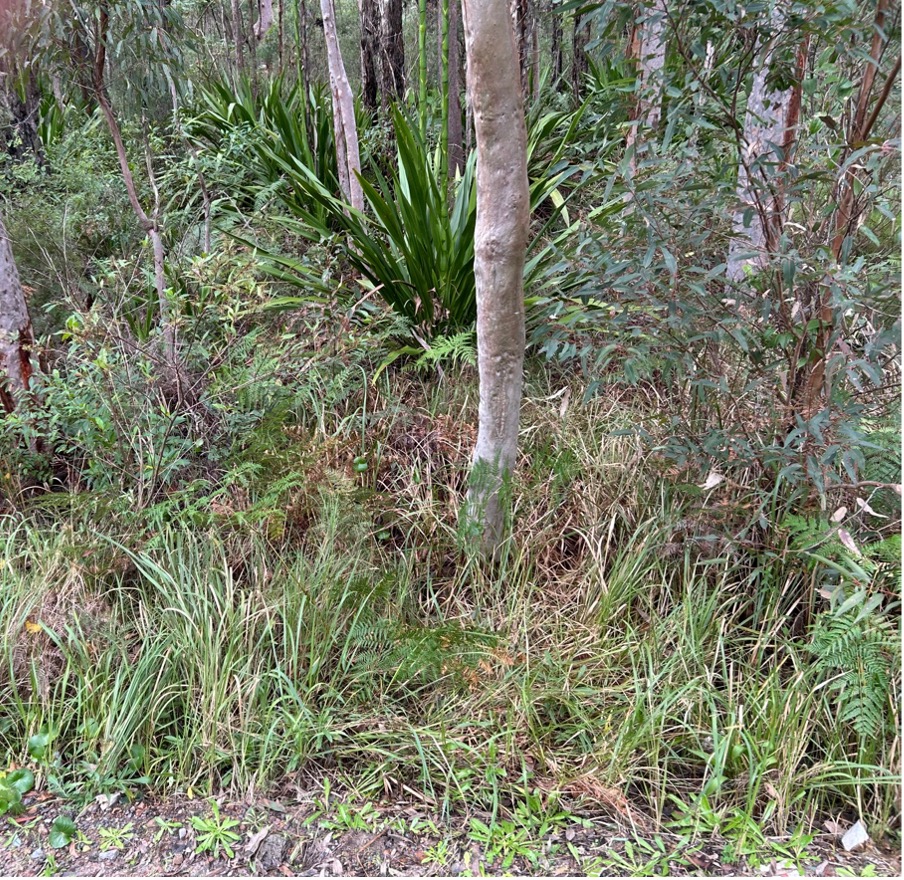
View of the burial site from Gan Gan Road, with the Gymea Lillies in the background. The vegetation covers the grave rocks that lie on the ground [Author photo]
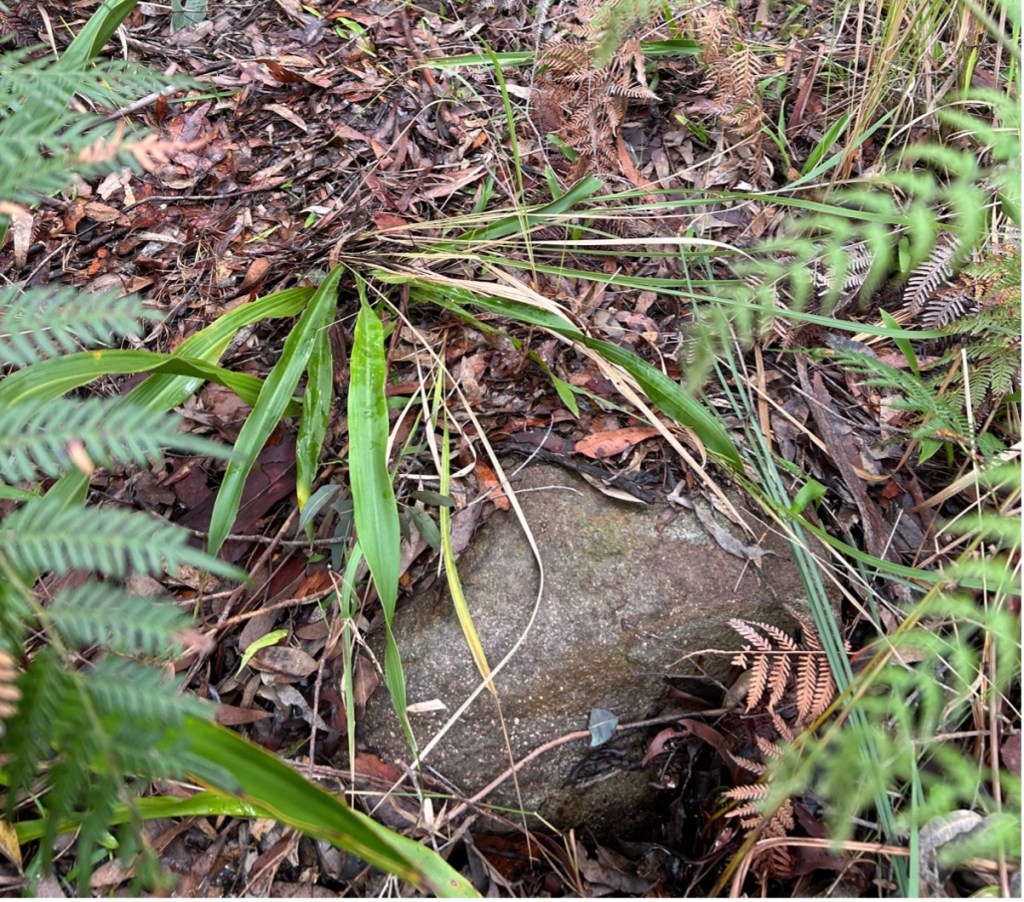
One of the two front boundary rocks, still in its original position [Author photo]
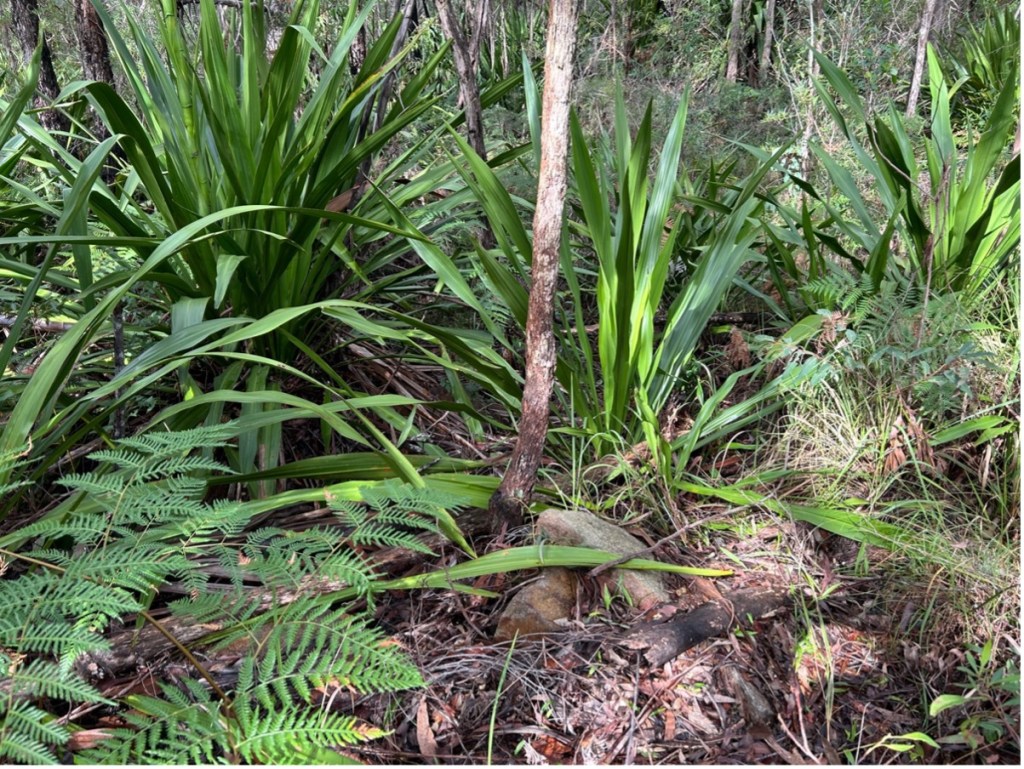
Several of the grave rocks that are no longer in their original position [Author photo]
Support Services at Gan Gan
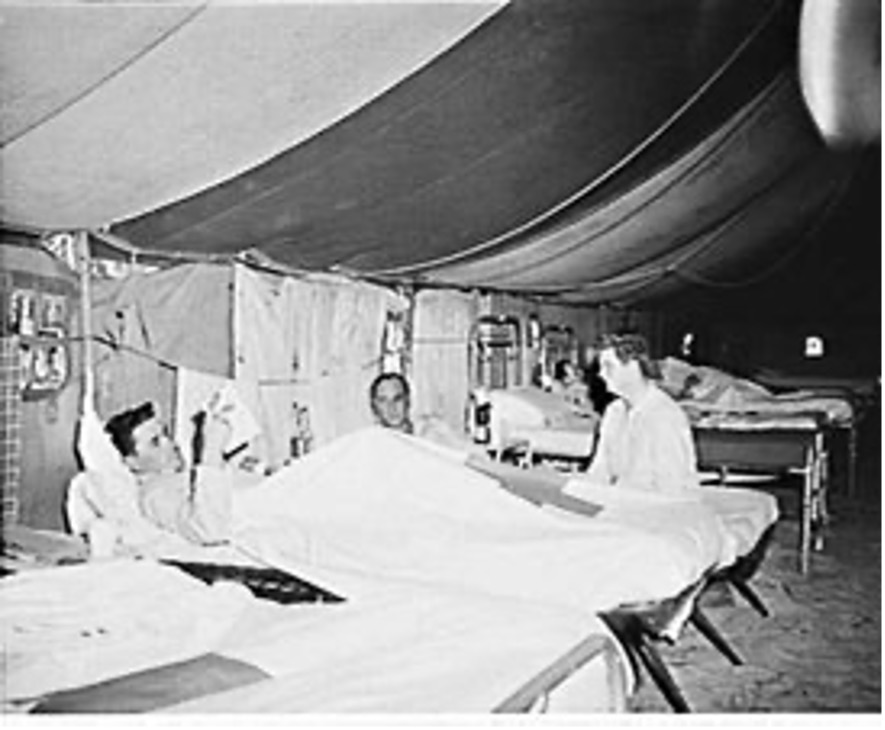
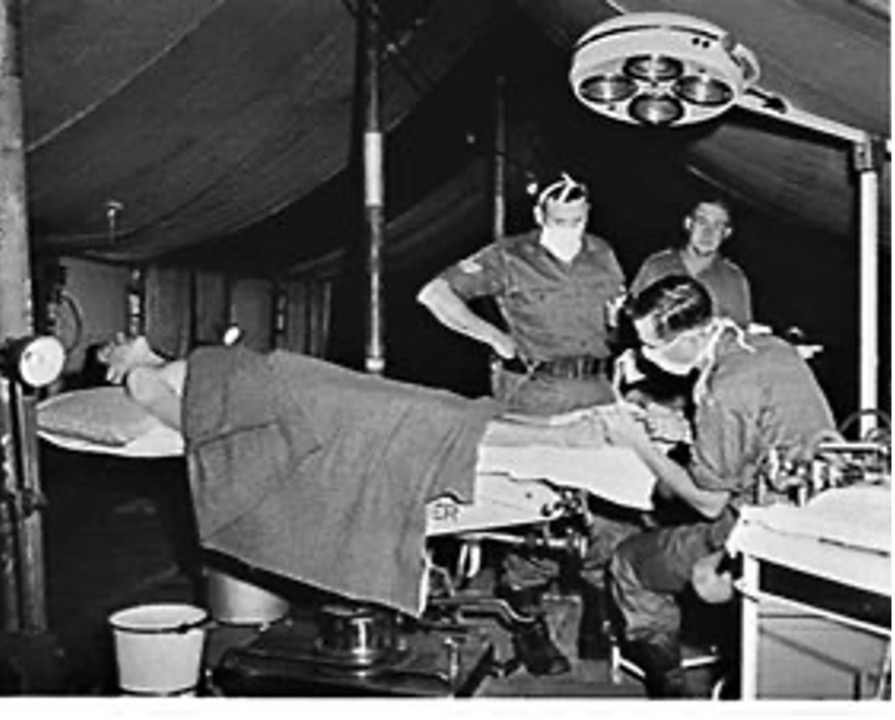
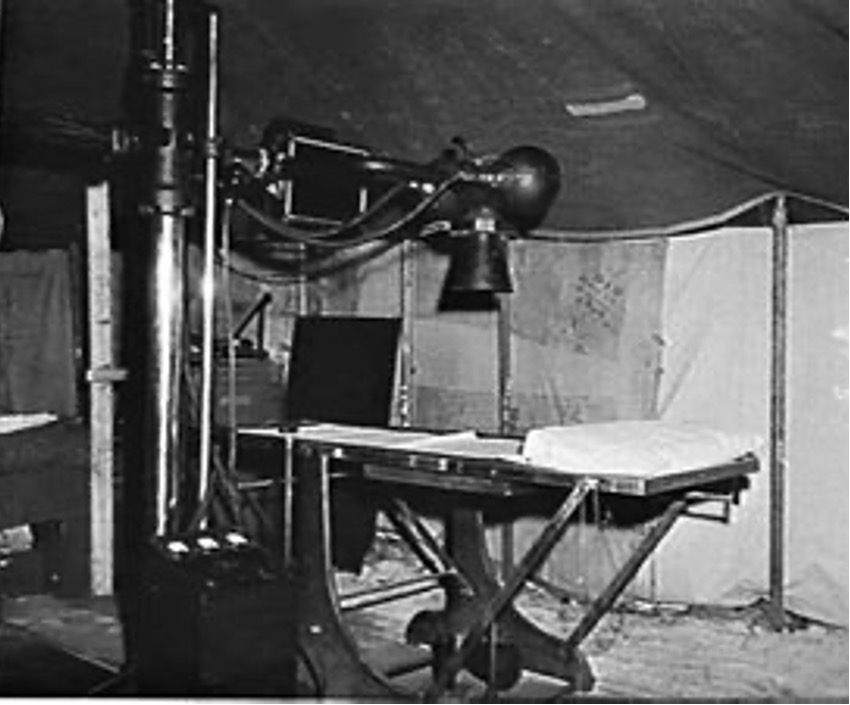
When used by the regular army for military training, Gan Gan, had a sophisticated array of medical facilities to support the training activities. The following photos held by the State Library of NSW (which are undated) illustrate some of the support services:


Sale of the Gan Gan Site – 2003
The former Gan Gan Army Camp was sold by the Commonwealth Government to a land developer in 2003. The sale caused some controversy at the time.
The then Federal Member for Paterson, Bob Baldwin, stated he was extremely disappointed by the Defence Department decision to sell Gan Gan Army camp to a developer instead of making it National Park. On 20 June 2003 Bob Baldwin released the following ‘press release’:
“When you consider that Gan Gan Army Camp is adjacent to Tomaree National Park, I believe it makes logical sense for this site to become parkland,” Mr Baldwin said. “But the Defence Department have gone ahead and sold this land, despite representations from myself and the community. “This land would have been an ideal addition to National Parks and I am also disappointed in the State Government’s failure to lodge a priority of sale for the land before the tender closed on the 30th May 2003, even though I wrote to the Premier about this land on 12th May 2003. “Not only has the Defence Department failed to listen to local concerns but the State Government has also failed to take advantage of the tender on offer, which would have enabled them to make more National Parkland in a suitable area.”
The sale of Gan Gan was the subject of 11 ‘Questions On Notice’ in the Australian Parliament on 28 July 2003 that Senator Chris Evans put to Senator Robert Hill (Minister for Defence). Some of the questions and their answers from Senator Hill are set out below:
Q. When the Gan Gan Army Camp was sold.
A. Exchange of contracts took place on 13 June 2003.
Q. Which organisation purchased the property.
A. Details of the purchaser are currently considered Commercial-In-Confidence until the title transfer has been registered, as advised in Parliamentary Question on Notice 2078.
Q. What was the sale price for the property.
A. The sale price is considered Commercial-In-Confidence until the title transfer has
been registered.
Q. (a) What was the closing date for expressions of interest; and (b) how
many expressions of interest for the property were submitted.
A. (a) There was not an expression of interest phase in this process. Tender
submissions were sought through an open market tendering process. Tenders were
originally scheduled to close on 3.00pm 19 May 2003, but this was subsequently
extended until 2.00pm 30 May 2003.
(b) Four tenders were received, three conforming and one non-conforming.
Q. (a) When a preferred buyer was selected; and (b) what process was used to
select the preferred buyer.
A. (a) A tender evaluation board report was submitted to the delegate on 10 June
2003 and subsequently approved on 13 June 2003.
(b) A tender evaluation board was established in accordance with the tender evaluation plan approved on 30 April 2003. The board members met to review and discuss the submissions received and presented recommendations to the delegate on 10 June 2003.
Q. What was the date of settlement for the sale.
A. Friday 27 June 2003.
Q. (a) Is it normal for Defence property sales to be settled so quickly; and (b) why did the settlement process for this sale occur so quickly.
Did the New South Wales Government (either through a New South Wales
Minister or a government agency) express any interest in acquiring the Gan Gan
Army Camp at any time during the past 5 years; if so, can the details of each
expression of interest made be provided.
A. No. The Department received a letter from the NSW Parks & Wildlife Service (NPWS), of 17 November 1999. The NPWS letter noted a strong interest in the protection of the vegetated lands of Gan Gan Army Camp and urged the Commonwealth to see that the greater portion of the land be set aside for conservation. Acquisition of the site was not mentioned in the NPWS letter.
Q. Did Defence respond to any of these expressions of interest; is so, what was
Defence’s response to each expression of interest.
A. Yes. A response was sent to NPWS on 10 December 1999 advising the Commonwealth Government’s policy for the disposal of surplus property was on the open market at full market value. The provision for a priority sale to State or Local government was also identified. Further, NPWS were advised that when an environmental consultant was engaged to undertake an assessment of the property, they would meet with NPWS representatives to discuss the property.
Q. Has there been an environmental evaluation of the Gan Gan Army Camp site
at any time in the past 5 financial years; if so, can a copy be provided of each
environmental evaluation report written in this period.
A. Yes. Defence engaged consulting firm GHD Pty Ltd to manage an environmental
assessment of the site prior to its sale. As advised in Parliamentary Question on
Notice 2049, in preparing their report GHD corresponded with the Port Stephens
Council, Planning NSW, Coastal Council of NSW, Department of Land and Water
Conservation, Department of Mineral Resources, National Parks and Wildlife
Services, Environment Protection Authority, Roads and Traffic Authority, Hunter
Area and Health Service, Environment Australia, Hunter Water Corporation, Energy
Australia and Telstra. In their report, GHD advise no response was received from
Planning NSW, Hunter Area Health Service and Environment Australia. None of the
respondents to the GHD correspondence indicated an intention to acquire the Gan
Gan Army Camp.
The Site Today – Archaeological Remains at Gan Gan
The Google Map below shows the site of the former Gan Gan military camp in its location between Nelson Bay Road and Gan Gan Road.
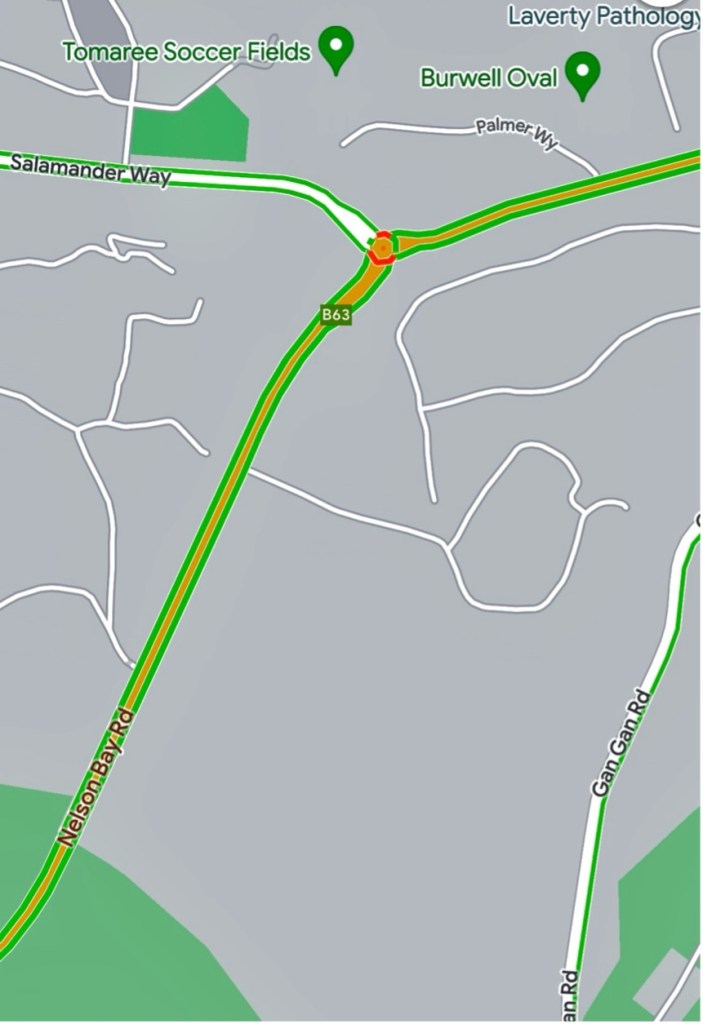
Location of the Gan Gan Military Camp site. The circular area in the centre is the likely Headquarters precinct. [Google Maps]
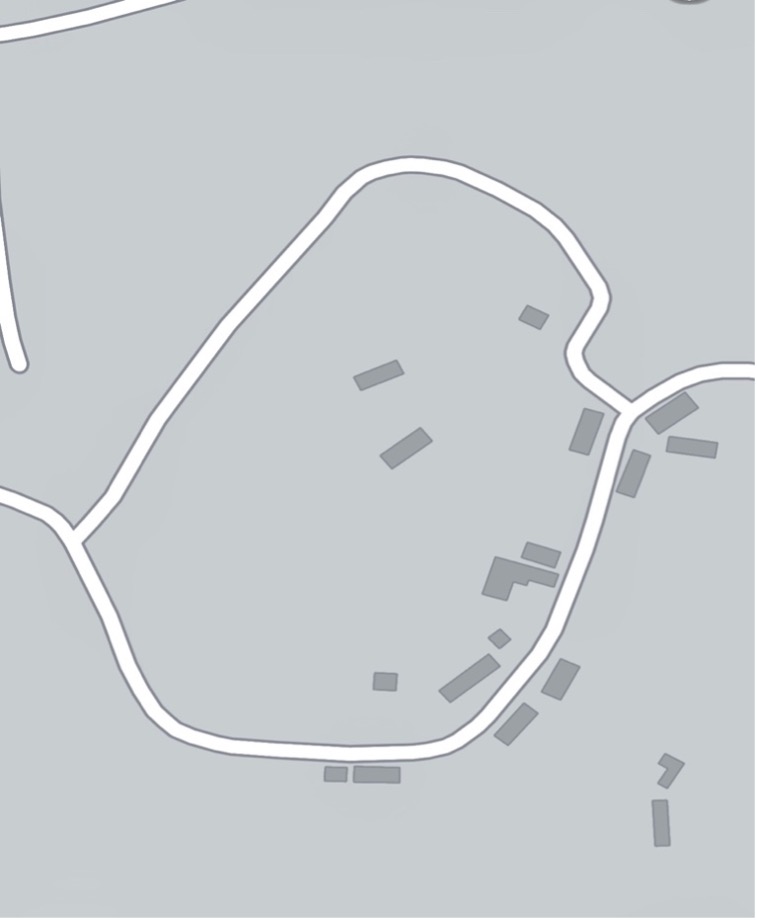
Google Map enhancement of the circular area of the map above showing the sites of the buildings of the former Headquarters precinct. [Google Maps]
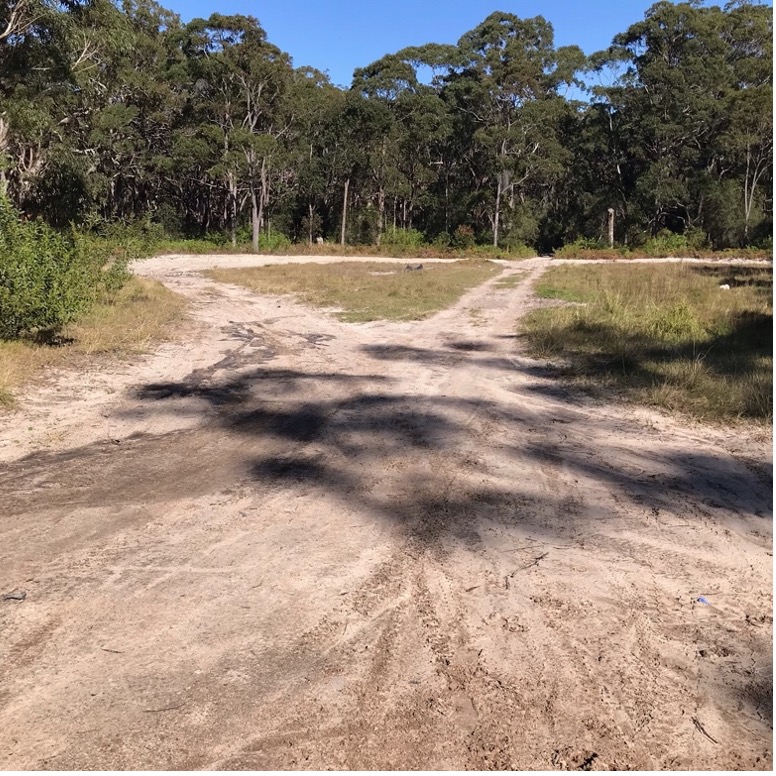
Today the site remains largely deserted. Bushland clearings, old bitumen roads, numerous sand tracks and the remains of the foundations of buildings tell of the existence of the former military camp.
Despite the blocking of the main entrances on both Nelson Bay Road and Gan Gan Road, the site is still accessible to cars and motorcycles. The bushland environment has been degraded by the dumping of several motor vehicles in recent times.
The more detailed Google map above allows for the pinpointing of the sites of buildings in the Headquarters area referred to in this paper as the ‘central precinct’ [and assists in the identifying where of the remains of their foundations lie. The most intact remains are those of the ablutions structure.
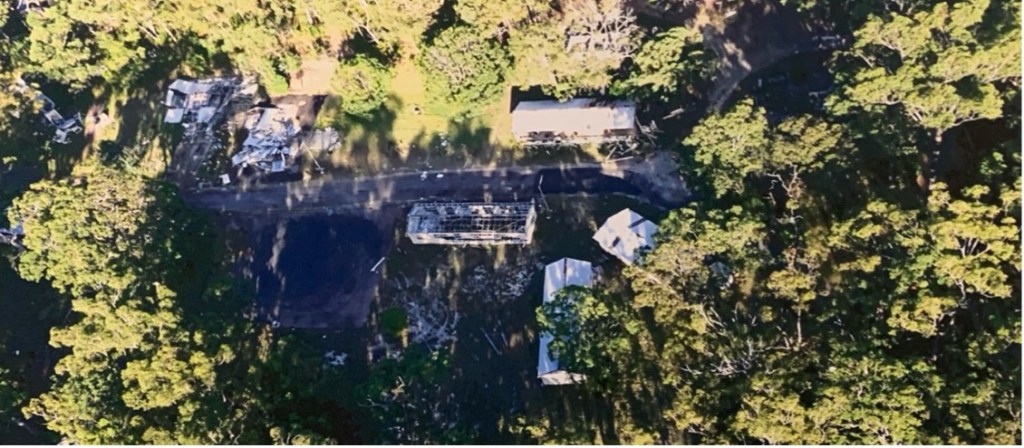
Aerial photo of Gan Gan showing derelict camp buildings, circa 2008
A current inspection of the site around the central precinct provides an insight to its past use, as per the following photos:
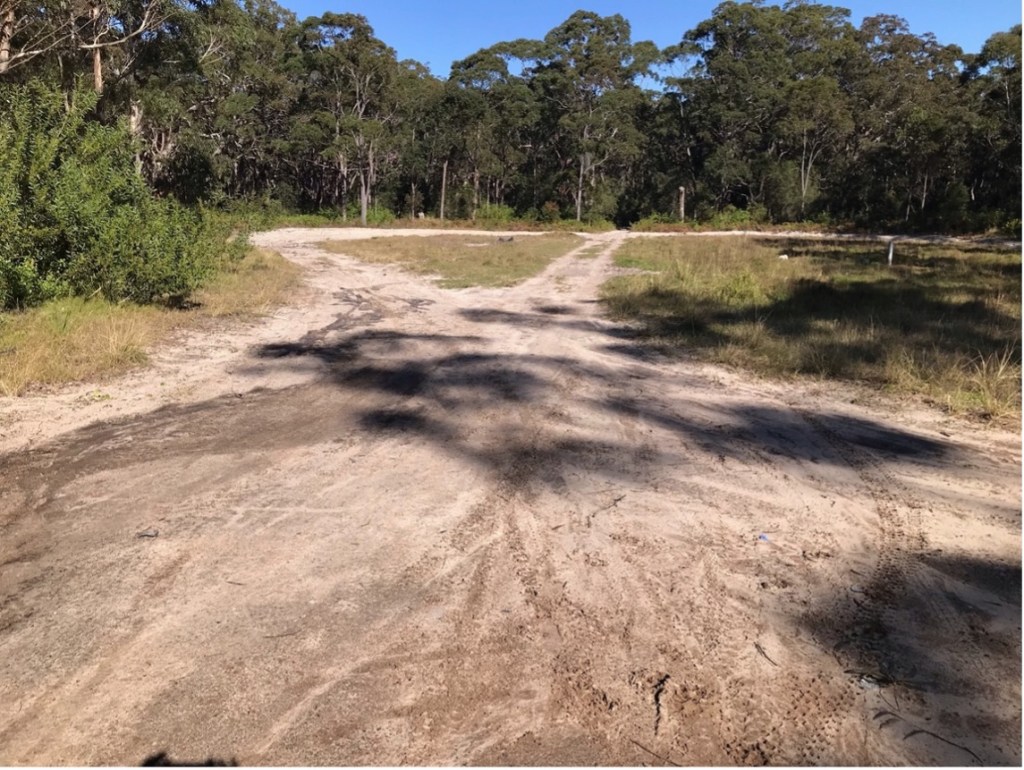
Large open space to the right of the of the main entrance road off Nelson Bay Road [Author Photo July 2022]
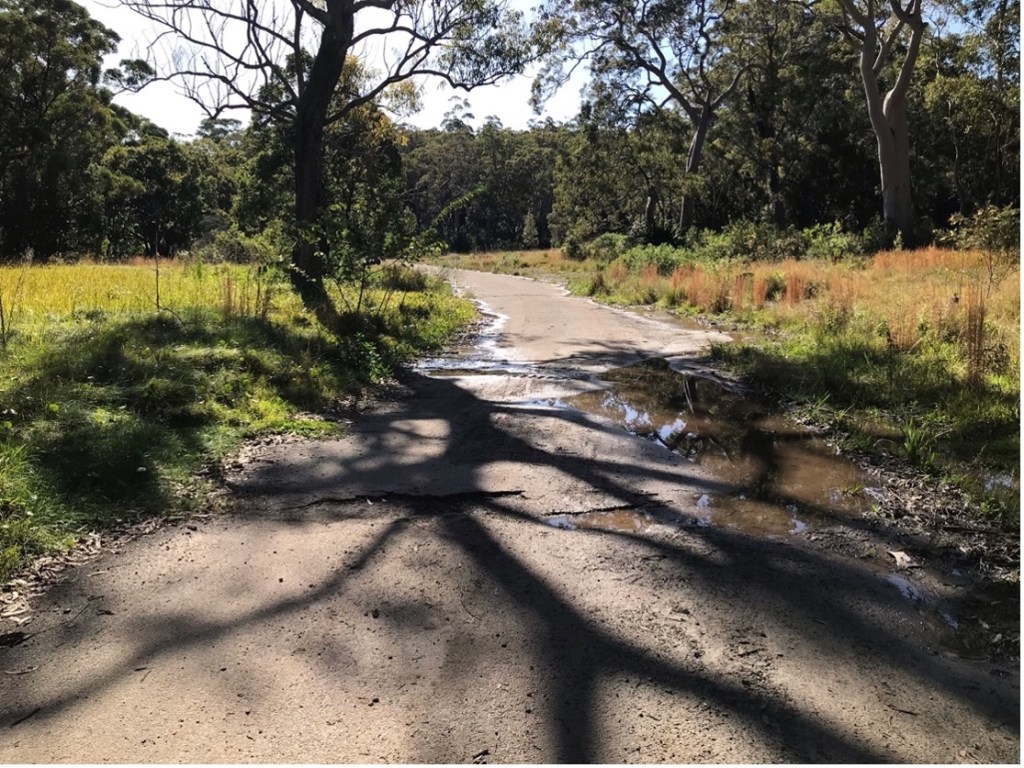
Bitumen road in the central precinct looking north. [Author Photo July 2022]
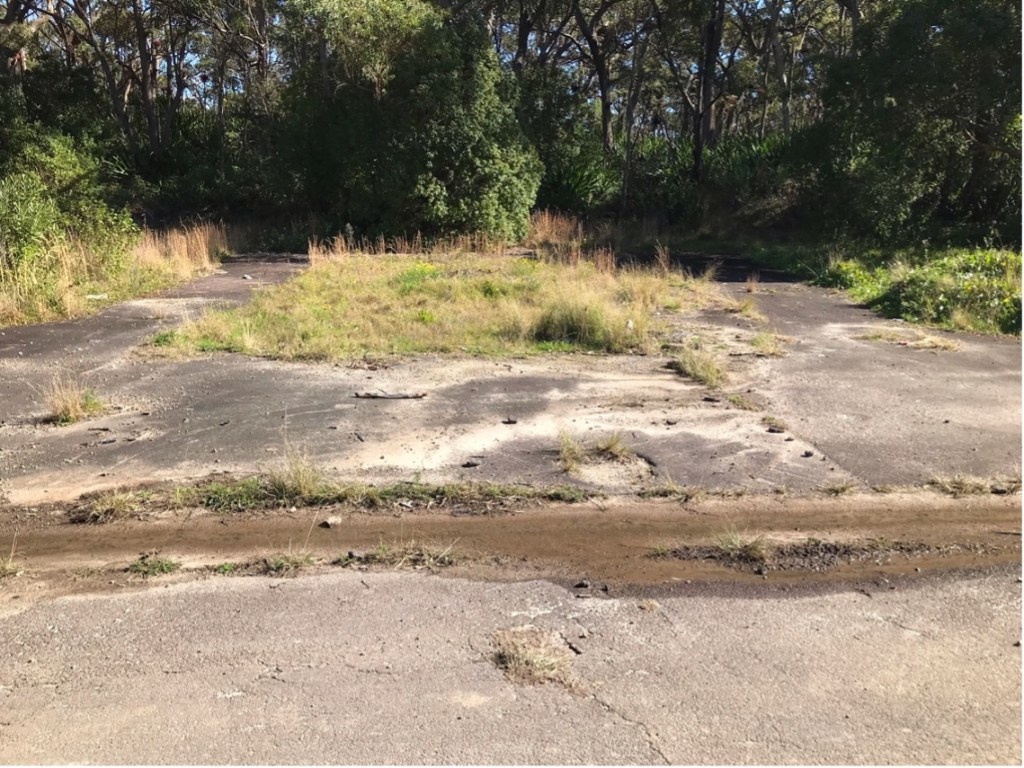
Foundations and bitumen surfaces in the central precinct area, to the right of the road looking north. [Author photo July 2022]
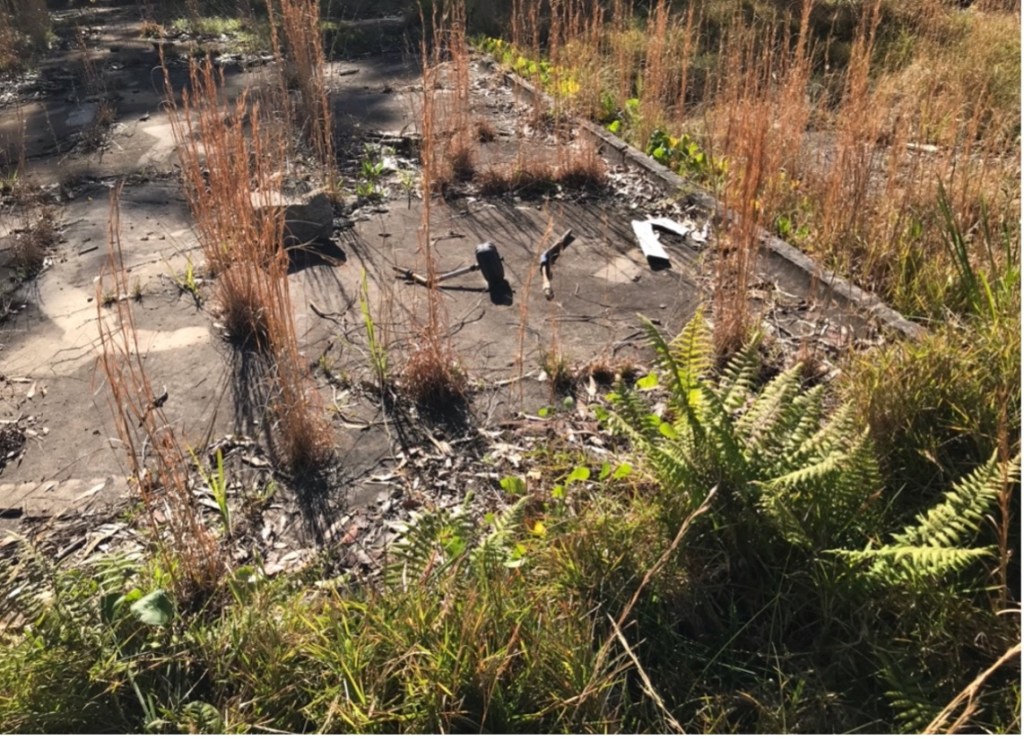
Foundations of a building in the top section of the inner central precinct. [Author photo July 2022]
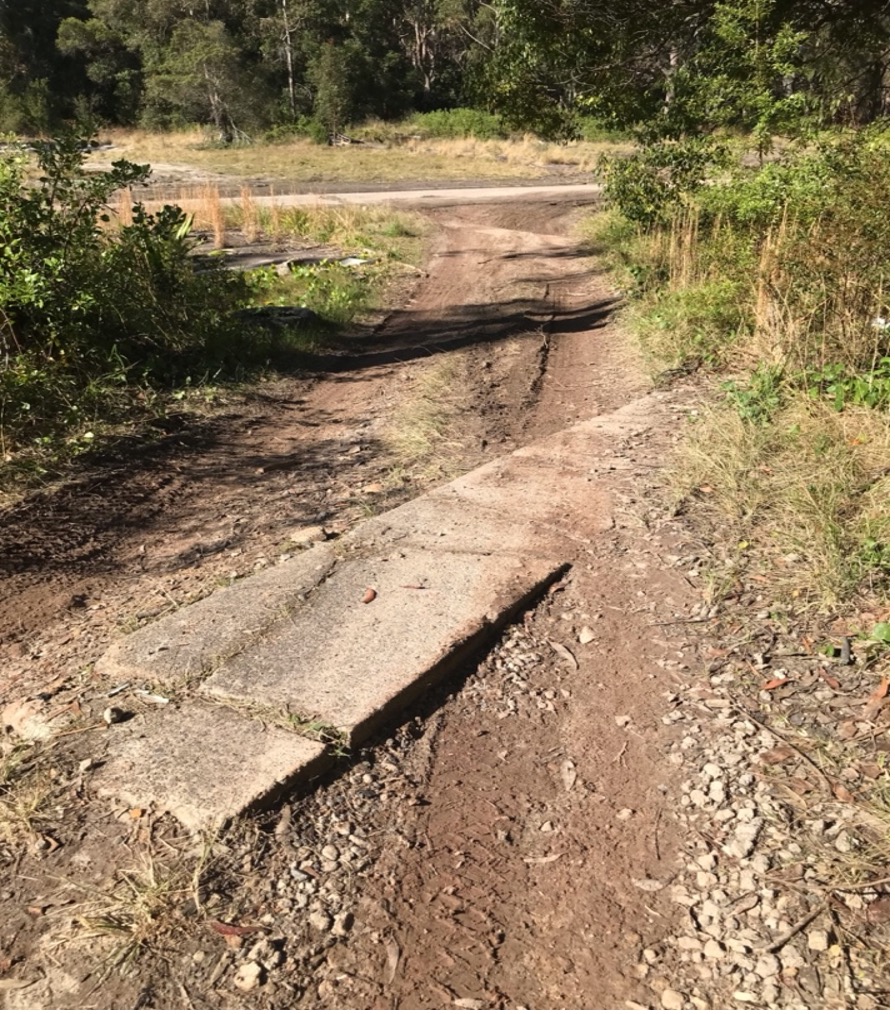
Concrete footpath in the inner section of central precinct [Author Photo July 2022]
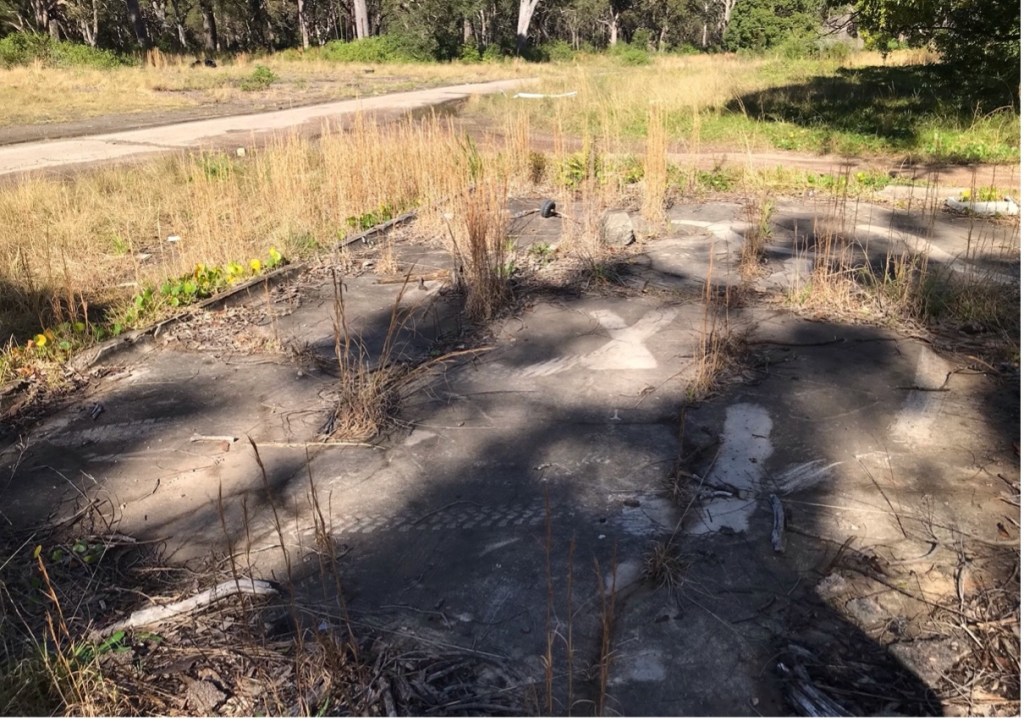
Foundations of a building in the middle section of the inner central precinct looking south. [Author 2022]

Structural remains of the Ablutions block, located in the lower right section of the inner central precinct. [Author Photo March 2022]
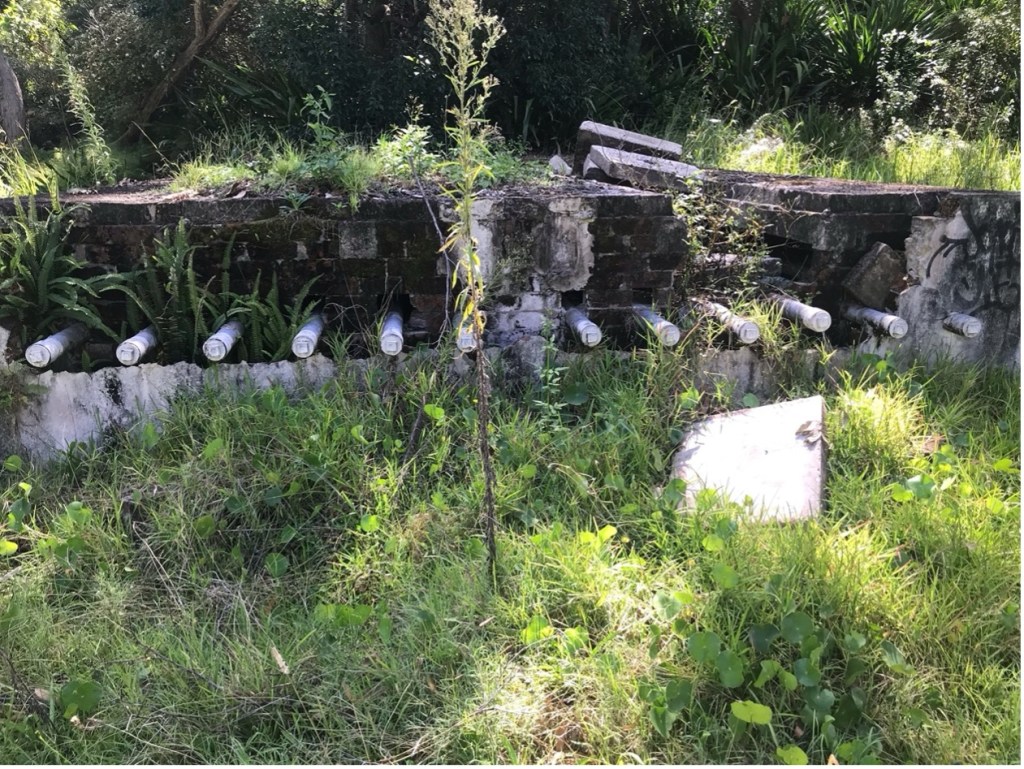
Waste water tank attached to the Ablutions block showing pipe outlets [Author Photo March 2022]
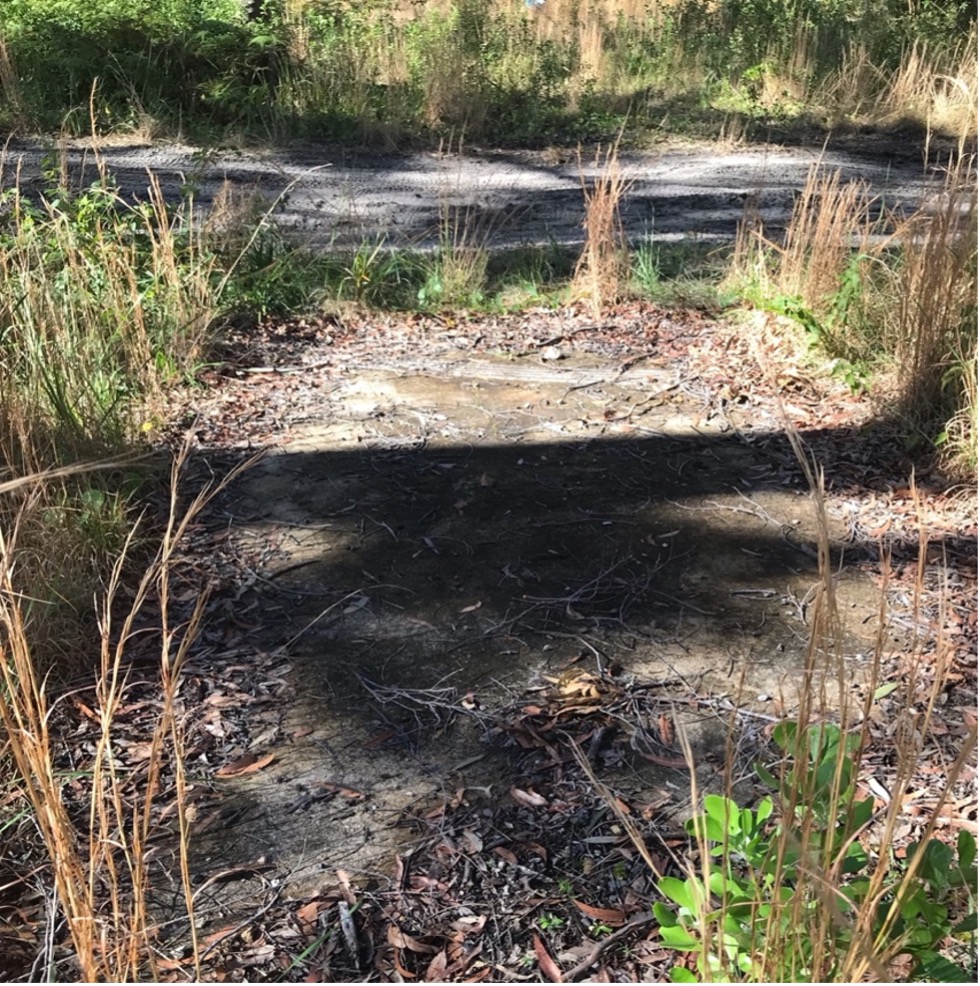
Further building foundations to the south-west of the central precinct off the Gan Gan Road entrance. [Author photo July 2022]
Recent Development Plans
Development plans were announced in March 2020 by the owner of the Gan Gan site, Greenport Pty Ltd, to redevelop a 18.5 hectare portion of the site into a residential leisure and dining precinct. The remaining 81.5 hectares of the Gan Gan site would be preserved in perpetuity.
The plans were met with a mixed public response, when announced. The initial challenge with the proposed development will be to have the property rezoned from E2 Environmental Conservation to SP3 Tourist, before a development application can be lodged.
Links to Six Other Papers of Post-War Activities at the Gan Gan Military Camp are as follows:
15th Northern Lancers at the Gan Can Military Camp – 1949
Military Training Camp at Gan Gan – February 1951
School Cadets at Gan Gan Military Camp – April 1951
Army Commando Training Exercises at Gan Gan – 1953 and 1955
First Army Camp for Women of the Citizen Military Forces (CMF) at Gan Gan – April 1954
University Students at the Gan Gan Military Camp – 1950 and 1962
Further Information on the Second World War years in Port Stephens is found at the following links on this website:
HMAS Assault and JOOTS – 1942/43
A Pictorial History of HMAS Assault – Nelson Bay
Royal Marines at Port Stephens – 1945/46
War Diary of Tomaree Coastal Artillery Battery Port Stephens – 1942/44
United States Landing Force Equipment Depot at Nelson Bay – 1942/43
Camouflage of Mount Tomaree – 1941/42
Tomaree Lodge Site at Port Stephens
Researched and compiled by Kevin McGuinness
July 2022


