
Introduction
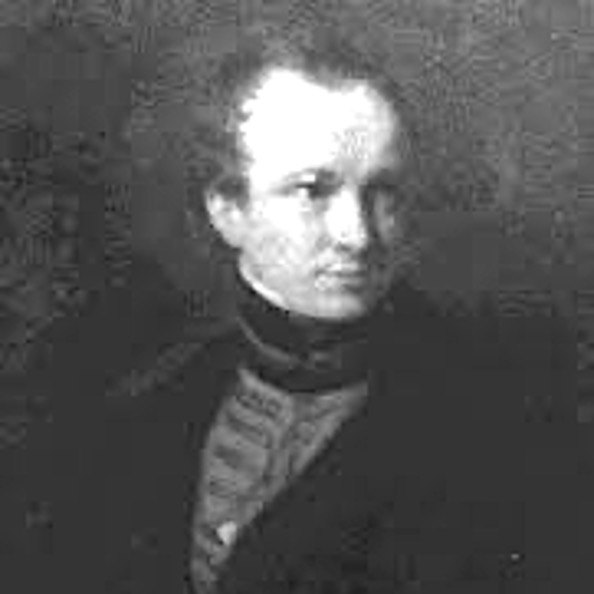
Henry Dumaresq was born in 1792, son of Colonial John Dumaresq of Shropshire, England, and his wife Anne, ne Jones.
Henry and his brothers, William and Edward, were educated at the Royal Military College, Great Marlow.
At age sixteen, Henry Dumaresq joined the British Army. He participated in eight campaigns, including the Peninsula War (1808), the War of 1812 between the United States and Great Britain, and the Battle of Waterloo (1815) where he sustained a lung injury.
He was promoted to Brevet Major for his heroic actions at Waterloo and two years later was made a lieutenant-colonel. Henry had earned his promotions though his efforts and courage, without the need of purchasing commissions.
He saw service in Mauritius from 1818-1825 as the Military Secretary to Ralph Darling who was appointed Governor of the Colony of New South Wales in 1824. Henry’s sister, Elizabeth was married to Ralph Darling.
In 1825, the Dumaresq brothers arrived in the Colony of New South Wales.
Henry Dumaresq was appointed Private Secretary to Governor Darling, who also appointed him as Clerk of the Executive Council.
Henry left government service in 1827 and resided for some time on his property at St. Heliers, near Muswellbrook, where he had been granted a 12,000-acre estate in recognition of his service.
In June 1827, Henry returned to England, where he married Elizabeth Sophia, elder daughter of Augustus Butler-Denvers and his second wife Eliza Bizarre, née Sturt, in 1828.
They returned to New South Wales in 1829.
In March 1834, following the departure of Sir Edward Parry as Commissioner of the Australian Agricultural Company at Port Stephens, Lieutenant-Colonel Dumaresq was appointed as his successor. Three years later, he received an unsolicited salary increase from the Australian Agricultural Company board in recognition of his effective leadership.
The family took up residence at Tahlee House, near Carrington at Port Stephens
Henry Dumaresq died unexpectedly on 5 March 1838 at Tahlee, aged forty-six years. The immediate cause of death was apoplexy, although the residual effects from his Waterloo injuries persisted throughout his life. His widow Sophia, returned to England with her children a few years later.
This paper is the story of time that Lieutenant-Colonel Henry Dumaresq spent at Port Stephens, in recognition of his contribution to the area.
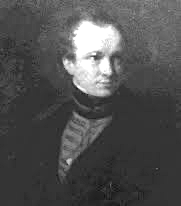
Lieutenant-Colonel Henry Dumaresq
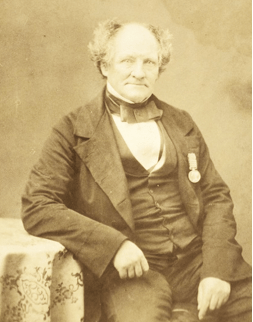
Captain William Dumaresq
Arrival in the Colony and an Offer of Advice – 1825
The Sydney Gazette and New South Wales Advertiser of 17 October 1825, page 2, reported on the arrival of Lieutenant-Colonel Henry Dumaresq in Sydney as follows:
‘Colonel Henry Dumaresq has arrived. This gentleman, it is understood, will be appointed to a prominent position under the new administration. He is related by marriage to Major-General Darling, the anticipated Excellency. Colonel Dumaresq, who is on half-pay from the 9th Regiment, has arrived directly from the Isle of France.
Everyone knows that with this Gentleman we are wholly unacquainted, and of course to him unknown; we feel little or no reluctance, therefore, in tendering the Colonel our hearty congratulations on his arrival in Australia; but for this gratuitous offering, on our part, he must condescend to receive from us a word of advice. Colonel Dumaresq is now in a strange land and will necessarily encounter many odd faces.
He may prepare himself, from the nature of his offices, and high connections, to meet with a multitude that will be satisfied with nothing short of his entire friendship and confidence, in return for their obsequiousness, and feigned respect; but we beseech the Colonel, as he values peace and happiness, and as a lover of impartiality, that he will keep himself aloof from forming an intimacy with any party or parties that may be induced to engender or perpetuate the seeds of strife, when the same might most unquestionably be allowed to die a natural death. We do not say to this stranger, “form no friendship in our Country,” but we entreat that he will be continually on his guard against those many traps and baits which will soon be in motion to allure him over to some particular interest.
As this Gentleman will doubtless be with us many years, we are not afraid that he will soon appreciate the justice of these remarks, which are offered with perfect sincerity; since we are determined on exerting all our influence, in future, to protect men in power from the whining insinuations of those who have anything but the welfare of the Country at heart. With the experience of a few months, and perhaps weeks, Colonel Dumaresq will be able to form a pretty correct estimate of the people amongst whom he has come to sojourn.
We beg him to read, with attention, the Sydney Gazettes for the last twelve months, and his mind will become gradually enlightened. Some may attribute to us the charge of presumption, but to this we shall ever be indifferent, since we are fully satisfied no little arts can long oppose the force of truth. We shall reserve further observations until the arrival of some other Stranger, commending these humble offerings to the immediate and indulgent consideration of Colonel
Transition of management of the Australian Agricultural Company to Lieutenant- Colonel Dumaresq – 1833
The first Commissioner of the Australian Agricultural Company, Sir Edward Parry, based at Tarlee, maintained a daily journal of his personal activities.
Lieutenant-Colonel Dumaresq arrived at Carrington in August 1833, to take over the management of the company from Edward Parry, who was to end his four-year term in March 1834 and return to England with his family.
Relevant entries from Parry’s journal relating to the transfer of power to Dumaresq are set out below.
The journal entries for 1833 and 1834, were published in the following editions of the Dungog Chronicle: 6 September 1927, page 6; 13 September 1927, page 6; 20 September 1927, page 6; and 17 January 1928, page 6.
27 August 1833 –
I sent letters to Graham’s [wharf near Newcastle on Hunter River] for Col. Dumarenq, whom I am in hopes of seeing tomorrow, having named this as a convenient way or coming, on account of the steamer from Maitland.
3 September 1833 –
We received a mail in the evening, but Col. Dumaresq did not come as I had expected he would.
13 September 1833 –
Col. Dumaresq continued reading the various dispatches and other documents and we conversed freely and confidentially throughout the day. Captain Moffatt and some of the company’s officers dined with us at Tahlee.
20 September 1833 –
I commenced this morning showing Col. Dumaresq the papers I had received from the Directors [of the Australian Agricultural Company] relative to his appointment as my successor, namely, his bond, agreement, and power of attorney, and he then began to read a number of other documents connected with those subjects which happened to be engaging my attention the most.
It may save writing to state at once that Col. Dumaresq and myself remained together the whole day, as long as he stayed at Port. Stephens, and generally sat up late at night reading and conversing upon every subject which occurred to us as the most interesting and useful. In everything, also, which related to the current business, I communicated with him, explaining my present method of conducting it, and then conversing on the subject together. Several of the officers called on Col. Dumaresq, and also Captain Moffatt.
21 September 1833 –
Col. Dumaresq and myself were again engaged the whole of the day in reading documents and conversing on the subjects of greatest interest and moment to the company. He commenced reading my communications to the Directors from the beginning and will also read theirs to me.
24 September 1833 –
Commenced my dispatch No. 112 to the Directors, intending to enclose to them Col. Dumaresq’s bond and agreement, which were duly executed this day. We intend going to Booral, Stroud, etc.; tomorrow.
27 September 1833 –
Col. Dumaresq, and myself, left Stroud at half past seven, accompanied by Mr. Harry Hall, and went to Booral to breakfast. After we had transacted the remainder of our business in the accountant’s office, we again embarked in the gig and got down to Tahlee at 1 o’clock, where we were engaged the rest of the afternoon in going over numerous documents and conversing on subjects of importance and interest.
28 September 1833 –
Col. Dumaresq and myself, were engaged in considering of a letter to be written to the Governor respecting the removal of the military, without sending any mounted police in the room of them, which we agreed cannot be carried into effect without great danger from the blacks, who are now principally restrained by fear of the soldiers.
7 November 1833 –
At 5 in the morning Col. Dumaresq, Mr. Darch and myself commenced looking out the documents relative to the demand of the Governor on the Company mentioned yesterday, and before breakfast had written a most conclusive and (I should think) final reply on the subject.
Colonel Dumaresq and I were engaged in conversation and writing all the forenoon and in the afternoon Mr. Darch accompanied him to the Branch to see a Durham bull, which he has purchased off the Company.
20 November 1833 –
The days of the steamer’s trips being altered, I sent horses for Colonel Dumaresq to Graham’s, in case of his coming there by the Sophia Jane today instead of tomorrow, but he did not come.
21 November 1833 –
Captain Dumaresq arrived about 3 p.m. and saw all the people assembled at a very happy party.
11 November 1833 –
Engaged with Col. Dumaresq all day. …. Sent horses’ up to Booral for Col. Dumaresq and myself tomorrow.
23 November 1833 –
At 4.30 a.m. Col. Dumaresq and myself left Tahlee in a boat for Booral, and after remaining two or three hours, we proceeded to Stroud, visiting the Alderley stables as we passed. The harvest of wheat at both farms is beautiful, and about half is in. They went on carting until about 11 o’clock to-night.
We visited the mill and the new brush, where there is a splendid crop of barley on the 20 acres. I visited, in the afternoon, all the free people at Stroud, and Hart, the overseer, who had broken his leg — a most wonderful recovery it bids fair to be.
We met this morning the Ebsworth and Karuah [boats] with 46 bales of wool, two thirds down the river, and Captain Corlette also coming down.
24 November 1833 –
Col. Dumaresq and I visited the camp and went into most of the huts. We also visited Hart.
25 November 1833 –
Col. Dumaresq and myself proceeded early to Booral and while there the Colonel went over the water to look at a mixed flock of sheep, about 500 in number, which Mr. Harry Hall is desirous of buying off the Company, in order that a price might be fixed. We afterwards returned by boat to Tahlee. Mr. Ebsworth accompanied us in order to proceed by the Lambton to Newcastle. I was engaged in finishing everything for her departure, and she got under way at 9 in the evening, having 46 bales of wool on board for the ‘Lochiel.’
26 November 1833 –
I was engaged with Colonel Dumaresq all day reading documents, and conversing on a multitude of subjects interesting to the Company. In the evening we received a mail bringing various letters, the most important being a demand from the Governor to provide, on the part of the Company a fund for the purpose of religion and education on the Company’s Estate, as a condition of the exchange of their lands. We sat up late to converse on this subject, and determined to rise early to write the reply.
28 November 1833 –
Our conversation today turned on the subject, among others, of a proposal of Colonel Dumaresq’s to substitute a monthly visit of one of the steamers to Port Stephens for the expensive establishment of the Lambton. We set down the heads of all the duties now performed by the Lambton, and also of an agreement which would be requisite with the proprietor of the steam vessel, if the plan were adopted.
I finished my despatch No. 116, to go by Col. Dumaresq tomorrow. We finally arranged that the Colonel and his Lady, with two of their children should come here, if all be well, on the 12th February.
29 November 1833 –
Colonel Dumaresq left us to return to St. Helier’s at 5 a.m.
21 February 1834 –
Messrs. Corlette, White, and T. L. Ebsworth dined at Tahlee to meet Coonel and Mrs. Dumaresq.
22 February 1834 –
Col. Dumaresq and myself, were as usual, occupied in business the whole day, and discussed many important points connected with the Company’s interests.
24 February 1834 –
Colonel Dumaresq and myself prepared to go to Newcastle tomorrow, from whence he proceeds to St. Heliers to get his family and goods ready for the steamer on the 14th prox. at Maitland, according to our agreement with Mr. Grose.
25 February 1834 –
At half past five Col. Dumaresq and myself left Tahlee for Graham’s, embarked in the steamer at half-past ten, and arrived at Newcastle at 1 p.m. where we were occupied for 3 hours in visiting the colllery, explaining everything to Colonel Dumaresq, and also in deciding upon the site and position, etc:, of the salt house, of which I delivered the plans to Mr . Henderson.
We also settled about the hiring of sawyers, carpenters, etc., for commencing this work without delay. At 5 p.m. Colonel Dumaresq set off on horseback for Maitland.
26 February 1834 –
Attended the evening lecture with Mrs. Dumaresq and Lady Parry.
17 March 1834 –
Hearing nothing of the steamer, I requested Mr. Thos. L. Ebsworth to go over this morning to Graham’s and thence, if necessary to Maitland, to procure information, etc. He returned in the afternoon, acquainting me that he had been on board the “Sophia Ann” at Graham’s on her way down, and that Col. Dumaresq, who was on board with his family, expected to be at Port Stephens at midnight.
The weather became changed in the afternoon, and the wind increased to a gale from the southward after dark with rainy thick weather. It was indeed one of the most inclement nights I ever saw, and I much apprehended the probability of the steamer being kept at sea; but at half-past eleven at night we saw her light, and she soon after, by the skill and attention of Mr. Corlette, anchored at Cockrenoy’s, relieving Mr. Dumaresq from the most pain-ul anxiety.
Colonel Dumaresq landed at Tahlee soon after, and we spent the rest of the night in consultation.
18 March 1834 –
The boats were alongside the “Sophia Ann” at daylight, and I accompanied Mrs. Dumaresq there to bring her family ashore. The baggage was all landed by noon, but the weather continued so inclement, and the sea so high outside, that the Captain decided on remaining here till daylight the following morning.
The endorsement on Colonel Dumaresq’s letter of attorney was dated this day, so that I now cease to be Commissioner to the Company.
Two daughters born at Tahlee – 1836 and 1837
The Sydney Herald of 15 August 1836, page 2, published the following advertisement:
‘On the 6th instant at Port Stephens, the lady of Lieut.-Colonel Dumaresq, of a daughter.
The Sydney Herald of 7 September 1837, page 3, also published the following advertisement:
‘At Port Stephens, on the 31st August, the Lady of Colonel Dumaresq, of a daughter.’
Death of Colonel Dumaresq at Tahlee House – 1838
The Sydney Monitor of 12 March 1838, page 3, reported:
‘On the morning of Monday last, the 5th inst. at Port Stephens, in about the 46th year of his age, Lieut.-Colonel Henry Dumaresq, Commissioner of the Australian Agricultural Company. His death was awfully sudden.
He retired to his chamber on Tuesday night, about 10 o’clock, in good heath; was shortly after seized with an apoplectic fit; and at about half-past four the following morning breathed his last.
This lamented officer was educated in the rudiments of military science in the Royal Military College at Great Marlow, Bucks; and having attained the highest honours which that establishment could confer, in the year 1808, he joined the 9th regiment of foot, then serving in the Pensinsula. In this honourable and arduous service he continued until nearly the close of the war, when he was appointed to the staff of General Packenham.
From the Peninsula he proceeded with the army to the campaign of New Orleans, in which he served as Aide-de-camp to Major-General Byng. On his return from that country, he joined the army in Belgium, then the theatre of those memorable engagements which terminated in the restoration of universal peace. In several of these perilous struggles, Lieut.-Colonel Dumaresq performed a gallant part, and in the battle of Waterloo, whilst in the act of returning from a post of imminent danger, to which he had been bravely leading some troops, he received a wound in the lungs, from which he never perfectly recovered, and the effects of which are supposed to have hastened his untimely death.
A musket ball lodged in his body, and although he submitted, a few years ago, to a most painful surgical operation for the purpose of extracting it, the effort was unavailing, and he has carried the fatal lead to his tomb.
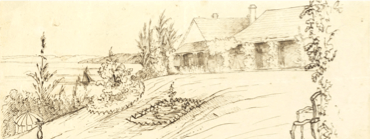
1840 drawing of the original Tahlee House, near Carrington, Port Stephens, where Dumaresq died in 1838 [State Library NSW]
Lieutenant-Colonel Dumaresq arrived in this Colony in the year 1825, a few months before his brother-in-law, Sir Ralph Darling. He was Private Secretary to that Governor throughout the whole of his administration, with the exception of an interval of absence on a visit to his native country, whence he returned in 1829, bearing the Royal Charter constituting and appointing the enlarged Legislative Council.
On the retirement of Sir Edward Parry, about four years ago, from the charge of the extensive establishments, in this Colony, of the Australian Agricultural Company, Lieut.-Colonel Dumaresq was appointed to succeed him, as the Company’s Chief Commissioner; and with so much ability and success had he performed the duties of that responsible office, that the Court of Directors last year spontaneously voted a handsome increase to his salary, accompanied by a high eulogium on his official services.
To the Company the Colonel’s death will be no ordinary loss, his ample local experience, joined to his other qualities, having peculiarly fitted him for the active, prudent, and profitable management of their affairs. The subordinate officers and servants of the establishment are mournfully sensible that by that sudden event they have lost a just and a kind superior, whose constant endeavour it was to promote their general happiness, and whose personal example recommended to them the duties and the consolations of our holy religion.
By a large and respectable circle of friends, his memory will long be cherished for the virtues which made him at once an exemplary member of society, and an ornament and pattern of private life. His numerous family connexions have sustained an irreparable bereavement, but their grief is assuaged by that sure and certain hope of the resurrection to eternal life, which is supplied by that Gospel of which he lived and died a firm and a consistent believer.’
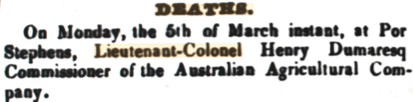
Death Notice for Lieutenant-Colonel Dumaresq [The Colonist, 10 March 1838]
Dumaresq was buried at his property, St Heliers, near Muswellbrook, and he is commemorated by a plaque in the church of St. John the Evangelist at Stroud.
English tribute to Colonel Dumaresq – 1838
The (London) Times of 23 July 1838 published the following tribute to Colonel Dumaresq:
The unrelenting grave has got possession of another of those intrepid men [ Lieutenant-Colonel Duamaresq] who in the late war, reaped so rich a harvest of glory, and placed the renown of their country on a rock of adamant. The subject of this notice joined the 9th regiment of foot, then under the command of Lieutenant General Sir John Cameron, at Shorncliff, in the year 1807. He was educated at the Military College, and was hardly sixteen when, he joined with his school-fellow and companion, the, late Captain the Honourable William Curzon, who was of his own age, and who fell covered with wounds at Waterloo, whilst Aid-de-Camp to the Prince of Orange.
It is enough to show that Colonel Duamaresq was no common person to say, that without powerful connexions, or other patronage than of his own creating, he reached the rank of Lieutenant-Colonel without purchase, before he was twenty-five years of age. The first patron he had was the Marquis Camden, and the whole transaction does honour to our nature. His Lordship’s nephew, Captain James, on the Adjutant-General’s staff was shot through the body and both thighs in mounting the terrible breach of Badajos, from which he fell into the water of the ditch.
Young Dumaresq had afterwards an opportunity of showing his wounded friend kindness; poor James found a soldier’s grave; but the grateful uncle never forgot the kindness of the friend. He afterwards drew the attention and experienced marks of notice and favour from the illustrious Chief himself. The Duke of Wellington honoured him with his countenance and friendship, and at the peace he was at his table with social parties at Apsley-house, Cheltenham, and other places.
He was in all the great affairs of the Peninsula, sometimes on the staff, in which capacity he served at Waterloo, where he was badly wounded, and carried with him to the grave the Frenchman’s ball. After he had received it, he continued on horseback and communicated with the Duke with regard to some outposts. His Grace, seeing him look pale and sin-ing, touched him on the shoulder, saying, “You are, wounded, my boy; go in the rear.”
He afterwards served on Sir Lowry Cole’s staff, when Governor of the Cape. General Darling, who, as Governor of New South Wales, fixed much of public attention, married his sister, and Colonel Dumaresq served in that distant colony as Military Secretary and Aid-de-Camp. He had before served on General Sir John Byng’s staff in Yorkshire.
In the colony he purchased property, and embarked in farming speculations. He returned to England on business connected with the charges against his brother-in-law; no one could explain them better. Here he married, and went back to the colony, when after some time he had an attack of paralysis, from which, however, he appeared to recover, and upon Sir Edward Parry accepting his pension, and retiring from the management of the affairs of the Australian Company, Colonel Dumaresq was appointed his successor.
He administered the affairs ably, and to the entire satisfaction of the company, but the snake was scotched not killed, for on the 5th of March last, he was again attacked with paralysis; he was found speechless in his bed and expired on the following morning. Thus fell this gallant soldier. And if it be true, and there appears to be no doubt, that the ball caused the paralysis, he may be truly said to have been killed at Waterloo, though he died on the other side of the globe, and twenty-three years after the mighty battle. He has left a sorrowing and amiable wife and mother, and seven children; and he has left sorrowing friends in every part of the globe.’
Concluding Comments
Henrys’ widow, Lady Sarah Dumaresq, died during March 1877 in England.

Death Notice for Lady Sophia Dumaresq [Glen Inness Examiner and General Advertiser, 23 May 1877]
Numerous papers covering the early history of Port Stephens are published on this website and can be viewed at the following links:
Journal of Sir Edward Parry – Commissioner of the Australian Agricultural Company 1830 – 1834
Return Journey of Sir William Edward Parry to England
Story of Commander Charles Parry R.N. – Born at Tahlee Port Stephens in 1833
The Convict History of Port Stephens
Escaped Convicts Visit Port Stephens in 1835
Port Stephens – A Destination for Whaling Ships
History of Tahlee House at Port Stephens
A Christmas Tale From Tahlee House – 1832
Aborigines of Port Stephens, Dungog and Gresford
Aboriginal People of Port Stephens – Reminiscences of William Scott
Aspects of Aboriginal History of Port Stephens
Evidence of Early Aboriginal Settlement at Port Stephens
History of Tomago House and Chapel
The Legacy of William Caswell and Tanilba House
The Carrington Church at Port Stephens
Researched and compiled by Kevin McGuinness
May 2026

 Port Stephens - a history exploration