
Introduction
This paper gives an account of the early history of the two Court Houses that operated at Tea Gardens, utilising the resources of the National Library of Australia’s Trove newspaper collection.
The first Court House at Tea Gardens occupied a prior weatherboard residence by the waterfront, constructed around 1892. By 1914, the building was displaying significant structural deficiencies, leading to concerns regarding its ongoing suitability to serve as a Court House facility.
After 19 years of sustained advocacy by local community groups, a new Court House was finally constructed and officially opened in 1933. The persistent efforts and frustrations experienced by these groups to have a new Court House erected are clearly reflected in the historical newspaper reports in this paper.
The main matters presided over by the Tea Gardens Court were primarily cases relating to alcohol-related offences, general disorderly conduct, fishing regulations, and coronial inquiries. A number of early court cases held at the Tea Gardens Court House are presented to illustrate the range of matters dealt with.
After a fifty-five year period of operation, the second Court House was closed in 1988, precisely one century after the establishment of the Court of Petty Sessions at Tea Gardens in 1888.
Around 1988, the State Government closed more than thirty country Court Houses across the state, resulting in many rural communities repurposing these now-disused buildings, often as museums.
Court of Petty Sessions established at Tea Gardens – 1888
By Proclamation published in the NSW Government Gazette of 16 October 1888, a Court of Petty Sessions was established at Tea Gardens, and had civil and criminal jurisdiction within the Port Stephens Police District. Other places of Petty Sessions within the Police District were then situated at Stroud, Bulahdelah and Forster.
The Port Stephens Police District covered the County of Gloucester; and according to a notice published in the NSW Government Gazette of 10 January 1888:
‘was bounded on the north from the sea, at the entrance to Wallis Lake, about 4 miles north-westerly from Cape Hawke, by a line westerly through Wallis Lake to the mouth, of the Wollomba River, and by that river to an eastern boundary line of the Australian Agricultural Company’s grant of 464,640 acres, and by that boundary bearing north to the corner of that grant, near Millstone Hill; thence by a line bearing north-westerly to the confluence of the Gloucester River with the Manning River, and by the Manning River to its source in the Mount Royal Range; on the west by that range, and the range dividing the waters of the Williams River from those of the Manning and Karuah Rivers, to the road from Clarence Town to Sawyer’s Point; on the south by that road to Sawyer’s Point and by the southern shore of Port Stephens; and on the east by the sea to the entrance of Wallis Lake aforesaid.’
Nelson Bay, and other towns on the southern side of Port Stephens were covered by the Raymond Terrace Police district.
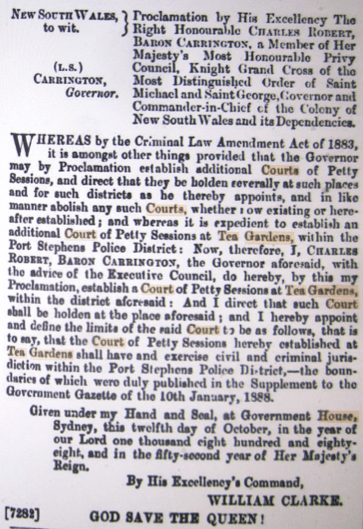
Copy of the Proclamation about the Tea Gardens Court of Petty Sessions [NSW Government Gazette of 16 October 1888].
Police Magistrate appointed for Tea Gardens – 1889
A Notice was published in the NSW Government Gazette of 19 July 1889 advising that Charles Hugh Fawcett, Esquire, Police Magistrate at Stroud, had been empowered to exercise his duties at Stroud, Forster, Bulahdelah, Bungwall and Tea Gardens, within the Police District of Port Stephens.
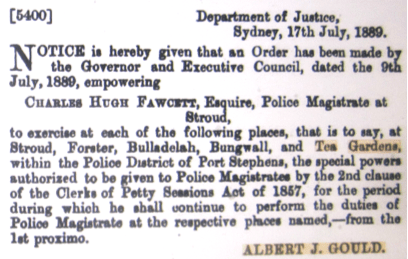
Copy of the notice appointing a Police Magistrate [NSW Government Gazette of 19 July 1889].
Early court case at Tea Gardens – 1890
The Maitland Mercury and Hunter River General Advertiser of 2 December 1890, page 2, reported on a tragedy at Tea Gardens:
‘The man Lorenzo Solari, who was remanded from the Newcastle Police Court to the Tea Gardens Court, a few days ago, on a charge of causing the death of a woman named Mary Martin on the 12th ult., was brought before the latter bench on Wednesday last. Mr. G. Y. M. Cooke, P.M., [Police Magistrate] of Stroud, and Mr. Barnes, J.P., adjudicated. Inspector Brennan of Newcastle, prosecuted for the Crown, and Mr. Windeyer, of the firm of Messrs. Windeyer and Thompson, defended the prisoner.
The evidence of Constable Stone, Mrs White, Dr. Findlay, of Stroud, and Mrs. Osborne, a nurse, was taken for the prosecution, and the dying depositions of deceased, which were taken by Mr. Barnes, were put in. The leading features of the evidence were that deceased and accused had been living at the Tea Gardens as man and wife since last August, at which time the latter rented a house from Mr. Hagon. It was then noticed that the parties quarrelled very frequently, and recriminations and angry disputes were often heard.
On the 12th October it appeared that the deceased got some meat for their consumption, and that accused took exception to it on account of its condition. She returned it to Mr. White, the butcher from whom it had been purchased, and Mrs. White carried it back to accused’s residence, stating that her husband would make an allowance for a quantity of bone in it. Accused used some very strong language and stated that the people of the neighbourhood would think that he was killing deceased.
She (Mrs. White) then returned home but had scarcely entered the door when she heard serious quarrelling going on at the house she had just left. She proceeded into the yard to see what was wrong, and observed the unfortunate woman, Martin, in a terrible condition, at the gate. Her face was covered in blood, and she had a deep contused wound in her left temple. Blood was also flowing over her clothing to the ground, and a pool of gore had formed where she was standing.
She (Mrs. White) took her into the house where she staggered and fell in an epileptic fit. She was then put to bed, and a series of fits followed in quick succession. An hour or so later she was removed to her own house, and Solari was arrested by Constable Stone on a charge of inflicting grievous bodily harm. From information that deceased then gave, the officer searched accused’s box, and in it found a revolver with which it is alleged he had struck the woman. An examination of the weapon disclosed the fact that the knob of the handle exactly fitted the wound in the woman’s temple, and there appeared little doubt that it had been used to that end.
The deceased was about eight months pregnant at this time, and her condition grew so serious that on the 17th it was considered advisable to take her statement. Dr. Findlay was summoned from Stroud by the police, and he found that there were strong symptoms of a premature confinement. The sufferer remained in a most precarious state until the 21st ult., when she gave birth to female twins. One of these died two days later, and the other expired on the 29th ult.
Accused was brought up at the police court on the charge of inflicting grievous bodily harm and was committed for trial on the 25th; and on the 31st the woman had become so bad that Mr. Barnes took her dying depositions. On that occasion accused was present, and in answer to the police stated that he did not wish to ask the sufferer any questions. She then repeated the statement that he had struck her with the revolver but stated that she would forgive him. She also asked if he would go and see her mother and explain the whole of the circumstances. After making a few further remarks, chiefly in lamentation at not being able to see her mother, she fell back and expired.
The theory of the prosecution is that the blow received on the 12th ultimo brought about the miscarriage, and that puerperal fever followed. Accused was committed for trial on Wednesday to the Maitland Quarter Sessions, bail being refused. His wife, who had come from Sydney, was present during the proceedings.’
A new Magistrate appointrd for Tea Gardens – 1900
The Dungog Chronicle of 3 April 1900, page 3, reported:
‘At the Court House on Tuesday morning Mr. Jacob Hough, of Tea Gardens, Port Stephens, was sworn in as a magistrate of the territory under a writ of dedimus potestatum [we have given the power] directed to the Police Magistrate, Mr. Fred. W. Garstang. After being congratulated on his appointment by the P.M., Mr. Hough took his seat on the Bench.‘
Important Fishing Case at Tea Gardens – 1900
The Daily Telegraph of 31 August 1900, page 5, reported:
‘At the Tea Gardens, on Tuesday last, Henry Thompson, jun., and Charles Diemar were charged with stealing oysters from Crown land not under lease. The information was laid by Mr. Henry Laman, Inspector of Fisheries. The offence was alleged to have taken place at Union Tree Point, North Arm, Port Stephens.
Mr. M. M. D’Arcy Irvine, a solicitor from the Crown Law Department, appeared for the prosecution, on behalf of the Crown Solicitor. After the case for the prosecution had closed, the accused elected to be dealt with summarily and pleaded guilty. Mr. D’Arcy Irvine drew the attention of the police magistrate (Mr. F. W. Garstang) to section 11 of the Oyster Fisheries Act of 1884, and also to a regulation dealing with the matter. He asked, for technical reasons, that a fine of not less than £2 should be inflicted.
The police magistrate said that the offence of stealing oysters was becoming far too common. There was an impression abroad that anyone had a right to take and sell oysters from Crown land— that impression was a wrong one. The Act of Parliament to which Mr. D’Arcy Irvine had referred made oysters on Crown land the subject of property, and therefore the subject of larceny. He would adopt the suggestion which had been thrown out by the counsel for the Crown, and fine each of the accused £2, and costs of Court, 3s 8d.’
Request for a Tea Gardens Police Court and Police Station – 1908
The Gloucester Advocate of 8 August 1908, page 9, reported on a decision of the Tea Gardens Progress Committee:
‘Proposed by E. Williams, seconded by E.T. Yates, ‘That the Secretary be instructed to forward a letter through Mr. Price to the Department of Justice, asking that a Police Court and Police Station be erected at Tea Gardens.’
The Dungog Chronicle of 26 March 1909, page 7, further reported:
‘The following correspondence has been received by the secretary of the Tea Gardens Progress Association from Mr R. A. Price, M.LA.: — Department of the Attorney General and of Justice, Sydney, 9th March, 1909. Sir,— I have the honour to acknowledge the receipt of your letter of the 8th inst, drawing attention to the dilapidated condition of the Police Station and Court Room at Tea Gardens, and suggesting the erection of a new building, and to inform you that a further communication will be addressed to you at a later date. I have the honour to be, etc., J. L. Williams, Under Secretary. The Hon. C. A. Lee, Department of Public Works.’
Description of the Tea Gardens Court House – 1914
The Raymond Terrace Examiner and Lower Hunter and Port Stephens Advertiser of 22 May 1914, page 3, reported:
‘There is a shanty here called a Court House. It is about 10 by 16, the P.M. [Police Magistrate] presides in a chair in the chimney, and while he disperses justice the wind whistles at him through gaping rents in the wall. The white ants have done their native instinct justice, and they have left a shell. Nowhere, it is safe to say, where the flag flies over the wide domain of the British Empire, does such a place exist, other than here.
It is more than a scandal; it “is” a hall of justice. The residence of the police officer is no better, or very little. Cramped, with ant eaten and leaky, devoid of domestic comfort. If there were a municipality here the lot would have been condemned long ago. The cell, where restraint is used upon those who disturb the peace, is a “sell.” Once a prisoner was locked in it, but he had disappeared in the morning, and now no one expects to get locked up. He can’t be; anyhow, its dangerous. If he pushed the wall, the lot may fall in on him, and death by misadventure, without a trial from the chimney corner, isn’t worth the risking. An effort is also being made by the Progress Committee to have up-to-date premises erected, and they should certainly succeed.’
Request for a Tea Gardens Police Court and Police Station – 1914
The Gloucester Advocate of 3 June 1914, page 2, reported:
‘A new Court House and police quarters are an urgent necessity, as the present buildings are a positive disgrace. They are rat-infested beyond imagination, eaten to a shell by white ants and absolutely unsafe. Yet it is understood that they are to be “repaired.” Oh! the mockery!. The Progress Committee purpose bringing the insanitary condition of the whole premises under the notice of the health authorities.’
The Department of Public Works, finally called for tenders on 7 May 1920 for the erection of Police Station at Tea Gardens, but not a Court House.
Further representations made for a new Court House at Tea Gardens – 1924
The Raymond Terrace Examiner and Lower Hunter and Port Stephens Advertiser of 25 January 1924, page 2, reported:
‘Mr. J. J. Fitzgerald, M.L.A. is in receipt of the following from the Minister for Justice: — “I am in receipt of a letter addressed to you by the Shire Clerk, Stroud Shire Council, regarding the construction’ of a new Court House at Tea Gardens. Your further representations in the matter will be considered, and a communication will be addressed to you in due course.”
The Raymond Terrace Examiner and Lower Hunter and Port Stephens Advertiser of 8 February 1924, page 3, also reported:
‘Messrs R. S. Vincent, and T. H. Hill. Ms.L.A. are in receipt of the following letter from the Minister for Justice: — Dear Sir, — With reference to your letter of the 14th ultimo concerning an application by the Stroud Shire Council for the erection of a new Court House at Tea Gardens, I have to inform you that I have carefully considered the Council’s request and will make arrangements to visit that centre at the earliest date possible.
I propose leaving Sydney for New Zealand on the 7th instant and will return about the middle of March. I will then communicate with you again and make an appointment mutually convenient to you and the other representatives of the Oxley Electorate.’
The Dungog Chronicle of 20 June 1924, page 5, further reported:
‘The Stroud Shire Council has received word from Messrs. Hill and Vincent, Ms.L.A., that the Minister for Justice, Mr. T. J. Ley, together with a party of about 12 Parliamentary Members, will visit Tea Gardens on Saturday, 21st June next, to go into several matters of local importance. Deputations will be received on the question of a new Court House.’
Ministerial visit to Tea Gardens concerning a new Court House – 1924
The Newcastle Morning Herald and Miners’ Advocate of 23 June 1924, page 4, reported:
‘An inspection of the public school and Court House was made by the Minister, upon whom the desirableness of improvement in respect to both were impressed by the district members, who introduced the deputation. The population, it was stated, had in the last two years increased substantially, and was now 950. The courthouse was dilapidated, and inadequate, subjecting the residents to a lot of inconvenience that could be avoided, and had been endured too long. …. In reply, the Minister said that an estimate of the cost of providing a new courthouse was £900. As soon as possible the work would be carried out.’
No Government funds available for new Court House – 1925
The Newcastle Morning Herald and Miners’ Advocate of 24 March 1925, page 5, reported:
‘Mr. Vincent, M.P., has been advised by the Department of Justice that the request for the erection of a new Court House at the Tea Gardens had been considered. In view of the urgent need for economy, provision could not be made on the estimates for the building desired, but the matter would not be lost sight of when the estimates for next year were being prepared.’
Dalay in preparing plans for new Court House – 1926
The Newcastle Morning Herald and Miners’ Advocate of 24 March 1926, page 9, reported:
‘The work of erecting the new Court House at Tea Gardens is not to be proceeded with at present. Representations were recently made by Mr. Fitzgerald, M.P., on this matter, as the instance of the local progress association, who urged that it be expedited. The reply of the Department of Works is that, through stress of other work and a shortage of staff, the plans have not been prepared. An effort to start the drawings would be made at the earliest opportunity.’
New Court House awaiting allocation of government funding – 1926
The Dungog Chronicle of 13 August 1926, page 2, reported:
‘Mr. Theo. Hill, M.L.A., has been officially informed as follows by the Under Secretary of Justice: — Referring to your letter of 5th instant and previous correspondence, I am directed to inform you that the Minister of Justice has approved of a new court house being erected at Tea Gardens, and the work will be commenced when the necessary funds can be made available.’
Magisterial Inquiry held at Tea Gardens – 1927
The Dungog Chronicle of 23 August 1927, page 4, reported:
‘A magisterial inquiry concerning the death of Eastathios Diligianais, a Greek fisherman, was held at the Court House, Tea Gardens, on Sunday last before the Coroner, Edward Hitchins, Esq.
Spearos Spathis deposed: I am a fisherman and reside at Broughton Island. Am of the Greek nationality and not naturalised. I remember on August 12th, at 4 a.m., three of us took an 18ft boat off the beach at Broughton Island, to go to the launch, which was moored about 300 yards from the beach. The deceased was in the boat and after we had covered half the distance to the launch, the boat started to take water in and we joked about it. There were five lobster pots in the boat. I noticed the water coming up to my feet and I said: ‘Pull hard,’ and threw out the lobster pots, but the boat sank shortly after. I grabbed one of the lobster float buoys, and deceased tried to swim to a launch close by.
He sang out “Oh! Oh!” two or three times. I called out “Try hard to get to the launch.” I did not hear him anymore. It was moonlight, but I could not see what happened. I called out to Gus, who was asleep, and he came to the beach. I cried out ‘the boat sank, and we want help.’ Gus called his brother and then came and picked me up. Nicholas, who was clinging to the upturned boat, said he was alright, so we went to look for deceased, but could not see him in the water, so we searched the launches, but could not find him. We then went and rescued Nicholas.
We searched for the body at sunrise but could not find it. I went to Nelson’s Bay and reported the matter at Nelson’s Bay. Those who remained behind continued to search for the body. We returned to Broughton Island and learned that the body had been recovered. We asked the white people what we should do with the body and they told us to bring it to the police at Tea Gardens. This we did. …. The day be-fore he died he told us his mother was alive, and that there were thirteen in the family, all being in Greece.
Con Ellissow: I am a fisherman, residing at Broughton Island. On Friday, 12th August, Spearos called me at 4 a.m. in the morning and wakened me. He called out that his boat was sinking. I got my brother and we launched a dingy and went out to assist them. Nicholas was slinging to the boat, and he said he was alright. I then picked up Spearos, who was hanging to two ropes, and we went to look for deceased, who Spearos said swam towards the launch, but we could not find him.
We then picked up Nicholas and took him to the beach. We then made another search but could not find anything. At daylight, we went to some English people and told them deceased was drowned. Jack Asquith and his mate went out but they could not find him. I took another mate and made further search. With the glass I saw the deceased on the bottom. I got grappling irons and recovered the body and took it ashore and tried to resuscitate it. His trousers had dropped down between his legs. There was a scratch on his forehead, which might have been caused by the grappling irons. I am sure deceased was drowned and did not meet his death by foul play.
Percy Alfred Bassett deposed: “I am police Constable, residing at Tea Gardens. On August 12th, the body of Eastathios Deligianais was brought to Tea Gardens. I had it removed to the hotel, where I examined it closely. There was an abrasion on the forehead, which might have been caused by grappling irons. There were no other marks of violence. I searched the deceased clothing and found no money or property. His bank book showed a credit of £474/1/1. The Coroner found that Eastathios Deligianais was accidentally drowned at Broughton Island, on August 12th, 1927.’
Condition of the original Court House – 1928
The Maitland Daily Mercury of 29 February 1928, page 9, reported on the following comments concerning the Court House, provided by the Progress Association:
‘The Court House is an ant-eaten shanty 17′ x 9′ x 9′ and is in the last stage of decay. So serious are the ravages of the white ants that they are eating even the “Government Gazettes.” For the last 15 years [since 1913] a new building has been promised and plans have been drawn, but tenders have not been invited for its erection. Possibly the local member, Mr. W. Bennett, M.L.A., may induce the authorities to treat the matter as urgent and so give employment to local unemployed.’
Funding restraints delay construction of new Court House – 1928
The Dungog Chronicle of 9 November 1928, page 2, reported:
‘Hon. W. Bennett, M.L.A., has received the following letter from the Minister for Justice, regarding the above [Tea Gardens Court House] – ‘Referring to your letter of 25 th ultimo, respecting the condition of the Court House at Tea Gardens, I beg to inform you that approval has been given for the erection of a new Court Room at that place. The Public Works Department has, however intimated that no funds are available at present for the work, and the matter must he deferred for consideration until the Estimates have been passed.’
Funding restraints again delay the construction of new Court House – 1930
The Dungog Chronicle of 14 March 1930, page 2, reported:
‘After repeated representations, Hon. Walter Bennett, M.L.A., has received the following communication from the Minister for Justice: — In reply to your representations in relation to the erection of a new Court House at Tea Gardens, I am directed by the Minister of Justice to inform you that the Public Works Department has intimated that funds will not be available this financial year for the carrying out of the abovementioned work. I am to add that plans and specifications are well in hand, with a view to proceeding with the work early next year, in the event of it being possible to make the necessary financial provision.’
The Dungog Chronicle of 14 November 1930, page 4, further reported:
‘The Tea Gardens Progress Association is to be commended for again making application for the erection of a new Court House to replace the present hovel used as a Court House. Such a structure would not be allowed to stand in a Municipality. If the attention of the Department of Public Health was drawn to it there is no doubt, that Department would pronounce that it was not suitable for human habitation.
When the late Mr. Bruntnell visited Tea Gardens about three years ago, he definitely promised the Progress Association that it would be replaced by a new building to cost about £600. The erection of a new Court House was placed on the estimates by the last Government, but we understand that the money was used for other purposes. But no other purpose was more urgent than the one intended.
The present hovel was featured, on one occasion, in the “Daily Pictorial,” and this satire was not strong enough to move the enthusiasm of the Department. A review of Government tenders from time to time is sufficient proof that much larger sums are spent on public buildings not in a condition so disgraceful as the hovel that stands for a Court House. It is so bad that no one would think of using it for a stable, and to think that such a public building is on the waterfront is an insult to the civic pride of any citizen.
There are so many builders and contractors unemployed the Government would only be providing work in lieu of the dole and would be getting some return for money spent on a work that is absolutely justified under any circumstances.’
Battle to obtain a new Court House continues – 1931
The Dungog Chronicle of 13 February 1931, page 4, reported:
‘From year to year over many of them efforts have been made to have a new Court House erected at Tea Gardens to replace a hovel, that is used for that purpose. Tea Gardens has no ambitious designs for a grand structure, but it certainly has a sense of fitness of things.
The respective Governments insist upon a standard of decency in regard to what private enterprise shall do, but they certainly prove that they are a law unto themselves despite the illogical position created by their policy. It is safe to say that this dilapidated structure, ant eaten, and no doubt unsanitary is a disgrace to any town and its retention as a public building is not justified under any circumstances whatever. We feel that if the attention of the Department of Public Health was drawn to it, the result would be its condemnation and a certificate that it was not fit for habitation.
The officer who is obliged to spend a large portion of his life within it is asked to suffer too much. The late Chief Secretary, Mr. A. Bruntnell, when he last visited Tea Gardens, could scarcely believe his own eyes and promised to do what was possible. To his credit, money was voted and to the discredit of someone else the money so voted was spent, as we feel certain, on less urgent works. The question is so urgent that the Progress Association should not allow the matter to drop. A suitable building could be erected at a cost of about £500.’
Early provision of funding for Court House to be considered – 1932
The Dungog Chronicle of 1 July 1932, page 4, reported:
‘Hon. W. Bennett, M.L.A., has been informed as follows by the Under Secretary for Justice: — Dear Sir, — Referring to previous correspondence relating to the request of Mr. A. W. Vaisey, Hon. Secretary, Tea Gardens Progress Association, for the erection of a new Court House at that place, I beg to inform you that the Secretary, Public Works Department has intimated that it is proposed to give early consideration to the provision from 1932-33 Revenue Expenditure of funds necessary to permit of the abovementioned work being put in hand.’
Fight for a new Court House continues – 1932
The Dungog Chronicle of 9 September 1932, page 4, reported:
‘For many years the Tea Gardens Court House has been recognised as a hovel, and a building that should be condemned by the authorities. When the late Chief Secretary, Mr. Bruntnell, visited Tea Gardens, he could hardly believe his Government had such a building for official purposes.
On a number of occasions provision has been made on the estimates for the erection of a new structure, but the money so voted was spent elsewhere at the expense of this town’s requirements. As a tourist centre the Court House is a positive eyesore and takes away much of the waterfront’s beauty. The so-called structure leaks, is ant eaten and can scarcely bear its own weight. Buildings of this nature cannot be regarded as fit for habitation, and it is a wonder that the Shire representative for this district has not brought the condition of the Court House under the notice of the Shire Council.
The building trade is very slack and the Government has an ideal opportunity of giving a lead in the matter of getting men back to work. The cost of a new structure suitable for the town is only a matter of about £500 or less, and it is inconceivable that officers of the Crown are asked to spend a great proportion of their time in what cannot be designated anything else but a hovel.
This paper has drawn attention to this matter on a number of occasions, but without avail. If local government means anything, here is an opportunity for the application of the provisions of the Act concerning such buildings. We say this in face of the need for economy, but in this instance, it would be real economy to call upon the Government to build a Court House in keeping with all conditions.’
Tenders called for the construction of a new Court House pending the availability of funds – 1932
The Dungog Chronicle of 21 October 1932, page 2, reported:
‘Hon. W. Bennett, M.L.A., has been informed by the Under Secretary for Justice as follows: — Referring to your representations in relation to a letter from Mr. A. W. Vaisey, Hon. Sec., Tea Gardens Progress Association relative to the erection of a new courthouse, I beg to inform you that it has now been intimated by the Secretary of the Public Works Department that tenders are being invited for the proposed new court room, with a view to consideration being given to the question of the provision of the requisite funds to permit of the work being put in hand.’
The Dungog Chronicle of 11 November 1932, page 4, further reported:
‘Tenders have been called for the erection of a new Court House at Tea Gardens, to replace the existing structure. For some considerable time, the Progress Association, backed up by other public bodies and assisted by the Member for this district, have fought hard for a new Court House, and it is pleasing to note that their efforts, have been rewarded. The present structure, which is an old type of weatherboard building, was erected about forty years ago [1892], and was originally built for a residence, so we are informed. Previous to the erection of the present Court House, the police resided in the house now occupied by Mr. T. Hill and the court was held in the front room.’
Contract for the construction of the new Court House approved – 1933
The Dungog Chronicle of 28 April 1933, page 4, reported:
‘After numerous appeals from various public bodies for a new Court House in Tea Gardens, success has now been achieved, as it is an established fact that we are to have a new building, to replace the existing structure. Messrs. G. A. Zeininger and Sons, local builders, are the successful tenderers.’
New Court House officially opened – 1933
The Dungog Chronicle of 22 December 1933, page 4, reported:
‘The official opening of the new Court House at Tea Gardens, took place on Thursday, December 13th, and owing to the weather conditions being unfavourable, only a small crowd was present at the function. In the absence of the Police Magistrate, the official opening was left in the hands of the local justices, Mr. H. M. Engel, J.P. performing the ceremony, and after a brief address turned the key and declared the building open.
Mr. Pyman, J.P., and Constable Ovenstone also spoke on the occasion. The Court House, which has been a long-felt necessity was built by Messrs. G. A. Zeininger and Sons, local contractors, under Government supervision, and is a credit to them. With regard to appearance and finish it is an asset to the town. It is built on modern lines.
For many years the local Progress Association worked hard to have a modern Court House in place of the insanitary building used for that purpose, and it is pleasing to them to see that their efforts have been rewarded with the erection of such an up-to-date building.’
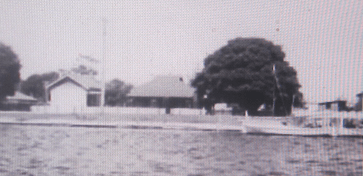
Tea Gardens Court House (left) and Police Station residence (right) circa 1980’s.
Electricity not installed at the Court House and Police Station – 1942
The Dungog Chronicle of 22 December 1942, page 1, reported:
‘Mr. Benson, of the Public works Department, paid a recent official visit to Tea Gardens, for the purpose, it is understood, to arrange for the electric light to be connected to the Fisheries Department boat shed at Tea Gardens, the headquarters of the Port Stephens Fisheries Inspector. What is of particular interest to us is that an important Government centre is not serviced with this modern convenience. We refer to the Court House and the Police Station and residence.
What is not understandable is if one Government Department can modernise a boatshed, and two other Government Departments — Justice and Police — will not approve electric illumination for the Court House and Police Station respectively. If the Chief Secretary’s Department considers electricity essential for a boatshed, what is the reasoning of the other two Departments, which have failed to connect the Court House and Police Station? The matter of expense cannot be seriously raised as an objection nor can the matter of importance be raised, neither can the matter of expense be considered formidable. What then can be the reason for not connecting such important public offices as the Court House and Police Station with a modern convenience? We are lost for a reason why our civic bodies have not taken the matter up.’
A busy Court Day – 1952
The Dungog Chronicle of 28 June 1952, page 4, reported:
‘The big day in Tea Gardens last week was Court Day. Conviction list is too long to print, but undersize fish and prawns, over length nets, were the chief fines. It looks as if with a few more new regulations, there will be another Government expenditure for a large Court House!’
Permanent closure of the Tea Gardens Court House – 1988
Nota [News of the Area] of 1 August 1988, page 3, reported:
‘John Tinner, M.P., Member for Myall Lakes, said that following consultation with members of the Tea Gardens/Hawks Nest community, he has written to the Attorney General to outline the concerns of the community in relation to the impending closure of the Tea Gardens Court House. Mr Turner said Tea Gardens/Hawks Nest is a residential and retirement area with a population approaching 2,000 people in the township and thousands more in the surrounding areas. “The area is a popular tourist destination and has a transient population using, or, unfortunately, in some cases, abusing the area. This transient population, when added to the users of the adjacent national park and the waterways surrounding the area adds at peak times to tens of thousands of people to the area.
“With the Bulahdelah Court House closed the court house at Tea Gardens services actions arising from the use of the road system. The most notable of course being the Pacific Highway, in the areas known as Karuah and Bulahdelah. “The Court House also services prosecutions brought under the Fisheries Act arising from use of the substantial waterways in the area and breaches by the Maritime Services Board.
Although the Attorney General in a recent letter to Mr Turner said the Court House was only opened for eight days per year Mr Turner’s enquiries revealed that it has sat up to 12 days in the last 12 months and could justify more sitting days. In 1987 charge cases totalling 189 matters and five civil cases were heard in 1987. On the basis of an eight day sitting per year this would average at 24.2 matters per sitting day or on a 12 day per year sitting 16.2 matters.
Mr Turner said he was informed that the annual cost of the magistrate to attend the court would amount to about $3,000. “This figure would have to be looked at as against the cost of requiring the police officers and witnesses to attend Raymond Terrace Court to present or defend matters. “It is almost certain both officers stationed in the area would have to attend to give evidence which would leave the twin towns of Tea Gardens and Hawks nest without a police presence. Because Raymond Terrace has more sitting days than Tea Gardens, then it is possible that the police will be required on more days for court appearances leaving the area without a police presence for longer periods than if the Court House remained Mr Turner said the Raymond Terrace Court is already overloaded. “I submit that justice would be better done at Tea Gardens than to stack the already overloaded lists of Raymond Terrace.
Mr Turner said other practical problems associated with the closure are the fact that no public transport is available to the parties or their witnesses, the additional costs to witnesses and the parties involved and the return trip of some 160km for local residents to have justice dispensed. Part of the service presently given when the Court is in session is that of a chamber magistrate also attends the Court House. Mr Turner said that this system is working extremely well and providing a valuable service to the area.
The Attorney General has stated that one of the main criteria for closure is the implementation of the computer network “Courtnet” and his security concern that high-tech equipment will be left unattended. Mr Turner said the Court House is positioned next to the existing police station and residence. “I don’t think that any security problem of note could really exist in those circumstances. Mr Turner said that he has written a detailed report to the Attorney General with a request that he review the decision to close the Court House and has asked for a personal meeting with the Attorney to reinforce his and the Tea Gardens/Hawks Nest community’s concern on the matter.’
Nota of 1 February 1989, page 14, further reported:
‘To answer some rumours about the Tea Gardens Court re-opening, it appears that the Tea Gardens Court will not be re-opening, unless submissions by Mr Cook, the Magistrate at Raymond Terrace and Senior Constable Avery, OIC of Police Tea Gardens, cause the present minister to change his policy on closure of small court houses. The submission by Senior Constable Avery dealt with the problem of both police stationed at Tea Gardens being absent from Tea Gardens patrol on Raymond Terrace Court days, which can be up to nine days per month. That is without District and Supreme Court appearance at Newcastle, Taree and Port Macquarie.’
Tea Gardens Court House was one of the 30 country Court Houses closed around 1988.
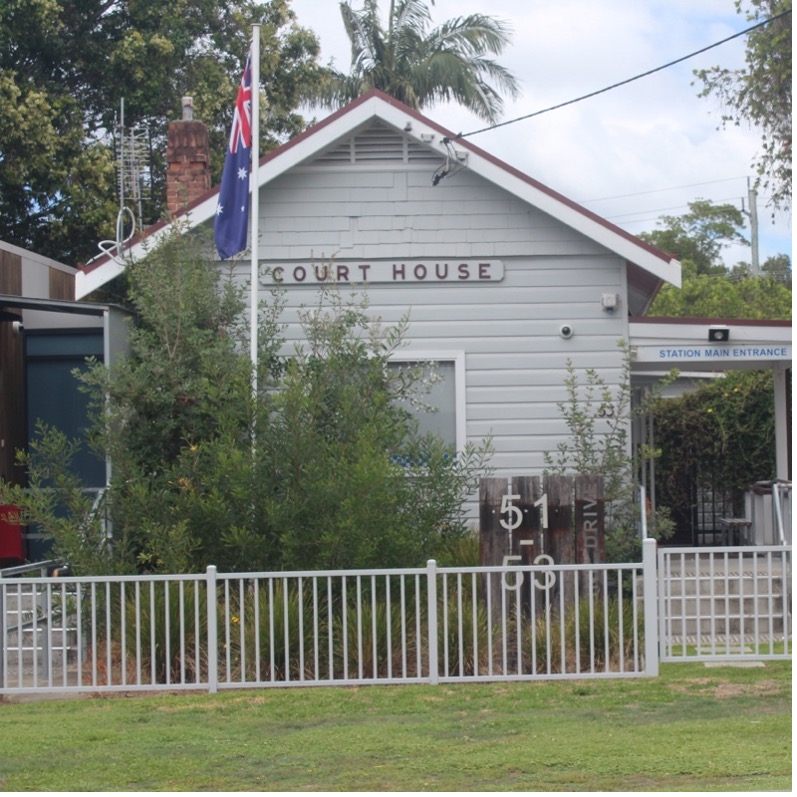
The former Court House which is heritage listed, is now used as part of the Tea Gardens Police Station. A modular extension was added to the Police Station in 2020.
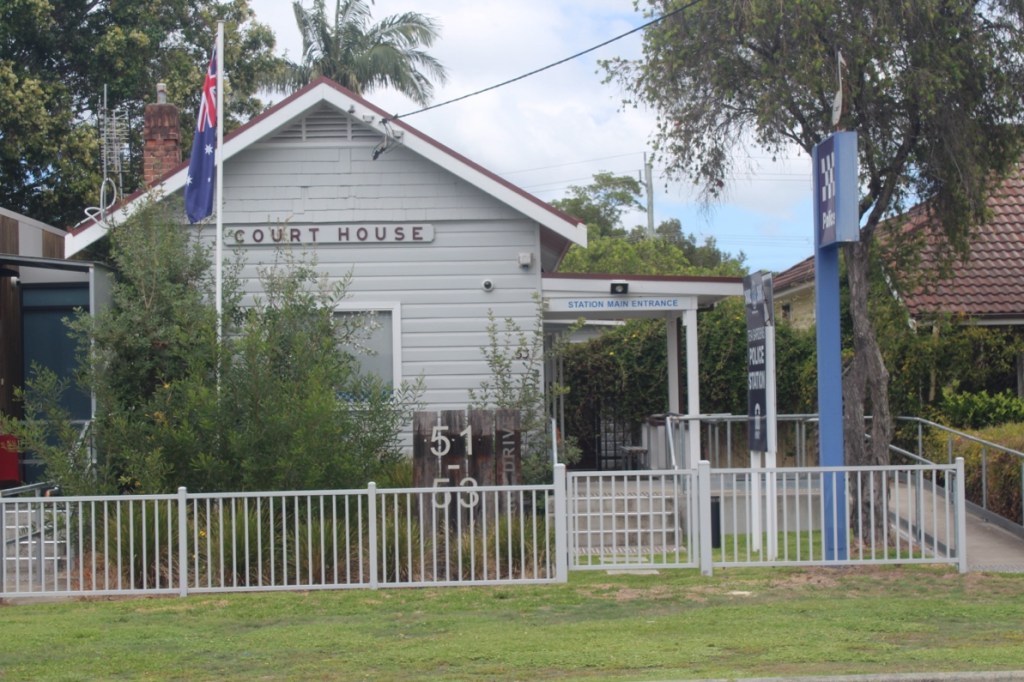
Former Tea Gardens Court House, now houses the Tea Gardens Police Station – 2023 [Author photo]
Concluding Comments
It took 19 years of persistent representations by Tea Gardens community groups to achieve the construction of a new Court House in 1933. This Court House was closed in 1988 after an operational life of fifty-five years.
In May 1991, the State Member of Parliament for Port Stephens, Bob Martin, unsuccessfully advocated for the re-opening of the Court House for a trial period of 6 to 12 months.
Numerous other posts concerning Tea Gardens are published on this website. A selection of those can be viewed at the following links:
Early Stories of Tea Gardens and Hawks Nest – 1936
Going to the Movies at Australia Hall – Tea Gardens
Tea Gardens Urban Area Committee
History of Early Hotels at Hawks Nest and Tea Gardens
History of the Tea Gardens Baths
Tea Gardens Horse Racing Track
Researched and compiled by Kevin McGuinness
October 2025


