
Introduction
Commercial prawning at Port Stephens commenced during the 1920’s at Tamboi [Tamboy], on the Myall River, on the southern shore of the Boombah Broadwater.
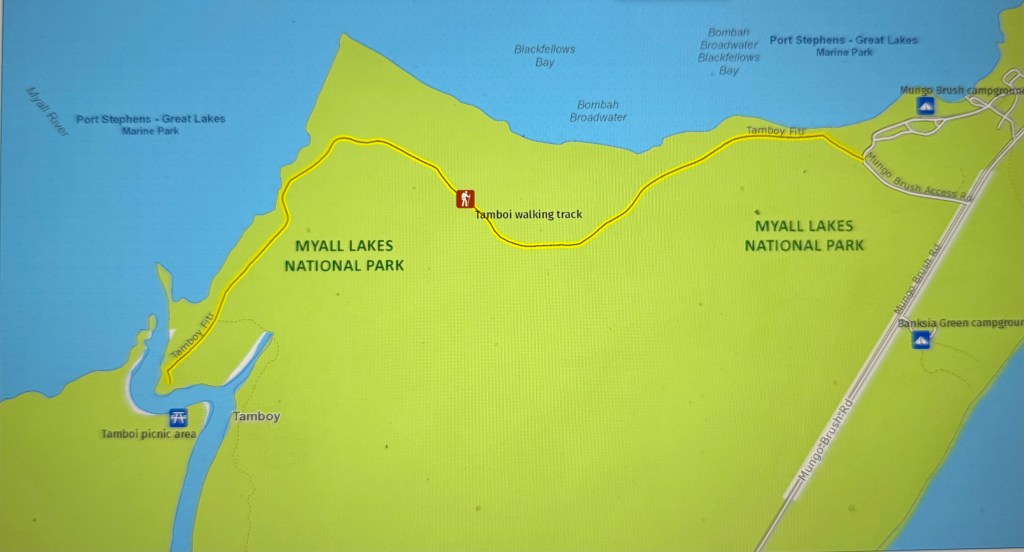
NSW National Parks and Wildlife Map showing the location of Tamboi [Tamboy] – published September 2021
The prawning activities were particularly important during the Depression years of the 1930’s.Together with the sawmilling operations at the Birdwood Sawmill, near Tea Gardens, they enabled many men to earn a living.
The Tamboi prawn fishermen used specific jargon to describe aspects of their operations, for example:
‘Sale’ – the daily roll call at 4 p.m. at Tamboi for a prawn fisherman to accept/decline, as per a ballot, the top ‘shot’ position on the Myall River.
‘Shots’ – Prime fishing locations on the river are called ‘shots’. Prawners shoot their nets out over the river to catch prawns, hence the term ‘shot’. These ‘shots’ have been determined over time, depending upon the physical features of the river at each ‘shot’.
The ‘Dark’ or ‘Big Dark’ – Prawning is best done during the ‘dark’ phase of the moon, viz the period after the full moon (the waning period) up to the new moon. The ‘dark’last for about ten nights after a full moon, with the two nights around the new moon often being very productive.
Around 100 fishermen were often employed at any one time on the Myall River at Tamboi. In the optimum ‘dark’ period, prawns would migrate from the Myall Lakes and enter the narrower Myall River at Tamboi, where prawning nets would be placed for the catch.
Prawning is still undertaken today using nets on the Myall River and by trawling at sea, off Port Stephens.
This paper examines the early history of commercial prawning on the Myall River at Tamboi.
Overview of Commercial Prawning at Tamboi – Port Stephens
The Newcastle Morning Herald and Miners’ Advocate of 7 April 1951, page 5, published the following comprehensive report on the commencement of commercial prawning at Tamboi, and of how the operations were managed:
‘The models of 39 small boats, bearing their owners’ names, hang on the wall of a one-roomed hut in the peaceful little fishing village of Tamboi, 16 miles north of Tea Gardens.
Some of the models are pieces of stick, with both ends roughly sharpened; others have been carved with more care and patience. They hang in rows, one beneath the other …… As models, the boats are valueless, but the position a model occupies on the board may be worth hundreds of pounds. At the time of the “Big Darks,” when prawns spill out of the five great freshwater Myall Lakes and into the narrow Myall River on their last twisting, 16 miles to Tea Gardens and the sea, a boat position may mean the difference between its owner getting several thousand pounds’ weight of prawns in one haul—or none at all.
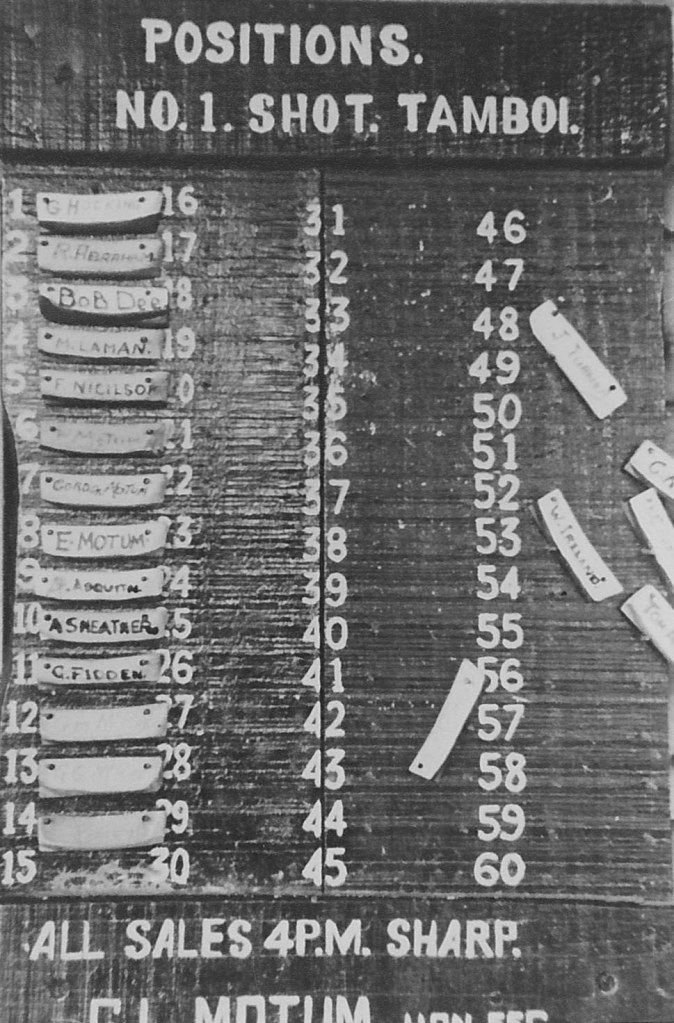
Ballot board at Tamboi
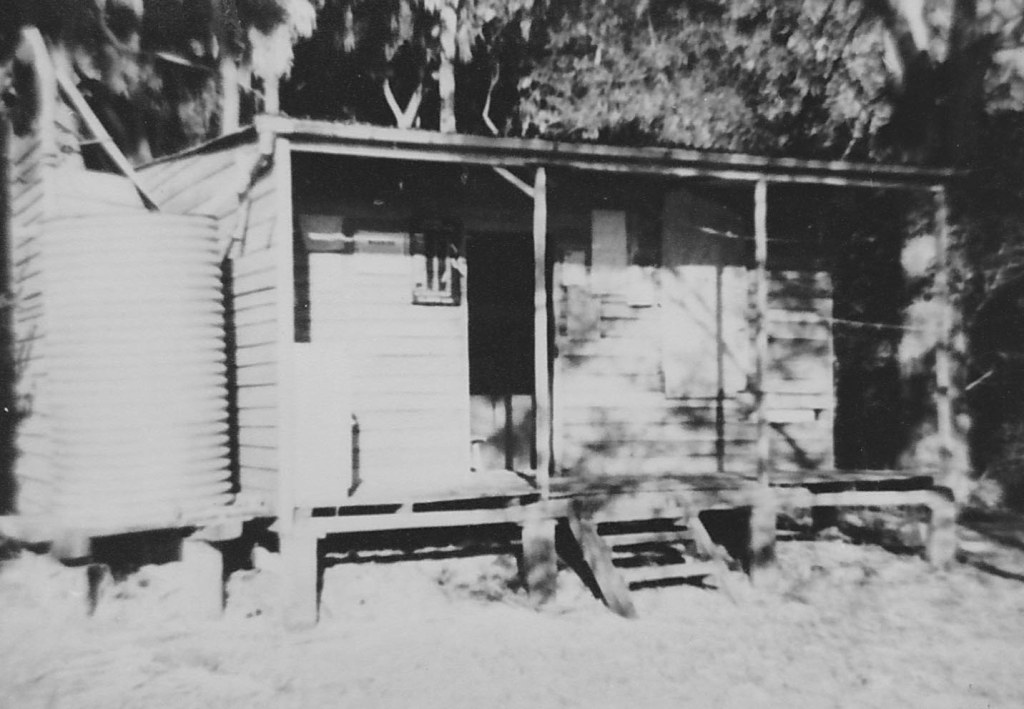
Ballot board as shown attached to the upper left hand side of the hut door at Tamboi. The hut was also known as the Tamboi Town Hall, the Jolly Roger, and the Positions Hut.
Prawn fishermen at Tamboi have been using the models for years to decide who shall have the best prawning shots each night. Their use is necessary, because of the unique set up of prawning at Tamboi. The village is on a bend of the river 300 yards below where water from Broadwater Lake – most southern of the five lakes-flows into the Myall River. Prawns move out of the lake and into the 40 yards wide river in a steady flow from the time of the full moon till the new moon—quizzically called the “Big Dark” by prawners.
Naturally, the net closest to where the prawns enter the river takes the biggest haul. Fishermen long ago decided that there would be endless trouble unless there, was some fair way of taking the “top shot” and “back up”—the shot 50 yards behind the top. Someone— some say it was a Fisheries’ Inspector [John Edward Neary] —hit on the idea of a ballot, with each man’s turn decided by the position of his “boat” on a board. With the board came certain rules, written at first, but long ago faded to illegibility on the paper beside the positions’ board, but still so clear in prawners’ mind that no one would dare to break them. The chief rule is for a call down the list of names on “boats” at 4 p.m each day, the “top shot” going to the first man from the top who wants it, and the “back-up” to the next in line. This call became known as the “sale.” Men could refuse the “shot” any time, but once it was accepted. their “boat” went to last position, and the “back-up” to second-last.
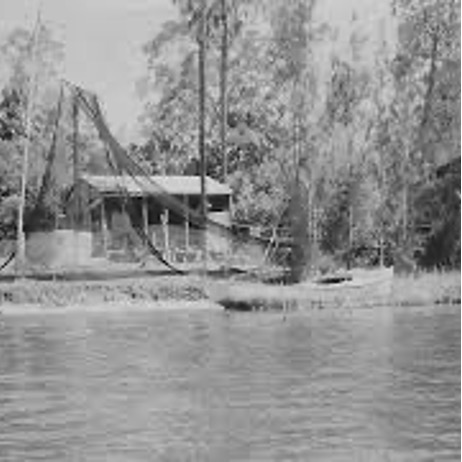
Many of the prawners live at Tea Gardens, but others live in huts and houses in the village. Those from Tea Gardens travel daily by launch up the narrow, twisting river, where a few feet from the channel means sticking on a mud bank, to the “sale” each day, returning home, often in the dark, if they miss the “shot.” From about 9 a.m. till 3.30, Tamboi slumbers, with the sluggish current the only thing moving on the river, and the flies the only things stirring around the huts and huge nets hanging from trees like giant spider webs.
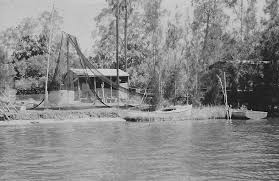
A prawn net hanging from a tree at Tamboi
The scene changes at 3.30. Men begin to move around in the huts, small groups walk around the river to Nick’s Bend; boats rowed by standing oarsmen appear from both sides of the river bank and round the bend; and launches come from Tea Gardens. The men congregate round the verandah of the “positions” hut. A rule that says each man must attend at least one sale in three or lose his position keeps the attendances high.
Promptly at 4 p.m. the “sale” begins. When Ted Pearce, one of the Tamboi residents, fixes his glasses and mounts a box, calls “sale-oh” and begins to read, a hush falls, but when the top two shots are decided, the village begins to hum. The fishermen work in bands of five or seven men, each of whom has gear and a “boat” on the board, to enable efficient prawning. A team might get a boat into the top position and leave it there for weeks for the right night, while others further down the list take the shots to keep the team working.
Those who fail to get the top shots, may shoot their nets further down the river, and usually there are about 18 nets out each night. The two top men work quickly after the “sale.” Rules state that the men getting the top and back up shots must shoot (or lay) their own nets and pick them up. The 20-yard nets are loaded into long rowing boats and taken by the owners to the top positions where guide ropes are fixed to posts and the nets are lowered.
Another rule prohibits the closing off of more than half the river. Experience has shown that the prawns travel in greater numbers down the left-hand side so the nets are laid across the left half. The nets, worth £50 t-day [1951], are shaped in the form of a huge funnel 20 yards wide and reaching to the bottom. The tip of the funnel —or bag—might stretch back 30 yards from the front lip. Once the net is placed, a boat lays on a rope over the bag. Prawns moving down the stream go in the wide opening, hit the sides and move down into the bag.
Every few minutes the man in the boat lifts the bag by means of a rope, slips a knot in the net and empties the prawns into a basket. Unlike Newcastle trawler prawners, Tamboy prawners must cook their prawns for market. Newcastle prawners are able to have their prawns iced almost as soon as they are out of the water, but this is impossible at Tamboy. If the prawns are left too long in the baskets, “sweating” takes place and they go bad. To overcome this, the prawns are cooked as soon as possible after they are caught—another reason for the teams of men.
While the laying of the net has been proceeding, others of the team have been preparing the cooking fires beside the river to boil water in cut down water tanks. Prawns collected in the net boat are relayed by other boats to the fire and tipped into the boiling water. Eels and other impurities rise to the top immediately and are scooped off. At the end of four minutes, the prawns rise to the top. A few are selected and if the shell has begun to lift along the pink back, they are put into baskets. The baskets of prawns are cooled in the river and the prawns are then spread on galvanised iron sheets. Coarse cooking salt is thrown over them at the rate of 1cwt bag to every 25 boxes.
When cold, they are slid off the iron into baskets ready for market. The water in the cooking tank is kept at boiling point by the addition of buckets of water, heated beside the fire, as water in the tank is boiled off. The prawners’ experience gives them a lead to the best nights, but the prawns still trick them. Men who wait weeks for the “shot” sometimes get a few boxes, and others get over 100 boxes on a night considered “not so good.”
“Prawning, is not hard — the prawns catch themselves,” one man said. “Still the work is tyring. We might start at 5 p.m. one day and not finish till nine o’clock the next morning, when we hang the nets to dry. “But it is worth it when prawns average about £6 a 60lb box — about 2/ a lb, and the life is free and easy. I wouldn’t work for a boss. It’s healthy, too, in the open air.
“Our only problems are eels and the scarcity of cooking salt. The river is full of eels of all sizes. They come down to the nets and chew through to get at prawns, causing costly damage.” The prawns were discovered by accident by Nick Vafeas—unofficial president of this prawning company. Good-natured Nick. whose hut on the main bend is surrounded by staghorns on trees was holidaying at Mungo Brush a few miles from Tamboi at Christmas 1921, when he saw prawns in the Lake. He went home and returned with gear to set up his shack and prawn. It was a lonely life but the prawns were there.
‘There was no market as there is now so for two years he dried his prawns and sold them to Chinese in Newcastle, bringing his hauls to Tea Gardens by rowing boat. He sent his first prawns to market in 1925, but there was still little sale so he arranged with a “locked-out” miner [unable to work due to industrial action] to sell them in Cessnock, the miner taking half of the profits. “We were lucky to get 8/6 a box at first,” Nick said. “It improved later and then others started prawning here. Eventually, the ballot scheme was introduced.”
Nick came to Australia in 1910 after working his way from Africa on a steamer “A friend and I had a couple of hundred pounds and we started a poultry farm, but eggs were so cheap we couldn’t make a go of it. I took to prawning and he became a barber. I had never prawned and he had never done any barbering. “With all my experience the prawns still trick me. A few nights ago, my shot got 19 boxes, yet I was in another a few nights earlier that had hundreds of boxes in the net. “That’s the way it goes. They are more plentiful this year than ever before despite the number we have taken.”

Nick Vafeas [Newcastle Morning Herald and Miners Advocate, 7 April 1951]
Commercial Prawning at Tamboi in its infancy in 1920’s
The Manning River Times and Advocate for the Northern Coast Districts of NSW, February 1925, page 5, reported on the first commercial sale of Port Stephens prawns that had been sent to market by Nick Vafeas:
‘From the annual report on the fisheries of N.S.W. for the year 1923 we take the following extracts: — Port Stephens and Myall Lakes, 817,673lb. fish, 32 lbs. prawns, and 1846 dozen crayfish.’
Huge Prawns Catches- 1933
The Dungog Chronicle of 21 July 1933, page 4, reported:
‘Huge catches of prawns are still being made in the Myall River, and they are realising good prices in the city markets. This week there has been practically a daily service to Newcastle with prawns by the local carriers, which is found very convenient by those engaged in the work. Two crews joined up at Tamboi near the entrance to the lake have despatched in the vicinity of one hundred baskets to market for their week’s work.’
Prawning Industry continues to grow – 1934
The Dungog Chronicle of 19 January 1934, page 4, reported:
‘This source of employment is absorbing a large amount of available labour, and huge shipments of prawns are sent to Newcastle daily. This industry has grown immensely during the last few months, and at the present time there are between forty and fifty crews at work between here and Tamboi.’
Prawn Buyers arrive by plane – 1934
The Dungog Chronicle of 2 February 1934, page 4, reported:
‘An aeroplane landed on the moor behind the town at the weekend and caused quite a stir in the village. The occupants were on a business trip to Tea Gardens, their mission being to purchase prawns, which are caught in large quantities in the Myall at the present time. It is rumoured that they have been successful in securing the catches of several of the leading prawners.’
The Dungog Chronicle of 9 February 1934, page 4, further reported:
‘Mr. Hampson and Mr. Lindsay, representing a company interested in the above [prawning industry] are staying at the Port Stephens Hotel, being convenient for meeting the prawners every morning on arrival with their catches, and are purchasing prawns in any quantity c.o.d. at the wharf. On Sunday morning last, they purchased 151 baskets at a price satisfactory to both buyer and seller. There are now over fifty boats prawning between here and Tamboi.’
Government Proclamation concerning Port Stephens Prawn Nets – 1934
The Dungog Chronicle of 2 March 1934, page 4, reported:
‘Hon. W. Bennett, M.L. A., has been informed by the Chief Secretary’s Department that with reference to his representations on behalf of the Myall River Prawning Association, steps were taken to declare a special set prawn-net lawful for the taking of prawns in the waters of the Myall River.
The proclamation is as follows:— With respect to fishing-nets known as set prawn-nets, for the catching of prawns only, to be used in the waters of Myall River (Port Stephens), a net with the length of net and pocket, and size of mesh, set out in the Schedule hereto shall be a lawful net, provided that such net may be used only as a set-net and no hauling-lines may be attached thereto.’
This regulation was rescinded in May 1935 and replaced with a new regulation that increased the net size.
Description of Prawning at Tamboi – 1934
The Sun of 25 March 1934, page 51, published the following article entitled ‘”‘Come Prawning‘ written by T. C. Roughley:
‘The average citizen, seeking the elusive prawn with a small hand-net and a hurricane lamp, grateful if he succeeds in securing sufficient for a belated supper, can form little conception of the capture of these delicious crustaceans on a wholesale scale for market. Let the average citizen, then, come with me to the Myall River, which connects the Myall Lakes to Port Stephens, where I can guarantee an enjoyable and instructive night with the prawn fishermen.
With our headquarters at the comfortable hotel at Tea Gardens, a small township on the banks of the river, we shall board our launch after lunch for the two hours’ journey to the prawning grounds. The day is hot and still; the river is narrow (one could throw a stone across it in most parts); and the water has a glass-like surface, which mirrors along the banks an upside-down world. Some cows grazing on the succulent grasses, preoccupied with the matter in hand, do not deign us a passing glance. Tea trees, swamp oaks, eucalypts, showing gaunt and drab against the vivid green of cabbage-tree palms, pass us in a never ending procession as we continue to plough our way northward.
We are at last awakened from our siesta by a small fleet of launches and punts, moored to the bank; prawn fishermen sit in groups, while others stand about their nets, lazily patching up nets. We pull into the shore and join one of the parties, expecting to find them talking prawns, but are surprised that cricket is the topic that interests them. Will Bradman reproduce his form of last tour; will O’Reilly be a success on English wickets . . . .? Do these men ever work? Soon the sun goes down; after a brief twilight the landscape is enveloped in an inky blackness; the moon is on the wane, and does not rise till ten o’clock.
Suddenly fires begin to blaze along the banks; in a short time they are burning fiercely, and the sparks disappear into the night— the water in the cook-pots is being boiled ready for the prawns. The prawns from the Lakes are entering the river with the ebb tide, and many crews are distributed at intervals for a mile or two down the stream hauling their nets as the prawns make towards the sea to spawn.
Suddenly, out of the darkness, a punt grounds on the bank; it is half-filled with a jumping mass of prawns, their eyes reflecting like rubies the light from the fires. Do these men work? With the advent of the prawns the daylight indolence of the camps gives place to a frenzied activity; each man works without a spell till the early hours of the morning; each has a job to do, and to do quickly; each knows his job, and there are no bosses.
The prawns are scooped from the punts into baskets, washed by agitating the baskets in the river, and then emptied into the fiercely-boiling water of the cook-pots. This water is taken from the river, and five double handfuls of coarse salt are dissolved in it as it boils. The contents of one basket is cooked at each operation, but several pots in each camp are necessary to cope with the supply as punt after punt brings the prawns ashore at intervals of about half an hour. With the addition of the prawns the water temporarily goes off the boil but soon bubbles and froths as it once again boils vigorously. The operator keeps the prawns stirred with a long-handled scoop, for they have all sunk to the bottom. In a minute or two a few of the prawns, their livery changed from a green to a beautiful pink, float to the surface, to be quickly followed by hundreds more. Some are lifted out in the scoop, hurriedly examined against the light of the fire to determine whether the flesh has left the scale of the hind-most segment, and on the appearance of this shrinkage, which indicates that cooking is complete, the whole of them are scooped out into a basket as rapidly as possible.
Cooking takes from about 2½ to 4 minutes, depending on the fierceness of the fire; the more rapidly it is accomplished the better the consistency of the prawns. The basket, when filled, is carried to the adjacent stream, and again agitated to wash the prawns thoroughly, and is then carried to racks of corrugated iron or fine-meshed wire netting, covered with hessian, where they are spread out in a single layer to cool off rapidly. Spreading completed, a sprinkling of coarse salt is thrown over them, and there they are allowed to remain till the early hours of the morning, when packing begins in the meantime the cook-pots have been filled with fresh supplies, and the same series of operations continued.
“There’s the moon!” shouts a fisherman, and all eyes are turned to an ominous silvery disc showing just above the hills in the distance. The rise of the moon is dreaded by prawners, for they know that their catches are nearing an end. The prawns rarely migrate in such great quantities, except during the “darks” between the setting of the sun and the rising of the moon. By midnight cooking is completed, and the fishermen, after four or five hours of feverish activity, have earned a respite. The work has been hard, but everyone is stimulated by the abundant catches, which mean good money.
At about 3 a.m. packing begins. The prawns are gathered up from the trays, and packed in benzine boxes, each holding about 50lb., a little coarse salt is sprinkled over the top, and the cases are loaded on to launches, which begin a race to the jetty at Tea Gardens, which they reach about five o’clock. Some are sold on the wharf immediately after arrival for despatch to Sydney by lorry and train, and others are consigned to a cool store in Newcastle, 50 miles distant. Here they are thoroughly frozen before continuing their journey to the Sydney market.
School prawns are the only ones caught in the Myall River. During my first night amongst the fishermen, the aggregate catch weighed over five tons. Fishing is only carried on during the suitable tides of the “darks,” which last for about ten nights after full moon.’

‘Come Prawning’ – at left, the boiling pot; at right, the drying trays [Dungog Chronicle of 2 March 1934]
Cut timber ready to fuel the cooking pots alongside the Myall River [Dungog Chronicle of 2 March 1934]
Prawning provides boon to employment in the Great Depression – 1934
The Smith‘s Weekly of 30 June 1934, page 7, reported:
‘John Edward Neary, who until ” a week or so ago was Fisheries Inspector at Tea Gardens, Port Stephens, has in the last 13 years performed outstanding service for the fishermen and oyster lessees of that district as well as at other places where he has been stationed since his first appointment in 1921. ….
For two years he worked as a prawn fisherman at Tuggerah Lakes, and when an appointment as temporary fisheries inspector, became vacant he got the job, and took up work at Port Stephens, where he brought his special knowledge to bear on the problems of the prawn fisherman. Departmental records show that up to the time Neary went there the total output of prawns for the preceding twelve years was less than 1200 boxes. Neary found that different methods of netting would have to be adopted if the industry was to be improved, and in addition the fishermen had much to learn regarding cooking, treating, and packing their prawns for market.
Port Stephens prawns were sent to Sydney markets and fishermen considered themselves lucky if they got 6/- a box for them. Neary changed all that and today no prawns are sent to Sydney from Tea Gardens. Cash buyers have contracted with the fishermen at 12/- a box during the season when prawns are plentiful and tip to 30/— a box when there is a scarcity. These buyers take delivery of the prawns cooked and packed at the river bank, and fishermen have no further worry.
When the department, through Neary’s recommendation and the agitation of an association called the Myall River Prawners’ Association, eventually sanctioned a new type of prawning-net the output increased tremendously, and 5000 boxes of prawns left Tea Gardens during the last twelve months. Fifty times as much as had ever been sent away during any previous year. A direct result of Neary’s efforts at Tea Gardens has been the absorption of unemployed into the prawning industry, and in twelve months nearly 70 additional persons have been employed, reducing the number of persons on food relief from 83 to 13.’
Prawning affected by Adverse Weather – 1934
The Dungog Chronicle of 21 September 1934, page 4, reported:
‘The net fishermen on the Myall River and Lakes are experiencing a lean time just at the present, owing to so much fresh water after the recent rains. The lakes at the present time are about three feet above summer level, which is a hindrance to landing for those who use hauling nets for a living. The prawning industry is also affected through the same reason, and it is the general opinion that there will be very little done in this line until Christmas.’
Legal Size of Prawning Nets increased – 1935
The Dungog Chronicle of 26 April 1935, page 4, reported:
‘Mr. C. E. Bennett, M.L.A., has received the following communication from Mr. E. B. Harkness, Under Secretary, Chief Secretary’s Department:— In reply to your representations on behalf of the Myall River Prawning Association (Mr. R. Burrows, Honorary Secretary, Tea Gardens), relative to the question of increasing the length of the pocket of the set prawn-net that may be used in the Myall River, I have to intimate that the Minister has approved of a recommendation being made to the Governor-in-Council giving effect to an increase in the length of the pocket from 4 to 7 fathoms. Action in this direction is now being taken.’
The Dungog Chronicle of 31 May 1935, page 4, further reported:
‘The Proclamation dated 14th February 1934 (published in Government Gazette of 16th February 1934) defining a set prawn-net for use in Myall River (Port Stephens) is hereby rescinded. In pursuance of the provisions of section 18 of the Fisheries Act, 1902.
I hereby declare that with respect to fishing-nets known as set prawn-nets, for the catching of prawns only, to be used in the waters of Myall River (Port Stephens), a net with the length of net and pocket, and size of mesh set out in the Schedule hereto shall be a lawful net, provided that such net may be used only as a set-net, and no hauling-lines may be attached thereto.’
Prawning Industry continues strongly – 1936
The Wingham Chronicle and Manning River Observer of 4 February 1936, page 4, reported:
‘A trip down the winding Myall River is delightful. About 100 prawners make a living by netting in the river, and one of their rowing boats is named H.M.S. Hood. They send prawns to Sydney and Newcastle.’
A warm reception awaits a visitor to Tamboi – 1937
The Dungog Chronicle of 25 March 1937, page 4, reported:
‘A Stockton resident after a visit to Tea Gardens writes as follows of his experiences. There are many things of which I can write because the hospitality of the people, away from the city, is so wonderful. I am constrained to voice some of my experiences: —
Before leaving Newcastle, I wrote Tom Perrin, of Tea Gardens, as to a launch and also as to a camping site. He said “Tamboi,” and there’s a hut available. On arriving at Tea Gardens, Tom practically insisted on my seeing Ernie Motum, to have the use of his hut. This gentleman and I, being friends all was easy. Speaking of the hut, the answer was “certainly, for ’tis a pleasure to let you have it.” Let me say the hut made all the difference between camping in tents and comfort. Now one needs to look and measure up the distance. Not very far in these days of modern travel; but how far does it seem measured in experience, for even at Tea Gardens, be it man, woman, or child one is greeted. ….
However, we left Tea Gardens safely behind and ventured forth towards “Tamboi.” There were no inciting incidents on the way. Our arrival was expected, for there was a feed of prawns, fish, and a crab. The crab, without exaggeration was a feed worthy of a King, for the claw was as big as your fist. It was easy under such conditions to camp. In the morning, there were prawns as thick as a man’s finger, both green and cooked. Well, I ask you, were we at home ? For the green prawns, the bream and flathead went as though they were starved.
Returning after a most successful morning we were greeted by “Nick” [Vafeas] …. This prawner, fisherman, lobsterman, of Broughton Island, handed me two large crabs, and did we enjoy them? We felt like eating them shells and all. …. One could write all day of the service of Engels’ and of the fishing and of the Lakes and the “Gibber;” but these are another story.’
Tamboi in a quiet period – 1938
The Dungog Chronicle of 15 July 1938, page 4, reported:
‘Tamboi is getting deserted now. The prawns will not be there till the weather gets warm, so most of the prawners are fishing in other waters.’
Phases of the Moon critical to prawning at Tamboi – 1939
The Dungog Chronicle of 10 February 1939, page 4, reported:
‘A calendar without the phases of the moon marked on it is of little use at Tea Gardens, as the prawners study the moon. With a full moon last Saturday night, work commenced for them for a fortnight. During the ‘off’ period wood has to be got ready, boats overhauled and nets prepared or mended. Tamboi is almost deserted till the moon changes, then there is a big change there. Camps are everywhere and it is a scene of industry.
A roster is kept, and each boat has its turn at the entrance of the river. One may catch a few boxes of prawns or it may be 50 boxes. Each man builds on getting a big catch, but many hopes are shattered at times. When the prawns are caught, they are cooked immediately, and when cold boxed and conveyed by launch to Tea Gardens, to be carried by lorry to Newcastle. The prawners have to work all night and then try to get a sleep during the day. They seem a contented lot and deserve all they earn, for they have to work hard for it.’
Description of Prawning at Tamboi – 1939
The Newcastle Morning Herald and Miners’ Advocate of 11 February 1939, page 5, reported on a prawning experience with some river men at Tamboi:
‘With or without the beer, all of us at some time or other have enjoyed a meal of juicy salt-tanged prawns. How many of us have inquired whence they come? How are they caught? How are they prepared in such pink, appetising freshness? I know the answers to these questions for I have seen professional prawners in action.
The complexities and problems of prawning may be divided into four broad groups—scientific, technical, industrial and economic. There are several methods of prawning. The one I describe is the river, or fixed-net system, as practised on the Myall River.
Recently I met a young man who owns a “boat” in a prawning crew stationed at Brasswater, on the Myall River. He was repairing a minor fault in his launch engine in the brightness of a recent full moon. “Can I help?” I asked from the jetty at Tea Gardens. “No. ‘Sall right, mate,” he drawled cheerfully. “She’s jake now.” The river men address you as “mate” and you feel that you have been their closest confidant for years. We discussed magnetos and carburettors for a while, and then he suddenly invited me to spend a couple of days and nights with his prawning crew “this darks.”
“This darks!” It sounded ungrammatical. He jerked his thumb toward the full moon. ”She starts to wane tomorrow night.” he explained. “Rises about 8.30. That’ll give us about three-quarters of an hour before they stop runnin’.” “You can’t catch them in the moonlight, then?” I prompted. “No hope!” They burrow into the sand until it is dark again the next night, he explained. Each night the moon rises three-quarters of an hour later. The 10 nights or so between the full moon and the new moon are the “darks.” Then there is a fortnight” in the beach” until the “darks” come again.
The next day the river was alive with launches each towing a “school” of rowing boats. Every crew member must be licensed, and possessed of one boat, also licensed. Certificates for men and boats cost 10/ each a year. The launches are the river tug boats and general pantechnicons.
Ben’s launch, the Lily, was loaded to the gunwales with camp equipment. There were dozens of kerosene cases (for prawn shipment, and also for furniture). Five or six “rings” of a galvanised iron water tank (the prawn boiler), and a simple larder, consisting mainly of bread, butter, jam, tea, sugar, honey, and dripping made up the remainder of the cargo. The staples in the diet would be fish and prawns. No matter how long a prawner “prawns” he never forsakes the succulent quarry as a favourite item on his menu.
The Lily was a bachelor ship. Other crews carried their women folk, and young families. Even spring mattresses projected crazily from the heaps of paraphernalia in some of the chugging launches. Brasswater, Ben’s camp site, lies 10 miles up stream. I am told it is about five miles as the wild ducks fly. But the ducks do it in as many minutes. The Lily took two hours. Brasswater is a wide lagoon-like expanse through which a 20 yard channel passes, marked simply by ti-tree posts topped with splintered and weatherbeaten kerosene cases. At the northern end of the water the whispering scrub oaks arch over the narrow stream again, and there on a grassed bank is the camp. It is a collection of rough weatherboard and galvanised iron shacks, dominated by the Jolly Roger, a single-roomed shanty on the rise.
Dotted about the clearing were cooling and draining racks, stacks of cut ti-tree, and scrub oak for the cooking fires. Fireplaces of loosely stacked bricks, blackened iron tanks in which the live prawns are cooked, and net tanning tanks, complete the prawners’ “props.” A smaller (three man) crew had installed itself a few yards along the bank. They had been driven out of the 40-boat settlement at Tamboi, near the top of the river where the Broadwater or Lower Myall Lake empties its myriad prawns into the narrow winding channel to the sea —or the fish shop. The newcomers’ arrival was tacitly accepted, but privately the resident crews considered them interlopers.
The huge roster of boats at Tamboi was responsible for the migration. Only two nets, by law, are permitted each night in each camp. These nets are called the “front” and the “back up.” When a crew shoots a front net a month or more may elapse before the opportunity occurs again. Here was the prawners’ greatest industrial concern.
I sensed the tensity toward the new crew, and asked Ben the reason. “Well,” he began slowly, “my family has always been in the fishing and prawning business, pretty well since the “abos” were here. Some of ’em up at Tamboi are fishermen, too. When we had the river to ourselves and prawns were a quid 30 bob, and to quid a box, it was a good ‘crust.’ That sounds a lot of ‘chips,’ when you think that we’ve taken as many as 40 cases a night ourselves. But you have to remember that we had to make a month’s wages for every member of the crew in about 10 days.
After the prawns we’d net-fish up on the lakes in the moon. All round, it wasn’t bad. But now the river’s crawlin’ with timber-getters, sleeper-cutters, and roadworkers. There’s so many at it now that it’s only tobacco money for all of us; and that’s all some of them want. How can a man get anywhere on tobacco money ?” “But the Government!” I interjected. “lsn’t there a limit to the licences?” “Limits! Huh! They limit our nets to 10 fathoms wide; they limit the ‘cod’ of the net to four fathoms; they limit the depth of the net. There must be only one man to one boat, and two nets to each camp per night regardless of the number of boats, but anyone with a quid can get a licence for man and boat.”
At sundown the 13 members of the two crews assembled on the rough verandah of the Jolly Roger. Now began the technical part of the business of prawning. This was the “sale”—the device by which the night’s two nets are allotted. No man may be absent from two successive sales except through illness or some other urgent excuse. The penalty is to drop down the roster to the last boat. A battered notebook was unearthed from the cornsack mattress of one of the Jolly Roger’s bunks. It contained the names or nicknames of each of the original crew as they had stood on the last night of the preceding “darks.” To these were grudgingly added the names of the newcomers, in the last three places.
There is no sale in the true sense of the word. The man at the top of the list may “shoot” the front net if he chooses. But if he senses that the prawns will not be plentiful on this particular night he may decline to “shoot” without losing his position on the list. The next man, and so on, down, may accept or decline. Whoever does decide to take the front net must automatically drop to the bottom of the list next night. In an extreme case the 12 men at this camp may refuse the “shot” for as many reasons, such as, “first night of the darks,” or a southerly wind brewing. The 13th man would then accept, as he would be no worse off. He would still be last on the list.
Ironically, the sages of prawn lore are often enough wrong in their guesses, and handy hauls have been taken, even on the first night. I mentioned to one man the work prepared by a scientist recently, after five years’ study of the prawn, from the king prawn to the egg. I suggested that a perusal of the work might give a new angle on the capture of prawns. “Aw! Nuts!” he said. “All I know is they come down, and if I stick a net out when it’s dark. I ketch ’em, an’ when I cook ’em I chuck ’em on a launch, an’ when the carrier trucks ’em to town, I get paid. What else is there.” “Yeah!” another interrupted. “I read about a joker that reckoned they spawn at sea, then go up to the lakes. Whoever seen ’em go up?” He snorted contemptuously. “But we know they come down.”
The same routine of the sale is followed with the “back-up” net, until somebody accepts—and drops to second last on the list. The front net is only 20 yards wide, and the river an average of 50 yards. A large number of prawns miss the front net. Instances are cited where the back net has taken more than the front net, by two to one. The “sale” is always conducted about sundown, so that number one on the list may have the right to judge the conditions, and thus not jeopardise his position by operating in adverse conditions.
Ben’s mate, Bill, elected to take the front “shot.” As the faint ebb tide and the coming of darkness coincided the net was piled aft in the rowing boat, and we pulled 50 yards upstream in the thickening dusk.” Quickly our cork, and lead lines were made fast to a black oak sapling across the river. Then, sliding the net over the stern, the ropes were lashed directly across the river Three forked and heavily weighted sticks were plunged into the sand of the riverbed on either side of the net opening, thus fastening the lead line to the bottom. The cork line was lashed to the poles about eight inches under water. The “cod” of the net trailed downstream, a phosphoresent cone in the black water. The boat dropped back, and was anchored directly over the bottom of the “cod,” from which a cord was carried to the boat. We settled back to wait.
Bill allowed me to hold the cord. As the travelling prawns thumped the net in quick succession the sensation was that of a hundred fish bites. Down they came, spearpoints of light in the watery darkness. We waited and smoked, while the boys reminisced of “lifts” by the boxful. After about 10 minutes the “cod” was hauled up and a knot was untied. A clipping, crackling, shiny mass of prawns slid into a basket. Small sole, flounder, and garfish and the fine river grass were separated and tossed overboard. Down went the “cod” again.
Before the second basket was filled a faint shout came from the “back-up” crew. It was barely audible above the crackle of the fire. The cooker relayed the warning to Bill. “Launch!” he yelled. The bane of the prawners; a launch was bearing down on the back net. Time was when the launches ignored the prawners and cut their nets to pieces. Open and physical warfare had resulted in a truce. Civility reigns, although each thinks the other a “flamin’ nuisance.” Ben quickly raised the anchor, and as the heavy cabin launch rounded the bend our boat was hauled upstream to the cork line. Bill slipped overside, and stood on the line whilst Ben” shepherded the slow-moving launch over with a waving hurricane lamp. We dropped back, and kellicked again as the “cook” came out for the baskets.
I went ashore to watch the final process. Fifty gallons of water seethed in the tank. In went a basketful of green prawns. In two minutes, they floated to the surface, crisp and pink. They were ladled out into a basket with a flat wire scoop, then the basket was dipped into the river for partial washing and cooling. A fatty substance adheres to them, but the cool salt water rids them of this. The prawns were then spread thinly on slightly sloped sheets of iron for draining and cooling. and were well sprinkled with coarse salt.
At 2 a.m. on the second morning an alarm clock routed me out of bed in time to catch the prawn boat back to civilisation. Each crew with a catch of prawns for shipment to the city freezing chambers places a lamp on jetty to signal the pickup boat. A low fog lay over the river as I said farewell to Ben and Brasswater. Probably the weirdest experience on that quiet, serpentine river, was the return trip to Tea Gardens. The two-hour, 10-mile voyage was made almost entirely by the aid of a powerful flashlight picking out the route by the familiar outlines of the treetops against the misty stars. Not once did the helmsman run her aground.’
Numbers engaged in Prawning Insustry – 1939
The Dungog Chronicle of 10 November 1939, page 4, reported on the approximate number of persons engaged in commercial fishing in the coastal waters of the State and the number and value of boats and gear. The report:
‘Indicated that at Port Stephens, including Myall River and Myall Lake, 121 persons were engaged in the industry, and the maximum number of boats in use was 103. The value of the boats was reckoned at £8055 and of the gear in use at £1253. ….. Port Stephens produced approximately £17,648 worth of fish, £4605 worth of prawns, £3461 worth of crayfish and £42,487 worth of oysters.’
Prawners complain About Government Order – 1944
The Dungog Chronicle of 7 January 1944, page 3, reported:
‘Prawning has been an important industry in the Myall River and those engaged in it have been responsible for large quantities of this delicacy being made available for anxious buyers in Newcastle and Sydney. The Government has issued an order prohibiting the use of nets which have a ‘bag’ attached. This will mean smaller catches and it may make the industry unprofitable to many of those engaged in it.
The reason for the Government’s action is not disclosed. It cannot be because prawns are being reduced in number, because this year, after many years of continuous netting, the prawns are as numerous as in the most prolific year recorded. It cannot be because manpower requires the men for other work. Most of the men prawning are well over military age; in fact, are too old to embark on some new vocation in life. Prawns are sold at a fixed price, and the public are not exploited.
Australia is asked by the Federal Government to produce more food, no matter what it is. This latest action on the part of the State Government is in direct conflict. The prawners held a meeting last week and decided to send a deputation to the Chief Secretary on the matter. They should not take this lying down. Some “bright” departmental genius has hatched the idea and away it goes. The idea needs throwing overboard.’
The Dungog Chronicle of 21 January 1944, page 3, further reported:
‘When word came through that the Fisheries Department had backed down and allowed a continuation of the use of pockets in prawn nets, there was a rush of boats up the Myall River as far as Tamboi. Many cases came down the river next day to be sent to market at Newcastle.’
Large Shipment of Prawns – 1948
The Dungog Chronicle of 24 April 1948, page 3, reported:
‘Myall Lakes prawns decided to travel over the last dark nights. As a result, approximately £4,500 worth were shipped to the markets.’
Description of Christmas at Tamboi – 1949
The Newcastle Morning Herald and Miners’ Advocate of 26 December 1949, page 2, reported:
Tamboi, a midget-sized fishing settlement, crouches on the lower lip of sprawling Tamboi Lake [the Broadwater]. Pivot of Tamboi is the home of Mr. and Mrs. H. Ripley. With the only telephone on the lower edge of the lake, their house is a calling-place for all the lakeside people at one time or another. Mrs. Ripley told us how Christmas was spent at Tamboi. Although only 15 miles from Tea Gardens — at the sea end of the river — Tamboi is isolated, with mails going up only when a fisherman’s launch chugs to the lakes. The alternative to boat travel is a rutted, lurching track that stalks the river down to Tea Gardens.
The permanent population is about a dozen, but at Kris-Kringle time people in boats ease out from the houses squatting at the base of the timbered hills rimming the lake, and putt-putt to Tamboi and perhaps to Mungo Brush, further around the lake — to say hello, to wish each other a merry Christmas, and to chat about the weather, prawns and fish, boats and nets.
Christmas dinner at Tamboi was much the same as in a million homes in a thousand cities and towns. Poultry-fattened for weeks — plum puddings, sweets, nuts, dried fruit were brought up the river by launch, deliveries depending, as with the mail, on the occasional passing by of a fisherman. Tamboi had no ice this year — there was no way to get it there and poultry was killed the day it was to be eaten.
Mrs. Ripley dressed the interior of her home on Christmas Eve with bells, coloured streamers, tinsel and flowers, to say welcome to the lake folk who called on her. She had no worry over a tree. She and her daughter went to the stretches of forest that fence the lake and selected a tall young pine. Yesterday afternoon, all at Tamboi set off in their boats to Mungo Brush. The first [Mungo Brush Regatta] for years was under way. Mungo Brush is a favoured camping spot for those who know of it. People go from Dungog and Gloucester, Bulahdelah, Newcastle, and lots of other places, pitch their tents, and stay for weeks. There are about 300 campers this year, and the shouts and cheers for the competitors, and the campfire singsongs startle the waterefowl which dive and paddle contentedly among the reeds. The echoes roll back from the hills that will not have an echo till Christmas returns again to Tamboi.’
Increased prawn supply expected – 1950
The Dungog Chronicle of 4 February 1950, page 3, reported:
‘Supplies of prawns, which have fallen off lately, are expected to improve with the full moon on Friday. A spokesman for the Newcastle Fishermen’s Co-operative said on Wednesday that the full moon would increase catches of prawns at the Myall Lakes. Prawns in the lake came out of the sand between sunset and moonrise. The best catches were made when the moon was full because the sun always set before the rise of a full moon. Fewer prawns had been netted in Stockton Bight lately, but catches were expected to improve soon, the spokesman added. Most Stockton Bight prawns were sent to Sydney, where they obtained higher prices. Prawns sold in Newcastle came mainly from the Myall Lakes, Swansea and Hexham. They were slightly smaller than Stockton prawns.’
Prawners lucky after flood – 1950
The Dungog Chronicle of 9 December 1950, page 5, reported:
‘The Myall River, which rose to flood level with the last rains, has again started to fall. This last flood water stirred the prawns up and has put a few hundred pounds in some of the lucky prawners’ pockets. Catches ranging between the 40 and 50 box mark. Arguments now are what will be the result of the floods sending the prawns out of routine. Optimists say it will be the best season ever while pessimists say — get all you can now for as the flood clears so will the prawns.
One thing we do know is that the Myall River is a busy place now with all classes of launches and fishing boats. Lucky are the prawns that they have a secret hideout in the winter. Wholesale prices of prawns are ranging from 2/- to 3/- a pound. Why this price fluctuates with the catcher and not the buyer is a problem the fisherman have got to catch up with. The Co-operative Association has not got all fishermen working for it, but it’s well known that since it became operative the wholesale market for the fishermen has become more balanced and although some opinions are against the Co-op. Assn., it cannot be denied that competition is the life of trade. It gives both buyer and seller better conditions.’
Record Prawn Catch at Tamboi – 1952
The Dungog Chronicle of 26 April 1952, page 2, reported:
‘Skipper’ Motum and his two mates had first shot at Tamboi and their catch amounted to 146 cases, a record. Selling at £12/10/- per case they did well for one night’s work. But it only happens on very rare occasions.’
The total selling price was £1825. The Reserve Bank of Australia pre-decimal inflation calculator indicates the one night catch would have been worth $82,628 in 2024 value.
New Mayor of Tamboi – 1953
The fisherman at Tamboi who was responsible for conducting the daily ballot for prawning position on the Myall River was referred to as the Mayor of Tamboi.
The Dungog Chronicle of 16 May 1953, page 6, reported:
‘The Mayor of Tamboi, Mr. Bob Hood, has resigned. He has now taken up residence at Newcastle. Owing to the lakes being flooded, no definite date is set for an election to fill the vacancy. It looks certain Mr. Vaffas (“Old Nick”) will be the new Mayor, unopposed.’
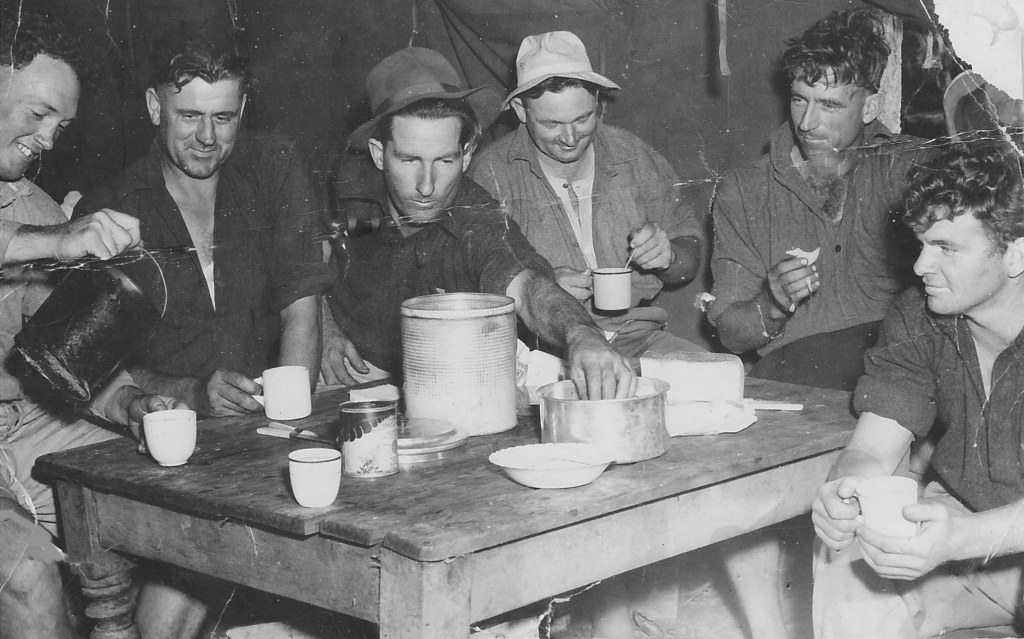
‘Smoko’ at Tamboi
Myall Prawn Festival 1984 – 1997
An annual Myall Prawn Festival was held at Tea Gardens from 1984 to 1997. The festival was held to promote the prawning industry and also tourism to Tea Gardens and surrounding areas. Each festival was very successful and in the latter years would attract approximately 5000 visitors.
The first festival was organised by a sub-committee of the Myall Waterways Tourist Association and was conducted from Saturday March 3 until Saturday March 10, 1984. The plans for the first festival included a world championship prawn eating competition to be entered in the Guiness Book of Records. The competition was to be followed by a dance at night at which there would be the crowing of the “King Prawn”.
The festival included stalls, carnival rides and a procession of floats from Moira Parade, Hawks Nest along Mungo Brush Road, Kingfisher Avenue and ended along the waterfront at Tea Gardens. The grand parade drew a crowd of 3000 persons.

One of the prawn characters used to promote the prawn festival

Three prawns who participated in the 1993 parade [NOTA, 21 March 1992]

Promotional sign on the singing bridge [NOTA, 1 January 1986]
Hawks Nest/Tea Gardens Boy Scouts march in the Festival parade [NOTA, 1 April 1990]
The last prawn festival was held in March 1997, in which it was reported that 5000 visitors attended. The festival’s events, included parachute demonstrations, speed boat and canoe races, and a myriad of “eating” competitions, including the popular prawn eating championship. NOTA of 18 September 1997, page 1, reported:
‘At the September meeting of the Myall Waterways Chamber of Commerce and Tourism, it was unanimously decided not to hold any more Myall Prawn Festivals. There were several reasons for this, the main one being the inability to find any person willing to take on the position of Chairman of the Festival Committee. Over the last few years it has become harder and harder to fill this position even with employing a coordinator. It was also felt that Hawks Nest / Tea Gardens has outgrown this type of event.’
Concluding Comments
Commercial prawning is still undertaken in the Port Stephens area on the Myall River and at sea.
A ballot system to allocate prawning positions to licensed fishermen on the Myall River is still used.
Today, the only way to access Tamboi is by river or by the National Parks and Wildlife Walking Track from the Mungo Brush camping area.
Other papers on fishing and oyster operations in Port Stephens are found at the following links on the website:
New South Wales Fish Company First Fish Processing Facility at Nelson Bay
Commercial Fish and Shark Processing at Pindimar
Early History of Game Fishing at Port Stephens
Royal Commission on Fisheries – Evidence Taken at Nelson Bay 1895
Early History of the Oyster Industry at Port Stephens
Adventures of Spero Spathis – A Greek Fisherman at Port Stephens
Chinese Fishermen at Port Stephens
Researched and compiled by Kevin McGuinness
September 2025

 Port Stephens - a history exploration