
Introduction
This paper examines the early history of the gathering and cultivation of oysters at Port Stephens.
The aboriginal Worimi people were the first to gather oysters for food. It is recorded that they generally ate them after having first cooked them in a fire.
The Raymond Terrace Examiner and Lower Hunter and Port Stephens Advertiser of 15 October 1953, page 5, reported:
‘Taken mainly from an account of “The Port Stephens Blacks” by William Scott, published in 1920, “fish were gutted by poking a hole with a finger under the side fin and extracting the entrails through it. Scales were left to come off when the fish was heated in the fire. Oysters were greatly liked but were seldom eaten raw”.’
During the early years, oysters grew profusely all-around Port Stephens. West of Snapper Island (opposite Tanilba Bay), they were very thick below the water and around the shoreline.
The arrival of the Australian Agricultural Company in 1826 in Port Stephens led to a significant diminishing of the oysters throughout Port Stephens with the shells of both living and dead oysters being used extensively for the making of lime for building purposes.
From 1856, oyster beds were cultivated in Port Stephens by oystermen. The Sydney Mail and New South Wales Advertiser of 9 September 1871, page 893, reported that
‘Numerous beds of large extent, has been worked continually for fifteen years (since 1856), and are still in good working condition.’
The provisions of the Fishing Act of 1884 (as amended in 1885) provided for the granting of oyster leases on NSW Crown lands.
A number of oyster leases were subsequently granted in Port Stephens which marked the beginning of an organised cultivation of oysters.
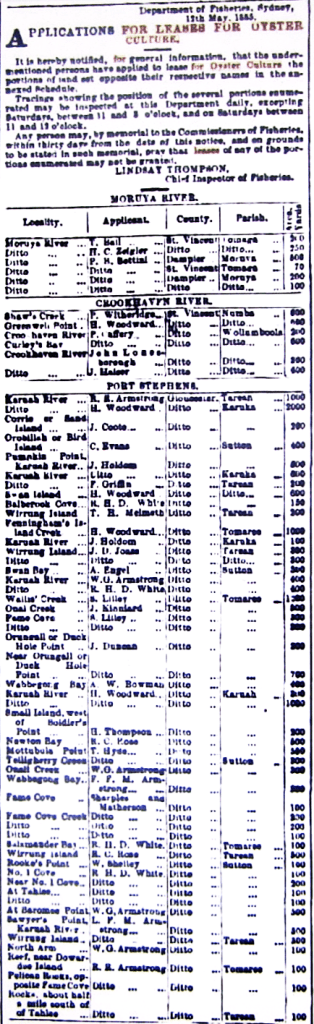
Applications for leases for oyster culture at Port Stephens [Sydney Morning Herald, 12 May 1885]
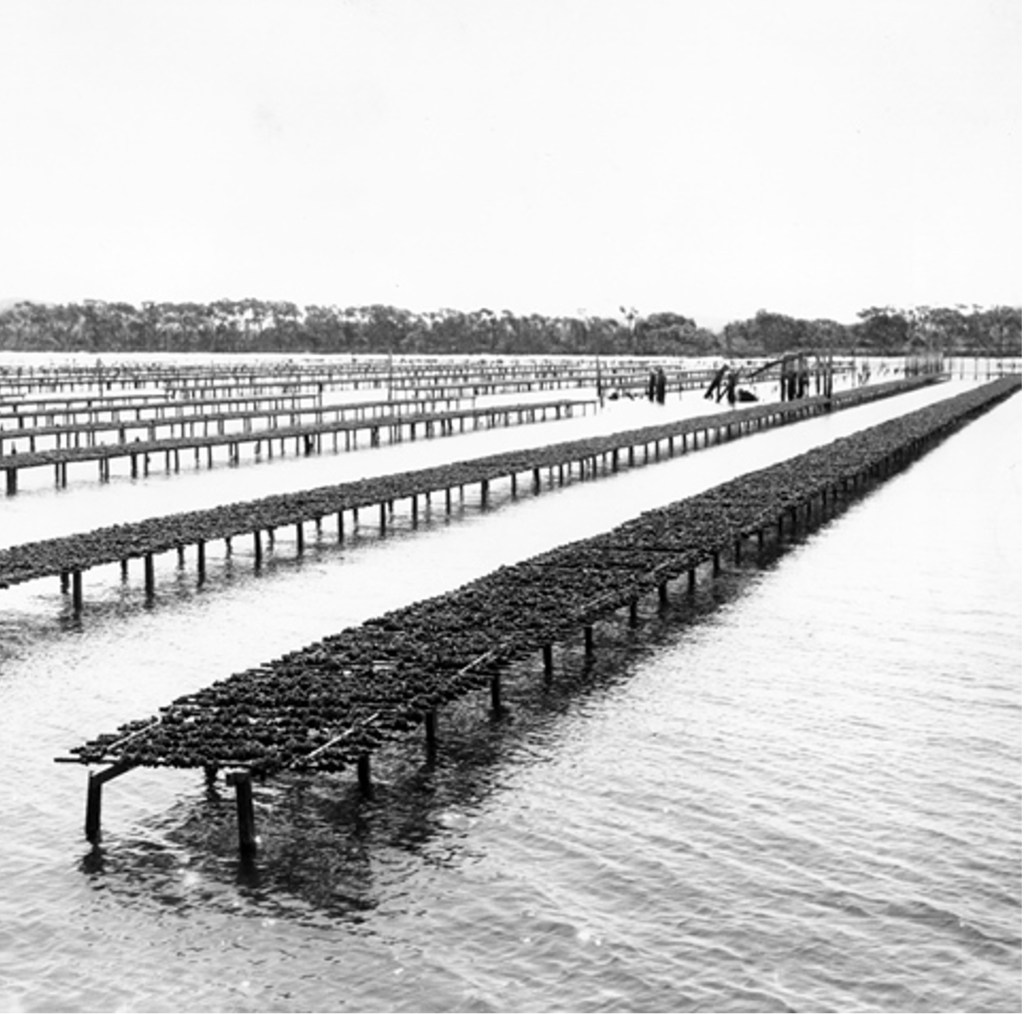
Oystermen cultivated oysters by placing rocks, wood or concrete blocks below the high water level, providing flat surfaces onto which young oysters (known as oyster spat) could attach, allowing them to grow to a mature state.
Port Stephens oystermen developed an improved way of cultivating oysters. After much experimentation, it was found that mangrove sticks, with bark attached, could be pushed into the water and provide an excellent surface onto which oyster spat could easily attach. The use of mangrove sticks was copied by oystermen in other areas. In the 1950’s, a system of using six-foot-long slats covered by tar was utilised.
The oystermen of Port Stephens suffered many hardships, such as the cost of transporting their oysters to market; oyster diseases; exigencies of government regulation; declining markets during the Great Depression, but the most significant of all was the theft of oysters from their leases.
By 1940’s and thereafter, Port Stephens was regarded as the Oyster Capital of Australia. At various times, it had several oyster growers who were regarded as the ‘Kings of Oysters’.
A large percentage of the Port Stephens oysters were sent to Melbourne where they were marketed and/or consumed in oyster saloons.
In recent years, the oyster industry in Port Stephens has been struck by several diseases and other misadventures.
In 1980’s, a non-indigenous fast growing oyster variety known as the Pacific oyster, was introduced into Port Stephens, which threatened the local industry.
In August 2021, QX disease in Sydney Rock Oysters was discovered in oysters in Port Stephens. Over a two-year period, this outbreak decimated the local oyster industry.
With remedial action being taken and the with introduction of new species, oyster cultivation is still carried out in areas of Port Stephens, but it faces many challenges.
The Early History: 1884 -1952
Early History of the Oyster Industry in Port Stephens
The Sydney Morning Herald of 12 April 1884, page 6, published the annual report of the Fisheries Commissioners, and the section on Port Stephens provided the following early history:
‘Port Stephens is exceedingly prolific both in fish and oysters but owing to the difficulty of access not many of the former find their way to Sydney except during the winter months. As an oyster bearing water it is of large value. It was held under the Oyster Beds Act, 1868 by Mr. Peter James for 10 years, at an annual rental of £150, and the yield during that period is said to have been immense.
At present the deep beds are being worked by dredgers, under the supervision of Assistant Inspector Smithers, whom we found it necessary to transfer from Eden, where he had been located, for the purpose. The deep-water beds are situated in the Karuah River. Owing to the rocky nature of the bottom they cannot be dredged clean, so that there is always a supply left for spatting, This spatting, it is believed, takes place in December.
In Port Stephens proper, there are no deep-water beds, but an abundance of shore oysters. They are in season from December to May. Very many applications have been made for oyster culture leases on this water, and, as you will be aware we have recommended that these as well as applications for other waters be granted as soon as possible We know that under the existing law, difficulties surround the issue of these leases but we hope that either by amended legislation or in some other way, these difficulties may be surmounted. We may add that the oyster-beds here are remarkable for the regularity of their seasons. The deep-water oysters are in season when the shore oysters are not, and vice versa.’
The Newcastle Morning Herald and Miners’ Advocate of 21 March 1953, page 5, also reported:
‘The oysters [at Port Stephens] in the early days of the Colony were extra ordinarily prolific. There were thousands of acres of permanently submerged beds, and the flats between tide marks were smothered with oysters. It was stated at the time that all of the bottom west of Snapper Island [located in Port Stephens opposite Tanilba Bay] was one vast oyster bed. But the demands of the lime-burners [of the Australian Agricultural Company based at Carrington, Port Stephens] knew no bounds and as many as 45 boats were engaged dredging the oysters from daylight to dark. Of course, the inevitable happened, and Port Stephens was, by the 1880’s, practically denuded of supplies, once so vast that they appeared to be inexhaustible. …..
What was to be done to restore the industry to a reasonable level of production! Intelligent cultivation alone could supply the answer. This meant laying out sticks, stones, and dead shells to provide surfaces for the young oysters. About 1896 cultivation on these lines began, and the production of oysters has progressively increased till in 1949-50 a record supply of 50,863 bags was marketed. Port Stephens is by far the largest oyster producing water in the State, and during the 10 years from 1940-1 to 1949-50 the supplies from this centre average over 15,000 bags annually. In contrast with this highly satisfactory production, the supplies of the 10 years from 1889 to 1898 averaged only 1142 bags annually.’
Oyster Royalty Penalises Port Stephens Oyster Cultivators – 1887
The Sydney Morning Herald of 15 March 1887, page 8, published a letter from a Port Stephens oysterman, Henry Woodward, who complained about the adverse effect the then oyster royalty, that was payable to the NSW Government, was having on his business:
‘By the ‘Te Anau’ steamer, from New Zealand which is reported as arrived today, there are 30 sacks of oysters which land here free. Tomorrow morning I shall have 30 or more sacks from Port Stephens, upon which I must pay 3s. per sack royalty.
Please permit me by figures to show how this affects our own lessees and the public in favour of those in other colonies: —
Oysters from New Zealand: 30 bags of oysters can be purchased in Auckland at 6s. per bag— £9; freight from Auckland, 2s. 6d. per bag £3 10s.; total cost for 30 bags from New Zealand, £12 10s.
Oysters from Port Stephens: Carriage on 30 bags from Port Stephens to Clarence Town, 2s. per bag £3; freight from Clarence Town to Sydney, 1s. 6d. per bag £1 12s. 6d.; royalty on 30 bags, at 3s. per bag, £4 10s.; cost of 30 sacks, at 6d. each, 15s.; total cost of 30 bags, for expenses only, £9 17s. 6d. Then there is the catching. I pay from 8s. to 20s. per bag— average, 13s. 4d., which, for 30 bags, amounts to £20; total cost for my 30 bags from Port Stephens, £29 17s. 6d.
Total cost of 30 bags from New Zealand, £12 10s,; balance in favour of New Zealand oysters, and against our Port Stephens, £17 7s. 6d.
Besides this royalty charge of 3s. per sack, I paid the Government £113 rent for my Port Stephen leases for last year, 1886. I received 367 bags of oysters during the year off these beds, which makes a further charge over royalty of 6s. 2d. per bag in all, the Government has had 9s. 2d. per sack off the whole 367 bags. It is too much.’

Fish and Oyster Saloon, Newcastle, circa 1900, from where Port Stephens oysters would have been sold [Newcastle Library]
Oyster Reserves proclaimed at Nelson Bay and Salamander Bay – 1901
The Evening News of 11 March 1901, page 7, reported:
‘The Crown lands at Nelson Bay and Salamander Bay, Port Stephens, have been declared public oyster reserves.’
Oyster Leases at Port Stephens set for forfeiture due to unpaid rent – 1905
The Maitland Daily Mercury of 25 October 1905, page 6, reported:
‘Mr. Hogue, the Chief Secretary, stated, in reply to Mr. Bennett, that a large number of oyster leases in the waters of Port Stephens and the Karuah River were liable to forfeiture in consequence of the rent being unpaid. The matter had been placed in the hands of the Crown solicitor with the object of recovering the amounts due.’
Fishermen object to Oyster Leases – 1906
The Sydney Morning Herald of 16 August 1906, page 3, reported:
‘Mr, Frank Furnell presided at a meeting of the Fisheries Board on Tuesday. ….. Objections were received from a number of fishermen at Port Stephens in regard to an oyster lease on a [fish] hauling ground. The board being satisfied that the ground was ….. not required as a hauling area, declined to interfere with the issue of the oyster lease.’
The Evening News of 30 April 1908, page 3, reported on a similar objection that was refused:
‘Objections were made by certain persons representing themselves as fishermen against oyster leases being granted at certain places at Port Stephens, as they were hauling grounds. The [N.S.W. Fisheries] board found they were not hauling grounds, and refused the request.’
Port Stephens Oyster Lessees required to pay Council Rates – 1907
The Clarence and Richmond Examiner of 30 April 1907, page 5, reported:
“The Port Stephens Shire Council, which has many oysters in its borders, has asked the Fisheries Board for particulars of … the names of the [oyster] lessees, and details of the leases, to assist in making the [rate] assessments. The Shire Council was informed by the Public Works Department, which has the central administration by ordinances under the Local Government, that it had the duty of making such assessments. The Fisheries Board decided to furnish the Port Stephens councillors with the names of oyster lessees and the extent of their holdings but declined to furnish a map of the leases, except at the Shire Council’s expense.
The ‘Sydney Morning Herald’ this morning says that it is safe to say that not one oyster lessee in the State, when he submitted his application for a lease ever anticipated that he had to pay a rate upon it under the Local Government Act. A lessee cannot erect a wharf or boatshed without paying another license, and he cannot prevent the public from going on his lease so long as there is no disturbance of the bivalves by the intruders. Under these circumstances, the assessable value of many leases must be very slight. The Fisheries Board in one sense is the owner of all leases, as the Board receives rent for them.’
Old Method of Oyster Cultivation – 1907
The Sunday Times of 26 May 1907, page 1, reported:
‘The casual visitor to Sydney will marvel at the number of oyster saloons in the city. They thrive in every street….. Here the succulent bivalve forms by far the most popular item on the menu, and all day long — and at night too — adept hands behind the counter open the shells and fill the plates; while from the kitchen below, when orders for the soup are given, comes the echoing cry of “Oys-ter-r-r !” as an accompaniment to the cracking of shells in the shop above. It would be safe to say that Sydney people are by far the largest consumers of oysters in the Commonwealth; and the fact that no less than 14,000 bags are placed on the market every year will indicate the extent to which the oyster industry has attained — for industry it is, and a very profitable one, too.
An oyster bed is about the most valuable portion of a foreshore lease, should the lessee have taken steps to cultivate his “ground” in the proper manner to keep up the supply. The value of the output varies according to the class and size of the oyster. The best command a price of £2 12s 6d per bag to the grower, while the average would be about £1 15/. In addition to the home consumption, Melbourne supplies an additional outlet. A large quantity of oysters is exported to the Victorian capital, where there is a regular demand at remunerative prices; and in the dead of night the rattle of a stick in a kerosene tin, and the shrill cry of “Sydney rock oyster-r-rs,” which betoken the oysterman on his rounds, are familiar sounds.
In the wintertime, too, when oysters carry well, large consignments are forwarded to the Sydney market from Brisbane. In that season from Stewart Island, New Zealand, also come fair supplies.
The majority of the oysters consumed in Sydney, however, are grown in the State. These come from Camden Haven, Evans River, Bellinger River, Manning River, Cape Hawke, Port Stephens, and Richmond River to the North; George’s River, Crookhaven River, Clyde River, Wagonga River, and Pambula River to the South. These waters give the greatest output of oysters; but from all intermediate rivers, inlets, and creeks, from the Southern to the Northern boundaries of the State, oysters are produced in varying qualities.
That the possibilities of oyster culture as a profitable industry are largely recognised is demonstrated by the fact that the number of lessees of oyster-bearing grounds totals close upon 400, the areas held comprising 404,064 yards of foreshore leases, while the deep-water areas are about 27 acres. First of all, it may be mentioned that no person may hold less than 500 yards of leased area. Leases may be acquired on application to the Fisheries Department, the cost being £1 per year per 100 yards of foreshore, for a term of 15 years, with the right of renewal. Inferior lands may be obtained at reduced rentals, leases for these areas being limited to five years, with the right of renewal and on certain conditions. In addition to the rental, a “deed fee” of £1, and stamp duty of 2s 6d are chargeable on all leases.
Special areas may be leased by tender, or disposed of at auction. It is interesting to know that picnic parties who are seized with an insatiable desire for oysters may assuage their appetite without any cost on Crown lands which are not under lease. The oysters, however, must be eaten on the spot, for, to indulge in the propensities of the small boy at a party and bear away quantities is to incur the displeasure of the law and a substantial penalty; for it is set down that “no oysters may be carried away in bags or other receptacles.” As oysters “may be eaten on the spot,” perhaps the word ”external” might be advantageously added before “receptacles.” There are various “public oyster reserves” proclaimed in suitable localities for the benefit of the people generally, and these are exempt from the power of leasing. …..
At this stage the query naturally suggests itself from the business point of view. What are the returns derivable from an oyster lease? Is it worthwhile to take up a lease and go in for oyster culture? The answer, however, depends upon two conditions — the lease itself and the person who controls It. In the first place the return from an oyster area depends on the manner in which it is stocked, for while on some grounds a bag may be collected off a few yards, in others only a few oysters would be obtained from an equal area. The fact is that the lessee who cultivates his “crop” to the best advantage will produce the most oysters from the smaller area.
It is a mistake to imagine that nothing further is required than to gather the oysters and forward them to market. They must be “cultivated” and “raised” just as a farmer will cultivate and raise his crop. But for those who are disposed to do no more than to denude their lease of the oysters and acquire another, there is a section of the Fisheries Act which says: ‘If a lessee does not, with in a period of one year from the date of his lease, take proper measures to cultivate the leased-area, or does so strip the area of oysters, or otherwise mismanage it as to threaten partial or total destruction as an oyster-bearing area, he is liable to have his lease cancelled.’ …..
For oysters attach themselves readily to anything which fulfils their requirements, in these respects, and in the office of the Fisheries Department may be seen the shells of oysters (or photographs of them) attached even to bottles, dinner plates, and old boots, which had been cast into the water on the oyster grounds. ….. The most effective method is to lay-out on flats a plentiful supply of such like material at about half-tide mark at the period of the year when a fall of spat is about to occur; and at the same period in the following year to remove the material with the attached oysters to low-water mark, replacing the spat-collecting objects at half-tide mark.
In the third year the oysters are to be shifted at low tide further out to where they are always covered, and those at half-tide to low-water mark, fresh spat-catching material being relaid at half-tide mark. At the end of the third year the three-year-old oysters are ready for market. If this system is followed, the lessee is always able to gauge approximately each year what his output will be, while at the same time he does not overtax or denude his areas. The method outlined here is carried out with great success by various lessees, who also transplant, to the cool water of the fattening grounds, young oysters collected on the spat-catching areas. Here the conditions are more suitable to the rapid growth and improvement of the oyster. It will thus be seen that in oyster culture everything is not left to Nature.
The result of carrying out this system on regular and methodical lines is that the oyster industry has been given a great impetus, while the supply has been enormously increased. Indeed, it is estimated that fifty times more oysters are now available than before the passing of the regulations which precluded the devastation or denuding of oyster grounds by rapacious lessees, who, so to speak, do not leave for tomorrow the oysters they can gather today. In conclusion, there may be mentioned a fact about the familiar oyster which is all the more interesting because it is not generally known.’
Grievances of Port Stephens Oystermen – 1907
The Newcastle Morning Herald and Miners’ Advocate of 17 June 1907, page 6, reported:
‘Mr. F. Farnell, chairman of the New South Wales Fisheries Board, accompanied by Mr. W. Bennett, M.P., visited Nelson’s Bay on Friday to inquire into grievances of fishermen and oyster lessees. A deputation representing Tea Gardens, Karuah, Tellegherry, and Nelson Bay waited upon Mr. Farnell, and placed the following matters before him:—Better security in the renewal of oyster leases; that, when part of an oyster lease resumed by the Crown, the lessee be compensated for improvements; lessees to have the right to prosecute any person for stealing oysters or trespassing without waiting to obtain the consent of the Fisheries Board to do so.
It was pointed out that persons now defiantly go upon leases and steal oysters, and before permission could be obtained from the board to prosecute, the offenders left in outgoing vessels. Complaint was also made of the action of the shire council in taxing the leases. Mr. Farnell promised to give favourable considerable to the requests, and said, where practicable, he would incorporate portions in the proposed Amending Fisheries Bill. He explained the position of the board and expressed his personal anxiety to do what he could to encourage the development of the fisheries industry. The rich harvests of the ocean were yet ungarnered, he said.’
Oystermen dissatisfied with Port Stephens Shire Council Rate Notices – 1907
The Dungog Chronicle of 22 November 1907, page 8, reported:
‘There is much ferment among Port Stephens oyster lessees over the shire rate notices. A mass meeting of all Port Stephens oystermen was held at Soldier’s Point last Friday, and it was decided to obtain the opinion of a leading Sydney barrister on the legality or otherwise of the shire’s demands. The shire chiefly concerned is the Port Stephens Shire, the Council of which has rated the lessees at the rate of 1s 8d per 100 yards, and has treated each lease separately, so that where a man has, say, three leases of 100 yds each, he has to pay the minimum rate of half-a-crown on each.
Much surprise has also been caused by the action of the Port Stephens Shire Council in claiming rates from leases which are situated on the northern shores of the port, and on the eastern bank of the Karuah, which it is thought are under the jurisdiction of the Stroud Shire. The greediness of that Council reads ill alongside its reply to the Karuah Progress Association when that body asked it to place conveniences for the oystermen on the Karuah wharf. The Council said it was not prepared to do so unless it levied a local rate to cover cost and maintenance. Mr. R. A. Price is to introduce a deputation of oystermen to the Minister during next week.’
Consideration of Petition by Port Stephens Oystermen deferred – 1908
The Daily Telegraph of 13 March 1908, page 11, reported:
‘A petition signed by a number of oyster growers at Port Stephens, urging the amendment of the Fisheries Act with regard to oyster culture, and the leasing of oyster-bearing areas, was deferred for consideration to the forthcoming Fisheries’ Conference.’
The petition sought:—(1) When any part or the whole of an oyster lease has been resumed by the Government for any purpose whatever, the lessee shall be paid reasonable compensation for his improvements thereon; (2) that a lessee shall have the right to prosecute any person for stealing or trespass without having first obtained the consent of the Board of Fisheries; (3) that any person found in possession of oysters reasonably supposed to have been stolen should be compelled to show his bona fides; (4) that the right of renewal of lessees should be secured; (5) that a lessee who pays rent and taxes should have the same rights and privileges as any other landholders against trespassers; (6) that ten-years leases should be renewable with the same right and privileges as the fifteen-years leases.’
Proposed Study of Oyster Cultivation at Karuah Public School – 1912
The Raymond Terrace Examiner and Lower Hunter and Port Stephens Advertiser of 21 June 1912, page 3, reported:
‘The question of the establishment of an experimental plot for oyster culture in connection with Karuah public school having been mooted, the practicability of the scheme is at present being inquired into. Mr. Brodie, Chief Inspector of Fisheries, while on his usual round of inspection of the waters of the Port, took occasion to visit Karuah during the week to view the proposed site and discuss matters with the teacher. The idea is one that should meet with the warmest approval and support of local residents as providing an interesting and instructive study for a section of the pupils which should prove of great practical benefit to them in their adult careers.
It is proposed to conduct a series of experiments in the various methods of catching oyster-spat, laying out and handling of beds, with a view to the production of a well-shaped marketable oyster, and the minimisation of loss in gathering same. The study of the life history and habits of this popular representative of the shellfish family should also prove of abiding interest to the maturer pupils. The boom in the oyster industry still continues.’
The Dungog Chronicle of 28 June 1912, page 4, also reported:
‘The Fisheries Department is considering the question of establishing an experimental oyster culture farm on the shores of Port Stephens, somewhere in the vicinity of Karuah. The spat will he collected, and the various form of culture conducted under the supervision of experts.’
Report on Port Stephens Oyster Industry – 1913
The Sun of 30 September 1913, page 6, reported:
‘Not far from Middle Island in the upper harbor of Port Stephens is a structure which seems on first sight to be a fowl-run. The fact that it is right out in the water, and is not connected with the land, makes one alter one’s first idea, and suppose instead that it is an experimental farm for the culture of sea-gulls. There is a wide enclosure composed of stakes set close together, and in the middle is a small house built of galvanised iron and held above the water on spindly piles. It is an oyster lease.
Oyster growing is one of the important industries of Port Stephens. Over forty miles of the foreshores of the harbour, pegged out and held under such leases issued by the Fisheries Department. But the most remarkable lease is that near Middle Island. It Is really situated on a sandbank, and the water is only a couple of feet deep, but of course it seems just as deep in that part as in any other part of the harbor. The stakes are pieces of mangrove stuck in the sand for the oysters to grow upon, and the little house is not a permanent home, but a temporary shelter for the oystermen when they go to gather their crop.
In addition to the forty miles of actual oyster leases there are over twelve miles of special leases, which may be described as preparatory schools for oysters. Oysters— one refrains resolutely from calling them, succulent bivalves, although the temptation is great in order to avoid repetition — take about three years to grow. They begin as “spat,” which might be described as oyster seed, and which is produced by grown-up oysters which have attained to years of discretion, and are able to support themselves, even if it is only upon a piece of mangrove bark. The spat floats about in the water and settles wherever it finds something hard and clean, like a piece of wood or a stone, and grows there until in the fulness of time it is sold for a penny, and a halfpenny in a Greek oyster shop in Sydney. (Incidentally one may mention that the oystermen of Port Stephens complain that their trade is not very profitable at the present time owing to the poor prices which they are paid by the Sydney buyers. Some have tried sending their oysters to Melbourne, and, in spite of the extra freight, are making larger profits.)
There are some parts of the harbour which grow oysters better than other parts, while those leases which do not grow oysters to their fullest size are useful for propagating them and growing them to a certain size, when they may be removed to other places where presumably the food is better. On the twelve miles of special leases oysters are brought to a stage of adolescence, and they are then removed to the forty miles of leases to mature. Nearly all the oysters of Port Stephens are grown on mangrove stakes. These are about four feet long, and are stuck into the sand along the foreshores about six inches apart. They are “planted” in rows just as one plants cabbages. The oysters fix themselves to the stakes. One oyster will give off enough spat to make a million oysters, but of course the greater part of this is lost. It is carried away by the tide, and the small fish of the sea devour it. But some falls on good oyster ground, and if there are plenty of fresh stakes lying about to which it can cling it will develop into robust oysters which will in time yield a million-fold.
An oyster lease covers 100 yards, but the distance outward from the shore varies. The annual rent is £1 per 100 yards, and this brings a revenue to the Government of £700 a year. The rentals on the special leases are worth £200 a year. If a man attends to his lease carefully and works it so as to have a continuous succession of matured oysters, a lease should be worth to him £1 a week; and one man can work ten leases —if he has them— with little trouble. The oysters are collected by the oysterman going round in a boat, pulling up the stakes, stripping the matured oysters from them, and then thrusting the stakes back into the sand. The gathered oysters are put in bags and are shipped on the Newcastle and Hunter River Company’s steamer ‘Karuah‘ for Sydney. They are merely placed in a cool place on the vessel, as oysters will keep for a fortnight, or even three weeks, without becoming unfit to eat. The oyster leases of Port Stephens are held by 273 men.’
Port Stephens Meeting on the Oyster Trade – 1914
The Sydney Morning Herald of 28 January 1914, page 11, reported:
‘A large and representative meeting of Oyster lessees was held here [at Nelson Bay] on Saturday evening to discuss the supposed glut in the oyster market. It was unanimously decided that the glut was caused by inefficient means of distribution. It was proposed to establish a strong co-operative company, whose members will be able to market approximately 3000 bags of oysters annually. Special attention is to be given to means of distribution.’
The Daily Telegraph of 18 February 1914, page 8, further reported:
‘Complaints have been received by the Chief Secretary’s Department from oyster lessees, particularly those at Port Stephens, as to their inability to find a satisfactory market for the produce of their leases. It is alleged that with some lessees the practice exists of marketing oysters that have barely reached marketable size. The department states that for such oysters, of course, there is little demand, though undoubtedly a good market exists for all good marketable oysters of suitable size, without regard to the source of supply.’
Port Stephens Oyster Lessees organise a Deputation to Minister – 1917
The Dungog Chronicle of 17 August 1917, page 3, reported:
‘Last week a deputation of oyster lessees from various parts of the State waited on the Acting-Premier, Mr Fuller, to ask redress of grievances under which they labour. Mr Ley, M.L.A., introduced the Hon. W. Bennett, and Messrs G. S. Briner, W. A. Zuill, M’s.L.A. Mr S. A. Wood represented the Port Stephens Oyster Lessees Association.
The most important request was for the right of renewal of leases by lessees in possession, with re-appraisement of rentals. It was pointed out that the law at present provided that at the termination of leases, they became the property of the Crown, together with all improvements. They were put up by tender or auction and the lessee was compelled, if he wished to retain the lease, to purchase back his own improvements. This condition of affairs prevented capital being invested in the industry and oyster culture developed as it should be. The feeling of insecurity existing sapped the enterprise of lessees and had a detrimental effect.
The Minister, after much questioning, said that it was the policy of the National Party to encourage and protect primary industries, and he would lay it down as the policy of the Department that oyster lessees, who complied with regulations, should have the right of renewal of their leases, subject to the right of re-appraisement. The deputation urged that this principle be embodied in the Fisheries Act, but the Minister thought it was unnecessary. He made a note of one or two instances where lessees had been victimised by being compelled to re-purchase their leases at an exorbitant figure with a view of redress.
Regarding inaccurate surveys, Mr Fuller said that lessees should be entitled to acquire any excess areas at the usual rental. He refused to allow compensation for disturbance of a lease, by the erection of small jetties or boat houses, but said that lessees should be allowed time to remove their improvements and given compensating area if available.
In the case of the erection of wharves under special lease tenure (as instanced by Mr Wood [of Port Stephens]) he said provision would be made by the Department to protect the oyster lessee from damage to improvements. The request to abolish confiscation of oysters in bags containing under sized oysters, as well as prosecution, was met with a direct negative. The Minister was emphatic that small oysters should not be allowed to be marketed.’
The Newcastle Morning Herald and Miners’ Advocate of 20 March 1925, page 5, finally reported:
‘Mr. C. W. Oakes, the Chief Secretary, who is also Minister Controlling State Fisheries, referred today to a published statement in which grievances were set forth relating to the non-renewal on the tenure of oyster culture leases at the expiration of a period of thirty years. “There appears to be some misapprehension existing in this regard,” said Mr. Oakes. “The cases in which leases are put up for tender or auction, when the original term of 15 years, and renewal term of 15 years have both expired, are rare, relating as they do to a class of lease known as “special lands,” which, having been acquired by open competition—not by ordinary application—must at the expiration of their terms be re-acquired by competitive tendering. Even in such cases as these the law provides that the Minister may cause the new lessee to pay the cost of the improvements made on the area, and refund their value to the outgoing lessee, if his tender for a re-lease is unsuccessful. The majority of leases, however, carry no such conditions, and the lessee is given preferent right of re-application for the expiring lease for two further terms of 15 years, making an aggregate term of 60 years. A draft “Fisheries Bill,” the Minister added. “is now in course of preparation, and in addition to many other phases, which it is hoped will advance the fishing industry generally, special attention will be given to increasing the security of tenure of oyster culture leases.”
Proposed granting of Oyster Leases at Port Stephens to Returned Soldiers – 1918
The Raymond Terrace Examiner and Lower Hunter and Port Stephens Advertiser of 11 October 1918, page 3, reported:
‘The local Repatriation sub-committee have made representations to the Fisheries Department, with a view to having portion of the foreshores of Port Stephens set apart as oyster leases for returned soldiers. As the majority of the boys who have gone to the front from this district, have had experience in oyster culture, it is considered that it is only justice that they should have the opportunity of securing leases in their native Port on their return.’
The Dungog Chronicle of 25 October 1918, page 7, further reported:
‘Hon. Walter Bennett has received the following [letter] from the Chief Secretary: — Regarding establishment of returned soldiers in oyster culture industry at Port Stephens. In reply to your representations in relation to the request of the Nelson’s Bay Branch of the Port Stephens’ Repatriation Committee, that a portion of the foreshores of Port Stephens should be reserved for settling returned soldiers from that district in the oyster culture industry, I have to state that this Department is affording every facility to returned soldiers in establishing them in the industry; and if any suitable area be brought under the notice of the Department consideration will be given to the question of reserving it for returned men from Port Stephens district.’
Meeting of the newly formed Port Stephens Oyster Lessees’ Association – 1920
The Newcastle Morning Herald and Miners’ Advocate of 16 March 1920, page 5, reported:
‘A general meeting of the Oyster Lessees’ Association of Port Stephens was held at Bundabah, Port Stephens, on Saturday. The balance-sheet was presented and adopted. The secretary’s report, which was read and received, said it was gratifying to the members to know that all the association had started out to do had, been accomplished. The secretary drew attention to the various points gained, and concessions granted by the Minister, all of which were due to the association’s activities, and expressed the hope that the cooperation that marked the first year’s efforts would continue.
He deplored the fact that there were probably a dozen lessees who, were either too self-interested, or else unable to comprehend the advantage of co-operation, and who had failed to enrol or pay their subscription, but were all the same eager to take advantage of the concessions recently secured by the association, but at the same time pointed out that the members’ roll numbered 53, while the total number of lessees in the port was about 70.
A petition was prepared, protesting against the proposed alteration in the administration of the Fisheries Department, the proposed appointment being viewed with much disapproval. During the past year the method of conducting the business of the association by the meeting of members at North Arm had proved unsatisfactory, and it was decided that local bodies be formed at Tea Gardens, Nelson’s Bay, and Karuah, which branches are to be responsible to the central or controlling committee, whom, in turn, will be composed of two delegates from each branch, and a general secretary. It is hoped that by this rearrangement better teamwork will result.
Another matter dealt with was the creation of a special fund for the purpose of paying a reward to any person laying information against any person stealing oysters from any member’s leases. It is expected that the fund will be about £30 for a beginning.’
Storms damage oysters at Port Stephens – 1921
The Dungog Chronicle of 23 September 1921, page 2, reported:
‘Serious damage was done here by the storms of July last. Messrs H. Woodward and Co lost over £5000 in Karuah River. The Commonwealth Proprietary lost approximately £300, sundry others up to £100 each.’
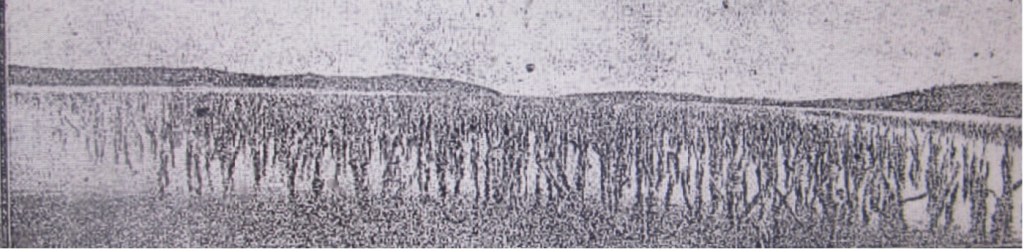
Oyster stakes at Port Stephens [Sunday Times, 18 December 1921]
Shares in a Port Stephens oyster firm offered to investors – 1923
The Smith’s Weekly of 14 July 1923, page 3, reported:
‘George Peter Engel ….. invites those with a little surplus cash to come in with him and share 20 per cent. profits on the cash invested. The whole thing is simple. All one needs to do is to go to the bank, draw out, say, £100, and buy shares in his oyster company. The investor may double his capital in five years. The G. P. Engel Oyster Coy. Ltd. says so in a prospectus for “private circulation only.” “Without any doubt,” says Mr. R. O. White, secretary of the company, in a letter to prospective investors, “this company from the inception should pay 20 per cent. dividends.” The company’s capital is nominally £15,000, and the provisional directors reserve the right to go to registration as soon as 7000 shares are applied for.
“As the prospectus would lead one to believe,” modestly says Mr. White, “I myself do not think that any more money beyond the application and allotment amounts will be called up.” Of course, in the final analysis, it all depends upon the oyster. He is of the Port Stephens variety, which has a vogue in Australia.
In consideration for plant, and 42 leases at Port Stephens, Engel is to receive £6500 cash and £2000 worth of fully paid-up shares. Assuming that the company goes to registration on a £7000 capital, this would bring in £3500 application and allotment money. Engel’s payments are to be made in this manner: £3500 on flotation of company and three sums of £1000 each on each succeeding six months. So Engel would take the whole of the cash subscribed, and if no further calls were made, the vendor would be sitting on the doorstep waiting until sufficient extra shares were sold to collect his £1000 each six months, unless profits were realised rapidly.’
Meeting of the Oystermen of Nelson Bay – 1923
The Newcastle Morning Herald and Miners’ Advocate of 16 October 1923, page 5, reported:
‘A well-attended meeting of the oystermen of Nelson’s Bay was held on Saturday evening last, Mr. W. Thompson presiding. It was decided to protest against the proposed change in the size of oyster bags from 25in x 41in to 26½in x 42in bag. The smaller bag holds the regulation quantity of oysters – six kerosene tins – and the new bag, unless folded in, will not allow the oysters to travel so well. It was decided to write to the other centres around Port Stephens and hold a meeting of the oystermen of the whole port at Karuah, on Sunday next.’
The Dungog Chronicle of 13 November 1923, page 2, also reported:
‘A deputation from the Pindimar-Port Stephens districts waited on Mr. Oakes, Chief Secretary, on Thursday concerning the present standard size of oyster bays. The deputation stated that, as oysters from their district were packed dry, many more were contained in the standard bag than were provided by sellers who bagged them wet. They asked that provision be made for the use of a smaller bag for their oysters, and that permission be given for sale in less quantities than three bushels. Mr. Oakes said that he would allow time for representations by other interested bodies, and would then confer with the officer in charge of fisheries with regard to the matter.’
Photos of Oyster Culture at Port Stephens
The Sydney Mail of 6 February 1924, page 24, reported:
‘The magnificent harbour of Port Stephens is attracting considerable commercial attention owing to its deep water and vast anchorages and is destined to play an important part in the overseas commerce of Australia. One industry which is now in full swing there is the culture of oysters. A correspondent, who recently visited the locality, in forwarding to the “Mail” these very interesting photographs [see below], writes: — “One little thinks, when seated before a plate of oysters, how the culture of this popular shellfish has during the last few years been developed until a most profitable industry has evolved, and that the advance has made it possible for thousands of people to exist happily on the returns made from the sales.
It has been my privilege, through the courtesy of officers of the Pindimar City Company, Ltd., which has acquired a vast area of the valuable foreshores of Port Stephens with the idea of making a new and model city, to visit its huge leases and ascertain some facts in connection with the scientific methods employed. The general manager (Mr. Fred Phillips) found time to initiate me into some of the mysteries.
I discovered several British army officers who have migrated to our shores busily occupied in arranging their catchment areas, amongst their number being a retired general. They were all in “shorts, happy and prosperous, working together. A cinema expert from Australian Films, Ltd., was operating with his camera and collecting interesting data to broadcast by means of the “movies” to the general public. The accompanying pictures [as displayed below] will give a comprehensive idea of what work is entailed in producing a marketable oyster.’
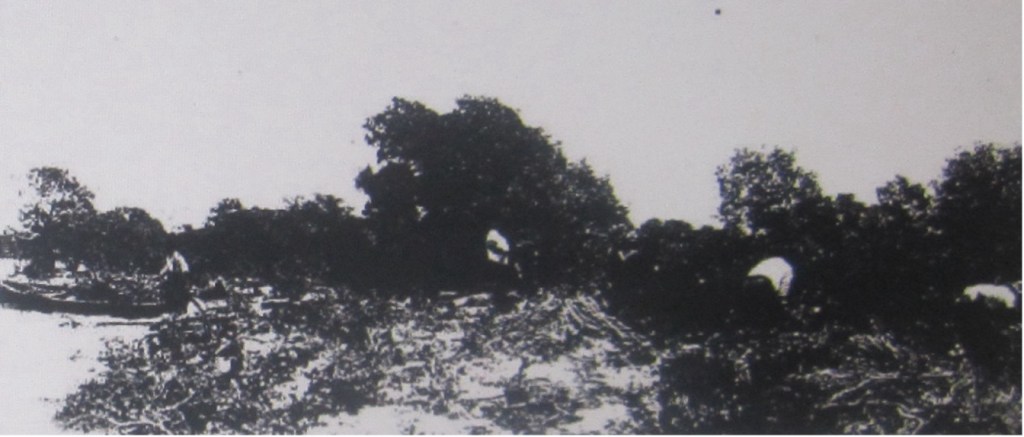
Mangrove sticks being cut and carried out to where punts can collect them.
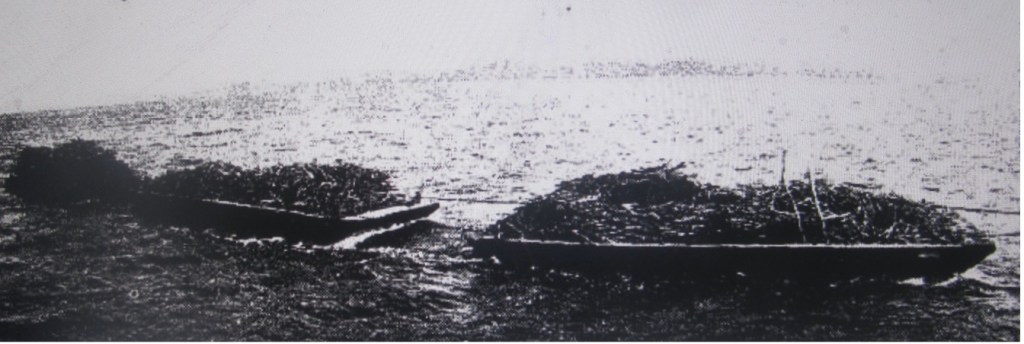
Punts loaded with mangrove sticks being conveyed to oyster leases.
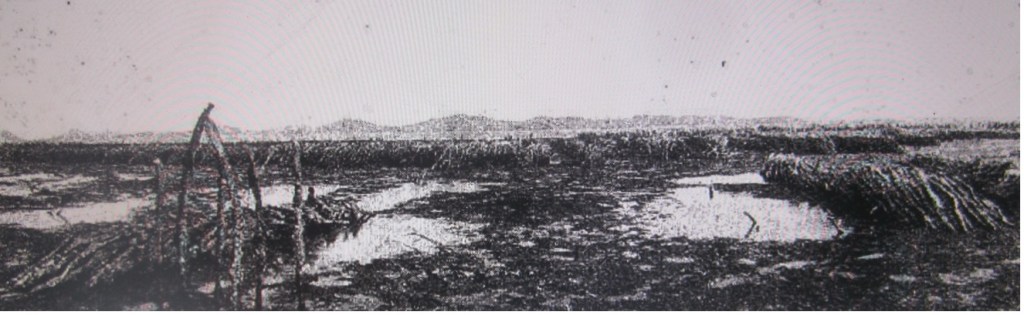
Grouping of oyster sticks, so as to protect the young spat from the heat of the sun and from strong cold winds and also from fish, who are very fond of the young spawn. The sticks standing up were drawn from the clumps, and show young oyster spat 15 months old, and ready to be moved to maturing leases. Over 250,000 sticks are on this lease.
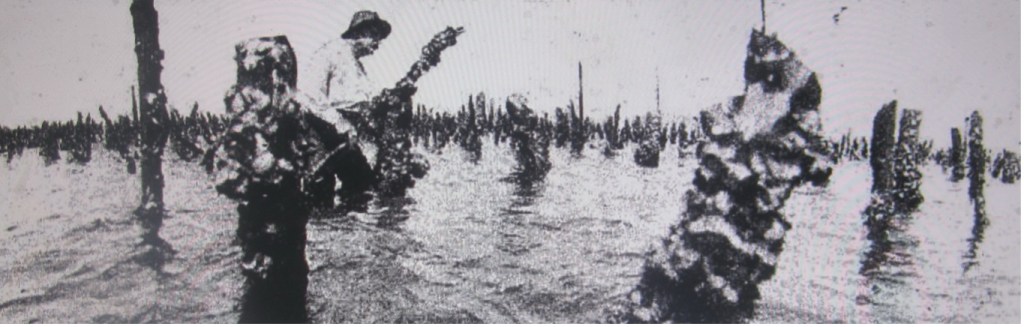
Parent oysters on the same lease. They are kept on permanent heavy swamp oak posts close to the grouped mangrove sticks, to ensure a good supply of spawn on the lease. One parent oyster can give off over 2,000,000 young per year, but great quantities are lost through not finding a suitable lodging-place on a clean surface and by being eaten by small fish.

Maturing grounds, with stakes set upright 18 to 24 inches apart, allowing plenty of water and food to surround each stick. Oysters are strictly vegetarians; their vegetable food is conveyed to them by the tides that rush past them.
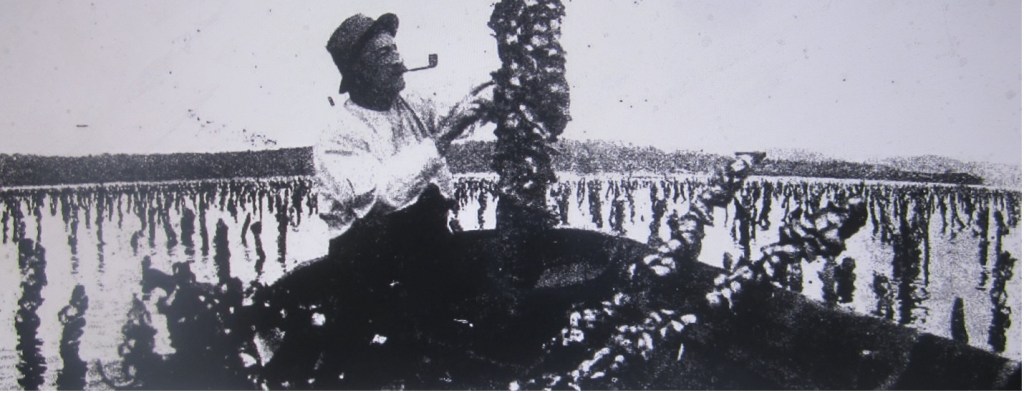
The harvest of oysters three years old ready for market.

Sticks taken from oyster beds on to punts. Hammers are used to knock the sticks. The oysters fall off and are then culled or separated one from another. The standard size for a marketable oyster is that it must not pass through a l½ in ring. One punt shows marketable oysters on sticks. On the large punt men are culling or dividing the oysters, boxes being filled with marketable ones, which are put on trays or racks in the water and kept there until the day before shipping. The smallest punt shows the waste sticks.

Spat or under-sized oysters, ready to be thrown back into the water on a stony bottom. They are left there for 18 months, then dredged up again and marketed. In other cases, they are put on trays or wire racks a foot above the mud bottom.
Port Stephens Oyster Growers raise grievances – 1924
The Newcastle Morning Herald and Miners’ Advocate of 16 February 1924, page6, reported:
‘At a meeting of oyster lessees, held at Pindimar, it was decided to form an association, to be known as the Port Stephens Oyster Lessees Association, for the protection of the interests of those engaged is the industry. Strong exception was taken to the action of Mr. Oakes, the Chief Secretary, in regard to the recent regulation affecting the size of oyster bags.’
Meeting of the Oystermen of Nelson Bay – 1924
The Daily Telegraph of 4 September 1924, page 9, reported:
‘At a conference of oyster lessees of the State, held at Bundabah, Port Stephens, under the auspices of the Port Stephens Oyster Lessees’ Association, the following oyster culture centres were represented: George’s River, Port Stephens, Hawkesbury River, Hunter River, and South Coast.
It was decided to form a New South Wales Oyster Lessees’ Association, with Mr. W. Thompson (Port Stephens) as president, and Mr. E. M. Robinson (Port Stephens), as honorary secretary. Resolutions were passed that thieving penalties, as enumerated in section 48 of the Fisheries Regulations, should be doubled, and that any licensed fishermen, so convicted, should have their licenses withdrawn, and that the present permits be so altered that oyster lessees be enabled to obtain loans on their leases and improvements. The secretary was instructed to write to the Minister for Customs, asking that a tax should be imposed to prevent the importation of oysters into Australia, whether canned or not.’
Shipping Mangrove Sticks – a new industry – 1924
The Dungog Chronicle of 31 October 1924, page 5, reported:
‘A new industry has commenced on the tributaries of the Lower Macleay —cutting black mangrove sticks, each about 3 ft 6in long, for shipment to Port Stephens, where they will be used for oyster spat catching. The black mangrove is the most favoured wood for this work, for after being in the water for a year or so the bark breaks away freely. Some 14 men are engaged in the work, under the supervision of Mr. J. G. Latta, inspector of fisheries, Port Macquarie.
These sticks are tied in bundles and put down where the spawn is discharged. After about six months the bundles are separated and the sticks are put out perpendicularly some 10 inches apart, where the tide can rise above them at high water. Then after about two or 2½ years the majority of the oysters are ready for market. Those not so far advanced are placed on wire netting trays and left in the water until they are ready for market. Capt. Ellery is using wire netting trays on his beds.
It is said that with a good flow of spawn sufficient spat is caught from 30 or 40 sticks to fill a bag worth on the market today about £4/5/. The steamer Jap has been chartered by the Port Stephens oyster companies to take away the first load of some 200,000 sticks, which were ready last weekend. Providing the costs of freight and cutting are reasonable it is expected that some 10 shiploads will be required.’
New Oyster Marketing Scheme at Port Stephens – 1925
The Newcastle Sun of 21 February 1925, page 1, reported:
‘Port Stephens oyster culturists are initiating a system whereby supplies will be conveyed to all the districts in the hinterland of Newcastle, providing that the Railway Department rises to the occasion by providing reasonable freight rates.
The oyster cultivators of Port Stephens have a grievance. First of all, they contend that a commission of 10 per cent for selling is excessive. On the average bag, they say, they pay approximately 30s in charges. A good bag will bring from £5 to £5 5s at Melbourne, where practically all the supplies from Port Stephens are despatched. When it is taken into consideration that Port Stephens has 200 miles of foreshore under oyster cultivation, giving employment at times to as many as 500 men, it will be readily conceded that the industry is of importance to the district. Last year’s report of the State Fisheries Department stated that 8500 bags of oysters were consigned from Port Stephens.
The recent maritime dispute placed the industry at considerable disadvantage. The oyster traders had to pay railage from Sydney to Melbourne in order to dispose of their output without undue delay. As the department has charged no less than 15s a bag for freight, the trade has been severely handicapped.
Charges in all have approximated 30s, which, it is submitted, is extortionate. The success of the new scheme for the country districts must necessarily depend to a very large extent on the railway department. If what is considered a fair rate is charged, the oysters will be conveyed in tins to inland customers in large quantities. Growers have been considering the scheme for some time, and it is now hoped to make it a big cooperative venture.
Among the oyster culturists at Port Stephens is a band of Imperial and Australian army officers. At their head until recently has been General Lee [George Leonard Lee]. A change in management, however, was undertaken within the last few weeks, and the General has relinquished his position. The officers are particularly keen on their life in the open, and hope that their scheme of unity and concentrated effort in peace, as well as in the days of war, will meet with the success it deserves.

Lieutenant General George Leonard Lee [Virtual War Memorial]
The cultivation of the oyster is an absorbing study. The Port Stephen’s method is that known as “stick culture.” Large stocks of black mangrove trees are placed in suitable areas where the water is fresh and clear. It is to these that the spawn attaches itself, and breeding grounds formed. Formation takes place in clusters of from 50 to 100 each. Packed closely together, protection is afforded from the sun, and the oyster’s natural enemies in the fish kingdom. Subsequently they are removed, mangrove sticks and all as winter approaches, to the maturing grounds. In some instances, the latter are from 10 to 15 miles away. Here they are left for about three years to fully mature. The matured oysters are then collected by punts, and removed from the sticks for culling purposes.
The next stage is the market. The oyster farmer is as keen after his return as the agriculturist. The life is an attractive one, particularly in good weather, but is by no means easy. Strict attention has to be given to the beds. They are watched and guarded just as tenderly, or even more so, than the field crops. The growers move among them by boats, watching their preserves with assiduous care. Port Stephens is assuredly the home of the oyster.
The steamer to Tea Gardens takes visitors through acres of them, as it makes its way down the Tilligerry Creek from Salt Ash, and thence from Pindimar up the river to the township. In all directions can be seen the work of the cultivator, who now desires to extend to residents in the country in connection with his marketable product, the privileges that the city dweller has enjoyed for so long.’
Frank Holbert – Port Stephens ‘Oyster King’ – 1925
The Newcastle Sun of 4 July 1925, page 8, reported”
‘Few people connected with the oyster industry in Australia have not heard of Mr. Frank Holbert; or as he is affectionately known, ‘The Port Stephens Oyster King.’ His methods have been adopted not only in Australia, but, it is stated, in America and England also. For 51 years Mr. Holbert, with his family of 12, has raised oysters at Port Stephens. He still holds the first two leases that were granted on the foreshores of the northern harbor. At the age of eight Mr. Holbert became fascinated with this industry on the South coast. “Something told me there was big money in the business, and I came north,” he said. “It was heart-breaking for the first few years. Just when I managed to get a good bed together the bull-headed stingrays came along and crushed them,” he said.
“Like human beings, oysters are subject to disease,” continued Mr. Holbert, “and these diseases gave us no end of worry for a while. It was just a matter of perseverance, and I overcame that also,” he added. How did you come to be known as the “Oyster King,” he was asked. He emphasised that about 18 months ago there was a contest. Those who entered had to pick out what they contended was the best matured, cleanest and best tasting oyster, and an expert acted as judge. “I gained 99 points, and a Newcastle grower came next with less than 50 points. The Newcastle man was not satisfied, and another test was arranged, and I won that easily, too.” Mr. Holbert sends all his oysters to Melbourne, somewhere in the vicinity of 400 bags a year. He holds about two miles of leases altogether, and a mile of those are of wire trays.’
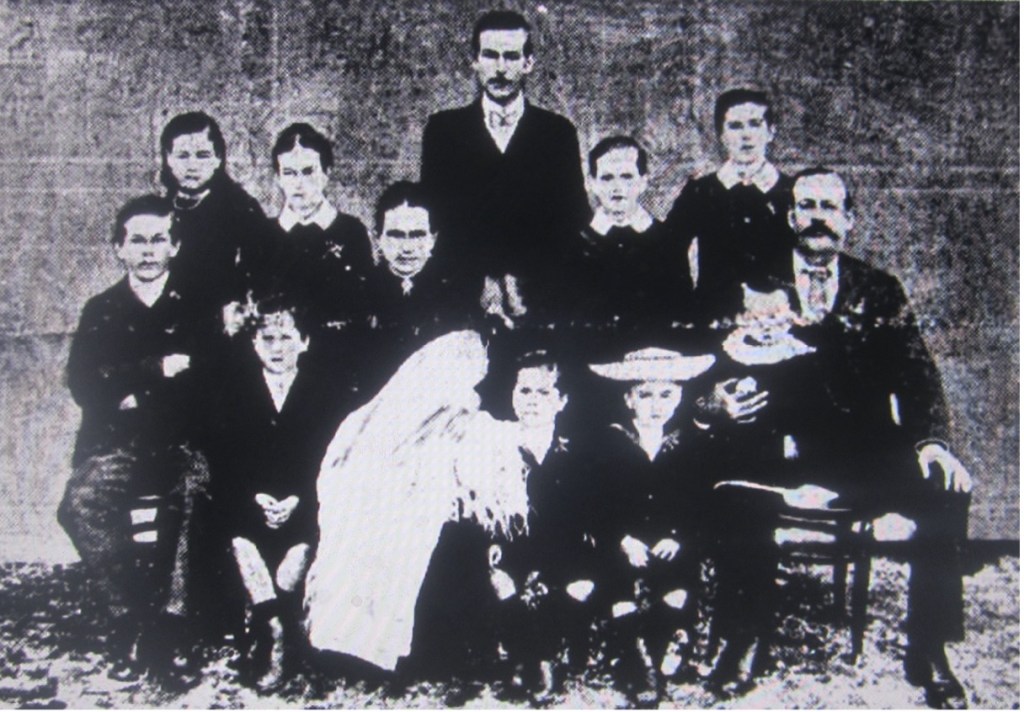
‘Oyster King’ Frank Holbert with his family – seated at right in the photo [Newcastle Sun, 4 July 1925]
The Smith’s Weekly of 29 January 1927, page 13, also published the following information on Frank Holbert:
‘Over 60 years ago, an 8 year-old lad used to help his father pull a heavily-laden fishing boat from Port Hacking to Sydney, with cargoes of oysters they had gathered laboriously from the rocks. The bags were the old 4-bushel sort, and, at Circular Quay, if the oyster market was good, were worth 2/6 a sack. The lad was Frank Holbert, now the Oyster King of Port Stephens. When he could manage a fishing boat himself, he left his Scandinavian parents at Botany to try the waters of Port Stephens. And there, for over 40 years, he has laboured and won to affluence.
Fishing in the early days gave a precarious livelihood. Once he shipped 120 baskets of snapper to Sydney, hoping that the returns from the agent would yield him sufficient to provide a decent Christmas dinner for his family. He made 25 trips eight miles in a rowing boat to the nearest post office to see if the cheque had arrived. It has not come yet. And the family dined on wallaby and fish through the festive season.
Thirty years ago Frank Holbert turned his attention to oyster culture, taking up a large number of leases. For 20 years he supplied the Italians of Sydney at 5/- a 4-bushel sack, barely keeping his family in food despite the herculean labours of all. All the time he had been experimenting with the bivalves, improving the quality and size of those on his leases until he won a reputation. Then he discovered, quite by accident, the mangrove-stick method of culture. This he perfected and proved until today it is in general use along the coast. But oyster producing did not pay while the Italians held the monopoly, though they had increased the price paid to 11/6 a bag. Their control ended in strange fashion.
Several bags of Holbert’s oysters found their way to Melbourne, each sack bearing the number of a lease. A restaurateur there wrote a letter addressed to the lease number at Port Stephens, offering the price he paid his Italian suppliers in Sydney, 50/- a bag. Since that day Frank Holbert sells his entire product in Melbourne, and now the price is 75/- a bag! The oyster king’s latest perfected methods of final culture on wire trays mature the bi-valve two years earlier than under ordinary conditions. He and his sons have miles of leases, and their weekly shipments are enormous. But the old man is always experimenting and even now is breeding out a new type that will bring him greater wealth.’
Depletion of the mangrove supply – 1925
The Dungog Chronicle of 4 September 1925, page 2, reported:
‘In Port Stephens waters, some hundreds of miles around, mangroves a few years ago were very plentiful but now they have been cut out, and a few months ago sticks were cut by the hundred thousand on the Macleay and freighted round to Port Stephens. Those engaged in oystering on the Macleay, with a view to the requirements of the industry in years to come, are taking objection to the export of mangroves to other districts, and Captain Ellery, on behalf of lessees, placed the matter fully before Mr. J. J. Fitzgerald, Assistant Minister for Local Government. The latter promised to place the objections before the proper department.’
Statistics of Port Stephens oyster production – 1925
The Maitland Daily Mercury of 29 October 1925, page 7, reported:
‘Figures compiled by Mr. W. N. G. Hincksman, fisheries inspector, of Pindimar, show that there has been substantial growth in the industries of Port Stephens. For the year 1924, the total output of markable oysters of the two districts of the port, was approximately 10,100 bags. Their net value was £30, 000. The capital employed in the oyster industry was £200,000, and in the fishing industry, including crayfish, £30,000.
The number of men employed was 175 in the oyster industry and 95 in the fishing industry. The culture of oysters is one of the principal industries of the port. The oysters are grown on black mangrove sticks. These are first placed in favourable places, such as Salamander Bay, and Duckhole where the spat catches, and later the sticks are moved to the growing grounds, the principal of which are Tilligery Creek, Pipeclay Creek, Karuah River, Bundabah Creek, and Myall River. The length of the aggregate beds leased from the Government is upwards of 360 miles, the oysters requiring about two years to reach maturity. The number of mangrove sticks brought into use in twelve months exceeded 2,000,000.’
First Annual Picnic of the Port Stephens Oyster Lessees’ Association – 1926
The Newcastle Morning Herald and Miners’ Advocate of 14 April 1926, page 4, reported:
‘The first annual picnic of the Port Stephens Oyster Lessees’ Association was held at Bundabah on Saturday in ideal weather. Lessees and their families and friends from Tea Gardens, Pindimar, Nelson Bay, Karuah and Anna Bay journeyed to the picnic grounds in their own launches. A large crowd was in attendance, and the sports were keenly contested. The children were specially catered for.’
Port Stephens – Home of the Oyster – 1927
The Dungog Chronicle of 8 November 1927, page 2, reported:
‘Port Stephens, says Messrs. D. J Lobban and W. T. Robinson, of Grafton, who have been there recently, is the home of the oyster (it produces one-third of the oysters of the Commonwealth) and 3000 miles of oyster leases have been granted along its shores. This does not mean that there are 3000 miles of leases on end, but many lessees have three or four parallel leases on 1000 yards or more and thus the total length is made up. And what glorious oysters they are. They are worth £5 per bag — corn sack size — and the visitors were told of one lessee who had 3000 bags for the market at the time of their visit.’

Advertisement for a monster auction sale of oyster leases on Karuah River, Port Stephens, mostly held by one individual, which illustrates the large number of valuable holdings that could accumulated [The Newcastle Sun, 12 March 1927]
Storm damages Oysters – 1928
The Dungog Chronicle of 22 June 1928, page 4, reported:
‘Early on Thursday morning a storm of terrific violence struck Port Stephens that did considerable damage. The wind at times reached a velocity of about 80 miles [129 kilometres] per hour, levelling fences, lifting roofs and stripping trees of their branches and uprooting them. The sea rose to enormous heights, washing right across parts that it was thought it would never touch. ……. The oyster leases at Pipe Clay and Swan Bay were seriously damaged, the mangrove sticks being washed away and the oysters in the racks lifted out and buried in the mud.’
Port Stephens Oysters sent to Honolulu – 1928
The Daily Telegraph of 20 September 1928, page 2, reported:
‘Some fat little Australian oyster aristocrats from Port Stephens — a hag of them — are leaving for Honolulu to-day. They are being sent by the Royal Zoological Society of N.S.W., at the request of the Hawaiian Board of Agriculture and Forestry. In Hawaiian waters they will be transplanted, and. If the experiment is a success, will reproduce and multiply until ail the fat gentlemen of Honolulu will grow fatter than ever. “If we can prove that Australian oysters can be acclimatised, it will mean a big new industry for New South Wales,” said Mr. C. E. Woodward, the oyster expert, who has charge of the shipping arrangements.’
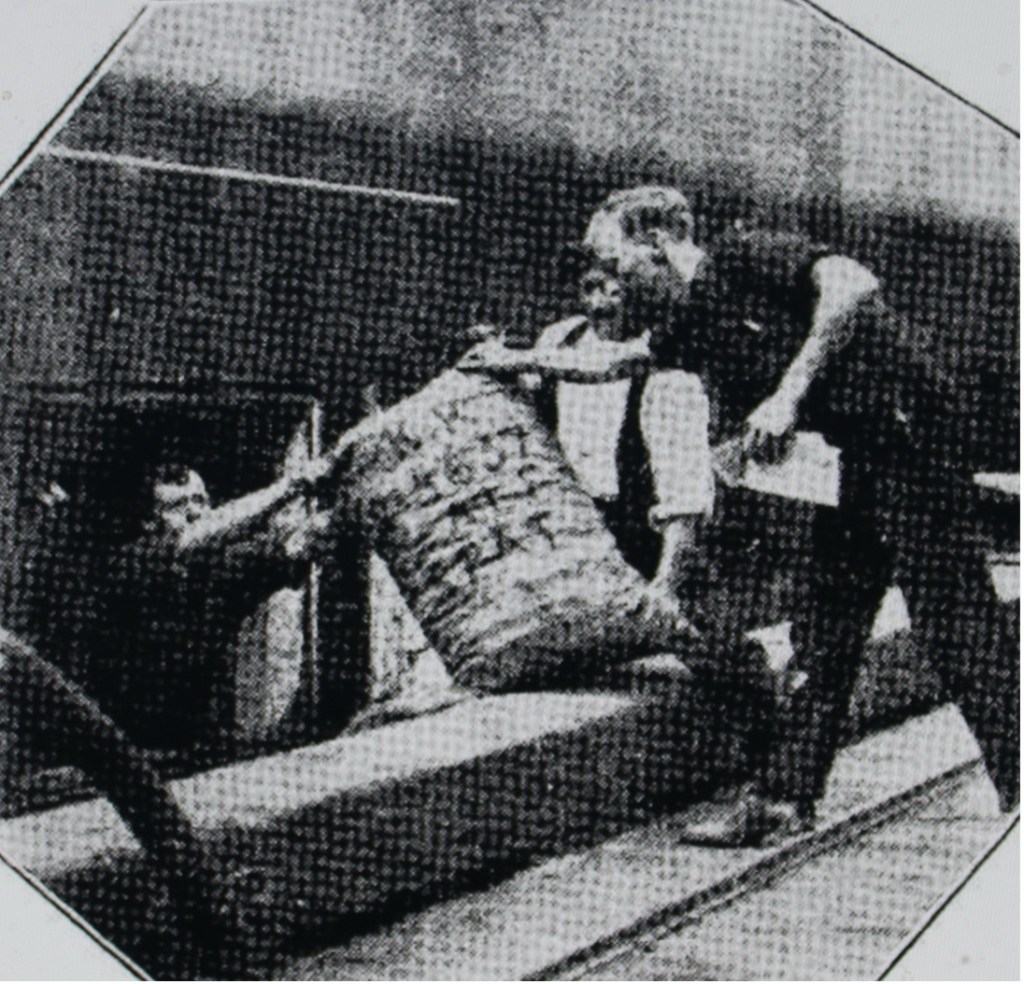
A bag of Port Stephens oysters being shipped aboard the m.v. ‘Aorangi’ for Honolulu for transplantation.
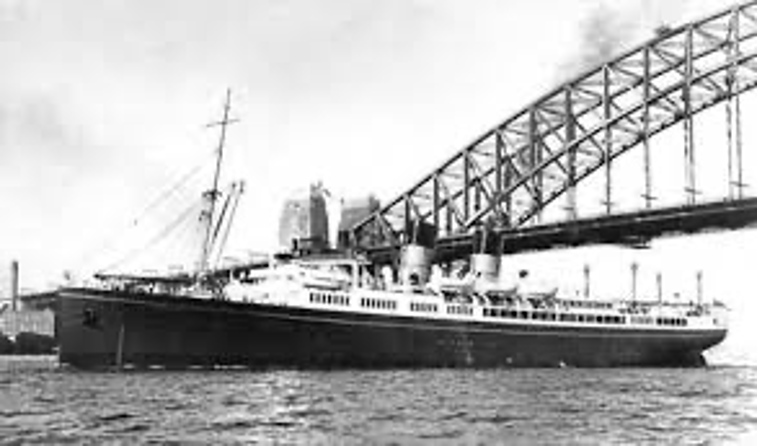
m.v. ‘Aorangi’ in Sydney Harbour [Derby Sulzers collection]
A Railway from Morpeth to Pindimar would assist Oyster Industry – 1929
The Dungog Chronicle of 30 July 1929, page 4, reported:
‘R. F. J. Wood, Managing Director of the Commonwealth Oyster Co., Ltd., Port Stephens, said: — A railway from Morpeth to Pindimar would assist the oyster industry of Port Stephens by facilitating the marketing of the oysters. Port Stephens produces one-third of the oysters consigned from the tidal waters of New South Wales for immediate consumption. In addition to that, large quantities of “spat’ are sent to other estuaries to be matured there. …..
A few oysters from Port Stephens find a market in Newcastle but the bulk go to Sydney where they are distributed — a large proportion going on to Melbourne. The present method of transport is by steamer, or motor lorry, from Port Stephens to Newcastle, transhipment there for Sydney, and further transhipment at Sydney of those oysters bound for Melbourne. The more that oysters are handled, the worse it is for them. Every slinging and dumping of the bag is likely so to damage some of the oysters in it that they arrive at destination unfit for consumption. A reduction of handling would take place if oysters were consigned by rail direct from Port Stephens to Sydney and elsewhere and loss would thereby be avoided.
Transport also would be quicker, thus permitting of oysters reaching their point of distribution in fresher condition than is now the case; and this is important with the oyster which, being a perishable commodity, is detrimentally affected when delay in transit lakes place — especially in the summer months when oysters frequently go bad in transit, with loss to the producer. Quicker transport, per medium of the railway, would tend to eliminate this loss. Railway communication to Pindimar would also open up the possibility of a larger and better distribution of fresh oysters — and fish as well — direct, with country towns and enable them to get supplies of both at cheaper rates than at present. These advantages of rail transport would be readily enough availed of by oyster farmers and the Railway Department would benefit by the freights.’
Further information on early proposals for railways in Port Stephens can be found at the following link on the website.
Port Stephens Oystermen raise grievances with the Government – 1930
The Dungog Chronicle of 11 April 1930, page 4, reported
‘A deputation of oyster farmers from Port Stephens, comprising: — Messrs. Guyt de Pullen, Johnson, Symonds, Pile and de Hamel waited on Hon. W. Bennett, M.L.A., at Newcastle, and brought before him the amendments that they required in the proposed Amending Fisheries Act.
Mr. de Pullen said that whilst the man on the land was well catered for by scientific advisers, the oyster farmers were neglected. They received no advice from the Department, which merely directed its attention to collecting revenue. It was pointed out that they not only wanted fixture of tenure in their leases, and tenant right in their improvements, but the Crown should assist them to protect their oysters from organised bands of thieves, who raided the beds periodically. At Karuah oyster lessees had lost in a few months £1,700 worth. It was suggested that oyster lessees convicted of stealing should have their oyster leases cancelled. It was the only way to rid the Port of thieves.
The uncertainty of securing a right of renewal of leases, prevented more money being spent on improvements. The oyster leases today were a different proposition to what they wore when the Fisheries Act was passed forty years ago. There should be better control of the industry.
Mr. Bennett said he recognised that the present Act was out of date. He had got a promise from the late Minister, Mr. Bruntnell, that the Amending Act should be sent on to all concerned in the industry, so that it could be considered by them, and amendments suggested. He had urged the present Minister to bring in the bill, and he had promised that he would do so this Session, so that it could be scrutinised by those interested, and amendments suggested, and that the bill could be passed into law next Session. He hoped to get a perfect and workable bill.
Mr. Bennett said he understood that their demand for security of tenure and right in improvements would be provided for in the bill, but he suggested that a Marketing Board should be formed for the control and marketing of their products; there was a big untapped market in the supply of inland towns with fish and oysters, but it could only be exploited by organisation. He promised to send the marketing bill to the secretary of the local organisation, so that the suggestion could be thrashed out at the annual conference to be held in Sydney on 22nd. inst. He assured the deputation that he was entirely in sympathy with their demands and would do his best to have them incorporated in the bill.’
Meeting of Port Stephens Oyster Lessees’ Association – 1930
The Dungog Chronicle of 27 June 1930, page 4, reported:
‘A meeting of the Port Stephens Oyster Lessees’ Association was held at Lemon Tree Passage on Saturday, 21st instant. It was decided to try and form a marketing board in connection with the industry. The association is of opinion that the time is ripe for more efficient and economic marketing of oysters throughout the State. There is no doubt that the oyster industry is entitled to the sane sympathetic treatment in the matter of railway freight as the fruit industry. The association may realise that they can achieve very little without organisation. Unless they do so and make their weight felt they can expect very little gratuitous help from the powers that be.’
Proposed Oyster Marketing Board not supported by Port Stephens Oystermen – 1930
The Raymond Terrace Examiner and Lower Hunter and Port Stephens Advertiser of 21 August 1930, page 3, reported:
‘A meeting of the Oyster Farmers’ Association of Port Stephens, was held at Lemon Tree, on Saturday morning last, to discuss the establishment of the proposed oyster Board, to govern the price and sale of oysters both wholesale and retail. Mr. W. Thompson, Nelsons Bay occupied the chair, and in opening the meeting expressed his convictions that the Board would be too expensive to oyster farmers, and would not give compensating benefits. He quoted the failure of the Egg Board, as an illustration of the workings of these Board generally and thought it advisable to refuse to have their industry controlled by anyone but themselves.
Mr. Phillips had an estimate of expenditure that the oystermen would be put to if the Board came into operation. Sheds would be required for sorting and a grader and an assistant would be necessary, which meant £750 and £500 and a launch to run, which would have to gather the oysters. This, would not be run of the cheapest but on the highest cost with little regard to economy of working. Then an additional officer in a salesman would be required. This would involve another expense of possibly £1000 a year. Mr. Pullen, secretary to the meeting was an advocate for the Board.
Mr. Pile, Karuah, said possibly the Board may come about later on, when the success of other Boards had been proved. A matter was referred to by Mr. Phillips which was recognised as a useful suggestion, and that was that a great deal of good could be done by more cohesion among oyster farmers by each looking after the respective interests towards each other and assisting in guarding against thieving of oysters and in minimising expense in various directions.
Oyster farmers were present at the meeting from Pindimar, Karuah, Lemon Tree, Swan Bay, Nelsons Bay, Teligherry etc., to the number of about 40. Mr. W . Bennett, M. L. A., was also present and spoke on the fishing and oyster industry. A resolution was carried in opposition to the Board, as it was considered that present conditions were better.’
Oyster Canning Factory established at Pindimar – 1932
The Newcastle Morning Herald and Miners’ Advocate of 18 May 1932, page 4, reported:
‘The Port Stephens Canning Company, Limited, with a capital of £2000, made up of 2000 £1 shares, has been registered in Sydney. The objects of the company are to carry on the business of preservers, parkers, canners, and bottlers of oysters and other sea food products. …. The registered office of the company is at Pindimar, Port Stephens.’
The Dungog Chronicle of 8 July 1932, page 4, also reported:
‘Oyster canning has begun in Port Stephens with favourable prospects. Their headquarters are at Pindimar. At present the company is putting up the oysters in bottles, so that the public can see the article they are buying. It seems a genuine effort to try and deal with the oyster product, which appears to be almost at a standstill as far as shipping the oysters to market is concerned.’
The Dungog Chronicle of 9 September 1932, page 4, further reported:
‘The establishment of the oyster canning factory at Pindimar, is a step in the direction which we feel sure will justify itself with the advance of time. It is the first industry of its kind in Australia, and we are pleased that it is associated with this wonderful district of Port Stephens.
The pioneers of this industry deserve the best thanks of the district, and Australia as a whole. Anything that contributes to the making of Australia self-reliant is justified. There is no primary industry that has been harder hit than the fish and oyster business, and these farmers of oysters need the same means of support and protection as any other industry that is native to these climes. We feel that the Federal Government will give tariff protection to this industry against the competition of one American canned oyster; besides the disproportionate trade balance in favour of the U.S.A. justifies this commonsense legislation.
This young industry is daily surmounting its difficulties and enriching its technique. Having passed through the initial stages the company today can place upon the market an article unsurpassed by any competitors. As a result of material alterations and improvements in the process of canning the Pindimar oyster factory is canning a more tender and palatable oyster that will command and justify the confidence of the wholesale business houses, and consumers alike. The oysters are now canned in their own flavour which appears to be the secret of success. The local oyster farmers would be well advised to make any reasonable sacrifice to make the canning industry a success.
The company, in the absence of tariff protection, cannot be expected to buy the oysters at a price that will not allow competition with the imported article, but with protection the industry will be able to demand a fair and reasonable price for their cultured product. In the past the oystermen of this district sold large quantities of spat to other districts which had the effect of creating opposition in the marketable oyster trade, but now that oysters are canned in this district there should be no need to adopt this practice, which is not in their interests. The obvious result will be that a better demand will be created for fresh marketable oysters as the natural shortage will be conditioned by the factors created by the canning industry. In this way the index wholesale price will be improved.’
Further information on the Port Stephens Canning Company Limited can be found at this link on the website.
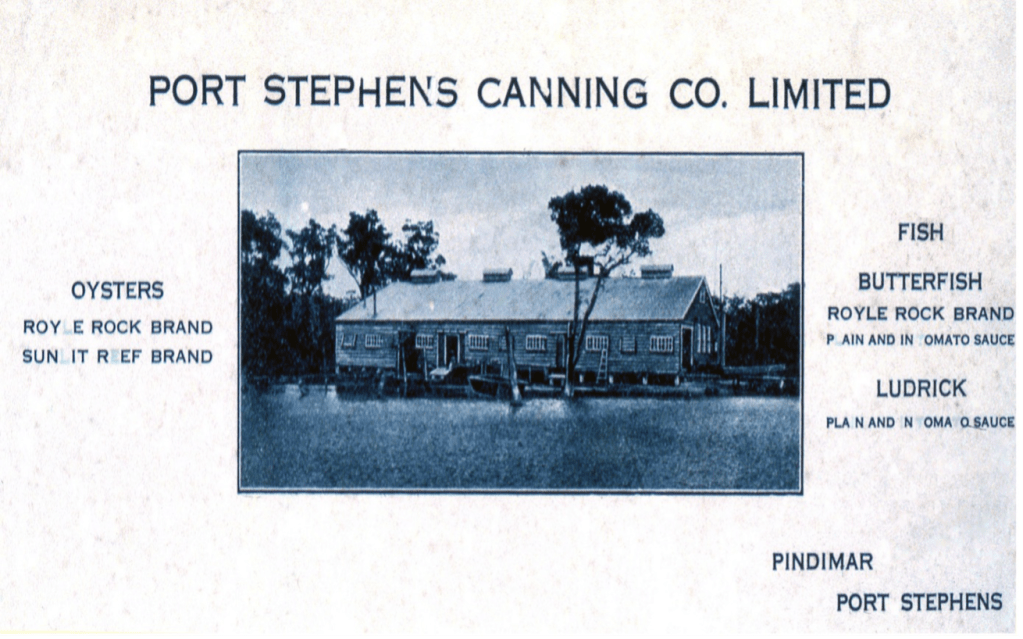
Advertisement for the produce of Port Stephens Canning Company, Limited.
Oysters sold directly in Sydney by Port Stephens Oysterman – 1932
The Dungog Chronicle of 24 June 1932, page 4, reported:
‘Mr. Ron Phillips, of Pindimar, who is an oyster lessee on a large scale in Port Stephens, has found a ready market for his products in Sydney. He handles his own oysters, and is established opposite the Town Hall, where he opens and disposes of them in bottles and on trays carefully graded and at prices to suit all classes. He has the trade of several large hotels, and restaurants.’
Preservation of Port Stephens Oysters in a Sydney experiment – 1933
The Labor Daily of 6 January 1933, page 4, reported:
‘Experiments which are likely to revolutionise the fish and oyster trade were conducted recently by Mr. A. W. Bohte. Oysters which had been taken from a lease at Port Stephens and were four days’ old were ”treated’ and packed in a box in the cold-room at the trawler wharf at “Woolloomooloo, sixteen days ago. At the same time samples of whiting, mullet, blackfish, flathead, bream and sea garfish were also treated and packed. A number of persons, ….. witnessed the packing and sealing of the fish and oysters in the patent boxes.
On Wednesday, the boxes were opened in front of many who witnessed the packing, and the fish were as fresh as the day they were put down. The eyes were bright, not dull, as are those of old or long-caught finnies. The oysters, on being opened, were as tasty as any purveyed in the city shops. The results to date are so satisfactory that the people in the country, who, according to the report of the Fisheries Department are fish starved, will in the near future be able to enjoy any of the saltwater varieties of fish for breakfast, dinner or tea.’
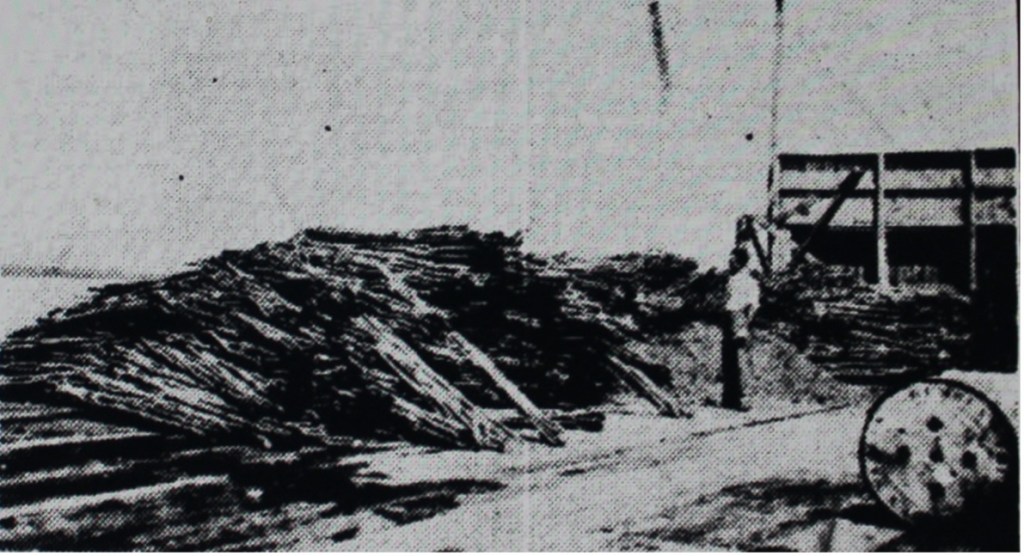
Part of the 200,000 shipment of mangrove sticks on Ballina wharf awaiting shipment to Port Stephens and the Hawkesbury. There are 25,000 in this pile [Northern Star, 13 January 1934].
Port Stephens Oysterman face difficult times – 1934
The Raymond Terrace Examiner and Lower Hunter and Port Stephens Advertiser of 1 February 1934, page 3, reported:
‘The heat wave has been responsible for heavy losses in oysters throughout Port Stephens. To add further to the misfortunes of the oysterman, thieves have been working overtime, it is no uncommon thing to hear reports of losses from this source. Taking it altogether the oysterman is having a bad time — poor prices, severe losses from natural causes and depredations of thieves — all these tend to take the heart out of those engaged in the trade.’
Request by Port Stephens Oyster Canning Company to Tariff Board – 1934
The Newcastle Morning Herald and Miners’ Advocate of 15 September 1934, page 7, reported:
‘Stating that the sale of cheap Japanese oysters had paralysed his market in Victoria and other States, and alleging that New Zealand exporters were indulging in dumping tactics, Mr. C. E. Royle, Manager of the Port Stephens Canning Company, asked the Tariff Board today to increase the duties on canned oysters exported from all countries. The present duties are British preferential, 1d per lb, and general 2½d per lb. Mr. Royle asked that they be fixed as at British preferential 1/ per dozen tins, general 3/ per dozen tins. At the suggestion of the Chairman (Mr. McConaghy), Mr. Royle amended his application for the rates to apply to weight instead of tins. The revised rates will be supplied in Melbourne.
In support of his dumping allegations, Mr. Royle stated that two merchants in New South Wales had each sold 1200 cases at prices ranging from 3/6 to 5/ a dozen tins, this being far below the cost of manufacture. He stated that also New Zealand oysters could be purchased cheaper in Australia than in New Zealand. Japanese “captain” oysters were selling on the Victorian market at 6/ per dozen tins, whereas, said witness, he could not sell under 9/ per dozen tins.’
Port Stephens Oyster Cultivation featured in Fox Movietone Newsreel – 1936
The Labor Daily of 14 March 1936, page 8, reported that the cultivation of oysters at Port Stephens, was the subject of a Fox Movitone Newsreel that was currently showing at movie theatres.
The National Film and Sound Archive of Australia holds a copy of the newsreel, that was narrated by Jack Lumsdaine [NFSA ID: 137178].

A launch at Relf’s mill, Bulahdelah, about to tow a puntload of sawn boards down the Myall River to be used in the oyster industry at Port Stephens [Sydney Mail, 22 April 1936, page 2].
Size of Marketable Oysters – 1936
The Dungog Chronicle of 24 April 1936, page 4, reported:
‘Mr. C. E. Bennett, M.L.A, is in receipt of the following communication from Hon. F. A. Chaffey, Chief Secretary: —
With reference to your representations on behalf of a number of oyster growers of Port Stephens, who are desirous that the minimum size of marketable oysters be reduced by half an inch so as to permit of the marketing of second-grade oysters without infringement of the law, I wish to state that careful consideration has been given to this question. It will, I am sure, be realised that, quite apart from the question of conservation of supply, it is in the interests of growers themselves that oysters which reach the purchasing public shall comply with some minimum standard of quality in order that the good reputation of the product may be maintained.
The standard now fixed requires that a marketable oyster shall not be less than one and one half inches in width and I think it will be admitted that any oyster of normal shape which is less than that width is a very small oyster. ….. As stated by your correspondent considerable latitude has been allowed in recent years regarding the bottling and sale of small oysters and it is not now proposed that the regulation shall be rigidly enforced. A reasonable proportion of undersized oysters will be allowed and no action will be taken by this Department when such proportion does not exceed twenty per cent. It has been pointed out that, owing to handling during shipment, oysters sometimes lose some of their fringe with a consequent reduction in width, and in such cases I do not intend to take proceedings provided a certificate issued by the local Inspector to the effect that the oysters complied with requirements at the time of shipment can be produced.’
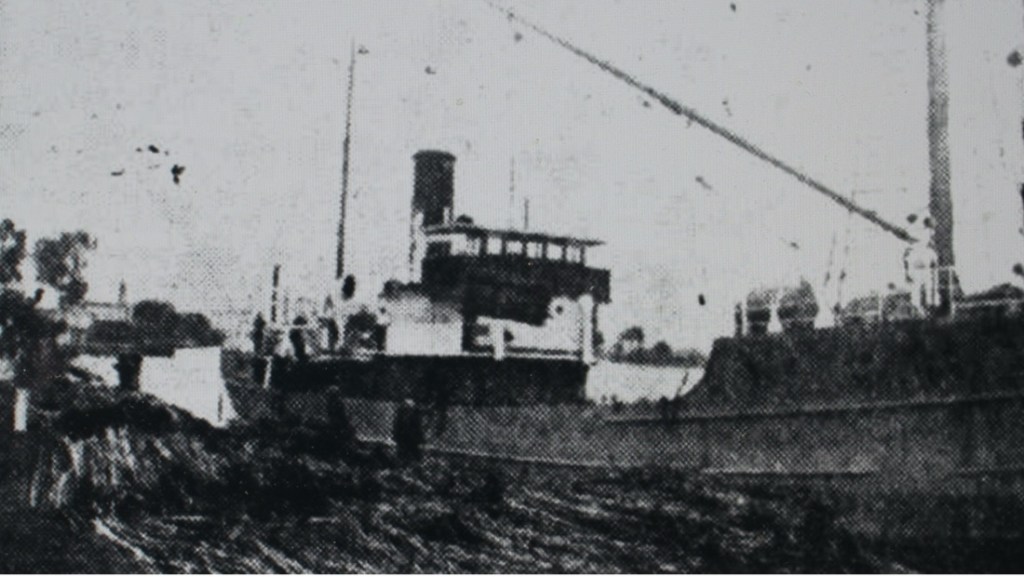
N.C.S.N. Co. Ltd. motor ship ‘Melinga’ loading mangrove sticks at Broadwater [near Richmond Valley] consigned to C. W. Phillips, of Port Stephens. On this occasion 105,000 were shipped and there are about the same number to follow shortly [Northern Star, 28 November 1936].
The Phillips – Oyster Kings of the North – 1938
The Newcastle Morning Herald and Miners’ Advocate of 26 November 1938, page 5, reported on the activities of Messrs. C. W. (Charlie ) and F. S. (Stanley )Phillips, who were the largest holders of oyster leases in Port Stephens:
‘At Port Stephens where the wooden ridges come down to the sea, where cone shaped hills tinted with purple haze rise from the blue water, the oyster farmers hold sway. Theirs is a real industry. To see it at close range completely dispels the idea that it is a life for a lazy man. No lazy man can be a successful oyster farmer, any more than an indifferent squatter can be a successful sheep breeder. There is more in oyster farming than merely placing a few sticks into the mud and watching the oysters grow.
The crustaceous substance which contains the succulent morsel known as an oyster actually does grow; nobody seems to know upon what it feeds, but it does, and it waxes fat or becomes thin according to the nature of the water in which it is matured. Seeking to learn something of the habits of oysters and oystermen, representatives of the ‘Newcastle Morning Herald’ visited the oyster farm controlled by Messrs. C. W. and F. S. Phillips, of Oyster Cove, Salt Ash. It is said that these are the oyster kings of the North. A day on the broad water of Port Stephens in the palatial launch ‘Stella Maris’, which is owned by the firm, verified every word of it.
Hard by the mouth of Pipe Clay Creek the Phillips homestead stands and close at hand are the oyster sheds, and a long jetty stretches out into the bay. The ‘Stella Maris’ was rocking gently in the swell at the end of the jetty, a wide, black punt with a flat bottom was fastened to her stern, and astern of that again was a small rowing skiff. There was a happy company on board when the launch backed into the bay and then ran full speed ahead for the oyster catching beds. To the uninitiated it was news that that there was such things as catching beds for oysters. It was generally believed that sticks stuck anywhere in the mud would catch and hold oysters until they were required for use.
For 10 miles down the bay the ‘Stella Maris’ ran before Mr. Phillips slowed up the engine. In the hazy distance was Salamander Bay. Long rows of black objects, which looked like steamer docks, reached out from the shore. The ‘docks’ were actually racks containing bundles of sticks on which the oysters in milk form are caught. The word ‘milk form’ is used by oystermen. It is generally understood that it is spawn or spat containing a male and female oyster, infinitesimal in form, which floats through the water in that particular spot. The ‘catching’ of oysters is another expression which hardly conveys the right idea. Oysters are not ‘caught’; they catch themselves. Propelled by the male the spat moves through the water until it strikes some object to which it can cling. When it does it sticks like glue. There is no shell on it at that stage of its life; the shell forms after months of clinging to the sticks—that is, if fish do not first raid the beds.
In the rowing skiff Mr. Phillips took the visitors through the catching beds. In some places could be seen oysters about eight months old; in others the sticks appeared to be bare, but the grower assured the visitors that they contained young oysters which could hardly be seen with the naked eye. Some were pointed out, grown as large as the size of an ordinary pin’s head. The racks containing the sticks are constructed so as to be about two feet above low water: when the tide is high the water laps over them. The old idea was to stand sticks up right in the water; that, however, is out of date.
Sticks on the oyster farms of the present day are tied in bundles of 10 and laid horizontally on racks and fastened down with wire. That prevents them floating away when the tide rises. The young oysters cling mostly to the underside of the stick. There they are left until between eight and 12 months old, when the sticks are removed to a ‘nailing out ground. It is difficult, of course, to estimate the number of oysters caught in a year, but a rough estimate is arrived at when it is known that last year the Phillips’ farm used 150,000 sticks, and that an average of 200 oysters clings to each one of them.
From Salamander Bay the launch moved some miles to the first ‘nailing out bed’ in North Arm Bay, at the mouth of Bundabah Creek. Acres and acres of racks were in evidence there. But the sticks were no longer in bundles. The wire had been cut, and they were laid out singly, three or four inches apart. On some racks the oysters were two year old. They are an importent part of the industry: without proper sticks oyster culture could not be carried on successfully. The sticks used by Mr. Phillips are brought by steamer from the Richmond River, mainly because it is impossible to obtain them in sufficient numbers locally. Black mangrove is the species of wood used, because its bark stays in position under water for a number of years. The bark on the stick serves a dual purpose. It entices the growing oyster to make a hard under shell and facilitates removal when the full grown oyster is ready for market.
As the ‘Stella Maris’ swayed at anchor off the catching beds some men were throwing bundles of sticks from a punt on to the racks. The sticks had just been landed from a steamer, and were being laid out for a new catc., In a year they will be removed with their young oysters to another part of the bay, full maturing age—four years. A flat bottom punt was operating between the rows of racks; in it were two men. They were stripping the four year old oysters from the beds and dropping them, sticks and all, into the punt. …..
Before nightfall, it was said, the punt would be loaded and towed back to Oyster Cove for culling purposes. On the trip the men would knock them from the sticks—an easy task because the oyster was clinging to the bark, which falls away readily. It was easy to distinguish the two year old oysters from those which had matured. They were much smaller, and there were many white patches on the sticks. Those patches indicated where the fish had made raids. Fish know the oyster beds as well as the lessee. They know, too, when the shells are soft. No fish would attempt to take the matured oyster—its shell is too hard.
From the sheltered water of North Arm Bay the launch took the visitors across the lumpy water towards Reedy Creek. A storm broke, and lightning played about the black hill tops as the vessel travelled. White caps appeared on the waves and mist came overhead. For 30 minutes or so the ‘Stella Maris’ battled into the weather, then shafts of sunlight appeared ahead, and the oyster maturing grounds of the foreshores came out of the gloom.
The Reedy Creek maturing beds are astounding. For miles along the foreshore, they stretched—racks and racks and racks loaded down by sticks laden with oysters. That particular lease covers about 200 acres. The longest rack is 1000 yards and the shortest 600 yards. A walk down the straight at Broadmeadow racecourse, with the white fences on both sides, would give a fair indication of how it appears in a boat between the racks. Reedy Creek is an oyster city, laid out in long, straight streets of water. It was in that area the oysters were ready for picking,
Visiting the three oyster leases occupied most of one day. But it was only portion of the area leased by the Messrs. Phillips for oyster culture. On the trip back from Reedy Creek to the homestead many miles of water was traversed and many leases were seen in the distance. Falling night prevented further visits, but here and there were patches of racks— a mere 100 acres or so—all under the Phillips control.
Back in the culling sheds, illuminated by electric light, another interesting feature of oyster culture was witnessed. Men were separating the oysters into three classes—first, second, and third: they are bagged and marketed according to their grade. Those not required immediately are placed in trays and allowed to sink beneath the water. They can be bagged when wanted. Each week the firm sends away 150 bags of oysters. There is a ready market in all States, and there is a tremendous demand in Newcastle. The firm has its own lorries and four launches, as well as punts and other equipment.
In Port Stephens 10 men are actively employed by the firm in oyster culture, and eight others are engaged cutting and shipping the mangrove stakes on the Richmond River. Visitors to the oyster farms were advised to take old clothing, because, it was said, there was a possibility of their having to wade waist deep in mud to reach the racks. In this case nothing could be farther from the truth. Launches carried the visitors to the grounds, smaller boats carried them between the rows of oysters: and entertainment fit for royalty, awaited them when they returned.

‘Stella Maris’, one of four launches used by Messrs. C. W. and F. S. Phillips for oyster culture. Built locally by the Lamans in 1934 [Newcastle Morning Herald and Miners’ Advocate, 26 November 1938].
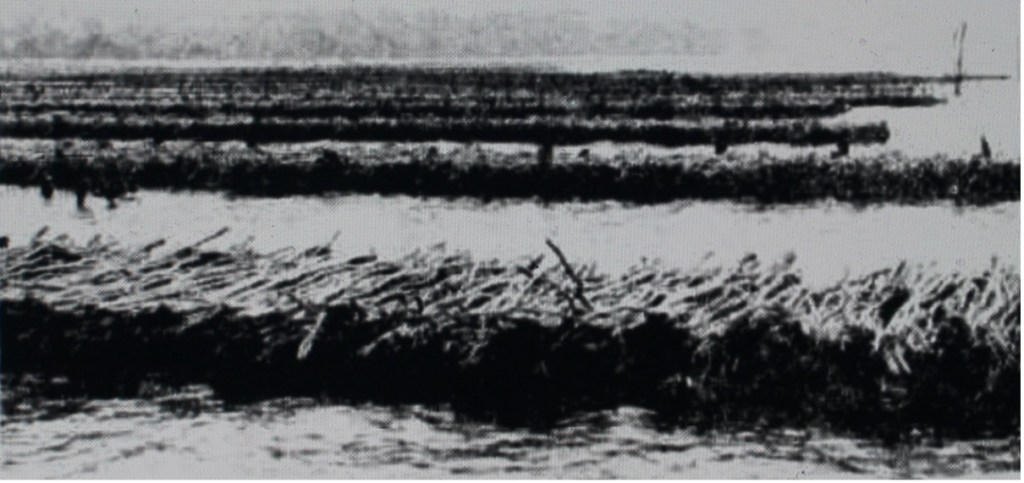
Bundles of sticks laid on racks at Port Stephens to catch oyster sprats [Newcastle Morning Herald and Miners’ Advocate, 26 November 1938].
Port Stephens Oysters to be sent to Singapore – 1939
The Propeller of 13 April 1939, page 1, reported:
‘Port Stephens rock oysters are now being transferred to George’s River for fattening before being flown to Singapore in the Empire flying-boats for consumption in the leading hotels and cabarets. Four hundred dozen oysters leave Sydney each week, packed in special crates so that they can be kept alive and fresh for two or three weeks. A scientific study of shipping oysters in the flying-boats has been made. A Qantas official said recently that oysters enjoy fresh air and sunshine, and had no objection to long flights, provided there was plenty of fresh air.
When oysters were first shipped in the flying-boats on the 4600 miles flight across the Equator on July 22, 1938, they were carried in bottles. By this method of shipping, they lost their flavour. The next method was to consign them unopened in sugar bags, and they were dipped overboard at each night stop. This was not very successful. Then they were packed in heavy damp sacks but sweating resulted when there was a sudden change in the temperature. By this time oysters had become popular in the East, so it was decided to make a study of their shipment.
They are now consigned in boxes, and each oyster has its own compartment. After the Port Stephens oysters have been fattened six inches above the tide at George’s River, they reach a stage of plumpness which enables them to be carried on a four days’ flight to Singapore without marked deterioration.’
The Barrier Miner of 5 April 1948, page 2, also reported:
‘The managing director of Melbourne Oyster Supply (Mr. T. Marmaras) said here today that N.S.W. oysters were sold for as much as 1/ each in Singapore night clubs. Shipments of 1000 dozen are sent every fortnight. The oysters, which come from Port Stephens, are opened and packed in wax containers and quick frozen in Melbourne before despatch.’
Prominence of Port Stephens in Oyster production statistics – 1939
The Dungog Chronicle of 10 November 1939, page 4, reported:
‘Conclusive evidence of the important part Port Stephens, as one of the biggest fisheries and oyster farms in the State, is playing in the life of the country is contained in the annual report on the New South Wales Fisheries, tabled in the Legislative Assembly recently. The report covered the year ended June 30, 1939.
The report indicates that the great development in oyster farming at Port Stephens and George’s River had resulted in doubling the output of oysters since the year 1931. These two producing centres had accounted for nearly two-thirds of the total output, of marketable oysters, Port Stephens producing 17,925 bags, or 40 per cent. of the total, and George’s River 10,556 bags, or 23 per cent.’
Oyster Beds ruined at Upper Tilligerry Creek – 1940
The Newcastle Morning Herald and Miners’ Advocate of 2 January 1941, page 6, further reported:
‘Advances will be made to a number of oyster growers at Tilligierry Creek, Port Stephens, who have suffered loss from a substance used by the Main Roads Department which was washed into the stream. Mr. C. E. Bennett, M.L.A who has received this assurance from the Premier’s Department said yesterday he had no doubt this was the first step toward recognition of the whole oyster industry as a primary industry, and to the general extension of benefits to oyster-farmers as were available to other primary producers. The advances will be made through the rural industries agency, of the Rural Bank at a low rate of interest to assist them to become re-established, and to purchase stores. Repayment will cover three years, with no repayment of principal required in the first 12 months, and at an interest rate of 2 per cent. a year.
A review of each case will be undertaken, and appropriate security will be taken. The Treasurer has also made available a small allocation to the Chief Secretary’s Department to assist in cleaning up sticks on damaged leases. In one or two instances where loss has been sustained, efforts should be made to arrange leases on new country if possible. In reviewing individual cases, the Chief Secretary’s Department has been authorised to grant concessions such as remissions of lease rents, according to losses sustained, but before approving any advances the department must be satisfied that there is a reasonable prospect of the applicant successfully re-establishing his holding. Review of individual cases will be treated as urgent.’
Drought adversely affects Port Stephen Oysters – 1940
The Sydney Morning Herald of 31 August 1940, page 13,reported:
‘Oyster farmers blame the drought for increased mortality among oysters, particularly in George’s River, and for an appreciable diminishing in the maturing and fattening of the shellfish. The fall of spat also has been irregular and decreased in quantity.
At Salamander Bay, Port Stephens, the richest breeding ground for oysters in the State, it was stated that no appreciable amount of spat had fallen during the summer, the principal breeding season, of either this year or last year. This is likely to adversely affect oyster farms in other coastal estuaries as a great quantity of spat is “imported” from Port Stephens.
The annual production of oysters in New South Wales during 1938-39, the latest figures available, decreased by almost 1,700 bags compared with the previous year. The greatest decline was at Port Stephens, George’s River, and Wallis Lake, where output dropped almost one-quarter.’
Difficulty in obtaining mangrove sticks for Port Stephens – 1941
During the early years of the Second World War, the Port Stephens oystermen experienced difficulties with the shipment of mangrove sticks from the N.S.W. north coast areas.
Firstly, the Dungog Chronicle of 7 March 1941, page 4, reported:
‘Mr. C. E. Bennett, M.L.A., is in receipt of the following letter from Mr. A. U. Tonking, Chief Secretary: “With further reference to your representations on behalf of Mr. E. N. Diemar, of Nelson’s Bay, relative to the transport of mangrove sticks from the Macleay River to Port Stephens for the use of local oyster farmers, I desire to intimate that the matter has been given careful attention. “Although under Section 109D of the Navigation Act, 1901-1935, every sea-going ship, unless exempted as provided by the Act, must carry the prescribed wireless telegraphy installation, I am pleased to inform you that the Colonial Treasurer has approved of the recommendation of the Committee of Advice that the s.s. Coweambah be permitted to trade to the Macleay River without wireless equipment until not later than Match 16, 1941. “In the circumstances, the local oyster farmers should make every endeavour to obtain an adequate supply of mangrove sticks before the limited concession expires.”
Secondly, the Dungog Chronicle of 21 March 1941, page 4, reported:
‘With further reference to his representations on behalf of Mr. E. N. Diemar, of Nelson’s Bay, relative to the transport of mangrove sticks from the Macleay River to Port Stephens for the use of local oyster farmers, Mr. C. E. Bennett, M.L.A., has been informed by Mr. S. L. Anderson, Under Secretary Fisheries and Game Department, that the Commissioner for Railways has signified his willingness to allow the conveyance of such sticks at special rates as a temporary measure. The concession has been granted, however, provided the mangrove sticks are loaded in trucks which would otherwise run empty.’
Oyster Farmers adversely affected by petrol rationing – 1941
The Raymond Terrace Examiner and Lower Hunter and Port Stephens Advertiser of 24 July 1941, page 3, reported:
‘More consideration should be given by the Fuel Control Board in the case of persons using petrol for business purposes. ….. One industry among others, that is badly hit by the rationing of petrol is the oyster farmer who has to use a launch to attend to his work on the oyster leases. At Port Stephens many are finding it hard to carry on with the ration allowed and as a consequence their weekly earnings from oyster farming is decreasing to a non-payable extent, and neglect in doing certain work required on the leases may cause a falling off in the returns for some time to come. These are features that should be studied closely by the Fuel Board, and no business should be forced out, unless it is one that does not matter to the general welfare of the nation, such as luxuries, and machines manufactured for sport and such like purposes.’
Oyster Farmers’ Conference held at Soldiers Point, Port Stephens – 1942
The Manning River Times and Advocate for the Northern Coast Districts of New South Wales of 14 October 1942, page 2, reported:
‘The annual meeting of the N.S.W. Oyster Growers’ Association was held in the hall at Soldiers’ Point on Saturday week. Mr. T. Priestley, of the Port Stephens Branch, introduced the Vice-President of the Association, Mr. C. Phillips, who took the chair. Other officials present were Messrs J. H. Facey (secretary), F. West (assistant secretary), and M. Marks. Members were present from the George’s River, Manning River, Hawkesbury River, and 47 local members.
The members were told that their association had gained them many benefits, some of which were the release of “frozen” goods to carry on their work with. They were called “farmers” and were trying to be recognised as primary producers. At present oysters were called a luxury and the farmers wanted a bigger outlet for their oysters. If they could come in as primary producers, the P.D.S. could handle the oysters in many country towns where their travellers now call. Insurance rates would be reduced by half. Oyster thieving was a crime and culprits would be punished.
The Port Stephens Branch decided to fall into line with other branches in supplying free oysters to the hospitals for returned men. The association gives one hospital each month a free lot of oysters. Port Stephens is to supply the next month’s quota. After the conference the visitors were taken for a trip around the Port to see the local oyster industry. Owing to the austerity campaign, the usual luncheon was dispensed with.’
Port Stephens Oysters a Favourite Treat in Melbourne – 1947
The Newcastle Sun of 7 January 1947, page 5, reported:
‘Melbourne eats half a million N.S.W. oysters a week, and its supply from Newcastle by rail rarely fails. Recently Melbournite’s have been surprised to see Newcastle visitors relishing their own State’s oysters as if they were as rare as bottled beer or cigarettes.
At least three members of the English Test team and one N.S.W. member of the Australian Test team were glad to be back in Melbourne for a couple of plates of ‘Sydney Rocks’ at 2/3 a plate without any side door talk of an oyster shortage. Oyster prices are fixed in Melbourne at 2/3 a dozen on the plate at the bar or in the cafe; 2/- a doz. in carton to take home; and 1/9 a bottle dozen to take home. Most of Melbourne’s oysters are gathered at Port Stephens and come regularly by rail, the average rail freight being 10/- a bag.’
Obituaries of Frank Holbert, Prominent Oysterman – 1947
The Dungog Chronicle of 28 January 1947, page 3, reported:
‘One of the best known identities of Port Stephens, Mr. Frank Holbert [Francis Henry Holbert], died on Sunday last after a short illness. He was over eighty years of age and is survived by seven sons and one daughter (Mrs. Worth, of Hawk’s Nest).
The late Mr. Holbert was practically one of the first men to engage in oyster culture in Port Stephens. He made a success of the industry and was known as ‘The Oyster King.’ Even 20 years ago he received £5 a bag for oysters delivered for the inter-state and overseas boats. They were specially selected and very large. The name of Holbert has been associated with fishing and oyster farming over a long period. A highly esteemed resident and a popular identity, the late Frank Holbert will be missed by a wide circle of friends. His wife predeceased him some years ago.’
The Raymond Terrace Examiner and Lower Hunter and Port Stephens Advertiser of 30 January 1947, page 3, also reported:
‘The death occurred on Sunday last, at Tea Gardens, at his home, of Mr. Frank Holbert, one of the oldest inhabitants of that part of Port Stephens. He was about 84, and had been associated with Tea Gardens all his lifetime, excepting a few years of his early boyhood. He followed the occupation of oyster farming all his life, with fishing occasionally. He was a successful oyster farmer and had a number of good leases.
His knowledge of the industry was efficient and often in his earlier life he was cited as an authority on the bivalve and the best means of cultivation. He was active in promoting the welfare of the industry and lent by his advice much assistance to men younger engaged in the industry.’
Obituary of Frederick Phillips, Prominent Oysterman – 1948
The Raymond Terrace Examiner and Lower Hunter and Port Stephens Advertiser of 1 April 1948, page 2, reported:
‘The death at 81, occurred on Sunday last of Mr. Frederick Phillips of Pindimar. Deceased was the chief Director in the Oyster industry at Port Stephens, which he and his sons have been conducting for the past 25 years. He acquired large areas of cultivated leases and improved many acres of land that had few oysters on previously. He was well known and respected by those who had known him, for his fair and considerate dealings.’
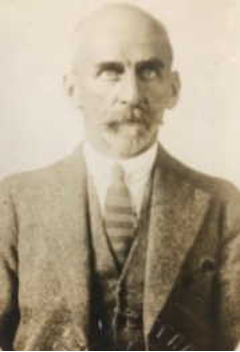
Frederick Phillips [Ancestry]
New Idea for Oyster Growing – 1948
The Daily Telegraph of 8 October 1948, page 1, reported:
‘Denzil Crawford, an Englishman living at Port Stephens, has carried out some revolutionary ideas in oyster growing the last few years. Instead of using the traditional mangrove sticks, he uses tar-coated hardwood slats. The tar forms a surface on the stick which comes off with the oysters without damaging the back of the shell. When oysters are taken from mangrove sticks, the bark comes off and the grower can’t use the sticks again. But Crawford merely re-tars his slats. Crawford finds that the tarred-slat idea has boosted his profits, and despite gloomy tipsters who said the tar would taint his oysters, he’s never had a complaint about their flavour.’
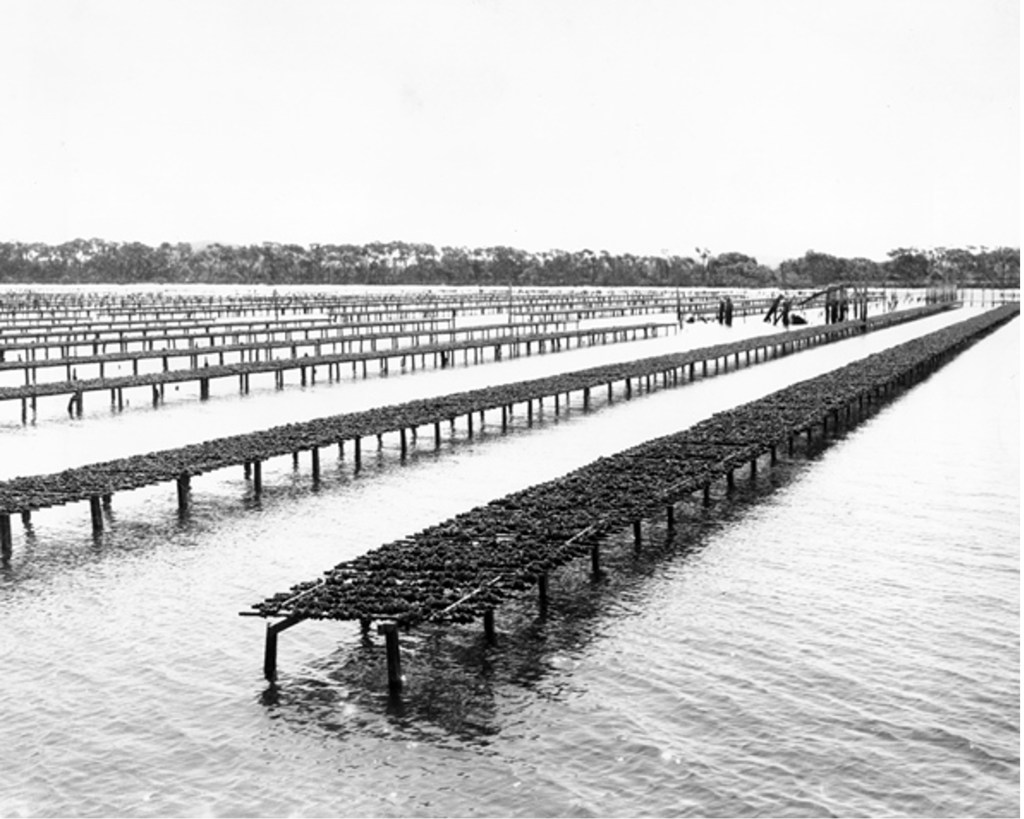
Oyster beds at Port Stephens, 1948 [Newcastle Library]
Port Stephens Oyster sales in Melbourne – 1949
The Smith’s Weekly of 19 November 1949, page 13, reported:
“Close as an oyster” is a phrase that does not fit Theo Marmaras, pleasant , heavy eyebrowed Greek , Melbourne’s world-famous oyster king.
Theo’s eyes shine almost with a light of exaltation when he talks about oysters. And he never tires of talking about oysters. His self-ordained task is to make Australians oyster-minded, conscious of the epicurean treasure they have in the N.S.W. oyster, the world’s most delicious oyster. Theo has almost achieved his ambition in Melbourne, now our greatest oyster-eating city. …..

Caricature of Theo Marmaros [Smith’s Weekly, 19 November 1949]
By 1936 he opened up a tiny shop in Flinders Street opposite the wharves. Today that shop has grown into the world’s largest oyster bar — 98 feet long. ….. In the Flinders Street shop, 14 oyster openers work at top speed and open 2000 dozen oysters a day. All told Marmaras employs 30 oyster openers permanently and ten extra casuals over the spring race meetings. In his three city bars and two country bars, at Geelong and Mildura, he is selling nearly 2,000,000 dozen N.S.W. oysters a year. Last November, C.W. and F.S. Phillips, of Port Stephens, owners of the world’s largest oyster farm, of 1000 acres, became part of the Marmaras organisation, now entitled the Melbourne Oyster Supply Pty. Ltd. It sounds crazy, but shortly the Melbourne Oyster Supply will be selling N.S.W. oysters in Sydney.
Theo believes the time is here when Sydney’s oyster trade should be organised and the locals given an oyster service, equal to Melbourne’s. “That’s the least I can do,” he says. “After all, N.S.W. does supply the oysters!” Marmaras sends his oysters all over the world. They are quick-frozen and sent to Singapore, London, America. He says there is a vast dollar market ready, to be tapped in the U.S.A, but he can send only token shipments at present because, having created an insatiable demand for oysters in Melbourne, he must first try to satisfy it.
Proposed Cancellation of Public Oyster Reserves – 1952
The Dungog Chronicle of 14 June 1952, page 3, reported:
‘The Chief Secretary’s Department advised Port Stephens Shire Council that it had under consideration a suggestion that public oyster reserves be cancelled with a view to leasing those areas capable of improvement as oyster farms and thus augment the production of oysters. The department states: ‘The leasing of public oyster reserves would aid the oyster farming industry and would not adversely affect the public interest, since few of the reserves contain oysters of legal size, though many of the areas could be developed into first-class oyster farms. This would materially increase production of oysters for sale to the public.
The cancellation of the reserves would still leave available for the public oysters on Crown lands on areas not suitable for development as oyster farms.” Oyster reserves within the shire are at West Point (Nelson Bay), an area known as Paddy Marr’s Bar, at the entrance to the Myall River, and the foreshore of Middle Island.
The department asked the council to consider the proposal and advise if it would have any serious objection to the cancellation of all or any of the public oyster reserves. Council decided not to agree to the proposal.’
The Newcastle Morning Herald and Miners’ Advocate of 12 November 1952, page 5, further reported:
‘Port Stephens Shire Council was advised yesterday, that the Chief Secretary (Mr. Kelly) had decided not to cancel the public oyster reserves in the shire. Trustees had been appointed to administer the reserve on the foreshores of Middle Island, but none had been appointed to administer other oyster reserves in the shire. It was requested that three trustees be appointed to supervise the work. The council will invite the Nelson Bay Urban Area Committee to make the selection.’
Port Stephens a Major Oyster Cultivation Area – 1952
The Durham and Gloucester Advertiser of 16 August 1952, page 1, reported:
‘From a survey of Newcastle regions by the Division of Reconstruction and Development comes the information that Port Stephens, in 1948-49, supplied 36 per cent, of the State’s oyster production. Port Stephens is the largest oyster producing estuary in New South Wales.’
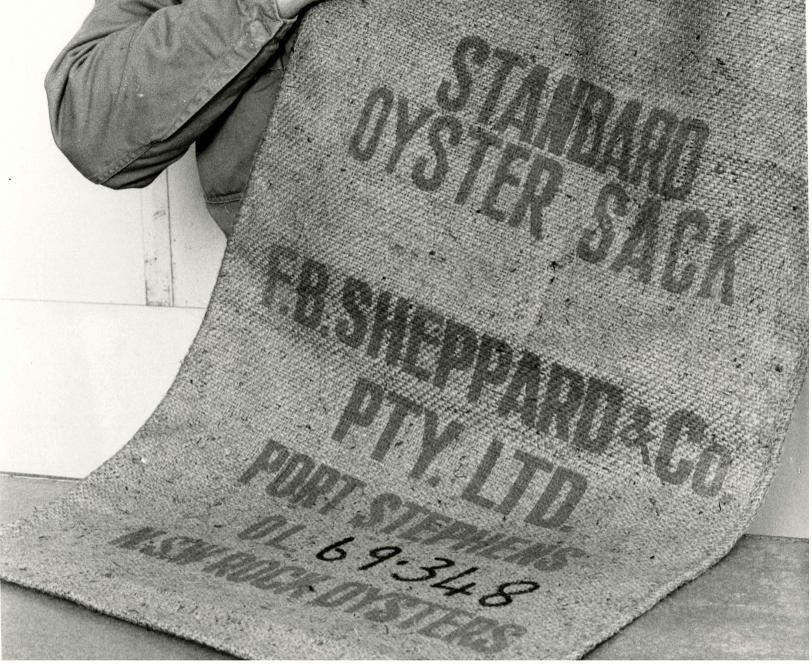
Standard Oyster Sack used by a Port Stephens company
Port Stephens Oysters exported to London – 1952
The Newcastle Morning Herald and Miners’ Advocate of 12 December 1952, page 2, reported:
‘Newcastle Chamber of Commerce has endorsed a plan by a Newcastle businessman to export deep-frozen oysters. A sample consignment of Port Stephens oysters has been well received in London and orders have been received from Melbourne and other centres. The oysters are gathered from clean areas at Port Stephens, washed, cleaned, opened, rinsed in a chlorinated bath, processed, packed, deep frozen and shipped in refrigerated chambers. They are graded into two sizes, the larger for table use and the smaller for cooking. They are packed in moisture proof cellophane, reduced to a temperature of not more than 10 degrees Fahrenheit in not more than 10 hours, and held in deep-freeze till shipment.
Mr. J. Laman, of Ordnance street [Newcastle], who originated the scheme, claimed yesterday that if directions were observed the oysters would taste, look and smell like fresh oysters. The methods of packing and shipping the oysters had been approved by the Medical Officer of Health in Newcastle (Dr. J. R. Shannon) and the London Veterinary Officer. Dr. Shannon said tests of the oysters under simulated shipment conditions showed they should reach the London market in good condition and fit for human consumption. The London Veterinary Officer reported that the sample oysters had been “well received and spoken of very highly.” The Senior Sanitary Inspector of the Port of London said there would be no fear of restrictions on the importation of the oysters.’
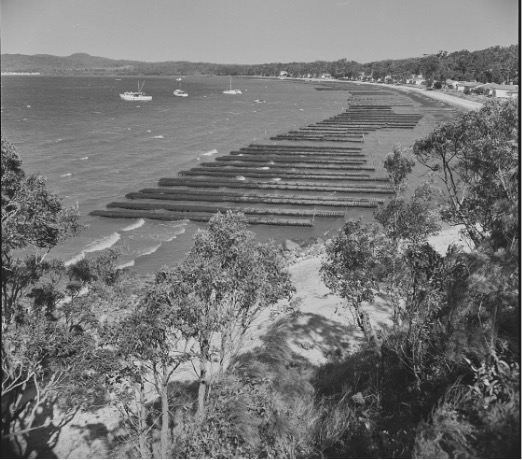
Oyster racks at Salamander Bay, Port Stephens – 1973 [National Archives of Australia]
Local Sales of Oysters
For many years, residents and holiday makers at Port Stephens have had the opportunity to purchase fresh oysters at local fish cooperatives and specialised oyster shops.
A former oyster shop can be found in Marine Drive at Tea Gardens. The oyster shop began advertising its delicacies in 1980 as Tim Motum’s Oyster Hut. In later years the shop was marketed as The Oyster Hut. The final advertisements for the business were published in 1997.

Advertisement for the Oyster Hut [NOTA, 21 September 1991]
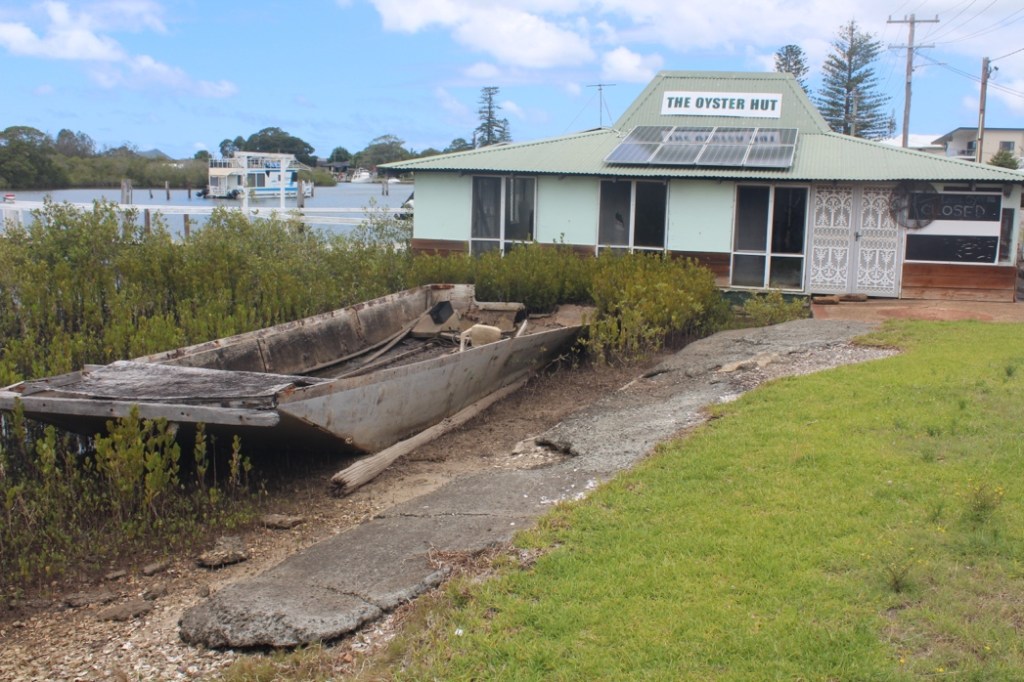
The Oyster Hut which had been closed to commercial trading for several years was demolished during December 2025. A derelict oyster punt lies in the foreground [Author Photo- 2023]
Concluding Comments
The cultivation of oysters has always been a prominent industry in the Port Stephens area with a fascinating history.
A comprehensive work on oyster cultivation in Port Stephens is the book ‘Oysterman – The World’s Biggest Oyster Farm’ by John Clarke published in 2013.
The State Library of N.S.W. and the Newcastle, Port Stephens and Dungog Libraries hold copies of this book.
The following links found on this website also contain useful information on the oyster industry at Port Stephens:
Chinese Fishermen at Port Stephens
Adventures of Spero Spathis – A Greek Fisherman at Port Stephens
Early History of Game Fishing at Port Stephens
New South Wales Fish Company First Fish Processing Facility at Nelson Bay
Commercial Fish and Shark Processing at Pindimar.
Researched and compiled by Kevin McGuinness
May 2025
POSTSCRIPT – September 2025
In recent years there have been numerous instances of diseases and flooding that have damaged oysters under cultivation in Port Stephens.
It was reported in the ‘News of the Area’ [NOTA] of 26 September 2025, that oyster farmers with leases in the Myall River had suffered stock losses worth over four million dollars after a mass mortality event in the industry. Oyster farmers said that their stock had been decimated by run-off from acid sulfate soils entering the estuary.
EPILOGUE
In times past in the Port Stephens area, local oysters were commonly used in cooking. For example, during 1937 the Maitland Daily Mercury featured prize award winning oyster recipes submitted by local readers. The following two oyster recipes were featured.
(1) Oyster Sauce
Ingredients: 6 pieces filleted whiting, 6 oysters, ½ to 1 pint milk, 2 tablespoons butter, 1 heaped desert-spoon flour, 1 teaspoon finely chopped parsley, 3 stuffed olives, salt, and pepper.
Method: Beard the oysters, reserve the beards and liquor, and roughly chop up the oysters. Wash the whiting, removing bones. Double each piece of fish over, skins inside, and roll them round your finger, commencing with the thick end. Secure each roll with a tiny skewer. Melt a little butter in a saucepan, put in fish carefully, just cover the rolls with milk, add the beards and oyster liquor, and a little salt. Cover closely, and simmer gently till tender, from 20 to 30 minutes. Remove the skewers, place the rolls on a dish to keep hot while you make the sauce. Strain the liquid, melt the butter in a saucepan, add the flour and blend well. Stir in gradually one large cupful of liquor, add the parsley, and a shake of pepper. Bring gradually to the boil, stirring well with a wooden spoon, cook for two minutes, remove from the fire, add the cut-up oysters and pour the sauce over, and around the rolls. Place half a stuffed olive in each roll and serve.
Submitted by: Miss Lil Phillips, Pindimar, Port Stephens [Maitland Daily Mercury of 2 November 1937, page 3]
(2) Oyster and Grape Fruit Salad
Parboil 1 pint of oysters, Drain and cool them. Take the pulp from two halved grapefruit, and mix it with the cooled oysters. Add 4 tablespoons tomato sauce, ½ tablespoon Worcestershire sauce, a few drops Tabasco, and a little salt. Fill the grapefruit shells with the mixture, and garnish with curled parsley.
Submitted by: Mrs. R. Campbell, Pindimar, Port Stephens [Maitland Daily Mercury of 2 November 1937, page 3]

 Port Stephens - a history exploration