
Introduction
Around the 1920s, the natural features of Bulahdelah and the Myall Lakes areas began to attract tourists.
In 1924, two newspaper articles were published highlighting the widespread natural features of this area of Port Stephens. These articles were titled Nature in all her Beauty and The New Garden of Eden’.
Both articles describe the geographic region surrounding Bulahdelah and the Myall Lakes.
The second article details the journey of a steam drogher transporting a load of timber from Bulahdelah to Tea Gardens. It also tells the story of its hardy engineer.
A Description of Bulahdelah and its Landscape – 1924
The Daily Telegraph of 2 August 1924, page 13, published an article written by B. Cecil Doyle, describing the Bulahdelah area which was described as ‘Nature in All her Beauty’:
‘Away on the banks of the Myall River, seemingly remote and yet quite accessible, lies one of my dream holiday spots, the mountain-guarded town of Bulahdelah. It is the jumping-off place for the Myall Lakes, which are not nearly as well-known as they should be, an Eden of delight for the sportsman, or the beauty-seeker, or merely those tired spirits who, in Kipling’s poem, seek the Islands of the Blest. …..
The way leads through the hills, where one meets few travellers, save for the bullock teams lurching along (for here one touches the timber country), a coloured hawker with his dog following patiently behind, or an infrequent car. But the road is one of the loveliest we have, for I think every variety of wildflower grows there. Long ago, there must have been more settlement, for here and there are old, deserted dwellings, with peach trees lovely in pink blossoms about them, and gnarled-looking lemon trees laden with yellow fruit, while, in the grass, patches of white fleur- de- lis have weathered all the summers that have passed, and the tramping of wandering stock. I remember how sweet the bushes of the old pink monthly rose were, and how beautiful was a bend of the road where a mauve wisteria wandered over a tangle of dogwood, I suppose all that remained of some early traveller’s hut.
High up on a mountain are a few houses and a lonely, little post-office, and it was there we found things reversed, for the wild gigantic lilies were blooming in a garden, and arum lilies were in the paddock and by the roadside, growing out of stumps and by logs. Beyond here again is another mountain, one of the many so-called “big mountains” in New South Wales, where the road makes a series of dips and bends, and in the spring, it is all of an indescribable loveliness. Clematis grows everywhere. One can snatch trails of it from the car, for it festoons all along the way, and Wonga vine and purple sarsaparilla spill over the cuttings, and drape the fallen timber, while golden pea-bush and wildflowers scatter the way all along, pink and white and yellow, and the delicate blue of wild sage.
Looking away to the left there are the most wonderful glimpses where the hills give a distant view of far purple mountains and one looks down on the trees soaring heavenwards, tall stringy bark, straight as a reed, flooded gums, peppermints, and blackbutts, most magnificent timber rising from the ferny undergrowth. Then the road dips again, and the scent of damp bush ways is in the air, where bracken clothes the mountain sides, and maiden-hair fern springs from banks of vivid green moss. Farther on, if the sun is shining, there is an unforgettable glimpse of distant Bulahdelah, with the Alum Mountain behind its glistening whitely in the gleam of light, something dream-like and unreal in the vision splendid, so that it is strangely reminiscent of one of Turner’s pictures.
The Regent and Lyre birds and all kinds of feathered songsters hold carnival in the gullies where there grows a beautiful red creeper I have not been able to find the name of. All along, too, there are patches of the beautiful pinky mauve boronia so familiar on all the flower kiosks in Martin Place, with tracts of wild may like a white cloud slipped down from the sky, starred with purple five-corners and wild orchids. On the level country towards Bulahdelah there are acres of boronia. One can just walk straight ahead and pick and pick until one is tired, and goes back carrying one’s sheaves of the lovely, fragrantly scented thing.
Over the white bridge the town dreams on the rising green banks of the Myall River, with its wharf where there is usually a steamer loading great stacks of sawn timber, for quantities are “lifted” here. And Bulahdelah, further, has the distinction of possessing the only alum mountain in the world, for, though there is an alum mine in Italy, it is underground. This is one of the rhyolite flows which by the action of thermal springs has been altered into Alunite (hydrous sulphate of alumina in potash), which has been quarried on a large scale for the manufacture of alum. The “Geological Handbook” informs us that “another feature of possible economic importance is the occurrence of numerous beds of titaniferous magnetite interstratified with the Upper Carboniferous Series.”

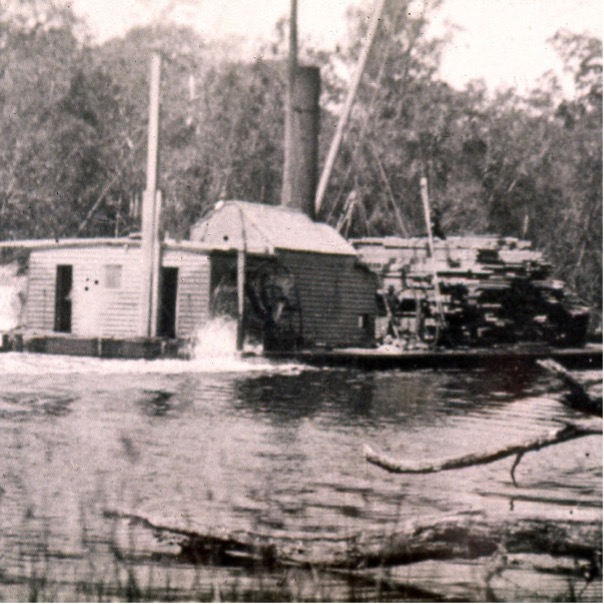
The waterfront at Bulahdelah in 1924. At the wharf is a steam drogher that plied to Tea Gardens and two alunite hoppers, awaiting transport to Tea Gardens [Sydney Mail, 20 August 1924]
Looking at the mountain, it always seems to me like a cascade that has suddenly turned to stone, so peculiar is the formation. In an unguarded moment once we started to climb the mountain, for we had been told that it would only take half an hour to reach the top, and that from there we would be able to see Seal Rocks and Broken Bay, and right over Port Stephens. The line is almost perpendicular, for the trucks are worked with wire ropes and a winch, and up this Via Dolorosa we climbed until the going was pain; then we came out amongst the rocks, which are all pitted and discoloured with charges, and, looking up, the steep rocky pinnacle, with its stunted trees, seemed as far away as ever.
There were rock lilies growing there, the creamy whiteness of them making beauty amongst the grey rocks, and flowers everywhere, though the mountainside reminded me of the haunt of Elsie Venner: it looked stony enough, and there were wild raspberries and wild hops, white and blue sago, and golden broom, while vines twisted about one’s feet. If the going up was bad, I am not sure that the going down was not worse, for one’s progress was a slide amongst an avalanche of falling stones. But the view was worth it all, even if we did not get to the summit, for we had tree-framed glimpses of the river glistening like new silver in the sun-shine, winding out of the hills and through the green land; and, looking down the long, straight tram-line out through the timber, the light flashed on the steel lines along the skids, and we saw the marble whiteness of tons of alum waiting to be crushed and burned.
Someday I hope to start in the early morning hours and get to the top of the mountain, but I shall take a thermos with me, and I will make my jumping-off place the end of the tramline if there are some trucks going up. Even if I fail to reach the top of the pinnacle, I shall see again the silver river leaving the purple-shadowed hills far away and winding through the valley somewhere safe to the dreaming blue of the wide waters of the Myall Lakes.’
Trip from Bulahdelah to Tea Gardens on a Steam Drogher
The Sydney Mail of 20 August 1924, page 37, published an article written by M. G. Skipper, titled ‘The New Garden of Eden’ that described the correspondent’s journey on a steam drogher, named ‘Lily of the Valley’ that was transporting a load of timber, from Bulahdelah tos Tea Gardens:
‘The pleasantest spot on the s.s. ‘Lily of the Valley’, carrying hardwood logs from Bulahdelah to Tea Gardens, via the Myall River and the Myall Lakes, was about ten feet from the stern on the port side, for this was the position of the furnace door. Every time the one-eyed engineer threw on a fresh shovelful of coals or stuffed another log under the boiler we felt as if we had come into a cosy parlour out of a snowstorm; and every time he closed the door we felt as if we had been turned out into the night again. The engine-room being unenclosed, the cold mists rose up from the river and curled about our spines as we sat on the rail, and so, from two in the morning, when the voyage began, until the sun came out, our fronts alternately froze and thawed, while our backs froze all the time.
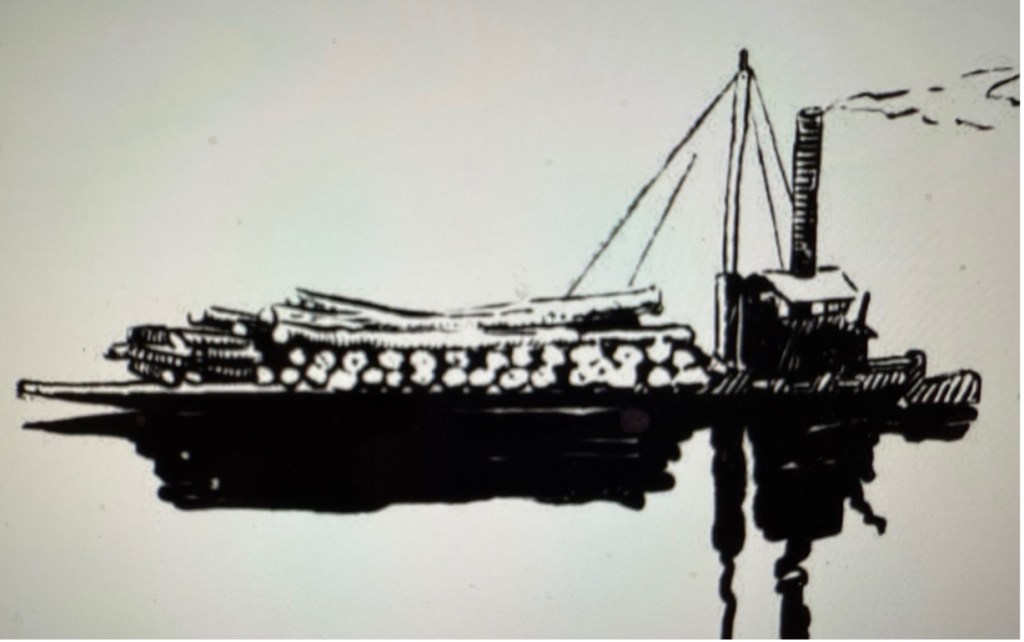
‘Lily of the Valley’ steam drogher loaded with timber [Sydney Mail, 20 August 1924]
We had engaged our berths on our arrival at Bulahdelah late the night before, on the assurance of the engineer that the ship would sail as soon as he could get pressure on the boiler, which might be two hours and then again it might be ten, and we would arrive at Tea Gardens about twelve hours later if the boiler didn’t blow up, which he had been expecting it to do any day these two months: so we went to bed early in a hotel overhanging the river and woke up from time to time to hear muffled sounds of stoking from below us and occasional bursts of lonely swearing: and about two o’clock the whistle blew.
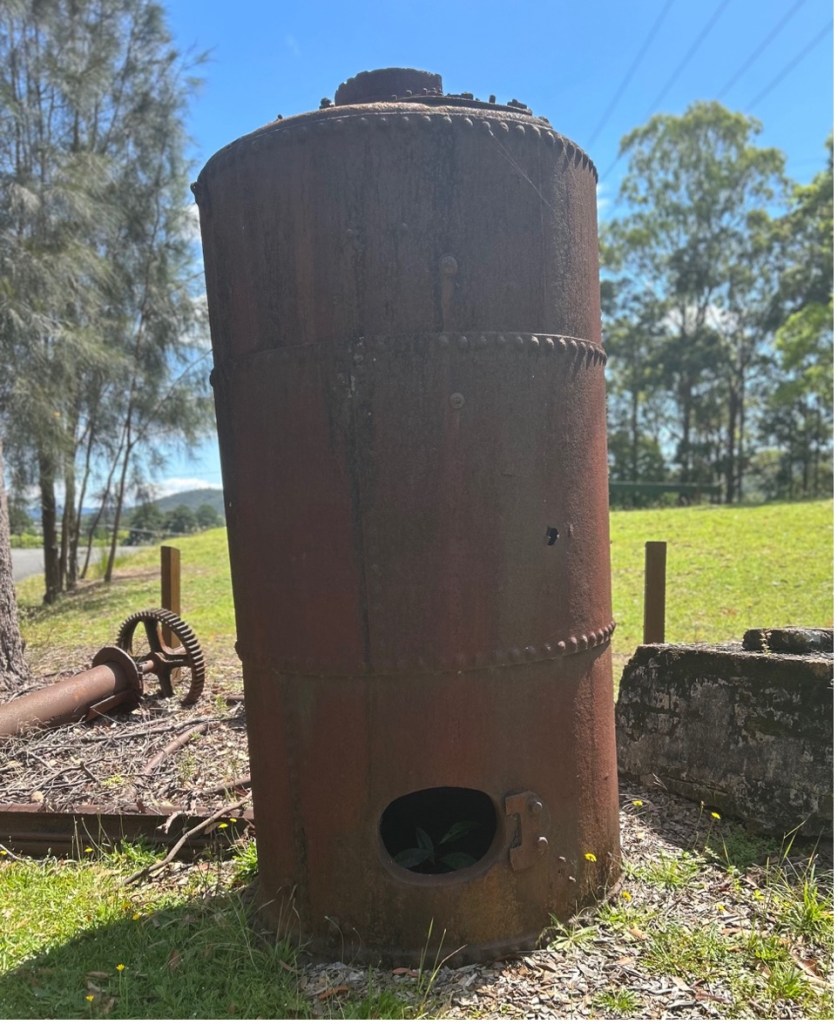
A drogher boiler onsite at the Bulahdelah Court House Museum [Author photo]
“The other blokes are sleeping up the town, but they’ll be down in half a shake,” the engineer explained, and awoke the echoes of the hills once more. The engineer of the ‘Lily of the Valley’ was a museum of industrial misadventures. He had lost two fingers of his right hand and the thumb of his left in a sawmill on the Manning: an ancient scald acquired in a boiler explosion on a Tweed steamboat, disfigured one side of his face, and his left eye had been destroyed by a rock-splinter on a drain laying job in Newcastle. “But that ain’t nothing,” he declared, ”to the things I could show you if the lady wasn’t present.”
He adumbrated by gestures the existence of worse horrors hidden by his suit of dungarees. ”I got the stiff knee in a goods yard loadin’ trucks. That cost the Department £200 and kept me in ease and luxury for a bloomin’ twelve months. Them fingers and thumb was worth £50 each, I reckon, but the Court cut it down to £25 apiece. They treated me shabby over the eye. A bloke doesn’t lose an eye for nothing: but I got it out of them when the donkey boiler exploded — £250 and hospital expenses. And I didn’t need to look for work for years after that, except a little fishing.”
He flung the furnace door open and threw in another shovelful of coals. “I’ve heard of famous pianists insuring their fingers against loss, said Eve, ‘but this is a profession new to me.” ‘Well, I wouldn’t hardly call it a profession,” said the engineer modestly; “but a cove has got to live, you know.” “Aren’t, you afraid someday you’ll blow your head off by mistake?” asked Eve. “While we are in life we are in death, Miss,” said the engineer. “A bloke ain’t worth his salt, if he won’t take a sporting risk sometimes.” “They tell me it’s a better paying job in New Zealand,” he went on. “They gotter better Act there. But I reckon this last knockout is good enough for me.” He indicated the region of his solar plexus. “Cage fell on me in a mine. My lawyer says it’s worth £700 if it’s worth a penny. I’ll chuck it then and buy a little house and settle down.” “Isn’t the captain taking a risk in employing you?” said Eve, thinking of the aged boiler. The engineer opened the furnace door and spat into the interior. “Have a heart, Miss.’ he said. “I wouldn’t play a dirty trick like that. We’re all friends aboard this ship!”
The whole cargo of the ‘Lily of the Valley’ was stowed forward, and consisted of 100 great hardwood logs destined for New Zealand laid crosswise on her nose, and forming a broad platform on which, when the sun came up and dispelled the mists, it was pleasant to lie and watch the changing colours of the shallow river bottom, the shoals of fish scattering at our approach, the fiddlers with Javanese patterns on their backs nosing out of sight in the weeds, and the stingrays like black vampires fleeing on either side. The blue sky without a cloud showed down the long lane of trees, and the warm air and the procession of casuarinas, banksia, flooded gums, and grey gums, laced about with creepers and loaded with elk and stag horns, filled our minds with a dreamy lassitude, which the three-knot speed of the ‘Lily of the Valley’ did nothing to disturb.
Now and then a kingfisher like a glowing sapphire flung itself along the bank, and stalely fish-eagles with well-laundered fronts stared down from dead limbs at our humble equipage with well-bred scorn. About five hours after leaving Bulahdelah we left the river and entered a shallow lake hemmed in by low blue hills, and from the lake poked our way into a still narrower avenue where our load of logs was sometimes too broad for the width of the stream and went crashing through the bush on either side in a fashion which brought showers of leaves and twigs down upon the deck and storms of protest from the birds.
This was the river in which, shortly before, McIntyre had made a landing [in a sea plane] on his historical flight around Australia. But the ‘Lily of the Valley’ did not concern herself with what goes on in the sky. She was a humble but useful craft with important business of her own. Like a dog with a bundle of sticks in his mouth she forged her steady way down to Tea Gardens, and there triumphantly laid the bundle on the bank not far from the entrance to Port Stephens. That noble estuary, the depth of whose entrance varies from a hundred to twenty feet according to whether you are a New Stater or an anti-New Stater, is to be the port of the future province— that is, unless Coff’s Harbour, Nambucca, Port Macquarie, or any of the other dozen of inlets and estuaries and river-mouths we have visited succeed in making good their claim. There will probably be war over it. Port, Stephens can at any rate lay claim to having most of Sydney’s good looks, whatever the truth about its entrance.
We ran up the harbour from Nelson Bay, along wooded shores that only needed red-roofed houses and a few gaunt blocks of flats to be replicas of Sydney’s, while the heat mirage played queer tricks with the distant headlands. Further up, the harbour narrowed into numerous shallow inlets given up to the culture of oysters. We steamed up one lined each side with oyster leases, where Sydney’s most famous edible bivalves are reared. Australia’s oyster king was with us. He had invested a fortune he had made out of stout appropriately in oysters: perhaps the association of ideas had suggested it to him. …..
At Saltbush [Salt Ash] the launch passengers dispersed in various ways. Some crowded themselves into a motor charabanc, one unearthed a motorcycle from the back of a shop, while the oyster king, was spirited away, lonely in a beautiful six-seater. We followed in the general dust. …..
Concluding Comments
Further information on the Bulahdelah and Myall Lakes area can be found at the following links on this site:
The Lakes Travel Route to Mid-North Coast – 1907
A Journey from Port Stephens up the Myall Lakes to Forster – 1908
A Reflection on the Beauty of Port Stephens – 1954
Journey from Maitland to Port Stephens – 1889
Early History of the Timber Industry in the Myall and Port Stephens Areas
History of Mining at Alum Mountain – Bulahdelah
Store Boats of the Myall River and Lakes
Scientific Surveys of the Myall Lakes – 1934/5
Researched and compiled by Kevin McGuinness
May 2025

 Port Stephens - a history exploration