
Introduction
The Australian War Memorial in Canberra holds the War Diary for the Tomaree Coastal Artillery Battery at Shoal Bay, Port Stephens, for the period March 1942 to February 1944.
The Tomeree Battery was located on Tomaree Headland at Port Stephens and was also known as Fort Tomaree.
The Battery was under the control of the Newcastle Fixed Defences Command and had close operational ties with the military facilities at Fort Scratchley in Newcastle, and also the Stockton Wallace Battery.
The Tomaree Battery was manned by up to 500 military personnel from 1942 to 1944.
From the war diary records of the Australian War Memorial, this paper tells the story of the Tomaree Battery.
The diary entries include military acronyms, some of which may not be able to be interpreted by readers of the diary entries, however this does not diminish the value of the material which demonstrates the varied operations of the Tomaree Battery.
The guns at Tomaree Battery were never fired in ‘anger’ but they were used on numerous times to warn off ships from entering Port Stephens which was then a ‘closed port’ to civilian and commercial craft.
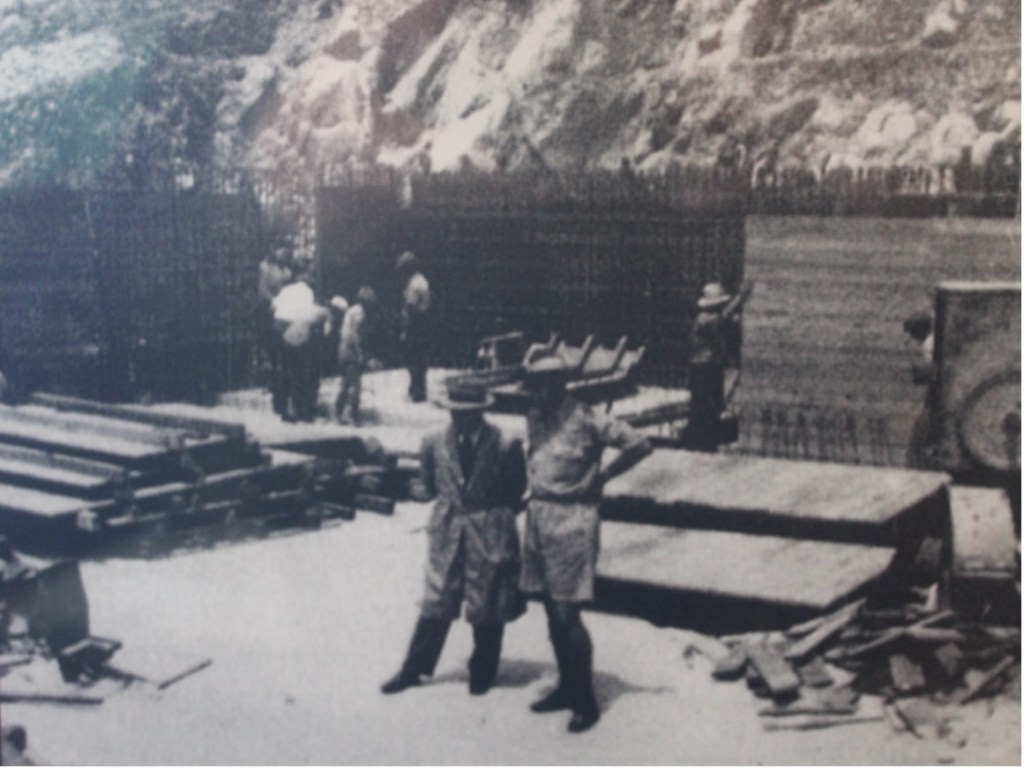
One of the 6-inch gun emplacements under construction at Mount Tomaree, circa 1940
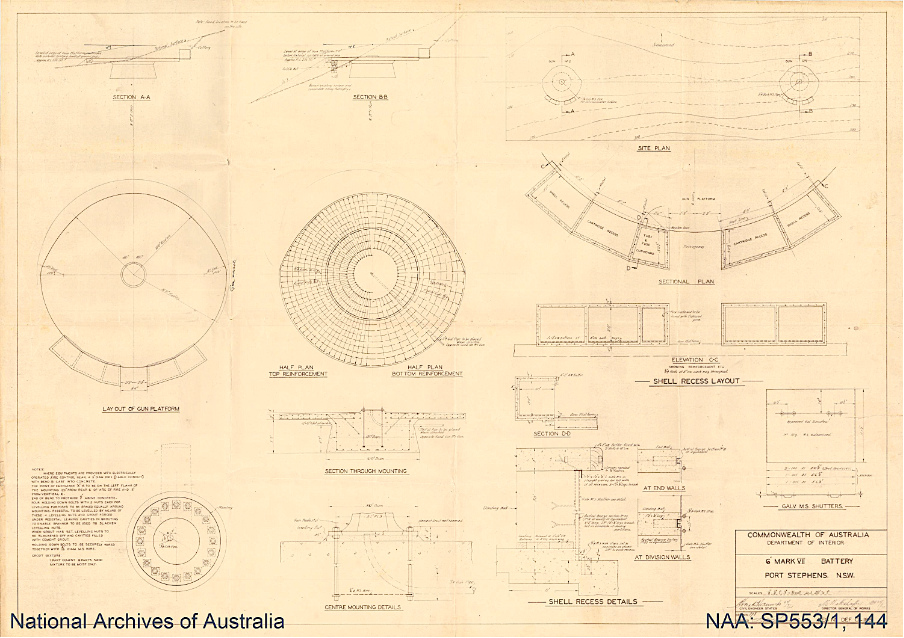
Plan for the two 6-inch Mark VII B gun emplacements and associated infrastructure at the Tomaree Battery, prepared by the Commonwealth of Australia, Department of Interior [National Archives of Australia]
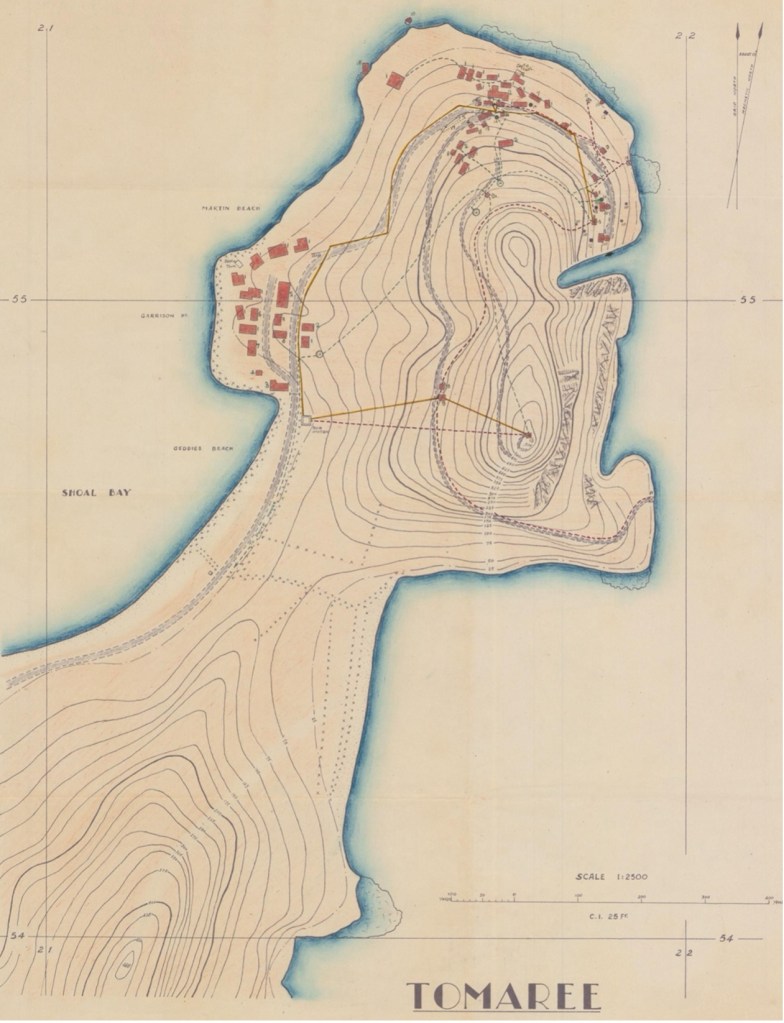
Map of the facilities at Tomaree Battery [National Archives of Australia]
When operational, the Mount Tomaree Battery consisted of the following components which are all covered in the diary entries:
- Lower and Upper Camp areas that comprised buildings utilised for accommodation, office, storage and operational purposes, with an associated infrastructure such as water pumps, roads and sanitary services. The upper camp was primarily used by the R.A.A.F. personnel.
- Torpedo Tubes on Tomaree Point.
- Three-pounder Gun emplacement on Tomaree Point, at ground level.
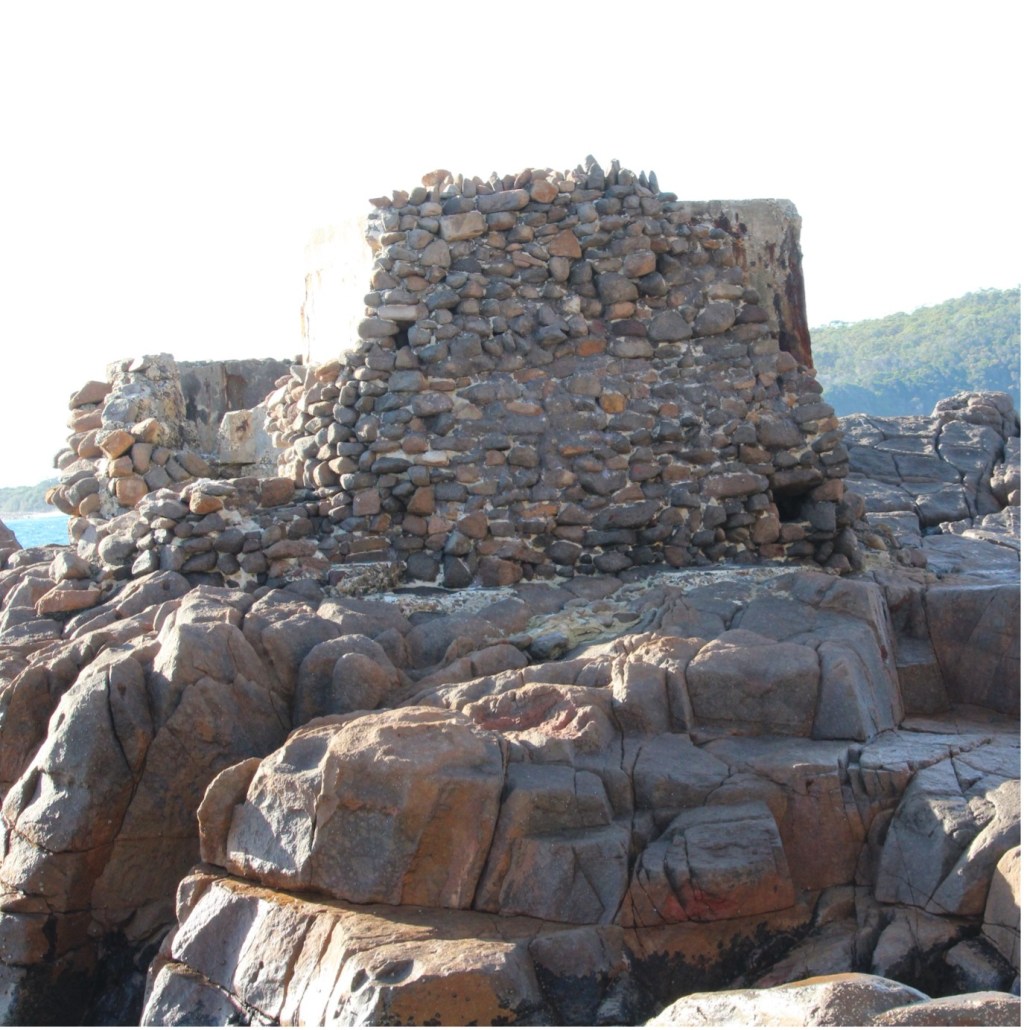
- Two six inch gun emplacements with associated infrastructure mid-way up the northern side of Tomaree facing the ocean.
- Three-pounder Gun gun emplacement and an observation post on the eastern side of Tomaree facing the ocean.
- Several machine and light posts across various parts of Tomaree.
- Radar facility on the summit of Tomaree operated by RAAF personnel.
- Radar detection system on Point Stephens [Fingal Island]
- Dummy Fort on Yacabba [northern headland].
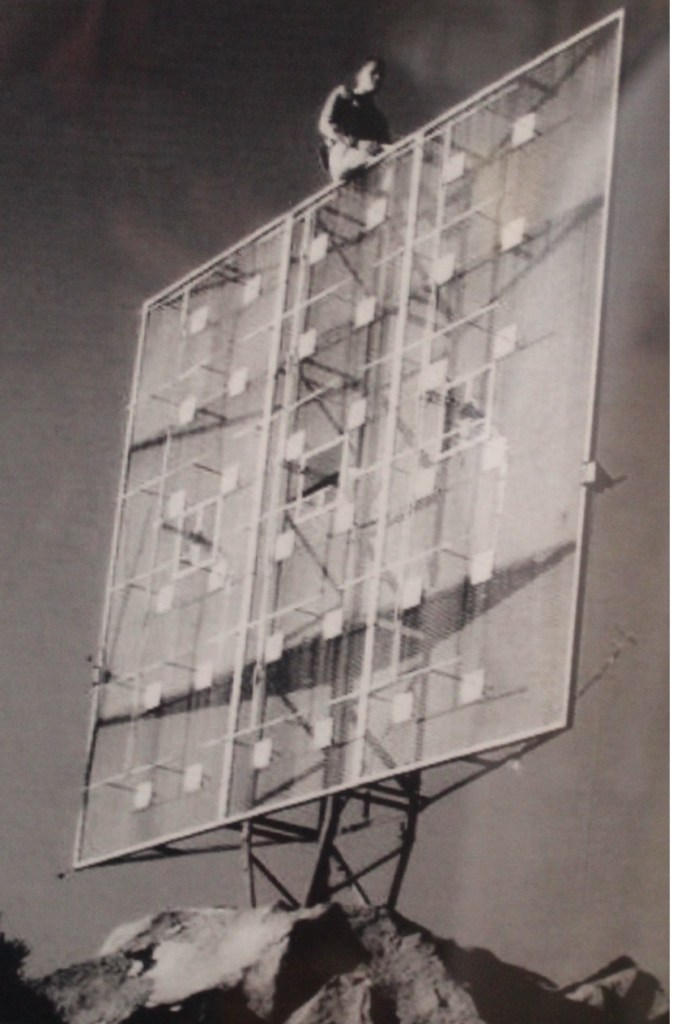
Radar Station located on the summit of Mount Tomaree showing a camouflaged base
From the diary entries the following information can be furnished:
- The Fort housed Army and RAAF personnel.
- Two R.A.A.F personnel were drowned in June 1942.
- Volunteer Defence Corp [V.D.C.] personnel trained at the Fort.
- Surf bridges were used to access No 1 and No. 2 Gun Emplacements Surf Section and also the Rock Gun emplacement.
- Port Stephens was a closed harbour and required military permission to enter and exit.
- One of the gun emplacements was camouflaged to resemble a small cottage.
- A camouflaged motor garage was erected adjacent to No 1 6 inch gun.
- A dummy Battery site and location finder was installed on Yacabba headland.
- Telephone connected Rock [Battery] to Teddy. [Summit radar]
- A Type 271 Radio Direction Finding device was installed on Point Stephens in July 1943.
- Torpedoes Tubes were removed in June 1943 and sent to Sydney with torpedoes.
- War Cemetery opened in Nelson Bay, adjoining existing civilian cemetery.
- Pack horse team commenced daily ration run to Stephens Point via Sand Spit in August 1943.
- Lower Camp area disused from August 1943.
- Datum post installed on Wonderbah Beach (near Yacabba).
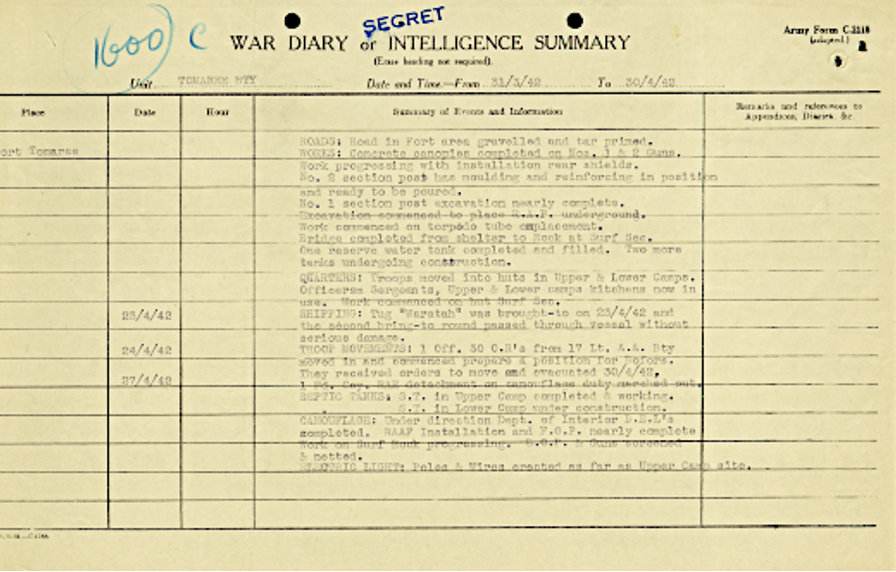
Copy of the first page of the War Diary of the Tomaree Coastal Artillery Battery
The majority of the diary entries were prepared by Major C. G. Davies, O. C. Tomaree Battery; Major R. S. Mort. Officer Commanding Tomaree Battery, and others.
An Appendix sets out a complaint made by the master of the ‘Desikoko’ ship which had warning shots fired at it from the Tomaree Battery, intended to stop it entering Port Stephens, which was then a closed port. The ship’s master claimed that the warning shots had come close to injuring persons on the ship.
THE DIARY ENTRIES
Initial Diary Entries – 31 March 1942 – 22 April 1842
ROADS: Road in Fort area gravelled and tar primed.
WORKS: Concrete canopies completed on Nos 1 and 2 Guns.
Work progressing with installation rear shields
No. 2 section post has moulding and reinforcing in position and ready to be poured
No. 1 section post excavation nearly complete
Excavation commenced to place R.A.P. underground.
Work commenced on torpedo tube emplacement.
Bridge completed from shelter to Rock at Surf Section.
One reserve water tank completed and filled. Two more tanks undergoing construction.
QUARTERS: Troops moved into huts in Upper and Lower Camps.
Officers
Upper and Lower camp kitchens now in use. Work commenced on hut, Surf Section.
Daily Entries Commencing 23 April 1942
1942
23 April
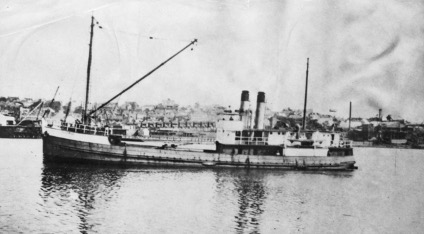
SHIPPING: Tug ‘Waratah’ was brought-to [came to a standstill] on and the second bring-to round passed through vessel without serious damage.
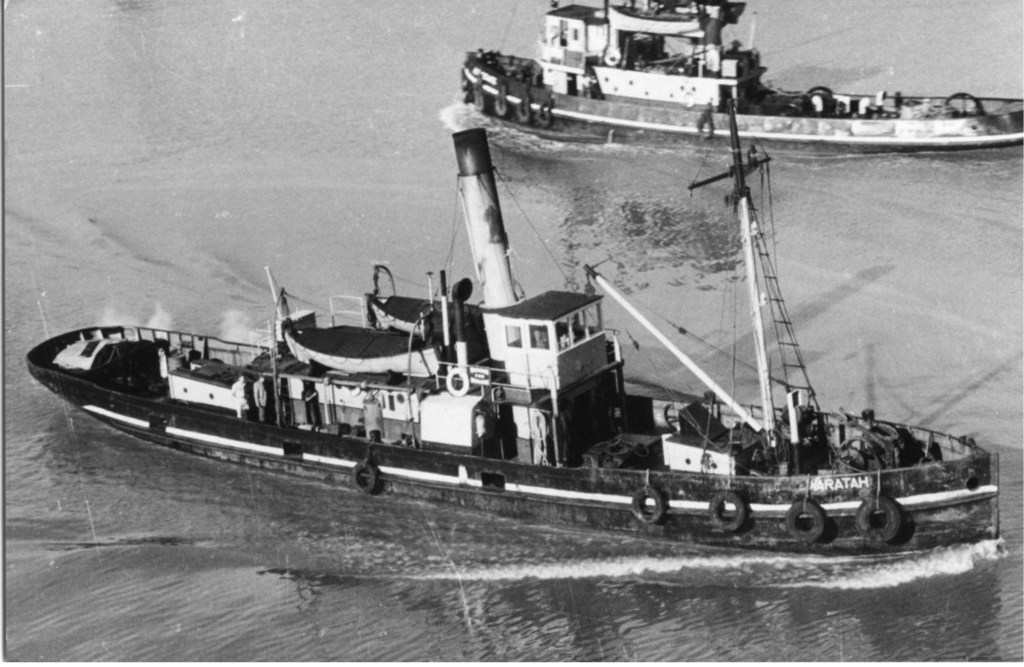
‘Waratah’ in Newcastle Harbour [City of Sydney Archives]. ‘Waratah’ tug was built in 1902 and now forms part of the Sydney Heritage Fleet
24 April
TROOP MOVEMENTS: 1 off. 30 O.R’s from 17 Lt. A.A. Battery moved in and commenced prepare a position for Bofors. They received orders to move and evacuated 30 April.
27 April
1 Fd. Company RAE detachment on camouflage duty marched out [left the camp].
Septic tank in Upper Camp completed and working. Septic tank in Lower Camp under construction.
CAMOUFLAGE: Under direction Department of Interior D.E.L’s completed. R.A.A.F. installation [on summit of Mount Tomaree] and F.O.P, nearly complete.
Work on Surf Rock [at Tomaree Point] progressing.
B.O.P. and Guns screened and netted.
ELECTRIC LIGHT: Poles and wires erected as far as Upper Camp site.
2 May
Road through Fort tar sealed.
4 May
Test round half charge fired from No. 2 Gun to test flash in No. 2 Section Post, Flash does not interfere.
6 May
No. 2 [Gun] Piece changed No. 1747 and replaced by No. 1791.
20 May
Rear shields completed.
21 May
Electric Light and power switched on in upper and lower camp.
25 May
Nos. 2 and 3 Reserve water tanks now filled.
10 June
Bomb seen dropped from plane approximately 20,000 yards, bearing 120 deg. duty officer, head office, informed.
26 June
Two R.A.A.F. washed off rocks while fishing and drowned.
27 June
Front shield for No. 1 arrived.
29 June
Both Section Posts completed and camouflage proceeding.
Concrete work on B.O.P. almost complete.
Electric installations complete on No. 2 Gun and B.O.P.
Filling on top of and between both Guns nearing completion.
No work has been done during month on new R.A.P.
Septic tank installed for F.O.P. Water supply through to F.O.P.
Torpedo Tubes completed and awaiting dredging operations before trials are carried out.
Camouflage of Surf Rock nearing completion.
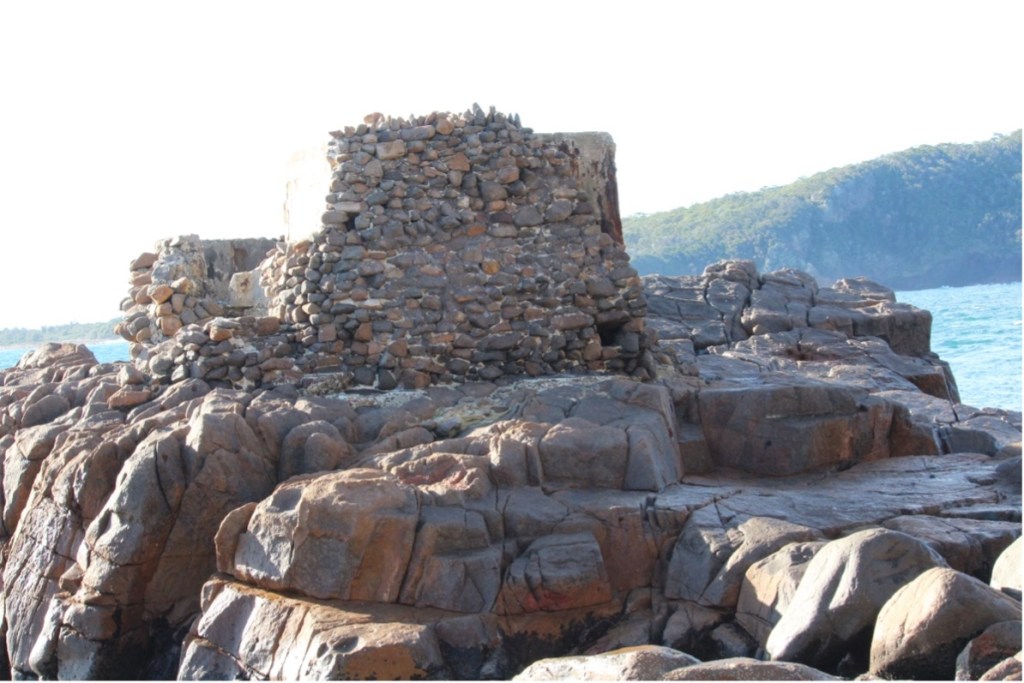
Surf Rock Gun Emplacement [Author Photo]
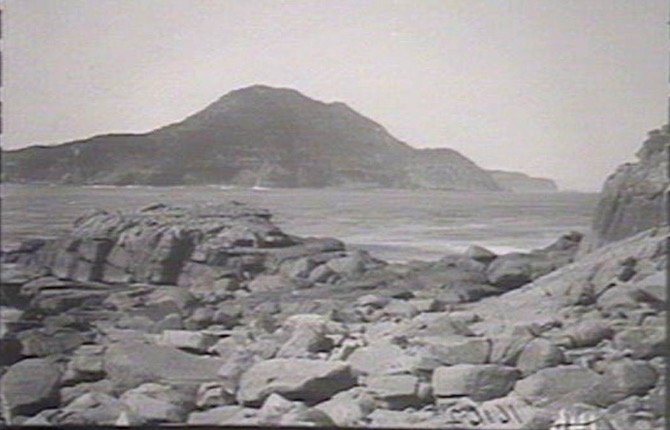
Rock formation before the placement of the Gun Emplacement in 1942
7 July
1st. Medium Section manning Battery, Marched Out [left camp, having been transferred elsewhere].
20th Garr. Bn. guard on Guns and ammunition.
23 July
Heavy rain commenced and was still falling at the end of the month (8 to 10 inches to date).
Drainage problems have occurred over whole hillside. Level banks have proved effective
The main road through the camp has subsided on the edges in many places. Road to No. 12 Engine Room cannot be used after heavy rain.
27 July
Launch ‘Myee’ launched,
Work has been complete on Surf Section Post and work on No. 1 Gun (Surf) is progressing.
Concrete B.O.P. is occupied and No. 2 Section Post is ready for manning.
Torpedo Tubes not yet in operation, but dredging is continuing.
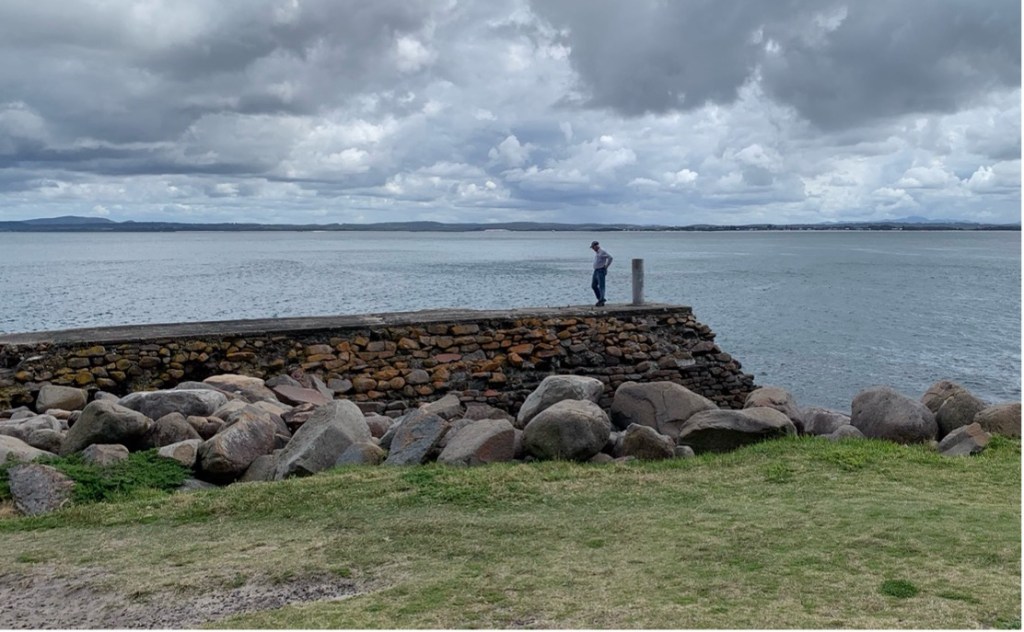
Base for Submarine Tubes [Author Photo]
10 August
Torpedo Tubes tested, 2 Torpedos without war heads fired.
18 August.
Torpedo tubes manned by Naval personnel, 2 Torpedos loaded ready for action with two in reserve.
21 August
Surf Section – 3 pounder mounted and ready for action.
22 August
No. 1 Gun Surf Section manned (3 pounder).

Two ‘Surf Section’ gun and observation posts, Mount Tomaree. Named No. 1 (left) and 2 (right) Gun Emplacement, Surf Section [University of Newcastle, Living Histories Collection]
19 August
Surf Section post completed and occupied.
28 August
V.D.C. [Volunteer Defence Corps] personnel marched into Head Battery.
28 August
Neap Spring Tides washing over No. 2 Gun Emplacement Surf Section.
Portion of Surf bridge washed away at No. 2 Gun.
1 September
R.A.A.F. Picquets [military guard] posted on F.O.P. path and top of hill.
5 September
5 Thompson sub machine guns received.
18 pounder Ammunition stored in gun floor passage ex Yacabba.
18 pounder ex Yacabba taken to Ordnance.
5 September.
Alarm system installed at Surf quarters.
6 September
Bullet proof glass installed in magazine windows – replacing shatter proof.
9 Recruits received – replacing 9 marched out to north.
9 September
Major Emery (D. of A.) took photos of guns – Bearing and range dial locations.
13 September
Visit from Senator Fell, V.D.C.
16 September
Visit from Mayor of Newcastle and Sir Alfred Davidson.
M. L. ‘Myee’ fitted with lifesaving gear and signalling equipment.
21 September
Shield brackets received for No. 2 6 inch gun.
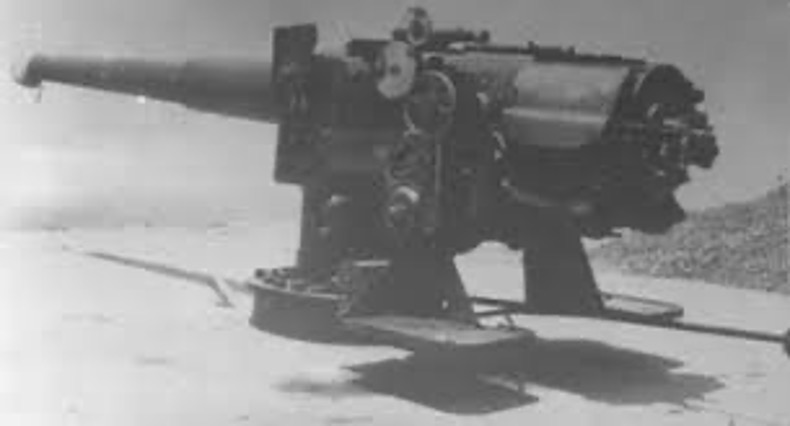
A 6-inch gun at the Tomaree Battery. The guns were nearly 8 metres long. The photo was taken before the installation of a shield designed to protect the gun crew.
23 September
18 pounder, ex Ordnance mounted at Head Battery
24 September
18 pound Ammunition delivered to Head Battery – ex Tomaree magazines.
Bearing and range phones fitted to both 6 inch guns.
26 September
Visit from O.M.E. who checked both 6 inch guns for droop and wear
Visit from O.M.E. No. 1 Gun surf proofed – 3 rounds.
27 September 1942
No. 2 Section post fitted with speaking tube.
No. 1 Section post fitted with loud speaking equipment.
Foot dip switch installed on B.O.P. microphone.
18 September
Signal room installed at rear of B.O.P.
Construction of No. 1 gun floor surf, progressing steadily.
29 September
Illuminating gear fitted to No. 1 gun Surf section
Visit from G.O.C. and C.F.D. and party.
30 September
Broadcast in foreign language (unidentified) picked up by 101 receiving set. Frequency 6.5 in cycles.
1 October
‘Bring-to’ bracket fitted to No. 1 6 inch gun.
12 to 14 October
Mounting of No. 2 6 inch gun shield completed.
Visit from Lt. Gen. Mackay and party.
Severe storm damage as per separate report submitted 16 October.
18 October [see below].
Separate Storm Report
Fixed Defence Command, Nelson Bay
16 October 1942
Sunday, 11
Seas rose shortly after night fall and increased towards midnight. Gun lookouts were recalled from No. 1 3 pdr. Surf Section (height 24 feet) and No. 2 – 3 pdr. Surf Section (height 19 feet) at approximately 2130 hours.
Monday 12
Terrific seas now running with wind at cyclone force. Camouflage roof of B.O.P. partly torn away, sheets of iron roof found 150 yards away. Both 3 pdr. gun emplacements continually awash; telephone on No, 2 – 3 pdr. gun floor washed to sea; bridge from gun floor shelter to No. 2 – 3 pdr. commenced to break up. At 2230 hours Surf section Port (height 68 feet) awash; pyramid switchboard on wall put out of action by constant heavy seas; look outs recalled. Also B.E.L. personnel recalled. Inspected by Battery Captain who ordered Surf Section top ‘stand down’
Monday 13
Mountainous seas now tunning. Bridge at no. 2 – 3 pdr. rapidly breaking up; both guns and Section Post continuously awash; gun floor shelter at No. 2 – 3 Pdr. broke up completely within an hour at approximately 1100 hrs., most articles of value being salvaged. Seas now breaking over No. 13 Light emplacement (72 feet); shutters on southern side carried away, also portion of camouflage. Projector and accessories salvaged. Camouflage on A.A. L.M.G Posts torn away. O.C. inspected No. 1 Surf at low tide and found ammunition to be apparently dry although boxes extremely wet. Hand grip on shoulder rest broken off and recovered.
Wednesday 14
Seas now at their worst, all Posts previously mentioned continually awash plus No. 1 – 6-inch gun (height 175 feet) being continually sprayed.
Numbers 12 and 13 C.A.S.L’s not expected this night as both emplacements were subject to continuous heavy spray. Roof of shed over torpedo tubes partly carried away.
Thursday 15
Seas still too high for inspection or maintenance of equipment.
Friday 16
C.C. inspected Nos. 1 and 2 guns Surf Section and found both in extremely rusty state, instructed Section Commander to strip all moveable parts and carry out maintenance. 303 rifle fitted to No. 2 gun is practically ruined. Two boxes of ammunition on No, 1 Surf found to contain approximately 6 – 8 inches of water. ammunition in no. 2 ammunition recess in excellent order.
Signed: R. S. Mort, Major.
Officer Commanding Tomaree Battery.
27 October
‘Bring-to’ bracket fitted to No. 2 6 inch gun.
28 October
Surf bridge to No. 2 gun replanked after storm damage.
Portion of B.O.P. camouflage roof replaced after damage by storm.
29 October
Work commenced on roadway landslide between upper and lower camps, under R.A.E. supervision.
6 inch half charge practice seaward – 12 rounds.
30 October
3 pounder practice seaward -2 series – 40 rounds.
No. 14 C.A.S.L. emplacement erected.
Turning point on Battery roadway practically completed.
M.V. ‘Myee’ still beached and undergoing repairs.
Camouflage work on Surf section Post held up temporarily.
No. 1 Surf emplacement concrete work completed, gun floor shelter yet to be erected.
3 November
H.A.M.S. ‘Assault’ now on Tomaree switchboard (extension 28)
12 troops marched out to headquarters [at Newcastle].
6 November
Watermain burst adjacent to gravity tank, repaired by R.A.E.
8 November
No. 2 6 inch gun elevating gear rebushed.
9 November
‘Myee’ relaunched after repairs.
C.A.S.L’s discontinue all night search, No. 12 sentry beam BRG. 052 degrees.
11 November
D.P.F. and D.R.F’s overhauled.
12 November
No. 2 6 inch gun traversing mechanisms rebushed.
13 November
Auxiliary launch ‘Eva’ bound for Townsville permitted to enter port to shelter and take on water and stores, no E.T.A. [estimated time of arrival].
21 November
‘Tinana’ permitted to shelter in Port Stephens, bound for Brisbane.
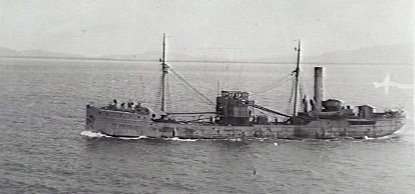
‘Tinana’ cargo ship [Australian War Memorial]
24 November
Road cutting landside between upper and lower camps now cleared.
25 November
Visit of C.F.D’s, W.A. and N.S.W.
28 November
American auxiliary launch seeking shelter in Port Stephens, damaged and with 10 degree to port having cut loose landing barge in two, of Stephens Point, entry permitted.
H.M.A.S. ‘Allenwood’ put to sea and towed barge to port.
All telephone communications broken down to Newcastle, repaired by 0600 on 29th.
W/T jammed for approximately 3 hours.
HMAS Allenwood [Australian War Memorial]
29 November
Anti-sabotage piquets installed on Battery.
American auxiliary launch permitted entry to Port Stephens, no E.T.A.
30 November
Water Board commenced drain excavations on Battery.
Camouflage work has been carried out on No. 4 C.A.S.L. emplacement which now resembles a small cottage with chimney and windows.
1 December
6. 4C.R.H. drill shell ex Scratchley [at Newcastle].
3 December
Sgt. A. Webb appointed Lieutenant.
4 December
Major Robin, D.C.R.E. Newcastle inspected camp.
Mr. Walker and Mr. Lamb, architect and contractor inspected buildings
5 December
19. 21st Labour Bn. troops M’O to Randwick Racecourse.
9 December
No, 14 C.A.S.L. exposed, limits of arc: 312 deg – 125deg.
10 December
H.M.A.S. Assault moved to new quarters at Fly Point.
13 December
42 rounds, powder filled shell 3 pounder returned to Scratchley.
H.M.A.S. Westralia, to sea. [Further information on the Westralia is published on this website at this link.].No. 1 gun Surf 2226 and mounting No. 1069, replaced by piece No. 759. and now fitted with R.B. sight.
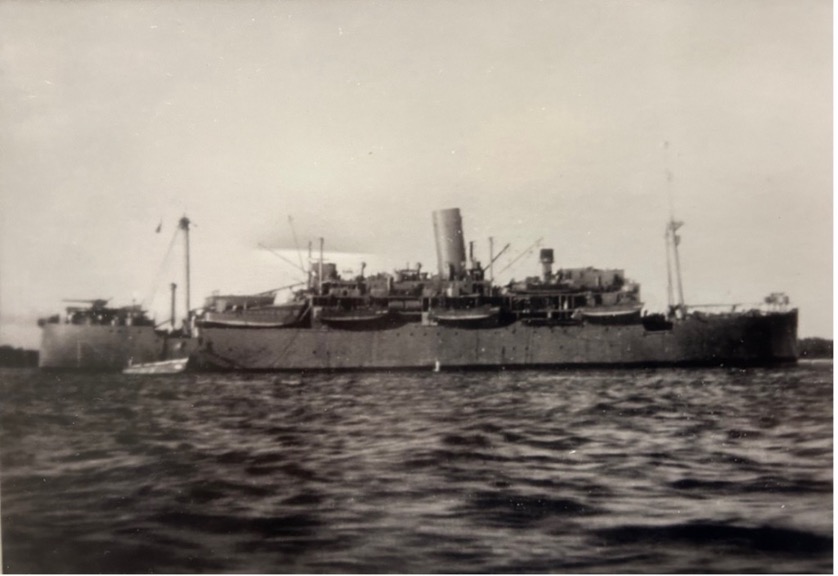
HMAS Westralia at anchor in Port Stephens 1943 [Nelson Bay RSL Sub-Branch Photo Collection]
15 December
Surf Section post camouflage completed.
Surf Section post fitted with new pyramid switch board.
No. 1 gun Surf, floor shelter commenced.
16 December
Lieut. Korff, M/O to H.Q. N.F.D.C. [Newcastle Fixed Defences Command.]
18 December
Camouflage motor garage, erected adjacent to No. 1 6-inch gun.
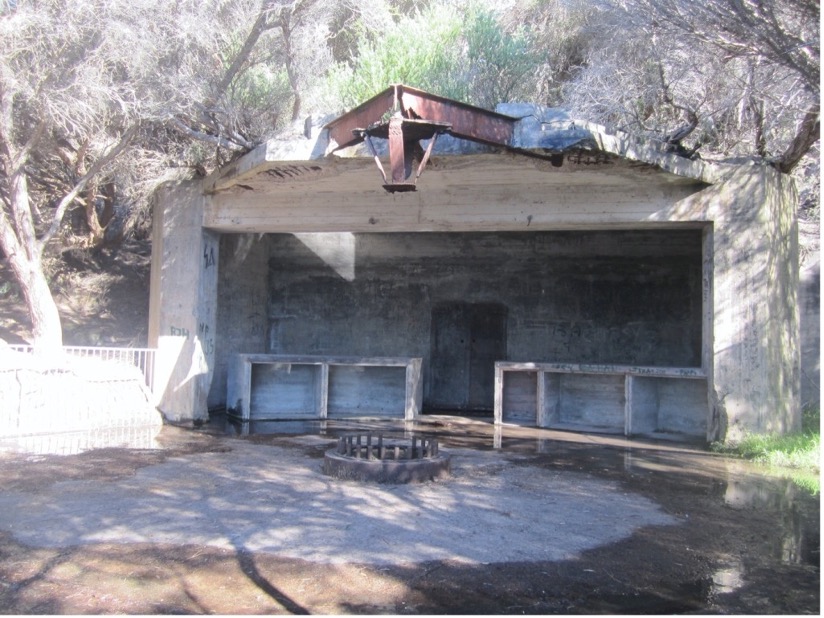
No. 1 Gun Emplacement [Author photo, July 2013]
19 December
Phone installed in Gunners mess; direct line to B.O.P.
21 December
Umbrella shield No. 2 gun concreted. [extended concrete roof over rear section of gun].
Dummy location finder at Yaccaba completed.
Dummy Battery site at Yacabba visited by Lieut Petschler, O.P. [Observation Post] repaired after recent storm damage.
Stevenson screen [instrument protector] erected on Battery approximately 15 yards south of No. 2 gun.
22 December
Water board workmen vacated Yacabba.
Ford utility C5410 replaced temporarily by Fargo 102584.
28 December
No. 12 Engine overhauled.
29 December
Lieut. Tiernan M/O to Scratchley Battery. [at Newcastle]
Visit by Major Gen. Murray.
Commanders Hopkins and Cook inspected torpedo tube site.
Storm water drainage work is now completed by Water Board.
Fence around B.O.P. has also been removed and Battery Personnel are attending to all camouflage work.
1943
3 January
Six V.D.C 5th Bn. Officers visited Battery.
5 January
No. 13 Lister engine overhauled
6 January
Lt. Webb M/O to Wallace Battery [located at Stockton, near Newcastle], Lt. Johnson M/I ex Wallace Battery.
All 12, 14 and 19 A.Q. shell. Refused.
7 January
Col. Tinkler and signals party visited Battery.
Lt. Pankhurst M/O to H.Q. Lt. Knox M/I ex H.Q.
8 January
No. 1, 3 pounder surf prematurely fired at P for A
11 January
Water pumps broke down – repairs effected by R.A.E. in 12 hours.
Cartridge clamps installed in both 6 inch gun floor passages.
13 January
Four Fortress personnel M/I ex H.Q. and are now stationed at F.O. P.
19 January
Elec. and percussion firing mechanism changed on both 6 inch mountings from left to right hand sides.
20 January
Boom erected across roadway to Battery, adjacent to Administration block.
23 January
Approximately 160 V.D.C. personnel carried out weekend exercises at Tomaree.
27 January
Gen. Downes D.M.S. visited Battery.
Local patern range finder installed at Surf Section Post.
No. 1 Surf gun floor shelter practically completed, camouflage of same not yet commenced.
Battery camouflage is being well maintained by Battery personnel.
Trees of heaven and pig face are flourishing.
1 February
Completion of alarm circuits underground.
3 February
Phone installed outside Q.M. store for use of troops.
No. 2 6 inch gun percussion firing lever refitted.
8 February
A.A.L.M.G. triple mounting now mounted on Battery
Lieut. W. S. Johnson M/O to H.Q. F.F.D.C.
10 February
Camouflage construction work commenced on No. 1 gun, surf.
12 February
Battery sentries rearmed with S.M.G (T.).
Mk. III rifles withdrawn and replaced by twelve Mk. IV.
19 February
Practise ammunition arrived for annual shoot.
21 February
Coke bin erected adjacent to ration store.
23 February
Telephone line, ‘Rock’ to ‘Teddy’ now underground.
Improvised breech lights fitted to both 6 inch guns.
25 February
Selected sights, approved by C.N.F.D. (A.A.L.M.G. triples)
Hand grenades arrived and stored in ex 60 pounder B.O.P. on roadway to Tomaree Battery.
26 February
Bring-to round fired across tug ‘Reserve’ at Bng. 125 degrees range 9400 (6 C.R.H. IX B. charge full S.C. 103.).
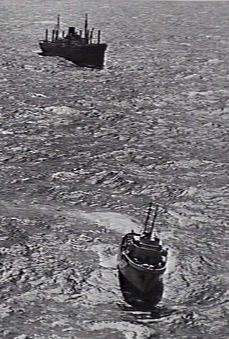
Tug ‘Reserve’ towing the merchant vessel ‘Palana’ [Australian War Memorial]
27 February
Both 6 inch guns fitted with brass elevation indicators. (4 C.R.H. charge full).
1 March
A.A.L.M.G. triple mounting installed adjacent to Gardner engine room.
2 March
No. 12 engine overhauled.
6 March
Breech lights fitted to both 6 inch guns.
No. 1 6 inch gun adjusted for ’tilt’.
10 March
Gardner engine overhauled
Roadway on Battery tarred also main road from Nelson Bay.
11 March
Half charge practice shoot conducted. 3 series. 1000 hours: 12 rounds C.B.; 2130 hours: 12 rounds C.D.; 2145 hours: 14 rounds C.D. (Section control).
Sentry beam discontinued.
12 March
New manning instituted as per C.F.D. instructions.
Major R. S, Mort M/O to H.Q. F.F.D.C.
15 March
Captain L. P. Osborn M/I as C.C. Tomaree Battery.
16 March
H.M.A.S. ‘Manoora’ berthed at Salamander Bay. [Further information on HMAS Manoora is found at this link on the website]
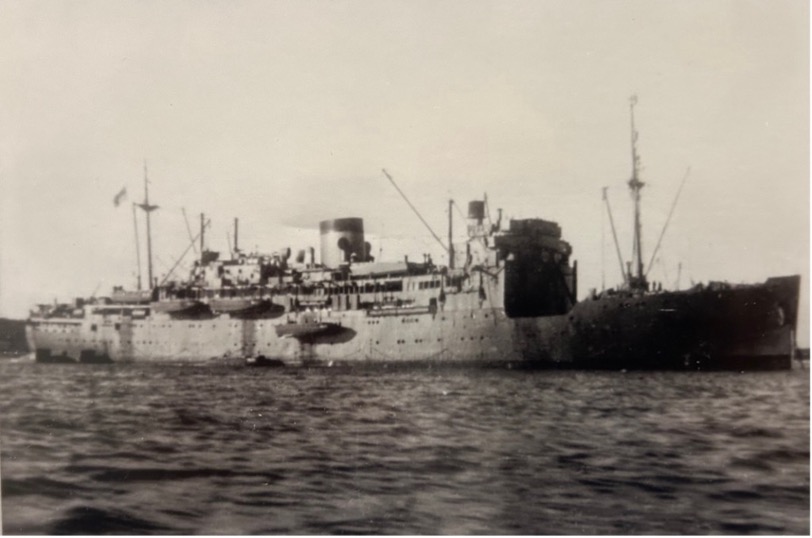
HMAS Manoora at anchor in Port Stephens [Nelson Bay RSL Sub-branch photo collection]
19 March
Rammer staves on both 6-inch guns shortened by 12 inches.
20 March
Canteen remodelled and counter refrigerator installed.
21 March
Winding gear fitted to both 6-inch gun rear shields.
23 March
M.V. ‘Myee’ shipped to Sydney per road.
24 March
Loud speaker installed No. 3 Sect. Post in circuit with No. 2 gun.
H.M.A.S. ‘Manoora’ and ‘Ping’ to sea.
Turning point on Battery roadway prepared for M.R.B.
Camouflage on No. 1 gun floor surf progressing.

HMAS Ping Wo – a former Indo-Chinese river steamer commissioned into the Royal Australian Navy [Wikipedia]
7 April
F.O.P. bearings now direct to guns.
Ring sights fitted to line sight of guns.
8 April
R.A.P. excavation work commenced off roadway below administration block.
12 April
162 3 pounder rounds (solid shot) taken on charge.
18 April
Loud speaking equipment installed in. No. 2 Sect. Post.
21 April
Roadway on Battery banked and widened adjacent to No. 1 gun.
23 April
9 L.C.I’s [Landing Craft Infantry] to port.
25 April
Combined Unit Church parade held on Battery. Attendance – Navy (U.S.A. and Australian), Army and R.A.A.F.
28 April
Electric clocks installed, B.O.P. and Orderly room.
30 April
Camouflage rock work on Surf No. 1 completed.
C.N.F.D and party inspected Yacaaba area.
New barrack room for R.A.A.F. constructed in camp area.
2 May
‘Teddy’ [radar on summit] off the air for major overhaul until 6 May.
3 May
Two B.E.L’s installed adjacent to 3 pound guns as fighting lights.
5 May
116th and 117th S.L. Sect. taken on strength Tomaree Battery.
7 May
Water Board fitted grills to storm water drains on Battery.
13 May
5 L.C.I’s to port.
21 May
14 days reserve rations returned, 3 days’ supply taken on charge.
23 May
Area cleared between 6 inch guns below roadway for 27I set.
24 May
Two new spearheads being installed by water in pump house area.
Catalina crashed in Port Stephens off Wadderrabah beach. [Further information on the Catalina crash is published on this website at this link].
27 May
L.O.O’s visit and inspection.
28 May
Surf No. 2 gun stripped, overhauled, painted and refitted.
29 May
7 A.P.C’c to port.
30 May
Surf No. 1 gun stripped, overhauled, painted and refitted.
Work on R.A.P. progressing steadily but slowed up owing to rain.
Owing to torrential rains revetting has been necessary were temporarily interrupted by P.M.G. on various occasions.
Range transmission dials have continued to give minor trouble throughout the month.
2 June
S.S. Mathew Flinders Closed port 0700 hours.
MK VI C.D. Set installed – allocated code name of Mary.
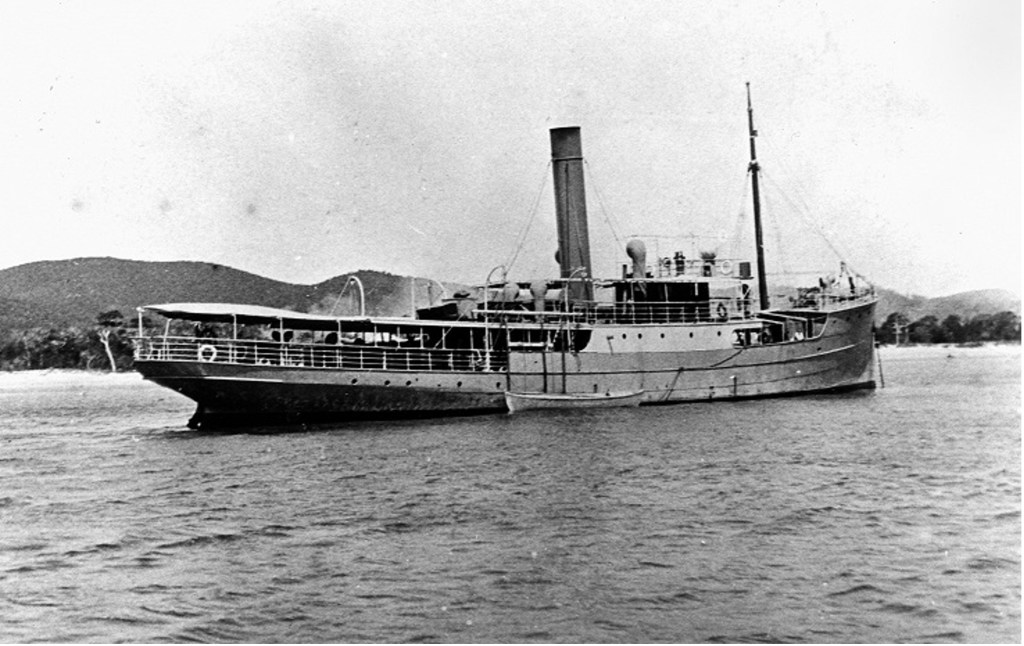
SS Matthew Flinders – requisitioned by the Royal Australian Navy in 1943 [Queensland State Library]
4 June
Range Dial No. 1 Gun out of action, repaired by Artificers.
5 June
S.S. Mathew Flinders opened port for Newcastle.
2 ‘Taylor Cub’ American planes landed in harbour attached to L.F.E.D.
9 June
Practice Shoot concluded at Tomaree.
10 June
H.M.A.S. Manoora entered port for installation and practice with troops.
16 June
Mobile Dental Unit installed at Tomaree.
Patrol Boat from Assault equipped with Signalling Devices and pyrotechnics stationed at harbour entrance.
20 June
The first two L.C.T. [Landing Craft Tank] entered port capable of carrying 20 fully manned tanks.
21 June
O.C. R.A.A.F No. 660 F’Lt. Percival M/O, New CCc. P/O Muir
22 June
Wind is of gale force today.
Reconnaissance Party proceeded to Point Stephens to view new R.D.F [Radio Direction Finding device] site.
Ex R.A.E. personnel taken on strength.
25 June
Torpedo Tubes removed by Navy.
28 June
‘Birchgrove Park’ cleared – conveying Torpedoes and Tubes to Sydney.
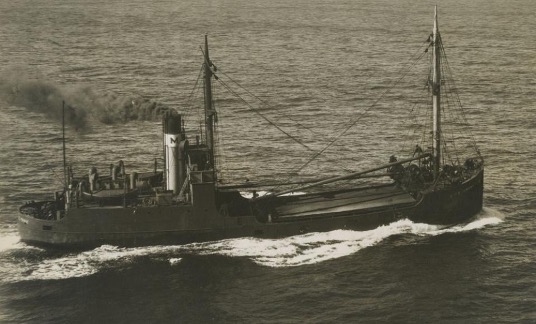
HMAS Birchgrove Park named after a park in Balmain, Sydney
3 July
Lieut. Scaife M/O to [Fort] Wallace.
4 July
Anti-sub. patrol commenced by N.A.P’s under supervision of H.M.A.S. Assault.
7 July
Continuation of practice shoot 2010 hours. 19 rounds 6 C.R.H.
Half charge, opened at Battery control and after 3 rounds changed to section control, targets were Hong Kong type, leading target hit 3 times, range approx. 5000 yards.
9 July
1 Officer 34 C/R’s Works Section sent to Point Stephens to prepare roadway and site for installation of 271 set.
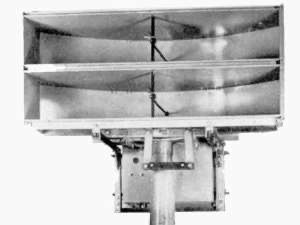
Type 271 – a British naval sea search radar used by the Allies
10 July
War Cemetery opened, Nelson Bay area, adjoins existing civilian cemetery.
11 July
Lieut. Connolly m/I ex Torres Straits.
14 July
Utility shipped to Stephens Point.
Visit by General Downs, D.D.M.S.
Reserve rations shipped to Stephens Point
20 July
Both 6 inch Guns run back.
27 July
Pest eradication contractor (Mr. Cowan) carried out Inspection. Results satisfactory.
29 July
Mk. V D.R.F. to workshops for overhaul, replaced by similar instrument.
30 July
Electric water pump installed and operating; petrol engine is now an auxiliary pumping paver unit.
Reverting of bank on Battery roadway completed.
31 July
Captain Wilkinson, R.M.O. M/I ex 113th A.G.H.
Battery camouflage has been overhauled and improved during the month.
Work on new R.A.P. is progressing favourably and nearing completion.
16 August
Airation stands fitted to water tanks on camp area by Water Board.
Head Battery practice shoot, 20 rounds – Target south end of Yacaaba.
17 August
19 troops M/O for distribution in N/C [Newcastle] Fortress as result of new W.E.
19 August
F.O.P now not manned
Surf Section, dismanned, equipment stored in No. 1 Gun floor Shelter.
20 August
Naval signaller now attached to Battery, ex. ‘Assault’.
22 August
Head Battery ceases to function. Pack horse team commenced daily ration run to Stephen Point via Sand Spit.
23 August
Head Battery commence to move out.
28 August
‘1’ Aiming practice carried out – 220 rounds by Battery and V.D.C. personnel.
30 August
Mary II manned and ready for action
Lower Camp area now disused.
1 September
No. 1 Breech changed.
2 September
C.A. Set taken out from Tomaree.
Brig. Prisk visited Battery.
7 September
R/T set installed at B.O.P. (N.A.P. Communications)
8 September
F/L Lieut Denny new R.A.A.F. Co O. Tomaree.
11 September
Major Osborn M/O to Fortress H.Q.
15 September
R.A.P. completed by Works Section.
19 September
Channel cut in Port Stephens sand spit by heavy seas prohibiting use by pack horse.
21 September
6 C.R.H. range strips fitted to both guns, ammo taken into use.
26 September
Point Stephens sand spit now negotiable. Rations delivered by pack horse.
30 September
Gun floors dug for fitting A.R.L. cable.
1 October
No. 1 Breech changed.
Visit by Major Gen. Downes to Tomaree Battery.
2 October
C.A. Set taken from Tomaree.
Brig. Prisk visited Battery.
4 October
D.D.S. removed from Lower Camp to Upper Camp Tomaree.
5 October
Motor vehicle ramp completed and ready for use.
7 October
R/T set installed at B.O.P. (N.A.P. Communications)
Unit canteen inaugurated.
8 October
F/Lieut Denny new R.A.A.F. C.O, Tomaree
11 October
Major Osborn M/O to Fortress H.Q.
13 October
Lieut Knox M’O to H.Q. Coast Artillery, Newcastle.
14 October
N.A.P. Port Stephens ceases to exist.
15 October
Lieut Rankin M/O to Scratchley.
16 October
R.A.P. completed Works Section
17 October
Flying fox completed for garbage destruction.
19 October
Channel out in Port Stephens sand spit by heavy seas prohibiting use by pack horse.
21 October
6 CRH range strips fitted to both guns, ammo taken into use.
23 October
F.O.P. locked up and key handed to Battery Commander.
25 October
Captain Petschler M/O to Kembla.
26 October
Port Stephens sand spit now negotiable rations delivered by pack horse
Captain Fry took over Tomaree Battery as Battery Commander..
28 October
Navy W/T and R/T removed to B.C’s room B.O.P. pending decision regarding use of same.
Septic tank lower camp cleaned out and leaking pipe at latrine repaired.
Water supply installed at C.D.S.
30 October
Gun floors dug for fitting A.R.L. cable.
Visit by Col. Penfold and Lt. Col. Shannon to Tomaree Battery.
1 November
Car parking area adjoining M.T. vehicle ramp completed.
3 November
F.C. visited the battery and carried out general inspection.
4 November
Captain Fry left for Sydney for eye inspection.
Checked reserve water supply.
6 November
Captain Fry returned to Sydney.
9 November
Balance of 4 C.R.H. Ammo (16rds.) sent to Fort Wallace.
10 November
F.C. Visited Tomaree Battery.
11 November
S.S. ‘Dopell’ entered port in leaking condition.
Breaches of security made by V.D.C. reported by Lt. Smith-Palmer.
12 November
S.S. ‘Dopell’ opened port.
Gnr. Faith came from Port Stephens to report to F.C. regarding security breaches.
Captain Fry to F.S.’s conference.
14 November
52 rds. MKxxx1v ammo; 249 rds. MK1xix ammo sent to Scratchley Battery for shipment to Sydney.
1b ammo held at Tomaree at this date. Nil.
18 November
Visit paid to Tomaree by Captain Roberts and two senior officers.
19 November
Lt. Moore and 17 O/R signalmen marched into Tomaree Battery.
Exercises carried out in shoal Bay by 18th Bn and H.M.A.S. Assault.
22 November
W.O. Genge dismantled D.P.F. at Tomaree. W.O. Manterfield conveyed bed plate down to lower camp,
23 November
W.O. Manterfield returned to Newcastle with bed plate.
W.O. Genge returned to Newcastle with D.P.F. parts.
24 November
Sgt. Dick measured and tried spare buffer spring to No. 2 gun.
25 November
Brass 6BRH range strips fitted to both guns by Capt. Batten.
26 November
Revetting in front of Administrative Building completed.
C.N.F. and Captain Roberts visited Tomaree.
27 November
Steps from road to Battery Office completed on this date.
29 November
Lt. Beckwith marched out to Bomb Disposal School, Wagga.
Captain Fry to conference at Shepherds Hill regarding V.D.C. training.
5 December
1 inch Aiming shot of nine series – attended by C.C.A. Major Howard.
7 December
Datum post installed on Wonderbah Beach.
Command Line to Stephens Island [Point Stephens] completed.
8 December
Lieut Ross and 12 C.R’s marched out after completing check of survey of Battery.
13 December
WOii. Bourke marched in to replace Sgt. O’Loughlin [see photo below].
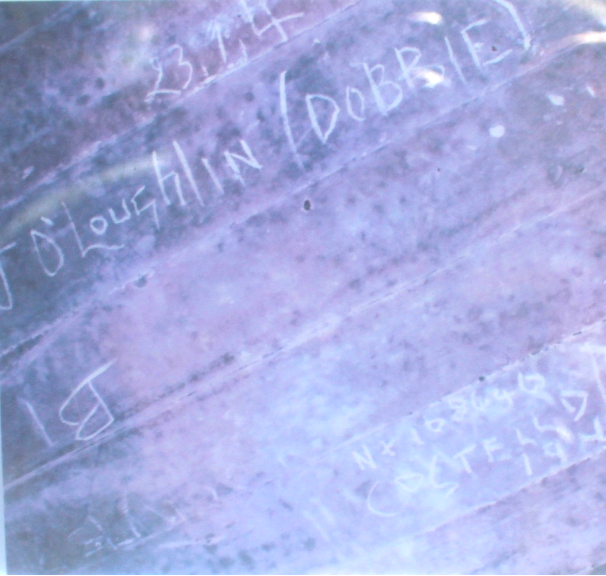
Personal signatures on the ceiling of a room behind a gun emplacement, showing the name of [Sergeant] J. O’Loughlin (Dobbie) [National Parks and Wildlife Service Notice Board]
15 December
No. 1 Gun pulled back and trunnions inspected and cleaned by Capt. Bates.
24 December
50% of Battery strength proceeded on 48 hours stand down.
25 December
Excellent Christmas dinner partaken by all. Visit by Lt. col. Dobson in the afternoon.
26 December
Camp for five days training.
31 December
V.D.C. Training carried out vide Syllabus of training.
8 series of 1 inch aiming rifle fired from Battery by V.D.C. personnel.
Faulty ammunition marred several of the series.
A new type of target was employed. It being a Naval Fog Bouy and proved very successful, as it allowed a lighter tow line and greater speed in tow. Lt. Col. Dobson attended the practice. Major Howard acted as director of practice. During the afternoon all V.D.C. personnel marched out of Lower Camp.
50% of Battery strength commenced 48 hours Stand Down.
1944
2 January
80 V.D.C. (Officers and I/R’s marched into Lower Camp for weekend training.
4 January
Captain Batten started work on Elevation Gear on No. 2 Gun.
5 January
Captain Batten completed work on Elevation Gear on No. 2 Gun.
8 January
One Bofor Gun A.A. handed over to Tomaree Battery.
12 January
408 rounds Bofor Ammunition. arrived at Tomaree Battery.
13 January
V.D.C. Training carried out according to Syllabus.
16 January
Major Howard came to instruct V.D.C. Officers in ranging.
1 Captain and 3 Subalterns marched into Tomaree Battery for one month.
17 January
Sand spit to Stephens Island [Point Stephens] broken, 1 foot 11 inches of water.
Pack transport personnel and horses changed over.
18 January
S/Sgt. Fraser came out on Deflection Scale on No. 1 Gun.
W.O. Gang at Tomaree checking all instruments.
23 January
1 inch aiming shoot at Tomaree. conducted by Major Howard.
25 January
Sand spit to Stephens Island still considered dangerous.
27 January
Sand spit to Stephens Island inspected by B.C. Tomaree and still considered dangerous.
30 January
All ball ammunition 303 checked over by M.G. Wright, Lt. Irving, Sgt. Dick.
6 February
V.D.C. on Battery for weekend camp
Captain Fry marched out to artillery school Wallace Battery.
Lieut Beckwith acting O.C. Captain Taylor, Lieut. Brack, Denton and Wood marched out for School.
14 February
8th Radar Detachment marched out from Port Stephens replaced by 15th Radar Detachment.
18 February
Contractors installed on 12 and 13 Lights. It is now possible to expose and douse these lights from D.S.
19 and 20 February.
V.D.C. in camp for training. With the exception of B.O.P. Lookout the manning of the Battery during darkness on 19 and 20th February was carried out by V.D.C. The job was carried out efficiently.
21 February
Bearing Indicator installed in D.S. for No. 13 Light checked and operating correctly..
22 February
No. 1 Storage Tanks of Tomaree water supply leaking.
R.A.E. Works notified.
25 February
Captain Fry marched in from school.
27 February
Lieut. Beckwith marched out to duty at Shepherds Hill.
Lieut. Wood marched in from school.
29 February
Work commenced on No. 2 Water Storage Tank.
Practice conducted with 1 inch ‘Coree’. Brigadier St. Claire, Lieut Col. Dobson, Lieut Col. Ord. on board. Practice was unsatisfactory during hours of darkness due to shipping in area.
Concluding Comments
The military buildings of the Tomaree Battery site still remain at the base of Mount Tomaree, although they were altered to accommodate later Government uses.
The facilities of the site will soon be made available for community use and details of this plan are found on the link Tomaree Lodge Site at Port Stephens on this website.
The following papers that cover the Second World War years at Port Stephens are published at the following links on this website:
Camourflage of Mount Tomaree – 1941/42
Port Stephens Council During the Second World War
Evacuees from Portuguese Timor at Bobs Farm Cadre Camp – 1943
Kanimbla – A Luxury Cruise Ship / Royal Australian Navy Warship
Westralia – A Luxury Cruise Ship / Royal Australian Navy Warship
Manoora – A Luxury Cruise Ship / Royal Australian Navy Warship
A Pictorial History of HMAS Assault – Nelson Bay
Royal Marines at Port Stephens – 1945/46
United States Landing Force Equipment Depot at Nelson Bay – 1942/43
HMAS Assault and JOOTS – 1942/43
Crash of a Catalina Flying Boat in Port Stephens – May 1943
APPENDIX
Complaint by the Captain of the ‘Desikoko’ [‘Dessekoko’] against the Tomaree Battery
Information on the Ship
The boat, of 230 gross tons was launched at Huskisson on 28 May 1934, and built by a local boatbuilder, Alfred W. Setree and took 10 months to build. Its initial activities included trading around New Guinea and the Solomon Islands. During the Second World War the vessel was commandeered into the US Army Small Shops Section and renamed USS ‘Desikoko’.
In December 1946 the vessel was sold to a Chinese company and renamed the ‘Yua Hwa’. She sank five miles south of Newcastle on 5 January 1947, with a cargo of flour for China on board. All the crew survived.
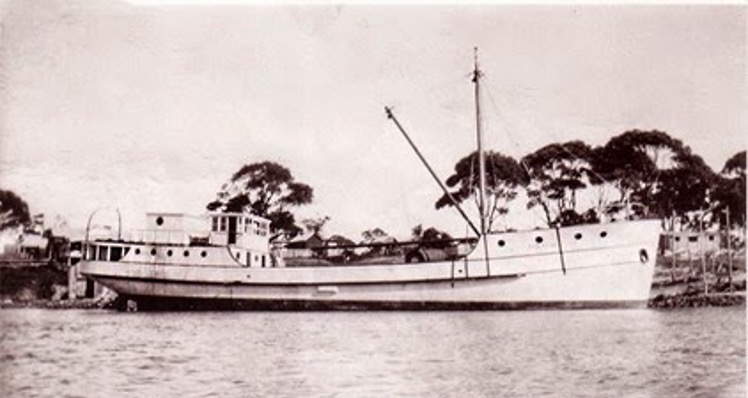
M.V. Desikoko [Jervis Bay Maritime Museum]
Complaint against the Tomaree Battery
The captain’s letter of 4 April 1942 to the Naval Control Officer at Brisbane, stated:
Sir,
I beg to report that I left on the 26th ult. as master of the m.v. ‘Dessekoko’ bound for Sydney. This ship had got away from Rabaul, New Guines, and was leaking.
Owing to the condition of the ship, instructions were received from the Comm. Nav. Department at Brisbane that in the event of meeting with rough weather ship should seek shelter.
On the 28th wind and sea increasing, ship rolling and straining, also leaking badly, I decided to keep away for shelter into Port Stephens, and at 3.0 p.m. a course was shaped for the port.
About 4.0 p.m. when well outside of Tomaree Head engines were eased down to slow, ships name and ensign hoisted and instructions were issued to keep a sharp lookout for any signals at the fort, the second mate with some natives was on the forecastle head, first mate and myself on the bridge, although the flag staff was clearly visible from the ship, no signals were at any time displayed indicating that it was a closed port, but when nearly abreast of the port, we suddenly received what appeared was a burst of machine gun fire, the engines were immediately put astern and in about ten seconds later, a shot was fired at the ship, not ahead of us as a warning, for the shot struck the water 200 yards inside of us and about four points on the port bow, from there it ricochetted across our deck just above our heads.
I stood outside the fort a little and then enquired by semaphore if we could anchor in Fly Roads just outside the fort. A reply was received asking if we could proceed to Newcastle. We replied that the weather was too rough, and the ship was leaking.
After dodging around for some time, I again requested permission to anchor in Fly Roads, outside the fort and entrance. The request made several times failed to elicit a reply of any kind from them. I then decided to proceed to Newcastle and risk being drowned in preference to being blown to Hades by our own forces.
Off Newcastle, the weather moderating. I stood on to Sydney arriving there at 10 a.m. on the 29th ult.
During my 25 years as a shipmaster, according to all sailing directions I have perused, stress is laid on the fact that a sharp lookout must be kept approaching a closed port. I submit that I took all reasonable precautions, and although embodied in all sailing directions is the statement that the closed port signal would be shown, or a shot fired across the bow or ahead of the ship. This was not done. If I were not positive that no signal was displayed ashore, I should certainly not now protest. The notice to Mariners issued regarding the closure of Port Stephens, contains certain exemptions, one being, that small ships seeking shelter during bad weather, will be allowed to enter the port.
No examination vessel was outside and although we were off the port for 30 minutes, no boat was sent to us.
The only reason this will not be described , (as similar incidents have been done) as a ‘regrettable accident’ I attribute to poor workmanship on the part of the military authorities, and suggest that all merchant ships should be armed, not so much as protection against the enemy, as against our own forces.’
Military Response
The Headquarters Report in response to the complaint, prepared by the Commander, Newcastle Fixed Defences and dated 8 July 1942, stated:
‘The following has been obtained from reports by the B.C. [Barracks Commander] Tomaree and other witnesses in regard to statements of the Master of the ‘Dessekoko’:
There is no flagstaff at the Fort or anywhere in the vicinity except at Nelson Head. Repeated signals were made from B.O.P. by Lucas Lamp starting when ship was at 9000x giving AK (unknown call signal). When at 6000x C.A.S.L. was exposed in the direction of the ship to attract her attention. At 4000x a flickering light appeared on the bridge which appeared to be about the strength of a small torch and was unreadable. ‘What ship’ sent continuously by Lucas lamp. Signals then changed to ‘K’ (stop instantly’, ‘stop’ and ‘OL’ (stop or I will fire on you) which were sent slowly and repeated several times. At 3500x ship hoisted V.K.L.P. which displayed her name in letters on her bridge. this conveyed nothing to the Battalion, as no E.T.A.[estimated time of arrival] had been received.
Being-to round was fired by 3-Pdr. followed shortly by a second as no notice appeared to have been taken of the first.
As reported previously no ‘Port closed’ signal is displayed and it is considered that this is a Naval responsibility.
The burst of M. G. fire referred to was probably a 3-Pdr. shot as no M.G. fire was opened. The statement by the Master that the shot was fired at the ship is incorrect.
From evidence available extreme left deflection (was applied and the gun was further laid off to the left. the round fell left and minus from the gun. as no range finder is available for 3 Pdr., ranges have to be estimated. This is difficult firing seawards.
The Master’s statement that the “shot ricochetted across the deck just above our heads” cannot be verified as the second graze of shot was not observed by him or by any Army personnel. It is submitted that experience in recent attacks by enemy submarines have proved that reports of closeness of projectiles to observers may be unreliable and exaggerated.
Although the Master attempted to communicate with the Battery by semaphore flags it was found impossible to read them owing to excessive speed. Battery sent ‘send slower’ by lamp. This was acknowledged but had no effect. Eventiually the signal was interpreted as ‘May I anchor’. Reply was ‘This is a Closed Port’ followed by ‘Can you proceed to Newcastle’, which was not replied to.
It is submitted that unless the Master visualised the line of fire from the gun, he would be unable to tell whether the round was fired across his bows when the range was inaccurate as in this case. A precedent to support this is the bring-to round fired August 1914 by Nepean Battery against S.S. Phalz.
The latter part of this paragraph was given by CN.F.D. much concern and a direction from the Navy would clarify the position.
Navy have not established an Examination Service at his Port.
It is my duty to ensure that any suspicious or unknown vessel is denied access to Port Stephens, and I wish to point out that owing to the tactical situation with Japan in the Pacific islands, I considered that this vessel, with a crowd of dark people on the deck, may reasonably be presumed suspicious until proved otherwise.’
Researched and compiled by Kevin McGuinness
March 2025

 Port Stephens - a history exploration