
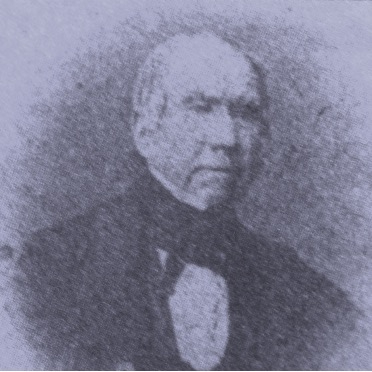
Introduction
This is a story of Lieutenant William Caswell, Royal Navy, who was the first colonial settler at Tanilba Bay at Port Stephens.
In 1825, William Caswell married Susan Hoddle in England. William, Susan and their two eldest children arrived in Sydney on the Pyramus on 12 May 1829.
William was initially given two crown land grants. One of 1290 acres on the Williams River at Raymond Terrace in November 1829, named ‘Balickera’ [‘Ballickera’], and a second 50 acre grant at Tanilba on the shores of Port Stephens on 31 March 1831.
The Caswells had eleven children – Emily and William who were born in England, and George, Tanilba, a baby son who survived 10 days, Henry, Caroline, Louiza (Lalla), Nessie and Florence who were born at Tanilba. The youngest child Anne was born at Balickera in 1847.
William chose Tanilba as the site for his family’s first residence, where they lived from 1831. He and Susan faced many hardships in the early years at Tanilba in establishing their farm. Their main neighbours were located nearby across the waters of Port Stephens at Carrington where the Australian Agricultural Company was located. Here hundreds of convicts, military personnel and company employees were engaged in agriculture.
Also, as his property at Balickera was of superior farming land quality, compared to that at Tanilba, William spent considerable time there while his wife Susan was left to manage Tanilba with the support of convict servants.
In 1837, following the formal signing of his deed of grant at Tanilba, William built the present day Tanilba House using convict labour and local stone resources.
The name Tanilba means ‘White Flowers’ which referred to the white flannel flowers that were common in the area.
Today, Tanilba House, and its surrounds, bears testament to the vision of William Caswell.
In 1930’s, the prominence of Tanilba House was enhanced by the well-known real estate developer of the time, Henry Halloran who purchased the house in 1920 and developed the Tanilba Bay Estate around its precinct.
From various newspaper sources from the Australian Library’s Newspaper collection, Trove, this paper tells the story of William Caswell and the early history of Tanilba House.
An Appendix gives the details of 32 convicts known to have been in the service of Lieutenant William Caswell at both Tanilba and Balickera, as compiled by the author from official convict records.
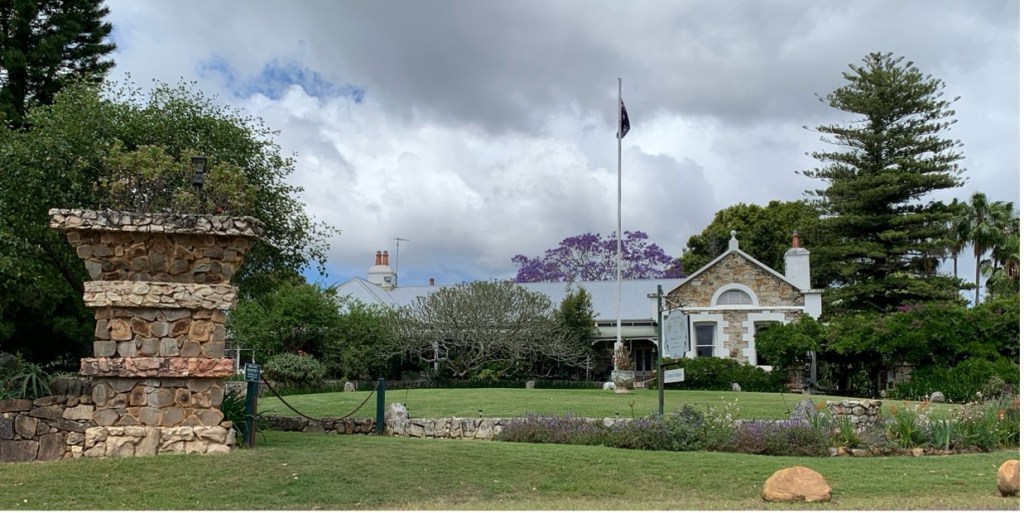
Tanilba House – [Author photo – November 2022]
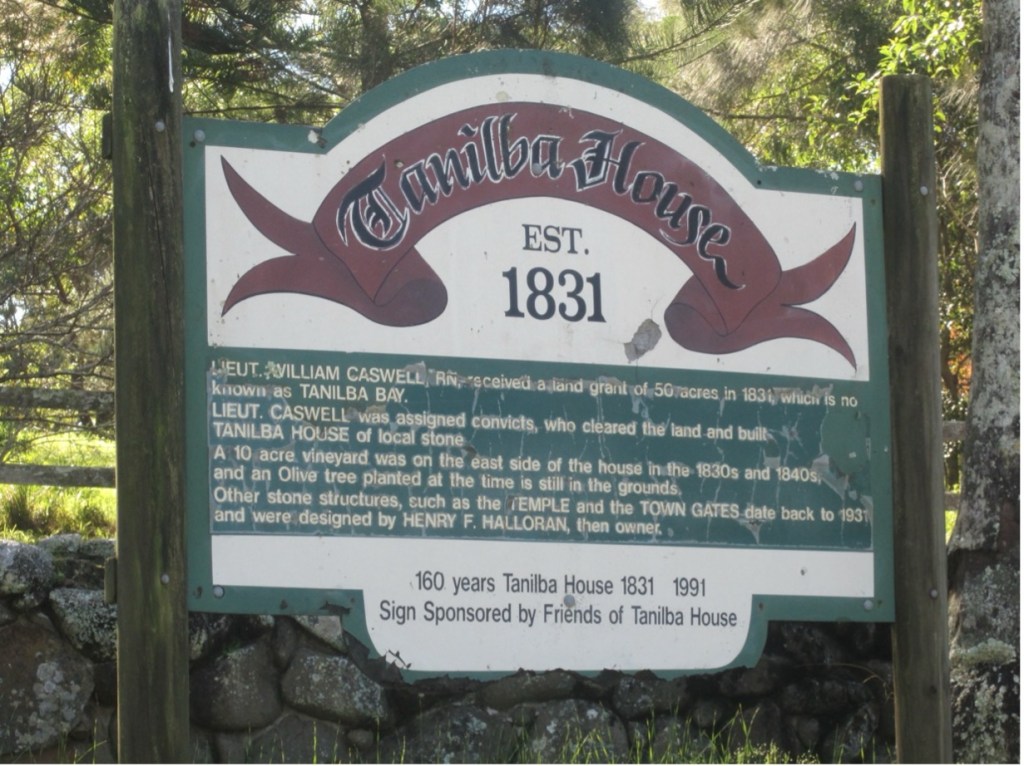
Sign located near the approach to the Tanilba House estate [Author photo – November 2022]
Part One: The Caswells 1829-1859
Naval Service of Lieutenant William Caswell
The Empire of 5 June 1857, page 6, published the following naval service history of William Caswell:
‘The following are the services extracted from O’Byrne’s “Naval Biography” of this Officer, who has accepted the rank of Retired Commander, under H.M.’s Order in Council of November 1, 1830, by Commission, dated February 13, 1857: — “William Caswell entered the Navy in September, 1805, as A.B. [Able Bodied Seaman] on board Fox, ….. on the East India Station, where he remained until his return home in October 1811, previous to which he had been taken prisoner as midshipman, in a conflict with the Malays, and detained a prisoner among them from September, 1807, to April, 1808, and had commanded Fox’s barge at the capture, March 28, 1809, of La Caravanne, French privateer, of 8 guns and 100 men under the batteries of Sappara.
In November 1811, he joined, as master’s mate, Maidstone, 36, Captain George Burdett, and on proceeding to the Mediterranean, commanded her launch at the capture of a privateer of 5 guns and 59 men. For his subsequent conduct on August 3, 1812, at the taking in the Bay of Fundy of the American cutter, Commodore Barry, of 6 guns, by the boats of Maidstone, one of which he again had charge, Mr. Caswell was appointed April 26, 1813, Acting Lieutenant of Spartan, …… and on November 13 following, was confirmed into the Plantagenet …… He was afterwards, on September 26,1814, wounded in a sanguinary attack on the American privateer General Armstrong.
On his return home after visiting the West Indies, he joined, September 7, 1815, Superb, ….. one of Lord Exmouth’s ships, at the bombardment of Algiers, in which he continued until paid off, October 1818. He was subsequently appointed, November 23, 1820, to Surinam sloop, ….. on the Jamaica Station, in November 1821, as First Lieutenant to Bann, ….. on the coast of Africa, and March 5, 1825, to the coast blockade, as Supernumerary of Hyperion. …..
He has been on half-pay since 1828.” A medal with two clasps has been awarded him, one for coast service, and one for Algiers.’
Caswell Crown Land Grants
On 26 February 1949, the Maitland Mercury published the following article written by E. S. Lauchland, who was a member of the Newcastle and Hunter District Historical Society.
“Tanilba House,” Port Stephens, ….. stands on property originally granted to a Lieutenant William Caswell, of the Royal Navy, nearly 120 years ago.
He had attained the rank of Commander in the Royal Navy when a circular issued by the Lord High Admiral on August 11, 1827, addressed to the Officers of the Royal Navy, came before his notice. This held out glowing propositions in regard to land grants with exemptions from quit rents [annual payment of a fixed amount to the Crown] according to years of service, so that Caswell decided it would be an advantageous move to retire from the navy and emigrate to New South Wales. Accordingly, he obtained the Admiralty’s permission and applied for a grant. Disposing of his property at Worthing, Sussex, he set sail for Australia with his wife Susan and their two children, a son and a daughter. …..

William Caswell (1789 – 1859)
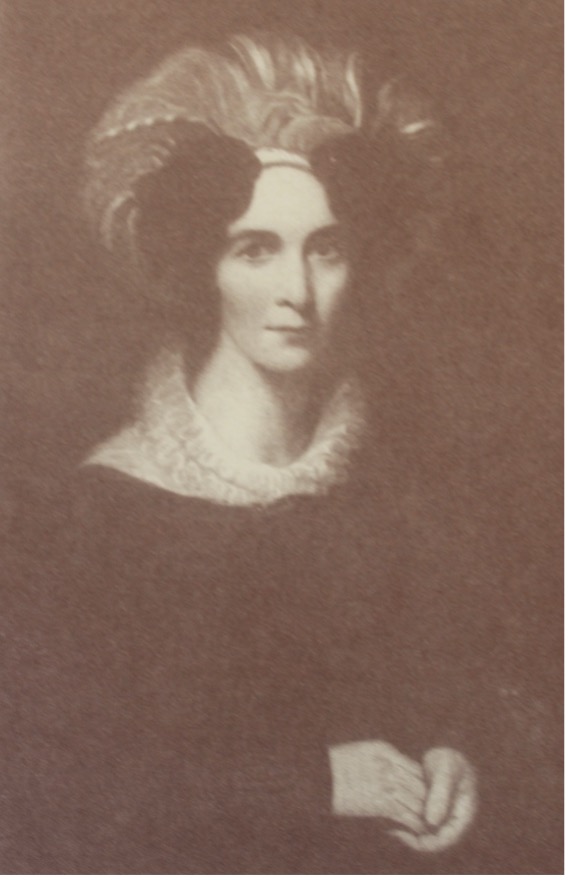
Susan Caswell nee Hoddle (1805-1886)
Mrs. Caswell was a sister of Surveyor Robert Hoddle, who surveyed Goulburn and other towns in New South Wales, and also laid out the city of Melbourne.
On his arrival in November 1829, Caswell received 1920 acres on the Williams River. This was called “Balickera.” In March 1831 [on 31 March 1831], came a second grant of 50 acres at Port Stephens, on which he built his home, Tanilba House. On October 5, 1831, Governor Darling allowed a third section, consisting of 590 acres “to complete his primary grant to four square miles.” A great deal of controversy went on over these grants, and, for some years, they were the subject of despatches between the Governors of New South Wales and the Colonial Office, London. Lieutenant Caswell was not satisfied that he had received fair treatment at the hands of the Government, in view of the promises held out by the Admiralty’s circular. A quit rent charged on his 590 acre grant was one source of vexation; and, in addition, he contended he was entitled to a fourth section of land for a “secondary grant equal to his primary grant.”
A despatch from Governor Sir Richard Bourke on February 2, 1833, to the Lord Viscount Goderich in London stated: “By the regulations in force on September 23, 1828, and the practice at the time of Mr. Caswell’s arrival in the colony, officers of the Army and Navy obtained land in the ordinary mode according to the extent of capital, their half-pay being calculated at seven years’ purchase, such land being exempt from quit rent for
the period regulated by the services of the parties.” “Mr. Caswell proved a capital of £1500 including the value of his half-pay (£630) and obtained three sections of land (1920 acres) free of quit rent. To these were subsequently added 50 acres as a special favour for Mr. Campbell’s accommodation. “Mr. Caswell thinking his half-pay was valued too low, and that it should have been rated at a sum which, by making his capital amount to £2000 would have entitled him to receive four sections (or 2560 acres of land) addressed a memorial to the Secretary of State through the late Governor, praying for that quantity.
The Governor wrote a minute on Mr. Caswell’s application in these words: ‘I have not had time to write home on this case. Let Mr. Caswell have 590 acres to complete his primary grant to four square miles, October 5, 1831’. “Mr. Caswell, in July 1832, claimed to have these 590 acres free of quit rent. On the papers conveying this claim from the Colonial Secretary’s office it is stated that General Darling gave the additional grant subject to quit rent after seven years according to the ordinary regulation. I therefore declined to exempt it from payment, believing that the Land Board had done full justice to Mr. Caswell in the valuation of his half-pay and other capital, and that he had received as much land free of quit rent as by regulations in force at the time of his grant he was entitled to.” It may be a question indeed whether he ought to have obtained the 590 acres otherwise than by purchase, the order being dated October 5, 1831.
“I have mentioned that on the papers received from the Colonial Secretary’s office it is stated that Governor Darling gave the additional grant subject to quit rent. It is still the opinion of that office that such was General Darling’s intention, but it is true, as asserted by Mr. Caswell in his memorial to Your Lordship, that the Colonial Secretary at one time seemed to entertain a contrary opinion. “The sum in contention is trifling, about £5 per annum, but as it might be very inconvenient to afford a precedent for reconsidering the decisions of the Land Board, which have been acted on for many years, I have thought it more proper to give your Lordship the trouble of this appeal than to grant the application of Mr. Caswell.”
Then from Tanilba House, Port Stephens, on August 30, 1833, Lieutenant William Caswell addressed a letter thus:— “My Lord,—In the year 1828 I took advantage of a circular addressed to the officers of the Navy holding out to those who chose to emigrate to New South Wales an exemption from quit rent according to their services. “I obtained the Admiralty’s permission and embarked the whole of my property. My family’s outfit, passage money, etc., etc., not being admitted as available, the Land Board only considering me as eligible for three sections of land. “I transmitted through His Excellency, General Darling, a letter to my Lord Goderich praying for his consideration of my case, stating the Land Board having admitted to me to possess £1100 available for agricultural purposes, that it, and the value of my Commission entitled me under existing regulations to a maximum grant. “After the Governor left the colony, I received an order to select 590 acres having just the quantity necessary to make up my primary grant. On receiving the order to take possession which I have done I found it subjected to quit rent.
“I called on the honourable the Colonial Secretary, who rebuked the clerk who had made the order out, and whom he desired to bring His Excellency Governor Darling’s minute, giving me the land. It was produced and read. The Hon. Mr. McLeay told the clerk a second time warmly it ought not to have been charged; it was my primary grant; and told me it should be rectified. Having waited two months, I ventured to beg His Excellency, the present Governor, in the circumstances to remit the quit rent—and I have this day received a letter from the Hon. Mr. McLeay stating His Excellency cannot do so. “I therefore most humbly pray the advantage held out to me by the Admiralty circular of August 11, 1827—which advantages I respectfully claim on the following grounds:— “First- The circular states Officers of 20 years and upwards shall be exempt from all quit rent—and I am an officer of upwards of 20 years’ standing; “Second: If I had not been entitled to the quantity of land it would not have been granted me, as I was, and am, wholly unknown to the late Governor; “Third: That a purser of the Navy who arrived with me in the same ship now holds four sections of land, and is not charged any quit rent.”
“I beg to state to your Lordship I have laid out the whole of my property on my land. I have been upwards of three years on my farm, an isolated and distant spot, never leaving it except for a few days, and then only when ordered by the Government on the public service; that I have never identified myself with the party feeling which has run so high in this colony, and therefore humbly hope you will consider me entitled to and order me the full benefit of the advantages set out by the Lord High Admiral which alone induced me to give up my hopes in the Navy and to bring my family and property to so distant a colony.” This letter Lieutenant Caswell sent to The Right Honourable The Secretary of State for the Colonies, London.
Still later in this connection Governor Sir George Gipps despatched the following:— “Lieutenant Caswell having come out to this colony whilst the orders of 1826 and 1827 were in force was entitled to a second grant on fulfilling the conditions on which his first grant was made to him, but such additional grant could not exceed the amount of his first grant. “Lieutenant Caswell wishes his first three grants to be considered as one grant; and if so considered he would have been entitled, when his case came before me in 1838, to a secondary grant of 2560 acres. But as I could not look on this second and third grants as part of his first grant, I allowed him only 1280 acres which, with his second and third grants, made up 1920 acres, a quantity equal to that of the first grant.”
“It may be admitted, as Lieutenant Caswell contends, that he was told in 1831 or 1832 that his second and third grants were to be held on the same terms as his primary grant, that is to say, on the same terms in respect to quit rents; or it may even be further admitted that he was told they were to be held as a part of his primary grant, but I must submit that any such loose or incautious expression, even though used officially, could not alter the facts of the case, or make that a first grant which was ‘ipso facto’ a second or a third one. “It might much more reasonably have been said to Lieutenant Caswell that, having already received a second grant, the conditions on which he emigrated had been fulfilled.
The only doubt, therefore, that I had when this case came before me in 1838 was whether he was entitled to anything at all, but in giving him a fourth grant sufficient to make up, with his second and third grants, a quantity of land equal to his first grant, I feel that at any rate I acted towards him most liberally.” Considering on the one hand the services rendered to his country by the gallant naval officer, Lieutenant Caswell, and on the other the enormous amount of land at the disposal of the Government, and the desirability of developing this suitably, one can hardly say that all this haggling over a few acres was ‘liberal’ treatment.”
When finalised, Lieutenant Caswell’s grants were: 1920 acres received on arrival, November 1829; 50 acres received in March 1831; 590 acres received in October, 1831; and 1280 acres received in May, 1838.
It was on the 50 acre grant at Port Stephens that Lieutenant Caswell built his home, Tanilba House. The deed of grant for this was actually signed on February 11, 1837, by Major General Sir Richard Bourke, Governor of New South Wales. It is interesting to note that it is signed as having been entered in the register in the Surveyor General’s office on March 31, 1838, by Henry Halloran, an ancestor of its recent owner. Wielding their axes, the bond servants [convicts] allotted to Lieutenant Caswell quickly prepared the site for the house—a site selected with masterly skill. They opened up a quarry in the quartz porphyry formation and soon the massive stone walls arose, so that the family moved into residence there that year….’
The lime used in the mortar for the Tanilba House construction was manufactured by convicts at a nearby site now named Sunset Park. During the 1930’s this area was used by for Girl Guide Camps. A history of these is found at this link on the website website.
Assigned Convict Servant to Caswell robs neighbouring property – 1832
The Sydney Gazette and New South Wales Advertiser of 10 May 1832, page 3, reported on a case in the Supreme Court on May 5:
‘Henty Blackford sworn—I lived in the month of February last at Port Stephens, where I had a farm; on a Saturday I had occasion to leave my house, with my two children, no person being then in it; the door was closed with a latch, but not locked;
everything was then safe; when I returned on Monday, I observed a quantity of feathers about the floor; on looking further I found my bed had been unripped, the feathers shaken out, and the tick and other bedding gone, as well as part of that belonging to the children, a fowling-piece, an adze, two chisels, one chair, one copper tea-kettle, one spoke-shave, and one axe, were also gone; the value of all I lost was about £10; there were no marks of violence on the door; I saw the footmarks of two men, as if from Mr. Caswell’s, to my house; there had then been two days rain, and I should not have seen the marks but for the assistance of the blacks; I saw some of the properly subsequently at the Police office; the prisoner worked for Mr. Caswell, who was my next neighbour. …..
William Caswell—I am a lieutenant in H.M. Navy; I know the prisoner; he was overseer on my farm, near Mr. Blackford’s station; I do not know where he was on the day laid in the information, because I am not aware what day that was; according to my opinion of the day, I thought he was with me.
Captain Robert Moffatt—I am resident Magistrate at Port Stephens; on the 17th Feb. Blackford laid an information before me that he had been robbed; as I was going some days afterwards to Maitland I met the prisoner with a gun, which I examined, and told the prisoner, “this is the gun which was stolen from Blackford;” he told me he had come from Major Sullivan’s, and was going to Sparkes’s to work as a sawyer; this took place near Grahame’s farm; I took the prisoner there, and asked Mr. Oliver if he knew him; Mr. Oliver did not, and not being very certain about the gun, I let the prisoner go; on my return to Port Stephens I had an interview with Mr. Caswell; I sent for the prisoner and immediately knew him; I despatched Mr. Field, the chief constable, to his hut, where he found a gun, which, on examining, I recognised to be the same I had seen in his possession before; when the prisoner was in the watch-house he sent for me, and told me that he was the same man I had met, but that he had sold the gun to a man on Hunter’s River for some tobacco. …..
Mr. John Field—l am chief constable at Port Stephens; about the 12th March Capt. Moffatt told me he had seen a fowling-piece in the possession of the prisoner, which he believed to be Blackfords; he sent me to search for it, and I found it in the house of a person named Meeling, at Hunter’s River; I also found the chair at Mr. Caswell’s.
Henry Blackford re-examined, identified the fowling-piece and chair.
The prisoner, in his defence, said that he went to Mr. Caswell’s service with a good character, and never went out without some person in company with him; also, that Capt. Moffatt and Mr. Caswell prevented him from having up witnesses whom he wished to bring forward in his defence, on the ground that he was unable to defray their expenses.
Captain Moffatt here begged to explain that he was not the Magistrate who committed the prisoner; but on finding that the prisoner wished to subpoena to Sydney persons who really knew nothing of the circumstance, and could testify nothing either way, he did recommend that they should not be brought.
The Jury found the prisoner guilty of stealing under the value of £5. The prosecutor then begged to recommend the prisoner to mercy, on the ground that he considered he had been seduced by another to assist in the commission of the offence and believed him to be a sobor man. Lieut. Caswell also gave the prisoner a good character, as a sober hard-working man during the eight months he had been in his service.
Mr. Field, the chief constable being called, said he knew nothing of the prisoner’s character either way. The Court then adjudged the prisoner to be worked on the roads in irons for three years.’
Caswell robbed by a Convict – 1833
The Sydney Monitor of 9 February 1833, page 2, published the following letter from Lieutenant Caswell to the editor of the newspaper, seeking justice for a crime of robbery committed by a convict in his service:
‘To the editor of the Sydney Monitor, Tanilba. January 21, 1833.
Sir, entirely ignorant of the manner Criminal Law proceedings are carried on (having to the moment of landing in this Colony always been afloat) and conceiving some mistake has occurred in liberating a burglar, I am extremely anxious he should be brought to justice. I know no better mode of bringing his case under consideration than addressing you. Will you be good enough to insert the following: it may then meet the eye of whomever it may concern.
The man may still be pursued, and a very improper impression removed from the minds of my assigned servants, that there is even the remotest chance of such a man escaping punishment in New South Wales. John Lynskey, per Mangles, (4) seven years, an assigned servant of Australian Agricultural Company, was brought before Captain Moffatt, resident Magistrate of Port Stephens, on the 23 and on the 24 of July, 1832, charged with two robberies, out of many which he committed while illegally at large, one on my farm, another on that of one Mr O’Neal, of the Williams’s River. On both of which charges he was fully committed, part of the property having been found on him, and sworn to.
My hut was cleared of all the men’s clothes, to a rag, amounting in value to more than five pounds. My man has just returned from Maitland Quarter Sessions, having been subpoenaed there, and I understand John Lynskey was forthcoming, he having been let at large, without trial, on his own recognizances, so that in addition to the men’s clothes, the trouble of apprehending and prosecuting him, I have also lost another man’s services for four days, at an important time, while this man is probably grinning at me in some near bush, and to use a Colonial phrase, “waiting for another chance.” I am, Mr. Editor, your obedient servant, William Caswell, Lt. R.N. Settled at Port Stephens ‘
Note: John Linskey [Lynskey], a labourer, arrived in the convict ship Mangles on 18 February 1826, aged 24 years. He had been sentenced at Clare, Ireland, to 7 years transportation. After arrival in the Colony he was assigned to the Australian Agricultural Company, at Port Stephens. In 1828, he absconded for the second time from the Company. In 1832 he absconded from the Company for a third time and remained at large until July 1833. While at large he committed robberies in the Williams River and Hunter River areas, one of which affected Lieutenant Caswell. These robberies were committed a few days before he was due to become free. He had received his Certificate of Freedom on 11 May 1833.
Two Convict Servants cause problems – 1833
The Sydney Monitor of 9 February 1833, page 2, reported:
‘[At the] Police Office, Port Stephens, December 26, 1832, before Capt. R. G. Moffatt, J. P., Mary Cavanagh, ….. an assigned servant of Lieutenant Caswell, R. N. charged by her master, with persevering to leave his service, and refusing to obey his orders, particularly this day, 26th instant.
The prisoner being put on her defence, states:—Let me get what punishment I will, I will not remain with Mr. Caswell; when I told my master I would not remain with him unless I received wages, he told me, that he could not afford to give me any wages; that he would bring me to the magistrate, and let him give me wages.—[Sentenced] to be confined in the cells, on bread and water, for 14 days, and to be returned to her master. (signed) R. G Moffatt.
Margaret Garney, …., an assigned servant of Lieut. Caswell, charged by her master, with refusing to work this morning, this 26th instant. Lieut. Caswell, R. N. being duly sworn, states:—having occasion to bring the prisoner’s fellow servant before the magistrate, the prisoner, on hearing that I intended to do so, asked me, “are you going to take Mary over, or is she going to leave?” I replied, yes. She then said, “the devil a hand’s turn will I do more.” I then desired her to wash some napkins, she said, “no.” (signed) William Caswell.
Sworn before me, this 26th day of December 1832, at Port Stephens. (signed) R. G. Moffatt, J. P. The prisoner being put on her defence, states, that she has nothing to say. The Court found the prisoner guilty.—To be confined in the cells, on bread and water, for 14 days, and to be returned to her master. (signed) R. G. Moffatt, J. P., January 9th.
Mary Cavanagh, ….. an assigned servant to Lieut. William Caswell, R. N., charged by her master with disobedience of orders, this morning, the 9th instant. Lieutenant William Caswell R. N. being duly sworn states—On going to receive the prisoner from the cell at Carrington [Port Stephens] where she had been confined, she told me she would not work without getting clothes; that she would go to Mr Ebsworth (magistrate,) and not to think I had all in my own hands; she refused to go to the boat until she should see Mr. Ebsworth; I told her she might come to the Court, or to Captain Moffatt, she said no, it must be to Mr. Ebsworth; on coming out of the watchhouse yard, I told her to go to the boat which I had waiting to take her over to my house; she refused to do so, on which I gave her in charge to a constable, and requested he would bring her to Court; she resisted the constable, and said she should be taken to Mr. Ebsworth. (signed) William Caswell.
Sworn before me at Port Stephens, 9th January 1833. (signed) R. G. Moffatt, J. P. John Powers, constable, being duly sworn state.—This morning I heard Mr. Caswell give the prisoner an order to go down to his boat, she refused to do so until she should see Mr. Ebsworth; Mr. Caswell then gave her in charge to me, to be brought to Court, she at first resisted, but afterwards came; she was insolent to her master during the time he was in the watch-house. (signed) John Powers.
Sworn before me at Port Stephens, 9th January 1833 (signed) R. G. Moffatt, J. P. The prisoner has nothing to state in her defence. The Court found the prisoner guilty of determined disobedience of orders, and also with impudence to, the Bench—to be confined in the cells, on bread and water, for 28 days, it being the second offence of the same kind, and to be returned to her master. (signed) R. G. Moffatt, J. P.
At the request of Capt. Moffatt, J. P. to have a Court of Petty Sessions formed to confirm the above sentence just passed, we, the magistrates now assembled in Petty Sessions, do confirm the same. (signed) W. E. Parry, J. P. R. G. Moffatt, J. P. Police Office, Port Stephens, January 9th, 1832.”
Convict Burns an Accommodation Hut of Caswell’s at Tanilba – 1833
The Sydney Monitor of 12 October 1833, page 2, reported:
‘…. Our incendiary did not burn his master’s dwelling, but the men’s hut. This act of malice was perpetrated on the farm of Lieut. Caswell, R. N., at Tanilba, close to the establishment of the Port Stephens Company [Australian Agricultural Company], but on the other side the water. Lieut. Caswell, we understand, does not attribute this act of arson to the malice of the incendiary exclusively, but considers it coupled with a general spirit of insubordination and malice among his men.
And as we know that Mr. Caswell gives his men a full ration and a full complement of slops, the affair is indicative of something wrong in the system of prison discipline in that quarter. The magistrates are Sir E. Parry and Capt. Moffatt. …..
From the evidence brought against one of Mr. Caswell’s assigned servants, named William Giddons, it appeared, that the latter had conspired with others to burn down the hut in question, in order to get the act fastened on another of Mr. Caswell’s servants named Thomas Lyons. The crime of the latter, which had fomented Giddons’s malice, and that of Giddons’s supposed accomplices, was, that as a faithful servant, he had been the chief means in August last, of prosecuting to conviction and punishment one Francis Gollsby, another of Mr. Caswell’s hopefuls. The evidence however failed to bring home the conspiracy as to the arson; but it was sufficiently strong to induce the Bench to commit for trial the above-named William Giddons.
We fully expect Giddons will be acquitted, because his accomplices, if he had any, will most likely swear pretty briskly in his favour in the Supreme Court. And as our Crown Solicitors cannot study their hundreds of cases as a private barrister studies his half-dozen, we expect the evidence will not be so complete on the side of the prosecution, as it will be on that of the prisoners. We must say, we think the Bench ought to have committed one other of Mr. Caswell’s men, if not two more; the evidence against them is, we think, strong enough; at all events, as witnesses for Giddons, their testimony ought to be received with great hesitation.’
Defamation Action Taken Against Caswell – 1837
The Sydney Gazette and New South Wales Advertiser of 1 July 1837, page 2, reported on a defamation case, before the Supreme Court on 26 June 1837 against Lieutenant Caswell by an employee of the Australian Agricultural Company:
‘Before the Acting Chief Justice Dowling, and a common jury. This was an action brought by the Plaintiff [Whitfield] , to recover compensation to damages for malicious defamation of his character. The damages were laid at £1,000. The plaintiff is of the medical profession, and for some two or three years had charge of the stud of the Australian Agricultural Company’s establishment at [Carrington] Port Stephens. During the time that he was employed in that capacity, one of the Company’s assigned servants named Howarth preferred charges against the plaintiff for having made unnatural proposals to him , and those charges resting alone on the evidence of the accuser, he was sent before Messrs. Cook and Myles, two of the magistrates in that vicinity who sentenced him, on the oath of Dr. Whitfield, denying the truth of the accusation, to two years imprisonment with hard labour in an iron gang; and to be exposed in the stocks at Carrington [Port Stephens], Stroud, Gloucester, and other places on the Company’s estate, wearing a badge with the words “Infamous Traducer” [one who attacks the reputation of another].
The defendant [Caswell] is a Lieutenant in the Royal Navy, on half-pay, and having heard of the many rumours afloat, which reach from the Hunter to the Peal, a distance of 200 miles, affecting the plaintiff’s character for propensities similar to those with which he was charged by Howarth, communicated what he had heard upon the subject to Colonel Dumaresq, the Chief Commissioner for managing the Company’s affairs; and it was upon this repetition of the slander, that the present action was brought.
The defence relied upon was not only that such rumours existed against the plaintiff’s reputation, both in this Colony and in England; but that they were well founded. The learned Judge however would not allow evidence as to particular facts, under the plea of the general issue only —to admit this a plea of justification should have been entered on the record.
After a most eloquent address from Mr. Therry on behalf of the defendant, the Jury under His Honor’s direction, found a verdict for the plaintiff, damages one farthing, and each party to pay their own costs.’
Departure of the Caswells from Tanilba House to reside at Balickera – 1842
Following the ending of convict transportation to the Colony of New South Wales and the onset of drought conditions in the late 1830’s, it is likely that William Caswell suffered financially, necessitating a move to his property at Balickera.
In the “hungry forties” Lieut. Caswell left “Tanilba” and went to live on his farm at Balickera, on the Williams River. The advertisement of Tanilba House in “The Australian” dated March 12, 1842, runs: “To be let— Tanilba House and grounds, comprising 50 acres opposite the AA. Co’s, settlement, the residence of Lieut. William Caswell, R.N. The house and rooms are capacious and, with the offices, are all of stone. “The pleasure grounds are tastefully laid out and the vinery covers 10 acres stocked with the choicest vines of good growth, from which many hogsheads of wine are annually extracted. This place is within a day’s journey of Sydney. The premises will be let either with or without the vinery at a very low rent, and heavy articles of furniture will be left for the use of the tenant without charge.”
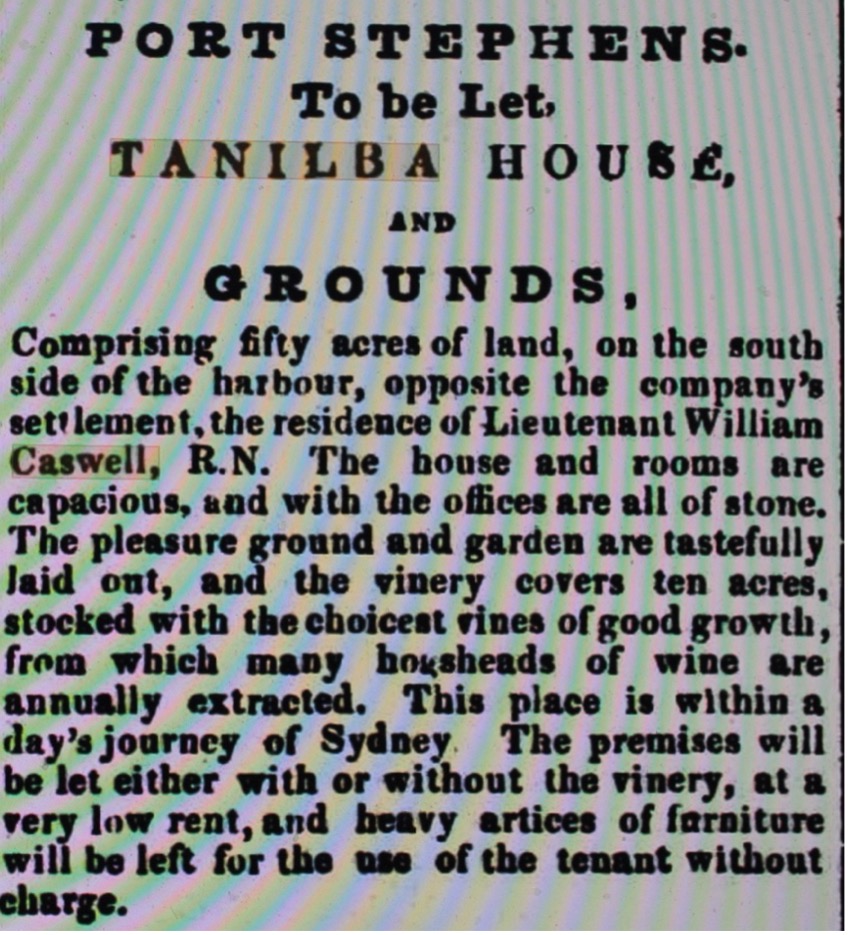
Advertisement for lease of Tanilba House [Sydney Free Press, 5 April 1842]
The same newspaper also carried the following story about Caswell:
‘In the month of August 1842, Lieut. Caswell was asked for advice on the conduct of a quarrel—which began in February, 1841—between a Mr. King and a Colonel Snodgrass. Mr. King had erected a mutual fence dividing the two properties. Although in a sale advertisement Colonel Snodgrass actually held out this identical fence as enhancing the value of his property, he had refused to contribute his share of the cost of it, and Mr. King was obliged to have recourse to the courts. Apparently, a duel had been suggested as a means of settling the dispute. However Lieut. Caswell, acknowledging his “detestation of the practice of duelling,” advised King to write a letter as courteous as the circumstances admit”—which might produce an apology and a settlement—and, if that failed, to have recourse to the courts, a course of action which was subsequently followed, wherein the Colonel’s threats and insults redounded upon his own head for the three judges punished him with a conviction which might have been prevented had Colonel Snodgrass tendered a satisfactory apology to Mr. King.’
Caswell assaulted at a political meeting – 1848
The Sydney Morning Herald of 27 October 1848, page 2, published the following letter from William Caswell, of Balikerra, near Raymond Terrace, that was dated 19 October 1848:
‘When about to give my vote for Mr Boyd, at a late election at Raymond Terrace for the county of Gloucester, I was assaulted by some thirty or forty men who surrounded me, took me by the throat, and would have done me some serious injury, but for the courage and readiness and kindness of Mr Gaeme Burnett, who dashed in among them, and enabled me to get off. These men were in favour of Colonel Snodgrass, who proved the successful candidate.
I selected for prosecution James Campbell and William Renex, who were pointed out to me as the ringleaders. They were tried by Colonel Snodgrass and Mr. Windeyer; after all the evidence had been heard, Colonel Snodgrass, as Senior Magistrate, was of opinion that the case ought to be dismissed, as Campbell was bound over to keep the peace for twelve months, and therefore the trial they had been engaged in all day was unnecessary; but as Mr Windeyer thought differently, the case would be referred to the Attorney-General.
With reference to William Renex, Colonel Snodgrass stated his opinion that this defendant had gone a little beyond what electioneering custom allowed, but he thought the case ought to be dismissed, Mr Windeyer differing in opinion, and wishing to impose a fine; this case also was deferred. I enquired until when, and was informed by Colonel Snodgrass that as there was only one other magistrate in the district, Mr. Dalyell, who declined to sit, the case must stand over sine die.
Unwilling that these cases should be so disposed of, I appealed to the Attorney-General, who directed the Bench to commit both parties for trial at the Quarter Sessions. My point being thus gained, I consented to withdraw my prosecution, on condition that the defendants paid the costs of the Court, and advertised an apology they should make, to which the Attorney General had given his permission.
During the riots which occurred at the first election, one man was killed at the Paterson, and another in Sydney, and many outrages were committed at the late elections generally; by giving the above publicity, you may be conferring a benefit to the public, by showing the lawless men who assaulted me and others, that the law is not so public as to be fitted for electioneering abuses.’
William Caswell became a Councillor for the Raymond Terrace district in 1851.
Tanilba House Vacant – 1850
“Tanilba House” apparently became vacant again in 1850, for the Maitland Mercury of July 6 1850 carried the following advertisement:
‘To let—50 acres of land, on it a large family residence and vineyard 20 years old capable of producing 1000 gallons of wine and has choice fruit trees in full bearing; is situated on the harbour of Port Stephens, 18 miles from Raymond Terrace. Apply, Lieut. Wm. Caswell, Raymond Terrace.’
Problem with the Tanilba Vineyard – 1851
The Maitland Mercury and Hunter River General Advertiser of 8 November 1851, page 4, reported on the following item written by a correspondent of the Hunter River Vineyard Association:
‘The moment I received your letter I looked over a number of vines of different varieties, but did not detect any of the insect or any symptoms of its presence. Some years ago [prior to 1842] , I saw a very similar insect on Mr. Caswell’s vines at Tinelba [Tanilba], which that gentleman [Caswell] pointed out to me, doing great damage to the young buds in spring; he was then very much annoyed at it, but I have heard nothing of it since.’
Tanilba House Advertised for Sale or Lease – 1854
In 1854, numerous advertisements were published for the sale or lease of Tanilba House and the surrounding land. The following advertisement was published in February 1854:
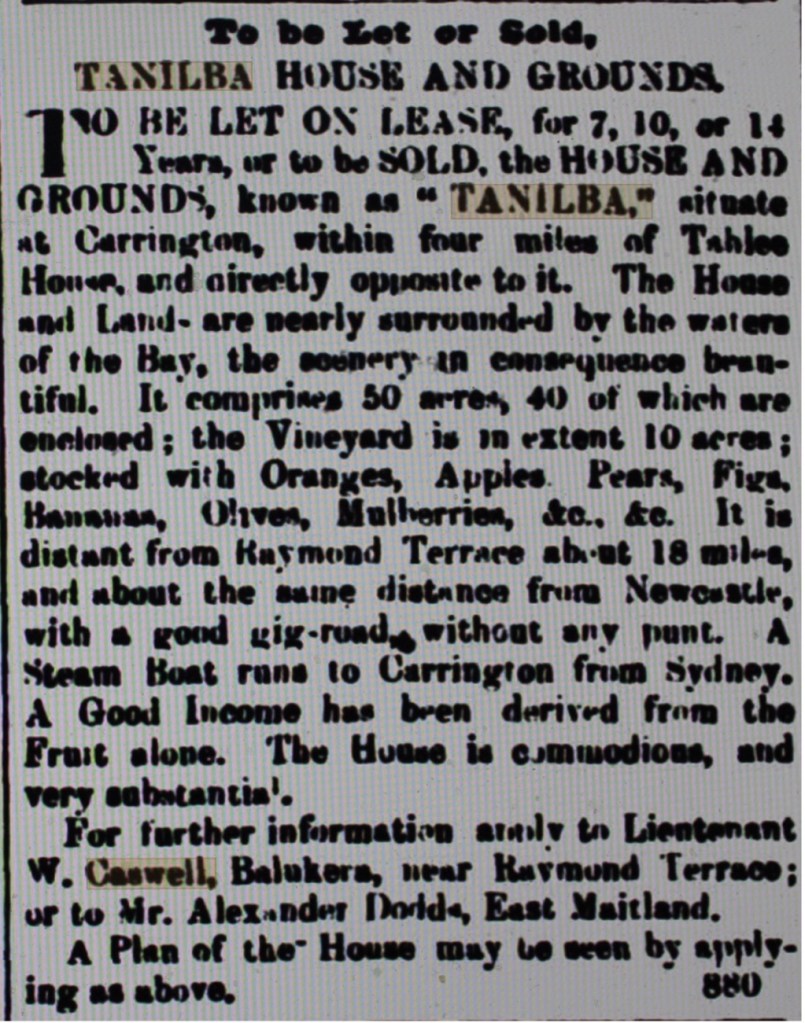
[Maitland Mercury and Hunter River General Advertiser, 22 February 1854]
A Year of Change for the Caswell Family – 1859
In 1857, Lieutenant William Caswell was informed by the Admiraltry that he had been gazetted as Commodore William Caswell, Retired and attached to the Naval Reserve. His pension increased as a result.
In 1859, the Caswell family decided to return to England. Susan Caswell and three of her unmarried daughters left first. Due to problems with leasing his Balickera estate, William Caswell left later on the ‘Light of the Age’. He never arrived in England as he died on board the ship and was buried at sea.
The Maitland Mercury of 5 March 1949, reported:
‘In 1859 Lieut. Caswell decided to pay a visit to England in company with one of his daughters and her Husband (Emily and Andrew Lang), but he did not complete the voyage, for he died on April 29, 1859, and was buried in the sea on which he had long before served with such distinction. Children who survived him were William Stewart Caswell, Emily (Mrs. Lang), Henry Caswell, Caroline (Mrs. Stacey—Stacey was a son of Dr. J. E. Stacey, of the Australian Agricultural Co. and later police magistrate at Newcastle), Nessie Christiana (Mrs. Whitley, Lalla (Mrs. BIyth), Florence (Lady Lucas), and Annie Caswell.
The Lieutenant’s widow, Mrs. Susan Caswell, died in England on January 15, 1886. The Evening News of 11 March 1886, page 4, reported her death as follows:
‘On the evening of the 15th January, 1886, at Dunmore, Teignmouth, in her 82nd year, Susan, widow of Captain Caswell, R.N., of Tanilba, Port Stephens and Balickera, Raymond Terrace.’
Their eldest son, William Stewart Caswell, became a notable figure in Newcastle’s history, being well known as C.P.S. and P.M. to various parts of New South Wales. He died in 1909.’
Part Two: Tanilba House after the Caswells
Linz Family Lease Tanilba House – 1860
The Linz family leased Tanilba House from 1861 to 1871. Mrs. Catherine (known as Nursel) Linz, of Stockton, lived there with her parents. Thereafter the condition of the house deteriorated and in 1882 it was reported that a portion of the roof was damaged.
Description of Fruit Trees at Tanilba – 1881
The Sydney Morning Herald of 10 January 1881, page 5, reported on the visit of a newspaper correspondent on his impressions concerning numerous fruit trees growing at Tanilba:
‘Exactly opposite [to Carrington, Port Stephens] Tahlee, about 2½ miles distant, is a pretty island, one of several dotting the bay, and immediately behind that is a forsaken property known as ‘Tanilba’ formerly the residence of the late Commander William Caswell, R.N., one of the heroes of Trafalgar. In November 1830, I took my first trip across the harbour, on a visit to Tanilba, and, amongst other sights supposed to be curious in those days, was a small olive tree in a most nourishing condition, which had been planted by Mr. Caswell some two or three years previously.
Last Christmas Day [1880] I sailed over from Tahlee to Tanilba and was surprised to find several fruit trees in full bearing, although the place had been deserted for many years. There were several large mulberry trees covered with fruit, as well as bergamot and Windsor pear trees, laden with fruit nearly ripe, showing evidently that visitors were rather rare. I was much struck at finding the olive tree I had seen in 1830, now grown into a splendid tree, without a decayed limb thereon. This tree is now over 52 years old, and in full bearing, clearly proving that the soil and climate of Port Stephens are well adapted for the product of a most valuable article, of export.
I can remember the grounds at Tanilba and Tahlee being prolific with vines and fruit trees of every description; and at the present moment may be seen at Tahlee numerous Norfolk pines, the bunya bunya tree of Queensland, and the Indian bamboo.’
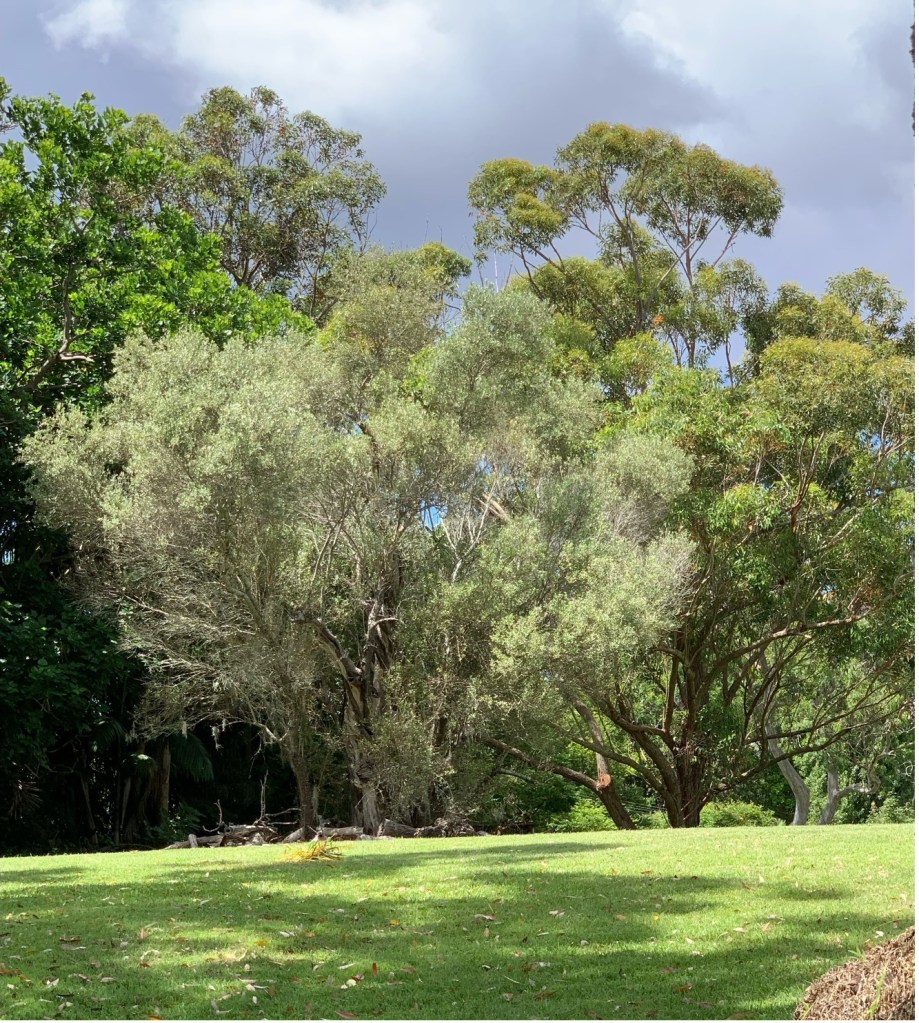
Olive tree planted by Susan Caswell c 1831 [Author Photo – November 2022]
Description of Tanilba House – 1882
A visitor to Port Stephens wrote a description of “Tanilba House” in the Maitland Mercury, dated January 18, 1882:
“We visited “Tinelba” (note the spelling), a deserted residence fast mouldering into decay. It must have been a pretty place once, and a few fine fruit trees scattered here and there showed that there had been an extensive orchard here. “Tinelba” was erected by convict labour is the olden days, and the neighbours speak of its decay as due to this.” At the same time as “Tanilba” was sold to Elizabeth Holmes (1897) the land adjacent to the Williams River known as Balickera of 1920 acres was sold to one, Reid, and also a small allotment of 590 acres at Raymond Terrace. In 1913 “Tanilba” became the country residence of Walter W. Clift Esq., who sold it to Henry Halloran, its recent owner, in 1920.
The home “Tanilba” is now [in 1949] occupied by the Gospel Fishermen’s Mission, whose superintendent was most courteous and kind to our members. Hot water was supplied for afternoon tea. Partaking of this most welcome repast in front of the old house, the visitors were enthralled at the magnificent view of Port “Stephens obtained from there. Undoubtedly “Tanilba House” occupies a most beautiful site. It was whilst looking out on this scene from the veranda that the president, Mr. Goold told the story of Lieut. Caswell and his grand old home. The day was ideal, and everyone enjoyed the visit to this grand memorial to one of Australia’s earliest pioneers.’
Description of Tanilba House – 1884
A visitor from Sydney recorded their visit to Tanilba House in the Sydney Mail and New South Wales Advertiser, of 8 November 1884, page 953, as follows:
‘I took the skiff (which he had rowed to the House site) and went ashore to see what remained of old Tanilba House, once as pleasant a retreat as ever mortal man could wish to pass the afternoon of a busy life in. I first visited the place in ’52, and then it was in a rather ruinous condition. I think it was originally the home of the Caswell family, but now it is deplorable to walk about the ruins. You can trace the positions of the orchard, the vineyard, and the parterres (ornamental arrangement of flower beds), and even still the lemon trees and olives keep up a brave fight with the indigenous swamp oaks and other native vegetation striving to obliterate all traces of the work of man by the original wilderness.’
Tanilba House and Balickera Estate Advertised for Sale – 1897
Following the death of Susan Caswell in January 1886, the finalisation of the Caswell Estate commenced.
In 1897, numerous advertisements were published for the sale of Caswell’s Tanilba House and the surrounding land, together with his Balickera [Ballickera] land.
The following advertisement was published in January 1897:
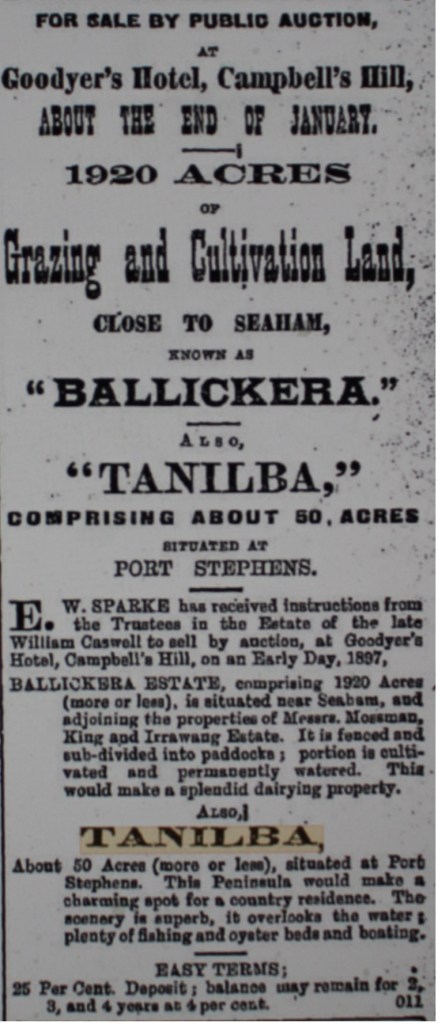
[The Maitland Weekly Mercury, 2 January 1897]
In 1897, Tanilba House it was purchased from the Caswell executors by Mrs Elizabeth Holmes, wife of Edwin Holmes. In 1913 it became the country residence of Walter W. Clift, who sold it to Mr. Henry F. Halloran in 1920.
Tanilba House Advertised for Sale – 1912
The following advertisement was published in November 1912:
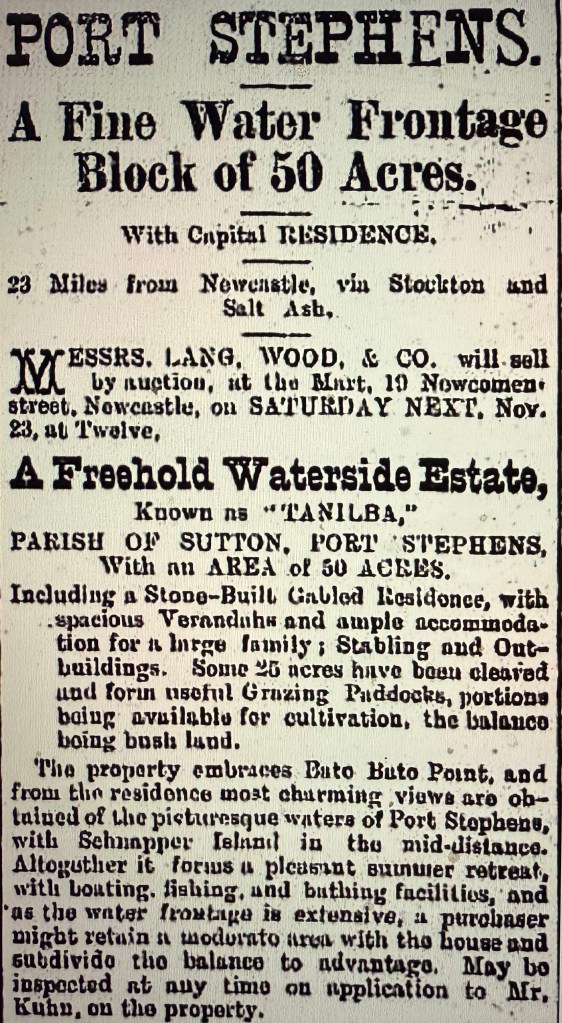
[Raymond Terrace Examiner and Lower Hunter and Port Stephens Advertiser, 15 November 1912]
In 1913, it became the country residence of Walter W. Clift, who sold it to Mr. Henry F. Halloran in 1920.
Henry Halloran Purchases Tanilba House and Land – 1920
The Dungog Chronicle of 11 January 1935, page 4, reported on events concerning Tanilba House:
‘The old home was occupied by many tenants after Lieutenant Caswell’s
death. In 1897 it was purchased from the Caswell executors by Elizabeth, wife of Edwin Holmes. In 1913 it became the country residence of Walter W. Clift, who sold it to Mr. Henry F. Halloran in 1920, who still owns the property [1935]. Mrs. Worthington, Hon. Secretary to the Regatta Club, now conducts it as a Guest House.’
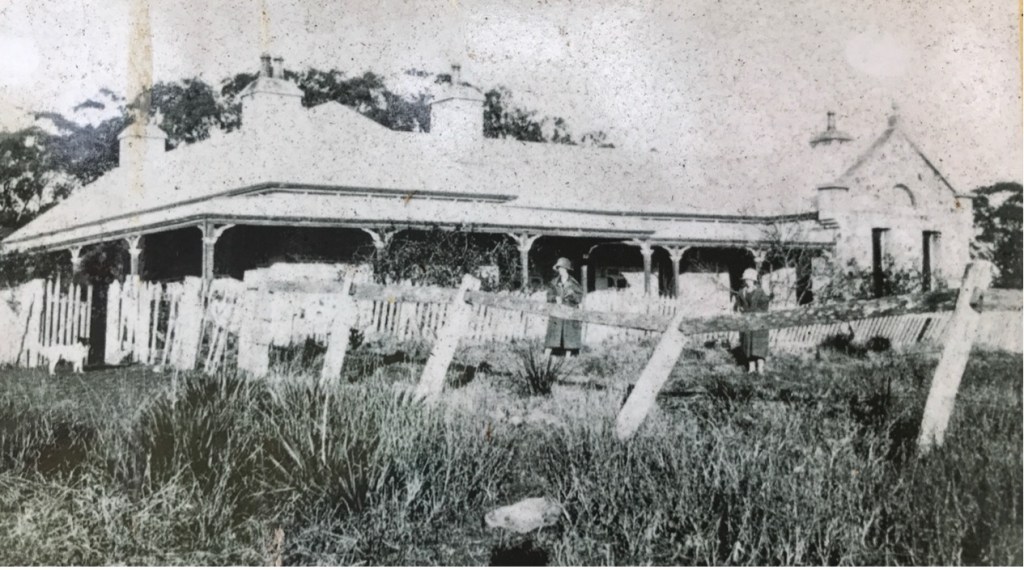
Tanilba House, circa 1920
Henry Halloran updated Tanilba House and added a conservatory, fences, gateways, pergolas and the adjacent Temple of the stork. During the 1920’s Halloran also subdivided a portion of the Tanilba House grounds, as residential allotments.
Tanilba Centenary Remembered – 1930
The Dungog Chronicle of 9 December 1930, page 1, reported:
‘Of historic interest is the old mansion of Tanilba on the southern shore of Port Stephens, situated on the most picturesque peninsula of that wonderful harbour, with glorious views. The old and substantial house is well known to many to whom its history is perhaps not so familiar.
The land was granted to William Caswell, a Lieutenant in the Royal Navy, in pursuance of a promise made to him by His Excellency Lieutenant General Sir Ralph Darling, as Governor of the Territory of New South Wales, on the 9 December 1830, just one hundred years ago. It is not known exactly when the fine old house was erected, but it must have been very shortly after that date, as records in the Mitchell Library show that Lieutenant Caswell resided there in 1833. The Lieutenant had seen considerable service, having served through the Napoleonic Wars and been wounded at the bombardment of Algiers. He also took part in the American War of Independence, subsequently coming to New South Wales with, his wife, one son and one daughter, in 1830.
He was granted ‘Tanilba’ and other lands for services rendered for over twenty years and undoubtedly showed great appreciation of the beautiful in selecting ‘Tanilba’ as the site of his residence which in those times must have been one of the finest mansions in the colony with its spacious rooms and solid walls of beautiful quartz-porphyry.
At one time the house was conducted as a boarding house and was a very favourite resort, but the means of communication in those days was poor. But now with the improved means of communication for motor vehicle along the new Lemon Tree Road bringing it within about an hour’s delightful drive from Newcastle or Stockton, it is to be again made available as a house of accommodation in the capable hands of Mr. and Mrs. I. F. Brown, late of Branxton, who have taken a lease of the property.
Tanilba is now owned by Mr. Henry F. Halloran, the well-known Estate Agent of Sydney and it is remarkable that the original crown grant of the land bears his grand-father’s signature as having been entered by him in the register of the Country in the Surveyor General’s office.’
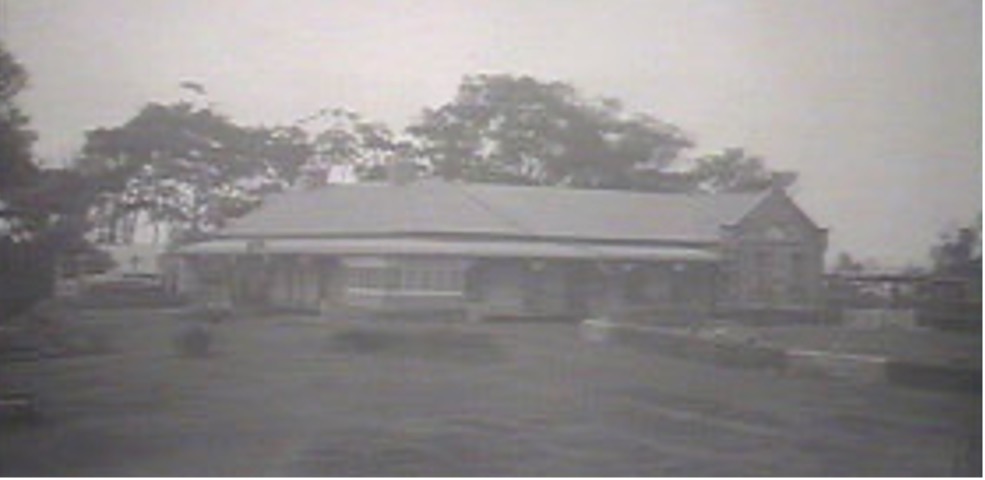
Tanilba House, circa 1930 [State Library, New South Wales]
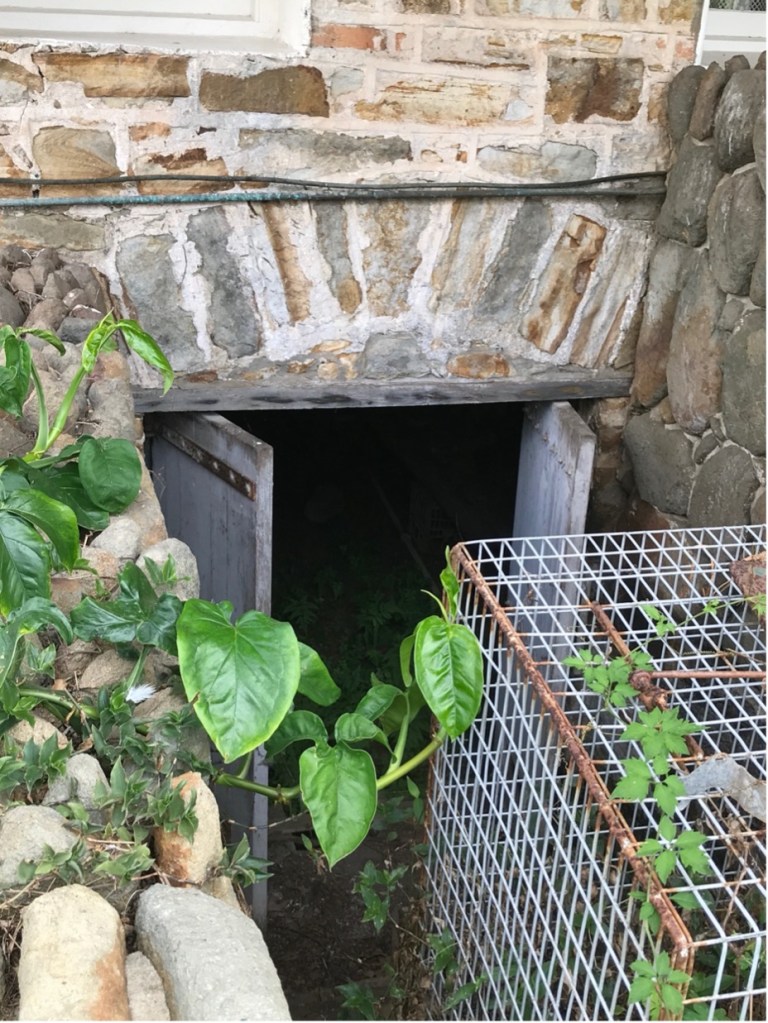
Cellar of Tanilba House, where wine produced on the estate would have been stored [Author photo – October 2017]
Tanilba Guest House – 1933
While Tanilba House and its surrounding land was still owned by Henry Halloran, it was leased by Mrs. E. Worthington who operated the premises as a Guest House.
The Maitland Daily Mercury of 30 October 1933, page 4, reported:
‘Port Stephens, situated about 88 miles from Maitland, with its extensive water frontages and a daily motor service to Newcastle, is now very popular, and Tanilba House provides the tourist with every comfort. Since Mrs. Worthington has taken
over Tanilba House she has re-furnished it throughout. Fishing at Port Stephens is the finest to be had — and the glorious views and delightful climate makes Tanilba an ideal spot to spend a holiday.’
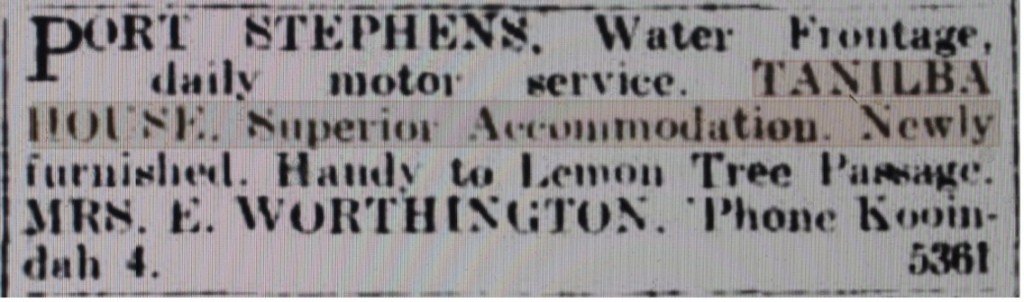
Advertisement placed by Mrs. E. Worthington for her Tanilba Guest House [Newcastle Morning Herald and Miners’ Advocate, 28 October 1933]
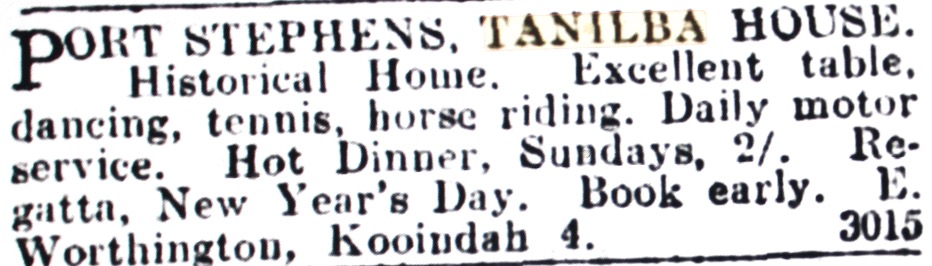
Advertisement placed by Mrs. E. Worthington for her Tanilba Guest House and the Tanilba Regatta that was to be held in the harbour waters opposite [Newcastle Morning Herald and Miners’ Advocate, 22 December 1934]
Clerical Summer School Held at Tanilba House – 1935
The Newcastle Morning Herald and Miners’ Advocate of 2 March 1935, page 10, reported:
‘From February 25 to March 1, a number of Anglican priests spent a very happy and instructive time at Tanilba House, Port Stephens. The course of their study included some of the Church’s problems, and the letter of St. Paul to the Ephesians. The Bishop of Newcastle (Right Rev. F. De Witt Batty) opened the school with a devotional address.
The Dean of Newcastle, Very Rev. W. H. Johnson, spoke on the “Personal Life of the Clergy.” Other important papers were, “Life Symbolism of the Bible,” by Dr. A. P. Elkin; “Reunion,” by Rev. C. R. Jessop; “The Church and the Economic Problem,” by Rev. A. R. Holmes: “Reformation Principles,” by Rev. J. C. W. Gumbley. The beautiful situation of Tanilba House, with its many facilities for recreation and good arrangements for meals provided by the hostess, Mrs. Worthington, helped greatly to make the “school” a success.’
New Proprietress of Tanilba Guest House – 1935
The following advertisement listed Mrs. Whyte as the proprietress of the Tanilba Guest House:
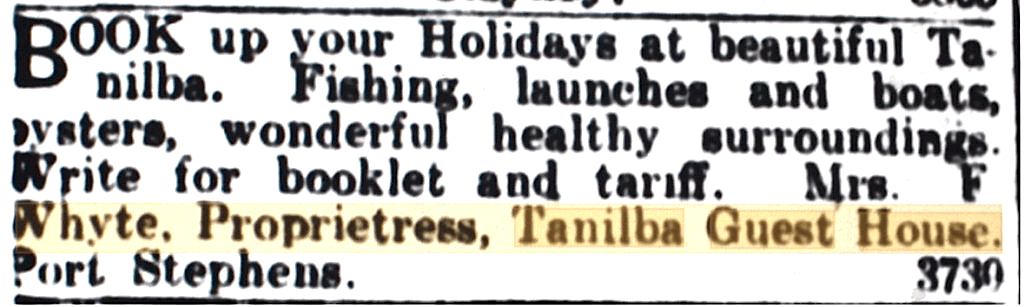
Advertisement for Tanilba House Guest House offers wonderful healthy surroundings [Newcastle Morning Herald and Miners’ Advocate, 7 December 1935]
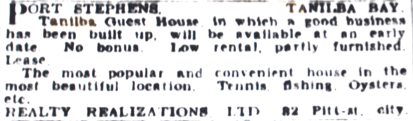
Guest House business at Tanilba House offered for sale [The Sydney Morning Herald, 18 July 1936. A similar advertisement was advertised in the Sydney Morning Herald on 29 August 1936]
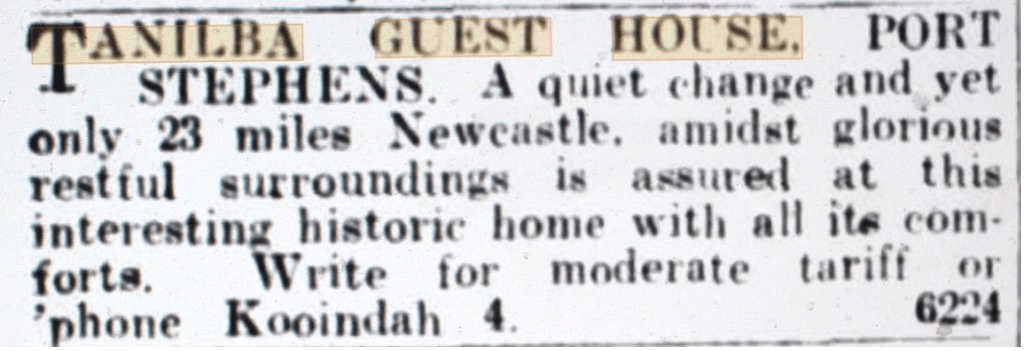
Advertisement for Tanilba House Guest House 1937 – offering glorious restful surroundings, presumably placed by the new business owner [Newcastle Morning Herald and Miners’ Advocate, 10 November 1937]
Land Sales in the Tanilba Estate Area Prove Difficult – 1938
Following the subdivision of the Tanilba House estate and nearby land estates, Henry Halloran had trouble selling the land allotments during the Great Depression years.
The Newcastle Sun of 20 September 1938, page 7, reported:
‘A practical stagnation of land sales with consequent fall in values in certain large foreshore subdivisions at Port Stephens was the basis of objections against valuations by the Valuer General heard today before Mr. Justice Roper at the Newcastle Land and Valuation Court.
Appearing as agent for Mrs. Queenie Tunnie, the Estate of the late Henry Charles Wilson, and Miss Eleanor Graham Dredge, a reduction of rates on Mallubala, Tanllba Bay, Tanilba House, Salamander and Tomaree estates at Port Stephens, were sought by Henry Ferdinand Halloran. Mr. E. J. Hook appeared for the Valuer-General.
Halloran said that he had 50 years’ experience as an estate agent and valuator. His experience of coastal subdivisions was probably larger than any other estate agent in the State. The valuations on the estates were too high. His reason for objecting to the valuations was that, with rare exceptions, no movement in land matters had taken place in the Port Stephens district. On some of the estates concerned only water frontage lots had been sold.
In support of his contention, he said that on a large subdivision at Karuah, which had been on the market for about 10 years, only one lot had been sold.
Portion of the Tanilba Bay Estate he valued at £40 an acre. The whole area was bought in 1918 for £2 10s an acre. He valued portion of the lots at from £1 to £10 an acre. About £3960 had been spent in roads and drainage and another £2500 in making a road of access from Salt Ash. A subdivision of 600 lots, the Anna Bay Estate, was bought about two years ago for £700, about 25s a lot. In certain cases, the valuations had been increased fourfold. Witness said that he considered the average value of lots, of the Salamander Estate would now be about 10s a lot. ……
He considered that Tanilba Bay subdivision, which was bought as one lot in 1918 for £700, was now worth only £510, even though it was now subdivided and there were 40 acres of roads on it. Only two lots had been sold in 15 years. …..
Halloran said that, despite the fact that he had sold Lot 5 on Tanilba Bay Estate in May 1936, for £120, its value in April 1937, was only £15. Lot 4 was sold for £120, but as an expert he did not think the land was worth so much as that. “People wanted it, and were prepared to pay for it,” he added.
George McBean, official valuer for Port Stephens Shire, said that in order to secure data on which to base his valuations in 1937, he obtained information about all land sales in the shire. He inspected the subdivisions under appeal, including the lots which had been sold. He had seen price lists of Halloran’s subdivisions at Tanilba House and Salamander. He knew of the sale of lots east of Nelson’s Bay, and that knowledge had assisted him in making his valuations.’
The marketing plans of Henry Halloran for the three land sale estates on the Tilligerry Peninsula during the 1930’s are reproduced below. The land subdivisions were marketed by Halloran’s company, Realty Realizations Limited.
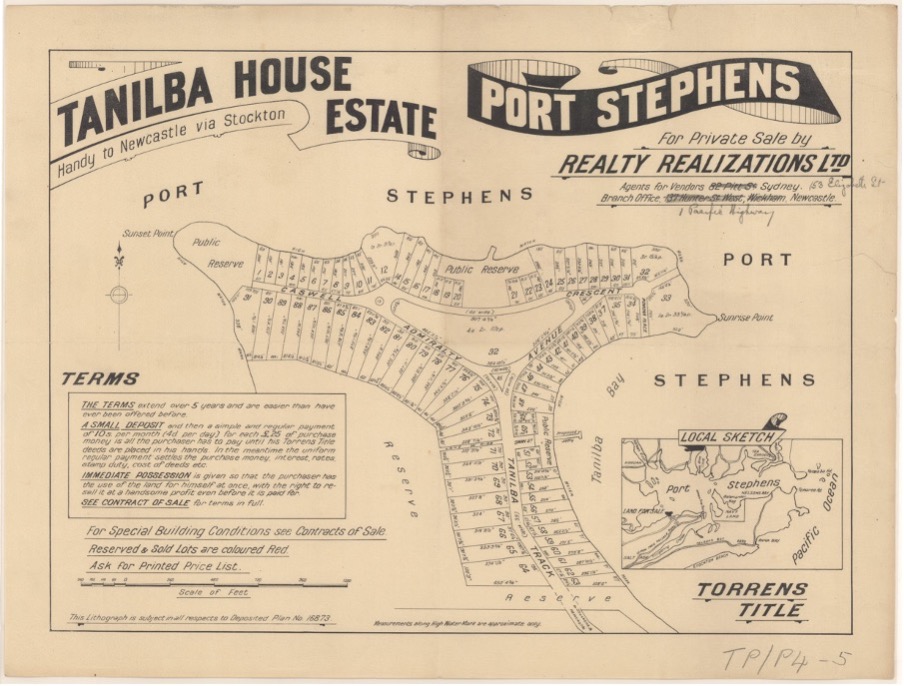
Tanilba House Estate [State Library New South Wales]
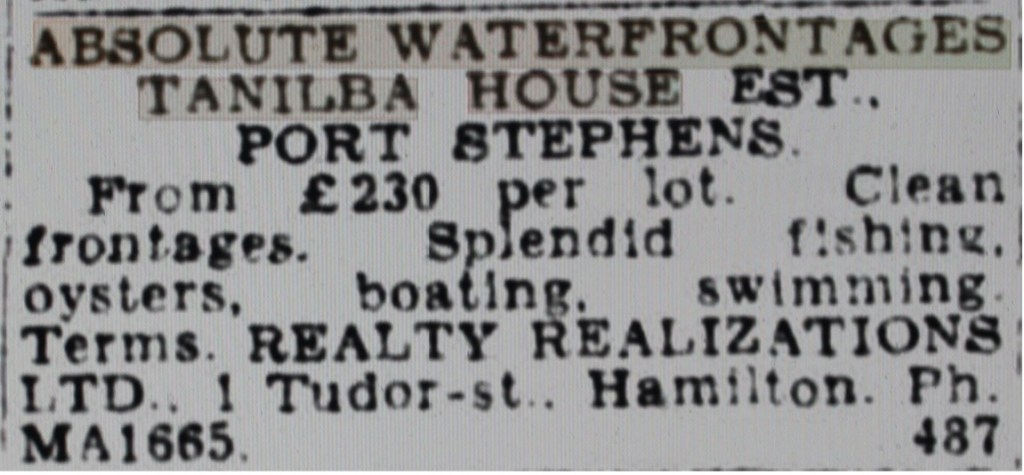
Advertisement for waterfront land at the Tanilba house Estate [Newcastle Morning Herald and Miners’ Advocate, 9 December 1954]
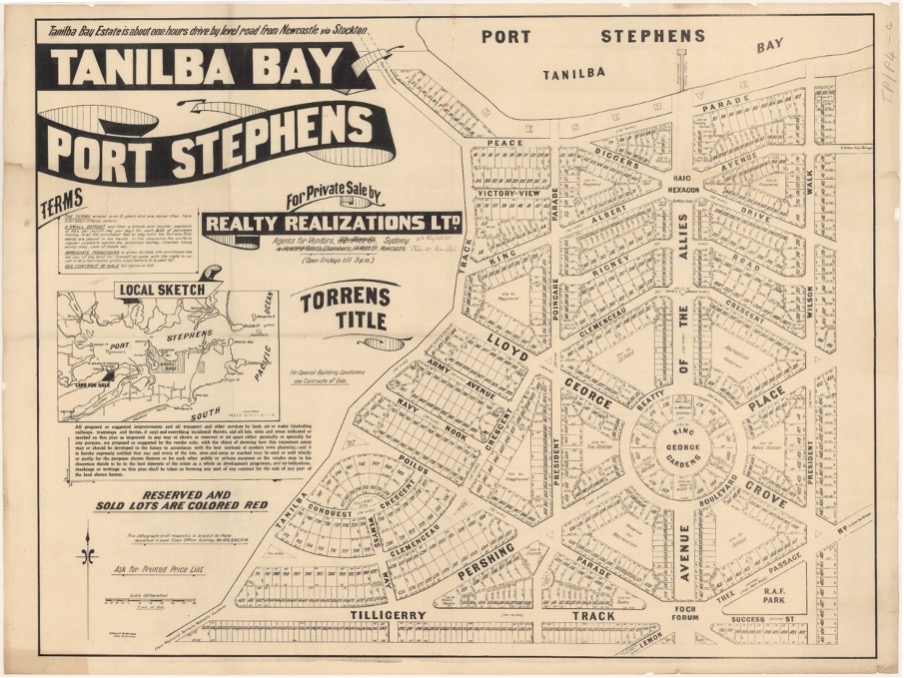
Tanilba Bay Estate
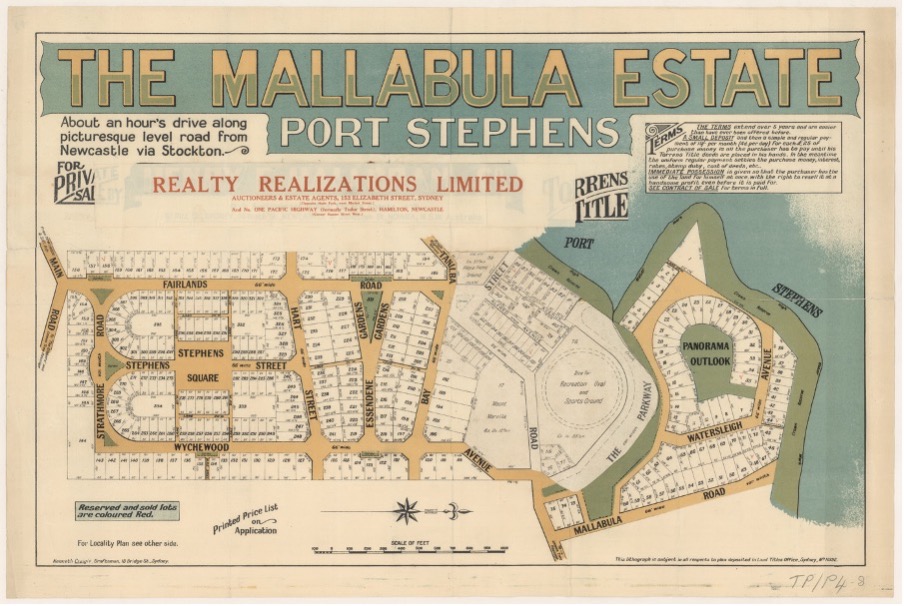
Mullabula Estate [State Library New South Wales]
Tanilba Guest House Under New Management – 1939
The Maitland Daily Mercury of 25 October 1939, page 10, reported:
‘Tanilba Guest House, Port Stephens, which is under entirely new management, announces the pleasures in store for the holidaymaker, no matter what he requires. Situated on the southern shores of Port Stephens, it presents an ideal place for fishing, boating and swimming. In the midst of natural surroundings. Tanilba Guest House is an ideal place to spend a vacation, whether one is in search of rest or recreation. Elsewhere in this issue will be found particulars of the guest house and the way in which reservations may be made.

Advertisement for Tanilba House Guest House offers a combined transport and accommodation package [The Maitland Daily Mercury, 25 October 1939]
‘Sly Grog’ Sold at Tanilba House – 1940
The Newcastle Morning Herald and Miners’ Advocate of 29 March 1940, page 14, reported on court proceedings undertaken at Raymond Terrace concerning the sale of alcohol at Tanilba House:
‘Thomas Leslie Russell was charged with having, at Port Stephens, sold liquor without holding a licence. He pleaded “Not guilty.” “I have no doubt that a sale was completed,” said the Magistrate, imposing a fine of £30, in default 60 days’ hard labour.
Sergeant W. E. Lind, of Newcastle, said that about 8.5 p.m. on December 2 he was near Tanilba House, which defendant occupied at Port Stephens. He told Constables McLeod and Escott to search the house. About 10 minutes later he saw Constable Escott outside the house. Later, he and Escott entered the veranda of the house, where defendant and McLeod were standing. A bottle containing a quantity of beer, and three glasses containing beer, were on a table nearby. McLeod told him that defendant had sold him five bottles of beer with a 10/ note which the sergeant had given him.
Defendant said, “I don’t like the way you men get your evidence. I only sold you the beer to oblige you:” Defendant said he had only two bottles left. A search of the house revealed 18 bottles of beer and a number of empty bottles of similar brand to that which he had sold to McLeod. To Mr. N. C. L. Nelson (for Russell), Lind said that Tanilba guest house was an old residence built by the early settlers. It was not a “roadhouse,” where drinking took place at all hours of the night. It was in a very inaccessible place.
Countable D. C. Escott, of Sydney, said that, entering the house, defendant told him and McLeod that he had had to cancel arrangements for a dance that was to have been held that night. McLeod suggested a drink of beer. Defendant produced five bottles of beer from an ice-chest, and said, “That will be 10/.” When defendant went to get some glasses, he (Escott) left, and spoke to Sergeant Lind. Russell, in evidence, said that he was preparing to go to bed when he heard a car approach the house. It stopped at the front door, where he met two men. They said, “No dance tonight?” He told them that the dance had been cancelled. He took them to the side veranda and showed them the dance floor. He said, “Will you have a drink with me?” Constable McLeod said, “We won’t have a drink unless we can repay the compliment.” He obtained three glasses, then Escott said he would go to the car.
He and McLeod were having a drink when Sergeant Lind appeared and said that he was a police officer. He denied having accepted a 10/ note. He had accepted no money of any kind. To the Police Prosecutor (Sergeant W. G. Wallace), defendant said that he had given Escott and McLeod drinks out of hospitality. When he entered with the glasses, Constable McLeod was trying to open a bottle of beer with a penknife. Imposing a fine, the Magistrate said, “I have no doubt that a sale was completed when the bottles were placed on the table.” He allowed time to pay.’
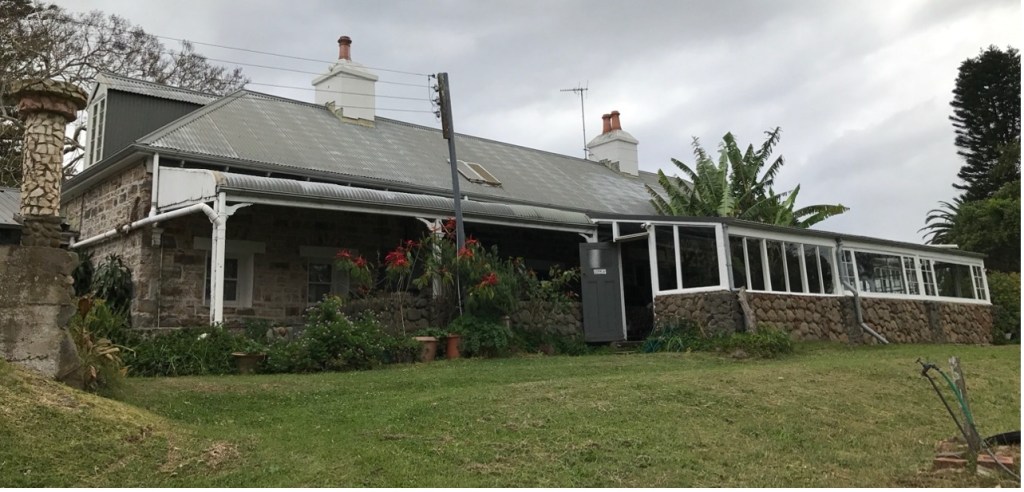
Veranda at the side of Tanilba House where the sale of ‘sly grog’ allegedly took place [Author photo – October 2017]
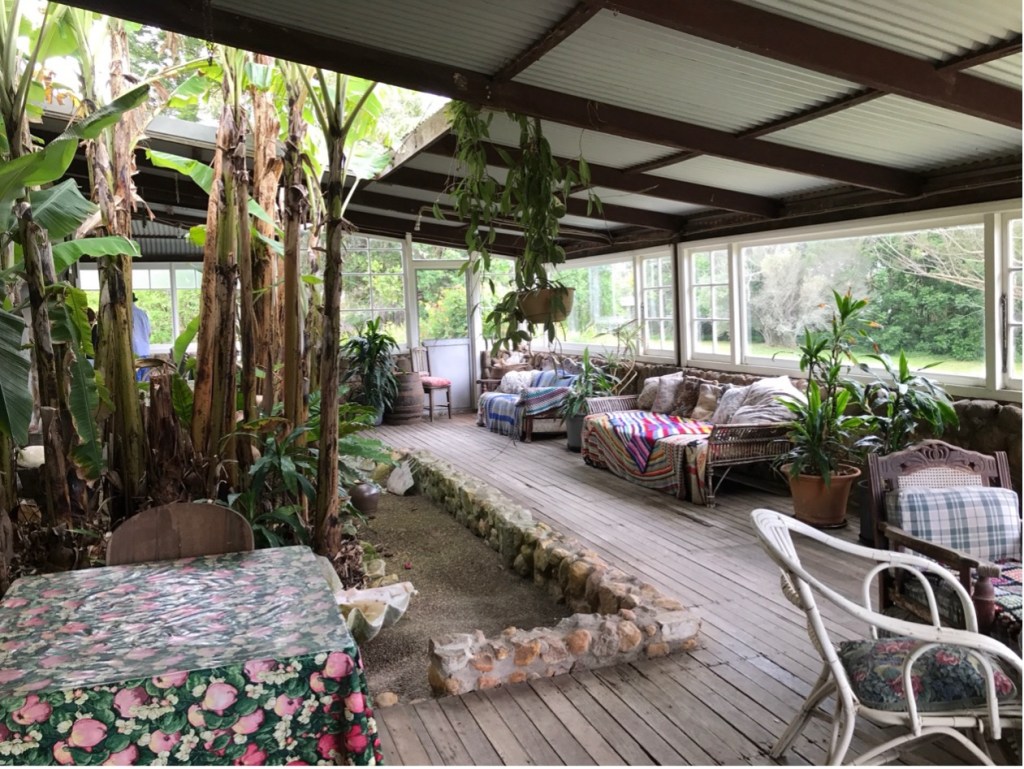
Interior of the Tanilba House veranda, once used for dances and meetings [Author photo October 2017]
Tanilba House Advertised for Lease – 1943
In April 1943, Tanilba House was advertised for lease by Realty Realisation Limited, which was a real estate marketing firm owned by Henry Halloran, the owner of the property.

[Newcastle Morning Herald and Miners’ Advocate, 17 April 1943]
Gospel Fishermen Headquarters Established at Tanilba House – 1946
Tanilba House was leased to the Gospel Fishermen Association around the late 1940’s. The Newcastle Morning Herald and Miners’ Advocate of 1 April 1946, page 5, reported:
‘Mr. and Mrs. F. Barker, founders of the inter-denominational mission known as the Gospel Fishermen, were the principal speakers when the mission held its anniversary meetings at Maitland-road Baptist Church on Saturday. Mr. and Mrs. Barker, who have just returned from the United Kingdom, spoke of their experiences in England, Wales and Scotland.
They also gave musical items at the Headquarters of the Gospel Fishermen are at Tanilba, where young people’s camps are conducted. At the afternoon session, field reports were presented. The Director (Mr. G. Theobald) said the organisation was free of debt. An address was given by Welfare Officer P. de Russet, R.A.A.F., and items by a male voice quartette. A girls’ choir from the Aboriginal Training College, Singleton, sang at night.’
Students Return Home After Holiday at Tanilba House – 1949
The Singleton Argus of 28 February 1949, page 2, reported:
‘The 15 students at Minimbah House returned last week from their holidays at Tanilba House, Port Stephens. Good weather for most of the two weeks made their vacation very enjoyable. Each girl had earned enough to pay all her own expenses. Miss B. Clough, of the College, and Miss Rae Fletcher, of Victoria, accompanied the girls to Tanilba. ‘
A View of Tanilba House and its Surrounds – 1949
On 28 February 1949, the Maitland Mercury published the following article written by E. S. Lauchland, of the Newcastle and Hunter District Historical Society, outlining a history of Tanilba House and its surrounds, which they had recently visited:
‘From Newcastle the Newcastle and Hunter District Historical Society reached “Tanilba” in three buses which led along the picturesque shore of Fullerton Cove, passing Fort Wallace and the golf course on the sand dunes, and on through prosperous farms to Williamtown. Along the Nelson’s Bay road the Salt Ash school and church were passed, then the Salt Ash wharf to Tilligerry Creek. Five miles along the Lemon Tree road brought the party to the entrance gate to Tanilba Estate. This is a magnificent stone fortress-like gateway leading into the grounds of Tanilba.
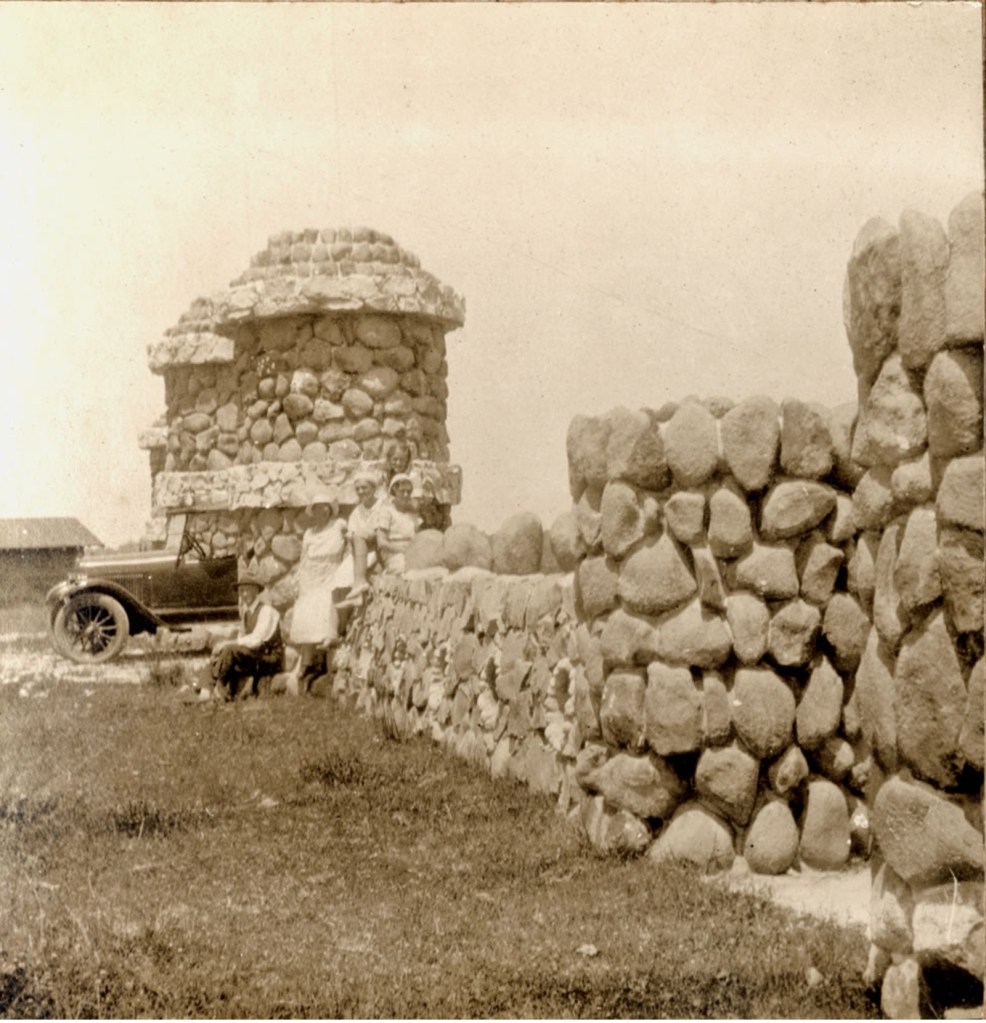
Entrance gates to the Tanilba Estate, 1935, constructed by Henry Halloran [Newcastle University Library]
A turn to the left led through a mile long avenue of Norfolk Island pines and half round Beatty Circle to the exceedingly imposing entrance gates known as the centenary gateway of Tanilba. These were completed on March 31, 1931—just 100 years from the day, March 31, 1831, when Lt. Caswell went into possession of “Tanilba.” The Bollards which surmount the central pillars came from HMAS Sydney, the victor in Australia’s first naval battle when she destroyed the Emden on November 9, 1914, at Cocos Island.
This gateway was designed and erected by Mr. Henry Halloran, landscape architect, and except for the twenty tons of cement which hold it together, is composed of the beautiful native stones of Tanilba.
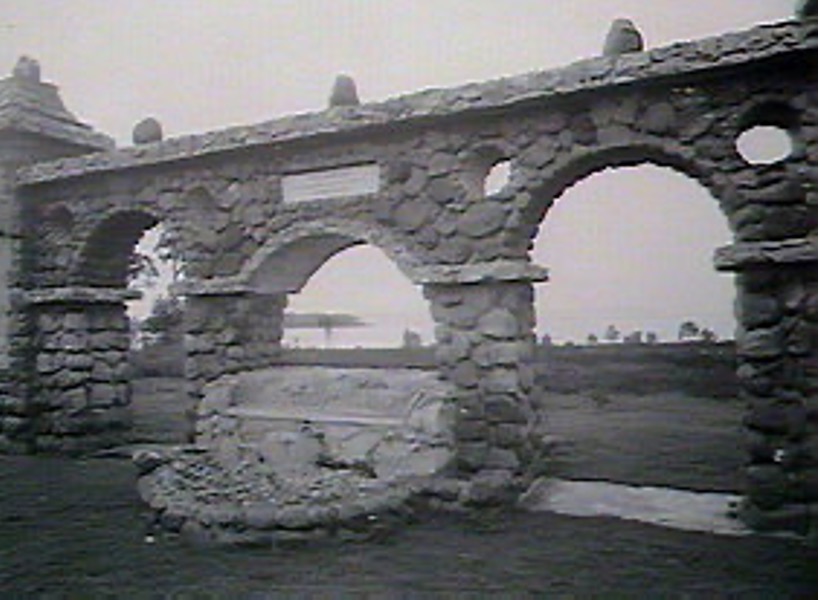
Centenary archway to Tanilba Estate, circa 1931, constructed by Henry Halloran [State Library, New South Wales]
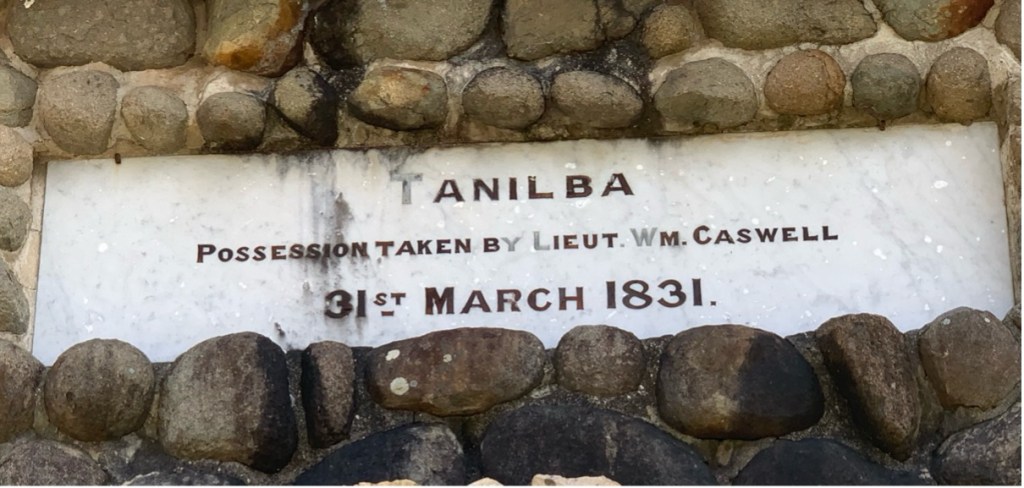
A plaque on the Centenary archway stating that Lieutenant Caswell took possession of the Tanilba land on 31 March 1831, which was the date of the crown grant to him [Author photo – November 2022]
Standing in its own grounds of several acres, “Tanilba House,” a massive, one-storey dwelling with verandas all round, is a place of exquisite charm and natural beauty. It is situated on a unique peninsula, surrounded on three sides by the waters of the port, and Swan Bay, with extensive views across the water and its white sandy beaches.
The house and rooms are capacious, delightfully cool on the hottest day of summer, and cosily warm in winter. In the house there is a painting of its founder, Lieutenant William Caswell, also an autographed photograph of Sir Henry Parkes. A stretch of about two miles of curving white sand forms the bathing beach at Tanilba Bay. Another curving tree-girt beach is the William Bay, which forms yet one more of the attractions of Tanilba. Among the lovely trees on the property is an olive, considered to be the oldest in Australia, which is still alive and healthy. Great cabbage-tree palms add to the picturesque grounds.
In front of the house is a fine ship’s bell engraved “Sobraon,” on which the hours are rung during the day. The “Sobraon” was the largest vessel afloat when she was launched in November, 1866 —since when she has been connected with much of Australia’s history. She was a great favourite as a passenger vessel. When, in 1868, she made her second voyage to this country, the Earl of Belmore was one of her passengers. The following year (1869) with H.R.H. Prince Alfred aboard she was the flagship on Anniversary Day. Purchased in 1891 by the Government, she afterwards became the training-ship “Tingira.” [The ship was paid off from the Royal Australian Navy in 1927].
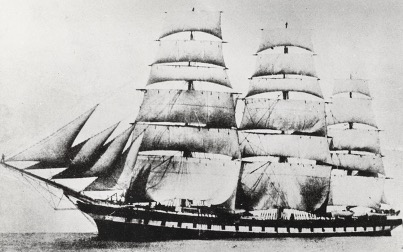
Sobraon

Sobraon bell [Jervis Bay Maritime Museum Blog]
On one side of the house is an extensive pergola with handsome stone columns. In this shady spot is set a large stone “wishing chair” with a domed canopy, all composed of the lovely natural stone found on the property.

Wishing chair at Tanilba House [Author photo – October 2017]
The wonderful native stone has been used to provide delight in the picturesque grounds, where in are situated all sorts of attractions. A beautiful piece of work in these native stones forms the dominating feature of the temple triangle at the approach to “Tanilba House.” This artistic work is called “The Mosaic Temple of the Stork.”
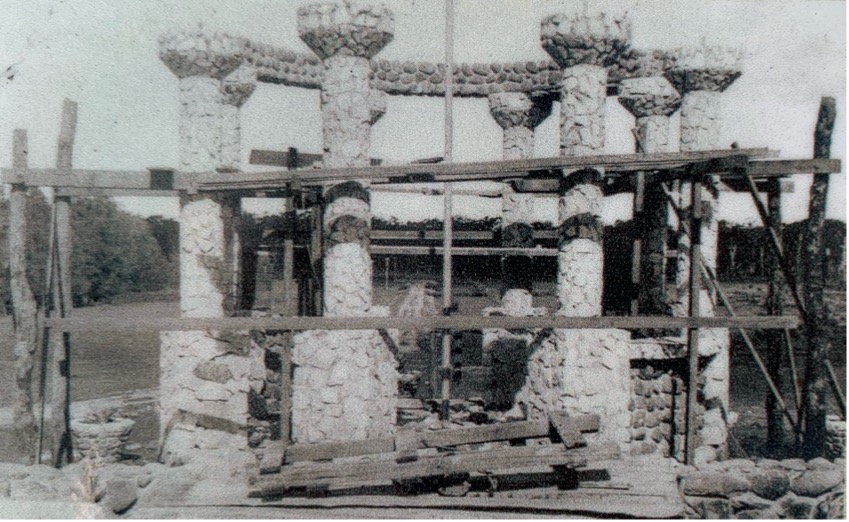
Construction of the Temple of the Stork
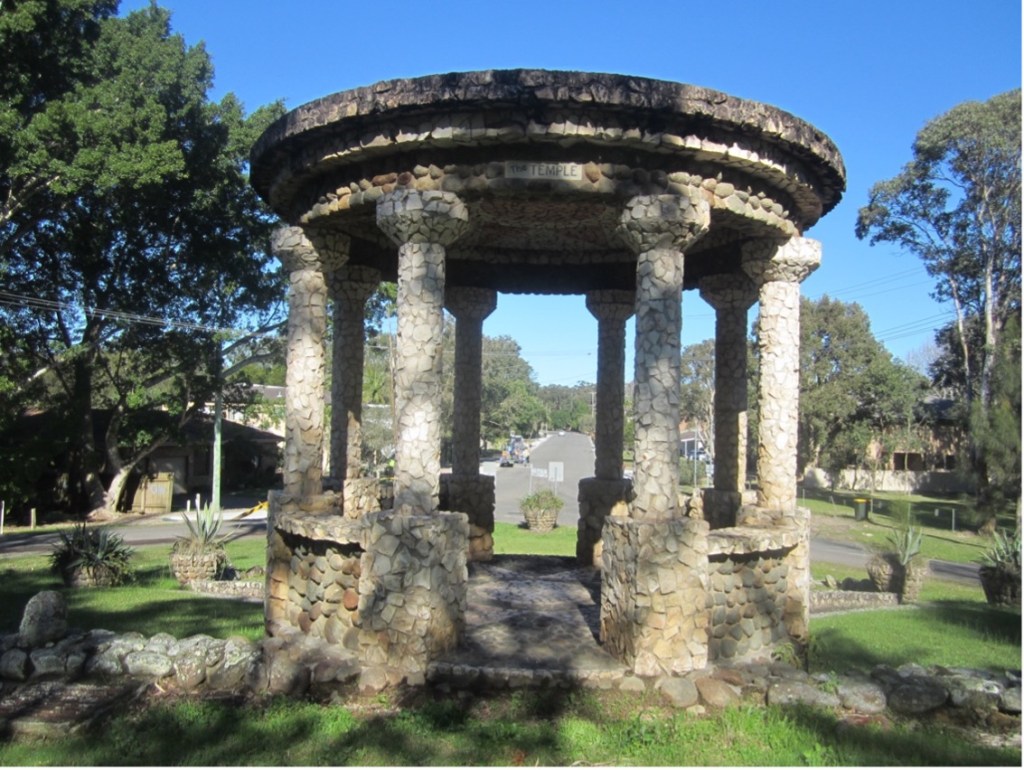
Temple of the Stork [Author photo – October 2017]

Stone Mosaic Roof of the Temple of the Stork [Author photo]
There is a well-equipped picnic ground with a large summerhouse and picnic shelters which can be converted into camping places. Carved figures of stone support the fireplaces, where the billy can be boiled, or chops grilled. At the foot of a winding path in Meridian Park is a large circular stone table with four seats encircling it. These are made of large stones surmounted by smooth wooden seating, which adds considerably to the comfort.

Circular stone table and surrounding seating at the present day Meridian Park, circa 1930 [State Library, New South Wales]
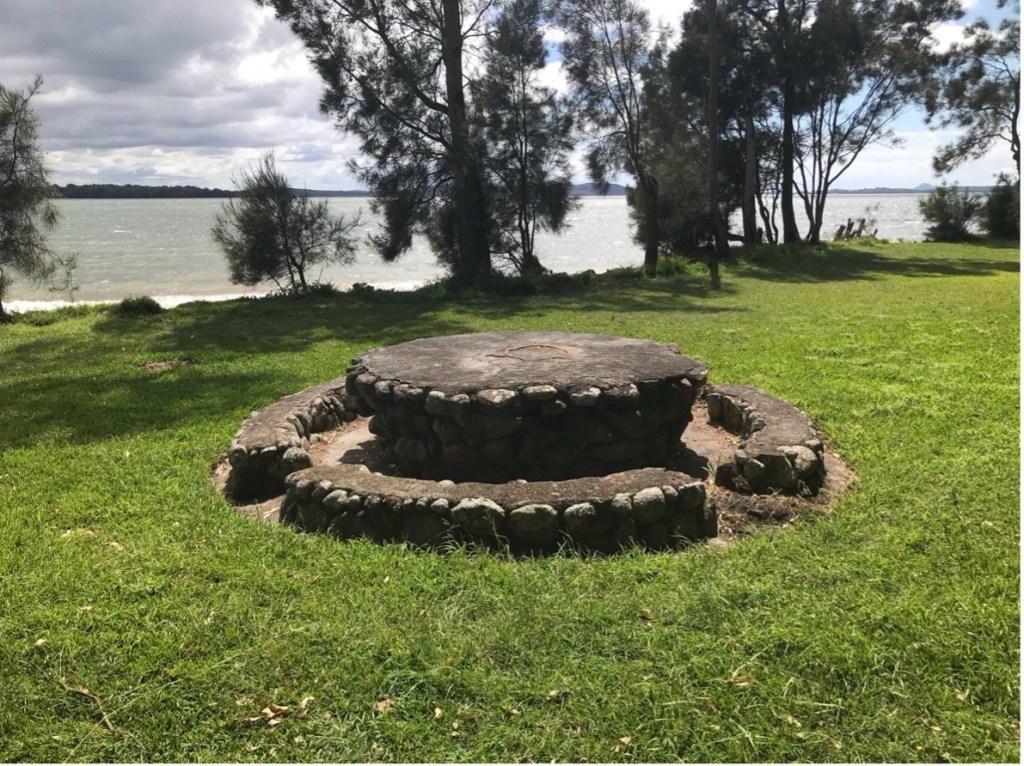
Circular stone table and surrounding seating at Meridian Park, minus the wood seats on top of the stone bases, [Author photo – November 2022]
Numerous rustic benches of stone, built-in permanently, supply comfortable seating accommodation throughout the grounds. These picnic arrangements have, of course, been added during recent years. An old headstone stands on the bank of the Port. It is said to mark the burial place of one of the Lieutenant’s servants, but the inscription has completely worn away.’
Endeavour Union Held a House Party at Tanilba House – 1953
The Newcastle Morning Herald and Miners’ Advocate of 27 January 1953, page 2, reported:
‘The Newcastle district Christian Endeavour Union held a house party at Tanilba House, Port Stephens, at the weekend. Guest speakers were the Superintendent of the Newcastle City Mission (Mr. J. McCallum) and the Secretary of the Port Stephens C.E.U. (Mr. Max Sykes).’
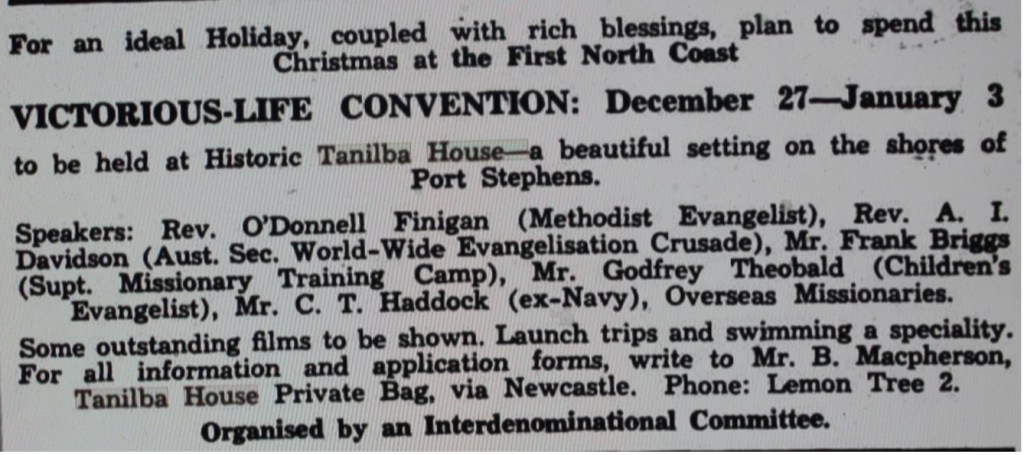
Advertisement for a Victorious-Life Convention held at Tanilba House [The Methodist, 20 November 1954]
Death of Henry Halloran, Developer of the Tanilba Area – 1953
The Newcastle Morning Herald and Miners’ Advocate of 31 October 1953, page 5, reported:
‘Mr. Henry Ferdinand Halloran, managing director of Henry F. Halloran, conveyancing surveyors, who died in Sydney at the age of 84, had been in practice as a conveyancer since 1897. His interests were not confined to Sydney. He was also managing-director of Realty Realizations Ltd., Hamilton, and from there controlled the activities of the two organisations in the Northern district.
His country home was at Ferodale, six miles out of Raymond Terrace, where he owned a farm. Usually, he spent his holidays there. He had made a close study of animal husbandry and had shown that the country in this part of the North was suitable for pasturing sheep. Between this suburban settlement and Port Stephens, Mr. Halloran divided his time when away from the capital. Estates were acquired, subdivided and sold at Tanilba and Shoal Bay, where there has been considerable expansion.
About Tanilba one might see the town-planner’s impression of a well-laid out town. Thirteen estates were sub-divided in this area by Mr. Halloran, who, addressing a conference of Port Stephens Shire councillors 30 years ago, said he was convinced that, with or without the railway that had been spoken of to connect Morpeth with Port Stephens, there would be rapid development.
At Lake Macquarie, he had planned and subdivided 15 estates and superintended much of the operations in the Newcastle district, with the firm’s representative (Mr. D. R. Roberts). Mr. Halloran assisted the research of the historical societies, and made available valuable data collected in the course of 50 years. The Halloran family’s link with the colony was unbroken from the days of Endeavour. Mr. Halloran’s grandfather was associated with Lieut. Caswell.’
Following Henry Halloran’s death in 1953, the condition of Tanilba House began to deteriorate. In 1962, it was leased to the Overland family who used it as Guest House and riding school.
The Oberlands, George and Helena, purchased Tanilba House in 1969. George died in 1972 and Helena in 2002.
A permanent conservation order under the NSW State Heritage Act was placed on Tanilba House and The Temple of the Stork in February 1980. In April 1999, both were placed on the State Heritage Registrar
Concluding Comments
The legacy of Lieutenant William Caswell and his wife Susan is still evident at Tanilba Bay, Port Stephens. In clear view on a small hill, on the shore of Port Stephens, Tanilba House still stands prominently, much the same as when it was first constructed by convict labour in 1837.
Prior to its most recent sale in 2018, Tanilba House had been the family home of Mrs Helen Taylor, daughter of the Oberlands, who had lovingly cared for it for many years until her death in September 2015.
The new owners, Glenn Short and Deidre Hall, currently operate the premises as a venue for weddings and functions.
Researched and compiled by Kevin McGuinness
August 2024
APPENDIX:
Convicts Recorded in the Service of William Caswell
The following is a list of 32 convicts known to have been in the service of Lieutenant William Caswell at both Tanilba and Balickera, as compiled by the author from official convict records.
Additional convicts are likely to have been in his service but have not been included in the list as a specific reference to Caswell has not been found in the available documentation.
Lot Broughton [Broydon], per Surprise 1790.
Sentenced at Cambridge in 1788 to life for burglary.
1790 – Included in an account of convicts money deposited in the hands of Captain Trail; 1809 – Produce received from Lot at the Hawkesbury Stores, April 1809; 1809 – Received rations from the Hawkesbury Stores, 13/5/1809; 1814 – Labourer of Windsor, of government stores; 1822 – Labourer of Windsor, with Conditional Pardon; 1825 – Landholder of Wilberforce, with Conditional Pardon; 1828 – Tailor with William Caswell, Lower Portland Head, aged 61, with Conditional Pardon; 1835 – Buried 29 March 1835, St. Matthews, Windsor. Aged 68 and had been a resident of Macdonald River area.
John Brown, per Florentia 1830.
Was a farm labourer aged 35. Sentenced at Stafford in 1830 to life for highway robbery. Was married with 4 children prior to transportation.
1830 – After arrival in Colony assigned to William Caswell, Port Stephens; 1837 – With Lieutenant Caswell, R. N., Port Stephens, aged 40; At Tanilba, Port Stephens; 1839 – Ticket of Leave, Williams River, 11/11/1839. Altered to Raymond Terrace, 2/6/1840; 1845 – Had Bank Warrant; 1847 – Ticket of Leave Passport, 20/7/1847 (issued by Raymond Terrace Bench) and 5/12/1848 and 30/11/1850 (on recommendation of Commissioner of Crown Lands, New England); 1851 – Conditional Pardon, 1/2/1851.
Richard Butler, per Larkins 1829.
Was a farm labourer aged 28. Sentenced at Kilkenny in 1829 to 7 years transportation for pig stealing.
Upon arrival assigned to Lieutenant Caswell, Port Stephens; 1834 – Ticket of Leave, Williams River, 26/7/1834. Cancelled, convicted, 19/11/1834; 1836 – Certificate of Freedom, 29/8/1836.
Ellen Clarke, per Minerva 1839.
Was a laundress aged 25. Sentenced at Cork in 1839 to 7 years transportation for stealing money.
1841 – Absconded from Female Factory, Parramatta; 1843 – Absconded from Elliot Balmain, since 28/4/1843; 1843 – Apprehended after abscondment from T. Elliott, Balmain; 1843 – Apprehended after abscondment from Lieutenant William Caswell, R. N., Balickera, on 29/11/1843; 1845 – Absconded from G. M. Harper, Kilcoy, Raymond Terrace, since 5/5/1845. Apprehended on 22/5/1845; 1845 – Applied to marry Richard Drawner alias Trayner, per Lonach 1825, Raymond Terrace. Application approved; 1846 – Absconded from Female Factory, Parramatta, since 15/12/1845. Apprehended on 7/1/1846; 1846 – Absconded from James Pigon, Colo River, Windsor, since 16/12/1846, Apprehended on 10/3/1847; 1847 – Applied to marry G. Spleysenberg [Spleydenburg], per Captain Cook 1833, Castle Hill. Application approved. Married during 1847 (Church of England, Castle Hill).
James Colgan, per Hero 1835.
Was a stonemason, aged 22 years. Sentenced at Kings County in 1834 to 7 years transportation for burglary in a storehouse.
1837 – With Lieutenant Caswell, R. N., Port Stephens, aged 23; At Tanilba, Port Stephens; 1839 – Ticket of Leave, Maitland, 11/11/1839; 1840 – Applied to marry Mary Supple alias Hickson, per Pyramus 1836, West Maitland, 29/2/1840. Application approved. Both were 28 years old. Married in 1840 and son Thomas born in 1848 at Maitland; 1844 – Certificate of Freedom, 19/1/1844.
William Cooke [Cook], per Susan 1834.
Was a Black and Whitesmith, aged 37 years. Sentenced at Middlesex in 1833 to life for housebreaking.
1837 – With Lieut. Caswell, R. N., Port Stephens, aged 26; At Tanilba, Port Stephens; 1839 – Ticket of Leave, Parramatta, 1/2/1839. Altered to Raymond Terrace, 2/12/1839; 1842 – Ticket of Leave, Muswellbrook, 21/7/1842; 1844 – Ticket of Leave Passport, issued by Muswellbrook Bench, 26/8/1844; 1847 – Conditional Pardon, 30/7/1847; 1850 – sentenced to 12 months hard labour by Water Police Office, 16/11/1850.
William Cowell, per Surrey 1831.
Was a Carpenter, aged 25 years. Sentenced at Essex to life for stealing linen.
Upon arrival assigned to Alexander Warren, Williams River; 1833 – Assigned to John Wighton, Williams River; At Tanilba, Port Stephens; 1837 – With Lieutenant Caswell, R. N., Port Stephens, aged 29; 1841 – Ticket of Leave, Maitland, 29/9/1841. Altered to Peterson, 9/12/1842; 1847 – Conditional Pardon, 10/4/1847.
William Egan [Eagan], per Java 1833.
Was a farm servant aged 26 years. Sentenced at Kilkenny in 1833 to 7 years transportation for sending a threatening notice.
Referred to in the Medical and Surgical Journal of the transport ship: William Eagan, aged 26, Convict; disease or hurt, dysentery. Put on sick list, 31 October 1833. Discharged, 19 November 1833; 1837 – With Lieutenant W. Caswell, R. N., Raymond Terrace, aged 27; At Balickera, Raymond Terrace; 1838 – Ticket of Leave, Williams River, 8/4/1838. Altered to Butterwick; 1840 – Certificate of Freedom, 21/3/1840.
John Flannery, per Java 1833.
Was a farm labourer and soldier, aged 20 years. Sentenced at Kings County to 7 years transportation for stealing a watch.
1837 – With Lieutenant Caswell, R. N., Port Stephens, aged 22; At Tanilba, Port Stephens; 1838 – Absconded from William Caswell, Port Stephens, since 26/12/1838. Later apprehended; 1844 – Certificate of Freedom, 2/3/1844.
James Foster, per Recovery 1819.
Was a seaman aged 26 years. Sentenced at Southampton in 1819 to life for burglary.
1819 – The Salisbury & Winchester Journal, 8/3/1819: On 6/3/1819 James was sentenced to death for burglariously breaking into and robbing the house of William Webb at Romsey; 1822 – (2 entries) Government employ, Macquarie Tower; Government employ, South Head; 1825 – With Road Party, Bringelly; 1828 – Married Ann Crawley, per Henry Wellesley 1837. He was aged 45 & she 21; 1829 – Ticket of Leave, Port Stephens, 10/12/1829. Replaced for Paterson, 20/7/1833; 1836 – Conditional Pardon, 8/9/1836 (690); 1837 – With Lieutenant William Caswell, R. N., Raymond Terrace, aged 40; 1838 – Applied to marry Anne Crawley, per Henry Wellesley, Newcastle, 18/5/1838. Application approved; 1838 – Married Ann Crawley on 1/6/1838. He was aged 45 and she 21.
Francis alias Michael Gallogly [Galloghy].
Was a Ploughman aged 21 years. Sentenced at Armagh in 1831 to 7 years transportation for stealing sheep.
Upon arrival assigned to William Caswell, Port Stephens; 1836 – Absconded from W. Caswell, Port Stephens, since 23/7/1836. Later apprehended; 1842 – Absconded from Lieutenant William Caswell, R. N., Raymond Terrace, since 7/3/1842; Served colonial sentences of 3 years 19 months & 28 days; 1843 – Certificate of Freedom, 27/10/1843.
William Giddings [Giddins], per Andromeda 1833.
Was a farm servant aged 25 years. Sentenced at Northampton in 1832 to life for poaching. Was married to Sarah Ball in England and they had 2 children.
1833 – Assigned to William Caswell, Port Stephens; At Balickera (Raymond Terrace) and Tanilba (Port Stephens); 1837 – With Dr. Stacey, Peel River, aged 31; 1841 – Ticket of Leave, Port Macquarie, 11/12/1841. Altered to Windsor, 9/1/1846; 1847 – Conditional Pardon, 31/12/1847; 1849 – Married Harriet Barwick in 1849 (Church of England, Richmond records). Had 16 children. Harriet died in 1899; 1882 – Died 27/7/1882. Buried with his wife Harriet at St. Stephen’s Church of England at Kurrajong. Aged 73.
Richard Duson Matthew, per Surrey 1834.
Was a groom aged 32 years. Sentenced at Plymouth in 1834 to 7 years transportation for stealing silver plate.
1837 – With Lieutenant Caswell, R. N., Port Stephens, aged 33; At Tanilba, Port Stephens; 1839 – Absconded from Lieutenant William Caswell, R. N., Raymond Terrace, since 25/4/1839; 1841 – Certificate of Freedom, 19/5/1841.
Richard Matthews, per Clyde 1838.
Was a woolcomber and soldier aged 33 years. Sentenced at a Court Martial to 7 years transportation for mutiny. Had been in the British Army for many years & was a Sergeant; 1872 – Died 7/1/1872, Invalid Establishment, Newcastle from disease of the heart.
Ninian Melville, per Fairlie 1834.
Was a cabinetmaker and wood turner aged 23 years. Sentenced at Perth, Scotland, to 7 years transportation for stealing clothes.
1837 – With Lieutenant William Caswell, R. N., Port Stephens, aged 26; Made furniture for Caswell’s wife, Susan; 1838 – Ticket of Leave, Maitland, 25/7/1838; 1840 – Certificate of Freedom, 3/9/1840; In the 1840’s Ninian set up as a Cabinetmaker; 1841 – Married Catherine Hayes in 1841. Had 6 children. Catherine died in 1879; 1895 – Died in 1895 at Newtown, Sydney.
James McGarvie [McGarvey] alias McGarvoch, per America 1829.
Was a ploughman aged 40 years. Sentenced at Aberdeen in 1828 to life for circulating bad notes [money].
Upon arrival assigned to John Black, Hunter River; 1831 – Absconded from No. 42 Road Gang; 1832 – Assigned to William Caswell, Port Stephens; 1837 – With Lieutenant W. Caswell, R. N., Raymond Terrace, aged 48; Was constantly before the Magistrate, having fallen out with Caswell’s Overseer, John Brown (per Florentia 1830); 1839 – Ticket of Leave, Raymond Terrace, 29/5/1839. Replaced for Raymond Terrace, 25/8/1841. Cancelled, unable to support himself, Raymond Terrace Bench, 22/11/1842.
Archibald McNeill, per Sophia 1829.
Was a ploughman aged 27 years. Sentenced at Antrim in 1828 to 7 years transportation for sheep stealing. Married with 7 children prior to transportation. Upon arrival assigned to John Reynolds; 1835 – Certificate of Freedom, 15/4/1835; 1832 – Gave evidence in court. Servant of Lieutenant Caswell; 1835 – Apprehension notice issued for Archibald; 1838 – Appointed as a Constable at Butterwick, 30/5/1838; 1839 – Dismissed as a Constable at Butterwick, 2/1/1839; 1844 – Married Catherine Harriett Warren at Morpeth, 11/7/1844.
John Mongan [Morgan], per Martha 1818.
Was a labourer aged 32. Sentenced at Roscommon in 1817 to life.
Upon arrival sent to Parramatta for distribution; 1820 – Sent to Newcastle, per Lady Nelson, 28/8/1820. Was a Gardener; 1822 – Government employ, Newcastle; With Clearing Party of Throsby, Liverpool; 1824 – Absconded from Mr. Throsby’s Clearing Party; 1824 – Received 50 lashes and sentenced to 6 months in the Gaol Gang for theft by the Liverpool Bench during June 1824. Was with Mr. Throsby’s Clearing Party; 1825 – With Clearing Party of W. H. Moore, Liverpool; 1827 – With Iron Gang no. 4 (Great North Road); 1828 – At Moreton Bay (7 year sentence); 1837 – With W. Caswell, Raymond Terrace, aged 54; 1843 – Ticket of Leave, Raymond Terrace, 4/1/1843. Altered to Maitland, 23/11/1843. Cancelled for absence from district, 24/4/1851; Was at Balickera, Raymond Terrace.
William Murphy alias Smith, per Blenheim 1834.
Was a grocer aged 30years. Sentenced at Tipperary in 1834 to life for sheep stealing.
1837 – With Lieut. Caswell, R.N., Port Stephens, aged 24; 1845 – Ticket of Leave, Raymond Terrace, 15/1/1845. Altered to Maitland, 18/2/1847. Cancelled, unable to support himself, Maitland Bench, 25/5/1848; 1848 – Applied for Conditional Pardon.
Henry Oakley [Oatley], per Grenada 1819.
Was a carpenter aged 28 years. Sentenced at Middlesex in 1818 to life for stealing. 1821 – Victualled from H. M. Magazines, 8/9/1821. Was a Carpenter; 1822 – Carpenter of Sydney; 1825 – Sent to Melville Island; 1825 – On list of sick prisoners at Melville Island between 1/11/1824 to 30/4/1825 **] — [1828 – At Melville Island; 1828 – Ticket of Leave, Parramatta, 30/8/1828. Cancelled for neglect of muster and absconding from district, 26/12/1835. Restored for Maitland, 20/1/1840. Cancelled, sentenced to 12 months in irons for theft, Maitland Bench, 13/2/1843. Restored for Bathurst, 20/1/1845; 1837 – With Lieutenant William Caswell, Raymond Terrace, aged 49; 1850 – Conditional Pardon, 10/7/1850; 1852 – Tried at Bathurst Quarter Sessions for stealing and receiving a table frame. Found guilty and sentenced to 12 months’ imprisonment at Bathurst Gaol, 4/10/1852.
John O’Burn [O’Brien], per Recovery 1823.
Was a ploughman. Sentenced at Leitrim to life.
1823 – He captured two bushrangers, 17/12/1823 & 20/12/1823. Servant with James Reid; 1824 – As a servant to James Reid, returned to government, 7/6/1824; 1824 – Replaced as a servant of James Reid, Hunter River and sentenced to 1 month hard labour in the Gaol Gang, 7/6/1824; 1824 – Correspondence prepared regarding cancellation of bond for his assigned services as he had been sentenced to hard labour in the Gaol Gang, 11/6/1824; 1825 – With government Miners Gang, Newcastle; 1832 – Absconded from Hyde Park Barracks. Later apprehended; 1836 – Absconded from Argyle Bridge Party, since 11/8/1836. Second time of absconding. Later apprehended; 1837 – With Iron Gang, Berrima, aged 38; 1841 – Absconded from Lieutenant William Caswell, R. N., Balickera, Williams River, since 1/11/1824.
Alice Salisbury, per Fanny 1833.
Was a housemaid and needle woman, aged 40 years. Sentenced at Lancaster in 1831 for falsely pledging goods.
Referred to in the Medical & Surgical Journal of the transport ship: Alice Salisbury, aged 40, convict; sick or hurt, scorbutus; put on sick list 16 October 1832, discharged 29 October 1832 cured.
1837 – With Lieutenant Caswell, R. N., Port Stephens, aged 40; 1840 – Ticket of Leave, Maitland, 13/8/1840. Cancelled for theft and not to be restored for 12 months, Maitland Bench, 13/2/1843 and received 14 days in the cells since, by the Hyde Park Barracks Bench; 1846 – Certificate of Freedom, 4/7/1846.
Calvin Sansum [Sanson] per America 1829.
Was a clothier aged 33 years. Sentenced at Gloucester in 1828 to 7 years transportation for stealing a hat.
Assigned to Caswell in Sydney before he went to Tanilba; Upon arrival assigned to William Caswell, Princes Street, Sydney; 1830 – With Iron Gang no. 9 (Great North Road); 1833 – Received 50 lashes during September 1833 inflicted by the Sydney Police Bench for stealing a pair of shoes. Blood flowed at the fourth lash. He cried out the eighteenth and continued crying for a few succeeding lashes. His skin was considerably torn and blood flowed during the whole of the punishment. He groaned much and prayed whilst suffering his sentence and afterwards declared seriously that he “would never come again”. It was considered that he was sufficiently punished at the twenty fifth lash. He said he was flogged once on the passage out but never before in the colony; 1836 – Certificate of Freedom, 30/12/1836; 1837 – With Major Lockyer, Goulburn, aged 20.
John Sharp, per Blenheim 1834.
Was a farm labourer aged 26 years. Sentenced at Queens County in 1833 to 7 years transportation for a firearms offence.
1837 – With Lieut. W. Caswell, R.N., Raymond Terrace, aged 25; 1840 – Certificate of Freedom, 1/8/1840.
Joh Smith, per Countess of Harcourt 1828
Sentenced at London in 1827 to life for robbing a person.
1828 – Labourer at Rooty Hill Establishment, Melville, aged 35; and also at Hyde Park Barracks, Sydney; 1837 – Absconded from W. Caswell, Port Stephens, since 8/11/1837; 1843 – Recommended he be sent to Cockatoo Island for 12 months in irons, as he was convicted by Bench of fraud, 12/4/1843; 1845 – Ticket of Leave, Parramatta, 20/1/1845. Altered to Sydney so long as in service of Mr. Kellick, 1847; 1845 – Ticket of Leave Passport, 8/4/1845 (on recommendation of Commissioner of Crown Lands, Clarence River) and 25/3/1847 (on recommendation of Mr. Kellick); [1845 – Had Bank Warrant; 1846 – Applied to marry Mary Peacock (came free), Sydney. Application approved; 1849 – Conditional Pardon, 20/2/1849.
John Smith, per Speke 1826.
Was a gardener aged 27 years, Sentenced at Middlesex to life for sheep stealing. 1837 – With Lieut. Caswell , R.N., Port Stephens, aged 36; Was at Tanilba, Port Stephens; 1837 – Ticket of Leave, Williams River, 23/2/1837. Altered to Butterwick, 1/7/1838; 1845 – Conditional Pardon, 1/2/1845.
Mary Supple [Sapple] alias Kickson, per Pyramus 1836.
Was a housemaid, aged 24 years. Sentenced at Cork in 1836 to 7 years transportation for robbing a man.
Referred to in the Medical & Surgical Journal of the transport ship: M Supple, aged 23, prisoner; disease or hurt, catarrh. Put on sick list, 1 October 1836. Discharged 4 October 1836 to duty.
1837 – With Lieutenant Caswell, Port Stephens, aged 24; 1840 – Applied to marry James Colgan, per Hero 1835, West Maitland, 29/2/1840. Application approved; 1842 – Ticket of Leave, Maitland, 10/1/1842.
Joseph Thomas, per Elphinstone 1838.
Was a seaman aged 29 years. Sentenced at Antrim in 1838 to 7 years transportation for receiving stolen goods.
1840 – Absconded from William Caswell, Williams River, since 12/9/1840.
John Thomas, per Countess of Harcourt 1828.
Was a farm servant aged 22 years. Sentenced at Glamorgan in 1827 to life for stealing from a dwelling house.
Upon arrival assigned to Joseph Thorp, Sydney; 1828 – Labourer with Mr. Thorp, Botany, aged 23; 1829 – Absconded from No. 9 Iron Gang. A notorious runaway; 1829 – Absconded from Joseph Thorpe, Sydney; 1832 – Assigned to William Ogilvie, Hunter River, Farm servant; 1833 – Absconded from W. Ogilvie, Merton; At Balickera, Raymond Terrace; 1837 – With Lieutenant W. Caswell, Raymond Terrace, aged 30; 1837 – Absconded from W. Caswell, Williams River, since 9/11/1837. Later apprehended; 1838 Absconded from William Caswell, Port Stephens, since 25/6/1838. Later apprehended; 1841 – Absconded from Lieutenant William Caswell, Williams River, since 23/2/1841. Later apprehended; 1842 – Absconded from Lieutenant William Caswell, R.N., Raymond Terrace, since 8/2/1842. Later apprehended; 1846 – Ticket of Leave, Queanbeyan, 20/2/1846. Altered to Maitland, 16/12/1846; 1850 – Conditional Pardon, 20/9/1850.
Andreas [Andrew] Vagreen, per Somersetshire 1814.
Was a seaman aged 32 years. Sentenced at Middlesex to life.
1818 – Ticket of Leave, 31/1/1818. Replaced for Newcastle, 22/5/1839; 1821 – The habitation of Alexander McDonald alias White, Airds district was robbed in April 1821 and Andreas’s Ticket of Leave was stolen; 1822 – Employed by J. Warby, Liverpool, with Ticket of Leave; 1825 – With Clearing Party of Mr. Hassall, Minto, with Ticket of Leave; 1828 – Servant with D. D. Mathew, Upper Castlereagh Street, Sydney, aged 50; 1837 – With Lieut. Caswell, R.N., Raymond Terrace, aged 54; 1847 – Conditional Pardon, 31/12/1847.
George Walker, per Forth 1835.
Was a labourer and soldier, aged 28 years. Sentenced at Westmeath in 1834 to 7 years transportation for stealing bank notes.
1837 – With Lieutenant W. Caswell, Raymond Terrace, aged 28; At Balickera, Raymond Terrace; 1841 – Certificate of Freedom, 10/12/1841; 1848 – Sent to Van Diemen’s Land, per Lady Franklin, 25/1/1848.
John Warner, per Hercules 1832.
Was a saddler and farm labourer, aged 19 years. Sentenced at Gloucester in 1832 to life for highway robbery.
1832 – Assigned to R. Crawford, Hillend, Saddler; 1836 – Absconded from Lieut. T. Caswell, Paterson (Port Stephens), since 7/10/1836. Later apprehended; 1837 – With Lieut. Caswell, R.N., Port Stephens, aged 24; 1847 – Applied for Ticket of Leave, 9/2/1847; 1851 – Ticket of Leave, Liverpool; 1852 – Conditional Pardon, 3/7/1852.
Richard Whitehurst, per Susan 1836.
Was a sawyer aged 25 years. Sentenced at Stafford to 7 years transportation for stealing a basket. His brother, Thomas Whitehurst, arrived per John Barry.
1837 – With Lieutenant William Caswell, R. N., Raymond Terrace, aged 24; 1842 – Certificate of Freedom, 25/6/1842; 1854 – Found guilty of stealing two blankets, moleskin trousers, a shite & handkerchief from Richard Whitehurst at Dunmore.
Researched and compiled by Kevin McGuinness
August 2024


 Port Stephens - a history exploration