

Introduction
On 5th and 6th May 1898, a huge gale blew along the New South Wales coast and for inland for some distance. It was of such intensity that it caused much destruction including damage to ships at sea and resulted in at least 32 deaths.
Several ships sought shelter in Port Stephens but found that the usually safe harbour did not provide a haven on this occasion.
The gale became known as the Maitland Gale and is still remembered for its ferocity. At Port Stephens, it permanently removed a large stretch of a vegetated sand bar that provided a trafficable lack between the mainland and the Point Stephens lighthouse on Fingal Island. From then on, all supplies for the lighthouse staff had to be conveyed by boat.
All that remains today of the sand bar is the Fingal Spit which is a low-level spit of sand that can only be transversed at low tide.
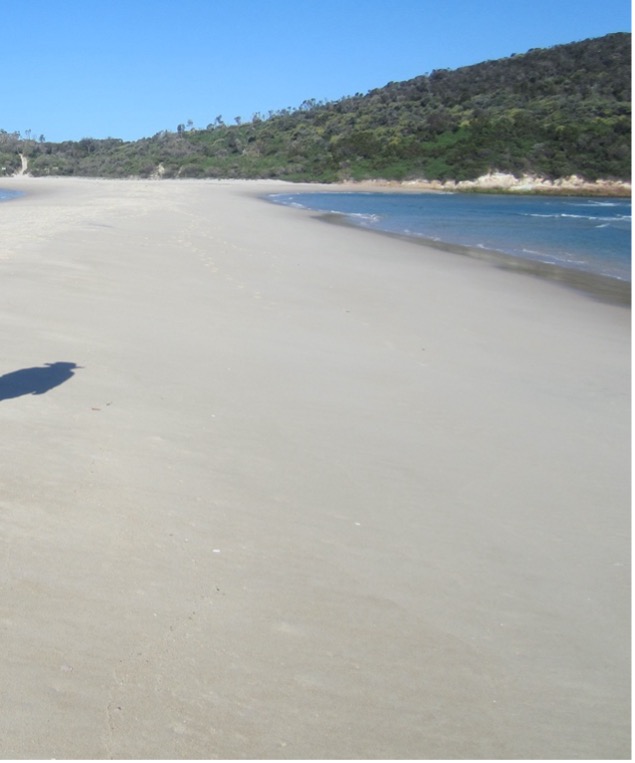
View of the Fingal Spit looking from Fingal Island to the Port Stephens mainland in the background [Author photo]
The gale was named, not from the town of Maitland, but from the paddle steamer Maitland that sunk near Broken Bay, on the Central Coast of New South Wales, resulting in the death of at least 23 persons. No accurate details were available of the number of passengers in the steerage section of the Maitland.
Several other boats foundered during the two-day gale, including the Merksworth, near Morna Point, Port Stephens, with the loss of nine lives, and the Hereward near Maroubra beach, Sydney, without the loss of life.
This paper tells the story of the Maitland Gale and examines the circumstances of the foundering of the above three ships, which were the largest to be wrecked. It is also the story of those who survived and those who perished, involving many acts of heroism.
The newspaper accounts are sourced from the National Library of Australia’s Trove collection.
A Postscript records several events in the following years that took place to commemorate the loss of the Maitland.
Additional information on shipwrecks in the Port Stephens region is published on this website and can be viewed at the following links:
A History of 110 Shipwrecks at Port Stephens 1800 – 1950
Shipwrecks Inside Port Stephens 1869 – 1950
Morna Point – A Graveyard of Shipwrecks
Wreck of SS Macleay near Port Stephens – October 1911
Foundering of SS Oakland off Cabbage Tree Island – 1903
Wreck of SS Pappinbarra at Port Stephens – 1929
Wreck of SS Uralla Near Birubi Beach Port Stephens – 1928
Wreck of HMAS Psyche in Port Stephens – 1924
Wreck of the Cora Lynn off Port Stephens – 1914
Early Report on the Maitland Gale
On the day after the cessation of the Maitland Gale, the Sydney Morning Herald of 7 May 1898, page 9, reported:
‘Anyone who was exposed to the weather between 10 p.m. on Thursday and daylight yesterday might be excused for treating past storm history with disdain, and with regarding Observatory [Observatory Hill in Sydney] records with indifference. Even in the secluded thoroughfares of the city verandas which have stood for years were snatched away like matchwood, and the noise of the crashing of signboards and the tearing of screens and other exterior decorations was only exceeded by the whistling of the gale through the telegraph and telephone wires, and the moaning of the wind as it swirled through the narrower byways off the main thoroughfares.
As will be seen from our correspondents’ reports throughout the suburbs and the country, the devastation has been very general. Unroofed buildings, trees which might have claimed equality with the giants of the forest, contributed their quota of limbs, and in some instances trunks, to the wreckage strewn in the track of the storm. Many of the telegraph wires along the suburban lines were down, and not a few of the country stations were cut off from a like cause, and the consequent interruption to business yesterday was such as one could scarcely credit possible in so brief a period. At the head office of the Telegraph Department the remark, ” Will send it, sir, when the line is restored,” was monotonously frequent.
” Like a mountain ” is a term usually employed by mariners to describe the sea in bad weather, but Captain Chatfield of the Monowai, from Wellington, yesterday said that he did not remember being in anything much worse than Thursday night’s blow. The wind and rain were bad enough, but the Monowai was under water most of the time. The Monowai is a 3000 ton steamer, and if she buried herself some of the smaller vessels may well be pitied. Captain Chatfield ran into the storm 200 miles off the land. The wind was from S.E., and he gives a sailor’s description of the towering majesty of the ocean in her revels. The passengers’ account is chiefly one of thankfulness to be ashore and admiration for the seamanship which enabled them to reach land. Much might be written of “vessels that weathered the storm,” but their reports will be found elsewhere.
The Gabo, for example, from Newcastle to Sydney, was 12 hours on the trip, and a more frightful passage she never made between the two ports. From Barrenjoey to Sydney she was seven hours, her rate of headway being about three knots per hour. Owing to the breakdown in the telegraphic service on the coast, it is impossible to supply detailed reports of the whereabouts of many of the steamers. That they would keep out to sea is but natural in the circumstances where it was impracticable to make a haven of refuge, and those which found shelter at Port Stephens and other places could not be communicated with. As the storm worked east the sea became heavier, and a grand roll set in last night on the coast. How the small craft would fare remains to be reported. That a few have fared badly can scarcely be doubted. Savagely the seas swept the decks of every vessel within 200 miles in the offing, and no surprise will be felt at learning of the ill fate of the weakest in the battle with the storm.
What created more excitement in the city than anything else was the repeated statements that the steamer Maitland was ashore, that the steamer Sydney was missing, and that other vessels were overdue. At the office of the Hunter River Company telephones were going all day asking for the whereabouts of the Sydney and Maitland. Here, again, the interruptions in the telegraph lines became prohibitive, and people were left in suspense until night, when word was received by Mr. Thomas, the manager of the company, that a steamer supposed to be the Maitland was ashore near Barrenjoey. It should be stated that prior to this a special messenger had been sent overland by the company to Barrenjoey to see whether the Maitland was in Broken Bay. Then came the following terrible message —” Barrenjoey reports an object looking like a steamer ashore about 4½ miles from Barrenjoey, 1¼ mile from Cape Three Points. The sea is apparently breaking over her. Weather too thick to see her distinctly. Supposed to be the steamer Maitland.”
This naturally created widespread alarm, which up to the hour of writing has not been allayed. The steamer left Sydney on Thursday night, and, with the wind behind her, should have been in Newcastle early yesterday. That something unusual had happened there was scarcely a doubt. The principal theory was that she had broken down, but the fact that the Sydney has turned up in Broken Bay and that a steamer like the Maitland is ashore near Cape Three Points, the northern head of Broken Bay, points so strongly to a wreck as to be almost a certainty. It might be easy to refer to the probabilities of wrecks in other instances, but so far nothing definite has been recorded except in the case of two schooners ashore at Botany, on the beach near the pier — the Albatross and the Hally Bayley, both of which vessels are quite out of danger, and will be refloated. The chief interest next to the Maitland was the stranding of the ship Hereward in Maroubra Bay, 10 miles south of Sydney Heads.’
Several Wrecks in Port Stephens
At Port Stephens, five vessels were driven ashore and two of those totally wrecked during the gale. The Daily Telegraph of 9 May 1898, page 6, reported:
‘Nelson’s Bay, a well-known sheltering ground for coasting vessels, situated about 20 miles north of Newcastle, had the full sweep of the recent gale, and of the vessels sheltering these five were driven ashore, two of which are totally wrecked. When the gale set in six vessels were anchored in the bay, viz.: — Steamers Express and Ethel; Ketches Coral, Merlin, Mabel White, and Lena and Lillian. The fleet had put into the bay for shelter from the wild weather outside, and during the hurricane squalls on Friday afternoon five of them drove ashore, viz., steamer Ethel, and the ketches Merlin, Coral, Mabel White, and Lena and Lillian.
With the exception of the Lena and Lillian, which went ashore on Pig Island [in Port Stephens], all the vessels drove on to the north beach, and two of them, the steamer Ethel and the ketch Coral, are total wrecks. The other vessels are apparently in a good position for salvage.
When the gale set in the Lena and Lillian was at anchor in Nelson’s Bay, but during Friday morning early commenced to drag anchor, and was driven ashore near Pig Station. The Ethel went to the assistance of the Mabel White, and when towing her in broke her shaft, and was driven ashore, completely breaking in two. The schooner Shannon, anchored in Shoal Bay, commenced dragging her anchors at 6 o’clock on Friday morning. She was rescued by the steamer Express. The ketches Coral and Merlin were also at anchor in Shoal Bay. They commenced dragging their anchors about 2 p.m. on Friday and tried to get under way.
The Coral had almost succeeded in reaching Nelson’s Bay, when she was driven rather close to the breakers on the Spit in the middle of the bay. She dropped anchor and held for about six hours. The gale increasing, the anchors would not hold, and the Coral was driven on the north shore, becoming a total wreck. The Merlin was driven ashore before she could set sails to clear the breakers. The captain of the Ethel states that seeing the schooner Mabel White in a perilous position inside the bar, he went to her assistance, and succeeded in placing a towline aboard twice, but each time when she commenced to tow the line broke. The third time the line was placed aboard proved fatal to the Ethel, as she broke her shaft, and was left to the mercy of the big sea, and, with the Mabel White, was driven ashore near the other wrecks, the Ethel striking the ketch Merlin on her stern, breaking her bulwarks. The Coral, Merlin, and Lena and Lillian were loaded with hardwood, the Mabel White was loaded with pine; the Ethel had been schnapper-fishing. The ketch Laura and the schooner Jane managed to get safely into Salamander Bay.’
Summary of the Maritime Damage
Several days after the cessation of the gale, when various reports of the damage had been assembled, The Daily Telegraph of 11 May 1898, page 8, published the following comprehensive report on over 30 vessels that were affected by the gale and the 30 plus lives lost:
‘Of the steamers that Shipmasters all agree that the recent gale was the heaviest that has swept the coast for many years, and evidence of its destructive character is shown by the number of wrecks strewn along the seaboard. A prominent insurance manager yesterday put the loss to shipping down at about £20,000. The loss of life amounted to over 30 all told. Up to the present six wrecks and 13 other casualties have been reported as the result of the storm, as follow: —
Maitland, Newcastle and Hunter River S.S. Company, paddle steamer, 880 tons, lost near Cape Three Points, insured for £8000 in the South British Insurance Company; 18 lives known to be lost and four doubtful.
Merksworth, Iron screw steamer, 270 tons, owned by Mr. C. Parbury, foundered off Newcastle; nine lives lost; insured in the South British Insurance Company for £2050.
Isabel, schooner, wood, 69 tons, wrecked at Crowdy Bay, insured in National Insurance Company, owned by Mr. A. Settree; all hands saved.
Phillip Palfrey, schooner, wood, 96 tons, wrecked at Trial Bay, owned by Mr. W. R. Settree; all hands saved.
Coral, ketch, 60 tons, wrecked at Nelson’s Bay, insured in the South British Insurance Company, owned by Mr. Driscoll; all hands saved.
Ethel, screw steamer, 33 tons, owned by Mr Peter Callen, of Newcastle, wrecked at Nelson’s Bay; all hands saved.
–Hereward, iron ship, 1513 tons, ran ashore on Maroubra Beach, vessel owned by Potter Brothers, of London, and bound from Sourabaya to Newcastle, all hands saved; insured in London.
Albatross, coasting schooner, 132 tons, driven ashore at Botany Bay, badly damaged by collision; all hands saved.
Hally Bayley, coasting schooner, 132 tons, driven ashore at Botany, since floated, damaged; all saved.
Amelia White, coasting ketch, 94 tons, driven ashore at Nelson’s Bay; all hands saved.
Merlin, coasting ketch, 68 tons, owned by H. C. Christiansen, driven ashore at Nelson’s Bay; insured in the South British office; all hands saved.
Lena and Lillian, coasting ketch, 38 tons, owned by Mr. S. A. Quigley, driven ashore at Nelson’s Bay; uninsured. All hands saved.
Lansdowne, coasting ketch, 81 tons, partially dismasted; put into the Richmond River. Owned by Mr. A. Heesh. All saved.
John Gollan, tugboat, 62 tons, ashore at the Manning. All hands saved.
Victor, tug, sunk at Balmain. Owned by Mr. A. Wilson.
A barque, name unknown, partially dismasted, and spoken [communicated with] by the steamer Wodonga off Port Stephens.
Lighter stranded at Manly. Vessel laden with cement. Owned by Mr. Chester.
Launch belonging to the lighter totally wrecked.
Seaflower, schooner, 66 tons, owned by Mr. A. Langley, driven ashore at Port Macquarie. All hands saved.
Venture, ketch, 23 tons; driven north to Clarence River, where she arrived in distress yesterday.
Of the steamers that weathered the storm, the A.U.S.N. Company’s steamer Victoria appears to have fared the worst. She was on her passage from Noumea to Sydney and arrived in a terribly battered condition. Messrs. J. and A. Brown’s collier Duckenfield lost all her boats, and the after wheel, and had a severe buffeting. She put into Port Stephens on Monday. The other vessels which were subjected to rough handling in the storm include the Monowai and Westralia, from New Zealand; the P. and O. liner Rome; and the steamer Barrier, the steamer Euroka (which was driven north to Byron Bay, where she anchored, short of coal and provisions); the steamer Brisbane, Melbourne to Newcastle (driven northward and anchored off Port Macquarie, short of coal); Coraki, North Coast boat, bound for the Manning; Sydney; Newcastle steamer; tug Hero; also the coasters Oakland, Illaroo, and Messrs. W. Howard Smith and Sons’ steamers Gabo and Leura.’
The Daily Telegraph of 10 May 1898, page 5, further reported on the Maitland and Duckenfield steamers:
‘Wrecks and rumours of wrecks still loom large on the public horizon, and it is to be feared that the worst has not yet been told of the fearful havoc wrought by the recent storm. The uncertainty which hangs over the Maitland tragedy, particularly in regard to the personnel of the passenger-list of the ill-fated steamer, leads to continuous and pitiable inquiries at the offices of the company. Walter Phillips, the chief steward, says that there were six women in the steerage, in addition to the child. In this event, another name must be added to the list of casualties.
One ray of sunlight relieves the sombreness of the outlook. The Duckenfield is reported to have entered Nelson’s Bay at 6 o’clock yesterday afternoon, but she had an awful time of it. She was out from Newcastle during the whole force of the gale, and steam tugs were scouring the seas in search of her for days together. Her wheel was picked up, it may be remembered, on the beach at Merewether, just outside Newcastle, and this gave rise to grave apprehensions as to her ultimate fate. This, however, has now been put beyond doubt, and, with her, all’s well that ends well.
Messrs. J. and A. Brown’s tug Champion has just returned from a search along the northern coast, prompted by a report that a big steamer had gone ashore near Broughton Island. She reports that she got as far up as Cape Hawks without sighting anything in the shape of wreckage, barring the old Fitzroy. Another relieving feature of yesterday’s happenings was the news of the whereabouts of the Brisbane, one of the colliers belonging to the Melbourne Shipping Company, which left the southern capital on Tuesday last for Newcastle. She has arrived off Port Macquarie on the northern coast and signalled “short of coal.” In view of the heavy weather, she is not altogether out of danger. Her position is somewhat critical from exposure to the seas, and unless assistance reaches her speedily, she may find herself in difficulties.
Another of the casualties reported yesterday as a result of the big blow was the dismasting of the ketch Lansdowne, a small coasting vessel. A vessel was also reported in distress off the Clarence River. The Victoria, which reached port late on Monday night from Noumea, shows unmistakable signs of the severity of the elements against which she, in common with many other vessels, had to battle. On deck she is in a helpless state of disorder. Everything above board is smashed to atoms, the davits have been torn asunder, and cabins battered out of all recognition. She has had a fearful time of it, and her captain despaired of ever reaching port again.’
Further Information on the Maitland
There were many newspaper reports about the wrecked paddle steamer, Maitland. The Newcastle Morning Herald and Miners’ Advocate of 11 May 1898, page 5, reported:
‘The work of searching the beach for the bodies of victims of this terrible calamity is still being continued by the water police, under Senior-sergeant McVane, and friendly settlers resident in the locality. Sergeant Ogden wired last evening, stating that the body of a man 5ft 9in high was recovered yesterday. ……
It is considered probable that the bodies may be discovered at some considerable distance from the scene of the wreck. Captain Mate, of the steamer Tangier, reports having passed a body floating off Broken Bay on Monday last. Some indication of the peculiar way in which wreckage from the ill-fated vessel has drifted, may be seen from the fact that a case of rum which was picked up on the beach behind the Newcastle Hospital on Saturday last, has been fully identified as being part of the Maitland’s cargo. The case, contents, and brands are identified by the ship’s manifest, the case having been shipped at Sydney by the Maitland, and consigned to Mr. Delander, of Gunnedah.
With regard to the names of some of the steerage passengers of the Maitland who are still missing, the officers of the steamship company are making every inquiry possible with a view of obtaining a full list. Inquiries have been made concerning one Henry Winsor and a Martin Hill. Winsor left his friends in the city shortly before the hour of the boat’s departure, with the intention of going on board, and there is no reason to suppose that he did not do so. Hill, it has been definitely stated, left in the ship. He told some people that he was going to work on the railway deviation works between Newcastle and Maitland. He has not been heard of since, but inquiries are being made among the contractors at the place mentioned.
The bodies of Mrs. and Miss McNeill arrived at Adamstown by the 1 p.m. train yesterday. The funeral will leave Adamstown by the 2.40 train today for the Presbyterian Cemetery, Sandgate. ……
Senior-sergeant McVane, who is at the scene of the wreck of the Maitland, telegraphed to Inspector Lynch last night that the body of the stewardess (Miss Fitton) had been recovered. It was found under the sand and wreckage near the wreck and was in an advanced state of decomposition. Arrangements have been made for the mails recovered from the ill-fated vessel to be brought on to Newcastle by the first train.’
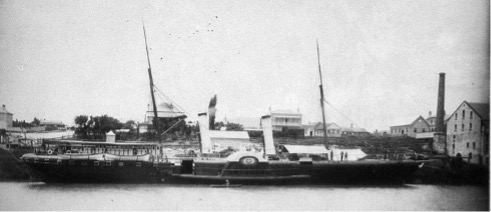
Maitland, circa 1884. [State Library of NSW]
Foundering of the Maitland
The Glen Innes Examiner and General Advertiser of 13 May 1898, page 3, published details about the foundering of the Maitland:
‘The Maitland left Sydney at the usual hour on Thursday night last, having on board a crew of 23 all told, about 36 passengers, and a valuable cargo. The night was dark and squally, and it rained heavily. A strong gale blew up from the south-east, and a heavy sea was running, but everything went well until passing Long Reef, when part of the starboard sponson house was stove in by a heavy sea, and water commenced to run in between decks. The damage was temporarily repaired.
The weather grew worse, and the vessel was labouring heavily. The deck cargo was jettisoned, and this seemed to relieve her somewhat, but presently a heavy sea washed over her, stoving in the after part of the starboard sponson, which had to be stuffed with mattrasses to keep the sea from flooding the deck. Sea after sea continued to break over the steamer, which by this time had her decks almost cleared, and the water pouring into her flooded the stokehole and put out the fires.
The vessel was headed for Broken Bay, fires were again lighted, but there was not steam enough to keep the engines going and they soon stopped. The vessel then began to drift broadside on to the rocks, which were within three or four hundred yards of the shore. When it was seen that the vessel was in a helpless condition, the passengers were warned of their danger by Captain Skinner, and all hands were supplied with life belts.
It was nearly 6 o’clock on Friday morning when the vessel struck the rocks. A heavy sea broke over her, and she quickly parted in two, the steerage passengers being washed overboard. The boats before this had been got ready but could not be used in such a sea. Some of those thrown into the water were assisted on board with lines, some swam or were washed ashore, but the chief officer (Mr. Thompson) and the bulk of the steerage passengers were not again seen.
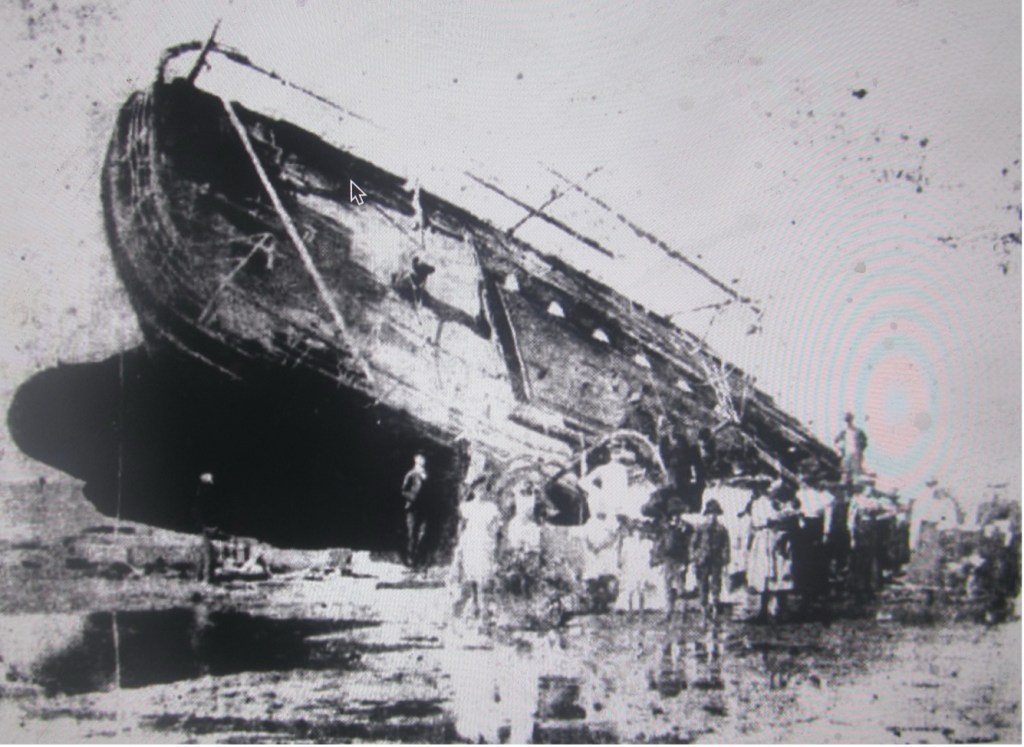
Two days after the foundering of the Maitland. [Gosford Times and Wyong Advocate, 24 April 1951]
The captain and the rest of the passengers remained in the after part of the vessel which was now high on the rocks with the sea breaking over it. Finding it impossible to land the passengers in boats Captain Skinner called for volunteers to take a line ashore. One of the sailors was the first to face the danger of the undertaking, and after a great battle with the waves, and being terribly knocked about with the rocks, he had to be hauled back to vessel again. Another sailor took the line, but it was cut with the rocks, and after a terrible struggle he managed to reach the shore safely, but much exhausted.
Then Mr. John Russell volunteered to take a line, and with him went one of the stewards and the second cook. Mr. Russell’s thrilling narrative is as follows: —’I got ashore and made the line fast around a rock, when a heavy sea came and washed my mates away. I never saw them afterwards. At this time we were about 50 yards from the shore. I tried to haul the line in but was unable to do so. I then went round the beach and got the assistance of a few firemen or passengers who had managed somehow to get ashore. At half-past one o’clock in the afternoon the line was got ashore. The next thing was to save the lives of those on board. In the meantime, all had behaved well. The women avoided screaming.
There were at this time three women and a baby aboard, with others, about 26 all told. The first to come ashore on the line was a man. I don’t know his name. He gave me a hand to haul the line tighter, and we managed to get it pretty straight from the vessel to the shore. The rest of the passengers came ashore, two at a time. When the women got halfway, they became exhausted I then helped to get them ashore. All the passengers were practically half drowned. When the second engineer (J. Henderson), one of the stewards (Ben Norton), and the stewardess (Miss Fitton) were coming ashore, the line broke. The stewardess was washed away with a breaker and was never seen again. We managed to drag the engineer ashore. Captain Skinner, four firemen, and a baby twelve months old, belong, to Mrs. Hammond, a resident of Bulahdelah, now remained on the vessel. [The child was Anita Daisy Hammond, and her parents were Frank H. and Anita Hammond].
Without a line I could do nothing more. Those ashore and myself then went away to Sandy Beach to look for quarters. We found a hut. I walked around alone. Just as I reached the sandy beach I saw the steward, who had been washed away when the line broke. I ran into the surf, swam up to him, and got him ashore. He was all but drowned. After he had vomited out the salt water, I helped him up to the hut. Most of them stopped in the hut all night. All of us were wet to the skin, and of course had no change of clothing. Some had no clothing at all. The unfortunate women had escaped in their night garments. We managed to find them an oilskin and same rags as a covering.
I spent most of the night walking about the sandy beach trying to keep myself as warm as I could. The next morning (Saturday) at 5 o’clock I saw the bodies of three women and two men on the beach. Many cases of whisky and rum were also washed ashore. We all helped ourselves to the spirits, without which some might have succumbed to the cold. A few pineapples were also found most acceptable. Before I started to go round to rescue the captain, I sent all the invalids away with a rescue party of six, which had just come from Barrenjoey. We would have close on two miles to walk and I knew that they (the women) could not stand it.
At 1 p. m. on Saturday, it was low enough water to try and get another line off. I and three firemen managed to get the line off. By this means Captain Skinner, three firemen, and the second mate were rescued one after the other. The second mate carried the one-year-old baby on his back, the poor little thing being got ashore alive after being exposed to the weather for 33 hours. When all hands had been got off the wreck, the captain being the last to leave, another rescue party came frow Woy Woy with provisions, which were partaken of in the hut. After this we all started to walk to Woy Woy, a distance of about two miles, which was reached at 7 o’clock on Saturday evening. It is Mr Russell’s opinion that at least 10 more lives could have been saved if the rescue parties were earlier on the scene. Mr. Russell himself saved about 17 lives.
In the course of an interview Captain Skinner said: — ‘We had to suspend operations for the night after the line broke. Five of us and Mrs. Hammond’s baby spent the night aboard. We did not know what minute the vessel might crumble to pieces, but we kept as cheerful as we could. We kept the baby wrapped up in blankets on deck and fed her with masticated biscuit and water. Fortunately, it was moonlight, and we could see what the seas were doing. In the morning, as soon as the tide was low enough, we, with the assistance of those on shore, got the line fast again, and we all got ashore safely, including the baby. I was the last to leave the ship. I don’t know how many are drowned, but I consider that the number that we have saved at least 30 or 33 is a marvellous one.’
The following photos and illustrations were published with the above report in the Sydney Mail and New South Wales Advertiser of 14 May 1898, page 1019
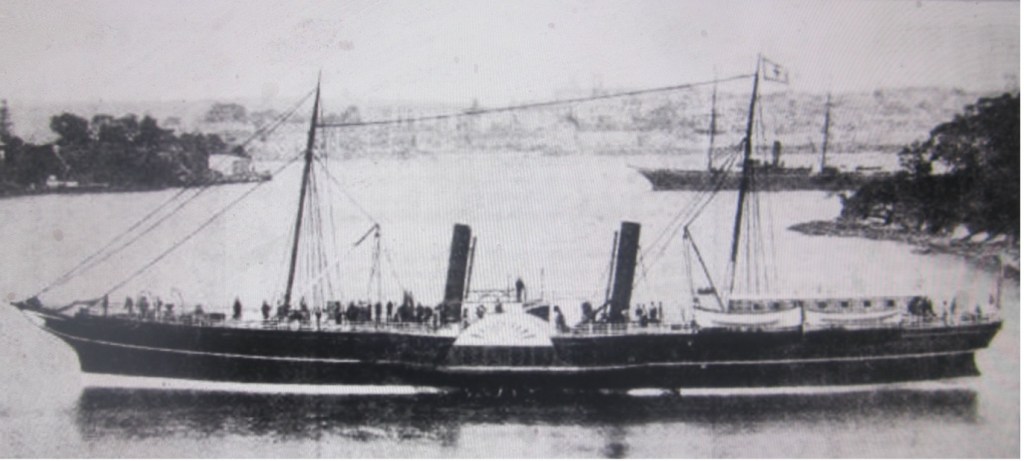
Maitland steamer in Sydney Harbour.
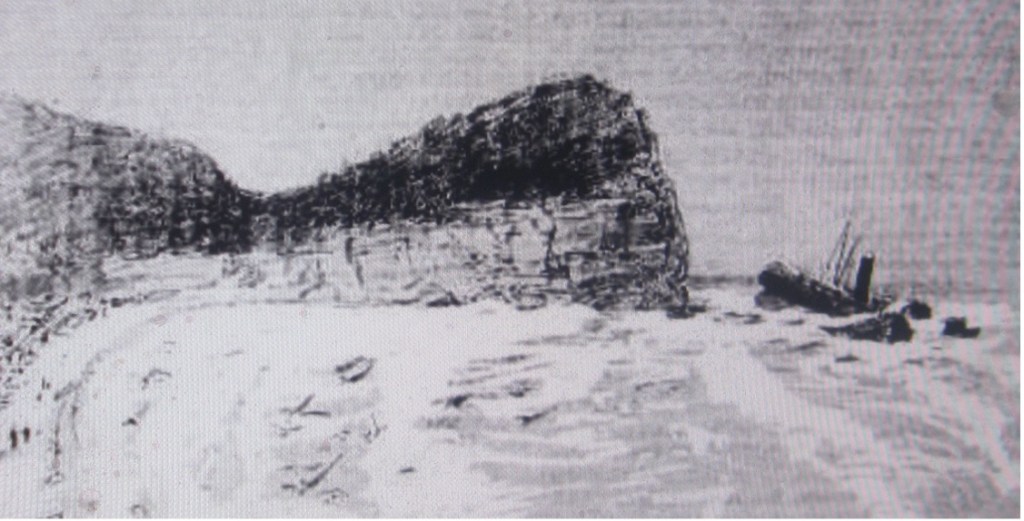
Illustration of the Maitland wreck.
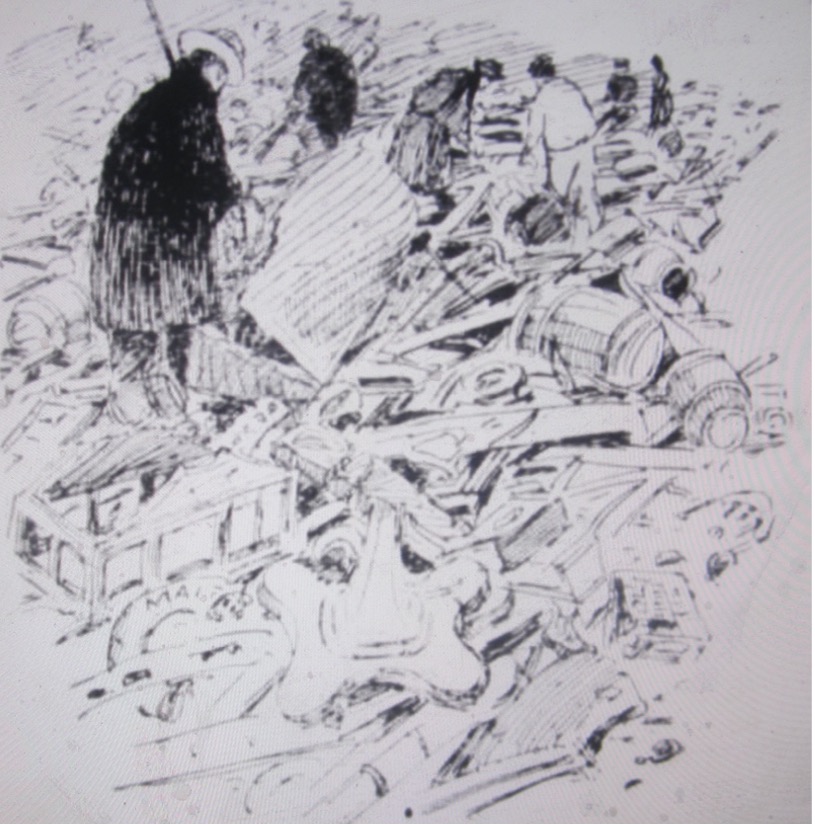
Searching for bodies.
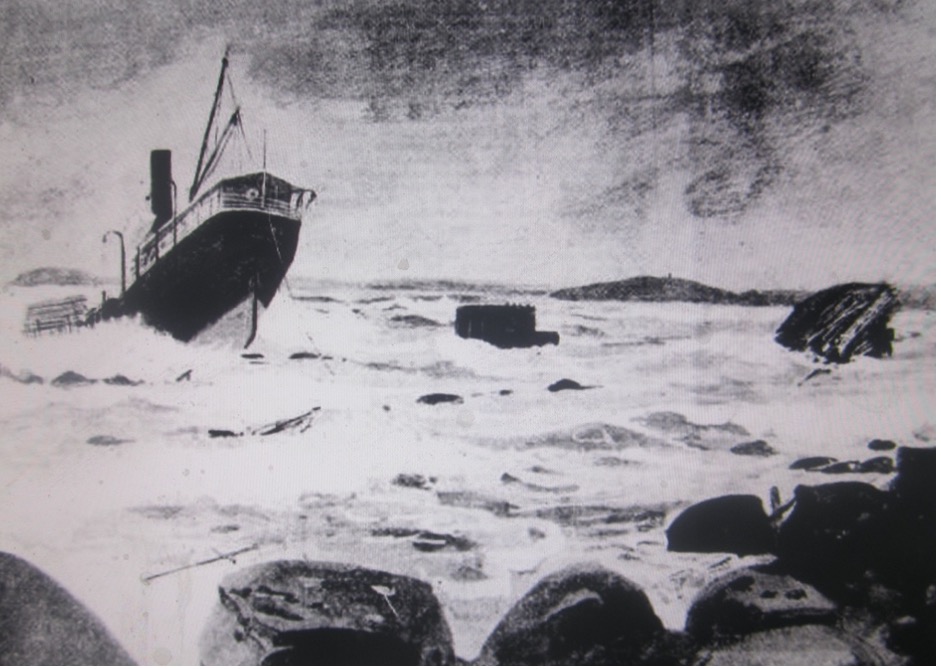
View of wreck from the Head.
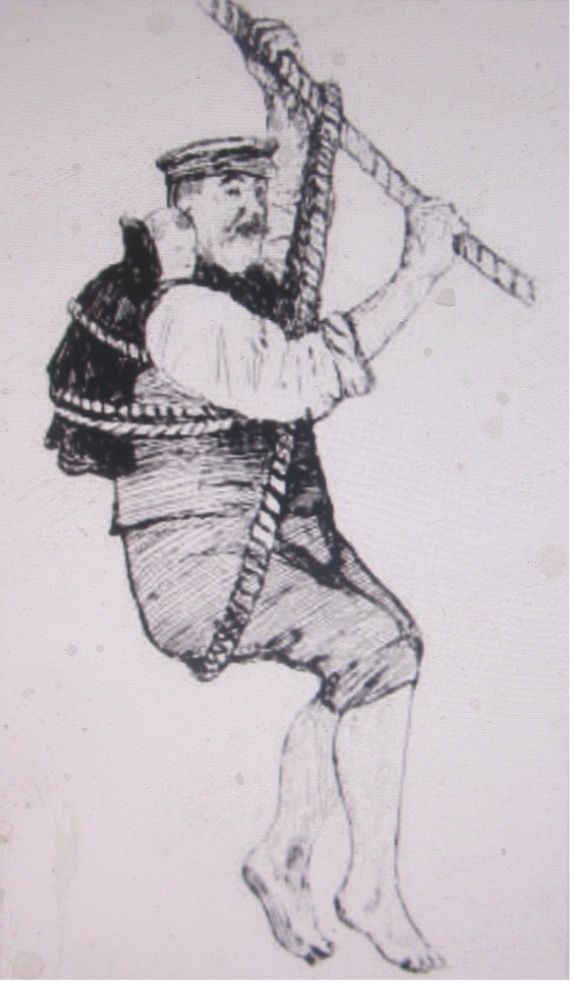
Boatswain brings the baby ashore.
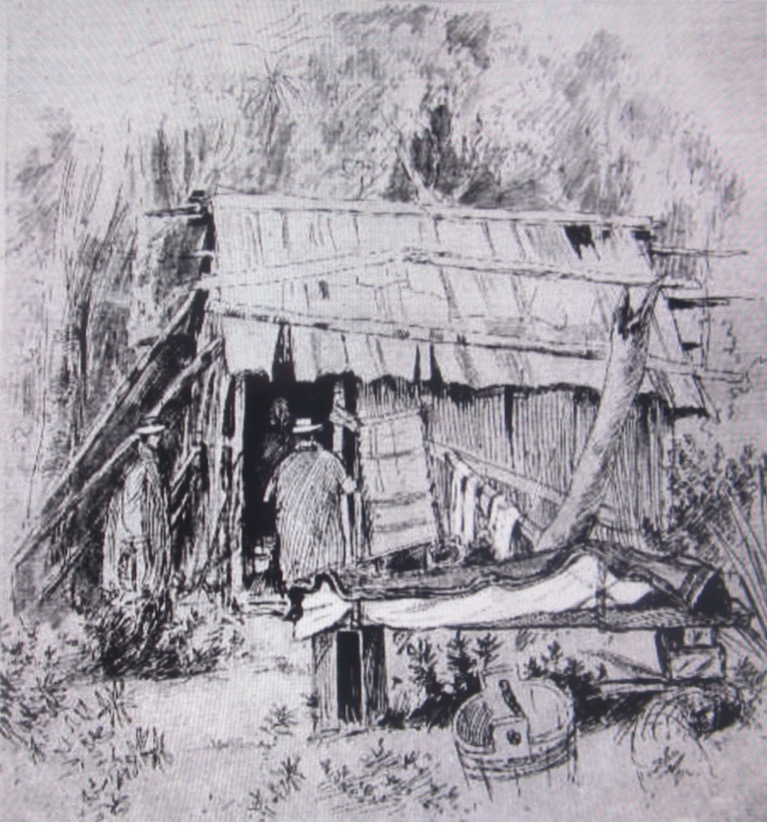
Hut where the survivors took refuge.
Marine Board of Inquiry into Foundering of the Maitland
The Sydney Morning Herald of 28 May 1898, page 7, reported:
‘Yesterday the Marine Board opened an inquiry into the circumstances attending the wreck of the Maitland, which occurred at Boat Harbour on May 6. ……
Richard James Skinner was the first witness. He said that he was master of the Maitland when she was wrecked. Her registered tonnage was 555 tons. She was a total wreck. She was engaged trading between Sydney and Newcastle and was wrecked on a voyage to Newcastle on May 6. Eleven passengers were drowned, four were missing, and 11 of the crew were drowned. The vessel left the company’s wharf at 11 pm on May 5. She carried mails and passengers and general cargo. She was in good trim and was manned by a thoroughly efficient crew. She was well up to the requirements of the trade.
They found the sea irregular. The wind was strong. He would not say it was a gale. Heavy rain and thick weather. About an hour after they proceeded on their course part of the starboard foremost sponson-house was carried away through a sea striking it. The inner part remained intact and firm. He gave orders to block it up-strengthen it.
Nothing of an alarming character occurred until about 1.45, when a sea took the after starboard sponson-house clean away. He wore [turn away from the wind] the ship. That was a movement of some difficulty. He gave orders to throw the deck cargo overboard and put on hands to bail out the stokehole. Steam was gradually failing, through the water in the stokehole putting out some of the fires. He could not replenish them with coal, the stokehole plates being washed up. They were being fed with boxwood they had on deck for cargo, and latterly with boxwood dipped in kerosene.
About 3.30 the gale was at its height. There was a very heavy sea. Steam was gradually falling the whole time. About 5 o’clock Broken Bay light showed up for the first time. His ship was not steering at that time. The engines were moving, but not sufficient to keep steerage way on her. About 5.15 their fires were all out. The land could be plainly seen. Orders were given by him for everybody to prepare for the worst. Lifebelts were issued to every person on board.
At 5.45 the ship struck, and in less than five minutes afterwards she parted. Twenty-three remained with him on the after end of the ship, and nothing could be done until the tide fell. Between the ship and the shore, the rocks were all flat, with occasional holes between them. The breakers kept rolling over these rocks. The distance between the taffrail and the shore had now been found by measurement to be 300ft. Captain Skinner went on to describe the steps taken to establish a connection between the ship and the shore and to save life (showing that great bravery was displayed on the occasion), details of which have already been published.
In reply to Captain Hixson, witness said that they had no outside help up to the time they reached the shore. He did not attribute any neglect to anybody. He thought the place was a bad one for communication. No outside assistance could be rendered to them from seaward with the sea that was running. How they escaped striking on the outer reef he did not know, and he did not think any man knew. If they had struck the outer reef they would not have been here now, that was quite certain.
Captain Hixson: Do you know whether any other ships went to sea the same night ? – Yes; I believe one ship went to Newcastle. I think it was the South Australian. The weather was thick. We did not see the South Australian. Had you any misgiving about going to sea that night?’ – I had no misgiving at all. The weather developed so badly apparently when you got further north. – When I got further north. Do you pay any attention to weather forecasts as a rule? – No; strictly I do not. Did you have any particular ones that night? – No.
In your experience of coasting do you find the weather forecasts any use to you?’- I find them sometimes seriously reversed. Can you credit yourself with having done everything you might have done? – I do not wish to speak about my chief officer. He is dead, but I may say that in common unity we worked for the benefit of all right up to the last.
By Mr Thompson: The gale came on about 3. The wind veered to the eastward. The covers were on the bunkers as far as he knew. No one told him they were on, and he did not give any orders to put them on. He knew that the hatches on the main deck were on. He thought the water got down the ash shoots. He had worked 23 years in this trade. No company he had ever worked for ever ordered him to sea. By Captain Hixson: He was armed with discretionary powers.
By Mr McLachlan: He thought they would have weathered the storm if the wind had not veered. He did not think he would have had any difficulty in taking the Namoi under the same circumstances. He did not consider the weather bad until about 3 o’clock. He should think that about 25 minutes after they left the Heads the chief engineer said, ” What about the bilges?” and he replied, ” If you tell me, you cannot keep them clear I will not go on.”
By Mr Ralston: He was keeping well off the land in the course he took. He wore the ship to fetch Broken Bay if he could. Carl Johansen, second mate and boatswain on the Maitland, said the weather was heavy when they left the Heads, but he did not think at the time that there was any danger. The captain did everything he could to save the vessel. Witness was the last but one to leave the ship, taking with him a baby which was on board. The captain was the last to leave.
F. C. Thomas, manager of the Newcastle and Hunter River Steamship Company, said that, from the beginning of 1892 up to the time of the last overhaul in February this year, £6335 had been spent upon the Maitland, £1100 being on the last overhaul. She was in good order when she left Sydney. She was valued at £10,000 and insured for £8000.
Donald McNichol, chief engineer, said that the alterations to the vessel might have weakened her, but they had nothing to do with her loss. The stokehole doors were not watertight. The covers of the ashpits were not fit to keep water out.
By Mr Thompson: The Maitland was only a standby. John Kerr, able seaman, said that when they passed the Heads it was blowing hard. The weather got worse. By Mr Thompson: She steered very well. When they went out there was a good lumpy sea on. It blew hard and was raining all the time. Alexander Anderson, able seaman, also gave evidence. On the application of Mr. Thompson, the further hearing of the case was adjourned till Monday afternoon.’
The Evening News of 31 May 1898, page 8, reported further on the inquiry:
‘The Marine Board’s inquiry into the circumstances surrounding the wreck of the steamship Maitland was resumed yesterday afternoon. Robert Pollock, Lloyd’s surveyor, and consulting engineer to the N. and H. R. Company, said, in answer to Mr. Ralston, that he superintended the work of cutting across the decks of the vessel, but the work did not interfere with the safety of the vessel. In answer to Mr. Thompson, he said that the main deck was not supposed to be watertight, although it should not be possible for a big rush of water to get below.
To the President: “As Lloyd’s surveyor, I considered her a good strong sea boat, and in good order and condition.” Mr. John Russell, saloon passenger, said that he had been making the trip for years, and did not think on starting that there was any particular danger. Continuing, witness said, in answer to Mr. Ralston, that from the way in which the vessel stood the bumping on the reef she proved her staunchness. To Mr. Thompson: I was below in my bunk until she struck.
The President: “The board understood, Mr. Russell, that you displayed great heroism after the vessel had struck, and that you were mainly instrumental in saving many lives. We have much pleasure in congratulating you on your gallant conduct.” Witness: “Thank you.” The President: “We hope that you will never have such a job again.”
Captain Skinner was then recalled at the instance of Mr. Thompson, who proceeded to cross examine him as to certain statements published in a Sydney daily paper and alleged to have been made by the witness on the day following the wreck. Captain Skinner denied having told any reporters or anyone else that there was a tremendous sea,” “that he knew they were in for a rough, time,” that he “was anxious,” or that he “rarely remembered a night when the wind blew more furiously.”
Mr. Thompson: “Well, these statements, if you made them, and I propose to prove that you did, are directly contradictory to what you have sworn here as to there being ‘no gale.’” The president then interposed. He failed to see what use such questions were. They would not bring back the lives of the drowned. Mr. Thompson: “No, but if I prove that the wreck is due to anybody’s folly, it is the duty of the board to place it out of the power of that person to do the same again and sacrifice more lives.”
The President: The witness had then been through an awful ordeal, and this examination is cruel. I won’t allow him to be “badgered.” Mr. Thompson: Of course, the board’s sympathy is with the master of the vessel. The President: That is not so. That is an impression which has got abroad, but it is not true. The board is absolutely impartial. The witness is not a ruffian — he is not a police court witness, and we won’t see him “badgered.” Mr. Thompson: That is not “badgering” him. The President: You are badgering him, and you are disrespectful to the board. Mr. Thompson’s: Then I beg the board’s pardon, but I don’t see how. Mr. Thompson then declined to ask the witness any more questions.
John Dempsey, fireman on the Maitland, was called, and examined. He said that if a tarpaulin had been placed over a grating in the upper deck, it would have prevented a lot of water getting below. The President: Did you suggest that to anybody? Witness: Yes. The President: Who to? Witness: The chief officer. What answer did he make? He said “the man’s mad,” but I think he was alluding to the skipper. Continuing, the witness said that he had never been to sea in such a gale on this coast. The further hearing of the case was adjourned till 2.15 p.m. on Wednesday.’
The Daily Telegraph of 2 June 1898, page 3, reported further on the enquiry:
‘Before the Marine Board yesterday further evidence was taken regarding the wreck of the Newcastle and Hunter River Company’s steamer Maitland. …..
Patrick Coffey, fireman, examined by Mr. McLachlan, stated that he had been 25 years at sea. On the night of the 5th ult. the weather was very bad before the vessel left the wharf, and it was not thought a fit night to go to sea by members of the crew. At the wharf double mooring lines had to be used in lieu of single lines, as ordinarily. The fidley-doors and ash-shaft covers, being defective, allowed the water in that put out the fires. If steam could have been kept up the wreck might have been avoided. The donkey pump could not be worked, because of the ashes that had been washed up. The woodwork of the sponson houses must have been weak, or they could not have carried away as they did.
The vessel should have turned back after the first injury; it was dangerous to proceed after. To the president: No one could be blamed for the defects but the superintendent engineer. The company’s boats were well found and comfortable; as good as he had been in during his long experience at sea. To Mr. Thompson: The members of the crew made no actual protest against going to sea, but spoke about it among themselves. John Kerr and Joseph Lloyd, firemen, generally corroborated the evidence of the previous witness.
Sydney Smith, saloon passenger, stated that water came into his cabin soon after the fore part of the sponson carried away. He was in the rigging for some time before he got ashore. He could not say if canvas would have stood, but no attempt was made to set any. It was considered that sail would have enabled the vessel to clear the point. The lifeline was got ashore through the skill and bravery of the fireman Dempsey. Frederick Franks, another saloon passenger, gave evidence in support of Mr. Smith’s statement.
Captain Creer, master of the Captain Cook, said that the wind and sea commenced to increase about 6 p.m. on the 5th ult. It was not blowing a gale, nor was it sufficiently bad weather to stop a well-equipped vessel putting to sea. He did not put to sea that night but would have had no hesitation in doing so. He would have taken the Maitland out had he been in command of her. The inquiry was further adjourned until Monday next, at 2 p.m.’
The Daily Telegraph of 14 June 1898, page 4, reported on the finding of the Board of Inquiry:
“The wreck was brought about by the vessel becoming cast upon the rocks near Cape Three Points during an exceptionally heavy gale, which washed portion of the starboard sponson away, thereby admitting seas into the engine-room, causing her fires to be put out, and rendering her unmanageable. No evidence was adduced upon which to found a charge of default against the master, Richard Skinner. The board highly commends the discipline which was maintained on board the ship under most trying circumstances; and they also appreciate the gallantry and efforts displayed to save life.”
Foundering of the Merksworth
The Australian Town and Country Journal of 14 May 1898, page 14, reported:
‘Late on Saturday evening it was learned that three survivors of the crew of the foundered steamer Merksworth had reached the shore after suffering terrible privations, and that eight had perished, while the fate of a ninth is uncertain. A party of rescuers met one of the survivors, named Johannsen, in a very exhausted condition about 17 miles from Newcastle, and two others were bought into Newcastle by the police on Saturday night. The names of the three men saved are: John Johannsen, William Way, and J. Vankinscott, A.Bs. [able bodied seamen].
The names of those known to have perished are: J. J. Dyball, master, married; J. Mitchell, chief engineer, married; C. Anson, second engineer, married; H. Steiner, cook, single; G. Dempsey and J. Campbell, firemen, single; A. Binstead, winch-man; and A. Anderson, A.B. A ninth man, Robert McIndoe, mate, is also missing; but it is not known yet whether he was drowned or not. He got out of the boat close to some rocks.
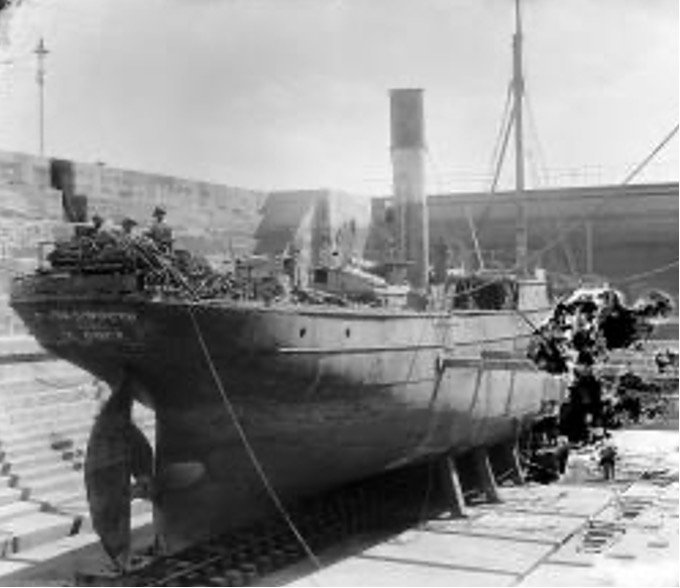
Merksworth in dry dock, Sydney. [Australian Maritime Museum]
John Johannsen, one of the survivors of the ill-fated steamer Merksworth, has made the following statement to a press representative: “I am an able seaman, 28 years of age, and one of the crew of the steamer Merksworth. We left Newcastle on the 5th at 4 p.m., coal laden, bound for Sydney. On clearing Nobbys, we found a strong southerly wind blowing, and when abreast Red Head we encountered the full force of the fearful gale which was raging. The steamer was fully laden, having 310 tons of coal aboard, but was slightly light forward. During the whole of the night, she shipped large quantities of water from time to time, the wind blowing with hurricane force. We were not steering our ordinary course but kept her heading well to sea. On the afternoon of the 6th, about 3 o’clock, the engine-room sky light was smashed in by a heavy sea, and the water rushed down into the engine-room. Two pumps were kept going continually, and we also baled with buckets to clear the engine-room, but the water gained on us.
At 1 a.m. on Saturday morning we decided to abandon the steamer, for at the time the fires were out. The whole of the crew then took to the lifeboat, which was launched safely, except that she was partly swamped. She was a splendid boat, quite new, and well found with provisions, etc.” Johansen was, however, unable to form any correct opinion as to the locality at this time, but thought they were somewhere near Morna Point [Port Stephens]. This would be fully 50 or 60 miles out of their course, as the steamer had been drifting all the time.
As soon as they got clear of the steamer, the lifeboat completely swamped, and they all clung to her about half an hour after she turned bottom upward. They lost the cook and Anderson during the night. The boat turned bottom upward several times, but no other lives were lost in that way during the night. Campbell and George, firemen, died in the boat, doubtless from exhaustion and exposure.” Continuing, he said: “We threw the dead bodies overboard. I could not say what time this was, but it was during the darkness later on in the night. Three others died in the same way, including the captain, Mitchell, and Binstead. The bodies were also thrown overboard at daylight on Saturday morning.
There were only five of us left in the boat, namely, McIndoe, Charlie the Second engineer, Way, Vankinscott, and myself. At this time four of us went overboard for short intervals, leaving the second engineer, who could not swim, to bail her out. It took us about two hours to get her bailed out. About this time, we sighted land at Morna Point, and the boat was drifting quickly towards the land in that direction. When nearing the shore, the boat capsized in the breakers. This was about noon on Saturday. At this time the second engineer was drowned, and I believe the chief officer was also lost, but there is just a possibility that he has been carried ashore at some other point. Way, Vankinscott, and myself reached the beach in safety. We were all very much exhausted, and almost lifeless. My companions were worse than me.
I reached a big log on the beach and lay there for some hours completely exhausted. My two mates joined me later, and we took to the scrub to seek shelter from wind and rain. Some two hours later I left to look for help, my mates being unable to accompany me. I got bushed about 12 midnight on Sunday, when I again found myself on the beach, some miles nearer Newcastle than where we were washed ashore. I found an orange and pineapple, which I ate. I was very hungry at that time. I then went back to the bush and slept off and on until daylight next morning.
At about 8 a.m. I met Harry Morriss and W. Johnson, who, having heard that some shipwrecked sailors were on the beach, were out making a search. Those gentlemen treated me very kindly, supplying me with food and clothing. I am totally destitute, having lost all my belongings, consisting of 30 shillings in money, a watch and chain, and all my clothes. I have been an A.B. in the Merksworth about eight and a half months, am a single man, a Swede by birth. I should say the point where we reached the shore was about 16 or 17 miles north of Nobbys. After leaving the Merksworth I should say that we kept her in sight about half an hour.”
Senior-constable Olsen, of the Water Police, arrived at Newcastle at 10 o’clock on Sunday night, bringing with him the remaining two survivors of the foundered steamer. He states that he found them nicely housed at the residence of a settler named Matterson, at Tilligerry Creek, a few miles from Stockton, which place the party left at 4 p.m. The men, who are fairly well, say that they camped last night around a fire built for them by some settlers, their constitution being so weak that they could not be moved. Young Matterson took them forward on Saturday afternoon, and at 11 o’clock on Sunday morning conveyed them to his father’s home. The shipwrecked men have joined their companion Johansen at the Sailors’ Home.’
The Sydney Morning Herald of 17 May 1898, page 5, further reported:
‘The police in charge of the Stockton district during their patrol of the beach today discovered the right leg of a human body, which had been washed ashore, about four miles distant from the township. A shark 15ft in length was sighted in the vicinity, and the limb bore marks by which it is evident that the body had been dissected by sharks, which abound along this portion of the coast. There can be no doubt that the limb in question belonged to one of the victims of the wreck of the steam collier Merksworth There were no marks by which identification could be established, and the coroner ordered that the limb should be buried.
It is presumed that the leg was that of one of the last two who died in the open boat from exhaustion and exposure, and whose bodies were consigned to the deep by their comrades when off the Stockton Beach. No other traces of the remains of nine men, officers, and crew who perished in the boat have yet been discovered.’
Marine Board of Inquiry into the Foundering of the Merksworth
The Newcastle Morning Herald and Miners’ Advocate of 19 May 1898, page 6, reported:
‘An enquiry was opened at the Custom House yesterday, before the local Marine Board, touching the loss of the steamer Merksworth, which foundered in the Newcastle Bight on May 7. ……
The vessel had carried 340 tons of coal from Newcastle to Sydney but was never loaded down to her marks. On her last voyage she had 307 tons on board, besides bunkers. Cecil L. Bull, local agent for the Merksworth, stated that when leaving Newcastle, the steamer had 10 tons of bunker coal and 307 tons of cargo. Her largest cargo from Newcastle was 330 tons of cargo only. Captain Bertram, shipping inspector under the local Marine Board, deposed to having seen the Merksworth on the voyage previous to being lost, when the Plimsoll mark was two inches clear of the water. The vessel invariably loaded from one to two inches clear of the Plimsoll mark. On her last voyage witness did not see the vessel when loaded.
William James Way, lamp-trimmer, on board the Merksworth, was next called, and deposed to having been about four months on board the vessel. On her last voyage the steamer left Newcastle about 5 p.m. on May 5, and about 6 p.m, got the full force of the gale off Redhead. It continued to blow heavy from the southward, with heavy seas. The engines were slowed down to keep the vessel’s head to sea, the weather continuing the same until Friday afternoon, when the engine room skylight was stove in. The damage was repaired with a tarpaulin, which washed away, and seas repeatedly went down the stokehole. The pumps refused to work, and the water was then putting the fires out. For three or four hours a portion of the crew were baling water from the stokehole. At midnight on Friday all hands stood by the lifeboat, which was launched at 1 a.m. Two hands got into the boat, which capsized, washing out the provisions and drowning the men. The remainder of the crew then jumped into the boat.
After getting into the boat the steamer was occasionally seen for about 20 minutes, and then lost sight of altogether. It was the captain’s proposal to abandon the ship, as they all thought she would go from under them. The vessel made no water until the skylight was smashed, and when they abandoned her the vessel’s hatches, &c., we’re all right. Just before leaving, the cabin was broken open to secure provisions. When the steamer left she had a much smaller cargo than usual. Witness had been on the coast since 1892, and had never seen such heavy weather, or sea, before. In his opinion, all that was possible was done to save the ship and crew.
To Mr. Millard: The Merksworth was a stanch vessel, and well found. He believed in the vessel, or he would not have risked his life in her. To Mr. Smith: The pumps were choked with small coal, owing to the stokehold plates being washed up and the coal getting into the bilges from the bunkers. Johan Johansen, another of the survivors, corroborated the evidence of the previous witness. At this stage the board held a brief conference, and, on resuming, the chairman stated that they did not consider it necessary to call further evidence. The board reserved its decision until Friday morning, at 11.15 a.m.’
The Evening News of 21 May 1898, page 4, reported on the finding of the Marine Board of Inquiry:
‘The Marine Board, at its sittings yesterday afternoon, gave its reserved decision in regard to the foundering of the Merksworth during the recent gale, as follows: “From the evidence adduced the board find the foundering to have been caused by the engine-room skylight being stove in by the exceptionally heavy seas raging on the coast at the time, and under the circumstances the crew was justified in abandoning the said Merksworth, believing her to be at the time in a sinking condition, and the board is of opinion that every possible precaution, was taken by the master and crew to navigate the vessel with safety.”
Foundering of the Hereward
The Sydney Mail and New South Wales Advertiser of 14 May 1898, page 1018, reported:
‘During the height of the storm on the night of the 5th the full-rigged iron clipper Hereward was coming along the coast under double-reefed topsails, the weather as thick as a hedge, so that nothing could be seen, when she ran ashore on the Maroubra Beach [Sydney]. The chief officer, Mr. Wannell, when seen on board the vessel, stated that the ship Hereward was bound from Sourabaya, a port in the Dutch East Indies, to Newcastle. She left the Dutch port on April 1, and after leaving experienced ordinary weather to Cape Leuwin and then strong winds to Tasmania, which was rounded on the afternoon of Saturday last, after which fine weather was experienced to 3 o’clock on the morning of the 5th, when the wind came from the S.S.E. fresh, and freshened to a moderate gale. At 10.35 p.m. the Hereward ran ashore, and the mate was called out of his bunk by the second officer, who was on watch. A tremendous sea was running, and sprays were breaking over the vessel.
The vessel first struck about 50 fathoms from the shore, and then drifted close in, so that at low tide people could get on board by climbing the ladder which hung from the side of the vessel. Immediately the vessel struck the lifeboat was provisioned with biscuits and water, and all hands were then taken ashore.
The second officer, who was on watch when the ill-fated vessel went ashore, stated that the ship was head reaching on the port tack, and in the act of wearing ship to stand out again, and before she paid off took the beach, where she remained fast. The vessel struck on the northern portion of Maroubra Beach, just in between a reef of rocks 30ft. from the stern and 25ft. from the bow. The crew, with the exception of the officers, who stood by the ship, were then taken ashore in the lifeboat, and in the morning were able to go on board the ship and collect their effects, which were all landed in safety. The Hereward is on Maroubra Beach, which is a nice sandy patch bounded at each end with rocks, and had the vessel struck 30ft. from where she lies it is probable that no one would be left to tell the tale.
When news reached Sydney of the wreck Captain Webber, secretary of the Shipwreck Relief Society immediately left for the scene, and upon arrival found that Mr. Brown, who had arrived before him, had made all necessary arrangements, and his help was, therefore, not needed. ….
On Saturday and Sunday, the bay was visited by thousands of citizens, and it was found that the stranded ship had canted over on her side. The Hereward is an iron ship of 1593 tons, built by E. Duncan and Co., of Glasgow, in 1877, for the Hereward Ship Company, Limited. Her dimensions are— Length, 254ft.; breadth, 39ft.; depth, 23.2ft. She was commanded by Captain P. H. Gore, who had with him Chief Officer Wannel and Second Officer Stevens.’
The following photos and illustrations were published with the above report in the Sydney Mail and New South Wales Advertiser of Saturday 14 May 1898, page 1018:
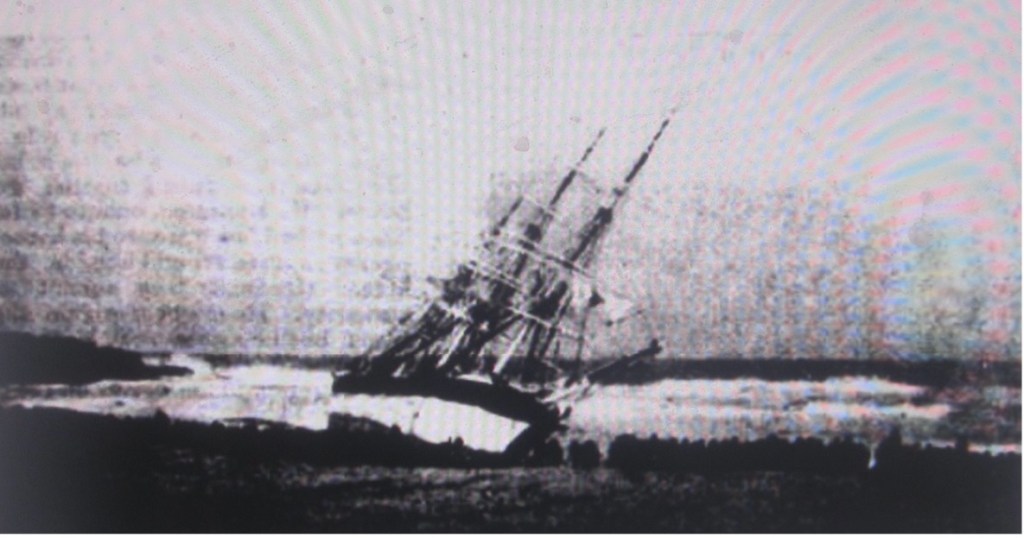
Hereward at Maroubra Beach on Sunday after the foundering.
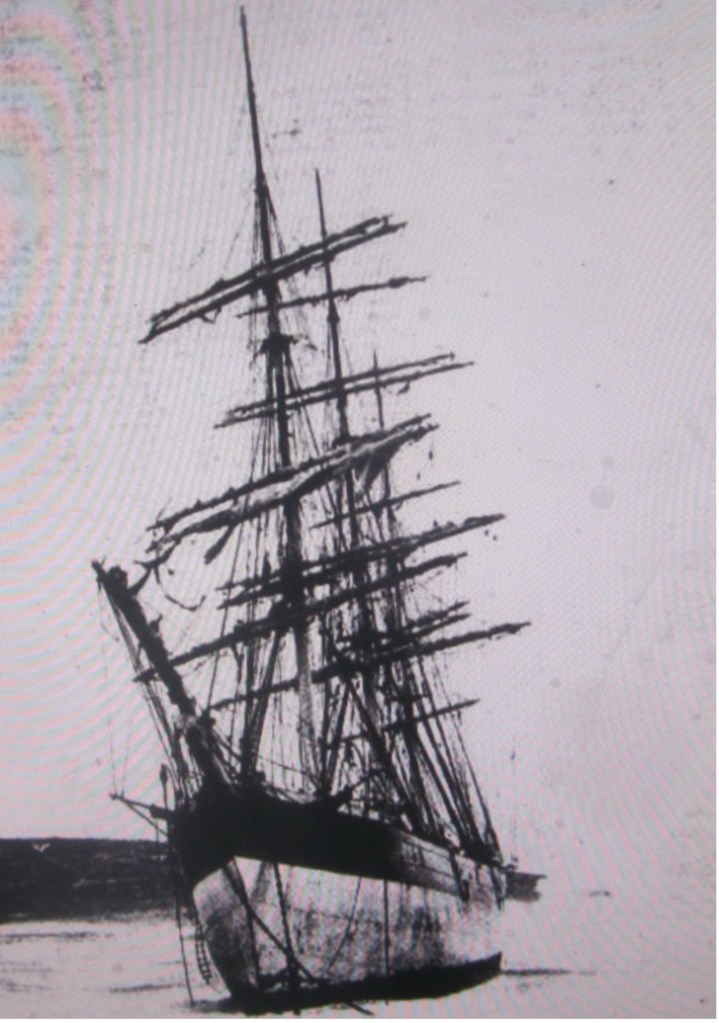
Hereward lain close to the rocks
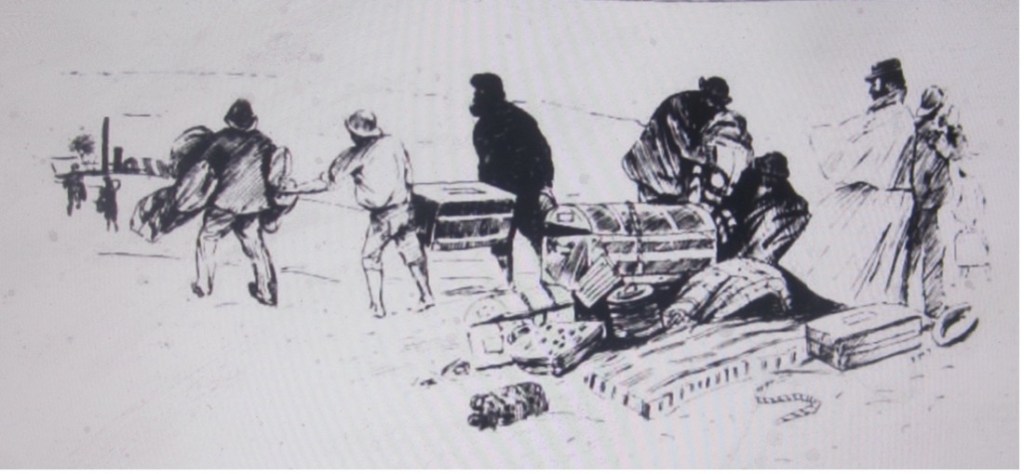
Carrying luggage from the Hereward.
The Stranded Harewood Generates Much Public Interest
The Sydney Mail and New South Wales Advertiser of 16 July 1898, page 150, reported:
‘Seldom has a wreck upon our coast caused so much interest to the general public as that of the ship Hereward, which was stranded at Maroubra Beach during the disastrous Maitland gale in the early part of May. Since then daily large numbers of people make their way to the scene of the catastrophe, and the quiet little beach has become a regular picnic resort. Mr. M. C. Cowlishaw purchased the stranded ship, and entrusted the work of floating her to Mr. Cumming, who, with over 100 assistants, has worked with a will.
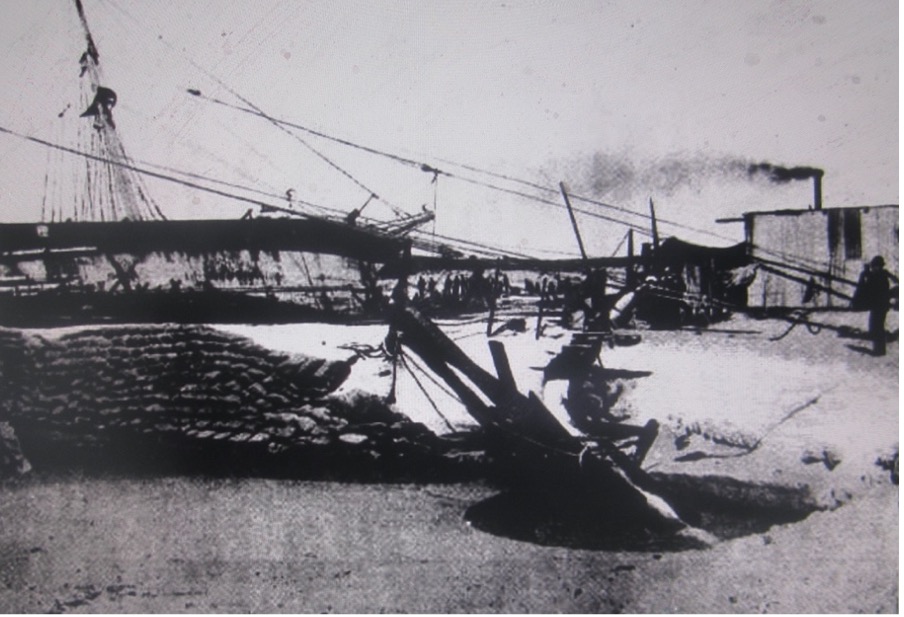
It is now over six weeks since operations were commenced. The contractor hoped to have the vessel snugly in Sydney Harbour by this time, but the rough weather which commenced at the outset and has been experienced off and on during the operations has greatly retarded the work, and it will now probably be next month before the final effort to tow the vessel off will be made. The first thing done by the contractor was to build an artificial dock. This was accomplished by piling thousands of bags filled with sand one upon another so as to form a retaining wall, and then pumping out sand to a depth of several feet.
When the final effort is made it is expected that the vessel will float in the dock, and that it will be an easy matter to tow her to sea. The walls of sand stood the buffeting of the waves for some time, but when exceptionally heavy weather was experienced part of the enclosure gave way and had to be repaired, which caused loss of time to the contractor. Meanwhile men have been hard at work dismantling the vessel of all her spars, rigging, and sails, and despatching them to Sydney. The ship’s ballast, which consisted of several hundred tons of sand, has been removed. A suction pump was sent from Sydney and used effectively for removing sand from inside the enclosure for the purpose of deepening the basin. A large anchor attached to a cable has been taken some distance seaward to hold the vessel in position and to be further useful when the critical moment arrives.
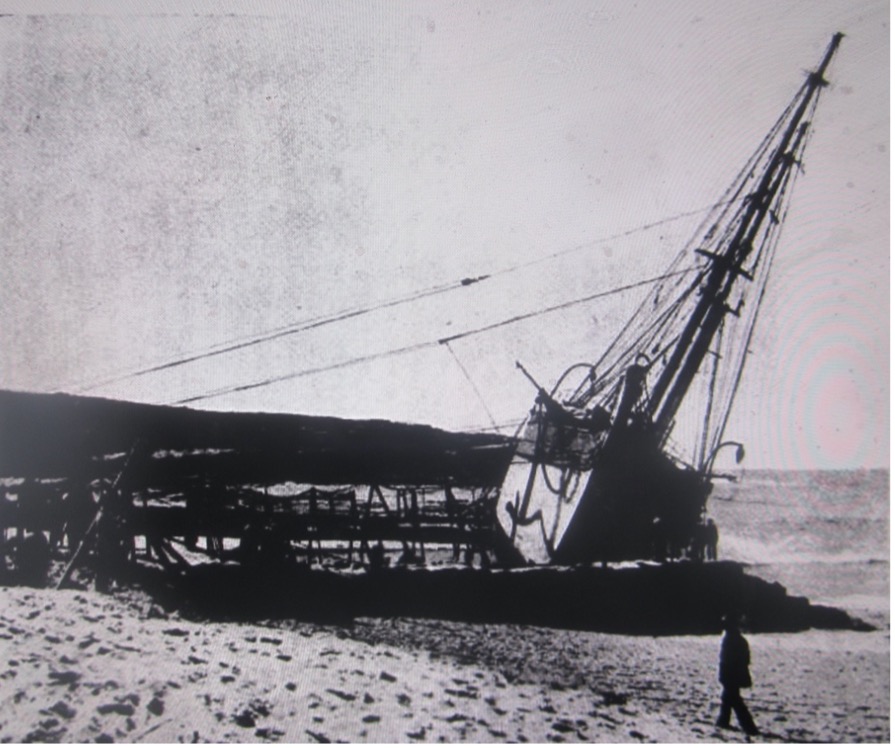
When most of the ballast had been removed it was discovered that the rocks upon which the stern of the vessel was lying had caused a small leak which had to be stopped, and this work was performed by a diver. During the last few days, the vessel has shifted considerably, and now lies almost due north and south. During last week the hawser attached to the vessel was hauled taut, and the Hereward, answering to the strain, straightened up somewhat. Our illustrations [see below] give a good idea of the position of the vessel.’
Despite extensive salvage attempts the Herewood was never refloated.
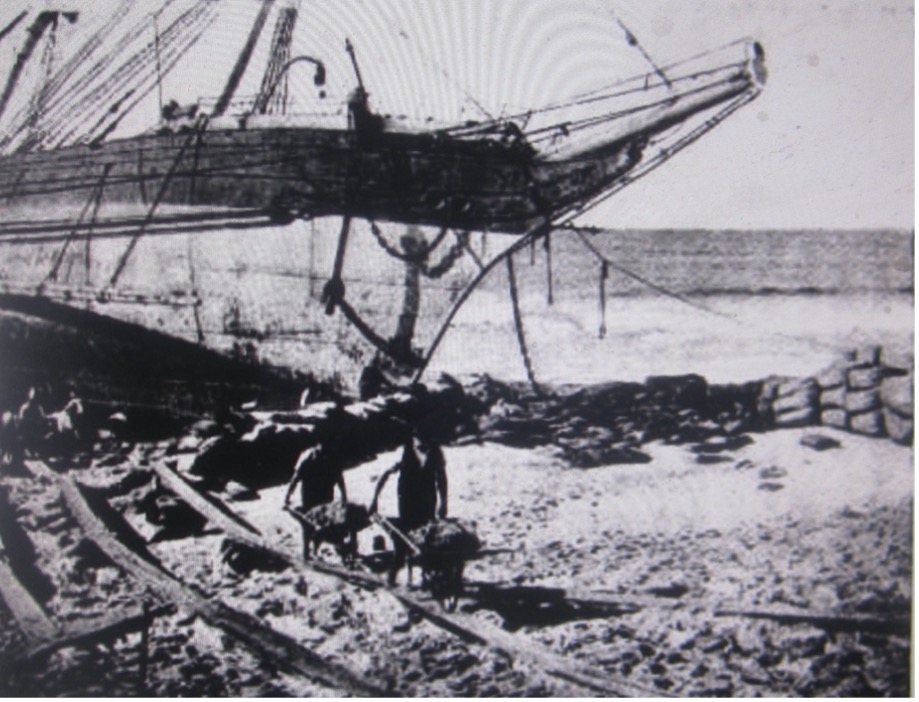
Making the dam.
Pumping water by steam pump from the hold.
General view of the dam.
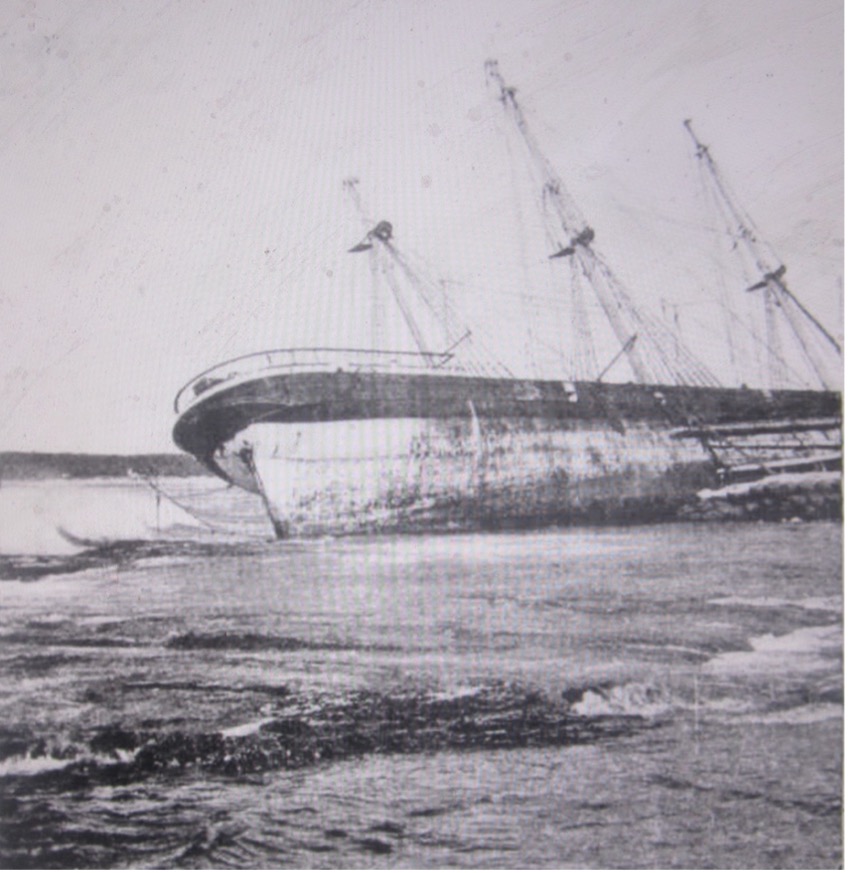
View showing rocks near stern post.

Dismantling the Hereward.
Marine Board of Inquiry into the Foundering of the Hereward
The Sydney Morning Herald of 13 May 1898, page 3, reported:
‘An inquiry was commenced yesterday at the offices of the Marine Board into the circumstances touching the stranding of the ship Hereward, which ran ashore on the Maroubra beach on the night of the 5th instant, while on a voyage from Sourabaya, Java, to Newcastle, New South Wales. Captain Hixson, R.N. (President of the Marine Board), presided. Mr. Thompson (Richardson and Thompson) appeared on behalf of the owners and captain of the Hereward.
Poole Hickman Gore, commander of the Hereward, deposed that he held a master’s certificate from the Board of Trade, Liverpool, and since 1893 had been in command of the stranded ship, which was a vessel of 1513 tons burden, owned by Messrs. Potter Brothers, of London, in which port she is registered. She was lying stranded in Maroubra Bay but had suffered no extensive damage; no lives had been lost, and most probably she could be again floated. There was a quantity of water in her hatches. The vessel passed the south of Tasmania at noon on April 30, and made the first land, Tasman Head, on that date, as shown on the chart produced, occasion being taken to correct his chronometer.
The vessel passed thence along the coast to Cape Pillar, and was next day off St Helen’s Point, where the wind hauled him up, the vessel then standing away close-hauled until the 3rd instant, when she got a fair wind and squared away, freeing all the while. On the 4th, with a fair wind, steered a northerly course, or by the compass north by west. On the 5th she was in the position shown on the chart, the wind blowing strong at the time. At 4 p.m. he was in the position shown on the chart, having run 44 miles by the patent log. At 7.30 p.m. he hauled in the patent log, which showed 80 miles. He then brought the ship to the wind on the port tack. Had been running under foresail, main upper topsail, and lower topsail, the wind being then south-east, hauling easterly during the squalls. The ship was in ballast and in good trim.
After having been rounded to for three hours a light was reported, which witness took to be that of a ship. About 11 p.m. saw what looked like land and called up all hands to wear ship. At the time could see land on the starboard bow, and as there was no room to wear told the mate to get both anchors ready to let go. The vessel was then in the breakers. They let go the starboard anchor and paid it out about 60 fathoms. The port anchor, however, became jammed. The ship then grounded and came broadside on to the sea. As it was very dark, he did not allow any boats to be lowered, and they stayed by the ship until daybreak. He felt certain, by the observations he had made, and which were checked, of his position. He was paying every attention to the navigation of the vessel, and did not take his clothes off from the previous day.
He was confident the course given was steered and had every confidence in the compass of the ship. The vessel stranded during the second officer’s watch. It was the worst weather he had ever experienced; but the ship made good weather of it. The ship was well found. When she stranded it was blowing a hard gale. When he hauled in the patent log at 7.30 p.m. on the 5th instant, he believed he was 78 miles off the land. He got ashore in the lifeboat about 3 a.m. on the 6th, when it was raining heavily, and there was but little light. There must have been a strong set in the current to account for his position. He had two chronometers, which were right. He got good observations, and the positions marked on the chart were fairly correct. Had he not been certain of his position he would not have brought to on the port tack. When rounding he did not cast the lead. He had consulted with the mate before bringing the ship to the wind. He had never seen the Macquarie light before, and the light he saw he took to be that of a ship. He saw no other light along the coast, the weather being very thick.
To Mr. Thompson : When trying to wear the ship she stopped dead and would not pay off. It was 10 to 15 minutes from the time he first saw land to the time of striking. Henry Wannel, chief officer of the Hereward, said he had been five years in the ship. He kept the log and took sights every day and assisted the master in the navigation of the ship. The last sight he worked was on the day before the stranding, which he compared with the captain. The day of the wreck he took no sight and did not know if the captain took one. The chart produced was the ship’s chart, on which the positions were put down daily. The last position marked was about 75 miles off the coast as reckoned by the master. He could not account for the ship’s actual position, unless there was a strong westerly set, and could give no explanation, as to discrepancy. The ship was correctly steered, and there was a good man at the wheel.
When they sighted the Tasmanian coast he made a good land fall. Everything was right up to then. Just before 8 o’clock on the night of the stranding he had a consultation with the captain as to the position of the ship, when they agreed they were 75 miles off the land. He took no cast of the lead, as he did not think there was any danger. He subsequently saw a light, which proved to be the Sydney light, and called out to wear ship. She would not wear, and they went ashore. The master was a very careful navigator, and he was confident it was not through carelessness that the vessel grounded.
Thomas Steven, second mate, Patrick Ryan, an able seaman, and Emil Swanson, the man at the wheel at the time of the stranding, gave evidence in confirmation of that reported.
Mr. Thompson addressed the court at some length, and contended there was some very strong unknown influence at work during the dreadful storm that was the direct cause of the stranding of the vessel. He would leave the matter to the board, hoping it would find the stranding was brought about by the extraordinary weather, and that the board would exonerate the master and mate from all blame, as every precaution had apparently been taken. The captain, after a careful study of his position, believed the ship to be 70 or 80 miles off the coast, and saw therefore no necessity for casting the lead. In concluding, he asked the board to find the loss was occasioned, not by carelessness or neglect on the part of the captain and his officers but by the extraordinary weather of the 5th and 6th instant. The board reserved its decision until Monday next at 3 p.m.’
The Daily Telegraph of 17 May 1898, page 6, reported on the finding of the Board of Inquiry:
‘The Marine Board yesterday announced their finding as the result of their inquiry into the causes which led to the stranding of the ship Hereward in Maroubra Bay, on May 5. The board found that the stranding of the vessel was caused by her drifting on the shore whilst lying-to during the night in a fierce south-past gale, with very thick weather. Under the circumstances, the board did not feel called upon to found a charge of default against Poole Hickman Gore, the master.’
Shipping Traffic Resumed after the Gale
The Daily Telegraph of 14 May 1898, page 11, reported:
‘There was a break yesterday in the wild weather along the coast, the stormy conditions of the past week or more giving place to fresh to light winds, with moderate seas. The shipping took advantage of the change, and a number of vessels that had been weatherbound throughout the gale put to sea. The steamers Gosford, Express, and Duckenfield cleared out from Nelson’s Bay, the first named vessel at 2.5 p.m., and the two latter at 2.10 p.m., both passing southward at 2.15 p.m. The Duckenfield, whilst at the bay, supplied the Government steamer Thetis with 40 tons coal.
On the southern coast the steamer Allowrie resumed her voyage from Bateman’s Bay to Sydney at 2.20 p.m. After being bar bound at Richmond River Heads for several days the steamer Macleay sailed yesterday for Sydney, crossing the bar shortly after noon. However, a few vessels were obliged to beat a retreat to shelter after venturing outside for a few hours. Of these, the schooner Gwendoline sailed from Clarence River for Nambucca Heads at 10.30 a.m. but returned to port at 2.10 p.m.; and the steamer Euroka was compelled to take shelter in Byron Bay after attempting to resume her voyage from that port to the Clarence River.
The vessels still bar bound, and sheltering are: — At Port Stephens, the schooners Shannon and Garfield; at Bellinger Heads, the steamer Volunteer and schooner Alexander; at Richmond River Heads, the steamers St. George and Electra; at Cape Hawke, the schooners Stanley, Willinga, Aleda, and Korunnah, the ketches Forest Queen and Amy Moir.
In connection with the shipping disasters, news from Gosford states that salvage operations are proceeding at the wreck of the Maitland, and the purchaser, Mr. Robert White, hopes to make a good thing out of the speculation. The wreck was sold for £15. No more bodies have been recovered from the wreck. Captain Bentley telegraphs from Nelson’s Bay that the weather has moderated, and operations have commenced for the discharge of the timber cargoes of the vessels ashore. Captain Bentley hopes to get the vessels off as soon as the weather moderates. Messrs. Fraser, Uther, and Co. yesterday sold at auction the wreck of the ketch Coral, as she now lies on the beach at Nelson’s Bay, for £8. The purchaser was Mr. R. Thompson.’
POSTSCRIPT
Heroes of the Maitland Honoured
Heroes associated with the foundering of the Maitland were publicly honoured in two ceremonies.
Firstly, John Russell was given a presentation at the Newcastle Town Hall in June 1898. The Sydney Morning Herald of 24 June 1898, page 5, reported:
‘At a public meeting of the citizens of Newcastle, held at the Town Hall tonight Mr John Russell of Watt-street, Newcastle, the hero of the Maitland wreck, was made the recipient of a handsome presentation in the shape of an illuminated address, accompanied by a purse of sovereigns, in recognition of his valuable services in rescuing life.
The movement was inaugurated some weeks ago, and a sum of £100 was readily subscribed The Mayor of Newcastle (Alderman W. L. Kidd) presided, and about 100 prominent citizens, including several ladies, were present. Among those in attendance were Messrs. Samuel Clift, Thomas Brookes, and J. R. Hall, directors of the Newcastle and Hunter River Steamship Company, the Hon. Alexander Brown, M. L. C., Captain Newton (harbour master), several aldermen of the city and suburban councils and a number of the leading commercial men of the district. …..
The mayor, in making the presentation, said that the people were always ready to recognise true pluck and courage, and it was especially gratifying to them to know that one of their fellow citizens had displayed such heroic conduct. Australia was proud of Mr. Russell and they were doubly proud that he was a son of Newcastle.
The address read as follows: —”We, the citizens of Newcastle and numerous other admirers of your gallant conduct on the occasion of the wreck of the steamer Maitland at Broken Bay on May 6 last, deem it our duty not to let such noble heroism pass without public recognition. The brave manner in which you, in the face of almost certain death, succeeded in conveying a line from the ship to the rock-bound shore in the height of one of the most terrific gales that have occurred in this colony, thereby saving the lives of many passengers and some of the crew, merits and receives our strongest feelings of admiration. For modest and manly behaviour subsequent to the wreck is worthy of emulation and deserves to be placed on record. We beg your acceptance of this address with the accompanying purse of sovereigns contributed by all sections of the community as a slight tribute to the valour displayed by you on the occasion of the wreck of the ill-fated steamer. On behalf of the subscribers, we are W. L. Kidd (Mayor of Newcastle), Samuel Clift (chairman Newcastle and Hunter River Steamship Company), T. H. Raysmith (hon. secretary).”
The address was an artistic one and was greatly admired. The inscription was surmounted by a representation of a lifebuoy, with the words, “Maitland lost, 6th May 1898,” together with an excellent view of the ill-fated steamer, showing the Nobby’s and a portion of the Newcastle harbour in the background. At the beginning of the address were a number of views of Barrenjoey, the scene of the disaster, and one represents the position of the vessel after she struck on the reef in the corners of the testimonial were the Union Jack and the company’s flag flying at half-mast. The work was entrusted to the establishment of Mr Alfred Sharp, architect, of Newcastle.
Mr Samuel Clift, chairman of the board of directors of the Newcastle and Hunter River S. S. Company, then handed to Mr Russell a handsome gold watch, chain, and locket together with a free pass on the company’s steamers for life. The watch was inscribed as follows: — “Presented by the directors of the Newcastle and Hunter River Steamship Company to Mr. John Russell in recognition of his heroic conduct on the occasion of the wreck of the steamer Maitland on May 6, 1898.”
The Hon. Alexander Brown, M.L.C., also delivered a eulogistic speech. Mr. John Russell, who was much affected, was received with continuous applause. He briefly thanked his fellow citizens for the handsome testimonial and for the kind words which had been uttered. He deeply appreciated their recognition of his services, but he felt that he had only performed his duty.
Mr. Frank Gardner, local secretary of the Royal Humane and National Shipwreck Relief Societies, stated that he was in communication with the headquarters of both organisations, and had no doubt that in both instances medals for bravery would be awarded. The proceedings terminated with cheers for Mr. Russell.’
Later in 1898, the National Shipwreck Relief Society of New South Wales presented medals to nine persons who had demonstrated bravery during the foundering of the Maitland. The Sydney Mail and New South Wales Advertiser of 20 August 1898, page 457, reported:
‘Despite a heavy downpour of rain on the 11th instant and at a time when one would imagine that most people would prefer to sit around the fireside and listen to the rain pattering on the windows, the Sydney Town Hall was crowded by an audience of ladies and gentlemen, with a large percentage of the more youthful members of the community. The occasion was the twenty-first annual meeting of the National Shipwreck Relief Society, and the fact that there was such a large attendance, notwithstanding the turbulent state of the elements, was a striking testimony, not only to the popularity of the annual distribution of medals and prizes in recognition of bravery in the saving of life, but was also an indication of the unusual interest taken in the operations of the society owing to the exceptional clangers of the past 12 months to which those who go down to the sea in ships have been subjected.
The hall was tastefully decorated with the flags of various nations, and presented a brilliant appearance, which was considerably heightened by a profusion of palms distributed throughout the platform. Precisely at 7.30 p.m. Lord Hampden, accompanied by Lady Hampden, the Hon. Dorothy Brand, the Hon. Alice Brand, and the Hon. Robert Brand, Major Sloane Stanley, and Captain Feilden entered the main entrance. They were received by the chairman of the society (Mr. J. H. Storey) and several other gentlemen and escorted to the platform, the City Organist (Mr. Wiegand) playing the National Anthem, whereat the large audience rose, and as the Vice-Regal party took their seats they were received with a hearty burst of applause. …….
For acts of bravery in saving life during the year the following awards have been made : —” Lady Hampden then presented the medals and certificates to the following recipients [only the nine persons associated with the Maitland disaster are listed below]: —
Williams, W., silver medal and certificate—attempting to get line ashore from wreck steamer Maitland.
Anderson, A., silver medal and certificate— attempting to get line ashore from wreck steamer Maitland.
Russell, J., silver medal and certificate— taking line ashore from wreck steamer Maitland.
Smith, S. S., certificate of merit—assisting to get line ashore, wreck steamer Maitland.
Franks, F. A., certificate of merit— assisting to get line ashore, wreck steamer Maitland.
Dempsey, J., silver medal and certificate— assisting to free line, wreck steamer Maitland.
Hammond, Mrs. A., silver medal and certiflcate—saving life, wreck steamer Maitland.
Henderson, J., silver medal and certificate— saving life, wreck steamer Maitland.
Phillips, W., silver medal and certificate— saving life, wreck steamer Maitland.
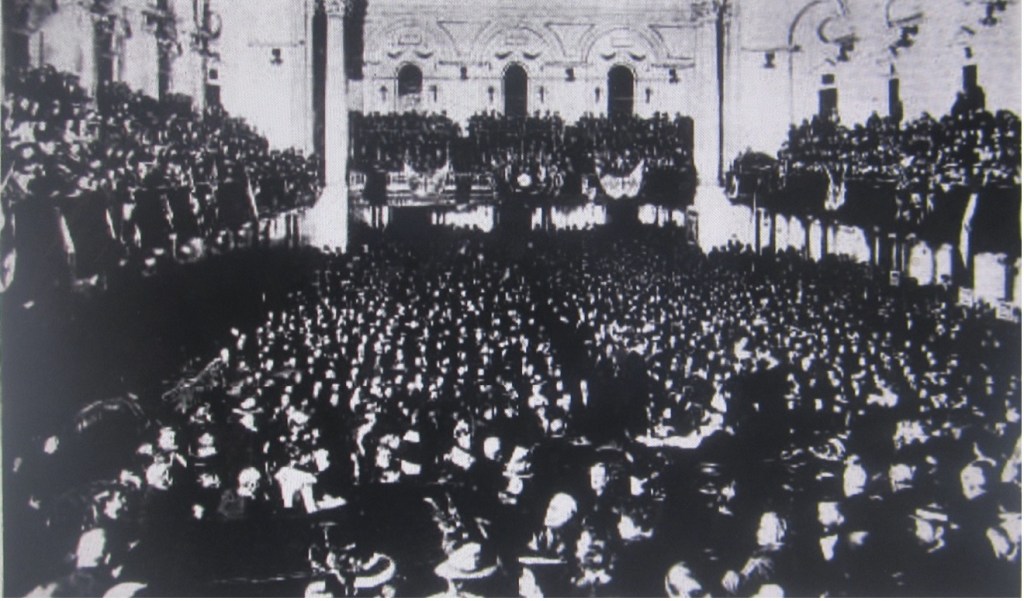
The twenty-first annual meeting of the National Shipwreck Society of N.S.W. held at the Sydney Town Hall when the presentations were made to the Maitland survivors. [Sydney Mail and New South Wales Advertiser, 20 August 1898]
Death of William Williams – Maitland Survivor Remembered
The Newcastle Morning Herald and Miners’ Advocate of 16 February 1939, page 10, reported:
‘The death of Sergeant W. Williams in Sydney yesterday recalls the wreck of the Newcastle and Hunter River S.S. Company’s steamer Maitland off Broken Bay on the night of May 5, 1898, with the loss of 25 lives. ……….
The Maitland struck at 5.45 a.m. Battered by the seas, she broke in two in less than as many hours. The boats were lowered but were useless under the wild conditions. It was at this point that the late Mr. Williams, with others, did such fine work. He was a member of the crew and was the first to volunteer to try to get a line ashore. Others who took part were Carl Johansen, Alexander Anderson, and John Russell (the last-mentioned a passenger). Williams did not reach the headland. He was dragged back into the sea before he could get a foothold, the weight of the long length of line being a great handicap. He was drawn on again on to what was left of the wreck, being unconscious and badly knocked about. Anderson then volunteered. He plunged into the surf with the line which broke at a vital moment. He was swept away but managed to reach the shore a considerable distance away.
Russell, who was a sturdily set up young fellow, next made the attempt and succeeded. The lifeline had to be dragged sideways through the surf. In this task Russell had valued assistance. The fore-cabin steward and the cook, who assisted him, were among the drowned. The cliffs were reached and by this means a line was got to the shore enabling those remaining on the vessel to be rescued. Messrs. Williams, Russell and Anderson were rewarded for their gallant conduct. Each received a similar decoration.
After leaving Newcastle Mr. Williams spent his time in Sydney. Latterly, and to the time of his retirement, he had been sergeant of police at the City Coroner’s Court. Mr. Anderson made his home at Balmain. Mr. Russell, who became a popular figure in Newcastle, was identified with the district for many years after the disaster.’
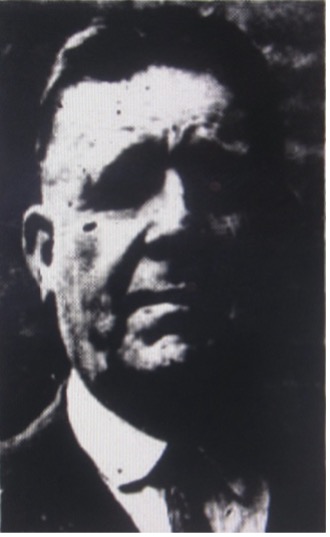
Sergeant William Williams, former crew member of the Maitland [Wingham Chronicle and Manning River Observer, 17 February 1939, page 6].
Death of Captain Richard J Skinner
The Sydney Mail and New South Wales Advertiser of 5 October 1901, page 863, published the following obituary on Captain Skinner, master of the Maitland:

Late Captain R. J. Skinner [Sydney Mail and New South Wales Advertiser, 5 October 1901]
‘Captain R. J. Skinner, a well-known Sydney shipmaster, died at his residence, North Sydney, on the 20th ultimo. The late shipmaster’s connection with the trade between this port and Newcastle extended over a period of nearly 30 years, and a profound feeling of sorrow was felt in shipping circles when the news of his death became known. Throughout his long career only once was his name ever associated with a shipping accident involving loss of life, and upon that occasion (the memorable Maitland gale) he was distinguished by conspicuous bravery.
Captain Richard J. Skinner belonged to the valued school of apprentices to sailing ships and continued in his first employ from 1855 for 10 years. He gradually rose to second officer of such clippers as the Devonshire, and chief of several of the China tea ships when £4 per ton was not an exorbitant freight from China to London, and a £500 bonus for the first ship home with the new season’s ‘chop.’ As far back as 35 years ago he was identified with the shipping trade of Sydney, under the house flag of Messrs. John Frazer and Co., in the Young Australia and the Ellesmere.
Before joining the Newcastle Steamship Company, he commanded one of Mr. Ebenezer Yickery’s vessels engaged in the island trade. Flags were half-masted on the whole of the shipping at Sydney and Newcastle. There was a great gathering of the shipping interests at the funeral. Captain Skinner was buried in St. Thomas’ Cemetery. The quartermasters and boatswain of the steamer Namoi, which Captain Skinner had lately commanded, acted as pallbearers, while the officers and crew of the same vessel marched in front of the hearse to the cemetery.’
Relics of the Maitland Wreck
The Sydney Mail of 24 July 1935, page 45, published the following photo with the caption:
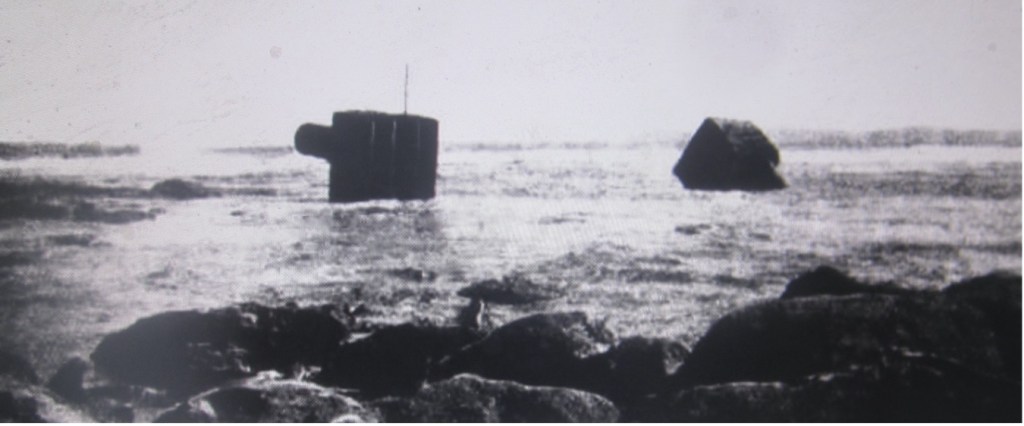
‘Although it is 37 years since the paddle-steamer Mainland was wrecked near Cape Three Points, between Sydney and Newcastle, New South Wales, portions of her boilers remain on a rocky ledge, where they stand out grimly at low tide as a reminder of the disaster.’
Maitland Monument at Killcare
On 14 October 1961, a monument to the memory of the steamship Maitland was unveiled near the intersection of Maitland Bay Drive and the Scenic Drive, Killcare, on the NSW Central Coast, which incorporates the ship’s bell. The monument is pictured below.
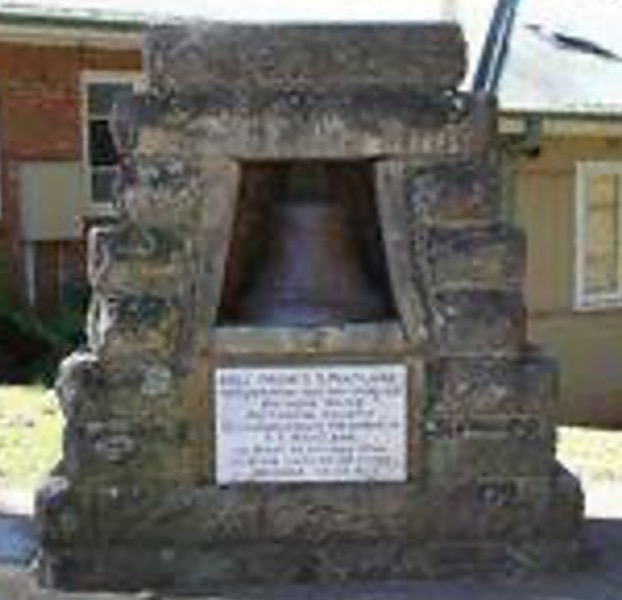
Maitland Memorial at Killcare.

Memorial Tablet.
Original Figurehead of SS Maitland
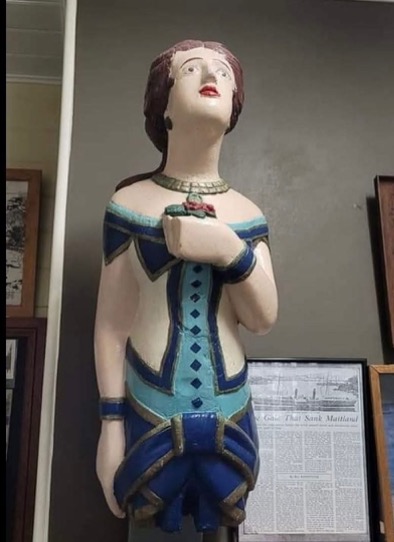
Original figurehead of SS Maitland on display at the South West Rocks Maritime Museum
Researched and compiled by Kevin McGuinness
September 2023

 Port Stephens - a history exploration