

Introduction
The steamer, SS Pappinbarra foundered on rocks at Point Stephens [also called Fingal Island] below the Point Stephens Lighthouse on 11 September 1929.
This event attracted considerable newspaper coverage, in particular the heroic act of one of the able seamen on board who saved the crew from certain death. The subsequent unsuccessful salvage operations were also widely reported.
The Pappinbarra was owned by the N. Cains Coastal Steamship Company and was a sister ship to the SS Uralla which foundered near Morna Point, south of Port Stephens, the previous year in 1928.
On 4 December 1877, fifty-two years prior to the foundering of the Pappinbarra, the steamship Florence Irving was also wrecked nearby on the rocks below the Point Stephens Lighthouse. Information on the Wreck of the SS Florence Irving is found at this link on the website.
This paper is the story of the foundering of the SS Pappinbarra and the events that followed. The records contained in the Australian National Library’s ‘Trove’ provide a wealth of information on this subject.
Hero of the sea
The Sun of 12 September 1929, page 15, (and other newspapers) reported on the heroism demonstrated by one of the crew of the Pappinbarra in saving the lives of his fellow seaman:
‘Above the desolation caused by the wreck of the coastal steamer Pappinbarra stands the heroic figure of G. Jervie, A.B. [able bodied seaman], who risked his life to save those of the 14 men and the captain, who were facing their end on the stricken vessel.
With rope bound tightly round his waist, he got ashore on an upturned boat, which had been torn by the gale from its davits, and made a line fast to the lighthouse shore [at Point Stephens]. A block and tackle was rigged, and on this the rest of the crew and the captain got ashore.
But for Jervie’s action, the crew might have gone down with the ship. Seeing that within a few moments the steamer might take its long plunge to the bottom, taking with it every man on board, he plunged overboard. The broken port boat provided a support in the boiling seas, and he made the lighthouse island. On the boat stood 16 haggard men with life-belts on. They stood by after the captain had shouted “every man for himself,” waiting for the end.
Jervie’s action came when all seemed lost. It was a desperate chance, but he alone was prepared to take it. Before anybody could stop him he was over the side and in the water. There was no cheering, because the full force of his heroic action had not been brought home to the men on board. Knowing what fate the raging waters might have for him he did not hesitate. On a desolate island out from the mainland by mountainous seas and perilous rocks the crew of the Cain Coastal Shipping Co.’s Pappinbarra, which, was wrecked off the south head of Port Stephens at dawn yesterday, are marooned. Indications are that it will be some days before the men can be taken by boat from their solitary haven. Local fishermen and boatmen look on to the rocky island with awe, an have flatly refused to set out to land on it until the weather moderates.
Meanwhile the only communication the wrecked crew have with the outside world is by telephone. Their ship, with huge waves thundering over it, is being battered to pieces almost under their eyes. A funnel and several spars are all that can be seen above the seething grey mass of the steamer, which 24 hours previously was running headlong before a howling southerly gale. A block and tackle hastily rigged carried the crew over the mountainous waves to safety. While this drama of the sea was being enacted fishermen and residents of Nelson’s Bay were sheltering in their homes unconscious of It. Even had they known they could not have given any assistance.
How the Pappinbarra was wrecked remains a mystery among skippers. Captain Merrett, the master of the Pappinbarra, has been on the coast for over 40 years, and knows every inch of it. So far as can be ascertained, the vessel struck a treacherous reef jutting out from the lighthouse. Fishermen and boatmen at Nelson’s Bay, who know the entrance like a book, think that the steamer was caught up bodily and dashed on the reef. The steamer is believed to be a total wreck. Lighthouse-keepers say that the sea is moderating slightly.’
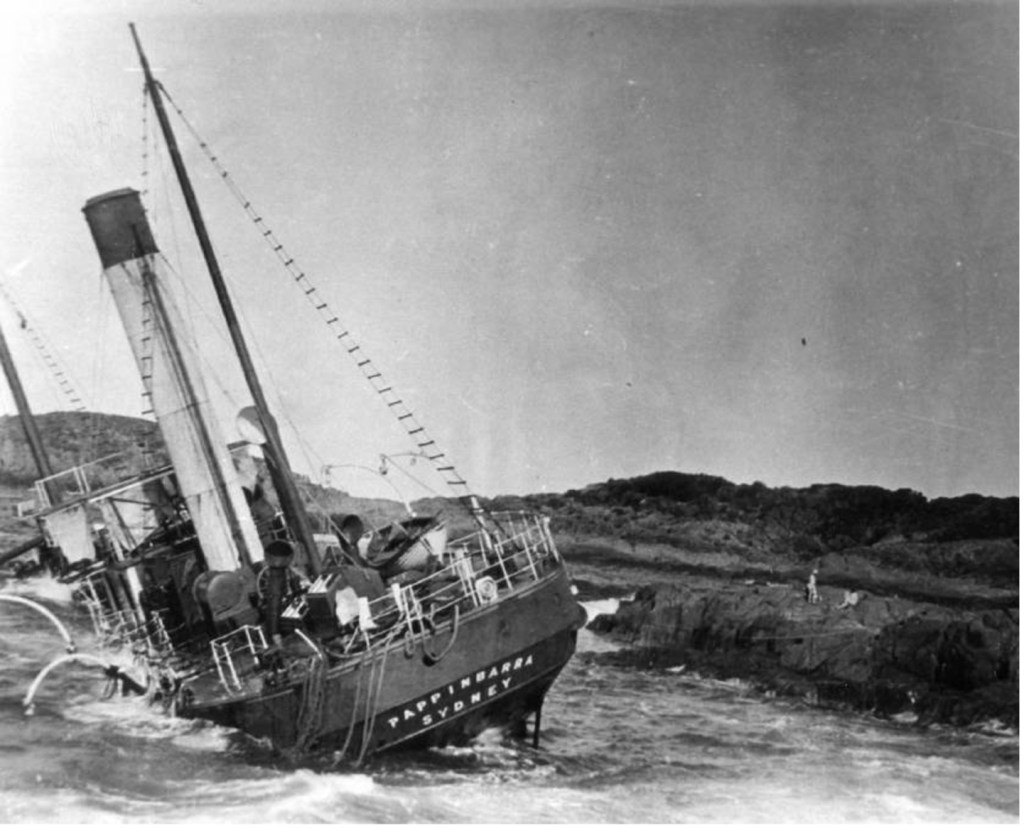
Pappinbarra stranded at Point Stephens [Newcastle Herald, 14 February 2014]
The Evening News of 12 September 1929, page 13, further reported:
‘The strip of coast from Port Stephens, to the southern breakwater at Newcastle is a graveyard for ships, and the skeletons of many vessels may be seen bleaching on the sand. Captain Merritt has been on the coast for 40 years. How his vessel struck the treacherous route near the outer light is a mystery. The general opinion among fishermen at Nelson’s Bay is that the vessel was lifted bodily and carried shore-wards. Four hours before she struck the Pappinbarra signalled to the outer lighthouse that she was about to enter. The vessel disappeared and was not seen again until she crashed on to the rocks.
A telephone message from the light house today stated that members of the crew of the Pappinbarra were none the worse for their experience. None were injured in the landing, and they were all in good health, though a trifle hungry, as supplies at the lighthouse, which is on an island, were running short. The opinion is expressed that there is not the slightest chance of salving the vessel, which is hard and fast on the rocks. The sea is moderating slowly today, but is still breaking right over the vessel, and burying her in a smother of foam.’
Crew Reach Newcastle
The Newcastle Morning Herald and Miners’ Advocate of 13 September 1929, page 10, reported:
‘Captain F.W. Merrett, Master of the coastal steamer, Pappinbarra, which had been driven on to the rocks at Stephens’ Point, near the outer lighthouse at Port Stephens, arrived in Newcastle last evening. He was accompanied by the members of the crew, numbering 15, who travelled overland from Nelson’s Bay. The names of the men are: J. Daley (Mate), G. Duthie (Chief Engineer), E. Withers (Second Engineer), A. Dybdale (Boatswain), G. Jervie (Winchman), J. Middleton, R. Cameron (stewards), N. Trughman (cook), G. Frederickson (fireman); O. Wargo, M. Murray, O. Stranberg, E. Carlson, H. Townsen, V. Gaddelin (seamen).
They were met on arrival, by Mr. E. Wallwork, of the North Coast Steam Navigation Company, Ltd., representing the owners, N. Cain’s Coastal Steamship Company, Port Macquarie. He made arrangements to provide them with clothing, boots, and meals.
“This is all we’ve got—what you see on us—and lucky to get ashore at that. We lost everything we had, and only have what we stand up in,” said one of the men. The crew presented a sorry spectacle. Their appearance told of the thrilling experience which they had gone through. Some of the men were without hats, boots, shirts, and coats. The first thing they asked for was a meal, and ‘something’ to get warm, which was quickly provided by Mr. Wallwork.
Captain Merrett said that when he left Port Macquarie, on Tuesday evening, the weather reports received were good. After he got past Tacking Point, and approaching Seal Rocks at night, they struck the first blow. The steamer was then heading south, with the gale, accompanied by heavy rain, increasing all the time. The ship was behaving splendidly in the mountainous seas. When abreast of Stephens Point, he got a glimpse of a light, which was not very clear. It was bearing west, so he kept off the coast. After passing the North headland of Port Stephens, he thought he would be able to get into Shoal Bay and did not care about taking the risk of entering the heads at Port Stephens on account of the high seas running. He could see nothing. and did not exactly know his position until the vessel started to bump. She kept bumping badly. He thought then that he had struck the rocks. This happened about 5.30 o’clock on Wednesday morning. He was on the bridge with the mate all the time. Daylight found the vessel fast on the rocks, at an angle of 45 degrees, with seas breaking over her.
The heavy pounding to which the vessel was subjected quickly began to take effect. The port lifeboat broke adrift, and was swept round the side of the ship, when three of the crew—Jurvie, Middleton, and Townsen—attempted to jump into it. Townsen failed and was jammed between the side of the ship and the boat. Fortunately, he managed to grasp a rope. and was hauled on board the vessel. The two other men were washed ashore in the boat, a distance of about 60ft from the Pappinbarra. They took a stout line with them. This was made fast, and an improvised bosun’s chair was then sent to and from the ship, until one by one the remaining members of the crew were landed. They suffered much from cold and exposure. Later they were accommodated by the lighthouse-keeper, Mr. Berryman, at Stephens Point, and made as comfortable as possible.
According to several members of the crew, the vessel will become a total wreck. She is hard and fast on the rocks, with her bottom badly torn. Captain Stobo, the marine underwriters’ representative, visited the scene of the stranded vessel during the day. The crew left for Sydney last night.’
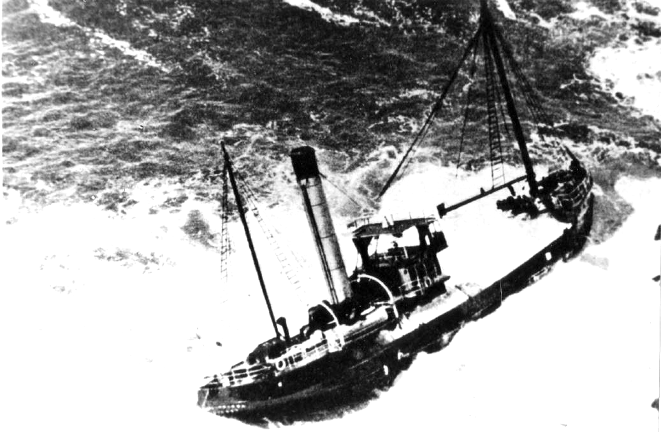
Plight of the stricken Pappinbarra [Newcastle Sun 13 September 1929]
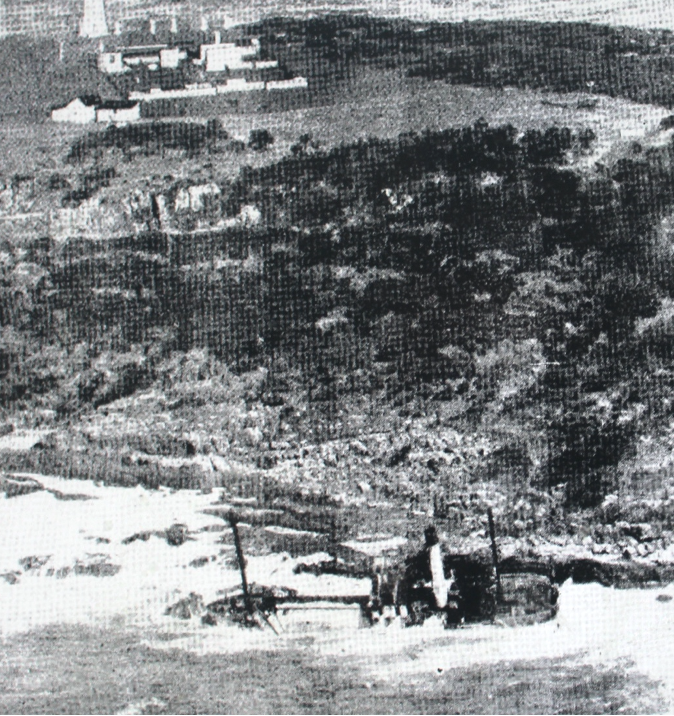
Location of the stricken ship below the Point Stephens Lighthouse [Daily Telegraph, 13 September 1929]
Hopes raised that Pappinbarra could be refloated
The Labor Daily of 21 September 1929, page 1, reported:
‘Acting on favourable reports from a diver, an attempt will shortly be made to refloat the coastal steamer Pappinbarra, which became stranded off the rocks of Port Stephens in the height of last week’s gale. With complete salvage gear and a party of men, Captain Stobo left for the scene of the wreck this week, and a tug or a small steamer will be despatched to assist the vessel off the rocks. If the attempt to refloat the Pappinbarra is unsuccessful, she will be sold at auction.’
Marine Board of Inquiry
The Sydney Morning Herald of 18 September 1929, page 20, reported:
‘The Superintendent of Navigation (Captain Sangster) began the preliminary inquiry yesterday into the wreck of the Pappinbarra. Captain F. W. Merrett, master of the Pappinbarra, and the crew were present. N. Cain’s Coastal S.S. Co., owners of the Pappinbarra, were represented by the manager, Mr. G. McArthur.’
The Port Macquarie News and Hastings River Advocate of 21 September 1929, page 4, further reported:
‘Captain Merrett made the following statement in reference to the wreck of the Pappinbarra: — The steamer left Port Macquarie shortly before noon on Tuesday bound for Sydney. The weather was then moderate to rough, but gave no promise of what was to be encountered later. By nightfall the force of the wind, which was blowing from the east-south-east, had tremendously increased, and a heavy sea was running. The gale grew worse and worse, and terrific seas were encountered in the early morning.
At about 4 o’clock the Point Stephens outer light was seen, and it became obvious that the wind and sea were forcing the steamer to the shore. An attempt was made to get into the shelter of Port Stephens, but a great sea caught the Pappinbarra beam-on, and in another minute she was on the rocks, and firmly fixed there. With the gale still at its fury and the night so dark that it was hardly possible to see more than a few yards in any direction, the plight of the crew appeared desperate.
When the steamer struck a lifeboat was swept overboard, and was seen floating near the stern of the vessel. A member of the crew seized his opportunity, lowered himself into the boat, and took a line ashore. A boatswain’s chair was then rigged, in which the ship’s crew succeeded in crossing safely to the land. “A miracle that we all escaped with our lives,” the Captain commented. It is reported from the lighthouse that there does not appear to be any chance of refloating the Pappinbarra. She is lying fast on the rocks with her stem hard in a crevice, and her head pointing north-east to sea. She has a slight list to port. Seas are at present breaking over her, but it is likely that when the gale abates further that she will be found to be in only shallow water.
The crew of 16 succeeded in getting a line to the island on which the lighthouse stands and reached the shore uninjured. Boatswain G. Jervie very pluckily swan through a raging sea with a line from the wreck to the shore, and by this means the crew were saved.
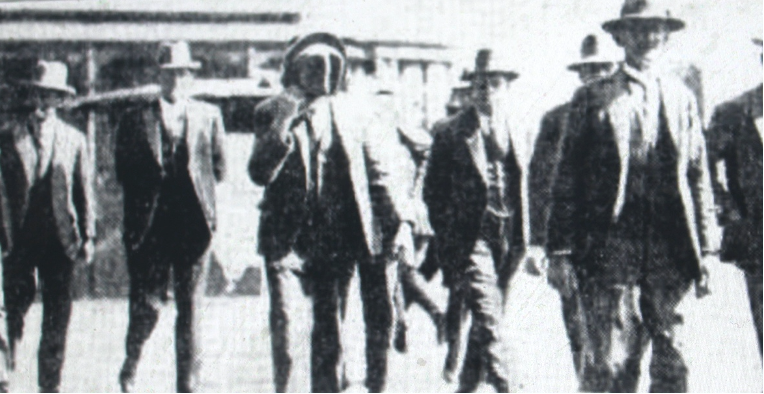
Crew members of the Pappinbarra attend the Marine Board of Inquiry [The Sun, 17 September 1929]
Previously Captain Merrett sailed in many of the small ketches and schooners that were trading on the coast before they gave way to the modern steam-driven vessels. The Pappinbarra was insured with the United Insurance Co., for an amount which Mr. McArthur (manager) says did not fully cover the loss.
The Pappinbarra had on board as cargo 1280 bags of red oxide, 60 boxes of butter, and 10,000 super feet of timber. An official of the company stated that the cargo was small. The Pappinbarra is of 518 tons gross, and was built at Port Glasgow in 1924. The N. C. steamer Urana will replace the Pappinbarra, and arrived here on Sunday afternoon, and left again on Monday evening. She is a replica of the former boat, under command of Capt. McGee. Shippers are fortunate in suffering practically no inconvenience through the prompt action of the Manager in sending another steamer.’
The Sun of 4 October 1929, page 16, further reported:
‘At the inquiry today into the stranding of the Pappinbarra, near Port Stephens, on September 11, the master, Captain F. W. Merrett, admitted that he had received a warning about the weather from the pilot at Newcastle before he left for Sydney, but he did not consider the conditions warranted him postponing his departure. When well out, the weather got worse, and about 4 a.m. mountainous seas, terrific squalls and hurricane gales made the vessel unmanageable. At 5 a.m., she went on the rocks.
Ernest Rose Withers, second engineer, said that when he went on watch at 2 a.m. the weather was as bad as a “typhoon in the China seas.” The judge said the assessors were of the emphatic opinion that the captain took the proper course in keeping close in, and thus being better able to safeguard life. He had also done everything he could to save his ship. Mr. Evans, instructed by Messrs. McDonell and Moffitt, appeared for all concerned, and Mr. A. H. Rogers represented the Navigation Department.’
Marine Court finding
The Barrier Miner of 9 October 1929, page 2, reported:
‘A story of storm and stress was told in the Marine Court today, when Judge Edwards, assisted by Captains H. Tryer and A. McRae as assessors, inquired into the loss of the steamer Pappinbarra, near Port Stephens, on September 11.
Evidence was given that the Pappinbarra, owned by the N. Cains Coastal S.S. Company Limited, left Port Macquarie for Sydney with timber and iron, on September 10, at 11.30 a.m., in bad weather, which became worse. At 3 o’clock on the morning of September 11 there were mountainous seas and heavy squalls, and the master of the steamer, Frederick William Merrett, found that he was only three miles off Port Stephens, instead of six miles, as he had supposed. He tried to put the vessel’s head to sea, but made no headway, and failed to get into shelter. She struck on the rocks near Port Stephens light, and became a total wreck. A member of the crew swam ashore with a line, and all hands were saved.
Mr. Rogers put it to the court that masters were not justified in taking the risk of a narrow margin in their course. In the present case the lives of 15 men had been at stake.
Judge Edwards, in giving the judgment of the court that no one was to blame, said his colleagues were of opinion that the safest navigation was to take the course adopted by the master. He would have run greater risk in a storm of foundering if he had gone farther out and would have destroyed his chance of running into shelter if forced at last to do so.’
Action of the Pappinbarra’s hero considered by Newcastle Council
The Newcastle Morning Herald and Miners’ Advocate of 1 October 1929, page 4, reported:
‘Reference to the heroism displayed by a member of the crew of the wrecked Pappinbarra was made at a meeting of the Newcastle Council last night. The Mayor (Ald. I. L. Wheeler) said that during the wreck of the Pappinbarra, at Port Stephens, the gallantry of Mr. Jervie, A.B, had resulted in the saving of the lives of the crew. When such a case of bravery came before the notice of the council, he felt that it demanded an expression of appreciation. Ald. Blackall was also enthusiastic in his praise of Mr. Jervie’s action. His pluck could best be realised, he said, when one pictured the heavy seas running, and the stricken vessel fast between the rocks. He had dived overboard and taken a line to the shore. At Ald. Blackall’s suggestion, council decided to bring the matter before the proper authorities with a view to securing suitable recognition of the seaman’s exploit.’
There are no newspaper records available that indicate a bravery award was ever granted.
NOTE: The heroism of Able Seaman G Jervie was similar to that demonstrated by a crew member Michael Mahoney, who was on board the Ben Nevis when it struck rocks near Port Stephens in July 1875. In similar circumstances to that faced by Jervie, Mahoney dived overboard and took a line to the shore, thus enabling the crew of the Ben Nevis to safely reach shore.
Salvage work abandoned
The Sydney Morning Herald of 16 October 1929, page 19, reported:
‘Gales during the last few days have done a great deal of damage to the stranded steamer Pappinbarra, and the underwriters decided yesterday to abandon salvage operations and submit the wreck to public auction.
High hopes were held that the Pappinbarra would be refloated. Small holes in the hull were patched, a collision mat placed in position, and pumps installed to lift the water out of the ship as soon as favourable weather, enabled the salvage party to place the hatches on the holds. It was intended then to charter a tug to tow the steamer off, but before the opportunity came the gale developed.’
Pappinbarra sold
The Newcastle Morning Herald and Miners’ Advocate of 25 October 1929, page 8, reported:
‘The steamer Pappinbarra, which went ashore at Port Stephens on September 11, during a fierce cyclone, was sold at auction in Sydney yesterday for £145, while the timber portion of the cargo went for £10. The purchaser was Mr. H. P. Stacey, whose firm successfully raised another coastal vessel, the Malachite, when it sank at its moorings in Blackwattle Bay last year. Mr. Stacey left for Port Stephens yesterday and is hopeful of raising the wreck.’
Salvage launch sinks
The Sydney Morning Herald of 8 November 1929, page 14, reported:
‘Efforts of the salvage party representing Sydney interests which purchased the stranded Pappinbarra from the underwriters recently, have met with an initial setback.
While the motor launch belonging to the party was manoeuvring to get some salvage gear aboard the steamer its engine stopped, and the launch was immediately caught by the waves and thrown against the rocks of Point Stephens.
A moment later it filled and sank at the side of the Pappinbarra. The crew managed to scramble ashore safely. It will probably prove possible to recover the engine, but the sinking of the launch will probably mean a loss of £200 or £300.
Despite this accident the party is going ahead with preparations for an ultimate attempt to refloat the Pappinbarra. Recent visitors to the wreck state that this may succeed. The steamer suffered less than was expected in the storms which have recently swept the coast, and seems to be holding together well.’
Salvage Operations
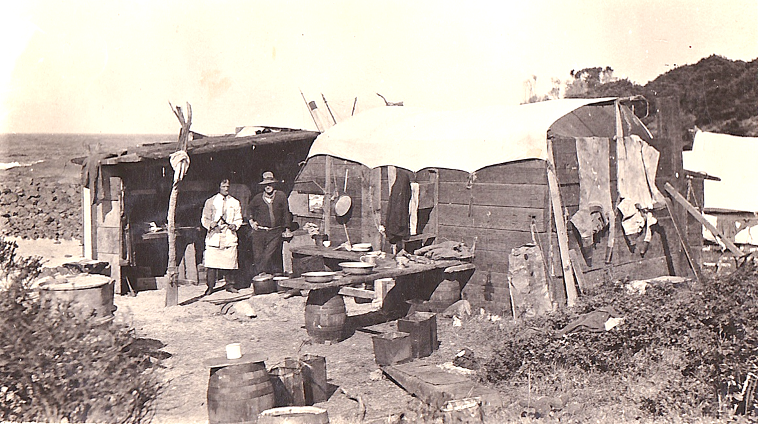
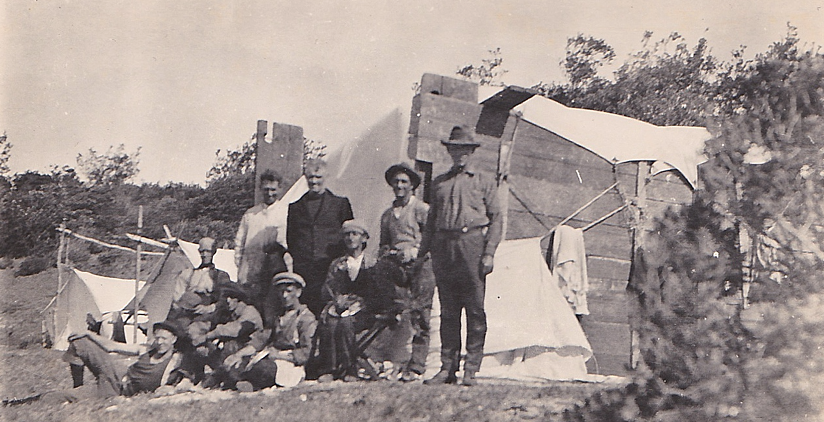
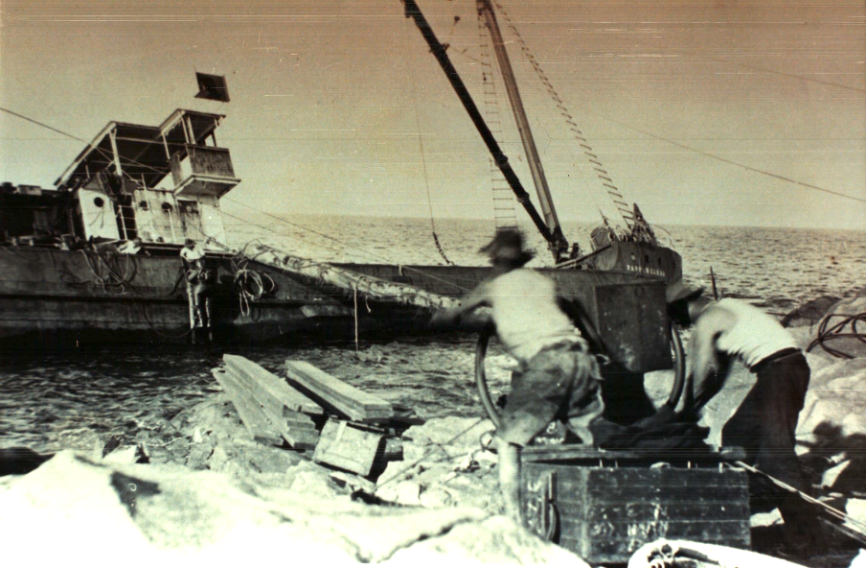
The following photos illustrate the wrecked Pappinbarra and those who attempted to salvage the vessel in September 1929:
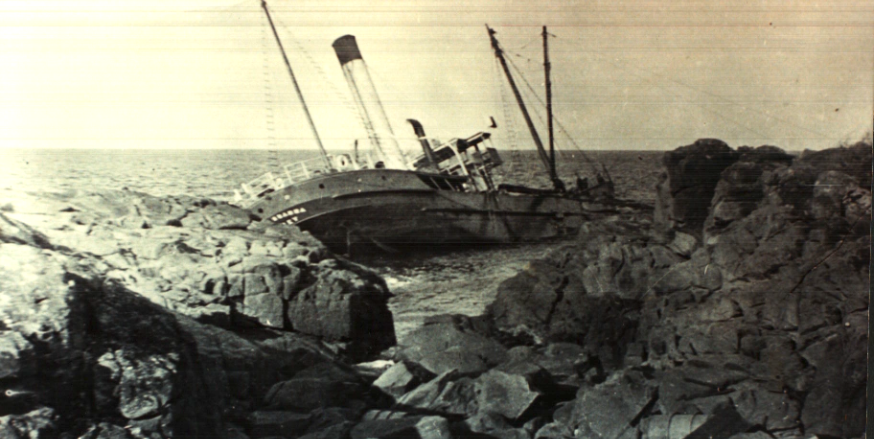
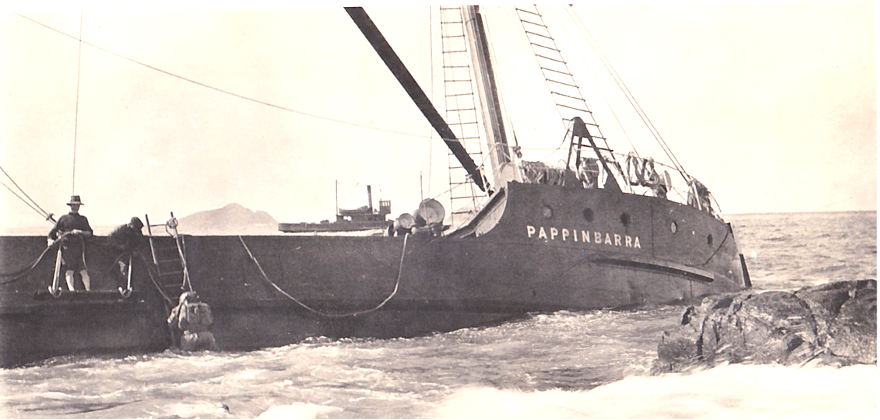
[State Library of NSW Collection]
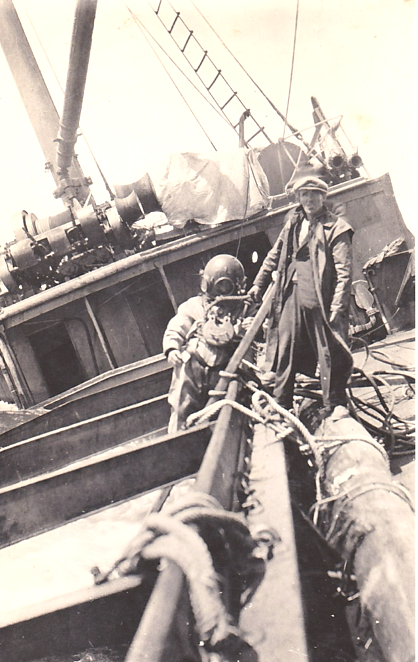
[State Library of NSW collection]
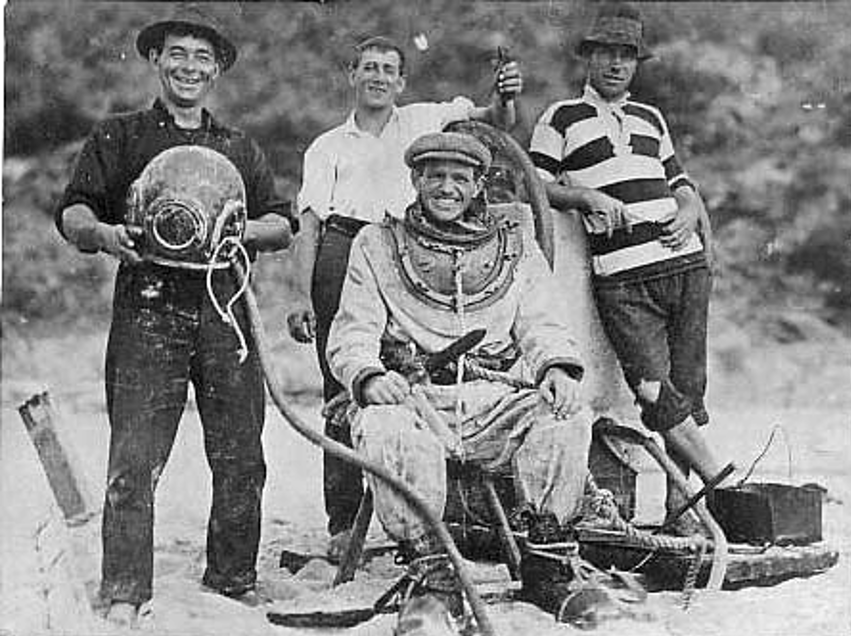
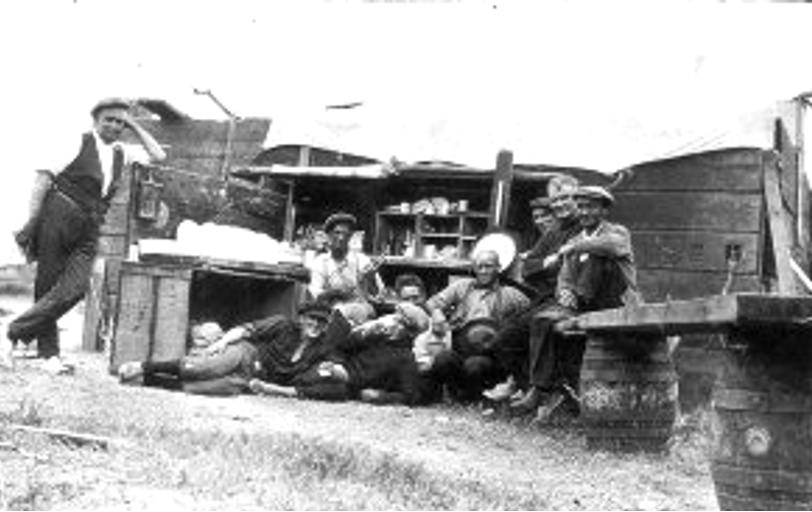
[State Library of NSW Collection]
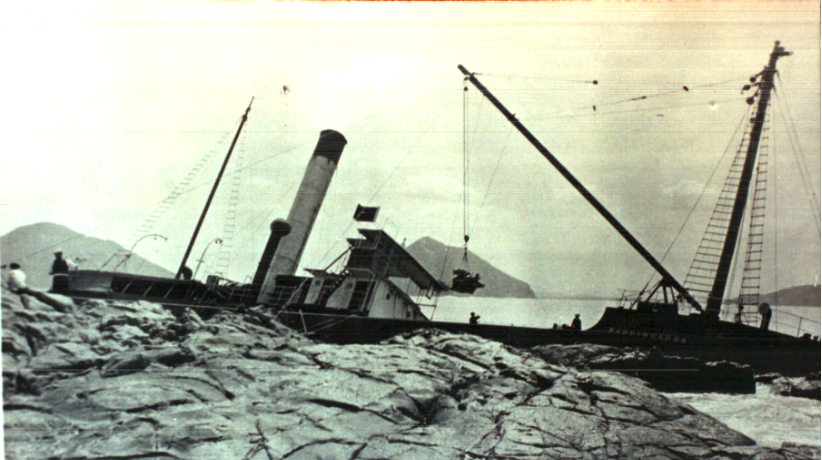
Pump being hoisted on board
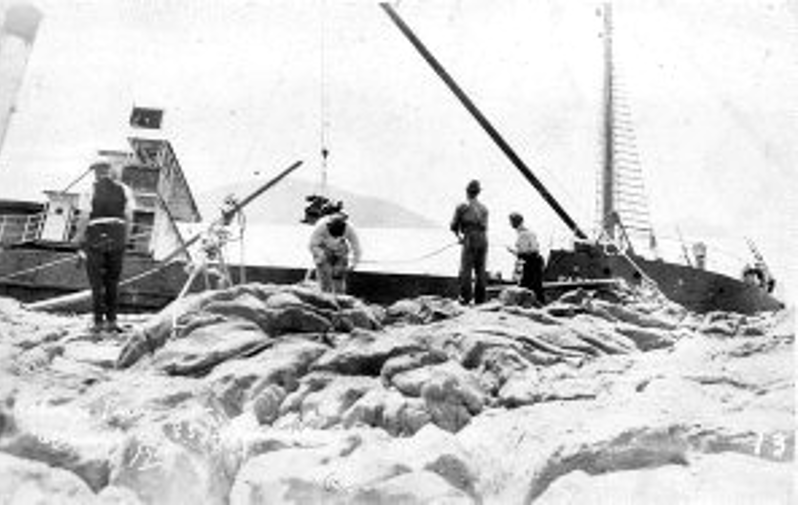
Pump being hoisted on board [State Library of NSW Collection]
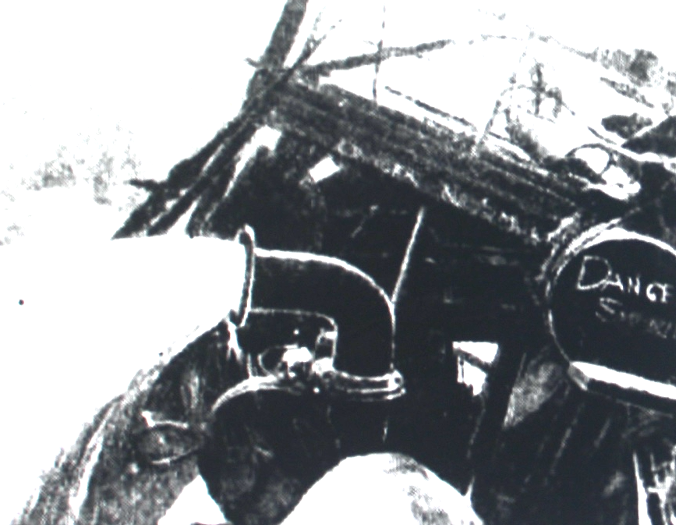
Water pump [Sydney Mail, 18 December 1929]
Workers Compensation Claim
During May 1930, the former fireman on board the Pappinbarra brought a Workers Compensation Claim against the ship’s owner, N. Cain Coastal Steamship Company Limited. The Dungog Chronicle of 16 May 1930, page 1, reported:
‘George Frederickson, a fireman, formerly of the steamer Pappinbarra, claimed compensation from the N. Cain Coastal Steamship Co. for injuries received on the vessel when she struck a rock off Port Stephens about 4 a.m., on September 11 last year.
The force of the impact, he said, threw him out of his bunk, and as he tried to get out of the forecastle a sea struck him, sweeping him from one end of the ship to the other. Finally, he took shelter in the cook’s potato box, remaining there until 6 o’clock in the morning. Then he went ashore on a line. He lay in the bush for a few hours, and then went to the Port Stephens lighthouse, where he remained for two days in his wet clothes. Afterwards he found that he had lost the use of his right leg.
For a time, he was under massage treatment without receiving benefit. Later he took a position on another vessel but found his leg still useless. Medical evidence was to the effect that applicant’s condition could not be connected as necessarily an effect of his exposure. The Commission found that applicant had not established his case and pronounced an award for the respondent company.’
Pappinbarra Relict
A Ship’s Log apparatus that measured the Pappinbarra’s speed is held by the Tomaree Museum Association and is displayed in relevant exhibitions. Pictures of the display of the Log relict at the Inner Light Museum during 2025 are shown below.
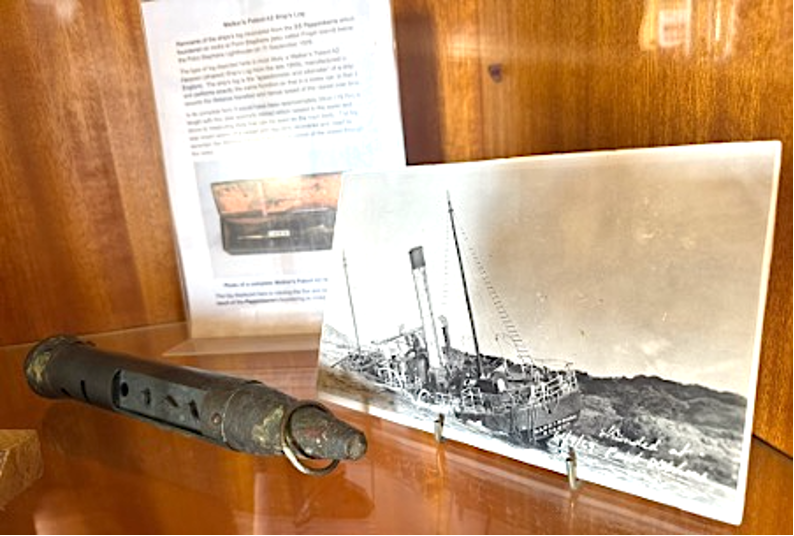
Walker’s Patent A2 Ship’s Log as used on the Pappinbarra [Tomaree Museum Association]
Concluding Comments
The Pappinburra was never refloated and eventually broke up.
Less than six months after its foundering, its owner, N. Cain Coastal Co-operative Company went into liquidation, apparently financially weakened by the loss of the steamship. The Newcastle Sun of 3 February 1930, page 5, reported:
‘After 24 years in the north coast trade, N. Cain’s Coastal Co-operative Company, Ltd., has gone into voluntary liquidation. The service to Port Macquarie, Hastings, and Wilson rivers will be maintained by the North Coast Steam Navigation Company, Ltd. On September 29 the Pappinbarra was wrecked off Port Stephens, and the service was continued by the two chartered vessels — the Urana and the Kinchela. The shareholders then decided to liquidate the company.’
Within three years of the foundering of the Pappinbarra, its master, Captain Merrett had died.
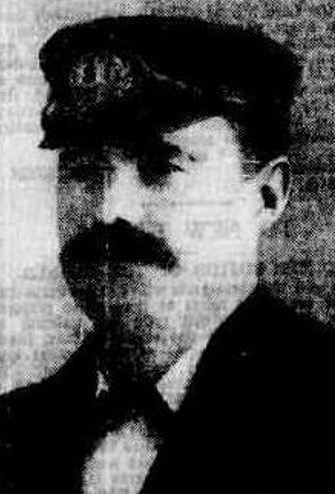
Captain Frederick William Merrett [Sydney Morning Herald, 15 August 1932]
The Sun of 13 August 1932, page 3, reported:
‘One of the best-known coastal shipmasters, Captain Frederick William Merrett, died at his residence at Waverley this morning.
He had been ailing for some time, and in the opinion of his friends there is no doubt that the loss of his steamer, the Pappinbarra, which was wrecked a few years ago, hastened his end, for he took the loss greatly to heart, although no blame was attached to him. Fifty-two years of age he had been at sea since he was nine years old and was among the pioneer captains of the North Coast, to which he made hundreds of voyages. The funeral will take place on Monday at the Waverley Cemetery.’
Information on other shipwrecks in the Port Stephens region is published on this website and can be found at the following links:
A History of 110 Shipwrecks at Port Stephens 1800 – 1950
Shipwrecks Inside Port Stephens 1869 – 1950
Morna Point – A Graveyard of Shipwrecks
Wreck of SS Florence Irving at Port Stephens – 1877
Wreck of SS Macleay near Port Stephens – October 1911
Foundering of SS Oakland off Cabbage Tree Island – 1903
Wreck of SS Uralla Near Birubi Beach Port Stephens – 1928
Wreck of HMAS Psyche in Port Stephens – 1924
Wreck of the Cora Lynn off Port Stephens – 1914
Researched and compiled by Kevin McGuinness
July 2023


