

Introduction
The steamship, SS Karuah was built in Scotland in 1908 being specially designed to suit the requirements of the passenger and cargo trade between Port Stephens and Sydney.
The long-time captain of the Karuah was Charles Phillipson, who sailed the steamship from Scotland and was its master until his retirement in 1916. He was a well known and respected seaman in Port Stephens.
This paper examines the history of the ‘Karuah’ during its service with the Newcastle and Hunter River Steamship Company, Limited (N.H.R.S.S.) Company.
Due to a decline in coastal trade between Sydney and Port Stephens the N.H.R.S.S. was forced to take the ship off the run and sell her to the Commonwealth Government for lighthouse work.
Karuah Built and Launched in Scotland – 1908
The Sydney Morning Herald of 8 June 1908, page 4, reported:
‘Among the passengers for London by the P. and O. Company’s R. M. S. Britannia, which was despatched from Sydney on Saturday, was Captain Phillipson, the master of the little coastal steamer Hawk, who is proceeding to Scotland for the purpose of assuming command of the new steamer Karuah, now in course of construction for the Newcastle and Hunter River Steamship Company, Limited.
The Karuah, which has been specially designed to suit the requirements of the passenger and cargo trade between Port Stephens and Sydney, is a steel twin-screw steamship of about 250 tons gross and will shortly be launched from the yards of Messrs Ramage and Ferguson at Leith. She is 130 feet in length, with a beam of 26 feet and a depth of eight feet six inches. She will have accommodation for between 30 and 40 passengers, and will be capable of maintaining an average speed of 10 knots. The vessel will be electrically lighted throughout, and deck cabins are to be fitted. Cool chambers are to be provided for the carriage of butter, and others for the carriage of fish.’
The Australian Star of 31 July 1908, page 5, further reported:
‘The new steamer Karuah, for the Newcastle and Hunter River S.S. Co., has been successfully launched at Leith, states a cable to Mr. K. J. Thomas, the company’s manager. She is for the Sydney-Port Stephens trade and is a vessel of a speed of 10 knots and 130ft. in length. She is to replace the Hawk.’
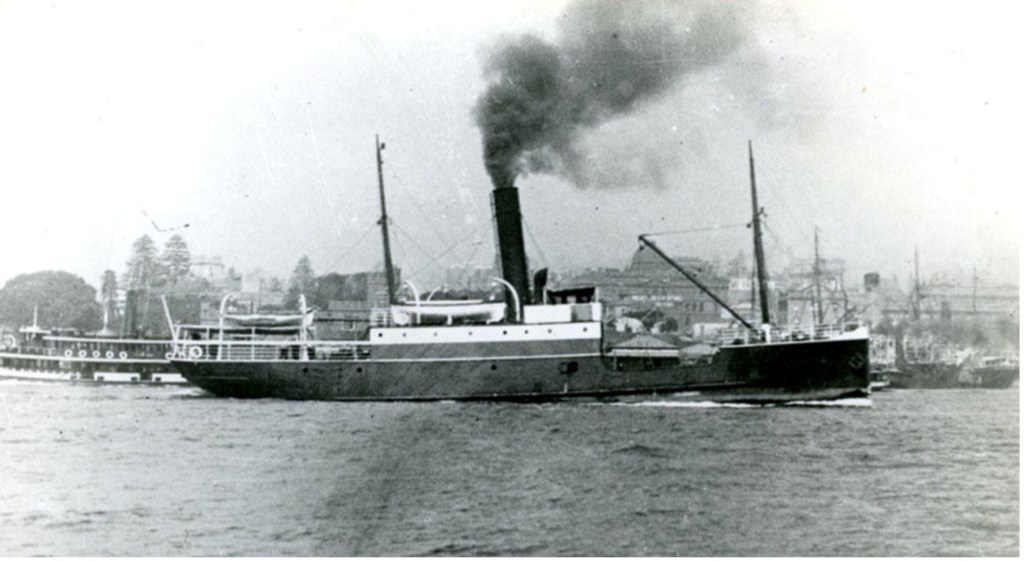
SS Karuah
Voyage to Australia – 1908
SS Karuah left Leith for Sydney on the 25 September 1908, under command of Captain Phillipson.
The Gloucester Advocate of 17 October 1908, page 10, reported:
‘We are advised, under date 12th October, that the Newcastle and Hunter River Steamship Co,, Ltd. have been informed by cable of the arrival of this Company’s new twin screw steamer “Karuah,” intended for the Sydney-Newcastle and Port Stephens trade, at Malta on Saturday, and that she would sail again on Monday for Sydney via Ports.’
The Sydney Morning Herald of 28 October 1908, page 10, further reported:
‘A cable message was yesterday received by the Newcastle and Hunter River S.S. Company, Limited, stating that the new steamer Karuah from Leith, Scotland, bound to Sydney, arrived at Aden on Monday and resumed her voyage the same day. The Karuah, will next call at Colombo, from which port she will proceed direct to Sydney.’
Karuah Arrives in Sydney – 1908
The Gloucester Advocate of 19 December 1908, page 8, reported:
‘The splendid new twin screw steamer ‘Karuah’ in charge of Captain Phillipson, arrived at Sydney from Scotland on Tuesday morning last, and having been docked and painted will leave Sydney on Tuesday afternoon next for Booral via Newcastle. From accounts appearing in the Sydney papers she would appear to be a most up to date steamer in every way suited for the. Port Stephens trade for which she has been specially built. She is 130 ft in length, 27 ft beam, with a speed of 10 knots.
On the trip out she proved a specially good sea boat. Excellent passenger accommodation for 28 persons has been provided in two berthed cabins on spar deck, the vessel has spacious promenade decks and a dining saloon, the full width of the ship. Cool chambers both for butter and fish have been provided. The public should make a point of visiting this vessel. An excursion will be run on New Years Day (1st Jan) when no doubt a large number of persons will avail themselves of the opportunity of a trip in the steamer.’
Karuah Stranded on Stockton Beach – 1909
Just over a year after the Karuah commenced trading operations between Sydney and Port Stephens, a serious incident occurred which led to the steamship becoming grounded on Stockton Beach.
The Evening News of 13 January 1909, page 5, reported:
‘About 3 o’clock this morning the Newcastle and Hunter River Company’s new steamer Karuah, which only arrived from England a few months ago, went ashore on Stockton Beach, some 15 miles distant from Newcastle, and about a mile north of the wreck of the Mareeba. The Karuah was, at the time of the mishap, bound to Port Stephens from Sydney, with cargo and passengers. The night was fairly clear, there being only a slight haze; while there was an entire absence of wind, and the sea was as smooth as glass. How the vessel came to run ashore is at present a mystery.
The Karuah took the beach near a reef of rocks, but not close enough to them for her position to be dangerous. The vessel went aground on a falling tide, about 60 yards from the shore. As soon as the Karuah’s distress signals were observed at 3 a.m. by the lookout on Signal Hill [at Newcastle], the customary two guns were fired, and the Ajax proceeded to the scene with the lifeboat and crew. On reaching the stranded vessel the Ajax and lifeboat crew offered assistance, but the master of the Karuah said the vessel was in no danger, and needed no help at that juncture. The Ajax offered to run lines to the vessel, and put the lifeboat alongside, as it was seen that there were passengers, including several ladies, aboard. The captain of the Karuah declined this assistance, and the passengers also declined to be taken off, saying that they considered themselves quite safe enough where they were.
After standing by for a while the pilot steamer and lifeboat returned to port, with a message from the captain of the Karuah, asking for a boat with salvage gear to be sent to him. When the distress guns were fired, the rocket brigade started to walk along the beach to the scene, and, having arrived there, are standing by the vessel. At about the same time as the Ajax and lifeboat left to proffer aid to the stranded boat, the tugs Commodore, Irresistible, and Leveret all went to the spot, and offered to help, but all aid was declined.
At 10 o’clock this morning the tug Storm King was sent away with steel cables and anchors and other salvage gear, the Karuah intending to make an effort to kedge herself off on the flood tide. Reports received from Signal Hill at 11.30 this morning, were to the effect that the Karuah is lying broadside on to the beach, and that the rising tide, and southerly ground swell are causing fairly large seas to break over her.
At noon the steamer was swept by a number of big rollers, and the opinion in shipping circles is that, should she not be got off on this tide, she will become a total wreck. The rollers will pound her into the sand, so firmly embedding her that when the ebb starts she will be left practically high and dry, and begin to break up. There is a strong impression in shipping circles that the attempt to tow the vessel off has been left rather late. Should the vessel not be got off this tide, the passengers and crew will be in no danger whatever, as they will practically be able to walk ashore. The tugs whose offers of assistance were declined by the Karuah have returned to port. The Storm King is expected to reach the stranded steamer this afternoon, and has everything ready for making an attempt to salve the vessel by high tide.’
The Newcastle Morning Herald and Miners’ Advocate of 14 January 1909, page 4, provided additional information concerning subsequent events:
‘The steamer Hunter, which arrived from Sydney, had on board Mr. J. Thomson, superintending engineer, and Mr. T. Clouston, foreman shipwright, who had come here to inspect the steamer Warraneen, which is on the slip. As soon as it was learned that it was the Karuah which was in distress, arrangements were made to send a steamer, in the hope of towing the stranded vessel off. For that purpose, the steamer Stormking was provided with complete salvage gear, and left at a quarter past ten for the scene of the intended operations. Messrs. Thomson and Clouston, accompanied by Captain Green, representing the South British Insurance Company, went in the Stormking. They also took with them Mr. Walker, chief officer of the Hunter, Mr. Cooper, chief steward, ten sailors from the Hunter, and a quantity of provisions. The Stormking arrived at the scene shortly after eleven o’clock being followed by the Carbine, which was also sent out by the company.
On arrival there it was found impossible to get near enough to put a line on board, owing to the rough sea. The Karuah was lying broadside on to the beach, with the seas at times breaking over her. As nothing could be done, both steamers returned to port. In the meantime, the passengers expressed a wish to get ashore. The rocket brigade, which had gone up in the morning, put a line over on to the ship, and got the passengers all ashore, without mishap.’
The Maitland Weekly Mercury of 16 January 1909, page 5, carried details of passenger experiences who had been on the ‘Karuah’, when stranded:
‘Fortunately there were only three passengers on the Karuah this trip, and they were brought ashore safely during the day. They were Miss Morrow, who was going on a visit to the Rev. Mr. Knox, Church of England Minister at Stroud ; Mr. Harland, of Gloucester, and Mr. Dalton, of Hannah Bay [Anna Bay]. The two former were brought to Newcastle in a drag, and were accommodated by the company at a Newcastle hotel. Mr. Dalton went on to Hannah Bay. Mr. Harland told a pressman that he was asleep when the vessel went ashre. He was awakened at, he thought, about three o’clock by the vessel bumping on the beach. He hastily got out on deck, and saw that the steamer was ashore. The morning, he said, was very misty, but the beach could be seen plainly. He heard that the captain was not on watch at the time of the mishap, the mate, Mr. Molloy, being, he believed, on the bridge.’
Karuah is Salvaged after Five Days – 1909
The Australian Star of 18 January 1909, page 1, reported:
‘The Newcastle and Hunter River Company’s new steamer Karuah has been floated off Stockton Beach. She entered Newcastle shortly before 8 o’clock this morning under her own steam. She is reported as having made no water, and is apparently uninjured. The feat of saving the steamer is looked upon as an extremely good one, as she lay on the beach in a very exposed position, and at one time was almost high and dry at low tide. After reporting herself to the local agents, the Karuah proceeded on to Sydney.
The recovery of the Karuah is regarded in shipping circles as a fortunate save, not only to the Newcastle and Hunter River Co. (her owners), but to the people of Port Stephens, who waited a long time for a modern steamer to be put into the trade. It is fully understood that it is extremely risky for a vessel to remain on Stockton Beach, one of the most dangerous on the New South Wales coast, half an hour longer than is necessary. Vessels are lucky that ever get off again. During the Karuah’s sojourn on the beach the weather was very mild, and but for such favourable conditions prevailing during the five days she was ashore she would in all probability have left her bones to bleach on the sands.’
Karuah arrives in Sydney for Repairs – 1909
Further details about the salvage of the ‘Karuah’ were reported in The Daily Telegraph of 19 January 1909, page 7:
‘The Karuah was floated with special salvage gear, obtained from Newcastle, and came on to Sydney under her own steam. The vessel had two lines out from the stem, secured to anchors, sunk about 250ft. to seaward, and when the tide was full a strain was put on the lines, with the result that the steamer was gradually drawn off the beach and out into deep water. Steam had been kept up on board, and after it was ascertained that the vessel was making no water it was decided to make for Sydney. The Karuah on her way south called in at Newcastle for a couple of hours, to load some salvage gear, and then left for Sydney.
Upon arrival she proceeded to the wharf, where she was the object of considerable interest. The floating of the Karuah is regarded as a splendid salvage feat, when it is considered that the vessel is valued at about £20,000. Captain C. Spinks, of the firm of J. Vine Hall and Spinks, superintended the salvage operations, and came on to Sydney in the Karuah. Upon landing he was congratulated on the success of his efforts.
Captain Spinks, interviewed on arrival, stated that he reached the stranded vessel on Wednesday night, and found her in a bad position on the Stockton Beach, about 11 miles from Nobbys, and one mile east of the wreck of the Mareeba. Salvage operations were started immediately, but it was found that the windlass and the after winch were useless, having become disabled soon after the steamer stranded. There was only one steam winch available, and this had to be carefully nursed throughout the operations. The tides were poor, but no time was lost in getting out the gear.
Mr. P. Callan’s punt had been chartered, and two anchors were run out, with 250 fathoms of wire hawser attached. The same day a strain was put on the anchors, and with the rising tide the vessel was shifted 20ft. sea-wards. The same night the wind veered to the south-east, blowing hard, and by midnight there was a big sea running, the waves breaking over the stern and the vessel bumping heavily aft. A watch was kept on the gear, and it stood the strain until 3 a.m. on Thursday when the wire hawser parted and the steamer was swept by the wind and sea high up on the beach. At low water she was high and dry, heading about north. The position of the vessel was now worse than ever, “but,” said Captain Spinks, “all hands set to work with a will to save the vessel. She had drifted inside two lines of breakers, which rendered the salvage work difficult and dangerous.” All efforts to secure the use of the rocket apparatus failed, and on Friday a punt was again hired to run out the anchors and lines. Mr. Norbert Callan was in charge of the punt, and displayed great pluck and skill in working among the breakers in his efforts to get a line to the stranded steamer. An attempt was made to float a line to the ship, but this failed, and a boat then put off from the punt, but it capsized and the occupants were thrown in the surf. They were, however, rescued, the line being eventually secured and passed to the stranded steamer.
By 3 p.m. that day the anchors were out and the hawsers attached, but it was found that the stern of the Karuah was embedded some 5ft. in the sand. With the rising tide she was however shifted 20ft. seawards. Next morning (Saturday) the steamer was moved another 20ft., the sea having mode-rated, and the wind shifted to the north-east. On Saturday afternoon the steamer moved 10 feet out. Operations were resumed on Sunday, and the Karuah shifted 20ft. with the morning tide, and 10ft. with the evening tide. By this time the bank of sand had reduced considerably, and at 2 a.m. yesterday the steamer was on the “move.” Full advantage was taken of the opportunity, and the steamer responded to the big strain on the lines with the result that at 6 o’clock yesterday she was afloat. The after part of the bilges stuck in the sand for a time, but eventually the steamer was hauled clear, and shipping her lines she proceeded to Newcastle and thence came on to Sydney.
Arrangements have been made to dock the Karuah to-day for examination. The steamer has a light general cargo on board, hut this was all saved. A quantity of sand found its way into the engines and injectors, and the machinery will have to be overhauled at the dock. Captain Spinks speaks highly of the manner in which the officers, engineers, and crew worked throughout the salvage operations. He also has a good word for Mr. Norbert Callan and his men for the splendid work done in connection with the floating operations. It is interesting to note that the Karuah is the first steamer salved from Stockton beach. The last vessel saved from this dangerous locality was the barque Adderley.’
Marine Court of Enquiry – 1909
A Marine Court of enquiry was held to examine all aspects pertaining to the stranding of the Karuah. The Court action attracted considerable newspaper interest. For example, the Newcastle Morning Herald and Miners’ Advocate of 2 February 1909, page 4, reported:
‘The stranding of the steamer Karuah on Stockton beach formed the subject of inquiry today by the Marine Court, consisting of Judge Fitzhardinge, and Captains Taylor and Mackenzie, assessors. Mr. F. J. Thomas, general manager of the Newcastle and Hunter River Steamship Company appeared for the owners; Mr. Curtis, of, the Crown Law Office, for the superintendent of navigation; Mr. Pickburn, for Captain Phillipson; and Mr. Russell, for Daniel Molloy, the mate of the Karuah. Mr. Curtis said that on the 13th January last the Newcastle and Hunter River Company’s steamer Karuah, became stranded, on Stockton beach, about ten miles north of Newcastle, at 3 a.m., while on a voyage, from Sydney to Port Step-hens, in fine weather, but with a haze off shore.
The master, Charles Phillipson, gave the following account of it:—They cleared Sydney Heads at 6.50 p.m., and steered the usual course past Broken Bay and Norah Head; the last named point being abeam about 3½ miles off at 11 pm. When the mate, Daniel Molloy, relieved him at 11.25 off Bird Island, the master gave him the course, N., 15 degrees E., with directions to keep that course until he reached Redhead [near Lake Macquarie], and then to steer N.E. until he picked up Port Stephens’ light. The master was below when the vessel grounded on the sand. He heard it, and ran to the deck, ordering full speed astern.
According to Captain Phillipson, when he upbraided the mate for putting the ship ashore, the latter admitted he was to blame. The mate on his part contended that he did not get the orders stated, that what he was told when he relieved the captain was to keep the course N. by E., by compass, and to work along the Stockton beach, in the smooth water. The mate denied that he got any orders but those. He said he kept to N. by E. to Redhead, and then hauled her out to N.N.E. as it got hazy, and that he passed Nobbys three or four miles off. He made out the light. He did not know they were so close in till the vessel struck. After putting the helm hard to north he ran below to the captain, hoping the vessel might glide off the beach, and the engines were put full speed astern, but the vessel remained fast. The mate says that when speaking to the captain, he did not accept all the blame; he merely reproached himself for not calling the captain when the weather became hazy.
There were passengers on board, but they were not in much danger, there being no sea. The steamer was ultimately got-off; but not without damage, and it had been found that the necessary repairs would cost £625, with £1625 salvage or £2250 in all. Charles Phillpson, giving evidence, said be held a foreign-going certificate, and was master of the steamer Karuah, which he had brought from the old country………
The Clarence and Richmond Examiner of 9 February 1909, page 5, reported on the decision of the Marine court:
‘The inquiry into the grounding of the steamer Karuah on Stockton Beach in January was concluded on Saturday. The Court found that the stranding of the vessel was caused by the wrongful act of the mate, Daniel Molloy, in altering the course given from N.E. to N.N.E., contrary to the order of the captain. The mate was therefore called upon to show cause why his certificate should not be cancelled or suspended.’
Karuah Damaged in Gale – 1911
The Sun of 13 January 1911, page 6, reported:’.
The easterly gale raged with renewed vigor at sea last night. From 8 o’clock until after midnight the fury of the storm was terrific, and the few vessels on the coast experienced a wild night.
The Port Stephens steamer Karuah, bound to Sydney, put into Newcastle yesterday, and although there was every indication of a furious blow she set out from Newcastle for Sydney again at 6 p.m. The negotiation of the Newcastle bar alone, steaming as the vessel was into the teeth of the blow and angry squalls, was described as thrilling, but once clear of the land the Karuah stood on her course for Sydney. At 11 p.m. it was blowing a whole gale from the eastward, with frequent squalls of hurricane strength, which raised a tremendous beam sea. The Karuah at this time had every opportunity of proving her seagoing qualities, and she did so.
Shortly after 11 o’clock she shipped a huge sea aft. It swept right over the vessel, making a clean breach over the after deck awning, and bending strong iron stanchions as if they were wire. The vessel’s port rail was twisted and bent, and wrenched away out of shape for a third of the length of the ship, while electric light fittings and anything that was not securely fastened aft suffered from the enormous weight of water that broke aboard. Fortunately the Karuah’s lifeboat was in the davits on the starboard side, and missed the sea, otherwise it must have gone over-board. The steamer frequently shipped a lot of water, and rolled almost rail under throughout the night, but the wind and sea were abeam, and did not delay progress. It was a welcome change for all aboard to reach the quiet waters of the harbor at 2 o’clock this morning. A gang of men were soon at work on the steamer repairing the damage sustained in the storm.’
Captain Phillipson Calls for Guiding Lights at the Entrance to Port Stephens- 1911
The Evening News of 12 April 1911, page 5, reported:
‘Captain Chas. Phillipson, master of the steamer Karuah, which trades regularly be-tween Sydney, Newcastle, and Port Stephens, during the course of a conversation with an “Evening News” reporter on the question of the Port Stephens entrance, advocated the establishment of leading lights. The captain knows the place well, and said, “The channel at the entrance to Port Stephens is about 1620ft wide, and the lowest depth of water is about 26ft. This increases in the channel to 30ft, 36ft, 48ft, and 60ft, decreasing again gradually to 26ft in about 4½ miles, that is, to Corlette Head, at the entrance to Salamander Bay. The anchorage in Salamander Bay has from 66ft to 39ft of water up to about 200 yards of the shore.
A big steamer went ashore the other day at Port Stephens, and I want to advocate that leading marks of some description should be erected to assist masters of big ships to enter. There are, of course, masters who do not need this assistance: but for the general good, I maintain that there should be marks to guide those big vessels in mid-channel and clear of the middle ground or entrance shoal. Marks in suitable places would make navigation in no way difficult by day or night. I think night time is the best time for a stranger to enter, because the Nelson Head light shows red in the deep water channel. I strongly recommend the erection of guiding lights for the benefit of strangers and those using the place as a port of refuge.’
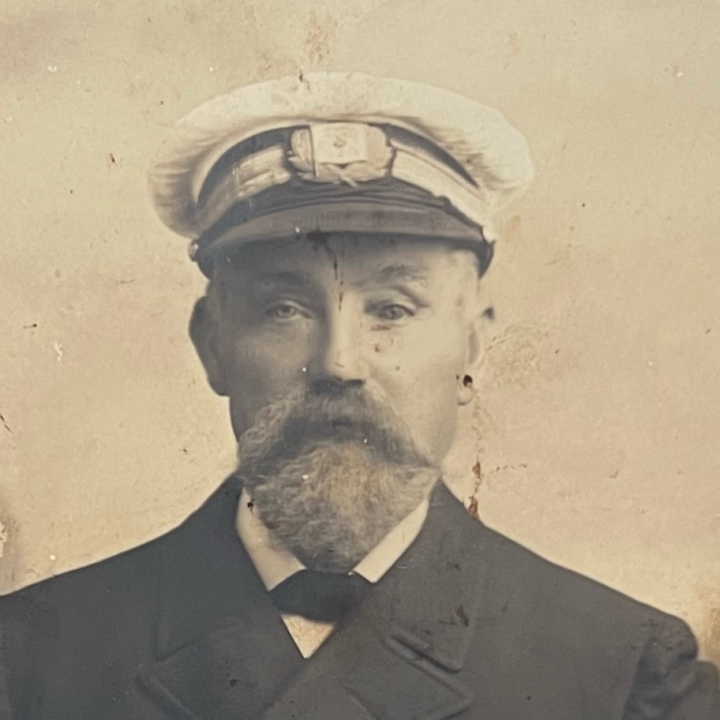
Captain Charles William Phillipson [Ancestry.com]
Karuah Collides with the Kiltobranks – 1911
In September 1911, a collision occurred off Fly Point between the steamhips Karuah and Kiltobranks which was under the command of Danil Molloy.
The Richmond River Herald and Northern Districts Advertiser of 22 September 1911, page 4, reported:
‘The Marine Court on Tuesday last inquired into the circumstances of the collision which occurred about 5 a.m. on Sunday, July 23, in Port Stephens, between the steamers Karuah and Kiltobranks. Mr. Curtis, of the Crown Law Department, appeared for the Superintendent of Navigation, Mr. Ralston, K.C., for the owners, skipper and officers of the Karuah, and Mr. A. Thompson for the owners of the Kiltobranks, the master (Daniel Molloy), and officers.
Mr. Curtis, outlining the case, said that shortly after 5 a.m. the steamers Ballengarra and Kiltobranks were lying off Fly Point in Port Stephens, sheltering. The wind, with heavy land squalls, was blowing from the south-west, and the night had been dark. The steamers were lying in the course of vessels rounding Fly Point to make for the wharf in Nelson’s Bay, the Ballengarra being the nearer the point, and a little to the westward. The Kiltobranks, which is a wooden steamer, had out 45 fathoms of cable. The Karuah was running on her usual trip to Port Stephens, and on rounding Fly Point to make for the wharf in Nelson’s Bay, the lights of the Ballengarra were plainly made out.
Having cleared the Ballengarra, the Karuah’s people failed to perceive the Kiltobranks in time, owing to the fact, as all on the Karuah said, that the Kiltobranks carried no lights. When the Kiltobranks was seen Captain Phillipson, of the Karuah, called to the man at the wheel “hard aport,” and with the aid of the twin screws, the Karuah was swung rapidly to starboard. The Karuah struck the Kiltobranks on the port quarter, and damaged timbers, stanchions, and top-side planking to the extent of £100. The people on the Kiltobranks denied that they were showing no lights, asserting that not only were their lights in good order before the collision, but they saw the Karuah coming, and sounded the whistle. Captain Molloy, of the Kiltobranks, declared that he gave special orders about the lights, and that he had a stern light burning as well as the light required by the regulations.
His Honor came to the conclusion that there was no riding light visible on the Kiltobranks, and this caused the mishap. The light had been burning, and had probably been blown out shortly before the collision. The mate, whose watch it was, should have noticed this, but, considering that probably the period during which the lamp was out was very short, the Court did not think it necessary to proceed further.’
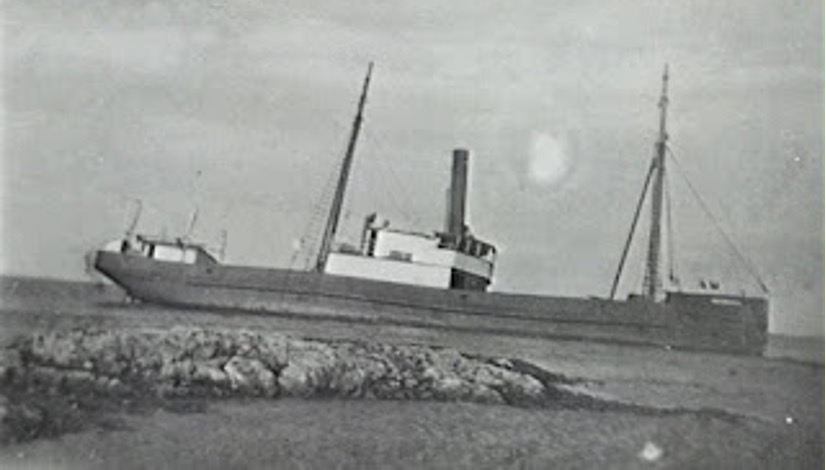
Kiltobranks Stranded at Shellharbour – 1914
Karuah Carries Raft Wreckage to Sydney – 1911
The Gloucester Advocate of 21 October 1911, page 7, reported:
‘The lighthouse keeper at Point Stephens observed a floating raft at sea on Saturday, and signalled the North Coast Company’s steamer passing, bound from Newcastle to the North Coast.
The Duranbah secured the raft, and towing it into Port Stephens, where, on examination it was found to be barnacled-covered, having been in the water for some considerable time. It was thought to have come from the missing steamer Rosedale, although the growth of barnacles on it would suggest that it had been more than a month in the water. Charles Peterson, one of the survivors from the Macleay, on seeing the raft, said he was certain it came from the missing Rosedale. It had evidently not been used as paint on rowlocks was intact. A lifebuoy from the Rosedale was washed upon the beach near Port Stephens on Saturday. Arrangements have been made to send the raft to Sydney by the steamer Karuah for positive identification.’
Karuah Damaged after Bumping into Port Stephens Wharf – 1912
The Sun of 29 March 1912, page 8, reported:
‘The Newcastle and Hunter River Steam-ship Co.’s Karuah, which arrived at Sydney today from Port Stephens, did not look herself. Her stern was badly twisted above the water-line as the result of an accident at the northern port between where and Sydney she is a regular trader. The Navigation Departmerit’s report states that the vessel bumped the wharf at Port Stephens, the accident being attributed by Captain Phillipson to an unusual current. The steamer will have to dock at Sydney for repairs.’
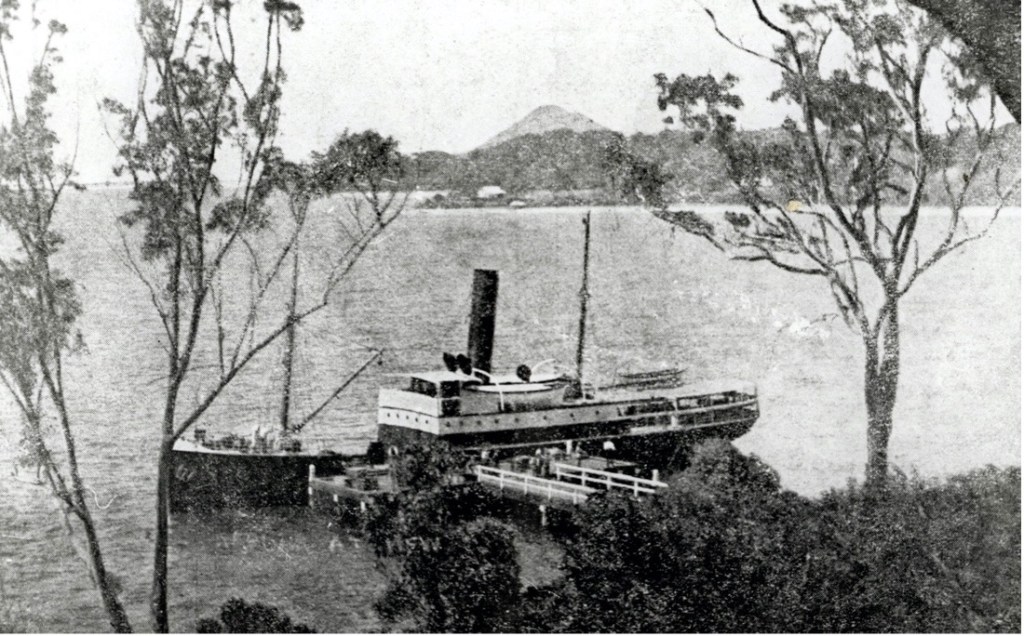
SS Karuah at Nelson Bay Jetty
Seaman Falls From Karuah – 1913
The Sunday Times of 21 December 1913, page 9, reported:
‘While the steamer Karuah was passing Broken Bay last night, a fireman named James Barry fell overboard. A rescue was effected by the ship’s boat.’
Description of a Trip on the Karuah Around Port Stephens District – 1914
Mr James R Fulton, who was the secretary of the Underbank branch of the Farmers and Settlers’ Association in 1914, which was headquartered in the Dungog district wrote several articles on the Port Stephens district, and in two of those articles he described a voyage on the Karuah. The following two excerpts were published in the Land journals of 12 June 1914, page 6 and 19 June 1914, page 3:
‘About 11 a.m., on the arrival of the s.s. Karuah [at the Karuah township] from Sydney, we embarked and took our passage up the river to Allworth, some 12 miles upstream.
The s.s. Karuah (Capt. Phillipson) is a comfortable passenger steamer, both trim and well appointed, drawing between eight and nine feet of water. The river, notwithstanding its great width at high water above Karuah, has only its proper channel, and requires careful navigation. The river trip, though delightful, cannot boast of much scene beauty, much of the land being low, and apparently poor and heavily timbered. Logs for milling purposes were much in evidence, and a few farms, some showing considerable labour had been expended in clearing. We drew to the wharf at Allworth, where the steamer made fast for the rest of the day and night, and discharged her cargo into a large shed on the wharf, and took, aboard a considerable amount of sawn timber. …..
At 7 o’clock the next morning we were again under weigh, and made the return call at Karuah, where the first of the fishing boats came alongside. From this on, boat loads of fish arrived, to be emptied by baskets into boxes in the steamer’s cool chambers. Leaving Karuah and taking a shorter but seldom used and difficult channel, with a fast falling tide, we touched the shoal, and the hawser carrying away, had to exercise our patience for the returning tide. …..
Afloat once more we steamed past Middle Island into the outer or main port, and from there to Nelson’s Bay, when daylight failed. We left the “Karuah” there, still absorbing fish, and steamed away in the Myall River steamer across the harbour, up the Myall River to Tea Gardens, arriving about 8 p.m.’
Captain Phillipson in Hospital – 1914
The Dungog Chronicle of 27 November 1914, page 10, reported:
‘Captain Charles Phillipson, of s.s. Karuah is once more back on the bridge of that well known coaster, after an absence of over a month, which has been spent in a private hospital in the ‘coalopolis’. The captain, whilst not looking his old self, is nevertheless very well, and hopes soon to be as strong as ever.’
Captain Phillipson Retires – 1916
When the pending retirement of Captain Phillipson was announced, several presentation functions were organised for the well-known master of the Karuah .
The Raymond Terrace Examiner and Lower Hunter and Port Stephens Advertiser of 21 April 1916, page 3, reported:
‘Francis Hall was the scene of a large gathering on 12th inst., when presentations were made to Captain Phillipson. The chairman (Mr. W. I. Hartcher) in opening the proceedings read an apology for the absence of Mr. and Mrs. W. Longworth, and said that the retirement of Captain Phillipson from active seafaring had caused a general wave of regret throughout the district. His many friends felt they could not allow the occasion to pass without marking in some small manner their appreciation of the long and efficient service rendered by him to Karuah and district as well as the Port generally.
The committee in charge of the arrangements had been very successful, despite the many calls that the present stressful times made upon every one’s generosity. As a result they would that night present the Captain with a cheque for £14 as an earnest of the good-will of Karuah and its immediate district. The committee had also been working in cooperation with the company of the s.s. Karuah, and on behalf of officers and crew a handsome illuminated address would be handed to the Captain. Mr. E. Paton, Fisheries Inspector, in the course of an interesting and effective speech, said that in a lengthy period of close personal contact with the Captain he had found him a fine, honourable, up-right gentleman. Speaking of the influence which the sea exercised over the British race, he said it was the “call of the sea” that had built up the great Empire of which we are so proud. He referred also to the Captain’s efficiency as a practical seaman, instancing the Karuah as the only vessel that salved off Stockton beach. The captain had stuck to his ship when others would have left her. He had also, realising the importance of his cargo to the shippers, gone out of Port at times when other vessels would have been lying in Nelson’s Bay in shelter. The speaker concluded with wishes of long years and blessings to the veteran captain in his retirement.
Mr. F. M. Bell, chief officer of the Karuah, said, though not long on the steamer, he had found Captain Phillipson a good captain. He wished him every success. The Rev. R. G. Knox, B.A., said the great gathering that night was a splendid testimony to the regard felt for the retiring captain. We should take off our hats to our sailors. They had made the British race what it is. Seamen like their friend had carried the flag to victory in the past and would do the same in the future. He paid a tribute to the assistance rendered by the captain in church work, and heartily endorsed the previous remarks as to his character. In him they had a man who would stand by his friends in all circumstances.
Mr. A. L. Farley, in appropriate terms, presented Captain Phillipson with the cheque on behalf of Karuah district. Mr. J. Carson, chief engineer, in handing over the illuminated address on behalf of the ship’s officers and staff, said the Captain had spent over 50 years at sea, the greater part of the time in sailing vessels. It spoke volumes for the stuff of which their guest was made to see him after half a century of hard and strenuous sea life still hale and hearty, and to all appearance fit for years of service yet. When Port Stephens developed into the great port it assuredly would, he was sure Captain Phillipson’s name would find an honourable place in its history as one of its pioneers. Having read the address, he concluded with the hope “that you and your good lady may be spared for many years yet to be a comfort to such other, and that your latter years may be your best years.”
Captain Phillipson, who was very much moved, said it was gratifying to see so many friends present, but he felt he could not speak as he would wish. During his eleven years in the Port trade he had tried to do his duty to shippers and company alike, but he had only done what any ship master should and would do. He admitted that his successor would have a hard row to hoe, but with firmness and courtesy, and taking a stand of his own, he was sure he would succeed. Much had been said about his going to sea in all weathers, but a captain always had a good crew upon which he could depend. On behalf of himself and his wife he thanked all for their kindness and appreciation.
The chairman then tendered a few words of welcome to the Karuah’s new master, Captain Pearce. These were supplemented by Mr. Paton, and responded to by the audience with hearty applause. During the proceedings songs and recitations were contributed by Miss L. Smith, Captain Phillipson, and Messrs. T. Ibbotson, T. Murray, Curson, and Hartcher, and Master Munford. Refreshments were served by the ladies, and dancing indulged in until midnight.
The address presented to the Captain was a beautiful piece of illumination, about two feet by three feet, with an inset photo of the recipient in R.N.R. uniform, and hand painted views of local scenes, and was signed by the whole of the ship’s company. It ran as follows:— “Dear Sir, — On the occasion of your relinquishing command of the S.S. Karuah, and retiring from active sea life, we the undersigned desire to express to you our continued esteem and regard. During the time we have been associated with you on this vessel we have always recognised in you all the qualities which go to make a popular and successful commander. You have been at all times kind and courteous, yet, withal, a strict disciplinarian. It is with the greater regret that we part from you, and it is out earnest wish that you may be spared for many years to enjoy your well earned retirement.” ‘
The Dungog Chronicle of 11 April 1916, page 3, reported on his farewell from Stroud:
‘This genial and popular officer, who until a few weeks ago commanded the good ship “Karuah,” paid an enforced visit to Stroud ‘ last week, to give his evidence in court about a paltry scuffle that took place on the wharf at Allworth.
Many friends were thus able to say good-bye to a man who had rendered them many kindnesses. The Captain was entertained one evening by Mr Knox at the Rectory, and another evening by Mr Graves. Mr W. H. Grant also entertained him at afternoon tea. In fact his two days visit was filled up by the kindnesses of his friends, who were delighted with the chance to return some small percentage of the good things the Captain had done for them. The Captain looks hale and hearty and not so many years old but that number young; just the right time to retire and enjoy home life and rest before old age and weakness have made enjoyment of these treasures impossible. With his other friends the “Chronicle,” I am sure, will wish Captain Phillipson much enjoyment in the less arduous life that is now before him.’
Sale of the Karuah to the Commonwealth Government for lighthouse work – 1916
The Daily Commercial News and Shipping List of 27 May 1916, page 4, reported:
‘It was yesterday reported that the steamer Karuah, of the Newcastle and Hunter River S.S. Company, had been sold to the Federal Government for £17,000. For some weeks past the Federal lighthouse authorities have been on the lookout for a suitable vessel for lighthouse work along the northern coast of Australia, and the Karuah was the vessel selected.’
The Daily Commercial News and Shipping List of 14 June 1916, page 4, further reported:
‘The general overhauling and structural alterations necessary to the s.s. Karuah to equip her for the lighthouse work on the New South Wales coast, has been completed, and it is expected that she will leave Cockatoo Dock in a day or so now, and shortly after be placed in commission.’
Karuah Replaced by SS Allyn River – 1916
The Sydney Morning Herald of 31 May 1916, page 13, reported:
‘The new steamer Allyn River, which has been in commission on the Hunter River, will take up the running of the Newcastle and Hunter River Company’s steamer Karuah in the Sydney, Newcastle, and Port Stephens trade, leaving Sydney with cargo only at noon on Friday. The Karuah will be taken over by the Federal Government on that day for use in connection with lighthouse work. The Allyn River will leave Sydney and Newcastle every Tuesday and Friday for Port Stephens.’
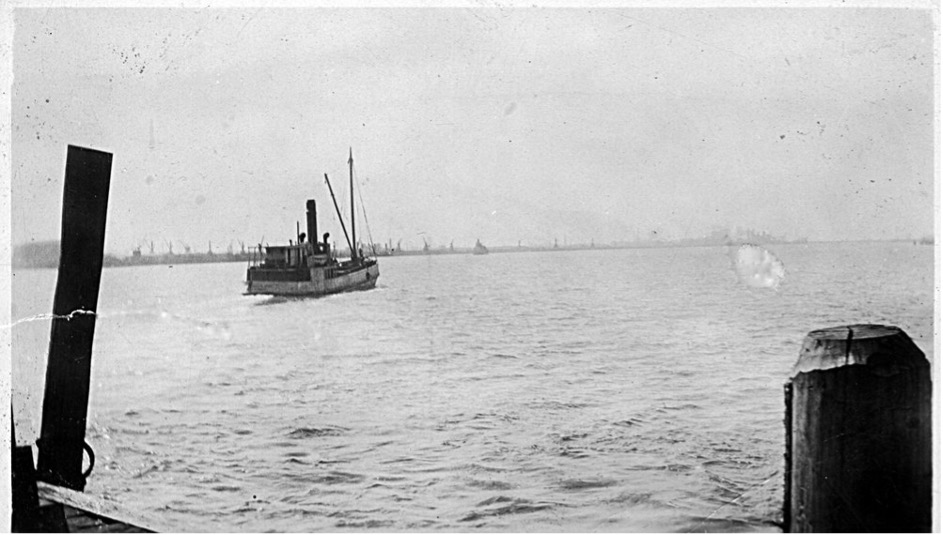
SS Allyn River Steamer [City of Sydney Archives]
Karuah Sold to New Owners in Singapore – 1927
The Daily Commercial News and Shipping List of 1 June 1927, page 4, reported:
‘The old Commonwealth lighthouse steamer Karuah, which was recently sold by Mr. A. Peters, of Peters’ Slip, Kangaroo Point, is to leave Brisbane for Singapore. Her new owners are the Hua Kiow and Co., of Muar, in the Straits Settlements, and she will be used for trading between Singapore and the surrounding islands and ports. A captain and crew for the vessel arrived about a fortnight ago by the Marella. Captain Low will be in command, and his crew will consist of five white officers, ten Malays, and four Chinese.’
Concluding Comments
After his retirement, Captain Charles Phillipson, and his wife Margaret, moved from the Karuah district and moved to Sydney. He died on 30 April 1918, aged 72 years, and was buried at Rookwood Cemetery. Margaret Phillipson died on 11 December 1925 and was buried with her husband at Rookwood Cemetery.
Researched and Compiled by Kevin McGuinness
October 2022


 Port Stephens - a history exploration