
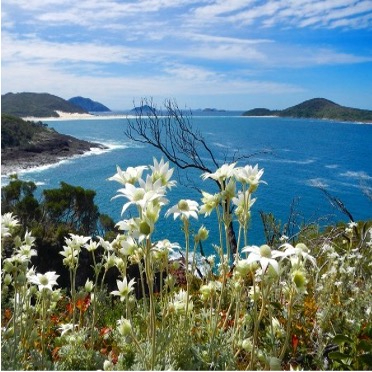
During the Great Depression years of the 1930’s, many people throughout New South Wales were engaged in the collection and bagging of shell grit to earn a meagre living.
This activity was undertaken at many locations along the coast, including Port Stephens. In addition to the collection of shell grit , some Port Stephens oyster farmers also sent their shells to Newcastle to be ground into oyster grit for the poultry industry.
Shell grit and oyster grit are common additives to poultry feed to strengthen the quality of eggshells.
The Labor Daily of 29 December 1937, page 10, reported:
‘The primary function of grit is to supply shell-making material, ….. When a hen is in full lay, a very large quantity of shell has to be made, and the necessity for an unlimited supply of this material [lime] is obvious. Either seashell or oyster shell, crushed to a suitable size, will answer the purpose, but a combination of one-third by measure of the oyster shell to two-thirds of the seashell appears to give the best results; given these, all purposes are served.’
Oyster grit was often seen as a superior supplement for the poultry industry vis a vis shell grit. The following advertisement from 1931 valued oyster grit as five shillings 6 pence shillings per bag compared with two shillings per bag for shell grit.

The Daily Telegraph [1 August 1931]
The collection of grit in the Port Stephens area was not a significant economic activity, but during the 1930’s it did provide a small supplementary income to those in other industries such as fishing, boat building and timber getting.
Fingal Island (Point Stephens) was the focal point for the collection of shell grit. The shipping of bags of the grit to the mainland posed its own challenges.
Arthur Murdoch was synonymous with the industry on Fingal Island. He arrived on the island 1930 with his brother William Hugh Murdoch in 1930.
This paper summarises some newspaper articles which add to the story of the shell grit business in Port Stephens.
First Report of Sand Grit Shipped to Newcastle – 1930
The Dungog Chronicle of 12 December 1930, page 4, reported:
‘Research work throughout the waterways of Port Stephens discloses that there is a large quantity of this lime product. Captain Murdoch of Nelson’s Bay shipped 100 tons last week to Newcastle where it is distributed to poultry farmers. It is understood that this gentleman proposes putting in a grader [sieve device] at Point Stephens [on Fingal Island] where he is operating, thus classify the various classes of shell. The Cockle Creek Cement Works also the B.H.P. Newcastle have been concentrating upon securing large quantities and it is understood that these companies have made application for areas within Port Stephens. Shell contains 100 per cent. lime, and is regarded as ideal for the blast furnaces and in the manufacture of cement. The shells will be reclaimed by means of a suitable dredge.
Tenders for the Right to Remove Shell Grit from Point Stephens – 1931
The Raymond Terrace Examiner and Lower Hunter and Port Stephens Advertiser of 27 August 1931, page 3, reported:
‘The Public Works Dept. is inviting tenders in this issue for the right to remove shell grit from Point Stephens. Particulars can be seen at Nelsons Bay post office.’
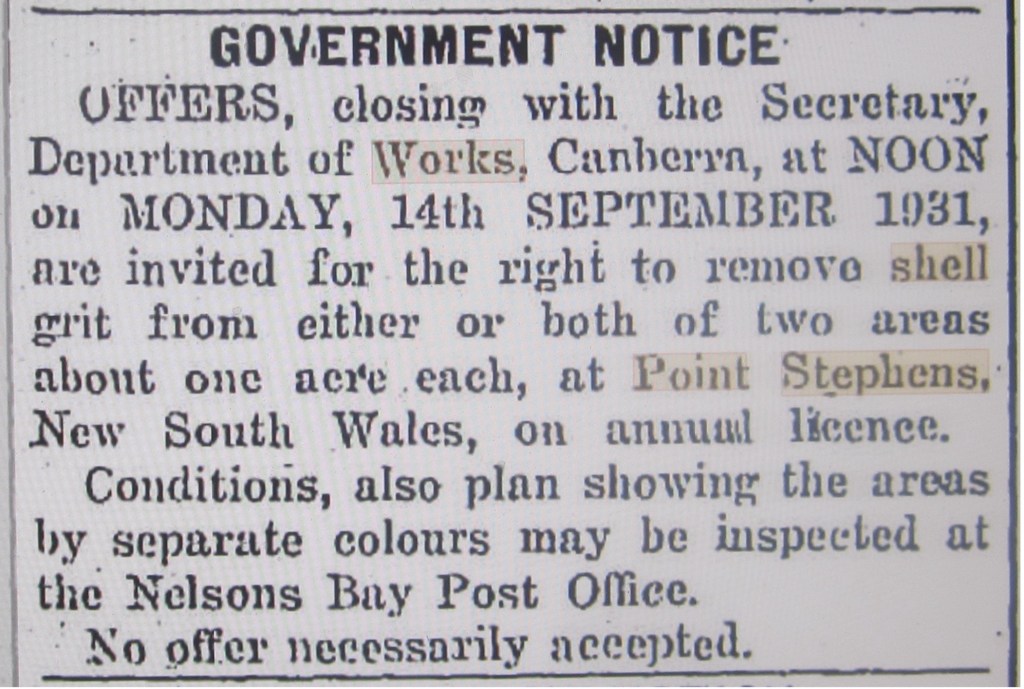
Tender Advertisement [Raymond Terrace Examiner and Port Stephens Advertiser, 27 August 1931]
Arthur Murdoch was successful in obtaining both areas on Fingal Island. One was on a site called ‘Shelley’ on the northern end of the island, close to where the ‘Pappinbarra’ had been recently wrecked in September 1929 and the second area was located on the south end of the island across from Fingal beach.
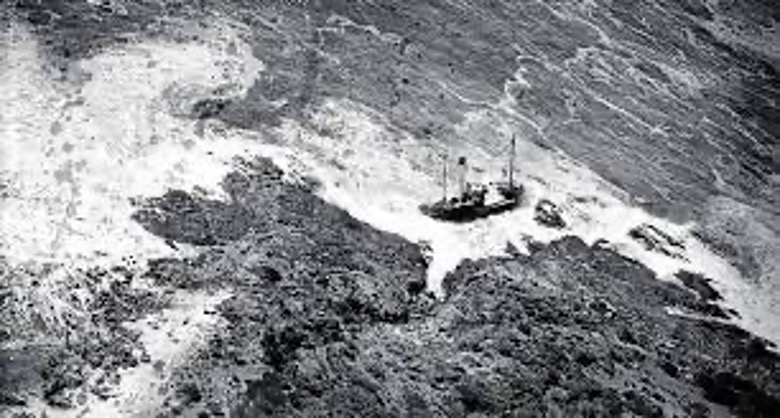
The wreck site of the Pappinbarra in 1929, close to ‘Shelley’ on Fingal Island where Arthur Murdoch commenced sand grit operations
Shell Grit Activities at Port Stephens Expand – 1932
The Dungog Chronicle of 26 February 1932, page 4, reported:
‘The demand for shell grit has increased so much that another company has begun operations at Point Stephens. This grit is shipped to Newcastle per G. A. Engel and Sons steamer, ‘Coweambah,’ and during the last few weeks she has carried upwards of 2,000 bags.
During loading operations last week an accident happened while transshipping a boat load of grit from the beach to the steamer. The boat, in charge of Mr. Bob. Hood, and assisted by Messrs. Leonard and Tunney capsized and only by skilful seamanship was the boat saved from, being smashed up. At the time there was a heavy north-east sea running. This work is carried out under great difficulties and at great risk and the company in question is entitled to all they get out of it. Some months ago, it will be remembered that Messrs. Flood and Murdoch had a narrow escape from drowning, through their boat capsizing whilst carrying out similar work at the same place. After clinging to the bottom of their up-turned boat for an hour they were rescued by a party of fishermen.’

Fingal Island (top right) connected to the Port Stephens mainland by a spit of sand [Author photo]
Ketch Goes Ashore at Point Stephens While Loading Shell Grit- 1932
The Sydney Morning Herald of 29 February 1932, page 9, reported:
‘Dragging her anchor before a still north-easterly on Friday evening, the ketch ‘Edriss’, owned by the Lyons Trading Co., of Sydney, ran ashore on Narrow Gut, near Point Stephens. An attempt to refloat the vessel, made early this morning, was unsuccessful. There will be another attempt early tomorrow morning.
The vessel is in a sheltered position, and, as long as there are no further north-easterly winds, there should be little difficulty in refloating her on a sufficiently big tide. The ‘Edriss’ has been running shell grit from the neighbourhood of Point Stephens for some time.’
The Dungog Chronicle of 24 March 1932, page 4, further reported:
‘An attempt will be made on the full moon tides to refloat the ketch ‘Edris,’ which went ashore whilst loading a cargo of shell grit at Narrowgut beach (Point Stephens). A quantity of salvage gear has been landed at the wreck by the ‘Coweambah,’ and the work will be in charge of Mr. Lyons, of the Lyons Trading Company, who are the owners of the vessel.’
No further newspaper reports about the fate of the Edris were published.

Ketch ‘Edris’ ashore at Narrowgut, Port Stephens [Daily Telegraph 3 March 1932]
Oyster Grit Processed in Newcastle – 1939
Port Stephens oyster shells were sent to Newcastle for processing into oyster grit, for the poultry industry. The Newcastle Morning Herald and Miners’ Advocate of 27 February 1939, page 6, reported:
‘A grating, rumbling sound came from a workshop in King-street, Newcastle, the other day. Inside a machine was running at a fast rate. It was built well above ground level and there were bins below it. From a trap-door is one of the bins a young man was raking grit into a bag. To stacks about the shop dozens of bags of grit were standing ready for market. Some of it was coarse, some more was like shingle from the seashore, and some was as fine as sand.
A heap of oyster shells lay behind the machine. They had been brought from Port Stephens district. Having in mind a story which appeared in the ‘Newcastle Morning Herald’ some time ago about oyster culture, a visitor asked questions. The oyster shells, he was informed, were being ground into grit for poultry farmers. The shells it was said, contained a higher percentage of lime than ordinary shell grit. That was why oyster shell grit was so valuable on poultry farms where a big egg-laying average was sought. There was grit as large as sixpence in the shop and grit as fine as the dust on Georgetown-road. Some of it will be sent to farmers in inland places, and some will be sent to feed the fowls of men who grow the oysters.’
Compensation Claim by a Port Stephens Shell Grit Worker – 1940
The Newcastle Morning Herald and Miners’ Advocate of 20 March 1940, page 14, reported:
‘A claim for alleged incapacity was made by Elwyn Sidney Hoole, of Lindsay-street, Hamilton, against William Hugh Murdoch, produce merchant, of King-street, Newcastle. The claim was made for an accident on November 16, 1938, when Hoole injured his leg. …..
Hoole said he was engaged by Murdoch to gather shell grit, bag it, sew the bags, and cart it from Shelley Beach [on Fingal Island], near Nelson’s Bay, to a jetty. Hoole said Murdoch drove him to Nelson Bay, and showed him how to get the shell grit. Murdoch then left him. At the end of the first week Murdoch took him back to Newcastle. He paid him £4/5/ for the week. He stayed on the island [Point Stephens] for another six weeks. “After I had been there for about six weeks, I injured my left knee,” said Hoole. “I was carrying a bag of shell grit from the beach to the bank when I. slipped and fell. The left knee seemed to go numb and I felt a sharp click. After a short rest, I continued my work.
On November 16, I was carrying another bag when my foot twisted and I fell down. Hoole said that his leg was so sore that he came back to Newcastle. He saw Murdoch and visited a doctor. The doctor advised an operation, and he was in hospital from December 18 to January 5, 1939. The doctor certified him as being fit for work on February 14, 1939. Replying to Mr. Cragg [Murdoch’s legal representative], Hoole said he had never told anybody before the injury that he had been having trouble with his knee.
On November 5, 1938, Murdoch asked him to carry on at 10/ a ton instead of a weekly wage. Murdoch said that Hoole was engaged by him until November 5, 1938, at a wage of £4/5/. He went out to see Hoole at Nelson Bay on November 5, but he was not there. He left a note that Hoole could carry on at 10/ per ton. Hoole continued to work on that basis. Answering Mr. Gee, Murdoch said he did not give Hoole notice at any time. Judge Perdrian made an award for Hoole for £2/16/8 for 13 weeks, with £19/5/6 medical expenses and £8/2/ hospital expenses.’
Concluding Comments
The collection of shell grit ceased at Fingal Island around 1940 when the Port Stephens area was taken over by the military.
After the conclusion of the Second World War, limited shell grit collection was resumed for a few years.
Researched and compiled by Kevin McGuinness
January 2024

 Port Stephens - a history exploration