
Introduction
This paper examines the circumstances of 110 shipwrecks that occurred around the coastal area of Port Stephens between 1800 – 1950.
The area covered is from Broughton Island in the north, out to sea for about 100 kilometres, and south past Morna Point along the Stockton Beach as far as the area of Anna Bay.
This part of the NSW coast is often referred to as the ‘shipwreck coast’. In the 150-year period covered, at least 110 persons died as a direct result of a shipwreck in the vicinity of Port Stephens. Animals on board ships also died.
Marine vessels wrecked inside Port Stephens are covered in a separate paper, Shipwrecks Inside Port Stephens 1869 – 1950 which is published on this website and can be found at this link.
An examination of the causes of the shipwrecks shows that stormy seas and negligence in navigation were the two main contributors.
A possible factor for the wreck of coastal trading ships was the practice of sailing close to the coastline to minimise the travel time between ports. Captains could choose to travel further out to sea away from the shoreline and submerged rocks, but this increased sailing time. They were often under pressure to complete trips in the shortest time and would choose to sail near the coastline, hopefully avoiding it and any submerged rocks. In rough seas, or at night, ships could unknowingly travel too close to submerged rocks with disastrous consequences.
The reports of the wrecks reveal many acts of heroism by crew members in saving lives and of attending to injuries suffered by survivors. Some survivors of ships that foundered south of Port Stephens at Morna Point and along Stockton Beach near Anna Bay, had to make the long and difficult walk along the beach back to Stockton to seek assistance.
Early steamships did not possess great horsepower when compared to modern motor vehicles which have an average of 180 horsepower. The steam boilers mostly produced between 25 and 50 horsepower which was inadequate to enable captains to sail away from danger in stormy seas.
Port Stephens was a harbour of refuge. During stormy seas, captains often sought shelter in the harbour. As there were no navigation lights or the services of a harbour pilot in the early years, this was problem for those captains not familiar with the area.
Sailing ships, in particular, had difficulties in entering or leaving Port Stephens in stormy weather and often ended up wrecked on the north head or nearby. Twenty-four ships are recorded as being wrecked in that vicinity. Captain Thomas Kehoe, had the misfortune to wreck three ships at the north head.
Residents of Port Stephens and along the immediate coastline, together with the Point Stephens Lighthouse officers, performed many acts of kindness and gave practical assistance to shipwreck victims. Many of these ended up in Nelson Bay or Anna Bay following their misadventure.
The wrecks along the Port Stephens coast and inside the harbour resulted in much ship wreckage being deposited on the ocean floor or along beaches. Some portions of hulls and larger parts such as boilers remain on the sea floor and have become popular dive sites.
Similarly, wreckage is sometimes uncovered along the beaches after severe storms have removed sand. Unfortunately, many of the ships that were wrecked carried coal which was subsequently deposited on the sea floor particularly at the north head of Port Stephens.
Newspapers reports in the National Library of Australia’s Trove collection are the primary sources used in preparing this paper. Some reports are written in a style that requires careful reading and may use nautical terms to describe actions undertaken prior to a foundering.
Where possible the newspaper reports have been presented in full, across various newspapers, to give the complete story of each foundering. Many reports contain descriptive summaries of the hardships experienced by crews and passengers who were subject to a ship foundering.
Part One of the paper is an alphabetical listing of 110 ships that were wrecked in the Port Stephens area, 1800-1950, with a brief description of each vessel and where it was wrecked.
Part Two provides further details for each wreck, as listed in Part One, in chronological order.
PART ONE: Alphabetical Listing of Wrecked Ships in the Port Stephens Area 1800 – 1950
The ship number as cited, refers to the detailed listing of the ship in Part Two.
ALICE – Cutter, Stranded off Port Stephens, 29 OCT 1835. Ship no. 7
ALICE – Hulk, Wrecked near Morna Point, while under tow, 17 NOV 1927. Ship no. 105
AMPHITRITE – Wooden barque, Wrecked off South Head, Port Stephens, 17 MAR 1891. Ship no. 72
ANN – Barque. Foundered at Port Stephens Heads, 22 JUL 1876. Ship no. 48
ANN – Ketch. Wrecked south of Morna Point, off Port Stephens, 13 MAR 1886. Ship no. 64
BARDS LEGACY – Schooner, Wrecked near North Head, Port Stephens, AUG 1858. Ship no. 19
BEN NEVIS – Wooden brig, Wrecked at North Head, Port Stephens, 3 Jul 1875 Ship no 44
BOUND TO WIN – Wooden ketch, wrecked at Port Stephens Heads, 20 October 1893 Ship no. 73
CARIBEAN – Cutter, wrecked off Port Stephens, APRIL 1831. Ship no. 6
CENTENNIAL – Wooden screw steamer, Stranded off Broughton Island, 29 DEC 1898. Ship no. 81
CHELYDRA – Barque. Wrecked 15 miles north of Port Stephens, 16 FEB 1868. Ship no 35
COLLEEN BAWN – Ketch, Lost while en route from Port Stephens to Sydney 5 DEC 1877. Ship no. 55
CONCORD – Ketch, Wrecked south of Morna Point, 7 APR 1867. Ship No 32
CONDONG – Wooden schooner, sunk 9 miles off Port Stephens, 15 AUG 1886. Ship no 66
CONDONG -Topsail schooner, Wrecked near Morna Point, 23 MAY 1896. Ship no. 7
COOMBA – Ketch, Wrecked near North Head, Port Stephens, SEP 1876. Ship no 51
CORA L – Ketch, Wrecked in Port Stephens, 5 MAY 1898. Ship no 80
CORA LYNN – Screw steamer, Wrecked at Wreck Beach, Port Stephens, 17 NOV 1914. Ship no 97
CYCLONE – Schooner. Wrecked at North Head, Port Stephens, 10 APR 1867. Ship No 33
CYNTHIA – Schooner. Wrecked on North Head, Port Stephens, 19 SEP 1900. Ship no. 85
DAISY – Wooden ketch. Wrecked near Anna Bay, Port Stephens, 8 JUN 1885. Ship no. 63
DAMARIS -Wooden brigantine. Wrecked at False Bay (Fingal Bay), 29 JUL 1858. Ship No 18
DANIEL O’CONNELL – Cutter. Wrecked at Nelson Bay, Port Stephens, JUN 1836. Ship no. 9
DARING – Schooner, wrecked off Port Stephens, AUGUST 1858. Ship no. 20
DART – Wooden brig. Wrecked on North Head, Port Stephens, 19 MAR 1876. Ship No 47
DAUNTLESS – Wooden steamer. Wrecked off One-mile Beach, near Anna Bay, Port Stephens, 22 MAR 1921. Ship No 99
DOVE Wooden cutter – Wrecked off North Head, Port Stephens, 5 JUN 1828. Ship no 5
ECHO – Wrecked at North Head, Port Stephens, 21 SEPTEMBER 1894. Ship no. 75
EDWARD – Wooden schooner. Wrecked off Anna Bay, 21 AUGUST 1839. Ship No 12
ELIZA – Wooden sloop. Wrecked off Port Stephens, 6 JUNE 1811. Ship No. 2
EMILY – Ketch. Wrecked north of Port Stephens, 9 NOVEMBER 1856. Ship No. 17
EMPEROR – Wooden brig. Wrecked off North Head, Port Stephens, 15 MARCH 1886 Ship no. 65
ESMERALDA – Blown ashore at Esmeralda Cove at Broughton Island, 26 FEB 1868. Ship No 36
ETHEL – Steamer. Wrecked on North Head, Port Stephens, 6 MAY 1884. Ship no. 59
ETHEL – Screw steamer. Wrecked on North Beach in Port Stephens, 5 MAY 1898. Ship no. 79
EXPERIMENT – Brig. Incorrectly reported as wrecked off Port Stephens, 21 MARCH 1810. Ship no. 1
FANNY – Brigantine. Wrecked off North Head, Port Stephens, 17 APR 1885. Ship no. 62
FANNY – Cutter. Foundered 60 miles east of Port Stephens, 9 JUN 1887. Ship no. 68
FITZROY – Steel steamship. Wrecked near Morna Point, 11 DEC 1897. Ship no. 78
FLORENCE IRVING – Iron screw steamer. Wrecked on rocks, off Point Stephens, 4 DEC 1877. Ship no. 54
FLYING FISH – Wooden schooner. Wrecked off Port Stephens, 5 MAR 1870 . Ship no. 39
FRANCIS FEELING – Wooden full rig ship. Wrecked in Port Stephens, 11 JUN 1839. Ship no. 11
FREAK – Wooden schooner. Wrecked in Port Stephens, 10 OCT 1864. Ship no. 27
HAWKE – Ketch. Wrecked near North Head, Port Stephens, SEP 1876. Ship no. 51
HAWKESBURY PACKET – Wooden sloop. Wrecked in Port Stephens, 25 JUN 1816 Ship no. 3
HERCULEAN – Schooner. Wrecked at North Head, Port Stephens, 16 OCT 1856 Ship no. 15
HUNTLEY CASTLE – Wooden schooner. Wrecked near entrance to Port Stephens, 4 MAR 1883. Ship No 58
IDA – Ketch. Wrecked in Nelson Bay, Port Stephens, 20 JUN 1911. Ship No 92
INCA – Wooden barque. Name board was found off Port Stephens, 1 JUL 1911. Ship No 93
INGEBORG – Danish barque. Collided with Arawatta and sank 9 miles off Port Stephens, 14 AUG 1907. Ship no. 90
ISABELLA – Brig. Stranded on North Shore in Port Stephens, 23 JUL 1876. Ship No 49
ISLE OF THANET – Wooden ketch. Wrecked off Port Stephens, 5 MAR 1870. Ship No 40
JANE – Wooden schooner. Wrecked in Shoal Bay, Port Stephens, 8 JUN 1900. Ship no. 84
JANET DICKSON -Two-mastered schooner. Wrecked off Cabbage Tree Island, 5 MAR 1870. Ship no. 41
JESSIE KELLY – Wooden schooner. Wrecked of North Head, Port Stephens, 10 NOV 1886. Ship no. 67
JOKER – Wooden ketch. Wrecked near North Head, Port Stephens, 13 NOV 1887. Ship no. 69
KAROOLA – Barquentine. Wrecked at Morna Point, 24 MAY 1896. Ship no. 77
KINGSLEY – Screw steamer. Wrecked near Morna Point, 16 APR 1902. Ship no. 86
KIRRIBILLI – Paddle steamer. Wrecked in Port Stephens, 6 AUG 1879. Ship no. 56
LAVINIA – Schooner. Stranded near Nelson Head, Port Stephens, 12 NOV 1856. Ship no. 16
LAVINA – Schooner. Wrecked near Nelson Head, Port Stephens, 7 SEP 1869. Ship no. 69
LEAH – Barque. Wrecked off the North Head at Port Stephens, 2 MAY 1866. Ship no 29.
LILLIAN -. Steamship. Wrecked near North Head, Port Stephens, SEP 1876. Ship No 51
LILY -Steamer. Wrecked near Anna Bay, 19 MAR 1885. Ship no. 61
LURLINE – Schooner. Wrecked in Port Stephens, 10 SEPTEMBER 1869. Ship No 38
MACLEAY – Steel steamer. Foundered near Boondelbah Island, Port Stephens, 11 OCT 1911. Ship no. 94
MAHINAPAU – Hulk, sank off Salamander Bay, 7 OCTOBER 1925. Ship no. 104
MARY & ROSE. Schooner. Wrecked at Fly Roads near Port Stephens Lighthouse, 12 JUL 1866. Ship no. 3
MORNING STAR – Schooner. Wrecked off Cabbage Tree Island, 28 APR 1877. Ship No 53
NEW MOON – Wooden paddle steamer. Wrecked near Anna Bay, 1 OCT 1864. Ship No 26
OAKLAND – Steel steamship. Wrecked near Cabbage Tree Island, 26 MAY 1903. Ship no. 87
OIMARA – Iron barquentine. Wrecked near Morna Point, 27 SEP 1903. Ship no. 88
PANDORA – Cutter. Wrecked off North Head, Port Stephens, 16 JAN 1836. Ship No 8
PAPPINBARRA – Steel steamship. Wrecked on Point Stephens, near Port Stephens, 11 SEPT 1929,. Ship No 108
PERSEVERANCE – Brigantine. Wrecked on North Head, Port Stephens, 14 MAY 1877. Ship no. 5
PETERBOROUGH LASS – Ketch. Foundered off Port Stephens, NOV 1876. Ship No 50
PHIL FORBES – Wooden ketch. Foundered near Broughton Island, 5 JUN 1922. Ship No 100
PRISCILLA. Cutter. Wrecked near Morna Point, JUN 1837. Ship no. 10
PSYCHE – Steel lighter. Sank opposite Salamander Bay, Port Stephens, 8 DEC 1924. Ship No 103
QUEEN – Ketch. Wrecked near Anna Bay, 12 FEB 1876. Ship No 46
RESULT – Fully rigged ship. Wrecked in Port Stephens, 9 JUL 1875. Ship No. 45
RHODERICK DHU. Schooner. Wrecked near Morna Point, 13 JUL 1866. Ship no. 31
ROSE – Steamer. Destroyed by fire at Tea Gardens, Port Stephens, 7 OCT 1916. Ship no. 98
S. A. HAYWARD – Ketch. Wrecked on North Head, Port Stephens, 13 MAR 1913. Ship no. 95
SCHOOL BOY – Barque. Wrecked at One Mile Beach, Port Stephens, 28 OCT 1881. Ship no. 57
SEA FOAM – Ketch. Wrecked off Shoal Bay, Port Stephens, 30 JAN 1894. Ship no. 74
SEA RIPPLE – Schooner. Wrecked at North Head, Port Stephens, 13 MAR 1875. Ship no. 43
SHAMROCK – Wooden ketch. Foundered off Morna Point, 8 MAY 1889. Ship no. 70
SINBAD – Schooner. Lost off Port Stephens, 20 OCT 1822. Ship no. 4
SOLE – Former lifeboat , foundered off Anna Bay, Port Stephens, 18 FEB 1861. Ship no. 23
SPECULANT – Schooner. Wrecked south of Anna Bay, 11 AUG 1859. Ship no. 22
STAG – Barque. Wrecked off North Head, Port Stephens, 27 JAN 1885. Ship no. 60
SUSIE. Schooner. Wrecked near Point Stephens Lighthouse, 14 JAN 1891. Ship no. 71
TALBOT – Schooner. Wrecked in False Bay (now Fingal Bay), 8 FEB 1899. Ship no. 82
TALLONG – Ketch, wrecked near Morna Point, 8 NOVEMBER 1913. Ship no. 96
TELEGRAPH – Beached at Nelson Bay after hitting rocks at Morna Point, 31 JAN 1865. Ship no. 28
TERRARA – Topsail schooner. Foundered 12 miles off Port Stephens, 4 FEB 1868. Ship no. 34
THORDIS – Steel steamship. Wrecked on North Head at Port Stephens, 4 MAR 1906. Ship no. 89
TOMKI – Steamer. Stranded off False Bay (Fingal Bay), APR 1899. Ship no. 83
TORY – Barque. Wrecked near Anna Bay, Port Stephens, 14 JUL 1853. Ship no. 14
TRAVELLER – Schooner. Wrecked at Myall Beach, in Port Stephens, 1 MAY 1874. Ship no. 42
TRITON – Schooner. Wrecked in Port Stephens, near Nelsons Head, 1 AUG 1862. Ship no. 24
TYBEE – Barque. Wrecked eight miles north of Port Stephens, 30 AUG 1864. Ship no. 25
UNCLE TOM – Wrecked off Anna Bay, 2 AUG 1859. Ship no. 21
URALLA – Steam boat, wrecked near Morna Point, Port Stephens. 14 JUNE 1928. Ship No. 106
WALLAMBA – Wooden steamship. Wrecked near Morna Point, 11 JUL 1923. Ship no. 102
WATER WITCH – Wrecked off Port Stephens, 23 DECEMBER 1839. Ship no. 13
WHITE BAY – Steamer. Wrecked near Morna Point Port Stephens, 14 JULY 1828. Ship no. 107
WILLIAMS – Steamship. Foundered south of Morna Point, 25 NOV 1922. Ship no. 101
WILLINGA – Schooner. Wrecked at Point Stephens, Port Stephens. 27 MAY 1908. Ship no. 91
PART TWO: Reports of the Shipwrecks in Chronological Order
The material available for each of the shipwrecks varies, with those of the later ones having greater details. Only shipwrecks found in newspaper reports are covered in this paper.
Where the details of several ships appear in the one newspaper report, they will be detailed in the same entry.
There would be a small number of shipwrecks in the 1800’s that were not reported in the newspapers of the time.
The stories of some of the more significant shipwrecks have been told in separate posts on the website. Their entries have been individually linked to the sites.
1. Wreck of Experiment – 1810
The Experiment was the first ship reported in a newspaper as wrecked at Port Stephens in 1810. A later newspaper report in the Sydney Gazette and New South Wales Advertiser of 10 March 1810, page 1, stated that the Experiment did not sink, as previously reported:
‘On Wednesday evening accounts were received of the total loss of the Experiment, a small colonial vessel at Point Stevens; but happily no lives lost.’
The Sydney Gazette and New South Wales Advertiser of 21 April 1810, page 2, later reported:
‘On the arrival of the Lady Nelson, a report by some extraordinary means got into circulation, relative to accounts received from the Governor Bligh of the loss of the Brig Experiment; which we are happy to state is altogether unfounded, as the only communication received respecting that vessel from the master of the Governor Bligh was, that the former was expected to sail from hence two days after her own departure.’
2. Wreck of Eliza – 1811
The Sydney Gazette and New South Wales Advertiser of 20 July 1811, page 1, reported:
‘[On] Tuesday came in from Hunters River His Majesty’s colonial vessel Estraminna, Mr. Watson master, with accounts of the wreck at Port Stephens of the colonial vessel Eliza, Mr. Joseph Underwood owner; no lives lost. Mr. Underwood had, it appears, chartered or hired her out to a settler of the name of Brown, at Hawkesbury, in whose charge the vessel was lost. She was bound to Hawkesbury; but from the state of the wind could not get into Broken Bay, and was blown off.’
3. Wreck of Hawkesbury Packet – 1816.
First vessel reported wrecked in Port Stephens.
The Sydney Gazette and New South Wales Advertiser of 6 July 1816, page 2, reported:
‘The Hawkesbury Packet, belonging to Mr. Solomon Wiseman, of Sydney, and commanded by Mr. Edward Watson, was driven considerably to the northward, and it was obliged to take shelter in Port Stephens, where she anchored the 20th ult. when her provisions being nearly expended, without a prospect of soon getting out again, or any chance of a supply, two of the crew, George Yates and Nicholas Thompson, tendered themselves to walk in to the settlement of Newcastle to procure a supply for the vessel, in which Mr. Watson and two other men remained.
Taking with them a small proportion of the slender stock of provisions that remained, they set out in the morning under the guidance of a native, in whose friendly disposition they thought they might confide; but he treacherously conducted them towards an encampment of his tribe, by whom the unfortunate men were immediately seized and stripped naked, plundered of their food, and compelled without a guide to resume their journey, in the best manner they were able, at a most inclement season, which was rendered excessive by incessant torrents of rain.
Having travelled some distance towards the sea coast, Thompson sunk beneath the weight of cold, fatigue, and famine; was seized with a violent shivering, and could proceed no further. In that deplorable condition his eyes were closed in death; and his companion, reduced to nearly an equally feeble and perishing condition, unable to stand erect, crawled three miles through a bush, and reaching the sea side after dark, was taken up by some people belonging to a lime boat, and conveyed to Newcastle, where his distresses were amply relieved by the Commandant, who also ordered an immediate supply to be dispatched round to the vessel.’
The Sydney Gazette and New South Wales Advertiser of 20 July 1816, page 2, further reported:
‘We regret to state that the account of the Hawkesbury Packet, belonging to Mr. Solomon Wiseman, having gone ashore at Port Stephens, is confirmed, the master being on board the Lady Nelson. The apparel of the vessel was taken into Newcastle by the directions of the Commandant, who dispatched a party of natives for that purpose.’
4. Wreck of Sinbad – 1822
The Sydney Gazette and New South Wales Advertiser of 25 October 1822, page 2, reported:
‘In a heavy gale of wind, accompanied with deluges of rain, on Sunday night last, the schooner Sinbad, belonging to Mr. Thomas Street, was blown on shore on Port Stephen’s beach, and became totally wrecked. Providentially, no lives were lost.’
5. Wreck of Dove – 1828
The Australian of 13 June 1828, page 3, reported:
‘Authentic intelligence of the loss of the sloop Dove has reached us. The destruction of the vessel unhappily is not the only circumstance to be regretted. With her seven persons have perished. The Dove left this port [Sydney] bound for Newcastle, during the late boisterous weather. The wind blew so strong as to render it dangerous for the vessel to carry sail, and in order to bear up against it, she was allowed to drift to steerward, past the port of Newcastle, and to the north-ward of it as far as the entrance of Port Stevens.
In a desperate gale on the 5th. inst., whilst the vessel was still dropping fast to leeward and close on the coast, the Master directed both anchors to be let go ahead, by which she was temporarily brought up, but this could not long oppose the violence of the gale. and a tempestuous ocean. The cables, after a hard strain parted and left the little vessel, with those on board of her, at the mercy of the infuriated element. She continued for some moments driving rapidly towards the shore, and finally was lost off the north-head of Port Stevens. Seven persons, as we have already stated perished on this awful occasion.’
The Sydney Gazette and New South Wales Advertiser of 13 June 1828, page 2, also reported on the wreck:
‘The insertion of the following letter, with which we have been favoured, furnishes the account of the wreck of the above vessel [Dove], with the loss of seven persons:
“Port Stephens, 9th June, 1828. “Sir,—I regret to acquaint you, that the Dove, William Vurrall [Worrall], master, bound from Sydney to Newcastle, was driven on shore near the North head of this harbour, on Thursday night, the 5th instant.
“The master, one seaman, a Newcastle constable, and a prisoner of the Crown, after having offered great privations, were brought here yesterday by the natives. They report the melan holy [meloncholy] loss of seven lives; viz. two seamen, John Delaney, a free man, and four prisoners of the Crown — one of the latter overseer of a Newcastle road gang.
“I remain, Sir, your obedient Servant, “Alex. Nisbet.”
The Monitor of 28 June 1828, page 6, further reported:
‘On Wednesday the 4th inst. the Dove left Sydney “with a wind,” which as the day drew to a close, and she was not many leagues from Newcastle, increased, and after nightfall a heavy gale from the. S. E. coming on, drove her away northward. A sudden squall carried away her main-sail and booms clear from the mast, and shortly after her jib, and jib-boom, leaving her with the bare mast standing.
The master, Mr. Worrall, an experienced coaster, finding the impossibility of keeping out to sea any longer, resolved to make for Port Stephen Heads, which with difficulty he effected. Endeavouring to enter the mouth of the river, the night being awfully dark, the vessel struck, at once carrying away seven feet of her keel; the shock caused the mast to start, and in a moment it bounded into the elements, leaving the vessel a hulk; quickly she capsized, and all hands had to buffet the waves for their lives.
Melancholy to relate, of eleven souls on board, seven perished. Of those lost, were three unfortunate men, mechanics, assigned to Colonel Dumaresq, viz. Gahagan an Overseer of a Road Party in this vicinity, and well known as Overseer of the Gaol Gang at Port Macquarie, one free man, and two of the crew. The master, Riley a Newcastle Constable, and other two of the crew, were with great peril saved. The puncheons of rum were saved. The mutilated remains of some of the sufferers have been washed on shore.’
6. Wreck of Caribean – 1831 – Convicts perish
The Sydney Gazette and New South Wales Advertiser of 23 April 1831, page 2, reported:
‘We regret to announce the distressing intelligence of the total wreck of the little cutters Caribean and Rover, in the late gales. The Caribean is stated to have been totally wrecked off Port Stephens, crew saved; the Rover, we learn, foundered between this port and Newcastle, every man on board lost. We hope our information may prove to be incorrect, but fear it is too true.’
7. Wreck of Alice – 1835 – Convicts Escape with stolen boat
The Australian of 30 October 1835, page 2, reported:
‘Mr. Wentworth’s cutter, the Alice; which was seized some little time back by runaways in the Bay of Vaucluse [Sydney] has been found ashore about 40 miles north of Port Stephens; it will be recollected that after putting the two free men on shore at Newcastle she proceeded on her way with the intention as was supposed of making for some of the Islands; want of knowledge, however, or of courage, has landed them on the coast, where they will either starve, be murdered by the natives or be captured. It is a positive fact that persons on the hills bordering on the coast saw the Alice and the Revenue cutter at the same time on the morning of the day they reached Newcastle — and had not the latter been obliged to put back for provisions, there is no doubt but that the capture of the runaways would have taken place before night. The Alice is said to have been scuttled and dismasted previously to being abandoned.’
For further information on the escaped convicts is available at this link on the website.
8. Wreck of Pandora – 1836
The Sydney Herald of 18 January 1836, page 2, reported:
‘We regret to hear the loss of the cutter Pandora, bound to Port Macquarie, which unfortunately went ashore on the North Head of Port Stephens, with four men and one woman drowned. The survivors were brought to the [Australian Agricultural Company] Settlement by the Company’s schooner Carrington.’
The Sydney Monitor of 23 January 1836, page 2, provided further details:
‘One of the survivors from the wreck of the cutter Pandora has handed us a long statement of the loss of that vessel, from which we learn that on the 8th inst. the Pandora left Sydney for the Manning River and that in consequence of heavy weather they brought too in Salamander Bay, near Port Stephen’s Heads, where the passengers, a party of sawyers and their wives, landed and had some refreshments. and in the afternoon of the 9th they again embarked the weather having become milder.
They got under weigh but making a board near the Heads of Port Stephen a sea struck the vessel which carried away the bow sprit and topmast; and in gibing, the checks of the main boom were carried away, and the vessel commenced drifting towards the rocks; both anchors were let go, but they did not hold her; part of the crew and passengers then got into the dingy, which was much injured, intended to make the shore, but they could not and returned to the vessel, but the dingy went to pieces almost immediately they got alongside; there were six persons including two women in the boat at the time, but they all got on board, and had scarcely done so when a sea struck the Pandora and tore the bitts out of her and dashed her on a rock on which many of the crew managed to climb, and in a few minutes the vessel went to pieces precipitating six individuals into the water, five of them including one of the women were drowned while the others with a deal of difficulty got ashore at low water.
The following day one of the party reached Carrington, when the Australian [Agricultural] Company’s schooner with Dr. Stacey and several of the Company’s officers were immediately dispatched to the wreck, and after an inquest had been held on the bodies of those drowned they were interred, and the remainder of the crew and passengers were conveyed to the settlement where they were kindly treated and upwards of £13 was collected for them. They speak in the highest manner of the conduct of Col. Dumaresq and the other inhabitants.’
The Sydney Gazette and New South Wales Advertiser of 23 January 1836, page 2, also reported:
‘Seven of the crew of the Pandora, which vessel was wrecked on the coast, arrived on Thursday morning by the steam-packet from Port Stephens. It is highly creditable to the settlers at Port Stephens, that they clothed, fed, and nourished the sufferers; raised a subscription, which was divided amongst them for future exigencies, and paid their passage by the steamer to Sydney.’
9. Wreck of Daniel O’Connell – 1836
The Sydney Herald of 16 June 1836, page 2, reported:
‘Captain Parsons ran into Port Stephens for coals, and resumed his trip on Monday last. The Richmond sailed from Port Macquarie on the same day as the steamer; and the Dan O’Connell had been blown high and dry on the beach of Nelson’s Bay, where she was seen by Captain Parsons.’
10. Wreck of Priscilla – 1837
The Sydney Gazette and New South Wales Advertiser of 14 September 1837, page 2, reported:
‘The cutter Priscilla, the property of Mr. W. H. Chapman, of Darling Harbour, that went on shore at Point Stephens about three months since, was got off without sustaining damage of any consequence, but in the attempt to get her out to sea over some breakers, she filled and went down. A tremendous sea was running at the time on the shore, and the parties on board injudiciously kept the hatches off the hold, and in consequence when the sea went over her it caused her to fill. Not the slightest hopes are entertained of a recovery of her; we are glad to hear no lives were lost.’
11. Wreck of Francis Freeling – 1839
The Sydney Gazette and New South Wales Advertiser of 15 June 1839, page 3, reported:
‘We have received the following particulars respecting the Francis Freeling, from one of her passengers arrived per steamer Sophia Jane. The Francis Freeling entered the Heads of Port Stephens on Tuesday last, and shortly after struck upon the sand spit, just inside the North Head. She immediately fell over on her beam ends; and H. M. surveying ship Beagle, instantly despatched her boats to her assistance, and succeeded in saving the passengers, who were landed safe at Port Stephens, at which place they would be obliged remain, until the port boat left that port for Raymond Terrace, Hunter’s River, by which conveyance it is expected they will proceed, and come up to Sydney per Tamar steamer, which leaves Newcastle this day.
The boats of H. M. ship Beagle, and those of the Australian Agricultural Company were employed saving what portion of the cargo they could get at; but as the vessel was fast going to pieces when our informant left, it was not expected much would be saved. At the time the Tamar saw the Francis Freeling, off Newcastle, Mr. J. T. Wilson, the owner of the former vessel, offered to tow her into Newcastle, but the pilot (Mr. Jackson,) informed him there was too much sea on to attempt it.’
The Sydney Herald of 17 June 1839, page 2, also reported:
‘Our readers will recollect that this vessel sailed some short time since for Port Phillip, with about forty passengers. It was reported the had three feet of water in her hold, and was obliged to be pumped during her stay in the harbour. She had not proceeded above forty miles, which, in consequence of head winds, took her three days to perform, when a gale of wind sprung up, and from her leaky condition, she was necessarily obliged to put into Newcastle. The pilot there finding he could not render any assistance, from the strong gale that was then raging, advised the captain to proceed immediately to Port Stephens, which he did, and on entering the port, grounded.
Immediately upon the accident, every assistance was tendered by the surveying ship Beagle, which was then laying there in consequence of the severity of the weather, and all the passengers placed carefully on shore; in a very short time her cabins began to fill, and before the day was out the went to pieces. One of the passengers arrived in Sydney on Saturday night by the steamer, having orders to charter another vessel to proceed to Port Stephens, and thence to Port Phillip. The remainder of the passengers are comfortably provided with tents, and, we understand, by the exertions of the steward of the vessel, most of their clothes were saved. The highest praise is awarded by the passengers to the officers of the Beagle, for their exertion in rescuing them and also their for their kind attention to them on the shore.’
The Commercial Journal and Advertiser of 3 July 1839, page 2, further reported:
‘Mr. McKeon has purchased the Francis Freeling, as she now lies at Port Stephens, for £279.’
12. Wreck of Edward – 1839
The Sydney Gazette and New South Wales Advertiser of 12 September 1839, page 3, reported:
‘The Edward, schooner, belonging to Mr. Peacock, which left Sydney about three weeks since for the Big River, was driven on shore at Hannah Bay [Anna Bay], between Newcastle and Port Stephens, in a gale of wind from the S. E. The crew took to the boat just before the vessel got among the breakers and made for Newcastle, where they arrived hale.
On the following day one of the hands walked overland to the spot where she had gone on shore to ascertain if there remained any hopes of getting her off, but found she had become a total wreck. Nothing was saved with the exception of one cask of sugar and some of the sails, which had washed on shore.’
13. Wreck of Water Witch – 1839
The Sydney Gazette and New South Wales Advertiser of 4 January 1840, page 2, reported:
‘We have been favoured by a gentleman who arrived per steamer William IV., yesterday, with the following account respecting the wreck of the above vessel. At 9 a. m., on Monday, the 23rd ultimo, the cutter Water Witch got underway for the purpose of proceeding to Sydney, with a full cargo of maize and cedar, and a large number of passengers. Just previous to taking the Bar, finding the vessel too close to the south shore, a board was over to the northward when it fell a calm; the vessel became unmanageable, and got broadside on to the breakers, in which situation she remained until she was hove on the beach, and from thence on the rocks off Nelson Bay, where she was bilged [water entered the lowest interior point of the boat].
Every exertion was used for the purpose of saving the unfortunate vessel, and at last they succeeded in getting her again on a sand beach, where she at present remains awaiting the decision of the owners as to repairing of her. Since writing the above we have received a letter from our correspondent at Port Macquarie, who states the above vessel is on the beach but slightly damaged, and her repairs are not likely to exceed £109. The whole of the maize and cedar was saved, and the former article was sold for five shillings per bushel.’
14. Wreck of Tory – 1853
Manslaughter Charges Laid Against the Captain and Mate
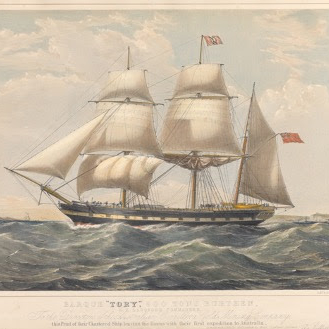
The Tory, on its first trip to Australia, with many immigrant labourers and their families, to participate in NSW mining operations for the Cordillera Gold Mining company, was near Port Stephens on the evening of the 14th of July 1853 when it foundered on the shore [near Anna Bay], south of Port Stephens, resulting in the death of a child.
The court case attracted much attention as it involved the trial of two foreign nationals. The arrival of the Tory, with foreign workers and their families, is also significant as it appears that Port Stephens was chosen to be the entry point for such workers.
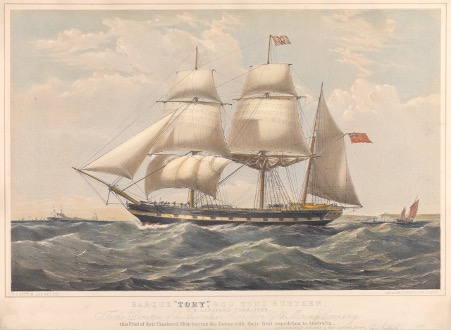
Tory [Royal Museums Greenwich]
The Sydney Morning Herald of 18 August 1853, page 2, reported on manslaughter charges laid against the captain and chief mate of the Tory, concerning the death of the child:
‘Charles Edward Langford, late Captain of the barque Tory, and Thomas Barker, the chief mate of said vessel, were indicted for the manslaughter, on the 16th of July last, at Long Beach, in the colony of New South Wales, of one Stephen Taylor. ….
The Solicitor-General, in a speech of considerable length and ability, detailed the circumstances under which the alleged manslaughter took place, and then called Francis Price, superintendent of the Cordillera Gold Mining Company [established operations in Peel River district of NSW], Christopher Terry Duke, carpenter of the barque Tory, William Henry Waite, passenger per Tory, and George Charles Henry Wigan, surgeon of the Tory. From the evidence of these witnesses it appeared that on the evening of the 14th of July last, at 8 o’clock, when the carpenter left the deck, the Tory was hove-to, head off the land (by the captain’s orders), being then (as was supposed by Mr. Barker, the chief mate, during whose watch the vessel struck) about 60 miles to the southward of Port Stephens, and 20 from Sydney.
At a quarter past 10 A.M., while Mr. William McKenzie, the second mate, was the officer of the watch, Captain Langford came on deck, and again repeated his orders, “to keep the vessel hove-to, head to seaward, and not to make sail until day-light,” and gave particular directions, that those orders should be repeated to Mr. Barker, the chief officer, when he took charge of the watch at midnight; at 12 o’clock p.m. Mr. Barker went on deck, accompanied by the surgeon, Dr. Wigan; the man at the helm having been relieved, Barker told the new helmsman to steer “north-west by west;” Dr. Wigan immediately reminded Mr. Barker of the captain’s orders to keep her head “east north-east,” and that if he persisted in keeping the present course, he would make the land, to which Barker replied that, “he wanted to make the land;” it did not appear that at this time Barber was drunk; but the doctor swore “he smelt very strong of liquor;” while the doctor was remonstrating with Barker, the carpenter came on deck, and immediately said, Mr. Barker, there are breakers ahead, and land too; Barker said, there was nothing of the kind, but the carpenter insisted it was so.
The doctor went immediately below, to awake the captain, who appeared when awake to be under the influence of drink; he was, however, on deck in a few minutes, and immediately said, Mr. Barker, Mr. Barker, for God’s sake what have you done with us; he then gave orders to rig the pumps, and sound the well, to ascertain what water she made, and told the people not to be alarmed, but by remaining quiet all the lives would be saved. Shortly after the vessel struck both the captain and Barker left the deck, and did not return again during that night; Barker endeavoured to lower the life-boat shortly after the vessel struck, but was prevented by the surgeon and the other passengers; he then returned to his cabin, and was not again seen until eight o’clock the next evening.
On cross-examination by Mr. Purefoy: Dr. Wigan said that, although the Captain, when first roused from his sleep, appeared to be under the influence of drink, yet, on consideration, he was convinced that this appearance was caused by the sudden alarm and excitement, coupled with the Captain’s previous bad state of health, and that the Captain could not be drunk, as he was perfectly sober at ten, when he retired to his cabin, and had no means whatever of procuring any liquor afterward.
All the passengers landed in boats in safety, except the child, the subject of this information, who was drowned by the upsetting of a boat in the surf.
The case for the Crown having closed, Mr. Purefoy in a speech of considerable length addressed the Jury for the defendant Langford, contending that the evidence for the Crown clearly disproved any sort of neglect or omission of duty on the part of Captain Langford, on the night the Tory was wrecked. The learned Counsel further said he would call evidence to prove that Captain Langford was perfectly sober on the night of the 14th of July last, and that his excitement was attributable to previous illness and annoyances experienced from certain persons on board. Lastly, the learned counsel contended that the death of the child by drowning, in the boat, was too remote an event from the wreck of the Tory to constitute the crime of manslaughter, not being the natural or necessary consequence of that event.
The learned counsel then called George Bond, Esq., William McKenzie, third mate, and Mr. John McIntyre, who distinctly proved that, on the night of the 14th July last, Captain Langford was perfectly sober, and was playing whist in the cabin until 10 o’clock; that he then went on deck, gave his orders for the night, and retired to his cabin, where he remained until he was called up by Dr. Wigan, about half past one o’clock; that Captain Langford was on deck within a few minutes after he was called, and gave orders to the carpenter to rig the pumps, sound the well, and report what water the ship made every three minutes; that these orders were given in a calm, cool, and steady manner, and that the captain assured all the passengers that by remaining quiet until daylight, all their lives would be saved.
Captain Langford subsequently retired to his cabin, and was not again seen until the evening of the next day; the want of energy and active exertion which the captain subsequently evinced was shown by Doctor Wigan to have resulted from the great shock he sustained by the sudden and unexpected wreck of his ship (caused by the wilful violation of his orders not to make sail until daylight), and the previous state of ill-health he had been suffering from for two months before.
To prove that the wreck of the Tory was caused by the wilful or obstinate disobedience of the captain’s orders, Mr. McKenzie, the third mate, was called, who proved that the captain gave him orders at 8 o’clock that evening to keep the vessel hove-to until morning, head off the land, and to repeat these orders to Mr. Barker, the chief officer, when he took the watch at 12 o’clock; but that no sooner had Barker taken charge of the ship than he put on sail and steered west north-west, directly on the land, and opposite to the course which the captain had directed; within half an hour after which the vessel went on shore.
The evidence of all the witnesses called for the defence proved that Captain Longford was habitually temperate and very regular, never having been seen even once drunk during the voyage; and so high was the opinion entertained of the captain’s kind and gentlemanly demeanour to all on board, that an address was got up the day before the wreck, and signed by all the cabin passengers except one, and presented to the captain, in testimony of the respect and esteem entertained for him.
His Honor, in summing up, told the jury that the evidence offered by the Crown, affected the two prisoners very differently indeed. So far as the prisoner Barker was concerned, there appeared to be a violation of the orders given by the captain in consequence of which the vessel was run ashore; but, however, after all, the questions the jury would have to decide would be nearly the same as to both prisoners; any negligent misconduct, or wilful omission of duty, by which life was lost, would in point of law amount to manslaughter, provided that such loss of life was the direct and necessary result of such negligence or misconduct.
The jury would, therefore, have to say (before they could find either prisoner guilty) was the death of the child by drowning the necessary result of the wreck of the Tory? The questions, therefore, that, he would submit to the jury were these – 1st, did the ship go on shore in consequence of any misconduct, negligence, or omission of plain duty on the part of the captain; and if so, was the death of the child the direct or natural result of the event? 2nd, was the upsetting of the boat, or the immersion beneath it, causing the death of the child, the direct or immediate result of any misconduct, negligence or omission of plain duty, on the part of the captain or the chief officer? Upon finding these questions in the affirmative, their verdict would be for the Crown, but if in the negative, in favour of the prisoners.
The Jury retired for about twenty minutes, and returned to court with a verdict of not guilty as to Captain Langford, and guilty as to Barker, who was remanded for sentence. Court adjourned at half-past eight until half-past nine on Tuesday.’
The Sydney Morning Herald of 22 August 1853, page 2, also reported:
‘There were some circumstances connected with the loss of the Tory which could not be very easily understood from the report of the trial of the captain and mate. We therefore applied to Captain Bingle, who we know had, as Lloyd’s agent, been very active in procuring assistance and endeavouring to save the property when the vessel was wrecked, and he has kindly favoured us with the following narrative. …..
His Honor the Judge, in summing up to the jury, stated that it was the duty of the master of the ship to acquaint his officers with the position of the vessel, and that he himself should not leave the deck at any time when within 14 or 15 miles from the land, the first observation it is well known is not carried out by the usages of seafaring men at all, and it is the duty of the chief mate at all times to know the position of the ship, and in this instance the chief mate held a certificate of competency as a passed master and a man of upwards of fifty years of age, and had himself been in command of vessels As to the latter point, that the captain should never leave the deck, &c , all nautical men will acknowledge is not according to usage. Had the ship been in a position of danger, such as beating off a lee shore, or in very heavy weather, it would be different; but here was a ship perfectly safe, lying-to, and making a course off the land and with a good look-out kept, and was as safe as if in dock.
The captain, although in a bad state of health had been compelled to be on deck to attend to the vessel during the three previous nights in consequence of the heavy weather and surely under those circumstances it was quite reasonable he should take a little rest when there was no immediate call for him on deck. Here it may be mentioned, that from the accident to the chronometer, he had brought the ship seven thousand miles by dead reckoning.
The last time the carpenter saw the captain it was about 4 a.m. after she struck, and in his evidence he swears that at that time he considered the captain’s mind quite gone, which is born out by the medical evidence of Doctors Wagan and McCartney – the former testifying to the previous state of his mind and health and the violent shock he had received the night of the wreck rendered him incapable of assisting the landing of the crew and passengers. The chief mate was not allowed from the feeling evinced by the passengers and crew to do any more duty, and he was obliged to put himself under the protection of the constables sent from Newcastle to secure himself from outrage. But the second and third officers were both superintending and making a raft for landing the baggage.
The following will show the feeling of the passengers respecting the captain’s conduct on that and other occasions during the voyage, which was handed to him [Captain Langford] by the cabin passengers on the 13th July, a day previous to the loss of the ship:
‘On board Ship Tory, July 13th, 1853 – Dear Sir, – Having arrived within a day’s sail of our destination (Port Stephens), we the undersigned passengers, including the officers connected with the Cordillera Gold Mining Company, consider it not only our duty due to you, but also the greatest pleasure to evince our sincere and heartfelt acknowledgments of your extreme kindness and urbanity at all times, and under all circumstances experienced by us individually and collectively during the voyage – the first to promote our comfort, and foremost as a mediator in all cases of disunion. Further, we must cordially acknowledge the general attention and services of your officers and crew upon all occasions – especially upon the days and nights of the 10th, 11th, and 12th instant – the ship and our lives being in imminent danger – when, under the guidance of a merciful Providence, yourself, the owners, and the crew’s prompt and untiring exertions, have preserved us to testify to more than this can express. [Signed by] George Bond … Elizabeth Bond … Henry Hore … Caroline Sarah Bond … John McIntyre … Mrs. Baker … George Wigan, Surgeon … Mary Wigan … Sarah Baker.’
Full Court Decision on Manslaughter Charges Against the Chief Mate
The Sydney Morning Herald of 31 October 1853, page 4, reported:
‘On Wednesday last, Sir Alfred Stephen, at the sittings in Banco, delivered the judgment of the full court in this case, which judgment was published by us in extenso on the following day. The grave and important questions which it embodies urge upon us the propriety of once more directing the attention of all classes connected with British, colonial, or foreign maritime interests to the salient points of this judgment.
The circumstances attending the wreck of the Tory have been already recorded in these columns; but it may be well to recapitulate them in the clear and concise terms in which the Chief Justice stated them on Wednesday last, in delivering the judgment of the Court:
The prisoner Barker was chief mate of a vessel bound from London to Port Stephens, in this colony, and, while in command of her, soon after midnight, within a few hours’ sail of that port, the ship being then in fact a little to the northward of Newcastle, but her true position being unknown, by gross carelessness and negligence, he caused her to go on shore. In the course of the morning and during the day, (the vessel then being aground, a considerable distance from the beach) the boats were got out, and the passengers, not by any orders from the mate or master, but of their own accord, for the preservation of their lives, from time to time landed. The disembarkation in most in-stances was effected without serious accidents; but the child in question, the boat which conveyed it being upset in the surf, was drowned.
It did not appear that there was any immediate apprehension of danger, by remaining on the wreck; for the vessel had, apparently, sustained no vital injury, and the weather was mild. The death, on the other band, was attributed to no misconduct or unskilfulness, in the management of the boat; and the jury found that it was the direct or natural result of the wrecking of the vessel.
His Honor, having stated the reasons (explained above) for reserving the question of the prisoner’s conviction of the full court, said: The case has since been argued before us, and we have taken time to consider; and we are of opinion that the conviction must be sustained. If the child’s death had been caused directly and immediately, by the shock of the vessel’s striking, or the rushing in of water, through a leak thereby then occasioned, or by the breaking up of her hull, and the consequent precipitation of all on board into the sea, there would have been no room for doubt. …..
His Honor, then at some length, considered the suggestion of the prisoner’s counsel, that the result in the case before the Court was too remote from (or, in other words, too little connected with) the prisoner’s act, to be imputed to him as a death thereby occasioned; but after an elaborate review of the cases cited in support of the suggestion, and a careful reference to others wherein the reverse of it was held to be the law, his Honor stated, that upon the latter authorities, and for the reasons previously given, the court was of opinion that the conviction of the prisoner was right.
We believe that Sir Alfred Stephen’s charge to the Jury when Barker was tried, and the confirmation of every point in that charge by the deliberate judgment of the full Court, will make a salutary impression on nautical men of all classes, from the commander to the ordinary seaman, downwards. And it is not to the officers and crews of British or colonial registered ships that the decision in this painful case of misconduct and negligence alone applies.
We desire once again to call the careful attention of foreigners navigating these seas to a very particular point in the Chief Justice’s charge at the Maitland Assizes. His Honor laid it down, that not only in the case of personal misconduct, but also in the case of gross negligence, both British and foreign officers and seamen are liable, when death ensues therefrom, to be indicted for a misdemeanour and made amenable to our laws. Since the fatal loss of the American steamship, the Monumental City, the local Legislature has passed an Act, to apply the stringent provisions of the New South Wales Steam Navigation Act of 1852 to foreign vessels engaged in the colonial passenger trade; and very earnestly is it to be desired that in any future cases which may unhappily arise of misconduct and negligence in our seas, the course pursued by the Crown Law Officers in the case of the Tory, may be applied under whatever flag the offender may sail.’
15 & 16. Wreck of Herculean and Lavinia– 1856
The Foundering
The Sydney Morning Herald of 20 October 1856, page 4, reported:
‘The master of the Dove, cutter, arrived here this morning, from Port Stephens, reports the Herculean, schooner, to be on shore inside Port Stephens Heads, with seven feet water in the hold. The Herculean left here [Newcastle] on the 15th instant, coal laden, for Sydney, and being caught in the gale of that evening, the captain ran for Port Stephens, and, in consequence of the leaky state of the vessel, was obliged to beach her to save the lives of the crew and his own.’
The Maitland Mercury and Hunter River General Advertiser of 21 October 1856, page 2, further reported:
‘The Dove cutter arrived from Port Stephens yesterday, the 18th instant, and reports the schooner Herculean having run into Port Stephens, and beached, on Thursday, the 10th instant, during the southerly gale which was then blowing. From the report of the master of the Dove, I have ascertained the particulars as nearly as possible.
It appears that the unfortunate schooner sprang a leak at sea, after leaving this port, and in pumping her, unfortunately the pumps got choked, so that the water gained so fast on them that they found it necessary to beach her, to keep her from sinking under them. She is now lying on Windeban [Wanderrbah] Beach, buried three feet in the sand, and with seven feet of water in her hold, and in all likelihood will become a total wreck. She has on board a full cargo of coal, and from the statement of the master of the Dove, no attempt has been made to lighten her.’
The Sydney Morning Herald of 28 October 1856, page 4, also reported:
‘The wreck of the schooner Herculean, lying on shore at Port Stephens, was sold here, by auction, on Saturday last, by Mr. H. H. Whtye, for £190; her cargo of coals, 110 tons, brough 1s. per ton. The figure realised for the wreck was considered a high one.’
Lavinia Sent to Retrieve Cargo is Stranded
The Empire of 13 November 1856, page 5, reported:
‘The Lavinia schooner belonging to this port [Newcastle], is reported as on shore. She belongs to Dr. Bowker, and was sent down to Port Stephens to bring off the wreck of the Herculean, and is said to have got on shore in the attempt.’
The Maitland Mercury and Hunter River General Advertiser of 13 November 1856, page 3, also reported:
‘The Lavinia, schooner, belonging to Dr. Bowker, of Newcastle, is a wreck at Port Stephens; she was sent down to take on board the cargo of the Herculean, wrecked at that place some days ago. She is uninsured.’
17. Wreck of Emily – 1856
The Maitland Mercury and Hunter River General Advertiser of 13 November 1856, page 3, reported:
‘By the Collaroy (steamer), from Morpeth, …… the crew of the ketch Emily, wrecked at Port Stephens, came up in the steamer. They report a boat belonging to the Maria Theresa, on the Newcastle Beach, on Saturday, they having travelled along the Beach, which is strewed with wreck.’
18. Wreck of Damaris – 1858
The Foundering
The Sydney Morning Herald of 3 August 1858, page 4, reported:
‘Captain Davidson, of the brigantine Damaris, arrived here [Sydney] on Saturday night from Port Stephens, near which his vessel had gone ashore, under the circumstances mentioned in his statement, as follows:— “Sailed from Melbourne on Sunday, 25th July; very heavy weather during the passage; ran to Newcastle was off that port on Thursday, 29th July; found too much sea on the bar, and a signal was made by the signal master to keep to sea; it came on to blow heavy, with rain; I then made for Port Stephens, but mistook the North Head for one of the Islands, the weather being hazy; got too far into False Bay, and could not get out; wind from south-west and S.S.W.; brought up with both anchors, at about four p.m.—eighth fathoms on one, and forty-five on the other, with springs on both cables; rode six hours, and both chains parted, and the vessel went ashore, and is now lying broadside on, on a sandy beach.’
Letter to the Editor
The Maitland Mercury, of 12 August, 1858, published the following letter to its editor:
‘Gentlemen .—I hope you will give a little space in your valuable paper to a castaway seaman. I have not much to say. I thank the Almighty God for my providential escape from a watery grave. And I beg to return my sincere thanks to Mr. Thomas Tyrrel, for his philanthropy, and kindness to me and my crew, who have been cast away in the ill-fated schooner, Daring, of Auckland. [Signed] William Hooks, Master. Port Stephens, August 9, 1858.’
19. Wreck of Bards Legacy in Port Stephens – 1858
The Northern Times of 4 August 1858, page 2, reported:
‘During the past week the weather has been very stormy, and we are sorry to announce the loss of two vessels. One was a large schooner called the Damaris, ……. The other vessel was the Bard’s Legacy, which left Newcastle on Tuesday evening, heavily laden. When off Port Stephens the vessel laboured so much that Captain Bloxsome determined on getting into harbour; he stood in, but the gale was so strong that the vessel could not carry sufficient canvass, and he was obliged to let go his anchors; during the night she parted them and drove ashore. All hands were safely landed. The Bard’s Legacy was owned by her captain, and was uninsured, and in her loss he loses the savings of ten years.
The Sydney Morning Herald of 4 August 1858, page 4, further reported:
The schooner reported yesterday as having been seen by Captain Davidson, of the Damaris, ashore to the northward, turns out to be the Bard’s Legacy, Bloxham, master, hence for Sydney, with coals; she left here Tuesday night, and had to bear upon Wednesday morning for Port Stephens, the wind being then SW., blowing strong. The master reports that they managed inside Port Stephens Heads at noon on Wednesday and the wind being then too strong to carry sail, they stood in as far as they were able, and then let go both anchors. She drove on shore during the night, inside the North Head. Crew saved. She now lies high and dry on the beach, with her stern store in. Spars and sails all saved.’
20. Wreck of Daring – 1858
The Maitland Mercury and Hunter River General Advertiser of 17 August 1858, page 3, reported:
‘Mr William Henry Whyte has obligingly favoured us with the following copy of a letter received by him from Port Stephens – “Port Stephens, August 7, 1858. – Wreck of the schooner Daring, of Auckland, Mr. Hooks, master; Left the Macleay River on Monday, the 2nd instant, in ballast, bound for Sydney, with a westerly wind, which changed to east, and chopped round to a strong south wester. The vessel made good head way until she came near Broken Bay. On Friday morning, the wind and sea increased, and the captain, for the safety of the vessel and crew, made for Port Stephens.
ln wearing in, she broke her main gaff, and became unmanageable; let go anchors, parted her chains, and drifted on to the rocks, where she is a total wreck. The crew have suffered much; they came through the surf, holding on to the rocks, in a state of nudity. The brigantine schooner, Chase, entered the same time as the ill-fated Daring, but she, being well found in sails and anchors, came inside the South Head, and anchored for the night. Your obedient servant, Thomas Tyrrell. W. H. Whyte, Esq., Newcastle. She is the property of Mr. Clemens, of Sydney.’
21 & 22. Wreck of Uncle Tom and the Speculant – 1859
Foundering of the Two Boats
The Maitland Mercury and Hunter River General Advertiser of 2 August 1859, page 2, reported:
‘In consequence of the rumoured loss of the Speculant, schooner, …… Mr. G. Tully dispatched a messenger down the coast to ascertain the truth of the report ; he returned late on Friday night, and reports the Speculant ashore about 14 miles from here ; from her appearance he thinks she must have come ashore broad-side on, as her masts are broken short off, and her stanchions torn away level with the deck. The sea must have been fearful on this part of the coast, as portions of the wreck are washed high up amongst the sand hills in the neighbourhood.
No trace of any of the crew could be found, but on Saturday morning information was received that the body of the captain had been discovered to the northward of the wreck. The party sent down by Mr. Tully reports that persons he saw on the beach informed him a vessel called the Uncle Tom was ashore nearer to Port Stephens; and, as in the case of the Speculant, all hands were believed to be lost.
A great portion of the beach in that neighbourhood is reported to be strewed with pumpkins. The Speculant was the property of Mr. Tully, and insured for £1000; she left here on the 20th July, deeply laden with coals; she had in all seven hands on board; the captain and mate have left wives and families.’
The Empire of 6 August 1859, page 5, further reported:
‘We have lamentable news of wrecks on the coast The Speculant, a Newcastle trader, has been found bottom upwards on the beach near Port Stephens – all hands seven in number, apparently lost.’
The ketch Uncle Tom is lying stranded further to the northward [near Anna Bay], and there are no tidings of her crew.’
Copper Stolen from the Speculant
The Maitland Mercury and Hunter River General Advertiser of 11 August 1859, reported:
‘It will have been already known in Sydney that a Mr. Sawyer has been down here to identify the wreck at Hannah Bay [Anna Bay], which was supposed to have been that of the Uncle Tom, but which has been since ascertained to be a portion of the hull of the Speculant. It is worthy of particular mention that the latter has been entirely stripped of her copper, by some persons unknown; in consequence of which, on its becoming known, Mr. George Tully, the agent of the Marine Insurance Company here, immediately communicated the fact to the Chief Constable. When it is remembered that a boat which recently had drifted out to sea from this port, and which was stranded on the beach near Port Stephens, was also “planted in the bush,” it will be admitted that the circumstances call for prompt attention of the authorities in Sydney, in order to deal effectually with facts so serious.
The underwriters and the commercial public both will, without doubt, take the matter up, and not permit such bold robberies to go unpunished, and to grow, with opportunity, into a system. A couple of detectives sent down from Sydney and ordered to camp out for a few days in the neighbourhood in question, would soon discover the delinquents and vindicate justice.’
Call for a Lighthouse at Port Stephens
The Australian Home Companion and Band of Hope Journal of 27 August 1859, page 364, reported:
‘A lighthouse is sadly wanted at Port Stephens Heads: it is stated the recent wrecks of the Uncle Tom and the Speculant might have been prevented had there been a light.’
NOTE: After many calls for a lighthouse at Port Stephens, one was finally built in 1862 at Point Stephens.
23. Wreck of Sole – 1861
The Maitland Mercury and Hunter River General Advertiser of 28 February 1861, page 3, reported:
‘The Sole, the old lifeboat, formerly the property of Mr. E. McPherson, and late purchased by Mr. Lang, shipwright, of Stockton, and fitted up at considerable expense for the Port Stephen’s trade, was lost on Monday last, while on her trip to Port Stephens; one of the hands was unfortunately drowned. It appears she left Newcastle at ten o’clock on Monday last, with a fair wind, having two men on board, and when off Hannah Bay [Anna Bay], one of the men, named Tassel, had occasion to go below for some fuel to light a fire, leaving the other man to steer the vessel; a sudden puff of wind caught her, and she gradually listed over.
The man Tassel, who was below, perceiving the water coming over the hatch, made his way as speedily as possible on deck, when the little craft almost immediately foundered. Tassel managed to get on a part of the hatch, which fortunately brought him ashore. The other man was seen to struggle for about five minutes, and then suddenly to disappear. Tassel arrived in Newcastle, on Saturday evening, by the Flower of Wexford, from Port Stephens, and at once reported the circumstances to the police.’
24. Wreck of Triton – 1862
The Foundering
The Newcastle Chronicle and Hunter River District News of 13 August 1862, page 2, reported:
‘We regret exceedingly to have to record this casualty. It would appear that this schooner [Triton], of 120 tons register, commanded by Captain Purss, bound hence for Sydney, encountering the late heavy gale at the commencement of the month, namely, on the 1st instant, made Port Stephens for shelter, and in endeavouring to beat up that harbour, she grounded on the Middle Bank, off Nelson’s Head.
On the following day, exertions were made, but unsuccessfully, to get her off, by the crews of the schooner Martha and brig Harriet Hope. ….. On Wednesday the ship filled with water, leaving it to be concluded that she was bilged. She had on board some 190 tons of coal at the time that she grounded. She was owned by Messrs. Hurley and Groom, and we have reason to believe, was insured.
The crew, gear, and stores of the ill-fated schooner were brought here [Newcastle] on Monday, the 11th instant, by the Margaret Elizabeth, the captain and crew of which shewed every kindness and attention to their brother mariners in distress.’
Sale of the Triton
The Newcastle Chronicle and Hunter River District News of 23 August 1862, page 2, reported:
‘In a late number we alluded to the wreck of this vessel. Last week, as is customary in such cases, the wreck as it stood, with cargo, spars, &c, were sold by public auction on account of whom it might concern. The total amount realised was something like £253. Captain Clarke, ship-chandler of Newcastle, was, however, the chief purchaser, having bought the hull and spars for something like £200.
It is his intention, if possible, to recover the hull, and for that purpose has despatched Capt. Cordey, with twelve men down to the scene of disaster. As the weather since the departure of these parties having continued fine there is every reason to hope, and great probability exists, that their efforts will be successful, and if such should be the case a steamer will be sent to tow her into this port [Newcastle] where she will undergo thorough repair and be again fitted for the colonial trade for which she is admirably adapted. Her owner purposes to place Mr Matthews, the chief officer of the Cincinati, (which vessel we believe has changed owners) in command of the Triton, in our opinion a very judicious selection of a responsible officer.
Mr. McNaughton, ship carpenter, of this town, bought the cargo on board, consisting of at least some 130 tons of coals for a sum of £4, no extravagant, but on the contrary, we think a most profitable investment. Since writing the above the Triton has been released from her perilous position, and a steamer will be despatched early today to her assistance. We warmly congratulate her spirited owner on this his partial success, and sincerely hope that his most sanguine expectations may be fully realized with regard to the future career of his new schooner.’
Triton Catches Fire in Newcastle Harbour
The Sydney Mail of 6 September 1862, page 3, reported:
‘The schooner Triton, which it will be remembered was wrecked at Port Stephens some short time since, and subsequently sold by auction, and got off by the purchaser, Captain Clarke, and brought safely into this port, where for the last few days she has been undergoing repair previous to entering the coal trade. It appears the carpenters left an iron drum, in which was a fire used by them for heating pitch, &c., when they left off work; this iron drum was placed in the galley, the fire they neglected in putting out; consequently, between twelve and one o’clock this morning a bright light was observed in the direction of the A. A. Co.’s works, where the schooner lies.
Mr. Corlette, cashier of the company, at once raised the alarm of fire, and quickly roused the men who reside on the works; they immediately set to work to extinguish the flames, which had now partially consumed the galley and got a hold of the mast and rigging. The volunteer firemen were early on the ground, and materially desisted in extinguishing the fire. The engines were held in readiness, but not brought into play, as, by the united exertions of the Australian Agricultural Company’s men and the firemen, with the aid of buckets, the fire was extinguished. The injuries the vessel has sustained appear to be the loss of galley, portion of deck, mast, and rigging, A sum of about £30 will probably cover the loss.’
25. Wreck of Tybee – 1864
The Sydney Morning Herald of 4 October 1864, page 4, reported:
‘By the Urara (steamer), which arrived at 3 o’clock this morning, we learn that the Lighthouse-keeper at Port Stephens reports a barque, supposed to be the Tybee, which sailed from Newcastle, on Friday, the 30th ultimo, for Melbourne, with 440 tons coal, running in under bare poles on Saturday night, and anchoring in mid-stream, between Narrowgut and North Head. She cut away her masts and rode out the gale safely till early on Sunday morning, when she broke adrift from her anchorage, and is supposed to have drifted between the North Head and Cabbage Tree Island, and gone on shore either on Long Island or the beach to the north-ward. Lowered a boat and landed on the north beach; could see nothing of the vessel except spars, supposed to be her’s, washed on shore. It is not known whether the crew are saved or not. The Urara made on ineffectual search for them.’
The Sydney Morning Herald of 7 October 1864, page 4, also reported:
‘The Dooribang steamer returned from Port Stephens about eleven o’clock to-day, bringing up three men saved from the wreck of the Tybee.
The following particulars have been kindly supplied by Pilot Collins: – Left Newcastle yesterday at 4.15 a.m. in search of the crew and passengers of the steamer New Moon, at daylight, half-a-mile off shore, abreast the Sand-hills, kept that distance to Morna Point, saw no traces of the steamer’s wreck along the beach, ran the course down to Port Stephens, and anchored in Fly Roads [adjacent to Point Stephens] at 8:30 a.m., when the lighthouse men came on board and reported that a barque had drifted between the islands and the North Head of Port Stephens; got underweigh and went to Nelson’s Bay, passed the Atlantic on her way up, with loss of jibboom, otherwise all right.
In Nelson’s Bay the fishermen reported the barque the lighthouse men had seen but did not know what had become of her. They had been on the beach with the captain of the Urara, but saw nothing of any wreck, and thought she must have gone on Long Island. Finding no one that could give any account of the New Moon, the Dooribang then started for Long Island in search of the barque’s crew; examined between the island and the beach – the way she would drift; about eight or nine miles north of Port Stephens, saw the wreck on the beach, with three men at it; landed and found it to be the wreck of the barque Tybee.
The three men belonged to a small vessel then lying in the Myall River; they reported three of the wrecked crew on board the ketch Ino in the same river; all the rest of the crew, including captain, drowned. At sun-down anchored in Nelson’s Bay for the night. At daylight on 5th, went on board the Ino, got the three men saved from the wreck, and started for Newcastle.
Martin Doyle, one of the survivors, late mate of the Tybee, supplies the following: The Tybee, barque, Captain Murphy, left Newcastle for Melbourne on Friday last, laden with coals. About ten o’clock at night, when between twenty and thirty miles to the southward, a gale of wind struck the ship, attempted to take in sail, but before this could be done nearly everything was blown away, shortly afterwards a fearful sea broke on deck, doing great damage; got lighter sail on the vessel, headed eastward, and reached on all night.
In the morning made land under the vessel’s lee, bent a main-staysail, and hoisted foretopmast staysail, still heading eastward, just cleared the land, which proved to be Morna Point. Made the lighthouse and stood in. Between two and three o’clock in the afternoon, let go the starboard anchor to wind-ward of entrance to Nelson’s Bay; as it would not hold, let go the port anchor, with about seventy fathoms chain to each. Port chain soon after parted, and as the vessel began to drag, the mainmast was cut away, which, in falling, took the mizenmast by the head.
Vessel still dragging, cut away foremast, when she held. Sounded pumps, and found three and a half feet of water in the hold, pumped till she sucked, and kept pumps going. About nine at night the remaining chain broke, then put out a kedge anchor, on to which a new Manila Uno of about 100 fathoms had been bent. By serging on the bits, this kept the vessel in check until about twelve at night, when they were so near the North Head that they had to set the lower staysail for a spanker to keep the vessel off the rocks.
At daylight on Sunday morning the vessel was about three miles off shore, to the north of Port Stephens. Cut away the rigging and spars alongside, unshackled chains and let them go; rigged jurymast forward, and made sail, but found the vessel would not steer. Finding they could not clear a point of rocks ahead, they endeavoured to beach the vessel. At this time there were five and a half feet of water in the hold; when in six fathoms water the long boat was put over, but immediately swamped. A sea now broke over the ship, filling her fore and aft, and breaking one man’s leg; next sea the ship struck; all hands then went aft underneath the deck-house; but one, Peter Andrews, who got on top, was washed overboard and succeeded in swimming to shore; the crew then began to look out for themselves – some jumping off, and others were washed off.
A Greek seaman having succeeded in getting hold of a spar, called to the mate to join him, as it would take them both to shore; the mate swam to him, and succeeded in getting hold of the spar, when a sea struck them, drowning the Greek and washing the mate shore. The steward was last seen going down the skylight. A seaman named Vincent, and Captain Murphy, were at this time about the last on the vessel’s deck. Vincent having in vain urged the captain, who stood at the fore part of the house, to take to a plank or spar, at last sprang into the water, leaving the captain still in the same place. Vincent succeeded in getting on to part of the deck-house, on which he was washed to shore, but the captain was never afterwards seen.
The two seamen, Vincent and Andrews, were naked when they reached shore, whilst Doyle, the mate, had very little clothing on, but this he divided with his fellow sufferers. They remained for some time on the beach, but no bodies came on shore, neither were any seen by them. They then started to the southward along the beach, on which they passed the night, rain falling freely. About an hour after starting next morning, they came upon the Ino, of Sydney, in the Myall River, the captain of which vessel took them on board, provided clothes and food, and put them to bed. At the request of Doyle, the captain of the Ino started for the wreck to see if any bodies had been washed ashore, but returned at nine o’clock same night, without success. The next morning the shipwrecked seamen were brought on by the Dooribang to Newcastle.
The behaviour of Captain Murphy, who was a young man of about twenty-one years of age, is highly spoken of. To the very last he endeavoured to cheer and encourage his men, disregarding danger himself. The fate of Murphy and his crew, following so many other disasters, has cast quite a gloom over the town, and this afternoon most of the vessels in harbour have their flags half-mast.’
26. Wreck of New Moon – 1864
The Foundering
The Maitland Mercury and Hunter River General Advertiser of 6 October 1864, page 2, reported:
‘The steamer New Moon, bound from the Macleay to Sydney, was lost at Hannah Bay [Anna Bay], near Port Stephens, on Saturday night. One seaman, named Richard Day, was washed on shore; but he can give no account of the remainder of the crew and passengers. He reports that there were eleven persons on board, including two lady passengers. The police have been dispatched to the wreck.
The New Moon was returning from the Macleay, and had reached as far as Bird Island, when the gale came on, and she turned to run back. She carried away her foresail, jib, and foretrysail; the steam valve broke, and thus all command over the engines was lost. Heavy seas broke on board, and the water rose fast in her hold; the pumps soon became choked, and all hands were compelled to bail out with buckets for several hours. The water, however, still increased, until there was three feet in the hold. The captain ran for Port Stephens, but was compelled to beach the vessel, at six ‘o’clock on Saturday evening, near Hannah Bay.
The fireman saved says he saw the crew and passengers floating about on pieces of wreck. There were eleven persons on board, namely the Captain and owner, his two sons, two female passengers, three firemen, and three seamen.
It was quite dark when the only known survivor got on shore. He is much bruised. Captain Allen, the harbour master, picked him up at the Bluff. Two men from Hannah Bay have since brought in the mail bags, but no news has been received as to the missing crew. Day says some of them have got on shore nearer Port Stephens. Captain Allen is anxious to take the Dooribang, steamer, down to make a search, and he only awaits the sanction of the Government.’
The Clarence and Richmond Examiner and New England Advertiser of 11 October 1864, page 3, also reported:
‘Two men from Hannah Bay have since brought in the mail bags, but no news has been received as to the missing crew. Day [the sole survivor] says some of them may have got on shore nearer Port Stephens, but it is more than probable all have perished. Day was for some time senseless on the bench where he was washed up; when he recovered himself very little of the wreck was to be seen.’
Wreckage on the Beach
The Newcastle Chronicle and Hunter River District News of 12 October 1864, page 3, reported:
‘Our correspondent from Raymond Terrace, writing on Saturday, says: — Senior sergeant Healy returned on Wednesday evening from Hannah Bay. He found a mail bag embedded in the sand, which he duly forwarded to Sydney yesterday morning. He says the whole of the beach is strewn with oranges, pieces of the wreck, pigs and poultry, empty casks, and other debris. Amongst the relics he found a bible with the name “Eleanor Janet Chape, from her affectionate aunt,” inscribed on the fly leaf, a prayer book with the name “Isabella Chape, Union-street,” and another book with the name of “William Vine Pearse.” These books are in the possession of Mr. J. Blanch who resides at the Bay.’
NOTE: The following Death Notice for 13 year old Eleanor Jannett Chape was published in the Sydney Morning Herald of 19 October 1864, page 1:
‘On 1st October, drowned on the passage (in the New Moon) from Darkwater, Macleay River to Sydney, Eleanor Jannett Chape, second daughter of Mrs. R. Knight and of the late R. L. Chape, of Balmain, niece of Mr. A Chape, P.M. Balmain, aged 13 years and 2 months, deeply regretted by her relations and all who knew her.’
The Sydney Morning Herald of 21 October 1864, page 9, further reported:
‘The steamer [New Moon] was the property of Mr. Marshall, of this city [Sydney]. She was a colonial-built vessel of 60 tons, and fitted with high pressure engines. She is insured for £2000 in the United Company.’
27. Wreck of Freak – 1864
The Sydney Morning Herald of 10 October 1864, page 4, reported:
‘Captain Carroll, who arrived by the City of Newcastle yesterday reports:
On Friday morning, the 7th instant, left Newcastle at 9 o’clock; wind was about S.W. and veered to S. S. W.; stood off shore till half-past twelve, when the sea rose very heavy; tacked ship; bore up for Port Stephens 6 o’clock p.m. In working in she got on the spit at dead low water and a heavy sea; got the starboard anchor out with thirty fathoms cable, and the kedge with a good scope of line. The heavy swell and the flood tide she dragged, and the vessel struck heavily; found she was making water fast, although pumps continually going. At 3.30 a.m on the 8th, there was 3 feet 6 inches water in the hold, when the Captain thought it advisable to abandon the vessel, as she was filling rapidly when he left.’
The Empire of 13 October 1864, page 4, published the following letter to the editor which contained further detail on the foundering of the Freak:
‘Sir,—I wish to let the public know the circumstances attending the loss of the schooner Freak. I left Newcastle on Friday the 7th instant, at 9 a.m., with the wind light from S.W. When we got outside the wind was S.S.W. The vessel headed S.E., and stood off shore until half-past twelve; the wind and sea increased and the vessel began to labour very heavy and make a great deal of water; carried away one of the fore chains, and bore up for Port Stephens in company with the brig Marie and West Hartley No. 2.
Entered the heads about 4.30 p.m., with a strong ebb tide; heavy squalls coming off the land; the lead was kept going all the time, and the first soundings got were ten fathoms, seven fathoms, and five fathoms. Put the helm hard down to stay; a heavy puff came off the land, which kept her a long time in coming round. As one came to the wind she grounded on the outer end of the Shifting Sands, or Middle Bank; loosed the sails immediately, and got the starboard anchor out with thirty fathoms chain, and a kedge with a good scope of line, which being a very poor one parted.
Kept the pumps going and got them to suck at 1 o’clock on Saturday morning; the men getting tired, let them stop for half an hour. At half-past 1 o’clock, one of the crew came on deck and told me the water was up to the forecastle deck. Sounded the pumps and found 3 feet 6 inches in the hold. I then knew she had bilges, and it was impossible to get her off without labour. I called the masters of the Maria, and West Hartley, on board. Captain Kenny being an experienced master, advised me to get to Sydney as soon as possible and give a report, as the vessel was settling in the sand fast.
I did not abandon the vessel until half-past 8 o’clock on Saturday morning, and then left the mate by her to save anything that would perish. By the arrival of the crew of the vessel I find they could not save anything, as the sea was breaking over her when they left, and they could not get alongside with the boat. I hope this will be taken in the proper light, as I think under the circumstances I acted promptly and did all that man could do to benefit all parties concerned. Being short of provisions I could not keep the men by the vessel. Charles Carroll, late Master, schooner Freak.’
28. Wreck of Telegraph – 1865
See entry in Morna Point – A Graveyard of Shipwrecks on this website.
29. Wreck of Leah – 1866
The Newcastle Chronicle and Hunter River District News of 10 May 1865, page 2, reported:
‘Intelligence reached Newcastle on Monday, 8th instant that the barque Leah was on shore at the North Beach Port Stephens, and that there was but little chance of saving her. As soon as the fact became known in Newcastle, a telegram was despatched to the underwriters in Sydney, and the necessary instructions having been received, the Bungaree, steam-tug, was engaged to proceed to the wreck. The Bungaree, taking extra warps, &c. on board to render every possible assistance in the emergency, started at a quarter to three a.m. on the 9th May, arrived at the scene of the disaster about half-past six a.m., and anchored about 100 fathoms from the wreck.
Immediately on the arrival of the steamer, a boat was lowered and Captain C. Robertson, marine surveyor, and Captain Collins, deputy harbour-master, proceeded in it to the barque which was found to be lying on the rocky beach, 100 feet from the shore of the Inner North Head of Port Stephens, with her starboard bilge hard on the rocks, and her deck seaward, the water half-way up on her decks, and the tide ebbing and flowing into her. The crew were all ashore in a tent and assisted to save the sails, gear and movables.
The Bungaree left the wreck and started for Newcastle, at nine a.m., having taken on board the master and crew of the Leah, all the sails, and the greater part of the property saved, but leaving two men to take charge of the wreck and whatever property was left behind. About three miles from the Heads the anchor buoy was sighted, and recovered with the anchor and forty five fathoms of chain, which had been slipped when the vessel arrived at the entrance of the port at half-past one p.m. on Monday.
Seeing no time was to be lost in realising upon the wreck, she was sold by auction, just as she lay, by Mr. W. K. Lochhead, on the wharf, at four p.m. yesterday, for £30, Mr. Brookes, of the firm of Brookes and Goodsir, contractors, being the purchaser, and also of her cargo of 308 tons of coal, which were knocked down to him for the sum of one shilling the whole quantity.
The Leah is insured in Metcalfe’s Marine Assurance Company’s Office for £1,400. The Leah was a barque of 216 tons burthen, commanded by Captain Lowrie, and left this port [Newcastle] on the 2nd instant, bound for Auckland, with 308 tons, coal. After proceeding, some distance to sea the vessel sprang a leak, which increased so rapidly that the captain deemed it advisable to run for the nearest port, the vessel at the time having five feet of water in the hold. On arriving near Port Stephens, Captain Lowrie brought the vessel to anchor, in order to make a final effort to save her, but finding the attempt useless he abandoned it and was compelled to beach her in order to save the lives of himself and his crew.’
The Kiama Independent, and Shoalhaven Advertiser of 18 May 1865, page 3, published an extract from the ship’s log pertaining to the foundering of the Leah:
‘Extract from Log.—Sailed on 1st of May, bound for Auckland, wind N., raining. 2nd, at midnight, ship making a good deal of water. 3rd, blowing strong from S.E.; ship laboured heavily, making water, kept pumps constantly going; at midnight wind increased, making very bad weather; water increasing, all continually at the pumps; captain deemed it advisable to make for Sydney. 4th, squally, pumps still going. 5th, heavy breeze increasing to a gale; sprung fore topmast; pumps going day and night; water coming in to forecastle, in streams; at 3 p.m. wore ship, tried to make the land at midnight; sighted Port Stephens light, bearing W.S.W.; weather moderating, but heavy squalls from the southward; pumps continually going.
6th, wind southerly; heavy swell ; cannot keep the vessel seaward; rolling and filling the decks; pumping all day and night, but vessel gaining water all the time; at 4p.m. men knocked up with fatigue; steering for Port Stephens; blowing a gale from S. S. W.; brought up off the Heads; came to anchor at 6 a.m., with two anchors down and 45 fathom chain in each; pumps going, but water rapidly gaining; captain communicated with lighthouse keeper; rode at anchor until midnight, with five feet water in the hold, and gaining fast; captain deemed it advisable to beach her to prevent her foundering; hove one anchor up, and slipped the other attached to a buoy; got inside the North Head with baffling wind and eddy tide; let go anchors, but of no service; she touched and went ashore. 7th. Captain went to lighthouse-keeper and reported the disaster; messenger sent to Newcastle; vessel became a wreck; sails were unbent and sent ashore, as well as all the moveables; tide flowing and ebbing in the vessel.’
30. Wreck of Mary and Rose – 1866
The Foundering
The Sydney Morning Herald of 19 July 1866, page 4, reported:
‘The schooner Mary Anne, from Port Stephens, arrived in Newcastle on Tuesday, and Captain Lane reports the total loss of the schooner Mary and Rose, the property of Mr. W. Wright, of this city — Captain Williams and one seaman being the only survivors out of seven. There were several vessels lying in Port Stephens wind-bound when the Mary Anne left.’
The Sydney Mail of 21 July 1866, page 4, also reported:
‘Captain Inglis, of the schooner Cleone, has just arrived [at Newcastle] from Port Stephens, and brought with him Captain Williams, of the wrecked schooner Mary and Rose, whose shoulder is much injured, and his face and body cut. Captain Inglis says a party of blacks brought in the report that two large vessels, one with a round stem, were ashore between Long Island and Port Stephens.’
The Sydney Morning Herald of 23 July 1866, page 5, further reported:
‘On Friday, the 13th, the schooner Mary and Rose was lost at Narrowgut, and five persons were drowned. She was bound from Circular Head to Brisbane, with a cargo of potatoes. It appears this vessel was caught in the gale of Friday, and put into Port Stephens. Upon entering the heads a heavy sea struck her, sweeping the decks with the same sea; three of the hands were washed overboard and drowned. The captain, deeming it impossible to save the vessel, beached her at Narrowgut; the sea breaking clean over, two more of the hands were washed off and were never seen any more—the captain and one seaman only were saved. The captain is at present on board of a vessel at Nelson’s Bay, in a dangerous state, he having received several severe wounds and contusions during his attempt to reach shore. So fearful was the gale and sea that in one hour not a vestige of the ill-fated vessel was to be seen. Two constables searched along the beach for upwards of fourteen miles, but could see nothing of the bodies of the crew.’
Report by the Captain
The Empire of 23 July 1866, page 4, reported:
‘The following report of the wreck of the abovenamed vessel, is given by Captain Williams:—”The Mary and Rose left Circular Head on the 5th instant, with a cargo of potatoes bound to Brisbane. She carried strong westerly winds to Cape Howe, and from thence to the 10th instant, had light southerly winds with rain; at 2 p.m., sighted Yackabee, bearing N.W., distant thirty miles. The wind then shifted to the eastward, with heavy rain squalls. Close reefer the ship down, and at 8p.m., tacked to the eastward. Gale increasing; stowed the closed reefed topsail and foresail. At 8 a.m. on 11th, were ship with head to the northward, wind having backed round to S.E.; kept head reaching under close reefed mainsail, inner jib, and staysail. At 6 p.m., wind and sea increasing, and backing round to E.N.W.; wore ship with head to the eastward until 4 a.m. on the 12, were ship again; gale increasing to hurricane force; barometer, 29.30. Compelled to take in inner jib and staysail, and hove ship to under close-reefer mainsail.
At 6 p.m. sighted Port Stephens’ light, W. by N., by compass, distant ten miles; wore ship and set inner jib and got all ready to enter the port. In rounding-to after wearing, a heavy sea broke on board, sweeping the deck fore and aft, and carrying overboard the boat, galley, &c., three of the crew being swept away at the same time. Lowered the mainsail and ran for the port; found the ship making a great deal of water; set the close-reefer topsail; Captain Williams went into the fore-rigging to keep the light in sight, when one of the men told him the vessel was half full of water; he came down and took the helm, and finding no chance of saving the ship ran her on the beach in Fly Roads [near Port Stephens Lighthouse], to save life and property if possible.
The schooner was all to pieces within half an hour of her taking the ground, the chief officer and steward going overboard with the foremast, and were drowned. Captain Williams is most anxious to express his gratitude to Mr. Hockley, the lightkeeper at Point Stephens, for the great care and attention received at his hands, and also to Captain Ingles of the Cleome, who got his vessel under way and came round to the roads to take him on board.’
31. Wreck of Rhoderick Dhu – 1866
The Sydney Morning Herald of 23 July 1866, page 5, reported:
‘The Rhoderick Dhu, was wrecked at Morna Point, fourteen miles south of Port Stephens ….. all hands were saved. She encountered the full force of the gale, and the captain tried to reach Port Stephens, but on making the land he found himself close to the breakers, and the only alternative to save those on board was to beach the vessel, which fortunately he succeeded in doing so as to get all hands on shore.’
32. Wreck of Concord – 1867
The Sydney Morning Herald of 23 April 1867, page 8, reported:
‘The ketch Concord, from Sydney, bound to Port Stephens, with a general cargo, was wrecked on Morna Point. The crew were ashore, having saved a portion of the cargo, which was lying on the beach. The vessel was well sanded up, and little hopes of saving her, or any more of her cargo. It appears the Concord was out in the late gale and lost her foremast and bowsprit; and on 11th instant, the vessel being quite disabled, the master had no other alternative but to run her ashore; the crew succeeding in getting safely on land unhurt.’
33. Wreck of Cyclone – 1867
The Goulburn Herald and Chronicle of 20 April 1867, page 3, reported:
‘George Belfour, chief officer of the schooner Cyclone, who, with his shipmates, arrived in Newcastle on Sunday, having walked from Nelson’s Bay, says:—” The schooner Cyclone. Mr. Duncan, master, left Sydney for Richmond River on Monday last with a S W. wind. She had favourable weather to Port Stephens when the wind hauled round to E.S.E. in heavy squalls and rain. Wore the schooner round and stood into Port Stephens. Anchored off Nelson’s head on the same evening, at half-past eight; remained at anchor until Friday, during which time the weather was very bad. Got underway about half-past two on Friday afternoon. Moderate weather, wind from the west. Proceeded down the harbour until she got between the heads, where there was a heavy swell rolling in. The wind suddenly fell calm, and as the vessel would not answer her helm, she gradually drifted to the north head.
The boat was immediately lowered with four hands in her and tried to turn the vessel’s head round; but the swell being too heavy their efforts were unsuccessful— finding that the vessel was likely to go ashore let go both anchors, but the next sea that came in swept her on the rocks. The men in the boat at once slipped the tow-line, and kept off just outside the breakers to render assistance to those on board, and they succeeded in picking up one man who swam off from the wreck; immediately after they observed the captain on the rocks calling out for assistance; waited about half an hour to see if they could find the cook, George Manson, but could not see anything of him; supposed he was drowned in the surf; pulled the boat round to the beach, and walked round to where the captain was left; when they got there they found that he had managed to get up on the high land; they then made farther search for the missing man, but without success.
The vessel soon broke up and became a total wreck. Neither captain nor crew saved anything. Captain was much bruised in getting ashore, so much so that he was unable to come along with the crew to Newcastle. The crew pulled the boat up to Nelson Bay and remained there all night; went back to the wreck next morning but could not find the body of the cook. The vessel had entirely disappeared, there only being a few fragments strewed on the rocks and beach; went back to Nelson Bay and started to walk along the beach to Newcastle, leaving the captain at Mr. Glover’s.
On arriving seven miles to the southward of Morna Point, found the wreck of the ketch Concord, from Sydney, bound to Port Stephens, with a general cargo; the crew were ashore, having saved a portion of the cargo, which was lying on the beach. …….
The crew of the Cyclone arrived here [Newcastle] about three o’clock yesterday (Sunday) afternoon, and at once communicated their situation to Captain Allen, who provided them with lodgings, &c. They leave for Sydney this morning.” George Belfour further states they found the body of a man about half a mile on this side of the ketch. The body appeared to have been lying on the beach some time, being dried hard by the sun. It was lying just at the top of high water, and partly buried in the sand; the head was gone; flesh was decayed away off one of the legs. They did not touch the body, but left it in the same position.’
34. Wreck of the Terrara – 1868
The Clarence and Richmond Examiner and New England Advertiser of 18 February 1868, page 2, reported:
‘This vessel, the property of Messrs. W. Hezlett and Rice, left Sydney for the Macleay River on Tuesday, the 4th instant, and at two a.m. on Wednesday, when off Port Stephens, the crew pumped her dry. About half-an-hour afterwards, the master, who was below dozing, heard a heavy rush of water, and, thinking there was a gale blowing, he ran upon deck, but found it was clock calm. The hatches were then taken off, when it was found that the noise which woke the captain was that of the water in the hold, she being then half full.
The boat was at once put over the side, and three of the crew got in, but the captain, wishing to have something to steer by, endeavoured to unscrew the compasses; but, teeing the vessel beginning to settle by the head, he very wisely desisted, and had just stepped into the boat when the schooner went down. They were at this time about twelve miles from shore, and were enabled to effect a landing at Narrowgut [Point Stephens] Lighthouse Island, at seven a.m. on the 5th. The schooner is insured for £600 in the Victoria Office, and the master attributes the foundering to the heavy swell, which must have started one of the butts, and opened her right along.’
35. Wreck of Chelydra – 1868
The Sydney Morning Herald of 29 February 1868, page 8, reported:
‘The barque Chelydra, 300 tons, Captain Lowe, from Melbourne, bound to Newcastle to load for coal, was lost near Port Stephens on 16th instant. The following particulars from our Newcastle correspondent were furnished to him by the chief officer of the ill-fated vessel:—
We left Port Phillip Heads on Tuesday 4th instant, bound for Newcastle, in ballast. We had the wind from the north until we reached Kent’s Group, the wind then blowing fresh at times. When off Kent’s Group it came to blow from the southward, which kept up until we reached Cape Howe. The wind then changed to N.N.E., and so continued until Wednesday or Thursday night, when it again veered to the southward, and continued so until Friday, when it then blew a gale. We then made the land on Friday night. We were not certain as to where we were, owing to the weather being so thick and hazy. The barometer was up to 30 then. Thinking the weather was going to be mild we then stood off the land, the wind then south-east; that time it came on to blow so hard we could not carry any sail; at midnight, on Friday, we took the foresail and foretopmast-staysail in, the weather at that time very thick, the lead was kept going twice a watch, and could get no soundings.
Sunday morning, about 4 o’clock, I sounded and got about 40 fathoms; and about 5 a.m., the same morning, the water seemed muddy and thick; I then sounded again and got about 25 fathoms; then we knew we were getting close to land; we set the foresail and foretopmast-staysail; then about 7 a.m., on Sunday, the foretopmast stays carried away; we then got some tackle on again, and got it right, one hand was repairing the staysail, all the others reefing the main-sail; it was blowing very hard at the time, and we did not think she would carry the mainsail as she was lying over on her beam ends with what sail she had got and a heavy sea running at that time.
About 9 o’clock on Sunday a.m., the master (Captain Rowe) gave orders to set the mainsail; when hauling the sheet aft we saw the land to leeward, about half a mile, owing to the weather having cleared a little; the wind then blowing from the south-east. We let her stop that way for about half an hour; seeing that she was going bodily to leeward. For to save life the helm was put up, and run for the shore, then being about a quarter of a mile off the breakers. When we struck I jumped overboard into the water with the life buoy, and had the leadline fastened on, but the line having got under the vessel’s bottom, I had to let it go to save my own life, when I succeeded in reaching the shore all safe.
R. Smith was the next to continue for shore; he jumped off the martingale, and succeeded in getting ashore without any assistance. Then W. Nutman and Harris—two seamen—went off together. Harris bidding Nutman goodbye when going; Nutman having reached the shore all safe, but Harris was lost, and never seen afterwards.
Those on board made several attempts to get a line ashore, and after five or six attempts succeeded in getting a line from the vessel, and made it fast to an old spar on the shore; by this means the remaining crew reached the shore; he saw at that time rolling over the vessel. Captain Lowe was the last person to leave the ship. We searched up to this morning for the lost man, but not having found him, we had to start to Newcastle, the nearest place. We left for Newcastle about 8 a.m. on Monday.
After we were about five miles in the bush, we met a man, who directed us on the right road for Newcastle; we also met another man, named McKenzie who gave us some refreshments. After having left McKenzie’s we met Captain Banks, who gave those who were unable to walk horses and they considerately accompanied us on our journey. Had we not very fortunately fallen in with the above-named gentleman we should have experienced some difficulty in finding our way to Newcastle, at which place we arrived this evening, shortly before dark. Several of the crew are very much hurt and bruised.’
The Clarence and Richmond Examiner and New England Advertiser of 25 February 1868, page 2, further reported:
‘The wreck of the Chelydra was sold by auction on Tuesday, and brought £6, the purchaser being Captain Harrison, the owner and master of the Springbok.’
36. Stranding of Esmeralda – 1868
The Empire of 26 February 1868, page 2, reported:
‘The following is a copy of a telegram from Captain Banks to Messrs. Lorimer, Marwood, and Rome, Sydney, agents of the stranded ship Esmeralda:— Succeeded in floating Esmeralda yesterday morning, and towed her to Port Stephens against a heavy gale. Ship and cargo all right, and will be towed to Sydney when weather moderates.”—The above will, therefore, set at rest all doubts for the safety of the ship, and in the course of a day or two she will be at anchor in Sydney harbour, apparently none the worse for the ordeal she has passed through.
Besides the assistance rendered by the steamer Fire King, the agents of the Esmeralda secured the services of the Newcastle steam-tug Prince Alfred; she left the latter place on Sunday morning for the Broughton Isles, the locality where the Esmeralda was stranded. The tug steamed away with the schooner Jessy Kelly in tow to take on board some portion of the Esmeralda’s cargo and convoy it to Sydney.
The stranded vessel was reached in the afternoon, and the work of lightning the ship was soon commenced. On Monday morning the Jessy Kelly was full of cargo and started on her voyage, for Sydney. At high water the Fire King and Prince Alfred were made fast to the vessel and succeeded in towing her safely into deep water, and thence got her into Port Stephens, where she is now anchored. The Prince Alfred put into Newcastle yesterday morning for a supply of coal, to enable her to tow the Esmeralda to Sydney.
When the steamer Fire King left here [Broughton Island], on the 21st instant, with her complement of cargo, principally consisting of beer, in bulk and case, total number of packages 300, which amounted to about a hundred tons burthen, the Esmeralda as still aground, but rather uneasy, in consequence of being lightened; during the night the ship had some very disagreeable knocks against the sunken rocks on which she was lying. All the crew slept on board, according to Captain Ninnis’s orders, before leaving in the Fire King for Sydney, and I can assure you that the general opinion was, during the night, that the crew wished themselves on shore in their tents, as they expected her to go smash every instant. I myself was sitting in the cabin at 10.30 p.m. when the ship gave a sudden lurch, and she continued bumping during the greater part of the night; but up to Saturday, the 22nd instant, she had not made any water to speak of.
The pumps are regularly kept sounded; everything seems safe up to the present. It appears the ship has embedded herself in a dock of her own, and at times you would imagine her afloat forward. The chief officer, Mr. Baker, sounded around the ship this morning, and found under the ships bows sixteen feet water, and amidship and aft from twelve to thirty feet water. Hove in thirty fathoms chain to try and got ship’s head to seaward, but found it impossible, as the anchor was drawing home. Got a kedge anchor out ahead with a warp attached, to keep ship from driving on the rocks astern, as we found her to have gone astern further than she lay at first. We have got all the topgallant masts and yards down, and at present employed at rigging tackle for discharging cargo. All hands are anxiously awaiting the arrival of the next steamer.
On Sunday morning, 23rd instant, the weather seemed fine and clear. Hove ship a fathom forward to save her if possible, from going further aft on the rocks astern, and was so far successful. At 4 p.m. the steam-tug Prince Alfred arrived from Newcastle having the fine schooner Jessie Kelly, in tow, and Captain Banks and Mr. Kelly (the schooner’s owner) on board. The steamer Fire King, from Sydney, arrived at the same time, having on board Mr. Pegus, of H.M. Customs, and Mr. Stevedore Chester’s men from Sydney, in readiness to commence to discharge cargo into the Jessie Kelly. We commenced to discharge cargo at 5 p.m., and continued uninterruptedly discharging until 8 a.m. this morning, 24th instant.
Fortune favoured us, and the stranded ship Esmeralda is once more afloat. The weather became exceedingly boisterous, and a heavy sea and strong wind from the S.E. were now against us. Certainly, too much praise cannot be given to Captain Bauks for the manner in which he has exerted himself to get this ship afloat again. As our ship floated from her dock, danger became more imminent than ever. The only place of safety at all near at hand was the little bay we were now leaving; and if the slightest accident occurred to the steamboat having us in tow, the ship and all hands must have inevitably perished. The Jessie Kelly was lying close on our quarter, and the Esmeralda seemed every instant to be in danger of grounding again.
Again, our position, for some two or three hours after floating, was one of considerable peril. We were compelled to part company with the Jessie Kelly and to go in tow to Port Stephens, piloted by Mr. Glover, where we arrived in safety, after a long and hard passage for so short a distance. All on board certainly feel thankful to providence for their safety so far. The Jessie Kelly is expected at Port Stephens this afternoon, unless she attempts to remain outside for a slant of a fair wind to take her on to Sydney. All seems well so far. The Esmeralda is only awaiting a fair chance of weather to leave for Sydney.’
37 & 38. Wreck of Lavinia & Lurline – 1869
The Newcastle Chronicle of 14 September 1869, page 2, reported:
‘Intelligence reached us, yesterday, that the above well-known coasters, trading to and from Newcastle, were wrecked at Port Stephens during the late gale, but that, fortunately, no loss of life occurred. The particulars that have been supplied to us are, although reliable, somewhat scanty.
They are as follows: — On Tuesday, the 7th instant, the Lavina, Captain McLaughlin, left Newcastle for Sydney, with coals, and on Wednesday night, she was caught in the southerly gale, and was necessitated to run into Port Stephens for shelter — the captain deeming it imprudent to face the gale. On Thursday, she made Nelson’s Point, Port Stephens, where she cast anchor, the wind at the time blowing very strong, and a heavy sea on.
On the same day, the Lurline, Captain Jackson, in ballast, also ran into Port Stephens for protection, and anchored at a short distance from the Lavina. On Friday, the gale increased, and at its height, the cables of both vessels parted, and, drifting ashore, they soon became total wrecks. The crews swam ashore with considerable difficulty — some of them being almost exhausted. Nothing was saved from either of the vessels.
On Sunday, both captains travelled overland to Raymond Terrace, where they arrived in the evening, much fatigued. They proceeded to Sydney yesterday morning, by the Coonanbarra, to report the wrecks to the owners of the vessels. The crews were, on Saturday, put on board a Sydney-bound schooner, at Port Stephens. During the gale, there was a tremendous heavy sea on at Port Stephens. As yet we have not heard of any other wreck northward of Newcastle. The Lavina was the property of Mr. John Henderson, of this city. She was insured for £500, which will not, we understand, cover his loss by fully £300.
The Clarence and Richmond Examiner and New England Advertiser of 21 September 1869, page 2, further reported:
‘Our Newcastle correspondent writes:—Captain McLaughlin and Captain Jackson arrived here by the Coonanbara this morning from Raymond Terrace, coming overland from Port Stephens.
The following is Captain McLaughlin’s report of the loss of the schooner Lavina:—We left Newcastle last Tuesday morning bound for Sydney. On Wednesday, at 7 o’clock in the morning, was off Bird Island, the wind blowing strong from W.N.W.; stood in for Broken Bay, the wind freshening and hauling round to S.S.W.; carried away all head sail; deemed it prudent to run for Port Stephens; and arrived there at half-past 1 on Thursday. A strong ebb tide running.
When abreast of Nelson Head let go the two anchors. On Friday morning, at half-past 1, the starboard chain carried away, and the vessel at once began to drag; and at 3 o clock she took the ground, a heavy sea breaking over her. To save life I thought it best to take to the boat; and after a great deal of trouble managed to reach the shore. When I last saw the schooner she was high and dry on the beach.
Captain Jackson, of the schooner Lurline, states that he was off Newcastle on Wednesday, but could not fetch in; the wind increasing and every appearance of bad weather, thought it best to run for Port Stephens and arrived there at half-past 11 o’clock. Blowing very heavy from the South; let go both anchors off Trafalgar Head with forty-five and thirty five fathoms of chain. At 6 o’clock on Friday morning, the starboard chain parted, and the vessel commenced to drag; to avoid the breakers slipped the chain, and tried to get round the spit, but did not succeed, and she gradually drifted into the area; with some difficulty we reached the shore with the stern-post knocked out, and was fast bedding up with sand. I left the mate in charge of the wreck, to look after the things that are saved.
The schooners Lurline and Lavina were both insured in the Australasian Office; the former for £900 and the latter for £500.’
39 & 40. Wreck of Flying Fish & Isle of Thanet – 1870
The Sydney Morning Herald of 7 March 1870, page 4, reported:
‘Last night intelligence was received respecting the total loss of the schooner Flying Fish, 37 tons, owned by Mr P. O’Doud, and ketch Isle of Thanet, 28 tons, D. McKinlay owner. These vessels went ashore at Port Stephens on Saturday night last, and were reported as fast breaking up.’
41. Wreck of Janet Dickson – 1870
The Manning River News and Advocate for the Northern Coast Districts of New South Wales of 2 April 1870, page 3, reported:
‘The Fire King (steamer), which arrived from the Manning River via Port Stephens, brings intelligence of the wreck of another of our coasting fleet, caused by the severe S.E. gale which has recently raged on the coast. The unfortunate vessel, the subject of this paragraph, is the Janet Dickson, a schooner of 66 tons register — the captain, Maxwell McKee, and crew of which arrived by the Fire King, having been picked up by that vessel in their dingy off Bungaree’s Norah.
Captain McKee informs us that he left Newcastle, with a cargo comprising 100 tons coal, on Friday, the wind at the time blowing light from the southward. This weather continued until arriving abreast of Broken Bay at noon on Saturday, when it suddenly chopped round to the S.E., and blew a furious gale, bringing up a heavy sea, Captain McKee at once tried to make Broken Bay, but the wind and sea increasing, he was obliged to run before it and ultimately succeeded in getting into Cabbage Tree Bay. At 6.30.p.m., the same day, the decks having been swept by the heavy seas, both anchors were at once let go with sufficient cable, but she commenced to drag on to a reef and soon became a total wreck.
The crew reached a safe landing in their boat, and were most humanely treated by Mr. Hargreaves, who rendered them all the assistance their desolate position required. Having saved all the gear possible they got into the dingy and met the Fire King off Bungaree’s Norah, and were by that vessel brought on to Sydney. The Janet Dickson was owned by Mr. F. Cook, of this city, and has only recently undergone an extensive overhaul to the extent of £150. She is partly insured.’
42. Wreck of Traveller – 1874
The Foundering
The Sydney Morning Herald of 8 May 1874, page 4, reported:
‘A schooner is reported to be wrecked in Nelson’s Bay. A rumour was current that it was the Stranger, a vessel well known at this port, but we learn that this has no foundation. The schooner is now believed to be the Traveller. It appears that on Saturday night she was off the lee shore in Nelson’s Bay, and at 2 o’clock on Sunday morning she either dragged or parted her anchors, and took the beach. At daylight this vessel was a total wreck, and on Monday had gone to pieces. No fears were entertained for the safety of the crew, as, owing to the position of the schooner, they could easily have reached the shore and there were several houses not far from the scene of the wreck. It was not possible to ascertain further particulars up to the time the Ajax left.’
The Clarence and Richmond Examiner and New England Advertiser of 12 May 1874, page 4, also reported:
‘A schooner, supposed to be the Traveller, collier, ran in at the same time, anchored, over the north side, and during Saturday night parted her cables, and broke up in a few hours; the crew were seen on shore all night.’
Marine Board of Inquiry
The Sydney Mail and New South Wales Advertiser of 16 May 1874, page 638, reported:
‘The [Marine] Board held an inquiry into the circumstances connected with the loss of the schooner Traveller, of Sydney 116 tons register, which occurred in consequence of the vessel having parted her chains off the Myall Beach, at the entrance to Port Stephens, during the heavy weather of the 3rd instant, and they came to the conclusion that no blame was attributable to J. E. Damon, the master of the vessel.’
43. Wreck of Sea Ripple – 1875
The Foundering
The Sydney Morning Herald of 15 March 1875, page 4, reported:
‘By telegram we learn that the schooner Sea Ripple was wrecked on the north head of Port Stephens. She was owned by Mr. M. E. Murnia. All hands saved.
Marine Board of Inquiry
The Sydney Morning Herald of 26 March 1875, page 4, further reported:
‘The Board also held an inquiry into the circumstances connected with the loss of the brigantine Sea Ripple, which took place at the entrance to Port Stephens on the 13th instant. This vessel was owned by Mr. Murray, of Sydney, and, so far as the master knew, uninsured. She was on a voyage from Sydney to the Richmond River, with about a ton of cargo on board, and had put into Port Stephens on account of adverse winds. In the attempt to get to sea from the last-mentioned place, she got on shore on the North Head in consequence of the wind failing, and became a total wreck. The Board decided that nothing had been adduced on which to ground a charge against Francis Lowry, the master of the vessel.’
44. Wreck of Ben Nevis – 1875
Background to the Foundering
The Australian Town and Country Journal of 10 July 1875, page 32, reported:
‘The Ben Nevis, Captain Jones, master, left Newcastle on Friday, the weather then being fine. When off Sydney, the wind veered round to south-west, and on Saturday night it was found necessary to shorten sail, all the smaller sails being taken in. At 4 o’clock on Sunday morning, the weather increasing in violence, sail was further reduced, the brig then being about fifty miles off Wollongong. The wind freshened and blew so hard that it was found necessary to take in almost all sail, and at 8 o’clock, when it was blowing a heavy gale, with a high sea running, a tremendous sea struck the vessel, knocked out 18 of the stanchions, together with the companion and sky light, washed away the boats, stove them in and rendered them useless, and washed the mate over board. He managed, however, to grasp the main brace, and was hauled on board again by two of the crew, but was so badly injured that he was scarcely able to move. The captain was more seriously hurt, his head being jammed by the companion falling upon it, and he remained insensible for upwards of ten hours.
The crew in the meantime worked the vessel as they best could, and battened down the hatches and skylight, as the brig was then taking in a great deal of water. When the captain recovered consciousness, the vessel was hove to, in the hope that she would make Newcastle, or some other port of refuge; she was hove to on the port tack for the land but at 10 o’clock on Sunday night, wore ship, fearing she would go ashore. At 7 a.m. on Monday, the brig was to wind-ward of Newcastle. Captain Jones stood in, hoping a steamer might come out and pick him up; but finding this not to be the case, the vessel was hauled off.
From Saturday, up to this time, all hands, with the exception of the man at the wheel, had been pumping incessantly, and the ship was, notwithstanding, making a great deal of water. Fearing she would go down at sea, Captain Jones next bore up for Port Stephens; which was made at dark on Monday evening, and anchored with ninety fathoms of chain on one anchor, and sixty-five to the other.
On Tuesday morning the ensign was hoisted union down, as a signal of distress. A tremendous sea rolled into the bay, and notwithstanding springs were got on the cable the brig drifted gradually ashore; and it soon became apparent that she would go on the beach. At twelve o’clock on Wednesday, after everything possible had been done to save her, the brig struck on the beach opposite the lighthouse and the sea broke heavily over her. Finding that the only hope of saving the crew was to let the vessel drift as high as possible, the anchor was cast adrift and the brig then drove considerably further ashore, the surf still making clean breaches over her.
A seaman named Michael Mahoney, at great personal risk, swam ashore with a life buoy attached to a line, and by this means the crew were ultimately saved. An hour after they had left the vessel, the latter broke up. We may here mention that before the men left by the life buoy, an attempt was made to send a boat off from the shore, but it capsized. About 6 o’clock on Wednesday evening, the crew then being knocked up, and having been without food for two days and two nights, started for a place of shelter, a quarter of a mile distant from the wreck, where they received clothes and shelter. They afterwards remained by the wreck, to ascertain if anything could be recovered, until yesterday morning, when they started for Newcastle, and arrived as stated, after 11 o’clock at night.’
Crew Arrive in Sydney
The Sydney Morning Herald of 5 July 1875, page 5, further reported:
‘The master and crew of the Ben Nevis arrived in Newcastle late last night. The brig is a total wreck. The crew got ashore by means of a line and life buoy swung from the ship, one of the crew having swam ashore with the line. The captain and his mate have both received severe injuries.’
A Brave Irishman
The Freeman’s Journal of 10 July 1875, page 13, published the following letter to the editor:
‘Sir,— I beg to place before your readers, an extract from a leading article in Wednesday’s Herald, speaking of the wreck of the Ben Nevis :— “There are one or two circumstances connected with the wreck of the Ben Nevis at Port Stephens, during the late gale, that should not be allowed to pass without a word of comment. A brave seaman, named Michael Mahoney, swam ashore through the boiling surf, with a life buoy attached to a line, and at the risk of his own life achieved the deliverance of all his shipmates. An hour afterwards the brig went to pieces, and without this timely assistance all on board would probably have perished.
“He long survives who lives an hour in ocean self-upheld.” Michael Mahoney dared this feat, and in all human probability saved his makes when within an hour of a sailor’s grave. Courage like this is worth recording, and if Austria is ever to become great, it must be by the heroism and devotion of her children.” You will see, sir, that in the last sentence of this extract, the Herald, unwillingly, I have no doubt, pays a fine compliment to Irishmen. Yours, T.’
NOTE: The heroism of Michael Mahoney was similar to that demonstrated by a crew member named Jervie, who was on the steamship Pappinbarra, that struck rocks near Port Stephens in September 1929. In similar circumstances to that faced by Mahoney, Jervie dived overboard and took a line to the shore, thus enabling the crew of the Pappinbarra to safely reach shore.
45. Wreck of Result – 1875
The Maitland Mercury and Hunter River General Advertiser of 3 July 1875, page 2, reported:
‘The Pilot [newspaper] of yesterday says :—”We have been favoured by Captain Allan, with copies of two telegrams received by him from Nelson’s Bay, at 7.30 last evening. ‘The ship Result is ashore inside on the sand spit opposite Nelson’s Head, where the schooner Freak went.’ ….. The ship Result is ashore inside on the north side of the harbour. She is flying signals of distress.’
The Evening News of 10 July 1875, page 5, further reported:
‘The following particulars are furnished to the Newcastle Pilot of Tuesday, June 6th, by Captain Jarvis : — The ship Result left Newcastle for Wallaroo on Friday, June 25th, with 1140 tons coal. She had fine weather until off Wollongong, on Saturday night, when the wind drew to the south, and the weather beginning to look very dirty. By midnight the wind was blowing a gale, and the foresail, all the topsails, jib, and foretop mast stay blew away. At 2 o’clock on Sunday afternoon, finding that the pumps did not suck, all the hands were placed at them from 2 until 10 p.m. The ship was then leaking a good deal, and we bore up for Sydney.
At 10 o’clock on Sunday night we got steam up in the donkey engine boiler [an auxiliary boiler to run pumps and other machinery]; after this we found that the engine would not feed, so we pumped the ship as long as water remained in the boiler. We next had to draw the fires, and the pumps were relieved by the crew while we were fitting the feed pipe. Got steam up again, and then found the feed pipe would not supply the boiler sufficiently; we then had to draw the fires again, and supply the boiler by hand. On drawing the feed pipe a second time we discovered a defect in the piping, which we remedied, and the pipes afterwards worked properly.
The ship made Sydney light at 6 o’clock on Sunday evening, and while drawing towards the land the wind veered to west. Finding that we could not make Sydney, we tried for Broken Bay, but were unable to fetch there. We next wore ship with the intention of beaching her at Norah Heads to save life; as she was leaking greatly. Finding the sea which was breaking on the beach to be so terrific, that even if the vessel were beached there was but little hope of saving life, we bore away for Newcastle. This was on Tuesday, the ship having stood off and on meanwhile. On Tuesday morning, when twelve miles from Nobby’s, we spoke the steam tug Challenge, and the master promised to tow us in at five o’clock in the afternoon. The steamer Southland, however, afterwards came up, and Captain Campbell stated that there would not be sufficient water for the ship to enter the harbour for three days.
On leaving Newcastle we drew twenty feet six inches, but in consequence of the water which the ship had taken in, she drew twenty-two feet, when Captain Campbell spoke us. Captain Campbell also advised that the ship should stand off for Port Stephens, as the sea was breaking very heavily across the bar at Newcastle, and he promised to send the Goolwa to our assistance. We squared away for Port Stephens about 1p.m. on Tuesday, the wind blowing a heavy gale from west-south-west, and the weather being exceedingly dirty.
Nothing noteworthy occurred after this until we rounded Port Stephens at 4.30 p.m., still making water fast, and the donkey engine working the pumps. Entered the bay as far as canvas would permit, and anchored in fifteen fathoms at 5 o’clock in the afternoon; the lighthouse bearing south by east half east, a mile distant; the water was at that time smooth, but at 11 p.m. heavy rollers set is to such a height that the lighthouse was not visible from the poop of the ship; we remained at anchor until Wednesday, at 11 a.m. when finding the sea increasing, we let go our second anchor.
At 2 p.m., a white flag was observed flying on the island of Port Stephens light. We launched the gig and made for the land. On approaching the land, however, the lighthouse keeper waved us to make for Chinaman’s Cove [Fly Roads], and we were endeavouring to do so, when a heavy sea struck the boat, and carried her high and dry, about fifty yards from the breakers. Spoke to the lighthouse-keeper, Mr. Hoadley, who then told us the ship was riding in a very bad position and advised us to run in for Port Stephens harbour. The gig was relaunched, and we succeeded in passing through a heavy surf, and again reaching the ship.
The Result lay in the position last mentioned until Thursday last, at noon, when the wind drew to east-south east. The anchors were hauled up, and the vessel now ran for Port Stephens harbour. Entered the heads about 6 p.m. on Thursday. In entering the heads a heavy sea struck the ship, and completely filled her decks to the rails. The Ballina, steamer, was at this time endeavouring to come out from Port Stephens and was within, fifty yards of the Result, when the sea last mentioned struck the ship; and Captain Bracegirdle, of the Ballina, states that he believes that the sea striking the ship instead of the steamer, saved the latter from going down. As it was, the force of the broken water striking the steamer after passing the ship was so great that the second mate had all the fingers of his left hand crushed off through being caught in the cogwheels of the steering apparatus.
The steamer managed to run back for shelter, having a very strong list. Part of her bulwarks, two rooms on the starboard side, and a lot of moveables on deck were carried away. The wind at this time baffled us on board the Result, just as we were entering the Heads. We had our lead line going, and as soon as we got into five fathoms of water, we tacked ship, but found her very sluggish in answering her helm, on account of the coals being thoroughly saturated and soddened by water in the hold. After the vessel was all full on the starboard tack, she grazed slightly; but the next roller that carried her caused her to bump heavily. We were at that time standing for Nelson Head; after striking, the ship paid off, and we let go our after canvas, and kept all rails full forward to try and drive her off, but she continued to bump so heavily that the bits forward went.
In order to save life it was deemed advisable to get out the boats, which was accomplished after a great deal of difficulty, and about half-past 6 o’clock in the evening we all succeeded in landing at Windy Wappa [near Tea Gardens]. The gig in which there were nine hands, was beached without accident, with the exception that the cook had his leg a good deal bruised by the boat rolling on him.
Finding the sea to be breaking so heavily, the mate, who had seven men in the pinnace [small boat], was hailed to beat off, but the boat was so far in the surf that he could not do so. The pinnace was carried in on the top of a sea while the crew were trying to pull her out, and turned completely over, all hands being thrown on the beach. Seeing that the crew were all safe we hauled the boats up, and lighted fires in the bush; rigging tents with blankets to protect the men from the inclemency of the weather, which was then very bad.
The ship was at this time ashore about three quarters of a mile from the beach. I left there at 2 o’clock on Sunday afternoon on horseback, and arrived in Newcastle at 11 o’clock the same night, having ridden thirty-two miles. I desire to return thanks to Messrs, Barnes and Flood, and also to Mr. and Mrs. Glover, for their kind attention to the wants of the crew; and also to the lighthouse-keepers (Messrs. Hoadley and Glover), for their attention to the ship during the time she was lying in Fly Roads. When Captain Jarvis left the vessel, she was still fast ashore, embedded in the sand, and had not broken up, but there was not the slightest hope of getting her off. He returned to the wreck yesterday. He states that he is not aware whether the vessel is insured.’
46. Wreck of Queen – 1876
The Maitland Mercury and Hunter River General Advertiser of 15 February 1876, page 7, reported:
‘On Friday forenoon, a man named John Dougall, representing himself as a seaman of ketch Queen, arrived at Stockton in a very exhausted condition, and gave information that the ketch to which he belonged had been wrecked about a mile south of Hannah Bay. The man was soon at a house at Stockton, where he received shelter, by water-police constable Shearer, to whom he made a statement of the circumstances under which his vessel was wrecked.
The information as we learn from Shearer, is as follows :— “The Queen, John Buckley, master, left Lake Macquarie on Thursday night, with a cargo of timber for Newcastle. All went well until reaching Nobby’s, and when the captain attempted to round the Bell Buoy, the sails were split to pieces, there being a strong southerly wind blowing and a high sea running. Only the mizzen sail was left standing, and it was impossible for them to put in under the circumstances. The captain then put the ketch about, and stood away towards Port Stephens, but finding nothing could be done with the vessel, he determined to run her ashore to save the lives of himself and the two men on board.
When he tried to round Nobby’s, it was early in the morning of yesterday, before daylight, and at 5 o’clock yesterday morning, the ketch was beached about a mile south of Hannah Bay. The captain and men got safely on shore, but the ketch became a total wreck. The man states further that everything they had was lost, and had it been dark when the vessel was beached, they could not have escaped with their lives.—On enquiry last night at a late hour, the shipping master had not received any information of the wreck —The Queen was owned by Mr. Thoroughgood, who resides up the river at “the Bluff.”
47. Wreck of Dart – 1876
The Sydney Morning Herald of 21 March 1876, page 4, reported:
‘A telegram has been received from Nelson Bay by Captain Campbell, owner of the brig Dart, reporting the wreck of his vessel on Saturday, on the north head of Nelson Bay, and that the crew were saved. No cause is assigned for the accident, but, as she was bound from this port to Newcastle, she had, doubtless, been compelled to run past the latter place in the southerly that set in during Saturday, and in making for shelter has got on the north head. The Dart is insured in McKenzie’s office for £1000.’
The Australian Town and Country Journal of 25 March 1876, page 31, also reported:
‘A telegram from Nelson’s Bay reports the total wreck of the brig Dart on Sunday on the North Head of Port Stephens. The crew of the brig were all saved. The Dart has been employed in the coal trade, running between Newcastle and Sydney.’
The Albury Banner and Wodonga Express of 1 April 1876, page 11, further reported:
‘The inquiry into the wreck of the brig Dart by the Marine Board, resulted in the acquittal of the master of the charge of neglect.’
48. Wreck of Ann – 1876
The Maitland Mercury and Hunter River General Advertiser of 25 July 1876, page, reported:
‘The barque Ann has been totally wrecked on the Middle Bank [at Port Stephens].’
The Newcastle Morning Herald and Miners’ Advocate of 25 July 1876, page 2, also reported:
‘The Government steam tug Ajax, Captain McCue, returned to [Newcastle] port yesterday, having left on Saturday morning last to proceed to Port Stephens for the purpose of rendering assistance to a schooner which was reported to be in danger near that port. There were about 200 persons on the wharf as she come alongside – all eager to learn what particulars she brought from Port Stephens, – whether her mission was successful and whether any further wrecks than those we have already read of reported had occurred.
Captain McCue renders the following report of his trip which will be found of great interest to our readers: “Left Newcastle at 5 a m. on Saturday morning last, with a violent southerly gale and heavy sea, for the purpose of proceeding to Port Stephens to assist a schooner, which was reported to be in distress and anchored between Port Stephens and Long Island [Broughton Island]. On going into Port Stephens saw the wreck of a vessel on the middle ground between the two heads. There were the topsides, bowsprit and masts and they were apparently hanging by an anchor, also covering boards painted red, and white stanchions, similar to those of the barque, Ann. Nothing however, was found to indicate her name, and the steamer proceeded on her way, and arrived at Nelson’s Bay at 9 a.m. …..
During Sunday afternoon the lighthouse keeper handed over to those in charge of the Ajax [government tug] a ship block branded “ANN,” also a No. 4 flag bearing the same brand, they had been found floating about the harbour on portions of wreck and evidently belonged to the barque Ann, of Melbourne. Several papers (private), the property of the chief officer of the Ann were also found and handed over. Several of the men who formed the crew of several other vessels which had been wrecked, informed the parties in the Ajax that on the beach there was a ships cook’s galley with the name Ann on it, also a life buoy. These proved, beyond all doubt, that the vessel wrecked was the barque Ann.’
49. Wreck of Isabella – 1876
The Foundering
The Sydney Morning Herald of 26 July 1876, page 7, reported:
‘The brig Isabella, in tow of Mr Dalton’s steam-tug Challenge, left Sydney on Friday last for this port but when off Broken Bay was left at his anchors by the Challenge. The steamer put into Broken Bay but when she was taken out again to look for the brig, the latter could not be seen. She had evidently been blown northward by the gale of wind, and being very lightly ballasted no doubt had a very nasty time.
On Saturday last, while the Ajax [government tug] was at Port Stephens, the Isabella under jib and foretry-sail, made that port and anchored, but so violent was the weather she could not stand to her moorings, the chain of both anchors giving way. The captain crowded on sail seeing his case was hopeless, and very wisely ran his vessel high and dry on the beach. The whole of the crew were saved, and are living in the vessel at present. It is expected that she will be got off safely.’
The Newcastle Morning Herald and Miners’ Advocate of 26 July 1876, page 2, further reported:
Captain Peter Murdoch, Master of the Brig Isabella, reports to us concerning the stranding of his vessel — Left Sydney, on Friday last in tow of the steam tug Challenge, was towed to N of Broken Bay, when they parted company. The Brig stood out to sea with the main stay sail set. Got the top gallant yards down before dark, and drifted during the night, at a quarter past 3 o’clock on Saturday morning, Nobbys light was sighted bearing W. by N. about 5 miles distant; at a quarter past 5 o’clock sighted Port Stephens light, bearing N. N. E. distant about 17 miles at daylight run for Port Stephens under fore topmast staysail got safely to anchor at 9.30 a.m. on Saturday, but parted the first chain when in the act of getting in the springs about half an hour after anchoring; let go the second anchor about ten minutes afterwards but the chain parted again; made sail and headed for the beach with the Ensign half-mast and the Union Jack reversed, being under the impression that the Ajax (steamer) would give assistance, and get the brig off at high water that night, it being the highest spring tide. The assistance not arriving as was expected, made, sail and ran the brig on the beach to prevent her from breaking up. It is not expected that she will be got off. She is insured in the Hobart Town and Launceston offices, but for what sum information has not been received.’
Isabella Sold
The Newcastle Morning Herald and Miners’ Advocate of 2 August 1876, page 2, reported:
‘Mr W. K. Lochhead submitted to public auction yesterday the brig Isabella, lying stranded at Port Stephens. Mr. R. Breckenridge was the purchaser for the sum of £370.’
Marine Board of Inquiry
The Sydney Morning Herald of 4 August 1876, page 4, reported:
‘A preliminary inquiry was held on July 26 to investigate the cause of the stranding of the brig Isabella on the North Beach, inside of Port Stephens. Present—Captain D. T. Allan, chairman; Messrs E. A. White, H. R. Cross and C. F. Stokes.
The following evidence was given:—
Peter Murdoch, on oath deposed: I was the late master of the brig; I left Sydney on Friday, the 21st instant in tow of the steam-tug Challenge, about 11.30 a.m. carried away the towline; the lighthouse at Broken Bay was then bearing about N,W., distant about four miles; when the steamer came alongside I told him he had best take us into Broken Bay; be made answer, “It will be all right, we shall get into Newcastle;” after we got the tow-line aboard, I set the foresail; wind and sea increasing; had to take it in again off Second Point; then I waved to the steamer to take me into Broken Bay; he got me as far as Cape Three Point, bearing N.N.W., about three quarters of a mile, when the hawser parted again, the vessel’s head canted to sea, with the wind south; left the fore and mizzen topmast staysails; during the afternoon set down topgallant yards.
At 5 p.m. Cape Barrenjuie [Barrenjoey], bearing west distant five miles, we were drifting about NNE, three miles per hour, heading from E to SE.; at dark the wind and sea increasing, took in the staysails, at midnight more moderate weather, making and shortening sail as requires at 3.15 a.m. Nobby’s light bore WMW., distant about 17 miles, at 5.15 Port Stephens light bore NNE. distant about 16 miles; about 7 a.m. bore up for Port Stephens, and at about 9.30 let go the anchor in Port Stephens.
Brought up about half an hour and when in the act of putting riding springs on the cable the chain parted; let go the port anchor, and had only been brought up about fifteen minutes when it parted; made sail forward with foresail and headsails; vessel then touched the beach; made all square sail forward to harden her up, when the second anchor parted I hoisted my ensign ‘union’ down and half-mast; kept it flying until 1or 2 p.m.; about 8 p.m. vessel commenced to flout and bump heavy; set the fore and aft sails to harden her up; at daylight in the morning we found her about 100 yards further up than on the previous tide.
By the Chairman: When we left Sydney the weather looked rather threatening to the SE., but at the time moderate; I had a barometer (aneroid) on board; it showed no indication of bad weather from 30 deg; 5 min to 30 deg 20 min; ship anchorage at Port Stephens is shown in the chart; also the spot where the vessel was beached; we hoisted our ensign (union down) to see if any assistance would come to us; there was a steamer in Nelson’s Bay and I think she could have towed us off that night.
By the Board: The steamer could not had rendered me any assistance between the time of my chains parting and the vessel going on the beach; she could not have endeavoured to assist me to get off at the next high water; I had never been to Port Stephens before, the master had been there in charge of a vessel; the wind being about SSW.; I could not haul close up for Nelson’s Head; I think if the steamer had been there that night when the vessel began to float she might have towed us off, because the vessel floated up 50 yards afterwards; there would not have been so much danger of the vessel bumping her bottom out while being towed off, as there was in going further up the bench; the steamer would have to have been cable’s length from me to be in safety; when I went on shore there was very little sea on, so little that I could have landed in my longboat without danger; I do not know what water there was; I did not have the lead, the vessel was in ballast, and drawing about 7 feet 6 inches; when the tow-rope parted it broke about 3 feet outside our rail; this was on the first occasion; the second time it was made fast to one of the bower chains, and parted just outside; the hawser was a good one; I have ascertained since that the steamer in Nelson Bay was the Government steamer Ajax; it would have been safe for the steamer to have anchored a cable length from the ship where I first went ashore; when I left the ship yesterday she was logged, and the water flowing in and out, this must have been done in hardening her up the second time, as she has been quiet ever since.
By the Chairman: The Isabella was well found; her anchor and cables were sufficient on the ship and were lately passed by a surveyor; it did not occur to me to let go the second anchor before the first chain parted; I was about three-quarters of a mile from the beach when the second chain parted; the ship had drifted about half a cable’s length before the second anchor was let go; there was a heavy swell, and the ship beating about a good deal, we had sixty fathoms of chain out before the vessel brought up a second time; she was brought up quietly, and then veered away.
Kenneth McKenzie deposed: I was boatswain on the brig Isabella; the weather looked threatening when we got outside Sydney Heads; when we neared Broken Bay the tow line of the Challenger parted, but before it parted the captain hailed the steamer to take us into Broken Bay; he took no notice; between 12 and 1 o’clock midday it came on to blow; the captain hailed the steamer a second time to go into Broken Bay; the steamer then put back, and when off Broken Bay it commenced to blow very hard; the tow line broke the second time; the ship was the headed seaward; we hoisted signals of distress; the steamer took no notice, but left us and went into Broken Bay; was vessel was hove too all night; sighted Nobby’s light Saturday morning; sent down our topgallant yards soon after the steamer left us; arrived off Port Stephens about 9 a.m., let go the starboard anchor about 10 a.m., in Port Stephens; it was down about a quarter of an hour; white we were preparing to get a spring on the cable the chain parted; the second anchor was then let go, when its cable parted, and we stood away for the beach.
By the master of the brig: I heard you ask the master of the steamer to take into Broken Bay, and he answered, “It will be all right; we shall get to Newcastle.”
John McKenzie, an able seaman on board of the brig Isabella, corroborated the evidence of the former witness, and the state of the weather off Broken Bay, the parting of the tow-lines, and the vessel being stranded at Port Stephens. He further. in answer to a question by the chairman, said that the captain was perfectly sober and collected, and did everything for the safety of the ship.
The Board came to a decision with reference to the stranding of the brig, but, owing to the absence of the captain he being at Port Stephens, deemed it not prudent to make it public until it could be read over to him. [The final decision of the Board was not published].’
50. Wreck of Peterborough Lass – 1876
The Evening News of 30 November 1876, page 2, reported:
‘For some time past grave doubts have been entertained concerning the safety of the ketch Peterborough Lass, owned and commanded by Captain John Lindsay, of this city [Newcastle]. The ketch sailed hence about a month ago for Cape Hawke, in company with the ketch May, and when off the coast a very heavy squall came on. The May ran for Port Stephens, which she safely reached, but the Peterborough Lass stood away off land, evidently with the intention of weathering the storm. When last seen by the May she was in a frightfully severe squall and cross sea. She was labouring heavily, and being very lightly laden, it was expected that she would have a very rough time of it.
The storm abating, nothing further was thought of the vessel until parties at Cape Hawke, who were awaiting the arrival, became anxious, and wrote to Newcastle to ascertain, if possible, her whereabouts. Of course, those interested here, then surmised that some mishap had occurred. Enquiries were at once instituted, but nothing to alleviate the anxiety of Mrs. Lindsay and others here could be learnt. There can be no doubt as to the fate of the ketch and all on board her; for she has now been nearly a month out, and the usual or average passage to Cape Hawke occupies two days. The Peterborough Lass is insured for £450, but we are informed cost Captain Lindsay £600. She was proceeding to Cape Hawke to bring a cargo of maize to Messrs. Hall and Son, and same timber on the captain’s account.’
51. Wreck of Coomba, Hawke & Lillian – September 1876
The Evening News of 14 September 1876, page 3, reported:
‘A telegram from Port Stephens last evening, stated that the ketches Coomba and Lillian were total wrecks on the North Beach, and that the steam-collier Waratah arrived there in safety. The telegram reached here at seven o’clock. A telegram from Port Stephens this morning, conveyed intelligence of the wreck of the ketch Hawke at that place, and the supposed loss of all hands. Other vessels are supposed to have succumbed to the force of the gale. Altogether, this gale is by far the most disastrous that has visited this coast for many years.’
The Sydney Morning Herald of 15 September 1876, page 4, also reported:
‘A telegram was received in Newcastle yesterday at 9 am, stating that the ketch Hawke was a total wreck on the North Head of Nelson’s Bay. All hands are supposed to have perished.’
The Maitland Mercury and Hunter River General Advertiser of 19 September 1876, page 5, further reported:
‘The steam collier Waratah, Captain Kelly, arrived in Newcastle on Wednesday morning, at about half-past nine o’clock, from Port Stephens. Captain Kelly reports leaving Sydney for this port on Sunday night, and experienced the first force of the gale, while just clearing the heads, but saw no sign of any wreck or mishap during the night. The gale being so furious Captain Kelly thought it prudent to go on to Port Stephens, and not to risk crossing the bar. The Waratah reached Port Stephens at about 8 o’clock on Monday morning. The wind was then about due south, having been blowing from that direction all night. Captain Kelly, after an experience of twenty years along this coast, pronounces it the heaviest gale he has over experienced. No vessels entered Port Stephens while the Waratah remained at anchor there.
The ketch Lilian was then ashore on the rocks above Nelson’s Head, having lost her anchors and chains. She had got well up in shore in the bay before she parted her anchors. The ketch them made sail, and the master tried to run her upon the beach; but unfortunately missed stays, and the ketch went upon the rocks, where she now is. At six o’clock on Tuesday night, she was water-tight, and safe.
The ketch Coomba was on the north beach at Port Stephens, (a little higher up than where the Isabella was stranded) high and dry, the sea not touching her when the Waratah left. The lighthouse-keeper at Port Stephens, as well as Captain Kelly, while examining the coast with the glass, perceived some-thing like the bottom of a vessel, with her timbers sticking up, on the beach about 500 yards eastward of the ketch Coomba, but they could form no opinion as to what kind of craft it was. The weather was too rough to admit of a boat being launched to visit the wreck or the Coomba. The Waratah left Port Stephens on Tuesday morning at half-past six o’clock, reaching Newcastle at half-past nine yesterday morning. A heavy south-east swell was encountered on the voyage.’
The Clarence and Richmond Examiner and New England Advertiser of 19 September 1876, page 2, reported:
‘The Lilian lies between two rocks, quite safe, but owing to the lack of anchors and warps, it was not deemed advisable to attempt her removal. The ketch Coomba is high and dry on the beach, but may be got afloat without great difficulty. All hands were saved from both wrecks, A telegram received from Port Stephens yesterday, stated that the ketch Hawke had been lost on the North Beach, Nelson’s Bay; and it was feared the crew were all drowned. When the Waratah left Port Stephens yesterday, there were no other vessels there.’
52. Wreck of Perseverance – 1877
The Evening News of 15 May 1877, page 2, reported:
‘The President of the Marine Board this morning revealed the following from Port Stephens:— Schooner Perseverance went on shore on North Head, Port Stephens, inside, at 7 o’clock last night. Sea breaking over her this morning. Appears full of water. Crew saved.’
The Australian Town and Country Journal of 16 June 1877, page 31, further reported:
‘The Marine Board held an inquiry into the circumstances connected with the loss of the Perseverance, and found that, she was a brigantine of 133 tons, registered in Sydney, owned by Mr. R. Hardman, and insured. She was on a voyage from the Richmond River here, timber laden, and took shelter in Port Stephens in consequence of the heavy weather that prevailed on the 15th ultimo. In the attempt to leave this place in the prosecution of her voyage she was drifted on shore and became a total wreck on the North Head [at Port Stephens]. The Board considered that the vessel was lost in consequence of the master committing an error in judgement in not taking precautions to make sufficient allowance for the flood tide and heavy S.E. swell in the light wind with, which he was trying to get to sea. It was decided to severely reprimand H. H. Grant, the said master, and caution him to be more careful in future.’
53. Wreck of Morning Star – 1877
The Foundering
The Newcastle Morning Herald and Miners’ Advocate of 14 May 1877, page 2, reported:
‘The shipwrecked crew of the Morning Star arrived from Port Stephens this morning, and they gave the following account of the wreck: – The schooner was working up between Cabbage Tree Island and the mainland on the 2nd instant, intending to make Port Stephens, the wind blowing a heavy gale from S. to S.E. In attempting to stay the jib was split, and she would not come round in the heavy sea. The main sheet was eased off, and they tried to wear her, but she went on shore stem on at 5.30 a.m., and in two hours had become a complete wreck.
The crew got on shore from the jibboom, but in doing so Captain Stephens was severely hurt by the bowsprit striking him, he having missed his footing and got underneath it. Of course nothing was saved, and the crew were without any food until on searching the island they found a wild bean growing, which they lived upon until taken off by some fishermen and conveyed to the lighthouse station, where they received every kindness, and finally arrived here by the schooner Sisters. The Morning Star was the property of Mr. Short, of this city, and is insured.’
Marine Court of Inquiry
The Newcastle Morning Herald and Miners’ Advocate of 7 June 1877, page 2, reported:
‘The Marine Board held an investigation into the circumstances attending the loss of this vessel, and ascertained that she was a ketch of 25 tons register, owned by Mr. Short, of Sydney, and insured. She was on a voyage from Camden Haven to this port [Newcastle], and was lost on Cabbage Tree Island, in consequence of the jib and mizen carrying away when trying to work into Port Stephens for shelter during a heavy S.W. gale on the night of the 28th April last. The vessel immediately broke up, but the crew managed to land, and remained several days on the island without food, and were eventually rescued by a fishing boat. ‘The Board decided no evidence had been adduced on which to found a charge of default against the master.’
54. Wreck of Florence Irving – 1877
See entry at Wreck of SS Florence Irving at Point Stephens – 1877 on the website.
55. Wreck of Colleen Bawn – 1877
The Foundering
The Sydney Morning Herald of 20 December 1877, page 5, reported:
‘The captain of the ketch Lilian, from Port Stephens, saw a body floating between there and this port [Newcastle] on Monday, but did not recover it, or report the matter to the police. It is supposed to be the body, of one of the crew of the Colleen Bawn.’
The Albury Banner and Wodonga Express of 22 December 1877, page 9, also reported:
‘The ketch Colleen Bawn, bound from Port Stephens to Sydney, has been missing since the 4th inst., and it is feared that she is lost, with her crew.’
The Maitland Mercury and Hunter River General Advertiser of 22 December 1877, page 10, further reported:
‘Croll and Co. have lost a large quantity of timber by the loss of the Colleen Bawn.’
Inquest Held
The Newcastle Morning Herald and Miners’ Advocate of 4 January 1878, page 2, reported:
‘On Tuesday, the 1st, an inquest was held on the body of a man (name unknown), by W. E. Shaw, Esq., coroner for the district [Anna Bay]. The body was that of a man apparently about 25 or 30 years of age; height, about 5ft. 8in.; stoutly built; hair, darkish brown, but with no appearance of whiskers or beard. A life-buoy was found three times round his body. The body was dressed in a white shirt, wish white glaps studs in front, black cloth trousers, grey worsted socks, elastic side boots, nearly new. In the pockets were found several small articles, and a card, on which was printed—”Noster House Boarding Establishment, Wolfe-street, corner of King-street, Newcastle, &c.”
The body was in an advanced state of decomposition, but on the left forearm a tattoo mark, representing the figure of a naked woman with a spear or staff in her left hand was traceable. It was conjectured by several of the people present at the inquest, that the body might be that of the master of the Colleen Bawn, and that instead of its being a sandbank on which the General Pel had struck it might have been the wreck of the Colleen Bawn, as no sand-bank was supposed to be near that particular spot. This, however, is but a mere supposition. The jury found a verdict of “found drowned.”
56. Wreck of Kirribilli – 1879
The Newcastle Morning Herald and Miners’ Advocate of 12 August 1879, page 2, reported:
‘The small steamer Kirribilli, which left here [Newcastle] on 3rd inst. for Bellinger River, having gone into Port Stephens for shelter, drove on shore in Nelson’s Bay on the night of 6th inst., and is lying bilged, with the water flowing in and out of her.’
57. Wreck of School Boy – 1881
TheSydney Daily Telegraph of 1 November 1881, page 3, reported:
‘The Government steamer Cyclops returned to port on Sunday, after searching for the barque Schoolboy, bound from Richmond River to Sydney, but reported nothing fresh.
The following letter has been received by the Collector of Customs from the Customs Station at Port Stephens: — Customs Station, Port Stephens, 27th October,1881. ‘Sir. — I have visited the wreck referred to in my telegram of yesterday’s date, and find that it is the Schoolboy, of Sydney. She is completely broken up, and she and her cargo are scattered along the coast for about two miles. I saw the remains of a man in a state of decomposition. I found about 100 pine logs, two life buoys, with “Schoolboy, Sydney,” on them, a twelve-foot dingy with green topsides, black bottom, and “Thomas Mountain ” inside the stern, and a red pennant with a white disk marked F. Third, D.P., which I have at the station. I also found that the wreckers had been at work, a bolt—copper doubtless — has been cut out of one of the timbers, and, strange to say, one of the above-mentioned life buoys has been carried into the bush (not by wind or sea), where I found it when taking a short cut home. It struck me that it might have been placed where I found il as a guide to some concealed wreckage, but I have been unable to find anything near it. I estimate the distance from here to the wreck at from five to seven miles by a tortuous track, and it is situated at One-mile Beach, between Fingal and Morna Point.— signed J. C. Fussell, C.W., the Collector of Customs, Sydney.”
58. Wreck of Huntley Castle – 1883
The Foundering
The Evening News of 5 March 1883, page 3, reported:
‘The well-known coasting schooner Huntley Castle, bound from the Myall River for Sydney, with a cargo of timber, went ashore at half-past 10 o’clock last night on the rocks at Port Stephens, and shortly, afterwards became a total wreck. Captain J. Brown and all hands succeeded in getting ashore safely. The Huntley Castle was a wooden schooner of 72 tons, and built at Port Stephens in 1879. She was owned by Mr. A. Croll and is insured.’
Board of Inquiry
The Sydney Daily Telegraph of 13 March 1883, page 3, reported:
‘In reference to the wreck of the Huntley Castle, which took place off Point Stephen on the 4th instant, several witnesses were examined. From the evidence of the master and members of his crew, it appeared that the vessel, which was a schooner of 72 tons, and owned by Mr Croll, was proceeding with a cargo of timber from Myall River to Sydney. The weather looked favourable on the date of her departure, 4th of March, being fine and clear, and the wind favourable, though the sea ran very high off the coast. After getting clear of the port, however, the wind fell, and at the point indicated, there being a strong current running in towards shore, the schooner was left to the mercy of the sea, which, despite all the efforts of the crew, numbering five all told, carried her on to the rocks, where she soon became a total wreck, the crew only escaping after considerable difficulty, and losing all they had possessed. The Board reserved its decision till next day of meeting, viz., Monday, 19th instant. The Board then adjourned.’
The Sydney Daily Telegraph of 20 March 1883, page 3, further reported:
‘A meeting of the Marine Board was held yesterday. Present — Captains Hixson (president), Jenkins, Robertson, McLean, and Fox. In reference to the wreck of the schooner Huntley Castle, off Port Stephen, the Board decided that the vessel came to grief through the wind failing, whereby she missed stays, and drifted on the rocks; and there was no evidence upon which to found a charge against the captain.’
59. Wreck of Ethel – 1884
The Newcastle Morning Herald and Miners’ Advocate of 16 October 1884, page 2, reported:
‘Captain John Dalton, of the steamer Kingsley has kindly supplied us with the following information concerning the ketch Ethel, which went ashore last week at North Head, Port Stephens. She is lying on the beach, and has probably before this broken up. The captain says he made a hawser fast to her last Saturday, and then went ahead, but the line snapped, and he did not make another attempt. The Ethel was a ketch of about 35 tons register, and was the property of Mr. Puckeridge, limeburner, of Botany Bay. It is not known whether the vessel was insured or not. The sails and spars have all been taken off the vessel. Captain Dalton kindly offered his assistance, if required, to tow her off; but he says she is sure to go to pieces.’
60. Wreck of Stag – 1885
See entry in Captain Thomas Kehoe – Three Shipwrecks at Port Stephens on this website.
61. Wreck of Lily – 1885
TheNewcastle Morning Herald and Miners’ Advocate of 31 March 1885, page 4, reported:
‘Another attempt to tow the steamer Lily off the beach at Hannah Bay [Anna Bay] was made on Sunday by the steam-tugs Secret and Young Bungaree, but without success, as the vessel would not move. She is still lying in the same position, and quite uninjured. As the highest spring tide occurs to-day, the steamers will again leave for Hannah Bay, and it is fully expected that the vessel will be safely floated and towed to Newcastle.’
The Newcastle Morning Herald and Miners’ Advocate of 4 April 1885, page 4, further reported:
‘It is reported that the steamer Lily, which went ashore at Hannah Bay, Port Stephens has broken up in consequence of a southerly wind blowing.’
62. Wreck of Fanny – 1885
See entry in Captain Thomas Kehoe – Three Shipwrecks at Port Stephens on this website.
63. Wreck of Daisy – 1885
The Wreckage is Found
The Evening News of 22 June 1885, page 5, reported:
‘It is feared that the ketch Daisy, which left Sydney on June 8, is a total wreck with the loss of all her crew. She is a wooden ketch of 82 tons, built in 1882 and owned by Mr. A. Legtree. She was laden with stores, and bound for Port Stephens. Three hands were on board, the master, W. Easton, and John Wohlgren, and S. Taylor, seamen, who it is thought, have perished.’
The same edition of the Evening News of 22 June 1885, page 6, verified the location of the wreck:
‘It is reported from Port Stephens that a wreck was passed [at] False Bay beach [Shoal Bay]. It is described as about 30ft long, with the stump of the mizzen mast just above her deck. Some of the cabin fittings and part of her stanchion with a hose pipe and a piece of her bulwarks, painted blue, are visible. It is supposed to be a portion of a ketch. This morning the inspector of police received a telegram of the wreck of a ketch close to the place in question. A boat was found smashed on the beach, with the words “Ketch Daisy, Easton master,” on the stern. She is supposed to have been wrecked in the gale on Thursday, and all hands lost.
The Newcastle Morning Herald and Miners’ Advocate of 23 June 1885, page 4, further reported:
‘It is feared that the ketch Daisy, hailing from Sydney, has been lost with all hands. A quantity of wreckage, including a boat’s stern with the name “Daisy, W. Easton, master,” painted there-on has been picked up on Hannah Beach [Anna Beach], near Port Stephens, by a Mr. William Bagots, who states that there are two masts showing out of the water. The Daisy, in charge of Captain Easton, left Sydney for Port Stephens about June 8, and as, we believe, nothing has since been heard of her, the finding of the wreckage clearly shows that the vessel has been wrecked and that all hands have perished. The crew consisted of three all told, viz., Captain W. Easton, who is believed to be a married man, John Wohlgren, A.B., and S. Taylor, cook. The Daisy has been engaged in the timber trade between Port Stephens and Sydney for some time past. She was a wooden vessel of 32 tones, built at Brisbane Water in 1882, and owned by the master and Mr. Alfred Leftree. Her dimensions were: Length, 56ft.; beam, 16ft. 8in.; and depth, 5ft. 6in.’
Shipwreck Relief Society Provides Financial Assistance
The Evening News of 24 July 1885, page 5, reported:
‘A meeting of the National Shipwreck Relief Society of New South Wales was held on Thursday. Captain Hixson (chairman), Messrs. Buzacott, M. H. Stephen, Captains Broomfield, Brown, Robertson, the secretary, and the collector, were present. Applications for relief were received from …. Mrs. Easton, widow of the master of the Daisy, wrecked at Port Stephens, £50 [granted].’
64. Wreck of Ann – 1886
The Foundering
The Newcastle Morning Herald and Miners’ Advocate of 15 March 1886, page 4, reported:
‘On Saturday morning a rumour was circulated in shipping circles stating that a vessel had been wrecked the previous night near Point Stephens during a heavy gale. Later on the rumour was confirmed, as the captain and crew of the vessel arrived in Newcastle, having traversed along the sand from the scene of the casualty. The vessel proved to be the ketch Ann, 28 tons register, bound from Lake Macquarie to Port Stephens.
Captain C. Hansen states that the ketch took her departure from Lake Macquarie at 12 o’clock (noon) on Friday, having on board besides himself a crew of two. The vessel was in ballast, and had fair wind, and everything went well until she was about five miles from Morna Point at 10 o’clock on Saturday night, when a heavy gale from the E.S.E. began to blow. The vessel was under double-reefed canvas, and reefs in the mainsail and foresail were taken in. She was heading S.W., and the gale catching her, and she being in light trim she began to drift bodily to leeward. The captain and crew saw that there was no chance of getting out of the difficulty, and the vessel went on to the beach high and dry at 12 o’clock a few miles below the sand hills this side of Port Stephens.
The crew remained by her until daylight on Saturday morning, when they started for Newcastle, and on arrival at once reported the matter to the harbourmaster and shipping master. The latter gentleman offered them every assistance, but they stated that they were not in indigent circumstances, having saved their effects, and stowed them at a safe distance from the scene of the wreck. When they left her she was still high and dry lying on the sand, and had received very little damage. Owing, however, to the exposed position in which she was lying broad side on the beach it was expected she would become a total wreck if the heavy weather continued.
The vessel was an old craft, owned by a lady residing at Brisbane Water, but rented by a Mr. Lacey, and no doubt during the very heavy weather and rough sea on Saturday night and early yesterday morning went to pieces. A Marine Board inquiry will probably be held.’
Marine Board of Inquiry
The Newcastle Morning Herald and Miners’ Advocate of 18 March 1886, page 4, reported:
‘The usual weekly meeting of the Newcastle Marine Board was held yesterday afternoon in the local offices. ….. The case of the stranding of the ketch Ann on the beach near Morna Point on Friday night last was heard. Christopher Hansen deposed that he was the master of the ketch Ann when she was wrecked, and held a master’s certificate issued from the Sydney Marine Board, No. 401. When the vessel was six or seven miles off the beach the mizzen carried away. The wind sprung up very suddenly. The vessel was a complete wreck and had gone to pieces. Did not know whether she was insured.
By the Chairman: When the mizzen carried away he did not exactly know where the vessel was, and there was too much wind to carry sail. She was going broadside on the sand, and afterwards witness found she was amongst the breakers. They ran her on shore to save themselves. John Colsen, an A.B., deposed that the Ann left Lake Macquarie about 12 o’clock (noon) on Friday last, bound for Port Stephens, and at half-past 11 o’clock the same night the mizzen carried away, the wind at the time was E.N.E. The jib also carried away. They could see the breakers to leeward and kept the vessel away for the beach to save their lives. It commenced to blow about 7 o’clock in the evening and continued incessantly up to the time the sails were lost. When the mizzen carried away, they were not more than a quarter of a mile distant from the beach. The cook, William Cooper, corroborated the previous witness’s statement.
The Board found that the captain was quite justified in beaching the vessel to save the lives of himself and crew and exonerated him from all blame. His certificate was therefore returned.’
65. Wreck of Emperor – 1886
See entry in Captain Thomas Kehoe – Three shipwrecks at Port Stephens on this website.
66. Wreck of Condong – 1886
The Foundering
The Sydney Morning Herald of 16 August 1886, page 7, reported:
‘Captain George Brown, of the B. I. S. N. Company’s steamer Bancoora, which anchored in Watson’s Bay [Sydney] yesterday evening at about half-past 5, having arrived from Calcutta via ports, reports that at 6 o’clock yesterday morning he observed a capsized vessel some distance off. He immediately proceeded to the spot, and found that the vessel was the schooner Condong, belonging to this port, which left Newcastle on Saturday evening with a general cargo, including 46 tons of coal for the Tweed River. A boat was lowered from the Bancoora, and the following survivors were picked up and received on board, viz.:— William Castor, master; David Bain, mate; Chovani Durrand, A.B. [able bodied seaman], and Francis Pontey, passenger. It is believed that two other men were drowned.
The schooner experienced strong westerly winds, with hard squalls, after leaving Newcastle, and at 20 minutes past 5 o’clock yesterday morning she was struck by a very hard squall and capsized, leaving the men struggling in the water. Forty minutes afterwards the Bancoora came along and picked four of them up. The others had disappeared. The Condong was a wooden vessel of 72 tons register, owned by Messrs. Corrigan and Reidy, of this city. She was built at Brisbane Water, and was a stanch and well-found vessel in every respect.’
The Newcastle Morning Herald and Miners’ Advocate of 17 August 1886, page 5, reported:
‘The schooner Condong, from Newcastle to Tweed River, capsized nine miles east from Port Stephens during a squall. Two of the crew were drowned, and the remainder was rescued by a passing steamer, the Bancoora, from Calcutta, after being two and a-half hours in the water.’
The Sydney Morning Herald of 17 August 1886, page 5, reported:
‘The steamship Bancoora, which brought the survivors of the schooner Condong into port on Sunday evening, was visited by Dr. Sibley yesterday morning, and the health report being satisfactory, she was granted pratique [permission to enter port], and came up to the Central Wharf. From Captain Castor we have been able to glean particulars of the disaster, and from Mr. Oliver, chief officer of the Bancoora, the important part played by that vessel in the rescue of the survivors is fully detailed.
The Condong was one of a fleet of vessels chartered by the Colonial Sugar Refining Company to proceed to the northern ports with coal and general merchandise and return with sugar; and at the time of the accident, she was making a voyage under the company’s auspices. As before stated, she was in every way staunch and seaworthy, and as well found as any vessel of her class sailing out of the port. Captain Castor, who was in command, was formerly in charge of the brig Jane, belonging to Mr. P. Hogan, which was recently driven ashore at Tallow Beach, Byron Bay, and became a total wreck. For five years he held command of that vessel, and never met with an accident during the whole of that time; and at the inquiry into the wreck of the Jane he was acquitted of all blame by the Marine Board. He was then appointed by Messrs. Corrigan and Reidy to the Condong, and was making his first trip in her when the disaster which has had such a fatal termination occurred.
The Condong was insured in the Hull Association Office for £1000, but she was valued at a much higher figure; and her cargo, owned by the Colonial Sugar Refining Co., is believed to be also covered by insurance. Among the cargo was the timber framework of a post-office, which it was intended to erect in one of the Colonial Sugar Refilling Company’s plantations on the Tweed River.
Captain Castor stated that the Condong left Newcastle at 3 o’clock on Saturday afternoon with a full cargo, consisting of general merchandise, timber and coal, and experienced light north-west winds until about half-past 6, when the wind veered round to the northward, but was still light with fine weather. This continued until about 5 o’clock next morning, when the vessel, without the slightest warning, was struck by a very heavy squall from south west, and immediately heeled over on her beam ends. At the time the schooner was under the topsail, headsails, foretopsail, and the mainsail, the latter being half lowered down when she went over.
An attempt was made to get the boat out, but this could not be done, and, as the vessel seemed to be going down, everyone on deck jumped overboard to some wreckage which was floating about, consisting of hatches, planks, &c. It was then quite dark, but Captain Castor, David Bain, the mate, Chovani Durrand, A.B., Francis Pontey, a passenger, and Henry Shields, the cook, succeeded in getting on to portions of it, and keeping themselves afloat. An able seaman named John Higgins, who was believed to have been below at the time, in the forecastle, was not seen afterwards, and it is supposed that he was drowned before he could get on deck.
After having drifted about for some two hours and a-half, Castor, Bain, Durrand, and Pontey, the passenger, who is only 16 years of age, were picked up by boats from the Bancoora. The cook, Shields, was close to the captain for some time after the accident, and spoke to him two or three times. Once he said that it was too far to swim to the shore; but the captain missed him soon afterwards, and it is supposed that he lost his hold of the wreckage through exhaustion and sank. There was a moderate swell on at the time. All on board were single men except the captain, who is married, but has no family.
The Condong was ten miles off the land, to the eastward of Port Stephens when the accident occurred. Captain Castor was at the wheel at the time. Mr. H. R. Oliver, chief officer of the B. I. S. N. Company’s steamship Bancoora, said the Bancoora was on a voyage from Calcutta to Sydney via ports. She left Brisbane on the 13th instant, at 5 p.m., and had N.W. winds until reaching off Point Stephens at about 20 minutes to 6 a.m. on the 15th, when she was struck by a heavy south-west squall. Just afterwards, he sighted wreckage on the starboard beam, distant about a quarter of a mile. The ship was immediately rounded to, the engines stopped, and, under the direction of Captain Brown, who then took charge of the bridge, two boats were lowered, and proceeded to the rescue.
The first boat, in charge of Mr. Oliver, with a crew of five Lascars, left the ship at 20 minutes to 7, and pulled towards the wreck. When within about 400 yards of it, they saw Durrand on a hatch, and got him into the boat, apparently but little the worse for his long immersion. In the meantime, the second boat, in charge of the fourth officer (Mr. Dothie) had left the Bancoora, and gone to the rescue also. After picking up Durrand Mr. Oliver’s boat pulled round the wreck to see if there was anyone on board, as Durrand said that Higgins had gone down into the forecastle just before the disaster but no one was to be seen; and as the forecastle was under water the boat went away to leeward.
A quarter of an hour afterwards Bain, the mate, and Pontey, the passenger, were observed astride of a plank a short distance off, and no time was lost in getting them into the boat also. Both were very much exhausted, and Pontey, who was quite naked, having taken off his clothes to swim from the vessel to the plank, was no sooner taken into the boat than he fell fast asleep, and continued so until being received on board the Bancoora. Mr. Dothie’s boat found the captain floating inside a lifebuoy a considerable distance from the wreck, and apparently in the last stage of exhaustion, being almost unconscious when picked up. Nothing whatsoever was seen of the cook, who it is said left the vessel at the same time as the captain. The boats, after searching some time longer, returned to the steamer, where the rescued ones were received on board and treated with every kindness.
The Bancoora then circled round the wreck twice, but nothing whatever was seen of Shields or Higgins, who there is no doubt perished. When the Bancoora resumed her voyage after a delay of an hour and a quarter, the wreckage bore N.E. from Point Stephens light, distant 9 miles, the vessel lying on her beam ends, with the forepart under water. The matter has been reported to the Marine Board, and an inquiry will be held.’
A Survivor’s Statement
The Daily Telegraph of 17 August 1886, page 6, reported:
‘The survivors of the schooner Condong landed in Sydney yesterday morning from the B.I.S.N. Company’s steamer Bancoora. Before leaving the vessel they thanked Captain Brown for the kind treatment they had received on board his ship, and spoke with expressions of gratitude to the chief officer (Mr. Oliver), who had been instrumental in saving their lives. The chief officer, it seems, was on the bridge on watch Sunday morning, and his attention was at first drawn to a number of casks which were floating about. The matter was reported to the captain, who stopped the vessel and sent two boats to search the locality, with the result that the captain, the mate and a seaman, together with the boy passenger, were picked up.
One of the boats was in charge of the chief officer of the Bancoora, the other was in charge of Mr. Dothie, the third officer. The boy passenger gives the following account of the disaster. He says: — “My name is Francis Pontey, I am 14 years of age, and I reside at the Tweed River. I came down with Captain Pugh, who was in command on the last trip of the schooner to Sydney for a holiday. Captain Pugh left the vessel here and I was sent back in charge of Captain Coster, who succeeded the former master. The schooner left Sydney on Thursday, and Newcastle, where she took in coal, on Saturday. The weather was fine, and the vessel was under plain sail.
On Saturday morning, about 5 o’clock, I was in my bunk in the cabin and was awakened by someone on deck calling out to lower sail. The vessel then heeled over and the water came pouring down into the cabin. I made the best of my way on deck, and running forward was hauled on the weather side of the galley by the mate. The mate and I remained on the galley. The captain and the cook each got a lifebuoy, and Durrand, the sailor, got on the hatch, which floated adrift. The mate soon left me and swam to a plank, which was floating adrift. I followed him, and we both remained on the plank until the boat from the Bancoora picked us up.
The vessel floated on her beam ends, and the captain returned to try to get the boat. The boat was lashed on deck. The captain could not get on board, He was caught in the suction and had a hard struggle to get clear. The cook when I last saw him was close to the captain, and must have gone down some time before the boat arrived. The buoy which he secured on board the Condong was picked up by the boats from the Bancoora. I think I was over two hours in the water. The vessel drifted away, and when I last saw her she was on her beam-ends with the topsail showing out of water. I do not remember being taken on board the Bancoora. I became unconscious and was brought to and very kindly treated on board the vessel.
I never saw Higgins, the sailor who was drowned. He must have gone down with the vessel, as it was his watch below. The jibboom carried away after the vessel was struck by the squall, and an unsuccessful attempt was made to get the schooner off before the wind. All those that were saved had no clothes on and suffered greatly from exposure. The plank that the mate and I floated on was some 23ft. long and 3ft. wide. It was used as a stage when discharging coal at the Tweed River.
Captain Coster, who had charge of the Condong, was formerly in the brig Jane, which was recently lost at Byron Bay. The mate was at one time an able seaman on the vessel. It was wrongly stated yesterday that the cook, who was drowned, was a Frenchman named De Villeneum. De Villeneum had served in the vessel and only recently was discharged and another, known as “Harry,” shipped in his place. The vessel is insured in the Hull insurance Company for £1000, and the cargo is covered in the Australian General Insurance Company for £400. The cargo was shipped by the Colonial Sugar Company and consisted of 13,999ft. timber, 3 cases galvanised iron, 3 bundles guttering and ridging, 4 kegs white lead, 3 drums oil, 3 cases kerosene, 3 cases soap, 1 cask cement, 1 coil rope, 7 pieces lead, 10 boiler tubes, 2 bags waste, sundries and a quantity of rations, also 46 tons of coal.’
Marine Board of Inquiry
The Daily Telegraph of 31 August 1886, page 6, reported:
‘The board then made some inquiries into the loss of the topsail schooner Condong, 72 tons, which was bound from Newcastle to the Tweed River, and which capsized at sea in a heavy squall on Sunday, August. 16, at about 3 o’clock in the morning. From the evidence adduced, it appeared that the vessel was not deeply laden, drawing 6ft. 5in. aft and 5ft. 10in. forward. A gale from the west-south-west very suddenly caught the ship, and in about a minute and a-half she foundered. Two of the hands — Thomas Higgins, A.B., and Henry Schields, cook — were drowned, but four others managed to secure some wreckage, to which they clung for two hours and a-half, till they were picked up by the Bencoora and taken to Sydney. The board did not think there was any blame attachable to the master, William Foster, but that the foundering was purely accidental.’
67. Wreck of Jessie Kelly – 1886
The Foundering
The Sydney Morning Herald of 22 November 1886, page 8, reported:
‘A telegram was received in town [Sydney] yesterday stating that the well-known coasting schooner Jessie Kelly had gone on the rocks at the North Head of Nelson’s Bay at 6 o’clock on Saturday afternoon, and become a total wreck. The disaster occurred while the vessel was attempting to cross out. The Jessie Kelly, was coal laden, and had been windbound in Nelson’s Bay since Wednesday last. The master and crew were saved.
The telegram added that the steamer Kingsley had gone to her assistance. The Jessie Kelly was a wooden vessel of 145 tons, 22 feet 2-10ths, and depth 11 feet. She was built at Auckland in 1866, and was owned in this city by Mr. Bernard Byrnes, coal merchant, who had the misfortune to lose the Falcon some time back. The Jessie Kelly saw a great deal of varied service before she was placed in the coal trade, and though 20 years old she was a much well-found craft.’
The Newcastle Morning Herald and Miners’ Advocate of 23 November 1886, page 5, further reported:
‘Still another wreck has to be recorded at the North Head, Port Stephens, in close proximity to where the barque Stag and the brig Emperor went ashore, the latter only a few months since. This time the fine little schooner Jessie Kelly has become a total wreck. As soon as news reached Newcastle of the disaster great alarm was caused in shipping circles. as it was feared that loss of life had occurred, but this rumour turned out to be without foundation. The steamer Kingsley, Captain Dalton, arrived here [Newcastle] last night from Port Stephens with Captain Conway and the crew of the ill-fated vessel, and they were immediately conveyed to the Sailors’ Home, where their immediate wants were attended to.
Captain Dalton states that on Saturday the weather was very dirty at Nelson’s Bay, with heavy rain squalls and unsteady easterly weather, there being a short choppy and very confused sea running at the Heads. At 6 p.m. the lighthouse keeper at Port Stephens wired to Nelson’s Bay to the effect that the schooner was in imminent danger at the North Head. He immediately got up steam and proceeded to the Heads, on the way thither meeting the captain and crew of the Jessie Kelly in a boat, they having had to abandon their vessel. The captain stated that they had barely escaped with their lives, and had not saved an article of their effects, in fact two of them were barefooted.
Captain Dalton proceeded as near as practicable to the wreck with his steamer, and found the sea making clean breaches over her. She had taken a strong list to starboard, which convinced him that her starboard bilge was gone. He then proceeded back to anchor in Nelson’s Bay, but next day returned to the vessel, taking the crew of the schooner with him, but found she had become a total wreck, portions of which were found strewn about the beach, After landing and searching along the beach they found that there was nothing worth saving, and returned to Nelson’s Bay.
On the arrival of the Kingsley here last night, our representative interviewed Captain James Conway, by whom he was courteously supplied with the following statement:—The Jessie Kelly left Newcastle at noon on Thursday, the 16th inst., bound for Sydney with a cargo of coal. At 8 a.m. on the 17th bore up for Port Stephens through stress of weather, arriving there at 7.25 p.m. Got under weigh again on the 18th at 8.20 p.m., and proceeded as far as the North Head, when the wind fell light, and as the flood tide was making put into Shoal Bay. At 4.20 p.m. on Saturday the 20th again got under weigh, with the wind east by north, the weather being equally, and beat the vessel down the bay until abreast of North Head. The wind then veered round to the starboard tack, and the vessel stood over towards North Head. There was a heavy confused sea running, and the main sail was lowered down to endeavour to veer her round, but she became unmanageable in the heavy sea, and missed stays. Both anchors were let go to try and bring her up, but these did not hold her and she went bodily ashore.
The boat, the only one on board, was immediately launched from the davits, into which the crew, numbering five, managed to scramble, Captain Conway being the last to leave the vessel, which appeared as if she would become a total wreck. They pulled towards Nelson’s Bay but were picked up on the way by the steamer Kingsley, which vessel returned to port after proceeding to the scene of the wreck. Only that the boat was in the davits the chances are that the whole of those on board would have perished, as there was no assistance at hand. Nothing was saved with the exception of what clothes the crew stood up in, and the mate’s certificate, and Captain Conway’s certificate and papers of registry.
Captain Conway speaks in high praise of the succour exhibited towards himself and the crew while at Nelson’s Bay, and says that had they not courteously been offered shelter they would have been in a sorry plight. The Jessie Kelly had 204 tons of coal on board. She was owned by Mr. Burnett Burns, coal merchant, of Sydney, and had been employed in the coastal trade for a period of two years, during which time she had been under the command of Captain Conway. She was built at Auckland (N.Z.), in 1860, by Mr. J. Nicholl, and had always been employed in the intercolonial trade, and at one time carried the mails to New Caledonia. The Jessie Kelly was a vessel of 146 tons register, and her dimensions were:-Length, 105ft; beam, 22ft 6in; and depth of hold, 11ft 6in. She was partly insured, but for what amount is at present unknown.
The mate has lost jewellery to the value of about £30 by the wreck of the vessel. The Jessie Kelly went ashore in a very dangerous place, to the eastward of where the Stag and Emperor were lost, and known as Yellow Patch. There is not the slightest assistance to be obtained at the lighthouse in case of a vessel going ashore, and not even a boat is stationed there, nor life saving apparatus, should it be required. Considering that so, many vessels have met with disasters near where the last vessel has come to grief is it only right that the Government should have appliances in readiness in case of mishap, for if a boat happened to swamp the consequences would be very serious? The matter has been reported to the Marine Board, and an enquiry will probably be commenced tomorrow at the local offices.’
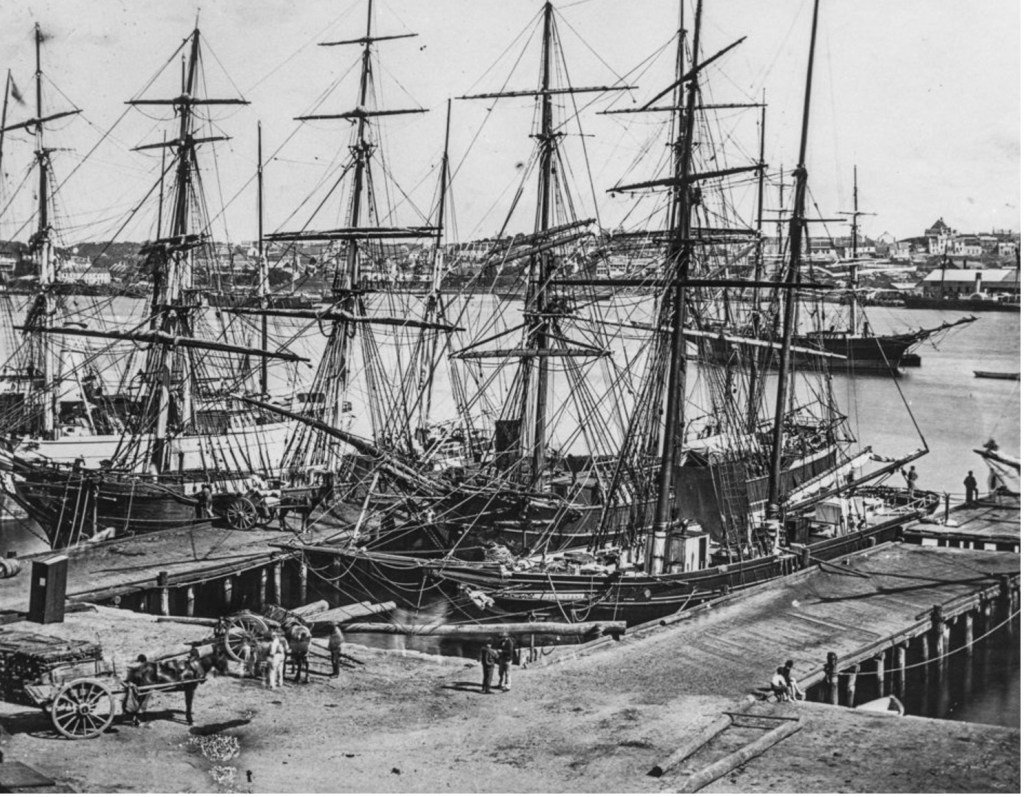
Jessie Kelly (front), near Darling Harbour, Sydney [City of Sydney Council]
Marine Board of Inquiry
The Newcastle Morning Herald and Miners’ Advocate of 25 November 1886, page 3, reported:
‘Yesterday afternoon an inquiry was opened by the local Marine Board into the circumstances attending the loss of the Jessie Kelly at Shoal Bay. Captain Allen presided, and the other members present were Messrs. R. B. Wallace, C. F. Stokes, and John Reid. The first witness called was James Conway, who stated that he had been captain of the Jessie Kelly and held a master’s certificate. They left Newcastle on Tuesday, the 16th inst., with a load of coals for Sydney. The wind was from the north-east. At 4 o’clock the next day the wind fell to the south, and about 5 a.m. it freshened and got to the S.S.W. He put the ship on the starboard tack, and stood to the south east. About 7.30 a.m. the wind gradually freshened from the same point, and the sea increased, with thick weather.
Witness consulted with the mate about going away for Port Stephens, which they did. At 7.45 p.m. they rounded the lighthouse, and at 8.20 came to anchor in Shoal Bay, in 3½ fathoms of water. Got under weigh on Thursday, the 18th, at 8 p.m., with the wind blowing from the east. They beat down to the North Head, and the wind falling light, with the flood tide beginning to make, he went back into Shoal Bay; he could not get out. On Saturday the 20th, at 4 p.m., got under weigh in company with several other vessels. They beat down and stood over for North Head on the starboard tack. When sufficient room had been secured for staying the ship, he did so, but she missed stays. The sea was very confused at the time, and the wind light squalls varying from E.N.E. to E.S.E. The helm was hard down at the time, and he had the mainsail lowered. Earlier in the voyage the mainsail was split.
The vessel veered round two points, and then stopped, and the sea and tide took command of the vessel altogether; she was up to that running about five knots. Both anchors were let go, as she would neither stay nor wear; but they could not stop her. The ship then drove ashore, and struck just as they were lowering the boat. He had ordered the boat to be lowered, and placed the mate and another man in her to let go the tackle when she struck the water. He then ordered all hands into the boat, and told the occupants to keep near the ship’s side until he got the papers. Witness met one of the men coming off the poop, who told him not to go into the cabin, as the floor was covered with water. He told the man to jump into the boat and went down into the cabin. He entered his own room and secured the log-book and papers. When he was leaving the cabin the water was up to his knees.
He got on deck and made three attempts to get into the boat, but failed in each. The sea then boarded the ship on the starboard side and carried everything away. She was then going towards the rocks, and witness sang out to the men in the boat to take her astern and he would jump into the sea. One of the men in the boat cried out “For God’s sake jump.” As the boat was going astern he told the crew to stand by in order to pick him up if he fell into the water. Witness then jumped off the taffrail, and succeeded into getting into the stern-sheets of the boat. A start was made for shore, and the boat was picked up by the steamer Kingsley.
The Jessie Kelly had broken up in a very short time. There were four sailors, the mate, and witness on board. There was no cook on board this voyage. By the Board: The mainsail was split some time before the accident. The sail was 18 or 20 months old, and was a good sail. If the mainsail had not split I do not think I would have borne up for Port Stephens. We were short two men on this trip—the cook and one of the men, who was ashore getting a sail repaired. The mainsail which was split was the only one on board. I believe that when I left Shoalhaven I was justified in doing so, considering all the circumstances. I would have been master of this vessel two years next April. The mainsail was a new one when I joined the ship, and there was 550 yards of canvas in it. At this stage of the proceedings the inquiry was adjourned until this morning at half-past 10 o’clock.’
The Newcastle Morning Herald and Miners’ Advocate of 26 November 1886, page 7, continued the report on the Marine Board of Inquiry:
‘Captain Conway continued his evidence : When they left Shoal Bay it was highwater slack. When they started from Shoal Bay he considered the vessel perfectly seaworthy. His opinion was that the immediate cause of the wreck was the unsettled state of the wind, and the heavy confused sea which was running, and the setting of the tide toward the North Head. The vessel then became unmanageable and would not steer.
By the Board: He had been running to and from Port Stephens off and on for the past 20 years. Had there been another mainsail on board at the time, he thought they would have endeavoured to make their voyage to the port for which they were bound. The vessel was drawing 12 feet 4 inches of water at the time. He did not know whether the Jessie Kelly was insured or not. The mainsail was not so efficient as it might have been. The principal cause of his putting back was to have the mainsail repaired. He was steering at the time she went ashore.
Joseph Gibson Branthswaite deposed that he was first mate on board the Jessie Kelly at the time she was lost. He held a master’s certificate of competency issued from the Marine Board of New South Wales. They left Newcastle on the 16th inst., the wind blowing N.E., moderate, with a very heavy sea. They got as far as Cape Three Points, when the wind changed to the S.S.W. This was about 4 o’clock next morning, and the vessel was placed on the starboard tack. The mainsail being split, they hove up for Port Stephens. Had the mainsail not been defective they would probably have continued on their voyage. It was not blowing hard enough to take in any reefs.
Captain Conway consulted with witness about the weather, and they both agreed that it would be best to bear up, as they did not like the look of the weather. They ran up to Port Stephens and anchored in Shoal Bay that evening, where they remained until the next night. When the weather cleared up they got under weigh again, with a light easterly wind. When they reached the heads the wind died away, and they proceeded back to an anchorage on the ebb tide, and they remained until Saturday, when they again got under weigh, with the wind from the east ward, and again worked down to the heads. On the last board she, however, missed stays, and they tried to wear her; put the helm up and the mainsail down, but found she would not pay off. She would not hold, and although the anchors were let go she went ashore.
A boat was launched from the davits, into which the crew got, the captain being the last to leave the vessel. They were picked up by the steamer Kingsley and conveyed to Port Stephens. He considered that the mainsail itself was a good one, but the twine by which it was sewn had parted. G. D. Nelson, an able seaman, deposed that he was engaged on the Jessie Kelly at the time she was lost. His evidence was almost corroborative of the previous witnesses’ statements.
This closed the evidence, and after some deliberation a decision was arrived at as follows:—The board find that in consequence of the threatening appearance of the weather, and the splitting of the main sail, there being no spare one on board, the master bore up for Port Stephens, and that in beating out she missed stays owing to the falling of the wind and the action of the tide and sea, and drifted on to the rocks, and became a total wreck. The board are of opinion that the master, James Conway, did all in his power to save the vessel, and therefore do not find him in default.’
68. Wreck of Fanny – 1887
The Sydney Morning Herald of 11 June 1887, page 12, reported:
‘The North German Lloyd’s steamer Lubeck, which arrived early yesterday morning from Apia and Tonga, brought Samuel Webber, master, and John Driscoll, mate, of the cutter Fanny. which was abandoned by them in a sinking condition about 60 miles due east of Port Stephens on Thursday.
The particulars of the abandonment, and what led to it, are contained in the following statement by Captain Webber:—”The Fanny was a vessel of 10 tons register, owned by Mrs. Furnell, of Parramatta, and was well known on the coast. She left here at 7 o’clock on Monday morning last, with a freight of iron, for Broken Bay, and had a very light breeze going down the Harbour, and until reaching between the Heads, when the wind increased to a strong breeze from the westward. The wind freshened as the day wore on, and the vessel could not therefore get into Broken Bay Heads during the day.
At night however, she stood in towards the land, the wind having veered round to S.W., and she fetched off Barrenjoey at 7 o’clock. Just at that time the vessel was struck by a terrific squall from S.W., which literally laid her over on her beam ends, and split every sail she had on her. What was left of them was secured, and the anchor was let go with 50 fathoms of chain, the cutter being them about half a mile from Barrenjoey. The anchor, however, would not hold her, and by next morning, what with the ebb tide and the southerly current, she had drifted 15 miles to S.E., and was off Long Reef.
Seeing that there were no hopes of a steamer picking the vessel up there, Captain Webber, with the fragments of canvas he had left, made what sail he could and steered for Newcastle, the wind being then from W.S.W to S.W. The same night the Fanny arrived off Newcastle light, 15 miles to the eastward, but she could not get in there owing to the wind, and she was then turned for Port Stephens. The sea rose very much and broke over the vessel several times on the run down, and to add to the trouble the wind was so unsteady that when she did reach off Port Stephens, late the same night, she could not affect an entrance.
During the following morning the wind veered round again, and blew right off the land, driving the little craft steadily but surely out to sea, despite all the two men could do to prevent it, and the sea became rougher. On Wednesday one sea struck her heavily, causing her to spring a leak; and as the wind freshened up again the vessel had to be kept running before wind and sea. The sea which caused the vessel to leak swept the com- pass overboard, and Captain Webber simply steered his un-fortunate craft by the rising of the sun and the setting of the moon.
On Thursday, at noon, by which time both men were completely exhausted, having been continually on duty without any sleep, and with little nourishing food from Monday morning, a steamer was sighted, and in answer to their signals of distress bore down upon them. By this time the Fanny was in a very bad state, without compass, all her rigging damaged, little or no sail, and leaking at the rate of about nine inches an hour. Still Captain Webber wanted to try and save his vessel, and so when the Lubeck, for such the steamer proved to be, came up and offered assistance, he tried hard to get her taken in tow.
This, however, was quite out of the question, as the Lubeck, being bound to time, could not do anything of the kind; but even if Captain Schmolder had been ever so willing, it would have been useless in the heavy sea that was running, to try and tow so small and so frail a craft, as she would have gone under. So in response to the kind offer of Captain Schmolder, who sent his chief officer, Mr. Richter, and a boat crew in one of the Lubeck’s lifeboats, Webber and his mate Driscoll left the Fanny and went on board the Lubeck, where Captain Schmolder, treated them with every attention that sympathy and kindness could prompt from that time until the Lubeck arrived at the Circular Quay.
Mr. Richter proposed to set the Fanny on fire, but Captain Webber considered this unnecessary, as the vessel was leaking considerably, and would no doubt sink before many hours had passed. She remained upright while in sight from the Lubeck. The Fanny was not insured.’
69. Wreck of Joker – 1887
The Daily Telegraph of 14 November 1887, page 4, reported:
‘A telegram from Nelson’s Bay yesterday stated that the ketch Joker, a well-known coaster, had gone ashore on the north beach, but was not in any immediate danger. The same station reported that the brigantine Malcolm and a ketch (name unknown) had anchored in the Fly Roads [near Port Stephens Lighthouse], Port Stephens, with three sails blown away.’
The Newcastle Morning Herald and Miners’ Advocate of 15 November 1887, page 4, also reported:
‘The ketch Joker, employed in the coasting trade, went ashore on the North Beach at Nelson’s Bay during the heavy southerly gale on Saturday. She is reported to be in no immediate danger. The Joker is a wooden vessel of 28 tons, built at Williams River, N.S.W., in 1885, and owned by Messrs. J. Weston and J. Beveridge, of Newcastle.’
70. Wreck of Shamrock – 1889
The Foundering
The Australian Star of 10 May 1889, page 4, reported:
‘The ketch Shamrock left this port [Nelson Bay], bound for Sydney, at 5 p.m. yesterday. The captain and crew returned here this morning in the ship’s boat, and reports that the ketch foundered last night about 14 miles south-east of Port Stephens light. No lives have been lost.
The Shamrock was a wooden ketch of 31 tons, and owned by Messrs. J. Weston and P. Callen. She was built at Brisbane Water (N.S.W.) in 1867. Her measurements were: Length, 64ft; beam, 16ft 6in; and depth of hold, 5ft 1in.’
The Evening News of 10 May 1889, page 5, also reported:
‘A telegram received from Nelson Bay, this morning, states that the ketch Shamrock foundered off Port Stephens, but all hands succeeded in reaching shore in safety. The Shamrock was a wooden ketch of 34 tons, and was built at Brisbane Water in 1867, and was owned by Messrs. Jos. Western and Peter Callen. She was 64ft in length, with a beam, of 16ft 6in, and 5ft in depth, of hold. She was employed in the timber trade on the northern rivers and is believed to have been partially insured.’
Marine Board of Inquiry
The Newcastle Morning Herald and Miners’ Advocate of 23 May 1889, page 5, reported:
‘An inquiry into the cause of the foundering of the ketch Shamrock, of Newcastle, off Morna Point on the night of the 9th instant, was commenced on the 15th instant. The members of the Board present were: Messrs. H. R. Cross (chairman), C. F. Stokes, R. B. Wallace, and John Reid. After the captain’s evidence had been taken, the Board adjourned until yesterday for the purpose of hearing the evidence of the two men who comprised the crew of the vessel. The following evidence was given : Edward O’Brien, master of the ketch, deposed that the ketch left Port Stephens for Sydney, timber laden, on the 9th inst., and passed through the Heads at 4.30 p.m. with wind northerly, weather moderate, and sea smooth; set all sail and ran before the wind, passed Stephen’s Point at about 6 p.m., pumped out the vessel himself, and took the helms at 8 p.m. after having sent the two men below.
He then saw water on the cabin floor, and called the men out to see where it came from. The men discovered that she was leaking fast. Then lowered the square sail down and hauled vessel on the wind with the intention of beaching her, and started pumping at same time. As he found the water gaining rapidly he launched the boat and put water and bread in it. Stayed by the vessel for about an hour, when she went down. Took the boat to the Fly-roads [near Port Stephens Heads] and landed.
The vessel was about nine miles off the land when she went down. Witness lost all his effects and master’s certificate, &c. Accounted for the leak through the starting of a butt. The top sides were caulked before leaving Port Stephens. Believed her bottom was sound. The ketch was 22 years old. Witness bought a half interest in the vessel in January last, which was insured for £150. He owed that amount on her, and therefore lost all the money. She had never struck anywhere after her bottom was last sighted. When she left port she was only three-parts loaded. The crew, David Waller and Richard Flood, who were examined yesterday, corroborated the captain’s evidence. The finding of the Board was “that the captain was justified in abandoning the vessel.”
71. Wreck of Susie – 1891
The Foundering
The Newcastle Morning Herald and Miners’ Advocate of 15 January 1891, page 5, reported:
The fore-and-aft schooner Susie, as she was making her passage along the coast on Monday night, struck on the rocks about 10 miles south of the Port Stephens light. The wind was fresh from the south-east at the time, with thick showery weather. The sea was moderate, but the roll was heavy enough to show the crow that any further delay on their part would probably result in loss of life. The schooner was evidently doomed, and her complete breaking up appeared to be only a matter of time. The single boat carried by the vessel was launched, and the skipper and his crew, four all told, put off and made for the friendly light, which could be occasionally seen through the gloom.
After considerable difficulty, and not a little danger, the party arrived at Nelson’s Bay, where they were hospitably received by the residents. The Susie was a wooden fore-and-aft schooner of 44 tons, built at Brisbane Water in 1879, her owner being Mr. John Stevens, of Sydney. Her dimensions were:—Length, 58ft 6in; beam, 10ft 2in; depth of hold, 6ft 8in. She was considered to be a staunch vessel, and well found for her class.’
The Crew in Newcastle
The Newcastle Morning Herald and Miners’ Advocate of 17 January 1891, page 4, reported:
‘Captain Holmes and two seamen of the above-named vessel [Susie] called at the residence of the shipping master, Mr. C. H. Hannell, on Thursday night in a distressed condition. Mr. Hannell at once looked after the men, and had them provided with various articles of clothing, and obtained them passage to Sydney by the steamship Newcastle. Captain Holmes states that the Susie foundered about eight miles south of Port Stephens on the morning of Wednesday last.’
Marine Board of Inquiry
The Newcastle Morning Herald and Miners’ Advocate of 3 February 1891, page 5, reported:
‘The Marine Board commenced an inquiry this afternoon into the loss of the schooner Susie, which foundered at sea on the night of January 13, when about nine or ten miles off Port Stephens. Captain Hixson presided. There was a full board present. Thomas Holmes, master of the Susie, said: All hands were saved. The Susie was a schooner of 44 tons register. He did not think she was insured. He thought she was registered in Sydney. He did not know where she was built. He held a master’s certificate, which, was lost.
The Susie was bound from Newcastle to Sydney with between 60 and 70 tons coal. The wind was south to south-west, blowing fresh and squally. When off Catherine Head they had a puff, and stood out a little. As night came on the weather became thicker, and he decided to run back. Shortly after picking up the Port Stephens light the vessel commenced to leak and appeared to open up. He kept the pumps going, and at the same time kept bailing out as fast as possible. The water gained so fast that he decided to abandon her. The water was then up to the rail. She gave one roll to windward, and then one to leeward, and went down three minutes after they had left her. They landed the boat at Narrowgut Bay. At this stage the case was adjourned for further evidence.’
The Evening News of 10 February 1891, page 2, reported on the conclusion of the Marine Board of inquiry:
‘Yesterday Captain Hixson presided over a full Marine Board to adjudicate upon the cases of the foundering of the schooners Susie and Surprise. In the first-mentioned case the captain of the Susie was recalled and stated that he could not produce further evidence. His chief officer had, he believed, gone to San Francisco. The president stated that the board would not, under those circumstances, give any decision.’
72. Wreck of Amphitrite – 1891
Initial Report of the Shipwreck
The Evening News of 3 March 1891, page 4, reported:
‘The well-known coasting barque Amphitrite went ashore on Monday night on the north-east side of the Station Peak, Nelsons Bay. She lies with her back broken. The masts are still standing.
The Amphitrite is a wooden barque of 129 tons, built at Jervis Bay in 1867, and was rebuilt in 1870. Her dimensions are: Length 116ft, beam 22ft, and depth of hold 7ft 7in. She is owned by Mr. W. T. Yeager, timber merchant, of Pyrmont.’
The Foundering
The Newcastle Morning Herald and Miners’ Advocate of 4 March 1891, page 3, reported:
‘The old coasting sailing vessels of New South Wales are fast dwindling away by catastrophes, such as foundering at sea and being driven ashore. On Monday night another loss occurred, when the three masted schooner Amphitrite was wrecked on the rocks south of Port Stephens, South Head, when on a voyage from the Richmond River to Sydney, with a timber cargo. A telegram was posted outside the telegraph office [at Newcastle] yesterday morning from the lighthouse-keeper at Port Stephens, stating that a barquentine was ashore on the rocks, South Head, Port Stephens, but he had no particulars to hand at the time.
A second message stated that the vessel reported ashore was the schooner Amphitrite. During the afternoon Mr. John Reid, the local agent for the vessel, received a wire from the captain stating that the mate had been badly injured, and would come on to Newcastle by the steamer Kingsley that night, and asking him to secure accommodation for the unfortunate man in the Namoi for conveyance to the Sydney Hospital.
The arrival of the Kingsley was anxiously awaited, and a number of citizens and sympathisers were on the wharf eager to learn particulars of the disaster. About 7.30 p.m. the Kingsley reached the wharf. The mate, Walter Graham, was found lying aft on a stretcher, and although suffering acutely from the effects of injury to his right leg, seemed quite hearty, and told the following story of the wreck:—”We left Newcastle on the 13th ultimo, coal laden, for the Richmond River, where we arrived after a very smart run of under two days, beating vessels that had left several days before. After discharging coal, we loaded timber for Sydney at the owners’ sawmills, Coraki, consisting of 87 logs of pine, and the balance of sawn boxwood. We were towed down the river, and remained for two days, weatherbound, inside.
On Friday last at noon we weighed anchor, and cleared the heads with light variable airs, which lasted till Monday. We were then off Cape Hawke; and at 4 o’clock p.m. a terrific easterly gale, which could be seen coming, struck the vessel, and seemed to tear her almost asunder. This was followed by a mountainous sea, which swept the decks, knocking her about like a cask in the water. Whilst battling with the ferocious elements, the vessel sprung a leak. All hands were ordered to the pumps, but, in spite of their efforts, the water gained on them, and it was found the vessel could not float long.
The captain decided to make for Port Stephens, in order to save life and cargo, and at 8.30 p.m., after an anxious time, the vessel was abreast of the port. By this time she was half-full of water, and making but little progress. At 9 p.m. she was running straight for the heads, when I was steering. I was washed away from the wheel by a big sea, and got my legs jammed between a log of timber and the coop, and was badly bruised. The same sea carried the log away, and left me free. The vessel then gibed at her will to the southward. By the time the wheel was manned there was not sufficient room to wear her away, so she drifted broadside on to the rocks, a little to the south of the South Head, with big seas breaking over her.
Lying in this position she acted as a breakwater, and thus we were enabled to lower the ship’s boat, into which all hands jumped. The boat was swept on to the rocks near the shore, from whence all hands reached the shore after great difficulty. The weather at the time was very thick. The crew consisted of seven, all told, including Captain Haggs, the mate (Walter Graham), a cook, and four A.B’s. [able bodied seamen], all of whom were on their final voyage on the vessel. The captain was the last to leave the boat, and as he did so a wave came up and smashed it to pieces. All hands scrambled up the rocks, dragging me (the mate) with them into the bush.
Two of the crew were then dispatched to the lighthouse for matches to light a fire. They returned soon after midnight, and lighted a big fire, round which all hands gathered and remained till morning, the rain pouring down all the time. At an early hour yesterday morning, the telegraph master and lighthouse men arrived with a quantity of provisions and comforts for us. A stretcher was made for me, and about 1 p m. I was carried to Port Stephens to the Kingsley by my mates and many helping hands from the village, and conveyed to Newcastle.”
The mate was here met by Mr. John Reid, junr., who had him taken on board the Namoi for Sydney. When Graham was leaving, the vessel was a total wreck, she having almost broken in two, with the masts falling down. During the morning the crew went off to her and secured their clothes, but the captain and mate lost everything, the cabin being washed away.
The Amphitrite was a wooden three-masted schooner, owned by Mr. W. T. Yeager, of Sydney, who is also the owner of the steamer Oakland and other vessels trading to the Richmond River from this port. and Sydney. She was built at Jervis Bay in 1867, and registered in Sydney in 1870. Her register was 120 tons. The following were her dimensions :—Length, 116ft; breadth, 22ft; depth, 7ft 7in. She is believed to be uninsured. The cargo was valued at about £500.
The captain and crew are remaining by the wreck in the hopes of saving some of the gear. Mr. Yeager has been unfortunate with his sailing vessels. During the past three years he has lost two others, neither of which were insured. They were the schooners Neptune and Emu, lost about the same time three years ago, off Gabo Island and Crowdy Heads respectively. Graham speaks in the most kindly terms of the treatment received from the residents of Port Stephens, and Captain Dalton of the Kingsley. The tugs Gamecock and Emu left the harbour yesterday afternoon on a salvage expedition for the wreck. Both tug boats returned to port last night, and reported that the vessel was breaking up fast. Her stern was torn away, and the wreckage floating in all directions. Nothing could be done for the vessel. The mizen mast was carried away.’
Lighthouse Officers Provide Assistance
The staff of the Point Stephens lighthouse helped the shipwreck survivors. The Daily Telegraph of 4 March 1891, page 5, reported:
‘Intelligence reached Newcastle this afternoon that the three-masted schooner Amphitrite, an old trader on the coast, had become a total wreck near the entrance to Port Stephens. …..
Finding that the vessel was hard and fast on the rocks, a boat was lowered and those aboard, consisting of Alfred Hogg (master), Walter Grahame (mate), the cook and four able seamen, names unknown, got into it and succeeded in reaching the beach. Just as Captain Hogg stepped into the boat the vessel commenced to break up, Grahame, who is badly injured about the groin and spine and otherwise bruised, was with difficulty got ashore.
Two of the crew then made their way to the lighthouse at Port Stephens, and reported the disaster. A fire was afterwards lighted, and the crew remained on the beach all night. This morning the lighthouse-keeper and a number of residents of Port Stephens supplied the shipwrecked people with provisions, etc.’
Hospitalisation of Crew Member
The Australian Star of 5 March 1891, page 2, reported:
‘Walter Grahame, mate of the schooner Amphitrite, and who was so severely injured in the wreck of that vessel near Port Stephens on Monday, arrived here from Newcastle yesterday, and was removed to the Sydney Hospital, where he was placed in one of the accident wards for treatment. Grahame, it will be recollected, was at the wheel at the time of the accident, and the Amphitrite was nearing the entrance to Port Stephens when the vessel shipped a very heavy sea, washing the unlucky helmsman away, and jamming him between some logs of timber and the poop. ……. It was with the greatest difficulty that the mate was transhipped and brought safely ashore, his injuries being very painful and rather severe. He seems to have been somewhat seriously injured about the spine, and also complains of having had his groin hurt.’
The Captain’s Story
The Australian Star of 6 March 1891, page 6, reported:
‘The captain and crew of the three-masted schooner whose wreck was reported in the Star a few days ago, arrived in Sydney by the Namoi from Newcastle this morning.
The facts of the disaster are briefly that the vessel, bound from the Richmond to Sydney with timber, experienced a terrific easterly gale off Cape Hawke on Monday last. The first squall seemed to tear her asunder. A mountainous sea swept her decks and the vessel from the great straining sprang a leak. All hands were kept at the pumps, but they could not keep the water under.
It was then decided to bear up for Port Stephens, in order to beach her and save the cargo. When nearing the Heads — the mate, steering— a huge sea broke on board, washing the mate between two logs, where he was jammed, and sustained such injuries that he had subsequently to be carefully removed to the Sydney Hospital. The vessel being left without guidance, was hurled on the rocks and commenced to break up; but fortunately, the crew were enabled to get into the boat, and reached Port Stephens in safety. They proceeded on to Newcastle and thence came on to Sydney. ……..
Captain Haggs states that he has nothing to add to the statement of the mate, Walter Graham. After Graham was seen safely on board the Kingsley on Tuesday the captain and crew returned to the scene of the wreck and camped in the bush during Wednesday and yesterday; they succeeding in saving most of the cargo, which was hauled up on to the beach. They remained by the wreck till yesterday afternoon. By then the vessel had completely broken up and was floating about in small pieces. The captain lost everything he had on board, but the seamen got most of their things from the wreck on Tuesday. They all proceeded to Sydney last night by the Namoi.’
The Northern Star of 11 March 1891, page 6, reported on previous injuries that Captain Hagg had suffered:
‘In connection with Captain Hagg, it may fairly be said that his misfortunes have been many. About 18 months ago, during the heavy gales at Byron Bay, in which many vessels were driven ashore, Captain Hagg, in the Bannockburn, had both his legs broken, and he is now, no doubt, a heavy loser pecuniarily.’
The Richmond River Herald and Northern Districts Advertiser of 20 March 1891, page 4, reported:
‘Last week the Marine Board held an inquiry into the wreck of the schooner Amphitrite. Alfred Hogg, master of the Amphitrite, stated that the vessel had become a complete wreck while making for Port Stephens; she was a three masted schooner of 129 tons register, and was owned by Mr. W. T. Yeager, Richmond River; who took in a cargo of timber and left the Richmond River on the 28th February; off Cape Hawke they experienced a heavy gale from the north-east, with a nasty cross sea; the cross sea caused the vessel to leak, and the pumps not being able to keep her free from the water he made for Port Stephens to get shelter; while doing so the man at the wheel was washed away and the vessel shipped a sea; she then became so full of water as to be unmanageable; the anchor was dropped, and she went ashore…… ; he had been to Port Stephens frequently before.
Three witnesses gave evidence attributing the loss of the vessel to the fact that she was unmanageable through the amount of water in her. The Board reported that the loss was caused by the vessel broaching to and drifting on to the rocks, in consequence of the helmsman being washed from the wheel by a heavy sea in an attempt to enter Port Stephens for shelter; and that no evidence had been adduced upon which to found a charge against Alfred Hogg, the master.’
73. Wreck of Bound to Win – 1893
The Foundering
The Newcastle Morning Herald and Miners’ Advocate of 23 October 1893, page 5, reported on the sole survivor of the Bound to Win foundering:
‘On Saturday morning the Government steamer Thetis arrived in the harbour [Newcastle] from Port Stephens with Captain Mills on board, the sole survivor of the wreck of the ketch Bound to Win, which was capsized on Friday afternoon whilst entering the Heads at Nelson’s Bay. On arrival Mills reported the sad fatality to the local Marine Board and also at the shipping office. An inquiry concerning the affair will be held in Sydney.
He was supplied with a complete outfit of clothing by Mr. J. J. Mason, the deputy shipping master, who is acting as agent for the Shipwrecked Sailors’ Society. The captain also received an order for admission to the Sailors’ Home and a pass by the steamer for Sydney. He left here on Saturday night. On being interviewed by a representative of this journal, he stated that the report already published was correct excepting that the man who had the lifebuoy was the passenger (Augusta) and not the mate.
The vessel left Sydney at 7 p.m. on Thursday with six tons of ballast, bound for Port Stephens, to load timber for Sydney. After clearing the Heads she met a fine south westerly wind. At 10 a.m. on Friday she was abreast of Nobbys, spinning along before a fair wind, under all canvas. When a little to the north-east of Nobbys the wind freshened, in consequence of which the gaff topsail was made fast and all the sails were reefed. When nearing Nelson Bay Heads the wind died away almost to a dead calm.
About 2 p.m. the ketch was between the Heads when a sudden and most violent squall from the mountains struck the vessel, and she capsized, turning bottom upwards. All hands—including Captain Mills, Middlemas (the mate), Peterson (cook and A.B.), and Augusta (the passenger) succeeded in scrambling on to the keel of the upturned craft, and remained there for about 10 minutes, when they were again thrown into the water by the vessel turning on to her side. All hands again reached the vessel, and held on to the rail, but scarcely had they reached her when she filled and sank by the bow.
Mills then called out to every man to look after himself, as the vessel was going down. He started to swim himself for some wreckage which was floating a little distance away. As he was struggling through the water he saw Augusta with a lifebuoy, and at that time he seemed to be all right. The other men whom he knew could swim he did not notice, but believed that they were swimming after some pieces of wreckage. He did not see any of the men after that, but heard one call out, ” My God, my God.” He is of opinion that all went down soon after the ketch sank.
Mills swam a good distance trying to collect sufficient wreckage to float on, and after a time he got the coverings of the two hatches, on which he lay down almost exhausted. For about three hours and a half he remained on this impromptu raft, when he was picked up by the Government steamer Thetis. The steamer cruised about in the vicinity of the wreck, but failed to find any trace of the three missing men. Mills adds that when taken on board he was treated with the greatest kindness and placed in the state cabin, which was being used by the Ministerial party that was on board. The necessary restoratives were applied, and he was comfortably wrapped up in blankets and allowed to remain quiet till nearly 10 o’clock that night. He remained at Port Stephens till Saturday morning and was then sent on to Newcastle by the steamer, where he was landed on Saturday morning. The vessel is insured in a Sydney office.’
The Sydney Morning Herald of 24 October 1893, page 5, further reported:
‘The Government steamer Thetis arrived on Saturday from Port Stephens, with Captain Mills on board, the sole survivor of the wreck of the ketch Bound to Win, capsised on Friday afternoon whilst entering the heads at Nelson’s Bay. The inquiry is to be held in Sydney. Captain Mills was looked after here, receiving admission to the Sailors’ Home and a pass by the steamer to Sydney on Saturday night.’
Marine Board of Inquiry
The Australian Star of 24 October 1893, page 6, reported:
‘The story of the foundering of the ketch Bound to Win was told before the Marine Board this afternoon. The Bound to Win was capsized in a squall outside Port Stephens last Friday, two of the crew and a passenger being drowned. An inquiry was today instituted by the Marine Board. The only evidence taken was that of James Mills, captain of the ill-fated vessel. She was owned, he said, by Mr. Beattie, of Balmain, from whom he rented her. She was a 32-tonner and was engaged in the timber trade between Port Stephens and Sydney, coming to Sydney with timber and returning with ballast. She was a well found vessel.
She left Sydney on Thursday evening last at 7 o’clock and reached the outer light of Port Stephens at 1 p.m. on the following day. The wind was west by south-west and was blowing pretty hard. The captain had the sails reefed to beat up into the port. There was a reef in the mainsail and one in the mizzen. The Bound to Win was suddenly struck by a heavy squall from overhead, and instantly capsized, there being no time to let go the sheets. The squall that struck her was exceptionally heavy. Witness, with all on board, was thrown in the water. Witness said he gave the only life buoy there was to the passenger, and an hour after the vessel went down he saw him clinging to the buoy.
Witness kept himself afloat for an hour and then clung to the main hatch which came to the surface after the vessel went down. He saw the A.B. [able bodied seaman] swimming about, but never once caught sight of the fourth man after the accident occurred. Witness was rescued by the Thetis after being three and a half hours in the water, but no trace of the other three could be found. The Bound to Win sank in about 16 to 20 fathoms of water, and at the time had her usual cargo of six tons of ballast.
The board found that the vessel was capsized by a very heavy squall, which came from the highlands, striking her, and that there was no evidence on which to found a charge of default against the master. President Hixson congratulated Captain Milis on his escape, and said he had had a hard time of it. The board, however, would do all it could to put him on his legs again, and would give him a new certificate in place of the one he had lost by the capsize. He pointed out that had the captain belonged to the Ship-wreck Relief Society he would have been entitled to an amount which would have proved very serviceable in the present emergency.’
Recovery of a Body
The Newcastle Morning Herald and Miners’ Advocate of 24 October 1893, page 5, reported:
‘Yesterday morning Captain Weatherill, the secretary of the local Marine Board, received a wire from the Customs officer at Port Stephens stating that the body of one of the three unfortunate men who were drowned through the capsizing of the ketch Bound to Win, on Friday last, had been washed ashore. The body, which was found on the beach at Shoal Bay, was lashed to the life buoy. This is supposed to be that of Augusta [Hammerstad], who was a passenger by the vessel. A telegram to Inspector Lynch later in the day stated that the body had been identified as that of Augusta, the hairdresser, and it was picked up at Shoal Beach, some two miles from the scene of the disaster. As the deceased was clinging to a lifebuoy, it is thought that he died from exposure and exhaustion. The Raymond Terrace coroner (Mr. Carmichael) will initiate a magisterial inquiry at Port Stephens this evening.’
The Evening News of 25 October 1893, page 6, further reported:
‘An inquest touching the death of August Hammarstadt, who was drowned by the wreck of the ketch Bound to Win was commenced before the district coroner, Mr. Carmichael, yesterday, and was adjourned pending the arrival of James Mills, captain of the wrecked ketch. The unfortunate man’s wife and relatives arrived in time for the burial. It was heartrending to witness the grief of his widow. The remains were followed to their last resting place by all the inhabitants. No other bodies have as yet been found. The masthead of the Bound to Win is visible three feet out of the water near the place where she was wrecked.’
Ship’s Master Offers Thanks
The Australian Star of 27 October 1893, page 6, reported:
‘The sole survivor of the ketch Bound to Win (Mr. James Mills, the master) is desirous of thanking the master, crew and passengers of the steamer Thetis, which rescued him, for their noble action in saving his life and reviving him after his three and a half hours’ immersion in the water. The Premier, who was among those aboard the Thetis; was as good as a doctor, says Mr. Mills. He was subjected to a course of treatment including hot baths, chafing with towels, &c., which finally succeeded in restoring him after four hours’ treatment. Every kind of nourishment was supplied, and altogether he was kindly treated, Mr. Mills also desires to acknowledge his gratitude to Mr. Lyne, junior son of the Minister for Works, who first discovered him in the water.’
The Evening News of 28 October 1893, page 5, further reported:
‘Captain James Mills, the sole survivor of the ill-fated ketch Bound to Win, which capsized off Port Stephens on Friday last, called at the News office [of the Evening News] today. The captain, who is a plain-spoken seaman of Swedish birth, said he wished to convey his hearty thanks to the officers and crew of the steamer Thetis and also to Sir George Dibbs, Mr. W. J. Lyne, and other gentlemen who were on board.
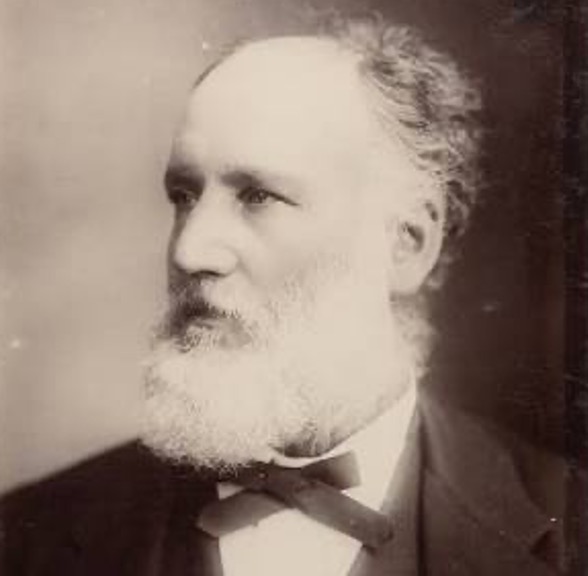
Sir George Dibbs, NSW Premier 1891 – 1894.
Captain MIlls said when the ketch capsized, she turned bottom up, and all hands got on her keel for about eight minutes. Then she rolled on her beam ends and sunk. He flung a lifebuoy to the passenger and saw him in it half an hour later. Peterson, one of the crew, he never saw after she sunk, and Middleman was swimming for 20 minutes after the vessel disappeared. “I got hold of a hatch,” said the captain, “and was on it for about three hours and a half. Just as I was about done and could scarcely hold on I was picked up by the Thetis’s boat and taken on board. The kindness I received from all on board could not have been greater, and I thank them all most deeply. I also desire to thank young Mr. Lyne, who first saw me in the water.” Captain Mills has been at sea 15 years, 10 of which he has spent as master on the coast of this colony and be never before has had a wreck. At the Marine Board inquiry he was completely exonerated from all blame in connection with the sad affair.’
74. Wreck of Sea Foam – 1894
Shelter Sought in Post Stephens
The Australian Star of 30 January 1894, page 5, reported:
‘The ketch Sea Foam, bound from Sydney to Manning River, having met heavy easterly weather from Sydney to Port Stephens, the captain, Hugh Hackett, decided to put into Shoal Bay for shelter. After being at the anchorage for about an hour the Sea Foam commenced to drag her anchor in a very heavy squall. The captain, seeing that she was in danger, attempted to get her under way, and in so doing the vessel was driven on the beach. The Sea Foam can be got off with prompt assistance.
The Sea Foam is a wooden ketch-rigged vessel of 66 tons, built at Brisbane Water, in this colony, in 1878, and registered in Sydney under the ownership of Thomas Davis. Her dimensions are: Length, 78ft.; beam, 19ft. 4in.; depth of hold, 7ft.’
Sea Foam Become a Total Wreck
The Daily Telegraph of 1 February 1894, page 5, reported:
‘The ketch Sea Foam, which was driven ashore in Shoal Bay on Monday night at 10 o’clock during a heavy easterly squall, has since become a total wreck. On Tuesday the tide shifted her about 8ft. further on the beach, and during the night a heavy sea, with strong wind from the north-east, came in, knocking the Sea Foam about on the beach, and causing her to become a total wreck. She is now full of water, and breaking up fast.
Had prompt assistance been sent, the captain thinks the vessel could have been saved. The tug Hero, with Captain Hall, of the Sydney Underwriters’ Association, on board, cleared Sydney Heads at 9 o’clock last night for Port Stephens. Captain Hall is proceeding to the wreck of the Sea Foam at Shoal Bay.’
The Newcastle Morning Herald and Miners’ Advocate of 2 February 1894, page 4, further reported:
‘Captain Hall, of the Sydney Underwriters’ Association, arrived in Newcastle yesterday by the Sydney tug Hero, for a visit to the wrecked ketch Sea Foam at Shoal Bay. Captain Hall left Sydney at 9 o’clock on Wednesday night and arrived at Port Stephens at daybreak yesterday. He at once proceeded to inspect the wreck of the ketch, which was found to have become a total wreck.
The little vessel was then breaking up very fast, and the wreckage was strewn all over the place. The Hero then steamed on to Newcastle where she arrived about 2pm. Captain Hall returned to Sydney by rail. The Sea Foam, it is understood, is insured for £700.’
Marine Board of Inquiry Held
The Sydney Morning Herald of 6 February 1894, page 3, reported:
‘The Marine Board initiated an inquiry yesterday afternoon at their offices, Circular Quay, touching the wreck of the ketch Sea Foam at Shoal Bay, Port Stephens, on 29th January. Captain Hixson presided, and there were also present Captains O’Sullivan, Jenkins, Broomfield, Moodie, and McLean, and Commander Lindeman (secretary).
Hugh Hackett, master of the ketch, said that the vessel went ashore at Shoal Bay, Port Stephens, on the 29th ultimo and became a total wreck. Nobody was lost nor hurt by the occurrence. The ketch was one of 65 tons register and was registered in Sydney. She was owned by Mr George Walters, of Coopernook, Manning River, and was insured for £700. She was worth £1000.
At the time of the wreck she was on a voyage in ballast from Sydney bound for the Manning River. She had left Sydney at about noon on the 29th ultimo. The weather got bad at about 4 p.m., and at about 6 p.m. he decided to go into Port Stephens for shelter. There was a strong, heavy sea on, and an easterly wind. The crew numbered four all told. All went well till 10 p m. When they went through the heads at Port Stephens it was in the midst of a heavy rain storm. Half an hour after they had let go an anchor, with 30 fathoms of chain, it was found that the vessel was dragging.
Notwithstanding the efforts that were made she went ashore, though about 10 more fathoms of chain had been paid out. Witness had been seven months in charge of the Sea Foam. It was about 4 p.m. on the 30th ultimo when the vessel became a total wreck. After the anchor had been dragged, he tried to get to Nelson Bay, but was prevented by the sea and the weather, and the vessel was driven ashore.
Charles Johnson, seaman, said he thought that the captain did the right thing in anchoring in Shoal Bay. He had never before known the vessel to drag the anchor which was used on the occasion in question.
Peter Edwards, cook and seaman, said he considered that the captain had done a proper thing in endeavouring to start for Nelson Bay. The inquiry was adjourned until Monday next, when the mate is to be examined if he can be found.’
The Sydney Morning Herald of 13 February 1894, page 3, further reported:
‘The board, after deliberating, gave their decision, which was—”That the said wreck was caused by the vessel being cast ashore and becoming a total wreck during an easterly gale while attempting to get under way in Shoal Bay, near the entrance to Port Stephens, to pick up a secure anchorage in a more sheltered part of the harbour No evidence was adduced upon which to found a charge of default against Hugh Hackett, the master.”
Artifacts of the Sea Foam
The Inner Lighthouse Museum located at Port Stephens holds several artefacts of the Sea Foam which are illustrated below:
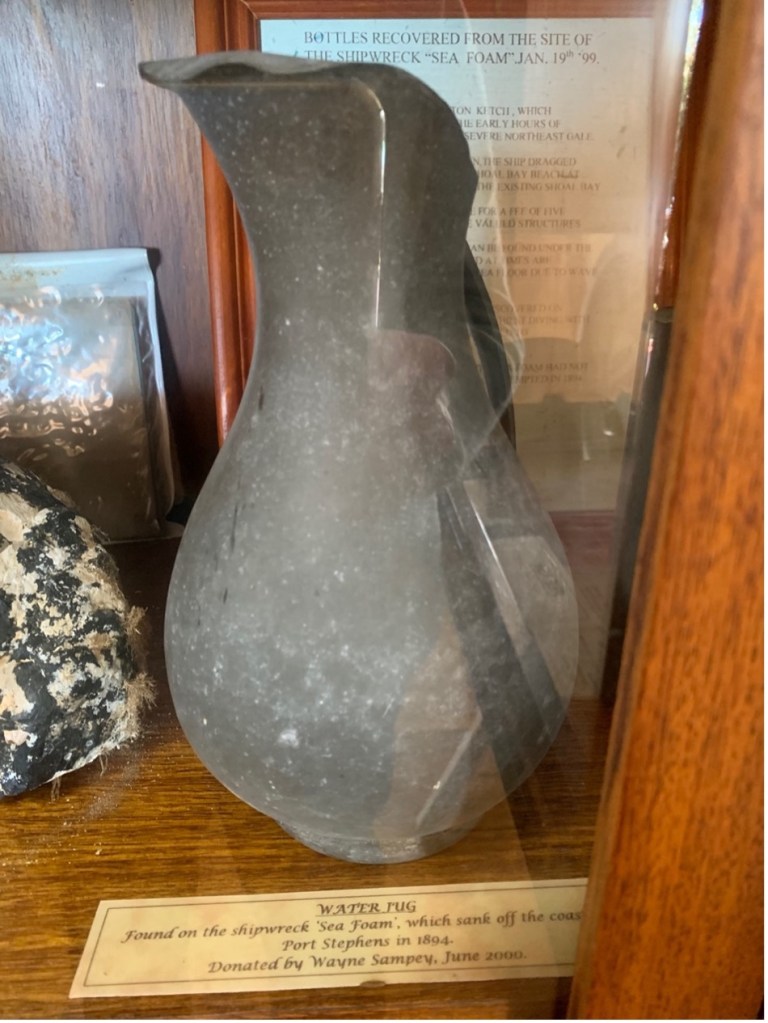
Water jug salvaged from the Sea Foam wreck site.
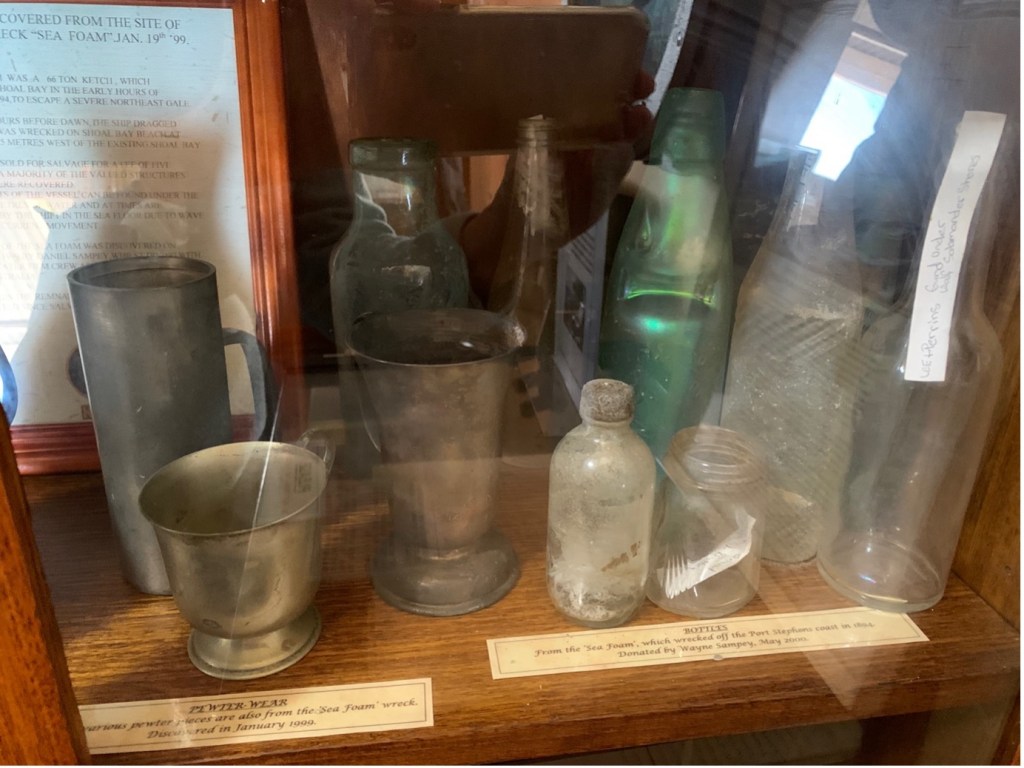
Various pewter and glass articles salvaged from the Sea Foam wreck site.
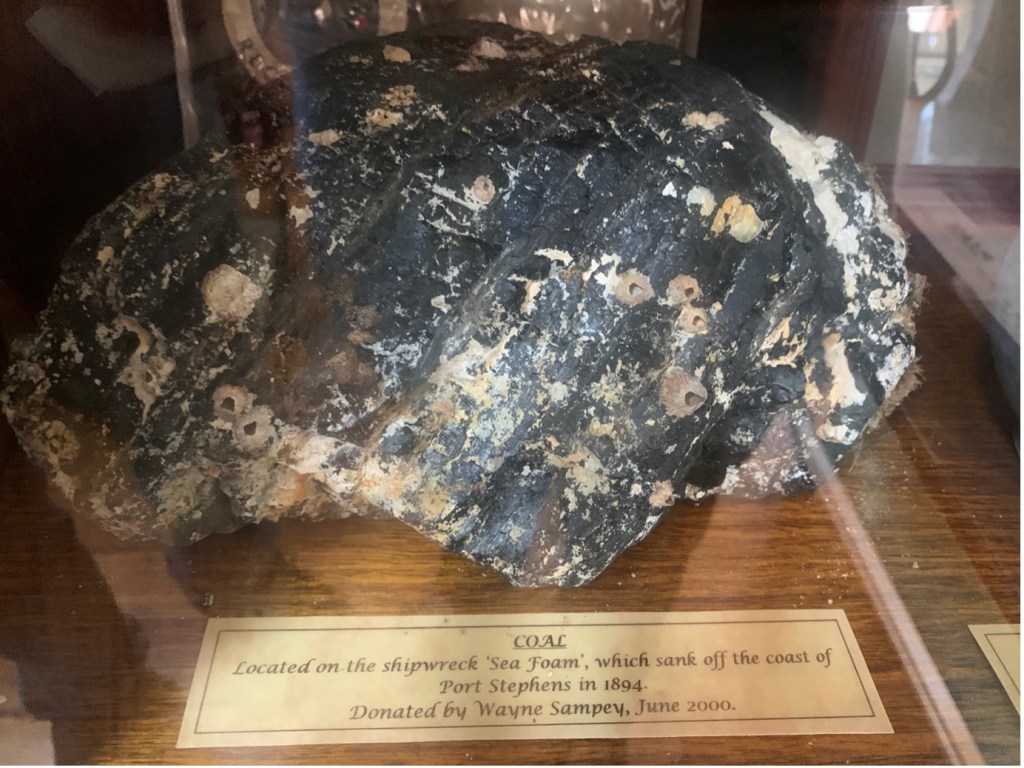
Coal located on the Sea Foam wreck site.
75. Wreck of Echo – 1894
The Foundering
The Daily Telegraph of 28 September 1894, page 5, reported:
‘Captain Nelson and the crew of the ketch Echo, wrecked at Port Stephens on Tuesday morning, reached Sydney yesterday, and during the day reported the loss of the vessel to the Marine Board. The ketch, it appears, left Sydney on Monday last for Bellinger River, and, favoured by a southerly breeze, made a good run to north of Newcastle. Here the wind increased to a gale and raised a high sea. As there was every appearance of the bad weather continuing, the captain decided to seek shelter in Nelson’s Bay. The vessel was accordingly headed for Port Stephens, and all went well until reaching the entrance, when the vessel missed stays and drifted towards the north head.
Seeing the vessel was being carried ashore, the captain let go the anchor, but owing to the fury of the gale it would not bold, and the vessel was thrown by the sea on to the rocks at the north head. There was a nasty break on, and the crew spent an anxious time on board, but all landed safely at daylight. The vessel was then high and dry on the rocks, the crew being able to walk ashore. An examination showed that the vessel was a complete wreck. The crew stood by the vessel until Tuesday, and then abandoned her and came on to Sydney in the tug Sir William Wallace.
Captain J. Hall, of the Sydney Underwriters’ Association, visited the wreck on Wednesday, and recovered her anchors, chains, boat, etc. He states that the Echo is a hopeless wreck, her broadside, bottom, and decks on the starboard side being smashed almost to matchwood, and the masts on the rocks.’
Marine Board of Inquiry
The Australian Star of 3 October 1894, page 2, reported:
‘An inquiry was held into the wreck of the ketch Echo, which took place on September 25 outside the north head of Port Stephens, by the Marine Board yesterday. After hearing the following evidence, the inquiry was adjourned till 2 p.m. on Monday next.
Peter Nelson, master of the Echo, said the vessel was a total wreak. All hands were saved. Her crew comprised four men all told. The vessel was owned by Mr. W. S. Preddey, timber merchant, was insured for £600, and was worth £700. The Echo cleared Sydney Heads at 5 p.m. on September 24, being in ballast. She was bound for Bellinger River. While off Newcastle, in consequence of the boisterous state of the weather, he decided to go into Port Stephens. The wind was then southerly, blowing a gale, with rain squalls between S. and S. E.
He rounded Port Stephens light at 2.30 a.m. on September 25. He then set the mizzen and the other sail up at the time was the whole mainsail, the jib and staysail. He stood, in the wind having veered to the S. W until he opened out Nelson’s head light. Then he hauled round, heading W.N.W. When in stays a baffling wind throw her off. He let go both anchors, and the wind was blowing so hard he had great difficulty in getting the sail off. The anchors did not bring the vessel up and she went broadside on to the rocks. There were eight fathoms of water, and it was very dark. It was flood tide.
They got ashore at daylight. The vessel commenced to break up, but they could do nothing. There was no body on the beach at the time of the wreck, but one man swung ashore. A telegram of the disaster was sent to the owner at noon that day from the Tea Gardens, and next day Captain Hull arrived from Sydney and said the vessel was a total wreck. The Echo drew 4ft. 6in. aft and 4ft. forward. She was coppered, but very dirty on the bottom. He had been in charge of the vessel on this occasion for only one day. He some time ago had been eight months in charge of her. He had had 19 years’ experience of coastal shipping. Corroborative evidence was given by Andrew Anderson, one of the crew.’
The Daily Telegraph of 9 October 1894, page 5, further reported:
‘The Marine Board yesterday continued the inquiry into the cause of the loss of the ketch Echo, which went ashore at Port Stephens on September 26. The evidence corroborated that given at the previous sitting and showed that the Echo went ashore owing to the vessel missing stays while trying to make the port for shelter in very dirty weather, while on a trip to the Bellinger River. The board found that there was no evidence adduced upon which to institute a charge of default against the master, Peter Nelson.’
76. Wreck of Condong – 1896
See entry in Morna Point – A Graveyard of Shipwrecks on this website.
77. Wreck of Karoola – 1896
See entry in Morna Point – A Graveyard of Shipwrecks on this website.
78. Wreck of Fitzroy – 1897
See entry in Morna Point – A Graveyard of Shipwrecks on this website.
79. Wreck of Ethel – 1898
Six Boats Foundered During Gales
The Australian Star of Monday 9 May 1898, page 5, reported:
‘Information from Nelson’s Bay states that the steamer Ethel, the ketches Lena, Lillian, Merlin, Coral, and the Schooner Mabel White are ashore in the bay. Inspector Lynch has received a wire confirming this, and stating that the Ethel and the Coral are total wrecks.’
The Daily Telegraph of 12 May 1898, page 6, reported:
‘Captain Bentley, of the Sydney Underwriters’ Association, made an examination of the vessels ashore at Nelson’s Bay yesterday, and reported as follows to the underwriters: — “Amelia White and Merlin on the beach; seas breaking ever them at high water. Vessels intact, except that Merlin has lost part of star-board bulwarks and stanchions aft. Ethel completely broken up; her boiler and engines on the beach can be saved. Coral a total wreck, with back broken, and sanded up. Weather still very bad. Cannot discharge cargo of either vessel until weather moderates.”
Marine Board of Inquiry
The Newcastle Morning Herald and Miners’ Advocate of 2 June 1898, page 7, reported:
‘An inquiry was opened at the request of the owners yesterday, before the local Marine Board, concerning the loss of the steamer Ethel at Nelson’s Bay on May 6th. The president, Captain Cross, occupied the chair, there being also present: Messrs. J. Reid, F. Gardner, and Captain Bain. Mr. Julian Windeyer appeared to watch the case on behalf of the owners, Messrs. P. Callen and Sons. Mr. P. Callen. senr., stated the Ethel was a certificated passenger steamer, chiefly engaged in the fishing trade to Port Stephens. The vessel was in good condition, having lately been slipped and overhauled, at a cost of £300.
Edward Gardiner, certified engineer, stated the Ethel left Newcastle on May 2 on a fishing excursion, and put into Nelson’s Bay on May 5, making fast to the jetty about 10.30 p.m., where she remained until 4 p.m. on Friday, a southerly gale then blowing. About 4 p.m. a note was received from the lighthouse-keeper, asking the steamer to go to the assistance of the ketch Merlin. The light-keeper came along later, and said the Coral and Amelia White were also showing signals of distress. When the Ethel got under weigh the Coral was down on the Middle Spit, and the Merlin ashore, so the steamer went to the assistance of the Amelia White.
On getting alongside witness invited the crew to jump on board. The captain asked to be towed to port, and witness agreed to try and do so. A line was put on board but parted shortly afterwards. The line was put on board a second time and the ship hauled ahead, where the steamer held the vessel until her anchors were up. The steamer was then in smooth water, outside the break. The master signalled to haul round for Nelson’s Bay, and just as this was being done the Ethel’s shaft broke. Witness at once let go the anchor, and sang out to the Amelia White to let go the tow rope.
The schooner made sail, and carried away the tow rope, which witness hauled in and made fast to the anchor chain. The Ethel subsequently drifted across, and went ashore on the North Beach. The pull the schooner received enabled her to get under weigh, and saved her from going on to the North Beach. Before the schooner parted the tow rope she towed the steamer into the breakers. There were six hands on board the Ethel, the engines being in charge of Courtenay Smith, witness’ assistant.
To the chairman: Witness had the sole control of the vessel at the time. By Mr. Gardiner: The master was not on board at the time of the accident, owing to his having been hurt the previous trip, when he was thrown from the wharf.
Courtenay Smith deposed to being in charge of the Ethel’s engines on the date of the accident and corroborated the evidence of the previous witness. Charles Joseph Redbank, a deck hand, engaged on the Ethel at the time of the accident, gave evidence similar to that of the acting master. There would be about 150 fathoms of 8in hawser between the two vessels, and during the time they were towing witness was aft keeping the hawser clear of the propeller. The Ethel was hanging on to the schooner about an hour before the line parted. Witness felt the shaft break some time before time hawser parted, the schooner meanwhile dragging the steamer into the break.
The anchor was let go immediately the shaft broke, but the weight of the schooner prevented it from holding. The tow line did not foul the propeller at any time. Charles Petersen, holding a coasting master’s certificate, deposed to being master of the Ethel. On last trip witness did not go with the vessel, owing to an accident he met on the previous trip. He had every confidence in Gardiner who was sent away in charge. The vessel was well found, and witness had every confidence in her. This closed the evidence, the board reserving its decision until this morning.’
The Australian Star of 9 June 1898, page 6, further reported:
‘The Marine Board inquiry into the loss of the steamer Ethel at Port Stephens on May 6 was continued this afternoon. Mr. Thompson, of Sydney, was present on behalf of the British insurance Co. Mr. W. Sparke (for Mr. Windeyer) appeared for Mr. Callen, the owner. Edward Garner was recalled. The evidence which he gave on the previous day of the inquiry was read over to him. In reply to Mr. Thompson, witness said he only held an engineer’s certificate. There was a crew of six, all told. They formed a fishing party. Witness chartered the vessel from Mr. Callen, and paid the crew the wages. Had paid off all since the wreck. The wages for the five men amounted to £12. One of the men had been with him a fortnight, the captain eight days, the fireman a fortnight, and one three days. The inquiry is proceeding.’
The Daily Telegraph of 9 June 1898, page 6, continued its report of the inquiry:
‘The inquiry by the local Marine Board into the circumstances attending the loss of the steamer Ethel at Nelson’s Bay on the 6th May was reopened yesterday. …..
Edward Garner, the engineer, who was in charge of the Ethel at the time of her loss, was recalled and cross-examined by Mr. Thompson. He deposed that he had no certificate except that of an engineer. There were six of a crew on the Ethel when she was wrecked, but they were not shipped before the shipping master. The whole crew formed a fishing party, witness having chartered the steamer and engaged the men. He had paid all hands since the wreck, the total amount due being somewhere about £12. It was not a picnic; they were fishing for a living. None of the party held a master’s certificate.
The Ethel was drawing 8ft. of water, and she was taking the full strain of the schooner Amelia White. The crew of the schooner first asked to be taken off, but an arrangement was then come to that the steamer should tow the schooner to a place of safety for £50. Witness was at the wheel, and Courtney Smith at the engines. The breaking of the shaft was not caused by the screw racing or by any incompetence on the part of the engine-driver. Witness did not advise the Marine Board that the Ethel was going to sea without a master. Captain Petersen ordered him to go out with the vessel. He was always of opinion that a steamer could go fishing without a certificated master.
The Ethel was not in the breakers before the shaft broke. This concluded the evidence. Mr. Thompson contended that the loss of the steamer was due to incompetent handling. He did not blame the Marine Board in any way for the fact that she went out without a master, because both in Sydney and Newcastle the same thing occurred every day, but steps were being taken by the insurance companies to put a stop to the practice, as a vessel in the hands of an unskilled man could do an immense amount of damage in a crowded harbor. The board reserved its decision.’
The Australian Star of 11 June 1898, page 5, reported on the decision of the Marine Board of Inquiry:
‘The local Marine Board this afternoon gave its decision in the inquiry held into the loss of the steamer Ethel at Port Stephens, on May 6. The finding was that the foundering was caused by the breaking of the propeller shaft, and through the anchor failing to hold the vessel. The board was of the opinion that the accident was unavoidable, and that no blame was attachable to anyone. The evidence went to show that the vessel left Newcastle without having a duly-certificated master on board, but such action did not contribute to the loss of the vessel. The board considered a censure would, meet the merits of the case, and accordingly censured Edward Garner for having acted in an incautious manner in taking the vessel out to sea without a certificated master.’
80. Wreck of Coral – 1898
The Foundering
The Coral was one of fifteen vessels lost during the Maitland Gale which ravaged the central New South Wales coast during May 1898.
The Australian Star of Monday 9 May 1898, page 5, reported:
‘Information from Nelson’s Bay states that the steamer Ethel, the ketches Lena, Lillian, Merlin, Coral, and the Schooner Mabel White are ashore in the bay. Inspector Lynch has received a wire confirming this, and stating that the Ethel and the Coral are total wrecks.’
The Daily Telegraph of 12 May 1898, page 6, reported:
‘Captain Bentley, of the Sydney Underwriters’ Association, made an examination of the vessels ashore at Nelson’s Bay yesterday, and reported as follows to the underwriters: — “Amelia White and Merlin on the beach; seas breaking ever them at high water. Vessels intact, except that Merlin has lost part of star-board bulwarks and stanchions aft. Ethel completely broken up; her boiler and engines on the beach can be saved. Coral a total wreck, with back broken, and sanded up. Weather still very bad. Cannot discharge cargo of either vessel until weather moderates.”
Wreck Sold
The Sydney Morning Herald of 13 May 1898, page 6, reported:
‘Messrs. Fraser, Uther, and Co. of the City Mart, sell today the wreck of the Coral, a ketch of 60 tons, one of the vessels driven ashore at Nelson’s Bay. This is the first sale of the present melancholy crop of wrecks.’
The Newcastle Morning Herald and Miners’ Advocate of 14 May 1898, page 4, further reported:
‘Messrs. Fraser, Uther, and Co., sold at their auction rooms yesterday the wrecked ketch Coral as she now lies on the beach at Nelson’s Bay. Mr. R. Thompson was the purchaser, the price being £8.’
Marine Board of Inquiry
The Daily Telegraph of 17 May 1898, page 6, reported:
‘Evidence was next heard with regard to the loss of the ketch Coral, 60 tons, registered in Sydney, trading between Sydney and Cape Hawke. Michael Driscoll, the master, said the vessel was owned partly by himself and partly by Andrew Muller. She was insured for £600, but he considered she was worth £800. At the time of the wreck the vessel was on her way to Sydney.
Not liking the look of the weather, he put into Port Stephens on Thursday night. In the morning she was struck by a heavy squall, and he resolved to make for Nelson’s Bay. She dragged her anchor towards the Middle Bank. Slipping her, he set small sails, and did his best to get into the bay, but was unsuccessful. Letting go the second anchor, he drifted towards Pelican Point, and hoisted distress signals. Directly the vessel touched the beach a heavy sea broke over her, and the crew had to take to the rigging. The vessel was well equipped, and well found. The mate and the cook gave corroborative evidence, and the board reserved their decision until Monday.’
The Daily Telegraph of 24 May 1898, page 2, further reported:
‘This boat was wrecked on May 8. The Court found that the wreck was caused by the vessel becoming cast on the beach in Port Stephens during a fierce south-cast gale. The master, Michael Driscoll, was exonerated from all blame.’
81. Wreck of Centennial – 1898
The Foundering
The Newcastle Morning Herald and Miners’ Advocate of 31 December 1898, page 5, reported:
‘News was received yesterday afternoon to the effect that Mr. A. Sneddon’s coasting steamer Centennial was ashore on the beach at Long Island, the most easterly of the Broughton Group. The scene of the wreck is about 10 miles north of Port Stephens. The captain and crew arrived at Nelson’s Bay all safe. The Centennial, which was in charge of Captain Slyney, left Newcastle at 10 p.m. on Thursday night, with a quantity of general cargo on board. The steamer Centennial, bound from Newcastle to Cape Hawke, struck on the rocks at Long Island at 4 o’clock this morning. All hands were saved. It is thought that a hole has been knocked in the steamer’s bottom, as the water put the fires out in 15 minutes after striking. The mate was in charge of the vessel at the time of the accident.
It is thought if salvage gear is sent at once the vessel can be saved. The master of the steamer remained on board, the mate, engineer, and deck hand coming on here in the ship’s boat to report the accident, and have since returned in their own boat to Long Island. The Centennial is a wooden screw steamer of 29 tons register, and was built at Honeysuckle Point in 1888 for Mr. H. Trelevan. Her dimensions are: Length 77ft, beam 13ft, depth 6ft 6in. She was propelled by engines of 21 horsepower. After her launch the steamer passed into the hands of Captain D. Williams, who ran the vessel in the Paterson River trade for several years. She was purchased by Mr. Sneddon for droghing, and was eventually placed in the Cape Hawke trade, carrying general cargo up and fish back to Sydney. Mr. Sneddon had only just spent about £200 on an overhaul of the steamer. The steamer Secret left here at midnight to ascertain the position of the steamer and render any assistance possible.’
The Evening News of 31 December 1898, page 5, reported:
‘The steamer Secret, with the crew of the wrecked steamer Centennial, reached Newcastle at noon today from Long Island, the scene of the wreck. Captain Slyney, the master of the Centennial, on being seen, declined to make any statement, reserving what he had to say for the Marine Board. The mate and other members of the crew also refused to say anything. The ship’s company, all of whom were saved, comprised: John Slyney, master; N. Bain, mate; W. Sutton, engineer; A. B. Applecord, cook; and A. Smith, fireman.
They were brought on to Newcastle by the Secret, and appear to have saved their personal effects. Mr. Sneddon, sen., who left for the scene of the wreck last night in the Secret, states that the vessel was reached early this morning. She was then seen to be a total loss. The Centennial was under water, and was held fast between two rocks on Long Island, the most easterly of the Broughton Group, which is situated about ten miles north of Port Stephens. Mr. Sneddon could not form any idea as to how the vessel got into the position, she was in. He states the Centennial was not insured, and he estimates his loss at £800.
The steamer at the time was bound from Newcastle to Cape Hawke. She left Newcastle at 10 o’clock on Thursday night, and at the time she struck was in charge of the mate. The weather is reported to have been fine and clear at the time. The Secret brought the ship’s boat on, and this is all that was saved, beyond the crew’s effects. The men camped on the beach till taken off by the Secret. The wreck has now been abandoned as a total loss, and it is not intended to make any efforts to raise her.’
Marine Board of Inquiry
The Daily Telegraph of 5 January 1899, page 5, reported:
‘An inquiry into the circumstances surrounding, the loss of the coasting steamer Centennial on Broughton Island last Friday morning was held before the local Marine Board yesterday afternoon. Captain H. R. Cross presided, and Mr. Daniel Sneddon, proprietor of the wrecked steamer, was present.
John Slyney deposed that he was master of the Centennial at the time of her loss. She left Newcastle, bound for Cape Hawke, at 9.30 on Thursday night. The weather was fine, and there was a moderate easterly sea, with a light north-east wind. Port Stephens light was passed at 2 a.m., and at 2.30 witness went below, leaving the mate at the wheel. He gave the mate the course north-east half north, which would have cleared Broughton Island by several miles, and also pointed the island out to him.
Some time later the fireman called witness and told him the steamer was on the rocks. He had not felt any shock. On looking at the hold he found it full of water, and by observing the compass he saw that the steamer was heading south by west half west —that, in fact, she had been slewed right round. In his opinion the mate must have gone to sleep. To Mr. Sneddon: The mate seemed to be all right when he left him at the wheel. No man could have got the steamer where she was with his eyes open. The mate was the worse for drink when the Centennial left Newcastle.
Norman Bain stated that he held a master’s coasting certificate, issued by the Sydney Marine Board, and had had 20 years’ experience on the coast. He was called the mate of the Centennial, but was not on the articles, and regarded himself as merely a deck band. The last trip of the Centennial was the first he made in her. At 2.30 a.m. the master gave him the course north-east half north, and he steered it all the way. He did not fall asleep. He saw by the chart that such a course should have taken the steamer two or three miles east of Broughton Island, and he could not account for her getting where she did. The steamer was almost on the rocks before he was aware of her position.
It was a hazy night, and he could not see the land. W. H. Sutton, the engineer, corroborated the captain’s evidence. He watched the mate after the master went below, and several times received the answer from him that all was right. At 20 minutes past 3 the mate asked him to shake her up in order that she might get to Cape Hawke at 9 o’clock. Witness went below, and remained there for 25 minutes. Just as he came on deck again he saw the land on the starboard bow, and at once reversed the engines on his own initiative. The steamer struck, and the fires were out in seven minutes. Had witness come on deck a minute earlier he believed he could have saved the steamer, by going astern. The land was visible all the time after the captain went below, and the night was clear. The board will give its decision next Wednesday.’
The Evening News of 12 January 1899, page 6, further reported:
‘Norman Bain, mate of the steamer Centennial, which was wrecked, at Broughton Island on Dec. 30, appeared before the Marine Board, yesterday to show cause why his certificate should not be cancelled for having failed to steer the course set him by the captain, and failed to keep a sufficient lookout. Bain pleaded that he steered the course set him by Captain Slyney, and that he was therefore, not responsible for the loss of the steamer. He stated that he did not think it necessary to produce his certificate, which was in Sydney, and which was issued to him as a master mariner (coasting) sixteen years ago. Bain bad no fresh testimony to bring forward, and, alter deliberation the board decided to recommend the cancellation of his certificate.’
Salvage Operations
The Evening News of 21 February 1899, page 6, reported:
‘Salvage operations at the wreck of the steamer Centennial at Broughton Island have resulted in the recovery of the engines, boiler, winches, propeller, shafting, and other gear, all of which was brought to Newcastle last night by the steamer South Australian. The salvage work was carried out under the direction of Mr. A. Sneddon, sen., and Diver Ellison, who report that the hull of the vessel has completely broken up.’
82. Wreck of Talbot – 1899
The Foundering
The Daily Telegraph of 10 February 1899, page 4, reported:
‘A telegram was received by the Marine Board yesterday stating that the schooner Talbot [bound from Manning River to Sydney] had gone ashore in Fingal Bay, near Port Stephens. This bay lies to the south of the entrance to Port Stephens, and is formed by the projection of Point Stephens. It is described in Welbank’s Almanac as a dangerous bay, and it has frequently been taken by shipmasters for the entrance to Port Stephens, the error being discovered only when too late. The Talbot is a well-known coasting schooner. She was built in 1896 at Middle Harbor. Her dimensions are: — Length, 56ft 5in.; beam, 14ft. 5in.; and depth of hold, 5ft. 3in. The vessel is believed to be insured in Sydney.’
Letter from the Captain
The Manning River Times and Advocate for the Northern Coast Districts of New South Wales of 18 February 1899, page 5, published a letter written by the Talbot’s captain to a friend:
‘The following letter has been received by Mr. H. J. Cornish, J.P., of Cundletown, from Capt. Gittins, and has been kindly handed to us for publication: — Fingal Bay, Port Stephens, Saturday, Feb. 11th. My Dear Mr. Cornish, — We towed out by the John Gollan on Wednesday, the 8th instant, and all went well until about 12 o’clock at night, when about a mile past Port Stephens the wind died away, and the heavy easterly sea drove us into Fingal Bay, and there we were fortunate enough to hit the sand, instead of the rocks, and with great difficulty — after a great knocking about — managed to get clear of the vessel.
She is now lying in the surf, half full of water, and as the sea is rising again today, I have little chance of getting her off. The policy has expired, and she is uninsured. I saved everything of value — your chain is all right, and Miss Cornish’s brooch. I got on board after the vessel had beaten up on the beach, and passed everything I could on shore to Jack, and at very great risk, but I could not get about as quickly as usual with my sore leg. I suffered great pain by the saltwater getting into it. I have only a pencil to write with but hope you will be able to make it out.
We have made a tent with a sail, but it is pretty miserable on the hot beach, with dry sand flying into your eyes. I shall be glad to get home to have a rest. We are four miles from the Post Office. I will visit you again from Sydney after having a rest. I feel quite knocked up with the hard work and little rest. We are carrying the timber up the beach when the tide is out. Please ask Mrs. Cornish to tell Mr. Hawkins all about it when she next writes. I hope to be in Sydney when I have saved all I can from the wreck. …..
The weather is very hot on the white sand here, and I have to go into the salt water with my leg, which is not quite well yet. Please thank Mrs. Cornish for her great kindness to me when staying with you. With kind love, and best wishes to you all, Yours very sincerely, Charles Lloyd Gittins.’
Total Wreck
The Daily Telegraph of 23 February 1899, page 3, reported:
‘A telegram from Nelson’s Bay yesterday stated: —”The schooner Talbot, that was ashore in Fingal Bay, has become a total wreck. The heavy, sea of Monday and Tuesday swept clean over her and she is now going to pieces.”
83. Wreck of Tomki – 1899
See entry in Morna Point – A Graveyard of Shipwrecks on this website.
84. Wreck of Jane – 1900
The Foundering
The Newcastle Morning Herald and Miners’ Advocate of 11 June 1900, page 5, reported:
‘During Friday night the schooner Jane, timber laden, bound from Port Stephens to Sydney, sank in about six fathoms of water at her anchorage in Shoal Bay. All hands were saved. Captain Simone (master of the Jane) stated in the course of an interview at Port Stephens on Saturday that he left Port Stephens on Thursday morning at 8 o’clock. All went well till he reached Red Head, when the wind came in very freshly from the south-west. He decided to make for Newcastle, but while endeavouring to head in the vessel lost her head sail, and the fore gaff carried away. Finding it impossible to get into Newcastle harbour, he turned about and made for Port Stephens, which was reached at 2 o’clock on Friday morning.
While crossing the bight he lost his boat; the bulwarks were smashed in, and everything movable on deck was washed overboard. The vessel was severely shaken, and throughout the day, from morning till after dark, the crew had a terrible experience. The crew were taken off the sinking vessel by the crew of the schooner Cynthia, and the Jane, a vessel of about 60 tons, sank at her anchorage shortly after nightfall. …..
The vessel shows every sign of fast breaking up. A piece of the bulwarks bearing the schooner’s name was picked up this morning. Part of the poop with the wheel attached floated on to North Head this afternoon, and the masts are now afloat. The weather is still bad, and heavy seas are breaking over the spot where the schooner sank.’
Crew Arrive at Newcastle
‘The Sydney Morning Herald of 13 June 1900, page 11, reported:’.
The master and crew of the little schooner Jane, which foundered at Nelson’s Bay during the tempest that raged throughout Friday night last, arrived at Newcastle from Port Stephens by the steamer Gosford this evening. The members of the crew—three in number were at once conducted to the Sailors’ Home, where they were accommodated by the superintendent, Mr. Booth, and subsequently they were provided with outfits by the National Shipwreck Relief Society. The unfortunate men have not yet thoroughly recovered from the effects of their sensational experiences and are grateful for their almost marvellous deliverance from watery graves.
The Jane, timber laden, left Port Stephen for Sydney on Thursday morning last, and had no sooner put to sea than a terrific southerly gale was encountered, which rapidly increased in fury. When the little craft was off Newcastle Breakwater she shipped a succession of heavy seas, resulting in extensive damages to the vessel. The bulwarks were carried away, and lost nearly the whole of her sails, the ship boats were washed overboard, and the tarpaulins covering the hatches were blown into ribbons and carried away. An attempt was made to make the port of Newcastle, but without success. The master, Captain Simons, then decided to endeavour to return to Port Stephens, and the Jane was carried along by the southerly gales. The only canvas remaining on the little craft was the mainsail, in which two reefs were taken, and the outer jib.
Captain Simons, however, succeeded by a display of clever seamanship to sail his vessel into Port Stephens, which was entered on the flood tide at 1.40 a.m. on Friday. The gale was then at its height, and as the wind was aft and the schooner had practically no sails, she was brought up just inside the North Head, where a little shelter was afforded. Both anchors were let go, but at 8 o’clock on Friday morning one of them carried away. Heavy seas continued to break over the schooner, and she commenced to fill by the open hatches. Signals of distress were hoisted, and at about 9 o’clock on Friday morning the master of the schooner Cynthia, which was anchored some distance ahead, despatched the ship’s boats to rescue the unfortunate men. They were safely conducted aboard the Cynthia, where they remained until leaving for Newcastle. The position of the abandoned schooner was watched with keen interest, and at about 7.30 p.m. on Friday she foundered in about six fathoms of water.’
Marine Court of Inquiry
The Evening News of 24 July 1900, page 5, reported:
‘A Court of Marine Inquiry was held on Monday in the District Court, there being on the bench Judge Backhouse and Captains Simpson and Hay. The court took the evidence of Captain Simon, owner and master of the late schooner Jane, which foundered at Port Stephens on Friday morning, June 8.
The evidence of Captain Simon showed that the schooner left Port Stephens for Sydney on the 7th instant, at about 9 o’clock. After describing the first part of the voyage, the captain explained that when the vessel had rounded the breakwater at Newcastle she was struck by a violent southerly gale, which carried away her head sails, and the ship was left comparatively helpless. She went round, and headed out to sea. Nobody came to his assistance. This was about 9 p.m. on the 7th. There was a big sea on, which did the schooner much damage and carried away her boat.
At 2 a.m. on the following day the vessel reached the south head of Port Stephens, the wind then being S.S.W. He set the jib, the vessel being under shelter, and tried to steer her, but she missed stays and began to lose ground fast, going on to the north shore. He let the anchor go when she was about two cable lengths from the shore, but she dragged her anchor, and there was no hope of saving her. He and the crew were rescued by the captain and crew of the schooner Cynthia. All the time the pumps were kept going. On the afternoon of the 8th, he saw the mastheads of the Jane above the water, the vessel having foundered. The court found that no blame was attributable to the master, but that, on the contrary, he appeared to have made every effort to save his vessel, and only left her when the safety of himself and crew required him to do so.’
85. Wreck of Cynthia – 1900
The Foundering
The Sydney Morning Herald of 17 September 1900, page 6, reported:
‘The small schooner Cynthia, trading between Sydney and Nelson’s Bay, was wrecked at North Head, Port Stephens, yesterday morning, and was totally lost, she was the property of Mr. Justin McSweeney, contractor, of Sydney, who employed her in the hardwood timber trade. It appears that at the time of the disaster the Cynthia was entering Port Stephens from Sydney, when she missed stays. A strong south-west wind prevailed, and there was a heavy roll, the tide being ebb. The master, realising the perilous position of his vessel, let go his anchors, but they dragged, and the Cynthia rapidly drifted towards the headland. At about 7 a.m. the vessel struck the north head with considerable force, and immediately commenced to make water. It was at once evident that the little schooner was doomed, and the crew, five all told, took to the boats and succeeded without difficulty in reaching the shore in safety. The Cynthia rapidly broke up, and within the space of an hour had completely disappeared from view. The crew managed to save all their effects and rescued all their valuables.
Upon arrival at Nelson’s Bay the master telegraphed the information to his owner, and the lighthouse authorities reported the loss of the vessel to the Department of Navigation. The Cynthia had a number of cases of galvanised iron and a quantity of stores on board, but her cargo was not valuable. She was proceeding to Port Stephens for the purpose of loading about 80,000ft. of hardwood timber for Sydney. The Cynthia was a comparatively new vessel, having been built about three-years ago at Bulahdelah, on the Myall River, and was valued at about £800. No information is obtainable locally as to insurance, but it is generally understood among nautical men of this port that the loss is not covered. It is probable that an inquiry into the circumstances surrounding the loss of the schooner will be held by the Marine Court. The shipwrecked mariners still remain at Nelson’s Bay and will proceed to Sydney as passengers by the ketches Candidate and Violet Doepel, both of which are loaded and awaiting a favourable opportunity to put to sea.’
Marine Court of Inquiry
The Sydney Morning Herald of 26 September 1900, page 4, reported:
‘In the matter of the inquiry into the wreck of the schooner Cynthia, which occurred at Port Stephens Heads on the 15th instant. Mr. Cargill, of the Crown Solicitor’s Office, appeared for the Superintendent of Navigation, and the evidence of Captain Tange, late master of the schooner, and of Adolf Dahlberg, his mate, was taken.
It appeared that the schooner was of 120 tons burthen, and was owned by Mr. Justin McSweeney. On the 14th instant the left Sydney bound for Port Stephens with a general cargo, and all went well until 5 o’clock on the following morning, when she was entering the Heads. The wind which had been blowing freshly from the southward, then suddenly chopped round to the west, and eventually dropped altogether. The captain dropped his anchor, but the vessel commencing to drag he made an unsuccessful attempt to kedge her off the land. Shortly afterwards she took the ground and became a total wreck.
The Court, having heard the evidence, found (1) that the Cynthia was wrecked when attempting to enter Port Stephens through her going on shore in consequence of the dragging of the anchor, which the master had been compelled to let go, as the vessel, from baffling winds, was too close to the North head, (2) that the master might, perhaps, have acted with more judgment if he had let go his anchor sooner, (3) before leaving the vessel the master should have let go his third anchor.
The President added that there was nothing in the evidence to justify the Court in calling upon the master to show cause why his certificate should not be dealt with, but the Court was clearly of opinion that everything possible should be done before a vessel was left, and in this case there was no saying what might have happened if the third anchor had been put down. It is understood that the owner of the vessel, who was unable to be present at the inquiry, will make application today to have the case reopened.’
86. Wreck of Kingsley – 1902
See entry in Morna Point – A Graveyard of Shipwrecks on this website.
See entry at Wreck of Oakland – 1903 on this website.
88. Wreck of Oimara – 1903
See entry as linked above, to the post on the website : “Morna Point – A Graveyard of Shipwrecks.”
89. Wreck of the Thordis – 1906
The Foundering
The Newcastle Morning Herald and Miners’ Advocate of 5 March 1906, page 5, reported:
‘The Thordis was a steel screw steamer of 3735 tons gross register, and 2414 tons net. She was classed 100 AI at Lloyd’s, and was built in May 1899, by Osborne Graham and Company, of Sunderland, for W. Wilhelmaen, and registered in Norway. Her principal dimensions were:—Length 339ft, breadth 43ft, depth 19ft. She arrived here from Manila on February 28th to load a cargo of coal back to Philippines, through the agency of Mr. R. B. Wallace. She had taken in close to 6000 tons, and as that brought her draught down to 23fr 6in, loading had to cease because she would not be able to cross the [Newcastle] bar at a greater draught. The vessel being 300 tons short of her capacity, the agent arranged that she should be sent on to complete her cargo at Port Stephens, and for that purpose the steamer Alice was chartered to convey 300 tons of coal to Port Stephens for the Thordis.
The Alice left on Saturday afternoon, and reached Port Stephens, but the Thordis went on the rocks before getting there.’
The Evening News of 5 March 1906, page 3, further reported:
‘Captain Berg states that the steamer Thordis is a total wreck. There is absolutely no hope of saving her. The rough seas is on one side, and on the other side, the vessel is flush up against the rocks. Seas are breaking right over her this morning. Captain Berg left Newcastle this morning on board the tug to return to the scene of the wreck. ……
The Thordis is still in the same position as when she struck. She seems to be resting on a rock amidship. Her stern is steadily settling down, with seas breaking over her. It is impossible for any salvage to be done while the present weather lasts. Five men are still on board, but are unable to hold any communication with the shore. The vessel is full of water.’
The Captain’s Statement
The Newcastle Morning Herald and Miners’ Advocate of 5 March 1906, page 5, reported:
‘Captain Harold Berg, master of the Thordis, when seen by a representative of the ‘Newcastle Morning Herald’ last night, said he left Newcastle at two o’clock on Saturday afternoon, and arrived off Port Stephens at seven o’clock the same evening. The wind was then blowing hard from the north-east, and there was a rough sea ruling. He went with his vessel behind the lighthouse, and anchored in Fly Roads anchorage. The Thordis remained at her anchors until half-past seven o’clock yesterday morning. The sea had by that time moderated, but the wind was fairly strong. It was deemed quite safe to take the steamer in, so Captain Berg had his vessel steered for Port Stephens. Everything went well, the helm answered, and there was nothing to indicate that any risk whatever was being taken. The sea, in the meantime, had, however, increased, but not to any alarming extent, said Captain Berg. The tide was on the ebb, and just as the Thordis got to the entrance of Port Stephens a strong current took hold of the ship, and she refused to answer her helm. The speed of the ship diminished, and she was carried over on to the rocks.
She rode on the top of a high wave, and was bumped heavily on the jagged rocks below North Head, and there she remained hard and fast. The seas, which by this time had increased, broke over the vessel amidships, and flooded her. As the vessel was bumping very heavily on the rocks, and as it appeared that she was doomed, Captain Berg ordered the lifeboats to be got ready. This work was carried out without any undue excitement, and soon afterwards it was seen that a hole had been made in the vessel’s bottom, and she soon filled with water.
By one o’clock the afterhold and the engine-room were full of water. It was then decided that the vessel had better be abandoned, and the crew took to the boats, the captain being the last to leave the steamer. Subsequently a visit was paid to the ship, and some of the men saved their effects. In answer to a question, Captain Berg said he was in charge at the time of the mishap. He did not have a pilot, because there was none to be obtained at Port Stephens.
There were 27 hands all told on the vessel, and Captain Berg said he left the second mate and ten of the crew behind to look after her. They were on board the vessel, but could easily reach the land if necessity arose. When the lifeboats were being got ready, said Captain Berg, the seas were very heavy, and during the operations Mr. Jaher, the chief engineer, was struck on the head by some of the gear, but he was not severely injured. Only one man was shipped at Newcastle, but he does not belong to this country. Captain Berg said that the Thordis was insured in Norway, but he did not know for what amount. She cost £40,000 to build. In answer to a question, the captain said he regarded the vessel as a total wreck.’
Danger Faced by the Crew Who Remained on Board
The Wingham Chronicle and Manning River Observer of 10 March 1906, page 6, reported:
‘The Norwegian steamer Thordis, which struck the rocks at Port Stephens on Sunday morning, now lies with her back broken. According to latest information, it will not be long before the vessel goes to pieces. Small hopes are entertained of salving her cargo of coal the steamer being now an abandoned wreck. A couple of kangaroos intended for the Philippines and some poultry still remain on board. The waves have driven the wreck to a position about 80 yards from the shore.
Five of the crew landed at Nelson’s Bay; five others remaining on board. The task of getting the five men off the wreck, which was carried out on Monday afternoon, was a work of danger and excitement. The tug Irresistible arrived off Port Stephens early in the afternoon. The wind was still blowing a gale, and heavy seas swept up from the south. Owing to the huge waves, the tug could barely approach to within hailing distance of the steamer. Mountainous seas at times broke over the wreck submerging the bridge. The men still on the steamer made excited signals to the tug. The Irresistible lowered a lifeboat, commanded by the first officer, which was nearly capsized by the surf breaking on the reef. The boat returned to the tug, and it was decided to make the attempt from Nelson’s Bay. Shortly after the boat left for the second attempt those on board the Thordis lowered a boat. It did not seem possible that the boat could live in the wild sea breaking round the wreck.
As the boat hung in the davits she was repeatedly filled by water. Waiting for their chance, the men dropped the boat, jumped into her, and out free. The second mate of the steamer was in charge. There was great risk of the craft being dashed on the rocks at the foot of the cliffs less than a hundred yards away. The men strained to the oars, and heroically freed the boat foot by foot beyond the line of immediate danger, when they were picked by the Irresistible. Captain Berg speaks highly of the conduct of his second mate, who remained with the vessel to the last. The men with him also displayed great bravery. When seen on Tuesday, Captain Berg, who returned to Newcastle on Monday night from Port Stephens, stated that the wrecked steamer Thordis is rapidly breaking up. Seas had carried away the bridge and bulwarks. The Vessel has been abandoned. The shipwrecked crew are still at the Sailor’s Home Newcastle.’
The Unlucky Thordis
The Australian Star of 6 March 1906, page 6, reported:
‘The Thordis had to leave Newcastle with her cargo incomplete, as she was deeply laden, and could not have crossed out if any deeper. It is thought, too, that economy played a part in her visit to Port Stephens, as by going in there she saved pilotage, which would have accrued to a visit to Sydney, and also the freight on the coal which the Alice was carrying. Port Stephens is only 24 miles from Newcastle, whilst Sydney is over 60 miles. Few big ships have ever gone into Port Stephens. Sometimes sailing ships are listed to call there, and it is not so long since that one big sailer touched whilst making the port. This steamer was previously ashore near Manila whilst bound to Newcastle, was then in collision, and has been on fire— a fairly unlucky ship in her short career, for she was built only in 1899.’
The Singleton Argus of 10 March 1906, page 5, also reported:
‘The Thordis, a new Norwegian steamer, which cost £40,000 to build, has left her bones and a cargo of coal at the entrance to Port Stephens. The captain and crew battled bravely with the elements, but were hopelessly beaten, and were, fortunate to save their own lives. The disaster is attributed to the defective lighting of the port. Possibly also the absence of a pilot was a contributory cause. The steamer had taken in the bulk of her cargo at Newcastle. Had she loaded more it would have made her too deep to cross the bar with safety. The captain intended, therefore, to ship about 300 tons more at Port Stephens, front a collier. The desire to get this extra 300 tons led indirectly to the loss of the ship.
She has been an unlucky boat from the beginning. Though only built in 1899, she has had five skippers. The last captain had been in charge eighteen months. During that time, she had had her side stove in by a heavy sea, had struck an unchartered rock off the coast of New Guinea, suffering £5000 of damage, and had collided with the barque Wallacetown on entering Newcastle a few weeks ago. Sailors, who are proverbially superstitious, see something more than mere coincidence in so unbroken a sequence of disasters. Some go so far as to express a positive feeling of relief that she can get into no more scrapes.’
Little Left of the Thordis
The Sydney Morning Herald of 8 March 1906, page 8, reported:
‘A visit was paid to the wreck of the steamer Thordis yesterday afternoon by Captain Velacotte, surveyor for Lloyd’s, accompanied by Captain Berg. He regards the vessel as a hopeless wreck. With the exception of the funnel, all the superstructure has gone by the board. The wreck will be sold as she lies on Friday by Messrs. Fraser, Uther and Company, of Sydney. Arrangements have been made for the captain and his officers to be sent to Norway, where an inquiry into the circumstances of the wreck will be held.’
Sale of the Thordis Wreck
The Sydney Morning Herald of 8 March 1906, page 8, reported:
‘Messrs Fraser, Uther, and Co. yesterday received instructions to sell by auction, on Friday next 9th inst., at the City Mart, 8 Spring street, at 11.30 a.m., on account of whom it may concern, the Norwegian steamship Thordis, 3735 tons gross register, as she now lies ashore, with her cargo of coals at the entrance to Port Stephens. The Thordis was built in Sunderland in 1899, and is supplied with triple expansion entrance by Blair and Co., Ltd., Stockton. She is also fitted with steam steering gear, steam winches, and other gear, to the highest class at Lloyds and the Norwegian Veritas. The sale is to be conducted by order of the Norwegian Consul, Mr. Olav E. Pauss.’
The Evening News of 9 March 1906, page 4, reported:
‘Messrs. Fraser, Uther, and Company sold today at their rooms, Spring street, City, under instructions from Mr. Harold Berg, the master, and on account of whom it may concern, the wreck of the Norwegian steamer Thordis, 3735 tons, as she now lies ashore at the entrance to Port Stephens. The price realised was £375, and the purchasers Messrs. Emerson Brothers, of Balmain. The same firm also brought the cargo of coal for £5, the three lifeboats, and a gig for £15, and the chronometer for £6.’
Salvage Operations
The Daily Telegraph of 14 March 1906, page 9, reported:
‘Salvage operations are now in full swing at the wrecked steamer Thordis. The steamer Tarshaw, which has been chartered for the occasion, has secured six large winches, the steam steering gear, and other gear. The purchaser expects to get the engines and anchors, but may not bother with the coal.’
The Evening News of 11 July 1906, page 5, further reported:
‘The salvage steamer Federal was again at work at the wrecked steamer Thordis. The late rough weather has completely carried the bridge away. Diver Maiden made several dives, and discharged dynamite with great success on the engines. There is also every hope of getting the boilers if the weather keeps fine. In another day or two the machinery will be ready for lifting aboard the Federal.’
90. Wreck of Ingeborg – 1907
The Foundering
The Australian Star of 15 August 1907, page 1, reported:
‘The A.U.S.N. liner Arawatta, which left Sydney for Brisbane on Tuesday night, signalled Crowdy Head yesterday afternoon, and reported that she had been in collision. Her stem, the message stated, was badly damaged, but she was proceeding to Brisbane. To the moment of going to press no news of the vessel’s arrival at the northern capital had been received. Many anxious inquiries were made as to what she had collided with, and it was considered as singular that if the Arawatta, had been in collision with another vessel the other vessel’s name was not mentioned. The present theory advanced, however, is that she struck some wreckage.’
The Macleay Argus of 17 August 1907, page 11, provided further details of the collision:
‘News has been received that the steamer Arrawatta came into collision with the Danish barque Ingleborg off Port Stephens on Wednesday morning. The barque was bound to Newcastle and sank in a few minutes. Seven of the crew were drowned. Boats were lowered from the Arrawatta and three men were picked up in the water, while five others climbed over the steamers bow and thus were saved. It is stated the captain of the barque lost his life while endeavouring to save a youth who was drowned. The steamer Arrawatta has a big hole in her port bow. No one so far appears to know how the collision occurred.’
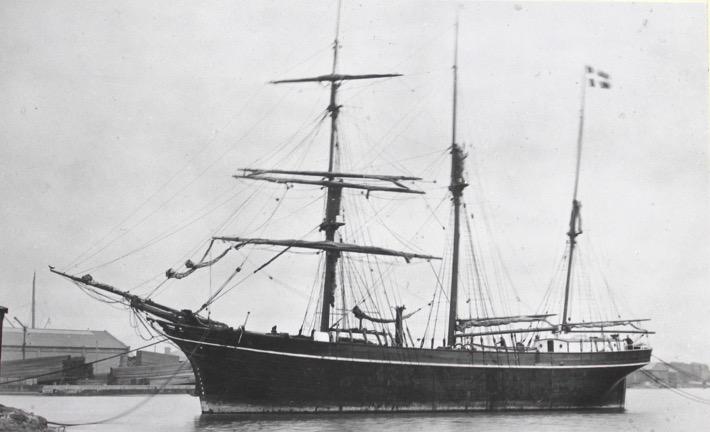
Ingeborg
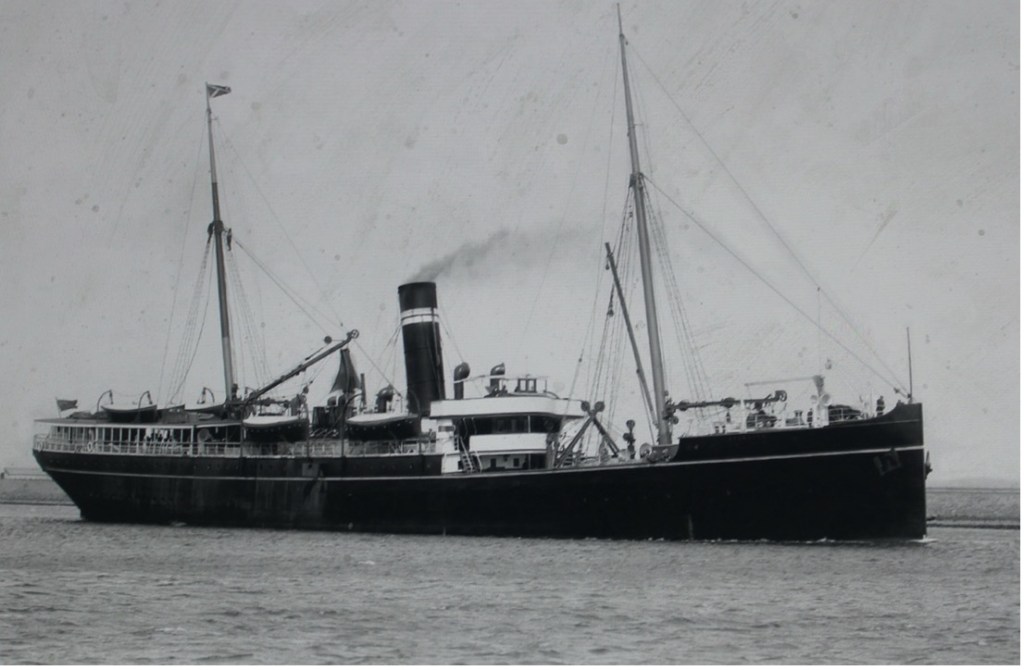
Arawatta.
The Raleigh Sun of 23 August 1907, page 5, provided further comprehensive information:
‘At 3 o’clock on Wednesday morning in the vicinity of Port Stephens, the Danish barque Ingeborg, bound from Wellington for Newcastle, collided with the steamer Arawatta. The barque sank in a few minutes and seven of the crew are missing and believed to be drowned. Eight were rescued.
Captain Middleton, the commander of the Arawatta, stated in the course of an interview: “At 2.40 on the morning of August 14, the second mate McDermid, who was on watch, reported to me that the Port Stephens light was seven miles abeam. Then I fell asleep. I could not have been asleep many minutes when the concussion of two vessels coming together awakened me. I immediately proceeded to the bridge of the Awaratta, and saw that we were in collision with a large barque. As soon as we got clear we came astern with the engines and lowered two boats.
The working boat was in the water in a very few minutes, and the occupants rescued three men. Five others climbed overboard to the Awaratta. I kept the boat in the water, and had the third officer, Williams, on the lookout at the masthead until 6.15 a.m. We saw nothing further of the missing members of the barque’s crew, and I resumed our voyage after ascertaining that our own damage was not sufficiently serious to compel me to return to the nearest port. Questioned as to the damage of the Arawatta, Captain Middleton states that she had a big hole in the port side and her forefoot was badly twisted.
A saloon passenger said that the Arawatta struck the barque abaft [behind] the fore-mast, and when he arrived on deck the vessel was interlocked. Immediately the Arawatta went astern the Ingeborg seemed to lurch away, and sank rapidly. In sinking her masts appeared to meet. The barque sank from 2 to 2½ minutes after the collision. The captain lost his life in a heroic effort to save the boy Gottfredsen.
When the collision occured the captain was so placed as to enable him to leap aboard the Arawatta, but he retired to arouse the boy. In this he succeeded and had almost passed him aboard the Arawatta when the vessels parted, and no more was seen of either. Charles Alfred Lewis, one of the rescued members of the crew, described the barque as being on the port tack in a calm sea at the time of the collision. She had 500 tons of coal ballast. Five of the crew leapt from the forecastle head of the deck of the Arawatta. The remainder, with the second mate, were below. He was on watch at the time of the collision, and saw the lights of the Arawatta for half an hour previously. The Ingeborg had all lights up. The Ingeborg was under the Danish flag, and of 1070 tons net.’
The Ingeborg
The Sydney Morning Herald of 16 August 1907, page 7, reported:
‘The Ingeborg was under the Danish flag, and of 1070 tons net. She was built in 1892 by Messrs. R. Thompson and Sons, of Sunderland. She was originally named Linden, and when under the British flag made several visits to Port Jackson. Her dimensions were: – Length, 215ft; breadth, 35ft; depth, 20ft 5in. The master was Captain N. M. Schmidt. Seven sailing vessels and five steamers in Lloyd’s Register bear the name Ingeborg. The sunken barque left Wellington on July 19 to load coal at Newcastle for a port on the west coast of South America.’
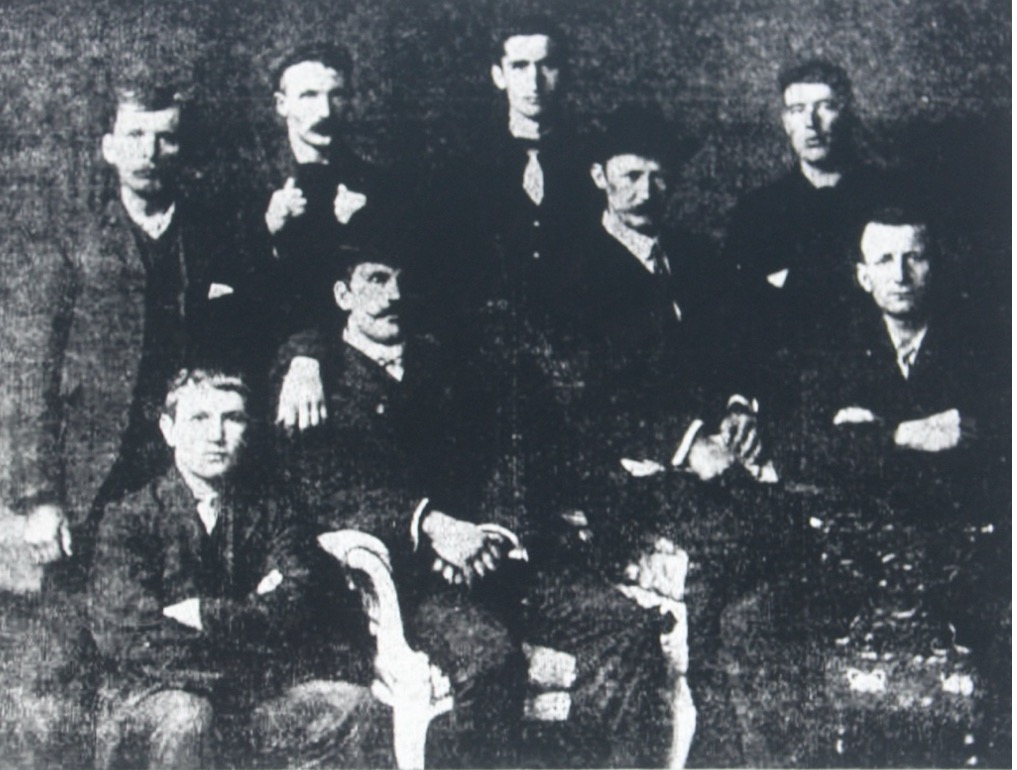
Survivors from the barque Ingeborg. Standing — Franz Beder (steward), Adolf Benjamensen, Ernst Koebike, Charles Alfred Lewis. Sitting— Axel Krentzlin, Carl Albertsen (chief mate), John Sorensen (second mate), Hans Lusader [Telegraph (Brisbane), 24 August 1907].
Marine Board of Inquiry
The Clarence and Richmond Examiner of 24 August 1907, page 10, reported on the first day of the Marine Board of inquiry into the sinking of the Ingeborg:
‘The survivors of the barque Ingeborg are unanimous in declaring that all her lights were burning clearly at the time of the collision. One seaman, who had been relieved at the wheel five minutes before the collision, stated that when the vessels were approaching each other he ran first to the starboard side and then to the port side, and saw both lights burning clearly. The Arawatta struck the barque on the starboard, near the foremast, and so great was the impact that showers of sparks flew from the spot where the vessels struck.
Survivors assert that Captain Schmidt was a splendid fellow, and that they never sailed under a better officer. He had sufficient time to have climbed several times on to the Arawatta had he chosen, but he ran heroically to the forecastle to raise the watch below. The cabin boy, Gottfriedsen, who was, a general favourite on the ship, had been roused by the captain and had climbed on to the barque’s rigging. Here he called out to his comrades who had scrambled aboard the Arawatta to save him. One of the survivors reached over the Arawatta’s rail as far as he could and was just able to touch the tips of the boy’s fingers when the vessels parted, and the lad went down.
One of the three sailors who were picked up out of the water was unable to swim, but he grasped a piece of wood which kept him afloat. This man had a peculiar experience. He was at the wheel when the vessels collided, and the impact caused the wheel to fly round, with terrific force. It struck his face, nearly stunning him. He then rushed to the side and attempted to climb aboard the Arawatta, but the vessels were too far apart. One of his comrades on the Arawatta stretched out a hand to pull him aboard, but was unable to get a sufficiently strong grip, and their hands slipped apart, and the man fell overboard, but was picked up by boats after being in the water nearly a quarter of an hour.
The Marine Board Inquiry was commenced at Brisbane on Monday. Captain Middleton, of the Arawatta, gave evidence at considerable length. He did not know that a member of the crew of the working boat which he sent out first could not pull. No lifebuoys were thrown over at his order, but he was doing his level best under the circumstances. No doubt many could criticise his actions now, but they were not similarly placed to him at the time.
Edward Scott McDermid, second officer of the Arawatta, said he took charge of the bridge of the steamer at midnight on August 13th after leaving Sydney. Twenty minutes after getting orders from the captain to alter the course, he saw a ship in front of him. He could not say what tack she was on. There was not much time to see anything, as the ship came up like a cloud in front of the steamer. He had thought since that the barque was on the port tack. The collision occurred just after he saw the ship loom up, and the mate of the barque, who had boarded the Arawatta, and two of the ship’s company, put off in a boat and picked up three men. He did not see any lights on the barque up to the time of the collision, but immediately after a green light flashed for a second. There was nothing to indicate the Ingeborg’s approach.
Everything possible to save life was done by Captain Middleton. He was wide awake at the time, and the lookout man was keeping a sharp watch. He saw a number of lights all round, but none of them were on the ship. Full speed astern was the only proper order to give if the Arawatta was to be prevented from going through the Ingeborg. There was no probability that more lives would have been saved had the vessels kept together a little longer. lt was more likely that both vessels would have been lost, as the barque might have dragged the steamer’s stem out. The boat picked up a man in the water who was in his bunk when the collision occurred.
Peter Nelson, an able seaman, who was on watch on the Arawatta at the time of the collision, deposed that he saw the sails of a ship simultaneously with the crash. Witness saw a flash of light at the time of the collision, which appeared to him to be a relieving light.
James Herd and Ernest James Garritt, able seamen on the Arawatta. and Theodore Tromson, a passenger on the Arawatta, were unanimous that had the barque been burning lights they would have been able to have seen them from the positions they were in at the time of the collision.’
The Evening News of 27 August 1907, page 2, reported:
‘The inquiry relative to the Arawatta-Ingeborg collision was continued yesterday. John Gilbert, A.B., called by Mr. Feez, said he was employed on the Arawatta at the time of the collision. He was asleep when the vessels struck, and the Ingeborg had disappeared when he came on deck. Hans Neilson Lysager told him that the Ingeborg was steering south-west, half west, on the starboard tack, and that if he was called to give evidence he would tell the truth about the collision, and it would exonerate the Arawatta from blame. Lysager was not sober at the time. It would not have taken much more drink to make him drunk. Lysager also told witness that during the last part of the voyage they did not burn any lights, and had used candles in the sidelights on the night of the collision. He further stated to witness that the lights had gone out and had been lighted again. The Arawatta’s binnacle light would not dazzle the eyes of the man at the wheel, or interfere with his sight.
By Mr. Henchman: He had heard that Lysager, or Neilson, as he was called, was locked up for drunkenness on the day of his conversation with him. T. W. Bouchard, Acting-Danish Consul, said Lysager called at his office on Friday, the day following the arrival of the Arrawatta in Brisbane. He complained about want of clothes’ and was under the influence of liquor. He was insulting in his behaviour, and also demanded money, but admitted that he had money on him. He did not refer to the collision, and left the Consulate in an excited state, and said he would not come back again.
By Mr. Feez: He would not suggest that the man was so drunk that he did not know what he was talking about. The man did not behave like a person who held a power over someone. Edward McDermid, second officer of the Arawatta, and James Herd, a seaman on the steamer, were recalled, but their evidence was practically identical with their previous testimony. The inquiry was adjourned until Friday.’
The Sunday Times of 8 September 1907, page 12, reported on the decision of the Marine Board of Inquiry:
‘The Marine Board at Brisbane have given their decision in the inquiry into the collision between the steamer Arawatta and the Danish barque lngeborg on the 14th ultimo, when nine miles eastward of Port Stephens light. The Marine Board were of opinion that the regulation lights were exhibited on the barque, and that the collision occurred through a proper look-out not having been kept on the Arawatta, for which the second mate, E. S. MacDiarmid, was found in default, and his certificate suspended for six months.
They further were of opinion that the Ingeborg contributed to the collision by failing to take the action prescribed by the regulations for preventing collisions at sea when the collision seemed inevitable. Captain Middleton was exonerated from all blame. It was considered that he did all that was possible to save the crew of the Ingeborg. The Board also placed on record their appreciation of the heroic conduct of the captain of the Ingeborg for his self-sacrifice in endeavouring to save the lives of his crew.’
Action Taken in the Vice-Admirality Court
The Sydney Morning of 7 December 1907, page 8, reported:
‘The suit (Ingeborg v. Arawatta) was one brought by the plaintiffs to recover compensation in respect of a collision, which took place between the barque Ingleborg and the Arawatta, the morning of the 14th August last, off Port Stephens. It was explained that the hearing of the case would not be formally commenced till Monday, but the evidence of several witnesses who had to leave Sydney in the meantime had to be taken.’
The Evening News of 21 December 1907, page 10, reported:
‘Mr. Justice Owen, sitting as Deputy Judge Commissary in Vice-Admiralty, delivered his reserved judgment in the suit brought by the owners of the barque Ingeborg against the owners of the steamer Arawatta, to recover compensation in respect of a collision which took place between the two vessels off Port Stephens on the morning of August 14 last.
His Honor, in the course of his judgment, said that in her preliminary act the barque alleged that the cause of the collision was that the Arawatta had not a proper look out; and the Arawatta, in her preliminary act, alleged that the barque had no lights; or, at any rate, the lights were not such as were recognised by law. The whole of the evidence and the argument of counsel were directed to these two questions, and the Court was asked to decide which of these two was the cause of the collision.
As was usual in these Vice-Admiralty cases, he had to rely more on the evidence of disinterested and independent persons than the evidence of the crews of the colliding vessels, and the evidence of these witnesses showed to his mind that the barque Ingeborg had both her side lights burning on the night of the collision, and within half an hour of the collision, and also at the time of the collision. In the circumstances, he thought that if the Arawatta had kept a proper look out she might have seen the Ingeborg in time to avoid the collision.
Being a steamer, it was the duty of the Arawatta to give way to the Ingeborg, and the latter was entitled to keep her course. For these reasons, therefore, that in his opinion the Ingeborg had both her lights burning at the time of the collision, and that the Arawatta did not keep a proper look out, he pronounced in favor of the Ingeborg, with costs to be paid by the Arawatta, and he referred all questions of damage to the Registrar.’
91. Wreck of Willinga – 1908
The Foundering
The Sydney Morning Herald of 28 May 1908, page 7, reported:
‘Information was received by the Harbour Master at Newcastle this morning that the schooner Willinga, of 80 tons register, had been wrecked at Port Stephens at 3.30 a.m.
The vessel, which was in command of Captain W. Ratcliffe, is owned by Messrs. Goodlet and Smith, of Sydney, and was bound from Cape Hawke to Sydney with a cargo of timber. A strong south-westerly wind has been blowing along the coast for the past two days, and this morning it amounted almost to a gale. The Willinga struck trouble soon after leaving Cape Hawke, and mountainous seas were continually breaking over her. Captain Ratcliffe, however, held on his course until after he had passed Port Stephens, but the gale increased with such violence that he decided to run back to the port for shelter.
This, however, was a task of considerable danger and difficulty, and despite all efforts the vessel was blown ashore near the lighthouse at Port Stephens, and soon became a total wreck. The steamer Hawk was in the vicinity at the time, and in response to the Willinga’s signals stood in to endeavour to give assistance. The crew of the wrecked schooner, however, found that with the heavy seas breaking over them the vessel was breaking up very quickly, and they had to take to a boat before anything could be done for them by the Hawk.
Their position in an open boat in such a rough sea was still perilous, but after some hours rowing they landed in an almost exhausted state at Nelson’s Bay, a distance of about seven miles from the wreck. The Willinga remained visible on the rocks for some hours; but at 8.30 she had become a total wreck. Everything on board was lost, but a large quantity of timber which comprised the cargo has been washed ashore. The schooner had a small auxiliary engine, but it is evident that this was not sufficiently powerful to stem the gale.
Captain Ratcliffe is held in high esteem by shipping men, and it is considered that had it been possible to save the vessel he would have done so. The coast at that point, however, is dangerous, and with a high sea a small vessel would always have a difficult task to make the harbour. The crew, consisting of four men and Captain Ratcliffe, received every attention at Port Stephens, and will go on to Sydney by the steamer Commonwealth. The master of that vessel has decided to remain in port until the weather moderates.
Less than three weeks ago the auxiliary schooner Willinga suddenly sprang a leak when off Port Stephens, on her way to Sydney. The master at once made for Nelson’s Bay, where part of the cargo was discharged, and the inflow was controlled. The Willinga, on the 11th inst, came on to Sydney for repairs, on completion of which she proceeded to Cape Hawke to load hardwood for Sydney.
The Willinga, which was registered in the name of Colonel J. H. Goodlet, was valued at about £1800, and was covered in the United Insurance Company to the extent of £1000.
The members of the crew were:— Master, W. H. Ratcliff; boatswain, A. Alto; cook, C. Lawrence; A.Bs. [able bodied seamen], R. Pellmann, R. P. Chapman, and C. Chapman.
The Willinga was a wooden schooner of 82 tons gross tonnage, 71 net. She was 93ft long, 25ft wide, and had a depth of 5.2ft. She was built in Totara, New Zealand, in 1892, and was fitted with a 50 horse-power oil engine.’
Crew Reach Newcastle
The Daily Telegraph of 29 May 1908, page 9, reported:
‘The captain and crew of the schooner Willinga, which was wrecked at Port Stephens early on Wednesday morning, left Nelson’s Bay for Newcastle in the steamer Commonwealth, about noon to-day, but owing to the still heavy sea, and strong wind from the southward, the vessel was forced to run back to port soon after, clearing the heads.
On arrival here [Newcastle] this afternoon about half-past 4 o’clock, Captain Heron, master of the steamer Hawk, interviewed by the representative of ‘The Dally Telegraph,’ stated that he was making for Port Stephens in the wake of the Willinga on Wednesday morning about 3 o’clock, and when he saw the latter in difficulties, and being driven on to the rocks, he manoeuvred the Hawk as close as possible to the schooner, with the intention of rendering what assistance was possible. The little craft was, however, in a hopeless position, and presently crashed on to the rocks below the light-house. Captain Heron lowered a boat, and sent it in charge of the mate to rescue the crew, but all hands had rowed ashore in their own boat, and as the Willinga had disappeared from view, leaving not a vestage of her hull, rigging, or masts showing, the intending rescuers returned to the Hawk, which, after standing-by for about an hour and an half, continued her voyage. The captain and crew of the schooner saved nothing but what they stood up in. Even the Willinga’s papers were lost, so sudden and complete was the destruction of the vessel.’
The Daily Telegraph of 30 May 1908, page 10, further reported:
‘The shipwrecked crew left Port Stephens yesterday morning by the steamer Commonwealth, and Captain Webber, secretary to the Royal Shipwreck Relief and Humane Society, last night arranged to provide the men with complete outfits, they having lost all their effects in the wreck.’
The Lighthouse Keepers Assist in Rescue Activities
The Newcastle Morning Herald and Miners’ Advocate of 30 May 1908, page 5, reported:
‘The captain and crew of the wrecked schooner Willinga left for Sydney by the steamer Commonwealth today. At the time, of the wreck the principal and assistants at Point Stephen lighthouse went to the assistance of the crew. They, went out in boats, and continued searching until they received word from Nelson’s Bay, that the crew were safe on the steamer Warraneen, where they received food and had their clothing dried.’
Captain’s Story
The Morning Herald of 1 June 1908, page 8, reported:
“Yes,” said Captain Ratcliffe, the master of the unfortunate little craft, “we have had a rough time. We left Cape Hawke at half-past 4 on Tuesday afternoon, and we had a smooth trip as far as Broughton Island. Then we met a fresh wind from the west to south-west, and it soon started to blow a gale, not of particular violence, but still fresh and strong. Heavy rain squalls set in, and the night became pitch dark. We had stopped the 50-h.p. oil engine in the boat about half an hour before we came up to Port Stephens, because the wind had been favourable. I was at the helm myself as we approached the point. We cleared the outside roof all right, and then I tried to turn to run back. She didn’t seem to answer the helm too well, but I could not say much about that. Just after rounding the outer reef, as I tried to turn the heavy south-west squalls caused the vessel to broach to, and in five minutes she went on the rocks near the outer light.
“If she had gone another 200 yards before broaching we would have got off clear. Two of the men were asleep at the time. Ralph Chapman, who used to look after the oil-engine, was in his berth. He had to leave without his boots. The other man, Richard Pellman, said afterwards that he saw the sharp rock come through the bottom of the vessel. The Willinga had centre-boards, and they struck the reef first, and then the bottom of the boat was torn right out. In rushed the water, and she commenced to break up straight away. People living in the city can hardly imagine what it was like. The situation was the same as if the boat had been thrown on the rocks under the cliffs at Coogee.
“Before ten minutes had passed we had out the boat and we all got in, though it was a very difficult task to launch the boat in such a sea, and we had all our work to keep her from being crushed against the Willunga. We left everything behind, and all we saved was the boat we came away in. “The steamer Hawk was close up to us, but we didn’t see her till we were in the boat, and she was too far to leeward for us to make for her.”
“As we got in, one of the lads grabbed a fire bucket to bale with; and we needed it. We were baling all the time we were in the boat, and we had a bad time generally. It was bitterly cold, and we were all wet through, so everyone wanted to row. I took the tiller and the men had turns at the two oars, and the waves beat over us as we went along. We had a rough passage over the Fly Roads [near the Port Stephens Lighthouse], which was the worst part of the seven miles to Nelson’s Bay. It took us from half-past 3 till 20 past 5 to cover the distance. Once we got up to the inner light, rowing was easy, for we had had a flood tide with us all the way, and the sea was comparatively smooth. We came up alongside the Nelson’s Bay wharf, and there was the Warraneen, which had put in for shelter. They took us on board, and we crowded down in the stoke-hole to try to get warm; for we were chilled to the marrow. The cook made us some coffee and we changed our clothes and had something to eat and that put new life into us.”
Captain Ratcliffe was in the Maitland gale of 10 years ago, when, out of five vessels in Shoal Bay, his (the Shannon) was the only one that was not driven ashore.’
Marine Court of Inquiry
The Australian Star of 27 June 1908, page 15, reported:
‘A Marine Court Inquiry in reference to the loss of the auxiliary schooner Willinga, near Port Stephens, on May 27 last, was commenced yesterday before his Honor, Judge Backhouse (president), and Captains Christie and Hay (assessors).
Mr. Robinson (of the Crown Law Department) appeared for the Navigation Department, whilst Mr. A. R. Macfarlane represented the vessel’s owner, Mr. J. H. Goodlet. After hearing evidence, the Court found that the Willinga was well found, and that the master, Wm. Henry Radcliffe, did not act otherwise than as any prudent seaman would have done.’
Pappinbarra Wrecked in Proximity to Willinga
Just over 20 years after the foundering of the Willinga, the steamship Pappinbarra, was wrecked in proximity on the rocks at Point Stephens, Port Stephens on 11 September 1929.
92. Wreck of Ida – 1911
The Newcastle Morning Herald and Miners’ Advocate of 20 June 1911, page 5, reported:
‘The small ketch Ida was blown ashore in Nelson’s Bay yesterday afternoon, and in less than half an hour she became a total wreck. The vessel had loaded timber and oil for New Guinea, and was at anchor in the bay. There had been a strong westerly wind blowing in the morning, but in the afternoon it increased to a gale. The little craft strained heavily at her moorings, and eventually the anchor chain carried away, whereupon the ketch drifted over on to the beach. The crew, numbering three all told, managed to get ashore safely, but they were cold and wet.
The ketch drifted higher up on the beach, and at half-past two, half an hour after her anchor chain carried away, she was a total wreck, with the bottom torn clean out of her. The master of the vessel has communicated with the owners, advising them that he will sell whatever is left. Captain Cumming, deputy superintendent of navigation, was notified of the wreck, and on being told that the crew had lost everything, he communicated with Mr. F. Gardner, representing the Shipwreck Relief Society, who authorised him to arrange for the men to be looked after. They were given quarters at the local hotel and supplied with dry clothes.
A tug-master, speaking last night about the wreck, said:—”The people who talk about making that place a port should have seen it today. The bay was white with waves; the wind blew across it very hard, and as there is no shelter the ketch had no chance.” The master of a small coaster said nothing has a hope at anchor in the bay, except steamers. The westerly blows from across country, and has a clean sweep of about four miles over water, with nothing to stop it. Nelsons Bay as a safe port in a westerly blow is right out of it, said the authority quoted.’
The Sun of 21 June 1911, page 7, further reported:
‘Captain Weaver, of the ketch Ida, which was wrecked at Nelson’s Bay, Port Stephens, on Monday, states that he and his crew reached the shore in an almost nude state. When this news reached Sydney Captain Webber, of the Royal Shipwreck Relief and Humane Society, telegraphed the proprietor of the hotel at Nelson’s Bay to supply the members of the crew with a new suit of clothes each, and this was done.’
93. Wreck of Inca – 1911
The Sydney Morning Herald of 6 September 1911, page 17, reported:
‘The other overdue vessel is the barque Inca, which, in command of Captain Barrio, left Callao on March 10 for Sydney, and is now 163 days out. She would have had much the same weather. One remarkable fact about the non-appearance of the Inca is that she left Callao a month before the barque Claudina, which arrived at Sydney on July 12. Another significant feature is the discovery early in August of wreckage (driving sails, yards, and a piece of topgallant mast) in lat. 41.57 S, long 82.43 E. The German ship Terpsichore, which made this discovery while coming to Adelaide from Santos, would have traversed much the same course as the missing vessel.’
The Newcastle Morning Herald and Miners’ Advocate of 16 October 1911, page 4, also reported:
‘On Saturday the people searching for bodies from the wrecked steamer Macleay [that foundered on 11 October 1911], near Port Stephens, found a board with the name “Inca” painted on it. The Peruvian barque Inca is a vessel now long overdue, having left Callao for Newcastle in March last, since when she has not been heard of. Another vessel of the same name, an American five-masted schooner, is now at Port Stephens loading timber. The board was shown to be mate of that vessel, and he said it did not belong to his craft, he thought it must be from the missing Peruvian barque.’
94. Wreck of Macleay – 1913
See entry at Wreck of Macleay -1913 on this website.
95. Wreck of S. A. Hayward – 1913
The Foundering
The Sydney Morning Herald of 15 March 1913, page 21, reported:
‘The ketch S. A. Hayward went on the inner rocks at the North Head, Port Stephens, while a strong wind was blowing at about 4.30 yesterday afternoon. The vessel filled rapidly, and the crew, consisting of Captain Sorenson and four men, got ashore safely, saving nothing but their clothes. The vessel is now lying full of water, and there is little or no hope of salvage.
The S. A. Hayward was bound from Camden Haven to Sydney with 25,000ft of hardwood. She put into Port Stephens for shelter, and missed stays as she was doing so.
The crew were accommodated at the hotel at Nelson’s Bay last night. They feared that, if the wind kept up, the ketch would be broken to pieces. At an early hour this morning they returned to the vessel to endeavour to obtain some of their belongings.
The telegraph wires were blown down by yesterday’s storm, and no information was obtained about the wreck until today. A message received this afternoon by Captain Cumming, of the Navigation Department, said that the men had been successful in securing some of their belongings, and that the vessel was breaking up.
The S. A. Hayward is a wooden ketch of 63 tons. She was built in 1884 at Brisbane Water, N.S.W., and is owned by Messrs. Clarke and Sorenson. Her principal dimensions are: Length 77ft 2in, breadth 21ft 4in, and depth 6ft 4in.
According to a message received in Sydney yesterday by the Sydney Marine Underwriters’ Association, the wreck was said to be breaking up, and there was no prospect of salvage.
The secretary to the Navigation Department in Sydney received a telegram from the signal officer at Port Stephens yesterday stating that the vessel was likely to become a total wreck, and intimating that he had sent a launch out, and taken the crew to Nelson’s Bay.’
Crew Proceeded to Sydney
The Newcastle Morning Herald and Miners’ Advocate of 18 March 1913, page 4, reported:
‘Captain S. Sorensen, master of the Ill-fated ketch S. A. Hayward, which went ashore inside Port Stephens in the squall on Thursday evening last, and became a total wreck, proceeded to Sydney yesterday by the Karuah, with the other members of the vessel’s company. They were Charles Mathieson, mate, A. Tang, cook, and A. Renhorn and O. Allison, A.Bs.
Shortly after the Karuah called at Newcastle last evening en route to Sydney a ‘Newcastle Morning Herald’ representative boarded the steamer and had an interview with Captain Sorensen. The vessel, Captain Sorensen said, left Camden Haven on Wednesday, bound for Sydney with 29,800 feet of hardwood. Fine weather and a smooth sea were experienced until the vessel neared Long Island, when the glass [barometer] began to fall, and it was decided to run for Port Stephens for shelter.
The ketch was just about the islands outside Port Stephens, when the squall struck her. This was about half-past four o’clock. “It was too much for the little vessel,” continued Captain Sorensen. “She missed stays just as we got inside. I let go the anchor, but it would not hold the vessel in that sandy bottom, and she went on to the rocks. She began to fill. I ran down below and saved what I could but did not manage to save all the books and papers. I got my certificate and the vessel’s register. At that time the water was coming into the cabin.
The crew saved most of their effects. We launched the boat and landed, and walked al distance of about three or four miles to where the ketch Korunnah was lying. We were treated hospitably by Captain Calder. We had tea on the Korunnah, and they lent us a boat, in which we pulled to the Tea Gardens, where we slept that night, returning to the scene of the wreck early in the morning. We were taken to Nelson’s Bay shortly afterwards in a launch.” The vessel was insured for £600 in the United Insurance Company.’
Marine Court of Inquiry
The Evening News of 9 April 1913, page 12, reported:
‘The wreck of the S. A. Hayward formed the subject of an inquiry before the Marine Court this morning. Judge Beckhouse, with Captains McGibbon and Hay, assessors, being on the Bench. Mr Robison, of the Crown Law Department, appeared for the Superintendent of Navigation. The master and owners appeared in person.
Mr. Robison said the ketch left Camden Haven for Sydney on March 12. The wind was from N.E., and the weather fine, until the vessel was abreast of Long Island. When off Port Stephens the glass [barometer] was very low, and still falling, and as the master realised that a heavy gale was coming on, he decided to shelter. When between Port Stephens Heads a gale from the west struck the vessel. The small sails were taken in, and a reef put in the main-sail, and the master stated that he made two tacks outside, and then got a slant right in through the heads.
He fetched well inside, and went round and made another tack, trying to get up to Shoal Bay, but she did not fetch quite far enough, so he brought her round again, and when he came over the gale increased to such an extent that when he put her in stays she refused to come round. The anchor was then let go, with 52 fathoms of chain, but the bottom being sandy, it would not hold, and the vessel dragged until she touched the shore with her heel, and fell broadside on.
As the seas at this time were very heavy, and breaking over the ketch, the boat was launched, and the crew left. The water at that time was two or three feet deep in the cabin. They got safely ashore, but the ketch became a total wreck. Captain Soren Sorenson, master and part owner of the ketch, said he had been in command of her for 20 years. When the wreck occurred, he was on a voyage from Camden Haven to Sydney with a cargo of 29,800ft of sawn timber. There was a crew of five, all told, including himself. The Court held that the master was in no way to blame for the mishap, that that he did all that he could, under the circumstances.’
96. Wreck of Tallong – 1913
The Foundering
The Newcastle Morning Herald and Miners’ Advocate of 2 September 1913, page 5, reported:
‘Captain E. J. Shimmin, master and owner of the ketch Tallong, which was wrecked on a reef to the north of Newcastle, is back in Sydney after having recovered from the effects of his exciting trip. The report of the loss of the Tal-long, received by the Navigation Department today, makes interesting reading. The Tallong was a wooden vessel of about six tons, and was built by Mr. Shimming, jun., and intended for trade between Gosford and Sydney.
On August 10 Captain Shimmin, who is 77 years of age, sailed the Tallong out through the heads, bound to Gosford, where he was to pick up a load of firewood. Contrary to the Navigation Department’s regulations, the skipper left port without any crew, and it was not until the Tallong was found high and dry on a reef that the department was aware that she had left Sydney.
According to Captain Shimmin, a strong wind was blowing when he left Sydney, and by the time he was off Newcastle it had reached the force of a full gale. An attempt was made to put in at Newcastle, but the little vessel could not make any headway in the gale, and was blown past the port. It was off Newcastle that the sails were carried away, and the Tallong was then at the mercy of the gale. There were no distress signals aboard the ketch, and her skipper was unable to call for assistance.
After being badly battered by the big seas for nearly twelve hours, the Tallong was driven high and dry on a reef close to shore, about five miles off Newcastle. The only person aboard the Tallong, Captain Shimmin, was washed out of the ketch, but managed to cling to the rocks until picked up by some fishermen. Although the ketch was wrecked before midnight, it was not till sunrise that the captain was rescued. He had been badly knocked about by the big seas that broke over the reef and considering that he has attained the age of 77, he must be a man of remarkable endurance.’
Story of Survival
The Sydney Morning Herald of 2 September 1913, page 9, also reported:
‘Few men can boast of a struggle against the elements for two nights and a day in a six-ton ketch, with a wreck on a rock-bound coast, a swim in the boiling breakers, with the handicap of an injured leg, and several hours on a wave-washed ledge of rock, as a climax.
This was the experience of Captain E. J. Shimmin, of the ketch Tallong, who has now returned to his son’s residence in Hanover-street, Waterloo. Captain Shimmin was 75 years of age last July, but a life spent in the open air has given him the appearance of being much younger.
“Yes, no doubt I’m a lucky man to be here tonight,” said Captain Shimmin, when seen at his home in Waterloo last night. “I left Bottle and Glass [near Watsons Bay, Sydney] at about 12.30 on the afternoon of Sunday, August 10, and cleared Sydney Heads, bound for Gosford, where I intended to take on a cargo of firewood. The Tallong was a trim little craft of about six tons. I built her myself in the bush near Tallong station, about four and a half miles this side of Marulan, on the Goulburn line. When she was finished, we loaded her on to a bullock wagon, and took her two miles to the railway station, where she was put on a truck and brought to Sydney.
The trip, which has now ended up in her being wrecked, was the third I had made in her. I was the only one on board when I cleared Sydney Heads, and the wind fell light shortly after I got outside. When I arrived off Broken Bay on Sunday night it began to blow very hard, and as it was impossible for me to get into Pittwater, I decided I would let her run before the wind. As the night advanced the wind increased and a very heavy sea worked up. I stuck at it all night, and continued to run before the wind until daylight when I noticed I was nearing Norah Head. I passed this point between 10 and 11 o’clock on Monday morning. The wind still blew a gale, and when I was nearing Lake Macquarie I pulled up one of the two flags I had on board, thinking I might get in there. The wind was ‘right out,’ however, and the sea was far too heavy so I shaped a course for Newcastle.
“From 11 a.m. until 5 p.m. on Monday I was beating up towards Newcastle. They must have seen the fight I was having from Nobbys and Signal Hill, but there was no sign of a boat coming out to help me. I got right up to the entrance, but was caught in the confused water inside the breakwater. The wind was blowing a howling gale from the south-south-east and I was afraid it would blow me on to the northern wall, so, seeing no signs of assistance, I slewed round and stood out to sea. I thought afterwards that I should have hauled down my ensign, and ran her up upside down. They might have taken notice of that signal of distress in Newcastle and sent assistance. I had my work cut out, however, to handle the boat.
“I stood well out to sea on Monday night, and at 11.30 p.m. sighted Port Stephens light. The moon had risen with big heavy clouds. Strong squalls struck the ketch, the weather was thick and dirty, and the sea very heavy. I had had the mainsail down most of the way and was running under a staysail and mizzen only. I thought I would make Port Stephens safely, and so set a course for the light. I went aft to see the time at midnight, and I was then a few miles south of Morna Point. About half an hour later there was a crash, and I knew the ketch was on the rocks. “I just glanced round and saw breakers to seaward; then a big, green wave struck the vessel, and flung me and most of the stuff in her out into the sea. As I went overboard, my right ankle struck the side of the ketch, and I thought at first that it was broken.
I found myself floundering about in boiling surf, which was breaking on numbers of sharp boulders. The moon came through the clouds, and I could see I was about 30 yards from the shore. I swam with the waves, and grabbed a boulder, clinging to it until the backwash eased off. Then I struck out on another wave and reached another boulder.
By degrees I managed to reach a ledge of rock, just washed by the waves, on which I lay down absolutely done. When day broke, I managed to creep to a patch of green grass close to the beach. Four fishermen found me here at 9 o’clock on Tuesday morning, and, after giving me some hot coffee, they succeeded in reaching the remains of the ketch, and fetching ashore the sails. With these they rigged up a camp and I remained in this for about a fortnight, while my ankle, which was badly injured, healed. One of the fishermen (Mr. Morris), who lived about two miles away, sent me provisions, and, at the end of the fortnight, drove me in a sulky to Nelson’s Bay, where I caught a steamer, and came on to Sydney.
“I forgot to tell you,” concluded Captain Shimmin, “that the cat, which was the only other living thing on the Tallong with me, also got ashore safely, and turned up meowing outside the camp on the second night.”
This is the third wreck Captain Shimmin has experienced, being in charge of the ketch Pearl when she foundered off Queensland 26 years ago, and also of the fore-and-after Dora, lost while crossing the bar at Lake Macquarie about 40 years ago.’
97. Wreck of Cora Lynn – 1914
See entry at Wreck of the Cora Lynn -1914 this link, as above, on the website.
98. Wreck of Rose – 1916
T8e Raymond Terrace Examiner and Lower Hunter and Port Stephens Advertiser of 27 October 1916, page 3, reported:
‘The steamer Rose was burnt to the water’s edge last Saturday at Tea Gardens. The cause of the fire is unknown. She had just returned from a trip to Salt Ash with 110 Naval Base men. She was discovered alight at 12 o’clock and cut away from the Reliance. She then drifted to the opposite side of the river and burnt to the water. The Reliance was slightly scorched.’
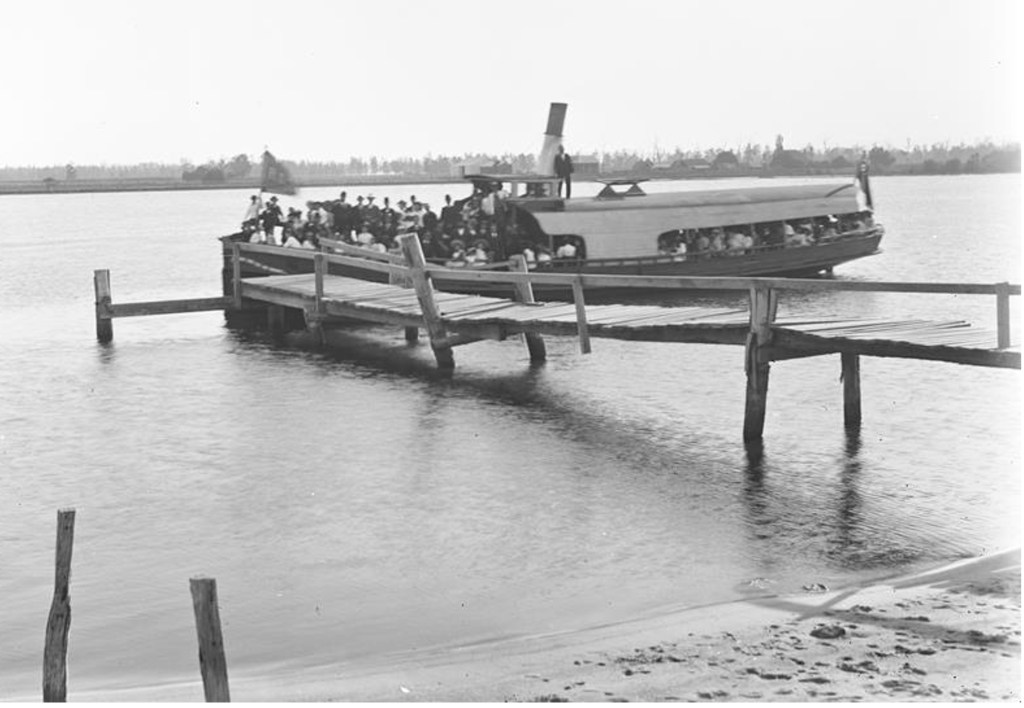
Steamer ‘Rose’ bringing picknickers to Tomago Picnic Ground
The Newcastle Morning Herald and Miners’ Advocate of 13 October 1916, page 4, further reported:
‘An officer sent from the Navigation Department, Newcastle, to investigate with regard to the destruction by fire of the steamer Rose at Tea Gardens, returned yesterday. This vessel, which was owned by the Port Stephens Transport Company, made her last trip from Salt Ash to the Tea Gardens on the night of October 6th, with only the crew on board. She was moored safely and all hands left her at a quarter to eleven o’clock that night; and an hour and half later she was found ablaze.
The flames had secured such a hold of the vessel, however, that it was impossible to save her, and in order to prevent the destruction of another vessel, belonging to the same company, moored inside her, the burning vessel was left cast adrift. As the steamer had been burned to such a considerable extent, and what was left of her was submerged, it was impossible for the officer to form any opinion as to in what part of the vessel the outbreak originated. The remains are submerged near the Tea Gardens wharf, but not in a position to impede navigation.’
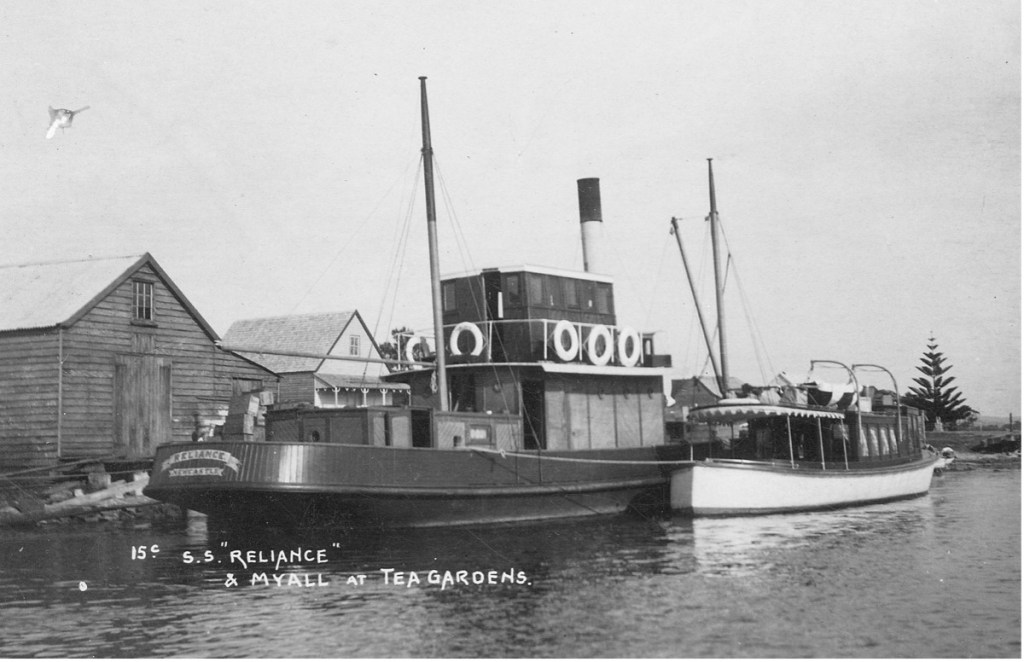
Steamer ‘Reliance’ and ‘Myall’ (small steamer) at Tea Gardens.
99. Wreck of Dauntless – 1921
First Reports of the Stranding
The Sun of 22 March 1921, page 3, reported:
‘A message from the lighthouse keeper at Port Stephens states that the small steamer Dauntless ran ashore on the One Mile Beach at Anna Bay early this morning. The captain and crew were landed safely. The Dauntless left Newcastle about midnight for Port Stephens. Constructed of wood, the steamer Dauntless is of 55 tons gross, and is owned by Peter Cullen. She was built at Stockton in 1899. The Navigation Department, Sydney, was this afternoon advised by wire of the mishap.’
The Sydney Morning Herald of 23 March 1921, page 14, further reported:
‘The Navigation Department was notified yesterday that the small steamer Dauntless, which trades between Newcastle and Port Stephens, had met with engine trouble whilst approaching the latter port. The vessel was moored close inshore off Anna Bay, and unless the necessary repairs can be made in the sea she will probably have to be towed to Newcastle.’
The Broken Shaft
The Newcastle Morning Herald and Miners’ Advocate of 23 March 1921, page 6, reported:
‘The steamer cleared Nobbys shortly after mid-night on Monday, bound for Port Stephens, and the breakdown occurred about 3.30 a.m. Messrs. J. and A. Bown’s tug Irresistible was despatched at noon yesterday, with the object of affording any assistance required by the stranded vessel. The tug arrived back at Newcastle at 5 p.m., having been unable to get in close enough to communicate with the Dauntless. Captain Brinkworth, however, was fully satisfied that the crew was safe, and the Dauntless appeared to be is no immediate danger of breaking up.
There appeared every probability of the vessel being floated off. Captain Brinkworth stated that he reached Anna Bay at 2.45 p.m., and found that the Dauntless was lying stem on to One Mile Beach, a little distance from the shore. It was low water when the Irresistible reached the place, and she was unable to get within a quarter of a mile of the Dauntless. Captain Brinkworth called out to the vessel through the megaphone, but received no response. He could see people on the vessel, and others on the beach with a boat. There was a fairly heavy swell, and waves were breaking slightly over the stern, but there was no movement of the vessel.
It was quite evident that there was communication between the vessel and the shore, and everything was as well as it could be under the circumstances. Captain Brinkworth returned to Newcastle, and reported the position of the vessel and the possibilities of getting her off. Arrangements will accordingly be made to try and get the stranded vessel off at high water. The Dauntless is in charge of Captain Thalberg, and a crew of three men. She is a wooden steamer, with 12 h.p. engines, of 55 tons gross, and 37 tons net tonnage, length 75 feet, breadth 20 feet 2 inches, and depth 5 feet 3 inches.’
Dauntless Breaks-up
The Newcastle Sun of 30 March 1921, page 7, reported:
‘A preliminary inquiry was held this morning by Captain Veitch, acting deputy superintendent of navigation at Newcastle, in regard to the steamer Dauntless, which went ashore on One Mile Beach, Anna Bay, on March 22 It is understood that the Dauntless is breaking up, and arrangements have been made to remove the engines and machinery.’
The Newcastle Morning Herald and Miners’ Advocate of 2 April 1921, page 6, further reported:
‘The wreck of the steamer Dauntless, which went ashore at Anna Bay, near Port Stephens, recently, will be sold by Messrs, Creer and Berkeley at noon today at their rooms, at Newcastle, as the vessel now lies on the beach.’
100. Wreck of Phil Forbes – 1922
The Foundering
The Phil Forbes was laden with 100 tons of coal from Newcastle for the Manning River, when she foundered near Broughton Island.
The Sun of 8 May 1922, page 7, reported:
‘According to the men on the coaster Kinchela, which arrived at Sydney this morning the tops of the masts of the ketch Phil Forbes are protruding out of the water, as she lies sunk on a reef off Broughton Island. Captain Muir, master of the ketch, today telegraphed to his home advising that he was none the worse for the experience. Langley Bros., Ltd., owners of the ketch, this morning had nothing to report.’
The Daily Commercial News and Shipping List of 8 May 1922, page 4, also reported:
‘The signal-master at Seal Rocks yesterday reported that the well-known ketch Phil Forbes had foundered three miles north of Broughton Island during last Friday night, and that all hands were safe ashore on the island. The Phil Forbes was a wooden vessel of 87 tons register and was built at Lake Macquarie in 1899. She was owned by W. Langley & Sons, Ltd.’
Crew Arrive at Nelson Bay
The Newcastle Morning Herald and Miners’ Advocate of 9 May 1922, page 5, reported:
‘Captain Morris, the Deputy Superintendent of Navigation, received a telegram last evening from Nelson’s Bay, stating that the crew of the ketch Phil Forbes, which foundered on Friday night off Broughton Island, had arrived from Broughton Island, and all were well.’
Master’s Story of the Foundering
The Sydney Morning Herald of 10 May 1922, page 12, reported:
‘The events which surrounded the sinking of the ketch Phil Forbes, a well-known coastal trader, near Broughton island, on Friday night, were related by the master of the vessel, Captain Muir, on his arrival at Newcastle this afternoon from Nelson’s Bay, where the crew were taken after landing on the Island. Captain Muir was accompanied by the four members of the crew of the vessel, and they were able to carry all that they had saved when the Phil Forbes was lost.
“It was just after dusk that the Phil Forbes foundered” said Captain Muir. “The weather was fine, and the sea smooth, and afterwards there was a bright moon. She went under just about a mile north of North-west Rock, to the north of the island. The ketch is now lying in about fourteen fathoms of water, and her masts are just showing above the surface. She filled and sank rapidly, and we had to leave in a hurry. All that we saved were our small personal belongings, and even the ship’s papers were lost. Our ship’s boat was a good one, and we had no difficulty in reaching Broughton Island, where we landed in the dark. It is rough, rocky country and the island extends for about three miles by a mile.
As soon as we landed, we cast about for habitations, and came across some huts, which we learned afterwards belonged to Greek fishermen, who come down from Port Stephens at the week-ends. We broke into these huts, and found stocks of macaroni, which we relished. We had no trouble over water, drawing our supplies from two wells. We were alone on the island until Sunday morning, when some Greek fishermen from the mainland arrived, and after spending the day there they towed us back in our boat to Nelson’s Bay, where we landed yesterday afternoon. The Greeks did everything they could to help us.”
Captain Muir referred humorously to the presence of rabbits on Broughton Island, which was the site selected some years ago for the experiments of Dr. Danysz, a German scientist, for the extermination of the pests by inoculation methods. He said that rabbits still abounded there, but, although traps were set, the crew failed to catch any of them. In view of a probable Marine Board inquiry into the sinking of the ketch, Captain Muir declined to state the cause of the vessel foundering.
The names of the crew were B. Hickson, engineer; H. A. Raahauge, mate; and T. Harper and L. C. Douglas, seamen. The Phil Forbes was owned by Messrs. W. Langley and Sons, and a somewhat interesting record attaches to her construction. Her builder was a Mr. Forbes, who, by serving three years before the mast of a well-known sailing vessel, the Nova Scotia, saved enough money to build first the Forbes Brothers, and afterwards the ketch which recently foundered.’
Further Report Concerning the Foundering
The Raymond Terrace Examiner and Lower Hunter and Port Stephens Advertiser of 12 May 1922, page 2, reported:
‘After an adventurous career in trading around the coast of Australia, the ketch Phil Forbes, owned by Messrs Forbes Bros founded near what is known as the Two Fathom Rock, about three miles north of Broughton Island, on Friday night. The master and the crew landed on the Island. The Phil Forbes arrived in Newcastle on Thursday from Sydney, where she had been refitted after being chartered by a syndicate for the recovery of copper and other cargo from the steamer Karitane, which was wrecked at Deal Island, in Bass Strait.
The Phil Forbes left Newcastle the following morning for the North Coast to take in a cargo, and passed the lighthouse at Nelson’s Bay shortly after noon on Friday. The lighthouse keeper there stated that the weather was favourable on Friday evening, and until a slight wind blew up towards evening, the sea was like glass. Even at night the sea was comparatively calm. He stated that the master of the steamer Kinchela had reported to the post master at Nelson’s Bay that he had seen the masts of the ketch standing out of the water near Broughton Island, and he had ascertained that the master and crew of the vessel had safely reached the island which was uninhabited, So far as the light-house keeper knew, the men were still there on Monday, but Greek fishermen who plied their calling in the neighbourhood of the island would leave and bring the crew back to the mainland. The Phil Forbes was blown ashore in Port Stephens a few years ago, and then sold for £30.’
NOTE: The story of the grounding of the Phil Forbes inside Port Stephens in July 1914 is set out in the Postscript of the ‘History of the Port Stephens Fire Brick Company‘ at this link on the website
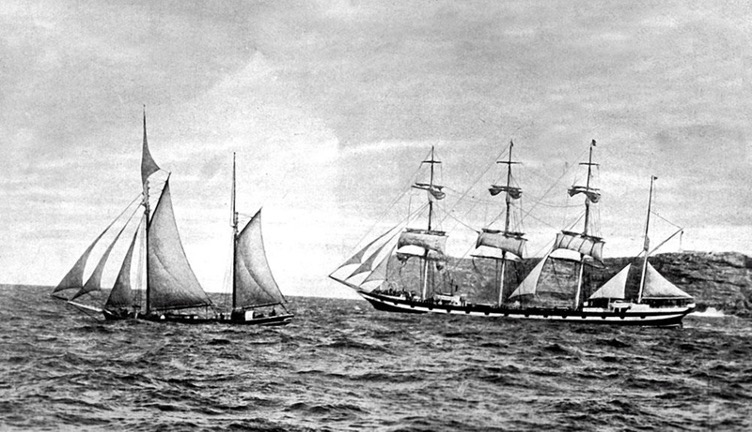
Phil Forbes (left) and Medway (right) passing through Sydney Heads [Sydney Mail, 17 May 1922, page 18].
Diver Inspects Vessel
The Daily Telegraph of 25 May 1922, page 6, reported:
‘The auxiliary ketch Phil Forbes, which foundered north of Port Stephens recently, while on a passage to the Manning River, has been examined by Diver Anderson on behalf of the underwriters. The inspection was made under the direction of an officer of the Sydney Marine Underwriters’ Association. The diver found the vessel lying on an even keel in 9¾ fathoms of water. She is on a sandy bottom with a slight list. The planking aft was found to have opened out. Owing to wreckage, the diver found it impossible to enter the cabin, but he states that the engine appeared to be intact.’
101. Wreck of Williams – 1922
The Sunday Times of 26 November 1922, page 2, reported:
‘The small steamer Williams was wrecked today 12 miles from Stockton, while on a trip to Port Stephens. Captain Boyd, his son, and two men were aboard. All landed safely. They think the Williams is a total wreck.
The captain says the steamer is well up on the beach, and only her masts and bridge are showing. She was seen by the steamer Seagull when near Nelson’s Bay, and for a while they were together. The Williams then seemed to make towards the sand, and followed the other boat, but whether the Williams turned over the Seagull’s crew could not say. They could only see the masts. They stood out, as very heavy seas were running, and they did not think they would reach port safely.
A tug was sent from here [Newcastle] to try and tow the Williams off, but they had an impossible task, as she was absolutely waterlogged. The crew comprised Captain W. Boyd, N. Boyd [master’s son], Frank Lee, A.B., and A. Green, engineer. The master stated tonight that after passing Morna Point the Williams was leaking in the engine-room. The water was three inches deep when reported by the engineer. The captain made for the beach, as the water was getting the better of the pumps. The lifeboat was lowered.
During the last few minutes, it was impossible to get near the engine-room, despite the fact that the engines were still working. Even after the lifeboat had been entered the throb of the engines could still be heard by the departing crew, who, after landing, walked 20 miles to Newcastle with only a few of their belongings saved from the wreck. Some time ago another vessel [the Uralla] foundered at the identical spot, and became a total loss. The Boyd’s are well-seasoned seamen and have been over this ground many times without mishap. From all accounts the Williams is quickly going to pieces.’
The Evening News of 27 November 1922, page 5, further reported:
‘The steamer Williams, which was beached on Saturday, will probably become a total wreck. The shipping people state that she is such an old vessel that she would be unable to stand the strain of an attempt at salvage. She is covered by insurance.’
The Sydney Morning Herald of 27 November 1922, page 9,, also reported:
‘Built at Stockton in 1906, the Williams was a wooden steamer of 88 tons gross register. Her measurements were Length 86.5 feet; beam, 20.9 feet; and depth, 6.5 feet. Her rated engine power was 15-h.p. Mr W. E. Flannery is the owner.’
102. Wreck of Wallamba – 1923
See entry as linked above, to the post on the website : “Morna Point – A Graveyard of Shipwrecks.”
103. Wreck of Psyche – 1924
See entry Wreck of HMAS Psyche on this website.
104. Wreck of Mahinapau – 1925
The Foundering
The Daily Telegraph of 8 October 1925, page 5, reported:
‘The hulk Mahinapua, laden with long telegraph poles, which was moored in Salamander Bay, Port Stephens, foundered at her moorings yesterday morning.
News of the mishap reached Sydney underwriters yesterday. No particulars are available, but it would appear that the vessel suddenly sprang a leak during Tuesday night, and gradually settled down. This is the second hulk that has met a similar fate in Salamander Bay. Some months back the Psyche, an old warship, which was sold out of the service and converted into a timber hulk, disappeared from her anchorage, and was found submerged in many fathoms of water.
The Mahinapua, which, after being turned into a hulk, was renamed Sydney, was an old Union liner, and for many years was running on the New Zealand coast. Later she traded between Melbourne and Tasmania. She is a vessel of 458 tons and was built at Dumbarton in 1882. Captain Gibson, of the Sydney Marine Underwriters’ Association, will proceed to Port Stephens today to arrange for salvage operations. It will be a long and tedious job, as the poles will have to be recovered before any attempt can be made to lift the vessel.’

SS Mahinapua
Cargo Discharged
The Daily Telegraph of 13 October 1925, page 3, reported:
‘The hulk Mahinapua, which foundered in Salamander Bay, Port Stephens, last week, laden with poles, is expected to be refloated either today or tomorrow. The deck cargo has been discharged, and Captain Gibson, of the Sydney Underwriters’ Association, had taken charge of the salvage operations. Two eight-inch pumps have been rigged to pump the vessel out at the first favourable opportunity.’
Hulk Refloated
The Daily Telegraph of 15 October 1925, page 3, reported:
‘The hulk Mahinapua, which foundered In Salamander Bay, Port Stephens, last week with a load of poles on board, has been refloated. A telegram was received yesterday by the Sydney underwriters stating that, after the deck load was discharged, two light 8-Inch pumps were fitted, and the vessel pumped out. She is now safe at anchor in Salamander Bay. Captain Gibson, of the Sydney Marine Underwriters’ Association, superintended the salvage work.’
105. Wreck of Alice
See entry in Morna Point – A Graveyard of Shipwrecks on this website
106. Wreck of Uralla – 1928
See entry at Wreck of Uralla -1928 on this website.
107. Wreck of White Bay – 1928
See entry in Morna Point – A Graveyard of Shipwrecks on this website
108. Wreck of Pappinbarra – 1929
See entry at Wreck of SS Pappinbarra – 1929 on this website.
Researched and compiled by Kevin McGuinness
August 2023

 Port Stephens - a history exploration