
Introduction
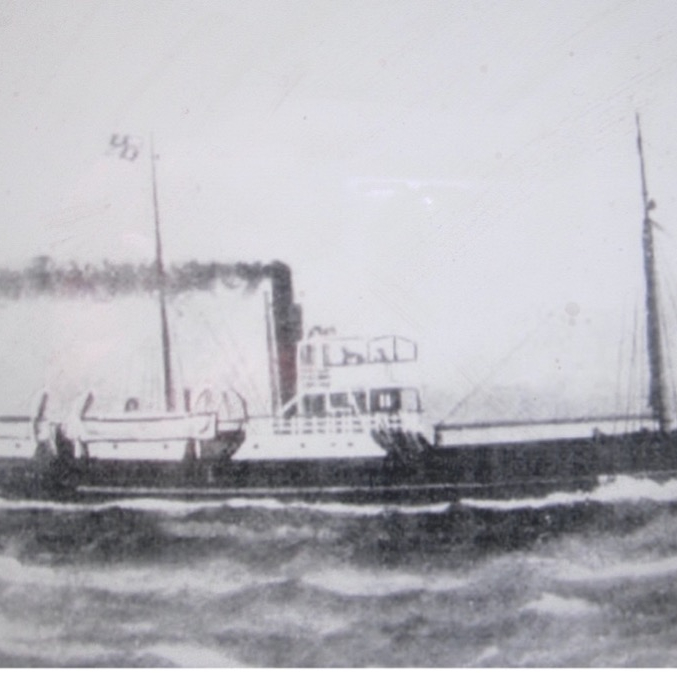
The SS Macleay, a steamship owned by the North Coast Steam Navigation Company, foundered on rocks off Port Stephens on 11 October 1911, with the loss of 15 lives.
The loss of the Macleay occurred just over three weeks after the foundering of the steamship SS Rosedale, near Port Macquarie, with the loss of at least 24 lives. The combined loss of at least 39 deaths from the two ships focused attention on the dangers faced by mariners and their passengers.
The loss of the Macleay generated much interest, as the survival of two crew members for eleven hours in the sea, was widely reported.
This paper is the story of the loss of the SS Macleay. A postscript tells of the fund-raising activities undertaken in Sydney to financially assist the families of the victims of the two shipwrecks.
SS Macleay founders soon after the SS Rosedale Disaster
The Grafton Argus and Clarence River General Advertiser of Friday 13 October 1911, page 4, reported:
‘The sympathies of the North Coast residents will go out to the North Coast Steam Navigation Co., Ltd., in the heavy loss which they have sustained in the wreck of the steamer Macleay at Broughton Island. Following so close on the Rosedale disaster, this week, and the heavy loss of life attending it, are deeply deplored. In summary fashion two of the oldest identities among the coastal fleet have thus ended their chequered careers.
The Macleay was formerly known as the Woodburn and, many years ago, was in charge of Captain E. Farrell, the genial master today of the Burringbar and commodore of the Company’s fleet. She was of such shallow draught as to be almost flat bottomed, but— perhaps because of this —she, for many years, did great service in maintaining communication between the metropolis and various parts of the North Coast, and in conveying freights back and fore.
Latterly, with the advent of larger and speedier vessels to cope with the increasing passenger traffic, the Macleay was used solely for carrying cargo, hence the absence of any passengers on her last fateful voyage. The Macleay had on board two tons of gelignite for the South Grafton-Glenreagh railway works, and Mr. Arthur McKittrick was to have left for Harwood at four o’clock this morning, in the Ibis, to fetch the explosive up.’
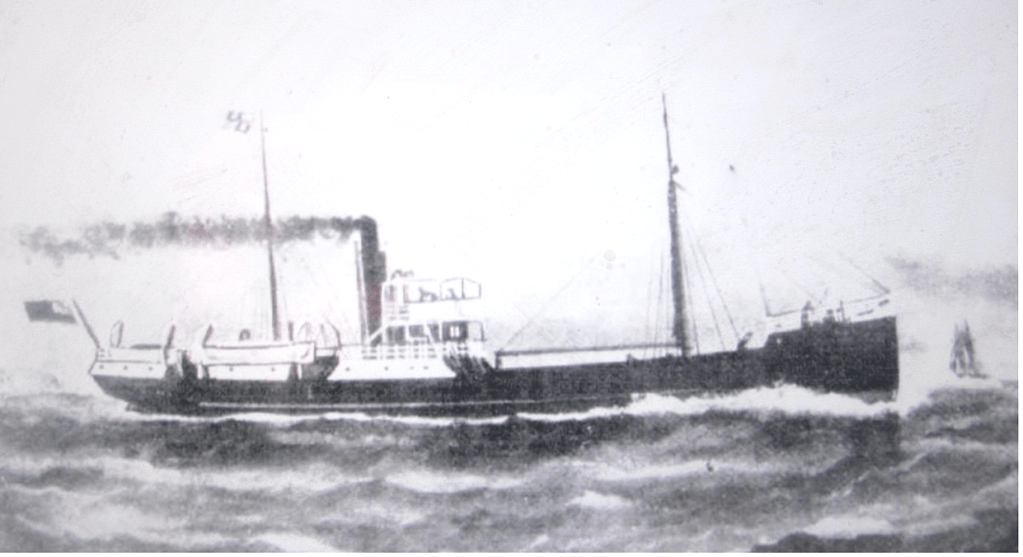
‘SS Macleay’ [Australian Town and Country Journal, 18 October 1911]
Wreck located
The Sun of 13 October 1911, page 7, reported:
‘A telegram received by the Department of Navigation this afternoon states that the captain of the tug Irresistible, which went out to search for the sunken steamer Macleay, reports locating the wreck on the south-east end of Boonbelbar Island [near Port Stephens]. The message adds that there are no further survivors, and that three bodies have been recovered.’
The Burrangong Argus of 14 October 1911, page 2, also reported:
‘With regard to the wreck of the Macleay, it is feared that all hands, save two who floated ashore, to Port Stephens on a plank, have been lost. The drowned body of W. Jones (steward) has been washed ashore. One of the survivors states that immediately after the steamer crashed on the rocks, it turned turtle and sank. Later. A message from Nelson’s Bay states that three bodies altogether have been recovered from the wreck. The sea is swarming with sharks.’
The Leader of 14 October 1911, page 2, provided additional information:
‘Captain Keith went down with the Macleay steamer. Five bodies have been recovered, fifteen being drowned. A quantity of wreckage has been observed between Richmond River and Cape Solitary Island.’
The Crew of the Macleay
The Armidale Express and New England General Advertiser of 17 October 1911, page 8, reported the names of the international crew:
‘The crew of the wrecked steamer Macleay comprised : Master, Captain Donald Keith, 33, Tomago; Mate, Mr. Goldsmith; 2nd Mate, J. N. McLean; 1st Engineer, A. T. Tarleton, 34, Sydney; 2nd Engineer, D. J. Gowing, 27, Bega ; Lamp trimmer, M. Alexander, 34, Leith; Cook, J. Meechan, 26, England; Steward, W. Jones, Sydney; A.B., A. Jablin, 20, Sweden; A.B., E. Drever, 34, Scotland; A.B., J. Mackenzie, 25, Scotland; A.B., C. Petersen, 31, Finland; A.B., W. Swanney, 30, Scotland; A.B., Hans Hansen, 38, Norway ; A.B., J. Joyce, 27, Dublin; Fireman, F. Monks, 49, England; Fireman, J. Killen, 40, England. The two survivors, Peterson and Swanney, are single men. The Macleay carried no passengers on her fatal trip.’
Published Interview with Charles Petersen
The Byron Bay Record of 21 October 1911, page 9, reported:
‘In a published interview Peterson said: He was the man at the wheel on Wednesday night, while in the mate’s (H. Goldsmith’s) watch. There were three men on deck, viz. Swanney, A. Dobson, and himself. Captain Keith set the course due north-east, and went off the bridge. “Not long afterwards,” said Peterson, “I said to the mate, There is something white on the beam. The mate replied, ” It is a school of fish.” I answered, “It is a school of rocks.” All most at once the ship struck, and she went on at a speed of nine knots. The captain rushed on deck and called out, “What have you done? You’ve sent the ship to the bottom, and from the look of it we will go with her ; we had better try to beach, her.” I swung the helm over, according to the captain’s instructions, and the steamer swerved round and slid sideways off the rocks. The well was sounded aft and no water was reported. It was, however, report ed that water was pouring in forward, In ten minutes we were floundering in water, and the ship had disappeared. She seemed to fall over on her side. The boats had been swung preparatory to launching, but they swung back again, as the ship healed over, and could not be launched.
In a later published interview Peterson said: ‘There was an awful row when the ship sunk. The water shot in as though enormous whales were spouting. When the commotion subsided all was quiet, except for the shouting of men in the water. Just before, the ship disappeared I saw Captain Keith on the bridge holding a lifebuoy. When the ship struck he rushed out of his cabin, and asked me whether I had kept the course. I said the chief mate had altered it from north-east, to three points; northward. He shrieked at the mate, ‘”Then you have drowned us. The last I saw of him he was on the bridge, I don’t, think he came up again alive after the ship sunk. The captain’s idea was, to try and beach the vessel, but she was too badly injured. I saw the second mate in the water. He called out, Charlie, I am gone,’ and sank almost at once. Steward Jones was a good swimmer. At first he had hold of a horse’s tail, but., he let go and seized a hurdle. He was paddling close to me for a long time.
When the moon rose we could see an island to the north, Cabbage Tree, I think it was, and the steward sang out. “If we only get a bit closer I believe could swim to that; I might, have a try.” I fancy Jones must have been drowned in the breakers. I cannot swim myself, so I could do nothing but hang on to the platform I had got hold of. For a long time I was shouting to Swanney, and after I could no longer hear his voice I thought I could hear him whistling. I began to think I was the only one left, and it was no use struggling any longer. The loneliness of it was killing me. Then when I was slipping off my platform I would say to myself, “You are not dead yet, Charlie, don’t give in yet.” I don’t know how I was saved. I was 13 hours in the water, When the morning broke we (Swanney, himself, and two other men) were close to the surf in the breakers. The other two men were washed off Swanney’s raft. I scrambled out more dead than alive, but infinitely thankful for my preservation.’
Three Crew buried at Tea Gardens in a Simple Ceremony
The Daily Telegraph of 16 October 1911, page 9, reported:
‘It is among those who live by the sea that such a disaster as the Macleay wreck strikes home most keenly. In this little community, composed chiefly of fishermen and men whose work takes them on the water, the loss of life has evoked a feeling of deep personal sympathy. It is not merely a matter for wonder and discussion — it is the toll of the sea, the cutting short of men in the fulness of life and strength, the exemplification of an ever-present danger.
Yesterday afternoon the three bodies that the sea has returned were buried. There is no hearse on this side of Port Stephens, and the funeral was all the more impressive in its simplicity. The procession started along the green slope that stretches like a lawn from the main street to the water’s edge. The whole town was there— men, women, and children. Hardly one of the latter was without a wreath of white lilies or flannel flowers, exquisitely beautiful. The coffins, of plain pine boards, were placed upon the only springcart which Tea Gardens possesses, and the little cortege wended its way slowly over the green stretch past the glistening river and through the shady trees to the cemetery.
The bodies of Hans Hanson, the seaman, and Thomas Monks, the fireman, were interred in the Church of England section of the reserve. Rev. R. G. Knox conducted the service. The remains of William Jones, the steward, found a resting-place in the Roman Catholic portion of the ground. The service at the graveside was read by Mr. Tom Hough, as there was no ordained priest available. Among the mourners was Jones’ mother, who had travelled to the Tea Gardens from Sydney.
The search along the beach north of North Head was continued yesterday and today. No further bodies have, however, come ashore. Some of the fishermen are inclined to think that the sharks are to some extent responsible for this. The carcase of one of the three horses on the steamer has floated on to the beach, greatly mutilated. The Macleay carried on deck nearly 200 empty casks, consigned to the Colonial Sugar Co. These are now scattered for five or six miles along the sand. Yesterday afternoon the steamer’s binnacle was washed ashore, and also a lifebuoy. There is not much wreckage as compared with the size of the vessel that went down.
No doubt now exists that the steamer’s port side was ripped out by the rocks before she sank like a stone to the bottom. There has been considerable discussion as to the exact locality of the rock on which the Macleay came to grief, but the positive statements of Charles Peterson, who was at the wheel when the disaster occurred, make it practically certain that she hit the south eastern angle of the island known as Big Island, but is marked on the chart as Boondolah, the other two island being Cabbage Tree and Little Island. Had the steamer just missed the rocks on which she struck, the course steered would have taken, her onto Little Island. The seaman Peterson, in evidence, stated that he thought the ship passed the Point Stephens light, four miles distant, but the light-house-keeper is of opinion that when he spoke the Macleay on Wednesday night she was not more than three-quarters of a mile spray. The survivor’s Swanney and Peterson, with Mr. Hough, the North Coast Company’s Newcastle manager, left for Newcastle, today.’
Coroner Inquest
The Singleton Argus of 17 October 1911, page 2, reported:
‘The inquest on the bodies recovered from the surf, in connection with the wreck of the steamer Macleay, was held at Tea Gardens on Saturday. The two survivors were the only two witnesses examined. Charles Peterson, one of these, said as soon as the steamer struck everybody came up on deck, and the captain came on the top bridge. The captain said to the mate, “What course have you been steering?” The mate replied, “North-north-east.” Witness said, “That’s a lie, because the ship has been going north by east for some time.” The captain also said to the chief officer, “Oh, you murderer!”
The coroner found that Thomas Monks, Hans Hansen, W. Jones bodies were found on the beach near North Head, Port Stephens, on, October 12 and 13, and that their deaths were caused by drowning. “I further find,” he said, “that their deaths were caused through the North Coast Steam Navigation Company’s steamer Macleay hitting on the south-east corner of Big Island, and foundering close by, such foundering being caused by the careless navigation of the chief officer, Henry Thomas Goldsmith.”
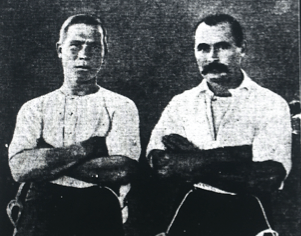
Charles Petersen and William Swanney – only two survivors from the ‘Macleay’ [Daily Telegraph, 17 October 1911]
The Armidale Express and New England General Advertiser of 17 October 1911, page 8, also commented on the sad atmosphere that existed at Tea Gardens:
‘It is now practically certain that all hands on the wrecked steamer Macleay have been lost—with the exception of the two men, Swanney and Peterson. An atmosphere of gloom rests on the small township at Tea Gardens (Port Stephens), which is intensified by the presence of small processions conveying the dead from the launches as they arrive from the scene of the disaster. The two survivors were on Friday both suffering from shock and the immersion of the previous night, but after a good breakfast and a pipe of tobacco they looked less like men nearly returned from their graves.’
Report of the Lighthouse Keeper at Port Stephens
The Daily Commercial News and Shipping List of 18 October 1911, page 4, published a report concerning the Macleay, prepared by W. Gidley, Acting Principal Keeper:
‘The Secretary of the Navigation Department yesterday received the following report from the lighthouse keeper at Port Stephens regarding the wrecked s.s. Macleay:— Sir— I most respectfully beg to report with reference to wrecked steamer Macleay. She passed here, going north, at 7 p.m. and gave her name by flashing signals. The remark was also flashed that he who was signalling at the time thought it was going to be a dirty night. I flashed back that, by the showing of my barometer I did not think it would be anything, although it was very dull at the time, and blowing fresh, from the south-east, with a moderate sea.
They then flashed good-night, and I returned the compliment. I at once went and reported her as passing here north at 7 p.m. Upon my returning to signal house, I saw her calling up again, and I answered her at once. They then gave the message, ‘Tell young Gard.’ I here stopped them, and told them that Gard was fishing at Seal Rocks. They then gave me ‘”Thank you, good-bye,” again, and proceeded on their way north.
The next morning Captain Cumming (Acting Deputy Superintendent, Newcastle) rang me up, and asked had I seen anything of the wreck of the Macleay, which was a complete surprise to me. I received a telephone message from Mr. Hough, the agent for the North Coast Company at Newcastle, to signal the Kallatina passing north to keep a lookout for anything in the way of wreckage, etc., about near Broughton Island, which was the place reported as where the wreck took place. I carried out the signals as requested; I also received orders to instruct the pilot steamer Ajax, which I also carried out by flag signals on her way north. On her return south that evening I again signalled her, with orders from the Deputy-Superintendent by flashing signals which were carried out by her. She returned here again at noon to-day, and I rang up the Deputy-Superintendent for orders, and then gave them by semaphore to her. She at once proceeded on to Newcastle.
I then rang up the master of the tug Irresistible, which had gone into Nelson’s Bay. He informed that he had located the steamer at the south-east corner of Boondelbah Inland, which is the nearest island to this point. By his statements he had the two survivors on board the tug, and they pointed out the place approximately where she was supposed to have gone, down. They then told him she went down, in three minutes, and that her port side was torn out. By the course the Macleay was steering when passing here she should have gone a good way clear of the island. Her course passing here was about north-east by north to north-east, as near as I could judge from this point. She was about three-quarters of a mile off from here on passing this point. After about 7.15 her lights were lost sight of, the stern, light not being a very bright one. This is all I have to state up to the present. (Signed) A. F. W. GIDLEY, Acting Principal Keeper.’
Survivors to return to Sydney
The Sydney Morning Herald of 17 October 1911, page 9, reported:
‘So far as is known by the North Coast Company and the police in Newcastle no further bodies have been recovered from the wrecked steamer Macleay, which sank on Wednesday night last near Big island, off Port Stephens. The two survivors, Charles Peterson and William Swanney, will leave Newcastle for Sydney tomorrow morning, and report themselves at the Navigation Department.
The raft which was picked up off Port Stephens on Saturday last, and which is supposed to have come from the missing steamer Rosedale, has been brought down to Newcastle by the steamer Karuah, and will be taken on to Sydney.’
The Grafton Argus and Clarence River General Advertiser of 18 October 1911, page 3, further reported:
Peterson and Swanney, the two survivors from the Macleay wreck, arrived in Sydney today. They brought, as mementos, the lifebuoy and wheel that did them such good service in the hour of trouble.’
Lifeboat washed Ashore
The Sydney Morning Herald of 20 October 1911, page 9, reported:
‘Mr. A. Hough, the local manager for the North Coast Company, received news from Tea Gardens, Port Stephens, today to the effect that the lifeboat from the wrecked steamer Macleay was washed ashore this morning. The boat is said to be undamaged.’
Marine Court of Inquiry
The Daily Commercial News and Shipping List of 14 November 1911, page 16, reported on the Marine Court of Inquiry held into the loss of the Macleay:
‘His Honor Judge Backhouse, assisted by Captains Dakin and Taylor (assessors), yesterday opened an inquiry into the loss of the North Coast Company’s steamer Macleay. Mr. Robison appeared for the Navigation Department, Mr. Broomfield (instructed by Mr. Dunhill) for the North Coast Steam Navigation Company, and Mr. W. A. Windeyer for the relatives of the late captain of the Macleay.
In outlining the case, Mr. Robison said that the Macleay left Sydney on the night of October 10, and proceeded to Newcastle, where she took in a cargo of coal. She departed at 4 p.m. on October 11, and at that time the wind was fresh from the south-east and the sea moderate. About 7 o’clock the captain went below, leaving the mate in charge. After the vessel had been on a north-east course for about 20 minutes the mate altered it to N. by E. About 10 or 15 minutes later the man at wheel (Peterson) said, “What’s that white stuff ahead? Breakers?” The mate replied, “No; a school of fish. There cannot be breakers there.” Peterson, however, put the helm hard a-port, and the vessel came round quickly, but struck hard on the port bilge. The master came up at once, and gave orders to take soundings and get the boats out, but before the latter order could be carried out the ship heeled over to port and went down head first.
Two men only were saved, while the bodies of three others were washed ashore. It was submitted that the accident was caused by the mate hauling the ship in on a N. by E. course without any instructions from the master to do so. William Swanney, A.B. on the Macleay on her last voyage, said the crew of the vessel numbered 17. After leaving Newcastle the sea was moderate. At the time of the accident, he was standing by. He remembered passing the Port Stephens light, and saw messages exchanged. Before the disaster he did not notice any signs of danger. The vessel struck on the for’ard port bilge. After the striking the captain called all hands up, and when they had mustered he ordered the starboard boat out. The boat was swung, but the Macleay had listed to such an extent that it swung back on to the davits. He heard it said that there was no water coming in aft or into the engine-room, but the engineer reported that a good deal was being made for’ard.
The Macleay remained afloat for about seven minutes after the striking. After the vessel disappeared witness saw only two men, Hanson and the donkeyman. They were on a plank with him. He was in the water for about 12 hours, and then got ashore. The donkeyman kept falling off the plank all night, and after being in the water for about 11 hours he fell back and was drowned. Hanson and himself got into the breakers together.
Mr. Robison: What became of Hanson? Witness: He was standing a breaker further out than I was. I called out to him, ‘Come on, Hanson.” I walked on, and when I looked back again he was gone. I struggled ashore, and was on the beach for some time before I was found by a fisherman. Witness said he went out afterwards in the tug Irresistible, and was of the opinion that the Macleay struck on the north-east corner of Big Island. When Swanney left the box his Honor congratulated him on having escaped drowning, and on looking none the worse for his experience.
Albert Gidley, lighthouse-keeper at Port Stephens, said he saw the Macleay off Morna Point. After sunset he obtained her name by means of Morse signals. The Macleay, as far as he could judge, was then steering N.E. by N. course. A short conversation took place between them, the message from the Macleay expressing the opinion that the night would be a dirty one. Witness replied that he did not think so, and the Macleay returned thanks. A little later he was called up again, and asked to give a message to a young fellow, but he interrupted and told them that the man was at Seal Rocks. The Macleay replied, “Thanks; goodnight.”
Captain Heard, marine superintendent of the North Coast Company, said the life-saving appliances of the Macleay were adequate, and in first-class condition when she left Sydney on her last trip. The compass and steering gear were also in first-class order. The captain had been in the service for three and a half years, and was a thoroughly reliable man, a good navigator, and a total abstainer. The first mate was a competent officer. He held a masters’ certificate. The second officer had not been in the company’s employ long, but was a very promising young man.
Charles McAlister, superintendent engineer of the North Coast Company, called by Mr. Broomfield, said the Macleay was overhauled in June last, and everything requiring to be done was attended to. She was about 28 years old, and during the seventeen years he had been in the employ of the company she had had four new bottoms in her. At the time of her loss the Macleay was worth about £4000. She originally cost £12,000. Pilot McCrea said the N.E. course which the Macleay was on when the captain went below was a perfectly safe one. Captain Spinks gave evidence that the vessel was in good order.
Charles Peterson, able seaman, who was one of the two survivors of the wreck, gave evidence. He stated that amongst the cargo carried by the Macleay was some iron-bound casks, which were stored on deck about 14ft from the compass. After Point Morna was passed a course N.N.E. was steered, the vessel making in the direction of Port Stephens light, which was about three-quarters of a mile distant. At this point another vessel was seen, and the captain ordered the Macleay to be put on a N.E. course, so as to give this vessel plenty of room. Afterwards the chief officer took charge, and ordered a N. by E. course, and witness noticed something white ahead, and said to the mate that it looked like breakers. The mate remarked, “It must be a school of fish,” and witness replied, “More like a school of rocks.” The mate then ordered the helm to be ported, but it was too late, as the vessel struck and heeled over.
The captain rushed up on deck and asked the mate what he was doing, but that officer did not reply. The captain then asked the mate what course he had been steering, and he replied, “Nor’-nor’-east.” Witness interposed, “It’s a lie; my course was N. by E.” Witness was 13 hours in the water before being washed ashore. He thought the vessel struck the S.E. corner of Big Island.
The Court found that the Macleay struck on the S.E. corner of Big Island on the night of October 11 while on a voyage from Sydney to the Clarence River, and became a total wreck; the vessel was well found in everything; the weather and the sea moderate; it was fine, although the night was dark; that the wreck was caused by the vessel’s course being altered after she passed Port Stephens from N.N.E. to N. by E.; that the evidence of Peterson, was unsatisfactory, and in justice to the mate, who was drowned, and was a thoroughly competent officer, it should be added that if the Court had heard his evidence it might have come to a different conclusion; that there was no blame attachable to the master, who was also a capable officer, and had lost his life. The Court also deeply regretted the great loss of life, and expressed the deepest sympathy with the relatives of those drowned.’
Concluding Comments
According to the findings of the Marine Court of Inquiry, there appeared to be some doubt as to who was responsible for steering an incorrect course on that fateful night. The Inquiry accepted the evidence of Petersen that he steered the course set by the ship’s mate, but as that person died, his version of events could not be verified.
The site of the Macleay wreck is a well-known dive site.
Information on other shipwrecks in the Port Stephens region is published on this website and can be found at the following links:
A History of 110 Shipwrecks at Port Stephens 1800 – 1950
Shipwrecks Inside Port Stephens 1869 – 1950
Morna Point – A Graveyard of Shipwrecks
Wreck of SS Florence Irving at Point Stephens – 1877
Foundering of SS Oakland off Cabbage Tree Island – 1903
Wreck of SS Pappinbarra at Port Stephens – 1929
Wreck of SS Uralla Near Birubi Beach Port Stephens – 1928
Wreck of HMAS Psyche in Port Stephens – 1924
Wreck of the Cora Lynn off Port Stephens – 1914
POSTSCRIPT
Fundraising to assist families of those who lost their lives in the sinking of the Steamships Rosedale and Macleay – 1911
The two marine disasters of the sinking of the Rosedale and Macleay within a number of weeks of each other, resulting in over 39 deaths, raised concern in Sydney, about the welfare of the many families affected by those who died. To provide financial assistance to bereaved family members, a number of fund-raising activities were quickly started in Sydney.
The Daily Telegraph of 21 October 1911, page 20, reported:
‘A meeting of citizens, convened by Messrs. D. H. Morton and G. H. Briner, Ms.L.A., was held at the Hotel Australia yesterday afternoon, to consider the best means of raising funds to assist the relatives of those who lost their lives in the recent Rosedale and Macleay wrecks. Mr. Morton, who presided, announced that it was Mr. Hugh D. McIntosh’s intention to arrange a large entertainment at the Stadium, free of cost, for the purpose of raising funds; that Mr. Skinner, of the Palace Theatre, had signified his intention of holding a matinee performance towards the object; and that Mr. Maas, manager of the Tivoli, would also hold a matinee performance, to raise funds. Messrs. Hollander and Govett had kindly agreed to do the printing free of charge.
The following motions were passed: —
– That this meeting desires to express its sincere sympathy in their sad bereavement and loss with the relatives and friends of those who met their death in the recent sad calamities, consequent upon the wrecks of the steamers Rosedale and Macleay, and with the view of expressing its practical sympathy, resolves that a fund be now inaugurated to relieve the necessity of those dependent upon the deceased.
– That those present form themselves into a committee, with power to add to their number, viz.:— Messrs. J. H. MacFarlane, W. Miller, H. D. Morton, A. Kelly, and R. A. Price. Ms.L.A., Captains Guest and A. W. Webber, Messrs. G. H. Varley, A. Maas, H. D. McIntosh, G. H. Williams, W. N. G. Palmer (Taree), H. Skinner, W. Rigg, J. F. Thomas, J. F. Bell, and J. Jackson.
– That funds be raised for the purpose of enabling the Royal Shipwreck Relief and Humane Society to render assistance to the relatives of those who perished in the recent Rosedale and Macleay shipping disasters, to whatever extent may be deemed necessary, the balance, if any, to be retained by the society for the purpose of carrying out this object.
Messrs. H. D. McIntosh and H. D. Morton were appointed hon. secretaries, and Messrs. Maas and Harry Skinner hon treasurers, in conjunction with the Lord Mayor, Messrs. Briner, R. A. Price, Macfarlane, Morton, C. A. Lee, and G. N. Hindmarsh.’
The Daily Telegraph of 23 December 1911, page 22, further reported:
‘A meeting of the citizens’ committee of the Rosedale and Macleay relief fund was held at the Hotel Australia yesterday afternoon. Mr. H. D. Morton, M.L.A., presided. A statement submitted by Mr. H. D, McIntosh set forth that the fund had been increased to the extent of £444 9s 7d, as a result of the successful entertainment held at the Stadium on November 27. Mr. E. A. Maas notified that the total amount in hand was £551 4s, while the amount subscribed (including a few amounts yet to be received) totalled £607 4s 10d. A sum of £25 has already been forwarded to the Royal Shipwreck R. and H. S. Society, to relieve urgent cases, and the treasurers were instructed to make a further payment of £550.
On the motion of Mr. G. H. Varley, seconded by Captain Webber, it was unanimously decided to acknowledge the great assistance rendered by Mr. Hugh D. McIntosh in respect to the relief of the sufferers through the wreck. In speaking to the resolution the chairman said that to Mr. McIntosh was undoubtedly due a large measure of the success, achieved in respect to the object the citizens’ committee had in view, and that through his efforts there would be a little brightness, to those who have suffered though the loss of breadwinners this Christmastide.
The committee especially appreciated the assistance rendered by Mr. Sam McVea and Mr. Sam Longford. The secretary of the Royal Shipwreck Relief and Humane Society has received a cheque for £550 from the treasurer of the “Rosedale and Macleay Relief Fund,” representing £444 9s 3d collected at the Stadium and £104 6s 3d at the Tivoli. The committee of the society desires to thank all those connected with the special fund for their successful efforts on behalf of the sufferers through these disasters, and is pleased to learn that there are still further sums in hand and others to follow.’
Researched and compiled by Kevin McGuinness
July 2023

 Port Stephens - a history exploration