
Introduction
On 4 December 1877, the SS Florence Irving, a steamship belonging to the A. S. N Company of Sydney, foundered in a heavy fog, on a rock shelf below the Point Stephens lighthouse. The ship was on a regular journey from Sydney to Brisbane carrying 42 passengers plus crew, together with cargo.
Given the dangerous rocky location of the shipwreck, it was fortunate that there was not multiple loss of life. Tragically, a seven-month-old baby, who was travelling in the steerage section (third class)of the ship, drowned.
Fifty-two years later in 1929, the cargo ship SS Pappinbarra also foundered on the rocks near the site of the wreck of the Florence Irving, below the Point Stephens outer lighthouse.
The foundering of the Florence Irving resulted in considerable newspaper coverage in Sydney and Brisbane. A Marine Board of Inquiry found that fault lay with the ship’s master for the disaster.
There was also newspaper speculation that sailing close to the shore in order to increase the speed of the voyage was also an unproved cause of the foundering. Passengers also later complained that when being evacuated from the ship, a boarding class status was adhered to, whereby the third-class steerage passengers were not allowed to board the ship’s evacuation boats until the first and second class passengers had done so.
The newspaper reports also demonstrate how the outer lighthouse staff aided the stricken passengers by housing the female passengers in the lighthouse staff’s quarters.
This is the story of the foundering of the SS Florence Irving and its consequences.
Major upgrade of the Florence Irving – 1873
In 1873, four years before it foundered at Point Stephens, the paddle steamer Florence Irving, sister ship of the Agnes Irving (pictured below), was reengineered. The paddlewheels were replaced with twin screws, and the ship was lengthened by nearly 28 feet, making her 43 feet longer than the Agnes Irving. New, more powerful engines were also installed.
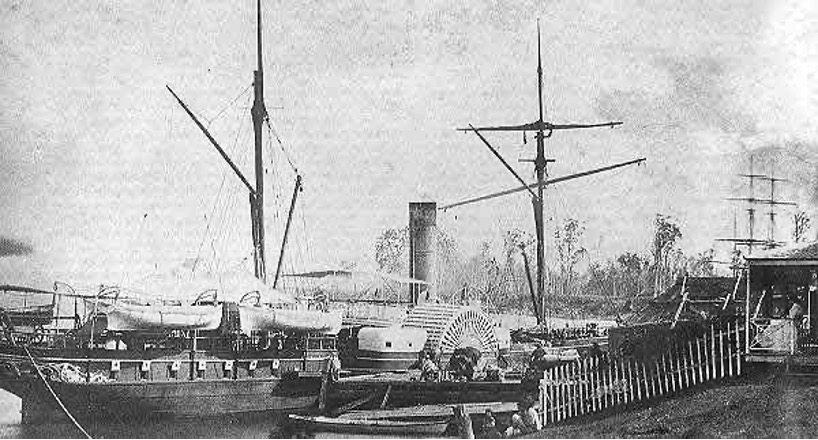
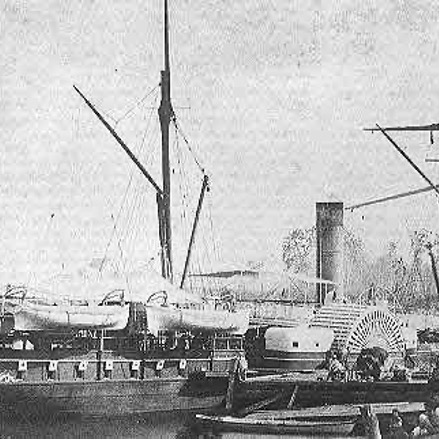
Paddle Steamer ‘Agnes Irving’ (sister ship of ‘Florence Irving’) at Lawrence on the Clarence River
The Empire of 23 October 1873, page 2, reported:
‘An event of an unusually interesting nature, and one that appears to mark a red-letter day in the progress of the engineering and iron-working industry of the colony, was celebrated in the trial trip of the A.S.N. Co. steamer, Florence Irving, which took place yesterday. It may, perhaps, be necessary to explain under what circumstances so wonderful a transformation has been carried out; and the practical and pecuniary benefits that it is assumed will accrue from the expenditure of some £20,000, upon what was considered a good sea-going steamer.
The Florence Irving was a paddle-wheel steamer of some 340 tons register, but from her large consumption of fuel, 28 tons per day, giving a steaming average of 8 knots; thus only a small space was available for freight, which rendered her inadequate to the requirements, of the Queensland trade. What is sought to be now achieved by the introduction of improved machinery is a reduced consumption of fuel, viz., 11 tons per day; an increased rate of speed, with a much greater capacity for cargo as well as passengers. The alterations carried out some time since in the Leichhardt have proved so successful that it has induced the company to effect a similar work with the steamer under notice.
How far the objects sought after have been achieved will be seen by the following notes: — The trial was fixed for yesterday, and extended throughout the whole day. The morning broke clear and mild, and the wind from the north-east set in early, keen and fresh, but nevertheless, a glorious day at sea. Of course, the ship has her faults, her appearance is somewhat against her, as it is against all ships so altered, a little less sightly than the Leichhardt, but not at all unlike her; but once on board, the singularity of her contour fails to strike, one so strangely.
The ship, under the charge of Captain Adams, of the Coonanbara, and having on board Mr. Broderick (the Government Superintendent Engineer), and Messrs. Davidson and Thompson (the Engineering Superintendents of the company), and a few others, glided peacefully away from the works at 7.55 a.m. upon a draught of 8 feet 8 inches aft, and 6 foot forward, and having 120 tons of coal in her bunkers. At half speed she continued, passed all the guns that sullenly keep watch and word over the anchorage of the port, and took leave of the North Head at 8 35 a.m., and met a hard north-easter; with full boiler power, and her increased velocity, gained Long Reef by 9.5 a.m., and the north head of Broken Bay at 10.50 a.m. Here one of the engines having primed, had to be stopped. The ship was put under fore and aft canvas, and stood out on the port tack. Any doubts that existed as to the ship being crank, were here swept away, for, though light, she stood splendidly to her canvas.
Went about at 11.45 a.m. and stood in; came abreast of the new Government steamer Ajax, bound for Newcastle. The Florence Irving was again put at full speed and measured her pace with the Ajax. There was no perceptible difference for some time, till the sea began to increase, when the Florence Irving began to draw ahead; but meeting with the Collaroy, from Newcastle, her head was turned, at 12.50, off North Head. She went off the wind at a great rate, in the wake of the Collaroy, and an exciting race was here prevented through one of the engines priming, and the other having to be slowed down.
The ship was again put under full speed at 2.15 p.m., and she ran past the South Head of Broken Bay at 2.51 p.m., and rounded the North Head at 3.57 p.m. This was the highest rate of speed attained, viz, 14 miles in 1 hour and 6 minutes. She was then put over the measured mile, and ran it with a strong wind on the quarter, in 5 minutes 7 seconds, or at the rate of 11¾ knots per hour, having the full boiler pressure of 60lb steam, vacuum twenty inches, engine making 110 revolutions. A trial of the boat’s turning qualities was tested off Lavender Bay, where she came round in a few feet more thar her own length, with port engine going full speed ahead, and starboard one working the reverse way.
The ship took on board Messrs. Cadell, Neale, and Milson, directors of the A.S.N. Company, and made a second trial; time 6 min 26 sec, having a strong wind on the port bow which gave the ship a considerable cant. The engines averaged about 60, but worked up to 65 revolutions after again going through the Heads. She was subjected to a third trial but was less fortunate as regards speed. She entered the mile with the rudder “hard on;” time, 5 min 14 sec.
The Florence Irving, when running as a paddle steamer, was fitted with oscillating engines, which are now replaced by these on the compound principle, designed by the staff of the company, for driving twin screws. They are of a nominal horsepower of 100. The high-pressure cylinder measures 20 inches in diameter, and the low pressure one 36 inches, both having a stroke of 21 inches. The severe test, 65lbs, at which they have been subjected, has failed to trace the slightest flaw.
The castings are by Taylor and Wearne, of Redfern. The screws are four bladed, of 7 feet 6 inches each in diameter, with 12 feet pitch, and on the trial yesterday their action caused no great amount of vibration. Steam is supplied by a double circular multitubular boiler, designed and constructed at the company’s works. Its diameter is 11 feet 6 inches, and it has been tested by hydrostatic pressure at 130lbs to the square inch. Fitted to the boilers aro two superheaters. The furnaces are 3 feet 3 inches in diameter and 7 feet long.
Other alterations, improvements, and ingenious inventions for economising labour are not of lesser importance than the improved engines. The ship has been lengthened 28 feet amidships, and measures now 218 feet, beam 26 feet, hold 14 feet. A spar deck now stretches right fore and aft, having a height of 7 feet 6 inches from the main deck. The gross tonnage is about 800, and the ship, it is computed, will carry 650 tons of cargo on a displacement of 11 feet. Accommodation for both classes of passengers has been carefully considered. The saloon being lengthened—it was formerly 10 feet 6 inches wide, and now measures 12 feet across, with a height of 7 feet 6 inches—thirty-four persons can be accommodated, besides ten in the ladies’ cabin.
The saloon is being tastefully ornamented with Cypress pine and gilt mouldings, and is well ventilated, with 12½-inch ports. There is a long bridge amidships, measuring 50 feet, under which are situated the officers’ quarters, &c. On the main deck amidships are the bathrooms, engineers’ lockers; horse-stalls, &c. It is evident that in every part of the ship the work carried out has received all the care and attention that forethought could suggest; and the success of yesterday is well deserved, both to the officers of the company and to the company themselves. One disadvantage was, however; conspicuous yesterday —-viz , that of having the wheel over the rudder, where the steersman has no chance of seeing beyond the bridge. The steering gear should, undoubtedly, be on the bridge, where there is an uninterrupted view of every point of the horizon.
Though there was a good roll on yesterday, the ship was almost unconscious of the mobility of the medium in which she floated. The conclusion to be arrived at by the trial is, that the Florence Irving is fast and efficient, and a safe and stable vessel. She will take her departure hence for Melbourne on Tuesday next. We believe his Excellency Sir Hercules Robinson is a passenger.’
The Foundering
The Sydney Morning Herald of 5 December 1877, page 4, reported:
‘Another sad accident has befallen one of the A. S. N. Co.’s fine steamships, in the stranding of the abovenamed vessel [Florence Irving]. The particulars of the affair are very meagre, but by telegrams received by the manager of the company, Captain Trouton, and also the President of the Marine Board, Captain Hixson, from the lighthouse-keeper at Point Stephens, we are enabled to give our readers the following particulars:—The Florence Irving (steamer), of 920 tons, Captain R. M. Phillips, left Sydney on the 3rd instant, at 6 p.m., bound for Cooktown via the intermediate ports, having on board the following passengers:—Mrs. E. J. Finch, Mrs. F. Wallen, Mrs. E. Roberts and nurse, Mrs. G. Hawkins, Mrs. Langrochwendt and 2 sons, Mrs. C. Klingner, Mrs. Dixon, Mrs. J. Iverson, Miss Fletcher, Mrs. Gataker, Messrs. F. Shepherd, Bromberg, W. J. Morley, E. Roberts, L. Levin, R. Macarthur, W. Munro, and 22 in the steerage.
The night was bright and calm in Sydney up to 1 a.m. yesterday morning, when a dense fog set in, which no doubt extended all along the northern coast, as the telegrams state that the Florence Irving went on shore at Point Stephens at 4 o’clock yesterday morning. Every assistance was afforded by the lighthouse-keeper, and passengers and crew were saved, with the exception of one child drowned.
Immediately on the intelligence reaching Newcastle the company’s steamer Collaroy was dispatched to render assistance, and the manager made arrangements for the dispatch of the Elamang (steamer) at 7 p.m. to render further aid if practicable, the latter vessel leaving at the appointed time……
The Collaroy arrived at 11 last evening [at Sydney] from the stranded steamer, bringing up all the passengers, together with their luggage. Captain Harris, of the Collaroy, brings the following particulars, forwarded by Captain Phillips, to the marine superintendent of the company, Captain Munro:—”The morning was very hazy, and I thought I was some two miles from the land; I was on the bridge at the time, my second officer being with me; I had not been off the bridge all night, but I was deceived in the appearance of the fog. I had ordered the engines to be stopped, and the ship’s head was N.E.¾E. when she struck. The boats were at once lowered and, together with the passengers, their luggage, and the mails, promptly landed, although with considerable difficulty, as the reef is most dangerous, and the approach to the mainland very rugged.”
The steamer now lies with her head to the S.E., she, after striking, having slewed round. When the Collaroy left her the whole of the fore part of the steamer was submerged to fore hatch, the engine-room was full of water, and there was about five feet of water above the lower deck aft, which would place the vessel at an angle of 45°.’
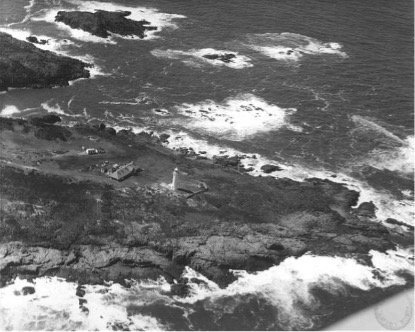
Location of the foundering of the Florence Irving on the rocks at Point Stephens, below the Outer Lighthouse [Newcastle Library]
The Newcastle Morning Herald and Miners’ Advocate of 7 December 1877, page 2, further reported:
‘There are a few later particulars regarding this melancholy occurrence, beyond what we have already stated. The captain attributes the disaster to an error in the compass, there being a quantity of iron wire for fencing on board. The steerage passengers lost their all. The vessel did not settle to quickly by the stern, but the saloon passengers were able to save their effects. The Collaroy took the passengers on to Sydney, and the sheep, of whom there were a number on board, escaped by swimming on shore. The Challenge, with a lighter, has gone to the wreck with the design of saving the cargo; but a rough see was running yesterday, and it is feared the ill-fated steamer will go to pieces. The child drowned was only seven months old. The bereaved mother saved three others of her children.’
Help provided by the Point Stephens Lighthouse staff
The Capricornian (Rockhampton, Qld.) of 15 December 1877, page 12, reported on assistance provided by the Point Stephens lighthouse staff:
‘As soon as Captain Phillips saw there was no chance of keeping his ship afloat, he gave orders to clear away the boats. The passengers returned to their bunks to dress, the ladies in the saloon, after the actual state of affairs had been ascertained, acting with one or two pardonable exceptions, with a calmness seldom seen under such trying circumstances.
Although to the passengers it seemed almost an age before a boat could be cleared from the davits, the first one (the port quarter boat) was really lowered within six or seven minutes from the time the steamer first struck, three boat-loads being landed within the space of a quarter of an hour. From where the steamer was ashore, a very dim glimmer could be seen, apparently a very short distance off, and this proved to be the Port Stephens lighthouse, which, although it was only a few hundred yards distant, had not been previously seen by the captain or the watch, so dense was the fog.
When the first boat, in charge of the second-mate, shoved off from the side of the vessel fitted with lady passengers, it was too thick to see whether a safe landing could be effected, but fortunately the light housekeeper (Mr. Priest), who had noticed the vessel strike, came down to the scene of the disaster, and as well as he could directed the boats to the best place for landing. This was in a small gap in the rocks, slightly protected by the steamer but still a very dangerous place even with the small swell then coming in. By the exercise of great care, however, all the passengers were safely landed, as well as most of their effects, and also a large quantity of provisions.
From the landing place the lighthouse could be approached over sharp rugged rocks, and to the lighthouse keeper’s cottage most of the ladies were taken, and made as comfortable as the circumstances would permit. Excepting one instance, in which what appeared to be an unjustifiable destruction of property was caused, the officers and crew worked with a will to save the passengers and what belonged to them, the result being that most of the cabin passengers’ luggage was saved, although some of it got knocked about a good deal…..
After the boats had been lowered and brought to the companionway, very little confusion occurred in getting the passengers into them. Some threats were made by one of the subordinate officers, but these were uncalled for and unnecessary. The ladies of course, were given precedence. After this the male passengers were landed, then the mails, luggage, and a large quantity of provisions. Mrs. Klingner, of Brisbane, had a rather narrow escape from drowning. Just as she was about to descend the steps to the boat the rope suspending them, which in the hurry had not been properly made fast, gave way. She fortunately had hold of the hand of her brother (Mr. Levin), by whose assistance she was prevented falling forward into the water. …..
From the steamer the lighthouse was approached up a steep rocky ascent, spread over which could be seen groups of people, some hunting for luggage and other valuables, same were climbing up over the rocks towards the lighthouse keeper’s cottage, while others were resting under sails which had been rigged up to serve as a protection from the sun. Plenty of food and wine was available for all who required it, but few, except the men who had been working hard, seemed to have much appetite after the excitement they had passed through. As soon as Captain Phillips was able to land his first care was to arrange for obtaining assistance. At one time the lighthouse had been connected with Port Stephens by wire, but the line having become damaged, it was not repaired. It was, therefore, necessary to send messengers, with telegrams a distance of five miles, to Nelson’s Bay, whence they could be sent by wire to Newcastle and Sydney. This course was at once adopted.’
Statement by a steerage passenger
The Evening News of 5 December 1877, page 4, reported on a statement given by steerage passenger:
‘George Walker, a steerage passenger by the Florence Irving, called at our office this morning, and made the following statement : — “The Florence Irving left Sydney on Monday, at half-past 6 p.m. Ahead of us was the steamer General Pel, bound for Batavia, both steaming the same course. Our captain evidently wanted to get ahead of the General Pel. The Pel kept well out to sea, while our vessel was closer to the shore all along. At half-past 3 on Tuesday morning, there was a heavy fog, both vessels blowing their fog-whistles. About twenty-five minutes to 4, I saw the Port Stephens lighthouse, and ten minutes after we struck the rock underneath the lighthouse.
To have cleared the land we wanted about another four points of the compass. We struck in the middle of the island. I was on deck at the time, and distinctly saw the lighthouse. The second mate was in charge of the ship. The captain was not on deck at the time. I ran down to get my luggage, as the vessel began to fill in the fore part very rapidly. I had not time to get my luggage, she filled so rapidly. I lost everything. A Mrs. Harnie had four children in the steerage. Directly the vessel struck, she run on deck with three of them, and returned for the fourth— the youngest, a child about seven months old; but then the water was six or seven feet deep in the hold. The vessel seemed to settle down almost immediately. The mother was unable to reach her child, and it was drowned.
The steerage passengers lost everything they possessed. The cabin passengers saved everything, as the vessel was a long time settling down by the stern. About half an hour elapsed before the boats were lowered. The captain attributed the accident to the compass going wrong, and attributes the compass going wrong to the fact that there was a large quantity of iron wire for sheep-fencing on board on the aft hatch. The captain said they were steering two points out of the course, and he could not account for it.
There was indescribable confusion, excitement, and fear on board when the vessel struck. The passengers rushed on deck in their nightdresses. When the vessel first struck, she ran on to the rocks, and two of the passengers jumped ashore. The captain ordered the screw to be turned astern, which was done. I think but for that the vessel would not have filled so quickly. We got ashore in boats. The mails were landed at daylight. There were about fifteen sheep on board. These were thrown overboard and swam ashore safely. Some of the cargo— wine, brandy, &c., was got ashore; also eatables and cooking utensils, and after breakfast some more things were got ashore. The Collaroy arrived at noon and took us on to Sydney, where we arrived at 11 o’clock last night.’
Complaints expressed by a number of steerage passengers
The Telegraph (Brisbane) of 8 December 1877, page 3 (and other Brisbane newspapers), reported on a statement of complaints endorsed by twelve steerage passengers:
‘The following, by passengers on board the Florence Irving, has been handed to us for publication:— Sir, A statement, or rather statements, have appeared in the Sydney papers relative to the wreck of the Florence Irving, which are erroneous, and lest you should be also led away by the same, we will give you a short account, which we trust you will kindly publish for the general public. The Florence Irving sailed from Sydney about 6 o’clock on Monday evening, December 4, for Brisbane. Another steamer left just before us, and we noticed that she kept out to sea, whilst we hugged the shore. It seemed to us that the captain of the Florence Irving wanted to make a quick passage and get before the other ships, for in no way else can we account for the fact of his running ashore, as there is no canal there, neither has the ship wheels to enable her to cut off corners.
About 4 o’clock on Tuesday morning, just after the fog whistle had blown for the third time, a tremendous crash followed, and those who rushed on deck saw plainly and distinctly the rocks, shore, and lighthouse, although there was a slight fog at the time. After she struck, the captain sent word forward, that there was no danger, although there was at that moment six feet of water in the fore cabin. The ladies, and their children, who rushed on deck almost naked at the time, could not get below again, and it was at this time the child was drowned, the mother having saved her three others.
After a long delay the boats were lowered, and, strange to say, all were laden at one gangway. Of course, lady passengers were to go in boats first, but we were unprepared to hear a distinction made at that time, between first and second cabin passengers, but when the ladies from forward [steerage] pushed on to get into boats with the others, the order was given to stop them till the first cabin ladies were in the boats. This distinction, we were sorry to see, was kept up on shore, no one asking the poor naked and hungry women and children if any assistance could be rendered them. Mr. Cross, the chief steward, was an exception, but he could not do everything.
All the boxes of the first cabin passengers were safely landed, and carried to a place of safety by the men who came in the second class, the owners themselves, with one or two exceptions displaying a most remarkable dislike to work, and too poor in thanks to be able to say, thank you for your services.
Another circumstance which did not escape our notice was the help the sailors rendered to save the luggage of the first cabin while the owners were on board, and the extreme aversion they displayed to help the poor and more unfortunate second cabin passengers, even refusing to help when two of the passengers went down to try to pull some out. The Sydney papers say that “all the luggage was saved”— of first class nearly all, and of second-class next to nothing. Not a single individual amongst us saved the whole, the ladies nothing, and most of the men only one-third — the two Palmers nothing, being destitute of everything except a shirt and trousers. When Mr. Cross asked the fore cabin steward to assist the fore cabin ladies, the reply was a foul expression, and he went on board again, where most likely he was employed in a much more genial occupation; at any rate, these women never had anything to eat for the whole day.
When some of us went on board again we found sailors drunk, breaking open packages and boxes, rifling them, and throwing away what did not ‘suit their fancy’. Mrs. Fitzgerald and Mrs. Carney had their money and keys together in a reticule, which was packed with their clothes in a box. Strange to say, the keys floated on deck, but no box or bag. The secretary of the Shipwrecked Mariners’ Society came on board the Governor Blackall in the harbour [at Sydney], and gave the women £8 10s. between them, but Captain Munro, disclaimed any participation in giving the money, and from the general treatment we received from the representatives of the company, we are led to suppose that we ought, as a matter of duty, to place our lives and property in the company’s hands who can drown us and destroy our property, and we must not grumble. If we do, we are very ungrateful.
We must not forget to mention the kindness we have received from Captain Nightingail and all his officers and crew on board the Governor Blackall, who have done their best to make us comfortable. [Letter from] Mrs. D. Carney, Mrs. David L. Fitzgerald, Mrs. W. Briarmen, R. A. Palmer, J. K. Grogan, A. H. Toffert, Jas. Smith, David Beh, John Brown, John Palmer, Jno. Stotter, passengers.’
Company reply to concerns raised by the steerage passengers
The Sydney Morning Herald of 11 December 1877, page 5, published the following response by the A. S. N Company concerning complaints raised by several steerage passengers, in Brisbane newspapers:
‘Sir,—The slanders promulgated through the Brisbane Press against the crew of the late steamer Florence Irving, and made known to this community by your telegraphic correspondent through your columns today, have called forth indignant replies to me from nearly every department serving on board that ship. I, therefore, consider it my duty to protect the servants of the Company who have been so maligned, and to state that having personally conducted the efforts to save the vessel from a few hours after the passengers embarked, until she went to pieces, I had ample opportunity of witnessing the conduct of the crew, and as a reliable contradiction to the statements published in Brisbane, I have now, for your inspection, my report to the Board of Directors, dated last Thursday, in which I speak of the crew in terms of the highest commendation, stating that I found them sober, obedient to the command of their officers and zealous in their duty.
Indeed, Sir, their steady good conduct was the only pleasant memory I brought back. So far from pillaging the steerage passengers’ luggage, I may mention that two of the seamen, whose honesty had long ago been tested, moved by sympathy for a female passenger, actually hazarded their lives by their bold attempts in diving into the fore compartment to recover her luggage from it.
I may add, the only treatment I have heard of on the part of other officers of the Company in Sydney, during my absence at the wreck, was simply libelling the steerage passengers necessary food and comfortable quarters in one of the vessels at the wharf, until the Brisbane boat was ready to take them, and making a voluntary contribution for some of the females.
Such unwarranted statements as have been put forth should be discouraged, as they cannot but prove detrimental to the interest of many under like circumstances for seamen, in common with others, prefer commendation, but vilifying their characters will only act as a preventive against future good efforts. [signed] Frederick H. Trouton, Sydney, December 10.’
Inquest into the child drowning
The Newcastle Morning Herald and Miners’ Advocate of 4 December 1877, page 2, reported:
‘A preliminary inquest was held on the body of the poor unfortunate little one that was drowned in this sad wreck some days ago. Sub-Inspector Thorpe, yesterday morning, about 10 o’clock, proceeded to the scene of the wreck in the steamer Ajax. He was accompanied by the following gentlemen from this city, who acted as jurymen. Messrs. Harwood, Richardson, Burrowes, Riley and Berry. The steamer had to contend with a strong north easter on her upward passage, but had a fair wind coming down. The wreck lies almost immediately under the lighthouse, being about 300 yards from the base of the edifice. Evidences of the melancholy occurrence lie scattered all along the coast.
The body of the innocent little victim of this sad disaster had to be exhumed and was viewed by the jury. An adjourned inquest will be held in the Criterion Hotel today, to admit of evidence from Sydney, from some who were on board at the time of the wreck.’
The Newcastle Morning Herald and Miners’ Advocate of 15 December 1877, page 4, further reported:
‘An inquest was held yesterday morning at the Criterion [Hotel], before Mr. T. W. Pearce (Coroner for West Maitland), and a jury of twelve, touching the death of a child found drowned at the wreck of the Florence Irving, on the 3rd December. From the evidence of Captain Phillips, captain of the Florence Irving,….. I did not know the child was drowned or missing till two hours after the passengers were landed; I had the child buried. ….
Richard Outridge, foreman on board the Florence Irving, stated that he knew nothing whatever of the steering; there was a dense fog on; I could hardly see the length of the ship at about 3.30; the ship ran ashore at Port Stephens in the fog; there was a child in the fore cabin skylight; I found it after the vessel struck; I know of nobody on board who knew how to treat the child under the circumstances; the child was dead when I saw it; a woman claimed the child; I cannot say whether the water was up to the deck of the fore cabin; the fore cabin was nearly filled with water; I do not know how many passengers were on board.
Barzos Touisant deposed: I was on board immediately after the vessel struck; I tried all in my power to save the lives of the passengers; I thought the child was on deck with its mother; I was afterwards told it was lying in a berth below, the lower berths were under water, and the child was not in the berth I was directed to. The jury returned a verdict that deceased was accidentally drowned in the wreck of the Florence Irving.’
Marine Board of Inquiry
The Sydney Morning Herald of 14 December 1877, page 4, reported the decision of the Marine Board of Inquiry:
‘On Monday, the 10th instant, the Board held a preliminary inquiry into the circumstances connected with the loss of this vessel, when the master and several of the officers and crew were examined. The Florence Irving was a screw steamer of 626 tons register,….. belonging to the A. S. N Company, of Sydney. She was on a voyage from the latter port, bound to Cooktown via Brisbane with a general cargo and passengers, and was lost during foggy weather, when there was very little wind and a smooth sea, by striking on the rocks near Point Stephens. Passengers and crew, with the exception of one infant, were saved.
This inquiry resulted in Richard M. Phillips, the master, being charged with default “in having navigated his ship in the vicinity of Port Stephens, when the light was obscured by reason of a fog, without taking the precaution of sounding to ascertain his distance off the land.”
On Thursday the 13th instant, the Board reassembled to investigate the charge. Captain Phillips admitted it and handed in a written statement in extenuation. After deliberation, the Board decided to suspend his certificate for three months, and, in communicating that decision, addressed him as follows:—
“In reference to the charge which you have admitted, and to the written document you have handed in, the Marine Board feel that a very painful duty devolves upon them. They have been impressed during the hearing of this case by the fact that you exhibited careful attention to your duties with the exception of the fatal neglect of not sounding when near the land in a fog. They have also given every consideration to the statement which you have handed in and to the excellent character you bear as a shipmaster, but they are convinced that if the lead had been used the wreck would not have occurred.
No absolute necessity existed in your case for rounding Point Stephens closely; there was unlimited sea room outside. The risk and responsibility of navigating near the land, therefore, devolved entirely upon you, and you were bound to take the necessary precautions, to avoid the danger of so doing. Taking all the circumstances of the case into consideration, the Board is of opinion that the suspension for three months of your certificate, No. 32,185, as master, issued by the Board of Trade, will meet the merits of the case. And the certificate is hereby suspended for that period, subject to the confirmation of the Governor.’
Safety questions raised by the findings of the Marine Board of Inquiry
The Sydney Morning Herald of 3 January 1878, page 4, provided an analysis of the findings of the Marine court of Inquiry, and raised questions about the culture of shipping companies concerning marine safety standards:
‘The points of interest to the public are that the Marine Board has decided that the loss of the vessel might have been prevented by the most ordinary precautions, and that so far as we know the justice of this decision has not been disputed by any authority but that of the captain himself.
The allegations which have been made since the loss of the vessel referred to, point to a still more serious question. It has been stated that the Florence Irving was made to hug the shore not only that she might make a quick passage, but that she might beat the General Pel. Captain Phillips says, that there was not to his knowledge “any wish expressed or implied by any one on board that we wished to race or beat the General Pel.” But he does not tell us whether the wish to race the General Pel existed or not. A statement to the effect that the Florence Irving was lost through hugging the shore, to make a quick passage, has appeared in the Press of a neighbouring colony, and it is an insufficient answer to it to say that no wish was expressed or implied to this effect by any one on board. The assertion that the loss of the vessel was the result of a determination to make a quick passage has not been proved. But the decision of the Marine Board has declared that the Florence Irving was lost because she was kept too near the land, and that the life and responsibility of this devolved entirely upon the captain. We submit that if this is a correct view of the case it is one that ought not to be overlooked or lightly regarded.
“We do not wish to discuss whether if the opinion of the Board is the right one and its sentence meets the justice of the case. It may be true that comparatively light sentences for offences alleged to be of a grave character tend to lessen the sense of official responsibility, and, in this way, to endanger public safety. But, on the other hand, companies and passengers are often more responsible for the tendency to sacrifice safety to speed than ship captains themselves. Whether the verdict in the present instance is a just or an unjust one it is well-known that the mania for quickening the pace of everything, and of vessels especially, is a growing one, and no one can doubt that if it goes on increasing, it will bring dangers that are not anticipated.
The fierceness of modern competition is fast placing too high a value on mere speed. The companies that want to make their ships pay must run them faster than rival companies can run theirs, and thus, although doubtful courses may not be exactly prescribed, they are tolerated till a disaster comes, and then some unlucky captain gets punished for other people’s sins, as well as for his own. We are far from implying that the company that owned the Florence Irving has any special proclivities in this direction; but the case to which we have drawn attention gives ample proof that the danger alluded to is one that is sufficiently serious to be carefully guarded against.
According to the decision of the Marine Board, the Florence Irving was wrecked because the captain went out of the proper course without taking the precaution of sounding. The most natural way of preventing similar misfortunes is that of having a course laid down which shipmasters are to keep, and from which they may not under ordinary circumstances depart. Unless some such precaution as this is more generally prescribed by the managers of ship companies, it will be necessary to inquire whether it ought not to he insisted on by the public authorities. The amount of life and property that is now placed daily in the hands of shipowners are far too serious to warrant the toleration of such neglect as that which, according to the Marine Board, led to the loss of the Florence Irving.’
Concluding Comments
The Sydney Morning Herald of 31 August 1878, page 3, reported on a financial benefit provided by the National Shipwreck Relief Society to the female survivors of the Florence Irving wreck:
‘The sum of £10 was granted to distressed female passengers who suffered loss by the wreck of the Florence Irving steamer during the voyage to Brisbane; although, this class of relief is not provided for in the rules, the case, being an exceptional and urgent one, was relieved.’
The Maryborough Chronicle, Wide Bay and Burnett Advertiser (Queensland) of 16 February 1878, page 6, reported:
‘Captain Phillips, late of the unfortunate Florence Irving, will shortly take command of the steamer Ly-ee-Moon.’
Information on other shipwrecks in the Port Stephens region is published on this website and can be found at the following links:
A History of 110 Shipwrecks at Port Stephens 1800 – 1950
Shipwrecks Inside Port Stephens 1869 – 1950
Morna Point – A Graveyard of Shipwrecks
Wreck of SS Macleay near Port Stephens – October 1911
Foundering of SS Oakland off Cabbage Tree Island – 1903
Wreck of SS Pappinbarra at Port Stephens – 1929
Wreck of SS Uralla Near Birubi Beach Port Stephens – 1928
Wreck of HMAS Psyche in Port Stephens – 1924
Wreck of the Cora Lynn off Port Stephens – 1914
Researched and compiled by Kevin McGuinness
July 2023

 Port Stephens - a history exploration