
Introduction
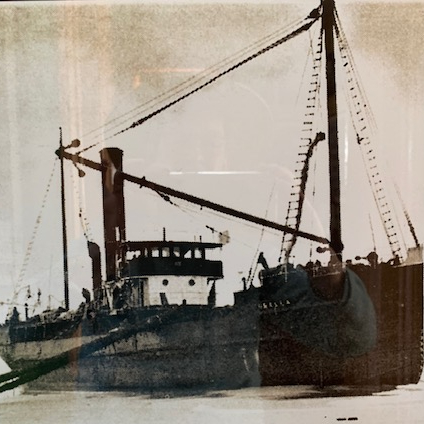
The steamship Uralla became grounded near Birubi Beach, south of Port Stephens in June 1928, and remained there for over a year while various unsuccessful salvage attempts were undertaken, before finally breaking up. The events pertaining to the grounding of the vessel on the beach and subsequent salvage operations, attracted continued media attention.
The Uralla was owned by the North Coast Steam Navigation Company and was only two years old when wrecked. It left Coffs Harbour carrying timber and other goods for transportation to Sydney, but a massive gale damaged the steering gear causing the vessel to become uncontrollable. The captain exercised supreme seamanship by using the engines to manoeuvre the ship away from the rocks at Morna Point and instead drove it onto the beach, thus saving the lives of its crew, and minimising further damage to the Uralla, so that it could be salvaged later. But this was not to be the case, as a further wave struck and the ship broke its back while on the beach.
How the Uralla Went Ashore
The Tweed Daily of 16 June 1928, page 5, reported:
‘The story of the fight put up by the ‘Uralla’ before she went ashore yesterday is told by the members of the crew of the vessel. Heavy seas and strong winds shook the ship from stem to stern, and mountainous waves swept over the decks, carrying everything before them. For several hours the ship was at the mercy of the elements. At one stage she must have been as far south as Broken Bay, but it was then decided to run before the storm and the boat turned round and headed north.
One moment riding on the crest, of a mountainous wave, and the next moment, almost engulfed by the seas, the ‘Uralla’ struggled on until a big wave dashed over the stern, tore the rudder away and smashed the lifeboat. With the steering gear gone the ship was at the mercy of the elements, and Captain O’Bierne decided to beach the vessel. Heavy mists on the shore rendered it impossible for the captain to see anything for a time and the ship went around in a circle, but then the two propellers were worked against each other and she straightened up, and with beach in sight, was driven full speed on to the sand.
The huge waves lifted her further on to the beach, and lifebelts were donned by members of the crew as the ship appeared to settle down. The crew remained in readiness to leave the ship throughout the night, but this morning the sea abated, leaving the ‘Uralla’ high and dry. The back of the vessel appears to be broken, and she is now firmly embedded in the sand. The underwriters will visit her tomorrow, but hopes of salving her are not bright.
During the storm one of the ‘Uralla’s’ crew, G. Coulson, was washed along the deck, sustaining injuries which, however, are not of a serious nature. Two others, W. Erickson and J. Halliday, were members of the crew of the ‘Wallamba’, which went ashore at Morna Point about five years ago and became a total wreck.’
The Daily Telegraph of 18 June 1928, page 3, reported on the engineer’s story:
“Two huge seas crashed into us in quick succession. I thought the end had come at last. I have seen some seas in my 24 years’ experience. but never anything to approach those two.” Mr. A. Laycock, second engineer of the North Coast steamer ‘Uralla’, which ran ashore at Anna Bay, Stockton Beach, during the height of Thursday’s storm, told a graphic story last night of the ordeal of those on board.
With nine other members of the crew of the coaster. Mr. Laycock returned to Sydney last night from Newcastle. “It will be great to get between dry sheets tonight,” he said. “You can take it from me that I think I’m a lucky man to be here. “The old ship showed herself sea-worthy. I did not think she would live through it,” he added.
“We had gone through a bad time before the two big seas struck us, and were making heavy weather of it. About 10 o’clock the two waves rolled along. “The Uralla shuddered and reeled when the first wave hit her. It was a wave that would frighten anyone. It towered high above the ship, and it was like looking up at a steep, moving green mountain.” The ship had not recovered when the second sea struck her. “After that it was some minutes before we could see the vessel. “When I tell you that the first sea stove in the door of my cabin and broke through into a cabin opposite, carrying everything before it, you can get some idea of its force.
“Everything was smashed. The steering gear was disabled, and then one of the boats carried away. We threw out four anchors, but they could not hold the ship. “We faced being washed on to Morna Point or Stockton Beach. We chose the lesser of two evils, and, steering by the engines, headed the water-logged vessel for the beach.” The other members of the crew, who reached Sydney last night, are: — Messrs. J. Halliday, T. Crocker, M. Woodbury, A. B. Neilson, W. Pry, T. Tomes, W. Hill, A. McLeod, and W. McEntee.’
The Coffs Harbour Advocate of 19 June 1928, page 2, provided additional comments by the Chief Officer:
‘The chief officer, Mr. Simonson, said a huge sea hit his cabin while he was in bed and filled it with water. Everything was carried away, even his alarm clock. But the log book was saved.
About 9.30 on Thursday morning, when off Barrenjoey, the ‘Uralla’ first struck trouble. She was on her way to Sydney and the crew realised that they could not live in the face of the cyclone. When off Norah Head a huge wave battered the starboard lifeboat, which crashed down on the steering gear and completely disabled it. Then the vessel was at the mercy of the storm. She began to drift, and four deep sea anchors were dropped. But at 12.30 p.m. they began to drag. The vessel drifted northward in the direction of Morna Point and the crew feared that before midnight they would be on the rocks there and probably lose their lives.
The only course open was to turn the vessel and beach her at Boyce’s Beach [near Birubi beach]. The steering gear had carried away completely, said the chief officer, “but by manipulating the engine and twin screws we were able to steer for the beach. We grounded about 4 p.m. and were then all right. Immediately the steamer hit the beach we began sounding the siren to tell the engine room staff to come up on deck, as we feared that another wave might flood the engine room. The first man to come to our aid was a man from Bob’s Farm, who left immediately for reinforcements.’
Uralla’s Cargo
The Coffs Harbour Advocate of 19 June 1928, page 2, reported:
‘The Uralla, which was wrecked on Stockton Beach in the gale last week, carried a cargo of timber and sundries from Coffs Harbour. There were four or five different lots of timber. Mr. A. J. Fogarty had about £100 worth of skins, hides and tallow on board. The tents and other paraphernalia of ‘Smallie Higgins’ boxing and hoopla show, which was at Coffs Harbour several days ago. was also shipped to Sydney by the Uralla and would be on board when she was wrecked. It was fortunate that there was no butter on her this trip.’
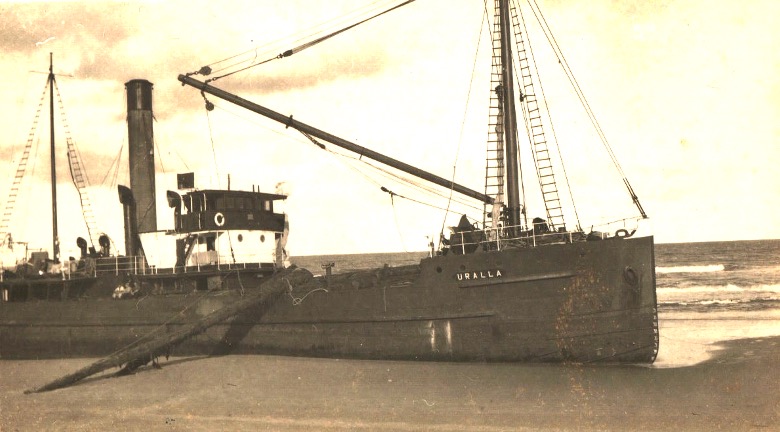
‘Uralla’ beached near Birubi Beach. Two of the timber poles that had been carried as cargo are used as a gangplank.
Insurance Underwriters’ Decision
The Sydney Morning Herald of 21 June 1928, page 11, reported:
‘Efforts are to be made immediately to salvage the steamer Uralla, which grounded on the Stockton Beach during the heavy gale last week. The underwriters in Sydney have been informed that there are bright prospects of refloating the steamer and repairing her at a reasonable cost.
Salvage gear was taken aboard the North Coast S.N. Company’s motor ship ‘Melinga’ yesterday. It will be landed at Newcastle, and transported overland to the scene of the stranding. Considerable difficulty will be experienced in getting the heavy gear to the ship. Over the last stage of the journey, it is probable that the gear will be placed on an improvised sledge and drawn across the sand for some miles by a team of bullocks or horses.
The ‘Uralla’ is almost broadside on to the beach, and at low water is practically high and dry. Much preliminary work will have to be done in shifting the sand and turning the vessel round. Several anchors will be laid at sea, and it is hoped that by hauling on them the Uralla will be moved into deep water. The small coastal steamer ‘Doepel’ will lay the anchors. She will leave Sydney today.
The weather is moderate, and as the vessel is resting on a soft bottom there is no immediate danger, but it is feared that she might further settle in the sand. Advice received by the underwriters shows that so far as the engine-room, boiler and bunker spaces are concerned, there is apparently no damage, but the storm caused considerable damage to the deck fittings.
The salvage operations will be carried out under the supervision of Captain Stobe, assistant surveyor of the Sydney Marine Underwriters’ Association. Captain Cuthbert, the chief surveyor, who returned from the scene yesterday, will act in an advisory capacity.’
The Newcastle Morning Herald and Miners’ Advocate of 3 July 1928, page 5, reported:
‘The attempt to refloat the North Coast S.N. Company’s steamer Uralla, which was beached near Morna Point during the storm on June 14, will be made at eight o’clock tomorrow morning. A gang of men has been on the spot for several days getting all the gear ready for the attempt, and shipping men are hopeful that it will prove successful. A lot of interest has been taken in the preparations for the salvage, which is the first of its kind on this part of the coast for some years, and there is certain to be a large number of spectators.’
The following four images were published in the Daily Telegraph of 16 June 1928, page 12:
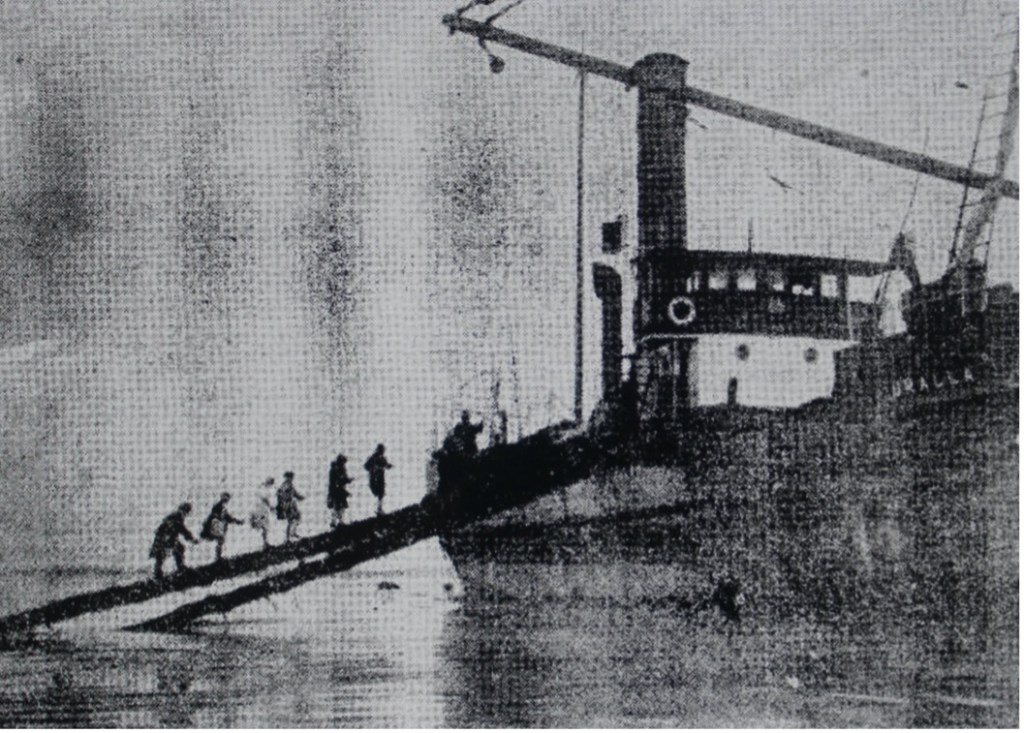
Visitors go aboard the wrecked ‘Uralla’. The improvised gangways seen on the left of the picture consist of logs taken from the ship’s cargo.
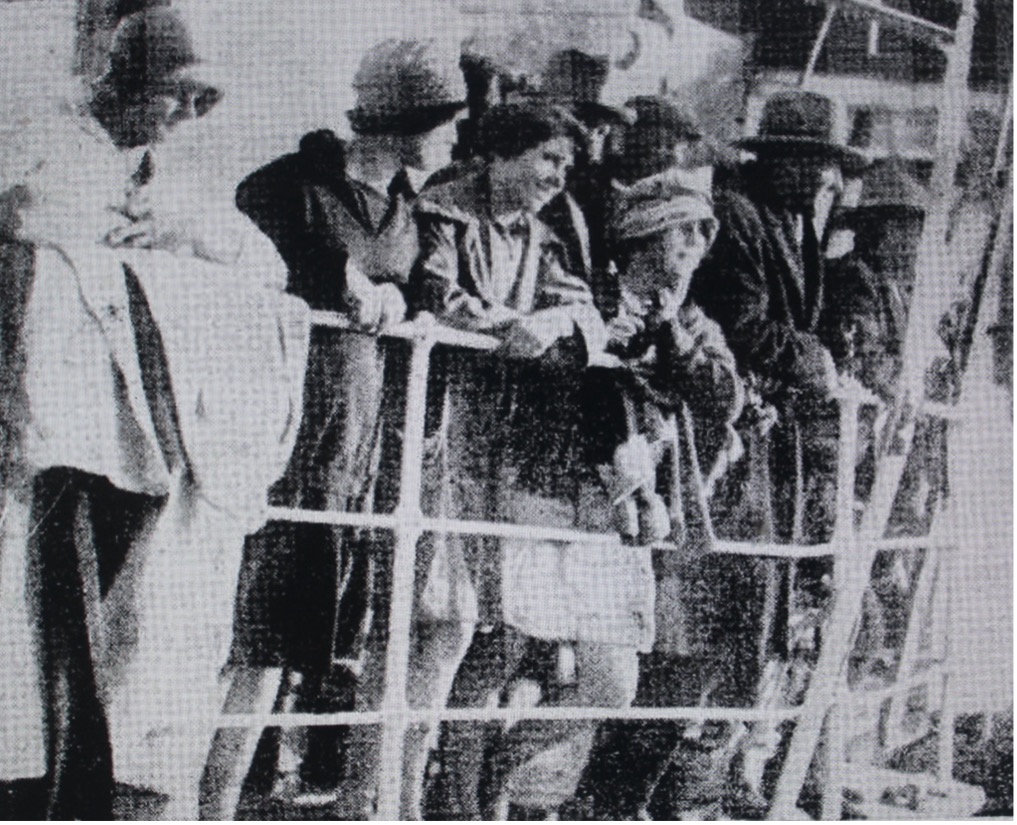
Residents of Anna Bay were welcomed aboard the wreck by the crew
The wreck provided valuable work to local residents of Anna Bay who were hired to transport material to and from the wreck.
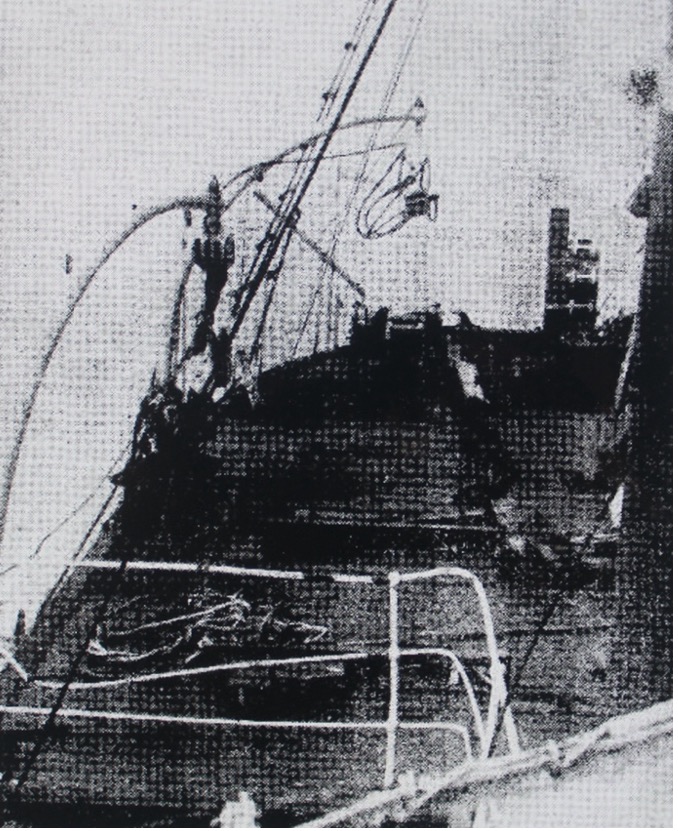
Broken davits and other wreckage as viewed from the bridge towards the stern

Splintered decking and shattered ventilators
The Sydney Morning Herald of 16 June 1928, page 18, published the following photo of the ship’s crew:

Standing from left to right: M. Woodbury, Y. Crockett, A. J. MacLeod (cook), W. Erickson, W. Bray, J. Jones. Seated, from the left: E. Neilson, H. Tomes, W. Hill, P. McGintee
Attempt to Salvage the Uralla by the Insurance Underwriters
The Nambucca and Bellinger News of 29 June 1928, page 2, reported:
‘Arrangements for the salving of the North Coast steamer ‘Uralla’ from its bed of sand on Boyce’s Beach, about 16 miles from Stockton, are now well in hand, and it is hoped that the steamer will be refloated on the spring tide on July 3. That the steamer will be safely refloated is the opinion of Newcastle shipping men. When the North Coast Company’s steamer ‘Doepel’ arrived at the scene of the wreck the rocket-men fired a thin line over the ‘Uralla’, and eventually steel hawsers were stretched between the two vessels. To these heavy sea anchors were attached and dropped to the bottom of the sea. The constant strain on the hawser’s is expected to move the steamer gradually down to the water. The ‘Uralla’ is now embedded in five feet of sand, and her back is broken. When she is refloated it is proposed to tow her to Newcastle, where repairs will be carried out. After the dropping of the anchors, the ‘Doepel’ left the Uralla and returned to Newcastle. Salvage gear has been landed on the beach, and everything now waits for the effort on July 3.’
Salvage Attempt Unsuccessful
The Newcastle Morning Herald and Miners’ Advocate of 5 July 1928, page 5, reported:
‘An unsuccessful attempt was made at high water on Tuesday night to refloat the North Coast Steam Navigation Company’s steamer ‘Uralla’ ….. . The incoming waves were not of sufficient height to provide the essential lift to enable the stranded vessel to be dragged from its bed of sand.
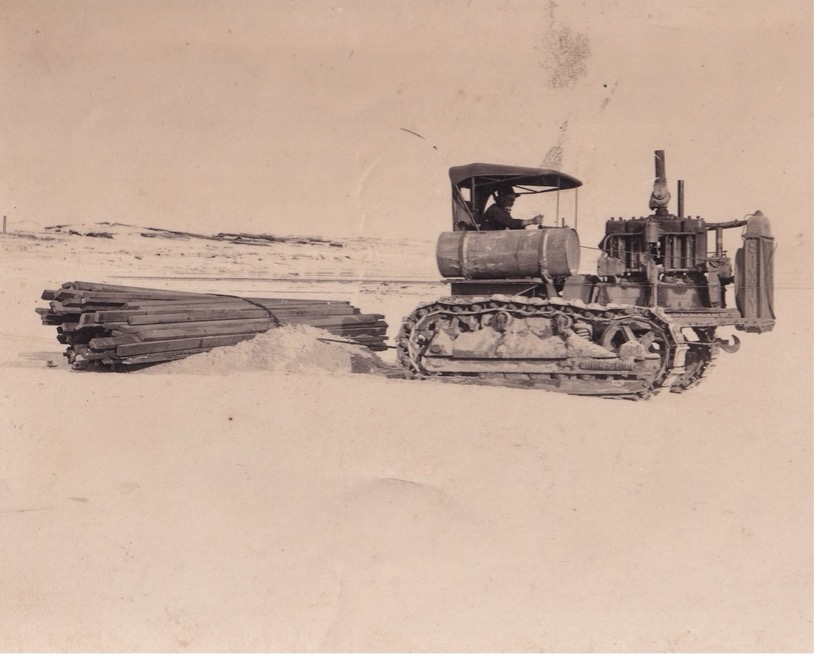
Preparations were made yesterday for another attempt to salvage the vessel. Captain Stobbo is in charge of the salvaging operations, and yesterday Captain Cuthbert, salvaging engineer for the underwriters, and Captain McAlister, marine superintendent for the owners of the vessel, arrived at the scene of operations on Tuesday. The services of a powerful caterpillar tractor were engaged, which, by making a series of circuits, loosened the sand between the forepart of the vessel and the ocean. Then a number of men were put to work with shovels removing the sand from around the keel, the idea being to reduce resistance when the strain is applied by the winches. With the aid of the tractor, all the vessel’s cargo has been placed high and dry on the shore.
Despite all these activities, the vessel has not been moved from its original position taken up after drifting on the shore. Owing to the shortage of coal, hundreds of palings, portion of the ship’s cargo, have been burnt in order to keep up steam for the winches. Three sand pumps have been placed in position to meet any inrush of water that may arise if the vessel is floated. Cement is being used to stiffen the bottom of the vessel and make it as water-tight as possible. Efforts were again to be made at high tide last night to refloat the vessel.’
Salvage Abandoned by the Insurance Underwriter and Uralla to be Sold
The Newcastle Sun of 9 July 1928, page 5, reported:
‘The North Coast steamer ‘Uralla’, which went ashore on Boyce’s Beach on June 14, is to be sold. All hopes of salving the vessel were abandoned last week [by the insurance underwriter], when it was found that it was broken amidships. With its back broken it would apparently bee a hopeless job to drag the vessel off the sand into the sea. Concrete was laid on the bottom of the vessel to guard against a possible leakage of water. Tides, although high, were not powerful enough to move the steamer last week. Another attempt was to have been made on Friday. Conditions were ideal, but before the effort was made the break in the ship was discovered. The salvage party has returned from the wreck. Details for the sale have not yet been fixed.’
Stranded Uralla Sold at Auction
The ship’s underwriter decided to sell the stranded wreck, which had a broken back, at auction as the machinery and steam engines, were in good order , being only two tears old. The Sun of 13 July 1928, page 16, reported:
‘Mr. John Brown, coal magnate, and Mr. B. S. Budrodeen, the well-known Sydney marine contractor, met today in a spirited bout of bidding at the sale of the stranded steamer ‘Uralla’. Mr. Budrodeen won after the bidding had gone in rapid jumps of £100 to £1500. So far Mr. John Brown was prepared to go, but no further, and the helpless ship at £1600 went to Mr. Budrodeen. One hundred prospective purchasers and spectators thronged the rooms of the auctioneer, F. R. Strange, Ltd., and studied the 17 photographs posted near the dais, of the wrecked steamer, taken from all angles. Several of those present were already well-known because of their purchases of other wrecks, but with Mr. John Brown and Mr. Budrodeen in the field, they held back and watched the rapid advance from £500 to £1600.
Compared with the prices of other wrecks, it was a most successful sale, but, as the auctioneer, Mr. Huenerbein pointed out, the feature of the stranding is its accessibility. Mr. Budrodeen, who also purchased the ‘White Bay’ recently, said subsequently that while at work on that vessel, he had had the ‘Uralla’ under observation, and he had strong hopes that he would be able to refloat her. Work would begin immediately. Sawn timber from the Uralla, 15,000 feet in all, was also purchased by Mr. Budrodeen, for £20.’
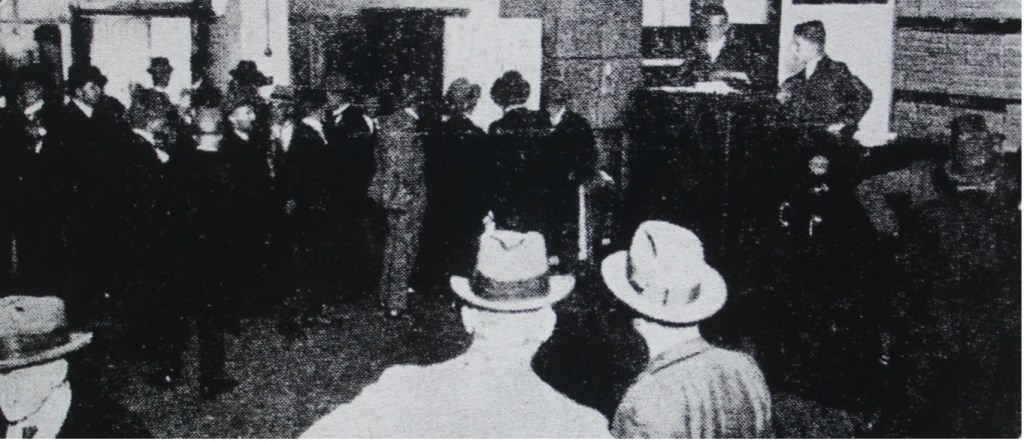
Auction sale for the ‘Uralla’ was attended by a large group of potential buyers [Daily Telegraph, 14 July 1928]
New Owner makes Salvage Attempts
The Macleay Argus of 24 July 1928, page 2, reported:
‘The steamer Uralla, recently abandoned as a wreck, is now partly afloat, and has been moved 12 feet towards the sea. Mr. Budrodeen, who purchased the vessel for £1600, set to work immediately. He used the vessel’s cargo of long turpentine poles for stiffening the ship, cleared the sand away so as to make a channel, and set the propellers going. The whirring screws and the ship’s winch, working simultaneously, shifted her towards deep water. Indications point to her being salvaged. When properly afloat, the Uralla will be worth £10,000. The tug ‘Lily’ is taking more substantial gear to the scene. At dead low tide some of Mr. Budrodeen’s men found a three-ton anchor in the vicinity of the Uralla wreck. It is valued at £60, and is being utilised in the salvage work.’
Salvage Workers Suffer Perilous Experiences
The Coffs Harbour Advocate of 31 July 1928, page 4, reported:
‘Those engaged in salvaging operations on the wrecked ‘Uralla’ at Stockton Beach are having some perilous experiences, owing to heavy seas. Three members of the Stockton Life-saving Club were upset in their boat one day last week and one of them was unconscious for a time. The prospects of refloating the ship, however, are considered to be very good, and it is hoped to have her off early next month.
Heavy seas prevented the tug ‘Lily’, which left Newcastle early on Thursday morning, from placing a line aboard the ‘Uralla’.
A surf boat was lowered and manned by three members of the Stockton Life-saving Club, H. Watson, A. Pugh and A. Sinclair. Soon after they pushed off the boat was struck by a huge roller and capsized. Sinclair was struck by a large piece of timber floating in the surf and rendered unconscious. After battling in the surf for over half an hour, his mates dragged him ashore. The three men were given stimulants, taken to a house nearby and provided with dry clothing. Later they were taken to their homes at Stockton, little the worse for their experience, suffering only a few bruises they got when the boat turned over.
The heavy seas caused a temporary hold-up in the salvage operations. A rocket brigade that went out from Newcastle to fire rockets and place heavier ropes aboard the Uralla was unable to get close enough to carry out this work. But the sea had abated a little and a gentle strain was placed on the ropes connecting the ‘Uralla’ to an anchored buoy and the shore. The vessel immediately responded, moving two or three feet. As the ropes were only light ones, the operation was not continued, those engaged being quite satisfied to know that their efforts were bearing fruit.
Not leaving anything to chance, the owner, Mr. Budrodeen, has taken a sand-grab up from Sydney. It was hauled overland from Stockton by bullock team. Before it is put into operation coffer dams are being constructed alongside the stranded steamer.
Mr. Budrodeen has about four turpentine six-feet stays battened on the hull, and is having holes drilled in each of the outside plates so that further battens can be placed on the outside when the seas will permit. Everything is ready now for the supreme effort to be made on the flood tides early in August, and the engineers on the job say they are very confident of success.’
When the salvage success appeared assured, a tragedy struck on July 30, which served to delay further recovery operations. The Newcastle Morning Herald and Miners’ Advocate of 31 July 1928, page 5, reported:
‘Herbert Arthur Smith, aged 21, shipwright, married, living at Grove-street, Balmain, while working on the ‘Uralla’ about 7.30 last night, was killed through being struck on the head by a block, through the fastenings giving away. He was brought to Newcastle by Newcastle Ambulance.’
At a subsequent inquest, the deputy coroner returned a verdict of accidental death.
Captain of the Uralla presented with a Gold Watch
The Sydney Morning Herald of 22 August 1928, page 20, reported:
‘Captain F. P. O’Beirne, master of the steamer ‘Nambucca’, which called at Urunga last week, was in charge of the ‘Uralla’, which was beached at Stockton in June. Captain O’Beirne has received a handsome gold watch and chain from the North Coast Steam-ship Company, bearing the following inscription:
‘Presented to Captain F. P. O’Beirne from the directors of the North Coast Steamship Navigation Company, Ltd., as an appreciation of his seamanship in saving all hands aboard the S.S. Uralla. Beached 14th June, 1928, at Stockton.’
Captain O’Beirne has been a master on the North Coast for 47 years.
Salvage Attempts Continue Over a Year
The Raymond Terrace Examiner and Lower Hunter and Port Stephens Advertiser of 3 January 1929, page 3, reported:
‘Efforts made to float the ‘Uralla’ now lying on Salt Ash beach, during the high tides at Christmas were not successful through arrangements miscarrying. On the morning of the highest tide, the ship was moving fairly freely in the swell and high water, but, the tug ordered for that morning did not turn up and the enterprising salver had the annoyance of seeing a splendid opporunity pass by. The tug was ordered for the next day but arriving on the top of the tide, before the hawser could be got aboard (after a break of the line used in hauling the hawser from the tug to the ‘Uralla’) the tide had receded, and that chance was also lost.
The Uralla’s boat manned by about a dozen of the employees launched the boat through the surf earlier in the morning, and put the line aboard the tug, and then came ashore. When the effort to get the boat through the surf was made to carry a fresh line, the surf was too much for them and there being no other means of getting the broken line replaced the tug returned to Newcastle. Mr. Budrodeen is still confident that he can float the stranded steamer and has her well strapped up to stand the strain. An ordinary 2 inch pump is all that is now required to keep her dry. The next effort will be made on the full moon this month . Every foot gained now is a big help towards the final launching, and the ship is certainly more lively in the wash, now than she appeared three months ago. Her bow is to sea and this portion lifts with the wash of the waves. A moderate sea, on the top of the tide, is the condition required.’
The Evening News 29 April 1929, page 8, further reported:
‘Hopes are expressed that the steamer ‘Uralla’, which went ashore during a cyclonic storm last June, may yet be drawn from her sandy bed at Morna Point. On account of the heavy weather at the weekend, the clamps holding the hawsers moved, and allowed the vessel to turn stem on to the sea. Her propellers are now in approximately 13ft of water, and when the weather abates an attempt will be made to tow the ‘Uralla’ stem first to sea. By some chance the sea cocks of the vessel opened during the weekend, and the engine room was flooded. This tended to hold the ship firmly on the sand, and certainly prevented her being pounded to pieces in the terrific surf.’
Thae last report on the salvage operations, which had been underway for over a year, was published in The Newcastle Sun of 16 July 1929, page 6″
‘Information received in Newcastle to-day was that the attempt made at high tide last night to refloat the stranded ‘Uralla’ from Boyce’s beach was unsuccessful. Observations from Signal Hill this afternoon showed that the position of the ship was unaltered. Early this morning the vessel was in about 15 feet of water, and heavy seas were breaking over her. It is understood that the surf was too rough for a further attempt to be made this afternoon.’
Concluding Comments
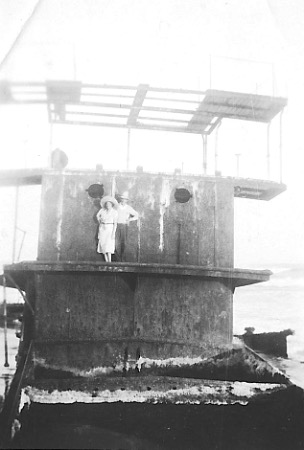
Two sightseers standing on the rapidly disintegrating ‘Uralla’ that was stranded on the beach
The ‘Uralla’ was never salvaged from the beach, and the remaining portion of its hull remain buried under the sand.
On the day the Uralla was wrecked, the ‘White Bay’ steamer was also wrecked on the same stretch of coastline near Stockton, with the loss of its crew. The Coffs Harbour Advocate of 6 July 1928, page 3, reported:
‘The steamer White Bay turned bottom upwards in the surf at Stockton about the same time the Uralla was driven ashore. One of the crew was washed ashore dead, but nothing has since been seen of the others. A hole about seven feet square was cut in the hull last Sunday and a diver went in and explored the up-turned boat. But he could find no trace of any bodies. Salvage work on the vessel had been abandoned. A farmer who resides ab out two miles from the beach stated he heard the whizzing of a rocket on the day of the wreck and went immediately to the beach. He found the body of the cook, the one man washed ashore. The vessel was bottom upwards in the surf. He and his son patrolled the beach, but could not find any other bodies.’
Just over year after the ‘Uralla’ was wrecked on the beach near Morna Point, its sister ship, the Pappinbarra, which was owned by the Cairns Coastal Steamship Company, was wrecked at Point Stephens, near the entrance to Port Stephens, in September 1929.
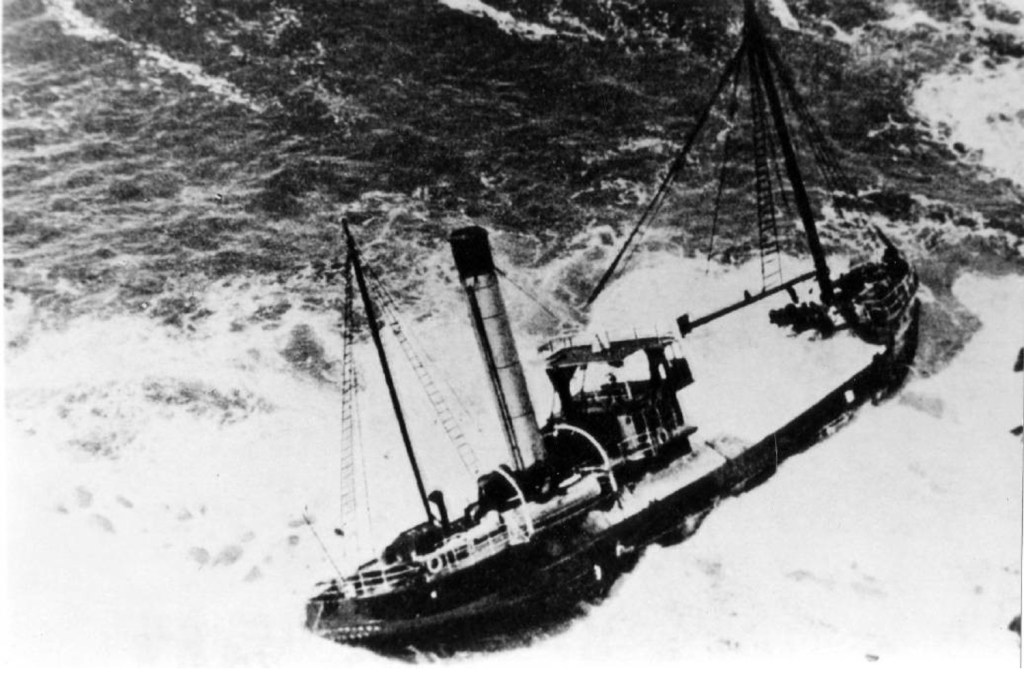
Sister ship of ‘Uralla’, the ‘Parrinburra’, wrecked at Point Stephens near the entrance to Port Stephens in September 1929.
The wreck of these two steam ships serve to illustrate the great dangers faced by the early mariners along the shipwreck coast near Port Stephens.
Information on other shipwrecks in the Port Stephens region is published on this website and are found at the following links:
A History of 110 Shipwrecks at Port Stephens 1800 – 1950
Shipwrecks Inside Port Stephens 1869 – 1950
Morna Point – A Graveyard of Shipwrecks
Wreck of SS Florence Irving at Port Stephens – 1877
Wreck of SS Macleay near Port Stephens – October 1911
Foundering of SS Oakland off Cabbage Tree Island – 1903
Wreck of SS Pappinbarra at Port Stephens – 1929
Wreck of HMAS Psyche in Port Stephens – 1924
Wreck of the Cora Lynn off Port Stephens – 1914
Researched and compiled by Kevin McGuinness
June 2023


 Port Stephens - a history exploration