

Introduction
Port Stephens is fortunate to have two lighthouses – the Outer Light known as Point Stephens Lighthouse on the coastline at Fingal Island, and the Inner Light at Nelson Head, situated within the harbour.
Point Stephens Lighthouse commenced operations on 1 May 1862 and the Inner Light at Nelson Head in April 1872.
How many other areas in Australia can lay claim to this. Much historical information has been published about both lighthouses, and they are frequently promoted in tourist literature.
This paper uses the resources of the Australian National Library’s ‘Trove’ to bring to light issues in the early days of the Point Stephens Lighthouse that are not so well known, and which add to the story.
The history of the Inner Lighthouse at Nelson Head can be found at this link on the website.
The Beginning
An article published in the Sydney Morning Herald of 30 May 1953, page 9, provided a background to the development of lighthouses along the Australian coast:
‘For many years, the original Macquarie Light [opened in 1818 at Vaucluse, Sydney] was the only lighthouse on the Australian coast. But, from 1831 on the coastal trade increased with the introduction of steam paddle wheel steamers like the ‘Sophia Jane’. The next recorded lights to be established were the Iron Pot (1833) and Cape Bruny (1838), both near the entrance of the Derwent River, Van Diemen’s Land [Tasmania]. Then followed Swan Island (1845) and Goose and Deal Islands (1846), all of which are off the Tasmanian eastern coast. Next, in 1858, a lighthouse was established at Nobby’s Head, Newcastle. Until that time, ships had been guided by an open coal fire kept burning on an exposed position near the entrance of the Hunter River.
As coastal trade grew, more lights came into being. In the 1860s, lights were built at Port Stephens, the Richmond and Clarence River entrances, and at Barrenjoey. Steady expansion continued to the turn of the century, until the last two lights to be constructed on the New South Wales coast, at Byron Bay and Norah Head, were opened in 1901 and 1903 respectively.
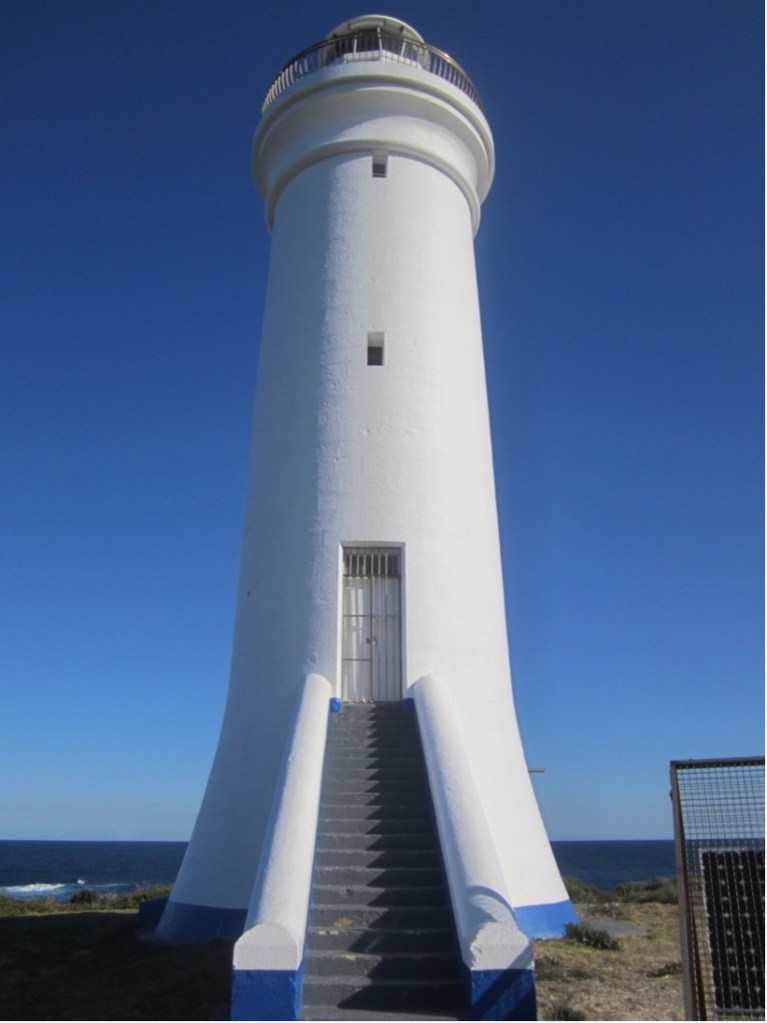
Point Stephens Lighthouse [Author photo 2007]
Petition for the erection of a lighthouse at Port Stephens – 1850
The Sydney Morning Herald of 20 June 1850, page 2, reported that a petition had been presented to the N.S.W. Legislative Council calling for the erection of a lighthouse at Port Stephens:
‘Mr. Cooper presented a petition from the inhabitants of Port Stephens and others connected with the trade of that port, praying for the erection of a lighthouse there. Petition read and received.’
The Sydney Morning Herald of 21 June 1850, page 3, published the following letter to the editor providing a correction to the previous days report on the proposed lighthouse:
‘To the Editors of the Sydney Morning Herald. Gentlemen, — In your report of the proceedings of the Legislative Council yesterday, it is stated that I presented a petition from the inhabitants of Port Stephens and others connected with the trade of that port, praying for the erection of a lighthouse. This is incorrect.
The petition was signed by all the Sydney merchants interested in shipping, and by the owners and masters of coasting crafts, praying that a lighthouse might be erected on Point Stephens, by which Port Stephens would become a harbour of refuge that could safely be entered either by night or day. The petition further pointed out that Port Stephens is the only harbour between Sydney and Moreton Bay where vessels can enter during the heavy south and south-east gales that spring up so suddenly on this coast; whilst the peculiar geographical features of the entrance renders it very hazardous to make for the port at night. A light house there will obviate all the existing dangers and will be less a benefit to the inhabitants of Port Stephens than to everyone voyaging on our coast. I am, &c., Daniel Cooper.’
Calls for the erection of a lighthouse at Port Stephens Continue – 1859
The Sydney Morning Herald of 10 August 1859, page 4, reported:
‘The disasters that are every now and then occurring along our coast, involving the loss of property, and still worse, the loss of valuable lives, does not receive that attention which the subject merits. The loss of the ‘Speculant’ and the ‘Uncle Tom’ have been attended with total loss of the lives on board, the captain and mate of the former having left wives and families to lament their untimely end, and the presumption is that, if there had been a beacon light fixed at Port Stephens Heads, their vessels and their crews would not, or might not, have now been lost. In such weather as they had to encounter on or about last Thursday week, it was impossible for them to have made the harbour of Newcastle, but with the wind from the south ward they would have been able to get into the harbour at Port Stephens, for which, in all probability, they were bearing up when their total destruction occurred.
As a harbour of refuge, we hear on every hand that Port Stephens is one of the best on the coast, if not the best without exception, and that many vessels coming from the southward would run for this port in a storm when they would not be able to make other along the coast with equal safety, but that many are afraid to do so, because there is no beacon to guide them.
Seeing that the trade to the port of Newcastle is increasing, and that we may have many foreign vessels coming here, strangers to the coast, the time has arrived when this matter should be impressed on the attention of Government especially since the insurance offices have added an additional per centage in the insurance of vessels coming to this port.
Surely the insurance offices, themselves are deeply interested in this question, as well as shipowners, and insurers of all kinds, who, by their united efforts, could procure for this purpose some kind of person that should be sufficient at all times, by night or by day, to guide vessels in distress to this haven of safety, and they ought to do to both for their own sakes as well as for the sake of humanity. There can be no valid excuse for its not being done, because the evidence of its necessity is abundant, and no mere question of pounds, shillings and peace ought to be permitted to stand in the way; for what money consideration can be placed in competition with the taking of human life, to say nothing of the property, every such loss of which is a subtraction from the wealth of the community no matter what individual portion of it the loss may immediately fall upon.
The expense to be incurred ought therefore to be no barrier to the adoption of some such safeguard for ever on that head it would not be difficult to prove that, in this respect, it should be gainers by the preservation of property alone which is annually doomed to destruction along this coast from the absence of some such provision. However, if the worst case of this question be admitted—the expense—we would say, let there be passing light dues, or some means of the kind put in operation, anything rather than this waste of life and property for the sake of a “penny-wise-and-pound foolish” consideration.’
Site selected for the new lighthouse at Point Stephens – 1860
After a number of years of inaction, government approval for the construction of a lighthouse at Point Stephens was finally given in 1860. The Maitland Mercury and Hunter River General Advertiser of 5 January 1860, page 3, reported:
‘The steamer Illawarra left Sydney on Monday night last convening Captain Brown the chairman, and Messrs. Darby, Fox, and Watson, members of the Pilot Board, appointed by the Government to select a site for a lighthouse in the vicinity of Port Stephens. They were accompanied by Mr. Crook, Harbour Master of Sydney, Mr. Dawson, Colonial Architect, Mr. Hodgson, M.P, and other gentlemen interested in this object.
On Thursday morning Point Stephens was reached, and an apparently eligible position having been selected while steaming round it, the vessel was anchored at 7 a.m. in Fly Road, [a small cove adjacent to Point Stephens] and the party landed. Having proceeded to the point, a site was selected by the Board, and being approved of as fit for building on by the Colonial Architect, a flagstaff brought for the purpose was erected on the spot. The steamer then again got under way and proceeded to sea, coasting round the Point to a considerable distance, and proved that the spot chosen was most satisfactory, the flagstaff being visible in every direction that a ship could safely approach this part of the coast.
The party left with the flagstaff having been re-shipped, the steamer started for Port Stephens; the flagstaff was clearly visible at the entrance to this port, so that the lighthouse, in addition to its value in leading ships out of the bight between Point Stephens and Newcastle, will be an excellent guide for taking the harbour. After leaving this port the steamer proceeded to Newcastle, arriving at 9 p.m. on Thursday.
On Friday it blew a strong gale from the southward, so that it was impossible to leave. The time was employed by the Board in visiting the lighthouse lifeboat, pilot establishment, &c. On Saturday, at 7 a.m., the Illawarra left Newcastle, but a strong wind and heavy head sea so far retarded her progress that she only arrived here at 9.30 p.m. The site chosen for the lighthouse is near the S.E. extreme of Point Stephens, within 500 yards of the shore, on a knoll about 70 feet high. The light to be exhibited from this will be seen from the deck of a small vessel about 16 miles and will be a great boon to vessels navigating this part of the coast.’
The Sydney Morning Herald of 4 February 1860, page 4, provided further information regarding the site selection:
‘It has been determined by the Government to erect a lighthouse at Port Stephens, and on the 21st December ultimo an expedition proceeded thither by instruction from the Government to select an eligible site. The party consisted of Captain H. H. Browne, chairman; and Captains Darley, Fox, and Watson, members of the Light, Pilot, and Navigation Board, and Mr. Wilshire, secretary; Captain Crook, Harbourmaster; Mr. Dawson, Colonial Architect; and Mr. James Moore. Mr. Arthur Hodgson, M.P., General Superintendent of the Australian Agricultural Company, the Rev. Canon Walsh, and Captain Collins, accompanied the party, who proceeded in the steamer Illawarra and arrived in Fly Roads on the 22nd.
The result of the trip, and the choice of a site for the lighthouse, have been just reported to the Government, and as every new and correct description of important parts of our seaboard, and fair directions for its harbours, must be regarded with interest, we are glad to be able to present an extract of the report of the Board.
Having arranged to examine correctly the features of the coast, the Board had ample opportunity of observing the dangerous character of the long beach lying to the southward of Morna Point; the rollers, in some instances, extending off shore to a distance of three or four miles, thereby endangering vessels which, from anxiety to retain a good sight of the coast, might be inclined to venture close in.
The dangerous nature of Fingal or False Bay, as described by mariners, was fully proved, as from the indistinctness of the strips of sand, dividing this bay from the anchorage in Fly Roads, and the remarkable features of Tomaree Head, the southern entrance to Port Stephens, as seen on opening this bay, they would be likely to lead the most careful mariner into False Bay, instead of the proper entrance. The remains of two vessels were seen, which had been wrecked there from this mistake.
The principal object of the Board’s visit being to ascertain first these facts, and then to fix a site for the lighthouse, which would prevent such disasters, they decided on recommending a small grassy knoll situated on Port Stephens Point, having an elevation of sixty feet above the level of the sea, and distant about two lengths from the two rocky ledges forming the eastern extremity of Fly Roads. This site affords an area of vision of 225 degrees, wholly uninterrupted, except by the occasional intervention of small islands lying off the entrance to Port Stephens, and is bounded on the south by Red Head, bearing S. W. W., and on the north by the easternmost extremity of Yacaaba or North Head, bearing N. 4 E.
The light will, therefore, not only afford an effectual guide to vessels seeking shelter in Fly Roads (an excellent and safe anchorage in southerly winds), but it will also form a good leading mark for entering Port Stephens Heads, as it will not be shut in by Tomaree Heads, until on a bearing of S. by E. E., the vessel being then in from five to six fathoms water and well sheltered.
The Board acknowledge their obligation to the Colonial Architect, who accompanied the party, for the elaborate plans and sketch of the lands in the vicinity of the site, and also for the bearings and authentic position of the staff erected on the site. The Board recommend that the light should be exhibited from a tower 60 feet high, giving an elevation to the centre of the lantern of 120 feet above the sea level; that it should be revolving and off the catoptric order of the third class, showing alternately a red and white flash. At this elevation the light will be visible from a ship’s deck at a distance of sixteen miles, from the masthead twenty-two miles.’
Construction underway – 1861
The lighthouse was constructed with stone brought to Point Stephens by boat. The Maitland Mercury and Hunter River General Advertiser of 9 March 1861, page 3, reported on one difficult encounter experienced during construction:
‘The ‘Catherine Agnes’, with a cargo of stone for the Port Stephens Lighthouse, put in here [at Newcastle] last evening in consequence of the strong southerly wind. She sailed again at daylight this morning.’
Lighthouse nears completion – 1861
The Newcastle Chronicle and Hunter River District News of 24 July 1861, page 2, reported:
‘The lighthouse at Port Stephens is fast approaching completion, and will probably be brought into use within two months from this time. The cases containing the lighting apparatus have arrived from London in the ‘Cairngorm’ within the last few days. The light will be a revolving one of the catophic order, third class, showing alternately a red and white flash. There are twelve strong silver-plated polished reflectors, each twenty-four inches in diameter, and ten inches in depth, and a patent lamp with brass burners, for burning vegetable oil. The apparatus was manufactured to order, by Messrs. Wilkins and Co., of Long Acre.’
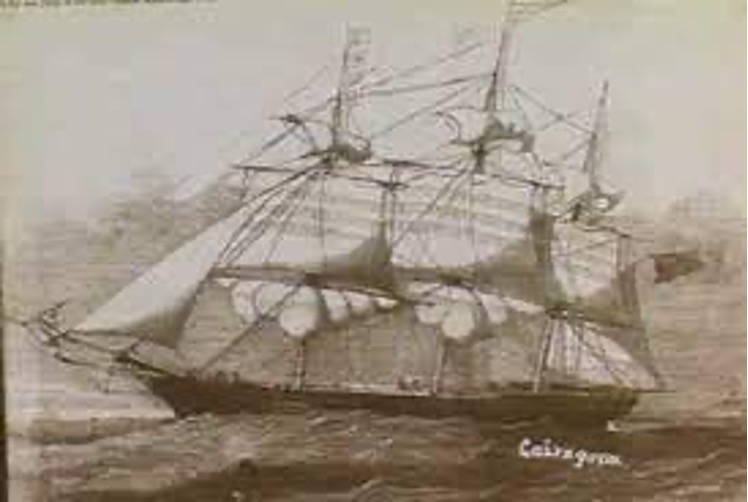
Cairngorm – sailing ship wrecked in 1863
Lighthouse keepers proceed to Point Stephens – 1862
A correspondent for the Empire of 26 March 1862, page 8, recorded aspects of his journey to Port Stephens with the lighthouse keepers who were to commence duty at the Point Stephens lighthouse:
‘I was quietly smoking my cigar in the Caledonia [Hotel] on Sunday morning, in that quietest of all cities, Newcastle, equally celebrated for its black diamonds and bad streets, wearily waiting for the next week to pass away, wondering what I should do with myself till then, when, in the other corner of the room I saw a group of travellers. I soon found out, by their conversation, that they were the lighthouse keepers and their friends proceeding to the new lighthouse erected at Port Stephens. Here is a chance for a change, thought I; and I soon found out, from my obliging host of the inn, that there was a party of officials going down in the steamer ‘Doorabong’ the next day, to open the establishment and permanently settle the keepers in their department.
So in the morning I packed my little black bag, took my stick, and went to the wharf. With my old luck, I soon found out I had an acquaintance in one of the officials, and on board I went for the trip. When all was ready, away went the little steamer; the wives and families of the lighthouse keepers snugly stowed away on one side of the quarter-deck, on a large sail spread out for them, with a splendid boat of the harbour master’s towing astern, and we are going well before a fine southerly breeze. There was D—, the architect; W—, of the Pilot department; A—, the harbour master, and a numerous staff, all good fellows, and or two, like myself, on pleasure.
The skipper was an old friend on the ‘Hunter’, and often missed since he left. We soon ran up to Fly Roads [cove adjacent to Point Stephens] and anchored. A large table was on deck (part of the furniture), the cloth spread, impromptu seats soon found, and thanks to that Prince of harbour-masters, a glorious feed put out. D—, who had been down on one side, suddenly sprang to life, and took the chair before a splendid ham, and as he quietly enjoyed himself, poked a little fun at everybody and everything; W— getting a sly poke at who he could; McK— on board, like myself, for pleasure, quoting Latin which sounded strangely like modern Greek.
Dinner over, away we all went to the lighthouse, a splendid tower, situated on Point Stephen, 12 feet above the level of the sea; the dwelling-houses, all stone, with slated roofs, stone veranda as enclosed yards; tanks, pumps, and every convenience for each dwelling. After dark, the light, only as a trial for inspection, was lit, and away we all went to the little steamer, to have a look at the light from the sea. At 10 p.m., the anchor was up, and out went the little craft against a heavy easterly swell that had set in, and as we passed the headland of Fly Roads, the light burst upon us in all its force and beauty, alternately varying from white to red every minute, in strong and bold relief to the heavy bank clouds that had accumulated and rose to the southward. We stood well out, observing the light from all directions seaward.
On coming in again, the little steamer, with the skipper quietly smoking his cigar at the wheel, running her in close round the edge of the tremendous brooks, lashing on the rocks of the point, the beautiful alternations of the light high above us, the dark mass of clouds in the rear of the light, the heavy sound occasional flashes of lightning, lighting up the whole scene around, dearly defining the entrance to Port Stephens, with its lofty heads (Tomaree and Yacaaba) Station Peak and Islands to the northward. The roar of the breakers, mingling with the occasional peals of thunder, made one vast panorama of nature, impossible to describe, and deep thought entered my mind of the wonderful works of the grand Architect of the Universe, till the light brought me back to think how careful man should provide for the safety of his follow creatures, for one crash on those heavy breakers of a dark night, and no soul would live to tell the tale. The skipper, while steering his little barque, remarked in his old cautious manner by pointing upwards at the light, “It is that which will often give rest to the weary mariner, and ease to many an anxious mind, in the long dark and stormy winter nights.”
We were soon again at anchor in Fly Roads, some of the party going on shore, and the rest quietly enjoyed themselves for half an hour, and soon all were sound asleep. ……..We then got underway and proceeded up to Carrington. The lofty heads at Port Stephens, with its sandy bay, and high well wooded ranges presented beautiful scenery, though much was lost to us by a heavy shower of rain. At Carrington we had a visit from Mr. Scott, and landed two of the party enroute for Raymond Terrace, and anchored at 11 p.m., in Nelson Bay for the night. At midnight the weather cleared and the moon shone out bright and clear, lighting up the sandy shore of the bay, with its Chinese fisherman tents; its well wooded hills and lofty peaks in the distance, well rewarded me for the trip.
In the morning we were again underway and soon at anchor in Fly Roads, and the party proceeded on shore to make a last official inspection of the department. And here presented a busy scene, the lighthouse keeper getting the house in order, the officials making inspection of everything to see all was right for those they left behind, W—, and A—, and the skipper, taking nautical observations and bearings of all the prominent points, headlands, and islands. Strange was this busy scene where, but a few short months past, there was nothing but the scrub and the kangaroo.
In company with the skipper, I proceeded up to the top of the tower, and there can be seen the full value of the tower by day to the stranger, precluding the bare possibility of mistaking Morna Point for Port Stephens, which has led to so many fatal accidents. The mariner mistaking False Bay for the entrance into Port Stephens, does not discover his error till he finds himself engulfed in a deep bay, with a narrow strip of sand scarcely above the edge of the water, fifty yards broad, between himself and his desired haven, too late for the error to be repaired. When all was finished, with many shakes of the hand, we bid goodbye to those we left behind and proceeded to the steamer.’
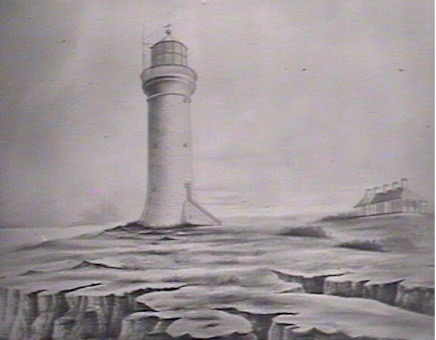
Sketch of Point Stephens Lighthouse and Accommodation [State Library of NSW. FL17655]
Inner Lighthouse commences operations – 1872
In 1872, the Point Stephens Lighthouse, ceased to be the only lighthouse at Port Stephens. Its smaller companion, the Inner Lighthouse, commenced operations on 1 April at Nelson Head, inside the harbour. Like the larger Point Stephens lighthouse, the Inner Lighthouse commenced operation without fanfare.
The Sydney Morning Herald of 13 April 1872, page 5, reported:
‘On and after the night of Monday, the 1st of April, a harbour-light will be exhibited on Nelson Head, Port Stephens, visible at a distance of from eight to ten miles in clear weather.
This light will show bright to seaward—be eclipsed over the entrance shoal—and made out red after the shoal is passed and Nelson Head can be steered for. When Nelson Head is passed the light will again make out bright and be a guide for picking up an anchorage or proceeding further into Port Stephens.
Vessels seeking shelter in Nelson Bay can, therefore, run for the harbour-light, (bright), so long as the Port Stephens revolving light is kept in sight. When the revolving light closes with Tomaree Head it will be necessary to haul to the N. N. W. till the harbour light is lost sight of and again made out red; a course can then be shaped direct for it, and when Nelson Head is passed the white light will reappear and be a guide for coming to in Nelson Bay. Note. — It will be necessary to keep a good look-out to avoid the islands off the entrance, when running for Port Stephens in bad weather. Francis Hixson, Superintendent. Office of Superintendent of Pilots, Lights, and Harbours, Sydney, 28th March.’
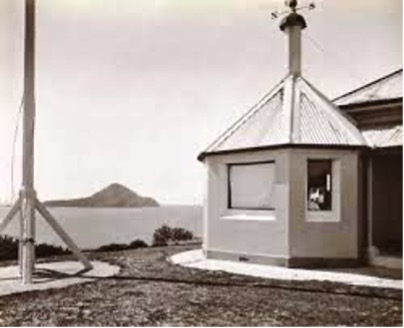
Nelson Head Lighthouse – one of the lamps is visible behind the open window.
Further history of this lighthouse is available in the book “The Guiding Light In Port Stephens Heritage – Nelson Head Inner Lighthouse“, published by the Nelson Head Lighthouse and Rescue Station Reserve Trust.
The role of the early lighthouse keepers at Point Stephens Lighthouse
The early history of the Point Stephens Lighthouse illustrates the varied role played by lighthouse keepers in protecting shipping and in saving lives of shipwreck victims. It was not beyond the call of duty for the lighthouse keeper to be suddenly required to place their own life in danger to provide for the safety of persons at risk of death in a shipping accident.
Point Stephens Lighthouse staff recover Items from the wreck of the Ann – 1876
Shipwrecks along the coast of New South Wales were a common occurrence during the 19th century. The staff at the Point Stephens lighthouse sometimes had to become involved with such misfortunes.
The Newcastle Morning Herald and Miners’ Advocate of 25 July 1876, page 2, reported on the wreck of the sailing barque Ann in the vicinity of Port Stephens:
‘The Government steam tug ‘Ajax’, Captain McCue, returned to [Newcastle] port yesterday, having left on Saturday morning last to proceed to Port Stephens for the purpose of rendering assistance to a schooner which was reported to be in danger near that port. ……. Captain McCue renders the following report of his trip which will be found of great interest to our readers: “Left Newcastle at 5 a m. on Saturday morning last, with a violent southerly gale and heavy sea, for the purpose of proceeding to Port Stephens to assist a schooner, which was reported to be in distress and anchored between Port Stephens and Long Island [Broughton Island]. ……………….
On Sunday morning steam was got up and at 7 o’clock the steamer proceeded [from Port Stephens] to sea, but on getting outside the wind and sea was found to be more than she could steam against, and it was very wisely resolved to return to port. During Sunday afternoon the lighthouse keeper handed over to those in charge of the ‘Ajax’ a ship block branded ‘Ann,’ also a No. 4 flag bearing the same brand, they had been found floating about the harbour on portions of wreck and evidently belonged to the barque ‘Ann’, of Melbourne. Several papers (private), the property of the chief officer of the Ann were also found and handed over.
Several of the men who formed the crew of several other vessels which had been wrecked, informed the parties in the ‘Ajax’ that on the beach there was a ships cook’s galley with the name ‘Ann’ on it, also a life buoy. These proved, beyond all doubt, that the vessel wrecked was the barque ‘Ann’. On Monday morning steam was got up, and the ‘Ajax’ left Nelsons Bay at 6 a m, and proceeded to Long Island, arriving off Esmeralda Bay at 7.30 a m. Inspected all round with glasses, but nothing could be seen unusual, either in the Bay on the island. From thence the steamer went round the island, and on the N.W. side of it saw two masts, apparently those of a vessel from 200 to 300 tons register. One of them had a bright masthead with a white top, and the other appeared to be the mainmast of a schooner. They were apparently anchored in a reef, as if a vessel had foundered at her anchors; they were nearly a mile from shore, but the steamer could not get within three quarters of a mile of her.’
The steamer Florence Irving wrecked near the Lighthouse – 1877
The Australian Town and Country Journal of 8 December 1877, page 10, reported:
‘The A.S.N. Co.’s well known intercolonial trader, the Florence Irving, was lost, early this morning, off Port Stephens:—The steamer, Florence Irving, left Sydney at 5 minutes past 6 p.m., last Monday, the weather being fine with slight mist; passed Newcastle light at 15 minutes past 1, the weather having got thicker. Eight miles off the light the captain steered a course, which, as he thought, would have kept him clear off the land. At forty-four minutes past 5 o’clock breakers ahead were suddenly seen. The engines of the steamer were stopped, but the vessel immediately struck, bumped again, and ran her nose into the rocks. After bumping a good deal, she slewed about, the forecastle filling fast with water.
After a little necessary delay, the boats were lowered, and safely landed all the passengers at the lighthouse at Stephens’ Point, off Port Stephens, which was within a few hundred yards; but the light could only be seen occasionally. The captain was on the bridge at the time but cannot account for being so near shore. The steamer steams badly. One child was drowned in the forecastle. Plenty of provisions were landed. There is no chance of saving the steamer. There is a good place for taking passengers off. She lies about four feet under water. Cargo must be greatly damaged. —Weather beautifully fine. The passengers are being taken off by the Collaroy from Newcastle. The Florence Irving remains on the rocks comfortably, not labouring; but there is no chance of saving her.’
The Capricornian (Rockhampton, Qld.) of 15 December 1877, page 12, reported on the assistance provided by the lighthouse officers to the 42 passengers and to the ship’s crew of the Florence Irving:
‘When the first boat, in charge of the second-mate, shoved off from the side of the vessel fitted with lady passengers, it was too thick [with a fog] to see whether a safe landing could be effected, but fortunately the light housekeeper (Mr. Priest), who had noticed the vessel strike, came down to the scene of the disaster, and as well as he could directed the boats to the best place for landing. …….
From the landing place the lighthouse could be approached over sharp rugged rocks, and to the lighthouse keeper’s cottage most of the ladies were taken, and made as comfortable as the circumstances would permit. …..
From the steamer the lighthouse was approached up a steep rocky ascent, spread over which could be seen groups of people, some hunting for luggage and other valuables, same were climbing up over the rocks towards the lighthouse keeper’s cottage, while others were resting under sails which had been rigged up to serve as a protection from the sun. Plenty of food and wine was available [from the ship’s cargo] for all who required it, but few, except the men who had been working hard, seemed to have much appetite after the excitement they had passed through. As soon as Captain Phillips was able to land his first care was to arrange for obtaining assistance. At one time the lighthouse had been connected with Port Stephens by wire, but the line having become damaged, it was not repaired. It was, therefore, necessary to send messengers, with telegrams a distance of five miles, to Nelson’s Bay, whence they could be sent by wire to Newcastle and Sydney. This course was at once adopted.’
The schooner Amphitrite wrecked near the Lighthouse – 1891
The staff of the Point Stephens lighthouse were again called upon to help another group of shipwrecked persons. The Daily Telegraph of 4 March 1891, page 5, reported:
‘Intelligence reached Newcastle this afternoon that the three-masted schooner Amphitrite, an old trader on the coast, had become a total wreck near the entrance to Port Stephens. The mate of the vessel, Walter Grahame, who was severely injured shortly before the vessel went ashore, arrived here tonight by the steamer ‘Kingsley’. He states that the ‘Amphitrite’ left the Richmond River on Friday last for Sydney, having on board a cargo of 87 logs of pine, sawn box-wood, and a quantity of other timber, consigned to W. T. Yeager, of Pyrmont, Sydney.
The ‘Amphitrite’ had light winds to Cape Hawke, which was reached on Monday evening. Here a strong easterly gale was encountered, and the ship sprang a leak. The water gained rapidly, although the pumps were kept continually going, and Captain Hogg decided to make for Port Stephens. A course was accordingly shaped for that place. On nearing the entrance, shortly after 9 o’clock last night, the mate, Walter Grahame, who was steering the vessel into that port, was washed away from the wheel and became jammed between the logs of timber and the poop. The vessel then jibed to the southward and drifted broadside on to the rocks a little to the south of the South Head of Port Stephens. The same sea which swept Mr. Grahame from the wheel also washed away the logs on deck.
Finding that the vessel was hard and fast on the rocks, a boat was lowered and those aboard, consisting of Alfred Hogg (master), Walter Grahame (mate), the cook and four able seamen, names unknown, got into it and succeeded in reaching the beach. Just as Captain Hogg stepped into the boat the vessel commenced to break up, Grahame, who is badly injured about the groin and spine and otherwise bruised, was with difficulty got ashore.
Two of the crew then made their way to the lighthouse at Port Stephens, and reported the disaster. A fire was afterwards lighted and the crew remained on the beach all night. This morning the lighthouse-keeper and a number of residents of Port Stephens supplied the shipwrecked people with provisions, &c. The mate decided to leave by the ‘Kingsley’, in order to proceed to the Sydney Hospital for medical treatment. He was brought to Newcastle and is leaving by the steamer Namoi tonight.
When he left Port Stephens the ‘Amphitrite’ was fast breaking up. The captain and rest of the crew are standing by the vessel in the hope of recovering sails and other gear. Her cargo was valued at £500. Two tug boats, the ‘Gamecock’ and ‘Emu’, left for Port Stephens today for the purpose of rendering assistance, but up to time of wiring had not returned. The crew succeeded this afternoon in saving portion of their effects, but the captain and mate lost everything.’
Lighthouse keeper catches a carrier pigeon – 1900
The Evening News of 29 March 1900, page 6, reported:
‘Our Nelson’s Bay correspondent wired on Saturday that a carrier pigeon was caught by Mr. Priest, lighthouse-keeper at Port Stephens, on Friday morning with a message tied to its leg. The bird which was exhausted, after being given food and water by Mr. Priest, was again liberated. Mr. Hunter, of Webb-street, Croydon, writes to us to say that the bird arrived home safely on Sunday morning with, the message. It was bred by Mr. Thurman, of Croydon, and was sent by Mr. Hunter to Mr. Letts, third officer on board the sailing ship ‘Vortigern’, who evidently liberated it at sea with the message. Mr. Hunter desires to express his thanks to the lighthouse-keeper for giving the bird food and water and again liberating it.’
Store ship runs aground near Lighthouse – 1902
The Newcastle Morning Herald and Miners’ Advocate of 30 June 1902, page 5, reported:
‘The ketch ‘Forest Queen’, which went ashore during this week, when landing stores at the lighthouse at Port Stephens, is still hard and fast, and is completely dry at low water. She has sustained very little damage, and the captain, expects to float her on the next spring tide.’
Lighthouse staff capture monster shark – 1908
The World’s News of 26 December 1908, page 5, reported:
‘Mr. Gow, principal light-keeper at Point Stephens and his two assistants, Messrs. Chapman and Morris, had a somewhat thrilling experience with a big man-eating shark the other day near their lighthouse. They went down to the beach (writes Mr. J. T. Lovell) to launch their boat to go off to a steamer, when they noticed a large shark swimming leisurely about a very few yards from the shore. He was evidently on the look-out for the unwary. To get the boat away it was necessary to go knee-deep into the water, and Mr. Gow very wisely decided that such a proceeding would not be justified with the shark in such close attendance.
Thereupon the keeper and his assistants procured a large shark hook, baited it with a portion of a shark caught four days before, secured it to a stout rope, and having made it fast ashore, threw it into the water. It had barely dropped before the hungry monster seized it. Then began a fierce battle between men and shark. The monster fought furiously against the attempts made to get him ashore, but the men were equally determined. By taking in slack at every opportunity the big brute was gradually drawn into the surf, when the rollers eventually washed it ashore.
It took just one hour and a half to get it to the water’s edge, and then it had to be levered up the beach. It proved to be a voracious man-eater, measuring 15ft. long, over 7ft. in girth, the fluke of the tail measured 3ft. 3in., the dorsal fin 15in., the jaws 28in. by 14in., and they contained four rows of teeth. Mr. Gow estimated its weight at fully half a ton. When landed high and dry, the shark snapped viciously in all directions. It was pierced with a lance many times and lived for an hour and a half after being disembowelled.
One peculiar incident of the capture was the presence of two small pilot fish, which were noticed to dart in and out of the shark’s mouth, after its capture, and before it was landed.
When the brute was finally secured both fish were found to be held in the roof of the shark’s mouth by their suckers. Mr. Gow has preserved the jaws, tail, and fin of the shark, as well as the two pilot fish. Two days before the capture, whilst two of the lighthouse men were pulling off to a steamer they noticed a very large shark about, which kept close to the boat until it reached the beach. The big one subsequently killed is believed to have been the same that followed the boat.’
Report from the Lighthouse concerning the wreck of the Macleay – 1911
The Newcastle Morning Herald and Miners’ Advocate of 18 October 1911, page 4, reported:
‘Mr. D’Arcy, the secretary of the New South Wales Navigation Department, today received the following report from the acting principal keeper of Point Stephens Lighthouse, dated October 13th. regarding the wreck of the steamer ‘Macleay’: — Sir,—I most respectfully beg to report with reference to wrecked steamer ‘Macleay’. She passed here, going north, at 7 p.m., and gave her name by flashing signals. The remark was also flashed that he who was signalling at the time thought it was going to be a dirty night. I flashed back that, by the showing of my barometer I did not think it would be anything, although it was very dull at the time, and blowing fresh from the south-east, with a moderate sea. They then flashed goodnight, and I returned the compliment.
I at once went and reported her as passing here north 7 p.m. Upon my returning to signal house, I saw her calling up again, and I answered her at once. They then gave the message, “Tell young Gard.” I here stopped them, and told them that Gard was fishing at Seal Rocks. They then gave me, “Thank you, good-bye,” again, and proceeded on their way north.
The next morning Captain Cumming (Acting Deputy Superintendent, Newcastle) rang me up, and asked had I seen anything of the wreck of the ‘Macleay’, which was a complete surprise to me. I received a telephone message from Mr. Hough, the agent for the North Coast Company at Newcastle, to signal the ‘Kallatina’ passing north to keep a lookout for anything in the way of wreckage, etc., about near Broughton Island, which was the place reported as where the wreck took place. I carried out the signals as requested. I also received orders to instruct the pilot steamer ‘Ajax’, which I also carried out by flag signals on her way north. On her return south that evening I again signalled her with orders from the Deputy Superintendent by flashing signals, which were carried out by her.
She returned here again at noon today, and I rang up the Deputy Superintendent for orders, and then gave them by semaphore to her. She at once proceeded on to Newcastle. I then rang up the master of the tug ‘Irresistible’, which had gone into Nelsons Bay. He informed that he had located the steamer at the south-east corner of Boondelbah Island, which is the nearest island to this point. By his statements he had the two survivors on board the tug, and they pointed out the place approximately where she was supposed to have gone down. They then told him she went down in three minutes, and that her port side was torn out.
By the course the ‘Macleay’ was steering when passing here she should have gone a good way clear of the island. Her course passing here was about north-east by north to north-east, as near as I could judge from this point. She was about three-quarters of a mile off from here on passing this point. After about 7.15 her lights were lost sight of, the stern light not being a very bright one. (signed) A. F. W Gidley, Acting Principal Keeper.’
Lighthouse keeper sights wreckage of the Rosedale – 1911
The Maitland Daily Mercury of 16 October 1911, page 8, reported:
‘The lighthouse-keeper at Point Stephens observed a floating raft at sea on Saturday, and signalled the North Coast Company’s steamer ‘Duranbah’, passing, bound, from Newcastle to the North Coast. The ‘Duranbah’ secured the raft, and towed it into Port Stephens, where, on examination, it was found to be barnacled-covered, having been in the water for some considerable time. It was thought to have come from the missing steamer ‘Rosedale’, although the growth of barnacles on it would suggest that it had been more than a month in the water. Charles Peterson, one of the survivors from the ‘Macleay’ [then at Nelson Bay], on seeing the raft, said he was certain it came from the missing ‘Rosedale’. It had evidently not been used, as the paint on rowlocks was intact. A life-buoy from the ‘Rosedale’ was washed up on the beach near Port Stephens on Saturday. Arrangements have been made to send the raft to Sydney by the steamer ‘Karuah’ for positive identification.’
Lighthouse keepers’ plight – 1912
The Daily Telegraph of 31 July 1912, page 17, reported:
‘Owing to the recent bad Weather, the lightkeepers at Point Stephens are in a very bad position. The boat-way where they used to launch their boat has been entirely washed away, and it will take many months of labour before, the keepers are able to build another. Until one is built it is impossible for them to meet the steamers from Newcastle, by which they receive their provisions, etc. In order that the keepers should not be left without stores, the Department of Navigation has had to hire a launch from Nelson’s Bay for the last two weeks. The launch meets the steamer, and, getting the lightkeepers’ provisions, lands them at the lighthouse.’
Assistance again provided to shipwreck victims – 1913
The Sun of 14 March 1913, page 7, reported:
‘The lighthouse-keeper at Point Stephens has wired the Navigation Department as follows:— “Ketch ‘S. A. Hayward’ ashore on the rocks at the north head of Port Stephens. She is likely to become a total wreck. She went ashore between 4 and 5 o’clock last night.”
A further message from the lighthouse keeper says: — “I have sent a launch to take off crew of the ‘S. A. Hayward’, numbering six. She is taking them to Nelsons Bay. The vessel is apparently full of water.”
Communication cut to Lighthouse – 1913
The Newcastle Morning Herald and Miners’ Advocate of 17 May 1913, page 6, reported:
‘A message was received by the Navigation Department yesterday from the lighthouse-keeper at Port Stephens stating that the stock of fresh provisions and vegetables was running low, and four men employed by the Public Works Department on a job there had to be victualled out at the supplies for the lighthouse, and they had been delayed in their work by the heavy weather. There was a month’s supply of fresh provisions on the wharf at Nelson’s Bay, but no craft was available to convey the food to the lighthouse. On receipt of the message the steamer ‘Barunda’ was immediately despatched to Port Stephens to render the necessary service.’
No telephone service to lighthouse – 1917
The Daily Commercial News and Shipping List of 11 September 1917, page 2, reported:
‘The North Coast Steam Navigation Company has brought under the notice of the Newcastle Chamber of Commerce the fact that the telephone office at Port Stephens had been done away with as from September 1, and that communication with the lighthouse there has now to be done by means of telegrams. Members of the council pointed out that communication with the lighthouse by means of the telephone was not only a great convenience and an assistance to shipping agents, but there was also the question of the sending of assistance to any vessel that might be in distress off that dangerous coast during a storm. The sending of messages by telegraph was not satisfactory, as there had been cases in which a boat coming down from Port Stephens had arrived ahead of a telegram. It was resolved to bring the matter under the notice of the Deputy Postmaster-General, and to request that the telephone office be restored.’
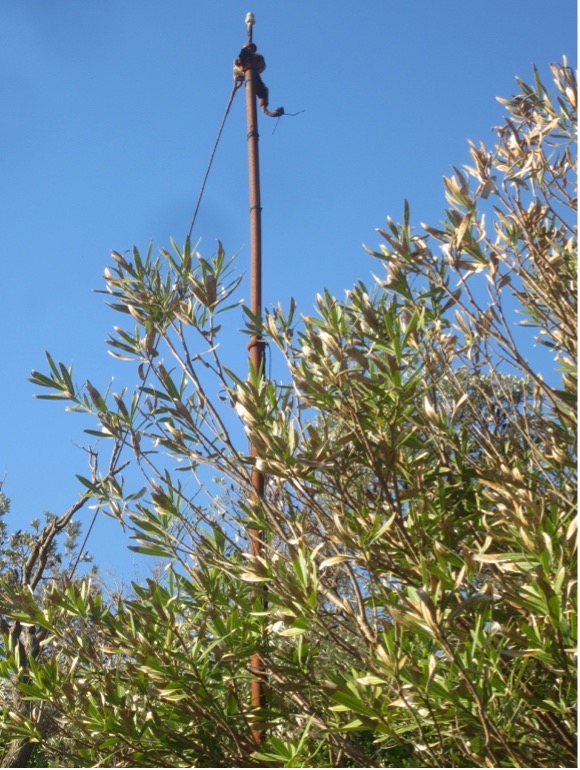
Remnants of an old telegraph pole on Fingal Island [Author Photo – September 2015]
Lighthouse keeper unaware pioneer aviators were searching for boat – 1929
The Labor Daily of 23 February 1929, page 5, reported:
‘The launch ‘Heather Belle’, with four men aboard, has taken shelter in Port Stephens. The Campbell brothers. P. Herthill and L. Campbell Jones Sydney, put out of Port Macquarie on Monday evening to go to the Macleay River, but, blown south out of their course, they sought shelter in Port Stephens. Although the lighthouse keeper at Port Stephens knew the missing motor launch was at anchor inside the harbour he was oblivious of the fact that a search was being made even when he saw several aeroplanes going over on Thursday. Kingsford Smith and Ulm made a search in ‘planes. Until the weather abates the ‘Heather Belle’ will delay her trip north. Messages were received in Sydney last night that the crew is well.’
The Pappinbarra is wrecked at Point Stephens – 1929
One of the best-known known shipwrecks along the New South Wales coast occurred on the rocks below the Point Stephens lighthouse, when the Pappinbarra ran aground. The wreck was widely reported in the newspapers of the day. The Maitland Weekly Mercury of 14 September 1929, page 4, reported:
‘The coastal steamer ‘Pappinbarra’, engaged in the Sydney-Port Macquarie trade, which was driven on the rocks near Port Stephens outer lighthouse, before dawn, on Wednesday morning, is likely to become a total wreck.
The vessel is lying fast on the rocks with her stern hard in a crevice, and her head pointing north-east to sea. She had a slight list to port. Seas are at present breaking over her, but it is likely that when the gale abates further that she will be found to be in only shallow water. The crew of 16 succeeded in getting a line to the island on which the lighthouse stands, and reached the shore uninjured. The master, Captain Merritt, stated that he left Port Macquarie, shortly before noon on Tuesday, bound for Sydney. The weather was then moderate to rough, but gave no promise of what was to be encountered later.
By nightfall the force of the wind, which was blowing from the east-south-east, had tremendously increased, and a heavy sea was running. The gale grew worse and worse, and terrific seas were encountered in the early morning. At about 4 o’clock the Point Stephens outer light was seen, and it became obvious that the wind and sea were forcing the steamer to the shore. An attempt was made to get into the shelter of Port Stephens, but a great sea caught the ‘Pappinbarra’ beam-on, and in another minuter she was on the rocks, and firmly fixed there. When the steamer struck a lifeboat was swept overboard, and in the darkness was seen floating near the stern of the vessel. A member of the crew seized his opportunity, lowered himself into the boat, and took a line ashore. A boatswain’s chair was then rigged, in which the ship’s crew succeeded in crossing safely to the land. “A miracle that we all escaped with our lives,” the captain commented.’
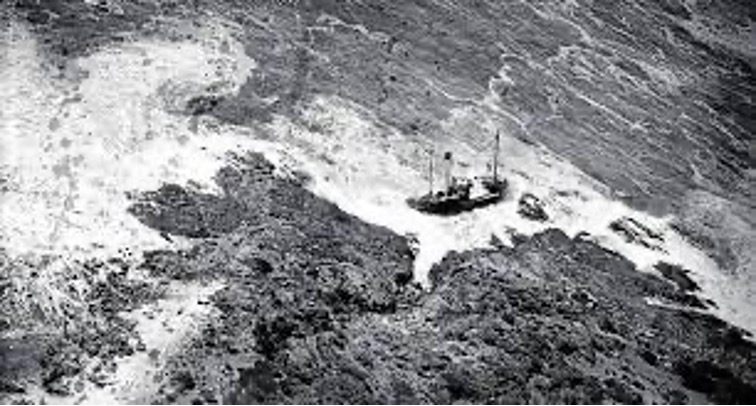
Wreck of the Pappinbarra at Point Stephens.
The Manning River Times and Advocate for the Northern Coast Districts of New South Wales of 14 September 1929, page 8, provided further information on the wreck of the Pappinbarra:
‘Driven on the rocks near Port Stephens outer lighthouse shortly before dawn on Wednesday morning by a raging east-south-easterly gale, the coastal steamer ‘Pappinbarra’, engaged in the Sydney-Port Macquarie trade, and owned by the N. Cain Coastal S.N. Company, is likely to become a total wreck. The crew of 16 succeeded in getting a line to the island on which the lighthouse stands and reached the shore uninjured. They will have to remain at the lighthouse until wind and seas abate enough to permit their being brought to the mainland. Capt. Merrett, master of the ‘Pappinbarra’, said the ‘Pappinbarra’ left Port Macquarie shortly before noon on Tuesday, bound for Sydney. The weather was then moderate to rough, but gave no promise of what was to be encountered later. By nightfall the force of the wind, which was blowing from the east-south-east, had tremendously increased, and a heavy sea was running. The gale grew worse and worse, and terrific seas were encountered in the early morning.
At about 4 o’clock the Point Stephens outer light was seen, and it became obvious that the wind and sea were forcing the steamer to the shore. An attempt was made to get into the shelter of Port Stephens, but a great sea caught the ‘Pappinbarra’ beam-on, and in another minute, she was on the rocks, and firmly fixed there. It was reported from the lighthouse late on Wednesday evening that there does not appear to be any chance of refloating the ‘Pappinbarra’. She is lying fast on the rocks with her stern hard in a crevice, and her head pointing north-east to sea. She has a slight list to port. Seas were breaking over her, but it is likely that when the gale abates further that she will he found to be in only shallow water. The Pappinbarra had on board as cargo 1280 bags of red oxide, which is secured from a curious soil formation at Port Macquarie; 100 boxes of butter, and 10,000 super feet of timber. An official of the company stated that the cargo was small. The ‘Pappinbarra’ is of 518 tons gross and was built at Port Glasgow in 1924.’
Huge waterspout sighted from Lighthouse – 1931
The Singleton Argus of 5 August 1931, page 3, reported:
‘A waterspout, which is said to be one of the largest ever seen on the New South Wales coast in recent years, was sighted about 10 miles east of Port Stephens shortly after noon on Monday. It was reported from Point Stephens outer lighthouse that the spout was large in diameter and extended between the surface of the sea and a high lying cloud. There was no shipping in the neighbourhood at the time.’
Lighthouse keeper to the rescue – 1934
The Labor Daily of 19 July 1934, page 7, reported:
‘Caught in the north-easterly current and a stiff westerly wind, a disabled fishing launch drifted helplessly to sea off Port Stephens this afternoon. The men, aboard hoisted a shirt attached to a pole and attracted the attention of the head keeper of the lighthouse, Mr. McGregor, who launched, a skiff and rowed two miles out to the launch, which was drifting at a rapid rate. The engine was repaired, and the launch entered Port Stephens for shelter. Mr. McGregor stated tonight that the plight of the fishermen would have been serious had the engine not been repaired. “They would have been miles out to sea by the morning he said. The men ….. said they were on their way from the Tea Gardens, Port Stephens to Broken Bay.’
Books supplied to Lighthouse staff – 1939
The Sun of 2 July 1939, page 2, reported:
‘Miss Dora Sparke, who came to Sydney for the Macquarie Club’s reception in honor of Lady Gowrie, has been staying at the club and will return home at the end of the week with her father, Mr. W. Sparke to their old home “Knowle,” at Waratah, Newcastle. Miss Sparke, who is the president of the Newcastle branch of the Victoria League, is most interested in the branch’s main effort — supplying books during the year to lighthouses, including those at Montague Island, Cape Solitary, Green Cape, Seal Rocks, and Port Stephens. The lighthouse keepers and their families in remote places receive not only books, but at Christmas time are sent gifts and tobacco and cigarettes. Gramophone records and games are also collected for these isolated families.’
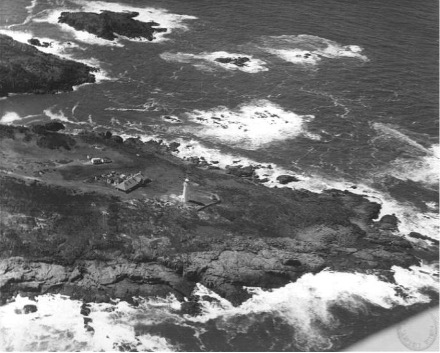
Point Stephens Lighthouse and surrounds, 1950 [Newcastle Library]
Lighthouse keeper facilitates Rescue – 1954
The Newcastle Morning Herald and Miners’ Advocate of 2 February 1954, page 2, reported:
‘A 30 foot launch was towed into Port Stephens late yesterday after its engine had broken down outside. Mr. Slack, of Newcastle, was taking the launch from Tea Gardens to Newcastle. It broke down 400 yards off the lighthouse. He anchored and hoisted a distress signal. The lighthouse keeper, Mr. W. Tulk, saw the signal about 5 p.m. Mr. T. Hyde went out in the ‘Irene H.’ and took the launch in tow.’
An aquatic dog – 1953
The Raymond Terrace Examiner and Lower Hunter and Port Stephens Advertiser of 9 July 1953, page 6, reported a light-hearted story:
‘At Point Stephens lighthouse, (the outer light) at Port Stephens, one of the lighthouse keepers, Mr. Bill Southern, has to keep a watchful eye on his Labrador dog, which likes the water too much and is inclined to get into strife. The other day, when fishermen at nearby Box Bay were hauling in their catch, the dog fascinated by all the fish rushed into the water and tried to chase them into the nets. In her excitement she got caught in the nets herself. She had to be hauled in with the fish, and was submerged in the process, but was none the worse.’
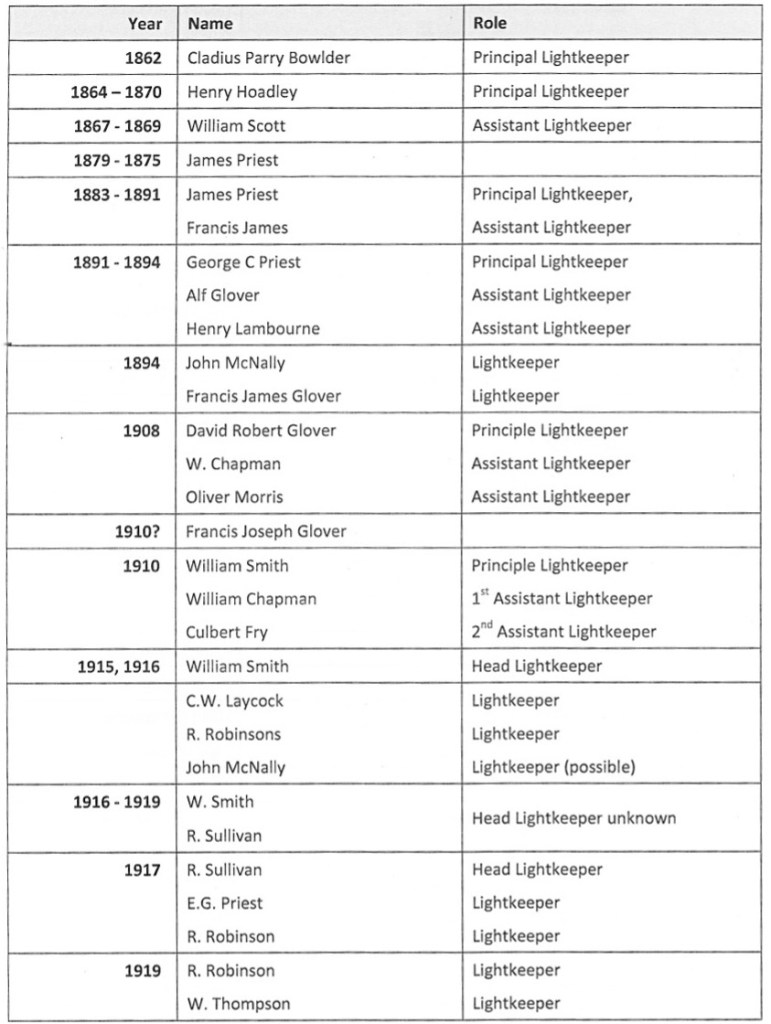
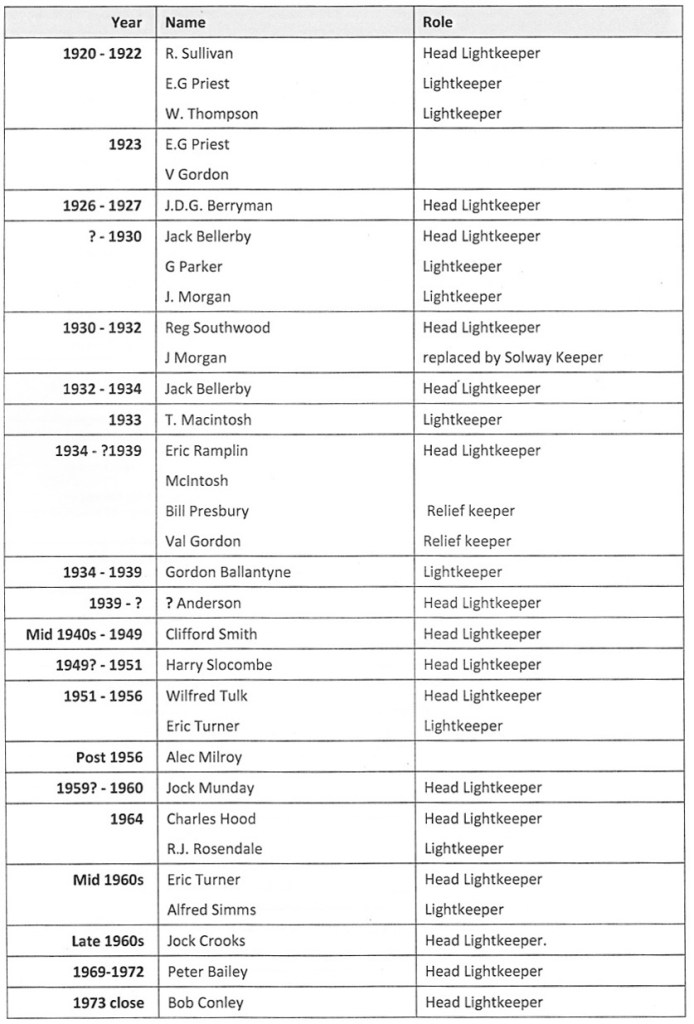
List of Lighthouse Keepers – 1862 to 1973
Concluding Comments
The Point Stephens Lighthouse is now fully automated, with the lighthouse keepers long gone. The voluntary organisation, Marine Rescue Port Stephens , now has the responsibility for dealing with marine safety issues, some of which would previously have been a role of the lighthouse keepers.
The original dome of the Point Stephens Lighthouse is presently located on the roof of the Tourist Information Centre in Nelson Bay. It was removed from the lighthouse in 1973.
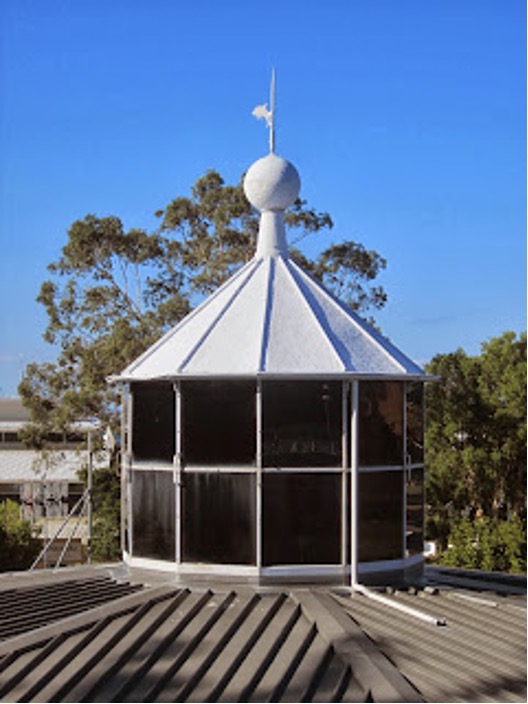
Original dome of the Point Stephens Lighthouse on the roof of the Tourist Information Centre, Nelson Bay. [Author photo, October 2013]
Sadly, the large Lighthouse keeper’s cottage was destroyed by fire in 1991.
The area is now under the management of the NSW National Parks and Wildlife Service. I previously wrote about the history of the lighthouse in 2013.
The following photos show some of what remains of the lighthouse keepers’ cottage:
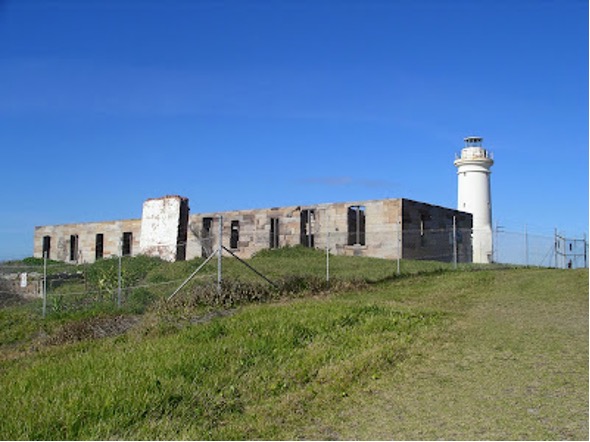
[Author photo June 2007]
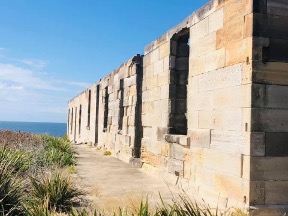
[Author photo – September 2015]
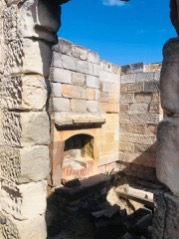
[Author photo – September 2015]
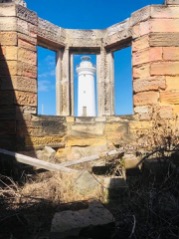
[Author photo – September 2015]
160th Anniversary
A week of events to mark the 160th anniversary of the opening of the Point Stephens lighthouse was staged around Fingal Bay from May 1, 2022. Events included tours of the lighthouse. The anniversary came just one month after the Port’s Inner Lighthouse celebrated its 150th.

Brochure promoting the 2022 celebrations
Researched and compiled led by Kevin McGuinness
May 2023

 Port Stephens - a history exploration