

Introduction
The Commonwealth Government first began to explore the potential of the ocean fishing industry in the Newcastle and Port Stephens regions in 1907.
The Newcastle Morning Herald and Miners’ Advocate of 2 December 1943, page 2, reported on one such initiative:
“A Federal investigation ship, the Endeavour, was designed and built especially for the work, and a director of fisheries was appointed. Experimental cruises were undertaken off Nobbys, Port Stephens, and other places along the coast. These showed that the nation had an asset of great value in its sea fisheries. But disaster overtook the enterprise. The Endeavour, in 1914, was lost at sea with all on board, and was not replaced.”
In June 1915, taking advantage of previous Commonwealth Government research, the NSW Government State Trawling Scheme came into operation. Its aim was to coordinate all aspects of the NSW fisheries industry, from the initial catch and netting of fish, through to its sale in Government owned fish shops. The intention of the scheme was to improve the financial situation of struggling fishermen, and to provide cheaper and more reliable fish supplies to the whole of the state.
The opening of the Pindimar Fish Receiving Depot on 15 November 1917, with much fanfare, formed an important part of the State Trawling Scheme.
The Fish Receiving Depot was located at the far end of Warri Street on Pindimar Bay as shown on the following map:

Location of the Pindimar Fish Receiving Depot at the end of Warri Street, Pindimar [Pindimar City Map, c1919]
By July 1922, the Pindimar Depot had closed, and the NSW Government State Trawling Scheme and the associated trawling operations had ceased. The assets of the scheme were put up for sale. The Daily Telegraph of 13 June 1923, page 9, reported that up to the time of its closure the State Trawling Scheme had recorded a loss of over £214,000 for the State Government.
The Pindimar Depot had several more lives in various capacities:
1) Ice Works Cooperative, which opened in the vacant premises in 1922, but failed after one season;
2) Shark Processing Factory, which opened in the abandoned Depot premises in 1927. It had a longer life, but closed in 1932 as it had depleted the shark population of Port Stephens; and
3) Port Stephens Canning Company which was opened in 1932. It operated successfully for five years, before the wooden factory was destroyed by fire, and the Company operations never reopened.
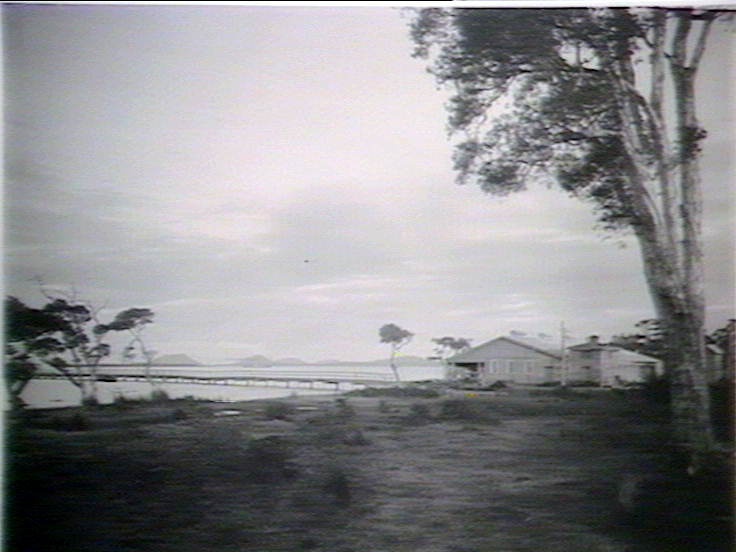
Pindimar Depot Premises- 1934 [NSW State Records Office]
Nothing remains of these four fishing ventures at Pindimar today. The site of the depot is now a public reserve adjacent to the water in Warri Street.
Their story however is a testament to the grand plans not only for the Pindimar region but also for the for the fisheries industry in New South Wales.
The following papers concerning the Port Stephens fishing industry are also published at the following links on this website:
Royal Commission on Fisheries – Evidence taken at Nelson Bay, 1895
New South Wales Fish Company – First Fish Processing Facility at Nelson Bay
Chinese Fisherman at Port Stephens
Adventures of Spero Spathis – a Greek Fisherman at Port Stephens.
State Trawling Scheme – The Grand Plan
The aim of the NSW Government State Trawling Scheme (1915-1922) was
- To give a quick start to the ocean fish trawling operations;
- to better organise the fishing practices of river and estuarine fishermen;
- to improve the financial livelihood of fishermen; and
- to improve the retailing of fish throughout the state and provide the best quality at the lowest possible price.
The plan involved:
- the manufacture and purchase of trawlers for ocean fishing;
- the constructing of several fish depots along the NSW coast to receive the fish caught by river and estuary fishermen;
- the establishment of fish shops in the Sydney metropolitan and selected country towns for the sale of fish to the community; and
- warehousing of frozen fish to reduce the peaks and troughs of supply throughout the year, and to improve the variety of both ocean and estuarine fish available.
The Sunday Times of 18 June 1916, page 8, carried the following report on the enthusiasm for the Scheme:
“The Chief Secretary, Mr. Black, expresses himself optimistically concerning the State trawling enterprise. In addition to the four Government shops being conducted in the city and at Newtown, six more shops are to be opened, the first in Glebe-road. Other establishments will follow at Camperdown, Marrickville, Kogarah, Granville, and North Sydney.
The Government is drawing supplies from the river fishermen to supplement what is caught by the deep-sea boats. “It is,” said Mr Black, “the desire of the Government thoroughly to organise the fishing industry. The better-known fish — whiting, bream, garfish, etc. — are rarely caught by the trawlers, since they are estuarine and shallow water fish. Should the net fishermen, however, come into the proposal and aid the trawlers, then a very wide variety of cheap and fresh fish food will be made available to the people of the whole State. ‘The Government will establish freezing works wherever fish can be bought in quantity from the fishermen. There the fish may be cleaned immediately upon capture, placed in chilling chambers, and held until a suitable opportunity arrives for its conveyance to market by sea or land.
The fish will be chilled, by the process of cold air blast. Similar arrangements for freezing will be made aboard the fish-carrier boats and the trains. On arrival at Sydney or Newcastle or any other place of distribution the fish will be placed in chilling chambers until sold to the public. Eventually the Government hopes to establish smoke houses and canning works at the various fishing centres, and to extend operations to the oyster industry and to other articles of diet of a perishable character.
“My proposal,” Mr. Black explained, “is in time to meet the demands for fish in Newcastle by taking over the supply derived from Lake Macquarie and conveying it to Newcastle by rail or else by quick motor service in refrigerator cars, and perhaps also by diverting thence a portion of the Port Stephens supply. “On the North Coast the main source of supply is the Clarence River, and I propose to erect a receiving depot at Maclean at a cost of £5000 or so, whence the fish will be carried by launch to the railway station. The tremendous quantity of fish thus obtained, in conjunction with the fish shipped at various other stations on the northern line, should be carried, in my opinion, in the latest refrigerating railway car. “If the Northern fish trade were properly organised a whole train might be run through daily to Maitland carrying fish, butter, bacon, and other perishable food products. The fish could then be diverted to the interior of the country. We would serve the bulk of the towns on the North and North-western lines with fish obtained from the North Coast. “Regarding the South Coast supply, the Shoalhaven River and Lake Illawarra fisheries seem the only other sources of supply worthy of our consideration. It is probable that the three South Coast stations which may be established would be equal to supplying a very large portion of the Sydney demands in conjunction with the trawlers.
The sums immediately needed, concluded the Minister, for the handling of netted fish, are: Depot and wharf at Newcastle. £3500; depot at Pindimar, Port Stephens, £3500; depot at Maclean, Clarence River, £5000; depot at Wandandian, George’s Basin, £1750; total, £13,750. “For the construction of four steel trawlers at Walsh Island, of steel trawlers at Mort’s Dock and at Williamstown, and of a wooden fish-carrier and a wooden trawler at Sydney, a further sum of £92,000 will be necessary.”
Newcastle Fish Depot
The Sunday Times of 8 July 1917, page 3, reported on the extension of the State Trawling Scheme to Newcastle:
“During last week the State trawling industry extended its permanent operations to Newcastle, where business was begun at the State fish depot. The exceedingly large catches which the State trawlers have been making lately made the present a favourable time to open this depot, and during the first few days large numbers of people were supplied with fish.
The great fish-receiving and refrigerating station is near completion at Pindimar Bay, Port Stephens, and shortly ordinary estuarine or inshore kinds of fishes will begin to pour into Newcastle from this depot for distribution in the Northern District.”
Tenders Called
Tenders for the supply and fitting of equipment at Pindimar, together with the carriage of fish from Pindimar to the State Fish Depot at Newcastle, were advertised by the NSW Department of Public Works during 1916.
The Construction and Local Government Journal, of 14 August, 1916, page 3, reported that the Department had accepted one of the tenders:
“Supply, Delivery, Erection and Testing of Ice Making and Refrigerating Plant for Pindimar Fish Depot, Port Stephens……. The Standard Waygood Hercules Ltd., Hay Street, Sydney. £3320.”
Specifications of the Pindimar Depot
The Newcastle Morning Herald and Miners’ Advocate (NSW: 1876 – 1954), Friday 16 November 1917, page 4, provided a summary of the Depot specifications.
“The Pindimar State Fish Receiving Station is situated on the northern foreshore of Port Stephens, in Wobbegong Bay, opposite Nelson’s Bay, and not far from the Tea Gardens. It is located close to the water’s edge, and adjacent to a jetty 800 feet long on which a 24-inch gauge light trolley track has been placed for facilitating the handling of the fishermen’s catches. The building, which is of substantial construction, is built on hard-wood piles. Charcoal has been used for insulating the walls and ceilings of the freezing rooms and sides of ice-making tank, while two thicknesses of 2in cork-seed constitute the insulation of all floors, on top of which is placed a working surface of Neuchatel asphalt. The floor area of 9000 square feet is apportioned to meet the respective requirements of fish handling operations, cold storage, ice-making and storage, power plant, refrigerating machinery, fuel stove, engineers’ workshops, office, etc.
There are two fish freezing rooms, having a total capacity of nearly 8000 cubic feet, in which may be placed approximately 70 tons of fish. The store has a capacity to hold 45 tons of ice. There are two separate sources of water supply. The freshwater service is obtained from two wells situated within the two-acre site of the depot. A pump in the engine room draws water from these wells and delivers to the fresh water supply tanks. Water for fish cleaning purposes is drawn from the 2000 gallon sea-water tank. These tanks have, been sufficiently elevated to ensure that there is, throughout the depot, a reasonable pressure of water for all purposes. The sea-water tank is filled by a pump, which draws the water through a 650 foot suction pipe line from a point along the jetty, and a pipe line from this tank de-livers water to the ten troughs for fish-cleaning purposes.
The power plant consists of a 52 horsepower Hornsby gas engine and suction gas plant, of British manufacture. Adjacent to the power plant is a well-equipped engineer’s workshop. The ice plant consists of a raw water ice-making system, containing 154 galvanised iron ice cans, each having a capacity to make a 1cwt net block of ice, and, in conjunction therewith, is an overhead travelling crane, or ice-can hoist, for removing the cans of ice from the tank. The ice tank contains 2000 lineal feet of l¼ in ammonia piping. An agitating pump circulates the brine in the ice tank, thus ensuring uniform freezing of the water in all cans. This plant has a capacity to easily make 5 tons of ice per day of 24 hours’ operation.
The ammonia compression system of mechanical refrigeration has been installed, the machine being of the Hercules type of Australian manufacture and having a refrigerating capacity equal to the melting of 18 tons of ice per day. This machine is driven by belt from the gas engine, and is of the Duplex type, i.e., having two compressors each provided with separate suction and discharge stop valves, so that either may be operated independently of the other in the event of it being necessary to effect repairs to one. The plant has been so arranged that all ammonia controlling and insulating valves are situated in the engine-room and are thus under the immediate observation and control of the shift engineer.”
Preparations for the Opening of the Pindimar Fish Receiving Depot
The Newcastle Morning Herald, of 12 November 1917, page 8, carried the following advertisement:
“PUBLIC NOTICES. PORT STEPHENS PASSENGER AND TOURIST TRANSIT CO., LTD. In connection with the opening of the State Fish Works on THURSDAY, 15th November we are running a Special Trip to Pindimar. Char-a-banc (sightseeing motor coach) will leave the Newcastle Railway Station at 8.45 a.m., and boat to leave Pindimar at 5.30 p.m., reaching Newcastle about 9 p.m. Office: 91 SCOTT-STREET. ‘Phone 334, Newcastle.“
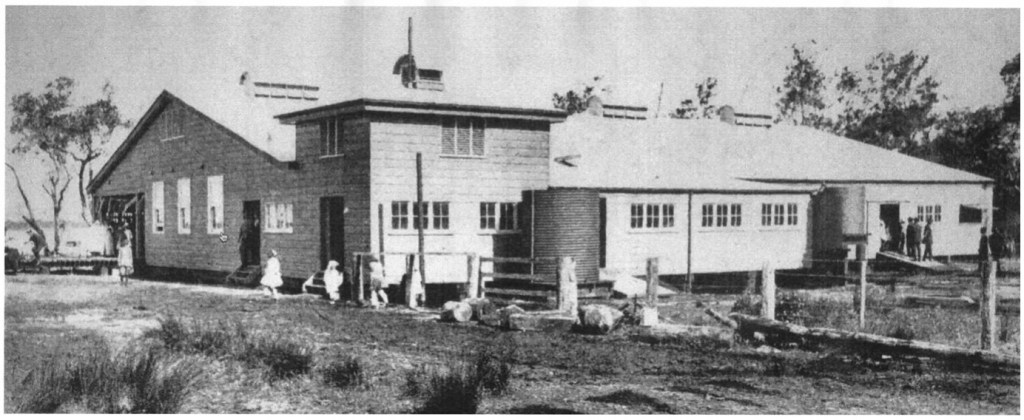
Rear of the Fish Receiving Depot
Official Opening of Fish Receiving Depot
The official opening of the Pindimar Fish Receiving Depot was held on Thursday, 15 November 1917 with much fanfare. The opening day was proclaimed a public holiday in the Port Stephens district.
Around this time plans were afoot to develop Port Stephens as a deep-water international port. Pindimar on the northern shores over Port Stephens was also being considered a possible site for the National capital.
The official opening also occurred about a month after the ending of the Great Strike of 1917. The Great Strike is regarded as one of Australia’s biggest industrial conflicts covering many industries.
The official opening of the facility was widely reported in several newspapers.
The Newcastle Morning Herald and Miners’ Advocate of 16 November 1917, page 4, carried the following report on the day’s festivities:
“Peaceful Pindimar, on the shores of Port Stephens, wore an air of importance and gaiety yesterday. Mr. Fuller, the State Chief Secretary; Mr. Garland, the Solicitor-General; Messrs. H. Morton and W. Bennett, Ms.P.; Mr. Harkness, the Under-Secretary; Alderman Kilgour, the Mayor of Newcastle, and a large number of visitors from Newcastle and the Port Stephens district, were there in connection with the opening of the first of the great coastal fish receiving, ice-making and refrigerating stations for the development of the New South Wales fisheries.
The day was ideal, and the Ministerial party thoroughly enjoyed the trip by motor and launch from Newcastle. The jetty at Pindimar was gay with flags, and when the visitors stepped ashore, they were cheered by a crowd of several hundreds. Counillor H. G. Ralston, President of the Port Stephens Shire, was present. ….
Before declaring the depot open, Mr. Fuller was invited by Mr. Bennett to address the gathering. Mr. Fuller said it was particularly pleasing, after the severe and anxious time which they had experienced during the last three or four months, to visit this beautiful sheet of water, and spend a few days, in order to get the rest which they required. He was delighted to meet there same of those who, when the strike was in progress, went to the assistance of the Government. From the district came some of the first who volunteered on that occasion, and they were with them that day. (Applause.) It was not an ordinary strike. It was a revolt against constituted authority. He hoped now that they had asserted constitutional authority that there would be a new state of affairs between employer and employee, and a saner system of unionism, and that the industrial life would continue, so that when the boys returned from the front they would not return to a dead State, but to a country where everything was going along rapidly and smoothly.
“Today is the anniversary of the establishment of National Government in New South Wales,” continued Mr. Fuller, amid applause. “This had been a red-letter day for the people of this country, and I trust that the actions of the Government during the year make the people rejoiceful and thankful that in a time of crisis men of different shades of political opinion thought fit, in the interests of the country, to come together and form the National Government. I trust the opening of this big depot in connection with this important fishing industry will be a red-letter day so far as Port Stephens is concerned, and I hope that, as you are all here from over 1000 square miles of water, this will be made an annual event, and that from all portions of Port Stephens, when this industry flourishes, you will come together, and make it a red-letter day in the district.
The establishment of this industry is a part of the great trawling scheme. “The trawling industry,” he said, “was established with two objects—to find out whether the coastal fisheries were a valuable asset to the people, and to give a cheap and valuable form of food, particularly to the poorer people. So far as labour conditions were concerned, the industry had carried on under adverse circumstances. The Government trawling scheme was launched in June 1915, amid a storm of trade opposition. In addition, there was a considerable amount of opposition from persons who honestly did not believe that successful deep-sea fishing was possible on the coast. The coast was declared to be beset with jagged rocks that would tear every trawl net to ribbons. Yet, in two years of work, on virgin fishing grounds, where so much work of a preliminary and exploratory nature had to be undertaken, the trawlers have brought in for the consumption of the public of New South Wales, many millions of pounds weight of the finest edible fish, of kinds which had lain untouched since the advent of white man in Australia.
By their operations an entirely new food province has been added to Australia. Until the last few months the State trawlers never had a fair chance, because of the dead set that was made against them by certain industrial organisations and by interested people. During the last few months, however, notwithstanding the many disabilities consequent upon the war under which the organisation had been suffering, not only had continued immense catches of fish been made, but it had been possible to work the undertaking on a sound financial footing. The financial progress, indeed, of that period had been highly remarkable. “We look,” said the Chief Secretary, “to the establishment of this depot as one means of developing the estuarine fisheries. Whenever they had sent fish to country places the people had simply rushed them. There was an immense market for fish in the State.
In Port Stephens and other places, the fishermen worked only two or three days a week. The Government wanted them to work full time and wanted them to get a fair and just deal. That they would get from Mr. Stead, the manager in charge. He paid to tribute to Mr. Stead for his energy and ability. The depot was the forerunner of others to be built along the coast. One was nearing completion at Maclean, on the Clarence River. The Government hoped that the depots would prevent the waste of valuable fish that had been going on in the State for years. He had seen great waste on account of there being no place of this character where they could be taken and preserved. This depot would, he believed, have the effect of doubling the output. For three or four months of the year they had large shoals of travelling fish, which were practically valueless to them. He hoped these would now be caught and put to good use. He hoped that all the trouble which the fishermen had had, and the way in which they had been robbed, would cease, and that they would have a haven of peace in the industry.
In years gone by dairy farmers were robbed just as the fishermen were. To prevent that they combined. The fishermen now had the opportunity of cooperating, not only among themselves, but with the Government. He hoped to come here again in the near future and find the industry on a better footing in consequence of the depot. (Applause.) Mr. Garland said Mr. Fuller dealt with the trawling trouble in the manner in which he had showed himself to be a master. (Applause.)
Mr. Bennett and Mr. Morton Ms.L.A., addressed the gathering. The latter said Mr. Stead had not had a fair deal. He had been criticised and had been up against unrest in Sydney.” The Chief Secretary then declared open the depot. Cheers were given for Mr. Fuller, the soldiers at the front, Mr. Stead, and the Parliamentarians present. A ten-year-old boy named Sheather, the youngest licensed fisherman in the State, presented Mr. Fuller with a bouquet. Aborigines played the National An them and popular airs through gum leaves. Afternoon tea was then served. There were boat races during the afternoon, and picnic parties lined the shore. In the evening the visitors were entertained by residents of Nelson’s Bay.”
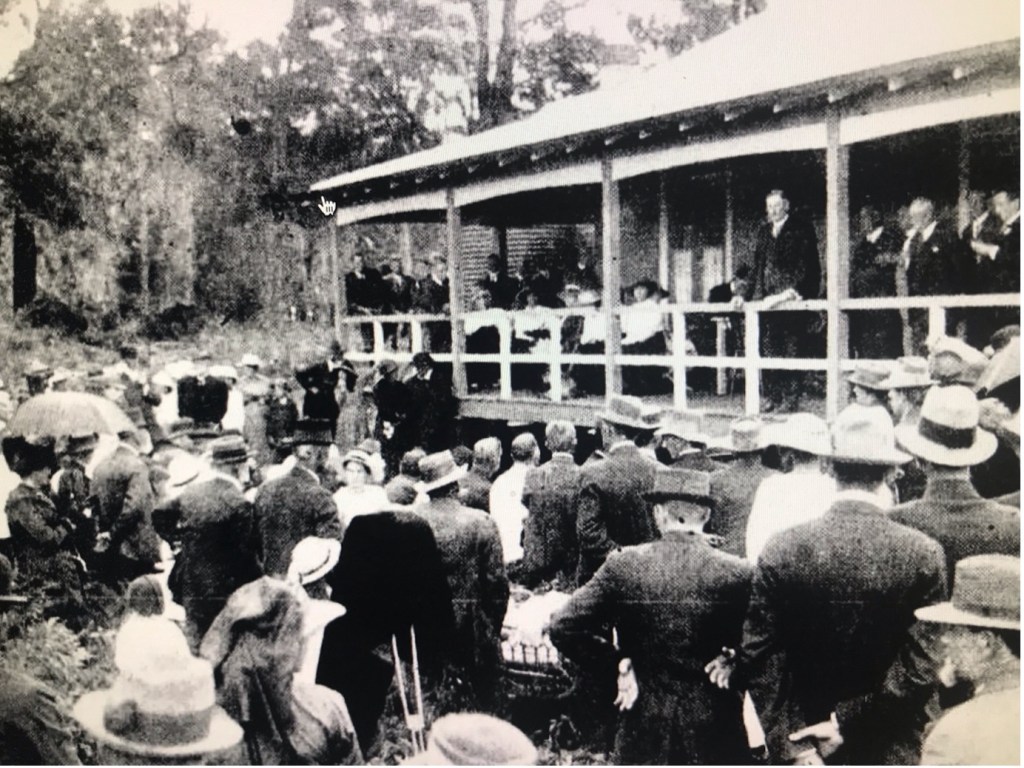
Chief Secretary Addressing the Opening Gathering at Pindimar
The Raymond Terrace Examiner and Lower Hunter and Port Stephens Advertiser of 23 November 1917, page 3, also reported on the official opening. Some of the comments expressed in the article, indicate some of the concerns of the fishing industry about the depot:
“The Pindimar Fish Works, inaugurated by the Government, was officially opened by the Hon. Geo. Fuller, on Thursday 15th. There was a large attendance of residents of Port Stephens and its districts. In addition to the Minister, the member for the district, Mr. W. Bennett, Mr. J. Garland M.L.C., and Mr. H. Morton, M.P., were present. The Newcastle Council and Chamber of Commerce, the Port Stephens and Stroud Shires also sent representatives. The Minister was met at Salt Ash by Mr. W. Longworth’s launch, and prior to the opening, toured round the bay viewing the expanse and beauty of the Port. The party dined at Nelson’s Bay, and the opening ceremony was held in the afternoon.
Addresses were delivered by Mr Garland, Mr. Bennett, and Mr. Morton. Mr. Fuller referred, in his remarks to the help rendered by residents of Port Stephens, as loyalists, during the strike, and to the value of those services. He dealt with the trawling industry and likened the plant at Pindimar as an auxiliary to the trawling supply. No trawling had been done recently, he stated, as the boats were used by the Commonwealth Government in netting mine’s, placed in our waters by German spies and disloyalists, but the last six month of their actual work had shown a profit. The depot in Port Stephens would enable the fishermen to carry on his occupation unhindered, as he had a market at home, and all he need do was catch the fish, and the depot would handle, and distribute them, paying the fishermen according to their catch by weight. It was to the fishermen’s interests to make a success of it; the more fish they supplied, the greater their success and that of the depot. They knew how they had been treated in the past by agents, and now they had an opportunity to throw off the agent, and save the middleman’s profit. He hoped they would give the depot a fair trial, and if they did, he thought they would be quite satisfied. The official declaration of the opening was delivered amidst cheers.
The aboriginals from Karuah camp gave several selections with the leaf band and were cheered. The depot is a commodious structure, and well equipped for handling any quantity of fish. The site is on the shore in the Duckhole, at the shore end of Phillip’s jetty, which was taken over with the site, and is 800 feet long, with ample water, a trolly line conveys the fish to the depot, which has 9000 feet of floor space, where the receiving room is supplied with a weigh bridge, alongside the freezing room. ….. After the opening, young Sheather, 10 years old, the youngest licensed fisherman in the State, was presented to Mr. Fuller. A regatta was held during the day and sailing, and rowing prizes competed for. …. The prices being paid for fish at the depot to the fishermen are whiting 4d per lb., bream 3d, mullet 1½d, blackfish 1d, flathead 2d, snapper 5d, garfish 3d, rays, salmon, leather jacket, etc. 1d. The prices are considered too low by the fishermen generally, but the principal item complained of is blackfish, and a rise, they say, should he given on 1d per lb. A basket of mullet weighs about 75lb. and a basket of blackfish about 90lb. The price the Government obtains for the fish from the public is ample, the fishermen say to enable the Government to pay a higher price. The fish agents are giving better values than the Government, and the net men think the latter is in as good a position to pay as the private agent. A feature too is that concerning the trade at the Port which is causing the fishermen some doubt. They think that if they send their fish to the depot, the H. R. Company’s boat will not trade to the Port, since their principal line of freight will be gone, and then the Port will be without regular shipping facilities for supplies and necessities. This is an important matter, and some arrangement should be made by the Government with the company in regard to carrying the fish to Newcastle or Sydney. If this can be arranged much more fish will probably go to the depot.”
- The Dungog Chronicle: Durham and Gloucester Advertiser of 23 November 1917, page 6, shines further light on the opening ceremony.
“Thursday last was a red-letter day in the history of Port Stephens, the occasion being the official opening of a State fish depot at Pindimar. The Parliamentary Party comprised Hon. G. W. Fuller (Chief Secretary), Mrs and Miss, and Master George Fuller, Hon. J. Garland (Attorney-General), Mrs and Miss Garland, Hon. Walter, Mrs and Miss Bennett, Mr Harry Morton, M.L.A., and Miss Morton, Ald. Kilgour (Mayor of Newcastle), Mr Stead (Fisheries Expert), and Mr and Mrs Harkness (Under Secretary). They left Newcastle at 8.45 via Stockton and Salt Ash and arrived at Nelson’s Bay at midday. After luncheon the party crossed the Harbor to Pindimar, where they were met by one of the largest gatherings ever assembled in the Port. School children from Nelson’s Bay, Tea Gardens, and other localities were lined up on the jetty, where they sang songs of welcome, under the direction of Mr Greentree. Beautiful branches of native flowers were presented to Mrs and Miss Fuller and Mrs and Miss Bennett, by little pupils.
The visiting ladies were then drawn by the children in a decorated trolly along the tramline to the depot, which is on the foreshore. Here the word “Welcome” worked in large blocks of ice met the view. After inspecting the freezing chambers and buildings, the Chief Secretary declared the depot open. He explained that the object of the Government in establishing the depot was to purchase fish, treat it and chill it, and then supply Maitland, Newcastle, and neighbouring localities with a regular supply of fresh fish. He explained the position of the trawling industry and said that the Federal Government having commandeered their trawlers for enemy mine sweeping, had dislocated their operations.
Hon. Walter Bennett in the course of his speech, said that Port Stephens had been sinfully neglected in the past. There was not a decent trafficable road to the beautiful resort, Tea Gardens, or to the more pretentious and equally attractive Nelson’s Bay. He urged that government assistance be given to make a trafficable road from Karuah to Tea Gardens and said that the latter place would be visited by thousands of people from the Dungog and Cessnock districts during the summer months, if it could be reached by motor car. The naval base at Salamander Bay had a front door, and the road from Salt Ash to Nelson’s Bay would provide a back door and give access to over 20 miles of seacoast line of bays and rocky promontories, which would be availed of by health seekers and holiday makers from Newcastle and neigh-boring districts. Over 20 years ago he had fought for the construction or the North Coast railway, and he would never cease agitating until he saw the Port Stephens — the finest port in Australia — linked up with the railway system of the State. He looked upon it as the natural outlet for the North Coast and the great North-West.
Hon. J. Garland and Mr H. Morton, M.L.A., also addressed the gathering, and expressed surprise at the potentialities of the Port. The depot is capable of treating 3,000 baskets of fish per week, and its advantage to the fishermen lies in the fact that they can sell the fish as soon as caught and get their cheques. Under the old conditions fishermen only caught when boats were running to market. One Fisherman on Saturday night secured a fine haul of sea garfish, for which he received a cheque for £31. Not a bad haul.
During the afternoon a deputation was introduced to the Minister by Mr Bennett, asking for assistance to secure a doctor for the port, and a sympathetic reply was given. Mr Bennett also introduced a deputation comprising, Councillors C. T. Abbott, W. J. Flannery, W. Gorton, and local residents asking for assistance for making road from Karuah to Tea Gardens. Mr Fuller promised to place the request in a favourable light before his colleague, the Minister for Local Government. At night the visitors were entertained at a banquet at Nelson’s Bay, which was largely attended by visitors from Newcastle, Maitland and elsewhere. Mr Greentree presided, and numerous toasts were honoured.”
Banquet for Ministerial Party at Nelson Bay
The Newcastle Morning Herald and Miners’ Advocate of 17 November 1917, page 4, provided a full report of the formalities of the banquet given for the Ministerial Party associated with the opening proceedings. The report details concern about the “Great Strike” that had only recently been settled. A day of festivities at Port Stephens must have come as a welcome break for the Government representatives present, to recover from the hard times of the strike, while keeping the matter of the war in mind. The newspaper report provides a summary of the issues and views of the times as held by the Port Stephens citizens:
“After the opening of the Pindimar fish receiving and refrigerating depot on Thursday, the Ministerial party was entertained at Nelson’s Bay by local residents. A large number attended the banquet in Mrs. Lund’s house. Mr. A. G. Greentrees presided and proposed the loyal toast. Mr. W. Rush proposed “The Ministry.” Port Stephens, he said, greatly admired the Ministry for the stand it took in the industrial crisis. They were with Mr. Fuller heart and soul. They admired a man will back-bone. Mr. Fuller had made a mark in Australian politics that would never be wiped out. If the Government had been defeated by the strike, it was hard to say what the future of Australia would have been. Australia would have been crushed, and the sooner Germany got it the better it would have been.
Referring to the opening of the Pindimar depot, he said as a fisherman of 30 to 40 years, that it was one of the greatest things any Government had done—in touching the estuaries of the fish. He thought it would be a very great success. To the present the fishing industry had been sadly neglected. At the mere mention of the word “fish” a Minister would close up quicker than any oyster when a star fish was about. (Laughter.)
Mr. Fuller, the Chief Secretary, was warmly received on rising to respond. He said that after having surmounted difficulties, and having made no mistakes, it was gratifying for the Ministry to receive appreciation of its actions. The members of the National party accompanying him were delighted with the reception Port Stephens had given them. One of the most delightful things to him was the aboriginal gum-leaf band, whom be hoped to meet again. He alluded to the formation of the National party a year ago that day, and said he hoped they would all live to celebrate the 20th anniversary. Reverting to the strike, he said, “I could not have done what I did if I had not the united support of my colleagues. We came through successfully, and I believe the result of our actions will do good, not only in New South Wales, but throughout Australia. In the interests of the development of the State and Australia. I hope the result of this revolt against the Government will mean improved relations between the people, and give our industries an opportunity to develop, so that this country, with its magnificent resources, after the war will he one of the biggest and freest nations in the world.” (Applause.)
Mr. Fuller said he believed that when the fish depots were firmly established there would be an influx of people into the Port Stephens district, and that the port would get the start it had been looking for, for many years. Speaking of the war, the Chief Secretary stated: “We are well into the fourth year of this struggle for our national existence. To-day nobody can say what the result will be. Things are occurring which must make us realise the seriousness of the position so far as Australia is concerned. Australia’s boys have done magnificent deeds. They have sacrificed much. Nearly 40,000 have paid the supreme sacrifice, and it is up to everyone left behind to do his utmost in this bloody war. We may have differences of opinion in regard to pledges and other matters, but it is the duty of every patriotic Australian to see that Australia is properly represented and does her duty. We don’t want the grand old Empire to go down. We don’t want to see the old flag hauled down off the oceans of the world. We in Australia, realise—many, I am afraid, do not realise—what the flag means to us. We want to keep the grand old flag and the Commonwealth flag flying as well. Therefore, I hope and sincerely trust that, for the successful prosecution of the war, whatever Australia does, and whatever opinions there may be among the people, every thing will be done to keep the five divisions at the front fully reinforced, so that when the war ends it will never be said that Australia shirked her duty when the great crisis arrived. We have our Good name to keep, and everyone has a duty in that regard.” (Applause.)
Mr. J. Garland, the Solicitor-General, dealt with the recent industrial trouble, and the war position. Things never looked gloomier than at present in the war, he said, although he believed the bulldog had his grip on the Western front and would never relax it. Mr. Garland spoke earnestly on Australia’s duty, and said the call was now made to Australia—not to do her duty, for she had been doing it all along—but to maintain those gallant five divisions at their full fighting strength Australia was asked to make a still greater effort. “The cause of democracy is at stake in this mighty war,” he continued. “We must do all we can, and if we fail in that we fail in doing our supreme duty. I think we will bear in mind the mighty issues before us, come forward in this hour of our country’s need, and supply the requisite numbers wanted to aid our boys at the front.” (Applause.)
The health of the State Parliament was proposed by Mr. H. G. Ralston, president of the Port Stephens Shire Council. Messrs. W. Bennett and H. Morton, Ms.P., responded. Mr. Bennett remarked that when the port had railway communication industries would be attracted to the place. The neglect of the finest harbour in Australia was lamentable and sinful. Mr. Morton pointed out what was the duty of young Australians without ties and said the more men we sent to the war the fewer would be the losses. He trusted the result of the referendum would show that we were thinking of the boys at the front, and that we were prepared to assist them, so that they might return victorious as early as possible.
“The industries,” proposed by Mr. F. Phillips, was responded to by Mr. D. G. Stead, Superintendent of State Fisheries, who had seen most of the harbours of the world, but not one so good as Port Stephens. He referred to the immense potentialities of the place, and the illimitable fish supply. Other toasts were “The Visitors,” submitted by Mr. Magnus Cromarty (whose family has been in the Port Stephens district for 100 years), and responded to by Alderman Kilgour, Mayor of Newcastle; “The Press,” proposed by Alderman Garnham, Mayor of Morpeth; and “The Chairman,” proposed by Mr. Fuller. The singing of the National Anthem closed the proceedings.”
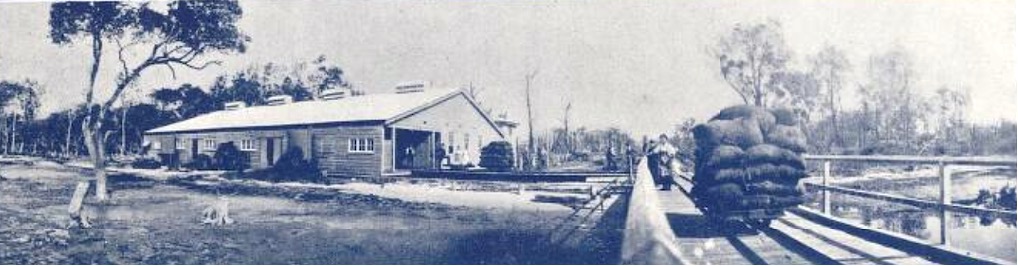
Wharf at Pindimar showing rail lines and trolley, circa 1920
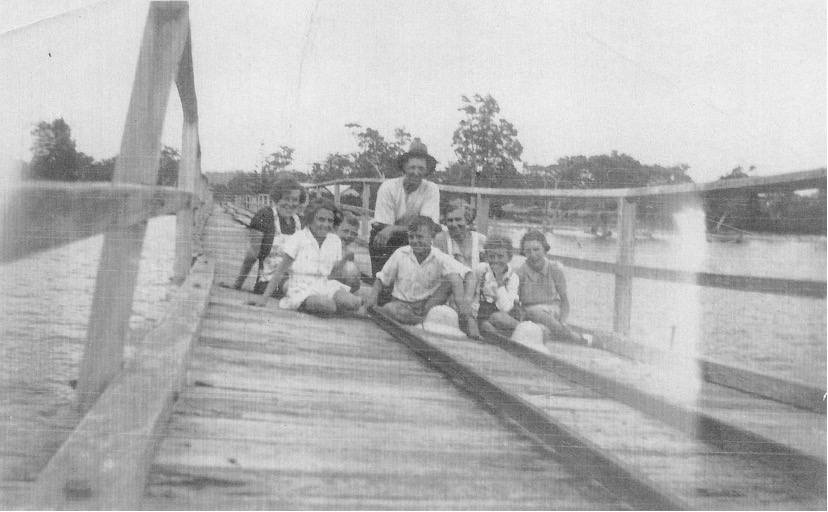
Family on Pindimar wharf, showing the rail lines.
Pindimar Fish Receiving Depot – A Colossal Blunder
The factors which would quickly lead to the Depot’s failure and associated State Trawling Scheme after three years of operation, were in evidence before the facility was opened. There was disquiet in the fishing industry when the Scheme was originally proposed,
The Newcastle Sun of 16 February 1922, page 3, carried a report concerning reasons for the closure of the Depot.
“Mr. A. P. Summergreene, general manager of the State Trawling Industry, has replied to the published criticism of the Port Stephens fish depot as a white elephant. He says: — “As far as the Pindimar depot, also the depots at Maclean, Wandandian, and Eden are concerned, it is common property that the late management of the trawling industry committed the National Government to one of the most colossal blunders ever made in the commercial activities of this State. Pindimar, from the day it opened, was doomed to failure. Assuming that every fish caught in a year at Port Stephens had passed through the depot, the turnover would have been insufficient to cover working expenses, let alone show even the shadow of a profit.
The fishermen of Port Stephens had nearly three years of the depot, and they expressed their appreciation by selling their ‘culls” (second quality) to the State and forwarding the choice varieties of fish to the Sydney agents. Up to a certain point, the fishermen were not to blame for this line of action, because the late management had an unfortunate habit of juggling with purchase prices. …. “In conclusion, the trawler management is not prepared to spend one penny on Pindimar depot, or any other wild-cat scheme. Too much of the taxpayers’ money has been lost by the trawling industry in the past on “white elephants,” and the management will not be a party to accumulating more bad debts for the State.”
Another factor contributing to the demise of the Scheme was the commandeering of the trawler boats by the Commonwealth Government, for a period of time, for mine clearing operations along the coast, as part of war defence operations.
Pindimar Depot Reopened as a Cooperative Ice Works
The Daily Telegraph of 15 April 1922, page 6, carried the following report on the re-opening of the Depot as an ice works on a co-operative basis:
“The deep waters of Port Stephens, long undisturbed, have recently become troubled by an invasion which threatens to violate their reserve for all time. All because of a noisy, churning, spitting refrigerating plant. Mr. Dodds is the responsible man. He was not a businessman, but just an ordinary citizen, engaged in oyster culture on the shores of the port. There, at Pindimar, the idle cooling plant, erected by the State Government at a cost of £14,000 — a perfectly good white elephant. Mr. Dodds set about procuring a lease of the property, with the result that, on Friday last, Port Stephens found itself joint promoter of a new industry. On Thursday great shoals of travelling fish invaded the bay. They were undisturbed. On Friday, Nemesis, in the shape of a fleet of fishing boats, overtook them. Since then, day and night, nearly 100 craft, manned by the fishermen of Nelson’s Bay and Tea Gardens, have scoured the port, gleaning a rich marine harvest. The newly opened refrigerator was their treasury. Port Stephens is an isolated place. A steamer from Newcastle calls there twice a week, and it provides the only means of sending fish to market. Previously, the amount of fish caught depended on the quantity of ice available in the bi-weekly steamer, and time, after time hundreds of baskets of fish were left on the beach. Fishermen could only work intermittently, and often were obliged to allow great shoals of fish to pass unmolested. During the past week all that has changed. The fishing industry at Port Stephens has been new-born. The Pindimar refrigerating plant is working on a partly cooperative system, the fishermen participating in the profits.”
The Ice Works did not operate for long and collapsed due to lack of lack of finance, in September 1923. The NSW Government commenced calling for tenders for the purchase of the Depot as a going concern or for one or any number of items, as they then stood. The Depot and its contents remained unsold, and the tender advertisements were still being placed during August 1924.
Shark Factory
An article published by Mid Coast Stories reported:
“In 1927, Marine Industries Ltd had leased the defunct Pindimar ice works for the purpose of opening a shark processing factory. The factory processed shark liver for oil and sold the shark hides, oil, flesh, and fins. The last shark skinner, Mr Tom Priestly, remembered a hard life working seven days a week; skinning, finning and beaming sharks, salting then stowing their hides and boiling livers down for valuable oil. The oil was used to treat leather, temper steel, and make soap.
The firm used two boats called the ‘Devil’ and ‘Demon’. The fishermen would lay several thousand feet of gill nets each night near the entrance to Port Stephens. In six years, over 25,000 sharks were killed.”
Description of the Shark Processing Operations
The Sydney Mail of 1 February 1928, page 14, published the following report written by its correspondent, Donald Thomson, on the operations of the Shark Factory at Pindimar:
‘Australia’s newest industry — hunting the tigers of the sea in the waters of Port Stephens, on the New South Wales coast — is one of the most thrilling imaginable. Exploiting the shark is a profitable industry, yielding fine leather for shoes and upholstery, fins for soup, a costly luxury in the mysterious culinary art of China, and filets of dried meat for export to the East. Last, but not least, the liver of many sharks yields valuable oil, and is one of the mysterious sources of ‘cod’ liver oil.
A few days in the ‘Devil’, as one of the shark-fishing craft is aptly named, and a brief stay with the shark-hunters of Port Stephens is a never to be forgotten memory. Pindimar — long famed for its oysters — now bids fair to become the scene of the renewal of a lost art — the art of telling real fish tales! …..
A company has made its headquarters in the old government Trawling Station at Port Stephens, and a special plant has been installed for the treatment of the byproducts of the industry. The fishing is carried out by means of great gill nets in place of lines — huge nets each 600ft long and 30ft deep, with a mesh of 8-12 inches. These nets are set each day, and as many as five or six are worked by each of the boats. More than two miles of nets are employed. Each boat is 30ft long, with a 9 ft beam, decked in to increase seaworthiness. They were specially constructed in Sydney for the industry and are fitted with 12 horse-power full diesel engines.
Each day the big nets are set offshore, the line being buoyed at the surface and anchored at each end. Strange as it may appear to those unfamiliar with sharks, the most prolific grounds are not in deep water, but close inshore just outside the line of breakers, just where one might swim in such a spot. Each day the big nets are inspected, lifted if necessary, and replaced on a fresh ground after the catch is removed.
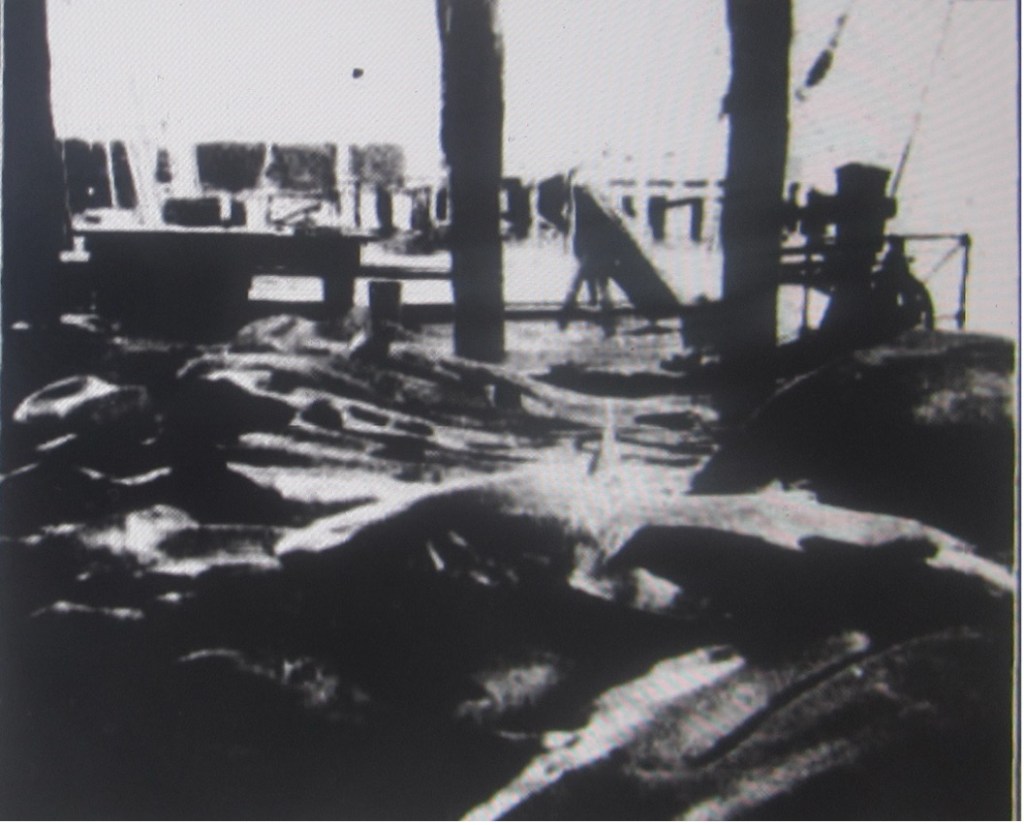
A morning’s haul of sharks at the dock.
Most of the sharks are drowned within a couple of hours of hitting the net, but some are still fighting when the boats come, and require careful and expert handling. We left Port Stephens soon after dawn on my first day with the shark-hunters. It was late winter then, and wind outside the heads was bitter, with a long roll outside and an ugly chop in the tide rip. …..
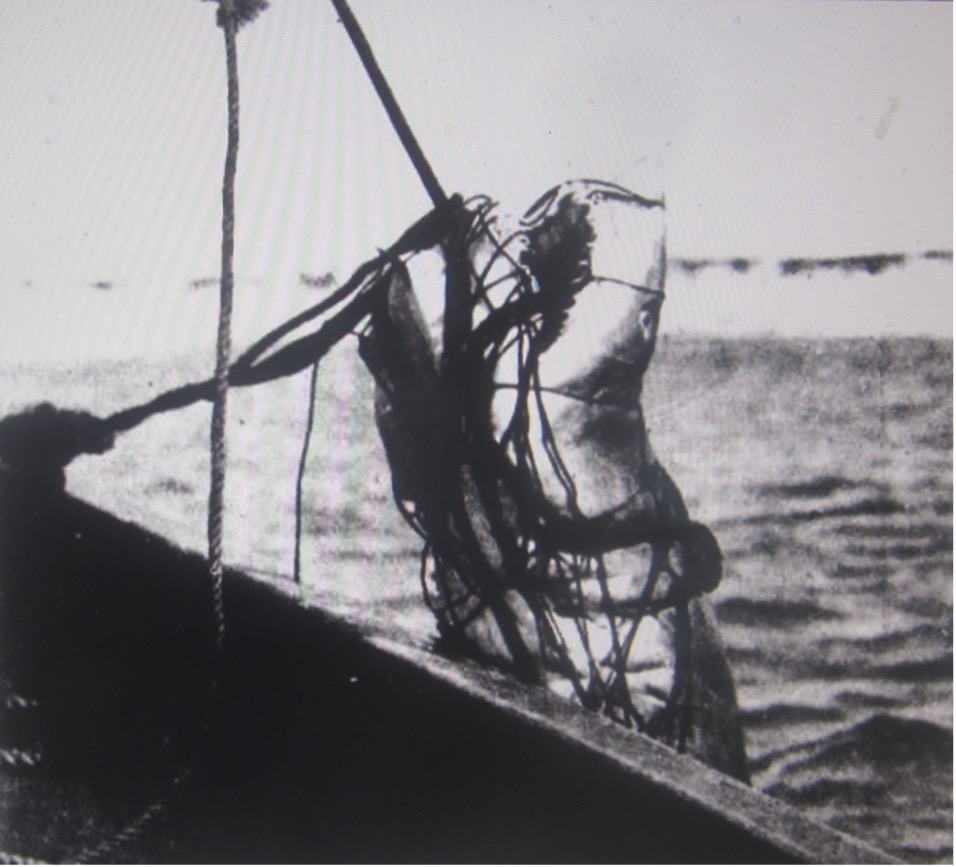
A grey nurse shark coming aboard the ‘Devil’
The first catch that day was a 9ft Grey Nurse, still living— an ugly creature, which fought its way to the boat inch by inch, snapping its great jaws and lashing the water with its tail. Once a flick of a shark’s tail sent a shower of water over the lens, putting the camera temporarily out of action. Blue sharks, Blue Pointers, Tiger, White, and Whaler sharks are among the species most abundantly met with at Port Stephens.

A big shark beside one of the boats employed at Port Stephens
With the coming of the warm weather big hauls have been made, the biggest number of sharks taken by one boat being 65. This record catch, taken from three nets, comprised a Tiger shark of 900lb weight, five White sharks weighing from 250lb to 500lb, a Grey Nurse, and 58 Whaler sharks. This haul turned the scale at over 16,000lb. Though line-fishing is not carried out at Port Stephens on a commercial basis, a Tiger shark of 1030lb weight and 14ft in length was secured after a battle-royal on a 2in. hook. One great Tiger — the biggest taken since fishing commenced — was 16 ft 6in in length, and, despite the wielding of the heavy club used for the despatch of the man-eaters, he steadfastly refused to die and had to be carried to the shore station alive, lashed down in the boat. …..
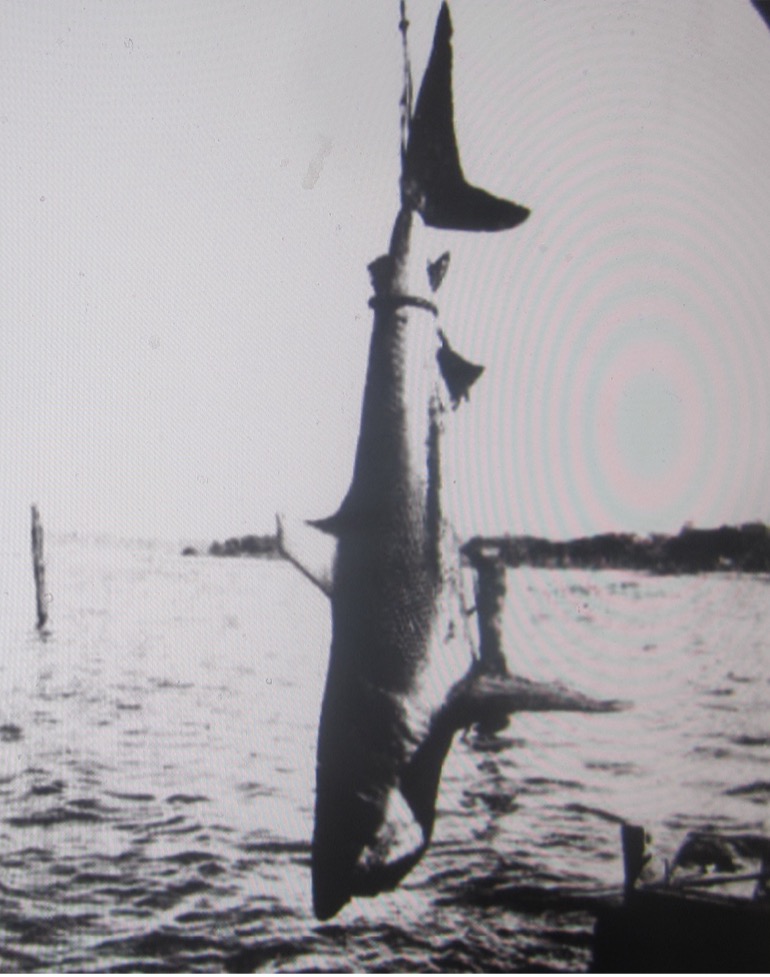
The record Tiger Shark
As each shark comes alongside he is clubbed to death if alive, and then secured by means of a hook, while a rope is fastened above the tail. The shark is then hauled aboard by means of a derrick attached to the mast. All the sharks at Port Stephens are treated at the shore station. For this purpose, the old trawling station has been secured and a plant erected here for the dehydration of the flesh. It is the boast of the shark-fisherman that nothing is wasted — not even the ‘grunt,’ since the shark, as far as is known, is silent. Immediately the creature is landed on the dock the fins are removed, dried, and treated. They are a valuable by-product and command a high price among Chinese gourmets.
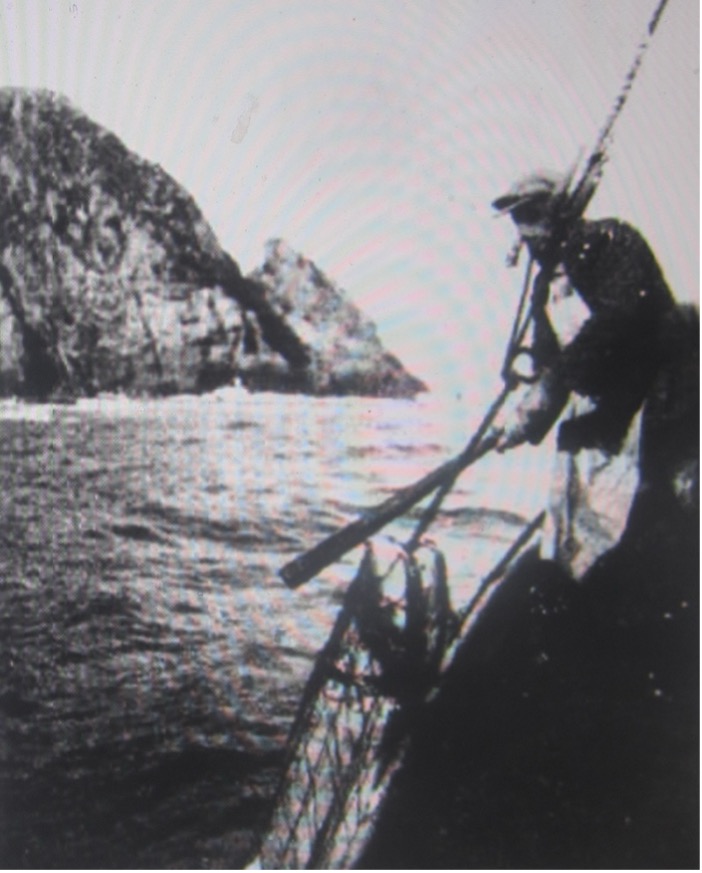
The club in action
The skin is then cut ready for stripping, the flaps clamped down, and the hide stripped off. Shark leather is in great demand for high-grade upholstery and for shoes and other purposes — a leather finer, stronger, more durable, and ornamental than any other hide. In the past the great difficulty has been the discovery of a process for the removal of the shagreen — the rough placoid scales of the shark, which are embedded in the skin. For a long time, the only satisfactory process known was a secret one.
The great lobed liver is always gorged and extended, and is next removed and placed in the extractor, where the oil is removed by super-heated steam circulating in the outer jacket of the drum. The extraction of the oil and the cutting up of the monster into attractive-looking fillets are carried out in the dock. The fillets are at once immersed in brine vats for some hours, to pass next to the dehydrating plant. Even the gall from the gall-bladder will be utilised [or the production of pigment]. The offal, too, will be converted into fish meal and fertiliser, while the teeth will be extracted and exported as trinkets to the islands of the Pacific. Shark oil is highly valued and commands a price of upwards of £50 per ton. …..
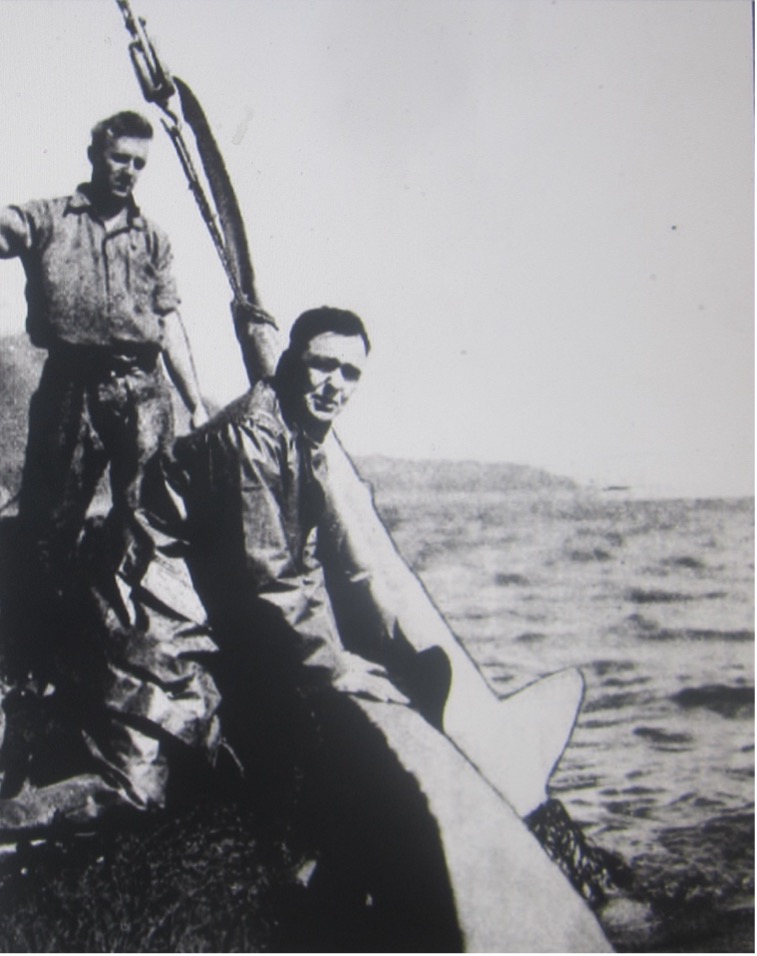
Captain Turner and the crew of the ‘Devil’ landing a shark off the heads at Port Stephens
So far, the greatest yield of oil from a single shark was 27 gallons — from the liver of a 14ft Tiger. The fillets of shark flesh can be cut, salted, dehydrated, and packed ready for the market within 36 hours of the shark’s capture. It is not intended to try to persuade Australians that shark meat is a delicacy, but to build up an export trade with China and Japan, Java, India, and Africa. …. It is a hard life, pioneering Australia’s newest industry, but it would be a difficult task to collect a finer and healthier body of men than the crew at Port Stephens. There are days when the swell rolls in from the ocean, when the working of the boats is a difficult and dangerous task, but it is rarely indeed that the nets cannot be picked up.
There is a glamour of adventure in this ‘sharking’ which cannot but appeal, and it stands in an almost unique position as the one sport in the world where there are no rules and no game laws, for, as far as one can tell, nobody has ever yet limited the bag or suggested a close season for the tigers of the sea.’
Factory Plant Moved to Broome for the Manufacture of Turtle Soup
The Sydney Morning Herald of 9 April 1928, page 6, reported:
‘Captain G. R. Turner, managing director of Marine Industries, Ltd., has announced that upon the removal of the company’s plant from Port Stephens at the end of the month to a position near Broome, it is intended to open up an industry new to Australia.
“We are going to can turtle soup,” said Captain Turner. “By installing a small canning plant we should be able to turn out from 3000 to 4000 cans of green turtle soup per week. The company has secured valuable concessions in the shape of three islands in the vicinity of Broome from the Government of Western Australia, and those are rich in green turtles, from which the famous soup is made. At the outset we believe we shall be able to dispose of our output locally, but later we intend to export to the East. For Java and the Far East, we are going to can lobsters, oysters, and dried fish.”
Prawns, he said, would also be treated for bottling, and, as be understood that an American company already sold quantities of bottled prawns in Australia, where the best prawns in the world could be obtained, the company expected to find a ready sale for an all-Australian product.
Captain Turner’s company is capitalised at £50,000 and was the first to start the manufacture of shark leather in Australia. With the assistance of the Government Technical Tanning School at Botany, the company has succeeded, after three months of experiment, in producing leather from the hides of sharks which is claimed to rival the best shark leather turned out by English and American factories. The operations at Port Stephens were successful.’
By April 1928 the shark processing factory had been closed. A major problem was that the Pindimar operation was land based. The company had been so successful in netting sharks in Port Stephens that supplies were depleted. Having only two boats the company found it impracticable to go further afield, and then bring their catch back to Pindimar. The company also conducted limited shark netting at Newcastle.
Strange Shark Products
During March 1929, Mr Norman Caldwell, the Manager of Marine Industries Limited attended a meeting at the Newcastle Council Chambers, to consider measures to combat the shark menace on the beaches of Newcastle.
The Newcastle Morning Herald and Miners’ Advocate of 21 March 1929, page 9, reported:
“An interesting address was given by Mr. Caldwell on the shark fishing industry. The boots he was wearing, and his handbag and wallet were made of shark skin.”
The Daily Telegraph of 28 August 1929, page 12 also reported:
“A comprehensive display of products obtained from sharks has been added to the exhibits at the Technological Museum. Leather from the tiger, grey nurse, whaler, and wobbegong varieties, shoes, handbags, oils, and shark fins are included in the display, arranged by Marine Industries Ltd., Port Stephens.”
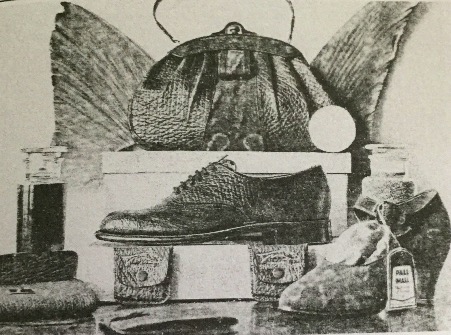
Display of the company products obtained from sharks
The World’s News of 15 May 1943, page 4, carried an extensive report of the harvesting of sharks for multiple product manufacture:
“At the outset there was English financial backing. But when, in 1927, Marine Industries, Ltd., set up its strange goods of trade at Pindimar, on the shores of Port Stephens, the company had Australian identity.
For the most part, the locals regarded the venture as either an insult or a stunt. To them sharks were bad publicity, and in any case there weren’t enough sharks in Port Stephens to justify all this new-fangled fuss. Said they!
Certainly, the pioneer shark-commercialisers were doing things in a big and a strange way. Overseas, their fellow-tradesmen used lines to catch shark. At Pindimar, Caldwell’s gang was using nets—nets 1000 leet long and 20 feet deep. They were the biggest ever used in Australia, and they were so rigged as to stand on the bottom like a fence. This also made net history.
Caldwell had reasoned it out thuswise: Sharks fed on the bottom. They had extremely small brains and very big livers. Also, they were short sighted. So it was likely they would barge into what seemed a fragile obstruction, rather than veer away. As results proved, this was sound reasoning. The First net, set overnight in Port Stephens, yielded 30 sharks, all whalers, ranging from 100 to 500lb. in weight.
The ensuing commercialisation was mainly murk and high odour. True, there was skill involved, especially in cutting the hides. But, obviously, not even his best friend ever told the shark; and after a gory dismemberment there was a boiling-down of the livers in a big steam-jacketed kettle. …
By the time the company had got into its stride, the shark (dead) had acquired new values. At first the fins were the main immediate source of revenue. There was a keen demand for them from China and Malaya. Dried, the pectoral and dorsal fins realised up to 3s per lb., and the lower lobe of the tail fin (which was a mass of gelatinous fibres, and which did not lose weight in drying) fetched up to 5s per lb. in China.
Everyone who has ever handled a shark’s hide knows it is rough and tough. The shagreen or denticles limited the commercial uses of the hide, until Marine Industries and the tanning experts evolved a method of getting rid of these impediments. Then the company had another and a hungry market. The leather trade paid 5s 3d a square foot for ordinary shark hide, and 10s a square foot for carpet shark hide, with its ornate arabesques.
There developed a demand for shark liver oil. Locally and overseas, the scientists had discovered splendid vitamin value in this odorless, colourless liquid.
The production of shark liver oil was also good news for the raisers of pigs and cattle. For, as done at Pindimar, the boiling-down of the livers was rather a crude process; there was a residue of liver and stearin. Again, at the instigation of the shark fisheries, the scientists got to work. On the recommendation of the latter a cattle fattener was made. It had the high protein value of 37.9. And the meal made from shark flesh was also found to be valuable as cattle feed.
Finally, practically every part of the shark, except the offal, was commercialised. Even the stomach bag was used—for the making of bags.
By this time dead shark was going into circulation as Chinese edibles, handbags, attache cases, boots, medicine, and as cattle food and fatteners.
To their own satisfaction, the shark fishers had proved that a shark of 250lb was of the same value as a porker of the same weight. And, to state the obvious, the shark did not involve the porcine expenses of fodder, care, and transportation.
But a 250lb shark was not a big fellow. The average weight of the big-shark family (such as tigers, whalers, whites, grey nurse and blue pointers) was 500lb. Caldwell has netted them up to a ton weight and 20 feet in length. Also, among the hearty eaters, there were some gigantic girths.
But it was the innards and not the contours that most interested the shark-fishers. “That is, in the oil “department.” A shark has two livers. You can imagine the happy smiles at the shark dock the day skilled knives repealed one bonny pair. 12 feet long and weighing 200lb. There was also mental pat on the back for a stout 13-foot tigress, deceased, whose litters yielded 18 gallons of oil.
Then, some 13 years ago, shark-liver oil was realising 2s 9d a gallon in Sydney. Now, according to the American advertisement quoted at the set, the oil is realising up to £30 a gallon!”

Shark Processing (diagram published by The World’s News of 15 May 1943)
Port Stephens Canning Company
The Newcastle Morning Herald and Miners’ Advocate of 18 May 1932, page 4, reported that:
“The Port Stephens Canning Company, Limited, with a capital of £2000, made up of 2000 £1 shares, has been registered in Sydney. The objects of the company are to carry on the business of preservers, packers, canners, and bottlers of oysters and other sea food products. The subscribers are Paul E. Royle, Albert B. Amess, Charles Bristly, Albert W. Deemar, Ernest N. Dewar, James C. Donaldson, and Raymond A. M. Allen. The registered office of the company is at Pindimar, Port Stephens.”
Further operational information was provided by The Macleay Argus of 22 July 1932, page 4:
“Oyster canning has begun in Port Stephens with favourable prospects. The headquarters are at Pindimar. At present the company is putting up the oysters in bottles, so that the public can see the article they are buying. The canned article will appear later.”
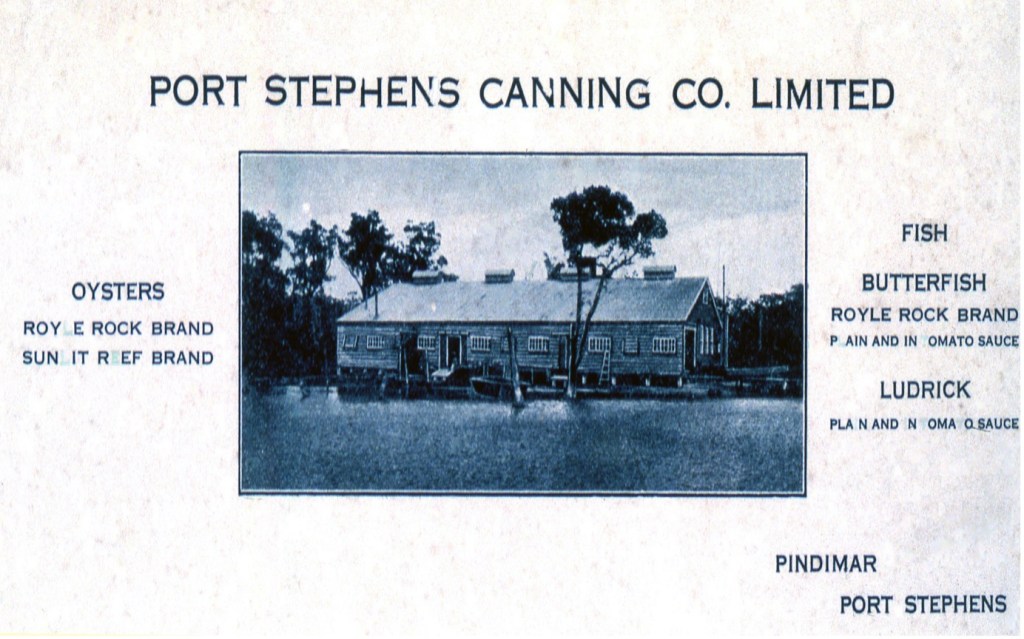
Advertisement for the produce of Port Stephen’s Canning Company, Limited
Company Operations Growing
The Dungog Chronicle of 24 March 1933, page 4, reported:
“The fish canning and oyster bottling industry at Pindimar, Port Stephens is growing rapidly. The Company is producing such an attractive article that it cannot keep pace with the demand. Not only is the quality right but the price is most reasonable.
Last week we met Mr. Royal, the Manager, and he presented us with a tin of fish. When sampled we found that it was equal to the best of the other brands and better than most. The bottled oysters, which we had previously used, and will still continue to do so, are one hundred per cent better than the American article. Royle Brand tinned fish is treated under the most ideal conditions. The cleaning, washing, etc., it done at the end of the long jetty at Pindimar in the swishing tidal waters and the fish is conveyed on ice straight to the factory at the other end of the jetty where the treatment, canning, labelling, etc., is carried out. The public are asked to patronise Port Stephens tinned fish and bottle oysters, not only because they are the best and the cheapest, but because it will be helping a local industry.”
Tragic End to the Canning Factory
The end of all fish processing at Pindimar, which commenced during 1917, came to a sudden end 20 years later, when on the night of 31 December 1937, the factory premises burnt down.
The Maitland Daily Mercury of 1 January 1938, page 2, reported on the circumstances:
“Damage to the extent of many thousands of pounds was caused by fire which gutted the premises of the Pindimar Canning Factory and Ice Coy., at Port Stephens. The outbreak occurred in the early hours of yesterday morning and was still smouldering today while police kept guard.
With no fire brigade and few persons to assist in efforts to overcome the blaze, the flames quickly established control and further attempts to quell them were useless. The building burnt fiercely, while the explosions of tins of canned fish and oysters could be heard for some distance. Even today, tins were still exploding, and little will be saved from the fire. It is understood that the building and contents were insured, but to what extent, is not known. Erected in 1917 and opened on November 21 of that year, the factory, which, cost £12,000 to construct, was the beginning of an industry which was the standby of the district, and by the disaster, fishermen of the locality will suffer a serious loss. The outbreak occurred in the “off-season,” when supplies to the factory are much lighter than at other times of the year, and but for that, at least portion of the building and contents may have been saved, for there would have been some to fight the blaze. As it was, only the manager of the factory and the manager of the ice-works are in attendance at this time of the year, and when the outbreak occurred there was no one on the premises to sound the alarm.
The fire was discovered by the manager of the factory (Mr. F. A. Lyle), who lives within a stone-throw of the building. He was awakened by the roar of the flames and the sound of exploding tins of fish, and when he looked out towards the factory, the flames were shooting through the roof. He sounded the alarm and endeavoured to raise a band to fight the outbreak, for there was no fire alarm, but he was unsuccessful, for most of the people who reside in the locality were away. It was impossible to save the premises, and Mr. Lyle and others had to stand by and watch the building being gutted. In addition to the building, the whole of the extensive stock, much of which was being held at reserve, was destroyed, and the valuable canning machinery was damaged almost beyond repair.”
The canning factory at Pindimar never reopened. The Port Stephens Canning Company Limited was placed into Liquidation in May 1938.
Concluding Comments
Few traces of the commercial fish processing operations at Pindimar remain today, following the collapse of the North Pindimar wharf in about 1970.
The following photos show some of the current remains at the site:
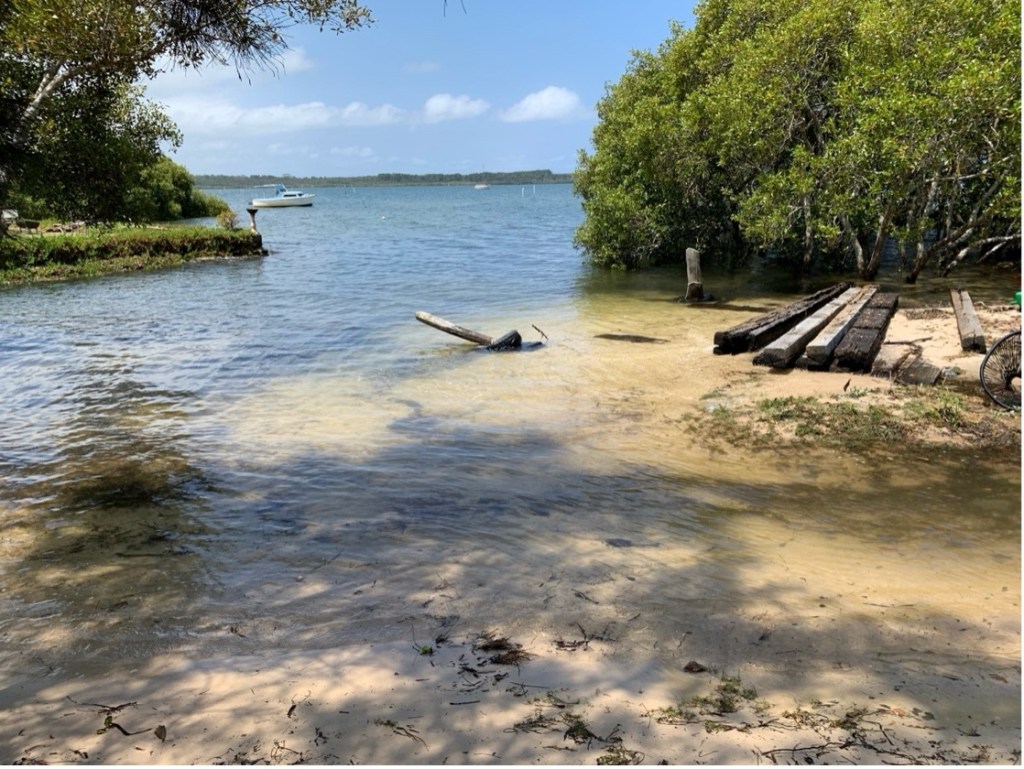
Location of the site looking out to Pindimar Bay [Author photo]
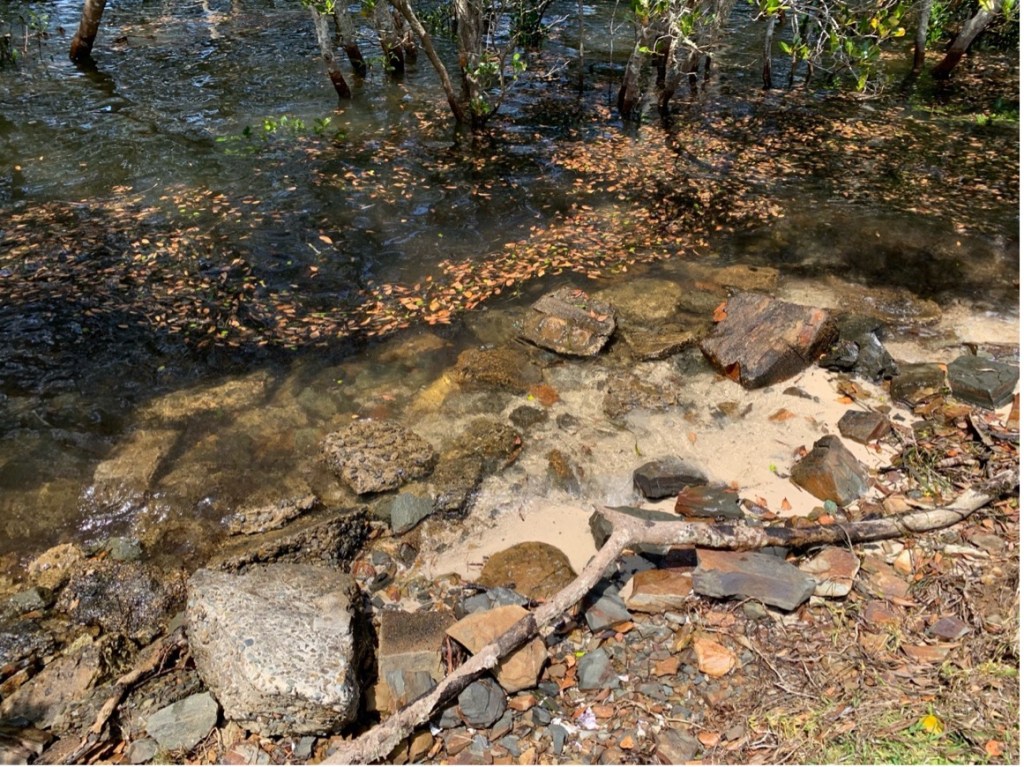
Rubble remains of probable building foundations [Author photo]
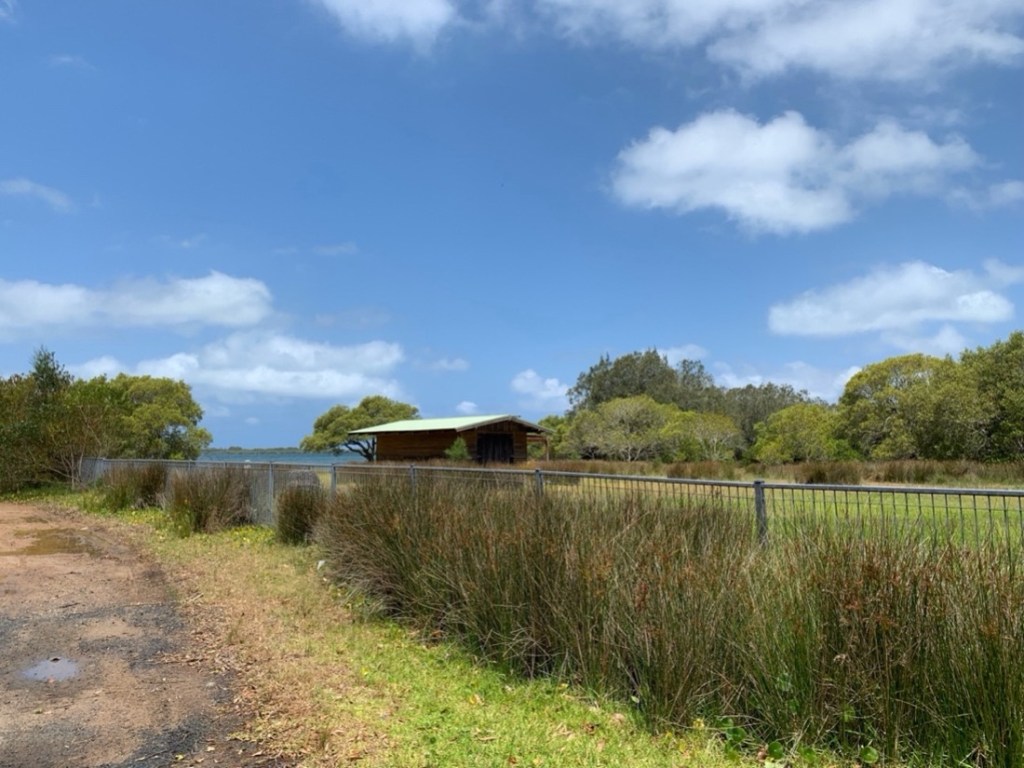
Site now fenced off looking towards Pindimar Bay [Author photo]
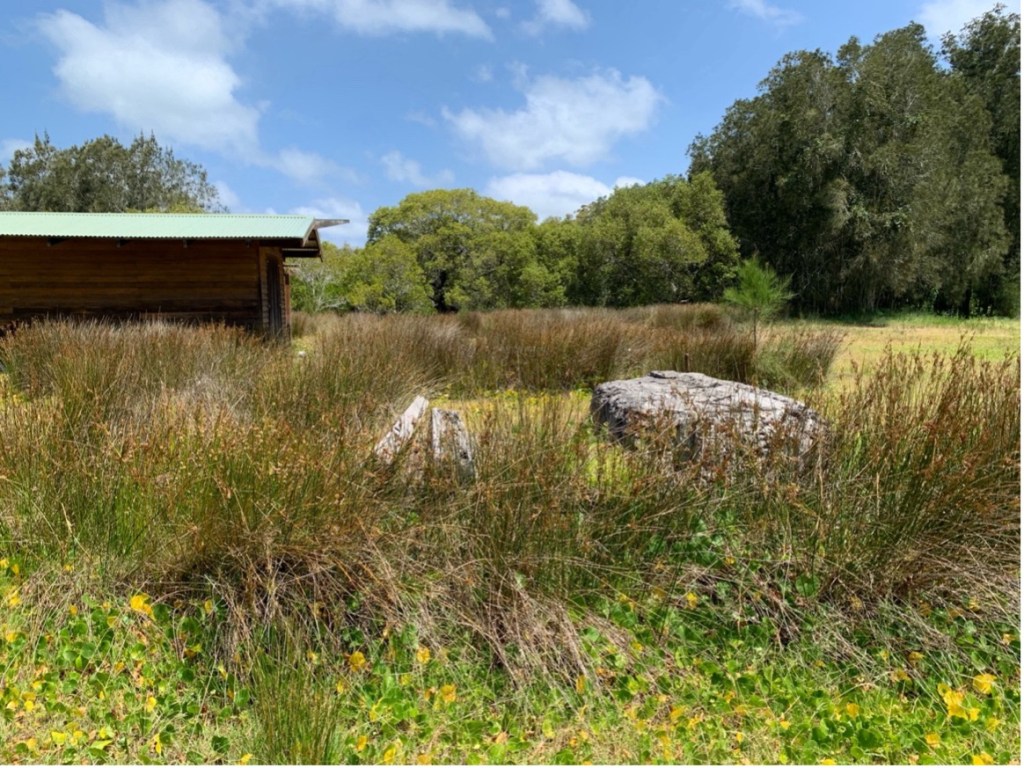
On site concrete remains of a building [Author photo]
Researched and compiled by Kevin McGuinness
March 2022

 Port Stephens - a history exploration