
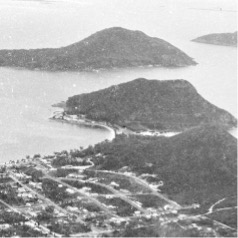
Introduction
From 1860’s, Captain Thomas Kehoe was the master of several large sailing vessels which sailed the waters of the east coast of Australia, and regional overseas ports.
He was the master of seven ships, six of which he owned, which were wrecked along the New South Wales coast between 1869 and 1898. Three of these vessels were wrecked on the North Head of Port Stephens.
In his early sailing career, Kehoe was the master of ships owned by other parties, but in later years he became both the owner and master of his own sailing ships. They mainly carried coal from Newcastle and Wollongong to overseas and Australian ports. To maximise his financial returns, Kehoe sometimes purchased the coal himself and transported it to his own customers.
A study of his seven ship-wrecking experiences casts light on the dangers of the sea-faring profession he embraced. He had no engines to get him out a difficult spot, or radios to help him receive advice on treacherous sea conditions.
Despite his persistent problems with sea wrecks, he was seemingly regarded as a competent sailor and Captain, having over 35 years’ experience. Perhaps his judgement at times could have been questioned.
In this paper, the circumstances of the wreckages of the seven ships are examined, as sourced from various newspaper reports. Many of these use nautical terms, which have been retained and preserve the maritime language of the time.
Of particular interest are the three ships which were wrecked on the North Head of Port Stephens, over a two period in 1885 -1886. It is likely many tons of coal would have been deposited at the entrance to the Port Stephens harbour as a result.
The list of the seven shipwrecks, in chronological order, are as follows:
1. Caroline – Wrecked on 12 February 1869 at Brisbane Water
The Caroline was a barque that was built at MacDonald River, New South Wales, in 1847, and measured 29 gross tons and 14m in length. She was wrecked on 12 February 1869 when she became stranded at the west spit bar at Brisbane Water, while sailing from Sydney to Newcastle. She was mastered and owned by Captain Thomas Kehoe.
The Maitland Mercury and Hunter River General Advertiser of 20 February 1869, page 4, reported:
“This vessel left Sydney on the 12th instant, bound for Newcastle in ballast, with a moderate S.W. wind. When off Broken Bay it increased to a gale, the master, Captain Kehoe, seeing every indication of heavy weather, and fearing he would not be able to reach Newcastle before dark, made for Broken Bay, and hauled his wind for that purpose, but not being able to fetch safe anchorage with the ebb tide, made for Brisbane Water. It was then blowing so hard that not sufficient sail could be carried to keep to windward until the flood made, and as she kept drifting on a lee shore he ran her for the bar, and in going over she struck aft in the hollow of the sea, and broached to on the West Spit; a kedge was let go, and endeavours made to get the bower anchor out, but the sea was too high for the boat to live. The vessel bumped heavily as the flood made, the waves making a clean breach over her. As the sea and weather were increasing in force, the crew left her for the night at 7 p.m. Up to that time she was making but little water. Watch was kept all night for fear she should break up, so as to save anything that might come on shore. At daylight on the 13th found the vessel was bilged, but the spars were standing. When the crew left on the 15th the craft was breaking up, but the spars and gear were hanging to the wreck.”
2. Atlantic – Wrecked in September 1878 at Trial Bay
The Atlantic was a wooden barque of 260 tons, registered in Sydney. She was beached at Trial Bay in September 1878. She was mastered and owned by Thomas Kehoe.
The Sydney Morning Herald of 25 September 1878 page 4, reported on the Marine Board inquiry into the circumstances leading to the beaching of the Atlantic:
“She was on a voyage from Newcastle bound to Maryborough, with 250 tons of coal on board, and commenced to leak, so badly in a N. W. gale as to oblige the master to take shelter in Trial Bay. After remaining here some time at anchor it was found necessary to beach her, as the crew were unable to keep the leak under. Although the vessel was run on shore on a sandy beach, she soon became a total wreck. The Board decided that no evidence had been adduced upon which to found a charge of default against the master.”
All the crew were saved.
3. Heather Bell – Wrecked on 27 November 1880 at Cape Hawke
The Heather Bell, was a wooden brig of 188 tons, built in Great Britain and registered in Sydney. On 27 November 1880, she foundered off Crowdy Head, NSW and was lost four nautical miles south of Cape Hawke. Thomas Kehoe was the owner and master.
A report on the evidence given by Captain Kehoe to the of the Marine Board inquiry into the wrecking of the Heather Bell, appeared in the Sydney Daily Telegraph of 8 December 1880, page 7:
“[The Heather Bell] took 200 tons of coal from Newcastle and discharged six tons at Cape Hawke. [He] intended discharging nine tons, but the wind came on and he had to clear out. The vessel commenced to leak as soon as he got off Crowdy Bay. She was leaking when she left Newcastle, but he did not sound the pumps. Kept them going now and again but did not consider her a leaky vessel. After they had been one hour out they pumped her and she sucked. …..When he got to Cape Hawke the wind lay south-west, and he went in there to lighten the ship of six tons, which he threw overboard : then the wind coming in from the east, he cleared out; the wind veering from east to south-east, the vessel would not lay her course. She was put about, and then stood E.N.E, off the land. The mate came up from below while he was at the wheel and asked him to go below to have a look. He found the water coming in in great force, as if a stern butt bad been started in a line with the lazarette under the cabin door. Called all hands and pumped for half an hour when there was 6 feel forward.
Got the boats out as he found the leak was gaining fast, and the vessel was settling down. About 20 minutes after he left her saw the vessel disappear. Landed at Cape Hawke. There was about 7 feet of water in the vessel when he left her. Knew she was in a bad way when be went away. The coals belonged to himself, and were insured. In cross-examination the captain said he had been in the vessel since 21st October 1879. She carried 160 tons over her ballast. Had been before the board before when the barque Atlantic was beached at Trial Bay. Thomas Dredge, the mate of the vessel, corroborated the evidence of the captain, as did the second mate and an A.B. seaman, who all agreed that they considered the Heather Bell seaworthy.”
The Board’s decision was reserved and not published.
4. Stag – Wrecked on 27 January 1885 off North Head Port Stephens.
The Stag was a barque of 307 tons, and was built in Halifax, Nova Scotia in 1865. She was engaged for some time in the trade between Auckland and Newcastle and lately purchased by Thomas Kehoe.
She was lost off the North Head of Port Stephens on 27 January 1885, being Captain Kehoe’s first shipwreck in the area.
The Daily Telegraph of 29 January 1885, page 5, reported on the wreck:
“The barque Stag, belonging to this port [Newcastle], has been wrecked on the rocks to the south-ward of the north head of Port Stephens. The first information came to the Marine Board, and was to the effect that she had gone ashore on Tuesday, and was full of water, the seas making a clean beach over her. A later telegram, however, received by Messrs J. and A. Brown from the captain, stated that she was a total wreck, and that the vessel had broken in pieces. All hands have been saved. The Stag left Newcastle on the 24th instant, with 150 tons of coal for Cleveland Bay, Queensland, and it is conjectured that she may have been making for Nelson’s Bay to take shelter from the southerly gale when she met her fate. Strange to say, a few days ago she had a narrow escape from going ashore in the vicinity of Cape Three Point, and had to return to Newcastle to obtain another anchor, her own having been lost.”
When Captain Kehoe returned to Sydney, the Newcastle Morning Herald and Miners’ Advocate of 2 February 1885, page 2, reported:
“Captain Thomas Kehoe, of the barque Stag, which was wrecked at Port Stephens, arrived at Sydney on Friday, and made the following statement with regard to the loss of the vessel, of which he was both commander and owner:— The Stag was a wooden vessel, barque rigged, of 307 tons net register, and was built in Nova Scotia in 1865. She was well found, and in good order. On January 24th instant at 9 a.m. she left Newcastle, under charter to the A.S.N. Company, with 450 tons of coal for Townsville, and had southerly winds till near Port Stephens, where the wind died away to calm. At 2 o’clock next afternoon a strong N.E. breeze sprang up, and Captain Kehoe thereupon headed his vessel for Port Stephens, and she reached the anchorage in safety, remaining there till the morning of the 27th, at half-past 7 o’clock, when she got under way again. The wind at starting was southerly, but as the vessel approached the Heads it went roundmade to wear her, but she would not wear; and an anchor was let go in order to prevent her from going ashore. She at once began to drag, however, and was in a short space of time on the rocks under the north head of Nelson’s Bay. The sea began to rise, and the result was that the Stag became a total wreck.”
The Marine Board inquired into the wreck. The Daily Telegraph of 10 February 1885, page 6, reported on the decision:
“The decision of the Board was that the Stag was lost in consequence of “missing stays” [tacks] during a heavy squall from the south-east, which headed her, and prevented her fetching out of the port, and that no evidence had been adduced upon which to ground a charge of default against the master, Captain Kehoe.”
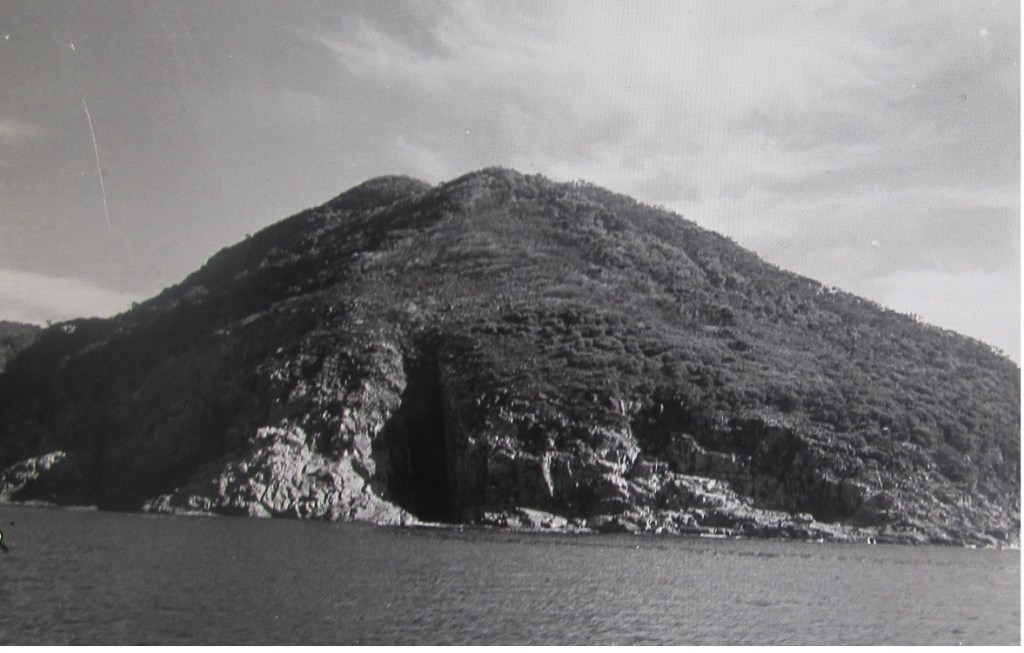
Yacabba, the North Head of Port Stephens, where three of Captain Kehoe’s ships were wrecked, spilling coal into the surrounding waters.
5. Fanny – Wrecked on 18 April 1885 off North Head Port Stephens
Two months after the sinking of the Stag, Captain Kehoe lost another of his ships, the Fanny. She was a brigantineof 164 tons and was wrecked on the North Head of Port Stephens on 18 April 1885.
The Evening News of 20 April 1885, page 4, reported:
“The strong southerly gale which has prevailed along the coast during the past few days continued throughout yesterday, and occasionally blew in fierce squalls during the night and early this morning, accompanied by a downpour of rain. ……
The only casualty as yet reported is from Port Stephens, where it is stated that the Fanny, schooner, a wooden vessel of 164 tons, lately in the coal trade, Newcastle to Sydney, has gone ashore there, and is high, and dry. Her crew, however, all safe. The vessel is owned by Captain Thomas Kehoe, late master of the Stag.”
The same newspaper of 5 May 1885, page 5 reported on the Marine Board inquiry into the wreck:
“In the matter of the loss of the ketch Fanny, the Board found that she had gone ashore during heavy weather, and that Captain Thomas Kehoe had done everything in his power to prevent the loss of his vessel. There was, therefore, no evidence on which a charge of default could be found against the master.”
6. Emperor – Wrecked on 30 March 1886 off North Head Port Stephens
And so for a third time, Captain Kehoe loses his latest vessel, the Emperor, which is also wrecked in the same vicinity of Port Stephens.
The Emperor was a wooden brig of 295 tons being built in Great Britain in 1868 and registered to Captain Kehoe in Sydney.
The Globe of 2 April 1886, page 3, reports on the wreck, and also noted that Captain Kehoe had lost three vessels within the last two years:
“News came to hand last night, on arrival of the coasting steamer Kingsley from Port Stephens, that the brig Emperor had gone ashore on the North Head yesterday morning, and was likely to become a total wreck. Captain Dalton, of that steamer, states that she drifted on to the rocks and had a hole knocked in her bow. When he left Port Stephens the Emperor was nearly full of water, and should any rough weather prevail she will no doubt fall to pieces. The wind is reported as having fallen light, when the vessel was off the North Head and Captain Kehoe not being able to weather the land, she drifted on the rocks where she now lies. The Emperer has been trading in these waters almost ever since she was built, and took her departure from this port on the 24th instant with 40 tons of Duckenfield coals for Dungeness (Queensland). She was the property of the master, Captain Kehoe, who only purchased her about seven months ago, and was a tight little craft of 284 tons register, formerly owned by Captain Cleary, who died while in Queensland with the vessel. …. Captain Kehoe has been very unfortunate with his vessels, having lost three within about the last two years, viz, the Stag (barque), Fanny (schooner), and now the Emperor, all of which he was the solo owner.”
The Newcastle Morning Herald and Miners’ Advocate of 8 April 1886, page 7, reported on the Marine Board of Inquiry into the wreck, which also noted that Captain Kehoe had lost three vessels at Port Stephens:
“An inquiry was held into the circumstances attending the loss of the brig Emperor. Thomas Kehoe, master of the brig when she was lost, deposed that the brig was 284 tons, registered at Sydney. Was on a voyage from Newcastle to Dungeness, in Queensland, and was insured. Had 455 tons of coal and 58 tons of ballast on board. Left Newcastle on March 24. In the morning wind N.N.W., and fine; the wind altered to north-east at about noon. Held until about midnight, and kept on until abreast of Port Stephens, next day. The weather looking dirty, ran in for the night, and remained there until the morning of the 30th. Coming out between the heads the wind got to the south-east, and she missed stays [tacks]. Backed her off and filled on her. Had all sail on her except topgallant sail and mainsail. Water smooth, but with a roll coming in. Tried to wear her, but found she would not clear the heads, and gave orders to lower the anchor.
The port anchor was let go, but she struck on the rock before the anchor took the ground. There was 5ft of water. She struck inside the North Head, just off the Yellow Patch. The ebb tide slewed her in. Ran a Kedge out, hove her tight, got the long boat out, and got the bow anchor out into position in about 15 fathoms. Hove her chain taut, and tried to get her off, but without avail, and she became a total wreck. The vessel was full of water when witness left her with a man in charge. She was breaking up fast. The vessel was well found, and no one was lost or injured. By the President: This was the third vessel the witness had lost at Port Stephens. …. Andrew England, mate of the lost brig Emperor, corroborated the evidence of the master as to the shifting of the wind after leaving Newcastle; the wind was north-east when making for Port Stephens, but not much sea on. During the night the weather was bad, but it was fine next morning. On going away in the morning there was a fresh southerly wind with a swell on. Had topsails, fore-sail, jib, and trysail on her going out of the heads.
Had been in Port Stephens twice before. Always understood channel was very narrow and that we could not stand out farther. Brought up outside Nelson’s Head. The vessel would not stay owing to the strong tide. There was not much room for her to stay. Witness further corroborated the sending out the anchors, paying from the chain. When she struck the road there were 17in of water in the hold, and water still rushing in. George Master, second mate of the Emperor, corroborated the evidence of the master as to her missing stays in the heavy current, and he could not take her off fast enough to clear the shore. She would not wear owing to the current being too strong for the wind. Captain Kehoe did all in his power to try and save the vessel. We tried to box the vessel off before wearing her. Robert Swan, seamen, gave corroborative evidence.
The board, after deliberation, found that the vessel was lost through the wrongful act or default of the master in not having sufficient sails set to stay the vessel in narrow waters, and in not letting go the anchor at the proper time. It therefore cited him to appear before it at 2 p.m., on Monday next to show cause why his certificate should not be suspended or cancelled”
Thomas Kehoe duly appeared before the Marine Board on Monday 12 April 1886. He gave further evidence, as per the Sydney Moring Herald, 13 April 1886, page 6, stating:
“ The vessels he had previously lost were his own property. The same person had assisted him in buying them all, and he had never been charged with default. He had 25 years’ experience as a master. He had the men at their posts, and he believed that if his orders to drop anchor had been properly attended to the brig would not have been wrecked.”
The Board however decided to suspend the master’s certificate for a period of six months.
7. Malcolm – Wrecked on 13 February 1898 off Bulli. Captain Kehoe and his crew go down with the ship.
Captain Kehoe’s luck in surviving shipwrecks came to an end on the night of Sunday 13 February 1898.
On that fateful day, two ships carrying coal left Wollongong bound for Sydney. One, the Amy, a brig commanded by Captain James McKee and the other, the Malcolm, in the charge of Captain Thomas Kehoe.
The Malcolm was a brigantine of 182 tons built in Tasmania in 1862 and registered in Sydney in 1882. It was owned by Mr Bernard Byrnes who was a coal merchant.
Shortly after leaving Wollongong within an hour or so of each other in daylight hours, the ships ran into a thick gale resulting in the loss of both boats and their crews during the night. The Amy was wrecked off Thirroul Beach with the loss of seven lives. Around the same time, the Malcolm foundered near Bulli with the loss of six lives. It was believed that she hit a reef in the vicinity of the Bulli wharf.
The Evening News of 15 February 1898, page 6, reported on the loss of the Malcolm:
“The latest reports respecting the foundering of the Malcolm show that the schooner went down opposite the Bulli Jetty during the night. A telegram has also been received stating that a mast, apparently without rigging, and which was supposed to be part of the Malcolm, was …. some 200 yards north of the inward buoy. … The Malcolm left Sydney on Friday night for Wollongong, with Captain Kehoe in command, and a crew of five, including the cook. She arrived at her destination on Saturday morning at 7 o’clock. The return journey was begun at 8 o’clock on Sunday morning, and it is believed that she carried about 250 tons of coal. It is surmised that when a short distance from Bulli she was over taken by the gale, and, as a result of the heavy seas which washed over her, foundered. The schooner, which was the property of Mr. Bernard Byrnes, had been under the command of Captain Kehoe about six months. The captain was considered an excellent navigator, and had previously been in charge of the Stag, the Neptune, and the John Knox…… The Malcolm was a schooner of 182 tons, and employed as collier. She was 152ft 2in long, 23ft 5in beam, and 12ft 5in depth of hold. She was built at Prince Edward Island in 1862, and was registered in Sydney in 1882.”
The Sydney Morning Herald of 17 February 1898, page 5, reported on the wisdom of setting out from Wollongong in the prevailing weather:
“A party went out in a boat to-day with the object of finding out whether the sunken vessel off the Bulli jetty is the Malcolm. They succeeded in making fast to the mast, which projects some feet out of the water, but they have not yet been able to discover definitely the name of the vessel, though there is no doubt that it is the Malcolm. Wreckage supposed to be from that vessel was picked up on the coast this afternoon. ….An impression exists in some quarters that the captains of the Amy and Malcolm exhibited foolhardiness or want of seamanship in leaving the port of Wollongong on Sunday morning. This is not the case, for Captain Thompson, the pilot at this station, states that when the vessels left there was a nice, fair wind and only a moderate sea on, though it showed signs of rising, and there was absolutely nothing to indicate that a severe storm would shortly spring up. No man would have hesitated to put out to sea under such conditions, and the suddenness with which the gales sprang up was a most unusual experience.”
The Daily Telegraph of 22 March 1898, page 7, reported on the Marine Board inquiry:
“The Board …. opened an inquiry yesterday concerning the loss of the brigantine Malcolm, which occurred in the same storm which caused the stranding of the Amy. The Malcolm foundered with all hands off Bulli. Evidence to the effect that the vessel was thoroughly sound was given by Pilot Thompson (of Wollongong) and Captain Banks, and it was also stated that the Malcolm left Wollongong with a smaller load of coal than usual. The manager for the owner, Mr B. Byrnes, was examined, and stated that the vessel was in good repair, and when anything was wanted on her it was always supplied without stint. The vessel was well found in every way.”
The Australian Star of 14 April 1898, page 6, reported on the finding of the Marine Board in respect of the missing brigantine, Malcolm:
“The board report that the said vessel sailed from the port of Wollongong, bound to Sydney, on February 13 last, apparently in very good condition, with 25 tons of coal short of her ordinary cargo, but was never afterwards seen. An exceptionally severe easterly gale prevailed along the coast after the vessel’s departure.”
Prior to his fatal 1898 shipwreck, no other lives had been lost in the ships under his command.
At the time of his death, Thomas Kehoe was a married man who resided in Redfern, in Sydney and had several children.
Additional information on shipwrecks in the Port Stephens region is published on this website and can be viewed at the following links:
A History of 110 Shipwrecks at Port Stephens 1800 – 1950
Shipwrecks Inside Port Stephens 1869 – 1950
Morna Point – A Graveyard of Shipwrecks
Wreck of SS Macleay near Port Stephens – October 1911
Wreck of SS Florence Irving at Point Stephens – 1877
Foundering of SS Oakland off Cabbage Tree Island – 1903
Wreck of SS Pappinbarra at Port Stephens – 1929
Wreck of SS Uralla Near Birubi Beach Port Stephens – 1928
Wreck of HMAS Psyche in Port Stephens – 1924
Wreck of the Cora Lynn off Port Stephens – 1914
Postscript
A monument was unveiled on 23 November 1898 at Thirroul, to the memory of those who lost their life on the Amy.
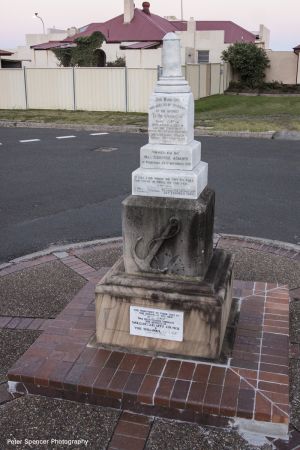
`Thirroul Monument for the Amy`
A final memorial for Captain Thomas Kehoe appeared in the Sydney Morning Herald, of 13 February 1899, with the publication of the following ‘In Memoriam’ notice on the first anniversary of this death:
“KEHOE. — In sad but loving remembrance of my dear husband and father, Captain Thomas Kehoe, who was accidentally drowned in the schooner Malcolm on February 13, 1898, in his 58th year. Gone but not forgotten.”
Researched and compiled by Kevin McGuinness
January 2022

 Port Stephens - a history exploration