
Introduction
On 8 March 1954, a military training tragedy occurred in waters off Port Stephens, along the Stockton Bight.
A convoy of 19 amphibious army vehicles, carrying 184 military personnel, had set off from Horseshoe Beach at Newcastle, near the Shortland Military Camp, bound for military exercises at Broughton Island.
At around 2 am on 8 March, a strong squall developed off Stockton Bight and some one hundred men were thrown into the sea.
Three were drowned, namely, Corporal Noel Lawrence Moran; Trooper Michael Mornement; and Trooper Robert Allan Blackie.
A further 10 personnel were admitted to RAAF Hospital at Williamtown and 5 to Royal Newcastle Hospital. Eight of the amphibious vehicles sunk.
The tragedy attracted much newspaper attention and was also subject to a military Court of Enquiry and a Coroners Enquiry. This paper looks at some of the newspaper articles and associated photos that were published on the event.
Reports on the Tragedy
The Newcastle Sun of 8 March 1954, page 1, reported on the tragedy:
‘Three soldiers were drowned when heavy seas swamped nine of a convoy of amphibious Army vehicles between Stockton and Port Stephens in darkness early this morning. Two men are still missing.
Two of the drowned men have been identified. One man is critically injured in Newcastle Hospital with a crushed back. Ten others in Newcastle Hospital with shock and immersion. Names of the dead are being withheld until next of kin have been notified.
Details of the tragedy were given by the Eastern Command headquarters official spokesman. The dead men were members of the 15th Northern Rivers Lancers and 16 Coy. R.A.A.S.C. [Royal Australian Army Service Corps], who were in camp with the 1st Armoured Brigade at Port Stephens. The amphibious vehicles were on an exercise several miles off the coastline. They were working in total darkness, although they had radio contact.
At 2 a.m., according to the official Army report, the vehicles ran into “extremely rough seas.” Several of the vehicles were swamped and their crews left floundering in the darkness. Other vehicles sped to their aid but were also swamped by the heavy seas.
The officer commanding the camp made an urgent appeal to members of Stockton Surf Lifesaving Club, who turned out and assisted in the rescue work. Bodies of the dead men were recovered up to 10 miles from where their vehicles foundered. Lt.-Col. J. S. Anderson of Eastern Command Headquarters and an emergency staff rushed north to Port Stephens to take personal charge of rescue and search operations and to commence a preliminary investigation. The drowned troops are believed to be members of the Citizen Military Forces, including National Servicemen. All the men are understood to be under 22 years of age.
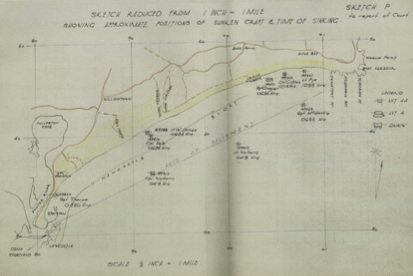
Diagram prepared for the Army Committee of Inquiry depicting approximate positions of sunken craft stretching from Morna Point, Port Stephens, and down the Stockton Bight [National Archives of Australia, MT1131/1, A251/3/56]
An Army spokesman said in Newcastle this afternoon that with the exception of those drowned almost the entire personnel of the regiment and the company had been accounted for and were on the beaches between Morna Point and Cemetery Point [Birubi Point]. They had been fed and reclothed and would be returned to Newcastle as soon as possible. The spokesman said that at the moment the position was still rather obscure. There were tremendous seas running off the coast and this was making it difficult to get a clear idea of what was going on. A search boat had left Newcastle to see if it could locate any of those still missing.
The first tank sank when off the coast behind the Stockton Mental Hospital. Two of the men drowned are believed to have been lost before rescue launches could reach the scene. As the survivors struggled in the water they were located by the launch crews who swept their flashlights over the boiling sea. The men struggling in the water were handicapped by heavy clothing but a number of them managed to inflate their lifejackets and remain afloat until hauled aboard the rescue launches. It was an amazing scene as men battled the rough seas for their lives until they were picked up by the criss-cross of lights which played about them.
When the second duck broke down it was taken in tow by a launch which started the return journey to Newcastle. The tow rope broke several times before the duck finally sank when nearing the harbor. Nobody was on board when it went down. The Stockton Surf Club members who rescued five men unable to get ashore in the huge seas were F. Littlewood, B. Jones, H. Rowlatt, W. Arthur and C. Whyte. They were summoned from their beds shortly after 5 o’clock this morning to make the hurried dash by truck to the beach where some of the men were still floating in the dangerous surf. They took with them reels and lines and an Eve Rocker and blankets from the Stockton clubhouse. After a messenger in a truck had managed to locate Littlewood’s home, Littlewood sent a message to the other club members to follow on and he accompanied the truck driver to a spot on the beach just north of the Stockton Mental Home, where he saw one of the soldiers being supported about 30 yards out by a companion. The soldier, a sergeant, was unconscious. He had been clinging to a kapok pillow which had been washed away and his companion who had managed to reach the shore saw his plight and swam back to assist him. However, he could not manage to regain the shore until Littlewood arrived.
By this time the other members of the surf club had arrived and they were then transferred to a spot about 10 miles north of Stockton where there were about 20 soldiers on the beach and four more floating beyond the breakers at distances up to 100 yards out. Rowlatt and Whyte swam out to a 16-stone soldier, who was clinging to a kapok pillow as his Mae West jacket would not inflate. Jones swam out in the belt and brought the soldier to shore. Jones, accompanied by W. Arthur, went out again about 75 yards to bring in the second man. Littlewood and Rowlatt got the third man and Jones and Whyte then rescued the fourth soldier, who was about 30 yards out. All the soldiers, who were clad in army uniforms and greatcoats, were exhausted when they were brought to the shore. The five surf club members applied resuscitation and then wrapped the men in blankets before they were taken on to waiting ambulances. ……….
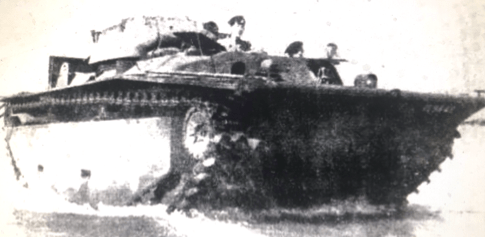
Northern Rivers Lancers testing one of the tanks for the long sea trip to Broughton Island
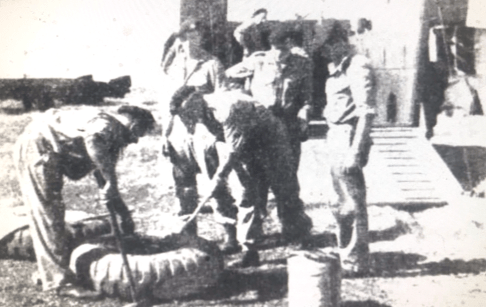
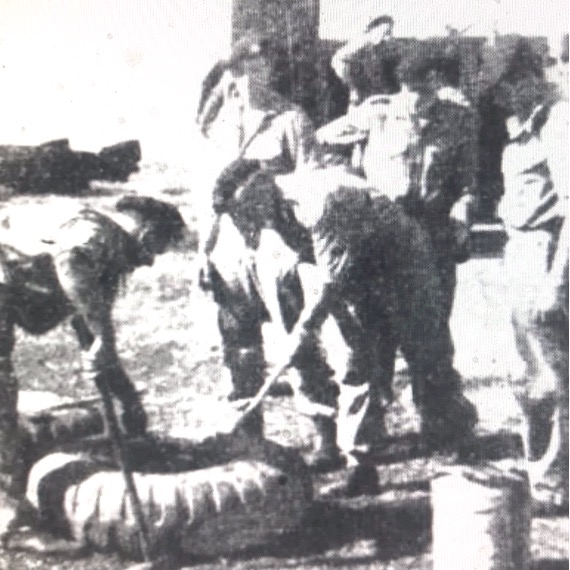
Members of a duck crew changing over tyres ready to leave for Broughton Island
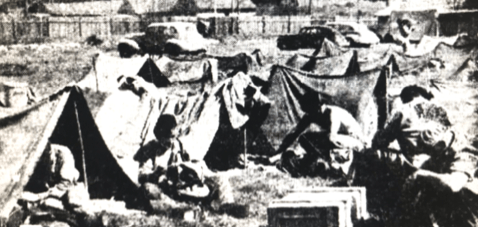
Some members of the unit checking their kit at the camp outside the two-man tents which they had intended to use at the Broughton Island camp
The sergeant rescued by Frank Littlewood was Sgt. John Sharp, a Permanent Army soldier. He told how his tank capsized in rough seas throwing himself and four young National Service Army trainees into the sea when the tank’s engine failed about 2.30 a.m. “We were on our way to Broughton Island on a routine amphibious training exercise,” Sergeant Sharp said from his bed at Royal Newcastle Hospital this morning. “When we were some miles up the coast, off Stockton Beach the batteries gave out and the bilge pump stopped working. We were about half a mile off the beach at the time and I could not get in touch with the rest of the convoy as I had no power for my wireless. “Another duck noticed our plight and took us in tow, but the new steel tow-line immediately snapped, and we turned side on to the waves. I was washed overboard, and the tank sank shortly afterwards. “We all had our life jackets on and I started to swim for the shore. The shore seemed only a short way off, but the more I swam the further away the beach seemed to get,” Sgt. Sharp said. “‘I am not a very good swimmer, and I was taking in a lot of water by now. I had a horrible feeling as though I was going under with chloroform.” he added. “There were Verey lights going up everywhere at the time so I gathered there were others in distress too.
As the disordered parties of the 233 survivors of 15 Northern River Lancers and 16 Company R.A.A.S.C. gathered at H.M.A.S. Assault, the Navy base at Nelsons Bay, this afternoon the tragic details of this morning’s disaster were pieced together.
The Commanding Officer of the company Lieut.-Col. James, was one of the last to arrive at H.M.A.S. Assault in a shocked and dazed condition. Barefooted and still in his damp clothes he could only give the bare details of the tragedy. He said that an R.A.A.F. weather forecast issued to the companies before they left Newcastle predicted fine weather with mild seas. When the detachment of amphibious L.V.T. vehicles had proceeded about 10 miles up the coast they ran into a very stiff breeze and mountainous waves. Some of the L.V.Ts. immediately got into difficulties and to make matters worse all the wirelesses were put out of order by the seas. It is believed that one of the missing soldiers is trapped in a tank that sank.
The scene at H.M.A.S. Assault (near Nelson Bay, Port Stephens) reflected the extent of the disaster. L.V.T.5s covered in sand with life-jackets hanging from the sides and personal gear scattered near by were dispersed through out the camp. Dozens of groups of trainees worn out and tired from the long hours spent at sea and in rescuework lay around on the lawns. Nelson Bay Post Office was besieged by young trainees trying to contact their relatives. The local postal officials had to cope with more than 100 telegrams and dozens of phone calls from trainees attempting to relieve the minds of their parents and friends.’
The Newcastle Morning Herald and Miners’ Advocate of 9 March 1954, page 1, that was published the day after the tragedy provided additional background information:
‘A Brisbane message says the Minister for the Army (Mr. Francis) has ordered an immediate inquiry into the tragedy. The inquiry will be conducted by “most experienced and competent officers.” An R.A.A.F. aircraft will begin a search of the area at dawn to-day. The G.O.C., Eastern Command (Lieut.-General Woodward), will fly to Williamtown from Sydney early today. He will then go by car to Gan Gan, where the rescued troops and other members of the units are camped. General Woodward will talk to the men and interview many on their experiences. Twenty amphibious vehicles left Shlortland Camp, at the mouth of the Hunter River, at 2 a.m. yesterday, to take part in an amphibious landing exercise on the beach near Morna Point, about 20 miles north of the camp. The amphibious vehicles carried 160 permanent Army men and national service trainees.
Soon after the exercise started a strong wind blew up and the craft began to ship water. Waves up to 20 feet high swept over the craft. Seas breaking into the craft swamped and stopped their engines and sump pumps. As some of the craft sank the crews took to the sea, linking arms to keep together. The two drowned men were taken from the water a mile south of Cemetery Point [near Anna Bay]. One was alive when he reached the beach, but died later, though artificial respiration was administered for more than two hours. The missing man is known to have left an amphibious tank. He was a strong swimmer. Five armoured troop landing vehicles, one non-armoured troop landing vehicle and two ducks failed to get ashore. An Army spokesman said last night that it was hoped that three of the armoured landing vehicles and one of the ducks would be recovered. The other craft were in deep water and would not be recoverable.
When the craft foundered more than 100 soldiers had to take to the sea. Many far at sea were picked up by other craft. Others close in shore battled through the surf to the beach. Wireless, weapons and Army and personal gear were lost. An Army spokesman said last night that before the exercise began, the Commanding Officer (Lieut.-Colonel J. A. James) obtained a weather report from the R.A.A.F. at Williamtown, which predicted clear skies and smooth seas. About midnight Colonel James tested the water in a duck and found it smooth and negotiable for the craft. The party went out in two groups at 2 a.m. At 3 a.m. one of the groups was about four miles off shore. Up to this stage the seas had been smooth and, although there was a swell, it had not affected the craft. Suddenly the sky clouded over, the wind rose, and within a few minutes the gentle swell had turned into choppy, heavy seas.
The first indication of trouble came when one of the troop landing craft, apparently in trouble, fired a distress rocket. Colonel James turned from the head of the column and went back to give assistance. He found the motor of the craft in distress had broken down, and took a line from it and tried to tow it to shore. He got the craft to shore, after several breaks in the towline, before it swamped. Colonel James’s own vehicle then was swamped. He had taken off all except three men from the troop landing craft into his own duck.
Meanwhile, the sea had got rougher and three other craft had sent up distress signals. One swamped and sank while still about four miles off shore. The crews of others, realising the sea was getting dangerous, made for the shore and got fairly close in before their craft sank. In a duck which sank four miles off shore, Corporal J. Wyborn, who was in charge, ordered the crew to abandon ship, and instructed them to hold hands in a circle. They did this and floated in their lifebelts for 30 minutes before they were picked up in a group. Sergeant Sharpe, who is seriously ill in hospital, is not a good swimmer, but he saved himself with his life jacket and two kapok pillows which he tucked under his arms. About 200 yards from shore he was stopped by a rip, where he kept afloat for 45 minutes till he was picked up.
A man who went out to rescue Sharpe had to return to the beach because the rip was too strong. Sharpe was finally rescued by one of the craft in the area. Throughout the day military authorities in Newcastle, police, newspaper and radio offices were inundated with calls from anxious relatives and friends of soldiers engaged in the exercise. Pressmen and others who spoke to soldiers during the day were asked to telephone messages to their relatives that they were safe. One of the vehicles which put into Stockton Beach summoned members of Stockton Surf Lifesaving Club from their beds. Two ducks ran nearly 20 miles down the beach to Stockton, picked up the club members, and took them to Morna Point, where, with a reel, they rescued four servicemen. …….
Officers in the Army exercise paid tribute to the courage and discipline of the troops, particularly the national service trainees, who had had little experience. Captain V. J. Sharpe said that when instructed to abandon craft the trainees had done so with precision drill, showing the utmost discipline. In the water they stayed together, linking arms and supporting comrades who could not swim or who were poor swimmers. The men, who wore life jackets, tore off their boots, which regulations require to be unlaced at sea, and gathered in the water on the port side of their sinking craft. As crews whose craft had sunk were brought ashore, fires were lit on the beach to warm them and dry them out. Later the Army appealed by radio to all members engaged in the operation to make for H.M.A.S. Assault, the naval station at Nelson’s Bay. At Assault the men were fed and were able to dry their clothes. The men were later taken to Gan Gan camp for the night. At the camp, unit cooks provided an evening meal. Throughout the day Army vehicles patrolled the beach in search of the missing man and equipment. The search was augmented by a R.A.A.F. Dakota and crash boat and a Newcastle police launch.
Yesterday afternoon Gan Gan camp was visited by the Commander 1st Armoured Brigade (Brigadier K. McK Arnott) and Lieut.-Colonel J. S. Anderson, of the General Staff, Eastern Command. A court of inquiry, convened by Headquarters, Eastern Command, will begin at Gan Gan today. The court will comprise three officers. The Chief Engineer, Eastern Command (Colonel B. F. Hussey) will preside. The court will not be open to the Press or public, but its finding will be published.’
The Daily Telegraph of 9 March 1954, pages 1 and 3, provided a further perspective:
‘Many of the men were violently seasick before the seas swamped their craft and threw them in to the water. One officer said last night: “As one vehicle would rescue the crew of a sunken vehicle, it would itself get into difficulties. ‘Verey’ light distress signals were going up everywhere. “It was just a case of rescuing the fellows you could and doing the best for yourself at the same time.” Another officer said: “Within an hour quite a number of vehicles were sending out distress signals. “There wasn’t a ship in sight. “The only ship we sighted was a cargo vessel at 7 a.m. “It was well out.” Captain C. G. MacDonald said: “Men were tossed about like ninepins as one vehicle after another sank. “Some of the men owe their lives to the knowledge of lifesaver members of the unit. “I saw Trooper Burns revive two men. “One of them who could not swim was blue in the face when Burns got him on the beach.”
Lieut. Bill Pye was one of several men who survived two sinkings. “Just before my first tank sank, I saw three sharks immediately behind it,” he said. “Another tank picked me up. “We were 200 yards offshore at Morna Point when a terrific wave 15ft. high broke over the stern. “We were back in the water again. “The current swept us 300 yards from where the tank sank.” Officers said that there was no panic. Only the calmness of those in trouble and the determined rescue work of those who survived, prevented a large loss of life, they said. As survivors reached the beach, they swam back in to the surf to rescue men in difficulties. Sergeant D. McHattie and Trooper Gibbs swam back four times and brought men in each time. On some trips they went 200 yards out.’
Burial of Soldiers with Military Honours
The Newcastle Morning Herald and Miners’ Advocate of 10 March 1954, page 1, reported:
‘Two soldiers drowned in the amphibious exercise in Stockton Bight on Monday will he buried with military honours to-day. They are Corporal Noel Laurence Moran, 28, of Park-avenue, Adamstown, and Trooper W. Mornement, 20, of Tourle-street Mayfield West. Officers and men of the 15th Northern Rivers Lancers and 16th Coy., R.A.A. S.C., who shared their ordeal, will attend the funeral with the full regimental pipe band. The funeral will leave for Sandgate Cemetery after a service at Christ Church Cathedral. The Dean of Newcastle (Very Rev. W. A. Hardie) will officiate at the Cathedral and graveside.
An Army officer said last night that as many men as possible who were engaged in the exercise would attend the funeral. The men, who were being issued with new clothing, would travel to Newcastle in ducks and trucks. A “good proportion” of the regiment were expected to attend. ….. Yesterday troops, police, an air-sea rescue launch and a R.A.A.F. aircraft continued, unsuccessfully, a search for Trooper Robert Alan Blackie, of Carrington-street, West Wallsend, who is missing, believed drowned.
Vehicles that patrolled the beach yesterday recovered a truckload of Army equipment and personal belongings of troops. An Army officer said residents of Stockton had been particularly helpful in salvaging gear washed up on the beach. The equipment was gathered by Stockton people and kept under police custody for Army personnel to pick up. More equipment is expected to be washed up today. National service trainees engaged in the exercise, who occupied Gan Gan Camp, near Port Stephens, on Monday night, spent yesterday morning cleaning up the camp. After their midday meal they resumed their training. Their period of training will finish on March 21.
An Army spokesman said last night that the morale of the men “had not suffered in the slightest degree” as a result of their ordeal. He said Sergeant W. Sharpe, 29, of Mayfield, who is suffering from pneumonia as a result of immersion, and Trooper C. Whitford, 21, of Islington, were reported to be off the seriously ill list at Royal Newcastle Hospital. Williamtown R.A.A.F. Hospital had advised that seven men admitted there were fit to return to duty. The G.O.C. Eastern Command (Lieutenant-General Woodward), who flew to Williamtown yesterday morning, visited Gan Gan Camp and talked with men who took part in the exercise.’
Army Enquiry on Drownings
The Sun of 10 March 1954, page 17, reported:
‘An inquiry into the drowning of two soldiers in Monday’s army disaster began at Gan Gan camp, Newcastle, today. It was held in camera, but its findings will be published. The court today took evidence from soldiers who survived the disaster, and later moved to beaches where survivors were washed ashore. The army announced today an alteration in the court of inquiry. Besides Col. Hussey, the court will comprise: Lieut.-Colonel J. B. Mather, CMF, CO 2nd Infantry Bn. Newcastle, Major R. H. Skelton, CMF, 12-16 Hunter River Lancers, and Captain T. W. Crawley.’
Findings of the Inquiry were not publically released.
Tribute paid To Soldiers
The Newcastle Morning Herald and Miners’ Advocate of Thursday 11 March 1954, page 3, published the following photo of the funeral of the two soldiers:
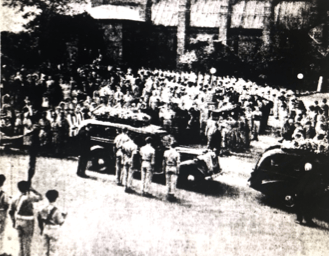
Scene at Newcastle Cathedral at the funeral of the two soldiers drowned off Stockton on Monday. Among the military officers at the funeral were Lieutenant-Colonel J. A. James, Commanding Officer of 15 Hunter River Lancers, and Brigadier K. H. M. Arnott, Commanding Officer of the 1st Armoured, Brigade.
The Newcastle Morning Herald and Miners’ Advocate of 12 March 1954, page 8, provide additional updated information:
‘Gan Gan survivors of 15th Northern Rivers Lancers and 16th Coy, R.A.A.S.C., whose discipline and courage saved the Stockton Bight amphibious exercise from being a worse disaster, will this weekend have their first leave since the exercise.
The men, who are continuing their training at Gan Gan, will have leave from 4.30 p.m. till midnight to-morrow. The camp will be closed to visitors on Sunday. The men have been busy since eight of their 20 amphibious vehicles were swamped and sunk in the dawn landing exercise on Monday. They have searched, so far without success, for the body of a comrade missing, believed drowned, salvaged Army equipment washed up on the beach, and resumed training. An Army officer said last night that the search for the missing man, Trooper R. A. Blackie, of West Wallsend, would continue to-day. On Wednesday the entire unit attended the funerals of Corporal N. L. Moran, of Adamstown, and Trooper W. Mornement, of Mayfield West, who were drowned in the exercise. Newcastle sub-branch of the Armoured Corps Association was well represented at the funeral. Corporal Moran was a former member of the association.’
Survivors return to Shortland Camp
The Newcastle Morning Herald and Miners’ Advocate of 19 March 1954, page 7, reported:
‘Members of 15 Northern Rivers Lancers and 16 Coy. R.A.A.S.C., who were engaged in the amphibious exercise in which three lives were lost and eight of 20 craft sunk last week, returned to Shortland Camp from Gan Gan yesterday.
Some—as many as were required to man the surviving craft—came back by sea. The men have been training at Gan Gan since the disastrous exercise. To-day they will compete in a drill competition for the Heath Trophy and a competition for the Brigadier MacArthur-Onslow trophy. Elimination heats in the sports events for the latter trophy will be run at No. 1 Sports Ground this afternoon. The men will complete a 16 days’ camp after lunch on Sunday.
Salvage of four of the craft sunk in the exercise is proceeding slowly, hampered by unfavourable weather and other factors. An Army salvage crew, assisted by R.A.A.F. tractors and bulldozers, recovered one of the amphibious vehicles, an LVT4A, from the sea near Morna Point on Sunday. On Monday, Tuesday and yesterday, with help from spear fishermen and Nobbys Surf Lifesaving Cub members, threat of sharks hampered successfully to get a line on to another vehicle in the surf at North Stockton. Surf breaking over the vehicle, murky water and a threat of sharks hampered work. A north-easterly wind on Wednesday prevented operations. Salvage work continued till late yesterday.’
Findings of Raymond Terrace Coroner
The Daily Advertiser of 14 April 1954, page 4, reported the findings of the Raymond Terrace Coroner:
‘Two Army trainees drowned when a convoy of Army amphibious vehicles were swamped off Stockton Beach on March 8 had died accidently, the Raymond Terrace Coroner found today.
No evidence of carelessness had been brought forward, said the Coroner (Mr. W. Priddle). The unit’s commander, Lt. Col. James had done everything in his power to prevent the disaster. It was completely bad luck, on the first-hand information brought before the Court, Mr Priddle added.
Evidence had disproved criticism that there had been a cyclone or that the vehicles were not serviceable, he said. A Magisterial inquiry will be held later into the disappearance of Robert Allen Blackie, 20, of West Wallsend, who has been posted by the Army as missing, believed drowned, in the tragedy. Lt.-Col. John Allenby James, 15th Northern Rivers Lancers, a Citizens’ Military Forces officer, of Maitland Road, Maitland, was the first witness to give evidence before the Coroner. James told the Court that he was in charge of the exercise in which the men lost their lives, and had arranged for an amphibious training exercise from the camp to Broughton Island and return. James went on that he had left the camp before the convoy in a duck on March 7 to observe sea and weather conditions. “The sea appeared quite safe, and indications were that there would be good weather,” he said. A weather report from the Meteorological Department at Williamtown airfield said that the weather would be clear and the sea calm, he added.
James told the Court that he had ordered the men to wear partially inflated life belts, and safety precautions had been read. The convoy left Newcastle harbor about 2.5 a.m. on March 8. About four or five miles from Cemetery Point, at about 3.15 a.m., he said he saw a distress flare from the rear of the convoy. Later he saw a second and then a third red, Verey light flare. He told the Court that he found one vehicle about 400 yards off course, and after escorting it back into file, moved back towards the head of the convoy. He noticed that an amphibious tank was disabled, and took it in tow.
James said he noticed a number of kitbags floating in the sea, and he was informed that one of the vehicles had sunk, but all personnel except one had been accounted for. He said he gave instructions for a search to be made for the missing man and continued to tow the disabled tank towards Stockton Beach. “About 200 yards from the beach two huge waves swamped the disabled vehicle we were towing, and it sank,” he said. His duck was still attached to the sunken tank, and following waves sank his vehicle before they could get clear. James said the convoy had never been more than 2½ miles from the shore. James told the Coroner that the vehicles were quite sea-worthy, and he considered the seas safe.’
Concluding Comments
The findings of a subsequent Army Committee of Inquiry were never publically released. However a report in the Age of 22 March 1954 stated that the Chief of the Australian General Staff, Lieut-General Sir Sydney Rowell, had refused to accept certain findings of the Inquiry. The Minister for the Army (Mr. Francis) later stated that certain aspects of the tradgedy would be examined further.
The Age of 7 April 1954 reported that the Australian Army in future would not allow non-swimmers to take part in amphibious exercises.
Further information on military exercises at Port Stephens after the Second World War is published on this website and can be viewed at the following links:
‘Operation Boomerang’ at Port Stephens – March 1952
Post war history of the Gan Gan military camp at Port Stephens
15th Northern Lancers at the Gan Gan military camp, Port Stephens – 1949
Military training camp at Gan Gan, Port Stephens – February 1951
School Cadets at the Gan Gan military camp, Port Stephens – April 1951
Army Commando training exercises at Gan Gan, Port Stephens – 1953 and 1955
First Army camp for women of the Citizen Military Forces at Gan Gan, Port Stephens – April 1954
University students at the Gan Gan military camp, Port Stephens – 1950 and 1962
Researched and compiled by Kevin McGuinness
April 2026

 Port Stephens - a history exploration