
Introduction
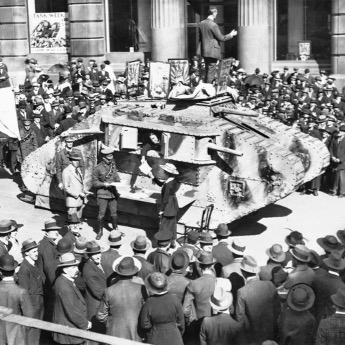
The introduction of tanks on the British front in France in September 1916 generated significant public interest.
These vehicles were later used in London and other British cities to promote war loan bonds, which resulted in substantial contributions to the British War Loan.
Following British model, a similar War Loan Tank Drive scheme was introduced to Sydney and selected regional areas in 1918, to promote the sale of Australian war bonds.
The first War Loan Tank Drive commenced in Sydney in April 1918, to promote sales of War Bonds for the Commonwealth’s Sixth War Loan.
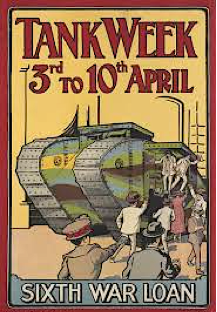
Poster promoting Tank Week and the Sixth War Loan [NSW State Library]
In September 1918, a second War Loan Tank Drive was launched in Sydney, with replica war tanks travelling to NSW regional towns including Raymond Terrace in the Port Stephens region, to promote the sale of War Bonds for the Commonwealth’s Seventh War Loan.
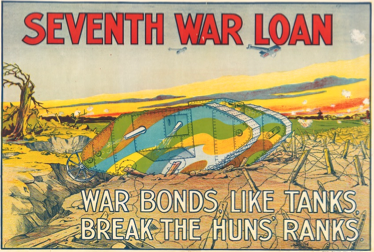
Poster promoting Tank Week and the Seventh War Loan [NSW State Library]
This paper is the story of the the Sydney launches of the War Loan Tank Drives for both the Sixth and Seventh War Loans; and the visit of the replica war tank to Raymond Terrace in September 1918.
Opening Ceremony in Sydney of the Tank Drive for the Sixth War Loan
The Sydney Mail of 10 April 1918, page 5, reported:
“Tank Week” in connection with the War Loan campaign was officially opened by the Governor, Sir Walter Davidson, in Moore-street [later called Martin Place], opposite the Commonwealth Bank, on Wednesday last. Our picture shows his Excellency addressing the spectators from the tank, accompanied by the Lord Mayor (Alderman Joynton Smith) and Mr. David Storey, M.L.A. (Minister for Health), who, with other speakers, made powerful appeals for subscriptions to the Loan.
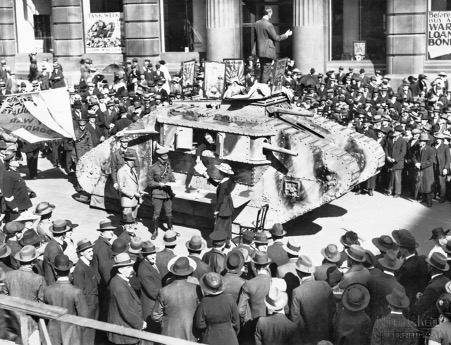
Opening of ‘Tank Week’ opposite the Commonwealth Bank, Martin Place, Sydney – April 1918 [Australian War Memorial]
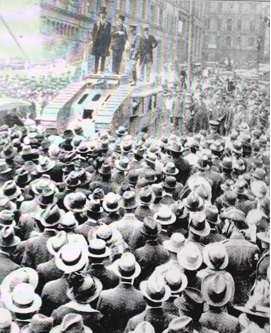
NSW Governor on top of the tank launching ‘Tank Week’ [Sydney Mail – 10 April 1918]
The contributions totalled £149,380. The tank subsequently proceeded to Balmain, where the drive netted £24,300, making £173,680 for the day. The tank has since appeared regularly in the city, and visited many of the suburbs, the response on the part of the public being very gratifying.’
Success of the Sixth War Loan Campaign
The Sydney Mail of 17 April 1918, page 13, reported:
‘For the Sixth War Loan the Commonwealth Government asked for £40,000,000. The response on the part of the people of Australia was magnificent. All over the continent money flowed surprisingly, and a great pitch of enthusiasm was verified. Last Wednesday was fixed as the closing day, but, although the indications then pointed to the full amount being realised, the Government decided to extend the appeal for another fortnight, so that subscriptions will be received up to Wednesday, April 24. This is a wise decision; the organisation has been perfected, the public enthusiasm being keen, and the whole machinery of the movement is running so smoothly, that vast sums more should be obtained by the extension.
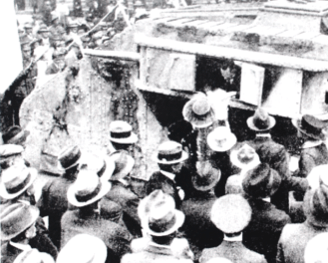
Rush for bonds in Martin Place Sydney [Sydney Mail – 17 April 1918]
And every penny that can be got in this way is wanted, for the £40,000,000 loan can only be regarded as an instalment of what will have to be found by the people of Australia. The tank here illustrated has assisted considerably in the campaign in the city and suburbs, raising over half a million pounds in small towns, and is now touring the country districts.
Mr. Denison Miller, governor of the Commonwealth Bank, in referring to the success of the loan, said: “The assistance of the tank has been decidedly successful. The Lord Mayor was particularly effective in his appeals, and they have been productive of very excellent results. Movements such as those of the Millions Club luncheon and the theatres have all joined to make the loan popular. The arrangements made by the banks to make advances to customers in 4 per cent. interest has resulted in a very large number of applications being made under that head. The Governor’s opening speech from the tank made that effort popular from the jump.
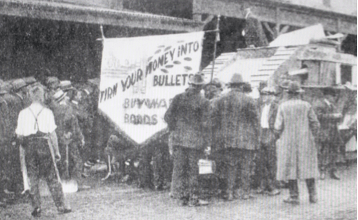
Merchants in Sussex Street, Sydney, listening to the appeal for investment in the War Loan. The sign reads: ‘Turn your money into bullets. Buy War Bonds’ [Sydney Mail – 17 April 1918]
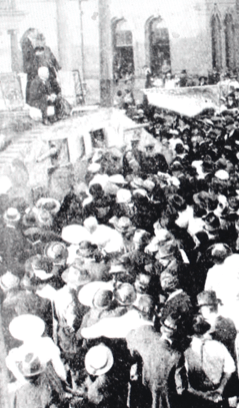
At Newtown, the Mayor (Alderman H. T. Morgan) addressed the gathering from the tank [Sydney Mail – 17 April 1918]
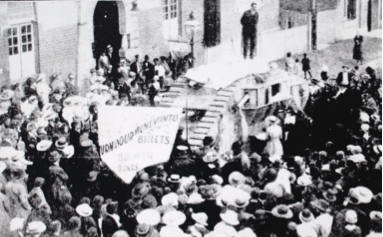
Mayor of Mosman (Ald. A. D. Walker) on the tank urging his hearers to invest in the loan [Sydney Mail – 17 April 1918]
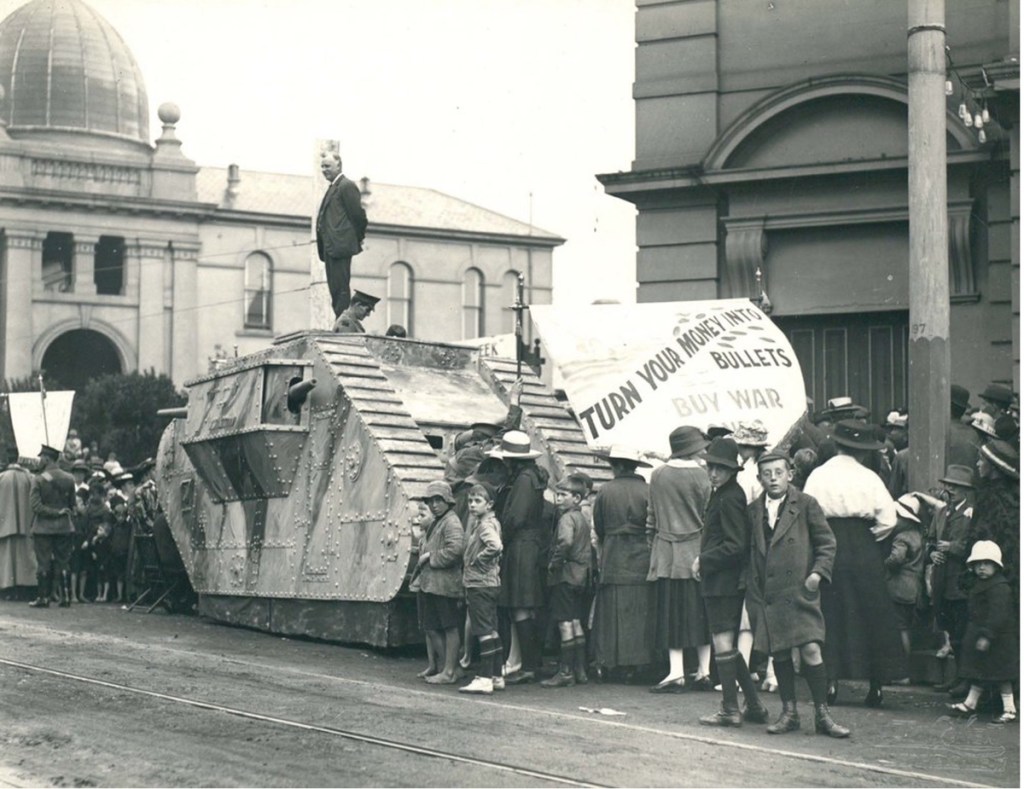
War Tank at Balmain [Museum of Reserve Bank of Australia]
Opening Ceremony in Sydney of the Tank Drive for the Seventh War Loan
The Daily Telegraph of 17 September 1918, page 5, reported:
‘Are you serving the State? Are you pulling your weight? Are you pulling your weight in the boat? In such words the Governor concluded his speech when, from the dock of the sturdy little warship that lies at anchor outside the Commonwealth Bank in Moore Street [now named Martin Place], he at noon yesterday declared the Seventh War Loan started. It seemed a scarcely necessary ceremony when the Lord Mayor read messages from different parts of the country advising that various centres had already raised their allotted quota, and that others were rapidly approaching that goal.
Still, it was the official touch, designed to give additional impetus to a movement that is sweeping the State with unusual promise of success. Spectacularly, the ceremony could scarcely have been bettered. Even the weather, though it certainly might have been called unkind, was singularly appropriate to the setting. As the Governor, the Lord Mayor, and other speakers took their places on the fo’castle head— or whatever is its equivalent in naval parlance — a bitter southerly wind, accompanied by a spattering of rain, swept the deck of the little vessel, and must have brought to the minds of many an idea of the conditions of life on the submarine-hunting destroyers of the North Sea.
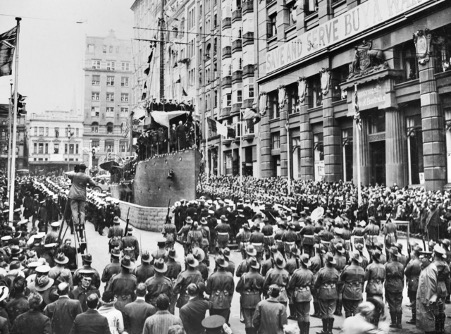
Opening ceremony for the Seventh War Loan and associated war tank drive in Martin Place, Sydney, outside the Commonwealth Bank – September 1918 [Australian War Memorial]
Three route marches through the city converged at the ship just before the ceremony. An active naval unit landed at man o’ war steps [next to the Sydney Opera House] and marched to a place at the side of the vessel; a detachment of naval cadets manned her decks; and a military unit from the district guard formed up across her bows and kept the crowd back. As the Governor set foot on the gangway after acknowledging the salutes of the guard of honour, realism was given to the scene by a cloud of smoke which rose from the vessel’s funnel, her siren at the same time sounding a welcome.
The firing of a gun was the signal that the loan was truly on its way. As the clocks boomed 12, the Governor turned a switch, and the bow-gun of the destroyer barked defiance at the enemy. The guards presented arms, the people cheered, and in the distance could be heard the sounds of whistles on the harbor spreading the news that the Seventh War Loan was on its way. “I declare the Seventh War Loan started. The deck is cleared for action. Full steam ahead!” was the Governor’s characteristic way of following up the firing of the shot.
The future of Sydney, he proceeded, was on the sea. The victory which the King’s ship Sydney won upon the sea was the omen of victory to-day. “On what you give now,” continued Sir Walter Davidson, “your Commonwealth will build the great ship of State, Australia. From the deck on which I stand I behold the valiant warriors, the sturdy workers, and thrifty savers building up the greatness of the future— the coming nation of this golden land. Now and here lend all the help you can. ….
The crowd that witnessed the ceremony was surprisingly large, when it was considered that not one-quarter of it had any chance of hearing one word in ten of what was said. The space kept clear about the vessel was unusually large, and even those in the front row must have had difficulty in hearing the speeches. The speakers, too, faced great difficulties. They were high up, and they were speaking against a strong wind. Still, it little mattered as far as the enthusiasm of the hundreds listening was concerned. They know what it was all about, and they cheered heartily when they got the cue either from those in front or from a particularly expressive gesture of the speaker. Many of them did more than cheer. A party formed up while the Governor was speaking, and soon afterwards boarded the ship, and, at the point of a fountainpen, demanded bonds. “I want £10,000 bonds,” said one; “£5000 for me!” chimed in two others. This went on until it seemed that the inclement weather had not, after all, depressing influence on the takings of the first official day of the new loan. …..
The destroyer, which is for the rest of the campaign to be used as the bank, is an excellent model. The hull was built by Mr. W. J. Buchanan, under the supervision of Mr. J. Kirkpatrick. The masts, fittings, and rigging were carried out by Mort’s Dock and Engineering Company. The guns, which are the genuine article, were lent by the naval authorities at Garden Island. The destroyer was originally modelled by Mr. Rook Phillips, from the design of Mr. Leslie Board, J. C. Williamson’s scenic artist. The spectacular side of yesterday’s ceremony was directed by Mr. Hugh J. Ward. …..
The following telegram was received yesterday from Dungog: “War Loan opened this morning; £3500 subscribed.” A telegram received from Collarenebri ran: “Quota exceeded by £2600. Expect to win bars and star for honour flag.” A wire from Wagga stated: “Campaign successfully inaugurated to-day. Anticipate raise quota. Accepting town challenge from Albury.” Dubbo wired: “£37,060 In hand. …….’
Three Tanks Visit Country Regions for Seventh War Loan
The Newcastle Sun of 17 September 1918, page 4, reported:
‘This tank is to tour the Northern District in the interests of the Seventh War Loan, which was launched yesterday. It is named the “Northern Star.” Similar tanks, called the “Southern Cross” and the “Sunset” will visit the South Coast and the Western Districts respectively.
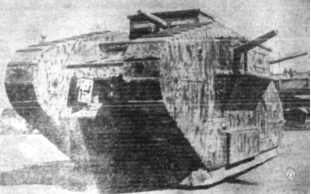
The ‘Northern Star’, one of the three replica tanks that visited NSW country regions, including Raymond Terrace, to sell War Bonds for the Seventh War Loan [Glen Innes Examiner, 30 September 1918]
War Loan Tank ‘Northern Star’ visits Maitland
The Newcastle Morning Herald and Miners’ Advocate of 19 September 1918, page 6, reported:
‘The war loan tank, “Northern Star,” arrived in Maitland yesterday afternoon, and was a centre of attraction. A meeting was held at night, when Mr. W. R. Kerr presided over a fair attendance. Alderman Quirk, Messrs. Addison, Netttleship, Lieutenant Glynn, and Mr. Alpress made appeals, and £5100 worth of bonds was the result.’
War Loan Tank ‘Northern Star’ visits Raymond Terrace
The Raymond Terrace Examiner and Lower Hunter and Port Stephens Advertiser of 20 September 1918, page 3, reported:
‘Under the charge of Alderman Quirk, of Manly, P. W. Allpress, and Sergeant Watkins, the “Northern Star” Tank Bank arrived in Raymond Terrace on Wednesday about 11.30 a.m. The Tank is true to the pictured descriptions of this famous war weapon and is built around a motor-lorry.
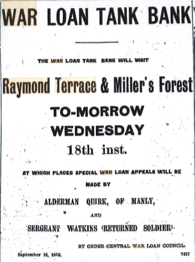
Advertisement for the War Loan Tank Bank visit to Raymond Terrace and Millers Forest [Newcastle Morning Herald and Miners’ Advocate, 17 September 1918]
On arrival at the Terrace the Mayor (Ald. Tooze) and Town Clerk (Mr. A. L. Adam) met the Tank, and short addresses were delivered. The Mayor stated that the mission of the Tank was perhaps fairly well understood, that was in soliciting subscriptions to the War Loan opened on Monday last. The necessity to subscribe by everyone capable of doing so was of supreme importance. They were by subscribing, defending their own homes, while they were unable to fight om the battlefield. They could not go wrong in investing from the point of view of soundness. It they put money in other investments, and got a higher interest just now, what might the position be when the war was over; the big interest might dwindle to nothing, but the War Loan was sure. Everyone could subscribe who had from £10 to larger amounts. Our quota in the Shire and Municipality was £27,000, and they should be able to secure that amount easily.
Aldermen Quirk also addressed the gathering and appealed for a ready response. The War loan was needed to carry them to victory, and to bring such a peace to our armies as would honourably commemorate the brave deeds of the fallen men of Gallipoli and France, such a peace that their sacrifice would not be in vain. Sergeant Watkins also spoke.
The Mayor announced amidst cheers that the following amounts had been subscribed as a result of the Tank appeal: — G. H. Pepper £1000, A. J. Windeyer £500, R. J. Pepper £300, Mrs. R. J. Pepper £200, W. Priddle £150, W. L. Priddle £130, J. R. Priddle £130, Eileen Wood £100, Ronald Wood £100, A. L. Adam £100, Mrs. McNiven £100, H. Clague £100, C. W. T. Adam £100, Mrs. Clague £10, Mrs. H. Selman £10, H. Selman £10; total £3040.
Alderman Quirk stated on leaving that the response in Raymond Terrace had been better than in Hamilton on Saturday night. He asked them to keep the agitation going all over the district till the Loan closed.’
Concluding Comments
After leaving Raymond Terrace, the War Loan Tank ‘Northern Star’ visited Branxton and Singleton.
Several other papers dealing with the First World War in the Port Stephens region are published on this website and can be found at the following links:
Letters from the Front sent by a First World War Soldier of Port Stephens
First World War Trophies – Port Stephens
First World War Memorials at Nelson Bay – Port Stephens
First World War Memorial at Karuah – Port Stephens
When the First World War came to Anna Bay – Port Stephens
Researched and compiled by Kevin McGuinness
March 2026

 Port Stephens - a history exploration