
Introduction
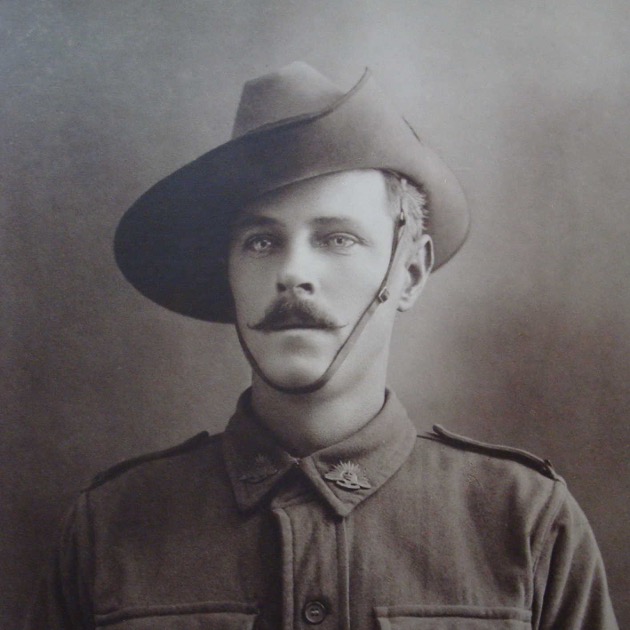
Many residents of the Port Stephens area volunteered for military service during the First World War (28 July 1914 – 11 November 1918).
Nineteen First World War servicemen from the Nelson Bay area are honoured on Nelson Bay War Memorial in Apex Park Memorial.
Of the 19 recruits from Nelson Bay who enlisted, four made the supreme sacrifice, viz., Sergeant James Dalton, Sergeant Herbert Laman, Privates George Glover and George Laman.
The Karuah War Memorial honours 24 local residents who volunteered for service during the First World War.
This paper tells of the experiences of one local resident, James Dalton, who served his country in wartime and sent many items of correspondence home from the Front.
First World War Service of James Dalton
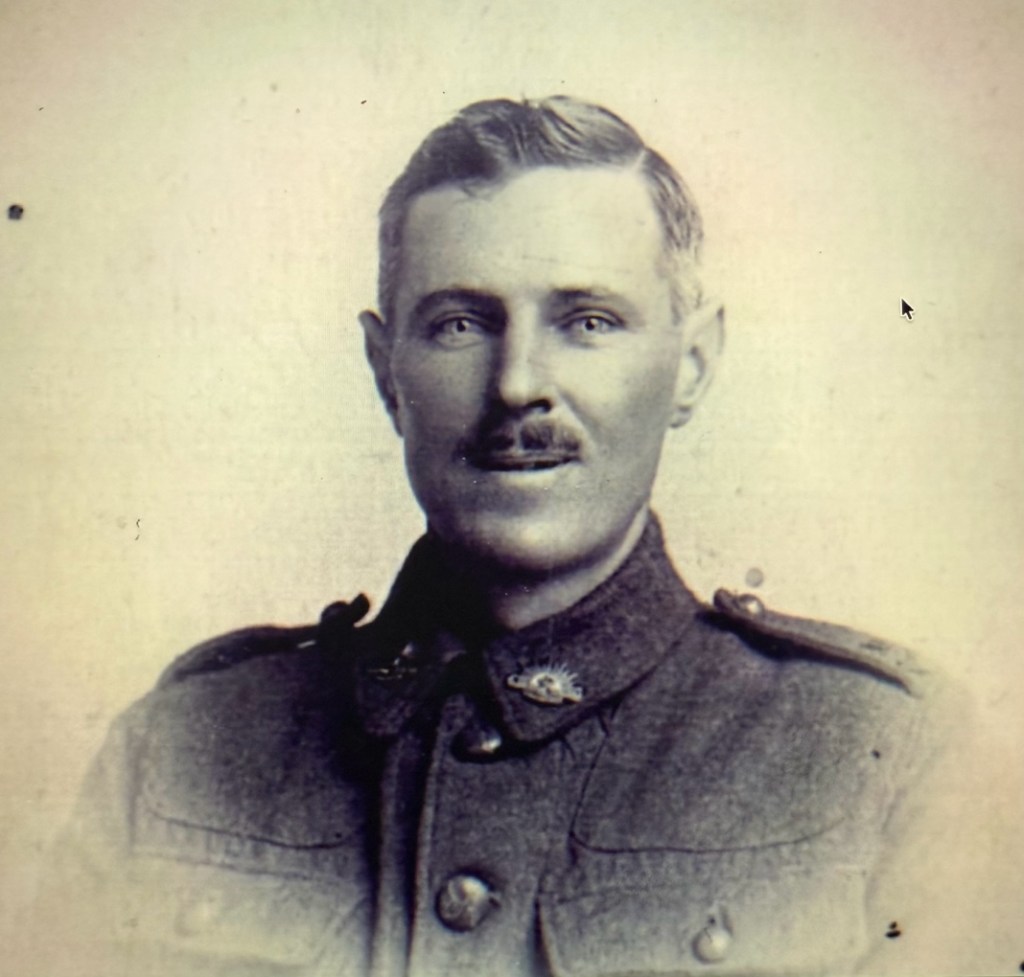
Corporal James Dalton, 1st Australian Division – October 1916, aged 33 years [Dalton Family Collection – University of Newcastle Living Histories Collection]
James Dalton was born on 25 May 1883 in Sydney, the second son of Captain John Dalton and Eliza Jane (nee Cox).
James lived at the family residence ‘Westward Ho’ at Nelson Bay, and later at the Dalton farm, ‘Burton-Agnes’ in Marsh Road at Salt Ash, from where he subsequently enlisted.
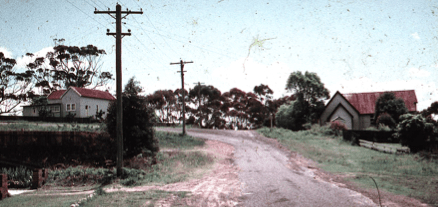
Westward Ho (left) and the Nelson Bay Methodist Church (right) – 1960
After the outbreak of the First World War, James Dalton, aged 31 years, was among the earliest residents of the Nelson Bay area to volunteer for military service where he served in the 4th Battery, A.I.F., as a gunner.
After serving at Gallipoli and in France, he was killed on 11 October 1917 at Westhock Ridge, Ypres, Belgium. He was buried in The Huts Cemetery, Dickenbusch, Leper, Belgium.
He had attained various ranks in his service and was wounded several times. He was promoted to Corporal in 1916 and to Sergeant just prior to his death.
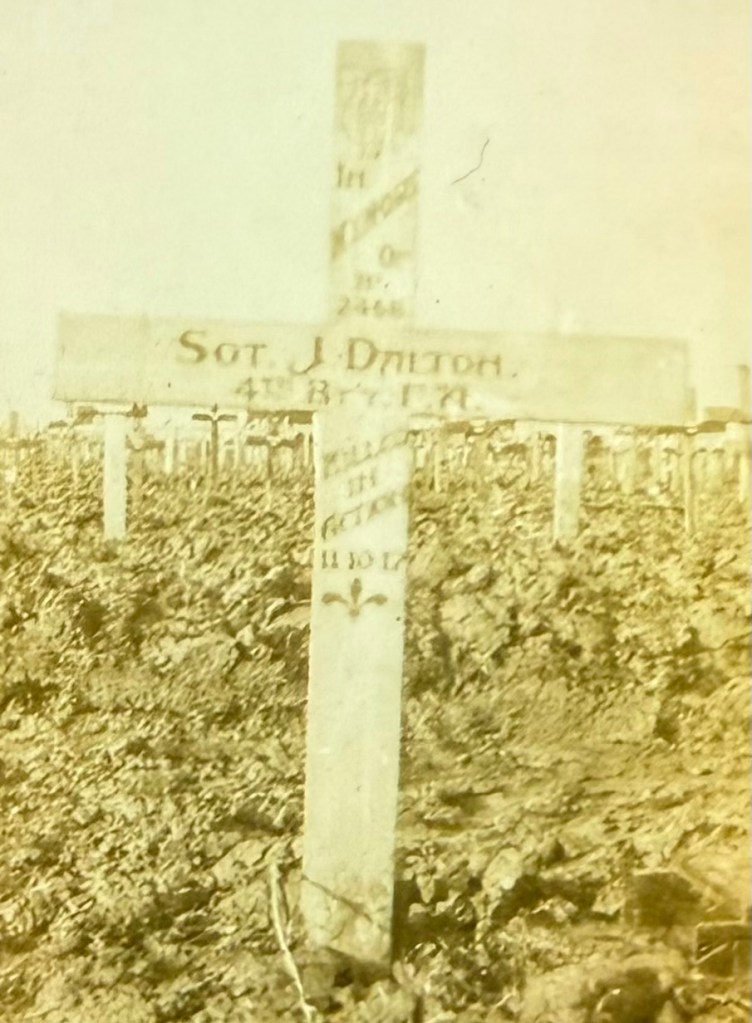
Grave of Sergeant J Dalton at Dickenbusch [Dalton Family Collection – University of Newcastle Living Histories Collection]
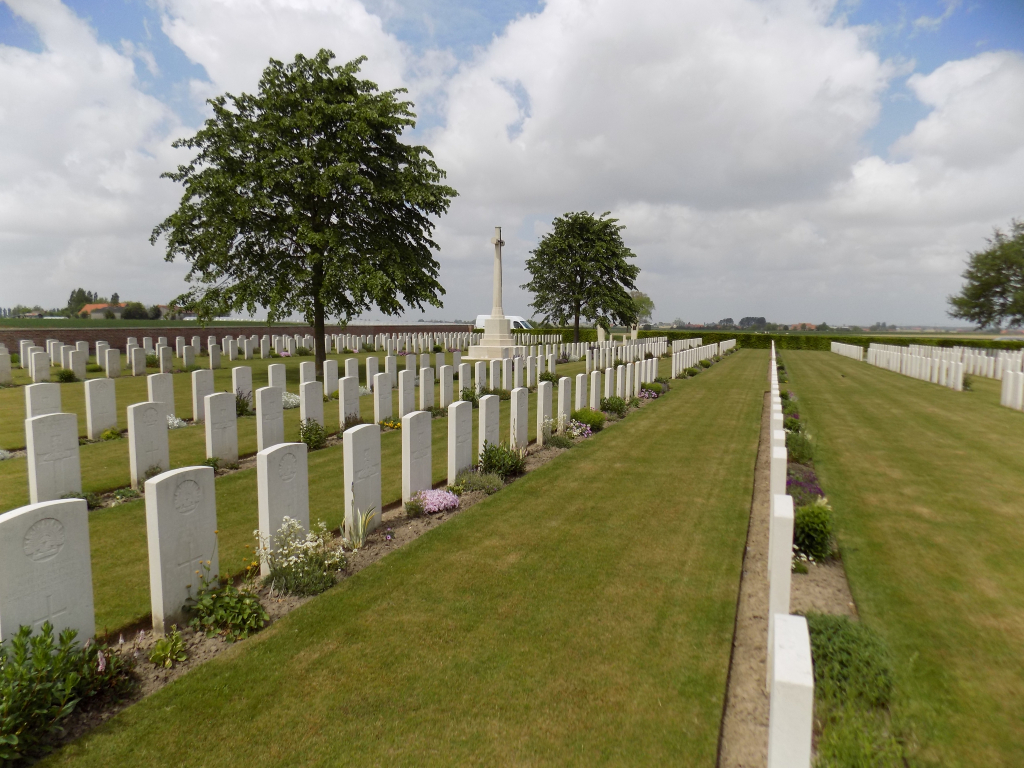
Huts War Cemetery, 6 kms southwest of Leper town centre, where James Dalton is interred [Commonwealth War Graves Commission]
James Dalton – Correspondent
James Dalton was a prolific correspondent from the War Front. He sent some 89 letters to family members during his war service.
The Raymond Terrace Examiner and Lower Hunter and Port Stephens Advertiser also received three letters from James Dalton from the War Front which it published as follows:
1) ‘Australia! Good-bye, and Good-bye’ – 1915
The Raymond Terrace Examiner and Lower Hunter and Port Stephens Advertiser of 19 February 1915, page 3, published the following verses, ‘written by a N.C.O. with the Australian forces in Egypt, (which were forward to the newspaper) from Egypt by Gunner James Dalton, who was also with the Australian contingent’:
‘Australia! Good-bye, and Good-bye,
The voice of the mother is calling
To her offspring who’ re scattered abroad
Upon me destruction is falling!
All my children must take up the sword.
Chorus
So, Australia, good-bye and good-bye,
Over lands far away we must roam;
Though we leave thee with tears and a sigh,
Soon us victors of war we’ll come home.
Shall in vain the cry of the mother
Reach our land ‘neath the Southern skies;
We’ll fight, each man says to his brother,
For Old England and for the Allies.
From our homes in the bush “Cooey” went,
From backblocks, countryside, and from town;
But a louder “cooey” will be sent
When the Prussian eagle we bring down.
Friends and sweethearts we then leave behind,
We can trust them all to remain true;
While in front of the foe we are lined
They’ll remember the Red, White, and Blue.
We shall go without records or fame
No traditions or deeds of the past
But you know, boys, the kangeroo’s game,
When he’s cornered, he’ll fight to the last.
So, comrades, at “call to arms,” double,
Fall in round the old Union Jack;
The Germans, we know, will give trouble
When we’re through, some of us will come back.
Someone ‘will return with the story
Of how sons of Australia won fame
How some met for her death and glory,
How we all left behind us a name.
Chorus
So, Australia, good-bye and good-bye,
Over lands far away we must roam;
Though we leave thee with tears and a sigh,
Soon us victors of war we’ll come home.
E. Anderson No. 1 Sect, D.A.C.’
2) Letter sent from a training camp in Egypt by James Dalton – 1915
The Raymond Terrace Examiner and Lower Hunter and Port Stephens Advertiser of 16 April 1915, page 3, published the following letter ‘received from Gunner James Dalton, formerly of Salt Ash, a member of the 1st Section of the Ammunition Column: Mena Camp, Egypt, 2nd February 1915’:
‘Sir,
We received the order a few days ago that the 1st Australian Division was to proceed to Alexandria to embark, the destination not being stated. Within a very few hours of receiving that order preparations were begun, and within very few days over 4000 Australian troops composing the 9th, 10th, 11th, and 12th Infantry Battalions were on their way to the sea.
On Sunday morning their tents stood in neat rows on the hill side where they had been erected nearly three months ago; six hours after the desert at that particular spot was bare and lonely, and at 4 p.m. the first companies of the leading battalion (the 12) filed out in column of fours into the Cairo road, etc., their rear guard stepped all the parade ground, they were followed by the other battalions in succession, and by 8 p.m. the last of the 3rd Infantry Brigade had turned their backs on the Pyramids. They will be followed as expeditiously as the railway service and shipping facilities will allow by the other units until the whole 1st division, we expect, will be afloat together again.
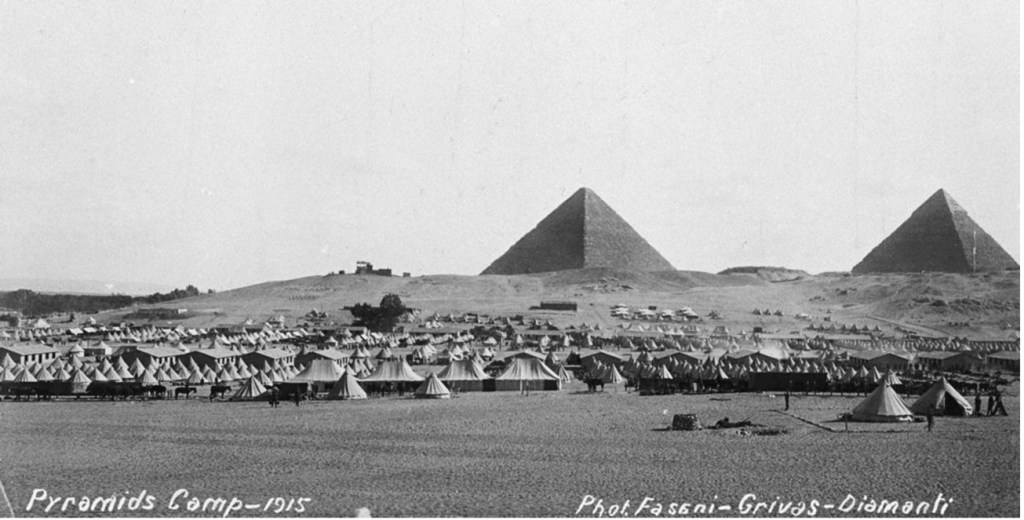
Australia’s Pyramid Camp Egypt- 1915
But now, it is not the same division as that which landed here at the beginning of December 1914. During the (nearly) three months that have passed since then the training has been pushed on unremittingly. They have been 12 weeks of strenuous work for officers and men. The training has been done under the supervision of our own Australian officers, and the highest staff officers who have inspected us, and who should know, say it has been done well. We ourselves do not feel competent to express an opinion, but we remember the time in September when we were doing our squad drill having difficulty in distinguishing between our right foot and our left— between ‘right turn’ and ‘ right wheel’ — than we have now in following the orders that enable our column of 600 men to take their place and move in unison with the 3000 men of the Artillery Brigade of which we form a part.
It may interest your readers to know that just now as we are facing the work in earnest that we were sent to do, we do so as thoroughly equipped, as well trained, and as physically fit as any portion of England’s great army is likely to be. When we say ‘trained,’ we don’t mean as toy soldiers, or as moving picture regiments; we mean as a fighting force. The first few weeks had to be spent in regaining the form that we had lost during the eight weeks spent without much exercise on board ship, but from then on no effort has been spared by either officers or men to bring the period of training to an end as soon as possible. Sir George Reid visited us at our camp, and in the course of a splendid address mentioned that Lord Kitchener had promised him that as soon as we were fit, we would go the front. ‘Now, men,’ said Sir
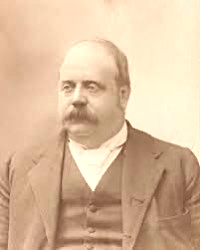
Sir George Reid
George, ‘it’s up to you to get fit,’ and during the days, that have followed — days of toil very often, of discomfort sometimes — our men have drawn inspiration from those words. Each one felt that it was ‘up to him’ to do his best, and that every day of effort brought him perceptibly nearer to the time when we should be declared ‘fit,’ and enter in real earnest upon the work we came to do. The secret of the high degree of efficiency that has been reached so quickly by our men lies right there — that every individual from the Brigadier-General to the youngest lad in the ranks has almost without exception done his best; and while this spirit is in evidence, everything goes with a swing.
The situation of the various camps selected for us lends itself readily to the purpose for which they were intended. They are all on the edge of the desert, and troops can manoeuvre without interruption, dig trenches and gun pits without injuring anyone’s land, and travel for miles and miles without trespassing on private property. Until the novelty wore off life in our camp here (Mena) was full of absorbing interest. Every morning the Infantry marched out to their work. We began to be able to pick out which battalion this lot belonged to by the officer at the head of the column, and so on, and were able to compare the marching and work of one with another. Some would consider that the 2nd battalion was the best, and others would vote for this, that, or the other. They would march out of camp together, and then each separated, so as not to interfere with the operations of the others.
Some would be sent skirmishing, some trench digging, others went through some of the hundred and one complicated evolutions with which this, perhaps the most useful, section of our division must be thoroughly familiar. They would return in the afternoon, clothes and equipment white with dust, a percentage always footsore but cheerful, and usually singing one of the numerous variations on parading of it’s a long way from Tipperary.
They are certainly a very cheery mob, are the boys of our Infantry. Their training being the simplest was finished some weeks before that of the Light Horse and Artillery. The N.S.W. Light Horse under Colonel Meredith has not been brought to Mena camp but have had a camp all to themselves. The Queensland L.H. is here, and if their comrades in the other regiments can do their work better than this fine body of men, they can certainly do it well; indeed the N.S.W. Light Horse lads visit us sometimes, and from them we learn that their training is declared complete — they are ‘ fit.’
The work of the Artillery was at one time the most unsatisfactory and discouraging of the lot. We will not soon forget the evening of the day when the 1st Artillery Brigade had to shoot their test in the presence of the English Staff Officers who were to decide whether we were competent or not. Their decision was not emphatic that we were not fit. The history of the shooting was narrated that night in hundreds of tents to interested but disgusted hearers. The 1st battery, of whom great things had been expected, had done if possible worse than the 3rd of whom we expected nothing startling. It was a record of fuses wrongly set, of angles incorrectly given, and of inaccurate laying. We expected that it would be months before mistakes such as these could be eliminated, and as we knew pretty well that we would all have to wait until they were, everyone’s spirits fell to zero, or below; but we were wrong. The determination of the men in our batteries to ‘get fit’ was stronger than we thought — so strong that now, only a few weeks later, they are doing work that has not only given satisfaction to the staff officers, but they have been declared to be as efficient as any of the English battalions at the front.
The 1st Division is well provided with artillery. In all four batteries came over, bringing their own guns of course; and more than that, they will go with them to the front, for the 18 pounder that has been used in Australia for the past two years has only one superior in the world, the new French gun ‘the 75.’ It is equal to anything the English army has and is said to be inferior in some respects to the field artillery used by the Germans.
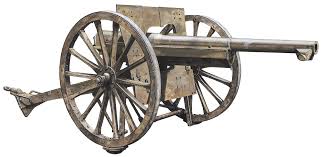
French 75 mm field gun
Of our Artillery Brigades, the 9th (Tasmanian) Battery has always done and is still doing the best work. One must have some experience of artillery to fully appreciate what they can and are doing, but we say that from the time they get the order, ‘Action,’ to the time they get the first shot away and get it on the target is about 19 seconds, anyone will understand they are doing good work. It means that the gun has to be detached from the timber carriage that draws it and swung round in the required direction. The ammunition wagon is then driven up beside it, the shell secured and loaded from different instruments adjusted by the gun layer, and adjusted accurately, and the gun fired all in 19 seconds.
These have been our experiences for the past 10 weeks. Up at the rifle range the splutter of musketry has been going on day after day. Further out we could hear the roar of the 18 pounders, followed by the shriek and brunt of the shell. Up along the desert the Light Horse would be drilling in a cloud of dust. Further out were other clouds which as they drew nearer resolved themselves into battalions of infantry; up on the hills the signallers would be at work with flags or heliograph or maybe setting up the field telegraph and telephone. On the Cairo road the engineers could be seen building bridges over one of the irrigation canals. It seemed a silly business to build a bridge simply to take it, up again, but they have been learning all the time; and during that time, they have given us examples of the various kinds of bridge of various degrees of stability such as we shall probably someday have to cross.
The Army Medical Corps have had the best time. Most of them are getting rusty for want of work, but we are just as well satisfied that they should be idle. There are some patients, of course: appendicitis is not an unheard of luxury here, and at Mena House, the luxurious hotel that had been built for the accommodation of the wealthy tourists from all parts of the world who visit the Pyramids, but which has been turned into a hospital, every provision has been made for attending to this or any other complaints that may need attention. There has been a good many cases of pneumonia, some of which ended fatally, but when they did it was not for the want of the best of medical attention and skilled nursing.
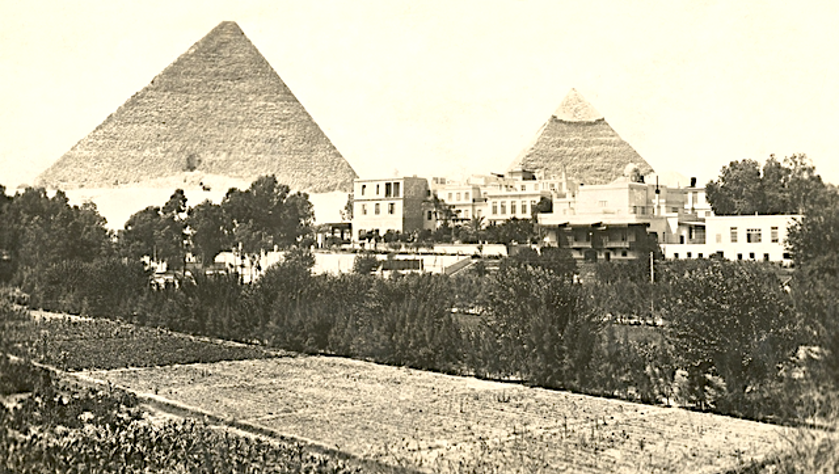
Mena House Hotel – Cairo [Australian War Memorial]
Probably the hardest worked crowd of all is the Army Service Corps, whose wagons are constantly at work drawing provisions for man and beast, but even here the work is lightened for them. When the camp was laid out provision was made to extend the electric tramline which had already been in use as far as the base of the hill on which the Pyramids stood right into the Army Service Stores, and much of our stores are brought in this way. We have so far had fresh meat every day, either Australian frozen beef or mutton. The ordinary ration issued to each man consists of 1lb of meat (including bone), 1lb bread, and tea, sugar, and salt. Any healthy Australian will admit that this is not sufficient for men who are working hard all day and who have in addition a fair amount of night work in the shape of guards and picquets, but in active service it is augmented by a payment of 6d per day, called field allowance made to each man.
A canteen has been provided for each unit, where almost any mentionable or thinkable commodity can be bought, and we find that this extra payment enables us to live quite comfortably. It may be mentioned that it is not issued in cash, though credit slips, which can be tendered at the canteen for payment of food only are given each day to the senior man in the tent, and with these purchases are made.
We all realise that we are having the most enjoyable period of the campaign now, for such conditions as we have experienced can be had hardly anywhere outside Egypt. The climate is as nearly perfect as it is possible to be. Sometimes the mornings are nearly frosty, but usually the nights are pleasant enough to make sleeping out possible. The days are invariably cool. There are such things as dust storms, of which we had experienced two, one of them at least just about as unpleasant as one could wish to have. After it had found everything, we had, even clothes in our kit bags were full of a fine dust.
They say it ‘never’ rains in Egypt, or rather hardly ever. It did once, though, a few days after the D Carnival at their first camp at Maadi. I have a very vivid recollection of it, for I was on guard. It was colder then than now, and we were in a poor condition to resist cold, for only a few days before we had come through the Red Sea and its sweltering heat. A cold wet night on parade carrying a rifle at the ‘slope’ and wearing an overcoat that was not waterproof was an experience that has left unpleasant memories. I had companions in misfortune though, and this made the burden lighter.
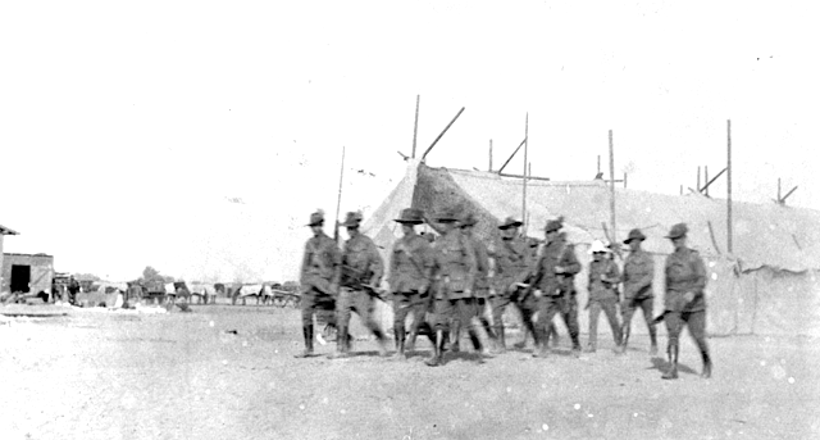
Maadi Camp, Egypt – 1915 [Australian War Memorial]
At 6 a.m., when I came off guard, I decided that a cup of hot cocoa, procurable at the canteen for the sum of one half-piastre (1¼d) would be just the thing for my complaint, so proceeded thither. Discipline was relaxed a little then, so I had to ask no one’s permission to leave the lines. When I reached the canteen the 1st Light Horse regiment was just coming to the camp, looking like a lot of half-drowned rats. I went down and fraternized with my companions in misfortune. I met Corporal Hussey sitting in the wet sand wearing a wet overcoat and holding a couple of wet and steaming horses; he looked for all the world like ‘the morning after the night before.’ They had had a trying night indeed — unloaded at Cairo in the middle of the night, they had to lead their horses 9 miles to our camp in the rain. I tried to find Sergt-Major James, but although I caught sight of him several times, when I got to where he was, he was somewhere else, so like Robinson Crusoe and the goats ‘I gave it over for that time’ and went back to work in our lines.
It rained that night safe enough, but we were told it was the heaviest they had had for five years; it was the heaviest we had, too — in fact, it may be said it was all we had, for we have never had enough at a time to lay the dust since. We often wish it would rain for a couple of hours for this reason, but one gets used to anything in time, even to living, eating, and sleeping in an atmosphere composed mainly of dust. With the exception of one or two minor details such as these, our stay in Egypt has been a delightful one.
Whenever possible the men have been granted leave to visit some of the intensely interesting places around us. We have not been able to see as much of them or as many as we would like, but after all our object in coming here was not that of sightseeing, and we are content to do comparatively little of it so long as the other and main object is gained. This will give you a faint idea of what we have done and how we have done it.
The 1st Division is ready for its work. Since we have received our marching orders a strange seriousness has come over all our men, for they know what lays ahead. Among them are many relations and friends of your readers. They have a real interest in us. Do you know the idea that seems to be uppermost in the minds of the majority of our fellows? It is that they should so act that all such should have no reason to be other than proud of them. I am intensely proud of the spirit of our men and feel quite confident that in this battle for civilisation Australia will have every reason to be satisfied with her representatives here. I know that certain statements have been published by a section of the press in the colonies that have represented us in anything but a favourable light. Whether they have obtained credence or not I do not know, but I do know that the facts are as I have stated. Our men are morally, physically, and in every other way equal to any other corps we have seen, and superior to most.’
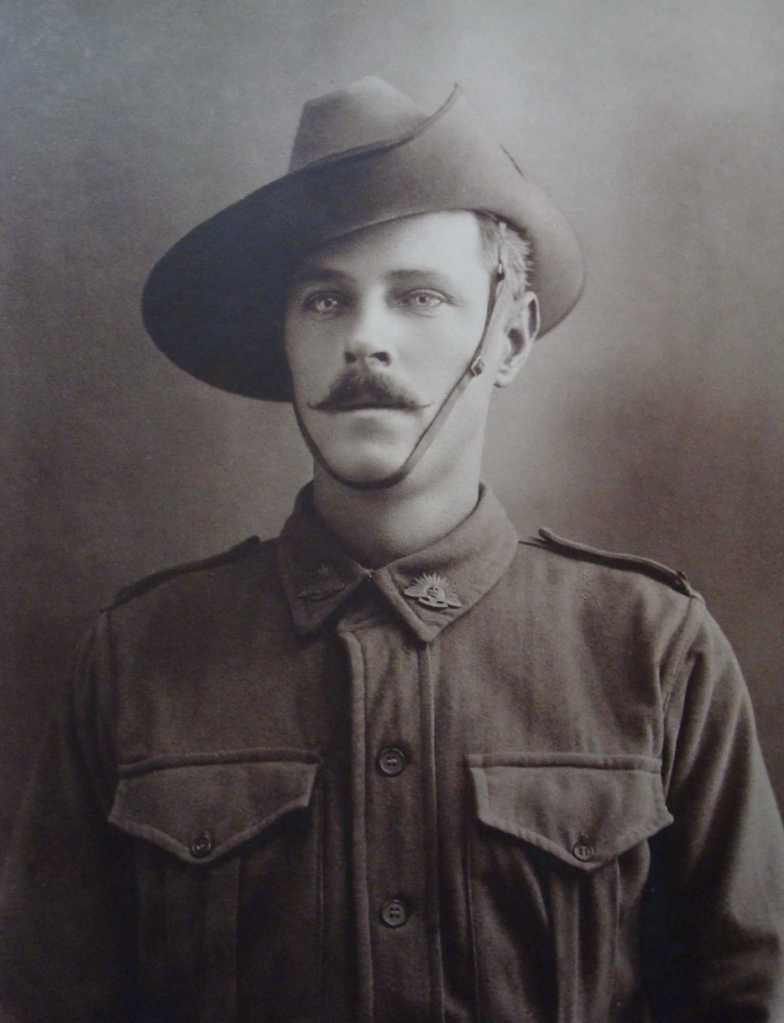
James Dalton [Dalton Family Collection – University of Newcastle Living Histories Collection]
3) Letter sent by James Dalton detailing his experiences after being wounded
The Raymond Terrace Examiner and Lower Hunter and Port Stephens Advertiser of 23 February 1917, page 3, published the following letter written by James Dalton dealing with his experiences after being wounded on the front line:
‘Attached to each unit in the field is one or more men of the Army Medical Corps. We had one, and a jolly fine time we all thought he had, for he was only “attached” to us for purposes of health, pure and simple. We used to envy him his job, when, after hauling ammunition until about 2.30 a.m., we had to get on parade by 6.30, and he stayed in bed until breakfast was ready. He had a beautiful little dugout, with oilcloth on the floor and the walls covered with pictures cut from the illustrated papers, using the battery stretcher for a bed. He didn’t mind giving up his bed and sitting up all night with a sick man, but we were such a beastly healthy lot that he only had reason to do this once while we were together.
I know he hadn’t been out of bed long on this particular morning when Fritz [Germans] began to shell us with his 4-25. I always noticed that he had a most methodical way of handling his artillery on such occasions. He had been trying for a battery near us the day before. He usually gets the range with about three shots and then proceeds with “Battery fire 5 seconds” until finished. One can see the explosion of the shell at the target, hear the wail of the next one as it rushes over, and the report of the gun all at the same instant. Sounds most business like without a doubt, for he usually sent us well over the hundred before he had finished.
On this particular morning, he got me with the second shot and the range too. I was stunned for the moment, but soon scrambled to my feet and made off as fast as I could away from the battery, for I knew how accurate the shooting was likely to be, and that even a short distance away from the target one is perfectly safe in these cases, for the layers invariably keep their shots near the same spot. They have though a nasty habit of spraying all-round the target with shrapnel; in this case the battery try to withdraw either themselves or with the guns they are caught by the shrapnel — German thoroughness you see.
I haven’t a very vivid recollection of what happened after I was hit; I know that I was greatly surprised to find that I was wounded, and also that Dick was there with his stretcher and bandages. He wasn’t in the least disturbed, although the shrapnel was beginning to arrive by this, but completed binding me up and then assisted by one of the lads who had been with me since we left Sydney, put me on the stretcher and set out for the Dressing Station a few hundred yards away.
While we were going over, I remember noticing another of those fine things, that happen so frequently out there. We heard a shell, and we had all been out long enough to know that this one was coming on a good line for us. The Battery S.M. was walking beside me, and while telling the bearers not to stop, he stooped so that if the shell burst dangerously close, I should be protected by his body. The fuse had been set too short as it happened, but that didn’t detract from the unselfishness of the action, did it?
At the Dressing Station when we arrived the motor ambulance, called up by a phone from the battery, was standing with the engine running; Capt. Harris, Medical Officer of our brigade (son of Dr. John Harris of Newcastle), was also in attendance, but could do no more for me than Dick had done already. The stretcher was lifted into the ambulance immediately, and we were off with no speed limit and the order to the driver to “hurry.”
In a few minutes we arrived at the Field Ambulance, where I was examined, but being found to be still going strong, was sent straight on to the Clearing Station at Railhead. I know the road we went over, for I had been along it on duty many times, and I knew it was not remarkable for its smooth surface, but what the road lacked in this respect the driver made up for by his skill; not once in the course of that four mile journey did I notice anything like a jolt, and it was covered in quick time, too.
On arrival I was taken into the operating room and examined thoroughly, but very gently, the wound was bound up more securely, and I was put to bed. My shirt and singlet had been cut off, so that the wound could be dressed. The remainder of my clothing was taken away and I was rolled up in blankets and surrounded by hot water bottles, after which (can’t quite remember). I do know I asked for and was given a cigarette and had the smoke of my life. Tobacco has been a great comfort to me many times during this and the previous campaigns, but I have never enjoyed it half so much as I did this, and indeed that was the usual experience for the following week or more.
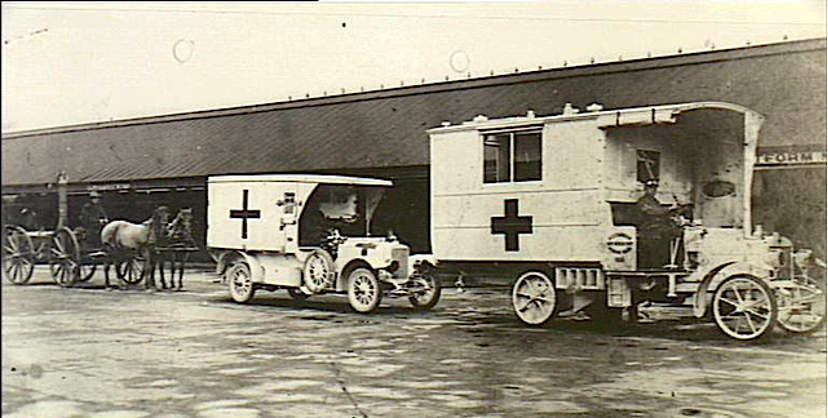
First World War ambulance and mobile operating theatre (right) outside a train station [Australian War Memorial]
I noticed just here how careful the orderlies were with the few articles I had in my trousers pockets. I had some money, and this was counted by one of the nurses in my presence, and a receipt put in a little print bag and hung on the headrail of the bed, the money being taken away to the office, but returned to me before I left for the base. My clothes I never saw again, but my own personal property was most carefully looked after here and wherever else I went.
I was only in the receiving station about 18 hours and cannot remember much about it. I know it was well within reach of shells from the German “heavies,” for I had been down there a few weeks before with one of our men, when at least three shells fell just outside, and I also know that there were Australian nurses there caring for the men as they came in in a way that only a woman can. That sounds like a platitude, does it not ? It may be urged that when men who have not enjoyed the privilege of women society for months (in my case 16 months) are wounded and have their pains relieved and their wants attended to by nurses, they are sure to draw exaggerated ideas of their qualities from their experience, and that trained men would produce pretty much the same kind of impression on their patients.
I admit the worth of arguments like these and would wish it were possible to say that in places of danger such as this men would do as well, but would not be true. Men arriving with torn and broken bodies are not normal, but I firmly believe their mental appreciation of the sympathy and hopefulness which seemed to radiate from the presence of these women is more keen for just that reason, and they are just the things they need. Men would do, of course; but women, because they are endowed with — shall we say — spiritual qualities men are not possess of, will do better, and for that reason their presence will always be needed where there is pain to be relieved and encouragement in great difficulties, to be given; and right there, whatever the danger or discomfort, they are sure to be found.
I met here an old friend of the Peninsula days in the person of the A.M.C. lad who dressed my wound over there in the 3rd Field Ambulance Station. A Lance-Corporal then, he now wears the badge of Sergeant-Major.
Concluding Comments
The three letters sent by James Dalton and published by the Raymond Terrace Examiner and Lower Hunter and Port Stephens Advertiser poignantly reflect his experiences of serving his country in wartime.
The following papers relating to Port Stephens and the First World War are published on this website and can be found at the following links:
First World War Memorials at Nelson Bay – Port Stephens
First World War Memorial at Karuah – Port Stephens
First World War Trophies — Port Stephens
When the First World War Came to Anna Bay – Port Stephens
Researched and Compiled by Kevin McGuinness
January 2026

 Port Stephens - a history exploration