
Introduction
Prior to the First World War, it was difficult to travel from Sydney, Newcastle or other regional areas to the Port Stephens region, including Nelson Bay, Salt Ash, Tea Gardens and the Myall River and Lakes.
Some of the travellers who did travel to the Port Stephens region for pleasure or business, wrote of their experiences and observations. Newspapers of the time often published these accounts.
Details of several early trips to Port Stephens are published on this website and the links to these are set out in the concluding section.
The trip summarised below was published in the Newcastle Morning Herald and Miners’ Advocate of 7 January 1903, page 7. The name of the traveller was not stated.
Trip from Stockton via Fullerton Cove and Williamtown to Salt Ash
‘From Stockton to Salt Ash, a distance of about fourteen miles, there is little else to see but paddocks and dairy farms. Practically the whole of the people live by farming pursuits, and, according to all accounts, some are doing very well. The produce is brought down to Newcastle at least twice a week. Tuesdays and Fridays being the market days. Some days there can be seen as many as twenty carts on the road passing through Fullerton Cove, and the average number is said to be not less than sixteen on each of these mornings.
The settlers must be up and doing at an exceedingly early hour, as it is being a regular thing for cart loads of produce to be in waiting for the cargo ferry at Stockton from 2 a.m. on market days. The farmers like to be early to catch the first trip of the punt, but it frequently happens that there are more carts than the ferry can accommodate, and so, after all, it becomes much a matter of luck if Newcastle is reached in what the farmers regard as good time. Instances are quoted of carts reaching Stockton at 2.30 a.m., and not being landed at the Newcastle side of the harbour until after 6 o’clock. This is said to be due to the punt having to make a second and, perhaps, a third trip to meet the exigencies of the trade.
What is complained of most is that the running table cannot be depended on. The farmers are looking forward to the time when there will be a steam cargo punt, as promised, and a Government service established. They do not, however, feel satisfied with their prospects in this direction. Though the £3000 was granted by Parliament for the service, they think it strange that the money for the approaches should have been struck off the Estimates. It is not intended to allow the agitation to drop.
Fullerton Cove is about five miles from Stockton, and four miles from the New Township, the latter being the last place where there is a licensed public house until Raymond Terrace is reached. The majority of the people at “The Cove” and at Williamtown, Parading Ground, and Cabbage Tree, are described as teetotallers, inasmuch as they opposed the granting of a colonial wine license to a wayside house A weary traveller can, however, be accommodated with pure milk at almost any of the old established homesteads, and if he does not care for milk he can have a change in water.
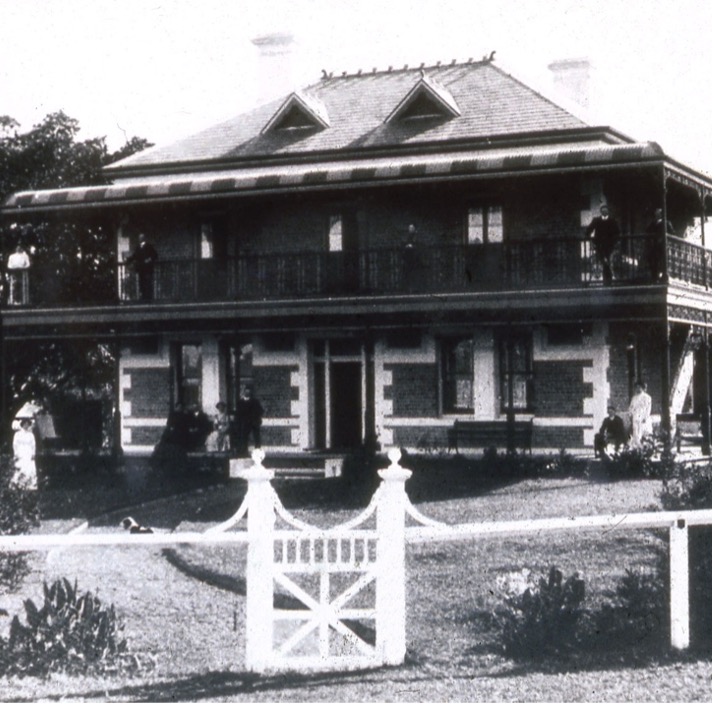
The dairying industry is carried on in a large scale throughout this district. Mr. S. W. Smith, whose estate comprises about 1000 acres of freehold land, has one of the largest dairying stations to be found anywhere, about 130 cows now being milked there daily. His house, which stands back some distance from the main road, but which is visible from afar, is a historic settlement, the brick portion having been built some 70 years ago. and originally occupied by the well-known J. T. Smith.
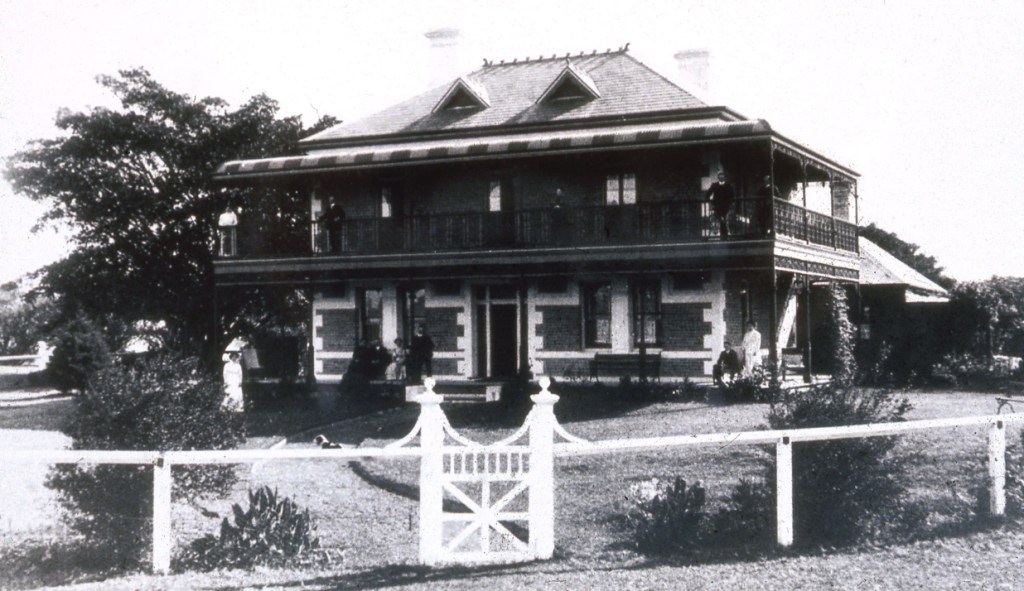
The Smith residence ‘Stanley Park’ at Fullerton Cove [University of Newcastle Library]
The posts of the old racecourse between the road and the house are still standing. Some accidents occurred at a race meeting about 12 years ago, and since then the meetings have been abandoned. On the far side can also be seen reminiscences of the old wharf, from which, in the early days, was shipped practically the whole of the stock required for the army service. The wooden portion of the homestead is about to be demolished and substituted by a two-storey brick dwelling of nine rooms, which is estimated to cost £1800. The walls are to be 14 inches at the bottom, and 11 inches at the top, and the material, now being carted to the spot, is of the best description. The contract has been let to Mr. W. King, of Largs.
Among other old-established holdings are those of Messrs. Sherman, Cox, West, and Morris, the majority of the other residents, with the exception of the Gilmour family, being in some way related to each other. All are engaged in the cultivation of the soil or in dairy farming. The school at Fullerton Cove is in charge of Mr. W. Ross, formerly of Young Wallsend. Religious services are conducted by the Rev. P. S. Waddy, of Stockton. One Sunday the services are held in the forenoon, and the following Sunday in the afternoon. The Church was opened a few years ago by the bishop of the diocese.
The lovely sheet of water from which the place derives its name, is about two miles wide and five or six miles long. Thie depth of water, however, never exceeds from four to five feet. The Cove is only used for net fishing. It could be made a splendid sheltering harbour, but the time when the port of Newcastle still require this accommodation has not yet arrived. About two miles north of Fullerton Cove is the little settlement known locally as the Long Bight, but which in reality is an extension of Fullerton Cove. The chief settlers there are Messrs. J. T. Smith, H. West, and C. George.
A few miles further on again is Cabbage Tree, an area of about three square miles, which embraces Williamtown and Parading Ground. Here roads branch off to Hexham and to Raymond Terrace. These roads are not in the same good order as is the main road from Stockton, but it is understood that they are to receive attention. Mr. R. A. Price, M.P., represents this part of the district, and the residents are satisfied that he does his best for them in this direction. Mr. S. W. Smith, junr., is the president of the Williamtown Progress Committee, and Mr. A. Maher is the secretary. Among the number settled at Cabbage Tree are the McLeans (three families), W. Moxey, Sansom (two families), Dawson, E. Maher, McDermott, and T. Sutton.
Mr. E. Maher has a [horse] training ground just off the road leading to Hexham. This is where Coralette, which won races recently, is trained, and he has also in hand a two-year-old colt by The Simmer, from Corallie. The Williamtown school, which is in the charge of Mr. Cameron, is situated at the Junction of the roads leading from Stock ton and Hexham. The average attendance at this school is said to be about 40.
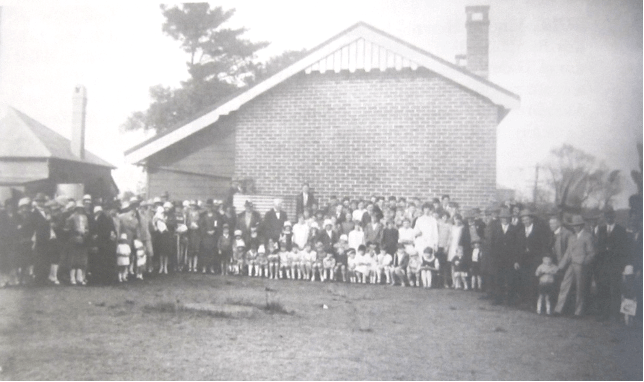
Williamtown Public School [Tomaree Family History Group Nelson Bay Inc.]
Among the chief residents at Parading Ground are the Moxeys, Boyce, Levis, Barnes, Steinbeck, W. Sutton, D. O’Keefe, S. W. Smith (top station), J. Chesworth, W. Slade, J. Slade, Cox. White, Maslen, Russell, and G. West. The store is in charge of Mr. O. Barnes, who also attends to the post and telegraph business. There is a hall known as the Temperence Hall.
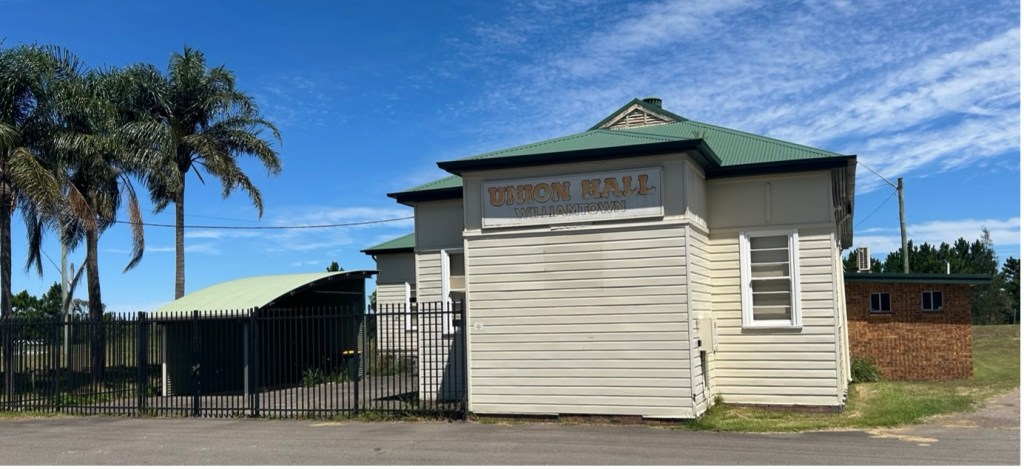
Temperance/Union Hall, Williamtown [Author photo, February 2024]
Religious services are conducted by the Rev. Mr. McPherson, from Nelson’s Bay (Methodist Church), and by the Rev. Mr. Waddy, of Stockton (Church of England). The people are said to be very regular in their attendance at Divine worship.
At Salt Ash, farming is again the chief form of employment, but a good deal of work is also done in despatching fish from the Nelson’s Bay steamers to Newcastle. There is a public school, which is in charge of Mr. W. Wills, and the attendance is said to be about 45.
Some of the land has been settled on for many years, and among old residents may be mentioned Captain J. Dalton and Messrs. Gillespie, J. Sansom, P. J. M. Brown, and J. Cox. A building erected in recent years is used for Divine worship, and services are conducted by the Revs. Waddy and McPherson. The whole population in these far north parts of Stockton is put down at about 500; but it is not for passenger traffic alone that the people are advocating the construction of a light railway to Salt Ash. What the line is most required for is for the carriage of produce and fish. There is said to be every probability of an extensive traffic. The route for the railway has been surveyed, and the residents are now anxiously looking forward to the construction of the line, since it has been reported that there are no engineering difficulties, and that the line would not be costly.’
Concluding Comments
The following travel stories of trips to various parts of the Port Stephens area are published on this website and can be found at the following links:
The Lakes Travel Route to Mid-North Coast
A Four Day Excursion to Port Stephens – Christmas 1906
A Personal Tour of Port Stephens – 1914
Excursion from Newcastle to Port Stephens by Sea
A Journey from Port Stephens Up the Myall Lakes to Forster – 1908
Journey from Maitland to Port Stephens – 1889
An excursion to Port Stephens by Dr Richard Arthur, MLA – 1914
‘Dungog and Round About’ – 1909 and 1910
A Description of Nelson Bay – Port Stephens – 1892
A Vacation Cruise from Sydney to the Myall Lakes – 1892
A Journey Around Port Stephens – 1894
Researched and compiled by Kevin McGuinness
January 2026

 Port Stephens - a history exploration