
Introduction
The First World War ended on 11 November 1918. The residents of the Port Stephens region, like those Australia wide, had been deeply affected by the War and the extra hardships to daily living it caused. Many families had suffered the death of one or more loved ones in the oversea battles.
Just when the Port Stephens community was coming to terms with the aftermath of the War, and endeavouring to resume a normal lifestyle again, along came an epidemic that was to lead to local deaths.
On a global level, the influenza pandemic (1918-1920) after the first World War killed an estimated 50 million people worldwide. It was also known as the ‘Spanish Flu’. As Spain was a neutral country in the First World War, influenza was first widely reported there due to the lack of wartime censorship. Scientists are unsure of its origin, but like all influenza strains, it spread easily and mutated rapidly.
Australia’s quick quarantine response delayed the arrival of the flu until early 1919, but soon about 40% of Australians became ill, with 12,000 to 15,000 deaths reported. In Australia it was called ‘pneumonic influenza’ or simply ‘flu.’
When the first COVID-19 cases were reported in Australia in 2020, many reports at the time compared that pandemic with the 1919 Spanish flu pandemic and the government restrictions that were imposed to stem its spread.
In 1919, deaths occurred among the residents of the greater Port Stephens area from the flu epidemic, but not to the same extent of their Sydney counterparts. Residences and places of work were generally more widely separated there, thus limiting the spread of the flu.
Several aboriginal people in the Port Stephens area died from the “Spanish Flu”.
The Port Stephens area was also impacted by State Government action aimed at closing the North Head Quarantine Station and possibly transferring its operations to the area. Many of the local residents were not happy with such a move.
In the terminology of the time, epidemic was the main descriptor of the influenza outbreak.
Report on the Influenza Epidemic in the Newcastle Region
Residents of the Port Stephens area who contracted the Spanish Flu had to ride out the sickness at their home or else be treated at the Waratah Hospital and Benevolent Asylum, near Newcastle. Port Stephens residents were among those treated at the Waratah facilities. The Newcastle Morning Herald and Miners’ Advocate of 16 October 1919, page 5, published a report prepared by Dr. R. Dick, on the epidemic in the Newcastle area:
‘The final meeting of the executive members of the Newcastle Influenza Epidemic Committee was held at the rooms of the Board of Health yesterday morning. … Dr. Dick, the Medical Officer of the Board of Health for the Hunter Combined District, presented his report dealing with the outbreak of pneumonic influenza within the area under his control and the steps taken to successfully combat the epidemic.
The report stated that the first known case of pneumonic influenza in the Newcastle district in 1919 was a seaman who was admitted on February 27 to the Newcastle Hospital with supposed enteric fever and died there on March 2. A number of the other patients as well as some of the staff employed in the same ward as this patient contracted the disease. All these cases were removed to the Benevolent Society’s premises at Waratah, which had been taken over for the isolation and treatment of influenza cases. All cases which required hospital accommodation in Newcastle and suburbs were treated in the Waratah Hospital or in the Wallsend Emergency Hospital. The total available beds at Waratah was 188. At Wallsend 60 beds were provided. The total notifications of pneumonic influenza received from medical practitioners was 2400. The weekly admissions to the Waratah Hospital, which began to receive patients on March 2, 1919, varied from 25 to 130, the maximum for the week ending June 21st.
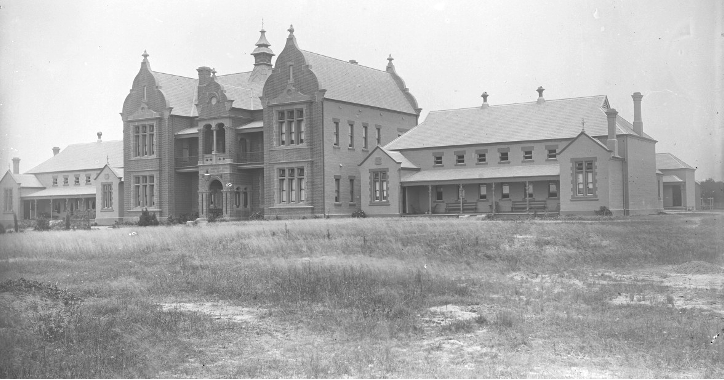
Newcastle Benevolent Asylum at Waratah – 1901, where influenza patients were housed [University of Newcastle Library, Hunter Photobank]
The disease showed itself in two waves, the crest of the first being felt during the period 6th to 19th April [1919], and the second more pronounced wave extended over the period May 25th to June 28th. After this there was a very rapid decline and disappearance of the disease. …..In the whole district there were 494 deaths registered as due to influenza or its complications during the period from March 2nd to September 10th, 1919. …. Of the total deaths 290 took place in hospitals and 204 among patients treated privately in their own homes. Of the deaths which took place in the hospitals about 20 per cent. occurred within 24 hours of admission. Of the total deaths 288 were males and 206 females. …
Dilating upon the lessons from the epidemic the medical officer says:—”There is much useful knowledge to be learnt in many ways from this epidemic. It was the first occasion, as far as I am aware, in which a regular campaign was devised and launched to deal with a threatened invasion of a disease like influenza. The methods adopted beginning with maritime quarantine, preventive inoculation of the population, masking, closure of theatres, picture shows, and all similar places where crowds congregate, the control of train and other traffic, etc., all failed to prevent the entrance of the disease to the State, and when once introduced, they had practically no appreciable effect in limiting its spread. As to whether the almost universal adoption of inoculation had any beneficial effect in preventing an attack, or in modifying the severity of the disease when once developed, the statistics do not conclusively prove. I think it will be judged that the enforcements of all these restrictions had no compensating advantages.
No one will deny that it is very unwise to frequent crowded places during the prevalence of any infectious diseases, but to compulsorily prohibit any and every form of meeting and to restrict travel unnecessarily is a different matter. One serious effect resulting from the adoption of the restrictions referred to was that the public was led to regard the disease as a very fearsome thing, and the application of regulations dealing with contacts strengthened their belief in this matter, with the result that so soon as a number of people fell ill they were in very many instances left to do the best they could for themselves, because of the fear which the neighbours had of themselves contracting the disease.
In some towns yellow flags and other symbols were displayed to warn the public from entering the invaded premises, and this was cruelly insisted on in some districts, where, unfortunately, the local authorities had made no efforts to provide proper help for the stricken inhabitants.” In conclusion, it was stated that it was not possible to give the total cost for the whole of the district. The expenses in connection with soup kitchens, clothing, and other articles supplied by relief committees in certain towns was borne by the residents themselves. Apart from that, the whole expense of running the emergency hospitals, issue of food orders, supply of blankets, and medicines, payment for visiting nurses, etc., was a charge on the State Government. …’
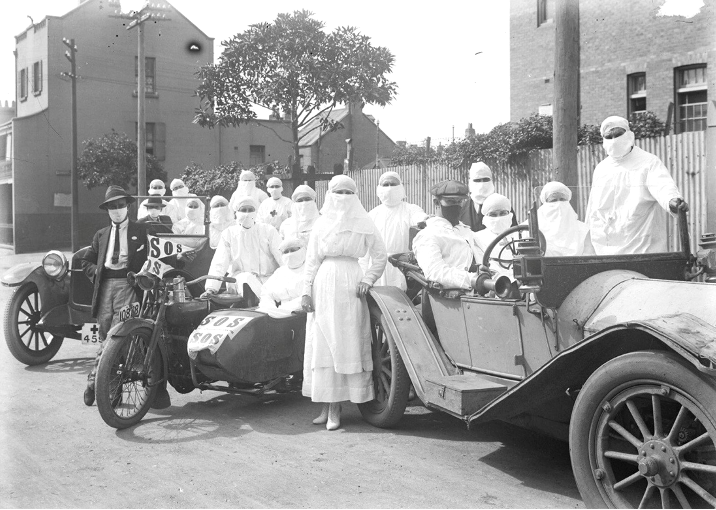
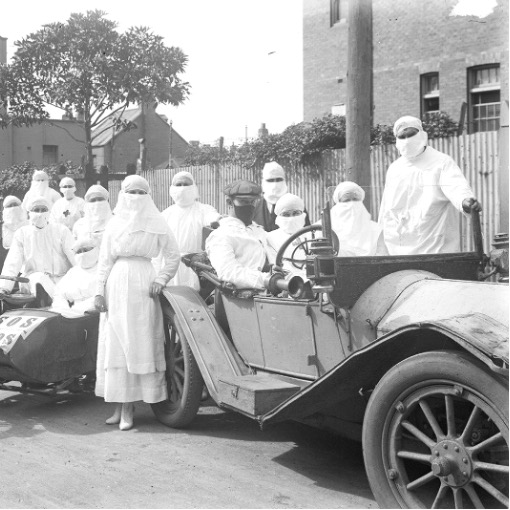
Medical staff and workers who dealt with the pandemic from the Riley Street Depot, Surry Hills – Sydney, April 1919 [NSW State Archives]
Inoculation depots in country areas delayed
The Raymond Terrace Examiner and Lower Hunter and Port Stephens Advertiser of 10 January 1919, page 3, reported that the Port Stephens Shire Council received a letter from the Board of Health, stating that as the danger regarding the spread of pneumonic influenza was now minimised, it was decided to delay the opening of inoculation depots in country centres.
Unbeknown to the Board of Health a further two waves of the epidemic were to arrive in April and May 1919.
Port Stephens Public Holidays cancelled
The Farmer and Settler of 25 February 1919, page 4, reported that by a special proclamation in the ‘Government Gazette’ all public holidays previously announced were cancelled in a number of country regions, including Port Stephens.
Antiseptic Nasal Cream available as a precaution against infection
Port Stephens residents were advised by the Raymond Terrace Examiner and Lower Hunter and Port Stephens Advertiser of 28 February 1919, page 2, that:
‘The Antiseptic Nasal Cream which is recommended by the Advisory Board of Health, for use as an application to the nasal passages for a precaution against pneumonic infection, can be procured at the local chemist. It ensures a large measure of protection against the disease.’
Provision of an isolation bungalow at Nelson Bay
The Newcastle Morning Herald and Miners’ Advocate of 29 April 1919, page 5, reported:
‘Provision has been made for an isolation hospital at the bungalow near Corlis Head, Nelson’s Bay. There have been no cases of influenza from the locality, however, but in view of the spread of the disease, the precaution is a wise one.’
Proposal to make Port Stephens a Quarantine Area
Starting in 1919, amid the influenza pandemic, there were repeated attempts to relocate the North Head Quarantine Station from Manly to Port Stephens due to concerns about infection spreading to Sydney.
The Dungog Chronicle of 2 May 1919, page 2, reported:
‘There have been many agitations for opening up that great port which lies above Newcastle, Port Stephens, and the agitations have sprung from different causes. At the present time since the influenza epidemic has assailed the people of New South Wales, there has been impressed upon the minds of the Government authorities the necessity for having a suitable place for purposes of quarantine. The best method of keeping the country free from the epidemics that periodically carry off so many of the States’ citizens is to keep disease out of the State, and quarantine is the way.
The unsuitability of the present site on North Head is unquestioned. Speaking on the matter recently the Minister for Customs, in reply to a deputation urging removal of the station from North Head said: — Every terminal port in the world had quarantine facilities, and there could be no doubt that if Sydney had not these facilities the trade of the port would to some extent be interfered with. There was great difficulty in finding a place for quarantine other than Sydney, and still allow the trade of the country to go on unimpeded.
The exigencies of quarantine were such that the authorities had to be prepared for some emergencies. Improvisation was out of the question. Most of the sea traffic converging on Sydney, apart from that coming past the southern coast, came down from the north and north-east. It would not be proper in cases of sickness to send vessels further south; therefore the Government had come to the opinion that for a quarantine port of New South Wales it should look northward. Port Stephens appeared to offer the desired facilities. A short railway to Maitland would give the necessary connection.
Departmental officers had been directed to go into the subject and report upon a transfer of the quarantine area from North Head to Port Stephens. In the event of such removal he did not think anything could be done to prevent a certain amount of trade being diverted from Sydney. If it was decided to make Port Stephens the State quarantine port, the development of that port would probably follow, and in that way the Federal Government would probably be able to recoup itself for the large outlay necessary for the equipment of a modern quarantine station.’
Efforts to relocate the quarantine station from North Head were unsuccessful, due to protests from the Port Stephens community and other groups. The station finally closed on 16 March 1984, becoming part of Sydney Harbour National Park.
Information on the Proposals to Establish a Quarantine Station at Port Stephens is published on this website and can be found at this link.
Port Stephens Shire Council funds influenza treatment
The Maitland Daily Mercury of 4 July 1919, page 4, reported:
‘The secretary of the Maitland Influenza Administrative Committee (Mr. W. J. Saunders), has received from the clerk of Port Stephens Shire Council, in answer to his representations, a letter stating that, in view of the Maitland Administrative Committee having admitted a number of serious cases of pneumonic influenza to the Isolation Hospital in Maitland from the Maitland end of the Port Stephens Shire, the Council has decided to contribute £20 towards the funds, and the amount would at once be forwarded to the hon. treasurer.’
Update on the local epidemic situation
The Raymond Terrace Examiner and Lower Hunter and Port Stephens Advertiser of 4 July 1919, page 3, reported:
‘The severity of the epidemic is still being sorely felt in most localities, and the death rate as a consequence in every town and district has greatly increased. In the Sydney areas the recrudescence has been the severest yet felt, in infection, though the death rate does not appear to be any heavier. There are thousands down with it, and business is at a dead lock.
This week has seen a slight improvement though, the wave appears to be receding, only perhaps to rebound in a month or six weeks with another severe turn. The deaths in Sydney have been 45 to 50 per day from the public hospitals, and many more from private homes. This district is passing through the tail end of the attack. Only now do we hear of an isolated fresh case. It has wrought havoc in many homes. Those who went down in batches in the early part of the attack, are mostly about again.
At Karuah the epidemic reached them about a week later than at the Terrace, and the cases there are many. There are fully 30 in the aboriginal camp. Around Williamtown too, there are many cases, and some serious ones have developed. Every case, if not treated cautiously and carefully develops pneumonia or pleurisy. It may be, by many, called a cold, but it is a much more insidious and dangerous attack, though it may not feel so at the time, and should be treated as something worse than a cold. In many cases its light attack has been its danger.
Every care should be taken by everyone till the winter is over, and no one should travel about any more than necessity demands, as it is only by isolation can the epidemic be wiped out. It may recur again if care is not taken, and the wisest plan is to stay at home. Keep away from possible sources of infection.’
Port Stephens Shire Council staff affected by influenza
The Raymond Terrace Examiner and Lower Hunter and Port Stephens Advertiser of 4 July 1919, page 3, reported:
‘Some of the maintenance staff [of Port Stephens Shire Council] have been off work through the pandemic now raging through the Shire.’
Karuah badly affected by the epidemic
The Dungog Chronicle of 15 July 1919, page 2, reported
‘At Karuah it is reported that ‘flu visited nearly everybody. Two or three deaths occurred amongst the blacks’ children. ….
Last week Mr. and Mrs .W. Longworth, of Karuah, Port Stephens, forwarded a cheque for £50 to Mr J. Lawson for distribution among the needy influenza cases of Newcastle or its suburbs. Through the generosity of these well-known and popular folk the Hamilton committee was able to use £25 for local needs, and Adamstown, Carrington, and Wallsend were apportioned £8 6s 8d each for the buying of necessary foodstuffs.’
Death of King Billy Ridgway from influenza
The influenza epidemic resulted in the death of numerous aboriginal people in the Port Stephens area. Most notable of the deceased was King Billy Ridgway.
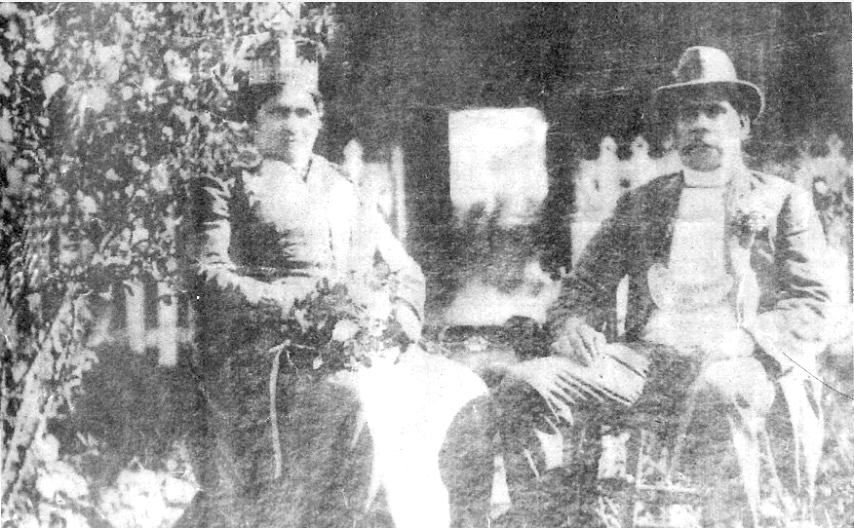
King Billy Ridgway and Queen Charlotte of Port Stephens [Boolah Dillah Art, Culture and Knowledge Centre]
The Maitland Daily Mercury of 17 July 1919, page 4, reported:
‘We learn that there have been a good many cases of influenza in the Karuah (Port Stephens) district and among the victims is Mr. Ridgway King, of the Port Stephens aboriginals. King was one of the best known and most respected residents of the district. Prior to its resumption for Federal purposes in connection with the naval station, his place at Soldier’s Point was one of the well-known places of the Bay, but of late years he had resided on the reserve at Sawyer’s Point [Karuah]. He was a most capable boat-builder and skilled in the management of sailing boats, frequently taking prizes against all-comers. We understand that two of the King’s grandsons also succumbed to the prevalent malady.’
Further information on King Billy Ridgway and Queen Charlotte is published on this website and can be viewed at the following link.
Port Stephens Shire Council to claim influenza expenses
The Dungog Chronicle of 18 July 1919, page 3, reported that the Port Stephens Shire Council had received the following correspondence from the:
‘Central Influenza Board (country section), stating that they will meet all reasonable expenditure in connection with influenza. The President said about £30 had been expended to date. It was decided to make a claim for the amount.’
Tea Gardens affected by influenza
The Raymond Terrace Examiner and Lower Hunter and Port Stephens Advertiser of 18 July 1919, page 3, reported:
‘Influenza is raging in Tea Gardens, a large numbers being laid up by the disease, some bad cases have developed, but no deaths as yet.’
Nelson Bay free from influenza
The Raymond Terrace Examiner and Lower Hunter and Port Stephens Advertiser of 15 August 1919, page 3:
‘The influenza epidemic [at Nelson Bay] after raging for three weeks has now disappeared, and business has again assumed the normal. We are thankful to report there were no fatal case locally. Residents, especially those who were unfortunate enough to contract the disease, are most grateful to Nurse Evans, of the Board of Health Department, whose skilful nursing greatly minimised the severity of the complaint.’
The above report was published a number of weeks after the second wave of the pandemic was deemed to be over.
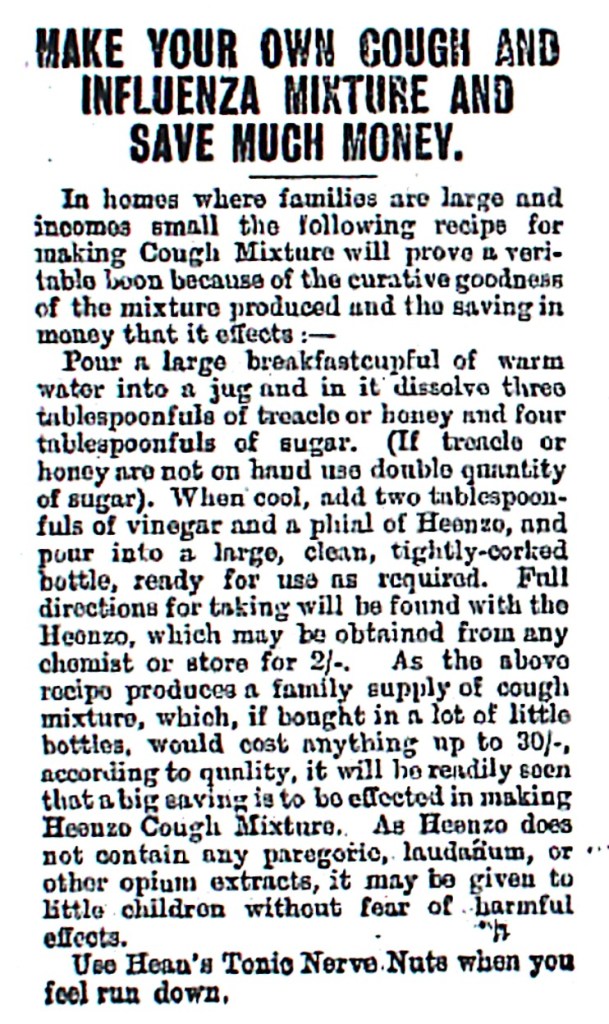
Do it yourself influenza cure
The Raymond Terrace Examiner and Port Stephens Examiner of 21 November 1919 published the following instructions on the preparation of ‘Heenzo Cough and Influenza Mixture’
Concluding Comments
While the Port Stephens was subject to the ‘Influenza Epidemic’, it appears that the death rate was minimal. The aboriginal community was not spared, and their much-respected leader was among those who died.
There were many similarities with the actions taken by government during the 1919 epidemic and those introduced during the COVID 19 pandemic.
Researched and compiled by Kevin McGuinness
January 2026

 Port Stephens - a history exploration