
Introduction
The Australian Star newspaper, in its editions of 29 March 1894 page 5, and 2 April 1894 page 5, published two articles describing picturesque spots around Port Stephens. They referred to areas such as the Myall Lakes, Aliceton, Bulahdelah, Tea Gardens, Hawks Nest and Nelson Bay.
The articles were written by a journalist who took part in a tour of the area organised by the North Coast Pastoral and Dairying Company.
The articles are of historical significance as they were written at a time when few people knew about the Port Stephens region. The two articles are reproduced below.
The Journey
‘It is a remarkable fact that very few persons know anything of the extent of the magnificent harbor Port Stephens. A visit to that beautiful and extensive spot shows it is destined to become noted for the picturesqueness of its shores, the hills near and far away, the wonderful facilities it affords for shipping, the last expanse of its water – twice as great as that of Port Jackson – the islands, now thickly covered with foliage, and its fine stretches of beaches. Added to these characteristics two pretty streams, the Myall and Karuah rivers, empty themselves into the port, the latter at the western side and the former a short distance from the northern head.
The entrance to the port, in which all the fleets of the world could lie at anchor, is a good one. Both headlands rise abruptly from the sea. East of the northern head is a large rocky island standing out to sea. This viewed from a distance of a few miles looks like the body of an immense tiger. It is 14 miles from the Heads to the western shore. All round nature has bestowed lavish and bounteous gifts.
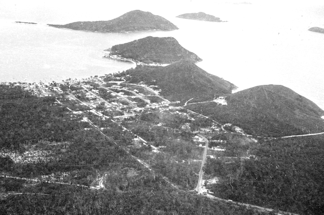
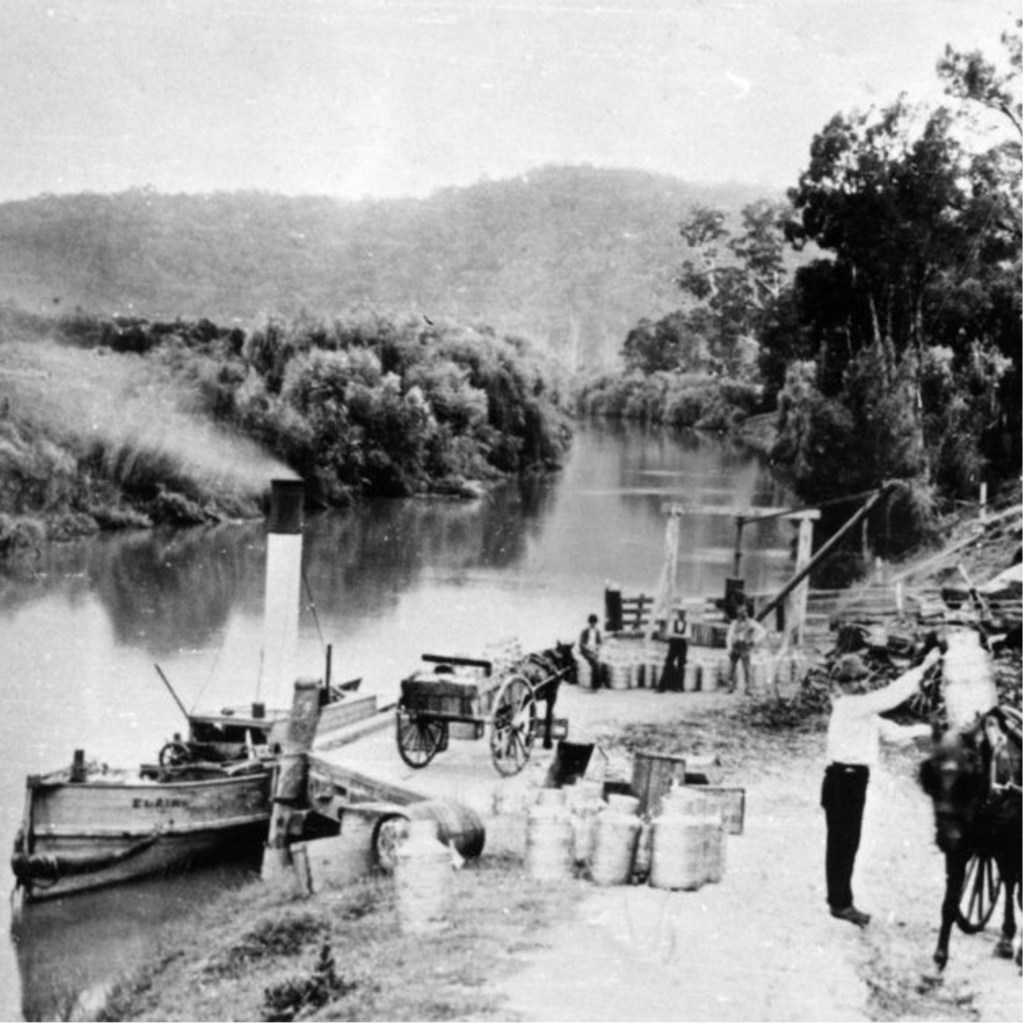
The entrance to Port Stephens showing the headlands of Yacabba and Tomaree [Arthur Renforth]
There are in reality two harbors, for about seven miles from the Heads the southern and northern sides run out in peninsula form towards each other, while right in the waterway between them is a large isle called the Middle Island. It is of beautifully even formation and covered with trees and shrubs. The scene was viewed by a party of gentlemen from Sydney during the Easter holidays from a launch which carried a picnic party organised by Mr. C. J. Muston, who has a residence at Aliceton [now called Karuah] near the mouth of Karuah, and facing the entrance to the port.

Charles John Muston – 1918 [Ancestry.com]
The visitors took train to Hexham, eight miles from Newcastle. The party that left the city on Sunday evening comprised press representatives, who were met at Redfern by Mr. Stevens, secretary of the North Coast Pastoral and Dairying Co. On arriving at Hexham, they were taken in a coach with four horses to Raymond Terrace, six miles away. The Hunter was crossed in a punt a few hundred yards from Hexham Railway Station, and for upwards of four miles the road passes through paddocks very little cultivated. Then a few houses are met with, and the habitations increase until the mail coach (Hexham to Gloucester-Stroud) stops at the post-office and the papers and letters are delivered there, the Hunter being, in close proximity.
The night was spent at the Cosmopolitan Hotel [at Raymond Terrace], and at 6 a.m. a breakfast of cold meats was partaken of, and the coach journey to Aliceton, the new name for Sawyer’s Point [now named Karuah], 18 miles off, commenced half an hour later. Raymond Terrace possesses three or four hotels, a number of stores, and two or three banks. Most of the business places and residences are situated close to the Hunter, and the land being low the waters from that stream inundate a considerable area here when the river is in flood. The streets are wide, and two of them are called Kangaroo and Bourke. The Hunter is now falling, but it is in several places only a few inches from the top of its banks, and the overflow during the past fortnight is still in many of the paddocks. The church stands on a hill and is not likely to be visited by floods.
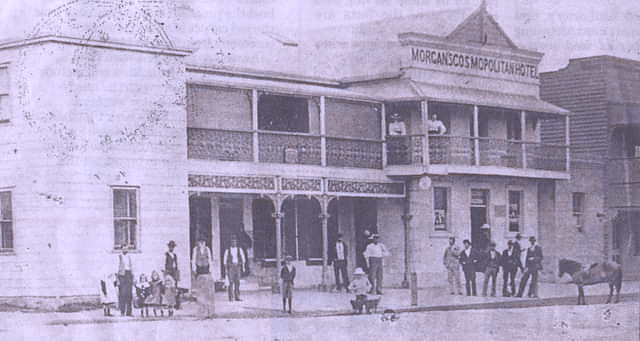
Cosmopolitan Hotel – Raymond Terrace
For 12 miles, except where there were a few gullies— and it would be unwise now to expend money in road formation on them— the track of the coach was along a fine macadamised road, and then the Stroud route was left by the party, and the remaining six miles to Aliceton occupied as long to cover as the preceding twelve, for the roadway is a good specimen of the average bush track in New South Wales. On both sides runs the North Coast Pastoral and Dairying Co.’s land, the road leading direct to the homestead at the head of Port Stephens. A good amount of jolting in the vehicle and a considerable number of wordy encouragements from the driver to his horses, intermixed with a few applications of the whip, to get along the boggy portions, now drying rapidly, a few bumps caused by crossing the corduroy parts and ruts, and the company, having taken three hours and a half on the trip, reach Mr. Muston’s residence at about 10 o’clock, the weather being fresh and bracing,
A number of other Sydney people having arrived a few days previously, among whom were Messrs. Best, Stinson, Purvis, all of whom are directors of the dairying company, introductions follow between the two contingents of visitors. Those last to arrive soon notice the hospitality which Mr. Muston displayed in a most openhanded manner to them during Monday and Tuesday. Due attention being given to a breakfast— the second that morning — in readiness for the city folk a party of 15 got on board a little launch, Elaine, which conveyed the picnickers up the two rivers and about the port for the two following days. A big hamper and boxes of provisions are shipped. Everything required to appease the already extra good appetites is provided, and there is a plentiful supply of good brands of liquors.
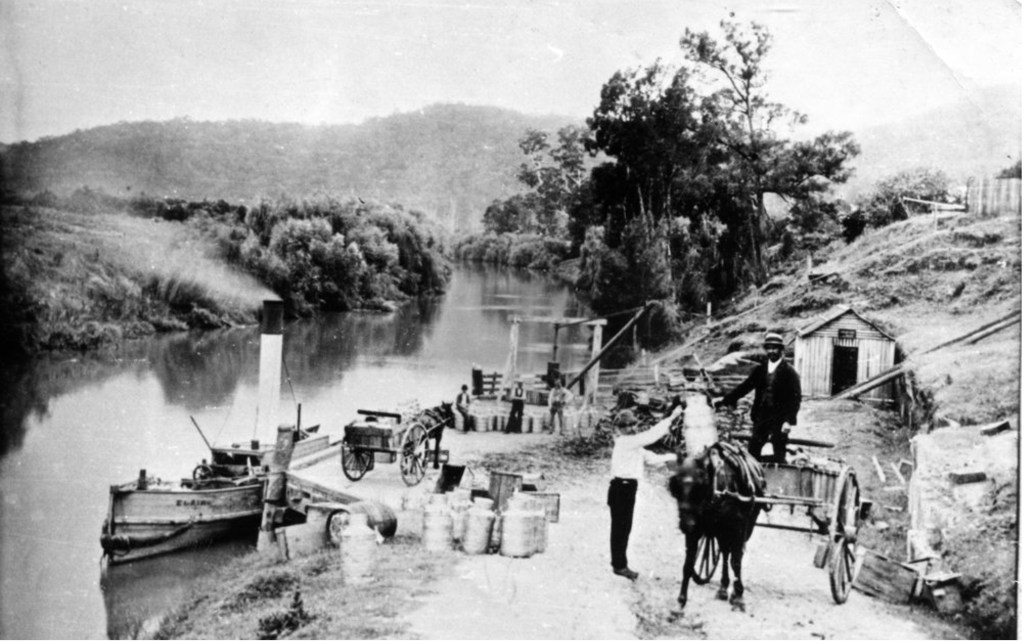
The river boat ‘Elaine’ on Paterson River at Dungog, circa 1890 [City of Sydney Archives]
The Elaine lies at the end of a long narrow jetty at the foot of the homestead. Her lines are cast off, and the party is taken up the Karuah River to view a portion of the Aliceton Estate fronting on that stream. The river is a most picturesque one, and after going along its southern bank, a straight stretch four miles long, the press representatives are taken over, a high part of the estate, Messrs. Muston and Stevens being the guides. A large area was traversed and everywhere was noticed a splendid coating of kangaroo grass. &c., the ground being in its native state. The mosquitoes were very persistent in their attacks upon the visitors. The Elaine was then headed down the river, which can be navigated by a 40-ton vessel, drawing about 5 feet, for about 30 miles.
The party of 15 picnickers, after navigating a few miles of the mouth of the Karuah River in the launch Elaine, started for a trip along the northern shores of Port Stephens, about halt-past 11 on the morning of Easter Monday, in delightfully calm weather, the vast expanse of water in the magnificent harbor being hardly broken by a ripple. A punt crosses the wide and picturesque mouth of the Karuah, running from the Australian Agricultural Company’s large estate on the north to Aliceton on the southern side. Steaming along at the rate of about seven miles an hour the Elaine passed at a few hundred yards from the punt a sawmill now shut up. This is one of the 23 out of the26 mills which at one time were in existence round about the port, and in full swing, but which are now idle. Nearby is a small row of untenanted cottages, which were in the milling days occupied by the timber cutters and getters. This embryo village is now deserted.
A stone’s throw further away the little steamer passes a small patch of beach. A few boats are out on the water, but there is only a one-roomed shanty in proximity. A number of coloured boys are playing in the shallow water. A blackfellow squats near them, and an old gin keeps popping her head in an out of the door of the diminutive dwelling, apparently too bashful to allow the picnickers to get a good view of her, although they are several hundred yards off. A local personage relates that amongst the little tribe of aborigines here a black woman has a white man for a partner to share her social joys and sorrows. Eleven or twelve children live with them in a wooden structure of the primitive order and of one room.
The residential property, Tahlee, of the Hon. R. H. D. White, M.L.C., is next noticed. It is beautifully situated on an eminence close to the water’s edge. It is backed and flanked by a hill covered with fine trees and shrubs. Not many hundreds of yards off in an easterly direction is a stone church built by convicts. In this edifice Dean Cowper (a local relater of history has it) preached over 60 years ago. The same authority says it was the first church that the dean delivered a sermon in. He points across the harbor to the southern shore and tells the passengers on the Elaine that a promontory is known as Soldier’s Point, for it was there the military paraded in order to watch for the prisoners who endeavoured to escape by swimming across. The church is situated in the village of Carrington.
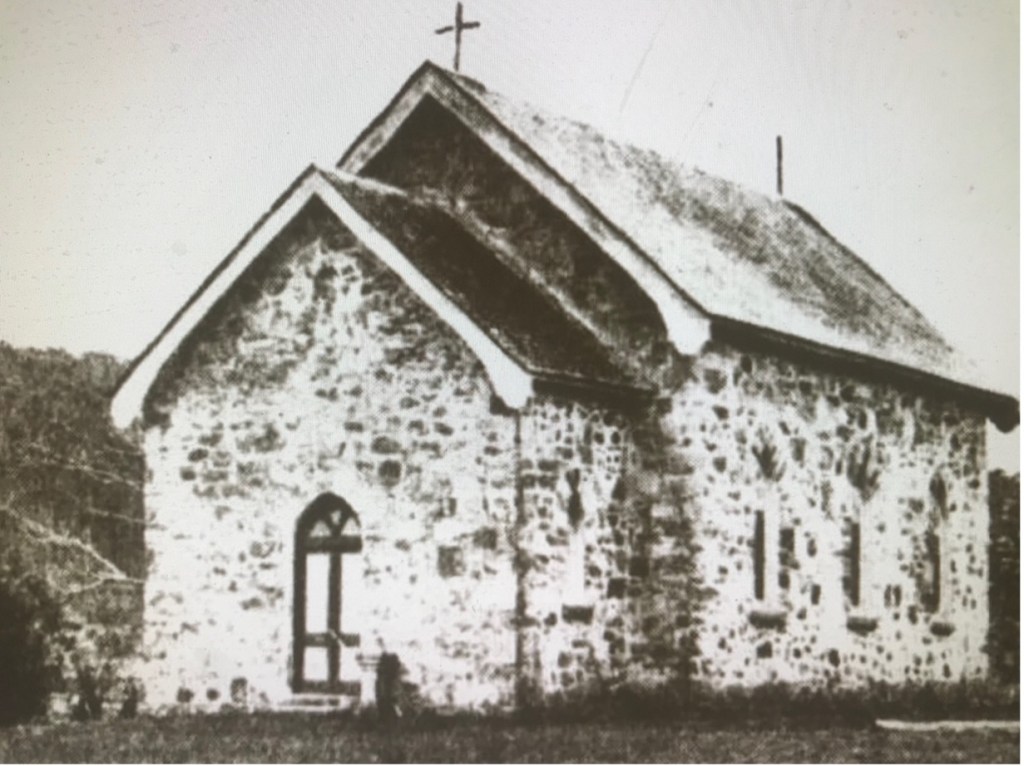
Carrington Church – circa 1935
Mosquito Island is passed on the starboard side, and a view obtained of Fane Bay on the left. It was about that and other pretty inlets that years ago small sailing craft used to load timbers, and about Fane Bay cattle were shipped by the Australian Agricultural Company. Many other bays are seen.
Away on the southern side is Nelson Bay, close to the Heads. Then further inland is Swan Bay, an inlet very large in extent, and Cabbage Tree Island, with beautifully green foliage all over it. This fine harbor is left by the party, who proceed up the Myall River, at the mouth of which are long low beaches. On these there are crowds of water birds. A “bang, bang” from a breech-loader on the launch puts all the feathered tribe to flight, a few large pelicans alighting but a short distance away, being the least scared by the gun’s report. Two miles up the stream the boat approaches The Hawk’s Nest, with but little pretension to be called a village. Its sawmills are idle, but it is the home of several fishermen, two of whom are engaged hauling in their nets. The Elaine was then headed for Bulahdelah, 50 miles up the Myall.’
Concluding Comments
This website contains several descriptions of early visits to the Port Stephens area, and they can be found at the following links:
The Lakes Travel route to Mid-North Coast
A Four Day Excursion to Port Stephens – Christmas 1906
A Personal Tour of Port Stephens – 1914
A Journey from Port Stephens Up the Myall Lakes to Forster – 1908
A Vacation Cruise from Sydney to the Myall Lakes – 1884
A Description of Nelson Bay – Port Stephens in 1892
Researched and compiled by Kevin McGuinness
December 2025

 Port Stephens - a history exploration