
Introduction
In July 1892, the N.S.W. Minister for Works and his party had an unplanned stay at Nelson Bay due to heavy seas preventing them from sailing further north. The Minister was heading to Kempsey where he was to officially open the recently constructed Sherwood Bridge.
The description of the Nelson Bay area of Port Stephens, as observed by one of the Minister’s party, provides an insight into the life of the Nelson Bay village over 130 years ago.
Observations of Nelson Bay
The Australian Town and Country Journal of 23 July 1892, page 11, reported on a rough trip that the N.S.W. Minister for Works experienced while weather bound at Nelson Bay:
‘The New South Wales Government steamer Thetis, with Mr. Lyne, Minister for Works, and others on board, left Sydney on July 14 for the Macleay. The Minister was to have opened the Sherwood Bridge at Kempsey, but as events turned out Mr. Dangar, M.L.A., performed the ceremony.
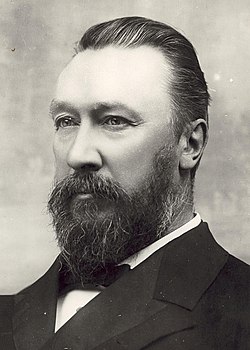
William Lyne [National Library of Australia]
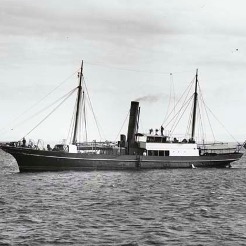
The steamer from the time it left Sydney encountered very bad weather, and after several attempts to make the passage, including a fruitless endeavour to land at Trial Bay, the Thetis put into Nelson’s Bay.
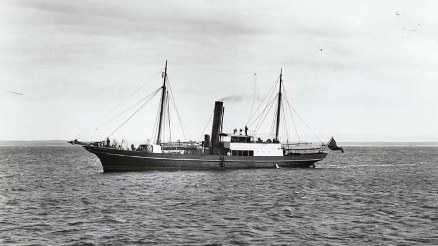
N.S.W. Government steamer ‘Thetis’ [State Archives & Records Authority of N.S.W.]
Our special correspondent on board the Thetis gives the following account of the steamer’s stay at this settlement: The reports from the various signal stations along the coast on Saturday and Sunday, sent specially to the Minister for Works, indicated that heavy seas were still running, and that it would be useless for the Thetis to again endeavour to enter either Trial Bay or the Macleay, consequently, Mr. Lyne did all he possibly could to make life happier than we had experienced it during the previous 36 hours.
The appetites of each improved to such an extent that on Saturday it was notified by the providore, Mr. Collins, that provisions were getting short. It was then arranged that foraging parties should be sent ashore to purchase supplies. I was told off with a fellow pressman, and the results of our labours were half a side of bacon, some corn beef, and the promise of a sucking pig if required. The other section of foragers secured poultry, eggs, &c., so that when the combined efforts were totalled it was found that sufficient had been obtained to supply all necessaries until we reached Sydney.
The village of Nelson’s Bay is composed of one hotel [Sea Breeze Hotel], well conducted by a most attentive host, Mr. Dent, who with his good wife did all in his power to make our stay in the village as pleasant as possible.
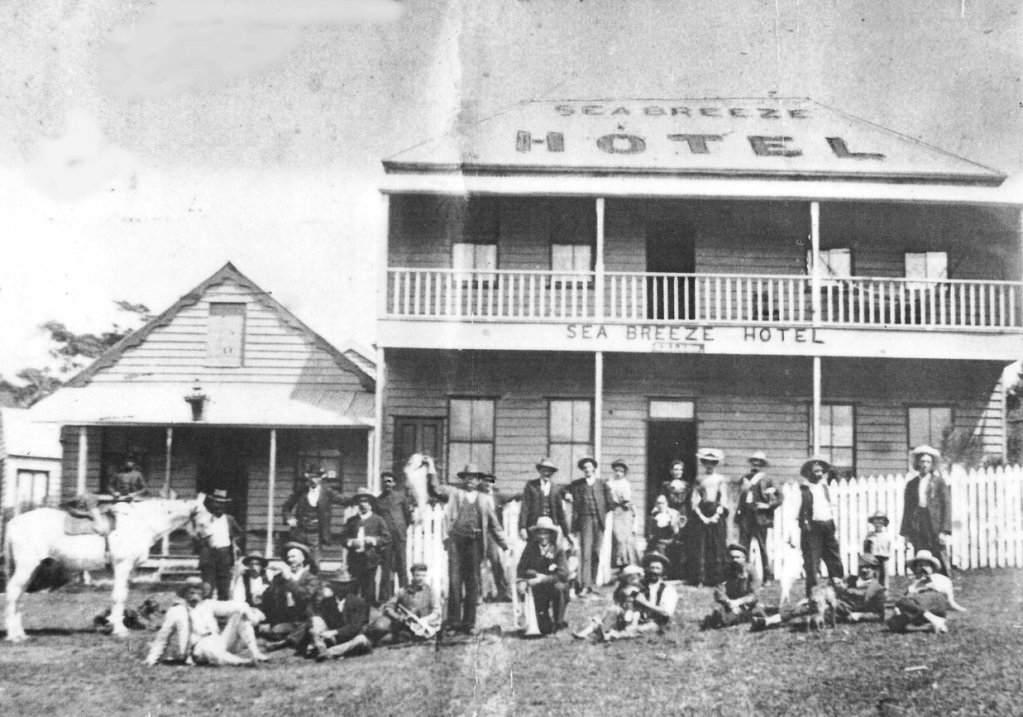
Sea Breeze Hotel – Nelson Bay
There is an accommodation house well conducted by Mr. Thompson, who also keeps the general store and newsagency. The post and telegraph offices are suitable buildings—the other residences comprise fishermen’s huts and the refrigerating rooms of the defunct Fish Preserving Company.
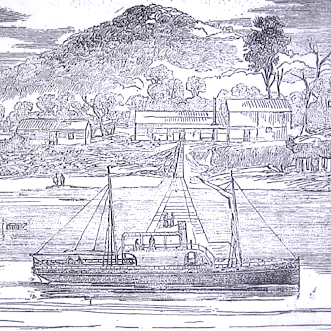
Fish preserving facility at Nelson Bay [Australian Town & Country Journal, 5 February 1881]
A chat with the fishermen was, of course, entered into by each of the visitors, and on inquiry as to the result of their work from a financial point of view one and all made pitiable complaints of the enormous charges for freight, commission, and cartage. Several returns from their agents were produced, bearing out this fact most unmistakably. If so many baskets of fish realised say £7 10s, the returns for these would not exceed £3 5s, being in nearly all cases 50 per cent for charges, which were deducted from the amount of sales. It costs 2s a basket for freight from Nelson’s Bay to Newcastle, and ls per basket by train to Sydney. Then cartage from the station to the fish markets, then commission on the proceeds of sale; then, if a basket of fish is sold for, say, 7s, the charges amount to 3s 6d, or one-half the total amount.
I suggested that they should co-operate, and only send their fish forward, say, twice a week, keeping the result of their catch in wells in a hulk, then hire a steamer to take their fish direct to Sydney. Something should be done to give these hard-working people more profitable results for their toil.
There were several camps of blacks, but more half-castes than aboriginals. Some of the children were almost white. These were provided with boats, rations, and blankets by the Government. The blacks travel about from one portion of the bay to another, never making a fixed home. Mr. Spain who was one of our party, had two photo cameras, and managed to get several interesting groups of the blacks’ camps and other bits of interesting scenery.
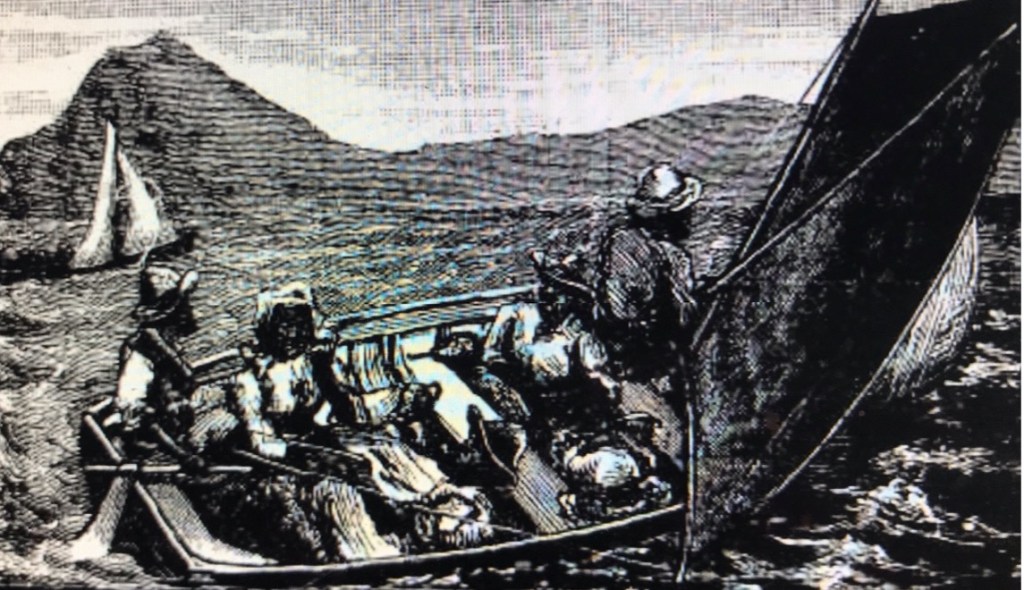
An Aboriginal Lobster Diving Party at Port Stephens in a boat provided by the N.S.W. Government [Sydney Mail and New South Wales Advertiser, 12 April 1884]
Our company were not successful in obtaining many of the finny tribe, notwithstanding they had the best of tackle and bait. The fishermen made two hauls of the net with very poor results, not sufficient for a meal for the party. On Sunday afternoon we steamed up the bay for some eight miles. There was a beautiful sunset, and as we reached Salamander Bay the reflection on the water was tinted in blue and gold; the sunset a line of dark blue clouds tipped and fringed with bright red and gold.
Passing on we reached Boondabah Island, and further on again the bay is bordered with hills and undulating country, and the land at its junction with the waters is bordered with flowering plants and stately reeds. Passing Soldier’s Point we approached a small rock which is only a few feet above the water. On this were perched hundreds of pelicans. The captain sounded the shrill whistle of the steamer, in order to make the birds take an upward flight, but to no purpose—they remained motionless. At this point there is 15 fathoms of water, and here and there small islands in mid-stream. The dark green foliage of the indigenous trees and shrubs is reflected upon the dark purple stream. It was one of the most charming spots it has ever been my pleasure to visit.
At midnight the signal to the chief-engineer was given to get ready, the anchor is weighed, Captain Hutton gave the word of command (half-speed ahead), and we gradually left the beautiful bay. I cannot conclude this sketch without thanking Mr. Lyne for his courtesy, and his subordinate (Mr. Collins), and others for their endeavours to make the trip agreeable. Only one general regret was expressed by the ministerial party, and that was at the great disappointment to the residents of the Trial Bay and Macleay districts at our having to abandon the trip.’
Official Opening of the Sherwood Bridge
The Macleay Argus of 20 July 1892, page 5, reported on the official opening of the Sherwood Bridge, in the absence of the Minister for Works:
‘The disappointment resulting from the non-appearance of Mr. Lyne, on Saturday, was severely felt, but as the cause was unavoidable, the committee, considering that they having ordered the banquet and published a programme, decided it best to carry out their intentions as well as they could, asking Mr. O. O. Dangar to act in the place of Mr. Lyne. This was done by Mr. Dangar very successfully.
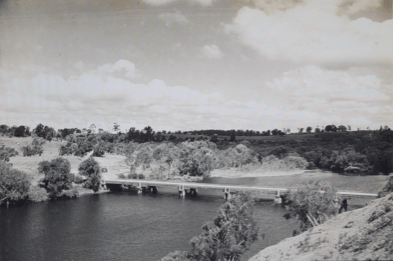
Sherwood Bridge over the Upper Macleay River, Kempsey [State Archives & Records Authority of N.S.W.]
He was at Trial Bay on Friday evening and saw the “Thetis” with the expected visitors on board, but finding that communication was impossible, he at once wired to the committee and received an answer to the effect specified above. Mr. Dangar with some friends came up the river in the “Athena,” arriving at Kempsey within a few minutes of the appointed time.
The wharf had been decorated, flags were displayed at most of the business places, and a considerable number of people were gathered to learn what was to be done. After a consultation with the committee, Mr. Dangar decided to proceed to Warneton in the “Athena,” receiving on the way a deputation from the Bellinger, which comprised Messrs. McDougal, Baker and Black, who interviewed him on the subjects of the delay in erecting their courthouse, the money having been voted and tenders called for, and afterwards withdrawn, and of the necessity of improving the entrance to their river. Mr. Dangar expressed himself as fully determined to see that justice was done to every part of his electorate. He had wired to Mr. Lyne’s second in command, asking him to see that the Minister was fully posted, as to five or six very important matters, and when he found that the passengers could not land from the “Thetis,” he had wired to Mr. Barling for information and unfortunately that gentleman was out of town; however, he (Mr. Dangar) would take action in their matters and see what could be done. ….’
Concluding Comments
This website contains several descriptions of early visits to the Port Stephens area, and they can be found at the following links:
The Lakes Travel route to Mid-North Coast
A Four Day Excursion to Port Stephens – Christmas 1906
A Personal Tour of Port Stephens – 1914
A Journey from Port Stephens Up the Myall Lakes to Forster – 1908
A Vacation Cruise from Sydney to the Myall Lakes – 1884
A Journey Around Port Stephens – 1894
Researched and compiled by Kevin McGuinness
December 2025

 Port Stephens - a history exploration