
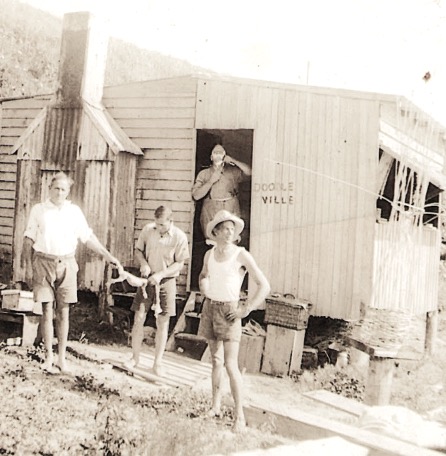
Introduction
Broughton Island, some 15 kilometres northeast of Port Stephens, was first charted by Captain James Cook on 11 May 1770 and later named after Captain William Broughton who took shelter at Port Stephens in 1795.
Captain Broughton undertook his journey in 1795 on ‘HMS Providence‘ a ship formerly commanded by Captain William Bligh. While at Port Stephens, Captain Broughton found four runaway convicts from Parramatta living with Aboriginal people. They were returned to Sydney, though their fate is unknown.

Captain William Robert Broughton [Wikipedia]

‘HMS Providence’ (left) and her tender ‘Assistant -, 1791 [State Library NSW]
Early 20th-century commercial fishing on the island mainly involved Greek, Italian, and Australian fishermen from Nelson Bay and surrounding area.
Prior to this, Worimi Aboriginals, the traditional owners of the land, visited the Island to fish. This story is currently being told in the Broughton Island Cultural Heritage Research Project.
Today, the island is managed by the NSW National Parks and Wildlife Service and comprises part of the Myall Lakes National Park.
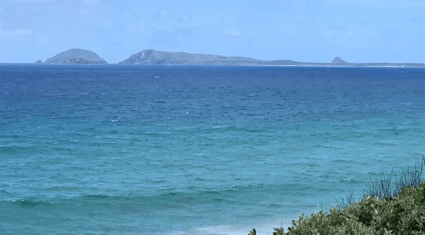
Broughton Island as viewed from Mungo Brush, north of Hawks Nest [Author photo]
This paper sets out the history of commercial and recreational fishing on Broughton Island and various nautical mishaps. Much of the material is sourced from records available in the National Library of Australia’s ‘Trove’ collection.
Reflections on the history of Broughton Island, that were published in 1951 are set out in the Appendix.
Memories of an Early Resident of Broughton Island, 1888 – 1890
The Newcastle Morning Herald and Miners’ Advocate of 28 July 1951, page 5, in the series from ‘Ian Healy’s Suburbia, This Week’, published the following recollections of Mrs. N. A. Sager, of Toronto, who went to live on Broughton Island in 1888:
“There have been residents on Gong Island – as it was known in the early days – for many years. The first that I know of were men of the Australian Agricultural Company, who put down a diamond drill, trying to get coal. The drill stuck fast, and they could not get it out. That would be about 80 years ago; in the 1870’s. It was around on the beach side facing Seal Rocks.
“Some aborigines used to go to the island fishing. Their names were Billy Price, his wife Nelly; two half castes – they called them Yellow Tom and Yellow Sarah-and a full-blooded lubra [female] whose name I forget. The black fellow sold his boat about 1881 and the only ones who went there, were fishermen to lobster.
“Then in 1888, my parents settled on the island. “My father went on ahead and was away lobstering when the rest of us arrived in a ship from Sydney. There was only one fisherman there. He could not understand why the steamer was hove to and it was a while before he came out to see about it. He took us ashore, with our belongings. “I do not forget my landing. I nearly lost my life. There was a strong westerly wind blowing and as I was getting out of the boat, a big wave lifted it and I fell into the breakers.
“I was washed onto the beach. Mr. Duncan told me to get up quickly before another wave came and washed me out. My mother was sitting in the boat with two smaller children screaming that I would be drowned. Mr. Duncan could not do anything to save me. He had to hold on to the boat or terrible things would have happened.
We were on the island nearly a week by ourselves before my father arrived. “He went lobstering and snapper fishing. When he was away, we were alone on the island. We saw no one. My father was home Saturday nights and Sundays. He left to start fishing on Mondays and on Thursday’s sail to Newcastle to sell his week’s catch.
“That coal shaft on the island was sunk there in 1889. Two men worked on it for about six months, then they gave up. There was a lawsuit over it. It cost a fair sum of money to put in that bit of a shaft. “We struck some bad weather there. Once, it lasted for three weeks. We were starving at the finish, and we nearly lost our big boat. We had a lifeboat hauled up where it was safe. “A man there we called Frank ‘ones was drowned. He must have sailed away, trying to get to Nelson’s Bay. His boat was found, washed up in pieces on the beach, and his body jammed in the rocks at North Head. He was buried there. “They did not know he had been drowned till my father went to Narrowgut [outer] lighthouse to try to get some food. He reported it. They had it in the papers that my father, Jones and a man from Tasmania were drowned. The man from Tasmania left the island the day the bad weather started, but he sheltered at Cape Hawke.
“There used to be a lot of pigface growing on the island. Fine cape gooseberries, too. “We had a few feeds of the mutton birds. They were not very nice. They were fishy and oily; a little better salted and dried. We also sampled the eggs. They were not bad. The mutton bird lays only one egg a year, in November.
“Speaking of. snakes, there were plenty of them when we were there, and few lizards. There were no rats, but a doctor who went there for experiments took snakes, guinea pigs and rabbits, and may also have taken the rats.”
Mrs. Sager’s letter ends with the family’s departure from the island in 1890. “We could not have stopped much longer,” she said. “The house was falling down. We had to prop it up.”
Stranding of the barque Esmeralda at Broughton Island – 1868
A prominent cove at Broughton Island which provides a protected landing area for visitors is Esmeralda Cove. The cove is also a favourite haunt of fishermen The cove got its name following the grounding of the English barque Esmeralda in that location.
Further information on the grounding of the Esmeralda at Broughton Island is found in the paper A History of 110 Shipwrecks at Port Stephens 1800-1950 on this website. Details of the Esmeralda are found at Ship 36.
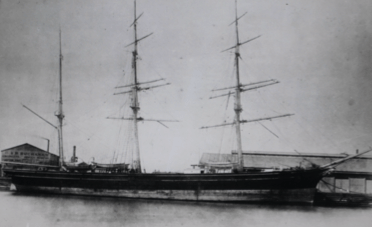
The iron barque ‘Esmeralda’ – 730 tons, at Melbourne [State Library, South Australia]
Dismasted ketch shelters at Broughton Island – 1874
The Sydney Mail and New South Wales Advertiser of 9 May 1874, page 606, reported:
‘The Ajax, Government steamer, has just returned from Broughton Island, having in tow the ketch Rachael, McLauchlan, master, with four of the crew and one passenger — named Archibald Cameron. The ketch left Sydney last Saturday week, bound for the Manning Eiver. She got dismasted on Sunday morning and took shelter under Broughton Island and remained there one week.
She signalled to two steamers, but no assistance was rendered until the Ajax [steamship] went to her this morning at 8 o’clock. They suffered no privations, having found a little flour in an uninhabited hut on the island.’
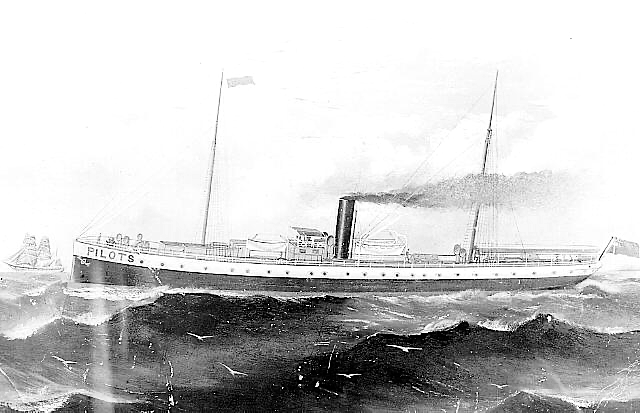
Ajax- pilot steamer [Newcastle Library, Hunter Photobank]
Coal mining trialled at Broughton Island – 1881
Coal Shaft Bay and the Coal Shaft Track are located on the western side of Broughton Island. The names are a reminder of attempts made in this area in the 1800’s to find coal deposits suitable for mining.
An excursion party from the Australian Museum, passed Coal Shaft Bay in February 1881 in a boat, and their comments were published in the Australian Town and Country Journal of 12 February 1881, page 23:
‘Passing inside the Broughtons, a group of bold rocky islets, sparsely clothed with stunted sombre-tinted vegetation, lying just off the entrance to the [Port Stephens] harbour; and steaming rapidly up the coast we were soon abreast of Long Island [Broughton Island], on which not a tree of the size of a gooseberry bush was to be seen, the only prominent object that met the eye on its wide expanse of undulating grassy surface, girdled by cliffs and sand beaches of pearly whiteness, being a small hut erected near a permanent spring of good water by a prospecting party engaged there some time ago in boring for coal.’
Further information on the trialling of Coal Mining at Myall Point and Broughton Island can be found at this link on the website.
Fisherman escapes drowning – 1886
The Newcastle Morning Herald and Miners’ Advocate of 22 September 1886, page 5, reported:
‘A fisherman named Oliff Brant appears to have had an almost miraculous escape from drowning at Broughton Island some three weeks since, and the facts have only just come to light by the arrival of the piscatorial [fishing] gentleman in Newcastle. It appears that he left Port Stephens in his fishing smack for the purpose of fishing several miles to the northward, there also being two other boats in his company. After being absent throughout the day the party turned homewards. The weather wore an exceedingly threatening aspect, and ominous clouds on the horizon appeared to be the precursor of bad weather.
When off Broughton Island, at 10 o’clock the same night, the three boats dropped anchor for the purpose of being sheltered. Brant, who was the only occupant of his craft, commenced hauling in his moorings for the purpose of better ensconcing his vessel further round one of the points. The anchor here began to drag, and in a few minutes the boat struck the rocks heavily and turned upside down. Brant dived, as he had no wish to be entangled under the craft, and commenced a struggle for life in the water, not knowing whither he was going, the night being pitch dark. He was, however, a good swimmer, and shortly touched against a rock, which he grasped, until a huge wave washed him high and dry some distance above.
Here he remained until next morning, when he happened to attract the attention of a passing vessel, and was taken to Port Stephens where, after providing himself with a bag of flour, he set sail for Broughton Island for the purpose, if possible, of picking up his boat, if she had not already been smashed to atoms by the force of the waves and rocks. He, however, found that such was not the case, as she was lying high and dry, although the whole of her port side was stove in.
Brant at once set to work to repair the damage, and hauled the vessel up the rocks, a distance of over 20 feet, without any aid whatever, and was on Broughton Island by himself for nearly three weeks, at the end of which time his frail craft was patched up sufficiently to bring her to Port Stephens, which was done, and from the latter port she was towed to Newcastle by the Kingsley [steamer]. She is now in the workshop of Messrs. A. Fraser and Sons, where she is being put in seagoing trim once again. Brant states that had he not managed to grasp the rock above mentioned he must inevitably have been drowned.’
Organised fishing excursions to Broughton Island prove popular – 1892, 1893
The Newcastle Morning Herald and Miners’ Advocate of Monday 23 May 1892, page 5, reported:
‘The steamer Awhina will leave the Newcastle wharf at 12 o’clock tonight for Broughton Island, and the whole of Queen’s Birthday will be devoted to the best piscatorial sport. Bait will be provided on board.’
The Newcastle Morning Herald and Miners’ Advocate of 2 August 1892, page 8, also reported:
‘A party of 16 members of the Waltonian Fishing Club proceeded to Broughton Island in the steamer Stormcock yesterday, in quest of piscatorial sport. The weather was very pleasant, and on the whole the outing was as pleasant and successful as could have been expected. Altogether 253 fine schnapper were hooked, and the sport was well distributed.‘
The Newcastle Morning Herald and Miners’ Advocate of 25 January 1893, page 7, likewise reported:
‘The steamer Emu will leave the wharf at 12 o’clock tonight on a fishing excursion to Broughton Island. Bait will be provided on board, and a good haul is anticipated.’
Two castaways on Broughton Island suffer privations for nine days – 1894
The Bathurst Free Press and Mining Journal of 24 May 1894, page 3, and other newspapers reported on the terrible experience of two fishermen stranded on Broughton Island:
‘A terrible story of suffering and privation on Broughton Island, a few miles north of Newcastle, is given by two fishermen who landed in Sydney yesterday. Their names are Richard Price and William Walters, and they hail from Newcastle. They left Newcastle in a fishing boat on the 4th inst. and reached Port Stephens the same afternoon.
The next morning, they proceeded to Broughton Island, and on the way the boat struck a sunken reef about a quarter of a mile from the island, with the result that the craft sprang a leak. The leak proved too big to cope with, so the men ceased bailing and rowed hard for the shore. They reached the island in time to save the boat from sinking, and managed to beach her, not, however, before the provisions were spoiled.
For nine days they subsisted on shellfish and water. They bad a sail for a covering at night and having saved a few dry matches were enabled to light fires. They hoisted a shirt to attract passing steamers, but the signal was not noticed, owing, no doubt, to two big hills partially obscuring the view.
On the 14th inst., the steamer Kingsley, trading between Cape Hawke and Sydney, called off the island and landed five Italian fishermen, who, upon learning the experience of the two castaways, readily invited them to partake of some food which they had brought with them. Five days later the Kingsley again called off the island with a fresh supply of provisions for the Italians, when Price and Walters embarked and came on to Sydney.
On arrival they went to the Shipping master, Captain Eedy, and were subsequently taken in hand by Captain Webber, Secretary of the National Shipwreck Relief Society, who purchased a new suit of clothes for each man and supplied their immediate wants. They left for Newcastle by the steamer Sydney last evening. The men speak very highly of the treatment they received from the Italian fishermen at Broughton Island.’
Unlicensed fishermen take over Broughton Island – 1894
The Australian Star of 23 October 1894, page 2, reported:
‘The member for Gloucester (Mr. Price) has been apprised by the fishermen of Port Stephens that a large body of unlicensed Italian fishermen has taken possession of Broughton Island. They have, says the correspondent, laid hundreds of lobster pots and mooring lines so it is impossible for any of the local fishermen’s boats to get near the island. They won’t even let the Greeks land there, alone let them fish.
All the fishermen and lobstermen, including the Greeks, were obliged to take out licenses some time ago; in fact, many were summoned, yet, it is alleged, not one of the Italians is licensed. As aliens these men are not allowed a vote, but they are allowed to fish without a license, although not naturalised. It would add hundreds of pounds to the revenue to have these men naturalised. The local fishermen are evidently very indignant.’
Wreck of the SS Centennial at Broughton Island – 1898
The Daily Telegraph of 31 December 1898, page 10, reported:
‘The steamer Centennial, bound from Sydney to Cape Hawke, went ashore on Broughton Island between 3 and 4 o’clock this morning, all hands being saved. The steamer has a hole in her hull and now lies full of water. It appears that the mate was in charge at the time of the mishap, but he is very reticent as to the cause of the steamer going ashore. The engineer thinks that she may he got off safely if appliances are sent to the scene at once. After the Centennial struck the fires were put out in 15 minutes. She had only a small amount of general cargo on board.
The steamer Centennial, word of whose stranding on Broughton Island was received here this afternoon, was owned by Mr. Andrew Sneddon, of Newcastle, proprietor of the Balmain line of steamers, and had recently been employed by him in the trade between Newcastle and Cape Hawke. She left here at 10 o’clock last night for Cape Hawke, with a small quantity of general merchandise for the storekeepers at Forster and on the Wallamba River, which had been brought up from Sydney by the steamer South Australian, and transhipped.
The Centennial was built at Honeysuckle Point, Newcastle, by Mr. A. Fraser, sen., to the order of Mr. Henry Treleven, and had a carrying capacity of about 40 tons. She was 76ft. long, with a 13ft. beam, and 6ft. 6in. depth of hold, and is described as a very good seaboat. Her engines were 21 horsepower. She was employed for many years prior to Mr. Sneddon purchasing her, about 18 months ago from Captain David Williams, in the Paterson and Hunter River trade, and she also ran for a time to Port Stephens.
Latterly she served as a drogher to the South Australian on the Clarence River, until she took up the present service to Cape Hawke. Mr. Sneddon has only just recently spent about £200 in thoroughly overhauling the steamer, and it is unfortunate for him that she was not covered by any insurance policy. The tug Secret has been engaged to leave Newcastle tonight at 12 for the scene of the wreck with pumping buckets and other appliances for emptying the wrecked steamer, with a view to refloating her. It is stated that the vessel filled in less than a quarter of an hour, and the water is now awash with her decks, and the chances of saving her are not therefore considered very good Captain Slyney has, however, wired for salvage apparatus, and it is being sent accordingly.’
The Evening News of 21 February 1899, page 6, further reported:
‘Salvage operations at the wreck of the steamer Centennial at Broughten Island have resulted in the recovery of the engines, boiler, winches, propeller, shafting, and other gear, all of which was brought to Newcastle last night by the steamer South Australian. The salvage work was carried out under the direction of Mr. A. Sneddon, sen., and Diver Ellison, who report that the hull of the vessel has completely broken up.’
Castaways survive for an extended period on Broughton Island – 1899
The Newcastle Morning Herald and Miners’ Advocate of 26 June 1899, page 5, and numerous other newspapers reported:
‘Two men, named Carpenter and Cain, who formed the crew of the fishing boat Schnapper, arrived here [Newcastle] today from Broughton Inland, and report that the Schnapper was wrecked at the Island on June 14. The men, who are in a terribly exhausted condition, state that everything was lost from the boat, including food, stores, &c., and since the wreck they have been existing on shellfish and water.
They state that they made signals to several passing steamers and vessels, but without success. They had given up all hope of being rescued by steamers and had almost constructed a punt from the wreck of the steamer Centennial [see above], in which they intended to pull to the coast, when a fisherman named Hammer, who had gone to the island to fish for schnapper, rescued them.
The Schnapper was a small vessel of 14 tons register, specially fitted out some months ago for schnapper fishing. Both members of the crew are residents of Newcastle, Captain Carpenter being well known in the fishing trade, and as one-time licensee of the Bellevue Hotel. Mr. Cain is also well known locally and resides on the Sandhills.’
The Sydney Morning Herald of 3 July 1899, page 8, also reported:
‘Captain Carpenter and Cain, a seaman, who were recently wrecked on Broughton Island, where they existed for ten days on shellfish arrived in Newcastle from Port Stephens yesterday none the worse for their sensational experiences. It will be remembered that their schooner, the Schnapper, of 12 tons, was lost on the night of June 14, and that with some difficulty Carpenter and Cain succeeded in reaching the shore.
They lived on the island for 10 days before they were successful in signalling a passing fishing boat. The men were rescued and taken to Port Stephens on Sunday last. The National Shipwreck Relief Society at the instance of the local secretary, Commander Frank Gardner, has granted assistance to the unfortunate men.’
Lobster fishermen drowned – 1905
The Newcastle Morning Herald and Miners’ Advocate of 31 October 1905, page 4, and other newspapers reported:
‘Two young men named Henry Lambourne and Archibald Marshall, fishermen, are supposed to have been drowned at Broughton Island. It appears that they were engaged lifting lobster pots on Saturday, when two heavy squalls struck their boat, and they have not been seen since. As the boat was only seventeen feet long, no hopes are held out for their safety. Search parties have been out ever since but can find no trace of the boat or its occupants. Lambourne is the son of Mr. H. Lambourne, the light-keeper at Nelson’s Bay, and Marshall only lately arrived from Scotland.’

Henry Edward Lambourne – lightkeeper at the Inner Light, Nelson Bay
The Daily Telegraph of 3 November 1905, page 5, also reported:
‘An oilskin, identified as that of John Lambourne, one of the men supposed to have been drowned at Broughton Island on Saturday, has been found near where the men were last seen.’
Dr. Danyez and the rabbit experiments on Broughton Island – 1906/ 1908
In the early 1900’s, large rabbit infestations were causing significant problems to pastoralists in New South Wales and elsewhere. The rabbits were having major impacts on the amount of grass available for livestock. Existing rabbit culling methods of trapping, fencing, and poisoning were largely ineffective.
A new method of rabbit eradication was deemed necessary by way of the introduction of a virus that only killed rabbits, and which could be spread by infected rabbits to other rabbits, regardless of whether they were on pastoral or Crown lands.
In 1905, the Council of the Australian Pastures Protection Board opened communications with Dr Jean Danysz, a well-known bacteriologist with the Pasteur Institute in Paris. He was invited to travel to New South Wales and conduct experimentation on rabbit extermination using a virus he had developed to eradicate rodents in France.
Broughton Island, was chosen as the ideal location for experimentation. Federal Government approval was given to Dr Danysz in 1906 to conduct his rabbit extermination experiments at Broughton Island. These were to be under strict government oversight by a government official, Dr Frank Tidswell. Dr Danysz, returned to France in May 1907, and left the balance of the experimentation in the hands of his assistant, Mr A Latapie, with oversight by Dr Tidswell.
By 1908, it had become evident that the experimentation had failed after a scientific review sought by the Federal Government. While the rabbit experimental party left Broughton Island in 1908, the rabbits remained.
Further information on Dr. Danysz and the rabbit experimentation on Broughton Island is found at this link on the website.

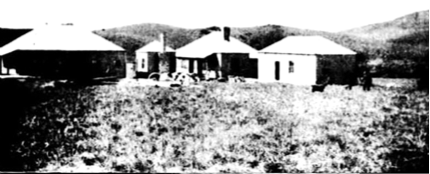
Buildings constructed on Broughton Island and used by the rabbit research team
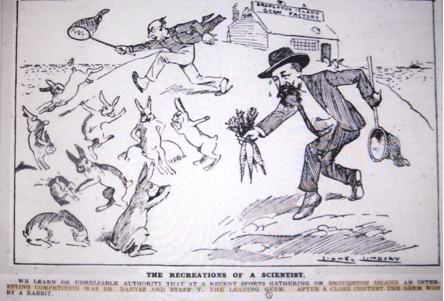
Cartoon featuring Broughton Island and the rabbits titled ‘The Recreations of a Scientist’ [Evening News, 8 December 1906]
Two steamboats collide near Broughton Island – 1907
The Macleay Chronicle of 7 March 1907, page 5, reported:
‘The ketch Rozelle collided with the North Coast steamer Nymboida off Broughton Island. The jib boom and bobstay of the ketch were carried away, but she managed to limp into port. The Nymboida stood by for some time but seeing the Rozelle was otherwise uninjured she proceeded on her way to Sydney. Upon inquiry at the ‘ North Coast Co.’s office it was found that the Nymboida was slightly damaged on the port quarter. She however left for the Clarence River.’
Earthquake shocks at Broughton Island – 1907
The Border Morning Mail and Riverina Times of 28 May 1907, page 2, reported:
‘Captain Cadden, the pastoralists’ representative at Broughton Island, states that at a quarter-past 11 a.m. on Wednesday last the inland community experienced what they took to be nine earthquake shocks, which occurred at intervals of about a minute. Each shock was accompanied by a rumble like thunder, and a slight tremor, which could be distantly felt. It is hinted that these shocks have been caused by the death grips of the multiplicity of rabbits which are dying from Dr. Danysz’s microbes.’
Fishing boat shelters at Broughton Island – 1907
The Sydney Morning Herald of 9 August 1907, page 9, reported:
‘The steamer Storm King was despatched from Newcastle early this morning by Mr. J. C. Reid, in search of the missing fishing boat and its three occupants, who were blown out to sea during the heavy squall the previous afternoon. After cruising about for some time Broughton Island, on which the rabbit experiments are taking place, was visited, and the boat was found under the lea of the island.
It appears that the men, whose names are Davis (2) and H. Manning, finding they were drifting seaward rapidly, partly utilised a small sail, and after some difficulty managed to run into shelter at the island. They state that they had a perilous experience, and several times, were almost swamped. The boat was towed back to Nelson’s Bay during the day.’
A leper station proposed for Broughton Island – 1907
The Evening News of 13 August 1907, page 4, reported:
‘Our Nelson’s Bay correspondent telegraphs that indignation is felt locally at a suggestion that Broughton Island is to be converted into a leper station, as it is one of the best schnapper fishing stations along the coast. He adds that the island has been extensively worked for crayfish, as many as 200 fishermen having been making a living there, besides being a popular pleasure resort.
An “Evening News” representative this morning saw Dr. Ashburton Thompson, President of the Board of Health, on the matter, Dr. Thompson said: — “The lot of the unfortunate sufferers from leprosy is hard enough without adding to it banishment to a barren island, where they would practically be isolated from their friends. At present, while kept apart from other people —quite sufficiently for all practical purposes— they are in cheerful surroundings near the Coast Hospital, at little Bay, inhabited by numbers of persons, whose movements to and fro they can watch. They are also within easy reach of friends who wish to visit them.
If they are to be placed over there they will never have a resident medical officer and consequently they will be withdrawn from that constant medical attention and the constant search for remedies, that will really cure them, which is of so much importance, not only to the patient but to everyone who suffers in the same way over the whole world. “To banish these unfortunate sufferers to any such place as Broughton Island would, in my opinion, be gratuitously cruel. But I know nothing of any such proposal, and I do not think it has been made.’
Severe storm at Broughton Island – 1908
The Sydney Mail and New South Wales Advertiser of 15 July 1908, page 147, reported:
‘Broughton Island, off Port Stephens, was visited by a heavy storm about ten days since. The lightning struck a small house in which a boatman named Nicholas and two boys were sleeping and demolished it. The occupants had a most miraculous escape but were uninjured. When the collapse of the building took place, after a violent stroke of lightning, Nicholas’s first thoughts were on the boys, for the walls and roof were in a heap. He heard the voices of the lads, and he managed to get his shoulders under one
of the beams and raise it up. By this means the boys were enabled to get clear.
The three then sought shelter at the cottage occupied by Mr. McKee, who has been in charge of the place since the scientist party left some time ago for the mainland. They were dazed at first but soon recovered under the kind treatment of Mrs. McKee. Next day Nicholas, who cannot understand how they escaped, tried to lift the beam again, but utterly failed, showing the superhuman strength he must have exercised.’
Buildings at Broughton Island removed to Milson Island on the Hawkesbury River – 1908
The Sydney Morning Herald of 21 October 1908, page 9, reported:
‘The buildings which were erected on Broughton Island by the Pastoralists’ Protection Board for the occupation of Dr. Danysz and his assistants during his experiments in connection with the destruction of rabbits, have been purchased by the Government, on behalf of the Department of Microbiology, and are to be removed to Milson’s Island, at Hawkesbury River, where most biological Investigations are to be carried out.’
A steamboat disabled near Broughton Island – 1911
The Singleton Argus of 3 August 1911, page 3, reported:
‘The steamer Orara, which left Newcastle this morning for Byron Bay, with 100 passengers, was towed to the lee of Broughton Island by the Noorebar in a disabled condition. When the Oram was first sighted near Port Stephens, she was nearly enveloped in a cloud of steam and smoke. When the Noorebar approached, the Orara, the signal master at Nelson’s Bay saw what he took to be, “Have you a surgeon on board?” The steamer Kallatina was despatched to the scene with Dr. Eames on board.’
Wreck of the Steamer Macleay off Broughton Island – 1911
The Macleay, a steamship owned by the North Coast Steam Navigation Company, foundered on rocks off Broughton Island on 11 October 1911, with the loss of 15 lives.
The loss of the Macleay occurred just over three weeks after the foundering of the steamship SS Rosedale, near Port Macquarie, with the loss of at least 24 lives. The combined loss of at least 39 deaths from the two ships focused attention on the dangers faced by mariners and their passengers.
The loss of the Macleay generated much interest, as the survival of two crew members for eleven hours in the sea, was widely reported.
Further information on the Wreck of the Macleay is found a this link on the website.
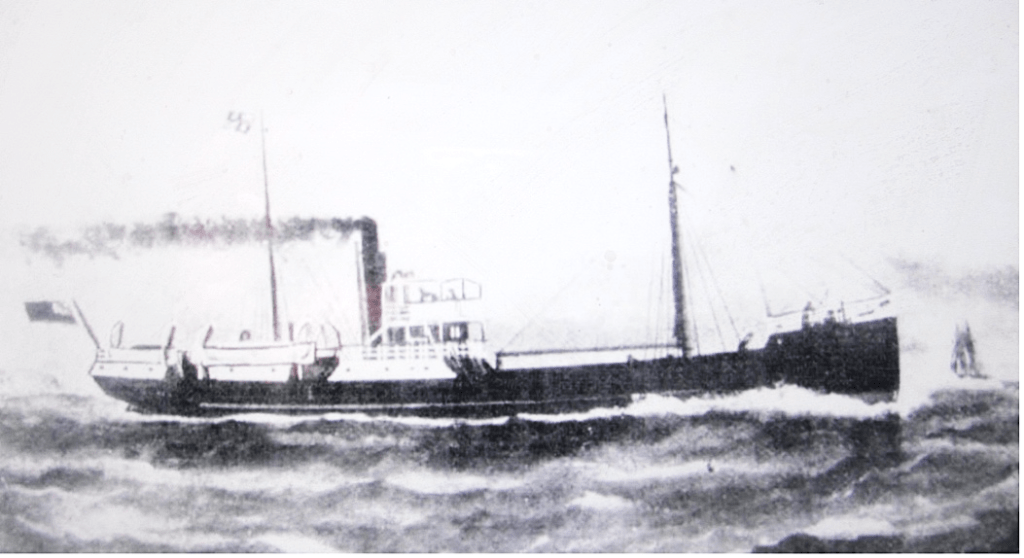
SS Macleay
The Daily Telegraph of 17 October 1911, page 7, reported:
‘The steamer Karuah, which left Port Stephens for Sydney this afternoon, had on board a raft, lifebelt, and box of butter, supposed to be from the steamer Rosedale, also a door that was picked up this morning near the Eastern Head, off Broughton Island. They are to be taken to Sydney for identification.’
Sculling champion Richard Arnst moves to Broughton Island as a fisherman – 1913
The Sun of 1 May 1913, page 2, reported:
‘Ex-champion Dick Arnst left Sydney last night in his motor launch Belper for Brougton Island, Port Stephens. Arnst has set out on his career as a fisherman, and expects to do well, as he has with him one who has done a lot of fishing around Port Stephens. Messrs. L. Clarke and W. Hobson accompanied Arnst and the party, and they expect to arrive at Broughton Island tonight. The Belper is a fine type of launch for fishing, being 36ft. in length, and fitted with a 10% h.p. engine.’
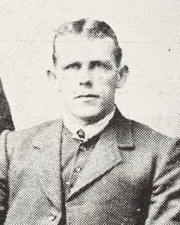
Richard Arnst [Wikipedia]
Recognition of the Broughton Island fauna – 1913
The Sun of 8 June 1913, page 16, reported:
‘Mr. S. E. Rohu, who has recently been to Broughton Island, the forbidding mass of rock which rises out of the Pacific a few miles to the north of Port Stephens, says that as a home for birds the island has high value. Many sea-birds nest in its rocky-crevices, and burrow in its soil, and the bird-lover may spend a pleasant week amongst them. Beyond rabbits and rats the land fauna is insignificant, but the birds compensate for all. ….
No doubt the time will come when there will be some settlement there besides the huts of crayfish catchers and fishermen. If, as is confidently anticipated, the big-game fishing available close to the island becomes popular, and people are attracted permanently to the island, it is to be hoped that they will not start using their guns and scaring the birds away. What birds and rabbits they will want should be trapped. In some parts of the island the earth is honeycombed with bird burrows, and one has to walk warily. Mr. A. S. le Souef, of the Sydney Zoo, considers the island a natural bird sanctuary, and hopes it will be kept so.’
Greek fishermen on Broughton Island and their boats – 1913
The Sun of 2 November 1913, page 12, reported:
‘Twelve miles to the north of Port Stephens Heads is Broughton Island, where there is a small colony of Greek fishermen, who engage principally in catching lobsters and snapper. They are the finest boatmen that come into the port. Their boats are somewhat bigger than those of the lake fishermen, but are only half decked, and the little engine is carried amidships under a box cover.’
Sixty dozen crayfish caught at Broughton Island – 1913
The Daily Telegraph of 14 November 1913, page 11, reported:
‘The crayfish [lobster] industry is now at its height. The crayfish come principally from Port Stephens, the Seal Rocks, Cape Hawke, and Port Macquarie in the north, and from Bateman’s Bay in the south. They are exceedingly prolific in the vicinity of Broughton Island.
Mr. David G. Stead, Government fisheries expert, says: “This is a highly profitable industry, capable of great expansion if the modern methods practised by a few of the fishermen were followed by many others. The crayfish always find a ready sale. As showing the possibilities of this Industry,
it may be mentioned that during the last two or three years enterprising fishermen have exported crayfish in a frozen state to Cairo and Asiatic Turkey, and even to Germany, where they have brought as much as 8d per lb.’
Steamship Marsina shelters at Broughton Island – 1919
The Newcastle Sun of 6 August 1919, page 4, reported:
‘The Burns Philp island steamer Marsina which left Sydney yesterday, with a scratch crew, for Papua and Rabaul, taking a cargo of food-stuffs to relieve the food shortage at those island, was sighted in an inlet off Broughton Island this morning. The reason for this stoppage is inexplicable but it is certain that there is nothing seriously amiss, as the steamer is fitted with an efficient wireless set and could have wirelessed for assistance if necessary.’
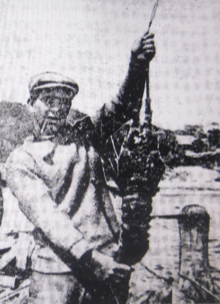
A large crayfish caught off Broughton Island [Daily Telegraph, 14 November 1913]
Fire destroys property at Broughton Island – 1920
In May 1920, a fire destroyed property belonging to a number of Greek fishermen who had huts on Broughton Island.
The two letters from Constable J. H. Deane, demonstrate the difficulty he experienced with his investigation of the fire.
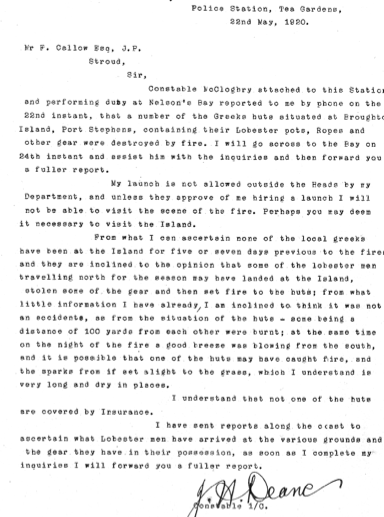
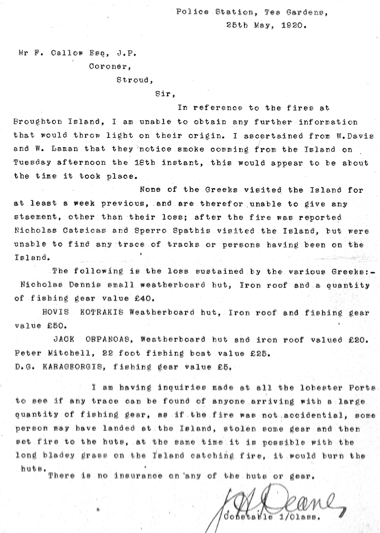
Letters sourced from John ‘Stinker’ Clark, Historian and Author of Fingal Bay, Port Stephens
Steamship Phil Forbes founders near Broughton Island – 1922
The Daily Commercial News and Shipping List of 8 May 1922, page 4, reported:
‘The signal-master at Seal Rocks yesterday reported that the well-known ketch Phil Forbes had foundered three miles north of Broughton Island during last Friday night, and that all hands were safe ashore on the island. The Phil Forbes was a wooden vessel of 87 tons register and was built at Lake Macquarie in 1899. She was owned by W. Langley & Sons, Ltd.’
Further information on the Phil Forbes is found in the paper A History of 110 Shipwrecks at Port Stephens 1800-1950 on this website. Details of the Phil Forbes are found at Ship 100.
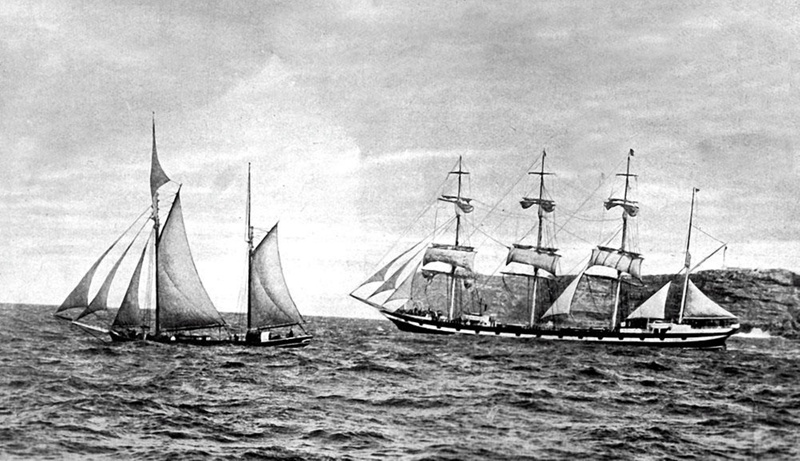
Phil Forbes (left) and Medway (right) passing through Sydney Heads [Sydney Mail, 17 May 1922, page 18]
Description of a day fishing trip to Broughton Island – 1922
The Dungog Chronicle of 27 June 1922, page 2, published the following description of a trip to Broughton Island that was provided by a correspondent:
‘The morning broke thick with fog as we were aroused from camp at 5.30 a.m. The fire was already in good going order, and breakfast made secure by 6.30, when we boarded the dinghy for the launch lying in Shoal Bay and just under South Head, Port Stephens.
Careful navigation was required as the rocky shore was hidden in the dense fog. Rounding the point we made for the northern headland and when about a hundred yards away, saw something ahead, which turned out to be two fishermen, pulling away, making for the northern beach to try their luck with the nets. We took the boat in tow and gave the men a rest till they cast off, and we headed to clear Cabbage Tree Island and made our way to Broughton.
The weather was clearer at sea, but the islands and rocky shore at our stern were still wreathed in fog. Members of our party, new to the journey and the scenery were much interested in the various points. As the fog on shore lifted, the numerous islands stood out in bold relief, and the outside lighthouse could then be plainly seen on the south, Bulahdelah Mountain on the north with the long range of hills further inland and intervening low land with its disadvantages and possibilities were all due for speculative discussion.
The sea was calm and full of interest as the birds overhead flew about looking for their morning meal and sighting a dainty morsel dived from a dizzy height to secure it. Porpoises sported on either side of the launch as we headed straight for Looking Glass rock [at Broughton Island]. From this angle, a view is obtained which enables one to see right through the water-worn hole. Round his rocky point we went and dropped our “bag” close to the “bummy” at the entrance to Eastern Harbour or Esmeralda Cove.
All hands being keen on schnapper, lines were soon out and by lunch time the basket had a very healthy appearance, fish up to about 5lb being safely landed. Presently one of the party spotted the blow off of a whale, and looking towards the eastern head all had a perfect and safe view of several whales sporting about as though for our especial benefit. Presently one rose sheer out of the water to quite a height of twenty feet, spread out its 8ft fins and fell backwards with a loud report in falling, throwing the sea into foam. Its mate repeated the performance within a few seconds.
For quite a quarter of an hour these two huge monsters engaged our attention. The effect was wonderful as the leap was repeated, for again the whale rose clear up, its mate this time playing only a few yards away. Fortunately, they were a safe distance from our launch which would not accommodate anything nearly so bulky. The colour of
these monsters appear a slatey grey on the back, the belly white, and the tail flutes about 6ft wide. The length was variously estimated 40ft to 50ft. long. It is a pity we had no camera fiend aboard for a man in search of interesting pictures would give something to be able to obtain a picture of so much interest.
As our entertainers had evidently left our vicinity we headed the launch for the little beach at the head of the bay, and landing in the dinghy proceeded with arrangements for a hearty lunch. A fire was soon set going in one of the fishermen’s humpies and a billy of tea made, bread, bully beef, sheep’s tongues, butter, pickles, and eight men with healthy appetites were soon in conflict.
Several took a walk up the track to the top of the island for a look round. It is quite evident that the island is inhabited by plenty of rabbits. A view to the south displayed the bay at the foot of the elevation, where were seen several schools of porpoises, lazily cruising about in search of their prey. To the north could be seen the top masts of the ketch Phil Forbes recently wrecked [see above], with a launch in attendance. As the wreck is considered to be dangerous to navigation in the inside course, it is recommended that the vessel be blown up.
Coming back to the beach, all were soon aboard the dinghy and conveyed to the launch in the cove, where half an hour was spent catching fresh bait in the shape of yellow tail, trevally and sweep. Off again on the trail of schnapper and let the bag down again close to the previous ground, and we soon had the satisfaction of topping up the basket with the famous red fish up to about 6lbs., and after trying a drift for strays wound up the lines about 4.30 with full basket of 50 schnapper. Red Cod and Leather jackets were amongst the catch but not counted in with the select tribe.
The run home was delightful, and, as on the way out, we were accompanied by the usual sea birds and the ubiquitous porpoise. The sunset was a splendid sight and betokened a fine day for the morrow. Our craft the “Viking” landed us safely at camp soon after six, where we were given a camp welcome by the home birds. A fry of schnapper was, ready and soon made disappear before the onslaught of the hungry fishermen. The usual tales were told of the big ones missed, but all were more than pleased with the day and all its incidents. The usual process of clearing and packing was carried out and, in the morning, a nice box of the best of fish despatch ed to our hometown, dear old Dungog.’
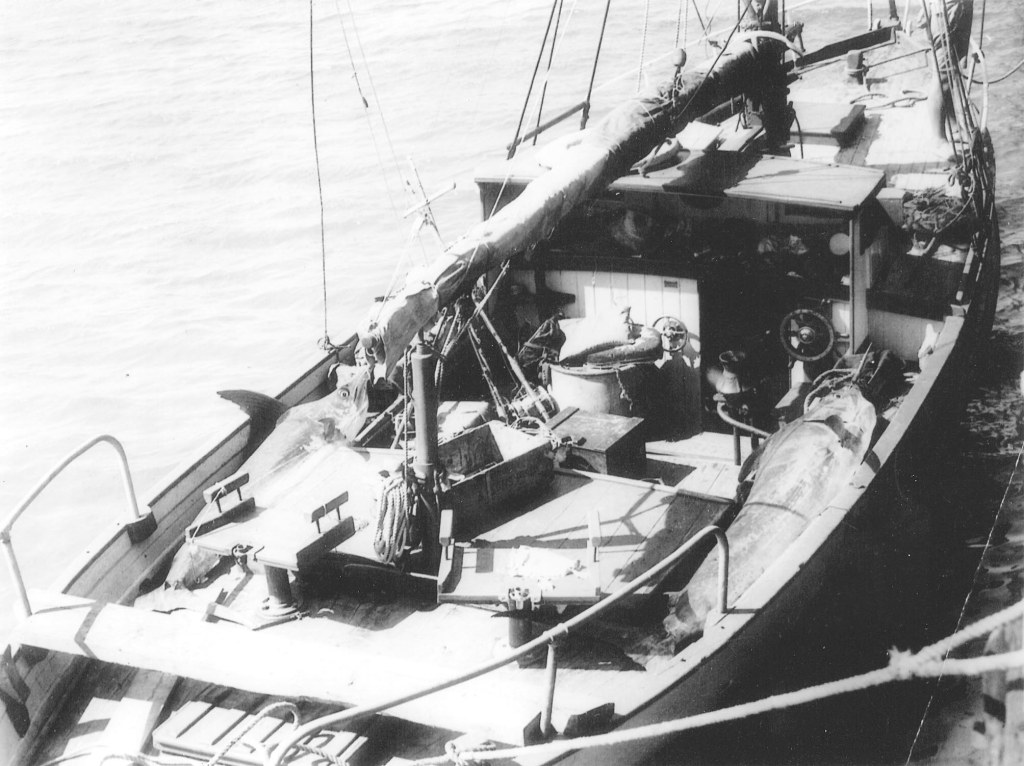
Two marlin and two fighting chairs on board the boat ‘Viking’ which was used for big game fishing.
Centre of lobster operations at Broughton Island – 1924
The Newcastle Morning Herald and Miners’ Advocate of 18 July 1924, page 7, reported:
‘The lobster season has opened at Port Stephens, and the first shipment was made this week. The centre of operations is Broughton on Long Island, which has become a scene of activity. Last season only five crews were engaged in the industry, but this year the number leas been augmented to twelve crews. Only fair catches have so far been made, but those taking part are hoping to have a good season to counterbalance the partial failure of the travelling fish season just finished.’
Greek fisherman missing from Broughton Island – 1925
The Northern Champion of 19 August 1925, page 3, reported:
‘Anxiety is being felt for the safety of two Greek fishermen on board the launch Miaqualis, which, left Broughton Island, near Port Stephens, for the lobster grounds some miles further north on Tuesday morning of last week.
One of the Greeks is said to be Speero Spathis, the owner of the vessel, but the name of his companion has not been ascertained. The Deputy Superintendent of Navigation, Captain Sangstar, ascertained from the light house-keeper at Seal Rocks that a launch had been seen there on Tuesday afternoon, but the vessel had proceeded north, probably bound for Cape Hawke. The pilot at Cape Hawke, however, stated that nothing had been seen of the vessel. Pilots, lighthouse keepers and masters of coastal vessels have been requested to keep a sharp lookout.’
Speero Spathis and his fishing companion did return to safety but there were no further newspaper reports concerning this.
Description of a fhing trip to Broughton Island – 1925
The Newcastle Morning Herald and Miners’ Advocate of 22 October 1925, page 7, reported:
‘A party, consisting of Messrs. A. E. Vesper, J. Wilson, M. Johnson, E. M. Vere, J. Neal, senior and junior, J. Hunter and E. Mogord left Nelson’s Bay last Sunday week in the launch Kelang for Broughton Island, which is situated about 11 miles north, and was reached in about two hours, after a pleasant trip. A landing was made at Eastern Harbour, the only buildings being three fishermen’s huts, which were used by the party.
After dinner a trip was made round the headlands, lifting lobster pots. The following day the party went fishing in a rowing boat off Looking Glass Point and were catching a nice lot of schnapper when a wind squall came away from the west. No time was lost in making for the shore, but the wind was so fierce that very little headway could be made. On rounding a spot called Bald Rock the full fury of the wind was met, and for about twenty minutes the boat was almost stationary, although two pair of oars were in use; but eventually the camp was reached after a very exciting two hours.
Trips were afterwards taken in the launch each day for a week, and good hauls of schnapper were always caught, the largest fish being 15 pounds, weight. Other varieties caught were rock cod, trevally, swepe, woorah, pike, sergeant baker, parrot fish, rainbow, and leatherjacket. A visit was made to the West Harbour, which is the headquarters of the Greek lobstermen, which consist of five huts.
About fifteen years ago Broughton Island came into prominence as being the scene of the experiments carried out by Dr. Dauzy [see above], a French bacteriologist, who came to Australia to demonstrate a system of rabbit destruction by inoculation with a germ. The island was not only stocked with rabbits, but with other animals to test the germ. The experiments, which cost the pastoralists nearly £10,000, failed to prove the efficacy of the theory, and were finally abandoned. The party found that there were still rabbits on the island, but not in large numbers.
There is little vegetation and not one tree on the island. Water is obtained from soakage from a hill in Wreck Bay, where tins are placed and fill from drips and improvised spoutings. One peculiar formation is a rock called The Fisherman, near Eastern Head, and, as the name denotes, it is very much like a man sitting on a ledge of rocks.
Some years ago a shaft was sunk at a spot now known as Boat Shaft Bay, in an endeavour to locate a coal seam [see above]. There is now but little trace of the work which was done. While the party was on the island two large whales were sighted at a distance of not more than 200 yards. The party returned to Nelson’s Bay at the end of last week after a thoroughly enjoyable trip.’
Greek fisherman drowns trying to save mates – 1927
The Evening News of 12 August 1927, page 13, reported:
‘A Greek fisherman named Statis, was drowned in a desperate effort to save two companions when their rowing boat capsized off Broughton Island early today. At 4 a.m. Statis and two other Greeks set out from Broughton Island in a motor launch to inspect their lobster pots. When the party reached its destination, the launch was anchored, and the three men entered a small rowing boat. A mile from land the boat commenced to fill with water and eventually capsized. The three men caught hold of the upturned boat but were rapidly blown to sea by a strong westerly.
Statis, who was the only one able to swim, decided on a desperate chance. He worked himself free of his clothes and commenced to swim towards the launch. His companions saw him draw nearer and nearer to his objective, but within striking distance, he threw up his hands, and uttering a cry, sank from sight. Another fishing party came on the scene some hours afterwards and took on board the two exhausted Greeks. Broughton Island is situated off Port Stephens, and there is a colony of Greeks there.’
His body was recovered by dragging.
Greek fisherman shot in arm – 1929
The Dungog Chronicle of 10 September 1929, page 1, reported:
‘Greek fishermen on Broughton Island gave one of their compatriots, who was leaving on Thursday, a rousing farewell. His departure was honoured by a salute of firearms.
Spiro Spathis, however, had the misfortune to be shot by his own gun. He was admitted to Newcastle Hospital on Thursday afternoon with a charge of shot in his right arm. The charge also broke the arm. A farewell scene to one of his mates, who was going to Greece, was responsible for Spero Spathis (40), a fisherman, being shot in the right arm with a shot-gun on Broughton Island in Port Stephens on Thursday. Spathis was taken to Newcastle Hospital Thursday afternoon, with a gun-shot wound in the right arm. His arm was fractured. He was picked up by the ambulance at Nelson’s Bay.
Several Greeks had been camped on Broughton Island for the lobster season, and on Thursday morning they had gathered together to say farewell to the Greek, who was going back to his country. Apparently, it was thought that a salute to their comrade was necessary, and a double-barrelled shot-gun was requisitioned. One shot had been fired, and Spathis was laying the gun on the ground, when the second barrel suddenly went off, the charge hitting him in the arm.’
A ’permanent resident’ at Broughton Island – 1933
The Dungog Chronicle of 23 June 1933, page 4, reported:
‘As it has become known that there is one permanent resident on Broughton Island, it is necessary to send a launch out to collect his census paper particulars. Even one person can be of such importance to warrant the expense.’
Photos of of fish catches by Members of the Newcastle and Northern District Deep Sea and Game Fishing Association who visited Broughton Island [Newcastle Sun, 19 January 1934]
Local Land Board considers rival applications for leasing Broughton Island – 1934
The Newcastle Morning Herald and Miners’ Advocate of 28 June 1934, page 6, reported:
‘Conflicting applications for a lease of Broughton Island, about eight miles from the entrance to Port Stephens, and having an area of about 350 acres, were determined in a deferred decision given by the Local Land Board in Sydney on Tuesday.
Mr. M. T. F. Jarvie, M.L.A., sought a lease of the island to establish a canning factory. Messrs. A. Williamson and J. R. Spencer, registered architects, asked for a lease with the object of developing tourist traffic by providing a clubhouse and golf links and facilities for rock fishing.
The Board recommended the granting to Messrs. Williamson and Spencer of a 28-year lease at a rental of £10 a year for the first three years and £100 a year thereafter, provided the applicants in three years spend £15,000 (at the rate of £5000 a year) in buildings and in otherwise carrying out the purposes of the lease. The Board said that the island was apparently a particularly attractive place from a tourist point of view, and, therefore a Crown asset of much value.
“Mr. Jarvie states,” the Board report proceeded, “that he has for some years given serious consideration to the development of our fish industry on the coast,” and that he is “conscious of the fact that in the environs of this island there are vast quantities of edible fish able to be captured there that could be turned to marketable use.” He admits he has never visited the island, and that he is “embarking on this venture on reports received,” but produces no evidence in substantiation of his statements that the island is suitable as a commercial fishing base. He states he has reached no stage for the development of the island beyond forming the idea, and that he has “carried on no similar work.”
The other applicants, Messrs. J. R. Spencer and A. Williamson, have both visited the island, and apparently thoroughly inspected it, and explored its possibilities for the purposes for which they desire to acquire it. Seemingly they are qualified to carry out the venture, provided they can raise the necessary capital. In this latter respect, however, both applicants leave much to be desired, but it does seem to us that Messrs. Spencer and Williamson have greater opportunities at their disposal for succeeding in raising the money than has Mr. Jarvie.
It was stressed before as that the purpose of the establishment of a fish-canning factory is a superior one to that of the development of the island as a tourist resort. Viewing the history of the fishing industry on the coast of this State and comparing it with the tourist industry on the north coast of Queensland, the highlands of this State and of Victoria, and that of Tasmania, New Zealand, and Norfolk and Lord Howe Islands, we entirely disagree with this idea, but whatever the opinion may be on that question we consider the mainland is the proper place for a fish factory. Large tracts of the coast are as suitable for the purpose as Broughton lsland, but apparently the State has few islands such as this one which could be developed as tourist resorts. We also consider the combination of the purposes, fish-canning factory and tourist resorts, most inadvisable.’
The Newcastle Sun of 29 June 1934, page 9, also reported:
‘To get first-hand information as to tourist possibilities, the [Newcastle] City Publicity Director, Mr. Cahill, will visit Port Stephens and Broughton Island this weekend. He will be accompanied by the town clerk (Mr. Glassop) and will submit a report to the Newcastle City Council.’
The proposed tourist development at Broughton Island never proceeded.
Sanctuary status sought for Broughton Island – 1934
The Sydney Morning Herald of 30 June 1934, page 19, reported:
‘The Royal Zoological Society of New South Wales has decided to oppose the proposal to lease Broughton Island as a tourist resort. It is claimed that the breeding places of sea birds would be disturbed.
The secretary of the society (Mr. A. Basset Hull) said yesterday that the council at its last meeting, decided to send a protest to the Minister for Lands against the leasing of the island and to urge upon the Chief Secretary the desirability of proclaiming the island a sanctuary for the preservation of bird life. There were few Islands on the coast which were the haunts of sea birds and as the birds would not breed on the mainland it was desirable to preserve their bleeding grounds.’
The Raymond Terrace Examiner and Lower Hunter and Port Stephens Advertiser of 8 November 1934, page 2, reported that the proposal for a sanctuary was rejected:
‘The Chief Secretary Hon. F. Chacey does not think it necessary to declare Broughton Island, Port Stephens a sanctuary as he does not think those who visit the island will interfere with bird life there. They won’t, there is none there. There are a few seabirds that nest there now. Thirty years ago, mutton birds occasionally nested there, but not in large numbers. The island off Port Stephens, known as Cabbage Tree, is the breeding ground for huge numbers of seabirds such as penguins, various petrels, gulls etc. and they no doubt chose this island as it is seldom visited by humans.’
Previous development proposals for Broughton Island put forward again – 1936
The Dungog Chronicle of 18 February 1936, page 3, reported:
‘Mr. Christianson, of Cessnock, is, along with other influential citizens of that town and Newcastle, promoting a new industry that should meet with great success. Schnapper and other fish will be purchased and treated at Broughton Island where the fish will be filleted and frozen by the “snap-freezing” process and despatched to market or to cold storage rooms. It is claimed that by this process a better quality fish is marketed, the full flavour being retained.
Another avenue will be that of catering for tourists. Log cabins will be built on the island and lovers of fishing will be conveyed there each weekend in a new £3000 boat specially built for the purpose. Schnapper can be caught off the rocks at Broughton Island which is one of the finest fishing spots on the coast. We wish the venture every success.’
The proposed tourist developments, similar to those proposed in 1834, never proceeded.
Fishing parties marooned on Broughton Island suffer food shortage – 1936
The Newcastle Morning Herald and Miners’ Advocate of 18 April 1936, page 10, reported:
‘The difficulties and privations experienced by fishermen who visited Broughton Island last weekend were related yesterday by members of several parties which returned to Newcastle late on Thursday night.
The gale which passed over the district on Sunday and Monday struck the Broughton Island area with such force that return trips to the mainland could not be made with any degree of safety until Thursday morning. Two parties which remained on the island until Thursday found their food supplies practically exhausted and had to fish in real earnest to supplement their supplies.
Another party, which attempted a crossing on Monday morning, narrowly escaped being swamped in the centre of a whirlwind. The party which returned to Nelson’s Bay on Monday included Dr. A. B. K. Watkins, A. Short, H. Wilson, and C. Kennedy, of Newcastle, and A. Buck, of Dungog, They proceeded as far as Seal Rocks in a launch on Friday, but found the gale so severe on Sunday that they ran back to Broughton Island for shelter.
It was essential that several members of the party should be in Newcastle by Tuesday, and early on Monday they decided to attempt the eight-mile run from Broughton Island to Nelson’s Bay. The crossing, which occupied two hours, was made with considerable difficulty. The party had hardly passed the bombora, facing a strong southerly, when the launch encountered a wind blowing from the east with hurricane force. The changing wind whipped up a whirlwind resembling a waterspout, which for almost a minute seemed to be centred directly over the launch. Disaster seemed inevitable, when the wind changed again to the south-east. The journey was completed in a heavy swell, but without serious incident.
Two other parties remained on the island until the wind abated. They included Messrs. W. Brown, N. McLelland, and G. Pepper, from Raymond Terrace, E. J. Marks, of Newcastle, W. Pender, of Maitland, and Messrs. Len Johnson, G. Jovelli, and H. Kershaw, from Sydney. They drove from Raymond Terrace to Nelson’s Bay on a motor lorry on Thursday with food supplies sufficient to last until Monday night. A good passage was made to Broughton Island on the Friday morning, and several large hauls of fish were caught in the sea off the island on Friday afternoon.
From late in the afternoon onwards, however, they were driven back to the rocks and had to content themselves with fishing from the shores for the remainder of the weekend. Food supplies began to run low on Monday, and by Wednesday sugar, bread, and other commodities were nothing but pleasant memories. A plentiful supply of eggs was all that remained to support the compulsory diet of fish.
Mr. Jack Campbell, a Nelson’s Bay launch proprietor, who had accompanied the party to the island, was cheered to the echo on Thursday morning when he announced that at least the sea had gone down sufficiently to permit the return passage. He led the way back to the mainland with most of the fishermen in his launch, while a second boatload followed shortly afterwards.
Anxious wives and friends, the fishermen learned later, had telephoned the Port Stephens lighthouse for news, and had been reassured by the information that although the party might be short of food, they had at least avoided any more serious plight, for no launch had left the island since Dr. Watkins’s party made their crossing on Monday.’
The freighter ‘Oorama ‘ disabled Near Broughton Island – 1936
The Tweed Daily of 31 August 1936, page 3, reported:
‘The Adelaide Steamship Company’s steamer Oorama struck a submerged object off Broughton Island, near Port Stephens, on route from Brisbane to Newcastle on Friday and was holed aft. Water made its way into bunkers, stokehold and engine room and a wireless message was sent for a tug. Last night the water was stated to be 15ft. deep in one part of the vessel. The fire engines pumped throughout the night and it was intended to plug the hole. When the mishap occurred the sea was calm, and it was fortunate the vessel was in a light trim.’
The Newcastle Morning Herald and Miners’ Advocate of 31 August 1936, page 6, also reported:
‘The damage to the Adelaide Steamship Company Ltd.’s interstate freighter Oorama. which struck a submerged object off Broughton Island on Friday morning, and was towed into Newcastle on Friday night, was not as extensive as was first thought. When the vessel was placed in dry dock at Walsh Island on Saturday it was found that there were several holes in the bilge keel, caused by rivets having been strained and torn out by the impact with the submerged object. Temporary repairs were made, and the Oorama will be towed to Sydney for an overhaul. The vessel will probably leave for Sydney tomorrow, provided the sea abates.’
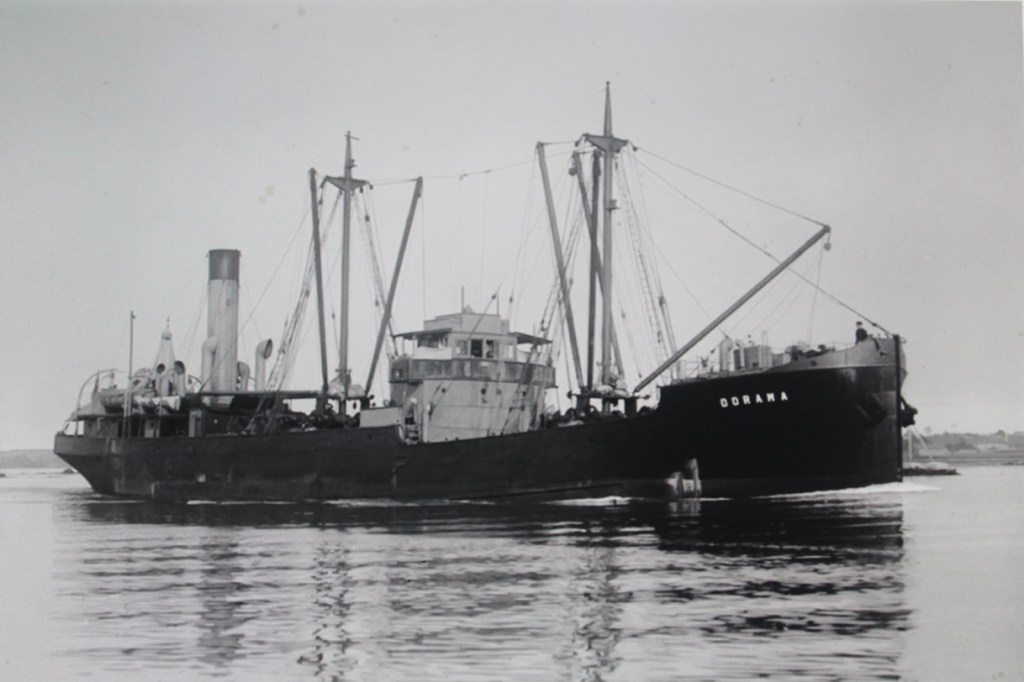
SS Oorama
Rough trip to Broughton Island by a Police Constable – 1936
The Dungog Chronicle of 23 October 1936, page 4, reported:
‘Constable A. Kidd had to go out to Broughton Island on police business last Sunday. He left the Island in the ‘Isis’ at 5 p.m. and was caught in the various winds that came up. After a very trying trip, he arrived at Nelsons Bay at 8 p.m. and stayed there, continuing the journey to Tea Gardens next morning.’
Successful fishing trip to Broughton Island – 1938
The Dungog Chronicle of 15 February 1938, page 3, reported:
‘There was choice schnapper on the menu in many Dungog homes during the weekend. Eleven anglers left Dungog about 11 p.m. Saturday and boarded the launch “Duncan” at Tea Gardens. It was scarcely daylight when Broughton Island was reached. The party fished around for several hours with success. They returned to Dungog by 4 p.m. with about 100 nice fish. The sea was comparatively calm but most of the fishermen experienced sickness. Some thought the launch was sure to founder because of its big load, which included the tiny tots, “Silver,” Jack and “Nugget.” Others hoped it would sink. Now that the roads are in good condition and the fish are plentiful, there are likely to be many more ocean jaunts to the schnapper grounds.’
Missing youths found safe at Broughton Island – 1938
The Daily Telegraph of 30 December 1938, page 1, reported:
‘Two youths in the 12ft. skiff Never-Fail, missing for four days, were reported safe last night. The skiff has been held up by engine trouble at Broughton Island, off Port Stephens, since Tuesday. Mr. J. Jansen, who returned from the island with a fishing party, reported this yesterday to Constable Kidd, of Nelson’s Bay, Port Stephens. The Never-Fail, an open skiff, with a 3 h.p. engine, manned by Len Jenkins and Bill Johnson, left North Bondi Beach on Saturday night for Port Macquarie. It arrived at Port Stephens on Sunday and left again on Monday morning. Yesterday the Maritime Services Board asked all ships and coast stations to keep a look-out. The Never-Fail met a 50-mile-an-hour north-east gale at Seal Rocks, and engine trouble developed.’
Fires on Broughton Island destroy huts – 1938
Similar to May 1920, fires again occurred on Broughton Island during December 1928. The Newcastle Morning Herald and Miners’ Advocate of 13 December 1938, page 7, reported:
‘Unable to leave because of the heavy seas, fishermen on Broughton Island, off Port Stephens, had an unenviable experience on Saturday. Although separated from the mainland by a wide expanse of water, the island did not escape the fury of the gale which swept the rest of the State and the few people on the island had to fight fires continually. They recounted their experiencer when they crossed by launch to Nelon’s Bay yesterday. The island comprises nearly 600 acres of heavily grassed land, which provided plenty of fuel for the fires once they had been kindled by the intense heat.
Fanned by a hot north-westerly wind, the flame destroyed a house and three sheds owned by N. Chesicus, a house and 18-footer net-boat owned by S. Spathis, and humpies owned by H. Gates and J. Pandoleons. Water had to be drawn from the sea, and the seven or eight people on the island formed a bucket brigade. They had trying experiences saving three remaining huts at North Harbour. All suffered severely from blisters. J. Karangeorgis, one of those who helped to fight the fire, had his feet badly burned.
One result of the outbreak, it was stated yesterday, would be a shortage of accommodation, for holiday-makers at Christmas and the New Year. Usually because fish and lobsters are plentiful off the island it is a popular resort for amateur fishermen, and the available huts are tenanted without difficulty. In view of the damage on Saturday, however, it appears that visitors this year will have to take their own tents.’
Missing seafarers found safe on Broughton Island – 1939
The Maitland Daily Mercury of 4 September 1939, page 5, reported:
‘The two brothers named Payne, who had been reported missing on a trip from Tuncurry to Anna Bay, are reported to be sheltering, at Broughton Island. They left Tuncurry on Saturday morning to do some fishing, but experienced rough weather and reached Broughton Island. Mr. T. Hyde, of East Maitland, who left the island last night, stated that he saw the men there, and that they were quite well. They were in a small launch, and they ran in there until the sea moderated.’
Fishermen at Broughton Island to use pigeons in case of an emergency – 1948
The Newcastle Sun of 10 June 1948, page 11, reported:
‘Newcastle Schnapper Fishing Club made history in amateur fishing at its outing to Broughton Island last weekend. For the first time pigeons were carried on each boat, as a communication medium in the event of emergency. An experimental flight was released from a launch off Broughton at 9.12 a.m. Sunday and the birds lofted at their destination, Jesmond, at approximately 9.30 a.m., thus proving that a rescue boat, having an approximate bearing, could leave Nelson’s Bay well within an hour of being required. With the cooperation of local pigeon fanciers’ birds will be carried on all future trips. In view of recent fishing launch disasters off the coast two of the launches and their occupants were never seen again after leaving for outside trips— the action of Newcastle Schnapper Club is timely.’
Submerged launch near Broughton Island – 1948
The Newcastle Morning Herald and Miners’ Advocate of 7 September 1948, page 1, reported:
‘A submerged launch is reported to have been seen by Mr. J. Karageorgis, Broughton Island fisherman, while he was attending to his lobster pots on Sunday. He said the launch was painted white, with green anti-fouling bottom and a tuck stern. It was between 22 and 24 feet long. It was floating to the east of the island. The launch was visible only at intervals. The sea was too rough for him to take it in tow. He intended making another search today. No launches were reported missing from Broughton Island. Newcastle police had not been informed of any missing launches last night.’

The King of Broughton Island, Dimitrios Georgis ‘Jimmy’ Karageogis, a long-time resident of Broughton Island
Carrier pigeons dispatched from Broughton Island – 1948
The Raymond Terrace Examiner and Lower Hunter and Port Stephens Advertiser of 9 December 1948, page 2, reported:
‘Some time ago, … Mr. H. Rigby of Stockton, went to Broughton Island to fish and was held on the island for some days by fierce westerly winds. At the weekend he again tried for fish near the island, but this time went prepared—he took four carrier pigeons belonging to his next-door neighbour. All went well, so the birds were not needed for S.O.S. purpose, but he sent them off anyway, with messages for his family written on slips of paper attached to their legs… Three reached Stockton quickly — one from the island took 27 minutes. The fourth took more than an hour and arrived home minus the message.’
Further development proposals for Broughton Island – 1949
The Newcastle Morning Herald and Miners’ Advocate of 8 January 1949, page 9., reported:
‘Establishment of a tourist centre at Broughton Island, near Nelson’s Bay, was proposed at a sitting of the Local Land Board, in Newcastle yesterday. The board, with Mr. C. Drummond presiding, heard evidence on five applications for special leases of land on Broughton Island. Applications were received from Milton Livingstone Jarvie for land for a holiday resort and aerodrome; Joseph Bellgardt and H. O. Fletcher, for agricultural purposes; Newcastle Schnapper Club, for land for a club house; and James McMoran, for erection of a building for recreation and fishing. There was no appearance for Bellgardt and McMoran.
Jarvie said he planned to build cottages on the island; erect a community club, provide a water service, and build an air strip, tennis courts, golf course, playground and a health centre. Electric light would be provided, and there would be facilities for deep-sea fishing. A proprietary company was prepared to spend between £75,000 and £100,000 on the project.
Bruce William Furse, architect, of Sydney, said sufficient water could be had for a tourist centre by sinking spearhead points and raising water to an elevated position for reticulation over the island. Buildings for the centre could be made from locally made concrete and tiles, using island stone and clay. It was estimated that two room cottages, with bathing and toilet facilities, would cost about £500 each. So that landings could be made on the island from boats in all weather, it was proposed to have two jetties or pontoons, one on the east and one on the north side of the island.
Furse said that on a recent tour of the United States he had been amazed at the facilities offered the holiday public in most States, and particularly in the Arizona desert. People he had met were surprised there were so few facilities for tourists in Australia. If a holiday centre were established at Broughton Island it would be suitable for the establishment of a military school or camp in time of war, he added. The hearing was adjourned till January 27.’
To prove the viability of transporting tourists to Broughton Island by aeroplane, a small airfield was constructed. Several small planes made successful flights to the island.

A plane landing on Broughton Island that did not go according to plan.

A barge returning the damaged plane to the mainland
No further newspaper reports were published on the development of tourism on Broughton Island and none of the proposals eventuated.
Salesman becomes a fisherman at Broughton Island – 1950
The Newcastle Morning Herald and Miners’ Advocate of 16 March 1950, page 2, reported:
‘Mr. R. P. Woodcock, a former market salesman, of Merewether, will leave in his launch this morning for Broughton Island where he intends to live for the next three years. Broughton Island is 12 miles north-east of Nelson’s Bay. A few fishermen live on the island in rough huts. Mr. Woodcock worked in the markets for 24 years. He left there a few months ago and bought a 25ft. launch, Rob-Marie. Since then, he has spent most of his time repairing the launch. “I intend to have a blow for a while and mean to make fishing pay for it,” he said. “I will live in a hut on the island and fish on the grounds there for snapper with hand and set lines. “My hut has beds, wireless and laid-on tank water, so I will be comfortable,” he said. “Provisions come over every week from Nelson’s Bay, except when there is heavy weather. At those times, it is impossible to leave the island, and I may be stranded for a few weeks.” Mr. Woodcock has been an amateur fisherman for 20 years. He is a foundation member of Newcastle Snapper Club, of which he has been President and Secretary.’
Broughton Island considered as a training area for the military – 1950
The Newcastle Morning Herald and Miners’ Advocate of 26 May 1950, page 7, reported:
‘A party of Army and R.A.A.F. officers, headed by Brigadier Denzil Macarthur-Onslow, will make a reconnaissance of Broughton Island in June to consider its suitability as a training area for the forces.
It is believed that, after the reconnaissance, service authorities will ask to have the island proclaimed entirely, or in part, for Army-Air Force use. Army personnel said in Newcastle yesterday that amphibious assault landing exercises, in which local C.M.F. units and the School of Land-Air Warfare, Williamtown, would take part, were expected to take place at the island in spring.’
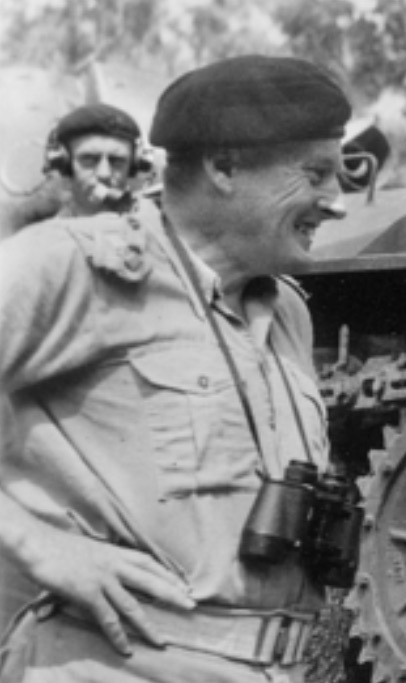
Sir Denzil Macarthur-Onslow [Wikipedia]
The Dungog Chronicle of 3 June 1950, page 5, commented on the military proposal in the following fashion:
‘Broughton Island has been tried out for several things — How to destroy rabbits was one — How to breed special goats another. But its main success has been the camping depot for the fishing industry. Thirty years ago, over 40 fishermen, seeking lobsters and fishing generally, occupied this Island. Today it still has several buildings with fishermen and their wives living there at East Harbour, it being the cosiest position.
Although East Harbour is noted for the fact that when bad weather strikes there is no getting away from it, boats are reasonably safe in this harbour. North Harbour for many years was the most popular spot. Well-known fishermen, such as Bent and Bill Blanch, Nicholas Dennis, Conameartie, Hail, Mitchell, Scotty Anderson, Nick Catchatis, Spero Spatis, Gus and Black Frank, Dick Partridge, Sam Throughgood, Tony Andrews, Cousens, Jim Kerogeorges, Jack Hunter, Jack Lund, “Ginger” Tarrant, and Geo. Hampton, are only a few whose names linger in the minds of many visitors, who have pleasant memories of the nick-named Long Island. Should the Island now become a link in the defence force of Australia, it is hoped that East Harbour will be left to the fishermen who still live there.’
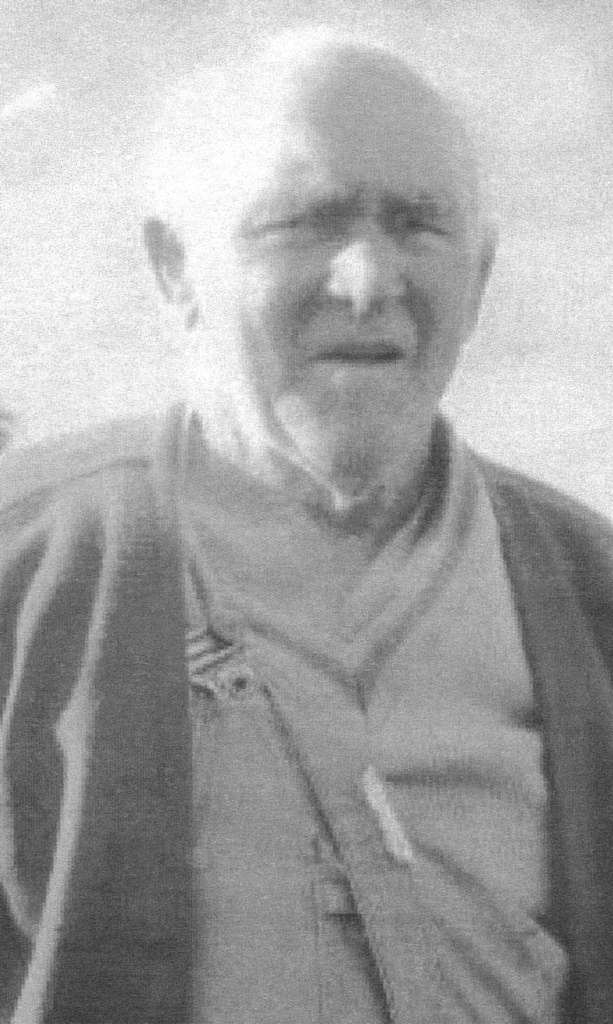
George Hampton
The Newcastle Sun of 19 June 1950, page 2, further reported:
‘In order to perfect Australia’s amphibious and island warfare technique the armed services propose to survey certain deserted islands close to the Australian coastline, including Broughton Island. First survey will be made at the end of the month on Broughton Island, which is miles off Port Stephens and 25 miles by ship from Newcastle. The survey will determine the suitability of the island for specialised training for the three services. This training will feature amphibious landing technique.
Final arrangements for the survey will be discussed by the Federal Defence Council next week at its meeting, which will be attended by the Chief of the Imperial General Staff (Field Marshall Sir William Slim). The survey party, which will be led by Brigadier Denzil MacArthur Onslow, will comprise Navy, Army and Air Force officers. Broughton Island will afford, if selected, a training centre close to populated areas. Broughton Island is deserted except for a few fishing shacks. It is approximately three miles long by one mile wide.’
Fisherman dies off Broughton Island – 1950
The Dungog Chronicle of 6 September 1950, page 2, reported:
‘Three men, alone on an island, tried unsuccessfully for two hours on Sunday to revive a mate who collapsed and died when his dinghy sank. The man, John Andrew Jensen, 27, fisherman, collapsed off Broughton Island, where he lived. Jensen and two other fishermen, Henry Evans and Vincent Charnesworth, put their launch into the harbour on the north of the island to shelter from a strong southerly. Evans and Charnesworth went ashore. Jensen followed in a dinghy. He was halfway across when the dinghy sank. The other fishermen saw him swimming with one arm and carrying a parcel in the other. Then Jensen called out and floated. When they brought him ashore, he appeared to be dead. With another man, Patrick Woodcock, Evans and Charlesworth applied artificial respiration for two hours without success.’
Famous radio compere catches a shark off Broughton Island – 1951
The Daily Telegraph of 8 January 1951, page 8, reported:
‘Jack Davey, radio compere, caught a 640lb. tiger shark off Broughton Island, Port Stephens, yesterday. It measured 12ft. 6in., and local fishermen said it was the biggest ever caught in the area.’
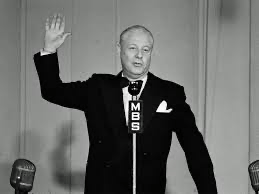
Jack Davey [National Film and Sound Archive]
Military exercises held at Broughton Island with shrapnel falling near huts – 1951
The Newcastle Morning Herald and Miners’ Advocate of 23 February 1951, page 5, reported:
‘Eight inhabitants of Broughton Island, Port Stephens, will remain in their huts when the island is strafed, bombed and shelled from an air raid during a Citizen Military Force exercise on March 8.
The exercise – an amphibious assault landing – will be the major feature of the annual 14-day camp of “A” Squadron, 15th Northern Rivers Lancers, a Newcastle unit. Live ammunition will be used. The squadron’s Second-in-Command (Captain M. T. Tripp) said fishermen living on the island had been warned of the exercise and advised to remain in the immediate precincts of their huts. It was understood they would stay on the island. An officer would visit them on March 7 to give them a final warning. Captain Tripp said Army and R.A.A.F. officials agreed it would be perfectly safe for the men to remain, provided they did not enter the operational area. Their huts were in a protected cove beyond the danger zone.
The assault landing will be made on one of the island’s southern beaches. The squadron’s full establishment of 11 amphibious tanks will take part. Nine are equipped with 75mm. howitzers. The others carry Browning machine-guns. Six Mustangs and six jet aircraft from Williamtown R.A.A.F. station are expected to provide offensive air support during the exercise. The jets will make strafing runs. The Mustangs will strafe, drop bombs. and fire rockets. Unit personnel believe the exercise will make their camp the most spectacular and exciting held in the Newcastle district since the militia re-formed in 1948.
Lieut. R. Steel said the men were “never more keen to attend.” About 80 officers and troopers will go to camp, the main party moving in to Gan Gan on March 3. The 11 tanks will be taken to Gan Gan, via Hexham, two at a time. They will be carried on heavy tank transporters which were received by the squadron last week. The first tanks will probably leave the city on Monday. On March 5 the squadron will move out of camp and proceed up the Myall River to the Broadwater. R.A.A.F. aircraft, acting as enemy, will “buzz” the amphibious craft en route.
Water formation exercises and practice landings will be conducted on the Broadwater, the following day. On March 7 a full rehearsal of the Broughton Island assault landing will be held, and the squadron will bivouac for the night on the beach west of the island. After the landing and occupation of “enemy” positions on March 8, troop tactical exercises will be held on the island. At night a leaguer will be formed. [A leaguer is a camp, in a formation which provides protection on all sides.] On March 9 the unit will break leaguer and return to Gan Gan by way of Yacaaba Head, the northern headland at the entrance to Port Stephens.’
The Newcastle Morning Herald and Miners’ Advocate of 9 March 1951, page 1, further reported:
‘Showering shrapnel from shells which ricocheted during the amphibious assault landing exercise at Broughton Island yesterday narrowly missed huts in which island inhabitants were sheltering.
The shells were fired from armoured tanks of “A” Squadron, 15th Northern Rivers Lancers, a Newcastle C.M.F. unit, which conducted the exercise. One piece of shrapnel landed within six feet of a hut in which two men were waiting for the firing to end. Others dropped into the water near fishing boats in the small, sheltered cove where the huts are built. None of the huts or boats were hit. Army officers visited the island a few weeks ago and again on Wednesday to warn the inhabitants, mainly fishermen that the exercise would take place, with live ammunition. The inhahitants were advised to spend the day on the mainland or remain about their huts. All but one of the 10 permanent residents remained.
The only absentee was Mrs. P. Woodcock, whose husband is one of the fishermen. Mrs. Woodccok was away on a previously arranged week’s holiday. Two women and a three-year-old girl were among those who stayed. The girl, Ruth Ode, daughter of Mr. and Mrs. L. Ode, laughed at the sound of the firing at first, then became frightened. She did not cry. The women continued with their housework most of the time. The men moved indoors after the first piece of shrapnel—the closest— landed on the sand in front of Mr. D. Karigeorgis’ hut. Mr. Karigeorgis, a Greek who has lived on the island 34 years, and is known as its “‘unofficial king,” said none of the residents was perturbed.
Five goats kept by the islanders disappeared as soon as the shooting began. “We won’t see them for days,” said Mr. A. R. Day, a Newcastle man who is holidaying on the island. “They go bush even when .22’s are fired.” Mr. C. Armstrong, a permanent resident, said fish would be “practically nil” in the vicinity for about two days as a result of the exercise. The area in which the unexpected shrapnel fell was regarded officially as beyond the danger zone. The Commander of 1 Armoured Brigade (Brigadier Denzil Macarthur-Onslow) said: “It was just one of those unavoidable things.” He added that the islanders were “very cooperative.”
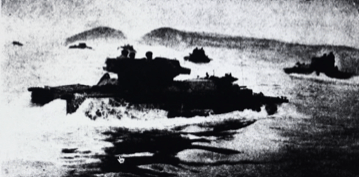
Amphibious craft plough through the sea as a prelude to the attack on Broughton Island
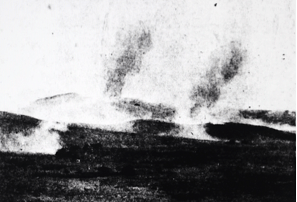
The appearance of the battleground from a hilltop position on Broughton Island
Men marooned on Broughton Island – 1952
The Goulburn Evening Post of 1 July 1952, page 6, reported:
‘A trawler left Nelson’s Bay this morning in an endeavour to reach four men believed to be marooned on Broughton Island. R.A.A.F. Dakotas yesterday sighted signal flashes from the island. It is believed the four men have been on the island since Monday when they were first, reported missing after a fishing trip.’
‘Operation Boomerang’ at Broughton Island – 1952
In March 1952, a major military training exercise codenamed Operation Boomerang was held to the north of Port Stephens, at Broughton Island and on the adjacent mainland coastline.
It was the biggest peacetime amphibious landing exercise in Australia since the Second World War. Details are found on this website at the above link.
Four fishermen found safe at Broughton Island – 1952
The Sun of 1 July 1952, page 3, reported:
‘Four men missing in a launch since they left Swan Bay (near Port Stephens) on a fishing trip on Sunday night, were found safe and well today on Broughton Island. Mr. H. Lund, a fisherman, of Nelson’s Bay, left this morning for Broughton Island, where signal flashes were seen early last night by the crew of an RAAF Dakota. Mr. Lund found the men on the island, where they had gone for shelter after their launch had broken down.’
The Dungog Chronicle of 5 July 1952, page 3, further reported:
‘Port Stephens fishermen have declared that if a two-way wireless were installed at Broughton Island, much anxiety would be relieved on occasions when boats are missing.
The fishermen made this comment after four Newcastle men had been found on Broughton Island on Tuesday. The men were missing for two days. Broughton Island, about 10 miles from Port Stephens Head, is about 400 acres in area, and is the only safe anchorage between Port Stephens and Seal Rocks. When in difficulties, fishermen often head for Broughton Island.
A member of the missing party said that soon after they landed on the island they returned to their launch and found it dragging its anchor close to a bombora. They had to swim out to the craft and drag it to a more secure mooring. Because there were no means of communicating with the mainland except by boat, the men made themselves as comfortable as possible and kept watch for planes and ships which would be searching for them.’
Man shot in the neck at Broughton Island Died – 1953
The Newcastle Morning Herald and Miners’ Advocate of 22 May 1953, page 1, reported:
‘A man spending a holiday on Broughton Island, off Port Stephens, was shot in the neck yesterday when a rifle carried by a companion was accidentally discharged. He is James Warren, 55, of Park-avenue, Kotara, an employee of the State Dockyard, Newcastle. Newcastle. Ambulance took him to Royal Newcastle Hospital. His condition is serious.
Police were told Warren, John William Blackwell, 19, of Russell-road, New Lambton, and John Norris, 23, of St. James-road, New Lambton, went to Broughton Island on Monday. They had fishing equipment and a .22 calibre rifle. While they were crossing the island yesterday two rabbits ran in front of them. Blackwell who was carrying the rifle, handed over his fishing rod, walked 30 yards ahead and put a cartridge in the breech.
The rabbits disappeared beneath a disused hut; Blackwell turned around, and was pushing the safety catch forward when the charge exploded and Warren dropped. Blackwell stayed with the wounded man and arrested the bleeding while Norris went for help. He returned with two fishermen and a stretcher. They carried Warren to a trawler in which he was taken to Nelson’s Bay. He was picked up there by Newcastle Ambulance and taken to hospital. The bullet entered the neck on the right side, struck a vertebra and travelled downwards injuring a lung and the spine.’
The Maitland Mercury of 29 May 1953, page 3, reported that Warren died in the Royal Newcastle Hospital.
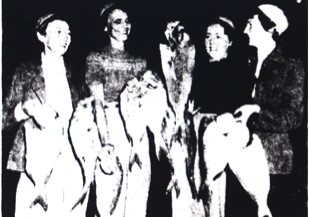
Members of Newcastle Women’s Angling Association display the results of their first deep-sea fishing trip off Broughton Island yesterday. Between them they landed 15 snapper, the biggest weighing 71lh. The women are, from left: Miss J. Henderson, of Hamilton, Mrs. G. Woolley, of Lambton, Miss M. Roach, of Hamilton, and Mrs. G. Avery, also of Hamilton, who caught the big one [Newcastle Morning Herald and Miners’ Advocate, 10 September 1953]
Proposal for rutile mining on Broughton Island – 1954
The Dungog Chronicle of 17 March 1954, page 1, reported:
‘Stroud Shire Council decided at its last meeting to seek a royalty on all rutile mined on Broughton Island. The Mines Department asked if the Council desired any special condition to govern mining on the island. Cr. Colliton said the council objected strongly to the mining of its beaches which disfigured them and prevented at, least temporarily, their use by tourists.’
Rutile was never mined on Broughton Island.
Wally Clayton – a frequent visitor to Broughton Island circa 1960
Walter Seddon Clayton was a communist who became a influential Soviet spymaster in Australia. The economic hardship of the Great Depression motivated him to join the Communist Party of Australia (CPA) by 1933, where he quickly rose through the ranks due to his organizational skills and public speaking, also participating in the New Theatre movement. By 1939, Clayton had moved to Sydney, serving as a campaign director and newspaper sales manager for the CPA.
After the government banned the party in 1940, he managed its covert operations, which honed his espionage abilities. As a senior member by 1944, he oversaw the party’s internal security. Between 1943 and 1950, Clayton led Australia’s largest Soviet spy ring, recruited by Soviet agent Semyon Makarov. He passed secret intelligence to Moscow, which the U.S. intercepted through the Venona program. His code name was “Klod,” and he handled at least ten agents.
After renewed government pressure in the early 1950s, Clayton went into hiding on a farm. Subpoenaed during the 1954 royal commission on espionage, he ultimately testified in 1955 but consistently denied all allegations. Despite clear evidence linking him to spy activities, he evaded direct consequences.
He eventually settled near Port Stephens as a fisherman, maintaining his innocence until the 1990s.
In 1993, a private confession surfaced, and by 1996, he admitted being “Klod” after seeing decrypted Soviet communications. Clayton died in 1997 in Waratah.
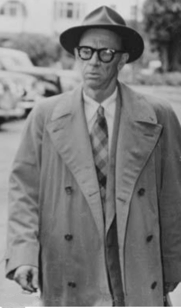
ASIO photo of Wally ‘Klod’ Clayton, circa 1956
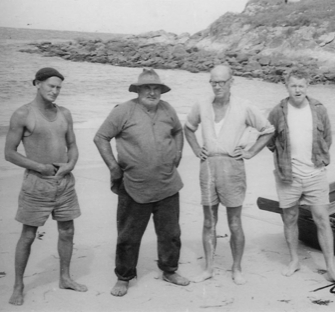
Wally ‘Klod’ Clayton (third from left) at Broughton Island
APPENDIX
Reflections on Broughton Island Over Time
The Newcastle Morning Herald and Miners’ Advocate published two articles on reflections of Broughton Island in the series entitled: Ian Healy’s Suburbia, This Week.
The photos have been inserted at the discretion of the author of this research paper.
First Article (7 July 1951, page 5 – Island Through the Looking Glass)
‘At the south-east corner of Broughton Island, Nature—in a mood of geological tomfoolery—built an archway through a jutting cliff. Seen from a boat approaching the island, the archway, with the sky beyond, resembles an outsize mirror, a likeness that long ago brought it the name of Looking Glass. Thirty to 40 feet high at its peak and with its base in the sea, the archway is wide enough at water level for the passage of a rowboat. Noting this, more than one visitor in a Lewis Carroll mood has felt the urge to sail through the Looking Glass as the start of an island exploration.
It has been done, but the journey is inclined to be dangerous, for close to the archway is the gushing current of The Rapids, and beyond Cod Rock, which breaks through the water in the sea-serpent manner, in a series of diminishing clusters. No one, even in a whimsical frame of mind, would imagine that riding through the Looking Glass would lead to a talkative Walrus or a Mad Hatter’s table, but the island, in its way, is a sightseer’s Wonderland. So much about it comes as a surprise.
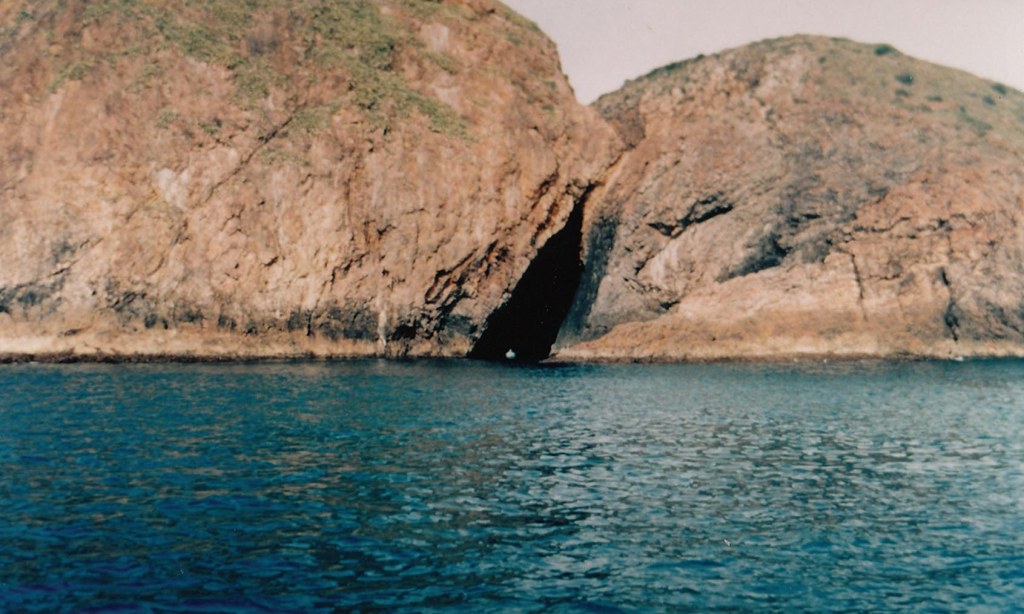
Archway at the Looking Glass – Broughton Island
To get to the island, the average visitor travels by fishing boat or in a hired launch. He leaves Nelson’s Bay, sails out through the sudden majesty of the Port Stephens headlands, slews north in the smashing cross-currents, and passing the less hospitable islands of Cabbage Tree and Boondelbah, goes on for about eight miles across open sea. The course runs parallel with the coast and long, crab-happy Hawk’s Nest Beach. The voyage takes about an hour and a half.
A mile and a half offshore, the island is two miles long and built like a swayback horse, with a sag in the middle. Above its brown cliffs, it is green from end to end, from West Point to Cape Horn, but the green is the green of wind whacked saltbush and the stubbly grass of moors. Nowhere is there a tree. Roughly up to a mile wide, its heart is deceptively boggy under the grass, and its hilly ends—in winter, at least—have something of the bleak look of remote, weather-harassed land. Wind howls across Big Swamp, between the two eastern rises that are known as The Twins and tussles the scrub on a slope called Pinkintop. Even in summer, when the sun makes a hot, shelterless oven of the interior, the island seems deserted, yet there are 10 permanent residents.
The 10 are six men, the wives of three of the men, and the four-year-old daughter of one of the couples: Ruth Ode. The men are professional fishermen, who set their lobster pots and go seine-trawling up to 20 miles east of the island and north-east some 15 miles, till they come to the grounds being worked by their fellow professionals from Forster.
The homes of the small Broughton Island community are one or two-roomed huts, hidden in a cove at East Harbour, a cliffed inlet near the Looking Glass that offers shelter from all but the blustering southerlies. The harbour is narrow, with the air of a quarry about it, and especially on a calm, sunny day is as fascinating as any corner of the island. Near its entrance, the Baldies—a row of smooth, round rocks—poke their heads through the water where snapper and bluefish are caught, and along the opposite side runs the cliff wall that is white enough to have been christened Dover.
There are two coves at the head of the harbour, both thumbnail size, with a point named Poverty separating them. The western cove is vacant. The eastern cove, between Poverty Point and Dover, and no more than 20 fish leaps wide, seem fully occupied by the fishing boats and along the shore, by the line-up of seven huts.
The shore has no depth. Immediately behind the huts is a high grass bank, with a track leading up to the heart of the island. In front, there is only a thin strip of sand. The beach was once wider, with a stretch of grass between it and the huts, but the violent seas that eroded Newcastle beaches, particularly in 1949, also caused havoc here. The grass patch was torn away and although the beach is building up again, it still seems little more than spitting distance to where the boats are moored. Here, fishing nets hang over railings in the carelessly draped fashion that photographers love; lobster pots lie ready to go snaring; and the atmosphere is more completely that of a peaceful fishing community when one of the men sets to work tarring a net or, sitting on a barrel or box, mending his net with patient expert fingers.
The fishermen work in a co-operative manner, observing the unwritten and traditional codes of their occupation. If one sees another repairing a net or at work on some other necessary task and knows he is “stuck for time,” he stops to lend a hand. When the catches are small, they take each other’s fish to market, gutted and packed “stomachs down” in ice boxes in their boats and, to save duplicating journeys, bring back each other’s supplies. The market and supply runs are usually made twice a week, to Newcastle or Nelson’s Bay.
There are no amenities on the island. At night, entertainment devolves into playing cards, listening to a battery radio, or reading by the light of a pressure lamp. There are no electric gadgets to speed household chores and water is carried from tanks, springs or a well. Yet the islanders appear to thrive in their matey isolation and to agree when those of their visitors who go back time and again call it a paradise.
“Among the regular visitors is Mr. A. R. Day, a Newcastle-Sydney businessman who finds the Broughton Island way of life an idyllic change from the hustle of urban life. He told us there were originally two settlements on the island, one at East Harbour, the other on the northern side, looking out to clumpy North Rock, 1000 yards offshore, and over a bay where dolphins play and seals flip past on their way to the barren sanctuary of Seal Rocks. The settlements were always distinct: the one at East Harbour for Australian fishermen, the other for Italians and Greeks.
In most cases, Port Stephens was the home port of the men. They went to live on the island through the busiest months of the year because it was closer to the lobstering grounds and allowed them more rest between hauls. It was such a drag from the port to the grounds and back in their small boats that they no sooner got to bed at night than they had to be up again—at one or two in the morning—to be back at the grounds at daybreak. On the island, when the seasons were good, they went to bed late and got up early, just the same, and there was a saying that they were “out before the lamps they went to bed by had had time to get cold.”
Returning from their lobster “lifts,” the men let their catches loose in pens built at the water’s edge and went back for more. In the pens, waiting their turn to be shipped to market, the lobsters showed an odd shellfish quirk: they grew fat. Lobsters are still penned and Port Stephens fishermen still operate on the north-east grounds, but their boats are bigger and faster and there is no longer any need for them to stay on the island, unless they wish.
Most of the Italians and Greeks departed in the depression, when profit slid through the fishermen’s hands like an eel in a shark net. Today, only one Greek remains: Mr. D. Karageorgis. He lives at East Harbour. Because he has been on the island 34 years—longer than anyone else— he is sometimes referred to as “the King of Broughton Island,” sometimes as “the Mayor.”
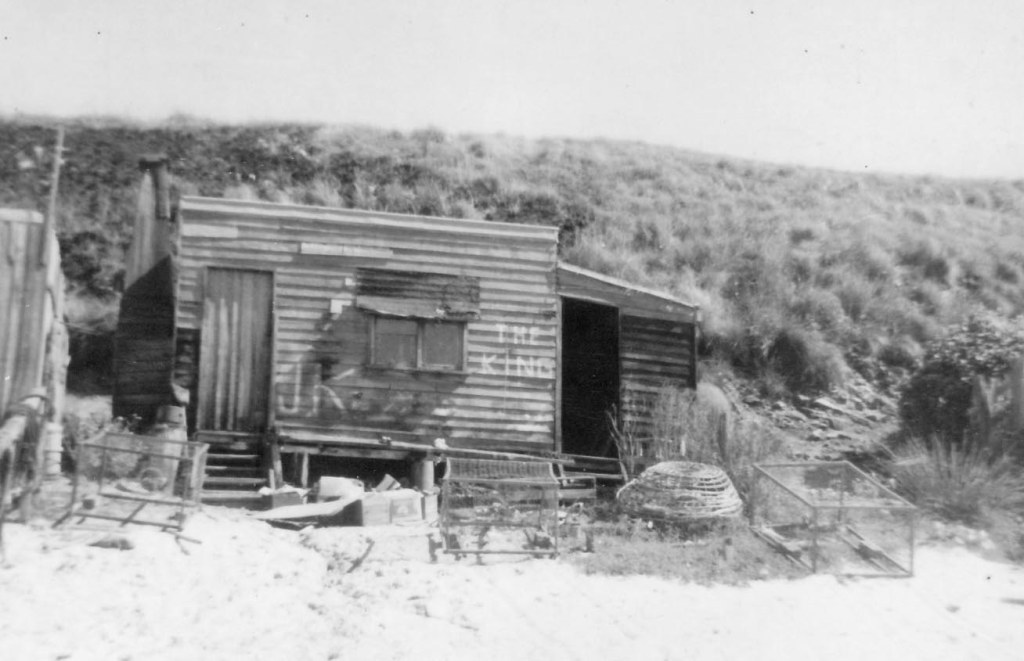
Kings Hut – Broughton Island
Friendly, but rather shy among strangers, the “king” has an admiring “subject” in Ruth Ode. The admiration runs both ways, for Mr. Karageorgis thinks highly of the little girl who scampers along the beach to talk to him and see what new fish he has caught. He rarely fails to bring her some treasure from the sea or gift from his trips to the mainland.
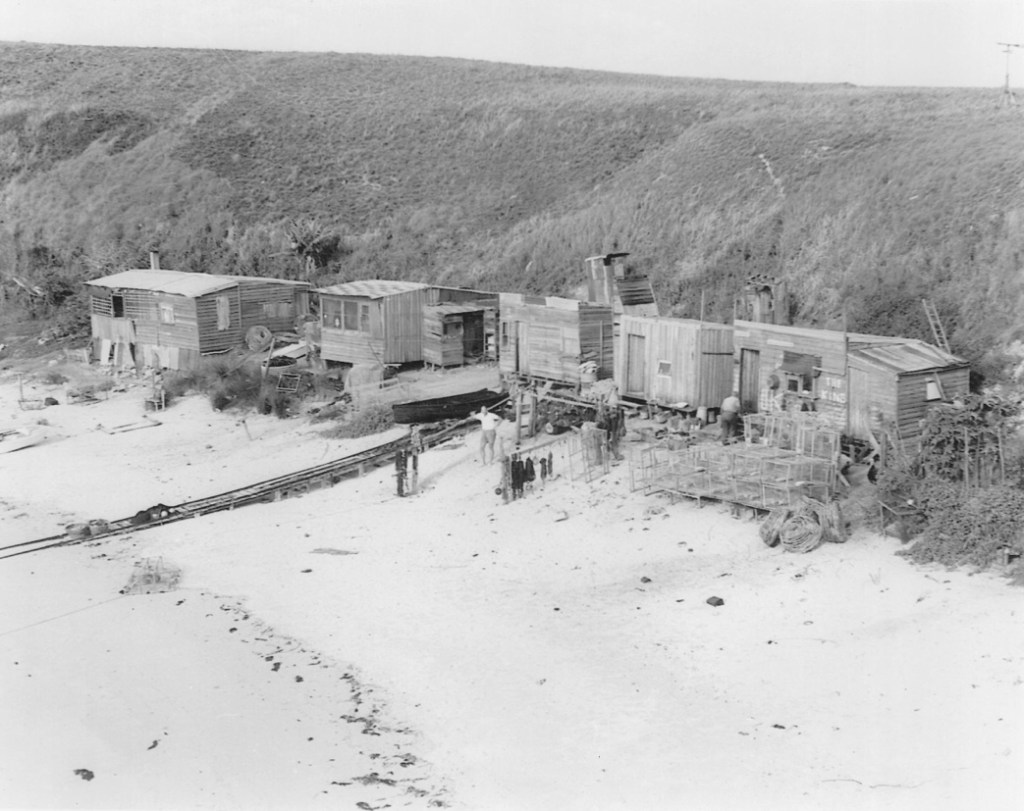
Huts at Esmeralda Cove- Broughton Island
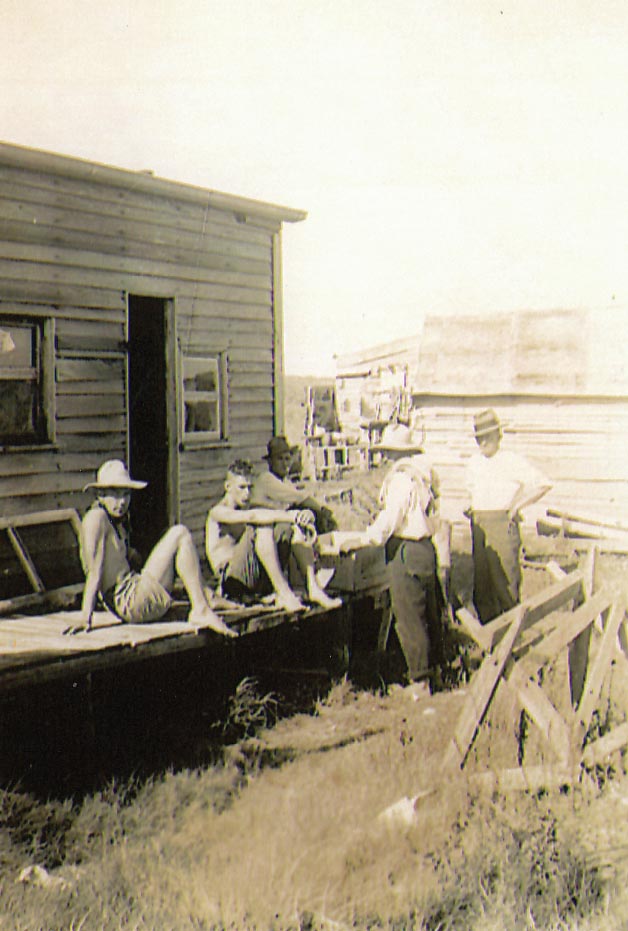
Huts at North Harbour – Broughton Island
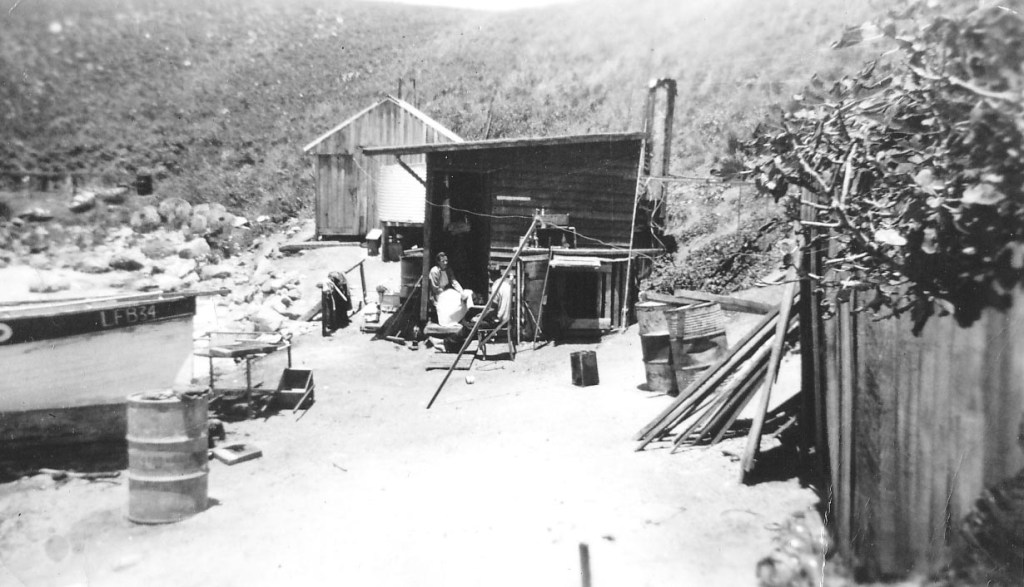
Hut destroyed by beach erosion – Broughton Island
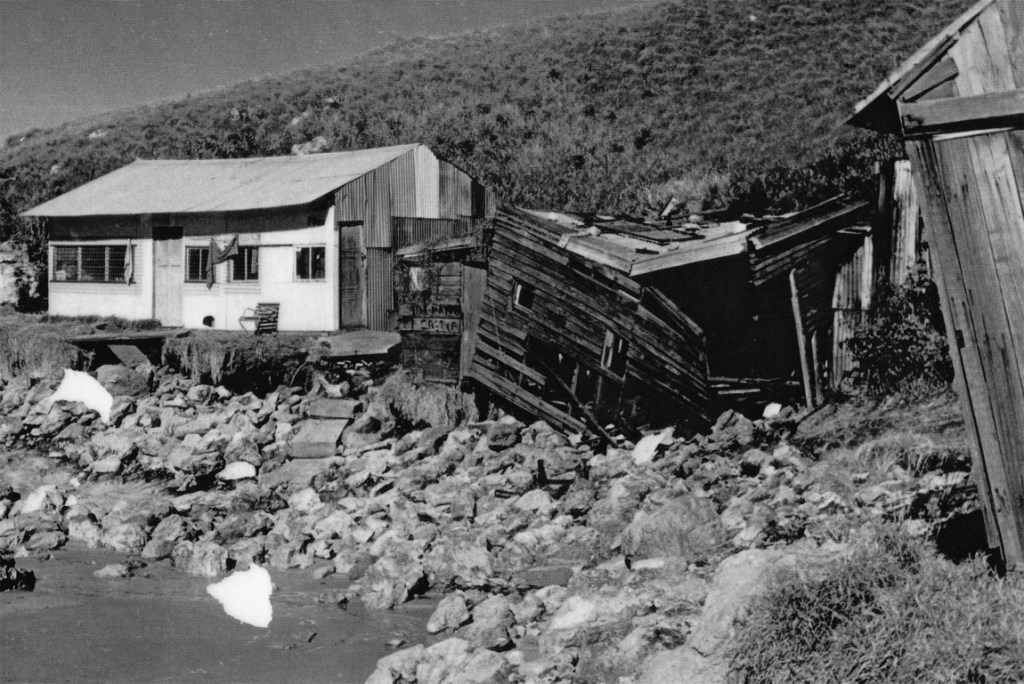
Hut destroyed by beach erosion – Broughton Island
Where the old Greek settlement stood, there are now four shacks. They are empty for most of the year. Islanders call them “the visiting huts” because they are used mainly by amateur fishermen on brief holiday excursions. Not far from the shacks, in some gone age, a coalmine was tunnelled into the hills. Its entrance is still visible, but little of its history is known. East Harbour residents do not know who started the mine or whether, in fact, it ever really operated, but they are fairly certain it was abandoned because the quality of the coal was too poor. A nearby beach was named Coal-shaft after the venture.
It is on Coal-shaft Beach and in the coves that strangers might be amazed to find coconuts. Mr. Day said coconuts were picked up frequently, sometimes intact, but more often than not in pieces. They were apparently washed in on currents from Queensland or tropical isles. It is presumed that snakes and rats have arrived in the same way, travelling in post-storm currents that have dumped driftwood and tree trunks on the sand. “Snakes were unknown on the island till about three years ago,” Mr. Day said. “There doesn’t appear to be many around, but a few have been shot. They and the rats must come down on flood timber. It seems the only way they could get there. “The fishermen poison the rats out. When they were bad a year or two ago, they were poisoned out in a couple of weeks; but every so often a new lot arrives.” The snakes and rats are not all that invade or roam the island. There are also rabbits and lizards, and household goats that follow the habit of less domestic nannies by climbing along the cliffs.’
Second Article (14 July 1951, page 5 – Cows Were “Out”, SO Goats Went In)
Fishermen once hoped to run cattle on Broughton Island to provide fresh milk for the inhabitants, but the island vegetation proved unsuitable for feed and the idea was abandoned.
Instead, a number of goats were shipped from the mainland. At least one of the goats is said to have missed its footing, while ambling along a cliff, and gone crashing to its doom on the rocks. Whether or not this is true, only five of the original number remain, wandering around at will, but nervously. The sound of a rifle shot sends them scurrying to secret hiding places.
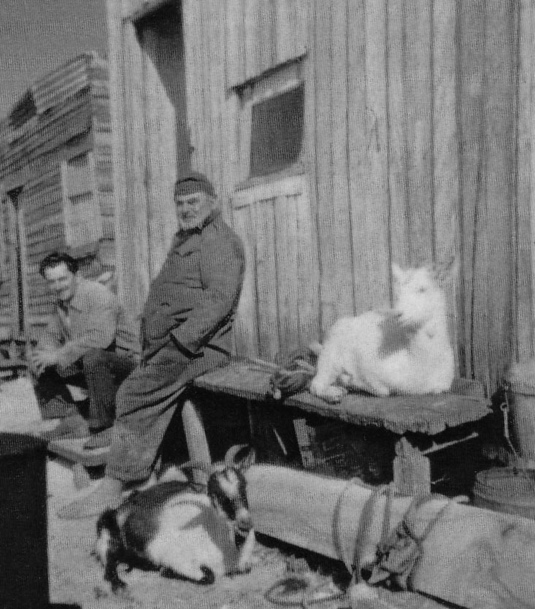
A Broughton Island goat
In March, when a Newcastle C.M.F. unit – the amphibious 15th Northern Rivers Lancers – held exercises at the island [see above] and fired 75 m.m. howitzers, the goats were gone in a flash and islanders said: “We won’t see them for days.” Despite the prediction, one of the goats appeared the following day in direct line of fire of one of the guns. Troopers had to be sent to shoo it out of range.
Rabbits, of course, went underground for the duration. They have been on Broughton Island since 1906. In that year, long before science began stabbing myxomatosis into the nation’s bunnies, the Rabbit Destruction Fund Committee, formed by pastoralists, invited Dr. Jean Danysz to Australia [see above]. He came from the Institut Pasteur, Paris, to make a rabbit extermination experiment with a virus he had recommended. The island was chosen as the logical place for the experiment and the concrete foundations of the experimental station are still to be seen in the Pinkintop wilderness. Officially Dr. Danysz’s virus was found “to be very deadly under certain conditions.” The conditions were apparently not right at Broughton Island, where fisherfolk claimed it had no major effect on the rabbit population. They say the bunnies at Broughton are as healthy today, and as family-promoting, as the most robust in the land. Myxomatosis has not reached them.
The presence of the rabbits was regarded with gratification last year when the island was besieged for 10 days by stormy seas. Out of touch with the mainland and unable to go for supplies, the islanders turned more than ever to baked rabbit and rabbit stew. The rabbits are also said to have been responsible for keeping alive a handful of sailors who survived a wreck near the island in the 1920’s. Details of the story are vague, but a Hamilton man, who cannot recall the name of the ship or the date it foundered, remembers that the sailors told him they were on the island three days before they were rescued. In the three days, they would have starved had they not been able to catch and eat rabbits.
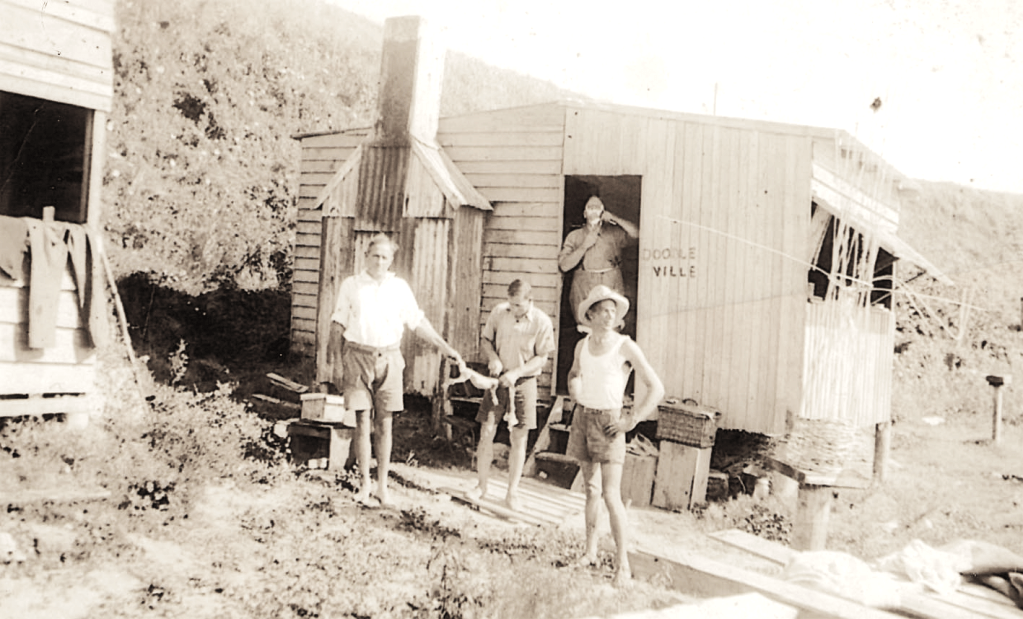
Rabbit on the menu for dinner at Broughton Island
A number of ships has come to grief in the neighbourhood of the island, the last a small trawler that sank one night in a south-east gale, about three years ago. There are numerous bomboras in the vicinity, tricky to all not familiar with the zone. The islanders have names even for the bomboras. One is Spero’s Bommy, named for “Spero, the fisherman,” who lived at Dutchie’s Beach, Port Stephens. He had a shack in the old Greek settlement on the island. Spero died last year [1950].
As well as they know the bomboras and the Looking Glass, fishermen in the zone know the other rock fissures and outcrops, the curious formations that abound. They know the Little Looking Glass, a small “mirror” 20 to 30 yards west of the other; the Steps, the caves, and uncommon Cathedral Rock.
Cathedral Rock is at the southern tip of a high, small island that is linked underwater with the main island, at the eastern end. The link is made at a spot called The Fisherman’s and the water is just deep enough to allow a flat-bottomed boat to go through, with reasonable safety. An oval formation, Cathedral Rock is 60 to 80 feet long and roughly 40 feet wide. It looks like an impressionist sculpture, a cathedral piece, with rocks jutting out in rows like a series of pews. Between the link and Cathedral Rock is the West Wall, a tall, sheer cliff in which there are caves, black mouthed and eerie-looking, 30 to 40 feet high and the largest wide enough to admit about five rowboats paddled abreast. Almost opposite, on the main island, are The Steps, a formation that seems, from a boat, like a huge stairway down the face of the cliff. The Fisherman’s, itself, got its name from another peculiar formation: a rock that looked for all the world like a fisherman holding a rod. The rock began to crumble and was destroyed when it fell during a storm.
Men of the Northern Rivers Lancers saw few of these features in their brief stay at the island, but their exercises taught them the whereabouts of some of the bomboras. The knowledge may prove important, for the Army has its eyes on Broughton. Senior officers, agreeing with the views expressed by their American equivalents during the war, have described it as an ideal place for amphibious and combined operational training. Further exercises were mooted when the lancers’ tanks ploughed through the sea for their March dawn assault landing and overnight camp on the island.
In a painless echo of Salerno, they pounded The Twins and West Point and accidentally sent shrapnel showering down on East Harbour, where residents had been advised to stay. One piece ‘of shrapnel landed within six feet of a hut in which “King” Karigeorgis and Mr. Day were waiting for the firing to cease. Another landed two or three feet beyond. Mr. Day and Mr. C. Armstrong, a permanent resident with a “New Yorker” sense of humour, inspected the shrapnel scraps. Mr. Armstrong touched one of the pieces and burnt his fingers. Impishly, he turned to Mr. Day and said: “Rush down and tell Jimmy to come and get a bit while it’s still hot.”
If the Army has a plan to take over the island, the inhabitants will believe it when the Army moves in. They say there have been numerous rumours about its future; among them, that a tourist hotel would be built. “with a golf course and everything.” As with the Army rumour, they will believe it when the hotel arrives. Not only the islanders, but others who know Broughton well, are inclined to shake their heads at a suggestion that an industry be established there to preserve and can mutton birds. Mutton birds fly there in thousands to breed.
Troopers returning from their exercises said that the ground was “riddled with mutton bird burrows. The white-winged petrels took them by surprise They fly mostly at night, constantly coming and going, and crying with a harsh, mournful, babyish cry. Some of the troopers, who slept in the open, said the birds. kept them awake “for ages,” crying and fluttering by. “I got the impression they were practically blind,” said Lieut. R. Steel. “They didn’t attack anyone, but they flew straight into you, as though they thought there was nothing in their way. Of course, it was a pitch-black night. That might have had something to do with it. “I tell you, it comes as a bit of a start when something white bashes against your chest or sails past your head in the middle of the night.”
This kind of talk would be likely to evoke, among the fishermen on the island, a bird story of a different nature; a story revolving around the hens that are kept at East Harbour to provide eggs and an occasional poultry dinner. In fairness, it is necessary to explain that it was once – if not still recognised that an inhabitant or regular visitor could, in the absence of another, help himself to anything of the other man’s he, required,’ on the understanding that he would replace whatever he took. Mr. Armstrong had been tending the fowls, but while he was away from the island one day, a visitor helped himself to eggs from some of the nests and replaced them with preserved eggs, on which he pencilled a cross for identification. When Mr. Armstrong landed back, he went to the nests and returned with the preserved eggs in is hands. Passing the visitor on the way, he said: “These hens are good layers, all right.” “Yes, Charlie,” said the visitor. “By cripes, they’re intelligent fowls,” Mr. Armstrong said. “How d’you make that out” asked the visitor. Mr. Armstrong pointed to the pencilled crosses. They are autographing their eggs, now,” he said.’
Concluding Comments
Commercial and recreational fishing were the main activities on Broughton Island from the time the Worimi aborigines visited there up to its more recent history.
Presently, numerous huts remain on the island that are used by fishing parties who still visit the island. The huts were saved from removal in 1984 as per the News of the Area (NOTA) of 1 March 1985, page 8:
‘A reprieve for the private huts on Broughton Island, which were due to be demolished under the controversial Myall Lakes National Park management plan, has been won by a Maitland fishing lobby led by Mr Walsh, M.L.A., Maitland. The Minister for Planning and Environment, Mr Carr, announced the reversal of a National Parks and Wildlife Service decision to replace the huts with an emergency shelter. The about-face came after Mr Carr met a deputation from the Maitland Off-Shore Fishing Club, led by Mr Walsh. Mr Walsh said that the Minister had accepted that it would be safer to retain rather than demolish the seven huts which are used extensively by fishermen. Because Broughton Island is now part of the Myall Lakes National Park, no additional huts can be built, Mr Walsh said.’
A very informative book titled, Broughton Islanders, was published in 2009 by John Clarke, historian and author of Fingal Bay, Port Stephens. The book includes the stories of many fishermen who called the island home.
Other relevant papers published on this website can be found at the following links:
Commercial Fish and Shark Processing at Pindimar
New South Wales Fish Company First Fish Processing Facility at Nelson Bay
Early History of Game Fishing at Port Stephens
Royal Commission on Fisheries – Evidence Taken at Nelson Bay, 1895
Early History of Prawning at Tamboi, Port Stephens
Early History of the Oyster Industry at Port Stephens
History of Boat Building at Port Stephens
Researched and compiled by Kevin McGuinness
November 2025

 Port Stephens - a history exploration