
Introduction
This paper outlines the history of efforts to establish a civil aviation airport near Newcastle, beginning in 1920 when an unofficial landing field was first used at District Park.
From that time on, organisations such as the Newcastle Aero Club, Newcastle City Council, Newcastle Chamber of Commerce, and others lobbied the Commonwealth Government for funding and the construction of an airport in proximity to Newcastle.
In 1952, the Commonwealth Government committed to building an airport to serve Newcastle, although funding was not allocated at that time. Despite over thirty years of agitation by Newcastle based organisations, a separate civil aviation airport, as originally proposed, was never constructed near Newcastle.
Commencing in 1939, a military airfield was built at Williamtown for the Royal Australian Air Force (RAAF).
In 1947, the Commonwealth Government, opened up the RAAF base airport to civilian aviation. Currently, Williamtown Airport accommodates both the RAAF military operations and the civil aviation operations of Newcastle Airport, serving the Newcastle and Port Stephens regions.
The Commonwealth Government managed Newcastle Airport until 1990, when Newcastle City Council and Port Stephens Council assumed joint responsibility for operating, maintaining, and developing the civil aviation facilities.
In this paper, the terms “aerodrome” and “airport” are used interchangeably. Technically, an aerodrome is any designated area for aircraft take-off and landing, while an airport is a certified aerodrome equipped with advanced facilities and infrastructure.
The resources of the National Library of Australia’s ‘Trove’ newspaper collection were primarily used in preparing this paper.
The history of the Williamtown RAAF Base is not covered in this paper.
Overview of activities to construct a separate Newcastle Airport
The Newcastle Sun of 9 May 1950, page 6, published a detailed summary of the efforts made to that time, to find a suitable site for a permanent Newcastle Airport for civil aviation purposes to replace the inadequate Aerodrome at Newcastle’s District Park.
The newspaper article posed the question: A civil airport for Newcastle … to be or not to be?
‘In the past 15 years this question has gone a complete, fruitless circle so that after much talking and negotiation Newcastle is still without one of its greatest needs— a civil airport. Frequently the answer to the question is sought in private, commercial and industrial circles, but each time the question is posed there is a little less confidence in the voices of those who ask, for too often before they have seen their bright hopes of fulfilment dimmed.
It is a vital problem and one that must be solved if the Hunter Valley district is to progress. For on population alone Newcastle deserves the right to be given a civil airport. As head city of an area containing 300,000 people, or 43,000 more than Tasmania, it is probably the only city in the world with a similar population that has no air facilities. This is a gloomy statement of fact, but the truth taunts us still further when we consider that Newcastle is the third port of the Commonwealth, the hub of the heavy industries of Australia and the gateway to the rich hinterland of the Hunter Valley.
When we consider the advantages to be obtained from a modern air service it is difficult to find a reason for so much hesitation. Broadly speaking, its establishment would assist decentralisation, facilitate commercial intercourse between Newcastle and the inland, provide back country residents with a quick and ready access to the sea during the summer months and would be of great value in times of sickness or distress. Trade, too, is expanding rapidly and the need for an air service to transport mails and freight, especially perishable goods, is felt increasingly.
The first move for establishment of a civil ‘drome here started as far back as 1936 when the Chamber of Commerce wrote to the Minister for Lands, directing his attention to the urgent need of air facilities here. But the idea was shelved and between that date and the outbreak of war in 1939 nothing was done. World upheaval made further progress impossible for the next five years, but the idea was not allowed to remain dormant.
In September, 1944, as the direct outcome of pressure by Newcastle Council and the Chamber of Commerce, the Superintendent of Ground Organisation in the Department of Civil Aviation (Dr. Bradfield) made a preliminary investigation of possible sites and conferred with council officers, representatives of the Chamber of Commerce, Aero Club and the B.H.P. All were hopeful that as the provision of an airport for Newcastle was a matter of vital importance something concrete would be done in the near future to implement.
Dr. Bradfield’s recommendations favouring a site at Sandgate. But there were months of waiting, followed by a statement from the then Minister (Mr. Drakeford) that no portion of the limited funds available for aero works could be used for construction of an airport here. He stated further that the investigations of Dr. Bradfield had been carried out at the express wish of Newcastle Council and the report in no way committed the Commonwealth to the establishment of a new aerodrome.
However, after years of fighting, Newcastle Chamber of Commerce was not prepared to admit defeat. With the backing of the Lord Mayor (Ald. Quinlan) and Federal and State Members of Parliament, arrangements were made for T.A.A. to include the R.A.A.F. training centre at Williamtown as a stopping place on the daily Sydney-Brisbane air route. This service began in March 1948, and immediately there was a regular demand for passenger and freight transport. But Williamtown is closed to private enterprise. In 1946 A.N.A. lodged an application to provide a service linking up with inland centres, as well as providing interstate connections. But approval was not given and in 1949 permission was again refused when A.N.A. applied to run a service between Sydney and Newcastle. The reason given was that Williamtown is a training station for fast-moving R.A.A.F. aircraft.
But during the war years civil service planes and Air Force units operated most effectively from Laverton, Wagga, Dubbo and Archerfield. Is there any reason, then, why Williamtown cannot be so used and made available to all air services until a fully-equipped civil aerodrome is ready to handle this traffic? This has been the subject of repeated agitation by the Lord Mayor.
It was not until January this year [1950] that the council received notification that a civil airport would be established here. The present Minister for Air (Mr White) said that it would begin as soon as plans were completed and funds, labour and material were available. Selection of a site is the chief drawback now. Civil aviation officials have stated that they want an area that would allow for three runways, each one to one and a half miles long, with obstruction free approaches to two miles at either end.
At an inspection made by the department last November it was conceded that Ash Island offered all these features, though it might need filling to bring parts above flood level. Williamtown has been rejected because it is needed for defence and the proximity of already established industries has ruled out Moscheto, Dempsey and Walsh Islands.
Dr. Bradfield in his report favoured a site at Sandgate, but the City Engineer (Mr. Baddeley) considers Tomago a better site. The County Planner favours Sandgate as the selected spot and at the proposed conference between our civic leaders and the Department of Civic Aviation on May 10 [1950] he will give his reasons why he considers this the most appropriate spot. Hopes are general that this conference will remove the crippling ban that has been placed upon Newcastle, for continual encroachment of heavy industries on eligible sites diminishes the prospects of a civil airport as time goes on.’
The history of the early developments when aviation was in its infancy, are set out in the following newspaper articles.
Government intervened in proposed Newcastle Aerodrome site – 1920
The Newcastle Sun of 9 March 1920, page 1, reported:
‘A letter from the Premier’s Office told the Newcastle Council last night that the Aerial Transport Executive Committee had in hand the question of the erection of aerodromes and was considering the establishment of one in Newcastle. In the opinion of the committee the site under consideration by the Newcastle Council was unsuitable.
“This is only another instance of the impudence of the people in Sydney wanting to control everything in the State of New South Wales,” said Ald. O’Mara. “If the time arrives for the necessity of establishing this aerodrome, I think we are quite capable of controlling it ourselves.” He moved that the Government be informed that the matter was under consideration. Ald. Christie said that if the Government intended to finance it then they should let them control it. The matter was referred to the works committee.’
Site for Newcastle Aerodrome considered by Council committee – 1920
The Newcastle Sun of 29 June 1920, page 4, reported:
‘An aerodrome for Newcastle is again in the air. At the next works committee meeting of the council on Thursday, the whole matter will be discussed. It was mentioned at the meeting of the council last night that when it was previously mooted, the desire was frustrated by the State Premier’s Department, which said that a special committee was going into the question of aerodromes for the State. The new Government, however, had written that it did not propose to do anything.
Several aldermen took the opportunity last night of speaking in favour of having an aerodrome in the District Park at Hamilton, where there are 150 acres of land, and not at the old racecourse. It was said that this ground was very suitable, and money would be saved in that they would not have to purchase it. The money saved in this way could be used in building an aerodrome. All that was necessary was for them to obtain the consent of the other councils to use part of the park for this purpose. The whole matter will be gone into on Thursday. The council may decide to use the loan of £8800 meant for baths and sports grounds, for the construction of an aerodrome.‘
Newcastle surveyors look for an Aerodrome site – 1922
The Newcastle Sun of 28 January 1922, page 1, reported:
‘Mr. R. Hoddinott, of the Department of Civil Aviation, Melbourne, and Mr. Henderson, of the Commonwealth Works and Railways, are in Newcastle in connection with the aerial mail service between Sydney and Brisbane.
They have completed the Sydney to Newcastle route, and at present are endeavouring to arrange for an aerodrome. Two areas have been inspected. As in other large centres of population, the location of an aerodrome within reasonable access of the city has been a problem. The officers expect to be in Newcastle until Wednesday. From Newcastle they go on to Taree. It is expected that the air mail will be delivered in Newcastle about the end of March; but there is still a prodigious lot of work to do which may cause a little delay.’
District Park, near Newcastle, chosen as the first Aerodrome site – 1922
The Newcastle Sun of 7 February 1922, page 6, reported:
‘The corner of District Park, where the Wallsend and Waratah tram lines junction, has been decided on as a suitable site for the aerodrome for Newcastle. As the Department of Aviation does not intend to erect any buildings, but merely plans to clear and fill in the land, it is not anticipated that the park trust will object.
Alderman Creer told the City Council last night that the chairman of trustees had called a meeting for Thursday night, and he, as one of the trustees, hoped that the decision would bring about an aviation station in this district.’
The Newcastle Sun of 19 April 1922, page 2, further reported:
‘Work in connection with the establishment of the Sydney-Brisbane air service Is proceeding. Negotiations have been continued for the establishment of an aerodrome at Newcastle. The Department of Defence, Melbourne, has requested the trustees of the District Park at Broadmeadow to grant a lease of the park at the earliest possible date.’
Still no Aerodrome at Newcastle – 1928
The Cessnock Eagle and South Maitland Recorder of 24 July 1928, page 4, reported:
‘The Department of Civil Aviation does not propose to provide facilities for the landing of aircraft at Newcastle, according to a letter from the Director of Civil Aviation (Colonel Brinsmead), which was read at this evening’s meeting of the Newcastle City Council. There was a chance, the letter added that the proposed establishment of a regular aerial service between Sydney and Brisbane might make a Newcastle landing ground necessary, but it was more probable that this service would be maintained by aircraft of a sea-going type.’
The Sydney Morning Herald of 15 August 1928, page 15, further reported:
‘The position with regard to country landing grounds is still unsatisfactory. The Aero Club [of New South Wales] has been officially informed that the civil aviation authorities do not intend to restore the landing ground at Newcastle, which has been an official landing ground since 1920, because, it is stated, that site is not now considered suitable for use as an aerodrome. This means that Newcastle will be without an official aeroplane landing-ground.’
Proposed Newcastle aircraft venture – 1928
The Newcastle Sun of 29 August 1928, page 6, reported:
‘If land for an aerodrome can be obtained, an airway company in Newcastle will shortly be registered, according to Mr. M. Gray, who is in Newcastle to test the possibilities of an airway company here. At first it is proposed to begin in a moderate way with two Handley Page ‘planes, and later, if the company is successful, to tender for mail and passenger services when they are called for by the Government. “It is a difficult matter,” said Mr. Gray, “to find a suitable ground about Newcastle for the safe landing of any medium sized mail and passenger machine on account of the rough nature of the ground and the great number of wires surrounding what grounds there are.”
District Conference called to consider a suitable landing ground – 1928
The Newcastle Sun of 2 October 1928, page 4, reported:
‘To discuss definite proposals for making part of District Park suitable for an aeroplane landing ground, a conference of district councils and the park’s trustees is to be called by the Acting Mayor of Newcastle (Alderman Christie), and the Commonwealth Defence Department will be asked to send an expert to advise the conference.’
The Sun of 15 November 1928, page 14, reported:
‘Representatives of the Newcastle Aero Club, accompanied by the City Engineer (Mr. Cummings), made an inspection today of a proposed site for an aerodrome. The club is anxious to have all preliminary investigations completed before the proposed visit of Col. Brinsmend.’
Charles Kingsmith Smith and Charles Ulm outline an Aeroplane Service Plan – 1928
The Newcastle Morning Herald and Miners’ Advocate of 27 November 1928, page 4, reported:
‘Messrs. Kingsford Smith, and C. T. P. Ulm, outlined their plans [to Newcastle Council] for establishing a regular triple-engined day and night aeroplane service between Canberra, Sydney, Newcastle, Lismore, and Brisbane, and sought the cooperation of the council regarding the laying down of a suitable aerodrome site in Newcastle. The secretary, Newcastle Aero Club, advised that the club was actively engaged in trying to locate an aerodrome site, and with the assistance of the council, hoped to have something definite both for the club and Messrs. Kingsford Smith and Ulm. It was decided to comply with the request of Messrs. Kingsford Smith and Ulm.’
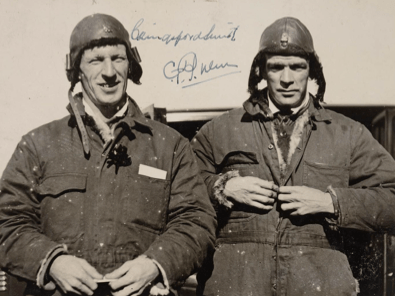
Charles Kingsford Smith and Charles Ulm – 1928 [NSW State Library ]
Aerodrome under Construction at Walsh Island, Newcastle – 1929
The Newcastle Sun of 2 April 1929, page 6, published the following sketch plan of an aerodrome proposed to be constructed at Walshe Island, Newcastle.
‘This sketch plan, prepared under the direction of the general manager of Walsh Island Dockyard (Mr. A. C. Waters), shows the layout of the aerodrome and seaplane base now in course of preparation at Walsh Island. When completed it will be the largest and most up-to-date port for aeroplanes and seaplanes in Australia. Within a year it is expected to become a regular port of call for planes travelling between Melbourne and Brisbane.’
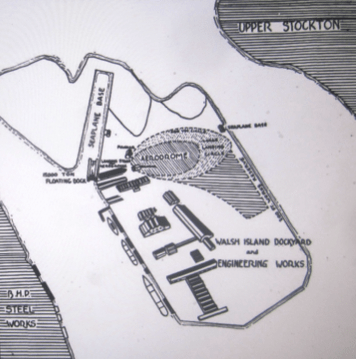
Sketch of proposed Walsh Island Aerodrome [Newcastle Sun – 2 April 1929]
Despite initial enthusiasm, the aerodrome never became fully operational.
Flight-Lieutenant Ulm visits Walsh Island Aerodrome – 1929
The Newcastle Morning Herald and Miners’ Advocate of 14 June 1929, page 10, reported:
‘Flight-Lieutenant Ulm, one of the trans-ocean fliers, arrived in Newcastle yesterday by aeroplane. He landed at the Government Dockyard, Walsh Island, and accompanied by Mr. A. C. Waters, General Manager of the Dockyard, and Mr. M. C. Reid, one of the directors of Australian National Airways, made an inspection of the aerodrome and site at Walsh Island. Mr. Ulm spent an hour at the island and returned to Sydney at 3 o’clock. He stated he was much impressed will the site of the aerodrome. The Sydney-Brisbane service, via Newcastle, will be commenced in November.’
The Newcastle Morning Herald and Miners’ Advocate of 10 August 1929, page 8, further reported:
‘The work of making ready the site for Newcastle’s aerodrome at Walsh Island is progressing satisfactorily. Three dredges are being kept busy at Walsh Island, and the material they are lifting from the river bed is being deposited on the aerodrome site. It should not be long now before the ground is ready. Colonel C. H. Brinsmead, Controller of Civil Aviation, has not yet replied to the Newcastle Aero Club’s letter. In the letter the club asked for a license to use that portion of the aerodrome which is already completed, and for the gift or loan of two flying machines. Mr. L. H. Irwin, President of the club, stated yesterday that a reply was expected shortly. There were many applications for membership of the club but nothing could be done until the preliminary arrangements were made with the authorities.’
Walsh Island Aerodrome inspected – 1929
The Newcastle Sun of 23 October 1929, page 6, reported:
‘The superintendent of aerodromes (Captain Burgess) inspected the Walsh Island Aerodrome today and, it is understood, considered it in a fit condition for skilled pilots to land on.
Arrangements for the aerial pageant, which it is proposed to hold during Civic Week can be proceeded with. The inspection of the ‘drome now under construction at the Island was made this morning. Captain Burgess was accompanied by officials of the Newcastle Aero Club and the president (Captain Irwin), the vice-president (Mr. Rankin), and a member of the committee (Mr. Sim). They were conducted over the aerodrome by officials of the Government dockyard, which is carrying on the work of constructing the drome in conjunction with the Public Works Department. After the inspection, Captain Burgess said that he considered the progress of the work “splendid.”
He would not commit himself to a statement of opinion concerning the suitability of the ‘drome in its present condition for the holding of an aerial pageant, but it is understood that he was favourably impressed, and thought it quite suitable for trained pilots to land on. …. Captain Burgess said, however, that before making any public statement as to the ‘drome’s “fitness he would have to make an official report to the Civil Aviation Department, Melbourne.’
Formation flight to Walsh Island Aerodrome – 1929
The Newcastle Sun of 28 November 1929, page 7, reported:
‘Newcastle saw its first formation flying today, when a flight of three machines in V formation circled over the city and landed on the Walsh island aerodrome.
Captain Preston, of the Newcastle Aero Club, led the formation in a ‘plane called Newcastle’s Own, and was accompanied by Captain Irwin, and another passenger. The two Moths, forming the V, were piloted by Messrs. N. and G. Littlejohn, of the Sydney Aero Club. Mr. N. Littlejohn, who is assistant instructor of the N.S.W. Club, flew from Sydney this morning, his purpose being to inspect the aerodrome, and to fly over the Victor Ice Cream Cup course.
He expressed satisfaction at the condition of the ‘drome, and said that he thought it would be “O.K.” for the pageant in Civic Week. A like satisfaction was expressed with regard to the Victor Ice Cream Cup course, which is via Hexham station and Sandgate, and on almost any part of which, it was claimed, a forced landing could be made, if need be. While the three machines were lined up on the ‘drome at Walsh Island and the inspection was being made, a machine from the Richmond aerodrome flew over and circled a number of times and took photographs from the air. It did not land but disappeared in the direction of Sydney. Messrs. N. and G. Littlejohn returned to Sydney at. 12. 15 p.m.’
Request for Government funding – 1930
The Newcastle Sun of 16 May 1930, page 7, reported:
‘The Newcastle Aero Club asked the Chamber of Commerce today to assist it in approaching the Commonwealth and State Governments for a sum of money for the construction and completion of an aerodrome in Newcastle. It is understood that the club has Walsh Island particularly in view; but reference was also made at the Chamber meeting to the possibility of District Park, although it has been condemned by the Sydney airmen as unsafe for training purposes. The Chamber decided to interview the club, and also to support the City Council in any action it intends to take regarding the provision of an aerodrome in this district.’
The Newcastle Sun of 13 August 1930, page 7, also reported:
“I will bring the matter before the Relief Council at the earliest possible opportunity.” This promise, regarding finance for the work of completing District Park Aerodrome, was given by the Minister for Local Government (Mr. Bruxner) when representatives of the Park Trust and Aero Club met him in Newcastle today. Despite Mr. Bruxner’s hurried rush through Newcastle, he granted the Aero Club people sufficient time to plead their case for an up-to-date aerodrome.
The application for money to complete the ‘drome was strengthened by an intimation from the Controller of Civil Aviation (Col. Brinsmead) that, provided certain works were carried out, he would license that portion of the area of District Park, at present used as an aerodrome, together with the triangular area, to the south of Young-road, for every type of aircraft now available. This would mean that if the difficulty regarding Young-road were quickly overcome, Newcastle would possess an airport closer to the city than any city or town in the Commonwealth.
The works to be carried out in connection with District Park are such as would employ labour from the outset. Embankments have to be levelled, holes filled in, soil to be spread, and the area has to be graded and drained. Men with picks and shovels could start tomorrow provided the money was made available. An estimate of the cost of these works was placed before Mr. Bruxner with the idea that [unemployment] relief money might be made available to carry them into effect.’
The Sun of 21 August 1930, page 14, further reported:
‘The unemployed relief council has granted £6000 towards the preparation of District Park for an airport for the Newcastle District. Encouraged by the announcement, the Newcastle Aero Club hopes within a few weeks to take active steps “to get into the air.” Following an inspection today by officials of the Aero Club, the park trust and the Public Works Department an immediate survey of the ground will be made.’
Aerodrome at District Park, Newcastle, commences operations – 1930
The Newcastle Sun of 29 August 1930, page 6, reported:
‘All obstacles to prevent the establishment of an aerodrome at District Park [at Newcastle] have been removed, and work on the ground will proceed on Monday, under the supervision of the Public Works Department. Two of the councils — Adamstown and New Lambton — from which an objection to the closing of Young-road was likely to be recorded, have agreed to a slight deviation of the road in lieu of its complete closing. Adamstown council met on Wednesday night, and favoured the proposed scheme; while New Lambton, at a special meeting last night, unanimously agreed to sign the necessary document giving the Public Works Department right of entry; and permitting the Park Trust to deviate the road.’
The Maitland Daily Mercury of 11 September 1930, page 8, further reported:
‘It is anticipated that within three months, District Park, will be licensed as a landing ground. When this development materialises, the training of air pilots by Newcastle Aero Club will begin. Two aeroplanes have been allotted by the Commonwealth Government to the club, whose hope is that every member will become a fully qualified pilot.
Mr. A. R. McComb, Superintendent of Aerodromes for the Civil Aviation Department, accompanied by the president and secretary of Newcastle Aero Club (Mr. A. A. Rankin and Captain H. S. Preston), visited District Park, and made a thorough inspection of the landing ground and of the work of improvement upon which about 40 men are engaged. The secretary of the club reported last evening, that within three months, a license for the ground should be issued. It would then be available for every type of aeroplane, from a Moth to a triple-engined machine of the type used in the inter-state air services.
Captain Preston added that the training of pilots would begin just as soon as the ground was licensed, as the two machines allotted by the Commonwealth Government would be available then. Later on, some members would probably buy their own machines. Those who did not, but who had qualified as pilots, would be able to hire aeroplanes at reasonable rates.’
Walsh Island Aerodrome abandoned – 1931
The Maitland Daily Mercury of 21 March 1931, page 1, reported:
‘Surprise only mildly describes the feeling in the district at the rejection by the Minister of the Land Board’s recommendation for Newcastle Aerodrome. The board had recommended that portion of district park be leased to the Aero Club, and that another portion of the adjoining Crown lands be added to the District Park. This recommendation has been turned down, but it does not appear that use of the park is absolutely prohibited.
The Minister, in his letter to Mr. R. Cameron, M.L.A., refers to “exclusive use by Aero Club.’ Apparently the park can be used as at present for landing, but no one body is to have sole right to so use it. Several efforts have been made to establish an aerodrome at Newcastle, and there has been just as many set-backs. Some thousands of pounds were spent on preparatory work at Walsh Island, but it was wasted, the site being abandoned. Then money, in a similar way, was spent at District Park by the club.
There are many people who consider that the Hexham flats offer an excellent site for an aerodrome, and there it may yet be established. In the meantime, District Park will continue to be used by flying men.’
Official approval for District Park Aerodrome site – 1932
The Newcastle Sun of 17 August 1932, page 1, reported:
‘The Department of Lands has decided that Newcastle is to have its aerodrome at District Park. The decision follows on a report made on the Walsh Island site which, it has been found, would be too expensive to improve to the standard required. ‘We are delighted with the news,’ said the chairman of the District Park Trust (Alderman Jenner) today, ‘but we know that it would have to come sooner or later, despite the opposition.’
The letter which Alderman Jenner received today from the Under Secretary of the Department of Lands read:— ‘The matter of the establishment of an aerodrome at District Park has been given further consideration, and in view of the heavy costs to establish an aerodrome at Walsh Island as an alternative to the District Park site, it has been decided to allow the reservation for the joint purposes of public recreation and aviation.
Approval has been given to the closing of portion of Young road, and to establish another road instead in the position as now constructed.’ Alderman Jenner said that when the former Minister for Lands (Mr. Tully) was in Newcastle some time ago he said he could not allow aviation together with recreation. ‘I then pointed out to him’, said Alderman Jenner, ‘that aviation was recreation. Instead of going for a walk a man now goes for a fly.’
Necessary steps for the closure of portion of Young-road had already been taken, he said, and when part of it was fenced off it would give the required area for an aerodrome. Other necessary preliminaries had also been completed. Alderman Jenner explained that although the Newcastle Aero Club would be in charge of the ground it would still be under the jurisdiction of the park trustees.
Under the new scheme of things the aero club would be able to charge fees for landing. Fifty per cent, of the amount raised in this way would go to the trustees for the improvement of the recreation areas adjoining, and the other 50 per cent, would be spent by the club on improving the aviation ground. …..
News of the Government’s decision was received with gratification by the Mayor of Newcastle (Alderman Parker) this morning. In company with other councils of the district the City Council has always been strongly in favour of the establishment of the aerodrome at District Park. ‘The news is a source of gratification to the whole of Newcastle,’ said the mayor. ‘It Is very evident that aviation is destined to play a big part in the progress of the city. ‘There has been ample evidence of late years that Newcastle would be seriously handicapped if it were not provided with a suitable aerodrome. ‘District Pork,’ he added, ‘appears to be the only solution for aerodrome facilities in this district and the decision of the Minister for Lands will be received with satisfaction not only by the Aero Club but by the public generally.’
The Maitland Daily Mercury of 18 August 1932, page 2, also reported:
‘Newcastle is to have its aerodrome. Portion of District Park is being made available for this purpose. The site is the most central available for aviation in the district, and has won the approval of many distinguished airmen. Several years ago arrangements were made to use it as a district airport, but the Lang Government refused to sanction the proposal.
Official Opening of the District Park Aerodrome at Newcastle – 1934
The Maitland Daily Mercury of 21 April 1934, page 1, reported:
‘The new aerodrome at district Park was officially opened this afternoon by the Mayor of Newcastle. There was a representative gathering, which included the Mayors of adjoining municipalities, the President (Flight Lieut. S. J. Moir), and mebers of the committee of the Aero Club of New South Wales. The Aero Club is to take over the aviation classes at the drone.’
Newcastle Airport Trust appointed – 1934
The Newcastle Sun of 23 June 1934, page 2, reported:
‘The Newcastle Airport Trust, the personnel of which was gazetted last night, is taking immediate action to make Newcastle an up-to-date airport. A meeting of the trustees has been called for next Friday night at the Town Hall.
One of the first matters to be decided will be the renaming of District Park Aerodrome. It is felt that some title, such as Newcastle Municipal Airport, would give an added dignity to the city, bringing it to the fore as a port of call for aircraft. The lessees will also probably take the name of Newcastle Airport Trust. …. The leases and the conditions governing them were also gazetted last night.’
Second Newcastle air pageant – 1934
The Newcastle Morning Herald and Miners’ Advocate of 17 December 1934, page 5, published the following two photos of the second air pageant held at Newcastle Aerodrome.

Three R.A.A.F. Bulldog Fighters take the air at the Newcastle Aero Club’s second pageant at Newcastle Airport on Saturday. The Bulldogs gave spectacular displays [Newcastle Morning Herald and Miners’ Advocate – 17 December 1934]
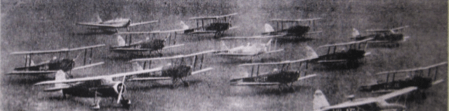
From the air, in an Air Travel Machine. On all sides the aerodrome presented an animated scene [Newcastle Morning Herald and Miners’ Advocate – 17 December 1934]

Spectators at the Newcastle Aero Club’s second pagent, taken by Mr. G. Henry, in an Air Travel Machine [Newcastle Morning Herald and Miners’ Advocate – 17 December 1934]
Construction of a hangar at Newcastle Aerodrome – 1935
The Newcastle Morning Herald and Miners’ Advocate of 4 September 1935, page 6, reported:
‘The [Newcastle Aero] club has been enabled to complete plans for one of the largest and most modern hangars in Australia, because of the generous assistance of a number of big companies in the district,” said the President of Newcastle Aero Club (Mr. A. A. Rankin) yesterday. Mr. Rankin added that the hangar would he constructed almost immediately, at the District Park Aerodrome. The companies concerned had agreed to provide all material for the construction of the hangar. ‘The club would be grateful for the assistance of other firms, since it had suffered severe loses by the accident to the Haleyon machine, which would cost £500 to repair.
It is expected that the cost of the han-gar, a definite site for which has not been selected, will be about £3000. In addtion to housing the club’s aeroplanes, it will provide a temporary clubhouse. The width of the doors will be 90ft. The hangar will have space for two large machines and 12 smaller aeroplanes. Provision will be made for additions. Captain McComb, of the Civil Aviation Department and the Chief Inspector of Aerodromes (Mr. Ross), who are to visit Newcastle at the weekend, will be asked for advice concerning the most suitable place at the aerodrome for the hangar. Mr. Rankin said he wished to emphasise that the club’s appeals for assistance were not based on a desire to have a suitable aerodrome and hangar for sport or pleasure, but on knowledge that an efficient organisation would be of inestimable value commercially, and for national defence.’
Newcastle Aerodrome deemed to be too small – 1935
The Newcastle Morning Herald and Miners’ Advocate of 9 September 1935, page 6, reported:
‘Important developments at Newcastle Aerodrome are foreshadowed by the visit of inspection yesterday of the Acting Controller of Civil Aviation (Captain A. R. McComb) and the Superintendent of Flying Operations (Mr. D. Ross). Captain McComb considers that the aerodrome should be extended and made safer, and his views will be considered by the Airport and District Park Trusts when they meet shortly.
“We came to Newcastle to give advice about the necessity for extending the aerodrome, and about sites for any future hangars or other buildings,” said Captain McComb. “The Civil Aviation Department has been concerned, right from the beginning, about the small size of the aerodrome, which is too restricted in view of the unsatisfactory approaches, to make it really safe for club training and general commercial aviation. “I have discussed proposals for extension with representatives of the club, the Mayor of Newcastle (Ald. R. H. Christie) and the Chairman of the Airport and District Park Trust (Ald. G. W. Jenner).
Although a good deal of expenditure would be involved, extensions that would give much longer runs appear to be practicable. “I was very pleased to see the extent of the work that has already been carried out by those who were responsible for the establishment of the aerodrome. Many important improvements have been made since I was last here, and I am also pleased to see the fine work that has been done by the club in actual flying training.
“The extension of the aerodrome to make it suitable for aircraft that is now operating should commend itself to those in authority. A further improvement by the removal, wherever practicable, of any high-tension and other lines is, in the interests of safety, very desirable. Approaches to an aerodrome are highly important, and any improvement that can be made in that direction is well worth while in the interests of safe aviation.” Captain McComb said that he did not know anything about the suggested inclusion of Newcastle in the network of Royal Australian Air Force centres of the Commonwealth.
Ald. Jenner said last night that he agreed with the views expressed by Captain McComb and Mr. Ross because, if they were adopted, Newcastle would be a city with a modern aerodrome in the heart of the city. That would be almost unique. Its position was admirable. The Government was willing to exchange land suitable for playing areas for any land that was used in the extension of the aerodrome. Speaking merely as a member of the trusts, he thought it was a golden opportunity to assist aviation and the district, and to give Newcastle a real aerodrome. The matter would be explained to the trusts, which would decide what was to be done.’
Floodlights Installed at Newcastle Aerodrome – 1936
The Newcastle Sun of 7 April 1936, page 1, reported:
‘Preliminary tests with the new beacon and floodlights al Newcastle Aerodrome last night were very successful. Pilots stated that they were very satisfied with the new lighting scheme, and that night landings should not present any great difficulty.’
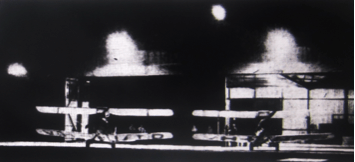
Preliminary tests with the new beacon and floodlights at Newcastle Aerodrome were successful [The Newcastle Sun – 7 April 1936]
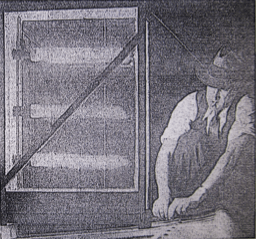
The new beacon installed on top of the new hangar at Newcastle aerodrome [The Newcastle Sun – 7 April 1936]
Present Aerodrome unsuitable and new site required – 1936
The Newcastle Morning Herald and Miners’ Advocate of 30 May 1936, page 7, reported:
‘On numerous occasions we have referred to the unsuitability of District Park as an aerodrome from which the giant air liners of the future could operate, and have stressed the fact that unless some action is taken to provide the city with a modern airport, fully equipped for day and night flying, Newcastle would be studiously avoided by air transport companies as a port of call on the coastal air route, with consequent loss of tourist revenue, and valuable publicity.
This contention was supported on Wednesday when the departmental committee set up at the request of the Minister for Lands (Mr. E A. Buttonshaw) met in Newcastle and unanimously decided that the present aerodrome was inadequate, and that some other site would have to be found capable of being developed on a large scale, and suitable for all classes of commercial planes. Such a site will not be easy to find within reasonable distance of the city, and the longer the matter is delayed the less chance there will be of locating an area sufficiently large for the purpose, that has not already been earmarked for some other object.
We have also referred to the possibility of Newcastle being developed as a marine air terminal, with a seaplane base and landing ground combined, but from investigations carried out by the committee it would appear that no suitable area can be found. In view of the verdict of the committee that the present District Park airport is unsuitable, it is advisable for the Newcastle Aero Club to reconsider certain proposals at present being discussed for improving the area. The club recently went to some expense in erecting one of the finest hangers in the State, and it has been suggested that a further large sum be raised for the purpose of building an up-to-date club house on the ground, with tennis courts and other amenities to keep non-flying members interested.
As the present lease under which District Park is held is limited to 28 years, and as strong objections to its renewal are expected, any decisions to lay down buildings of a permanent nature should be deferred until the site of a permanent airport is decided upon.’
Airport site Inquiry – 1936
The Newcastle Sun of 6 August 1936, page 9, reported:
‘Called by the Airport Committee — which was appointed by the Government to find a site for a civil aerodrome in Newcastle — a public inquiry will be held tomorrow to hear suggestions as to the most suitable site in the district.
The committee has been confronted with a difficult problem in selecting a site and hopes that witnesses will come forward tomorrow with information of assistance. The chairman of the committee (Mr. H. G. Barrie) said this morning that the inquiry would be held at the Customs House at noon. …..
It was stated today that various sites have been inspected by the committee. Difficulties had been met, however, and none of the sites, from the information before the committee, would be suitable. The landing ground at District Park, for instance, would not be suitable with its present limited area, but if considerable extensions could be carried out, it might fill the requirements. Witnesses will be permitted to present cases for or against any site in the district.’
Motto Farm, near Raymond Terrace, favoured as new Aerodrome site – 1937
Motto Farm, in the Raymond Terrace district, was at one time the private training track for the racehorses of the late Mr. John Brown.
The Newcastle Morning Herald and Miners’ Advocate of 16 January 1937, page 8, reported:
‘The Aerodrome Site Inquiry Committee which is investigating suitable locations for an airport for the Newcastle district on behalf of the Minister for Lands (Mr. E. A. Buttenshaw), completed its report yesterday. The report will be sent to the Lands Department. The report, it was learned last night, recommends Motto Farm, near Raymond Terrace, as the most suitable site available for an airport for Newcastle. District Park, which has been used for many years, is regarded as unsuitable for many reasons. The principal objections to District Park are that the land is too valuable to be reserved in such a large area solely for aviation purposes, that it is dangerous on account of the proximity of overhead electricity wires and tall industrial buildings, and that it is too small. Objections by various sporting interests, the necessity for covering a drain at heavy expense, and other lesser difficulties are other obstacles to the enlargement of the area.
Several sites are suggested as desirable alternatives. Of these, the committee regards Motto Farm as the most suitable. The area, which is situated on the main North Coast highway, about 14 miles from Newcastle, and two miles from Raymond Terrace, is regarded as ideally suited for airport purposes. It comprises a wide expanse of ground, is perfectly level, and is of elevated sandy ground with effective natural drainage. The area is to all intents and purposes a plateau surrounded by swampy ground, which slopes away to the Hunter River on the western boundary. It is adjacent to the roadway and is easy of access.
The property, which is locally known as Brown’s racecourse, is at present used for dairying. The committee, it is understood, has taken into consideration the fact that to reach the locality from Newcastle by road, it is necessary to cross the Hunter River at Hexham. The fact that the Main Roads Department has already prepared plans for a bridge across the Hunter River about that point, and the certainty that the work must be started in a few years, is regarded as overcoming that difficulty.
It is anticipated that any suggestion that the present District Park aerodrome should be abandoned will meet strong opposition from commercial aviation companies and other interests favouring an aerodrome convenient to the city. Witnesses who appeared before the committee at a public sitting at Newcastle some months ago stressed their belief that Newcastle, having secured a central aerodrome—a facility lacked by nearly every large city in the world—should hesitate to surrender it. It is probable that this viewpoint will be pressed further when the contents of the report are officially disclosed, if not beforehand. This aspect was stressed by the Mayor of Newcastle (Ald. H. Fenton) who secured permission to give further evidence at the committee’s sitting yesterday. Ald Fenton stated that public opinion in Newcastle was strongly in favour of the retention, and if possible, the extension of District Park. He assured the committee that if such a move were made the City Council would cooperate in the removal of the electricity wires which are said to constitute a danger to the big passenger ‘planes.
Objections to the Motto Aerodrome site – 1937
The Maitland Daily Mercury of 1 February 1937, page 4, reported:
‘The reported decision of the aviation authorities that a site at Motto Farm, Raymond Terrace, is most suited for an aerodrome to serve the needs of both Maitland and Newcastle districts has occasioned considerable dissent from residents of both towns, who consider that it will not be acceptable to either district. Being ten miles from either centre, the proposed site cannot be said to be conveniently situated or readily accessible. It is extremely unlikely that business men from either town will be persuaded to make regular use of aviation facilities if they have to travel ten miles to reach the flying field, and unless the interest of business men is promoted, the establishment of such an aerodrome, as far as civil aviation is concerned, would not prove worthwhile.
Radio station for Newcastle Aerodrome – 1937
The Newcastle Morning Herald and Miners’ Advocate of 19 October 1937, page 8, reported:
‘A ground radio station for the Newcastle Airport is to be established in the near future. It is understood that the necessary equipment will be ordered from England at a cost of approximately £200. Provision will be made for long and short wave transmission of both telegraphy and telephony, in addition to the installation of a radio direction finder for aeroplanes. Radio equipment will also be installed in the Newcastle Aero Club’s Fairchild monoplane for training purposes.
New Civil Aerodrome to be established near Hexham – 1938
The Sydney Morning Herald of 10 May 1938, page 10, reported:
‘The Minister for Defence, Mr. Thorby, announced yesterday that an area of more than 700 acres, near Hexham, about 12 miles from Newcastle, would be acquired as a site for an aerodrome in place of the existing landing ground at Newcastle. Mr. Thorby said that the new ground would meet present day requirements and around it was an area suitable for expansion if it should be required in the future. When the new aerodrome was established, it would be lighted and equipped for night flying.
The selection of the new site followed a thorough examination of the area between Raymond Terrace and Newcastle during which several possible sites had been considered.
The existing landing ground at Newcastle, Mr. Thorby added, was situated in the triangle of three railway lines, and could not be expanded except by incurring very considerable expense. The dimensions of the landing area were insufficient for modem aircraft, and the surroundings provided a considerable number of obstructions which were possible dangers to aircraft.
It is not yet known whether the Federal Government intends to utilise the new aerodrome at Newcastle solely as a commercial aerodrome or as a combined civil aerodrome and Air Force station. The present aerodrome at Newcastle is notoriously bad for large machines, and it has been announced that another two squadron R. A. A. F. station will be selected on the New South Wales coast.
Newcastle is an important industrial centre, must be adequately defended, and it is believed that a new Air Force station will be established there. This would also help in the defence of Port Stephens in the vicinity of which Air Force manoeuvres were recently held.
A large sum has been spent at the District Park Airport, Newcastle. In addition to a modern clubhouse and hangars, is the Newcastle Aero Club has just arranged for the building of machine shops costing about £600. It is possible that this aerodrome might be used solely as a training field and that the new aerodrome might be used for air liners.’
Representations for the retention of Newcastle Aerodrome – 1938
The Raymond Terrace Examiner and Lower Hunter and Port Stephens Advertiser of 28 July 1938, page 2, reported:
‘Representations are being made in Newcastle for the District Park Aerodrome to be retained as the airport of Newcastle, on the grounds that, with the development of air communication with Sydney it is desirable that the airport should be as close as possible to the city It is agreed that Hexham [Tomago], 10 miles away, where it was recently decided to establish a second airport, is too far from the city, while if land around the present District Park aerodrome is resumed the shortest runway will be 800 yards and the longest 1,000 yards.
The attention of the Civil Aviation Board has been drawn to the fact that the Government has spent £8000 on the present ground, and that the clubhouse, workshops, and other facilities have cost a further £10,000. It is claimed by local authorities that as land for extensions is available around the present aerodrome, it would be wasteful if the money spent on the District Park aerodrome was not considered. Experienced pilots’ comment that the Newcastle Aero Club is a model of systematic efficiency, and that although the present aerodrome is too small for large planes, there is sufficient in the surrounding land that would provide adequate dimensions.’
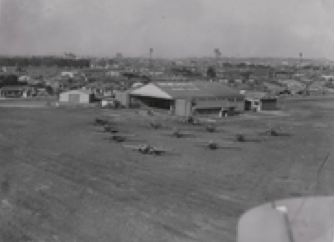
District Park Aerodrome, near Newcastle [ University of Newcastle e Library, Living Histories Collection]
Council rejects extension of District Park for aviation – 1938
The Maitland Daily Mercury of 16 September 1938, page 2, reported:
‘By nine votes to eight Greater Newcastle Council declined to entertain any proposal for the extension of District Park for use as an aerodrome, maintaining that it should be reserved solely for sport.’
Subsidy offer withdrawn – 1939
The Maitland Daily Mercury of 3 July 1939, page 4, reported:
‘The Civil Aviation Department has withdrawn its offer, made many months ago, for a subsidy for the extension of the District Park aerodrome, Newcastle.
It is understood that the 1000 yards runways which, with an extension, the aerodrome could have provided are considered to be inadequate in view of modern trends in aviation. The extension of the aerodrome was delayed because of a heated district controversy about the possible alienation of playing fields. The department’s action will automatically end the controversy.’
Further details on the new civil Airport site – 1939
The Newcastle Sun of 18 July 1939, page 1, reported:
‘A site at Tomago has been selected by experts of the Civil Aviation Department in conjunction with the Air Force for a new and modern aerodrome for Newcastle, the Minister for Civil Aviation (Mr. Fairbairn) said today.
It was not possible to estimate the cost of the new aerodrome, Mr. Fairbairn said, nor when it would be completed. The site was heavily timbered. An extension of a contour survey, which was commenced some time ago, was being undertaken. The speed with which work progressed, depended entirely on the money available, Mr. Fairbairn said. “We have approached the State Government for assistance and are hopeful that it will meet a fair proportion of the cost.
No indication, however, has been received of the State Government’s feelings in the matter.” Representations had been made to him yesterday for new aircraft for the Newcastle Aero Club. Mr. Fairbairn went on. “No club in Australia has done finer work,” he declared, “and I am most sympathetic toward the request. At the moment, however, I am not in a position to say whether or not extra aircraft can be provided for the club. “I realise that the club’s present aircraft are now fully occupied.”
Opinion in Newcastle aviation circles today was that the location of an aerodrome at Tomago would not be at all convenient for Australia. “Tomago may be only about seven or eight miles by air line from Newcastle, but it would take as long for prospective air passengers to get there by car from Newcastle as it would for the ‘plane to fly from Newcastle to Sydney,” was one opinion.
Another objection raised to the site so far as Newcastle was concerned was that it was on the other side of a river. There was always the danger. it was claimed, of floods interfering with transport by road, and in time of possible war the destruction of river crossings would be a serious matter in the communication link with this city.
The secretary of the Hunter Division of the Air League (Mr. L. Cavalier) said today that the proposed site advocated by him at Hexham would be far better. There would be initial expense in draining the land and in placing part of the water supply pipes underground, but once this was done an area of a mile square would be available on the main road between Newcastle and Maitland. The distance from Newcastle would be only about seven miles by road.’
New Military Aerodrome to be built at Williamtown – 1939
The Maitland Daily Mercury of 14 September 1939, page 5, reported:
‘Williamtown has been selected as the site for the proposed military aerodrome instead of Tomago. In a letter to Mr. D. Watkins, M.H.R., the Minister for Civil Aviation, Mr. J. V. Fairbairn, states that work on the Williamtown site will begin next week or the following week, and will be carried out as rapidly as possible. Mr. Watkins approached the Minister and Mr. Fairbairn subsequently communicated with the Inspector of Ground Organisation. He stated that at the last inspection of the Tomago site by a Civil Aviation inspector and Air Force officer it was decided that, owing to some constructional difficulties in the area the aerodrome should be constructed at another site which had been acquired in the vicinity of Williamtown. Mr. Fairbairn said that there were military arguments in favour of the change of site.’
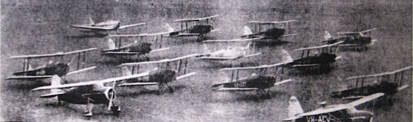
Newcastle Aero Club’s training planes for the R.A.A.F. assembled at Newcastle Aerodrome, District Park [Newcastle Morning Herald and Miners’ Advocate – 28 June 1940]
Improvements to Newcastle civil Aerodrome sought – 1944
The Sydney Morning Herald of 12 August 1944, page 4, reported:
‘Improvements estimated at £45,000 to £50,000 are being urged to make safe the Newcastle civil aerodrome, where damage to planes in the past two years has been estimated at about £ 150,000. One airman has been killed, and several injured. The move is to be made by the Newcastle Chamber of Commerce.
Yesterday, a large U.S. transport plane, carrying 25 airmen, ran into a drain after making an emergency landing in a storm. Covering of the stormwater channels, which restrict the landing area, would cost, according to authoritative estimates, from £45,000 to £50,000.
The president of the Chamber of Commerce, Mr. Beath, said today that, as a result of agitation by the Chamber, the Civil Aviation Department had undertaken to send an expert to inspect the aerodrome. This inspection had not yet been made.’
The Newcastle Morning Herald and Miners’ Advocate of 16 September 1944, page 4, also reported:
‘To investigate airport facilities for Newcastle, Dr. Bradfield, of the Department of Civil Aviation, will visit the city next week. He will arrive on Wednesday and will stay a few days. Executive officers of the Chamber of Commerce are making the arrangements. It is understood that the object of Dr. Bradfield’s visit is to decide whether Newcastle is to have a major airport or an aerodrome large enough for feeder line traffic after the war. He will inspect several sites in the district, notably at Hexham, and will discuss the possibility of enlarging the present aerodrome at District Park.’
The Maitland Mercury of 2 November 1944, page 2, further reported:
‘In a report submitted to Greater Newcastle Council last night, the Superintendent of ground organisation of the Civil Aviation Department (Dr. K. N. Bradfield) said District Park was not suitable as an aerodrome to provide for the future commercial aviation requirements of Newcastle.
He considered that the Hexham landing strip promised suitable facilities for an airport, and it would also be of value to Maitland and Raymond Terrace. Williamtown would be unsuitable as an airport for Newcastle, unless a bridge was constructed across the mouth of the Hunter. Dr. Bradfield’s report stated that if in the future there was a radical change in aircraft design and helicopter types were developed, then the present area at District Park should be large enough for their operation.’
Another proposal to enlarge Newcastle Aerodrome made by the Aero Club – 1945
The Newcastle Morning Herald and Miners’ Advocate of 23 April 1945, page 2, reported:
‘The proposal of the Aero Club to enlarge District Park Aerodrome by the addition of the tin hare ground revives a controversy which most people had assumed was disposed of by the definite report of the Superintendent of Ground Organisation of the Department of Civil Aviation (Dr. Bradfield) that District Park cannot accommodate satisfactorily the fast feeder type of aircraft which may be expected to visit Newcastle. Any attempt at development is merely an improvisation to serve until a larger ground is prepared outside the city area.
The Aero Club suggests that the Sandgate site should be chosen. It has many advantages, the principal being that it is on the Newcastle side of the Hunter River, and substantially nearer the city than Williamtown or Hexham. If the club were correct in its contention that the filling of the Sandgate site would take six years, there might be a case for making temporary provision at District Park. But surely that ignores wartime technique in the rapid development of airfields.
If the Sandgate land were needed for military purposes, it would be in use within a few months. Why then assume that in peace time the tempo of construction must be slowed down to occupy several years? The club’s estimate may be soundly based if the community is to wait for the swamp to be filled with waste industrial products, but that is not necessary or desirable. Such an outlook is a defeatist one, which would postpone indefinitely any satisfactory civil aviation facilities for Newcastle.
If the Government takes over the control of airlines, it must assume a large responsibility for providing landing grounds, and it should be asked to furnish one near Newcastle as an urgent national work, even if filling in costs more than it would under the leisurely process of dumping industrial waste. The Aero Club is doing excellent work, and should be confirmed in its lease of the District Park ground. The future of that area and the surrounding lands should then be determined solely from the point of view of the reasonable needs of the club and the claims of sporting bodies. To introduce the factor of commercial aviation is, in the light of Dr. Bradfield’s report, an irrelevance which will merely prolong a controversy which has divided the community for many years.’
Proposal for Williamtown Aerodrome to be used a temporary civil Airport – 1946
The Newcastle Sun of 30 October 1946, page 8, reported:
‘Newcastle’s total exclusion from the rapid development now taking place in air transport is causing concern in many quarters in the city and the Mayor (Ald. R. Norris) has suggested that the R.A.A.F. aerodrome at Williamtown should be used, at least until another is available.
Williamtown is about nine miles from the city, but the route passes over the Stockton punt. The time taken for the journey has also always been the objection raised to its use. However, it has become plain that there is no hope of the proposed Sandgate aerodrome being available for some years— perhaps not for 10 years or more, in the opinion of some interested bodies which have studied the position. It is unthinkable, they say, that Newcastle should be without air services for so long.
R.A.A.F. aerodromes at Archerfield (Brisbane), Townsville, Parafield (South Australia) and Lavington (Victoria) are at present used for civilian flying, and because of this, hopes are held that the Air Force would consent to the use of Williamtown. The first step, however, will probably be to sound out the air transport companies as to whether they would be prepared to make Williamtown a stopping place, if it is made available. A number of services at present fly past Newcastle. As well as the overseas planes, these include the services to Brisbane, Coffs Harbor and Evans Head.
At present, anyone wishing to go to Queensland from Newcastle has to go to Sydney first. A Newcastle stop would mean a considerable saving of time for passengers, not only from Newcastle, but from all the towns in the north-west. It would save time also for people wishing to fly to Victoria or South Australia, as they could change planes at Mascot without going into Sydney.’
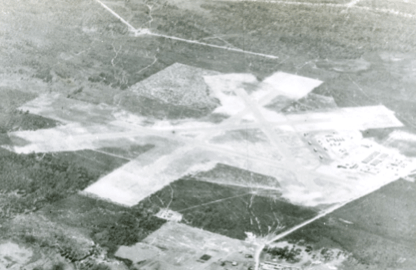
Williamtown RAAF Aerodrome, circa 1943 [National Archives of Australia]
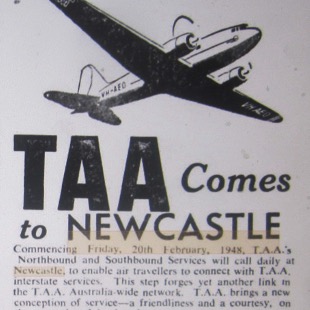
TAA Commences air services at Williamtown Aerodrome – 1948
IN 1947, the Commonwealth government finally decided to open the Williamtown town RAAF base airport to civilian aviation. This was in line with the policy applying to other RAAF bases.
The first domestic flight to Williamtown was made on 20 February 1948 by Trans Australia Airlines (TAA) with a Douglas DC-3 aircraft on the scheduled Sydney-Williamtown-Brisbane route with eighteen civilian passengers
For several years, TAA flights were the only authorised airline to land at Williamtown.
The Newcastle Morning Herald and Miners’ Advocate of 21 February 1948, page 3, reported:
‘T.A.A. [Trans Australia Airlines] began its interstate air service from Newcastle yesterday.
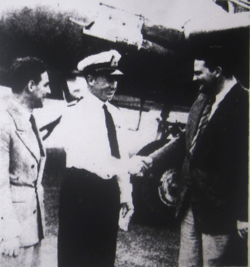
Captain A. Hawkesford, D.F.C., captain of the T.A.A. airliner, Currie, is congratulated on arrival at Williamtown Aerodrome by the Sydney Branch Manager. At left is the sales representative. The captain has just handed over the first air mail from Brisbane [Newcastle Morning Herald and Miners’ Advocate – 21 February 1948]
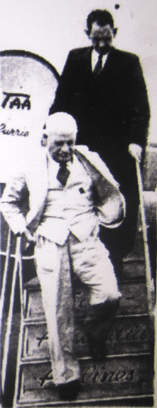
The first passenger to step down when the plane reached Williamtown Aerodrome [Newcastle Morning Herald and Miners’ Advocate – 21 February 1948]
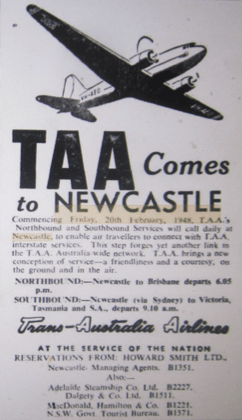
Advertisement that TAA was coming to Newcastle [Williamtown Aerodrome] [Newcastle Morning Herald and Miner’ Advocate – 23 February 1948]
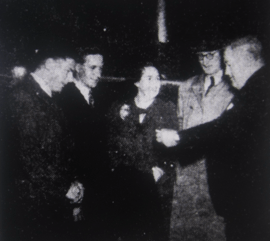
Newcastle passengers who arrived by T.A.A. plane at Williamtown in the line’s first night landing on Saturday [Newcastle Sun – 25 March 1948]
Ash Island, Newcastle, considered as site for new civil Airport – 1949
The Newcastle Morning Herald and Miners’ Advocate of 28 July 1949, page 3, reported:
‘The Civil Aviation Department is considering Ash Island as a potential site for Newcastle’s civil airport. Two officials of the department’s aerodrome planning staff inspected Ash Island this week. They also sought aerial photographs of Ash Island, including pictures showing the island during the floods six weeks ago.
Ash Island’s northern section was recently discussed by the Newcastle Port Development Committee as a possible airport site. The Northumberland County Council will meet the problem at a later stage in its area planning. A Newcastle aviation expert whom the officials consulted during their visit said they were looking for “something big with an eye to the future.” “They wanted an area that would allow for three runways, each a mile to a mile and a half long, with obstruction-free approaches for two miles at either end,” he said. The expert said Ash Island offered all those features. It might need filling to bring par’ above flood level.
Another site the officials are believed to have examined is an area on the northern side of the Hunter River, near the wartime Tomago airstrip. This area is flat and is considered capable of development into an airport by taking in the wartime strip. This strip would be unsuitable for use by high-speed jet-propelled civil airliners.’
The expert said he thought the Civil Aviation Department had rejected sites at Williamtown (needed for defence), Hexham (would require expensive filling), Sandgate (insufficient clear approach space). Dempsey and Walsh Islands (approaches spoilt by proximity of already established industries) and Moscheto Island (too low-lying). “Sandgate ‘was favoured by Dr. K. N. E. Bradfield in his report on aerodrome’ sites in Newcastle some years ago,” he said. “But since then, aviation has made such strides that the hills would spoil the approaches for the fast airliners of the near future.”
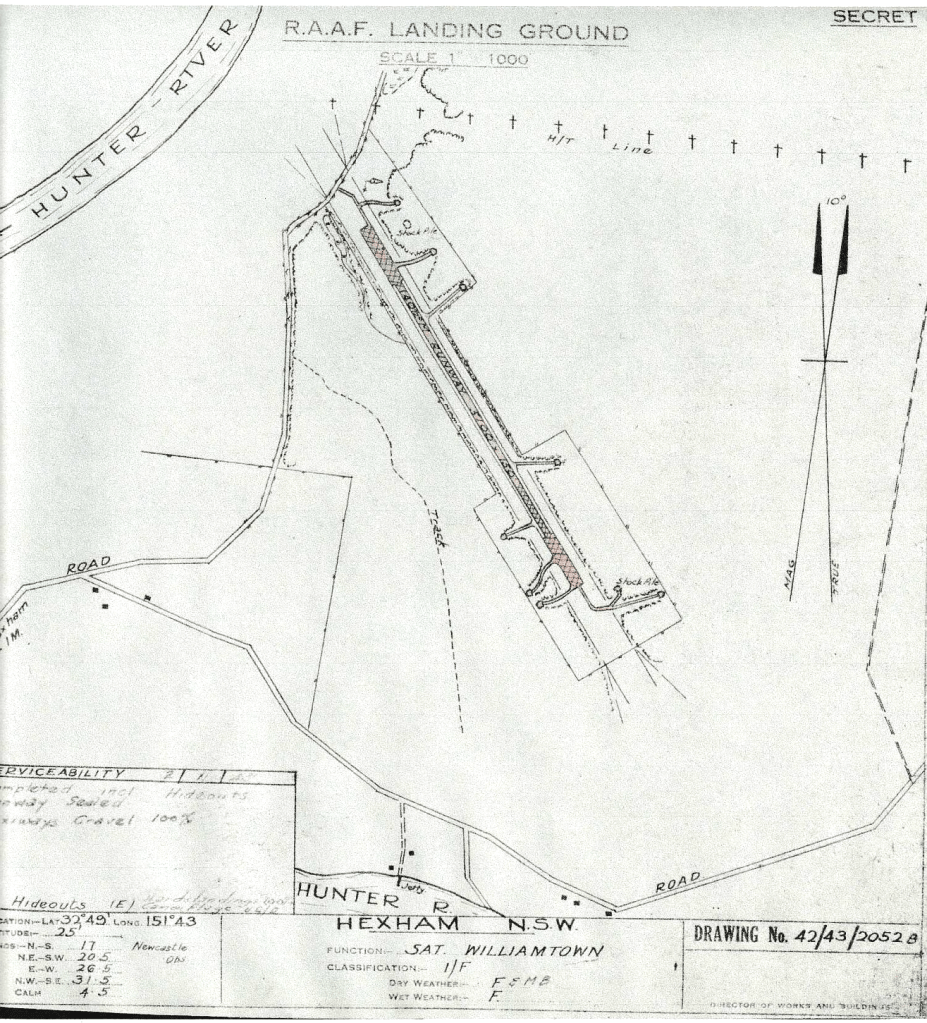
Military plan of the Hexham landing strip
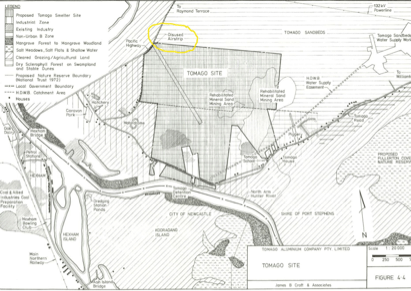
Location plan of the disused Hexham landing strip. The unsealed airstrip was built by the R.A.A.F. during the Second World War. It was quite small, only 3800 feet in length.
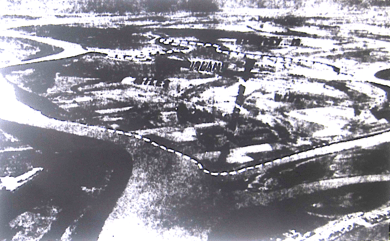
An aerial view yesterday of Ash Island showing its dimensions, with Moscheto and Dempsey Islands, in the background [Newcastle Morning Herald and Miners’ Advocate – 28 July 1949]
Deputation for a civil Aerodrome – 1949
The Newcastle Morning Herald and Miners’ Advocate of 2 September 1949, page 2, reported:
‘The main purpose of the deputation which will seek an interview with the Prime Minister on airport facilities for Newcastle should be to obtain Federal assistance in the establishment of a civil aerodrome. It would be a convenience if companies other than Trans Australia Airlines were permitted to use Williamtown, and there is no reason why, at present, they should not, but when Williamtown reaches its fuller development as a main fighter plane task-force base, it will not be able to accommodate civil planes. In any case, it is too far from the city, with communication interrupted by the river, to serve indefinitely as a civil ‘drome.
Newcastle is entitled to substantial help from the Federal Government in founding its own centre for civil aviation. Such assistance has been given without stint to other communities. The indifference of the Federal Government may arise from the circumstance that Newcastle is not a terminal nor a staging post for through services, but its size and commercial importance warrant its asking that the Government should help to make possible air services which much smaller centres already enjoy.
A civil aerodrome at Newcastle is needed not only for the convenience of travellers to Melbourne and the Western States, but to maintain communication with the north and north-west. There are suitable sites in the raw. Reports have been furnished on those at Hexham and Sandgate and, with industrial development pending north of the Hunter River, Ash Island may be worth considering. But a great deal of money will have to be spent on any site to give Newcastle a serviceable aerodrome, and it is utterly unfair that the cost of establishing a link fully justified from the national point of view should be thrown on local authorities.’
Limited civil aviation to continue at Williamtown Aerodrome- 1949
The Newcastle Morning Herald and Miners’ Advocate of 10 September 1949, page 4, reported:
‘Newcastle Chamber of Commerce decided yesterday to continue to seek a conference with Mr. Chifley on a proposal to establish a civil aerodrome in Newcastle. It will ask all organisations in the North and North-west for support. Earlier this week, Mr. Chifley advised that he had referred to the Minister for Civil Aviation (Mr. Drakeford) a request for him to receive a deputation. Mr. Drakeford advised that, because it had been decided that existing limited civil airlines operations at Williamtown R.A.A.F. aerodrome were to continue, his department proposed to take no action to establish a civil airport. The Secretary of the chamber (Mr. Nancarrow) said members considered the provision of a civil aerodrome at Newcastle a national matter. Mr. Drakeford’s letter had not replied to the chamber’s request.’
Action for new Newcastle Aerodrome continues – 1949
The Raymond Terrace Examiner and Lower Hunter and Port Stephens Advertiser of 10 November 1949, page 1, reported:
‘At the Chamber of Commerce meeting on Monday night, the Lord Mayor of Newcastle asked the Chamber to cooperate in getting an aerodrome established for Newcastle and District. Hexham swamp was favoured for the purpose.
Cr. Richardson said the Chamber should make it clear, that it was supporting Newcastle Council’s efforts to get an airport but not the site advocated in Hexham swamps. He agreed that the swamp site would make a fine airfield but it would take many years and thousands of pounds to reclaim. To stand the heavy air traffic of today at least one and half square miles would have to be filled with about six feet of silt to bring it above flood level. Even if the area could be filled in a week, it would take nearly 15 years to consolidate.
With the new road bridge, access to Tomago site, would be easily provided. It could be prepared rapidly and the existing strip could soon be adapted to civilian airfield requirements. It would be close to the bridge and would take no time to get to Newcastle. He moved that we inform the Newcastle Council that the Chamber favours a site on the water reservation. Cr. Rodgers said Tomago site was on Hunter District Water Board land. The problem would be to get this authority to agree to the airport going there. The Mascot airdrome was on a swamp. Mr. G. Hunter said he favoured the swamp site. It had more room for development. Air travel was only in its infancy and no one could forecast the size of the airliners of tomorrow. Tomago site would also have to be cleared of vegetation, which had a vital part in the sandbeds water supply scheme by checking evaporation. The motion was seconded by Mr. Hutchinson and carried.’
The Maitland Mercury of 18 November 1949, page 1, further reported:
‘In view of an existing agreement between the Department of Civil Aviation and the Departments of Air and Navy concerning joint use of aerodromes, the Director-General of Civil Aviation advised Northumberland County Council it was not intended to construct a separate civil aerodrome to serve Newcastle.
Preliminary investigations were carried out with the object of locating a site near Newcastle, which could be developed as a major aerodrome, if necessary.” “The possibility of Ash Island had been examined, but the nature of the ground and its liability to flooding precluded its use as an aerodrome,” he stated.
The site favoured was located on the eastern side of the Hexham-Raymond Terrace road, and north of the abandoned Tomago landing strip. “It is intended that the possibilities of the Hexham site will be kept under review, and the Department would appreciate any proposals for the development of this area or environs, especially with regard to housing and industrial activity, which would hazard any of the requirements for an aerodrome,” stated the Director General.
The County planner (Mr. Stone) said the Department’s statement was in conflict with recent development for an airport. He stated that further enquiries for the establishment of a large industry in close proximity to the Tomago landing strip would be made, and of the suitability of other land in the district for industrial expansion. County Council went into committee to discuss the matter, which Cr. Brown said was most important. He moved that it be deferred until Mr. Stone prepared a report on a site most suitable for an aerodrome.’
Tarro proposed as an Airport site – 1950
The Newcastle Morning Herald and Miners’ Advocate of 25 May 1950, page 5, reported:
‘Northumberland County Council will investigate the possibility of using a site near Tarro railway station for Newcastle’s civil aerodrome. The site was suggested yesterday at a conference between two representatives of the Department of Civil Aviation (Messrs. Hill and Mowbray), the City Engineer (Mr. Baddeley), Chief County Planner (Mr. Stone) and County Clerk (Mr. Wells). The sites previously favoured were at Sandgate and adjoining the former airstrip at Tomago. The County Council and Newcastle Council had agreed on the Sandgate site. The Tomago proposal was abandoned mainly because it would be affected by a high chimney stack to be erected by Courtaulds as part of the joint rayon factories. Mr. Wells said he was sure good would come from the conference. Another meeting might be necessary when a report on the Tarro site had been prepared.’
The Newcastle Morning Herald and Miners’ Advocate of 6 June 1950, page 2, also reported:
‘The Airport Committee of Newcastle Chamber of Commerce decided yesterday that the Sandgate site suggested hy Dr. Bradfield in 1944 was still the best for a civil airport for Newcastle. The committee also decided to advise Mr. Menzies that, after the project had been dormant for six years, a new site at Tarro was being examined by officers of the Civil Aviation Department and Northumberland County Council.
The committee examined the question of an airport from three angles: (1) Removal of the R.A.A.F. from Williamtown to farther inland because of the introduction of jet aircraft, and the use then of Williamtown as a civil airport. (2) Extension of the District Park aerodrome against the cost of a new aerodrome at Sandgate. (3) The scheme set out by Dr. Bradfield in his report in 1944. The committee stated that the site favoured in the Bradfield report was easily accessible from Newcastle, West Wallsend and Coalfield towns. Newcastle Chamber of Commerce will be invited by Northumberland County Council to submit its views if any more conferences on a civil airport for Newcastle are held.
At the County Council meeting yesterday, the chamber advised that it wished to be represented on proposed conferences with the Civil Aviation Department on an airport site. The project had had its attention since 1936 and, since it had a special committee to deal with the matter, it believed it was essential in the interests of Newcastle for the chamber to be taken into confidence on negotiations with the department.’
Rutherford suggested as an Airport site – 1951
The Newcastle Morning Herald and Miners’ Advocate of 19 April 1951, page 2, reported:
‘The civil airport for the Newcastle District should be at Rutherford, Maitland City Council suggested to the Newcastle Regional Development Committee yesterday. Maitland Council, commenting on the committee’s economic plan for the Newcastle region, said it thought the possibility of developing Rutherford as the district airfield should be investigated. Mr. C. G. Schroder said the idea today seemed to be to bring freight as close as possible to the city. The committee had simply recommended that a commercial field be established near Newcastle at a site to be determined by the Department of Civil Aviation.
Mr. W. G. Wileman said with the large concentration of population in the city, Rutherford was too far away for the airfield. It was a matter for experts to decide, but it was the practice overseas to have feeder services from main centres to places close at hand. The suggestion was noted.’
Newcastle Aerodrome issue raised in Federal Parliament – 1951
The Newcastle Morning Herald and Miners’ Advocate of 23 November 1951, page 3, reported:
‘The need for a new aerodrome in Newcastle was emphasised in the Senate tonight by Senator McMullin (Lib., N.S.W.). He said the one at Williamtown was most unsatisfactory. Speaking in the debate on the Appropriations Bill, he said the people of the coalfields would welcome a new aerodrome. The Minister for Shipping (Senator McLeay) said he understood there had been a deputation on this matter, but he could not say whether the new aerodrome would be provided. He would take the question up with the Minister for Civil Aviation (Mr. Anthony).’
Belmont suggested as Airport site – 1951
The Muswellbrook Chronicle of 18 December 1951, page 3, reported:
‘The Federal Government was urged to build an airport for the Newcastle region by the Liberal Party’s first Hunter Valley Regional Conference. The Meeting at Newcastle, declared that the R.A.A.F. Williamtown airfield was not suitable for a commercial airport. …. Mr. R. H. Stewart (Newcastle) said the district would seriously, lag in its development unless the Government supported its need for an airfield. Experts did not agree with claims that the terrain was unsuitable. “If it was built at Hexham it would never be free of the Hunter River floods,” he said. “The sand dunes at Belmont should be bulldozed to make a place for it.”
New move for new Aerodrome – 1952
The Newcastle Sun of 9 January 1952, page 6, reported:
‘The Minister for Aviation (Mr. Anthony) will be asked to establish the alternative civil airport for Mascot at Newcastle instead of at Narromine. The Lord Mayor (Ald. Armstrong) said today he was concerned to learn that the Minister had stated that he was satisfied that the most suitable site for the alternative airport was at Narromine. The Minister had advised him this week that he would be willing to meet a deputation from Newcastle, seeking a speeding up of the establishment of the civil airport at Hexham. A date for this deputation still had to be fixed.
Ald. Armstrong said this deputation now had become an urgent matter, as it would be necessary to convince the Minister quickly that not only did Newcastle deserve an airport in its own right, but that it was the logical place to have the alternative aerodrome for Mascot. ‘It would be far better, if planes had to be diverted from Mascot, to bring them to Newcastle rather than send them way out to Narromine,’ Ald. Armstrong said.’
Commonwealth Government agrees to construct a new civil Airport – 1952
The Newcastle Sun of 13 February 1952, page 2, reported:
‘Newcastle Chamber of Commerce has received its first official intimation that the Federal Government has agreed to construction of an airport at Newcastle.
The president (Mr. L. Saddington) said today that this had been contained in a letter from the Minister for Civil Aviation (Mr. Anthony), forwarded by Senator McLeay. The letter said: ‘As you know from previous correspondence the Government has agreed to construct the airport and a recent meeting at Newcastle made progress towards this aim. However, I have no need to point out the very serious curtailment in Government expenditure which makes impossible an immediate commencement of the work. It has been decided that no new works can be commenced before the financial position improves.
‘I notice the Secretary of the Chamber (Mr. Hutchinson), whose letter you presented to me, points out that works are still continuing on aerodromes of less importance than Newcastle. However, you will know that only works which had already been commenced are to be completed and indeed in most cases even those works have necessarily been slowed down owing to lack of finance. ‘Under the circumstances I can only assure you that the Government regards the Newcastle aerodrome as a work of high importance, which will be commenced as soon as possible.’
Mr. Saddingujn said it was gratifying to know that the Chamber, which had initiated the move for an aerodrome, was seeing its efforts bearing fruit. This had been the first indication on a Ministerial level that the Government approved the project and it would not let up in its efforts now to have the aerodrome included on next year’s Government estimates and a start made at an early date.’
Newcastle Aerodrome issue raised again in Federal Parliament – 1952
The Newcastle Morning Herald and Miners’ Advocate of 27 February 1952, page 4, reported:
‘The scope of R.A.A.F. operations at Williamtown prevented increased use of the airport by civil airlines, the Minister for Transport (Senator McLeay) said tonight. He was replying in the Senate to a written question by Mr. McMullin, who asked that A.N.A. be given permission to operate from Williamtown, thus placing it on an equitable basis with T.A.A.
Replying for the Minister for Civil Aviation, Senator McLeay said a Cabinet committee was working out ways of securing fair competition between A.N.A. and T.A.A. The committee was considering the possibility of sharing calls at Newcastle equitably between the two airlines.’
Problems with proposed Hexham Aerodrome site – 1952
The Newcastle Morning Herald and Miners’ Advocate of 21 August 1952, page 2, reported:
‘A new obstacle to establishing a civil airport for Newcastle at Hexham swamps was brought up yesterday. The obstacle was discovered when the Lord Mayor (Ald. Armstrong) conferred with the Minister for Civil Aviation (Mr. Anthony) in Canberra. Mr. Anthony said R.A.A.F. authorities had expressed doubt whether the Hexham site was far enough from the R.A.A.F. ‘drome at Williamtown to ensure safe working with jet fighters. Later in the day, the Lord Mayor discussed the matter with the Minister for Air (Mr. McMahon), who undertook to have the doubt cleared up as quickly as possible.
Ald. Armstrong was accompanied in the discussions by Messrs. Watkins, Griffiths, James, Fairhall and Dean, Ms.H.R. He told Mr. Anthony he was anxious for speedy finalty to negotiations on the civil airport which had been proceeding for 16 years. He asked that the surveys necessary to allow the Government to acquire the site be expedited. “The Government must acquire the land before discussions can proceed on methods by which the land can be reclaimed,” he said.
Mr. Anthony said the Government was fully conscious of the importance of establishing a civil airport in the Newcastle region. He said he would instruct the Civil Aviation Department to expedite the surveys. Expenditure for acquiring the site was already provided for in the Budget before Parliament, but in view of the development of jet fighters and their terrific speed, doubts had arisen whether the proposed site might be too close to the R.A.A.F. drome for safe working.
The deputation then saw Mr. McMahon. They told him that Newcastle people would be greatly disappointed if after 16 years of effort their work was to be nullified by a R.A.A.F. objection. Ald. Armstrong said that, after years of investigation of many months of reclaiming land, the Hexham site had been agreed on as the most suitable in the area.’
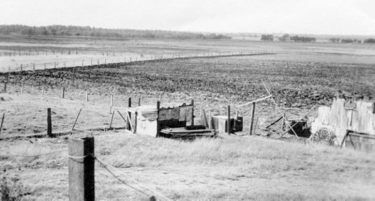
Proposed land at Hexham as suitable for the new Newcastle Civil Aerodrome site, 1951 [University of Newcastle Library, Living Histories collection]
No Government money for Newcastle civil Airport – 1953
The Newcastle Morning Herald and Miners’ Advocate of 11 July 1953, page 4, reported:
‘There is no likelihood of funds being set aside this financial year for construction work on the proposed civil airport for Newcastle. The Minister for Civil Aviation (Mr. Anthony) advised the Lord Mayor (Ald. Purdue) of this yesterday. The Lord Mayor said he would recommend to the Newcastle City Council that it make the strongest possible protest. Mr. Anthony said he had received a resolution from Newcastle Council seeking the inclusion of funds for the airport work in the forthcoming Federal budget. He had recently visited Newcastle and discussed the matter with the Lord Mayor. He had accompanied the Lord Mayor on a trip designed to give him a good look at the prospective aerodrome site at Hexham. “But under present circumstances, when every effort is being made to curtail Governmental expenditure in order to try to bring about a reduction in taxation, there is no likelihood of it being possible to set aside any appropriation for construction work at the airport,” he said.
“It would be of little value for the suggested deputation coming either to Canberra or Sydney to see me.” Ald. Purdue said the Minister’s advice was most disappointing and disquieting. It was to be regretted that once again Newcastle’s claims for consideration were being pushed into the background.
There was no doubt Newcastle had made a greater contribution than any other city toward the development of the Commonwealth, particularly in regard to materials for transport and communications. But when Newcastle advanced a legitimate claim for a reasonable share in the modern transport facilities, it was relegated to a last priority. He said it should be appreciated by the Commonwealth Government that Newcastle could only continue to play effectively its destined part in the further development of the country if given the reasonable facilities which were essential to modern progress. The Minister’s letter would be referred to the council with a recommendation that the strongest possible protest and further representations be made.’
Negotiations to acquire land for a Municipal Airport at Newcastle begin – 1955
The North-Western Courier of 12 May 1955, page 1, reported:
‘Negotiations have begun for the acquisition of land for a municipal airport at Newcastle. This was stated today by the Minister for the Interior, Mr. Kent Hughes, in the House of Representatives. He was replying to a question by Mr. Watkins (Lab., N.S.W.). Mr. Kent Hughes said an officer of his Department and one from the Department of Civil Aviation were trying to speed up C
Concluding Comments
The Hexham land was never acquired, nor was a separate Newcastle civil aviation airport ever constructed on the variously proposed sites.
Newcastle Airport as we know it today, began life as the Williamtown Civilian Airport in 1947, when the Commonwealth Government opened the Royal Australian Air Force (RAAF) airport there to civil aviation.
Both civil and military aviation activities have continued to operate from the Williamtown RAAF site. The airport runway is owned by the Commonwealth Government. The Newcastle Airport site is leased from the government for civilian air travel until 2075.
Commercial operations began at Williamtown with the first domestic Trans Australian Airlines flight arriving on 20 February 1948.
Since the 1950’s travel time between Newcastle and Williamtown have decreased to about 30 minutes, due to the construction of the Stockton and Hexham bridges over the Hunter River.
The Commonwealth Government managed the civil aviation operations at Newcastle Airport until 1990 when responsibility was handed over to Newcastle City Council and Port Stephens Council. The current operator, Newcastle Airport Pty Ltd, was formed by the two councils in 1993.
In 1996, Newcastle Airport began its first phase of terminal expansion to improve facilities and accommodate growth.
In 2015, a new $14.5 million terminal was opened.
On 25 September 2025, the newly completed international terminal at Newcastle Airport was officially opened.
New Terminal at Newcastle Airport – October 2025 [Author Photo]
Addendum
The following papers on the early aviation history in the Port Stephens region are published on this website and can be found at the following links:
History of Seaplanes at Port Stephens
Landing of a Sea Plane in Port Stephens – 1926
Bert Hinkler Lands His Baby Avro Plane at Anna Bay – Port Stephens
Tea Gardens Aerial Plane Thrills – 1930
Crash of Catalina Flying Boat in Port Stephens – May 1943
Geoffrey Wikner and Halifax Park – Nelson Bay
Researched and compiled by Kevin McGuinness
October 2025

 Port Stephens - a history exploration